I am writing to formally express my disappointment regarding my recent stay at your hotel from February 3rd to February 6th.
As a returning guest, I chose your establishment because of its reputation for excellence and high standards of service. Unfortunately, my experience this time did not meet those expectations.
Upon arrival, the reception staff appeared disorganized and inattentive. I waited nearly 25 minutes to check in, despite having a confirmed reservation. Additionally, my luggage was not delivered to my room until over an hour later, and only after I had called twice to inquire about it.
During my stay, I found several members of staff to be unhelpful and, at times, discourteous. Room service orders were delayed, and one request was delivered incorrectly. When I raised the issue, the response I received lacked professionalism and courtesy.
Given the reputation and pricing of your hotel, I expected a far higher standard of hospitality. I trust you will take this matter seriously and provide an explanation for the shortcomings I experienced.
I look forward to your response.
Yours sincerely, Mr. Jonathan Reed
2️⃣ Response email from hotel reception
Dear Mr. Reed,
Thank you for taking the time to share your feedback regarding your recent stay with us.
Please accept our sincerest apologies for the service shortcomings you experienced. The level of service you described does not reflect the standards of excellence we strive to maintain at our hotel. We deeply regret the delay during check-in, the late delivery of your luggage, and the issues you encountered with room service.
Your comments have been shared with the relevant department managers, and we are conducting a thorough review to ensure such incidents do not occur again. Providing attentive, professional, and seamless service is our highest priority, and we are disappointed to learn that we fell short during your visit.
As a gesture of goodwill, we would like to offer you a complimentary one-night stay on your next visit, along with a room upgrade, subject to availability.
We truly value your loyalty and hope to have the opportunity to restore your confidence in our hotel in the near future.
Yours sincerely, Emma Collins Front Office Manager
######################
✅ Strengths (Pros) of the AI-generated reply
1️⃣ Professional Tone
The response maintains a polite, respectful, and formal tone throughout. For a luxury hotel, this is essential. Phrases like “Please accept our sincerest apologies” and “We truly value your loyalty” reflect hospitality standards.
2️⃣ Clear Apology
The email clearly acknowledges the problems:
Check-in delay
Late luggage delivery
Room service issues
It does not deny or minimize the complaint, which is important in customer service.
3️⃣ Responsibility Taken
The hotel does not blame the guest. Instead, it states:
“We are conducting a thorough review…”
This shows accountability.
4️⃣ Offer of Compensation
The complimentary one-night stay and room upgrade demonstrate goodwill and an attempt to repair the relationship.
5️⃣ Structured and Organized
The email follows a logical structure:
Thank the guest
Apologize
Acknowledge specific issues
Promise action
Offer compensation
Close politely
This makes it easy to read and professional.
❌ Weaknesses (Cons) of the AI-Generated Reply
1️⃣ Generic / Formulaic Language
The response sounds like a template. Phrases such as:
“does not reflect the standards we strive to maintain”
“highest priority”
“restore your confidence”
are common in customer service emails and may feel automated rather than personal.
2️⃣ Lack of Personalization
Although the guest is addressed by name, the reply does not:
Refer to the exact dates again
Mention how long the guest has stayed before
Recognize that he is a returning guest
Acknowledge his specific frustration (e.g., waiting 25 minutes after traveling)
It lacks emotional intelligence.
3️⃣ No Concrete Explanation
The hotel says it is reviewing the issue, but it does not explain:
Why the delay happened
Whether there was a staffing issue
If there was an unusual situation that day
Guests often want an explanation, not only an apology.
4️⃣ Compensation May Feel Conditional
The complimentary stay is “subject to availability,” which can reduce the perceived value of the offer.
5️⃣ No Direct Contact Invitation
There is no direct phone number or invitation for the guest to speak personally with the manager. That can make the response feel distant.
🤔 Why might a guest feel unhappy about the impersonal touch?
Luxury hotel guests expect:
Warmth
Individual attention
Recognition
Emotional understanding
An AI-generated message may feel:
🔹 Too Polished
It sounds perfect but not human.
🔹 Emotionally Flat
The guest expressed disappointment. The response does not reflect empathy in a deep way (e.g., “After a long journey, waiting 25 minutes must have been frustrating.”)
🔹 Lacking Authenticity
Guests may feel the message was copied from a template rather than written specifically for them.
🔹 Not Relationship-Focused
For a returning guest, the hotel could have said:
“We are especially disappointed to let you down as a loyal guest.”
That emotional connection is missing.
🎯 Overall Evaluation
The email is:
✔ Professionally correct
✔ Structurally strong
✔ Safe and appropriate
But:
✖ Not emotionally engaging
✖ Not highly personalized
✖ Slightly corporate and mechanical
For a luxury hotel, service recovery should feel exclusive and personal — not standardized.
##################
Does that reply sound better?
Dear Mr. Reed,
Thank you for taking the time to write to us. I was truly sorry to read about your recent experience, especially as a returning guest who has previously placed trust in our hotel.
I can only imagine how frustrating it must have been to wait 25 minutes at check-in after your arrival, and then to experience further delays with your luggage and room service. This is certainly not the smooth and attentive welcome we want our guests to receive, and I completely understand your disappointment.
I have personally discussed your comments with our front office and room service teams to better understand what happened during your stay from February 3rd to 6th. While this does not excuse the inconvenience you experienced, please know that we are addressing the matter internally to ensure it does not happen again.
As someone who has stayed with us before, your experience matters greatly to us. We never take your loyalty for granted. I would very much appreciate the opportunity to welcome you back and provide the level of service you rightfully expect. Please allow me to personally arrange a complimentary one-night stay with a confirmed room upgrade at your convenience.
Should you wish to speak with me directly, I would be happy to do so. You may contact me at any time via email or by calling the hotel and asking for me personally.
Once again, Mr. Reed, please accept my sincere apologies. I hope we will have the chance to restore your confidence in us.
Tet, or Tết Nguyên Đán, is the Vietnamese New Year. It is the most important holiday in Vietnam. Tet usually happens in January or February. The date changes every year because it follows the lunar calendar.
Before Tet, people clean their houses. They want to say goodbye to the old year and welcome the new year. Families also decorate their homes with flowers and small trees. In the north of Vietnam, people like pink peach flowers. In the south, people often buy yellow apricot flowers. Many homes have a kumquat tree with small orange fruits.
During Tet, families cook special food. They make bánh chưng or bánh tét. This food is made of sticky rice, meat, and beans. People also eat chicken, soup, and sweet snacks. Children get lucky money in red envelopes. This money brings good luck for the new year.
On New Year’s Eve, families have a big dinner together. They watch fireworks and say “Happy New Year.” In the first days of Tet, people visit family and friends. They give good wishes for health, happiness, and success.
Tet is a happy time for family, food, and new beginnings.
_____________________
Vocabularry:
Here are the definitions in simple A1 English:
to be important – to be very special or have great value
usually – most of the time
a date – a day in the calendar
to change – to become different
to follow – to use or go after something
a lunar calendar – a calendar based on the moon
to clean – to make something not dirty
to decorate – to make something look nice
a peach flower – a pink flower from a peach tree
an apricot flower – a yellow flower from an apricot tree
beans – small seeds that people cook and eat
sweet snacks – small sweet food like candy or cakes
to get lucky money – to receive money for good luck
an envelope – a paper cover for a letter or money
to bring good luck – to give good things or good fortune
a firework – colorful light in the sky at night
health – feeling good and not sick
success – doing well and reaching your goals
a new beginning – the start of something new
####################
Match definition to word exercise:
Definitions
To become different
Feeling good and not sick
To make something not dirty
A paper cover for a letter or money
A pink flower from a peach tree
To use or go after something
A day in the calendar
Small sweet food like candy or cakes
Most of the time
To make something look nice
Doing well and reaching your goals
To give good things or good fortune
To be very special or have great value
Colorful light in the sky at night
A yellow flower from an apricot tree
A calendar based on the moon
To receive money for good luck
The start of something new
Words
A. sweet snacks B. a peach flower C. a date D. to clean E. success F. a lunar calendar G. an apricot flower H. to bring good luck I. an envelope J. to follow K. usually L. to get lucky money M. a firework N. to decorate O. a new beginning P. to change Q. to be important R. health
A paper cover for a letter or money – means an envelope
A pink flower from a peach tree – means a peach flower
To use or go after something – means to follow
A day in the calendar – means a date
Small sweet food like candy or cakes – means sweet snacks
Most of the time – means usually
To make something look nice – means to decorate
Doing well and reaching your goals – means success
To give good things or good fortune – means to bring good luck
To be very special or have great value – means to be important
Colorful light in the sky at night – means a firework
A yellow flower from an apricot tree – means an apricot flower
A calendar based on the moon – means a lunar calendar
To receive money for good luck – means to get lucky money
The start of something new – means a new beginning
Words – means letters
##############
Match the Words
Words
Tet
Lucky money
Firework
Peach flower
Apricot flower
Bánh chưng
Bánh tét
Family
Decorate
Visit
Health
New beginning
Clean
Sweet snacks
Definitions
A. To make something not dirty B. A pink flower from a tree C. Children get this in red envelopes D. The start of something new E. A yellow flower from a tree F. A special rice cake from the north G. A special rice cake from the south H. To go to see someone I. The most important holiday in Vietnam J. Colorful light in the sky at night K. People you love and live with L. To make something look nice M. Small sweet food like candy or cakes N. Feeling good and not sick
Families __________ their homes with __________ and small trees.
In the north, people like __________ flowers.
In the south, people buy __________ flowers.
Many homes have a __________ with small orange fruits.
Families cook bánh chưng or bánh tét with __________, meat, and __________.
People eat __________ during Tet.
Children get__________ in a red envelope.
Lucky money can bring __________ for the new year.
Families watch __________ and wish for health, __________, and a new beginning.
________________________
Correct version:
Tet is the most important holiday in Vietnam.
The date of Tet can change every year.
Tet follows the lunar calendar.
People clean their houses before Tet.
Families decorate their homes with flowers and small trees.
In the north, people like peach flowers.
In the south, people buy apricot flowers.
Many homes have a kumquat tree with small orange fruits.
Families cook bánh chưng or bánh tét with rice, meat, and beans.
People eat sweet snacks during Tet.
Children get lucky money in a red envelope.
Lucky money can bring good luck for the new year.
Families watch fireworks and wish for health, success, and a new beginning.
##################
True or false:
Families usually ignore flowers and decorations.
Tet follows the lunar calendar.
Children get candy in yellow envelopes.
People visit family and friends during the first days of Tet.
Tet is celebrated in December.
Peach flowers are popular in the south of Vietnam.
Lucky money can bring good luck for the new year.
People watch fireworks on New Year’s Eve.
Tet always happens on February 17.
Families cook bánh chưng or bánh tét for Tet.
Tet is the most important holiday in Vietnam.
Children get lucky money in red envelopes.
People clean their houses before Tet.
Families eat pizza during Tet.
Many homes have kumquat trees with small orange fruits.
Tet is not an important holiday in Vietnam.
________________________
True: 2,4,7,10,11,12,13,15
________________________
Correct version:
Families usually ignore flowers and decorations. True is: Families decorate their homes with flowers and trees.
Tet follows the lunar calendar.
Children get candy in yellow envelopes. True is: Children get lucky money in red envelopes.
People visit family and friends during the first days of Tet.
Tet is celebrated in December. True is: Tet is celebrated in January or February.
Peach flowers are popular in the south of Vietnam. True is: Peach flowers are popular in the north of Vietnam.
Lucky money can bring good luck for the new year.
People watch fireworks on New Year’s Eve. True is: Families watch fireworks on New Year’s Eve.
Tet always happens on February 17. True is: The date of Tet changes every year.
Families cook bánh chưng or bánh tét for Tet.
Tet is the most important holiday in Vietnam.
Children get lucky money in red envelopes.
People clean their houses before Tet.
Families eat pizza during Tet. True is: Families eat special food like bánh chưng, bánh tét, and sweet snacks.
Many homes have kumquat trees with small orange fruits.
Tet is not an important holiday in Vietnam. True is: Tet is the most important holiday in Vietnam.
#############
Match the questions to the answers
Questions :
What is Tet? YOU WRITE: (i) Tet is the Vietnamese New Year.
Why is Tet important? ___________________________
When does Tet usually happen? ___________________________
Which calendar does Tet follow? ___________________________
Who cleans the house before Tet? ___________________________
What flowers do people buy in the north? ___________________________
What flowers do people buy in the south? ___________________________
Where do families put the kumquat tree? ___________________________
Which food do families cook for Tet? ___________________________
Who gets lucky money? ___________________________
How does lucky money help? ___________________________
What do families do on New Year’s Eve? ___________________________
Who do people visit during Tet? ___________________________
What is your favorite part of Tet? ___________________________
———————————-
Answers:
a. People visit family and friends. b. Families put the kumquat tree in their homes. c. Lucky money brings good luck for the new year. d. Tet is important because it is the most special holiday in Vietnam. e. Families have a big dinner and watch fireworks. f. Children get lucky money in red envelopes. g. I like giving lucky money and eating bánh chưng with my family. h. Tet follows the lunar calendar. i. Tet is the Vietnamese New Year. j. Families cook bánh chưng or bánh tét. k. People buy apricot flowers in the south. l. People buy peach flowers in the north. m. Tet usually happens in January or February. n. All family members clean the house before Tet.
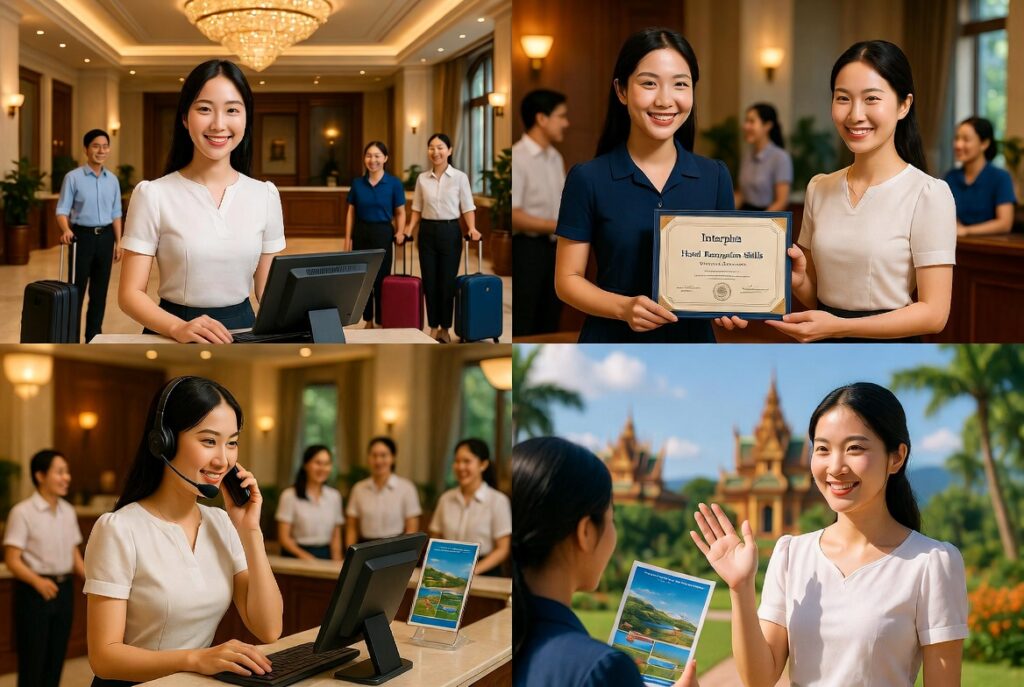
Before you speak, the guest already feels something.
Do this:
Wear a clean uniform
Hair neat, light perfume
Stand straight
Smile gently
Look at the guest, not at the computer
A calm and clean look = luxury. __________________________
1. Look and body language
The first impression starts before speaking. A receptionist must look clean, neat, and professional at all times. Good posture shows confidence and respect. A gentle smile makes guests feel welcome and safe. Eye contact is very important because it shows attention and care. The receptionist should avoid looking tired or busy. Calm body language helps the guest feel relaxed. In a five-star hotel, quiet and elegant movements create a feeling of luxury and trust.
###################
2. When the guest arrives
When you see the guest:
Stop typing
Look at them
Smile
Welcome them
Say slowly and clearly:
“Good afternoon. Welcome to [Hotel Name].”
or
“Good evening. Welcome to [Hotel Name].”
Your voice should be:
Calm
Warm
Not fast __________________________
2. Guest arrival
When a guest arrives, the receptionist should give full attention immediately. Stopping other work shows respect and importance. A calm and friendly attitude helps the guest feel comfortable. The welcome should be clear and warm, not rushed. The first seconds are very important because guests form opinions quickly. A smooth and polite arrival experience sets the mood for the whole stay. In a luxury hotel, the arrival should feel organized, peaceful, and professional.
####################
3. Use the guest’s name (very important)
If you know the guest’s name, use it.
Example:
“Welcome to [Hotel Name], Mr. Johnson.”
This makes the guest feel:
Important
Respected
Comfortable
In a 5-star hotel, names are very powerful.
______________________
3. Using the guest’s name
Using the guest’s name creates a strong personal connection. It shows care, respect, and good service. Guests feel recognized and valued when their name is used correctly. This small action can make a big difference in their experience. It also shows that the hotel is well prepared. In a five-star hotel, personal service is very important. Remembering and using names helps build trust and makes the guest feel special and welcome.
################
4. Speak politely and simply
Use polite and soft words.
Instead of:
“Passport.”
Say:
“May I please have your passport?”
Instead of:
“Wait.”
Say:
“One moment please.”
Smile when you speak. Guests can hear your smile.
________________________
4. Polite and simple language
Clear and polite language helps guests feel comfortable and understood. Simple words reduce confusion, especially for international travelers. A soft and respectful tone shows professionalism. The receptionist should avoid strong or short words that may sound rude. Polite language creates a positive atmosphere at the front desk. In luxury service, the way something is said is as important as the message. Good language skills show high standards and care.
#################
5. Make the guest feel safe and relaxed
Many guests are:
Tired
Hot
New to Cambodia
Help them feel relaxed.
You can say:
“Please allow me to assist you with your check-in.”
“You may relax. I will take care of everything.”
If possible:
Offer water
Offer a seat
_______________________
5. Making the guest feel relaxed
Many guests arrive tired from long travel. A good receptionist helps them feel calm and supported. Kind behavior and patience reduce stress. Offering help and showing understanding make the guest feel safe. When guests feel relaxed, they trust the hotel more. A peaceful check-in experience is very important in a five-star hotel. The goal is to let the guest feel cared for and free from worry from the first moment.
#################
6. Explain what you are doing
Guests feel happy when they understand.
Example:
“I will check your reservation now.”
“This will take about two minutes.”
“After this, I will give you your room key.”
This makes the guest feel calm and confident.
____________________________
6. Explaining the process
Explaining each step of check-in helps guests feel confident. When guests know what is happening, they feel more comfortable. Clear information reduces waiting stress and confusion. The receptionist should explain the process in a simple and calm way. This shows organization and professionalism. In a luxury hotel, guests expect smooth and clear service. Good explanations show respect for the guest’s time and improve the overall experience.
####################
7. Be calm, even with difficult guests
In a 5-star hotel:
Never argue
Never show anger
Never say “No” directly
Instead of:
“That is not possible.”
Say:
“Let me check what I can do for you.”
or
“Allow me to see the best solution.”
Your calm voice = luxury service.
____________________________
7. Staying calm with difficult guests
Some guests may feel upset or impatient. A professional receptionist stays calm and polite at all times. Showing understanding helps reduce tension. Arguing or showing anger damages the hotel’s image. A calm response shows confidence and control. In a five-star hotel, problems should be handled quietly and respectfully. The goal is to find a solution while keeping the guest comfortable and maintaining a high service standard.
####################
8. End the welcome in a warm way
Before the guest leaves the desk, say something kind.
Examples:
“If you need any help, please contact the front desk.”
“We wish you a pleasant stay with us.”
Smile again. Eye contact again.
The last feeling is as important as the first.
____________________________
8. Ending the welcome warmly
The end of the first interaction is very important. A warm and polite ending leaves a positive feeling. Guests should feel supported and confident after check-in. Clear guidance helps them know what to do next. A friendly attitude shows ongoing care. In a luxury hotel, the last moment at the desk should feel just as welcoming as the first. A good ending helps create a memorable and pleasant stay.
##############
Simple rule to remember
A 5-star first impression means:
Calm
Polite
Clean
Personal
Never rushed
You are not only checking in a guest. You are welcoming them to their experience.
Oum is a nine-year-old girl. She lives in the countryside. Every day, she walks to her small village school. Oum loves her home. She wants to keep it clean and healthy.
At school, Oum learns about pollution. She decides to help the environment. She takes a reusable bag to the market with her mother. She does not use plastic bags. Oum also has a metal water bottle. She fills it with clean water from home. This way, she makes less plastic waste.
Oum teaches her friends to keep the village clean. They pick up litter and put it in bins. They also collect old paper and plastic for recycling. Oum explains why it is important to take care of the environment.
Oum loves nature. She plants trees and flowers near her home and school. The plants make the village beautiful and help clean the air. Her friends and neighbors see her work and want to help too.
Oum shows that small actions can make a big difference. Everyone can help the environment and keep their home clean and green.
_____________________
Vocabulary:
pollution – dirt or waste in the air, water, or land that is bad for nature.
a role model – a person you can look at and try to be like.
countryside – land with fields, trees, and small villages, not a city.
to be clean – not dirty.
to be healthy – feeling good and strong, not sick.
to decide – to choose something.
environment – the land, water, air, plants, and animals around us.
a reusable bag – a bag you can use many times, not throw away.
a water bottle – a container for drinking water.
less plastic waste – a smaller amount of plastic trash.
to keep the village clean – to make sure the village is not dirty.
to pick up litter – to take trash from the ground.
a bin – a container for putting trash in.
to collect – to bring things together in one place.
to recycle – to use old things to make new things.
a neighbor – a person who lives near you.
to make a big difference – to change something in a very good way.
#################
Match word to definition:
Words:
pollution
a role model
countryside
to be clean
to be healthy
to decide
environment
a reusable bag
a water bottle
less plastic waste
to keep the village clean
to pick up litter
a bin
to collect
to recycle
a neighbor
to make a big difference
Definitions:
a. to bring things together in one place b. land with fields, trees, and small villages, not a city c. a bag you can use many times, not throw away d. dirt or waste in the air, water, or land that is bad for nature e. feeling good and strong, not sick f. a person who lives near you g. a person you can look at and try to be like h. to choose something i. to change something in a very good way j. a container for putting trash in k. the land, water, air, plants, and animals around us l. to make sure the village is not dirty m. not dirty n. a container for drinking water o. a smaller amount of plastic trash p. to use old things to make new things q. to take trash from the ground
pollution – dirt or waste in the air, water, or land that is bad for nature
a role model – a person you can look at and try to be like
countryside – land with fields, trees, and small villages, not a city
to be clean – not dirty
to be healthy – feeling good and strong, not sick
to decide – to choose something
environment – the land, water, air, plants, and animals around us
a reusable bag – a bag you can use many times, not throw away
a water bottle – a container for drinking water
less plastic waste – a smaller amount of plastic trash
to keep the village clean – to make sure the village is not dirty
to pick up litter – to take trash from the ground
a bin – a container for putting trash in
to collect – to bring things together in one place
to recycle – to use old things to make new things
a neighbor – a person who lives near you
to make a big difference – to change something in a very good way
########################
Find the word/s:
dirt or waste in the air, water, or land that is bad for nature – ________
a person you can look at and try to be like – ________
land with fields, trees, and small villages, not a city – ________
not dirty – ________
feeling good and strong, not sick – ________
to choose something – ________
the land, water, air, plants, and animals around us – ________
a bag you can use many times, not throw away – ________
a container for drinking water – ________
a smaller amount of plastic trash – ________
to make sure the village is not dirty – ________
to take trash from the ground – ________
a container for putting trash in – ________
to bring things together in one place – ________
to use old things to make new things – ________
a person who lives near you – ________
to change something in a very good way – ________
Answer Key
pollution
a role model
countryside
to be clean
to be healthy
to decide
environment
a reusable bag
a water bottle
less plastic waste
to keep the village clean
to pick up litter
a bin
to collect
to recycle
a neighbor
to make a big difference
_____________________
Correct answers:
dirt or waste in the air, water, or land that is bad for nature – pollution
a person you can look at and try to be like – a role model
land with fields, trees, and small villages, not a city – countryside
not dirty – to be clean
feeling good and strong, not sick – to be healthy
to choose something – to decide
the land, water, air, plants, and animals around us – environment
a bag you can use many times, not throw away – a reusable bag
a container for drinking water – a water bottle
a smaller amount of plastic trash – less plastic waste
to make sure the village is not dirty – to keep the village clean
to take trash from the ground – to pick up litter
a container for putting trash in – a bin
to bring things together in one place – to collect
to use old things to make new things – to recycle
a person who lives near you – a neighbor
to change something in a very good way – to make a big difference
################
Match action and result:
Action
Result
1. Oum uses a reusable bag at the market
a. which helps her stay healthy and enjoy nature.
2. Oum fills her metal water bottle
b. which shows that small actions can make a big difference.
3. Oum and friends pick up litter
c. which helps reduce plastic waste.
4. Oum plants trees and flowers
d. so it can be used to make new things.
5. Oum collects old paper and plastic
e. which keeps the village clean.
6. Oum teaches friends about pollution
f. which makes the village beautiful and cleans the air.
7. Oum walks to school every day
g. so she does not need single-use plastic bottles.
8. Oum encourages neighbors to help
h. which helps them understand why the environment is important.
_________________________
Answers: 1-c, 2-g, 3-e, 4-f, 5-d, 6-h, 7-a, 8-b
_________________________
Correct version:
Oum uses a reusable bag at the market, which helps reduce plastic waste.
Oum fills her metal water bottle, so she does not need single-use plastic bottles.
Oum and friends pick up litter, which keeps the village clean.
Oum plants trees and flowers, which makes the village beautiful and cleans the air.
Oum collects old paper and plastic, so it can be used to make new things.
Oum teaches friends about pollution, which helps them understand why the environment is important.
Oum walks to school every day, which helps her stay healthy and enjoy nature.
Oum encourages neighbors to help, which shows that small actions can make a big difference.
################
Fill in, words below:
bags – healthy – village – flowers – old – help – litter – countryside – difference – pollution – loves – collect – clean – reusable
Oum is nine years __________.
She lives in the __________ of Cambodia.
Every day, Oum walks to her small __________ school.
Oum __________ her home.
She wants to keep her home clean and ___________.
At school, Oum learns about __________
She decides to __________ the environment.
Oum takes a __________ bag to the market with her mother.
She does not use plastic __________.
Oum fills her metal water bottle with __________ water from home.
Oum and her friends pick up __________ in the village.
They __________ old paper and plastic for recycling.
Oum plants trees and __________ near her home and school.
Her small actions help the environment and make a big __________.
——————————– Correct version:
Oum is nine years old.
She lives in the countryside of Cambodia.
Every day, Oum walks to her small village school.
Oum loves her home.
She wants to keep her home clean and healthy.
At school, Oum learns about pollution.
She decides to help the environment.
Oum takes a reusable bag to the market with her mother.
She does not use plastic bags.
Oum fills her metal water bottle with clean water from home.
Oum and her friends pick up litter in the village.
They collect old paper and plastic for recycling.
Oum plants trees and flowers near her home and school.
Her small actions help the environment and make a big difference.
#################
Words from the text, a bit mixed – which phrase are we looking for?
##################
Match question and answer:
Questions:
Who are you?
Where do you live?
When do you go to school?
Why do you love your home?
What do you learn about at school?
Why do you decide to help the environment?
Who helps you in the village?
What do you take to the market with your mother?
What do you use for drinking water?
Why do you and your friends collect old paper and plastic?
Where do you plant trees and flowers?
How can small actions make a difference?
Answers (Randomized): a. My friends and neighbors help me. b. I learn about pollution. c. I use a metal water bottle filled with clean water from home. d. I take a reusable bag. e. They can keep the environment clean and green, and everyone can help too. f. I am a nine-year-old girl. g. We collect it for recycling. h. I love it because I want to keep it clean and healthy. i. I plant them near my home and school. j. I live in the countryside. k. I go to my small village school every day. l. I want to protect nature and make my home clean.
Friday the 13th is a day many people think is unlucky. The fear of this day comes from old myths, religion, and history. First, the number 13 is considered unlucky in many cultures. In ancient times, 12 was seen as complete and perfect. For example, there are 12 months in a year, 12 signs of the zodiac, and 12 gods in some myths. The number 13 comes after 12, so it is often seen as extra or strange.
Second, Friday is also seen as unlucky in history. In Christian tradition, Jesus died on a Friday. Some stories also say that Adam and Eve left the Garden of Eden on a Friday. Because of this, Fridays were sometimes considered unlucky days for important work or travel.
When the unlucky number 13 meets the unlucky day Friday, people started to think it was very unlucky. Over time, this idea spread in Europe and later in the United States. Books, newspapers, and stories helped make Friday the 13th famous as a day of bad luck.
Today, some people are careful on this day, even if it is only a superstition.
______________________
Vocabulary:
intermediate – not easy, not very hard; in the middle level
a myth – an old story that may not be true
unlucky – something that brings bad luck
a fear – a feeling of being afraid
to be considered unlucky – people think it is unlucky
ancient times – a long, long time ago
the zodiac – 12 star signs used in astrology
to be strange – unusual, different from normal
Garden of Eden – the place in the Bible where Adam and Eve lived first
travel – to go from one place to another
over time – after a long time
to spread – to go to more people or places
to make Friday a day of bad luck – to make people think Friday is unlucky
to be careful – to watch out, to be safe
superstition – a belief that something can bring good or bad luck
###################
Match the word to the correct definition
Words:
intermediate
a myth
unlucky
a fear
to be considered unlucky
ancient times
the zodiac
to be strange
Garden of Eden
travel
over time
to spread
to make Friday a day of bad luck
to be careful
superstition
Definitions:
A. A long, long time ago B. People think it is unlucky C. To go to more people or places D. Unusual, different from normal E. To go from one place to another F. Not easy, not very hard; in the middle level G. A feeling of being afraid H. A belief that something can bring good or bad luck I. To watch out, to be safe J. An old story that may not be true K. Something that brings bad luck L. To make people think Friday is unlucky M. The place in the Bible where Adam and Eve lived first N. 12 star signs used in astrology O. After a long time
A long time ago, in Rome, there was a priest named Saint Valentine. He lived around the year 270 A.D. The emperor did not want young men to marry because he thought soldiers should stay single. But Saint Valentine helped people who loved each other. He married couples in secret.
The emperor found out and was very angry. He put Saint Valentine in prison. While he was in prison, Saint Valentine became friends with the jailer’s daughter. He wrote her a small note and signed it, “From your Valentine.” After some time, Saint Valentine was executed because of what he had done. This was the first Valentine’s card.
People remembered his kindness and bravery. They wanted to celebrate love and friendship. They chose February 14 to honor him.
Today, people in many countries give cards, flowers, and gifts. They remember Saint Valentine and his story of love and courage. Valentine’s Day is a special day to show love, just like Saint Valentine did.
_______________________
Vocabulary:
a priest – a man who works in the church
270 A.D. – the year 270, a long time ago, after the birth of Jesus
A.D. – it means “Anno Domini” in Latin; it counts the years after Jesus was born
an emperor – the ruler of a country, like a king but in an empire
to marry – to become husband and wife
to stay single – to not have a husband or wife
to marry a couple – to help a man and woman become husband and wife
in secret – hidden, so other people do not know
to be angry – to feel very bad or upset
a prison – a place where people stay because they break the law
a jailer – a person who looks after people in prison
to sign something – to write your name on a paper
to be executed – to be killed because of a law or punishment
to remember – to not forget
kindness – being nice and helpful to others
bravery – being not afraid, being brave
to celebrate – to do something special for an important day
friendship – being friends with someone
to choose – to pick one thing
to honor somebody – to show respect and say thank you to someone
a gift – something you give to someone to show love or thanks
courage – the ability to be brave
to show love – to do nice things for someone to tell them you love them
################
Infinitive
Past Simple
Definition
be
was / were
to exist, to be in a place or state
live
lived
to have life in a place or time
want
wanted
to wish for something
think
thought
to have an idea or opinion
stay
stayed
to remain in a place or state
help
helped
to do something for someone
love
loved
to like someone very much
marry
married
to become husband and wife
find out
found out
to discover or learn something
put
put
to place something somewhere
become
became
to start to be something
write
wrote
to put words on paper
sign
signed
to write your name on something
execute
executed
to kill someone as punishment
have
had
to own something or experience something
do
did
to act or perform an action
remember
remembered
to not forget
celebrate
celebrated
to do something special for an important day
choose
chose
to pick one thing
honor
honored
to show respect for someone
give
gave
to offer something to someone
show
showed
to make something visible or express something
###############
Match the word to its definition
Words:
a priest
270 A.D.
an emperor
to marry
to stay single
in secret
a prison
a jailer
to sign something
to be executed
kindness
bravery
friendship
a gift
courage
Definitions : a. hidden, so other people do not know b. a man who works in the church c. the ability to be brave d. to write your name on something e. to become husband and wife f. a place where people stay because they break the law g. being not afraid; being brave h. a person who looks after people in prison i. the year 270, a long time ago, after the birth of Jesus j. something you give to someone to show love or thanks k. to not be afraid to do something difficult l. being nice and helpful to others m. to be killed because of a law or punishment n. being friends with someone o. to not have a husband or wife
The emperor wanted young men to marry. True is: The emperor did not want young men to marry.
Saint Valentine married couples in secret.
Saint Valentine lived around 270 A.D.
The emperor put Saint Valentine in prison.
Saint Valentine became friends with the emperor’s daughter. True is: Saint Valentine became friends with the jailer’s daughter.
He wrote a note and signed it, “From your Valentine.”
Saint Valentine was executed because he helped his family. True is: Saint Valentine was executed because he had helped soldiers.
Valentine’s Day is celebrated in March. True is: Valentine’s Day is celebrated on February 14.
People give cards, flowers, and gifts on Valentine’s Day.
Saint Valentine married couples in public. True is: Saint Valentine married couples in secret.
People celebrate soldiers only on Valentine’s Day. True is: Valentine’s Day is a special day to show love and friendship.
People remembered Saint Valentine for his kindness and bravery.
Saint Valentine had Valentine’s cards. True is: The first Valentine’s card was written by Saint Valentine.
Valentine’s Day is not about love. True is: Valentine’s Day is a special day to show love.
###################
Fill in, words below:
emperor – bravery – marry – love – stay single – people – daughter – priest – gifts – signed – chose – in secret – note – executed
A long time ago, in Rome there was a __________ named Saint Valentine.
The emperor did not want young men to __________.
He thought soldiers should __________, but Saint Valentine helped people who loved each other.
Saint Valentine helped young __________ to marry.
He married couples __________.
The __________ found out and was very angry. He put Saint Valentine in prison.
While he was in prison, Saint Valentine became friends with the jailer’s __________.
He wrote her a small __________.
He __________ the note, “From your Valentine.”
After some time, Saint Valentine was __________ because of what he had done.
People remembered Saint Valentine for his kindness and __________.
They __________ February 14 to honor him.
Today, people in many countries give cards, flowers, and __________ to remember Saint Valentine.
Valentine’s Day is a special day to show __________ just like Saint Valentine did.
—————————– Correct version:
A long time ago, in Rome there was a priest named Saint Valentine.
The emperor did not want young men to marry.
He thought soldiers should stay single, but Saint Valentine helped people who loved each other.
Saint Valentine helped young people to marry.
He married couples in secret.
The emperor found out and was very angry. He put Saint Valentine in prison.
While he was in prison, Saint Valentine became friends with the jailer’s daughter.
He wrote her a small note.
He signed the note, “From your Valentine.”
After some time, Saint Valentine was executed because of what he had done.
People remembered Saint Valentine for his kindness and bravery.
They chose February 14 to honor him.
Today, people in many countries give cards, flowers, and gifts to remember Saint Valentine.
Valentine’s Day is a special day to show love just like Saint Valentine did.
################
Multiple Choice Questions
Who was Saint Valentine? a) An emperor b) A soldier c) A priest
Where did Saint Valentine live a long time ago? a) Rome b) Egypt c) Greece
Around what year did Saint Valentine live? a) 500 B.C. b) 1500 A.D. c) 270 A.D.
Why did the emperor not want young men to marry? a) He did not care b) He wanted soldiers to stay single c) He wanted soldiers to marry
What did Saint Valentine do for couples? a) He helped them marry in secret b) He helped them buy gifts c) He gave them chocolate
Where did the emperor put Saint Valentine? a) In a prison b) In a house c) In a school
Who became Saint Valentine’s friend in prison? a) The jailer’s daughter b) The emperor’s daughter c) The jailer
What did Saint Valentine write and sign? a) “I love you” b) “From your Valentine” c) “Happy Valentine’s Day”
When do people celebrate Valentine’s Day? a) February 14 b) March 14 c) December 14
What is Valentine’s Day a special day to show? a) Bravery b) Kindness c) Love
________________________ Answers:
1-c, 2-a, 3-c, 4-b, 5-a, 6-a, 7-a, 8-b, 9-a, 10-c
________________________
Full version:
Who was Saint Valentine? – Saint Valentine was a priest.
Where did Saint Valentine live a long time ago? – Saint Valentine lived in Rome.
Around what year did Saint Valentine live? – Saint Valentine lived around the year 270 A.D.
Why did the emperor not want young men to marry? – The emperor did not want soldiers to marry because he wanted them to stay single.
What did Saint Valentine do for couples? – Saint Valentine helped couples to marry in secret.
Where did the emperor put Saint Valentine? – The emperor put Saint Valentine in prison.
Who became Saint Valentine’s friend in prison? – Saint Valentine became friends with the jailer’s daughter.
What did Saint Valentine write and sign? – Saint Valentine wrote a note and signed it “From your Valentine.”
When do people celebrate Valentine’s Day? – People celebrate Valentine’s Day on February 14.
What is Valentine’s Day a special day to show? – Valentine’s Day is a special day to show love.
_______________________
Who was Saint Valentine? – priest
Where did Saint Valentine live a long time ago? – Rome
Around what year did Saint Valentine live? – 270 A.D.
Why did the emperor not want young men to marry? – soldiers stay single
What did Saint Valentine do for couples? – marry in secret
Where did the emperor put Saint Valentine? – prison
Who became Saint Valentine’s friend in prison? – jailer’s daughter
What did Saint Valentine write and sign? – From your Valentine
When do people celebrate Valentine’s Day? – February 14
What is Valentine’s Day a special day to show? – love
################
Unscramble the sentences:
Rome / Saint / a / Valentine / priest / was / in
YOU WRITE: Saint Valentin was a priest in Rome.
men / The / want / did / emperor / not / to / marry ____________________________
in / married / secret / couples / Valentine ____________________________
other / He / loved / each / helped / who / people ____________________________
emperor / The / put / in / Valentine / prison ____________________________
jailer’s / Valentine / became / the / daughter / friends / with ____________________________
small / a / He / note / wrote ____________________________
He / note / signed / the / “From / Valentine / your” ____________________________
kindness / and / remembered / for / People / bravery / his / Valentine ____________________________
Day / Valentine’s / day / show / love / is / special / a / to ____________________________
——————————– Correct answers:
Saint Valentine was a priest in Rome.
The emperor did not want men to marry.
Valentine married couples in secret.
He helped people who loved each other.
The emperor put Valentine in prison.
Valentine became friends with the jailer’s daughter.
He wrote a small note.
He signed the note “From your Valentine.”
People remembered Valentine for his kindness and bravery.
Valentine’s Day is a special day to show love.
##############
Fill in, words below:
soldiers – jailer’s – priest – small note – remember – around – emperor – in Rome – in secret
Interviewer: Who was Saint Valentine? Historian: Saint Valentine was a _________.
Interviewer: Where did he live? Historian: He lived _________.
Interviewer: Around what year did he live? Historian: He lived __________ the year 270 A.D.
Interviewer: Why did the emperor not want men to marry? Historian: The emperor did not want young men to marry because he thought __________ should stay single.
Interviewer: What did Saint Valentine do for couples? Historian: Saint Valentine married couples__________.
Interviewer: Where did the _________ put him? Historian: The emperor put Saint Valentine in prison.
Interviewer: Who did he become friends with in prison? Historian: He became friends with the __________ daughter.
Interviewer: What did he write and sign? Historian: He wrote a __________ and signed it “From your Valentine.”
Interviewer: Why do people celebrate Valentine’s Day? Historian: People celebrate Valentine’s Day to ________ his kindness and bravery.
________________________
Full dialogue:
Interviewer: Who was Saint Valentine? Historian: Saint Valentine was a priest.
Interviewer: Where did he live? Historian: He lived in Rome.
Interviewer: Around what year did he live? Historian: He lived around the year 270 A.D.
Interviewer: Why did the emperor not want men to marry? Historian: The emperor did not want young men to marry because he thought soldiers should stay single.
Interviewer: What did Saint Valentine do for couples? Historian: Saint Valentine married couples in secret.
Interviewer: Where did the emperor put him? Historian: The emperor put Saint Valentine in prison.
Interviewer: Who did he become friends with in prison? Historian: He became friends with the jailer’s daughter.
Interviewer: What did he write and sign? Historian: He wrote a small note and signed it “From your Valentine.”
Interviewer: Why do people celebrate Valentine’s Day? Historian: People celebrate Valentine’s Day to remember his kindness and bravery.
It is Chinese New Year’s Day. Mei wakes up early. The sun is bright and the sky is clear. She wears a red dress. Red is a lucky color in China.
Her family is happy. They eat breakfast together. There are dumplings, rice, and fish on the table. Mei’s mother says, “Today is a special day. We must be together and be happy.”
After breakfast, Mei and her brother go outside. Many people are on the streets. They see red lanterns and colorful decorations. Children run and play. Some people carry firecrackers. The sound is loud, but it is exciting.
Mei visits her grandparents. She gives them red envelopes with money. Her grandparents smile and say, “Happy New Year!” Mei feels happy too.
In the afternoon, the family goes to the temple. They pray for health and good luck. Many people are there. Everyone is smiling and taking pictures.
At night, the family sits together. They watch a show on TV. Mei feels warm and happy. She thinks, “Chinese New Year is a very good day. I love my family and I love this day.”
The day ends with smiles and happiness. Everyone hopes for a good year.
_______________________
Vocabulary:
to wake up – to stop sleeping
early – before usual time
a bright sun – the sun is shining and strong
a clear sky – no clouds in the sky
to wear a dress – to put a dress on your body
a lucky color – a color that brings good things
dumplings – food with meat or vegetables inside a small dough
outside – not inside a building
a colorful decoration – something with many colors to make a place beautiful
firecrackers – small things that make a loud noise and light when you burn them
a loud sound – a noise you can hear very strongly
to be exciting – to feel happy and interested
an envelope – paper to put money or a letter inside
to pray for health – to hope and ask for good body and mind
good luck – happiness and success in the future
to smile – to make your mouth show happiness
at night – the time after the sun goes down
to hope for a good year – to want a happy and good new year
##################
Match the Word with Its Definition
Words:
to wake up
early
a bright sun
a clear sky
to wear a dress
a lucky color
dumplings
outside
a colorful decoration
firecrackers
a loud sound
to be exciting
an envelope
to pray for health
good luck
to smile
at night
to hope for a good year
Definitions:
A. paper to put money or a letter inside B. to want a happy and good new year C. to stop sleeping D. no clouds in the sky E. the time after the sun goes down F. happiness and success in the future G. something with many colors to make a place beautiful H. to feel happy and interested I. to put a dress on your body J. children playing and people carrying small things that make a loud noise K. a color that brings good things L. the sun is shining and strong M. before usual time N. a noise you can hear very strongly O. to hope and ask for good body and mind P. to make your mouth show happiness Q. food with meat or vegetables inside a small dough R. not inside a building
___________________
Correct answers:
to wake up – to stop sleeping
early – before usual time
a bright sun – the sun is shining and strong
a clear sky – no clouds in the sky
to wear a dress – to put a dress on your body
a lucky color – a color that brings good things
dumplings – food with meat or vegetables inside a small dough
outside – not inside a building
a colorful decoration – something with many colors to make a place beautiful
firecrackers – children playing and people carrying small things that make a loud noise
a loud sound – a noise you can hear very strongly
to be exciting – to feel happy and interested
an envelope – paper to put money or a letter inside
to pray for health – to hope and ask for good body and mind
good luck – happiness and success in the future
to smile – to make your mouth show happiness
at night – the time after the sun goes down
to hope for a good year – to want a happy and good new year
###################
True or false:
Mei wears a blue dress on Chinese New Year’s Day.
Dumplings have meat or vegetables inside dough.
The sky is always cloudy on Chinese New Year’s Day.
People go outside to see decorations and lanterns.
Firecrackers are quiet and soft.
A red envelope can have money inside.
Mei wakes up early in the morning.
A lucky color brings bad luck.
At night, Mei’s family watches TV together.
To smile means to be angry.
The sun can be bright in the morning.
People pray for health and good luck.
A colorful decoration has only one color.
To hope for a good year means to want happiness in the new year.
Mei wears a blue dress on Chinese New Year’s Day. True is: Mei wears a red dress on Chinese New Year’s Day.
Dumplings have meat or vegetables inside dough.
The sky is always cloudy on Chinese New Year’s Day. True is: The sky can be clear on Chinese New Year’s Day.
People go outside to see decorations and lanterns.
Firecrackers are quiet and soft. True is: Firecrackers are loud and make noise.
A red envelope can have money inside.
Mei wakes up early in the morning.
A lucky color brings bad luck. True is: A lucky color brings good luck.
At night, Mei’s family watches TV together.
To smile means to be angry. True is: To smile means to show happiness with your mouth.
The sun can be bright in the morning.
People pray for health and good luck.
A colorful decoration has only one color. True is: A colorful decoration has many colors.
To hope for a good year means to want happiness in the new year.
Outside means inside the house. True is: Outside means not inside a building.
##################
Fill in, words below:
envelope – good luck – bright – at night – happiness – firecrackers – dumplings – wakes up – pictures – wish – lucky – decorations – family – clear
Mei __________ early on Chinese New Year’s Day to see her family.
She wears a red dress because red is a __________ color.
The sun is __________ and the sky is clear, making the day perfect for celebrations.
Mei’s family eats breakfast with __________, rice, and fish.
After breakfast, Mei and her brother go outside to see colorful __________.
Children play while people carry__________, making a loud sound.
Mei visits her grandparents and gives them a red __________ with money.
Her grandparents smile and __________ her a happy new year.
In the afternoon, the family goes to the temple to pray for health and __________.
Many people are at the temple, smiling and taking __________.
__________, the family sits together and watches a show on TV.
Mei feels happy because she spends the day with her __________.
The bright sun, __________ sky, and red decorations make the streets exciting.
Mei hopes for a good year with __________ and health.
———————————— Correct version:
Mei wakes up early on Chinese New Year’s Day to see her family.
She wears a red dress because red is a lucky color.
The sun is bright and the sky is clear, making the day perfect for celebrations.
Mei’s family eats breakfast with dumplings, rice, and fish.
After breakfast, Mei and her brother go outside to see colorful decorations.
Children play while people carry firecrackers, making a loud sound.
Mei visits her grandparents and gives them a red envelope with money.
Her grandparents smile and wish her a happy new year.
In the afternoon, the family goes to the temple to pray for health and good luck.
Many people are at the temple, smiling and taking pictures.
At night, the family sits together and watches a show on TV.
Mei feels happy because she spends the day with her family.
The bright sun, clear sky, and red decorations make the streets exciting.
Mei hopes for a good year with happiness and health.
###############
Unscramble the sentences:
wakes / Mei / Day / on / Chinese / early / New / up
YOU WRITE: Mei wakes up early on Chinese News Year’s Day.
red / wears / color / a / lucky / red / because / a / she / is / dress
bright / the / sun / clear / and / sky / is / the / is
rice / dumplings / breakfast / with / fish / Mei’s / family / eats / and
brother / outside / her / go / Mei / and
carry / play / firecrackers / children / people / and
red / grandparents / a / Mei / gives / envelope
New / smile / her / Year / grandparents / happy / and / wish
family / temple / the / goes / the / to
year / a / Mei / happy / hopes / healthy / for
_________________________
Unscrambled version:
Mei wakes up early on Chinese New Year’s Day.
She wears a red dress because red is a lucky color.
The sun is bright and the sky is clear.
Mei’s family eats breakfast with dumplings, rice, and fish.
Mei and her brother go outside.
Children play and people carry firecrackers.
Mei gives grandparents a red envelope.
Grandparents smile and wish her happy New Year.
The family goes to the temple.
Mei hopes for a happy, healthy year.
#################
Find the Word – Match the Definition
Definitions:
Not inside a building
YOU WRITE: outside
Food with meat or vegetables inside dough. ____________
The sun is shining and strong. ____________
To show happiness with your mouth. ____________
A color that brings good things. ____________
The time after the sun goes down. ____________
To ask or hope for a healthy body and mind. ____________
To stop sleeping. ____________
Something with many colors to make a place beautiful. ____________
Small objects that make a loud noise when burned. ____________
To put a dress on your body. ____________
Happiness and success in the future. ____________
A noise you can hear very strongly. ____________
Paper to put money or a letter inside. ____________
To want a happy and good new year. ____________
Words:
A. to wake up B. a bright sun C. firecrackers D. to wear a dress E. dumplings F. a lucky color G. outside H. a colorful decoration I. to smile J. good luck K. at night L. an envelope M. a loud sound N. to hope for a good year O. to pray for health
happiness – wake up – envelopes – celebrating – firecrackers – breakfast –
Interview with Grandma about Chinese New Year’s Day
Me: Hello, Grandma! Can you tell me what you do on Chinese New Year’s Day? Grandma: Hello! Yes, of course. On New Year’s Day, I _________ early. I wear a red dress because red is a lucky color.
Me: Do you eat something special? Grandma: Yes! We eat dumplings, rice, and fish for __________. It is very delicious.
Me: What do you do after breakfast? Grandma: We go outside to see the decorations. There are red lanterns and colorful decorations everywhere. Children play, and some people carry __________.
Me: Do you visit anyone? Grandma: Yes, we visit grandparents and relatives. We give red _________ with money. Everyone smiles and wishes each other good luck.
Me: Do you do anything in the evening? Grandma: At night, our family sits together. We watch TV and enjoy being together. We also hope for a good year with _________ and health.
Me: Thank you, Grandma! Now I know how special New Year’s Day is for our family. Grandma: You are welcome! I love _________ with my family.
—————————— Correct dialogue:
Interview with Grandma about Chinese New Year’s Day
Me: Hello, Grandma! Can you tell me what you do on Chinese New Year’s Day? Grandma: Hello! Yes, of course. On New Year’s Day, I wake up early. I wear a red dress because red is a lucky color.
Me: Do you eat something special? Grandma: Yes! We eat dumplings, rice, and fish for breakfast. It is very delicious.
Me: What do you do after breakfast? Grandma: We go outside to see the decorations. There are red lanterns and colorful decorations everywhere. Children play, and some people carry firecrackers.
Me: Do you visit anyone? Grandma: Yes, we visit grandparents and relatives. We give red envelopes with money. Everyone smiles and wishes each other good luck.
Me: Do you do anything in the evening? Grandma: At night, our family sits together. We watch TV and enjoy being together. We also hope for a good year with happiness and health.
Me: Thank you, Grandma! Now I know how special New Year’s Day is for our family. Grandma: You are welcome! I love celebrating with my family.
Chinese New Year 2026 begins on February 17, 2026. This day is the first day of the lunar calendar. The celebration starts one day before, on February 16, 2026, which is Chinese New Year’s Eve. On this evening, families come together for a big dinner.
The festival lasts about 15–16 days. It ends with the Lantern Festival on March 3, 2026.
________________________
Chinese New Year’s Eve and New Year’s Day
Chinese New Year’s Eve in 2026 is on February 16. It is one of the most important days of the year for families. On this evening, people travel home to be with their parents and relatives. Families clean their homes before the evening to remove bad luck from the old year.
The most important part of New Year’s Eve is the family dinner. Everyone sits together and eats special food. Common foods are fish, dumplings, and noodles. These foods mean good luck, long life, and happiness. After dinner, families talk, watch TV, and stay awake late. Some people watch the New Year show on television. At midnight, people light fireworks to say goodbye to the old year.
Chinese New Year’s Day is on February 17, 2026. On this day, people wear new clothes, often in red. They visit family members and say “Happy New Year.” Children receive red envelopes with money. People try to be kind and happy, because they believe this brings good luck for the year.
New Year’s Day is a time for family, hope, and new beginnings.
_______________________
Vocabulary:
a lunar calendar: a calendar that follows the moon
a celebration: a happy time with people and events
to last about 15 days: to continue for around 15 days
a lantern: a light inside a paper or glass cover
to travel home: to go back to your home
a relative: someone in your family
to clean a home: to make the house clean
to remove: to take away
bad luck: bad things that happen
common foods: food people eat often
dumplings: small pieces of food with meat or vegetables inside
good luck: good things that happen
happiness: feeling good and happy
to stay awake late: to not sleep until very late
midnight: 12 o’clock at night
to light fireworks: to make fireworks start and shine
to say goodbye: to tell someone you are leaving
to wear clothes: to have clothes on your body
to receive: to get something
an envelope: a paper cover for a letter or money
to believe: to think something is true
##################
Match the word to the definition:
Words: a) a lunar calendar b) a celebration c) to last about 15 days d) a lantern e) to travel home f) a relative g) to clean a home h) to remove i) bad luck j) common foods k) dumplings l) good luck m) happiness n) to stay awake late o) midnight p) to light fireworks q) to say goodbye r) to wear clothes s) to receive t) an envelope u) to believe
Definitions:
to get something → __s__
a calendar that follows the moon → __a__
small pieces of food with meat or vegetables inside → ___
To stay awake late means to go to bed early. True is: To stay awake late means to not sleep until very late.
Red envelopes are only for adults. True is: Red envelopes are usually for children.
Happiness is feeling good.
To travel home means to go back to your home.
A relative is someone in your family.
To clean a home means to make the house dirty. True is: To clean a home means to make the house clean.
Bad luck means good things that happen. True is: Bad luck means bad things that happen.
A lantern is a light inside a paper or glass cover.
To remove means to put something in. True is: To remove means to take away.
Common foods are food people rarely eat. True is: Common foods are food people eat often.
Midnight is in the morning at 6 o’clock. True is: Midnight is 12 o’clock at night.
To wear clothes means to take off your clothes. True is: To wear clothes means to have clothes on your body.
To believe means to think something is true.
##################
Fill in, words below:
house – lantern – common – follows – feeling – celebration – stay awake – bad luck – family – inside – light – happen – relative – people
A lunar calendar is a calendar that __________ the moon.
Chinese New Year is a __________ when families are happy together.
The festival lasts about 15 days from New Year’s Eve to the _________ Festival.
A lantern is a __________ inside a paper or glass cover that people hang outside.
To travel home means to go back to your home to see your __________.
A __________ is someone in your family, like a mother, father, or uncle.
To clean a home means to make the __________ clean before the new year.
To remove means to take away __________ from your home.
Bad luck means that bad things can happen to __________.
__________ foods are food that people eat often during the festival.
Dumplings are small pieces of food with meat or vegetables __________.
Good luck means that good things __________ to people.
Happiness is the __________ of being good and happy with your family.
To __________ late means to not sleep until very late on New Year’s Eve.
_________________________
Correct version:
A lunar calendar is a calendar that follows the moon.
Chinese New Year is a celebration when families are happy together.
The festival lasts about 15 days from New Year’s Eve to the Lantern Festival.
A lantern is a light inside a paper or glass cover that people hang outside.
To travel home means to go back to your home to see your family.
A relative is someone in your family, like a mother, father, or uncle.
To clean a home means to make the house clean before the new year.
To remove means to take away bad luck from your home.
Bad luck means that bad things can happen to people.
Common foods are food that people eat often during the festival.
Dumplings are small pieces of food with meat or vegetables inside.
Good luck means that good things happen to people.
Happiness is the feeling of being good and happy with your family.
To stay awake late means to not sleep until very late on New Year’s Eve.
################
Unscramble the sentences:
travel / I / home / New Year’s Eve / on →
YOU WRITE: I travel home on New Year’s Eve.
eat / dumplings / families / together / often → _____________________________________
children / red / to receive / envelopes / happy / are → _____________________________________
lantern / outside / people / home / hang / a / their → _____________________________________
to stay / late / I / on / New Year’s Eve / like / awake → _____________________________________
clean / the / home / we / a / before / new year → _____________________________________
bad luck / to remove / home / to / people / from / try / their → _____________________________________
midnight / fireworks / start / at / → _____________________________________
people / the festival / wear / new / often / during / clothes / → _____________________________________
happiness / with / family / feel / we /our → _____________________________________
___________________
Correct answers:
I travel home on New Year’s Eve.
Families often eat dumplings together.
Children are happy to receive red envelopes.
People hang a lantern outside their home.
I like to stay awake late on New Year’s Eve.
We clean a home before the new year.
People try to remove bad luck from their home.
Fireworks start at midnight.
People often wear new clothes during the festival.
We feel happiness with our family.
##################
Find the word:
fireworks, dumplings, relative, clean a home, lantern, travel home, red envelope, happiness, family dinner, common foods, wear clothes, midnight, bad luck, remove, to believe
A light inside paper or glass that people hang outside → ________
Small pieces of food with meat or vegetables inside → ________
Bad things that happen → ________
Feeling good and happy → ________
To go back to your home to see family → ________
Someone in your family → ________
12 o’clock at night → ________
A paper cover with money for children → ________
To take away something → ________
To make the house clean before the new year → ________
Food that people eat often during the festival → ________
What people wear on their body during the festival → ________
To think something is true → ________
Colorful lights and noise in the sky during celebrations → ________
A big meal with family on New Year’s Eve → ________
——————————–
Answers:
A light inside paper or glass that people hang outside → lantern
Small pieces of food with meat or vegetables inside → dumplings
Bad things that happen → bad luck
Feeling good and happy → happiness
To go back to your home to see family → travel home
Someone in your family → relative
12 o’clock at night → midnight
A paper cover with money for children → red envelope
To take away something → remove
To make the house clean before the new year → clean a home
Food that people eat often during the festival → common foods
What people wear on their body during the festival → wear clothes
To think something is true → to believe
Colorful lights and noise in the sky during celebrations → fireworks
A big meal with family on New Year’s Eve → family dinner
#################
Interview: Chinese New Year’s Eve – complete!
Q1: What day is Chinese New Year’s Eve in 2026? A1: Chinese New Year’s Eve is on February 16, 2026.
Q2: What do you do on New Year’s Eve? A2: We __________ our home and prepare food for the family dinner.
Q3: Why do you clean your home? A3: We clean the home to remove bad __________ from the old year.
Q4: What food do you eat on New Year’s Eve? A4: We eat dumplings, fish, and other __________ foods.
Q5: Do children get presents? A5: Yes, children receive red __________ with money.
Q6: Do you wear special clothes? A6: Yes, we wear new clothes, usually __________, for good luck.
Q7: Do you stay awake on New Year’s Eve? A7: Yes, we stay awake late and watch __________ at midnight.
Q8: Do you visit relatives on New Year’s Eve? A8: Yes, many people travel __________ to see their relatives.
Q9: Do you decorate your home? A9: Yes, we hang __________ and other red decorations.
Q10: What do the lanterns mean? A10: Lanterns bring happiness and good __________ for the new year.
Q11: Do you __________ with your family only? A11: No, some people also go to public festivals and watch dragon dances.
Q12: What is your favorite part of New Year’s Eve? A12: I like the family dinner and staying __________ late with fireworks.
—————————— Correct dialogue:
Q1: What day is Chinese New Year’s Eve in 2026? A1: Chinese New Year’s Eve is on February 16, 2026.
Q2: What do you do on New Year’s Eve? A2: We clean our home and prepare food for the family dinner.
Q3: Why do you clean your home? A3: We clean the home to remove bad luck from the old year.
Q4: What food do you eat on New Year’s Eve? A4: We eat dumplings, fish, and other common foods.
Q5: Do children get presents? A5: Yes, children receive red envelopes with money.
Q6: Do you wear special clothes? A6: Yes, we wear new clothes, usually red, for good luck.
Q7: Do you stay awake on New Year’s Eve? A7: Yes, we stay awake late and watch fireworks at midnight.
Q8: Do you visit relatives on New Year’s Eve? A8: Yes, many people travel home to see their relatives.
Q9: Do you decorate your home? A9: Yes, we hang lanterns and other red decorations.
Q10: What do the lanterns mean? A10: Lanterns bring happiness and good luck for the new year.
Q11: Do you celebrate with your family only? A11: No, some people also go to public festivals and watch dragon dances.
Q12: What is your favorite part of New Year’s Eve? A12: I like the family dinner and staying awake late with fireworks.
Yesterday, Tom __________up the mountains with a jetpack. Suddenly, he __________on a rock and __________ his leg. He shouted for help. A mountain rescue team __________quickly. They __________Tom to the helicopter. The emergency service __________his leg and gave him medicine. Tom was wet and tired, but he __________safe. He __________to thank the rescue team. Tom __________ about his next adventure.
————————————-
Correct version:
Yesterday, Tom flew up the mountains with a jetpack. Suddenly, he slipped on a rock and broke his leg. He shouted for help. A mountain rescue team arrived quickly. They carried Tom to the helicopter. The emergency service checked his leg and gave him medicine. Tom was wet and tired, but he was safe. He remembered to thank the rescue team. Tom dreamed about his next adventure.
#################
Fill in the correct verb in past tense, verbs below:
be – dream – call – help – notice – remember
Fire in the Forest
Yesterday, Max was in the forest. Suddenly, a tree was on fire. He __________ the smoke and __________ the fire brigade. The fire brigade arrived quickly. They checked the forest and put out the fire. Max __________ them carry water bottles. He __________ tired but happy. Later, he watched a film about fire safety and __________ the emergency. Max __________ about becoming a firefighter one day.
————————————-
Correct version:
Yesterday, Max was in the forest. Suddenly, a tree was on fire. He noticed the smoke and called the fire brigade. The fire brigade arrived quickly. They checked the forest and put out the fire. Max helped them carry water bottles. He was tired but happy. Later, he watched a film about fire safety and remembered the emergency. Max dreamed about becoming a firefighter one day.
#################
Fill in the correct verb in past tense, verbs below:
check – be – dream – arrive – fall – help – shout – give
————————————- Correct version:
Yesterday, Leo was sailing near the coast. Suddenly, the wind was strong, and he fell into the water. He shouted for help. A coastguard arrived with a rescue boat. They helped Leo and carried him safely on board. Leo was wet and tired. The coastguard checked that he was okay and gave him medicine. Later, Leo remembered the adventure and dreamed about flying with a jetpack again.
#################
Fill in the correct verb in past tense, verbs below:
Yesterday, a cat was stuck on a tree. It was high and in danger. A child __________ the cat and __________the fire brigade. The firefighters arrived quickly. They __________ the tree and __________ the cat safely down. The cat was wet but safe. The child __________ happy and __________ “thank you!” Later, the child __________ the rescue and __________ about helping animals again.
———————————— Correct version:
Yesterday, a cat was stuck on a tree. It was high and in danger. A child noticed the cat and called the fire brigade. The firefighters arrived quickly. They climbed the tree and carried the cat safely down. The cat was wet but safe. The child was happy and shouted “thank you!” Later, the child remembered the rescue and dreamed about helping animals again.
################
Fill in the correct verb in past tense, verbs below:
help – cry – smile – ride – give – push – promise – arrive
Biker Emergency
Tom lives in Austria. He jumped on his bike and __________ to school. Suddenly, a car __________ him off the bike. He __________ loudly. People called the emergency service. An ambulance __________ fast. The paramedics __________ Tom and lifted him into the ambulance. They __________ him medicine. Tom looked at the sky and felt safe. Later, he __________and __________ to be careful on his bike.
———————————– Corrrect version:
Tom lives in Austria. He jumped on his bike and rode to school. Suddenly, a car pushed him off the bike. He cried loudly. People called the emergency service. An ambulance arrived fast. The paramedics helped Tom and lifted him into the ambulance. They gave him medicine. Tom looked at the sky and felt safe. Later, he smiled and promised to be careful on his bike.
##################
True or false:
Tom jumped on his bike and rode to school.
A car pushed him off the bike.
Tom jumped into a river.
He cried loudly.
People carried Tom on a stretcher to the mountains.
The ambulance arrived fast.
He fell asleep in the forest.
People called the emergency service.
The paramedics helped Tom and lifted him into the ambulance.
He looked at the sky and felt safe.
An ambulance arrived slowly.
Tom smiled and promised to be careful on his bike.
Tom jumped into a river. True is: Tom was pushed off his bike by a car.
He cried loudly.
People carried Tom on a stretcher to the mountains. True is: People called the emergency service.
The ambulance arrived fast.
He fell asleep in the forest. True is: He looked at the sky and felt safe.
People called the emergency service.
The paramedics helped Tom and lifted him into the ambulance.
He looked at the sky and felt safe.
An ambulance arrived slowly. True is: The ambulance arrived fast.
Tom smiled and promised to be careful on his bike.
They gave him medicine.
Tom lives in Germany. True is: Tom lives in Austria.
################
Help!
Fill in, in past simple:
A man (sit) __________on a rock on the mountain. He __________ (fall) on the ground. His bike __________ (break). The man __________ (shout) for help. Two paramedics __________ (arrive). They __________ (carry) a bag and medicine. The man __________ (notice) the ambulance. The lights __________ (be) on. The man __________ (look) at his bike. The paramedics __________ (help) the man. They __________ (rescue) him. The man __________ (be) lucky. _______________________
Correct version:
A man sat on a rock on the mountain. He fell on the ground. His bike broke. The man shouted for help. Two paramedics arrived. They carried a bag and medicine. The man noticed the ambulance. The lights were on. The man looked at his bike. The paramedics helped the man. They rescued him. The man was lucky.
###############
LISTEN – IF NECESSARY TWICE OR THREE TIMES – AND COMPLETE
if necessary use the
button!
part 1:
Yesterday Anna and Tom __________ up the mountains in a small plane.
Suddenly the plane had a __________.
They were in __________.
Anna __________ for help.
Tom called the __________ service.
The mountain rescue __________ quickly.
The pilot landed on a mountain near a big__________.
Anna slipped and __________ her leg.
——————————
part 2:
Tom __________ her.
The __________ arrived.
The paramedics __________ Anna.
They __________ her medicine.
Anna was __________ but safe.
—————————-
part 3:
Everyone was lucky.
Later Anna __________ the adventure and smiled.
The rescue __________ was amazing.
Tom __________ thank you.
It was a terrible __________, but in the end all were safe.
——————————————
Correct version:
Yesterday Anna and Tom flew up the mountains in a small plane. Suddenly the plane had a problem. They were in danger.Anna shouted for help. Tom called the rescue service. The mountain rescue arrived quickly.The pilot landed on a mountain near a big rock. Anna slipped and broke her leg.
Tom carried her.The ambulance arrived. The paramedics helped Anna. They gave her medicine. Anna was tired but safe.
Everyone was lucky. Later Anna remembered the adventure and smiled. The rescue team was amazing. Tom said thank you.It was a terrible situation, but in the end all were safe.
###################
Saxon genitive (’s) – showing possession
The Saxon genitive shows that something belongs to someone. We add ’s to a name or noun.
Basic rule:
👉 person/animal + ’s + thing
Examples:
John’s book = the book belongs to John
Anna’s bag = the bag belongs to Anna
The cat’s food = the food belongs to the cat
If the name ends in -s (like James):
We still usually add ’s:
James’s book = the book belongs to James
James’s car = the car belongs to James
Plural nouns:
If the word is plural and already ends in -s, we just add an apostrophe ’:
the boys’ room = the room of the boys
the teachers’ office = the office of the teachers
Easy way to remember:
Instead of saying “the book of John”, we say: 👉 John’s book
If you want, I can also give you a short quiz to practice it.
#################
Rewrite with Saxon genitive
the book of James → __________ YOU WRITE: James’s book
A: Hello. B: Hi. A: My name is Anna. What is your name? B: My name is Tom. A: Nice to meet you. B: Nice to meet you too.
______________________
A: Hello. B: Hi. A: My name is Anna. What is your name? B: My name is Tom. A: Nice to meet you, Tom. B: Nice to meet you too, Anna. A: Where are you from? B: I am from Canada. A: And you? B: I am from Spain.
################
Dialogue 2: Name and country
A: Hello! What is your name? B: My name is Sara. A: Where are you from? B: I am from Brazil. A: Oh, nice!
_____________________
A: Hello! What is your name? B: My name is Sara. A: Nice to meet you, Sara. B: Nice to meet you too. A: Where are you from? B: I am from Brazil. A: Do you live here? B: Yes, I live here now. A: Welcome! B: Thank you!
################
Dialogue 3: Name and age
A: Hi. B: Hello. A: How old are you? B: I am 18 years old. A: And you? B: I am 20.
_____________________
A: Hi. B: Hello. A: How old are you? B: I am 18 years old. A: And you? B: I am 20 years old. A: Are you a student? B: Yes, I am a student. A: Nice to meet you. B: Nice to meet you too.
A: Hello. What do you do? B: I am a student. A: What do you study? B: I study English.
__________________
A: Hello. What do you do? B: I am a student. A: What do you study? B: I study English. A: Where do you study? B: I study at a school. A: Do you like English? B: Yes, I like it.
#############
Dialogue 5: Work
A: Hi! B: Hi! A: What is your job? B: I am a nurse. A: Where do you work? B: I work in a hospital.
__________________
A: Hi! B: Hi! A: What is your job? B: I am a nurse. A: Where do you work? B: I work in a hospital. A: Is the hospital near? B: Yes, it is near. A: Nice! B: Thank you.
__________________
a nurse – a person who helps sick [not healthy; feeling ill]people. a hospital – a place where sick people go to get help. near – close in distance [how far one place is from another].
#############
Dialogue 6: Likes
A: Hello. B: Hi. A: What do you like? B: I like music and coffee. A: Me too!
_____________________
A: Hello. B: Hi. A: What do you like? B: I like music and coffee. A: Do you like tea? B: No, I don’t like tea. A: Oh, okay. B: And you? A: I like coffee too. B: Me too!
###############
Dialogue 7: First day in class
A: Hello. Are you new here? B: Yes, I am. A: What is your name? B: My name is Alex. A: Welcome, Alex! B: Thank you.
____________________
A: Hello. Are you new here? B: Yes, I am. A: What is your name? B: My name is Alex. A: Nice to meet you, Alex. B: Nice to meet you too. A: Where are you from? B: I am from Australia. A: Welcome to the class! B: Thank you very much.
##############
Match the questions with the correct answers.
Questions:
Hello!
What is your name?
Nice to meet you.
Where are you from?
How old are you?
What do you do?
What do you study?
Do you like English?
Do you like music?
Where do you live?
Answers: A. I am 19 years old. B. I study English. C. Hi! D. I live in Madrid. E. I am from Spain. F. Yes, I like music too. G. I am a student. H. My name is Sara. I. Nice to meet you too. J. Yes, I like it.