##################
When do we use the past simple?
We use the Past Simple to talk about the past.
Use it for:
- things that happened yesterday
- things that happened last week, last month, or last year
- things that are finished
Examples
- Yesterday I walked to school.
- Last Sunday we played football.
- She watched TV last night.
- He ate breakfast at seven o’clock.
- They went home after school.
Time Words
These words often tell us to use the Past Simple:
- yesterday
- last night
- last week
- last month
- last year
- this morning (if the morning is finished)
- two days ago
- one hour ago
- in 2024
Remember
The action is finished.
- ✔ Yesterday I played football.
- ✔ Last year we visited Thailand.
- ✔ He was tired.
The Past Simple tells us about something that happened before now.
########################
How to form the past simple
We use the Past Simple to talk about the past.
1. Regular verbs
For most verbs, add -ed.
verb + ed
Examples:
- walk → walked
- play → played
- watch → watched
2. Verbs ending in -e
Add -d.
verb + d
Examples:
- live → lived
- like → liked
3. Verbs ending in consonant + y
Change y to i and add -ed.
y → ied
Examples:
- study → studied
- try → tried
4. Irregular verbs
Some verbs are different.
You must learn these verbs.
Examples:
- go → went
- eat → ate
- get → got
5. The verb be
The verb be is different.
am / is → was
are → were
Examples:
- I/he/she/it → was
- we/you/they → were
Remember:
- Regular verbs usually use -ed.
- Irregular verbs change.
- Be uses was and were.
########################
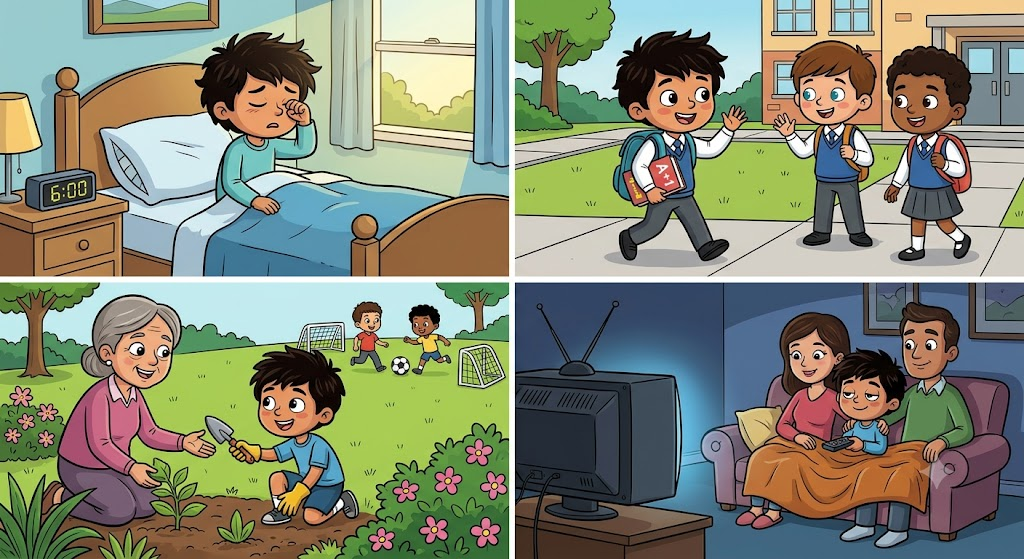
Fill in, past simple:
Yesterday Salas ______ (get up) at six o’clock.
He ______ (wash) his face and ______ (eat) breakfast.
Then he ______ (walk) to school.
He ______ (study) English and maths.
At school, he ______ (talk) with his friends.
After school, he ______ (walk) home.
He ______ (help) his mother in the garden.
Then he ______ (play) football with his friends.
In the evening, he ______ (watch) TV with his family.
He ______ (go) to bed at nine o’clock.
He ______ (be) tired, but he ______ (be) happy.
—————————————————-
Correct version:
Yesterday Salas got up at six o’clock.
He washed his face and ate breakfast.
Then he walked to school.
He studied English and maths.
At school, he talked with his friends.
After school, he walked home.
He helped his mother in the garden.
Then he played football with his friends.
In the evening, he watched TV with his family.
He went to bed at nine o’clock.
He was tired, but he was happy.
_________________________________
Verbs in text:
| Infinitive | Past Simple | Definition |
|---|---|---|
| get up | got up | to leave your bed in the morning |
| wash | washed | to clean something with water |
| eat | ate | to have food |
| walk | walked | to move on your feet |
| study | studied | to learn at school |
| talk | talked | to speak with someone |
| help | helped | to do something for someone |
| play | played | to do a sport or a game |
| watch | watched | to look at something like TV |
| go | went | to move to another place |
| be | was/were | to say what someone is or feels |
########################
Short answers, past simple, basics:
| Example Sentence | Yes | No |
|---|---|---|
| I learned letters. | Yes, I did. | No, I didn’t. |
| You read signs. | Yes, you did. | No, you didn’t. |
| He spoke English. | Yes, he did. | No, he didn’t. |
| She watched TV. | Yes, she did. | No, she didn’t. |
| It helped me. | Yes, it did. | No, it didn’t. |
| We used an app. | Yes, we did. | No, we didn’t. |
| You read words. | Yes, you did. | No, you didn’t. |
| They made mistakes. | Yes, they did. | No, they didn’t. |
Questions (Past Simple)
| Question | Yes | No |
|---|---|---|
| Did I learn letters? | Yes, I did. | No, I didn’t. |
| Did you read signs? | Yes, you did. | No, you didn’t. |
| Did he speak English? | Yes, he did. | No, he didn’t. |
| Did she watch TV? | Yes, she did. | No, she didn’t. |
| Did it help me? | Yes, it did. | No, it didn’t. |
| Did we use an app? | Yes, we did. | No, we didn’t. |
| Did you read words? | Yes, you did. | No, you didn’t. |
| Did they make mistakes? | Yes, they did. | No, they didn’t. |
####################
Short answers – yes, he did, or, no, he didn’t:
- Did Salas get up at six o’clock?
- Did he wash his face and eat breakfast?
- Did he walk to school?
- Did he study German and maths?
- Did he talk with his friends at school?
- Did he ride a bike home after school?
- Did he help his father in the garden?
- Did he play basketball with his friends?
- Did he watch TV with his family?
- Did he go to bed at ten o’clock?
- Did he feel tired but happy?
___________________________
Correct answers:
- Did Salas get up at six o’clock? Yes, he did.
- Did he wash his face and eat breakfast? Yes, he did.
- Did he walk to school? Yes, he did.
- Did he study German and maths? No, he didn’t.
- Did he talk with his friends at school? Yes, he did.
- Did he ride a bike home after school? No, he didn’t.
- Did he help his father in the garden? No, he didn’t.
- Did he play basketball with his friends? No, he didn’t.
- Did he watch TV with his family? Yes, he did.
- Did he go to bed at ten o’clock? No, he didn’t.
- Did he feel tired but happy? Yes, he did.
###################+
Was / Were
| Question | Yes | No |
|---|---|---|
| Was I happy? | Yes, I was. | No, I wasn’t. |
| Were you happy? | Yes, you were. | No, you weren’t. |
| Was he happy? | Yes, he was. | No, he wasn’t. |
| Was she happy? | Yes, she was. | No, she wasn’t. |
| Was it good? | Yes, it was. | No, it wasn’t. |
| Were we happy? | Yes, we were. | No, we weren’t. |
| Were you happy? | Yes, you were. | No, you weren’t. |
| Were they happy? | Yes, they were. | No, they weren’t. |
########################
Basics in past simple:
| Personal Pronoun | Verb (Past) | Object |
|---|---|---|
| I | ate | apples |
| You | ate | apples |
| He | ate | apples |
| She | ate | apples |
| It | ate | apples |
| We | ate | apples |
| You (plural) | ate | apples |
| They | ate | apples |
| I | played | football |
| You | played | football |
| He | played | football |
| She | played | football |
| It | played | football |
| We | played | football |
| You (plural) | played | football |
| They | played | football |
| Personal Pronoun | Verb (Past Negative) | Object |
|---|---|---|
| I | did not eat | apples |
| You | did not eat | apples |
| He | did not eat | apples |
| She | did not eat | apples |
| It | did not eat | apples |
| We | did not eat | apples |
| You (plural) | did not eat | apples |
| They | did not eat | apples |
| I | did not play | football |
| You | did not play | football |
| He | did not play | football |
| She | did not play | football |
| It | did not play | football |
| We | did not play | football |
| You (plural) | did not play | football |
| They | did not play | football |
Forms of ‚to be‘
| Personal Pronoun | Positive | Negative | Question |
|---|---|---|---|
| I | I was happy. | I was not happy. | Was I happy? |
| You (singular) | You were excited. | You were not excited. | Were you excited? |
| He | He was at home. | He was not at home. | Was he at home? |
| She | She was tired. | She was not tired. | Was she tired? |
| It | It was cold. | It was not cold. | Was it cold? |
| We | We were at the party. | We were not at the party. | Were we at the party? |
| You (plural) | You were friends. | You were not friends. | Were you friends? |
| They | They were in the garden. | They were not in the garden. | Were they in the garden? |
Make the following statements negative, write the correct statement:
- Salas got up at eight o’clock.
YOU WRITE:
Salas did not get up at eight o’clock.
He got up at six o’clock. - He washed his hands and drank coffee.
- He drove a car to school.
- He studied German and science.
- He talked with his teacher at school.
- After school, he took a bus home.
- He helped his father in the kitchen.
- He played basketball with his friends.
- In the evening, he played computer games.
- He went to bed at eleven o’clock.
- He was tired and sad.
____________________________
Correct version:
Salas got up at eight o’clock.
Salas did not get up at eight o’clock. He got up at six o’clock.
He washed his hands and drank coffee.
Salas did not wash his hands and drink coffee. He washed his face and ate breakfast.
He drove a car to school.
Salas did not drive a car to school. He walked to school.
He studied German and science.
Salas did not study German and science. He studied French and maths.
He talked with his teacher at school.
Salas did not talk with his teacher at school. He talked with his friends.
After school, he took a bus home.
Salas did not take a bus home. He walked home.
He helped his father in the kitchen.
Salas did not help his father in the kitchen. He helped his mother in the garden.
He played basketball with his friends.
Salas did not play basketball with his friends. He played football with his friends.
In the evening, he played computer games.
Salas did not play computer games in the evening. He watched TV with his family.
He went to bed at eleven o’clock.
Salas did not go to bed at eleven o’clock. He went to bed at nine o’clock.
He was tired and sad.
Salas was not tired and sad. He was tired, but he was happy.
##################
Forms of ‚to be‘
| Personal Pronoun | Positive | Negative | Question |
|---|---|---|---|
| I | I was happy. | I was not happy. | Was I happy? |
| You (singular) | You were excited. | You were not excited. | Were you excited? |
| He | He was at home. | He was not at home. | Was he at home? |
| She | She was tired. | She was not tired. | Was she tired? |
| It | It was cold. | It was not cold. | Was it cold? |
| We | We were at the party. | We were not at the party. | Were we at the party? |
| You | You were friends. | You were not friends. | Were you friends? |
| They | They were in the garden. | They were not in the garden. | Were they in the garden? |
########################
Salas is 20 years old. Tell a story about when he was eleven, use sentences below:
>>Salas is eleven years old.
>>>>>>>YOU WRITE:
>>>>>>>Salas was eleven years old.
Salas has a bird.
The bird is yellow.
The bird is loud.
Salas loves his bird.
He talks to his bird.
Every morning, Salas wakes up.
He eats cereal.
He takes the bus to school.
He listens to his teacher.
He writes in his notebook.
After school, Salas walks home.
He plays soccer.
He eats an apple.
He reads a book.
He goes to bed.
Salas is excited.
_______________________________
Correct version:
Salas is eleven years old. → Salas was eleven years old.
Salas has a bird. → Salas had a bird.
The bird is yellow. → The bird was yellow.
The bird is loud. → The bird was loud.
Salas loves his bird. → Salas loved his bird.
He talks to his bird. → He talked to his bird.
Every morning, Salas wakes up. → Every morning, Salas woke up.
He eats cereal. → He ate cereal.
He takes the bus to school. → He took the bus to school.
He listens to his teacher. → He listened to his teacher.
He writes in his notebook. → He wrote in his notebook.
After school, Salas walks home. → After school, Salas walked home.
He plays soccer. → He played soccer.
He eats an apple. → He ate an apple.
He reads a book. → He read [red] a book.
He goes to bed. → He went to bed.
Salas is excited. → Salas was excited.
######################
Correct the following statements as shown:
- Salas was ten years old.
YOU WRITE:
No, he wasn’t ten years old. He was eleven years old. - Salas had a cat.
- The bird was blue.
- The bird was quiet.
- Salas hated (=not like) his bird.
- He talked to his dog.
- Every morning, Salas slept.
- He ate bread.
- He took the train to school.
- He listened to his friend.
- He wrote in his book.
- After school, Salas ran home.
- He played basketball.
- He ate a banana.
- He read a newspaper.
- He went to bed at ten o’clock.
- Salas was sad.
_______________________________
Correct version:
Salas was ten years old.
No, he wasn’t ten years old. He was eleven years old.
Salas had a cat.
No, he didn’t have a cat. He had a bird.
The bird was blue.
No, the bird wasn’t blue. The bird was yellow.
The bird was quiet.
No, the bird wasn’t quiet. The bird was loud.
Salas hated his bird.
No, he didn’t hate his bird. He loved his bird.
He talked to his dog.
No, he didn’t talk to his dog. He talked to his bird.
Every morning, Salas slept.
No, Salas didn’t sleep every morning. He woke up every morning.
He ate bread.
No, he didn’t eat bread. He ate cereal.
He took the train to school.
No, he didn’t take the train to school. He took the bus to school.
He listened to his friend.
No, he didn’t listen to his friend. He listened to his teacher.
He wrote in his book.
No, he didn’t write in his book. He wrote in his notebook.
After school, Salas ran home.
No, Salas didn’t run home. He walked home.
He played basketball.
No, he didn’t play basketball. He played soccer.
He ate a banana.
No, he didn’t eat a banana. He ate an apple.
He read a newspaper.
No, he didn’t read a newspaper. He read a book.
He went to bed at ten o’clock.
No, he didn’t go to bed at ten o’clock. He went to bed earlier.
Salas was sad.
No, he wasn’t sad. He was excited.
######################
Match question and answer:
Questions
- How did Salas feel?
- What colour was the bird?
- What did Salas do after school?
- How old was Salas?
- What did Salas eat in the morning?
- Who did Salas talk to?
- What animal did Salas have?
- How did Salas go to school?
- Did Salas love his bird?
- Was the bird quiet or loud?
Answers
A. He took the bus to school.
B. The bird was yellow.
C. He was excited.
D. He had a bird.
E. Yes, he did.
F. He ate cereal.
G. He was eleven years old.
H. The bird was loud.
I. He talked to his bird.
J. He walked home and played soccer.
____________________________
Correct version:
- How did Salas feel? → (C) He was excited.
- What colour was the bird? → (B) The bird was yellow.
- What did Salas do after school? → (J) He walked home and played soccer.
- How old was Salas? → (G) He was eleven years old.
- What did Salas eat in the morning? → (F) He ate cereal.
- Who did Salas talk to? → (I) He talked to his bird.
- What animal did Salas have? → (D) He had a bird.
- How did Salas go to school? → (A) He took the bus to school.
- Did Salas love his bird? → (E) Yes, he did.
- Was the bird quiet or loud? → (H) The bird was loud.
###################
Who did what? Match the people with the actions.
- Salas → ________
- Mother → ________
- Teacher → ________
- Bird → ________
- Friends → ________
- Family → ________
- Father → ________
- Classmates → ________
Actions
A. watched TV with Salas
B. was yellow and loud
C. studied at school
D. worked in the garden
E. played football with his friends
F. taught English at school
G. helped in the garden
H. talked with Salas at school
___________________________
Answer Key
- Salas → (E) played football with his friends
- Mother → (D) worked in the garden
- Teacher → (F) taught English at school
- Bird → (B) was yellow and loud
- Friends → (H) talked with Salas at school
- Family → (A) watched TV with Salas
- Father → (G) helped in the garden
- Classmates → (C) studied at school
###################
Put the sentences in the correct order:
☐ He played football with his friends.
☐ He got up at six o’clock.
☐ He went to bed at nine o’clock.
☐ He watched TV with his family.
☐ He walked to school.
☐ He ate breakfast.
_______________________
Answer Key
- He got up at six o’clock.
- He ate breakfast.
- He walked to school.
- He played football with his friends.
- He watched TV with his family.
- He went to bed at nine o’clock.
##################
Change negative sentences into positive sentences, correct them:
- Salas didn’t get up at eight o’clock.
YOU WRITE:
He got up at six o’clock. - He didn’t wash his hands.
- He didn’t eat bread.
- He didn’t drive to school.
- He didn’t study German.
- He didn’t talk with his teacher.
- He didn’t take a bus home after school.
- He didn’t help his father in the kitchen.
- He didn’t play basketball with his friends.
- He didn’t play computer games in the evening.
________________________
Answers:
- He got up at six o’clock.
- He washed his face.
- He ate breakfast.
- He walked to school.
- He studied English and maths.
- He talked with his friends.
- He walked home.
- He helped his mother in the garden.
- He played football with his friends.
- He watched TV with his family.
##################
Answer in complete sentences:
- When did Salas get up?
YOU WRITE:
He got up at six o’clock. - What did Salas do after he got up?
- What did Salas eat for breakfast?
- How did Salas go to school?
- Which subjects did Salas study at school?
- Who did Salas talk with at school?
- Where did Salas help his mother?
- What did Salas play after school?
- Who did Salas watch TV with in the evening?
- What time did Salas go to bed?
__________________________
Answers:
- When did Salas get up? → He got up at six o’clock.
- What did Salas do after he got up? → He washed his face and ate breakfast.
- What did Salas eat for breakfast? → He ate breakfast.
- How did Salas go to school? → He walked to school.
- Which subjects did Salas study at school? → He studied English and maths.
- Who did Salas talk with at school? → He talked with his friends.
- Where did Salas help his mother? → He helped his mother in the garden.
- What did Salas play after school? → He played football with his friends.
- Who did Salas watch TV with in the evening? → He watched TV with his family.
- What time did Salas go to bed? → He went to bed at nine o’clock.
####################
Rewrite as shown:
- Salas played football with his friends last week.
YOU WRITE:
a) question: Did Salas play football with his friends last week?
b) negation: Salas did not play football with his friends last week.
c) negative question: Didn’t Salas play football with his friends last week?
2. He visited his grandparents yesterday.
3. He watched a film with his family last night.
4. He learned English at school in 2023.
5. He went to the market with his mother two days ago.
6. He helped his father on the farm last month.
____________________________
Correct version:
Salas played football with his friends last week.
YOU WRITE:
a) Question: Did Salas play football with his friends last week?
b) Negation: Salas did not play football with his friends last week.
c) Negative question: Didn’t Salas play football with his friends last week?
He visited his grandparents yesterday.
YOU WRITE:
a) Question: Did he visit his grandparents yesterday?
b) Negation: He did not visit his grandparents yesterday.
c) Negative question: Didn’t he visit his grandparents yesterday?
He watched a film with his family last night.
YOU WRITE:
a) Question: Did he watch a film with his family last night?
b) Negation: He did not watch a film with his family last night.
c) Negative question: Didn’t he watch a film with his family last night?
He learned English at school in 2023.
YOU WRITE:
a) Question: Did he learn English at school in 2023?
b) Negation: He did not learn English at school in 2023.
c) Negative question: Didn’t he learn English at school in 2023?
He went to the market with his mother two days ago.
YOU WRITE:
a) Question: Did he go to the market with his mother two days ago?
b) Negation: He did not go to the market with his mother two days ago.
c) Negative question: Didn’t he go to the market with his mother two days ago?
___________________________________
He helped his father on the farm last month.
YOU WRITE:
a) Question: Did he help his father on the farm last month?
b) Negation: He did not help his father on the farm last month.
c) Negative question: Didn’t he help his father on the farm last month?
####################
####################
####################
####################
Please use the box below
to write your feedback.
Only I can read it.
It is not public.
Please tell me:
- Are the texts and exercises OK?
- Are the topics OK?
- Is the level OK?
- Is it too easy or too difficult?
- Do you want texts about other topics?
Thank you! I appreciate your feedback.
##################
##################
##################
Remember how babies learn a language:
Babies learn a language by listening.
They use their ears to hear sounds.
Their brain remembers these sounds.
Babies connect sounds with people and things.
They listen to their parents.
Then they copy the sounds they hear. They imitate words.
Slowly, babies learn to speak.
So,
LISTEN, LISTEN, LISTEN, LISTEN………………
Schreibe einen Kommentar