IMPORTANT:
do ‚Moni’s dream“, part 1/2, first
If you are not too familiar with
past simple,
check out that exercise
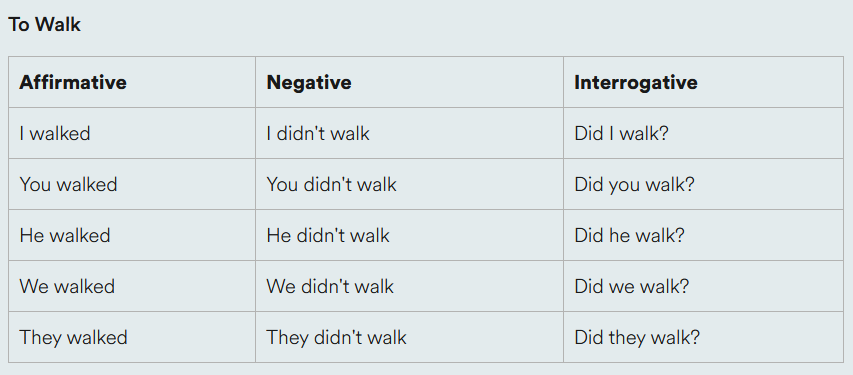
Basics in past simple:
| Personal Pronoun | Verb (Past) | Object |
|---|---|---|
| I | ate | apples |
| You | ate | apples |
| He | ate | apples |
| She | ate | apples |
| It | ate | apples |
| We | ate | apples |
| You (plural) | ate | apples |
| They | ate | apples |
| I | played | football |
| You | played | football |
| He | played | football |
| She | played | football |
| It | played | football |
| We | played | football |
| You (plural) | played | football |
| They | played | football |
| Personal Pronoun | Verb (Past Negative) | Object |
|---|---|---|
| I | did not eat | apples |
| You | did not eat | apples |
| He | did not eat | apples |
| She | did not eat | apples |
| It | did not eat | apples |
| We | did not eat | apples |
| You (plural) | did not eat | apples |
| They | did not eat | apples |
| I | did not play | football |
| You | did not play | football |
| He | did not play | football |
| She | did not play | football |
| It | did not play | football |
| We | did not play | football |
| You (plural) | did not play | football |
| They | did not play | football |
##################
Forms of ‚to be‘
| Personal Pronoun | Positive | Negative | Question |
|---|---|---|---|
| I | I was happy. | I was not happy. | Was I happy? |
| You (singular) | You were excited. | You were not excited. | Were you excited? |
| He | He was at home. | He was not at home. | Was he at home? |
| She | She was tired. | She was not tired. | Was she tired? |
| It | It was cold. | It was not cold. | Was it cold? |
| We | We were at the party. | We were not at the party. | Were we at the party? |
| You (plural) | You were friends. | You were not friends. | Were you friends? |
| They | They were in the garden. | They were not in the garden. | Were they in the garden? |
########################
How to form the past simple
We use the past simple to talk about things that happened in the past. We often use words like yesterday, last week, last year, ago.
1. Regular verbs
For most verbs, we add -ed to the verb.
Verb + ed = past simple
Examples:
- walk → walked
I walked to school yesterday. - play → played
She played football last Saturday. - start → started
I started my training last July. - clean → cleaned
He cleaned his room.
2. Verbs ending in -e
If a verb already ends in -e, we only add -d.
Examples:
- live → lived
I lived in a small village. - like → liked
I liked the place. - love → loved
She loved the music.
3. Verbs ending in consonant + y
Change y to i and add -ed.
Examples:
- study → studied
I studied English. - try → tried
I tried again.
4. Irregular verbs
Some verbs do not use -ed. Their past forms are different. You need to learn them.
5. Negative sentences
Use did not (didn’t) + verb.
The verb goes back to the present form.
Examples:
- I played football.
- I did not play football.
- She went home.
- She did not go home.
6. Questions
Use Did + person + verb?
Examples:
- Did you watch the film?
- Did she run yesterday?
- Did they visit the village?
Remember:
✅ Regular verbs → add -ed
✅ Irregular verbs → learn the special past form
✅ After did / didn’t → use the normal verb
#######################
| Infinitive | Past Simple | Past Participle | Definition |
|---|---|---|---|
| want | wanted | wanted | to wish for something |
| run | ran | run | to move fast on your feet |
| be | was / were | been | to exist; to happen |
| start | started | started | to begin something |
| prepare | prepared | prepared | to get ready for something |
| know | knew | known | to understand or have information |
| need | needed | needed | to have something necessary |
| make | made | made | to create or do something |
| become | became | become | to change and be something new |
| improve | improved | improved | to make something better |
| try | tried | tried | to make an effort |
| eat | ate | eaten | to put food in your mouth |
| drink | drank | drunk | to take liquid into your body |
| sleep | slept | slept | to rest with your eyes closed |
| train | trained | trained | to practise for a sport or skill |
| wait | waited | waited | to stay until something happens |
| stop | stopped | stopped | to finish; to not continue |
| feel | felt | felt | to have a feeling |
| give | gave | given | to hand something to someone |
| support | supported | supported | to help someone |
| encourage | encouraged | encouraged | to give someone confidence |
| arrive | arrived | arrived | to come to a place |
| manage | managed | managed | to succeed in doing something |
| complete | completed | completed | to finish something |
| plan | planned | planned | to decide what you will do |
| bring | brought | brought | to take something to a place |
################
Correct version:
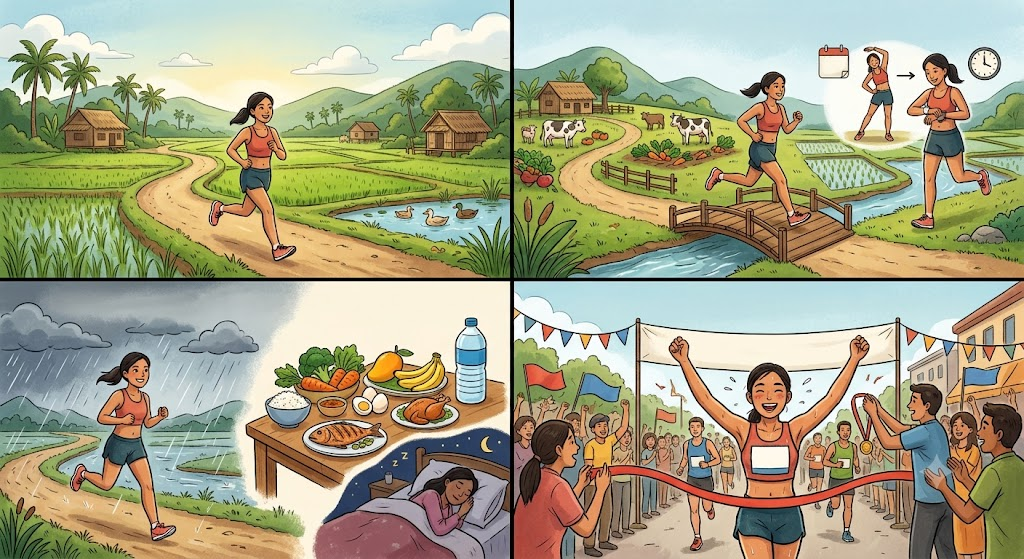
My name is Moni. I am 28 years old, and I live in the countryside in Asia. My village is small and quiet. There are green rice fields, trees, small farms, and peaceful roads around my home. I like living there because the air is fresh, and it is a great place for running. Running is my hobby, and it makes me happy.
Last July, I _____ (want) to run my first marathon. It _____ (be) a big dream for me, so I _____ (start) preparing early. I _____ (know) I _____ (need) many months of training, so I _____ (make) a simple plan. I _____ (run) three times a week to become stronger.
On Monday and Thursday, I _____ (run) for about 30 minutes. On Saturday, I _____ (run) for a longer time. I usually _____ (run) on the quiet roads near my village. Sometimes, I _____ (run) past rice fields, small farms, and rivers. I _____ (not run) fast because I _____ (want) to improve slowly. Every week, I _____ (try) to run a little farther.
I also _____ (eat) healthy food. I _____ (eat) rice, vegetables, fruit, eggs, fish, and chicken. I _____ (drink) a lot of water every day. I _____ (sleep) for about eight hours every night because my body _____ (need) rest after training.
Sometimes, training _____ (be) difficult. The weather _____ (be) very hot, or there _____ (be) heavy rain. On rainy days, I _____ (wait) until the rain _____ (stop), or I _____ (run) early in the morning when the air _____ (be) cooler. Some days, I _____ (feel) tired, but I _____ (not give) up. My family and friends _____ (support) me and _____ (encourage) me.
After many months of training, the big day _____ (arrive). I _____ (run) my first marathon and _____ (manage) to complete the race. I _____ (be) very tired, but I _____ (be) also very happy and proud. It _____ (be) a special experience for me. Now, I am planning to run another marathon in 2026 because I know that every small step can bring me closer to my dreams.
################
Correct version
My name is Moni. I am 28 years old, and I live in the countryside in Asia. My village is small and quiet. There are green rice fields, trees, small farms, and peaceful roads around my home. I like living there because the air is fresh, and it is a great place for running. Running is my hobby, and it makes me happy.
Last July, I wanted to run my first marathon. It was a big dream for me, so I started preparing early. I knew I needed many months of training, so I made a simple plan. I ran three times a week to become stronger.
On Monday and Thursday, I ran for about 30 minutes. On Saturday, I ran for a longer time. I usually ran on the quiet roads near my village. Sometimes, I ran past rice fields, small farms, and rivers. I did not run fast because I wanted to improve slowly. Every week, I tried to run a little farther.
I also ate healthy food. I ate rice, vegetables, fruit, eggs, fish, and chicken. I drank a lot of water every day. I slept for about eight hours every night because my body needed rest after training.
Sometimes, training was difficult. The weather was very hot, or there was heavy rain. On rainy days, I waited until the rain stopped, or I ran early in the morning when the air was cooler. Some days, I felt tired, but I did not give up. My family and friends supported me and encouraged me.
After many months of training, the big day arrived. I ran my first marathon and managed to complete the race. I was very tired, but I was also very happy and proud. It was a special experience for me. Now, I am planning to run another marathon in 2026 because I know that every small step can bring me closer to my dreams.
################
Read the statements and fill in the correct word from the list below:
- Something Moni wanted to achieve in the future. → __________
- Food that is good for Moni’s body. → __________
- A small place where Moni lived in the countryside. → __________
- To get better at something. → __________
- An activity Moni enjoyed in her free time. → __________
- To finish a race successfully. → __________
- Clean air that is good to breathe. → __________
- A person who knows Moni well and helps her. → __________
- The months Moni spent preparing for the marathon. → __________
- A very long running race. → __________
- Something Moni made before she started preparing. → __________
- A feeling Moni had after finishing the race. → __________
- Not quickly; step by step. → __________
- Easy and not complicated. → __________
- A physical activity that keeps the body strong. → __________
—————————————–
Words
a) marathon
b) hobby
c) improve
d) simple
e) dream
f) training
g) exercise
h) village
i) fresh
j) plan
k) complete
l) healthy
m) slowly
n) happy
o) friend
____________________________
Answers:
1e 2l 3h 4c 5b 6k 7i 8o
9f 10a 11j 12n 13m 14d 15g
____________________________
Full version:
- Something Moni wanted to achieve in the future. => dream
- Food that is good for Moni’s body. => healthy
- A small place where Moni lived in the countryside. => village
- To get better at something. => improve
- An activity Moni enjoyed in her free time. => hobby
- To finish a race successfully. => complete
- Clean air that is good to breathe. => fresh
- A person who knows Moni well and helps her. => friend
- The months Moni spent preparing for the marathon. => training
- A very long running race. => marathon
- Something Moni made before she started preparing. => plan
- A feeling Moni had after finishing the race. => happy
- Not quickly; step by step. => slowly
- Easy and not complicated. => simple
- A physical activity that keeps the body strong. => exercise
################
True or false
- Moni lives in a small and quiet village in Asia.
- She started training only a few days before the marathon.
- She likes running because it makes her happy.
- She always ran on busy roads with many cars.
- Moni is 28 years old.
- She ran three times a week to become stronger.
- She never drank water during her training.
- On Saturday, she usually ran for a longer time.
- She ate healthy food during her preparation.
- She stopped training when the weather was bad.
- There are rice fields and small farms near her home.
- She wanted to improve slowly and safely.
- She slept only three hours every night.
- Heavy rain and hot weather sometimes made training difficult.
- Her family and friends did not support her dream.
- She completed her first marathon after many months of training.
- She always ran very fast because she wanted to win.
- She drank a lot of water every day.
- She was unhappy after finishing the marathon.
- She plans to run another marathon in 2026.
___________________________
True: 1,3,5,6,8,9,11,12,14,16,18,20
___________________________
Correct version:
- Moni lives in a small and quiet village in Asia.
- She started training only a few days before the marathon.
True is: She started training many months before the marathon. - She likes running because it makes her happy.
- She always ran on busy roads with many cars.
True is: She usually ran on quiet roads near her village. - Moni is 28 years old.
- She ran three times a week to become stronger.
- She never drank water during her training.
True is: She drank a lot of water every day during her training. - On Saturday, she usually ran for a longer time.
- She ate healthy food during her preparation.
- She stopped training when the weather was bad.
True is: She continued training even when the weather was bad. - There are rice fields and small farms near her home.
- She wanted to improve slowly and safely.
- She slept only three hours every night.
True is: She slept about eight hours every night. - Heavy rain and hot weather sometimes made training difficult.
- Her family and friends did not support her dream.
True is: Her family and friends supported her dream. - She completed her first marathon after many months of training.
- She always ran very fast because she wanted to win.
True is: She did not always run very fast because she wanted to improve slowly. - She drank a lot of water every day.
- She was unhappy after finishing the marathon.
True is: She was tired but happy and proud after finishing the marathon. - She plans to run another marathon in 2026.
################
Choose the correct answer:
1. Moni lives…
A. in the countryside with rice fields and small farms.
B. in a big city with many people.
C. near the sea with many beaches.
2. Moni’s village is…
A. modern and busy.
B. small and quiet.
C. large and crowded.
3. Running is…
A. Moni’s job at a local sports centre.
B. Moni’s least favourite activity.
C. Moni’s hobby and something that makes her happy.
4. Moni trained…
A. once a month before the marathon.
B. three times a week before the marathon.
C. every day without any rest.
5. On Monday and Thursday, Moni ran…
A. for about 30 minutes.
B. for only five minutes.
C. for about three hours.
6. On Saturday, Moni usually…
A. stayed home and watched television.
B. visited friends in another village.
C. ran for a longer time.
7. Moni usually ran on…
A. large roads with many cars.
B. quiet roads near her village.
C. crowded streets in the city centre.
8. Moni wanted to…
A. improve slowly.
B. stop running after one month.
C. become famous around the world.
9. During training, Moni ate…
A. only bread and chocolate.
B. only sweets and fast food.
C. healthy food such as vegetables, fruit, eggs, fish, and chicken.
10. Moni drank…
A. only coffee before running.
B. only a little water during training.
C. a lot of water every day.
11. Moni slept…
A. about eight hours every night.
B. only three hours every night.
C. more than fifteen hours every night.
12. Training was sometimes difficult because of…
A. snow and ice every week.
B. hot weather and heavy rain.
C. strong storms every day.
13. On rainy days, Moni sometimes…
A. waited until the rain stopped.
B. moved to another country.
C. cancelled her dream completely.
14. Her family and friends…
A. told her to stop training.
B. supported and encouraged her.
C. ignored her marathon dream.
15. After finishing her first marathon, Moni was…
A. angry and disappointed.
B. bored and unhappy.
C. tired but happy and proud.
________________________
Answer Key:
1A 2B 3C 4B 5A 6C 7B 8A
9C 10C 11A 12B 13A 14B 15C
________________________
Correct version:
- Moni lives in the countryside with rice fields and small farms.
- Moni’s village is small and quiet.
- Running is Moni’s hobby and something that makes her happy.
- Moni trained three times a week before the marathon.
- On Monday and Thursday, Moni ran for about 30 minutes.
- On Saturday, Moni usually ran for a longer time.
- Moni usually ran on quiet roads near her village.
- Moni wanted to improve slowly.
- During training, Moni ate healthy food such as vegetables, fruit, eggs, fish, and chicken.
- Moni drank a lot of water every day.
- Moni slept about eight hours every night.
- Training was sometimes difficult because of hot weather and heavy rain.
- On rainy days, Moni sometimes waited until the rain stopped.
- Her family and friends supported and encouraged her.
- After finishing her first marathon, Moni was tired but happy and proud.
##################
Find the evidence in the text
- Moni’s home is a peaceful place.
Evidence: “My village is small and quiet. There are green rice fields, trees, small farms, and peaceful roads around my home.” - The area around her house is suitable for her hobby.
Evidence: ___________ - She started preparing well before the race.
Evidence: ___________ - She created a clear way to prepare for the marathon.
Evidence: ___________ - She was not interested in running very quickly.
Evidence: ___________ - Her goal was to increase her ability little by little.
Evidence: ___________ - Her meals helped her stay healthy during preparation.
Evidence: ___________ - She gave herself enough time to recover each night.
Evidence: ___________ - There were problems that made practice harder sometimes.
Evidence: ___________ - People close to her helped her continue.
Evidence: ___________ - She reached the end of her first long race.
Evidence: ___________ - The race gave her a very important memory.
Evidence: ___________ - She has another running goal for the future.
Evidence: ___________ - She thinks progress comes from small actions.
Evidence: ___________
——————————————–
Correct version:
- Moni’s home is a peaceful place.
- “My village is small and quiet. There are green rice fields, trees, small farms, and peaceful roads around my home.”
- The area around her house is suitable [right or good for something] for her hobby.
- “I like living there because the air is fresh, and it is a great place for running.”
- She started preparing well before the race.
- “Last July, I wanted to run my first marathon. It was a big dream for me, so I started preparing early.”
- She created a clear way to prepare for the marathon.
- “I knew I needed many months of training, so I made a simple plan.”
- She was not interested in running very quickly.
- “I did not run fast because I wanted to improve slowly.”
- Her goal was to increase her ability [being able to do something] little by little.
- “Every week, I tried to run a little farther.”
- Her meals helped her stay healthy during preparation.
- “I ate rice, vegetables, fruit, eggs, fish, and chicken.”
- She gave herself enough time to recover [to feel better after being tired or sick] each night.
- “I slept for about eight hours every night because my body needed rest after training.”
- There were problems that made practice harder sometimes.
- “Sometimes, training was difficult. The weather was very hot, or there was heavy rain.”
- People close to her helped her continue [to go on].
- “My family and friends supported me and encouraged me.”
- She reached the end of her first long race.
- “I ran my first marathon and managed to complete the race.”
- The race gave her a very important memory.
- “It was a special experience for me.”
- She has another running goal [something you want to do or get] for the future.
- “Now, I am planning to run another marathon in 2026 because I know that every small step can bring me closer to my dreams.”
- She thinks progress [getting better little by little] comes from small actions.
“Every small step can bring me closer to my dreams.”
##################
Match each question with the correct answer:
Questions
- How old is Moni?
- Where does Moni live?
- Why does she like her village?
- What is Moni’s hobby?
- When did she want to run her first marathon?
- How often did she train?
- Where did she usually run?
- Why did she not run fast?
- What food did she eat during training?
- How much did she sleep every night?
- What made training difficult sometimes?
- What did she do on rainy days?
- Who supported Moni?
- How did she feel after the marathon?
- What does she plan to do in 2026?
Answers
A. She wants to run another marathon.
B. She ate rice, vegetables, fruit, eggs, fish, and chicken.
C. She lives in the countryside in Asia.
D. She was tired but happy and proud.
E. Her family and friends supported her.
F. She ran three times a week.
G. She wanted to improve slowly.
H. She is 28 years old.
I. She waited until the rain stopped or ran early in the morning.
J. She likes the fresh air and the good place for running.
K. She ran on quiet roads near her village.
L. Hot weather and heavy rain made training difficult.
M. Running is her hobby.
N. Last July.
O. She slept for about eight hours every night.
_________________________
Answers:
1H 2C 3J 4M 5N 6F 7K 8G
9B 10O 11L 12I 13E 14D 15A
##################
Exercise: complete the sentences, match the halves:
Sentences
- Moni is 28 years old and she lives…
- Her village has rice fields, trees, small farms, and…
- Running is Moni’s hobby because…
- She wanted to run her first marathon because it was…
- She trained three times a week to become…
- On Monday and Thursday, she ran for about…
- On Saturday, she usually ran…
- Moni did not run fast because she wanted to…
- Every week, she tried to run…
- During her training, she ate rice, vegetables, fruit, eggs,…
- She drank…
- She slept for about eight hours because her body needed…
- Training was sometimes difficult because the weather was very hot or there was…
- Her family and friends…
- After the marathon, Moni felt tired but also…
- In 2026, she plans to…
______________________
Sentence Endings
A. a lot of water every day.
B. another marathon in the future.
C. happy and proud after the race.
D. for a longer time on Saturdays.
E. supported her and encouraged her.
F. in a quiet village in the countryside.
G. heavy rain during some training days.
H. stronger for the marathon.
I. a big dream for her.
J. enough rest after training.
K. a little farther each week.
L. it makes her happy.
M. about 30 minutes each time.
N. fish, and chicken as healthy food.
O. improve slowly.
P. peaceful roads around her home.
____________________________
Answer Key:
1F 2P 3L 4I 5H 6M 7D 😯 9K
10N 11A 12J 13G 14E 15C 16B
____________________________
Correct version:
In 2026, she plans to run another marathon in the future.
Moni is 28 years old and she lives in a quiet village in the countryside.
Her village has rice fields, trees, small farms, and peaceful roads around her home.
Running is Moni’s hobby because it makes her happy.
She wanted to run her first marathon because it was a big dream for her.
She trained three times a week to become stronger for the marathon.
On Monday and Thursday, she ran for about 30 minutes each time.
On Saturday, she usually ran for a longer time on Saturdays.
Moni did not run fast because she wanted to improve slowly.
Every week, she tried to run a little farther each week.
During her training, she ate rice, vegetables, fruit, eggs, fish, and chicken as healthy food.
She drank a lot of water every day.
She slept for about eight hours because her body needed enough rest after training.
Training was sometimes difficult because the weather was very hot or there was heavy rain during some training days.
Her family and friends supported her and encouraged her.
After the marathon, Moni felt tired but also happy and proud after the race.
##################
Fill in, words below:
peaceful – closer – countryside – happy – encouraged –
preparing – waited – last – village – fresh –
vegetables, – tired –
become – wanted
Interviewer: Hello Moni. How old are you?
Moni: I am 28 years old.
Interviewer: Where do you live?
Moni: I live in the _____ in Asia. My village is small and quiet.
Interviewer: What is your village like?
Moni: There are green rice fields, trees, small farms, and _____ roads around my home.
Interviewer: Why do you like living there?
Moni: I like living there because the air is _____, and it is a great place for running.
Interviewer: What is your hobby?
Moni: My hobby is running. Running makes me _____.
Interviewer: When did you want to run your first marathon?
Moni: _____ July, I wanted to run my first marathon.
Interviewer: Why was the marathon important to you?
Moni: It was a big dream for me, so I started _____ early.
Interviewer: How often did you train?
Moni: I trained three times a week to _____ stronger.
Interviewer: Where did you usually run?
Moni: I usually ran on the quiet roads near my _____.
Interviewer: Why did you not run fast?
Moni: I did not run fast because I _____ to improve slowly.
Interviewer: What did you eat during your training?
Moni: I ate rice, _____ fruit, eggs, fish, and chicken.
Interviewer: What did you do when the weather was difficult?
Moni: When there was heavy rain, I _____ until the rain stopped or ran early in the morning.
Interviewer: Who supported you during your training?
Moni: My family and friends supported me and _____ me.
Interviewer: How did you feel after finishing your first marathon?
Moni: I was very _____ but I was also very happy and proud.
Interviewer: Do you have another dream?
Moni: Yes, I am planning to run another marathon in 2026 because every small step can bring me _____ to my dreams.
——————————–
Full version:
Interviewer: Hello Moni. How old are you?
Moni: I am 28 years old.
Interviewer: Where do you live?
Moni: I live in the countryside in Asia. My village is small and quiet.
Interviewer: What is your village like?
Moni: There are green rice fields, trees, small farms, and peaceful roads around my home.
Interviewer: Why do you like living there?
Moni: I like living there because the air is fresh, and it is a great place for running.
Interviewer: What is your hobby?
Moni: My hobby is running. Running makes me happy.
Interviewer: When did you want to run your first marathon?
Moni: Last July, I wanted to run my first marathon.
Interviewer: Why was the marathon important to you?
Moni: It was a big dream for me, so I started preparing early.
Interviewer: How often did you train?
Moni: I trained three times a week to become stronger.
Interviewer: Where did you usually run?
Moni: I usually ran on the quiet roads near my village.
Interviewer: Why did you not run fast?
Moni: I did not run fast because I wanted to improve slowly.
Interviewer: What did you eat during your training?
Moni: I ate rice, vegetables, fruit, eggs, fish, and chicken.
Interviewer: What did you do when the weather was difficult?
Moni: When there was heavy rain, I waited until the rain stopped or ran early in the morning.
Interviewer: Who supported you during your training?
Moni: My family and friends supported me and encouraged me.
Interviewer: How did you feel after finishing your first marathon?
Moni: I was very tired, but I was also very happy and proud.
Interviewer: Do you have another dream?
Moni: Yes, I am planning to run another marathon in 2026 because every small step can bring me closer to my dreams.
##################
##################
##################
##################
Please use the box below
to write your feedback.
Only I can read it.
It is not public.
Please tell me:
- Are the texts and exercises OK?
- Are the topics OK?
- Is the level OK?
- Is it too easy or too difficult?
- Do you want texts about other topics?
Thank you! I appreciate your feedback.
##################
##################
##################
Remember how babies learn a language:
Babies learn a language by listening.
They use their ears to hear sounds.
Their brain remembers these sounds.
Babies connect sounds with people and things.
They listen to their parents.
Then they copy the sounds they hear. They imitate words.
Slowly, babies learn to speak.
So,
LISTEN, LISTEN, LISTEN, LISTEN………………
Schreibe einen Kommentar