Kategorie: FKC

  • 🥸😳👻🤠A dark street (A1, beginners, present tense, listening comprehension only) 🤠👻😳🥸

    • boy and a girl walk home at night and feel scared

    ________________________

    Vocabulary:

    • dark: no light
    • listening comprehension: you listen and understand
    • to feel scared: you feel afraid
    • to be scared: you are afraid
    • crunch: a sound like crack when you step on something
    • leaves (one leaf): green parts of a tree
    • a sound: something you hear
    • to hold one’s arm: to take someone’s arm with your hand
    • to beat fast (heart): the heart goes very fast
    • to flap: to move wings up and down
    • a bat: a small animal that flies at night
    • to be quiet: no sound
    • maybe: not sure, it can be yes or no

    ##############

    LISTEN ONLY,
    DO NOT LOOK AT TEXTS

    Listen to the story, then do the following exercises below
    (full text at the end of the exercise)

    ##############

    True is:


    1. (a) The boy and the girl walk home.
      (b) The boy and the girl walk to school.
    2. (a) It is night. It is dark.
      (b) It is day. It is bright.
    3. (a) They go into a big street with many cars.
      (b) They go into a small street with many trees.
    4. (a) “I am excited,” says the girl.
      (b) “I am scared,” says the girl.
    5. (a) They walk slowly.
      (b) They walk quickly.
    6. (a) The girl lets go of his arm.
      (b) The girl holds his arm.
    7. (a) There are no lights.
      (b) There are many lights.
    8. (a) They keep walking.
      (b) They stop.
    9. (a) A bat flies over them.
      (b) A bird flies over them.
    10. (a) They hear a sound.
      (b) They hear nothing.
    11. (a) “Run now,” says the boy.
      (b) “It is okay,” says the boy.
    12. (a) They walk slowly.
      (b) They run fast.

    ___________________
    Correct Answers:

    1a, 2a, 3b, 4b, 5a, 6b, 7a, 8b, 9a, 10a, 11b, 12b

    #############

    (a) or (b)?


    1. Do the boy and the girl walk (a) to school or (b) home?
    2. Is it (a) day or (b) night?
    3. Are there (a) lights or (b) no lights?
    4. Is the street (a) small or (b) big?
    5. Is the girl (a) scared or (b) happy?
    6. Does the boy say (a) “It is okay” or (b) “Run now”?
    7. Do they walk (a) slowly or (b) fast?
    8. Does a (a) bird or (b) bat fly over them?
    9. Do they (a) stop or (b) keep running?
    10. Does the girl (a) hold his arm or (b) let go of his arm?

    _________________

    Answers:
    1b, 2b, 3b, 4a, 5a, 6a, 7b, 8b, 9a, 10a


    #############

    A dark street

    The boy and the girl walk home.

    It is night. It is dark.

    They go into a small street with many trees. There are no lights.

    “I am scared,” says the girl.

    “It is okay,” says the boy.

    They walk.

    Crunch.

    They stop.

    “What is that?” she says.

    “Leaves,” he says.

    They walk again.

    They hear a sound.

    The girl holds his arm. Their hearts beat fast.

    “Let’s go,” he says.

    They walk fast.

    Flap!

    A bat flies over them.

    “Aaa!” says the girl.

    “It is just a bat,” says the boy.

    They stop.

    It is quiet.

    Crunch.

    They look back.

    Flap!

    Another bat flies out.

    They run.

    They run fast.

    They do not stop.

    Maybe more bats are there.

    #####################

    #####################

    Listen to the story and fill in,
    if necessary click on

    The boy and the girl __________ home at night.
    The street is small and dark.
    There are many __________.
    There are no lights.

    The girl feels __________.
    The boy feels calm.
    They walk __________.
    They hear a sound on the ground.
    It is leaves.
    They continue __________.

    Suddenly, a bat flies over them.
    The girl is __________.
    They run fast.
    Another __________ flies near them.
    They do not stop.
    They keep ___________.
    The street is quiet again.
    They are __________.

    ————————————–

    Full version:

    The boy and the girl walk home at night. The street is small and dark. There are many trees. There are no lights.

    The girl feels scared. The boy feels calm. They walk slowly. They hear a sound on the ground. It is leaves. They continue walking.

    Suddenly, a bat flies over them. The girl is frightened. They run fast. Another bat flies near them. They do not stop. They keep running. The street is quiet again. They are safe.

  • 🥸😳👻🤠Night walk in the dark woods (A1, beginners, present simple, listening comprehension only) 🤠👻😳🥸

    • A boy and a girl hear a strange sound in the night forest and feel afraid.

    LISTEN ONLY,
    DO NOT LOOK AT TEXTS

    Listen to the story, then do the following exercises below
    (full text at the end of the exercise)

    ´___________________
    Vocabulary:

    to beat fast (heart): when your heart goes very quickly

    dark woods: a forest with no light

    listening comprehension: understanding what you hear

    to be quiet: not make noise

    a torch: a small light you hold in your hand

    a path: a small way to walk on

    to feel scared: to feel afraid

    a soft sound: a quiet sound

    to walk slowly: to walk not fast

    leaves: green parts of a tree

    suddenly: very quickly, without warning

    to shake: to move fast up and down or side to side

    a shadow: a dark shape from light

    to be still: not move

    a step: one movement when you walk

    to shine like stars: to be bright like stars

    to gasp: to take a quick breath in surprise

    a fox: a small wild animal with red fur

    to laugh a little: to laugh a small amount

    ###############

    LISTEN ONLY

    True is:

    1. (a) Tom and Anna walk at night. (b) They walk in the morning.
    2. (a) The sky is bright and blue. (b) It is very dark in the woods.
    3. (a) Tom has a torch in his hand. (b) Anna drops the torch.
    4. (a) They walk slowly on the path. (b) They run very fast all the time.
    5. (a) Anna hears a sound. (b) Anna has no fear.
    6. (a) The animal talks to them. (b) The animal is small.
    7. (a) They see eyes in the dark. (b) They see a big dog.
    8. (a) They go home before the end. (b) They feel scared in the woods.
    9. (a) Tom looks around. (b) Tom says nothing.
    10. (a) The torch light moves. (b) The light stays still.

    ____________________

    Correct:

    1. (a) Tom and Anna walk at night. (b) They walk in the morning. ✅ a
    2. (a) The sky is bright and blue. (b) It is very dark in the woods. ✅ b
    3. (a) Tom has a torch in his hand. (b) Anna drops the torch. ✅ a
    4. (a) They walk slowly on the path. (b) They run very fast all the time. ✅ a
    5. (a) Anna hears a sound. (b) Anna has no fear. ✅ a
    6. (a) The animal talks to them. (b) The animal is small. ✅ b
    7. (a) They see eyes in the dark. (b) They see a big dog. ✅ a
    8. (a) They go home before the end. (b) They feel scared in the woods. ✅ b
    9. (a) Tom looks around. (b) Tom says nothing. ✅ a
    10. (a) The torch light moves. (b) The light stays still. ✅ a

    ##############

    LISTEN ONLY


    Which one is correct?

    1. Does Anna hold (a) the torch or (b) Tom’s arm?

    2. Does Anna walk in the woods (a) at night or (b) in the morning?

    3. Is the forest (a) very dark or (b) very bright?

    4. Who has the torch? (a) Anna or (b) Tom?

    5. Do they walk (a) slowly or (b) very fast?

    6. Does Anna hear a (a) loud sound or (b) soft sound?

    7. Is the animal they see (a) small or (b) big?

    8. Do they see (a) a big dog or (b) two eyes in the dark?

    9. Do they feel (a) happy or (b) scared in the woods?

    10. Does Tom (a) sit down or (b) look around?

    11. Does the torch light (a) stay still or (b) move?

    12. Do they walk on (a) the grass or (b) a path?

    13. Does the fox (a) stay near them or (b) run away?

    14. Is the wind in the forest (a) cold or (b) hot?

    ______________________
    Correct answers:

    1. Does Anna walk in the woods (a) at night or (b) in the morning? ✅ a
    2. Is the forest (a) very dark or (b) very bright? ✅ a
    3. Who has the torch? (a) Anna or (b) Tom? ✅ b
    4. Do they walk (a) slowly or (b) very fast? ✅ a
    5. Does Anna hear a (a) loud sound or (b) soft sound? ✅ b
    6. Is the animal they see (a) small or (b) big? ✅ a
    7. Do they see (a) a big dog or (b) two eyes in the dark? ✅ b
    8. Do they feel (a) happy or (b) scared in the woods? ✅ a
    9. Does Tom (a) sit down or (b) look around? ✅ b
    10. Does the torch light (a) stay still or (b) move? ✅ a
    11. Do they walk on (a) the grass or (b) a path? ✅ b
    12. Does the fox (a) stay near them or (b) run away? ✅ b
    13. Is the wind in the forest (a) cold or (b) hot? ✅ a
    14. Does Anna hold (a) the torch or (b) Tom’s arm? ✅ b

    ###############

    LISTEN ONLY

    1. Is Anna
      a) a girl
      b) a boy
    2. Is Tom
      a) a boy
      b) a girl
    3. Where do they walk?
      a) in the woods
      b) in the city
    4. When do they walk?
      a) in the morning
      b) at night
    5. Who has the torch?
      a) Tom
      b) Anna
    6. How do they walk?
      a) very fast
      b) slowly
    7. What do they hear?
      a) a soft sound
      b) a loud song
    8. What moves in the dark?
      a) a car
      b) a shadow
    9. What animal do they see?
      a) a fox
      b) a dog
    10. How does Anna feel?
      a) happy
      b) scared
    11. What do they walk on?
      a) the grass
      b) a path
    12. What does the torch do?
      a) moves
      b) stays still
    13. Who does Anna hold?
      a) the torch
      b) Tom’s arm
    14. What is the wind like?
      a) cold
      b) hot

    ____________________

    Answers:

    1a, 2a, 3a, 4b, 5a, 6b, 7a,
    8b, 9a, 10b, 11b, 12a, 13b, 14a

    ###############

    Tom is a boy. Anna is a girl. They walk in the woods at night. It is very dark. The trees are tall and quiet. The wind is cold. Tom has a torch. The light is small, but it helps them see the path.

    Anna feels scared. She hears a soft sound. “Did you hear that?” she asks. Tom looks around, but he sees nothing. They walk slowly. The leaves move under their feet.

    Suddenly, the torch light shakes. It goes left, then right. A shadow moves behind a tree. Tom stops. Anna holds his arm. They are very still.

    The sound comes again. Step… step… step…

    “Who is there?” Tom says. No answer.

    The torch light shows two small eyes in the dark. They shine like stars. Anna gasps.

    Then, a small animal runs away. It is only a fox.

    Tom and Anna laugh a little, but their hearts still beat fast.

  • 🥳👻🍳When dreams come true (A1, beginners, present simple, listening comprehension only)🍳👻🥳

    • from dream to reality


    ___________________________

    Vocabulary:

    • to come true → to really happen
    • BBQ (barbecue) → food cooked on a fire (like meat)
    • a dream → pictures and stories in your sleep
    • at night → when it is dark and you sleep
    • an idol → a person you really like and look up to
    • a movie star → a famous actor in movies
    • to wake up → to stop sleeping
    • to smell something → to feel a smell with your nose
    • a kitchen → a room where you cook food
    • to make breakfast → to cook food in the morning
    • to smile → to look happy with your face
    • to be happy → to feel good and glad

    ___________________________

    LISTEN ONLY,
    DO NOT LOOK AT TEXTS

    full text at the end of the exercise

    the do the following exercises:

    ###################

    True or false:

    1. The boy eats breakfast in his bedroom.
    2. The boy wakes up in the morning.
    3. The movie star is the boy’s teacher.
    4. The boy goes to the kitchen after he wakes up.
    5. The family is sad in the dream.
    6. The boy smells BBQ in the bathroom.
    7. The BBQ in the dream is not good.
    8. The boy has a dream at night.
    9. The boy is happy at the end.
    10. The boy goes back to sleep after breakfast.
    11. The mom says “Good morning!”
    12. The boy sleeps in his bed.
    13. The movie star eats BBQ with the boy’s family.
    14. The boy’s mom sleeps in the kitchen.

    ______________________

    True: 2,4,8,9,11,12,13


    ################

    LISTEN ONLY


    1. Does the boy dream at night or during the day?
    2. Does he go to the kitchen or to the garden after waking up?
    3. Is his idol a football star or a movie star?
    4. Does his mom smile or frown and say “Good morning”?
    5. Does the boy eat pizza or BBQ in his dream?
    6. Does the boy wake up at night or in the morning?
    7. Is the boy happy or angry at the end of the story?
    8. Does the boy sleep on a sofa or in his bed?
    9. Does the dream disappear without effect or come true?
    10. Does the boy smell flowers or BBQ in his bedroom?
    11. Is the BBQ in the dream very bad or very good?
    12. Does the boy’s family feel sad or happy in the dream?
    13. Does the movie star have BBQ with his friends or with the boy’s family?
    14. Does his mom make lunch or breakfast?

    ___________________

    Correct answers:


    1. Does the boy dream at night or during the day? → night
    2. Does he go to the kitchen or to the garden after waking up? → kitchen
    3. Is his idol a football star or a movie star? → movie star
    4. Does his mom smile or frown and say “Good morning”? → smile
    5. Does the boy eat pizza or BBQ in his dream? → BBQ
    6. Does the boy wake up at night or in the morning? → morning
    7. Is the boy happy or angry at the end of the story? → happy
    8. Does the boy sleep on a sofa or in his bed? → bed
    9. Does the dream disappear without effect or come true? → come true
    10. Does the boy smell flowers or BBQ in his bedroom? → BBQ
    11. Is the BBQ in the dream very bad or very good? → very good
    12. Does the boy’s family feel sad or happy in the dream? → happy
    13. Does the movie star have BBQ with his friends or with the boy’s family? → boy’s family
    14. Does his mom make lunch or breakfast? → breakfast

    ##################


    LISTEN ONLY

    1. The person who sleeps in a bed is
      a) a boy
      b) a girl
    2. The person loves
      a) pizza
      b) BBQ
    3. The person dreams
      a) during the day
      b) at night
    4. In the dream, the person eats
      a) pizza
      b) BBQ
    5. The BBQ in the dream is
      a) very good
      b) very bad
    6. The person’s idol is
      a) a football star
      b) a movie star
    7. The movie star eats BBQ with
      a) the person’s family
      b) the person’s friends
    8. The family in the dream feels
      a) sad
      b) happy
    9. When the person wakes up, it is
      a) night
      b) morning
    10. The person smells
      a) BBQ
      b) flowers
    11. After waking up, the person goes to
      a) the garden
      b) the kitchen
    12. The mom makes
      a) lunch
      b) breakfast
    13. The mom is
      a) smiling
      b) frowning
    14. At the end of the story, the person feels
      a) happy
      b) angry

    _________________

    Answers:
    1a, 2b, 3b, 4b, 5a, 6b, 7a,
    8b, 9b, 10a, 11b, 12b, 13a, 14a

    The BBQ Dream

    The boy sleeps in his bed.
    He likes BBQ very much.

    He dreams at night.
    In his dream, he eats BBQ.
    The BBQ is very good.

    His idol is a movie star.
    The movie star is in the dream.
    He has BBQ with the boy and his family.
    They are happy. It is great.

    The boy wakes up.
    He smells BBQ in his bedroom.

    He goes to the kitchen.
    His mom makes breakfast.
    She smiles and says, “Good morning!”

    The boy is happy.

  • 🥸🎒⚽A day in Lina’s life – memories (A1, beginners, questions, short answers, past simple, part 2/2)⚽🎒🥸

    • Lina is a teacher now, remembering her time when she was 10

    There is a present simple A1 version,
    Lina as a child => link

    ###############


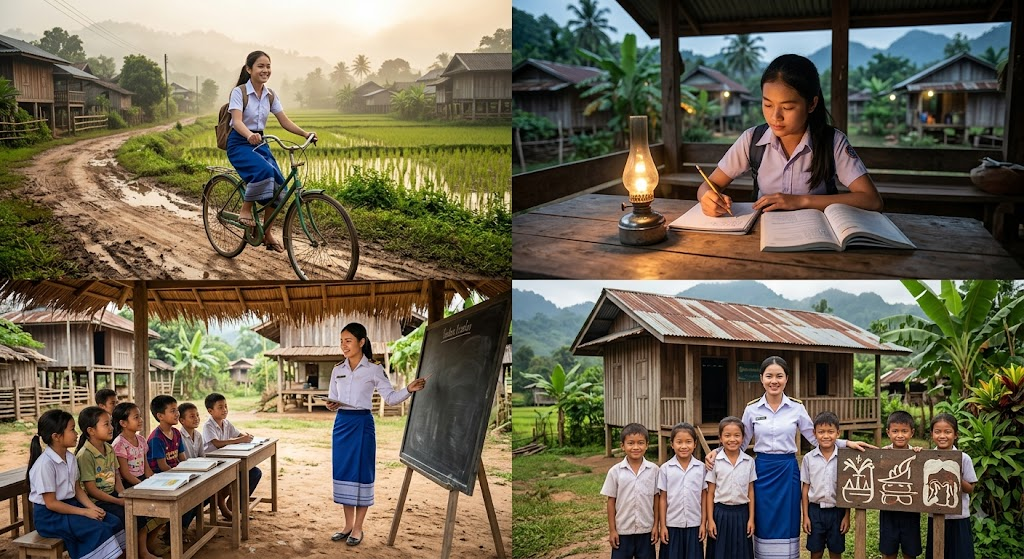
    Lina was a 10-year-old girl. She lived in a small village in Southeast Asia. She lived with her parents and grandparents. Her father was a farmer. Her mother sold vegetables and fruits at the morning market.

    Lina woke up early every day. She helped her mother prepare food and carry things. Then she walked to school. The walk was long, but she liked it. She saw trees, animals, and her friends.

    At school, Lina was happy. She loved learning. Her favorite subjects were Maths and English. She listened to her teacher and worked hard. She also played with her friends during breaks.

    After school, Lina walked home. She helped her family again. In the evening, she did her homework and studied.

    Lina wanted to be a teacher one day. She wanted to help young children in her village learn and have a better life.

    And she has lived her dream – SHE IS A TEACHER NOW.

    ________________________

    Vocabulary:

    • to remember: to keep something in your mind and not forget it
    • to dream of something: to want something very much in the future
    • a village: a small place where people live, smaller than a town
    • grandparents: the parents of your mother or father
    • to sell vegetables: to give vegetables to people for money
    • morning market: a place where people buy and sell things in the morning
    • to wake up: to stop sleeping
    • to prepare food: to make food ready to eat
    • to carry things: to hold and take things from one place to another
    • a favorite subject: the school subject you like best
    • to listen to somebody: to hear and pay attention to someone
    • to work hard: to do a lot of work with effort
    • a break (school): a short time to rest at school
    • to study: to learn and read for school
    • to have a better life: to live in a happier and easier way

    ###################

    Dieses Bild hat ein leeres Alt-Attribut. Der Dateiname ist grafik-2.png

    Verbs in text, regular and irregular:

    InfinitivePastA1 Definition
    bewas / wereto exist; to be something
    livelivedto have a home in a place
    sellsoldto give something for money
    wake upwoke upto stop sleeping
    helphelpedto do something for someone
    preparepreparedto get something ready
    carrycarriedto hold and take something
    walkwalkedto move on your feet
    likelikedto think something is good
    seesawto use your eyes
    lovelovedto like something very much
    listenlistenedto hear and pay attention
    workworkedto do a job or task
    playplayedto have fun or do a game
    dodidto make or finish something
    studystudiedto learn about something
    wantwantedto wish for something
    learnlearnedto get knowledge or skill
    havehadto own or get something

    ###############

    Basics in past simple:

    Past Simple – Regular Verbs

    Rules:

    • Most verbs: add -ed
      play → played
    • Verbs ending in -e: add -d
      live → lived
    • Verbs ending in consonant + y: change y to i and add -ed
      study → studied
    • Short verbs ending in vowel + consonant: double the final consonant and add -ed
      stop → stopped
    • List of irregular verbs => LINK

    Use:
    The past simple is used to talk about finished actions in the past.

    ################

    Match the words with the definitions:

    1. to dream of something
    2. a village
    3. grandparents
    4. to sell vegetables
    5. morning market
    6. to wake up
    7. to prepare food
    8. to carry things
    9. a favorite subject
    10. to listen to somebody
    11. to work hard
    12. a break (school)
    13. to study
    14. to have a better life

      Definitions:

    A. to stop sleeping
    B. to give vegetables to people for money
    C. to hear and pay attention to someone
    D. the parents of your mother or father
    E. to want something very much in the future
    F. to make food ready to eat
    G. a small place where people live, smaller than a town
    H. a short time to rest at school
    I. to hold and take things from one place to another
    J. a place where people buy and sell things in the morning
    K. to do a lot of work with effort
    L. the school subject you like best
    M. to learn and read for school
    N. to live in a happier and easier way

    ___________________
    Answers:
    1-E, 2-G, 3-D, 4-B, 5-J,
    6-A, 7-F, 8-I, 9-L, 10-C,
    11-K, 12-H, 13-M, 14-N

    ###############

    Find words that match the definitions below:

    Definitions:

    1. to hold and take things from one place to another
    2. to live in a happier and easier way
    3. to stop sleeping
    4. a short time to rest at school
    5. to make food ready to eat
    6. the parents of your mother or father
    7. a place where people buy and sell things in the morning
    8. to do a lot of work with effort
    9. to want something very much in the future
    10. to hear and pay attention to someone
    11. a small place where people live, smaller than a town
    12. to learn and read for school
    13. the school subject you like best
    14. to give vegetables to people for money

    Words:

    a. to study
    b. to wake up
    c. to carry things
    d. grandparents
    e. to work hard
    f. a village
    g. to prepare food
    h. to sell vegetables
    i. to listen to somebody
    j. a break (school)
    k. to dream of something
    l. a favorite subject
    m. morning market
    n. to have a better life

    _____________________
    Answers:
    1-c, 2-n, 3-b, 4-j, 5-g,
    6-d, 7-m, 8-e, 9-k, 10-i,
    11-f, 12-a, 13-l, 14-h

    #################

    True or false:

    1. To carry things means to take things from one place to another.
    2. To work hard means to do very little work.
    3. A favorite subject is the subject you like best.
    4. To dream of something means to not want anything.
    5. A morning market happens at night.
    6. Grandparents are your mother’s or father’s parents.
    7. To prepare food means to make food ready to eat.
    8. To wake up means to start sleeping.
    9. To study means to learn for school.
    10. To sell vegetables means to buy vegetables.
    11. To listen to somebody means to ignore them.
    12. A break at school is time to rest.
    13. A village is a small place where people live.
    14. To have a better life means to live in a worse way.

    _____________________

    True: 1,3,6,7,9,12,13

    #################

    True or false:

    1. Lina went to school by bus.
    2. Her favorite subjects were Maths and English.
    3. She lived in a small village in Southeast Asia.
    4. Lina wanted to be a doctor.
    5. Lina walked to school every day.
    6. She never helped her family.
    7. Lina became a teacher in the end.
    8. Her mother worked in a school.
    9. Lina was a 10-year-old girl.
    10. She lived only with her parents.
    11. She did not like learning.
    12. Her father was a farmer.
    13. Lina lived in a big city.
    14. She liked the walk to school.

    _______________________

    True: 2,3,5,7,9,12,14

    #################

    Short answers, past simple, basics:

    Example SentenceYesNo
    I learned letters.Yes, I did.No, I didn’t.
    You read signs.Yes, you did.No, you didn’t.
    He spoke English.Yes, he did.No, he didn’t.
    She watched TV.Yes, she did.No, she didn’t.
    It helped me.Yes, it did.No, it didn’t.
    We used an app.Yes, we did.No, we didn’t.
    You read words.Yes, you did.No, you didn’t.
    They made mistakes.Yes, they did.No, they didn’t.

    Questions (Past Simple)

    QuestionYesNo
    Did I learn letters?Yes, I did.No, I didn’t.
    Did you read signs?Yes, you did.No, you didn’t.
    Did he speak English?Yes, he did.No, he didn’t.
    Did she watch TV?Yes, she did.No, she didn’t.
    Did it help me?Yes, it did.No, it didn’t.
    Did we use an app?Yes, we did.No, we didn’t.
    Did you read words?Yes, you did.No, you didn’t.
    Did they make mistakes?Yes, they did.No, they didn’t.

    Was / Were

    QuestionYesNo
    Was I happy?Yes, I was.No, I wasn’t.
    Were you happy?Yes, you were.No, you weren’t.
    Was he happy?Yes, he was.No, he wasn’t.
    Was she happy?Yes, she was.No, she wasn’t.
    Was it good?Yes, it was.No, it wasn’t.
    Were we happy?Yes, we were.No, we weren’t.
    Were you happy?Yes, you were.No, you weren’t.
    Were they happy?Yes, they were.No, they weren’t.

    #################

    Give short answers:

    1. Lina became a doctor.

      YOU WRITE:
      Yes, she did.

    2. Lina was a 10-year-old girl.
    3. She played with her friends during breaks.
    4. Lina did not go to school.
    5. Her favorite subjects Maths and English were.
    6. She woke up late every day.
    7. Lina lived with her parents and grandparents.
    8. Lina was unhappy at school.
    9. She helped her mother in the morning.
    10. The walk to school was long.
    11. Her favorite subjects History and Art were.
    12. Her father was a teacher.
    13. In the evening, she did her homework.
    14. Lina lived alone.
    15. She was happy at school.
    16. The school was very close to her house.
    17. She hated Maths and English.
    18. Her mother sold vegetables and fruits.
    19. Lina woke up early every day.
    20. Lina was 15 years old.

    _______________________

    Correct version:


    Lina became a doctor. – No, she didn’t.

    Lina was a 10-year-old girl. – Yes, she was.

    She played with her friends during breaks. – Yes, she did.

    Lina did not go to school. – No, she didn’t.

    Her favorite subjects Maths and English were. – Yes, they were.

    She woke up late every day. – No, she didn’t.

    Lina lived with her parents and grandparents. – Yes, she did.

    Lina was unhappy at school. – No, she wasn’t.

    She helped her mother in the morning. – Yes, she did.

    The walk to school was long. – Yes, it was.

    Her favorite subjects History and Art were. – No, they weren’t.

    Her father was a teacher. – No, he wasn’t.

    In the evening, she did her homework. – Yes, she did.

    Lina lived alone. – No, she didn’t.

    She was happy at school. – Yes, she was.

    The school was very close to her house. – No, it wasn’t.

    She hated Maths and English. – No, she didn’t.

    Her mother sold vegetables and fruits. – Yes, she did.

    Lina woke up early every day. – Yes, she did.

    Lina was 15 years old. – No, she wasn’t.

    #################

    Short answers, if false, provide short answer and then the corrected version:

    1. Did Lina play with her teachers during breaks?

      YOU WRITE:
      No, she didn’t.
      She played with her friends during breaks.

    2. Did she help carry things for her mother?
    3. Did Lina ride a car to school?
    4. Did she help her father sell fruits at the market?
    5. Were two of Lina’s favorite subjects Maths and English?
    6. Did Lina love learning at school?
    7. Did she spend all her time away from her family?
    8. Did Lina see animals and friends on her way to school?
    9. Was Lina 10 years old?
    10. Did Lina walk to school every day?
    11. Was Lina’s father a teacher?
    12. Did Lina dislike learning at school?
    13. Did her mother sell vegetables and fruits at the morning market?
    14. Was her favorite subject Science only?
    15. Did she help her mother prepare food?
    16. Did Lina live in a big city?
    17. Were her favorite subjects Science and History?
    18. Did she want to be a teacher in the future?
    19. Did she sleep all morning?
    20. Did Lina become a teacher in the end?

    _______________________

    Correct version:

    1. Did Lina play with her teachers during breaks? – No, she didn’t.
    2. Did she help carry things for her mother? – Yes, she did.
    3. Did Lina ride a car to school? – No, she didn’t. She walked to school every day.
    4. Did she help her father sell fruits at the market? – No, she didn’t. Her mother sold fruits and vegetables at the market.
    5. Were two of Lina’s favorite subjects Maths and English? – Yes, they were.
    6. Did Lina love learning at school? – Yes, she did.
    7. Did she spend all her time away from her family? – No, she didn’t. She helped her family at home every day.
    8. Did Lina see animals and friends on her way to school? – Yes, she did.
    9. Was Lina 10 years old? – Yes, she was.
    10. Did Lina walk to school every day? – Yes, she did.
    11. Was Lina’s father a teacher? – No, he wasn’t. He was a farmer.
    12. Did Lina dislike learning at school? – No, she didn’t. She loved learning at school.
    13. Did her mother sell vegetables and fruits at the morning market? – Yes, she did.
    14. Was her favorite subject Science only? – No, it wasn’t. Her favorite subjects were Maths and English.
    15. Did she help her mother prepare food? – Yes, she did.
    16. Did Lina live in a big city? – No, she didn’t. She lived in a small village.
    17. Were her favorite subjects Science and History? – No, they weren’t. Her favorite subjects were Maths and English.
    18. Did she want to be a teacher in the future? – Yes, she did.
    19. Did she sleep all morning? – No, she didn’t. She woke up early every day.
    20. Did Lina become a teacher in the end? – Yes, she did.

    #################

    Fill in:

    Lina was ______ years old.

    She lived in a small ______ in Southeast Asia.

    Her father worked as a ______.

    Her mother sold ______ and ______ at the morning market.

    Lina walked to ______ every day.

    She helped her mother prepare ______ and carry ______.

    Lina’s favorite subjects were ______ and ______.

    In the evening, Lina did her ______ and studied.

    She wanted to be a ______ in the future.

    She wanted to help ______ in her village.

    Lina woke up ______ every day.

    On her way to school, she saw ______ and ______.

    She played with her ______ during school breaks.

    Her father worked hard as a ______.

    ————————————-
    Correct version:

    Lina was 10 years old.

    She lived in a small village in Southeast Asia.

    Her father worked as a farmer.

    Her mother sold vegetables and fruits at the morning market.

    Lina walked to school every day.

    She helped her mother prepare food and carry things.

    Lina’s favorite subjects were Maths and English.

    In the evening, Lina did her homework and studied.

    She wanted to be a teacher in the future.

    She wanted to help young children in her village.

    Lina woke up early every day.

    On her way to school, she saw trees and animals.

    She played with her friends during school breaks.

    Her father worked hard as a farmer.

    #################

    #################

    Past simple – basics

    Personal PronounVerb (Past)Object
    Iateapples
    Youateapples
    Heateapples
    Sheateapples
    Itateapples
    Weateapples
    You (plural)ateapples
    Theyateapples
    Iplayedfootball
    Youplayedfootball
    Heplayedfootball
    Sheplayedfootball
    Itplayedfootball
    Weplayedfootball
    You (plural)playedfootball
    Theyplayedfootball
    Personal PronounVerb (Past Negative)Object
    Idid not eatapples
    Youdid not eatapples
    Hedid not eatapples
    Shedid not eatapples
    Itdid not eatapples
    Wedid not eatapples
    You (plural)did not eatapples
    Theydid not eatapples
    Idid not playfootball
    Youdid not playfootball
    Hedid not playfootball
    Shedid not playfootball
    Itdid not playfootball
    Wedid not playfootball
    You (plural)did not playfootball
    Theydid not playfootball
    Did + PronounVerbObject
    Did Ieatapples?
    Did youeatapples?
    Did heeatapples?
    Did sheeatapples?
    Did iteatapples?
    Did weeatapples?
    Did youeatapples?
    Did theyeatapples?
    Did Iplayfootball?
    Did youplayfootball?
    Did heplayfootball?
    Did sheplayfootball?
    Did itplayfootball?
    Did weplayfootball?
    Did youplayfootball?
    Did theyplayfootball?
    Didn’t + PronounVerbObject
    Didn’t Ieatapples?
    Didn’t youeatapples?
    Didn’t heeatapples?
    Didn’t sheeatapples?
    Didn’t iteatapples?
    Didn’t weeatapples?
    Didn’t youeatapples?
    Didn’t theyeatapples?
    Didn’t Iplayfootball?
    Didn’t youplayfootball?
    Didn’t heplayfootball?
    Didn’t sheplayfootball?
    Didn’t itplayfootball?
    Didn’t weplayfootball?
    Didn’t youplayfootball?
    Didn’t theyplayfootball?

    Forms of ‚to be‘

    Personal PronounPositiveNegativeQuestion
    II was happy.I was not happy.Was I happy?
    You (singular)You were excited.You were not excited.Were you excited?
    HeHe was at home.He was not at home.Was he at home?
    SheShe was tired.She was not tired.Was she tired?
    ItIt was cold.It was not cold.Was it cold?
    WeWe were at the party.We were not at the party.Were we at the party?
    You (plural)You were friends.You were not friends.Were you friends?
    TheyThey were in the garden.They were not in the garden.Were they in the garden?

    ##############

    Rewrite as shown below:

    1. Lina was 10 years old.

      YOU WRITE:
      a) Lina was not 10 years old.
      b) Was Lina 10 years old?
      c) Wasn’t Lina 10 years old?

    2. She lived in a small village in Southeast Asia.
    3. Her father worked as a farmer.
    4. Her mother sold vegetables and fruits at the morning market.
    5. Lina woke up early every day.
    6. She helped her mother prepare food and carry things.
    7. Lina walked to school and saw trees, animals, and friends.
    8. Her favorite subjects were Maths and English.
    9. Lina wanted to be a teacher in the future.
    10. She played with her friends during school breaks.

    ______________________

    Correct version:


    Lina was 10 years old.
    a) Lina was not 10 years old.
    b) Was Lina 10 years old?
    c) Wasn’t Lina 10 years old?

    She lived in a small village in Southeast Asia.
    a) She did not live in a small village in Southeast Asia.
    b) Did she live in a small village in Southeast Asia?
    c) Didn’t she live in a small village in Southeast Asia?

    Her father worked as a farmer.
    a) Her father did not work as a farmer.
    b) Did her father work as a farmer?
    c) Didn’t her father work as a farmer?

    Her mother sold vegetables and fruits at the morning market.
    a) Her mother did not sell vegetables and fruits at the morning market.
    b) Did her mother sell vegetables and fruits at the morning market?
    c) Didn’t her mother sell vegetables and fruits at the morning market?

    Lina woke up early every day.
    a) Lina did not wake up early every day.
    b) Did Lina wake up early every day?
    c) Didn’t Lina wake up early every day?

    She helped her mother prepare food and carry things.
    a) She did not help her mother prepare food and carry things.
    b) Did she help her mother prepare food and carry things?
    c) Didn’t she help her mother prepare food and carry things?

    Lina walked to school and saw trees, animals, and friends.
    a) Lina did not walk to school and see trees, animals, and friends.
    b) Did Lina walk to school and see trees, animals, and friends?
    c) Didn’t Lina walk to school and see trees, animals, and friends?

    Her favorite subjects were Maths and English.
    a) Her favorite subjects were not Maths and English.
    b) Were her favorite subjects Maths and English?
    c) Weren’t her favorite subjects Maths and English?

    Lina wanted to be a teacher in the future.
    a) Lina did not want to be a teacher in the future.
    b) Did Lina want to be a teacher in the future?
    c) Didn’t Lina want to be a teacher in the future?
    ___end of audio___

    She played with her friends during school breaks.
    a) She did not play with her friends during school breaks.
    b) Did she play with her friends during school breaks?
    c) Didn’t she play with her friends during school breaks?


    ################

    Form questions to which the word/s given is/are the correct answer:

    1. Her mother sold vegetables and fruits at the morning market.
      a) Her mother:
      b) Her:
      c) sold vegetables and fruits at the morning market:
      d) vegetables and fruits:
      e) at the morning market:

    2. Lina woke up early every day.
      a) Lina:
      b) woke up early every day:
      c) early:
      d) every day:

    3. She helped her mother.
      a) She:
      b) helped her mother prepare food :
      c) her mother:
      d) her:

    4. Lina walke to school with her friends.
      a) Lina:
      b) walked to school with her friends:
      c) to school:
      d) with her friends:
      e) her:

    5. Lina wanted to be a teacher in the future.
      a) Lina:
      b) wanted to be a teacher in the future:
      c) a teacher:
      d) in the future:

    ____________________

    Correct version:


    Her mother sold vegetables and fruits at the morning market.
    a) Her mother: Who sold vegetables and fruits at the morning market?
    b) Her: Whose mother sold vegetables and fruits at the morning market?
    c) sold vegetables and fruits at the morning market: What did her mother do at the morning market?
    d) vegetables and fruits: What did her mother sell?
    e) at the morning market: Where did her mother sell vegetables and fruits?


    Lina woke up early every day.
    a) Lina: Who woke up early every day?
    b) woke up early every day: What did Lina do every day?
    c) early: When did Lina wake up every day?
    d) every day: How often did Lina wake up early?


    She helped her mother.
    a) She: Who helped her mother?
    b) helped her mother prepare food: What did she do?
    c) her mother: Who did she help?
    d) her: Whose mother did she help?


    Lina walked to school with her friends.
    a) Lina: Who walked to school with friends?
    b) walked to school with her friends: What did Lina do?
    c) to school: Where did Lina walk to?
    d) with her friends: Who did Lina walk with?
    e) her: With whose friends did she walk to school?


    Lina wanted to be a teacher in the future.
    a) Lina: Who wanted to be a teacher?
    b) wanted to be a teacher in the future: What did Lina want to do?
    c) a teacher: What did Lina want to be?
    d) in the future: When did Lina want to be a teacher?


    ##############

    Complete:


    Interviewer: Hello, Lina! Can you tell us about your childhood?

    Lina: Hello! Yes, I can.

    Interviewer: How old were you when you were a ____________?
    Lina: I was 10 years old.

    Interviewer: Where did you live?
    Lina: I lived in a small _____________ in Southeast Asia.

    Interviewer: Who did you live with?
    Lina: I lived with my parents and ______________.

    Interviewer: What did your father do?
    Lina: My father worked as a ___________.

    Interviewer: What did your mother do?
    Lina: My mother ______________vegetables and fruits at the morning market.

    Interviewer: How did you help your mother?
    Lina: I helped her prepare food and ____________ things.

    Interviewer: How did you go to school?
    Lina: I _______________ to school every day.

    Interviewer: What did you see on your way to school?
    Lina: I saw trees, animals, and my ______________.

    Interviewer: When did you wake up?
    Lina: I woke up ___________ every day.

    Interviewer: Which subjects did you like best?
    Lina: My ___________ subjects were Maths and English.

    Interviewer: Why did you like learning?
    Lina: I loved learning because it was________________.

    Interviewer: Who did you play with at school?
    Lina: I played with my friends during school ______________.

    Interviewer: What did you want to be when you were a child?
    Lina: I wanted to be a ______________ in the future.

    Interviewer: Why did you want to be a teacher?
    Lina: I wanted to help children in my _____________ learn.

    Interviewer: How did you spend your evenings?
    Lina: I did my _____________ and studied in the evening.

    Interviewer: Thank you, Lina!
    Lina: You’re______________!


    _______________________

    Full version:


    Interviewer: Hello, Lina! Can you tell us about your childhood?

    Lina: Hello! Yes, I can.

    Interviewer: How old were you when you were a child?
    Lina: I was 10 years old.

    Interviewer: Where did you live?
    Lina: I lived in a small village in Southeast Asia.

    Interviewer: Who did you live with?
    Lina: I lived with my parents and grandparents.

    Interviewer: What did your father do?
    Lina: My father worked as a farmer.

    Interviewer: What did your mother do?
    Lina: My mother sold vegetables and fruits at the morning market.

    Interviewer: How did you help your mother?
    Lina: I helped her prepare food and carry things.

    Interviewer: How did you go to school?
    Lina: I walked to school every day.

    Interviewer: What did you see on your way to school?
    Lina: I saw trees, animals, and my friends.

    Interviewer: When did you wake up?
    Lina: I woke up early every day.

    Interviewer: Which subjects did you like best?
    Lina: My favorite subjects were Maths and English.

    Interviewer: Why did you like learning?
    Lina: I loved learning because it was interesting.

    Interviewer: Who did you play with at school?
    Lina: I played with my friends during school breaks.

    Interviewer: What did you want to be when you were a child?
    Lina: I wanted to be a teacher in the future.

    Interviewer: Why did you want to be a teacher?
    Lina: I wanted to help children in my village learn.

    Interviewer: How did you spend your evenings?
    Lina: I did my homework and studied in the evening.

    Interviewer: Thank you, Lina!
    Lina: You’re welcome!


  • 🍐🍌🥥🌶️A day in Lina’s life (A1, beginners, questions, short answers, present simple, part 1/2)🌶️🥥🍌🍐

    • a young girl learns, helps her family, and dreams of becoming a teacher

    There is a past simple A1 version,
    Lina as a teacher,

    and her memories => link

    ##############


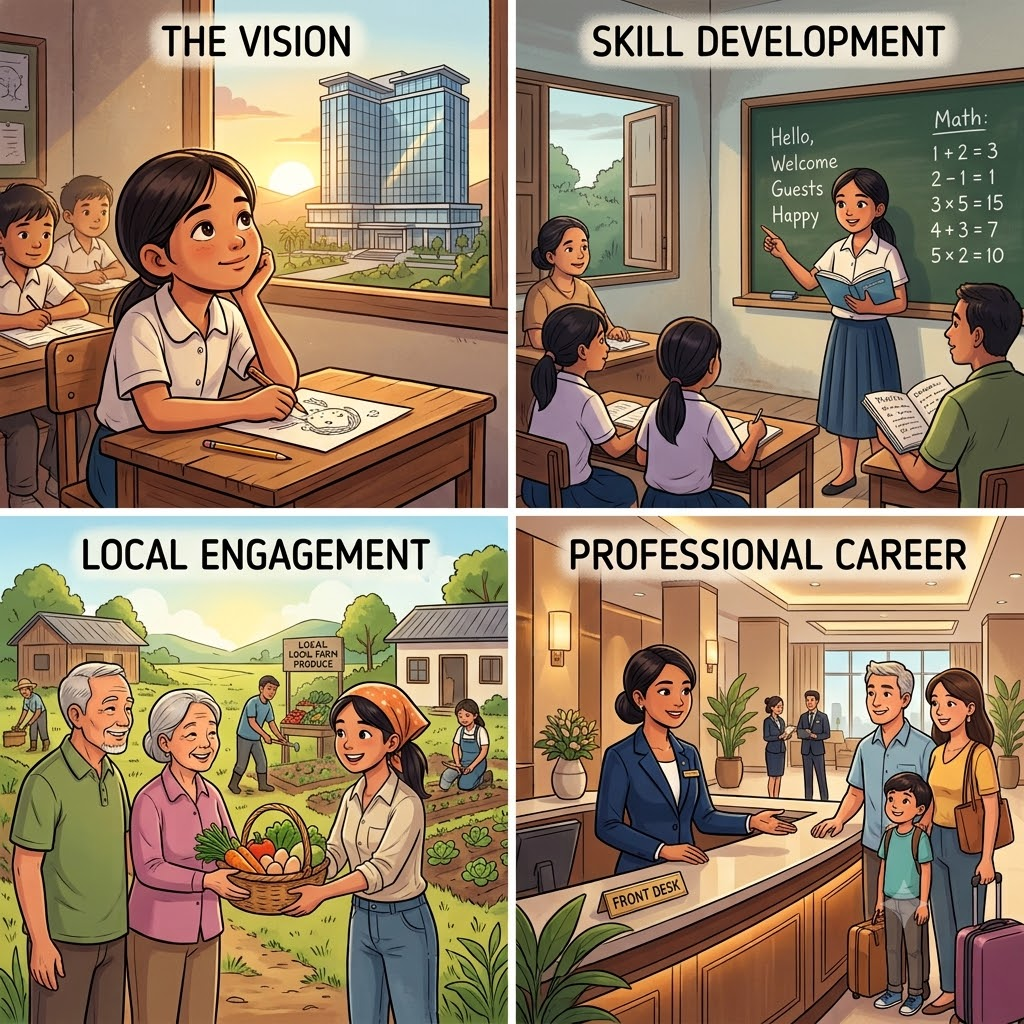
    Lina is a 10-year-old girl. She lives in a small village in Southeast Asia. She lives with her parents and grandparents. Her father is a farmer. Her mother sells vegetables and fruits at the morning market.

    Lina wakes up early every day. She helps her mother prepare food and carry things. Then she walks to school. The walk is long, but she likes it. She sees trees, animals, and her friends.

    At school, Lina is happy. She loves learning. Her favorite subjects are Maths and English. She listens to her teacher and works hard. She also plays with her friends during breaks.

    After school, Lina walks home. She helps her family again. In the evening, she does her homework and studies.

    Lina wants to be a teacher one day. She wants to help young children in her village learn and have a better life.

    _____________________

    Vocabulary:

    • to dream of something: to want something very much in the future
    • a village: a small place where people live, smaller than a town
    • grandparents: the parents of your mother or father
    • to sell vegetables: to give vegetables to people for money
    • morning market: a place where people buy and sell things in the morning
    • to wake up: to stop sleeping
    • to prepare food: to make food ready to eat
    • to carry things: to hold and take things from one place to another
    • a favorite subject: the school subject you like best
    • to listen to somebody: to hear and pay attention to someone
    • to work hard: to do a lot of work with effort
    • a break (school): a short time to rest at school
    • to study: to learn and read for school
    • to have a better life: to live in a happier and easier way

    ###############

    Match the words with the definitions:

    1. to dream of something
    2. a village
    3. grandparents
    4. to sell vegetables
    5. morning market
    6. to wake up
    7. to prepare food
    8. to carry things
    9. a favorite subject
    10. to listen to somebody
    11. to work hard
    12. a break (school)
    13. to study
    14. to have a better life

      Definitions:

    A. to stop sleeping
    B. to give vegetables to people for money
    C. to hear and pay attention to someone
    D. the parents of your mother or father
    E. to want something very much in the future
    F. to make food ready to eat
    G. a small place where people live, smaller than a town
    H. a short time to rest at school
    I. to hold and take things from one place to another
    J. a place where people buy and sell things in the morning
    K. to do a lot of work with effort
    L. the school subject you like best
    M. to learn and read for school
    N. to live in a happier and easier way

    ___________________
    Answers:
    1-E, 2-G, 3-D, 4-B, 5-J,
    6-A, 7-F, 8-I, 9-L, 10-C,
    11-K, 12-H, 13-M, 14-N

    ###############
    Find words that match the definitions below:

    Definitions:

    1. to hold and take things from one place to another
    2. to live in a happier and easier way
    3. to stop sleeping
    4. a short time to rest at school
    5. to make food ready to eat
    6. the parents of your mother or father
    7. a place where people buy and sell things in the morning
    8. to do a lot of work with effort
    9. to want something very much in the future
    10. to hear and pay attention to someone
    11. a small place where people live, smaller than a town
    12. to learn and read for school
    13. the school subject you like best
    14. to give vegetables to people for money

    Words:

    a. to study
    b. to wake up
    c. to carry things
    d. grandparents
    e. to work hard
    f. a village
    g. to prepare food
    h. to sell vegetables
    i. to listen to somebody
    j. a break (school)
    k. to dream of something
    l. a favorite subject
    m. morning market
    n. to have a better life

    _____________________
    Answers:
    1-c, 2-n, 3-b, 4-j, 5-g,
    6-d, 7-m, 8-e, 9-k, 10-i,
    11-f, 12-a, 13-l, 14-h

    ###############

    True or false:

    1. To carry things means to take things from one place to another.
    2. To work hard means to do very little work.
    3. A favorite subject is the subject you like best.
    4. To dream of something means to not want anything.
    5. A morning market happens at night.
    6. Grandparents are your mother’s or father’s parents.
    7. To prepare food means to make food ready to eat.
    8. To wake up means to start sleeping.
    9. To study means to learn for school.
    10. To sell vegetables means to buy vegetables.
    11. To listen to somebody means to ignore them.
    12. A break at school is time to rest.
    13. A village is a small place where people live.
    14. To have a better life means to live in a worse way.

    _____________________

    True: 1,3,6,7,9,12,13

    ###############

    True or false:


    1. Lina is 10 years old.
    2. She lives in a big city.
    3. Her father is a farmer.
    4. Her mother sells vegetables at the night market.
    5. Lina helps her mother prepare food and carry things.
    6. Lina walks a short distance to school.
    7. She likes seeing trees and animals on her way to school.
    8. Lina does not like learning at school.
    9. Her favorite subjects are Maths and English.
    10. She ignores her teacher in class.
    11. Lina wants to be a doctor one day.
    12. She wants to help children in her village.
    13. Lina plays with her friends during school breaks.
    14. In the evening, Lina does her homework and studies.

    ______________________

    True: 1,3,5,7,9,12,13,14

    ###############

    Short answers, basics:

    Example SentenceYesNo
    I learn the alphabet.Yes, I do.No, I don’t.
    You read signs.Yes, you do.No, you don’t.
    He practices speaking.Yes, he does.No, he doesn’t.
    She watches cartoons.Yes, she does.No, she doesn’t.
    It helps us learn English.Yes, it does.No, it doesn’t.
    We use apps like Duolingo.Yes, we do.No, we don’t.
    You read labels.Yes, you do.No, you don’t.
    They make mistakes sometimes.Yes, they do.No, they don’t.
    QuestionYesNo
    Do I learn the alphabet?Yes, I do.No, I don’t.
    Do you read signs?Yes, you do.No, you don’t.
    Does he practice speaking?Yes, he does.No, he doesn’t.
    Does she watch cartoons?Yes, she does.No, she doesn’t.
    Does it help us learn English?Yes, it does.No, it doesn’t.
    Do we use apps like Duolingo?Yes, we do.No, we don’t.
    Do you read labels?Yes, you do.No, you don’t.
    Do they make mistakes sometimes?Yes, they do.No, they don’t.
    QuestionYesNo
    Am I big?Yes, I am.No, I am not.
    Are you big?Yes, you are.No, you aren’t.
    Is he big?Yes, he is.No, he isn’t.
    Is she big?Yes, she is.No, she isn’t.
    Is it big?Yes, it is.No, it isn’t.
    Are we big?Yes, we are.No, we aren’t.
    Are you big?Yes, you are.No, you aren’t.
    Are they big?Yes, they are.No, they aren’t.

    ###############

    Give short answers:


    1. Lina walks to school and sees trees, animals, and friends.

      YOU WRITE:
      Yes, she does.

    2. Lina rides a car to school.
    3. Lina wakes up early every day.
    4. Her favorite subject is Science only.
    5. She helps her mother prepare food and carry things.
    6. Lina plays only and does not study in the evening.
    7. Lina loves learning at school.
    8. Lina lives in a big city.
    9. Her father works as a farmer.
    10. One of Lina’s favorite subjects is Maths.
    11. She spends all her time away from her family.
    12. Lina is 10 years old.
    13. Two of Lina’s favorite subjects are Maths and English.
    14. She wants to be a teacher and help children in her village.
    15. Her mother sells vegetables and fruits at the morning market.
    16. Lina sees buildings and traffic on her way to school.
    17. She wants to be a doctor.
    18. Lina sleeps all morning.
    19. Lina lives in a small village in Southeast Asia.
    20. She helps her father sell fruits at the market.
    21. Lina dislikes learning at school.

    __________________

    Correct version:


    1. Lina walks to school and sees trees, animals, and friends.
      Yes, she does.
    2. Lina rides a car to school.
      No, she doesn’t.
    3. Lina wakes up early every day.
      Yes, she does.
    4. Her favorite subject is Science only.
      No, it isn’t.
    5. She helps her mother prepare food and carry things.
      Yes, she does.
    6. Lina plays only and does not study in the evening.
      No, she doesn’t.
    7. Lina loves learning at school.
      Yes, she does.
    8. Lina lives in a big city.
      No, she doesn’t.
    9. Her father works as a farmer.
      Yes, he does.
    10. One of Lina’s favorite subjects is Maths.
      Yes, it is.
    11. She spends all her time away from her family.
      No, she doesn’t.
    12. Lina is 10 years old.
      Yes, she is.
    13. Two of Lina’s favorite subjects are Maths and English.
      Yes, they are.
    14. She wants to be a teacher and help children in her village.
      Yes, she does.
    15. Her mother sells vegetables and fruits at the morning market.
      Yes, she does.
    16. Lina sees buildings and traffic on her way to school.
      No, she doesn’t.
    17. She wants to be a doctor.
      No, she doesn’t.
    18. Lina sleeps all morning.
      No, she doesn’t.
    19. Lina lives in a small village in Southeast Asia.
      Yes, she does.
    20. She helps her father sell fruits at the market.
      No, she doesn’t.
    21. Lina dislikes learning at school.
      No, she doesn’t.

    ###############

    Short answers, if false, provide short answer and then the corrected version:


    1. Does Lina wake up late every day?

      YOU WRITE:
      No, she doesn’t.
      She wakes up early every day.
    2. Does Lina play with her friends during breaks?
    3. Does she help carry things for her mother?
    4. Does Lina ride a car to school?
    5. Does she help her father sell fruits at the market?
    6. Are two of Lina’s favorite subjects Maths and English?
    7. Does Lina love learning at school?
    8. Does she spend all her time away from her family?
    9. Does Lina see animals and friends on her way to school?
    10. Is Lina 10 years old?
    11. Does Lina walk to school every day?
    12. Is Lina’s father a teacher?
    13. Does Lina dislike learning at school?
    14. Does her mother sell vegetables and fruits at the morning market?
    15. Is her favorite subject Science only?
    16. Does she help her mother prepare food?
    17. Does Lina live in a big city?
    18. Are her favorite subjects Science and History?
    19. Does she want to be a teacher in the future?
    20. Does she sleep all morning?

    _______________________

    Correct answers:


    1. Does Lina wake up late every day?
      No, she doesn’t. She wakes up early every day.
    2. Does Lina play with her friends during breaks?
      Yes, she does.
    3. Does she help carry things for her mother?
      Yes, she does.
    4. Does Lina ride a car to school?
      No, she doesn’t. She walks to school every day.
    5. Does she help her father sell fruits at the market?
      No, she doesn’t. She helps her mother sell vegetables and fruits.
    6. Are two of Lina’s favorite subjects Maths and English?
      Yes, they are.
    7. Does Lina love learning at school?
      Yes, she does.
    8. Does she spend all her time away from her family?
      No, she doesn’t. She helps her family at home.
    9. Does Lina see animals and friends on her way to school?
      Yes, she does.
    10. Is Lina 10 years old?
      Yes, she is.
    11. Does Lina walk to school every day?
      Yes, she does.
    12. Is Lina’s father a teacher?
      No, he isn’t. He is a farmer.
    13. Does Lina dislike learning at school?
      No, she doesn’t. She loves learning at school.
    14. Does her mother sell vegetables and fruits at the morning market?
      Yes, she does.
    15. Is her favorite subject Science only?
      No, it isn’t. Her favorite subjects are Maths and English.
    16. Does she help her mother prepare food?
      Yes, she does.
    17. Does Lina live in a big city?
      No, she doesn’t. She lives in a small village in Southeast Asia.
    18. Are her favorite subjects Science and History?
      No, they aren’t. Her favorite subjects are Maths and English.
    19. Does she want to be a teacher in the future?
      Yes, she does.
    20. Does she sleep all morning?
      No, she doesn’t. She wakes up early every day.

    ###############


    Fill in:

    1. Lina is ______ years old.
    2. She lives in a small ______ in Southeast Asia.
    3. Her father works as a ______.
    4. Her mother sells ______ and ______ at the morning market.
    5. Lina walks to ______ every day.
    6. She helps her mother prepare ______ and carry ______.
    7. Lina’s favorite subjects are ______ and ______.
    8. In the evening, Lina does her ______ and studies.
    9. She wants to be a ______ in the future.
    10. She wants to help ______ in her village.
    11. Lina wakes up ______ every day.
    12. On her way to school, she sees ______ and ______.
    13. She plays with her ______ during school breaks.
    14. Her father works hard as a ______.

    ———————————
    Correct answers:


    1. Lina is 10 years old.
    2. She lives in a small village in Southeast Asia.
    3. Her father works as a farmer.
    4. Her mother sells vegetables and fruits at the morning market.
    5. Lina walks to school every day.
    6. She helps her mother prepare food and carry things.
    7. Lina’s favorite subjects are Maths and English.
    8. In the evening, Lina does her homework and studies.
    9. She wants to be a teacher in the future.
    10. She wants to help children in her village.
    11. Lina wakes up early every day.
    12. On her way to school, she sees trees and animals.
    13. She plays with her friends during school breaks.
    14. Her father works hard as a farmer.

    ###############

    Basics of present simple:

    Personal Pronounam / is / are
    Iam8 years old
    Youare8 years old
    Heis8 years old
    Sheis8 years old
    Itis8 years old
    Weare8 years old
    You (plural)are8 years old
    Theyare8 years old
    Personal Pronounam not / is not / are not
    Iam not8 years old
    Youare not8 years old
    Heis not8 years old
    Sheis not8 years old
    Itis not8 years old
    Weare not8 years old
    You (plural)are not8 years old
    Theyare not8 years old

    Question:

    Question WordPersonal Pronoun
    AmI8 years old?
    Areyou8 years old?
    Ishe8 years old?
    Isshe8 years old?
    Isit8 years old?
    Arewe8 years old?
    Areyou (plural)8 years old?
    Arethey8 years old?

    Statement:

    Personal PronounVerb
    Ilikeice cream
    Youlikeice cream
    Helikesice cream
    Shelikesice cream
    Itlikesice cream
    Welikeice cream
    You (plural)likeice cream
    Theylikeice cream

    Negation:

    Personal PronounVerb (negative)
    Ido not likeice cream
    Youdo not likeice cream
    Hedoes not likeice cream
    Shedoes not likeice cream
    Itdoes not likeice cream
    Wedo not likeice cream
    You (plural)do not likeice cream
    Theydo not likeice cream

    Question:

    Do / DoesPersonal PronounVerbSugar?
    DoIlikesugar?
    Doyoulikesugar?
    Doeshelikesugar?
    Doesshelikesugar?
    Doesitlikesugar?
    Dowelikesugar?
    Doyou (plural)likesugar?
    Dotheylikesugar?

    ###############

    Rewrite as shown below:


    1. Lina is 10 years old.

      YOU WRITE:
      a) Lina is not 10 years old.
      b) Is Lina 10 years old?
      c) Isn’t Lina 10 years old?

    2. She lives in a small village in Southeast Asia.
    3. Her father works as a farmer.
    4. Her mother sells vegetables and fruits at the morning market.
    5. Lina wakes up early every day.
    6. She helps her mother prepare food and carry things.
    7. Lina walks to school and sees trees, animals, and friends.
    8. Her favorite subjects are Maths and English.
    9. Lina wants to be a teacher in the future.
    10. She plays with her friends during school breaks.

    _____________________
    Correct answers:


    1. Lina is 10 years old.
      a) Lina is not 10 years old.
      b) Is Lina 10 years old?
      c) Isn’t Lina 10 years old?
    2. She lives in a small village in Southeast Asia.
      a) She does not live in a small village in Southeast Asia.
      b) Does she live in a small village in Southeast Asia?
      c) Doesn’t she live in a small village in Southeast Asia?
    3. Her father works as a farmer.
      a) Her father does not work as a farmer.
      b) Does her father work as a farmer?
      c) Doesn’t her father work as a farmer?
    4. Her mother sells vegetables and fruits at the morning market.
      a) Her mother does not sell vegetables and fruits at the morning market.
      b) Does her mother sell vegetables and fruits at the morning market?
      c) Doesn’t her mother sell vegetables and fruits at the morning market?
    5. Lina wakes up early every day.
      a) Lina does not wake up early every day.
      b) Does Lina wake up early every day?
      c) Doesn’t Lina wake up early every day?
    6. She helps her mother prepare food and carry things.
      a) She does not help her mother prepare food and carry things.
      b) Does she help her mother prepare food and carry things?
      c) Doesn’t she help her mother prepare food and carry things?
    7. Lina walks to school and sees trees, animals, and friends.
      a) Lina does not walk to school and see trees, animals, and friends.
      b) Does Lina walk to school and see trees, animals, and friends?
      c) Doesn’t Lina walk to school and see trees, animals, and friends?
    8. Her favorite subjects are Maths and English.
      a) Her favorite subjects are not Maths and English.
      b) Are her favorite subjects Maths and English?
      c) Aren’t her favorite subjects Maths and English?
    9. Lina wants to be a teacher in the future.
      a) Lina does not want to be a teacher in the future.
      b) Does Lina want to be a teacher in the future?
      c) Doesn’t Lina want to be a teacher in the future?
      __end of audio__
    10. She plays with her friends during school breaks.
      a) She does not play with her friends during school breaks.
      b) Does she play with her friends during school breaks?
      c) Doesn’t she play with her friends during school breaks?

    ###############

    Form questions to which the word/s given is/are the correct answer:

    1. Her mother sells vegetables and fruits at the morning market.
      a) Her mother:
      b) Her:
      c) sells vegetables and fruits at the morning market:
      d) vegetables and fruits:
      e) at the morning market:

    2. Lina wakes up early every day.
      a) Lina:
      b) wakes up early every day:
      c) early:
      d) every day:

    3. She helps her mother.
      a) She:
      b) helps her mother prepare food :
      c) her mother:
      d) her:

    4. Lina walks to school with her friends.
      a) Lina:
      b) walks to school with her friends:
      c) to school:
      d) with her friends:
      e) her:

    5. Lina wants to be a teacher in the future.
      a) Lina:
      b) wants to be a teacher in the future:
      c) a teacher:
      d) in the future:

    _____________________________

    Answers:


    1. Her mother sells vegetables and fruits at the morning market.

    a) Her mother:
    Who sells vegetables and fruits at the morning market?

    b) Her:
    Whose mother sells vegetables and fruits at the morning market?

    c) sells vegetables and fruits at the morning market:
    What does her mother do at the morning market?

    d) vegetables and fruits:
    What does her mother sell at the morning market?

    e) at the morning market:
    Where does her mother sell vegetables and fruits?


    2. Lina wakes up early every day.

    a) Lina:
    Who wakes up early every day?

    b) wakes up early every day:
    What does Lina do every day?

    c) early:
    When does Lina wake up every day?

    d) every day:
    When does Lina wake up early?


    3. She helps her mother.

    a) She:
    Who helps her mother prepare food?

    b) helps her mother prepare food:
    What does she do ?

    c) her mother:
    Who does she help prepare food?

    d) her:
    Whose mother does she help prepare food?


    4. Lina walks to school with her friends.

    a) Lina:
    Who walks to school with her friends?

    b) walks to school with her friends:
    What does Lina do?

    c) to school:
    Where does Lina walk with her friends to?

    d) with her friends:
    Who does Lina walk to school with?

    e) her:
    Whose friends does Lina walk with to school?


    5. Lina wants to be a teacher in the future.

    a) Lina:
    Who wants to be a teacher in the future?

    b) wants to be a teacher in the future:
    What does Lina want to do in the future?

    c) a teacher:
    What does Lina want to be in the future?

    d) in the future:
    When does Lina want to be a teacher?


    ################

    Rewrite story as shown below:


    I am Lina. I am 10 years old. I live in a small village in Southeast Asia with my parents and grandparents. My father is a farmer. My mother sells vegetables and fruits at the morning market. I wake up early every day. I help my mother prepare food and carry things. I walk to school. I like the walk. I see trees, animals, and my friends. I love learning. My favorite subjects are Maths and English. After school, I help my family. I do my homework and study. I want to be a teacher one day.

    Rewrite, make all changes necessary:

    She is Lina. She is 10 years old. She lives in a small village in Southeast Asia with her ……………………

    __________________

    Correct version:


    She is Lina. She is 10 years old. She lives in a small village in Southeast Asia with her parents and grandparents. Her father is a farmer. Her mother sells vegetables and fruits at the morning market. She wakes up early every day. She helps her mother prepare food and carry things. She walks to school. She likes the walk. She sees trees, animals, and her friends. She loves learning. Her favorite subjects are Maths and English. After school, she helps her family. She does her homework and studies. She wants to be a teacher one day.

    ##############


    Interview with Lina:


    Interviewer: Hello! What is your name?
    Lina: My name is Lina.

    Interviewer: How old are you?
    Lina: I am 10 years old.

    Interviewer: Where do you live?
    Lina: I live in a small village in Southeast Asia.

    Interviewer: Who do you live with?
    Lina: I live with my parents and grandparents.

    Interviewer: What does your father do?
    Lina: My father is a farmer.

    Interviewer: Does your mother work at home or in a market?
    Lina: She works at the morning market.

    Interviewer: What does your mother sell?
    Lina: She sells vegetables and fruits.

    Interviewer: When do you wake up every day?
    Lina: I wake up early every day.

    Interviewer: How do you go to school?
    Lina: I walk to school.

    Interviewer: Which subjects do you like the most, Maths or English?
    Lina: I like both Maths and English.

    Interviewer: What do you do after school?
    Lina: I help my family and do my homework.

    Interviewer: Why do you want to be a teacher?
    Lina: I want to help children in my village learn.


    ===================

    Rewrite the exact interview with Lina’s friend as shown below, make all changes necessary:


    Interviewer: Hello, Salas. What is your friend’s name
    Salas: Her name is Lina.

    Interviewer: How old is she?
    Salas: She is 10 years old.

    Interviewer:……………………..

    ===================

    Full version:


    Interviewer: Hello, Salas. What is your friend’s name?
    Salas: Her name is Lina.

    Interviewer: How old is she?
    Salas: She is 10 years old.

    Interviewer: Where does she live?
    Salas: She lives in a small village in Southeast Asia.

    Interviewer: Who does she live with?
    Salas: She lives with her parents and grandparents.

    Interviewer: What does her father do?
    Salas: Her father is a farmer.

    Interviewer: What does her mother do?
    Salas: Her mother sells vegetables and fruits at the morning market.

    Interviewer: What time does she wake up every day?
    Salas: She wakes up early every day.

    Interviewer: How does she go to school?
    Salas: She walks to school.

    Interviewer: What are her favorite subjects?
    Salas: Her favorite subjects are Maths and English.

    Interviewer: What does she do after school?
    Salas: She helps her family and does her homework.

    Interviewer: Does she like learning?
    Salas: Yes, she loves learning.

    Interviewer: What does she want to be in the future?
    Salas: She wants to be a teacher.


  • 🥳😍😁🏨My life in hotels, for guests (A1, past simple, questions, short answers) 🏨😁😍🥳

    • from bell boy to hotel manager – what a role model


    Sam, looking back at a great career, is telling us about his life in tourism and hospitality business.

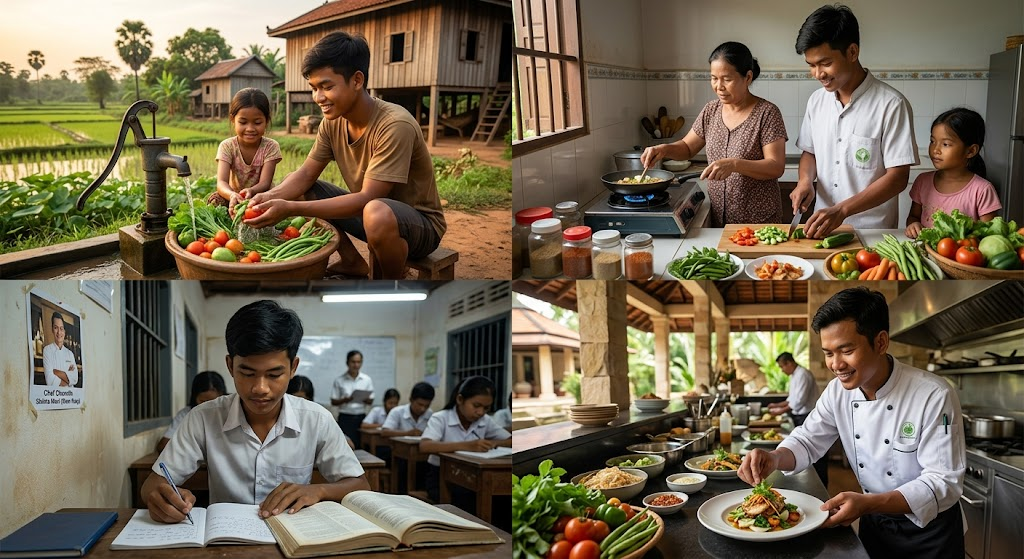
    I started my career as a bell boy. I learned hotel work, helped guests, and worked in a team. I worked hard and was responsible.

    Then I worked at the front desk. I was a receptionist and concierge. I spoke with guests every day. I helped them with questions and problems. I used English to talk with international guests. I gave clear information and was polite.

    Later, I became a hotel manager. I managed two hotels in Southeast Asia. I ran daily work, led teams, and made sure service was good.

    I stayed calm, listened carefully, made good decisions, and focused on guest satisfaction.


    ______________________-

    Vocabulary:

    • a bell boy – a hotel worker who carries guests’ bags.
    • a role model – a person you want to be like.
    • to look back at a career – to think about your work in the past.
    • hospitality business – jobs with hotels, restaurants, or helping guests.
    • to be responsible – to do your work carefully and correctly.
    • front desk – the place in a hotel where guests check in.
    • a receptionist – a worker who greets guests and helps them at the front desk.
    • a concierge – a hotel worker who helps guests with questions and plans.
    • to give information – to tell people facts or answers.
    • to be polite – to use kind and good manners.
    • to run daily work – to manage the work every day.
    • to make sure – to check and be certain something is right.
    • to stay calm – to not get angry or nervous.
    • to listen carefully – to pay attention when someone talks.
    • to make good decisions – to choose the right actions.
    • to focus on something – to pay attention to one thing.
    • guest satisfaction – when guests are happy with the service.

    ################

    Verbs in text, regular and irregular verbs:

    Infinitive (to…)PastDefinition
    to startstartedto begin something
    to learnlearnedto get knowledge or skills
    to helphelpedto do something for someone
    to workworkedto do a job or activity
    to bewas / wereto exist; to have a state or quality
    to speakspoketo talk
    to useusedto do something with a tool or skill
    to givegaveto give something to someone
    to becomebecameto start being something
    to managemanagedto organize or control something
    to runranto manage or lead something
    to leadledto guide a group of people
    to makemadeto do or create something
    to staystayedto remain in a place or state
    to listenlistenedto pay attention to sounds or someone speaking
    to focusfocusedto pay attention to one thing

    ################

    Match the words with the correct definition:

    Words:

    1. a bell boy
    2. a role model
    3. to look back at a career
    4. hospitality business
    5. to be responsible
    6. front desk
    7. a receptionist
    8. a concierge
    9. to give information
    10. to be polite
    11. to run daily work
    12. to make sure
    13. to stay calm
    14. to listen carefully
    15. to make good decisions
    16. to focus on something
    17. guest satisfaction

      Definitions

    A. to check and be certain something is right
    B. a hotel worker who carries guests’ bags
    C. a worker who greets guests and helps them at the front desk
    D. to think about your work in the past
    E. a hotel worker who helps guests with questions and plans
    F. jobs with hotels, restaurants, or helping guests
    G. to pay attention to one thing
    H. when guests are happy with the service
    I. to choose the right actions
    J. a person you want to be like
    K. to manage the work every day
    L. to pay attention when someone talks
    M. to use kind and good manners
    N. the place in a hotel where guests check in
    O. to do your work carefully and correctly
    P. to tell people facts or answers
    Q. to not get angry or nervous

    Answer:
    1-B, 2-J, 3-D, 4-F, 5-O, 6-N,
    7-C, 8-E, 9-P, 10-M, 11-K, 12-A,
    13-Q, 14-L, 15-I, 16-G, 17-H

    ###############

    Match the definitions with the words:

    1. a hotel worker who carries guests’ bags
    2. a person you want to be like
    3. to think about your work in the past
    4. jobs with hotels, restaurants, or helping guests
    5. to do your work carefully and correctly
    6. the place in a hotel where guests check in
    7. a worker who greets guests and helps them at the front desk
    8. a hotel worker who helps guests with questions and plans
    9. to tell people facts or answers
    10. to use kind and good manners
    11. to manage the work every day
    12. to check and be certain something is right
    13. to not get angry or nervous
    14. to pay attention when someone talks
    15. to choose the right actions
    16. to pay attention to one thing
    17. when guests are happy with the service

      Words:

    A. to focus on something
    B. a receptionist
    C. to be responsible
    D. guest satisfaction
    E. a bell boy
    F. to stay calm
    G. to make good decisions
    H. a concierge
    I. front desk
    J. to listen carefully
    K. a role model
    L. to give information
    M. to run daily work
    N. hospitality business
    O. to be polite
    P. to look back at a career
    Q. to make sure

    Answer:
    1-E, 2-K, 3-P, 4-N, 5-C, 6-I,
    7-B, 8-H, 9-L, 10-O, 11-M, 12-Q,
    13-F, 14-J, 15-G, 16-A, 17-D

    ################

    True or false:


    1. To give information means to hide facts or answers.
    2. A bell boy carries guests’ bags in a hotel.
    3. To make good decisions means to ignore [to not pay attention to something] problems.
    4. Front desk is the place where guests check in.
    5. To focus on something means to pay attention to many things at once.
    6. To stay calm means to not get angry or nervous.
    7. To be responsible means to do your work carefully.
    8. A role model is someone you want to be like.
    9. Guest satisfaction means guests are unhappy with the service.
    10. A concierge only cleans hotel rooms.
    11. To look back at a career means to think about your work in the past.
    12. To run daily work means to skip [to not do something you usually do] work every day.
    13. To be polite means to use bad manners.
    14. A receptionist greets guests and helps them at the front desk.

    ____________________
    True: 2,4,6,7,8,11,14

    ##############

    True or false:

    1. Sam led teams as a hotel manager.
    2. He never helped guests with problems.
    3. Sam focused on guest satisfaction every day.
    4. Sam learned hotel work while he was a bell boy.
    5. He was often rude [saying or doing things in a bad or unkind way] and did not give clear information.
    6. At the front desk, Sam answered questions from guests.
    7. Sam worked alone and never with a team.
    8. He gave clear information and was polite to guests.
    9. Sam worked only in restaurants, not hotels.
    10. He made good decisions during his work.
    11. Sam did not listen carefully to guests.
    12. He helped guests and worked in a team.
    13. Sam ignored guest satisfaction during his work.
    14. He managed hotels in Europe, not Southeast Asia.

    _______________________
    True: 1,3,4,6,8,10,12


    #################

    Basics in past simple:

    Personal PronounVerb (Past)Object
    Iateapples
    Youateapples
    Heateapples
    Sheateapples
    Itateapples
    Weateapples
    You (plural)ateapples
    Theyateapples
    Iplayedfootball
    Youplayedfootball
    Heplayedfootball
    Sheplayedfootball
    Itplayedfootball
    Weplayedfootball
    You (plural)playedfootball
    Theyplayedfootball
    Personal PronounVerb (Past Negative)Object
    Idid not eatapples
    Youdid not eatapples
    Hedid not eatapples
    Shedid not eatapples
    Itdid not eatapples
    Wedid not eatapples
    You (plural)did not eatapples
    Theydid not eatapples
    Idid not playfootball
    Youdid not playfootball
    Hedid not playfootball
    Shedid not playfootball
    Itdid not playfootball
    Wedid not playfootball
    You (plural)did not playfootball
    Theydid not playfootball
    Did + PronounVerbObject
    Did Ieatapples?
    Did youeatapples?
    Did heeatapples?
    Did sheeatapples?
    Did iteatapples?
    Did weeatapples?
    Did youeatapples?
    Did theyeatapples?
    Did Iplayfootball?
    Did youplayfootball?
    Did heplayfootball?
    Did sheplayfootball?
    Did itplayfootball?
    Did weplayfootball?
    Did youplayfootball?
    Did theyplayfootball?
    Didn’t + PronounVerbObject
    Didn’t Ieatapples?
    Didn’t youeatapples?
    Didn’t heeatapples?
    Didn’t sheeatapples?
    Didn’t iteatapples?
    Didn’t weeatapples?
    Didn’t youeatapples?
    Didn’t theyeatapples?
    Didn’t Iplayfootball?
    Didn’t youplayfootball?
    Didn’t heplayfootball?
    Didn’t sheplayfootball?
    Didn’t itplayfootball?
    Didn’t weplayfootball?
    Didn’t youplayfootball?
    Didn’t theyplayfootball?


    Forms of ‚to be‘

    Personal PronounPositiveNegativeQuestion
    II was happy.I was not happy.Was I happy?
    You (singular)You were excited.You were not excited.Were you excited?
    HeHe was at home.He was not at home.Was he at home?
    SheShe was tired.She was not tired.Was she tired?
    ItIt was cold.It was not cold.Was it cold?
    WeWe were at the party.We were not at the party.Were we at the party?
    You (plural)You were friends.You were not friends.Were you friends?
    TheyThey were in the garden.They were not in the garden.Were they in the garden?

    ################

    Rewrite as (a) questions, and (b) negations:


    1. He learned hotel work.

      YOU WRITE:
      a) Did he learn hotel work?

      b) He didn’t learn hotel work.
    2. Sam was a bell boy.
    3. Sam helped guests.
    4. He worked in a team.
    5. Sam was a receptionist.
    6. He spoke with guests.
    7. Sam helped with problems.
    8. He used English.
    9. Sam gave information.
    10. He was polite.
    11. Sam became a hotel manager.
    12. He managed two hotels.
    13. Sam ran daily work.
    14. He focused on guest satisfaction.

    ___________________

    Correct answers:


    1. He learned hotel work.
      a) Did he learn hotel work?
      b) He didn’t learn hotel work.
    2. Sam was a bell boy.
      a) Was Sam a bell boy?
      b) Sam wasn’t a bell boy.
    3. Sam helped guests.
      a) Did Sam help guests?
      b) Sam didn’t help guests.
    4. He worked in a team.
      a) Did he work in a team?
      b) He didn’t work in a team.
    5. Sam was a receptionist.
      a) Was Sam a receptionist?
      b) Sam wasn’t a receptionist.
    6. He spoke with guests.
      a) Did he speak with guests?
      b) He didn’t speak with guests.
    7. Sam helped with problems.
      a) Did Sam help with problems?
      b) Sam didn’t help with problems.
    8. He used English.
      a) Did he use English?
      b) He didn’t use English.
    9. Sam gave information.
      a) Did Sam give information?
      b) Sam didn’t give information.
    10. He was polite.
      a) Was he polite?
      b) He wasn’t polite.
    11. Sam became a hotel manager.
      a) Did Sam become a hotel manager?
      b) Sam didn’t become a hotel manager.
    12. He managed two hotels.
      a) Did he manage two hotels?
      b) He didn’t manage two hotels.
    13. Sam ran daily work.
      a) Did Sam run daily work?
      b) Sam didn’t run daily work.
    14. He focused on guest satisfaction.
      a) Did he focus on guest satisfaction?
      b) He didn’t focus on guest satisfaction.

    ##############

    Form questions to which the word/s given is/are the answer:

    1. He helped guests every day.
      a) He:
      b) helped guests every day:
      c) guests
      d) every day
    2. Sam worked hard yesterday.
      a) Sam:
      b) worked hard yesterday:
      c) hard:
      d) yesterday:
    3. He spoke English every day.
      a) He:
      b) spoke English every day:
      c) English:
      d) every day:
    4. Sam learned hotel work last year.
      a) Sam:
      b) learned hotel work last years:
      c) hotel work:
      d) hotel:
      e) last year:
      f) last:
    5. He used English in class.
      a) He:
      b) used English in class:
      c) English:
      d) in class:
    6. He was a manager in a big city.
      a) He:
      b) was a manager in a city:
      c) a manager:
      d) in a big city:
      e) big:
      _____________________

    Correct questions:


    1. He helped guests every day.
    a) Who helped guests every day?
    b) What did he do every day?
    c) Who did he help?
    d) When did he help guests?

    2. Sam worked hard yesterday.
    a) Who worked hard yesterday?
    b) What did Sam do yesterday?
    c) How did Sam work?
    d) When did Sam work hard?

    3. He spoke English every day.
    a) Who spoke English every day?
    b) What did he do every day?
    c) What (language) did he speak every day?
    d) When did he speak English?

    4. Sam learned hotel work last year.
    a) Who learned hotel work last year?
    b) What did Sam do last year?
    c) What did Sam learn?
    d) Which work did Sam learn?
    e) When did Sam learn hotel work?
    f) Which year did Sam learn hotel work?

    5. He used English in class.
    a) Who used English in class?
    b) What did he do in class?
    c) What language did he use?
    d) Where did he use English?

    6. He was a manager in a big city.
    a) Who was a manager in a big city?
    b) What did he do in a big city?
    c) What was he?
    d) Where was he a manager?
    e) What kind of city was it?


    ################

    Short answers in past simple:

    QuestionShort Answer (Yes/Positive)Short Answer (No/Negative)
    Did she check reservations?Yes, she did.No, she didn’t.
    Did she give keys to guests?Yes, she did.No, she didn’t.
    Did she talk to many guests?Yes, she did.No, she didn’t.
    Was she happy?Yes, she was.No, she wasn’t.
    Were the guests satisfied?Yes, they were.No, they weren’t.

    ################


    1. Sam ran a restaurant, not a hotel.

      YOU WRITE:
      No, he din’t.

    2. He used English to talk with international guests.
    3. Sam helped guests.
    4. Sam started his career as a bell boy.
    5. He worked in a team.
    6. Sam used Spanish at work.
    7. Sam became a hotel manager.
    8. Sam started his career as a chef.
    9. Sam gave clear information to guests.
    10. He spoke Frnech with guests.
    11. He learned hotel work.
    12. Sam ignored guest satisfaction.
    13. Sam spoke with guests every day.
    14. Sam worked alone.
    15. He managed only one hotel.
    16. He helped guests.

    ________________________
    Answers:


    1. Sam ran a restaurant, not a hotel.
      No, he didn’t.
    2. He used English to talk with international guests.
      Yes, he did.
    3. Sam helped guests.
      Yes, he did.
    4. Sam started his career as a bell boy.
      Yes, he did.
    5. He worked in a team.
      Yes, he did.
    6. Sam used Spanish at work.
      No, he didn’t.
    7. Sam became a hotel manager.
      Yes, he did.
    8. Sam started his career as a chef.
      No, he didn’t.
    9. Sam gave clear information to guests.
      Yes, he did.
    10. He spoke French with guests.
      No, he didn’t.
    11. He learned hotel work.
      Yes, he did.
    12. Sam ignored guest satisfaction.
      No, he didn’t.
    13. Sam spoke with guests every day.
      Yes, he did.
    14. Sam worked alone.
      No, he didn’t.
    15. He managed only one hotel.
      No, he didn’t.
    16. He helped guests.
      Yes, he did.

    ###################
    Give questions, then short answer, followed by correct answer:


    1. Sam started his career as a chef.

      YOU WRITE:
      Did he start his career as a chef?
      No, he din’t.
      He started his career as a bellboy.

    2. He helped only friends.
    3. Sam was rude to guests.
    4. He spoke only with managers.
    5. Sam used French at work.
    6. He managed only one hotel.
    7. Sam ran a restaurant, not a hotel.
    8. He ignored guest satisfaction.
    9. Sam gave wrong information to guests.
    10. He focused on cleaning rooms all day.
    11. Sam left hotel work after one year.
    12. Sam was late for every meeting.

    ______________________

    Correct answers:


    1. Sam started his career as a chef.
    Did he start his career as a chef?
    No, he didn’t.
    He started his career as a bell boy.

    2. He helped only friends.
    Did he help only friends?
    No, he didn’t.
    He helped guests.

    3. Sam was rude to guests.
    Was Sam rude to guests?
    No, he wasn’t.
    He was polite to guests.

    4. He spoke only with managers.
    Did he speak only with managers?
    No, he didn’t.
    He spoke with guests every day.

    5. Sam used French at work.
    Did Sam use French at work?
    No, he didn’t.
    He used English at work.

    6. He managed only one hotel.
    Did he manage only one hotel?
    No, he didn’t.
    He managed two hotels.

    7. Sam ran a restaurant, not a hotel.
    Did Sam run a restaurant, not a hotel?
    No, he didn’t.
    He ran hotels.

    8. He ignored guest satisfaction.
    Did he ignore guest satisfaction?
    No, he didn’t.
    He focused on guest satisfaction.

    9. Sam gave wrong information to guests.
    Did Sam give wrong information to guests?
    No, he didn’t.
    He gave clear information to guests.

    10. He focused on cleaning rooms all day.
    Did he focus on cleaning rooms all day?
    No, he didn’t.
    He focused on guest satisfaction.

    11. Sam left hotel work after one year.
    Did Sam leave hotel work after one year?
    No, he didn’t.
    He stayed in the hotel business for many years.

    12. Sam was late for every meeting.
    Was Sam late for every meeting?
    No, he wasn’t.
    He always was on time.


    ###############

    Interview, complete, words below:

    guests – hotel work – focused – front desk –
    later – two – career – concierge –
    team – clear – language –
    was


    1. Q: Who did you start your __________ as?
    A: I started as a bell boy.

    2. Q: What did you do as a bell boy?
    A: I learned __________ and helped guests.

    3. Q: Who did you work with?
    A: I worked in a__________.

    4. Q: Where did you work after being a bell boy?
    A: I worked at the__________.

    5. Q: What jobs did you do at the front desk?
    A: I was a receptionist and a __________.

    6. Q: Who did you speak with every day?
    A: I spoke with __________ every day.

    7. Q: What __________did you use with guests?
    A: I used English.

    8. Q: How did you give information to guests?
    A: I gave ___________ information.

    9. Q: Were you polite to guests?
    A: Yes, I __________ polite.

    10. Q: What job did you do __________ in your career?
    A: I became a hotel manager.

    11. Q: How many hotels did you manage?
    A: I managed __________ hotels.

    12. Q: Why was your work important?
    A: I __________ on guest satisfaction.


    ———————
    Correct version:


    1. Q: Who did you start your career as?
    A: I started as a bell boy.

    2. Q: What did you do as a bell boy?
    A: I learned hotel work and helped guests.

    3. Q: Who did you work with?
    A: I worked in a team.

    4. Q: Where did you work after being a bell boy?
    A: I worked at the front desk.

    5. Q: What jobs did you do at the front desk?
    A: I was a receptionist and a concierge.

    6. Q: Who did you speak with every day?
    A: I spoke with guests every day.

    7. Q: What language did you use with guests?
    A: I used English.

    8. Q: How did you give information to guests?
    A: I gave clear information.

    9. Q: Were you polite to guests?
    A: Yes, I was polite.

    10. Q: What job did you do later in your career?
    A: I became a hotel manager.

    11. Q: How many hotels did you manage?
    A: I managed two hotels.

    12. Q: Why was your work important?
    A: I focused on guest satisfaction.


    ################

  • 🚣🏻‍♂️🛤️😋Sightseeing elsewhere: Battambang: A hidden gem in Cambodia (A2, present simple)😋🛤️🚣🏻‍♂️

    • explore countryside, Bamboo Train, and floating villages at a relaxed pace

    If you think about visiting Battambang, I recommend staying one night instead of going only for one day. Battambang is a very nice and peaceful place, but it is quite far from here. The journey takes about three hours each way, so a one-day trip means you spend a lot of time in the car. This feels tiring and rushed.

    If you stay one night, you enjoy the trip in a more relaxed way. Battambang is known for its beautiful countryside, small villages, and local life. You take your time to see the rice fields, meet local people, and try traditional food.

    One of the most popular activities is the bamboo train, also called the railroad trip. It is not a normal train, but a small bamboo platform on wheels. A motor pushes it along old railway tracks. You sit on top and travel through the countryside. It is simple, but very fun and different. Many guests enjoy this experience.

    In the evening, you visit the nearby hills and watch thousands of bats fly out of the caves at sunset. This is a very special and memorable sight.

    You can also take a trip to Tonle Sap Lake. It is the largest lake in Cambodia and it has floating villages. You take a boat and see how people live on the water, with floating houses, schools, and shops. It is a very interesting cultural experience.

    Battambang also has a calm atmosphere and quiet streets. For these reasons, one night is much better than a quick day trip.

    __________________________

    Vocabulary:


    • to be hidden – not easy to see or find
    • a gem – something very good or special
    • to recommend – to say something is good to do or try
    • instead of – rather than, not doing something else
    • to be peaceful – quiet and calm, not noisy
    • quite far – a long distance away
    • to be tiring – making you feel very tired
    • to be rushed – done too quickly, not enough time
    • to enjoy – to like something and feel happy doing it
    • to be relaxed – feeling calm and not worried
    • a railway – a place where trains run
    • wheels – round parts of a vehicle that turn and move it
    • a railway track – the rails where trains travel
    • an experience – something you do and learn from or remember
    • a bat – a small animal that can fly at night
    • a cave – a large hole in a rock or mountain
    • a memorable sight – something you see that you will always remember
    • a floating village – a village where the houses are on water
    • a calm atmosphere – a quiet and peaceful feeling in a place
    • for this reason – because of this

    #################


    Match the Word to the Definition

    Words:

    1. to be hidden
    2. a gem
    3. to recommend
    4. instead of
    5. to be peaceful
    6. quite far
    7. to be tiring
    8. to be rushed
    9. to enjoy
    10. to be relaxed
    11. a railway
    12. wheels
    13. a railway track
    14. an experience
    15. a bat
    16. a cave
    17. a memorable sight
    18. a floating village
    19. a calm atmosphere
    20. for this reason

    Definitions:

    a) something you see that you will always remember
    b) not easy to see or find
    c) a quiet and peaceful feeling in a place
    d) round parts of a vehicle that turn and move it
    e) feeling calm and not worried
    f) rather than, not doing something else
    g) because of this
    h) something very good or special
    i) a small animal that can fly at night
    j) to say something is good to do or try
    k) a village where the houses are on water
    l) a large hole in a rock or mountain
    m) quiet and calm, not noisy
    n) a place where trains run
    o) the rails where trains travel
    p) a long distance away
    q) making you feel very tired
    r) done too quickly, not enough time
    s) something you do and learn from or remember
    t) to like something and feel happy doing it

    ________________________
    Answers:
    1-b, 2-h, 3-j, 4-f, 5-m, 6-p, 7-q,
    8-r, 9-t, 10-e, 11-n, 12-d, 13-o, 14-s,
    15-i, 16-l, 17-a, 18-k, 19-c, 20-g


    ##############


    Find the word from the definition:

    Definitions:

    1. a village where the houses are on water
    2. done too quickly, not enough time
    3. not easy to see or find
    4. quiet and calm, not noisy
    5. a small animal that can fly at night
    6. to like something and feel happy doing it
    7. round parts of a vehicle that turn and move it
    8. something very good or special
    9. feeling calm and not worried
    10. a large hole in a rock or mountain
    11. because of this
    12. something you see that you will always remember
    13. the rails where trains travel
    14. rather than, not doing something else

    Words:

    a) a bat
    b) wheels
    c) a memorable sight
    d) to be relaxed
    e) instead of
    f) a floating village
    g) a cave
    h) a gem
    i) to be rushed
    j) quiet / peaceful
    k) for this reason
    l) to enjoy
    m) a railway track
    n) to be hidden


    __________________

    Answers:
    1-f, 2-i, 3-n, 4-j, 5-a, 6-l, 7-b, 8-h,
    9-d, 10-g, 11-k, 12-c, 13-m, 14-e

    #############

    True or false:

    1. A bat is an animal that can fly at night.
    2. To be rushed means doing something slowly with lots of time.
    3. A memorable sight is something boring that you forget quickly.
    4. For this reason means because of something.
    5. Instead of means doing one thing and another thing at the same time.
    6. To enjoy means to like something and feel happy doing it.
    7. A cave is a small house on water.
    8. A gem is something very special or good.
    9. To be hidden means not easy to see or find.
    10. A railway track is where cars drive on the road.
    11. To recommend means to say something is good to do or try.
    12. Wheels are flat parts of a vehicle that do not move.
    13. A floating village is a village where houses are on water.
    14. To be relaxed means feeling worried and stressed.

    _________________

    Correct:


    1. A bat is an animal that can fly at night. ✅
    2. To be rushed means doing something slowly with lots of time. ❌
    3. A memorable sight is something boring that you forget quickly. ❌
    4. For this reason means because of something. ✅
    5. Instead of means doing one thing and another thing at the same time. ❌
    6. To enjoy means to like something and feel happy doing it. ✅
    7. A cave is a small house on water. ❌
    8. A gem is something very special or good. ✅
    9. To be hidden means not easy to see or find. ✅
    10. A railway track is where cars drive on the road. ❌
    11. To recommend means to say something is good to do or try. ✅
    12. Wheels are flat parts of a vehicle that do not move. ❌
    13. A floating village is a village where houses are on water. ✅
    14. To be relaxed means feeling worried and stressed. ❌

    #################
    True or false:


    1. Battambang is very noisy and busy.
    2. The bamboo train is a small platform on wheels pushed along railway tracks.
    3. Tonle Sap Lake is a small pond in Battambang.
    4. Staying one night allows you to enjoy the trip in a more relaxed way.
    5. The bamboo train is a normal passenger train.
    6. You can see rice fields and small villages in Battambang.
    7. Battambang is a very peaceful place.
    8. Watching the bats is a common, everyday event with no special appeal.
    9. The journey to Battambang takes about three hours each way.
    10. Tonle Sap Lake has floating villages with houses, schools, and shops on water.
    11. In the evening, visitors can watch thousands of bats fly from caves.
    12. The floating villages are on mountains, not on water.
    13. A one-day trip to Battambang allows plenty of time to relax.
    14. Battambang is very close and easy to reach in less than an hour.

    ____________________

    Answer:

    1-False, 2-True, 3-False, 4-True, 5-False,
    6-True, 7-True, 8-False, 9-True, 10-True,
    11-True, 12-False, 13-False, 14-False

    ##############


    Short answers wanted:


    1. Is Battambang a quiet place or a noisy place?
    2. Does the journey to Battambang from here take one hour or three hours?
    3. Should you visit Battambang for just one day or stay one night?
    4. Can you see rice fields or mountains in Battambang?
    5. Are there small villages or big cities in Battambang?
    6. Is the bamboo train a normal train or a small platform on wheels?
    7. Does the bamboo train travel on railway tracks or on the road?
    8. Do you sit on top of the bamboo train or inside it?
    9. Do visitors watch bats or birds in the evening near the hills?
    10. Do the bats fly from caves or from trees at sunset?
    11. Is Tonle Sap Lake the largest lake in Cambodia or a small pond?
    12. Are the villages on Tonle Sap Lake floating villages or mountain villages?
    13. Can you see houses, schools, and shops on the floating villages or only on land?
    14. Is staying one night in Battambang better than a quick day trip or the same as a day trip?

    _________________________

    Answers:


    1. Is Battambang quiet or noisy? quiet
    2. Journey time to Battambang: 1 hour or 3 hours? 3 hours
    3. Visit Battambang: one day or one night? one night
    4. See in Battambang: rice fields or mountains? rice fields
    5. Villages in Battambang: small or big? small
    6. Bamboo train: normal train or platform on wheels? platform on wheels
    7. Bamboo train travels on: railway tracks or road? railway tracks
    8. Seat on bamboo train: on top or inside? on top
    9. Evening near hills: bats or birds? bats
    10. Bats fly from: caves or trees? caves
    11. Tonle Sap Lake: largest lake or small pond? largest lake
    12. Villages on Tonle Sap: floating or mountain? floating
    13. See on floating villages: houses/schools/shops or only land? houses/schools/shops
    14. Staying in Battambang: one night better or same as day trip? one night better

    ################


    Match the first part of the sentence with the correct second part:

    1. The journey to Battambang takes about three hours…
    2. Staying one night allows…
    3. The bamboo train is…
    4. In the evening, visitors can…
    5. Tonle Sap Lake is…
    6. Visitors can see rice fields and small villages…
    7. Battambang has quiet streets…
    8. Many guests enjoy riding the bamboo train…
    9. On Tonle Sap Lake, people live in…
    10. One-day trips are often…

    A. …because it is simple but fun.
    B. …and a calm atmosphere.
    C. …the largest lake in Cambodia with floating villages.
    D. …each way from here.
    E. …floating villages on the water.
    F. …watch thousands of bats flying from caves.
    G. …a small bamboo platform on wheels.
    H. …tiring and rushed.
    I. …throughout the countryside.
    J. …to enjoy the trip in a relaxed way.


    ____________________________

    Answers:

    1-D, 2-J, 3-G, 4-F, 5-C,
    6-I, 7-B, 8-A, 9-E, 10-H


    ####################


    Fill-in-the-blank, words below :

    1. Battambang is a very ________ and peaceful city.
    2. The journey takes about ________ hours each way.
    3. One popular activity is the bamboo ________.
    4. Visitors watch thousands of ________ fly from caves at sunset.
    5. Tonle Sap Lake has floating ________.
    6. Staying one night is more ________ than a one-day trip.
    7. Battambang has a calm ________ and quiet streets.
    8. The bamboo train travels on old ________ tracks.
    9. You sit on top of the bamboo train, not ________.
    10. Many visitors enjoy the bamboo train because it is ________ and fun.
    11. In the evening, visitors can watch bats flying from ________.
    12. Tonle Sap Lake is the largest ________ in Cambodia.
    13. The floating villages have houses, schools, and ________ on water.
    14. A one-day trip to Battambang can feel ________ and rushed.

    Word Bank:

    A. rice fields
    B. caves
    C. houses
    D. bamboo train
    E. 3
    F. motor
    G. tracks
    H. city
    I. tiring
    J. relaxed
    K. largest lake
    L. bats
    M. calm
    N. memorable


    ______________________

    Correct version:


    1. Battambang is a very quiet and peaceful city.
    2. The journey to Battambang takes about three hours each way.
    3. One popular activity in Battambang is the bamboo train.
    4. Visitors watch thousands of bats flying from caves at sunset.
    5. Tonle Sap Lake has floating villages.
    6. Staying one night in Battambang is more relaxed than a one-day trip.
    7. Battambang has a calm atmosphere and quiet streets.
    8. The bamboo train travels on old railway tracks.
    9. You sit on top of the bamboo train, not inside.
    10. Many visitors enjoy the bamboo train because it is fun and memorable.
    11. In the evening, visitors can watch bats flying from the caves.
    12. Tonle Sap Lake is the largest lake in Cambodia.
    13. The floating villages have houses, schools, and shops on the water.
    14. A one-day trip to Battambang can feel tiring and rushed.

    ###############

    Find answer to question, rewrite interview:


    Questions:

    1. What kind of place is Battambang?
    2. How long do you travel to reach Battambang?
    3. Why is it better to stay one night?
    4. What can visitors look at in the countryside?
    5. How would you describe the bamboo train?
    6. Where does the bamboo train move?
    7. Where do people sit on the bamboo train?
    8. What happens near the hills in the evening?
    9. What is special about Tonle Sap Lake?
    10. Where do people live on Tonle Sap Lake?
    11. How do one-day visitors feel?
    12. How would you describe the streets in Battambang?
    13. What can guests taste in Battambang?
    14. Which activity is exciting for many visitors?

    Answers:

    A. Thousands of bats fly out of the caves
    B. Calm and quiet
    C. In houses, schools, and shops
    D. Rice fields and small villages
    E. About three hours each way
    F. Riding the bamboo train
    G. Quiet and peaceful
    H. Floating villages are on the water
    I. The trip feels more relaxed
    J. A small bamboo platform on wheels
    K. On top of the platform
    L. Along old railway tracks
    M. Traditional food
    N. Tired and rushed


    _____________________
    Answers:

    1-G, 2-E, 3-I, 4-D, 5-J, 6-L, 7-K,
    8-A, 9-H, 10-C, 11-N, 12-B, 13-M, 14-F


    ###############


    Correct version:

    1. Q: What kind of place is Battambang?
    A: It is quiet and peaceful.

    2. Q: How long do you travel to reach Battambang?
    A: The journey lasts about three hours each way.

    3. Q: Why is it better to stay one night?
    A: The trip feels more relaxed.

    4. Q: What can visitors look at in the countryside?
    A: Rice fields and small villages.

    5. Q: How would you describe the bamboo train?
    A: It is a small bamboo platform on wheels.

    6. Q: Where does the bamboo train move?
    A: Along old railway tracks.

    7. Q: Where do people sit on the bamboo train?
    A: On top of the platform.

    8. Q: What happens near the hills in the evening?
    A: Thousands of bats fly out of the caves.

    9. Q: What is special about Tonle Sap Lake?
    A: Floating villages are on the water.

    10. Q: Where do people live on Tonle Sap Lake?
    A: In houses, schools, and shops.

    11. Q: How do one-day visitors feel?
    A: They feel tired and rushed.

    12. Q: How would you describe the streets in Battambang?
    A: The streets are calm and quiet.

    13. Q: What can guests taste in Battambang?
    A: They can try traditional food.

    14. Q: Which activity is exciting for many visitors?
    A: Riding the bamboo train is very fun.


    ###############

    Complete, words below:

    watch – quiet – experience – rice – night –
    railway – takes – floating – bats –
    quite far – tiring –
    bamboo – life –
    enjoy


    1. Battambang is a __________ and peaceful city, __________ from here.
    2. The journey __________ about three hours each way, so a one-day trip can be __________ and rushed.
    3. Staying one__________ is better because you can __________ the trip in a relaxed way.
    4. Visitors see __________ fields, small villages, and local __________.
    5. One popular experience is the __________ train, a small platform on wheels that travels on old __________ tracks.
    6. In the evening, you can __________ thousands of __________fly from caves.
    7. Tonle Sap Lake has __________ villages with houses, schools, and shops, giving a memorable cultural _________.

    _________________________
    Correct version:


    1. Battambang is a quiet and peaceful city, quite far from here.
    2. The journey takes about three hours each way, so a one-day trip can be tiring and rushed.
    3. Staying one night is better because you can enjoy the trip in a relaxed way.
    4. Visitors see rice fields, small villages, and local life.
    5. One popular experience is the bamboo train, a small platform on wheels that travels on old railway tracks.
    6. In the evening, you can watch thousands of bats fly from caves.
    7. Tonle Sap Lake has floating villages with houses, schools, and shops, giving a memorable cultural experience.

    #################

  • 🦷🍬🍫🪥NGOs elsewhere: Global Dental Relief brings dental care to children in rural Cambodia (A1, present simple, questions, negations)🪥🍫🍬🦷

    • volunteer dentists visit villages each year to treat teeth, reduce pain, and teach healthy habits

    based on a story on Global Dental Relief published by @shintamanifoundation


    Global Dental Relief is an organization. It helps children with dental care. It works in countries like Cambodia. The team visits small villages where people do not have a dentist.

    Every year, the organization comes to Cambodia. The dentists and team set up a clinic. They work in schools or community places. Many children come to the clinic. Some children have tooth pain. Some children have never seen a dentist.

    The dentists check the children’s teeth. They clean the teeth and fix problems. They take out bad teeth if needed. They also teach children how to brush their teeth. They show how to keep teeth clean every day.

    At one clinic this year, more than 1,000 children get care. The clinic is busy. The team works all day to help many children. The children feel better after treatment. They can eat food without pain. They can sleep and study better.

    This help is important because many families cannot go to a dentist. Dental care is far away or costs too much. Without help, children can have pain and infection. This can affect their health and daily life.

    Global Dental Relief helps children stay healthy. The visits happen every year, so more children can get care and learn good habits for their teeth.

    __________________

    Vocabulary:

    • global: about the whole world
    • dental: about teeth
    • relief: help to stop pain or problems
    • dental care: help to keep teeth clean and healthy
    • a volunteer: a person who works for free to help
    • a dentist: a doctor for teeth
    • to treat teeth (a tooth): to fix a tooth
    • pain: a bad feeling in the body
    • healthy habits: good things we do every day to stay healthy
    • a village: a small place where people live
    • to set up a clinic: to make a place to help people with health
    • a community place: a place where people in the area meet
    • to check the teeth: to look at the teeth to see problems
    • to take out a tooth: to remove a tooth
    • to brush the teeth: to clean the teeth with a toothbrush
    • to get care: to receive help for health
    • a treatment: care to fix a health problem
    • an infection: a sickness in the body
    • to affect one’s health: to change how healthy a person is
    • to stay healthy: to keep the body well
    • a habit: something we do often every day

    ##################

    Match the words with the correct definitions:

    1. global
    2. dental
    3. relief
    4. dental care
    5. a volunteer
    6. a dentist
    7. to treat teeth
    8. pain
    9. healthy habits
    10. a village
    11. to set up a clinic
    12. a community place
    13. to check the teeth
    14. to take out a tooth
    15. to brush the teeth
    16. to get care
    17. a treatment
    18. an infection
    19. to affect one’s health
    20. to stay healthy
    21. a habit

    Definitions:

    a. a small place where people live
    b. to fix a tooth
    c. a doctor for teeth
    d. something we do often every day
    e. help to keep teeth clean and healthy
    f. a place where people in the area meet
    g. to look at the teeth to see problems
    h. a person who works for free to help
    i. a bad feeling in the body
    j. help to stop pain or problems
    k. to clean the teeth with a toothbrush
    l. to remove a tooth
    m. care to fix a health problem
    n. to keep the body well
    o. about the whole world
    p. to receive help for health
    q. a sickness in the body
    r. to make a place to help people with health
    s. about teeth
    t. to change how healthy a person is
    u. good things we do every day to stay healthy

    ________________________

    Answers: 1-o, 2-s, 3-j, 4-e, 5-h, 6-c,
    7-b, 8-i, 9-u, 10-a, 11-r, 12-f, 13-g, 14-l,
    15-k, 16-p, 17-m, 18-q, 19-t, 20-n, 21-d

    #################

    True or false:

    1. A dentist is a doctor for teeth.
    2. Pain is a happy feeling in the body.
    3. To brush the teeth means to clean teeth with a toothbrush.
    4. A habit is something we do only once.
    5. A village is a small place where people live.
    6. Relief is a new toy or gift.
    7. Dental care helps to keep teeth clean and healthy.
    8. To check the teeth means to eat candy with teeth.
    9. Healthy habits are good things we do every day to stay healthy.
    10. An infection is a sickness in the body.
    11. Global means about one small city only.
    12. To take out a tooth means to remove a tooth.
    13. To stay healthy means to get sick all the time.
    14. A volunteer always gets a lot of money for work.

    ________________

    True: 1,3,5,7,9,10,12

    ############


    True or false:


    1. Global Dental Relief comes to Cambodia every year.
    2. The dentists give money to the children.
    3. Healthy teeth help children eat, sleep, and study well.
    4. Some children have never seen a dentist before.
    5. The clinics happen only once and never come back.
    6. The dentists clean teeth and fix problems.
    7. Children do not need to learn how to brush their teeth.
    8. The team sets up a clinic in schools or community places.
    9. Dental care can make children sick.
    10. The team visits only one child each year.
    11. Children feel better after dental treatment.
    12. The dentists help children with their teeth.
    13. Children go to the clinic to play games, not for dental care.
    14. Global Dental Relief works only in big cities.

    _________________
    True: 1,3,4,6,8,11,12

    ############

    Short answers, basics:

    Example SentenceYesNo
    I learn the alphabet.Yes, I do.No, I don’t.
    You read signs.Yes, you do.No, you don’t.
    He practices speaking.Yes, he does.No, he doesn’t.
    She watches cartoons.Yes, she does.No, she doesn’t.
    It helps us learn English.Yes, it does.No, it doesn’t.
    We use apps like Duolingo.Yes, we do.No, we don’t.
    You read labels.Yes, you do.No, you don’t.
    They make mistakes sometimes.Yes, they do.No, they don’t.
    QuestionYesNo
    Do I learn the alphabet?Yes, I do.No, I don’t.
    Do you read signs?Yes, you do.No, you don’t.
    Does he practice speaking?Yes, he does.No, he doesn’t.
    Does she watch cartoons?Yes, she does.No, she doesn’t.
    Does it help us learn English?Yes, it does.No, it doesn’t.
    Do we use apps like Duolingo?Yes, we do.No, we don’t.
    Do you read labels?Yes, you do.No, you don’t.
    Do they make mistakes sometimes?Yes, they do.No, they don’t.
    QuestionYesNo
    Am I big?Yes, I am.No, I am not.
    Are you big?Yes, you are.No, you aren’t.
    Is he big?Yes, he is.No, he isn’t.
    Is she big?Yes, she is.No, she isn’t.
    Is it big?Yes, it is.No, it isn’t.
    Are we big?Yes, we are.No, we aren’t.
    Are you big?Yes, you are.No, you aren’t.
    Are they big?Yes, they are.No, they aren’t.

    ############

    Short answers:


    1. The dentists clean teeth and fix problems.

      YOU WRITE:
      Yes, they do.

    2. Children eat candy instead of getting treatment.
    3. The clinics happen every year.
    4. The dentists give money to the children.
    5. Some children feel pain in their teeth before treatment.
    6. The team works in schools or community places.
    7. Children go to the clinic to play games.
    8. The dentists teach children how to brush their teeth.
    9. Global Dental Relief visits children in Cambodia.
    10. The clinics happen only one time.
    11. Children can eat and sleep better after treatment.
    12. The dentists take care of animals’ teeth.
    13. The team treats only one child each year.
    14. Dental care makes children sick.

    ____________________
    Answers:

    1. The dentists clean teeth and fix problems. – Yes, they do.
    2. Children eat candy instead of receiving treatment. – No, they don’t.
    3. The clinics happen every year. – Yes, they do.
    4. The dentists give money to the children. – No, they don’t.
    5. Some children feel pain in their teeth before treatment. – Yes, they do.
    6. The team works in schools or community places. – Yes, they do.
    7. Children go to the clinic to play games. – No, they don’t.
    8. The dentists teach children how to brush their teeth. – Yes, they do.
    9. Global Dental Relief visits children in Cambodia. – Yes, they do.
    10. The clinics happen only one time. – No, they don’t.
    11. Children can eat and sleep better after treatment. – Yes, they can.
    12. The dentists take care of animals’ teeth. – No, they don’t.
    13. The team treats only one child each year. – No, they don’t.
    14. Dental care makes children sick. – No, it doesn’t.

    ############

    Give short answers:


    1. A dentist is a doctor for teeth.

      YOU WRITE:
      Yes, he/she is.

    2. To brush the teeth means to clean teeth with a toothbrush.
    3. A village is a small place where people live.
    4. Healthy habits are good things we do every day to stay healthy.
    5. To take out a tooth means to remove a tooth.
    6. Dental care helps to keep teeth clean and healthy.
    7. A volunteer is a person who works for free to help.
    8. A dentist is a person who fixes cars.
    9. Pain is a happy feeling in the body.
    10. To check the teeth means to eat candy with teeth.
    11. To stay healthy means to get sick all the time.
    12. Relief is a new toy or gift.
    13. A habit is something we do only once.
    14. An infection is a game children play.

    _______________________
    Answers:


    1. A dentist is a doctor for teeth. – Yes, he or she is.
    2. To brush the teeth means to clean teeth with a toothbrush. – Yes, it does.
    3. A village is a small place where people live. – Yes, it is.
    4. Healthy habits are good things we do every day to stay healthy. – Yes, they are.
    5. To take out a tooth means to remove a tooth. – Yes, it does.
    6. Dental care helps to keep teeth clean and healthy. – Yes, it does.
    7. A volunteer is a person who works for free to help. – Yes, he or she is.
    8. A dentist is a person who fixes cars. – No, he or she isn’t.
    9. Pain is a happy feeling in the body. – No, it isn’t.
    10. To check the teeth means to eat candy with teeth. – No, it does not.
    11. To stay healthy means to get sick all the time. – No, it does not.
    12. Relief is a new toy or gift. – No, it isn’t.
    13. A habit is something we do only once. – No, it isn’t.
    14. An infection is a game children play. – No, it isn’t.

    ############

    Short answers:


    1. Who helps children with their teeth in Cambodia?

      YOU WRITE:
      dentists

    2. Where do the clinics take place, in schools or homes?
    3. What do dentists do to clean children’s teeth?
    4. What do dentists fix in children’s mouths?
    5. What problem do many children have before treatment?
    6. What can children eat better after treatment?
    7. What can children do better after treatment, besides eating?
    8. What do dentists teach children to do every day for their teeth?
    9. How often do the clinics happen?
    10. Who comes to the clinic for the first time sometimes?
    11. What do dentists not give to children, toys or care?
    12. What does dental care help children to stay?
    13. What do children not do at the clinic, games or treatment?
    14. How many children does the team treat in one year, one or many?

    ______________________

    Answers:


    1. Who helps children with their teeth in Cambodia? – Dentists
    2. Where do the clinics take place, in schools or homes? – Schools / community places
    3. What do dentists do to clean children’s teeth? – Brush / clean
    4. What do dentists fix in children’s mouths? – Teeth
    5. What problem do many children have before treatment? – Pain
    6. What can children eat better after treatment? – Food
    7. What can children do better after treatment, besides eating? – Sleep / study
    8. What do dentists teach children to do every day for their teeth? – Brush teeth
    9. How often do the clinics happen? – Every year
    10. Who comes to the clinic for the first time sometimes? – Children
    11. What do dentists not give to children, toys or care? – Care
    12. What does dental care help children to stay? – Healthy
    13. What do children not do at the clinic, games or treatment? – Treatment
    14. How many children does the team treat in one year, one or many? – Many

    ###############

    Basics of present simple:

    Personal Pronounam / is / are
    Iam8 years old
    Youare8 years old
    Heis8 years old
    Sheis8 years old
    Itis8 years old
    Weare8 years old
    You (plural)are8 years old
    Theyare8 years old
    Personal Pronounam not / is not / are not
    Iam not8 years old
    Youare not8 years old
    Heis not8 years old
    Sheis not8 years old
    Itis not8 years old
    Weare not8 years old
    You (plural)are not8 years old
    Theyare not8 years old

    Question:

    Question WordPersonal Pronoun
    AmI8 years old?
    Areyou8 years old?
    Ishe8 years old?
    Isshe8 years old?
    Isit8 years old?
    Arewe8 years old?
    Areyou (plural)8 years old?
    Arethey8 years old?

    Statement:

    Personal PronounVerb
    Ilikeice cream
    Youlikeice cream
    Helikesice cream
    Shelikesice cream
    Itlikesice cream
    Welikeice cream
    You (plural)likeice cream
    Theylikeice cream

    Negation:

    Personal PronounVerb (negative)
    Ido not likeice cream
    Youdo not likeice cream
    Hedoes not likeice cream
    Shedoes not likeice cream
    Itdoes not likeice cream
    Wedo not likeice cream
    You (plural)do not likeice cream
    Theydo not likeice cream

    Question:

    Do / DoesPersonal PronounVerbSugar?
    DoIlikesugar?
    Doyoulikesugar?
    Doeshelikesugar?
    Doesshelikesugar?
    Doesitlikesugar?
    Dowelikesugar?
    Doyou (plural)likesugar?
    Dotheylikesugar?

    Answer as shown:

    1. The dentists give money to the children.

      YOU WRITE:
      No, they don’t. They take care of their teeth.

    2. Children go to the clinic to play games.
    3. The team treats only one child each year.
    4. Dental care makes children sick.
    5. The clinics happen only one time.
    6. The dentists take care of animals’ teeth.
    7. Children can eat candy instead of receiving treatment.
    8. The clinics happen only in big cities.
    9. Children do not learn how to brush their teeth.
    10. Global Dental Relief comes only once and never returns.

    ___________________
    Answers:


    1. The dentists give money to the children. – No, they don’t. They take care of their teeth.
    2. Children go to the clinic to play games. – No, they don’t. They get dental treatment.
    3. The team treats only one child each year. – No, they don’t. They help many children.
    4. Dental care makes children sick. – No, it doesn’t. It helps children stay healthy.
    5. The clinics happen only one time. – No, they don’t. They happen every year.
    6. The dentists take care of animals’ teeth. – No, they don’t. They help children’s teeth.
    7. Children can eat candy instead of receiving treatment. – No, they don’t. They receive dental care.
    8. The clinics happen only in big cities. – No, they don’t. They visit villages.
    9. Children do not learn how to brush their teeth. – No, they don’t. They learn to brush their teeth.
    10. Global Dental Relief comes only once and never returns. – No, it doesn’t. They come every year.

    ################

    Rewrite statemenets as questions:


    1. Global Dental Relief helps children in Cambodia.

      YOU WRITE:
      Does Global Dental Relief help children in Cambodia?

    2. The dentists clean the children’s teeth.
    3. The dentists fix problems in the children’s teeth.
    4. Children feel pain before treatment.
    5. The team works in schools or community places.
    6. The dentists teach children how to brush their teeth.
    7. Children eat better after dental treatment.
    8. Children sleep better after dental treatment.
    9. The clinics happen every year.
    10. Some children see a dentist for the first time.
    11. Global Dental Relief is an organization.
    12. Healthy teeth are important for children.
    13. The team is small but works hard.
    14. Children are able to study better after treatment.

    ________________________

    Correct answers:


    1. Does Global Dental Relief help children in Cambodia?
    2. Do the dentists clean the children’s teeth?
    3. Do the dentists fix problems in the children’s teeth?
    4. Do children feel pain before treatment?
    5. Does the team work in schools or community places?
    6. Do the dentists teach children how to brush their teeth?
    7. Do children eat better after dental treatment?
    8. Do children sleep better after dental treatment?
    9. Do the clinics happen every year?
    10. Do some children see a dentist for the first time?
    11. Is Global Dental Relief an organization?
    12. Are healthy teeth important for children?
    13. Is the team small but works hard?
    14. Are children able to study better after treatment?

    ################

    Make the following sentences negative:


    1. Global Dental Relief only helps adults in Cambodia.

      YOU WRITE:
      Global Dental Relief does not only help adults in Cambodia.

    2. The dentists give money to the children.
    3. The dentists take care of animals’ teeth.
    4. Children go to the clinic to play games.
    5. The team treats only one child each year.
    6. Children eat candy instead of receiving treatment.
    7. Dental care makes children sick.
    8. The clinics happen only one time.
    9. The clinics are only in big cities.
    10. Children do not learn how to brush their teeth.
    11. The team is lazy and does not work hard.
    12. Healthy teeth are not important for children.
    13. Children cannot eat, sleep, or study better after treatment.
    14. Global Dental Relief is a sports club.

    _____________________

    Correct answers:


    1. Global Dental Relief does not only help adults in Cambodia.
    2. The dentists do not give money to the children.
    3. The dentists do not take care of animals’ teeth.
    4. Children do not go to the clinic to play games.
    5. The team does not treat only one child each year.
    6. Children do not eat candy instead of receiving treatment.
    7. Dental care does not make children sick.
    8. The clinics do not happen only one time.
    9. The clinics are not only in big cities.
    10. Children do not forget to learn how to brush their teeth.
    11. The team is not lazy and does not avoid work.
    12. Healthy teeth are not unimportant for children.
    13. Children are not unable to eat, sleep, or study better after treatment.
    14. Global Dental Relief is not a sports club.

    ##############


    Fill in the blanks:


    dentists, healthy, brush, children, clinic,
    teeth, pain, visit, treatment,
    teach, study, eat,
    sleep, community

    1. The _______ visit villages every year.
    2. The dentists clean and fix the _______.
    3. Many _______ have tooth pain before treatment.
    4. The team works in a small _______.
    5. The dentists _______ children how to brush their teeth.
    6. Dental care helps children stay _______.
    7. Some children feel less _______ after treatment.
    8. Children can _______ better after treatment.
    9. Children can _______ better after treatment.
    10. Children can _______ better after treatment.
    11. The team works in a _______ place in the village.
    12. The dentists do _______ the children’s teeth every day.
    13. Children eat healthy food and keep their _______ clean.
    14. The dentists give _______ to the children about teeth care.

    ————————-
    Correct version:

    1. The dentists visit villages every year.
    2. The dentists clean and fix the teeth.
    3. Many children have tooth pain before treatment.
    4. The team works in a small clinic.
    5. The dentists teach children how to brush their teeth.
    6. Dental care helps children stay healthy.
    7. Some children feel less pain after treatment.
    8. Children can eat better after treatment.
    9. Children can sleep better after treatment.
    10. Children can study better after treatment.
    11. The team works in a community place in the village.
    12. The dentists do brush the children’s teeth every day.
    13. Children eat healthy food and keep their teeth clean.
    14. The dentists give treatment to the children about teeth care.

    ###############

    Which word?


    1. Dentists help children (with / on) teeth.
    2. Children learn to (paint / brush ) teeth.
    3. Clinics happen (every / some) year.
    4. Healthy teeth help children (play / study) better.
    5. The team works (in / on) schools and community places.
    6. Some children feel (happy / pain ) before treatment.
    7. Children can (eat / run) better after treatment.
    8. Children can (sleep / jump) better after treatment.
    9. The dentists check (our / their) teeth.
    10. Dentists give (treatment / candy) to children.
    11. The clinic is in a (community / city) place.
    12. Dentists ( sleep / teach) children about healthy teeth.
    13. Children keep their teeth (clean / dirty).
    14. Children visit dentists (every / sometimes) year.

    ______________________

    Correct answers:


    1. Dentists help children (with / on) teeth. ✅ with
    2. Children learn to (brush / paint) teeth. ✅ brush
    3. Clinics happen (every / some) year. ✅ every
    4. Healthy teeth help children (play / study) better. ✅ study
    5. The team works (in / on) schools and community places. ✅ in
    6. Some children feel (pain / happy) before treatment. ✅ pain
    7. Children can (eat / run) better after treatment. ✅ eat
    8. Children can (sleep / jump) better after treatment. ✅ sleep
    9. The dentists check (their / our) teeth. ✅ their
    10. Dentists give (treatment / candy) to children. ✅ treatment
    11. The clinic is in a (community / city) place. ✅ community
    12. Dentists (teach / sleep) children about healthy teeth. ✅ teach
    13. Children keep their teeth (clean / dirty). ✅ clean
    14. Children visit dentists (every / sometimes) year. ✅ every

    ##################

    Complete:

    1. Who __________ children with teeth in Cambodia?
    2. Where do the __________ happen?
    3. What do children __________ at the clinic?
    4. How __________ do the clinics happen?
    5. Who do the __________ help first?
    6. How __________ children go to the clinic each year?
    7. Why do children __________ the clinic?
    8. What do the dentists check __________ ?
    9. How long do the clinics stay in the __________ ?
    10. Who teaches children to __________ their teeth?
    11. Where does the __________ set up the clinic?
    12. How do children __________ after treatment?
    13. What do the children eat after __________ the clinic?
    14. How do the clinics help the children stay __________ ?

    ———————————
    Correct version:


    1. Who helps children with teeth in Cambodia?
    2. Where do the clinics happen?
    3. What do children learn at the clinic?
    4. How often do the clinics happen?
    5. Who do the dentists help first?
    6. How many children go to the clinic each year?
    7. Why do children visit the clinic?
    8. What do the dentists check first?
    9. How long do the clinics stay in the village?
    10. Who teaches children to brush their teeth?
    11. Where does the team set up the clinic?
    12. How do children feel after treatment?
    13. What do the children eat after visiting the clinic?
    14. How do the clinics help the children stay healthy?

    ################

    Complete, words below:

    brush – teeth – every year – pain – treatment –
    community – schools – less –
    problems – tooth –
    healthy – than


    Interview with a dentist

    1. Who helps children with __________ in Cambodia?
    I do. Dentists help children.

    2. Where do the clinics happen?
    The clinics happen in schools and _________ places.

    3. What do dentists do at the clinic?
    We check the teeth, clean them, and fix__________.

    4. Who teaches children to brush their teeth?
    The dentists teach children to __________ their teeth.

    5. Why do children visit the clinic?
    Many children have __________ pain.

    6. How often do the clinics happen?
    The clinics happen __________.

    7. How many children get care at one clinic?
    More__________1,000 children get care.

    8. How do children feel after treatment?
    Children feel __________ pain.

    9. What can children do better after __________?
    Children can eat, sleep, and study better.

    10. What habits do dentists teach children?
    We teach __________ habits.

    11. Where does the team set up the clinic?
    The team sets up the clinic in__________ or community places.

    12. What is important about dental care?
    Dental care helps children stay healthy and avoid __________.


    ———————————

    Full version:


    1. Who helps children with teeth in Cambodia?
    I do. Dentists help children.

    2. Where do the clinics happen?
    The clinics happen in schools and community places.

    3. What do dentists do at the clinic?
    We check the teeth, clean them, and fix problems.

    4. Who teaches children to brush their teeth?
    The dentists teach children to brush their teeth.

    5. Why do children visit the clinic?
    Many children have tooth pain.

    6. How often do the clinics happen?
    The clinics happen every year.

    7. How many children get care at one clinic?
    More than 1,000 children get care.

    8. How do children feel after treatment?
    Children feel less pain.

    9. What can children do better after treatment?
    Children can eat, sleep, and study better.

    10. What habits do dentists teach children?
    We teach healthy habits.

    11. Where does the team set up the clinic?
    The team sets up the clinic in schools or community places.

    12. What is important about dental care?
    Dental care helps children stay healthy and avoid pain.


    ###############

  • 👨🏻‍🍳🍳🍷🍧Seak and his striving (A2, present simple)🍧🍷🍳👨🏻‍🍳

    • a young worker who learns from mistakes and always tries his best


    Seak works in a restaurant in a five-star hotel. He is a young man, and he always tries to give his best. He serves food to the guests, cleans the tables, and helps his colleagues. He speaks politely to the guests and smiles every time. He likes his work, and he wants to be a very good worker.

    Sometimes Seak makes mistakes. He may forget an order or drop something. When this happens, he feels sad and a little frustrated. But he does not give up. He thinks about what he does every day and tries to find better ways to work. He wants to learn from his mistakes.

    After his work, Seak takes time to analyze his day. He remembers the problems and thinks about how he can solve them. He asks his colleagues for advice sometimes. He also watches how other workers do their job. He practices and tries new methods to improve his work.

    Seak is patient and responsible. He knows that it is important to work hard and to stay positive. Every day, he does his best, even when the work is difficult. He wants to give good service to the guests and make them happy. His manager and colleagues see that he is careful and motivated.

    Seak’s striving is strong. He learns from his mistakes, works hard, and never gives up. He believes that with practice and effort, he can become an excellent worker in the restaurant. He hopes that one day he can have a very good position in the hotel.

    Seak is a good example of someone who works with heart and always tries to improve.


    _____________________

    Vocabulary:


    • to strive – to try very hard to do something
    • to give one’s best – to do your work as well as you can
    • a colleague – a person you work with
    • to speak politely – to talk in a nice and respectful way
    • to make a mistake – to do something wrong
    • to drop something – to let something fall from your hands
    • to feel frustrated – to feel unhappy because something is difficult or goes wrong
    • to not give up – to keep trying, even if it is hard
    • to learn from a mistake – to understand your mistake and try to do better next time
    • to analyze – to think carefully about something
    • to remember – to keep information in your mind
    • to solve a problem – to find a way to fix a difficulty
    • to ask for advice – to ask someone to help or give an idea
    • to improve work – to make your work better
    • to be patient – to wait calmly and not get angry
    • to be responsible – to do your duties carefully and correctly
    • to stay positive – to keep a happy and hopeful mind
    • to be motivated – to feel ready and want to do something
    • an effort – the work or energy you put into something
    • to work with heart – to work with care, love, and energy

    ####################

    Match the word/phrase with the correct definition

    1. to strive
    2. to give one’s best
    3. a colleague
    4. to speak politely
    5. to make a mistake
    6. to drop something
    7. to feel frustrated
    8. to not give up
    9. to learn from a mistake
    10. to analyze
    11. to remember
    12. to solve a problem
    13. to ask for advice
    14. to improve work
    15. to be patient
    16. to be responsible
    17. to stay positive
    18. to be motivated
    19. an effort
    20. to work with heart

    Definitions:

    A. to think carefully about something
    B. to work with care, love, and energy
    C. to do your work as well as you can
    D. to feel unhappy because something is difficult or goes wrong
    E. to ask someone to help or give an idea
    F. the work or energy you put into something
    G. to keep a happy and hopeful mind
    H. to let something fall from your hands
    I. to try very hard to do something
    J. to wait calmly and not get angry
    K. to do something wrong
    L. to feel ready and want to do something
    M. a person you work with
    N. to talk in a nice and respectful way
    O. to keep information in your mind
    P. to find a way to fix a difficulty
    Q. to make your work better
    R. to keep trying, even if it is hard
    S. to understand your mistake and try to do better
    T. to do your duties carefully and correctly


    ____________________________

    Answers:
    1→I, 2→C, 3→M, 4→N, 5→K, 6→H,
    7→D, 8→R, 9→S, 10→A, 11→O, 12→P,
    13→E, 14→Q, 15→J, 16→T, 17→G,
    18→L, 19→F, 20→B

    ####################


    Match the definition with the correct word:

    Definitions:

    1. to try very hard to do something
    2. to do your work as well as you can
    3. a person you work with
    4. to talk in a nice and respectful way
    5. to do something wrong
    6. to let something fall from your hands
    7. to feel unhappy because something is difficult or goes wrong
    8. to keep trying, even if it is hard
    9. to understand your mistake and try to do better
    10. to ask someone to help or give an idea
    11. to make your work better
    12. to wait calmly and not get angry
    13. to keep a happy and hopeful mind
    14. to work with care, love, and energy

    Words :

    A. to not give up
    B. to drop something
    C. to strive
    D. to work with heart
    E. to ask for advice
    F. to learn from a mistake
    G. to speak politely
    H. to give one’s best
    I. to make a mistake
    J. to be patient
    K. to stay positive
    L. a colleague
    M. to improve work
    N. to feel frustrated


    Answers:

    1→C, 2→H, 3→L, 4→G, 5→I,
    6→B, 7→N, 8→A, 9→F, 10→E,
    11→M, 12→J, 13→K, 14→D


    ####################


    True or false:

    1. Seak learns from his mistakes to improve his work.
    2. Seak works in a school cafeteria.
    3. He sometimes makes mistakes, like forgetting an order.
    4. He always gives wrong orders on purpose [to do something deliberately; not by accident].
    5. Seak smiles and speaks politely to the guests.
    6. He asks colleagues for advice when he needs help.
    7. Seak does not watch how other workers do their job.
    8. Seak works in a five-star hotel.
    9. Seak tries to do his best every day.
    10. He never makes mistakes at work.
    11. Seak ignores the guests and does not talk to them.
    12. He does not try to improve his skills.
    13. Seak serves food to the guests every day.
    14. Seak is lazy and does not care about his work.

    ____________________________

    True: 1,3,5,6,8,9,13

    ####################

    Short-answer questions:


    1. Where does Seak work?

      YOU WRITE:
      in restaurant

    2. What kind of hotel does he work in?
    3. What does Seak serve to the guests?
    4. How does Seak speak to the guests?
    5. Does Seak sometimes make mistakes? (Yes/No)
    6. Give one example of a mistake Seak makes.
    7. What does Seak do after making a mistake?
    8. Who does Seak ask for advice?
    9. What does Seak try to do every day?
    10. How does Seak feel when work is difficult?
    11. What does Seak watch to learn new methods?
    12. What quality shows Seak cares about his work?
    13. What does Seak want to improve?
    14. How does Seak work—carefully, with energy, and love? (Yes/No)

    ___________________________

    Correct answers:

    1. Where does Seak work? in restaurant
    2. What kind of hotel does he work in? five-star
    3. What does Seak serve to the guests? food
    4. How does Seak speak to the guests? politely
    5. Does Seak sometimes make mistakes? yes
    6. Give one example of a mistake Seak makes. forget order / drop plate
    7. What does Seak do after making a mistake? learns / improves / thinks
    8. Who does Seak ask for advice? colleagues
    9. What does Seak try to do every day? give best / do best
    10. How does Seak feel when work is difficult? frustrated / sad
    11. What does Seak watch to learn new methods? other workers / colleagues
    12. What quality shows Seak cares about his work? careful / responsible / patient
    13. What does Seak want to improve? work / skills / service
    14. How does Seak work—carefully, with energy, and love? yes / with heart


    ####################


    Fill in, words below:

    responsible – drop – serve – meeting – restaurant –
    excellent – frustrated – mistakes – guests –
    colleagues – every day –
    smile


    1. Q: Where do you work?
      A: I work in a ___________ in a five-star hotel.
    2. Q: What do you like most about your job?
      A: I like serving __________ and making them happy.
    3. Q: What is difficult for you at work?
      A: Sometimes I forget orders or __________ plates.
    4. Q: How do you feel when you make a mistake?
      A: I feel sad and a little __________.
    5. Q: Why do you like working in a hotel?
      A: I like __________ many different people every day.
    6. Q: Who helps you when you have problems?
      A: My ___________ help me and give advice.
    7. Q: When do you feel most happy at work?
      A: I feel happy when the guests _________ and say thank you.
    8. Q: Which tasks do you do every day?
      A: I __________ food, clean tables, and help my colleagues.
    9. Q: How do you try to improve your work?
      A: I watch other workers, practice, and learn from my __________.
    10. Q: What do you think is important in a restaurant job?
      A: It is important to be polite, careful, and __________.
    11. Q: How do you stay motivated during a difficult day?
      A: I stay positive and try my best _________.
    12. Q: What is your goal for the future?
      A: I want to become an __________ worker and get a better position.

    _____________________________

    Correct version:

    1. Q: Where do you work?
      A: I work in a restaurant in a five-star hotel.
    2. Q: What do you like most about your job?
      A: I like serving guests and making them happy.
    3. Q: What is difficult for you at work?
      A: Sometimes I forget orders or drop plates.
    4. Q: How do you feel when you make a mistake?
      A: I feel sad and a little frustrated.
    5. Q: Why do you like working in a hotel?
      A: I like meeting many different people every day.
    6. Q: Who helps you when you have problems?
      A: My colleagues help me and give advice.
    7. Q: When do you feel most happy at work?
      A: I feel happy when the guests smile and say thank you.
    8. Q: Which tasks do you do every day?
      A: I serve food, clean tables, and help my colleagues.
    9. Q: How do you try to improve your work?
      A: I watch other workers, practice, and learn from my mistakes.
    10. Q: What do you think is important in a restaurant job?
      A: It is important to be polite, careful, and responsible.
    11. Q: How do you stay motivated during a difficult day?
      A: I stay positive and try my best every day.
    12. Q: What is your goal for the future?
      A: I want to become an excellent worker and get a better position.

    #####################
    Use the dialogue above, rewrite as interview about Seak, and make all changes necessary:

    YOU WRITE:


    1. Q: Where does he work?
      A: He works in a restaurant in a five-star hotel.
    2. Q: What does he like most about his job?
      A: ………………………………

    complete

    ____________________________

    Correct version:


    Q: Where does he work?
    A: He works in a restaurant in a five-star hotel.

    Q: What does he like most about his job?
    A: He likes serving guests and making them happy.

    Q: What is difficult for him at work?
    A: Sometimes he forgets orders or drops plates.

    Q: How does he feel when he makes a mistake?
    A: He feels sad and a little frustrated.

    Q: Why does he like working in a hotel?
    A: He likes meeting many different people every day.

    Q: Who helps him when he has problems?
    A: His colleagues help him and give advice.

    Q: When does he feel most happy at work?
    A: He feels happy when the guests smile and say thank you.

    Q: Which tasks does he do every day?
    A: He serves food, cleans tables, and helps his colleagues.

    Q: How does he try to improve his work?
    A: He watches other workers, practices, and learns from his mistakes.

    Q: What does he think is important in a restaurant job?
    A: He thinks it is important to be polite, careful, and responsible.

    Q: How does he stay motivated during a difficult day?
    A: He stays positive and tries his best every day.

    Q: What is his goal for the future?
    A: He wants to become an excellent worker and get a better position.


    ####################

    Checklist for Seak:


    1. Identify the Problem

    • Did I make a mistake today?
      • Example: I forgot an order, dropped a plate, or spilled a drink.
    • Did a guest seem unhappy?
    • Did I feel confused or slow in my work?

    2. Understand the Problem

    • Why did the mistake happen?
      • Example: I was in a hurry, I did not listen carefully, or I forgot instructions.
    • Is it a problem I can fix today or do I need practice?
    • Did I ask the guest or colleague for feedback?

    3. Find a Solution

    • Can I ask a colleague for advice or help?
      • Example: “How do you serve the soup carefully?”
    • Can I watch how other workers do the task?
    • Can I practice the task slowly and carefully?
      • Example: Practice carrying plates or writing orders.
    • Can I make a note to remember important instructions?

    4. Take Action

    • Try the solution tomorrow or next shift.
    • Focus on one small improvement at a time.
    • Be patient and careful while working.

    5. Review and Learn

    • Did my solution work?
    • Did the guest notice a better service?
    • Did I feel more confident?
    • What else can I do to improve?

    6. Keep Motivated

    • Remember: mistakes are normal.
    • Celebrate small successes.
    • Tell yourself: “I can do better tomorrow.”
    • Keep trying and never give up.

    #############

    Daily checklist:

  • 🏊🏻‍♀️👙🏨Bopha joins NGO training in hospitality (A2, present simple)🏨👙🏊🏻‍♀️

    • 10 months of learning help her prepare for a job in tourism


    Bopha is accepted by an NGO for a 10-month training program in hospitality and tourism. She feels very happy and also a little nervous because it is a new experience for her. Every day, she goes to class and learns many new things.

    She studies English so she can talk to guests from different countries. She practices simple conversations, like saying hello, giving information, and answering questions. At first, she makes some mistakes, but she learns quickly and becomes more confident.

    Bopha also learns how to work in a hotel. She learns how to clean rooms, prepare beds, serve food, and help guests at the front desk. Sometimes, she trains in a real hotel. There, she works with real guests and practices her skills. It is not always easy, but she works hard every day.

    She follows a daily schedule. In the morning, she studies in the classroom. In the afternoon, she does practical training. She works with other students, and they help each other. The teachers are friendly and patient, and they explain everything clearly.

    During the program, Bopha also learns about tourism. She learns about culture, traditions, and famous places. She understands how to make visitors feel welcome and happy.

    At the end of the 10 months, Bopha finishes the program and gets a certificate. She feels proud of herself. Now she has new skills and more confidence. She is ready to find a job in a hotel or tourism and build a better future.

    _________________________

    Vocabulary:

    • ngo (non-governmental organization) – a group that helps people, not part of the government
    • hospitality – helping and taking care of guests in hotels or restaurants
    • to be accepted – to be allowed to join a school, program, or group
    • an experience – something you do and learn from
    • to go to class – to go to school or lessons
    • to practice – to do something many times to get better
    • to answer a question – to say or write the correct reply to a question
    • to make a mistake – to do something wrong
    • to become confident – to feel sure about yourself and your abilities
    • to prepare a bed – to make a bed ready for someone to sleep
    • to serve food – to give food to people to eat
    • to practice a skill – to do an activity again and again to learn it well
    • to follow a schedule – to do activities at the right time every day
    • to be patient – to wait calmly and not get angry
    • to explain something – to tell someone clearly so they understand
    • to finish a program (education) – to complete all lessons and work in a school or course
    • a certificate – a paper that shows you finished a course or learned a skill
    • to feel proud of oneself – to feel happy about what you do or achieve
    • confidence – the feeling that you can do something well
    • to build a future – to work and learn so your life is better later

    ####################


    Match the word to the correct definition:

    1. ngo
    2. hospitality
    3. to be accepted
    4. an experience
    5. to go to class
    6. to practice
    7. to answer a question
    8. to make a mistake
    9. to become confident
    10. to prepare a bed
    11. to serve food
    12. to practice a skill
    13. to follow a schedule
    14. to be patient
    15. to explain something
    16. to finish a program
    17. a certificate
    18. to feel proud of oneself
    19. confidence
    20. to build a future

    Definitions (random order):

    a. to feel happy about what you do or achieve
    b. to complete all lessons and work in a school or course
    c. the feeling that you can do something well
    d. to do something wrong
    e. to do an activity again and again to learn it well
    f. a paper that shows you finished a course or learned a skill
    g. to make a bed ready for someone to sleep
    h. to wait calmly and not get angry
    i. to work and learn so your life is better later
    j. something you do and learn from
    k. to be allowed to join a school, program, or group
    l. to go to school or lessons
    m. to tell someone clearly so they understand
    n. helping and taking care of guests in hotels or restaurants
    o. a group that helps people, not part of the government
    p. to say or write the correct reply to a question
    q. to feel sure about yourself and your abilities
    r. to do activities at the right time every day
    s. to give food to people to eat
    t. to do something many times to get better

    Answers:
    1–o, 2–n, 3–k, 4–j, 5–l, 6–t, 7–p, 8–d,
    9–q, 10–g, 11–s, 12–e, 13–r, 14–h, 15–m,
    16–b, 17–f, 18–a, 19–c, 20–i


    #################


    Match the definition with the correct word:

    Definitions:

    1. a group that helps people, not part of the government
    2. helping and taking care of guests in hotels or restaurants
    3. to be allowed to join a school, program, or group
    4. something you do and learn from
    5. to go to school or lessons
    6. to do something many times to get better
    7. to say or write the correct reply to a question
    8. to do something wrong
    9. to feel sure about yourself and your abilities
    10. to give food to people to eat
    11. a paper that shows you finished a course or learned a skill
    12. to feel happy about what you do or achieve


    Answers:


    a. to feel proud of oneself
    b. confidence
    c. to be accepted
    d. an experience
    e. hospitality
    f. ngo
    g. to go to class
    h. to practice
    i. to serve food
    j. a certificate
    k. to make a mistake
    l. to answer a question

    ____________________

    Answers:
    1–f, 2–e, 3–c, 4–d, 5–g, 6–h,
    7–l, 8–k, 9–b, 10–i, 11–j, 12–a


    ###############

    True or false:


    1. To practice means to do something only once.
    2. To make a mistake means to do something wrong.
    3. Confidence is when you feel unsure about yourself.
    4. To go to class means to attend lessons or school.
    5. To feel proud of oneself means to feel sad about your achievements.
    6. To serve food is to give food to people to eat.
    7. To answer a question is to say or write a reply.
    8. Hospitality means helping guests in hotels or restaurants.
    9. An NGO is part of the government.
    10. A certificate shows that you finished a course or learned a skill.
    11. An experience is something you do and learn from.
    12. To follow a schedule means to do activities at random [not planned] times.
    13. To be accepted means you are not allowed to join a program.
    14. To prepare a bed means to make it ready for someone to sleep.

    ______________________
    True: 2,4,6,7,8,10,11,14
    ################

    Answer:

    1. Does Bopha go to class every day? (a) yes (b) no
    2. Does she sometimes practice with real guests? (a) yes (b) no
    3. Is Bopha happy to join the program? (a) yes (b) no
    4. Does she welcome guests? (a) yes (b) no
    5. Does Bopha work alone? (a) yes (b) no
    6. Does she follow a schedule? (a) yes (b) no
    7. Are the students helping each other? (a) yes (b) no
    8. Is Bopha proud of herself at the beginning? (a) yes (b) no
    9. Does Bopha clean hotel rooms? (a) yes (b) no
    10. Are the teachers unfirendly? (a) yes (b) no
    11. Is Bopha confident with guests after training? (a) yes (b) no
    12. Does she make reservations in the hotel? (a) yes (b) no
    13. Does Bopha get a prize at the end? (a) yes (b) no
    14. Does she practice her skills every day? (a) yes (b) no
    15. Are the students in English classes only? (a) yes (b) no
    16. Does she study English? (a) yes (b) no
    17. Is the program 12 months long? (a) yes (b) no
    18. Are the students learning about local culture? (a) yes (b) no
    19. Is she nervous at the beginning? (a) yes (b) no
    20. Is Bopha ready to work in supermarkets after training? (a) yes (b) no

    ____________________
    Correct answers:

    1–a, 2–a, 3–a, 4–b, 5–b, 6–a, 7–a,
    8–b, 9–a, 10–b, 11–a, 12–b, 13–b, 14–b,
    15–b, 16–a, 17–b, 18–a, 19–a, 20–b

    ###############


    Short answers:

    1. What does Bopha learn in the program?

      YOU WRITE:
      hospitality and tourism

    2. How long is the program?
    3. Where does Bopha practice her skills?
    4. What does Bopha do with guests?
    5. What kind of work does she do in the hotel?
    6. What does she prepare for the guests?
    7. What does Bopha follow every day?
    8. What do the students learn besides English?
    9. What does Bopha get at the end of the program?
    10. How does Bopha feel after finishing the program?
    11. Who helps Bopha during her training?
    12. What skill makes Bopha confident?
    13. What do the students sometimes do with real guests?
    14. What kind of future does the program help Bopha build?

    ______________________


    Short Answer Questions and Answers:

    1. What does Bopha learn in the program?
      • Hospitality and tourism
    2. How long is the program?
      • 10 months
    3. Where does Bopha practice her skills?
      • Hotel
    4. What does Bopha do with guests?
      • Serves them / Helps them
    5. What kind of work does she do in the hotel?
      • Cleaning, making beds, serving food
    6. What does she prepare for the guests?
      • Beds / Rooms
    7. What does Bopha follow every day?
      • Schedule
    8. What do the students learn besides English?
      • Hospitality / Tourism skills / Local culture
    9. What does Bopha get at the end of the program?
      • Certificate
    10. How does Bopha feel after finishing the program?
      • Proud / Happy / Confident
    11. Who helps Bopha during her training?
      • Teachers / Other students
    12. What skill makes Bopha confident?
      • Working with guests / Hospitality skills
    13. What do the students sometimes do with real guests?
      • Practice / Help
    14. What kind of future does the program help Bopha build?
      • Career in hospitality / Tourism

    ################

    Fill in:

    proud / happy / confident – rooms – food – career / future – hospitality / tourism / local culture – certificate –
    skills – real – schedule – beds / rooms –
    patient – kind – confident –
    hospitality


    1. Bopha is learn __________ and tourism.
    2. She prepares __________ for the guests.
    3. At the end, she gets a __________.
    4. Bopha follows a daily __________.
    5. She serves __________ to the guests.
    6. Bopha cleans __________ in the hotel.
    7. She practices her __________ every day.
    8. The students learn __________ besides English.
    9. Bopha feels __________ after finishing the program.
    10. She sometimes practices with __________ guests.
    11. The teachers are very __________.
    12. Bopha wants to build a __________ in hospitality.
    13. She becomes more __________ when working with guests.
    14. Bopha learns to be __________ when helping guests.

    _________________________

    Correct version:


    1. Bopha learns hospitality and tourism every day.
    2. She prepares beds / rooms for the guests in the hotel.
    3. At the end of the program, she gets a certificate.
    4. Bopha follows a daily schedule to organize her work.
    5. She serves food to the guests at the hotel.
    6. Bopha cleans the rooms to make the rooms ready.
    7. She practices her skills every day to become better.
    8. The students learn hospitality / tourism / local culture besides English in the program.
    9. Bopha feels proud / happy / confident after finishing the training program.
    10. She sometimes practices with real guests to gain experience.
    11. The teachers are very kind and help the students.
    12. Bopha wants to build a career / future in hospitality in the future.
    13. She becomes more confident when working with guests.
    14. Bopha learns to be patient when helping guests every day.

    #################

    Find answer to question:


    Questions:

    1. What kind of program do you offer?
    2. How long is the program?
    3. Who can join the program?
    4. Where do students practice their skills?
    5. Why do students learn English?
    6. When do students follow a schedule?
    7. Which skills make students confident?
    8. How do teachers help students?
    9. What do students do in the hotel?
    10. Do students get a certificate?
    11. How do students feel after the program?
    12. What else do students learn besides English?
    13. What kind of future do students have?
    14. Which qualities do students develop?

    Answers:

    a. They have chances to work in tourism or hotels.
    b. Teachers give advice and support carefully.
    c. They feel proud and happy.
    d. Students who want skills in hotels and tourism.
    e. They develop patience, confidence, and teamwork.
    f. They receive a paper showing they finish the course.
    g. The program lasts 10 months.
    h. They use English to talk with guests.
    i. Hospitality and speaking with guests.
    j. They practice in hotels.
    k. They make beds, clean rooms, and serve guests.
    l. We give training in hospitality and tourism.
    m. They follow a schedule every day.
    n. They learn hotel work and local culture.


    _________________________
    Answers:
    1–l, 2–g, 3–d, 4–j, 5–h, 6–m, 7–i, 8–b,
    9–k, 10–f, 11–c, 12–n, 13–a, 14–e
    _________________________

    Correct version:


    1. Q: What kind of program do you offer?
    A: We give training in hospitality and tourism.

    2. Q: How long is the program?
    A: The program lasts 10 months.

    3. Q: Who can join the program?
    A: Students who want skills in hotels and tourism.

    4. Q: Where do students practice their skills?
    A: They practice in hotels.

    5. Q: Why do students learn English?
    A: They use English to talk with guests.

    6. Q: When do students follow a schedule?
    A: They follow a schedule every day.

    7. Q: Which skills make students confident?
    A: Hospitality and speaking with guests.

    8. Q: How do teachers help students?
    A: Teachers give advice and support carefully.

    9. Q: What do students do in the hotel?
    A: They make beds, clean rooms, and serve guests.

    10. Q: Do students get a certificate?
    A: Yes, they receive a paper showing they finish the course.

    11. Q: How do students feel after the program?
    A: They feel proud and happy.

    12. Q: What else do students learn besides English?
    A: They learn hotel work and local culture.

    13. Q: What kind of future do students have?
    A: They have chances to work in tourism or hotels.

    14. Q: Which qualities do students develop?
    A: They develop patience, confidence, and teamwork.


    ###############

    Which phrase are we looking for?