- Lina is a teacher now, remembering her time when she was 10
There is a present simple A1 version,
Lina as a child => link
###############
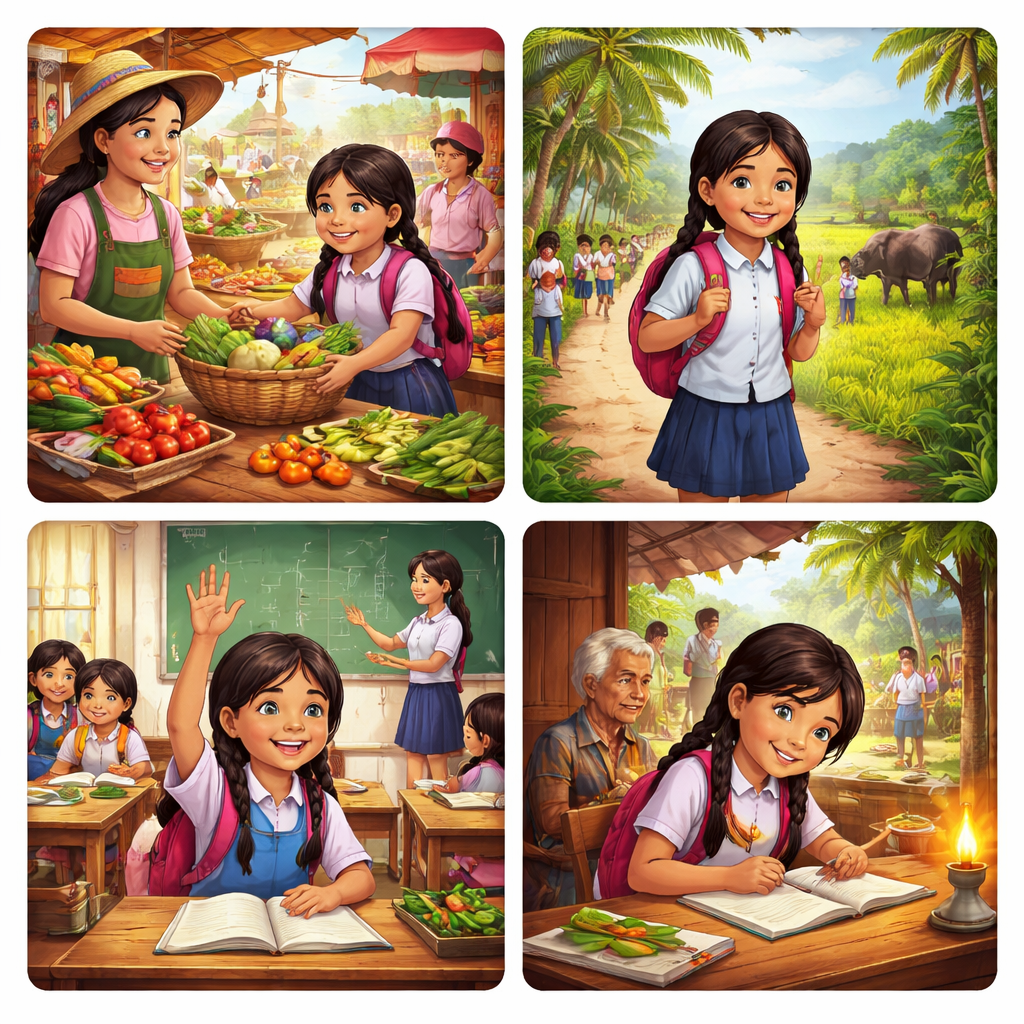
Lina was a 10-year-old girl. She lived in a small village in Southeast Asia. She lived with her parents and grandparents. Her father was a farmer. Her mother sold vegetables and fruits at the morning market.
Lina woke up early every day. She helped her mother prepare food and carry things. Then she walked to school. The walk was long, but she liked it. She saw trees, animals, and her friends.
At school, Lina was happy. She loved learning. Her favorite subjects were Maths and English. She listened to her teacher and worked hard. She also played with her friends during breaks.
After school, Lina walked home. She helped her family again. In the evening, she did her homework and studied.
Lina wanted to be a teacher one day. She wanted to help young children in her village learn and have a better life.
And she has lived her dream – SHE IS A TEACHER NOW.
________________________
Vocabulary:
- to remember: to keep something in your mind and not forget it
- to dream of something: to want something very much in the future
- a village: a small place where people live, smaller than a town
- grandparents: the parents of your mother or father
- to sell vegetables: to give vegetables to people for money
- morning market: a place where people buy and sell things in the morning
- to wake up: to stop sleeping
- to prepare food: to make food ready to eat
- to carry things: to hold and take things from one place to another
- a favorite subject: the school subject you like best
- to listen to somebody: to hear and pay attention to someone
- to work hard: to do a lot of work with effort
- a break (school): a short time to rest at school
- to study: to learn and read for school
- to have a better life: to live in a happier and easier way
###################
Verbs in text, regular and irregular:
| Infinitive | Past | A1 Definition |
|---|---|---|
| be | was / were | to exist; to be something |
| live | lived | to have a home in a place |
| sell | sold | to give something for money |
| wake up | woke up | to stop sleeping |
| help | helped | to do something for someone |
| prepare | prepared | to get something ready |
| carry | carried | to hold and take something |
| walk | walked | to move on your feet |
| like | liked | to think something is good |
| see | saw | to use your eyes |
| love | loved | to like something very much |
| listen | listened | to hear and pay attention |
| work | worked | to do a job or task |
| play | played | to have fun or do a game |
| do | did | to make or finish something |
| study | studied | to learn about something |
| want | wanted | to wish for something |
| learn | learned | to get knowledge or skill |
| have | had | to own or get something |
###############
Basics in past simple:
Past Simple – Regular Verbs
Rules:
- Most verbs: add -ed
play → played - Verbs ending in -e: add -d
live → lived - Verbs ending in consonant + y: change y to i and add -ed
study → studied - Short verbs ending in vowel + consonant: double the final consonant and add -ed
stop → stopped - List of irregular verbs => LINK
Use:
The past simple is used to talk about finished actions in the past.
################
Match the words with the definitions:
- to dream of something
- a village
- grandparents
- to sell vegetables
- morning market
- to wake up
- to prepare food
- to carry things
- a favorite subject
- to listen to somebody
- to work hard
- a break (school)
- to study
- to have a better life
Definitions:
A. to stop sleeping
B. to give vegetables to people for money
C. to hear and pay attention to someone
D. the parents of your mother or father
E. to want something very much in the future
F. to make food ready to eat
G. a small place where people live, smaller than a town
H. a short time to rest at school
I. to hold and take things from one place to another
J. a place where people buy and sell things in the morning
K. to do a lot of work with effort
L. the school subject you like best
M. to learn and read for school
N. to live in a happier and easier way
___________________
Answers:
1-E, 2-G, 3-D, 4-B, 5-J,
6-A, 7-F, 8-I, 9-L, 10-C,
11-K, 12-H, 13-M, 14-N
###############
Find words that match the definitions below:
Definitions:
- to hold and take things from one place to another
- to live in a happier and easier way
- to stop sleeping
- a short time to rest at school
- to make food ready to eat
- the parents of your mother or father
- a place where people buy and sell things in the morning
- to do a lot of work with effort
- to want something very much in the future
- to hear and pay attention to someone
- a small place where people live, smaller than a town
- to learn and read for school
- the school subject you like best
- to give vegetables to people for money
Words:
a. to study
b. to wake up
c. to carry things
d. grandparents
e. to work hard
f. a village
g. to prepare food
h. to sell vegetables
i. to listen to somebody
j. a break (school)
k. to dream of something
l. a favorite subject
m. morning market
n. to have a better life
_____________________
Answers:
1-c, 2-n, 3-b, 4-j, 5-g,
6-d, 7-m, 8-e, 9-k, 10-i,
11-f, 12-a, 13-l, 14-h
#################
True or false:
- To carry things means to take things from one place to another.
- To work hard means to do very little work.
- A favorite subject is the subject you like best.
- To dream of something means to not want anything.
- A morning market happens at night.
- Grandparents are your mother’s or father’s parents.
- To prepare food means to make food ready to eat.
- To wake up means to start sleeping.
- To study means to learn for school.
- To sell vegetables means to buy vegetables.
- To listen to somebody means to ignore them.
- A break at school is time to rest.
- A village is a small place where people live.
- To have a better life means to live in a worse way.
_____________________
True: 1,3,6,7,9,12,13
#################
True or false:
- Lina went to school by bus.
- Her favorite subjects were Maths and English.
- She lived in a small village in Southeast Asia.
- Lina wanted to be a doctor.
- Lina walked to school every day.
- She never helped her family.
- Lina became a teacher in the end.
- Her mother worked in a school.
- Lina was a 10-year-old girl.
- She lived only with her parents.
- She did not like learning.
- Her father was a farmer.
- Lina lived in a big city.
- She liked the walk to school.
_______________________
True: 2,3,5,7,9,12,14
#################
Short answers, past simple, basics:
| Example Sentence | Yes | No |
|---|---|---|
| I learned letters. | Yes, I did. | No, I didn’t. |
| You read signs. | Yes, you did. | No, you didn’t. |
| He spoke English. | Yes, he did. | No, he didn’t. |
| She watched TV. | Yes, she did. | No, she didn’t. |
| It helped me. | Yes, it did. | No, it didn’t. |
| We used an app. | Yes, we did. | No, we didn’t. |
| You read words. | Yes, you did. | No, you didn’t. |
| They made mistakes. | Yes, they did. | No, they didn’t. |
Questions (Past Simple)
| Question | Yes | No |
|---|---|---|
| Did I learn letters? | Yes, I did. | No, I didn’t. |
| Did you read signs? | Yes, you did. | No, you didn’t. |
| Did he speak English? | Yes, he did. | No, he didn’t. |
| Did she watch TV? | Yes, she did. | No, she didn’t. |
| Did it help me? | Yes, it did. | No, it didn’t. |
| Did we use an app? | Yes, we did. | No, we didn’t. |
| Did you read words? | Yes, you did. | No, you didn’t. |
| Did they make mistakes? | Yes, they did. | No, they didn’t. |
Was / Were
| Question | Yes | No |
|---|---|---|
| Was I happy? | Yes, I was. | No, I wasn’t. |
| Were you happy? | Yes, you were. | No, you weren’t. |
| Was he happy? | Yes, he was. | No, he wasn’t. |
| Was she happy? | Yes, she was. | No, she wasn’t. |
| Was it good? | Yes, it was. | No, it wasn’t. |
| Were we happy? | Yes, we were. | No, we weren’t. |
| Were you happy? | Yes, you were. | No, you weren’t. |
| Were they happy? | Yes, they were. | No, they weren’t. |
#################
Give short answers:
- Lina became a doctor.
YOU WRITE:
Yes, she did. - Lina was a 10-year-old girl.
- She played with her friends during breaks.
- Lina did not go to school.
- Her favorite subjects Maths and English were.
- She woke up late every day.
- Lina lived with her parents and grandparents.
- Lina was unhappy at school.
- She helped her mother in the morning.
- The walk to school was long.
- Her favorite subjects History and Art were.
- Her father was a teacher.
- In the evening, she did her homework.
- Lina lived alone.
- She was happy at school.
- The school was very close to her house.
- She hated Maths and English.
- Her mother sold vegetables and fruits.
- Lina woke up early every day.
- Lina was 15 years old.
_______________________
Correct version:
Lina became a doctor. – No, she didn’t.
Lina was a 10-year-old girl. – Yes, she was.
She played with her friends during breaks. – Yes, she did.
Lina did not go to school. – No, she didn’t.
Her favorite subjects Maths and English were. – Yes, they were.
She woke up late every day. – No, she didn’t.
Lina lived with her parents and grandparents. – Yes, she did.
Lina was unhappy at school. – No, she wasn’t.
She helped her mother in the morning. – Yes, she did.
The walk to school was long. – Yes, it was.
Her favorite subjects History and Art were. – No, they weren’t.
Her father was a teacher. – No, he wasn’t.
In the evening, she did her homework. – Yes, she did.
Lina lived alone. – No, she didn’t.
She was happy at school. – Yes, she was.
The school was very close to her house. – No, it wasn’t.
She hated Maths and English. – No, she didn’t.
Her mother sold vegetables and fruits. – Yes, she did.
Lina woke up early every day. – Yes, she did.
Lina was 15 years old. – No, she wasn’t.
#################
Short answers, if false, provide short answer and then the corrected version:
- Did Lina play with her teachers during breaks?
YOU WRITE:
No, she didn’t.
She played with her friends during breaks. - Did she help carry things for her mother?
- Did Lina ride a car to school?
- Did she help her father sell fruits at the market?
- Were two of Lina’s favorite subjects Maths and English?
- Did Lina love learning at school?
- Did she spend all her time away from her family?
- Did Lina see animals and friends on her way to school?
- Was Lina 10 years old?
- Did Lina walk to school every day?
- Was Lina’s father a teacher?
- Did Lina dislike learning at school?
- Did her mother sell vegetables and fruits at the morning market?
- Was her favorite subject Science only?
- Did she help her mother prepare food?
- Did Lina live in a big city?
- Were her favorite subjects Science and History?
- Did she want to be a teacher in the future?
- Did she sleep all morning?
- Did Lina become a teacher in the end?
_______________________
Correct version:
- Did Lina play with her teachers during breaks? – No, she didn’t.
- Did she help carry things for her mother? – Yes, she did.
- Did Lina ride a car to school? – No, she didn’t. She walked to school every day.
- Did she help her father sell fruits at the market? – No, she didn’t. Her mother sold fruits and vegetables at the market.
- Were two of Lina’s favorite subjects Maths and English? – Yes, they were.
- Did Lina love learning at school? – Yes, she did.
- Did she spend all her time away from her family? – No, she didn’t. She helped her family at home every day.
- Did Lina see animals and friends on her way to school? – Yes, she did.
- Was Lina 10 years old? – Yes, she was.
- Did Lina walk to school every day? – Yes, she did.
- Was Lina’s father a teacher? – No, he wasn’t. He was a farmer.
- Did Lina dislike learning at school? – No, she didn’t. She loved learning at school.
- Did her mother sell vegetables and fruits at the morning market? – Yes, she did.
- Was her favorite subject Science only? – No, it wasn’t. Her favorite subjects were Maths and English.
- Did she help her mother prepare food? – Yes, she did.
- Did Lina live in a big city? – No, she didn’t. She lived in a small village.
- Were her favorite subjects Science and History? – No, they weren’t. Her favorite subjects were Maths and English.
- Did she want to be a teacher in the future? – Yes, she did.
- Did she sleep all morning? – No, she didn’t. She woke up early every day.
- Did Lina become a teacher in the end? – Yes, she did.
#################
Fill in:
Lina was ______ years old.
She lived in a small ______ in Southeast Asia.
Her father worked as a ______.
Her mother sold ______ and ______ at the morning market.
Lina walked to ______ every day.
She helped her mother prepare ______ and carry ______.
Lina’s favorite subjects were ______ and ______.
In the evening, Lina did her ______ and studied.
She wanted to be a ______ in the future.
She wanted to help ______ in her village.
Lina woke up ______ every day.
On her way to school, she saw ______ and ______.
She played with her ______ during school breaks.
Her father worked hard as a ______.
————————————-
Correct version:
Lina was 10 years old.
She lived in a small village in Southeast Asia.
Her father worked as a farmer.
Her mother sold vegetables and fruits at the morning market.
Lina walked to school every day.
She helped her mother prepare food and carry things.
Lina’s favorite subjects were Maths and English.
In the evening, Lina did her homework and studied.
She wanted to be a teacher in the future.
She wanted to help young children in her village.
Lina woke up early every day.
On her way to school, she saw trees and animals.
She played with her friends during school breaks.
Her father worked hard as a farmer.
#################
#################

Past simple – basics
| Personal Pronoun | Verb (Past) | Object |
|---|---|---|
| I | ate | apples |
| You | ate | apples |
| He | ate | apples |
| She | ate | apples |
| It | ate | apples |
| We | ate | apples |
| You (plural) | ate | apples |
| They | ate | apples |
| I | played | football |
| You | played | football |
| He | played | football |
| She | played | football |
| It | played | football |
| We | played | football |
| You (plural) | played | football |
| They | played | football |
| Personal Pronoun | Verb (Past Negative) | Object |
|---|---|---|
| I | did not eat | apples |
| You | did not eat | apples |
| He | did not eat | apples |
| She | did not eat | apples |
| It | did not eat | apples |
| We | did not eat | apples |
| You (plural) | did not eat | apples |
| They | did not eat | apples |
| I | did not play | football |
| You | did not play | football |
| He | did not play | football |
| She | did not play | football |
| It | did not play | football |
| We | did not play | football |
| You (plural) | did not play | football |
| They | did not play | football |
| Did + Pronoun | Verb | Object |
|---|---|---|
| Did I | eat | apples? |
| Did you | eat | apples? |
| Did he | eat | apples? |
| Did she | eat | apples? |
| Did it | eat | apples? |
| Did we | eat | apples? |
| Did you | eat | apples? |
| Did they | eat | apples? |
| Did I | play | football? |
| Did you | play | football? |
| Did he | play | football? |
| Did she | play | football? |
| Did it | play | football? |
| Did we | play | football? |
| Did you | play | football? |
| Did they | play | football? |
| Didn’t + Pronoun | Verb | Object |
|---|---|---|
| Didn’t I | eat | apples? |
| Didn’t you | eat | apples? |
| Didn’t he | eat | apples? |
| Didn’t she | eat | apples? |
| Didn’t it | eat | apples? |
| Didn’t we | eat | apples? |
| Didn’t you | eat | apples? |
| Didn’t they | eat | apples? |
| Didn’t I | play | football? |
| Didn’t you | play | football? |
| Didn’t he | play | football? |
| Didn’t she | play | football? |
| Didn’t it | play | football? |
| Didn’t we | play | football? |
| Didn’t you | play | football? |
| Didn’t they | play | football? |
Forms of ‚to be‘
| Personal Pronoun | Positive | Negative | Question |
|---|---|---|---|
| I | I was happy. | I was not happy. | Was I happy? |
| You (singular) | You were excited. | You were not excited. | Were you excited? |
| He | He was at home. | He was not at home. | Was he at home? |
| She | She was tired. | She was not tired. | Was she tired? |
| It | It was cold. | It was not cold. | Was it cold? |
| We | We were at the party. | We were not at the party. | Were we at the party? |
| You (plural) | You were friends. | You were not friends. | Were you friends? |
| They | They were in the garden. | They were not in the garden. | Were they in the garden? |
##############
Rewrite as shown below:
- Lina was 10 years old.
YOU WRITE:
a) Lina was not 10 years old.
b) Was Lina 10 years old?
c) Wasn’t Lina 10 years old? - She lived in a small village in Southeast Asia.
- Her father worked as a farmer.
- Her mother sold vegetables and fruits at the morning market.
- Lina woke up early every day.
- She helped her mother prepare food and carry things.
- Lina walked to school and saw trees, animals, and friends.
- Her favorite subjects were Maths and English.
- Lina wanted to be a teacher in the future.
- She played with her friends during school breaks.
______________________
Correct version:
Lina was 10 years old.
a) Lina was not 10 years old.
b) Was Lina 10 years old?
c) Wasn’t Lina 10 years old?
She lived in a small village in Southeast Asia.
a) She did not live in a small village in Southeast Asia.
b) Did she live in a small village in Southeast Asia?
c) Didn’t she live in a small village in Southeast Asia?
Her father worked as a farmer.
a) Her father did not work as a farmer.
b) Did her father work as a farmer?
c) Didn’t her father work as a farmer?
Her mother sold vegetables and fruits at the morning market.
a) Her mother did not sell vegetables and fruits at the morning market.
b) Did her mother sell vegetables and fruits at the morning market?
c) Didn’t her mother sell vegetables and fruits at the morning market?
Lina woke up early every day.
a) Lina did not wake up early every day.
b) Did Lina wake up early every day?
c) Didn’t Lina wake up early every day?
She helped her mother prepare food and carry things.
a) She did not help her mother prepare food and carry things.
b) Did she help her mother prepare food and carry things?
c) Didn’t she help her mother prepare food and carry things?
Lina walked to school and saw trees, animals, and friends.
a) Lina did not walk to school and see trees, animals, and friends.
b) Did Lina walk to school and see trees, animals, and friends?
c) Didn’t Lina walk to school and see trees, animals, and friends?
Her favorite subjects were Maths and English.
a) Her favorite subjects were not Maths and English.
b) Were her favorite subjects Maths and English?
c) Weren’t her favorite subjects Maths and English?
Lina wanted to be a teacher in the future.
a) Lina did not want to be a teacher in the future.
b) Did Lina want to be a teacher in the future?
c) Didn’t Lina want to be a teacher in the future?
___end of audio___
She played with her friends during school breaks.
a) She did not play with her friends during school breaks.
b) Did she play with her friends during school breaks?
c) Didn’t she play with her friends during school breaks?
################
Form questions to which the word/s given is/are the correct answer:
- Her mother sold vegetables and fruits at the morning market.
a) Her mother:
b) Her:
c) sold vegetables and fruits at the morning market:
d) vegetables and fruits:
e) at the morning market: - Lina woke up early every day.
a) Lina:
b) woke up early every day:
c) early:
d) every day: - She helped her mother.
a) She:
b) helped her mother prepare food :
c) her mother:
d) her: - Lina walke to school with her friends.
a) Lina:
b) walked to school with her friends:
c) to school:
d) with her friends:
e) her: - Lina wanted to be a teacher in the future.
a) Lina:
b) wanted to be a teacher in the future:
c) a teacher:
d) in the future:
____________________
Correct version:
Her mother sold vegetables and fruits at the morning market.
a) Her mother: Who sold vegetables and fruits at the morning market?
b) Her: Whose mother sold vegetables and fruits at the morning market?
c) sold vegetables and fruits at the morning market: What did her mother do at the morning market?
d) vegetables and fruits: What did her mother sell?
e) at the morning market: Where did her mother sell vegetables and fruits?
Lina woke up early every day.
a) Lina: Who woke up early every day?
b) woke up early every day: What did Lina do every day?
c) early: When did Lina wake up every day?
d) every day: How often did Lina wake up early?
She helped her mother.
a) She: Who helped her mother?
b) helped her mother prepare food: What did she do?
c) her mother: Who did she help?
d) her: Whose mother did she help?
Lina walked to school with her friends.
a) Lina: Who walked to school with friends?
b) walked to school with her friends: What did Lina do?
c) to school: Where did Lina walk to?
d) with her friends: Who did Lina walk with?
e) her: With whose friends did she walk to school?
Lina wanted to be a teacher in the future.
a) Lina: Who wanted to be a teacher?
b) wanted to be a teacher in the future: What did Lina want to do?
c) a teacher: What did Lina want to be?
d) in the future: When did Lina want to be a teacher?
##############
Complete:
Interviewer: Hello, Lina! Can you tell us about your childhood?
Lina: Hello! Yes, I can.
Interviewer: How old were you when you were a ____________?
Lina: I was 10 years old.
Interviewer: Where did you live?
Lina: I lived in a small _____________ in Southeast Asia.
Interviewer: Who did you live with?
Lina: I lived with my parents and ______________.
Interviewer: What did your father do?
Lina: My father worked as a ___________.
Interviewer: What did your mother do?
Lina: My mother ______________vegetables and fruits at the morning market.
Interviewer: How did you help your mother?
Lina: I helped her prepare food and ____________ things.
Interviewer: How did you go to school?
Lina: I _______________ to school every day.
Interviewer: What did you see on your way to school?
Lina: I saw trees, animals, and my ______________.
Interviewer: When did you wake up?
Lina: I woke up ___________ every day.
Interviewer: Which subjects did you like best?
Lina: My ___________ subjects were Maths and English.
Interviewer: Why did you like learning?
Lina: I loved learning because it was________________.
Interviewer: Who did you play with at school?
Lina: I played with my friends during school ______________.
Interviewer: What did you want to be when you were a child?
Lina: I wanted to be a ______________ in the future.
Interviewer: Why did you want to be a teacher?
Lina: I wanted to help children in my _____________ learn.
Interviewer: How did you spend your evenings?
Lina: I did my _____________ and studied in the evening.
Interviewer: Thank you, Lina!
Lina: You’re______________!
_______________________
Full version:
Interviewer: Hello, Lina! Can you tell us about your childhood?
Lina: Hello! Yes, I can.
Interviewer: How old were you when you were a child?
Lina: I was 10 years old.
Interviewer: Where did you live?
Lina: I lived in a small village in Southeast Asia.
Interviewer: Who did you live with?
Lina: I lived with my parents and grandparents.
Interviewer: What did your father do?
Lina: My father worked as a farmer.
Interviewer: What did your mother do?
Lina: My mother sold vegetables and fruits at the morning market.
Interviewer: How did you help your mother?
Lina: I helped her prepare food and carry things.
Interviewer: How did you go to school?
Lina: I walked to school every day.
Interviewer: What did you see on your way to school?
Lina: I saw trees, animals, and my friends.
Interviewer: When did you wake up?
Lina: I woke up early every day.
Interviewer: Which subjects did you like best?
Lina: My favorite subjects were Maths and English.
Interviewer: Why did you like learning?
Lina: I loved learning because it was interesting.
Interviewer: Who did you play with at school?
Lina: I played with my friends during school breaks.
Interviewer: What did you want to be when you were a child?
Lina: I wanted to be a teacher in the future.
Interviewer: Why did you want to be a teacher?
Lina: I wanted to help children in my village learn.
Interviewer: How did you spend your evenings?
Lina: I did my homework and studied in the evening.
Interviewer: Thank you, Lina!
Lina: You’re welcome!
Schreibe einen Kommentar