- some thoughts
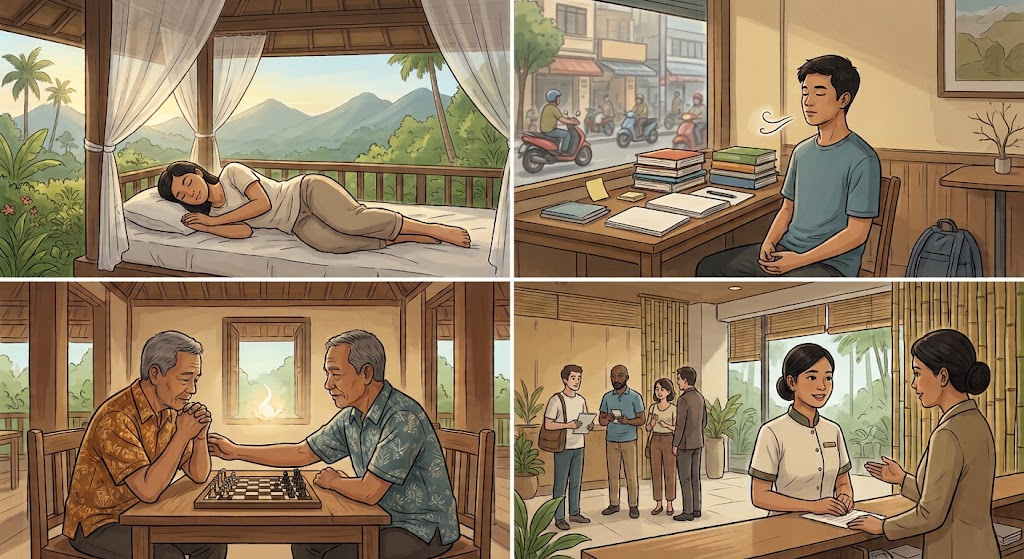
Mental health is an important part of our everyday life. It affects how we think, feel and behave. It also affects how we learn, work and live with other people. We all have good days and bad days. Sometimes we feel happy and full of energy. At other times, we may feel sad, tired, worried or angry. These feelings are normal. We must learn how to understand them and take care of ourselves.
1. Self-Care
Self-care means looking after our body and mind. There are many simple ways to do this. First, we should get enough sleep every night. Our bodies and minds need time to rest. We should also eat healthy food, drink enough water and do some physical activity every day.
Free time is important, too. We can listen to music, read a book, meet friends or spend time with our families. We should not work or study all day without a break. When we feel tired, a short rest can help us feel better.
We should also talk about our feelings. If something makes us unhappy or worried, we can speak to someone we trust. This could be a friend, a family member or a teacher. We do not have to deal with every problem alone.
2. Managing Stress
Stress is a feeling that we often have when something is difficult or when we have too much to do. Students may feel stress before an exam. Workers may feel stress when they have many tasks and not enough time.
There are several ways to deal with stress. We can take a few slow, deep breaths and try to stay calm. We can make a list of our tasks and start with the most important one. We should do one thing at a time instead of trying to do everything together.
It is also important to take short breaks. A little fresh air, a glass of water or a short walk can help us feel better. If a problem is too difficult, we should ask someone for help.
3. Emotional Well-Being
Emotional well-being means understanding our feelings and learning how to deal with them. We should not be afraid to show that we feel sad, worried or disappointed.
Everybody makes mistakes. When someone tells us that we have done something wrong, we should listen and try to learn from it. We should not become angry immediately or lose confidence in ourselves.
We must also think about other people’s feelings. Listening, being friendly, showing respect and helping others can make a big difference. Good friendships and positive relationships with other people are important for a happy life.
4. Mental Health at Work
Mental health is also important at work. In a hotel, employees meet many guests every day. Some guests are friendly, while others may complain or become angry. Workers must try to stay polite and calm, even when a situation is difficult.
Managers should listen to their employees, treat everyone fairly and help workers when they have problems. A friendly workplace helps people feel safe, respected and happy.
Conclusion
Taking care of our mental health is important for everyone. We should look after ourselves, learn to manage stress and respect the feelings of others. Small changes in our daily lives can help us feel better, enjoy our work and build a happier future.
___________________________________
Vocabulary:
| Word / Expression | Simple A1 Definition |
|---|---|
| mental health | How we feel in our mind. |
| to affect | To make a change in someone or something. |
| to behave | To act in a certain way. |
| to be worried | To feel afraid or not happy about something. |
| a physical activity | An activity that makes your body move. |
| feelings | Things we feel, such as happiness, sadness or anger. |
| to trust somebody | To believe that a person is good and will help you. |
| to deal with a problem | To try to find a way to solve a problem. |
| a task | A piece of work that you must do. |
| a deep breath | A big breath of air into your body. |
| to breathe | To take air into your body and let it out again. |
| emotional well-being | Feeling good and happy in your mind. |
| to be disappointed | To feel sad because something is not as good as you wanted. |
| immediately | Right now, without waiting. |
| to lose confidence | To stop believing that you can do something well. |
| a relationship | The way two or more people know and feel about each other. |
| to complain | To say that you are not happy about something. |
| to treat employees fairly | To be kind and fair to all people who work for you. |
########################
Match the words and expressions with the correct definitions
Words and expressions
- Mental health
- To affect
- To behave
- To be worried
- A physical activity
- Feelings
- To trust somebody
- To deal with a problem
- A task
- A deep breath
- To breathe
- Emotional well-being
- To be disappointed
- Immediately
- To lose confidence
- A relationship
- To complain
- To treat employees fairly
Definitions
A. To say that you are not happy about something.
B. To take air into your body and let it out again.
C. To feel sad because something is not as good as you wanted.
D. A piece of work that you must do.
E. To believe that a person is good and will help you.
F. To act in a certain way.
G. To make a change in someone or something.
H. To be kind and fair to all people who work for you.
I. A big breath of air into your body.
J. The way two or more people know and feel about each other.
K. To try to find a way to solve a problem.
L. To stop believing that you can do something well.
M. Things we feel, such as happiness, sadness or anger.
N. Right now, without waiting.
O. How we feel in our mind.
P. To feel afraid or not happy about something.
Q. An activity that makes your body move.
R. Feeling good and happy in your mind.
__________________________________
Answer key:
1–O, 2–G, 3–F, 4–P, 5–Q, 6–M, 7–E,
8–K, 9–D, 10–I, 11–B, 12–R, 13–C,
14–N, 15–L, 16–J, 17–A, 18–H
#########################
Match the definitions with the correct words or expressions
Definitions
- To say that you are not happy about something.
- To take air into your body and let it out again.
- To feel sad because something is not as good as you wanted.
- A piece of work that you must do.
- To believe that a person is good and will help you.
- To act in a certain way.
- To make a change in someone or something.
- To be kind and fair to all people who work for you.
- A big breath of air into your body.
- The way two or more people know and feel about each other.
- To try to find a way to solve a problem.
- To stop believing that you can do something well.
- Things we feel, such as happiness, sadness or anger.
- Right now, without waiting.
- How we feel in our mind.
- To feel afraid or not happy about something.
- An activity that makes your body move.
- Feeling good and happy in your mind.
Words and expressions
A. A task
B. To complain
C. Mental health
D. To trust somebody
E. Immediately
F. To behave
G. Emotional well-being
H. A deep breath
I. To affect
J. To lose confidence
K. A relationship
L. To deal with a problem
M. To breathe
N. To be disappointed
O. Feelings
P. To treat employees fairly
Q. To be worried
R. A physical activity
_______________________________
Answer key
1–B, 2–M, 3–N, 4–A, 5–D, 6–F, 7–I, 8–P,
9–H, 10–K, 11–L, 12–J, 13–O, 14–E,
15–C, 16–Q, 17–R, 18–G
#######################
Choose the correct answer: A, B or C
1. Why is enough sleep important for our health?
A. It gives us more time for work.
B. It helps our body and mind rest.
C. It makes all problems disappear.
2. Which activity can help people feel better?
A. Staying inside all day
B. Thinking about work all evening
C. Going outside for some fresh air
3. How can a person become calmer when feeling stressed?
A. By taking a few deep breaths
B. By doing more difficult tasks
C. By thinking about every problem
4. Which situations can cause stress for young people?
A. Meeting friends at the weekend
B. Exams and too much schoolwork
C. Having free time after school
5. Why can making a list of tasks be helpful?
A. It helps people plan their work.
B. It makes every task disappear.
C. It means people never need help.
6. What is a good way to manage a lot of work?
A. Trying to finish everything at once
B. Forgetting about difficult tasks
C. Doing one task at a time
7. Which of these is a good way to care for your body?
A. Working without taking breaks
B. Eating healthy food
C. Going to bed very late every night
8. How can people show that they care about their feelings?
A. By hiding all their problems
B. By never talking to anyone
C. By accepting their feelings
9. What can people learn from their mistakes?
A. They can learn and improve.
B. They must stop trying new things.
C. Other people are always wrong.
10. Why is it important to listen to other people?
A. It means we must agree with everything they say.
B. It helps us understand them.
C. It gives us the right to make their decisions.
11. Who can help someone with a difficult problem?
A. Only a person from their family
B. Nobody, because problems must stay private
C. A person they trust
12. Which behaviour is best when a hotel guest is unhappy?
A. Staying calm and listening carefully
B. Ignoring the guest’s complaint
C. Telling the guest to come back later
13. How should a good manager treat employees?
A. Differently, depending on their personal friendships
B. Fairly and with respect
C. Without listening to their problems
14. What may happen when employees feel respected at work?
A. They no longer need a manager.
B. They never make mistakes.
C. They feel safer and more comfortable.
15. Which of these is a good activity during a short break?
A. Taking a short walk
B. Starting another difficult task
C. Checking all your work again
16. Why are good relationships important?
A. People never have problems with each other.
B. People can support and help each other.
C. People always think in the same way.
17. What is the best thing to do when a problem is too difficult?
A. Pretend that nothing is wrong.
B. Stop speaking to other people.
C. Ask someone for help.
18. Which statement about feelings is correct?
A. Everyone has different feelings.
B. Only young people have strong feelings.
C. People should always hide sad feelings.
19. When should someone look for help with a problem?
A. Never, because asking for help shows weakness
B. When they cannot manage it alone
C. Only after the problem becomes very serious
20. Which sentence best describes the main message?
A. Work and study must always come first.
B. People should solve every problem alone.
C. Taking care of mental health is important.
_______________________________
Answer key
1–B, 2–C, 3–A, 4–B, 5–A, 6–C, 7–B, 8–C, 9–A, 10–B, 11–C, 12–A, 13–B, 14–C, 15–A, 16–B, 17–C, 18–A, 19–B, 20–C
#######################
True or false
- Mental health affects how we think, feel, and behave.
- Mental health only affects how we work, not how we think or feel.
- Feeling happy or worried sometimes are normal parts of life.
- We should get enough sleep every night to rest our bodies and minds.
- You should work or study all day without taking a break.
- You must deal with every single problem completely alone.
- Stress is a feeling we often have when something is difficult.
- Stress only happens when you are sleeping at night.
- Students may feel stress before an exam.
- When you feel stressed, you should run as fast as you can.
- Hotel workers should always shout back at angry guests.
- We should do one thing at a time instead of trying to do everything together.
- Everybody makes mistakes sometimes.
- Listening to other people’s feelings makes no difference in life.
- In a hotel, employees meet many guests every day.
- Managers should treat employees unfairly so they work harder.
- A friendly workplace helps people feel safe, respected, and happy.
- When someone tells you that you did something wrong, you should immediately become very angry.
- Free time is important for listening to music or reading a book.
- Taking care of mental health is only important for children.
______________________________
Answer Key
- T | 2. F | 3. T | 4. T | 5. F | 6. F | 7. T |
8. F | 9. T | 10. F | 11. F | 12. T | 13. T | 14. F |
15. T | 16. F | 17. T | 18. F | 19. T | 20. F
#####################
Causes, effects – match
Causes (1–10):
- We get enough sleep every night.
- We take a short rest when we feel tired.
- We talk to someone we trust about our worries.
- We have a difficult task or too much work to do.
- We take slow, deep breaths.
- We focus on doing one task at a time.
- Someone points out a mistake we made.
- We treat others with respect and help them.
- Hotel workers stay polite when guests complain.
- Managers listen to employees and treat them fairly.
Effects (A–J):
- A. We build good friendships and positive relationships.
- B. Workers feel safe, respected, and happy.
- C. We can stay calm during stressful moments.
- D. We can handle our work better without feeling overwhelmed.
- E. Our bodies and minds get time to rest.
- F. We do not have to deal with problems alone.
- G. We help ourselves feel better and recover energy.
- H. We can listen and learn instead of getting angry.
- I. We often experience feelings of stress.
- J. Difficult situations stay peaceful and professional.
____________________________
Answer key
- E | 2. G | 3. F | 4. I | 5. C | 6. D |
7. H | 8. A | 9. J | 10. B
####################
Match the first half (1–10) to the second half (A–J) to make grammatically correct and meaningful sentences based on the text.
First Halves (1–10):
- Mental health affects how we think,
- Our bodies and minds need time
- When we feel tired, a short rest can
- If something makes us worried, we can speak to
- Workers often feel stress when
- Taking a few slow, deep breaths helps us to
- We should try to do one thing at a time instead of
- When someone points out our mistake, we should
- Listening, being friendly, and showing respect can
- A friendly workplace helps employees feel
Second Halves (A–J):
- A. stay calm when we are stressed.
- B. try to learn from it rather than get angry.
- C. safe, respected, and happy.
- D. feel, and behave in our everyday lives.
- E. someone we trust, like a friend or teacher.
- F. help us recover energy and feel better.
- G. to rest every night through enough sleep.
- H. make a big difference in building good relationships.
- I. trying to do everything all at once.
- J. they have too many tasks and not enough time.
____________________________
Answer Key
- D | 2. G | 3. F | 4. E | 5. J | 6. A |
7. I | 8. B | 9. H | 10. C
####################
Short-answer WH-questions
- What does mental health affect in our everyday life?
- How much sleep should we get every night?
- Why is taking a short rest important when we feel tired?
- Who can we talk to when we feel unhappy or worried?
- When do students often experience stress?
- What should we do first when we have a long list of tasks?
- How can deep breathing help us when we feel stressed?
- What should we do when someone points out a mistake we made?
- Where do hotel workers meet many different guests every day?
- Why should managers treat their employees fairly and listen to them?
___________________________
Answer key
- How we think, feel, behave, learn, work, and live with other people. |
2. Enough sleep. |
3. It can help us feel better. |
4. A friend, a family member, or a teacher. |
5. Before an exam. |
6. Start with the most important one. |
7. It helps us try to stay calm. |
8. Listen and try to learn from it. |
9. In a hotel. |
10. To help people feel safe, respected, and happy.
#######################
#######################
#######################
Please use the box below
to write your feedback.
Only I can read it.
It is not public.
Please tell me:
- Are the texts and exercises OK?
- Are the topics OK?
- Is the level OK?
- Is it too easy or too difficult?
- Is it too short, too long?
- Do you want texts about other topics?
Thank you! I appreciate your feedback.
##################
##################
##################
Remember how babies
learn a language:
Babies learn a language by listening.
They use their ears to hear sounds.
Their brain remembers these sounds.
Babies connect sounds with people and things.
They listen to their parents.
Then they copy the sounds they hear. They imitate words.
Slowly, babies learn to speak.
So,
LISTEN, LISTEN, LISTEN, LISTEN………………

SMFrockZ@gmx.at
Schreibe einen Kommentar