– A simple story about a girl in Bali
| Word | A1 definition |
|---|---|
| early | before the usual time |
| a face | the front part of your head with eyes, nose, and mouth |
| breakfast | the first meal of the day |
| a fruit | food from a plant, often sweet |
| a beach | a place with sand next to the sea |
| a good time | a happy and fun time |
| lunch | the meal you eat in the middle of the day |
| evening | the time after the afternoon and before night |
| outside the house | not inside the house |
| a sky | the space above the Earth |
| a star | a bright light in the night sky |
##################
Regular and irregular verbs in text:
| Verb (infinitive) | Past simple | Definition |
|---|---|---|
| to live | lived | to have your home in a place |
| to be | was / were | to exist or to say what someone or something is |
| to get up | got up | to leave your bed after sleeping |
| to wash | washed | to make something clean with water |
| to eat | ate | to put food in your mouth and swallow it |
| to walk | walked | to move on your feet |
| to see | saw | to look with your eyes and notice something |
| to play | played | to do something for fun |
| to talk | talked | to speak with someone |
| to smile | smiled | to show happiness with your face |
| to have | had | to own something or experience something |
| to go | went | to move from one place to another |
| to cook | cooked | to make food |
| to sit | sat | to be on a chair or another place |
| to look | looked | to use your eyes to see something |
| to sleep | slept | to rest with your eyes closed |
#################
Past simple – how to form it
We use the past simple to talk about things that happened before now, e.g. yesterday
1. Regular verbs
For most verbs, add -ed.
Verb + ed = past simple
Examples:
- I worked yesterday.
- She played tennis.
2. Verbs ending in -e
Add only -d.
Examples:
- He lived in London.
- She liked the film.
3. Short verbs: double the last letter
Some short verbs double the last letter before adding -ed.
Examples:
- to stop => The bus stopped.
- ro plan => He planned a trip.
4. Irregular verbs
Some verbs do not use -ed. The verb changes. You must learn these forms.
Examples:
- to go => I went home.
- to see => She saw a bird.
- to be => She was 10 years old. They were in the garden.
5. Negative sentences
Use:
did not (didn’t) + verb
was/were not
The verb goes back to the normal form.
Examples:
- I didn’t watch TV.
- They didn’t go outside.
- She was not 10 years old. They were not in the garden.
6. Questions
Use:
Did + person + verb?
Was?
Were?
Examples:
- Did you visit your friend?
- Did he cook dinner?
- Was she 10 years old? Were they in the garden?
Past Simple Signal Words
- yesterday
- last night
- last week
- last year
- two days ago
- when I was young
#################
Fill in the verbs in the past simple.
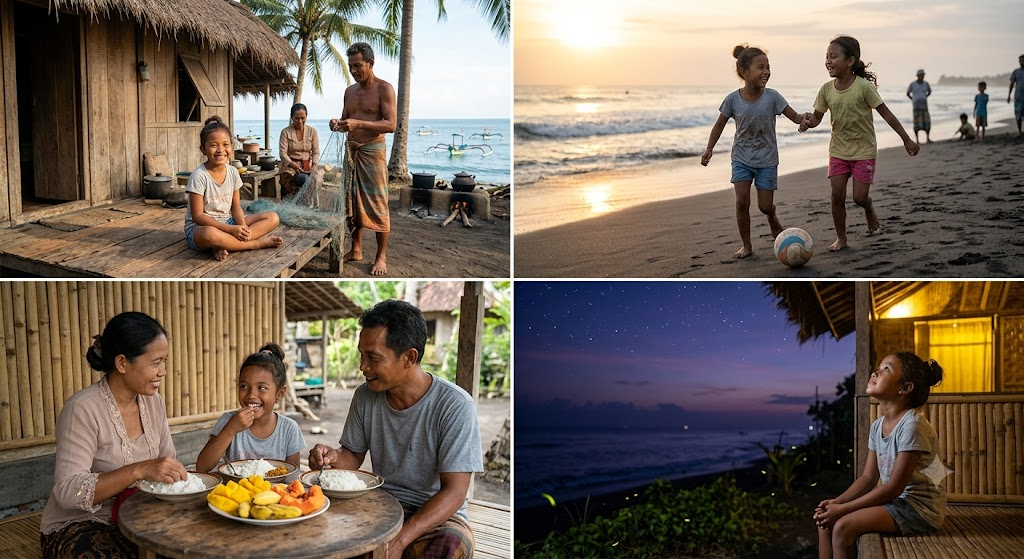
Sita _____ (live) in a small village in Bali, Indonesia. She _____ (be) a young girl. She _____ (live) with her mother and father. Her house _____ (be) near the sea.
One morning, Sita _____ (get up) early. She _____ (wash) her face and _____ (eat) breakfast. She _____ (eat) rice and fruit. Then she _____ (walk) to the beach.
At the beach, Sita _____ (see) her friend Ana. They _____ (play) with a ball. They _____ (talk) and _____ (smile). They _____ (have) a good time.
After that, Sita _____ (go) home. Her mother _____ (cook) lunch. Sita _____ (eat) rice with her family. She _____ (be) very happy.
In the evening, Sita _____ (sit) outside her house. She _____ (look) at the sky. She _____ (see) the stars. Then she _____ (go) to bed and _____ (sleep).
Sita _____ (have) a nice day.
_______________________
Correct version:
Sita lived in a small village in Bali, Indonesia. She was a young girl. She lived with her mother and father. Her house was near the sea.
One morning, Sita got up early. She washed her face and ate breakfast. She ate rice and fruit. Then she walked to the beach.
At the beach, Sita saw her friend Ana. They played with a ball. They talked and smiled. They had a good time.
After that, Sita went home. Her mother cooked lunch. Sita ate rice with her family. She was very happy.
In the evening, Sita sat outside her house. She looked at the sky. She saw the stars. Then she went to bed and slept.
Sita had a nice day.
#################
Short answers, past simple, basics:
| Example Sentence | Yes | No |
|---|---|---|
| I learned letters. | Yes, I did. | No, I didn’t. |
| You read signs. | Yes, you did. | No, you didn’t. |
| He spoke English. | Yes, he did. | No, he didn’t. |
| She watched TV. | Yes, she did. | No, she didn’t. |
| It helped me. | Yes, it did. | No, it didn’t. |
| We used an app. | Yes, we did. | No, we didn’t. |
| You read words. | Yes, you did. | No, you didn’t. |
| They made mistakes. | Yes, they did. | No, they didn’t. |
Questions (Past Simple)
| Question | Yes | No |
|---|---|---|
| Did I learn letters? | Yes, I did. | No, I didn’t. |
| Did you read signs? | Yes, you did. | No, you didn’t. |
| Did he speak English? | Yes, he did. | No, he didn’t. |
| Did she watch TV? | Yes, she did. | No, she didn’t. |
| Did it help me? | Yes, it did. | No, it didn’t. |
| Did we use an app? | Yes, we did. | No, we didn’t. |
| Did you read words? | Yes, you did. | No, you didn’t. |
| Did they make mistakes? | Yes, they did. | No, they didn’t. |
#################
Give short answers:
- Sita walked to the beach.
YOU WRITE:
Yes, she did. - She was an old woman.
- Her mother cooked lunch.
- Sita lived in a city.
- She ate rice and fruit for breakfast.
- She looked at the moon.
- Sita got up early in the morning.
- They played with a toy car.
- Her house was near the sea.
- Sita slept in the garden.
- She was a young girl.
- Sita went to school.
- She walked to the forest.
- Sita lived in a small village.
- She ate vegetables for breakfast.
- Sita looked at the sky in the evening.
- Sita got up late.
- She played with a ball with Ana.
- She went to bed and slept.
- She washed her hands.
_______________________
Answer key:
1 T, 2 F, 3 T, 4 F, 5 T, 6 F, 7 T, 8 F,
9 T, 10 F, 11 T, 12 F, 13 F, 14 T,
15 F, 16 T, 17 F, 18 T, 19 T, 20 F
_______________________
Correct answers:
- Sita walked to the beach. Yes, she did.
- She was an old woman. No, she wasn’t.
- Her mother cooked lunch. Yes, she did.
- Sita lived in a city. No, she didn’t.
- She ate rice and fruit for breakfast. Yes, she did.
- She looked at the moon. No, she didn’t.
- Sita got up early in the morning. Yes, she did.
- They played with a toy car. No, they didn’t.
- Her house was near the sea. Yes, it was.
- Sita slept in the garden. No, she didn’t.
- She was a young girl. Yes, she was.
- Sita went to school. No, she didn’t.
- She walked to the forest. No, she didn’t.
- Sita lived in a small village. Yes, she did.
- She ate vegetables for breakfast. No, she didn’t.
- Sita looked at the sky in the evening. Yes, she did.
- Sita got up late. No, she didn’t.
- She played with a ball with Ana. Yes, she did.
- She went to bed and slept. Yes, she did.
- She washed her hands. No, she didn’t.
#################
Answer as shown:
- Did she walk to the beach or to the shop?
YOU WRITE:
She walked to the beach. - Was she a young girl or an old woman?
- Did Sita live in a village or a city?
- Was her house near the sea or near a mountain?
- Did she get up early or late?
- Did she wash her face or her hands?
- Did she eat rice and fruit or bread and eggs?
- Did she walk to the beach or the forest?
- Did Sita see Ana or her teacher?
- Were Sita and Ana friends or sisters?
- Were they at the beach or at the park?
- Did they talk and smile or cry and shout?
- Did they have a good time or a bad time?
- Did Sita go home or go to school?
- Did her mother cook lunch or dinner?
- Did Sita eat with her family or alone?
- Did she sit outside her house or inside her house?
- Did she look at the sky or the ground?
- Did she see stars or clouds?
- Did Sita sleep or play at night?
_______________________
Correct answers:
- Did she walk to the beach or to the shop? – She walked to the beach.
- Was she a young girl or an old woman? – She was a young girl.
- Did Sita live in a village or a city? – Sita lived in a village.
- Was her house near the sea or near a mountain? – Her house was near the sea.
- Did she get up early or late? – She got up early.
- Did she wash her face or her hands? – She washed her face.
- Did she eat rice and fruit or bread and eggs? – She ate rice and fruit.
- Did she walk to the beach or the forest? – She walked to the beach.
- Did Sita see Ana or her teacher? – Sita saw Ana.
- Were Sita and Ana friends or sisters? – Sita and Ana were friends.
- Were they at the beach or at the park? – They were at the beach.
- Did they talk and smile or cry and shout? – They talked and smiled.
- Did they have a good time or a bad time? – They had a good time.
- Did Sita go home or go to school? – Sita went home.
- Did her mother cook lunch or dinner? – Her mother cooked lunch.
- Did Sita eat with her family or alone? – Sita ate with her family.
- Did she sit outside her house or inside her house? – She sat outside her house.
- Did she look at the sky or the ground? – She looked at the sky.
- Did she see stars or clouds? – She saw the stars.
- Did Sita sleep or play at night? – Sita slept at night.
#################
Rewrite as shown:
- Sita lived in a small village.
YOU WRITE:
a) Negation: Sita did not live in a small village.
b) Question: Did Sita live in a small village?
c) Negative question: Didn’t Sita live in a small village? - She was a young girl.
a) Negation: ________
b) Question: ________
c) Negative question: ________ - She got up early.
a) Negation: ________
b) Question: ________
c) Negative question: ________ - She washed her face.
a) Negation: ________
b) Question: ________
c) Negative question: ________ - She ate breakfast.
a) Negation: ________
b) Question: ________
c) Negative question: ________ - She walked to the beach.
a) Negation: ________
b) Question: ________
c) Negative question: ________ - They played with a ball.
a) Negation: ________
b) Question: ________
c) Negative question: ________ - Sita went home.
a) Negation: ________
b) Question: ________
c) Negative question: ________ - She looked at the sky.
a) Negation: ________
b) Question: ________
c) Negative question: ________ - Sita slept well.
a) Negation: ________
b) Question: ________
c) Negative question: ________
———————————–
Correct answers:
Sita slept well.
a) Negation: Sita did not sleep well.
b) Question: Did Sita sleep well?
c) Negative question: Didn’t Sita sleep well?
Sita lived in a small village.
a) Negation: Sita did not live in a small village.
b) Question: Did Sita live in a small village?
c) Negative question: Didn’t Sita live in a small village?
She was a young girl.
a) Negation: She was not a young girl.
b) Question: Was she a young girl?
c) Negative question: Wasn’t she a young girl?
Sita got up early.
a) Negation: Sita did not get up early.
b) Question: Did Sita get up early?
c) Negative question: Didn’t Sita get up early?
She washed her face.
a) Negation: She did not wash her face.
b) Question: Did she wash her face?
c) Negative question: Didn’t she wash her face?
She ate breakfast.
a) Negation: She did not eat breakfast.
b) Question: Did she eat breakfast?
c) Negative question: Didn’t she eat breakfast?
She walked to the beach.
a) Negation: She did not walk to the beach.
b) Question: Did she walk to the beach?
c) Negative question: Didn’t she walk to the beach?
They played with a ball.
a) Negation: They did not play with a ball.
b) Question: Did they play with a ball?
c) Negative question: Didn’t they play with a ball?
Sita went home.
a) Negation: Sita did not go home.
b) Question: Did Sita go home?
c) Negative question: Didn’t Sita go home?
She looked at the sky.
a) Negation: She did not look at the sky.
b) Question: Did she look at the sky?
c) Negative question: Didn’t she look at the sky?
###################
Use: Who – Where – When – What,
and give correct answer:
- ______ did Sita live?
YOU WRITE:
Where did Sita live?
Sita lived in a village in Bali. - ______ did she eat for breakfast?
- ______ did she see at the beach?
- ______ did she walk in the morning?
- ______ did her mother cook?
- ______ did Sita get up?
- ______ did she play with?
- ______ did they have at the beach?
- ______ did Sita go after the beach?
- ______ did she sit in the evening?
- ______ did she look at?
- ______ did she see in the sky?
- ______ did Sita live with?
- ______ did she eat with?
- ______ did she wash?
- ______ did Sita go to bed?
- ______ did she walk to the beach with?
- ______ did Ana play with Sita?
- ______ did Sita sleep?
- ______ was Sita?
__________________________
Correct answers:
- Where did Sita live?
Sita lived in a village in Bali. - What did she eat for breakfast?
She ate rice and fruit for breakfast. - Who did she see at the beach?
She saw Ana at the beach. - Where did she walk in the morning?
She walked to the beach in the morning. - What did her mother cook?
Her mother cooked lunch. - When did Sita get up?
Sita got up early in the morning. - What did she play with?
She played with a ball. - What did they have at the beach?
They had a good time at the beach. - Where did Sita go after the beach?
Sita went home after the beach. - Where did she sit in the evening?
She sat outside her house in the evening. - What did she look at?
She looked at the sky. - What did she see in the sky?
She saw the stars in the sky. - Who did Sita live with?
Sita lived with her mother and father. - Who did she eat with?
She ate with her family. - What did she wash?
She washed her face. - When did Sita go to bed?
Sita went to bed in the evening. - Who did she walk to the beach with?
She walked to the beach alone. - Who did Ana play with?
Ana played with Sita. - When did Sita sleep?
Sita slept at night. - Who was Sita?
Sita was a young girl.
##################
Interview – now Sita is 24 years old, she remembers the time when she was young:
- What _______ (be) your name?
My name _______ (be) Sita. - Where _______ you _______ (live)?
I _______ (live) in a small village in Bali, Indonesia. - Who _______ you _______ (live) with?
I _______ (live) with my mother and father. - Where _______ (be) your house?
My house _______ (be) near the sea. - What _______ you _______ (eat) for breakfast?
I _______ (eat) rice and fruit for breakfast. - What _______ you _______ (do) in the morning?
I _______ (get up) early and _______ (walk) to the beach. - Who _______ you _______ (see) at the beach?
I _______ (see) my friend Ana at the beach. - What _______ you _______ (do) with Ana?
We _______ (play) with a ball and _______ (talk). - What _______ you _______ (do) after the beach?
I _______ (go) home and _______ (eat) lunch with my family. - What _______ you _______ (do) in the evening?
I _______ (sit) outside my house and _______ (look) at the sky. - What _______ you _______ (see) in the sky?
I _______ (see) the stars. - _______ you _______ (have) a good day?
Yes, I _______ (have) a nice day.
————————————-
Correct version:
1. What is your name?
My name is Sita.
2. Where did you live?
I lived in a small village in Bali, Indonesia.
3. Who did you live with?
I lived with my mother and father.
4. Where was your house?
My house was near the sea.
5. What did you eat for breakfast?
I ate rice and fruit for breakfast.
6. What did you do in the morning?
I got up early and walked to the beach.
7. Who did you see at the beach?
I saw my friend Ana at the beach.
8. What did you do with Ana?
We played with a ball and talked.
9. What did you do after the beach?
I went home and ate lunch with my family.
10. What did you do in the evening?
I sat outside my house and looked at the sky.
11. What did you see in the sky?
I saw the stars.
12. Did you have a good day?
Yes, I had a nice day.
##################
##################
##################
##################
##################
Please use the box below
to write your feedback.
Only I can read it.
It is not public.
Please tell me:
- Are the texts and exercises OK?
- Are the topics OK?
- Is the level OK?
- Is it too easy or too difficult?
- Do you want texts about other topics?
Thank you! I appreciate your feedback.
##################
##################
##################
Remember how babies
learn a language:
Babies learn a language by listening.
They use their ears to hear sounds.
Their brain remembers these sounds.
Babies connect sounds with people and things.
They listen to their parents.
Then they copy the sounds they hear. They imitate words.
Slowly, babies learn to speak.
So,
LISTEN, LISTEN, LISTEN, LISTEN………………
Schreibe einen Kommentar