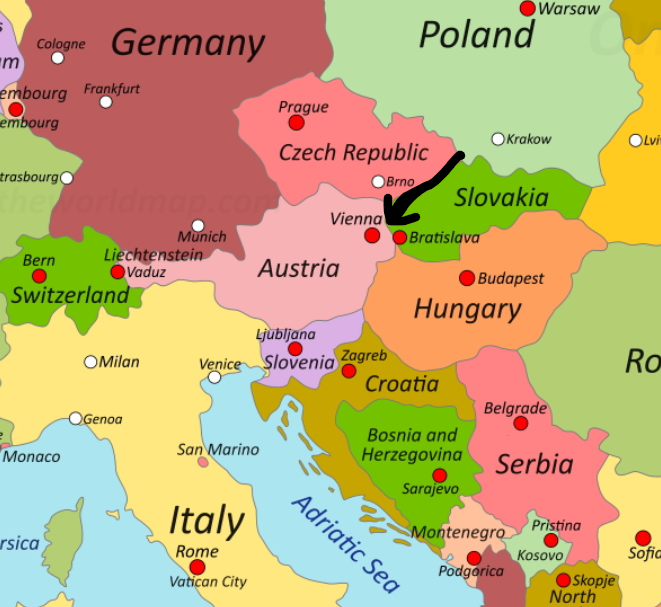
Vienna is the capital of Austria. It is a large and beautiful city. About two million people live in Vienna. The city lies on the Danube River. Vienna is famous for its old buildings, music, parks, cafés and history.
The centre of Vienna is very interesting. St. Stephen’s Cathedral stands in the heart of the city. It has a very large roof with colourful tiles. Visitors can walk around the cathedral and see many old streets nearby.
Another famous place is Hofburg Palace. It is in the centre of Vienna and has many beautiful buildings. The Hofburg is connected with the history of the Austrian emperors. Today, it is also an important place for the Austrian government.
Schönbrunn Palace is one of the most popular sights in Vienna. The palace has many rooms and a large garden. People walk through the garden and enjoy the beautiful views. There is also a zoo called Tiergarten Schönbrunn. It is one of the oldest zoos in the world.
Vienna also has many interesting squares and streets. Stephansplatz, Graben and Kärntner Straße are busy places with shops, cafés and restaurants. At the Hoher Markt, visitors see the famous Anker Clock. The figures move every day at noon.
Vienna is also a city of music. Famous composers such as Mozart, Beethoven and Strauss live and work here. Today, people can still hear classical music in concert halls and churches.
Vienna has many green places too. Prater is a large park with walking paths and the famous Giant Ferris Wheel. People enjoy the park, especially on sunny days.
Vienna is easy to explore by underground trains, trams and buses. Many sights are close to each other in the city centre. Visitors can walk, take a tram or use the underground.
Vienna offers history, beautiful buildings, music, parks and good food. It is a city that gives visitors many things to see and enjoy.
________________________
Vocabulary:
| Word / phrase | Definition |
|---|---|
| a capital | The main city of a country. |
| to lie on a river | To be next to a river. |
| a building | A place with walls and a roof where people live or work. |
| a café | A small place where you can buy coffee, drinks and food. |
| the heart of a city | The centre of a city, often calla the City. |
| a roof | The top part of a building. |
| tiles | Small flat pieces used to cover a roof or a floor. |
| nearby | Not far away. |
| an emperor | A man who is the ruler of an empire. |
| a government | The people who run a country. |
| to enjoy a view | To like looking at a beautiful place. |
| a square | An open place in a city, often with buildings and shops around it. |
| a busy place | A place with many people or cars. |
| at noon | At 12 o’clock in the middle of the day. |
| a composer | A person who writes music. |
| classical music | Music written by famous composers, often a long time ago. |
| a concert hall | A large building where people listen to music. |
| a church | A building where Christians go to pray. |
| a walking path | A path where people can walk. |
| a Giant Ferris Wheel | A very large wheel with small seats that moves around and gives a high view. |
| especially | More than other things or people. |
| to explore | To go around a place and learn about it. |
| a tram | A vehicle that carries people in a city and runs on tracks. |
| to offer | To give or provide something. |
| a visitor | A person who comes to a place for a short time. |
##################
Match the words with the definitions
Words
- a capital
- to lie on a river
- a building
- a café
- the heart of a city
- a roof
- tiles
- nearby
- an emperor
- a government
- to enjoy a view
- a square
- a busy place
- at noon
- a composer
- classical music
- a concert hall
- a church
- a walking path
- a Giant Ferris Wheel
- especially
- to explore
- a tram
- to offer
- a visitor
Definitions
A. A place where Christians go to pray.
B. A person who comes to a place for a short time.
C. The top part of a building.
D. To give or provide something.
E. A person who writes music.
F. Not far away.
G. A large building where people listen to music.
H. The main city of a country.
I. A path where people can walk.
J. To go around a place and learn about it.
K. A small place where you can buy coffee, drinks and food.
L. At 12 o’clock in the middle of the day.
M. Small flat pieces used to cover a roof or a floor.
N. A place with many people or cars.
O. To like looking at a beautiful place.
P. A man who is the ruler of an empire.
Q. An open place in a city, often with buildings around it.
R. A vehicle that carries people in a city and runs on tracks.
S. Music written by famous composers, often a long time ago.
T. A place with walls and a roof where people live or work.
U. More than other things or people.
V. To be next to a river.
W. The centre of a city.
X. A very large wheel with small seats that moves around.
Y. The people who run a country.
__________________________
Answers:
1-H, 2-V, 3-T, 4-K, 5-W, 6-C,
7-M, 8-F, 9-P, 10-Y, 11-O, 12-Q,
13-N, 14-L, 15-E, 16-S, 17-G,
18-A, 19-I, 20-X, 21-U, 22-J,
23-R, 24-D, 25-B
##################
Match the definitions with the words
Definitions
- The main city of a country.
- A place with walls and a roof where people live or work.
- To like looking at a beautiful place.
- A man who is the ruler of an empire.
- A vehicle that carries people in a city and runs on tracks.
- Not far away.
- A large building where people listen to music.
- Small flat pieces used to cover a roof or a floor.
- The centre of a city.
- A person who comes to a place for a short time.
- At 12 o’clock in the middle of the day.
- A place where Christians go to pray.
- To give or provide something.
- A path where people can walk.
- A small place where you can buy coffee, drinks and food.
- A person who writes music.
- An open place in a city, often with buildings around it.
- To be next to a river.
- Music written by famous composers, often a long time ago.
- A very large wheel with small seats that moves around.
- More than other things or people.
- A place with many people or cars.
- The people who run a country.
- To go around a place and learn about it.
- The top part of a building.
Words
A. a tram
B. a roof
C. a visitor
D. a capital
E. a busy place
F. to explore
G. a composer
H. tiles
I. to lie on a river
J. a church
K. classical music
L. a square
M. nearby
N. a government
O. a concert hall
P. especially
Q. a building
R. to enjoy a view
S. a café
T. a Giant Ferris Wheel
U. the heart of a city
V. an emperor
W. to offer
X. at noon
Y. a walking path
___________________________
Answers:
1-D, 2-Q, 3-R, 4-V, 5-A, 6-M,
7-O, 8-H, 9-U, 10-C, 11-X, 12-J,
13-W, 14-Y, 15-S, 16-G, 17-L,
18-I, 19-K, 20-T, 21-P, 22-E,
23-N, 24-F, 25-B
###################
Choose the correct word/s
- If you travel to Austria, is Vienna the capital or the government?
- If you are in the centre of Vienna, are you in the heart of the city or a walking path?
- What do you see on the roof of St. Stephen’s Cathedral: tiles or walking paths?
- In the time of the Austrian rulers, was the ruler an emperor or a visitor?
- Who writes music for an orchestra: a composer or a visitor?
- When you listen to Mozart or Beethoven, are you listening to classical music or pop music?
- Where can you sit and listen to an orchestra: in a concert hall or a café?
- Where can people meet in an open place in the city: in a square or a building?
- If there are many people, cars and shops, is it a busy place or a walking path?
- If you walk around a new city and discover interesting places, do you explore or offer the city?
- If a city is next to the Danube, does it lie on a river or walk on a river?
- Which attraction can you ride high above the Prater: the Giant Ferris Wheel or the tram?
- If you stand on a hill and look at Vienna, can you enjoy a view or build a view?
- If a café is only a short walk from your hotel, is it nearby or far away?
- If a hotel gives guests breakfast, does the hotel offer or explore breakfast?
- If you come to Vienna for a holiday, are you a visitor or an emperor?
- Where can Christians go to pray: in a church or a concert hall?
- What can you take through Vienna on tracks: a tram or a bus?
- If you like one place more than the others, can you say you like it especially or nearby?
- When do the figures on the Anker Clock move: at noon or at midnight?
__________________________
Answers:
- If you travel to Austria, is Vienna the capital or the government?
the capital - If you are in the centre of Vienna, are you in the heart of the city or in a walking path?
the heart of the city - What do you see on the roof of St. Stephen’s Cathedral: tiles or walking paths?
tiles - In the time of the Austrian emperors, was the ruler an emperor or a visitor?
an emperor - Who writes music for an orchestra: a composer or a visitor?
a composer - When you listen to Mozart or Beethoven, are you listening to classical music or pop music?
classical music - Where can you sit and listen to an orchestra: in a concert hall or a café?
a concert hall - Where can people meet in an open place in the city: in a square or a building?
a square - If there are many people, cars and shops, is it a busy place or a walking path?
a busy place - If you walk around a new city and discover interesting places, do you explore the city or offer the city?
explore - If a city is next to the Danube, does it lie on a river or walk on a river?
lie on a river - Which attraction can you ride high above the Prater: the Giant Ferris Wheel or the tram?
the Giant Ferris Wheel - If you stand on a hill and look at Vienna, can you enjoy a view or build a view?
enjoy a view - If a café is only a short walk from your hotel, is it nearby or far away?
nearby - If a hotel gives guests breakfast, does the hotel offer breakfast or explore breakfast?
offer - If you come to Vienna for a holiday, are you a visitor or an emperor?
a visitor - Where can Christians go to pray: in a church or a concert hall?
a church - What can you take through Vienna on tracks: a tram or a bus?
a tram - If you like one place more than the others, can you say you like it especially or nearby?
especially - When do the figures on the Anker Clock move: at noon or at midnight?
at noon
###################
True or false:
- The Anker Clock moves every day at noon.
- The Prater is a small park.
- The Hofburg is connected with the history of the Austrian emperors.
- Vienna has no underground trains.
- Mozart, Beethoven and Strauss are connected with Vienna.
- Schönbrunn Palace has a large garden.
- The Giant Ferris Wheel is at Schönbrunn Palace.
- About two million people live in Vienna.
- Stephansplatz, Graben and Kärntner Straße have no shops or cafés.
- Vienna is the capital of Austria.
- Visitors can only travel around Vienna by bus.
- Tiergarten Schönbrunn is one of the oldest zoos in the world.
- The Prater is a large park.
- St. Stephen’s Cathedral is outside the centre of Vienna.
- Vienna has no green places.
- The Hofburg is outside the centre of Vienna.
- Vienna lies on the Danube River.
- Schönbrunn Palace has no garden.
- The Anker Clock is at the Hoher Markt.
- St. Stephen’s Cathedral is in the heart of Vienna.
________________________
True: 1,3,5,6,8,10,12,13,17,19,20
________________________
Correct version:
The Anker Clock moves every day at noon.
The Prater is a small park.
True is: The Prater is a large park.
The Hofburg is connected with the history of the Austrian emperors.
Vienna has no underground trains.
True is: Vienna has underground trains.
Mozart, Beethoven and Strauss are connected with Vienna.
Schönbrunn Palace has a large garden.
The Giant Ferris Wheel is at Schönbrunn Palace.
True is: The Giant Ferris Wheel is in the Prater.
About two million people live in Vienna.
Stephansplatz, Graben and Kärntner Straße have no shops or cafés.
True is: Stephansplatz, Graben and Kärntner Straße have shops, cafés and restaurants.
Vienna is the capital of Austria.
Visitors can only travel around Vienna by bus.
True is: Visitors can travel around Vienna by underground trains, trams and buses.
Tiergarten Schönbrunn is one of the oldest zoos in the world.
The Prater is a large park.
St. Stephen’s Cathedral is outside the centre of Vienna.
True is: St. Stephen’s Cathedral is in the heart of Vienna.
Vienna has no green places.
True is: Vienna has many green places.
The Hofburg is outside the centre of Vienna.
True is: The Hofburg is in the centre of Vienna.
Vienna lies on the Danube River.
Schönbrunn Palace has no garden.
True is: Schönbrunn Palace has a large garden.
The Anker Clock is at the Hoher Markt.
St. Stephen’s Cathedral is in the heart of Vienna.
################
Connect the halves:
First:
- Vienna is famous for
- About two million people
- St. Stephen’s Cathedral has
- Visitors can walk around
- The Hofburg is in
- Today, the Hofburg is also
- Schönbrunn Palace is one of
- People can walk through
- The Anker Clock is at
- The figures on the Anker Clock
- Vienna is also a city
- The Prater has
- Vienna is easy to explore
- Many sights are close
- Visitors can walk, take a tram
Second:
A. the garden at Schönbrunn Palace.
B. with underground trains, trams and buses.
C. the Hoher Markt.
D. its very large roof with colourful tiles.
E. live in Vienna.
F. of music.
G. an important place for the Austrian government.
H. history, music, parks and cafés.
I. to each other in the city centre.
J. one of the most popular sights in Vienna.
K. the cathedral and see many old streets nearby.
L. move every day at noon.
M. the famous Giant Ferris Wheel.
N. the centre of Vienna.
O. or use the underground.
____________________
Answers:
1-H, 2-E, 3-D, 4-K, 5-N, 6-G,
7-J, 8-A, 9-C, 10-L, 11-F, 12-M,
13-B, 14-I, 15-O
____________________
Connect the two halves
- Vienna is famous for history, music, parks and cafés.
- About two million people live in Vienna.
- St. Stephen’s Cathedral has a very large roof with colourful tiles.
- Visitors can walk around the cathedral and see many old streets nearby.
- The Hofburg is in the centre of Vienna.
- Today, the Hofburg is also an important place for the Austrian government.
- Schönbrunn Palace is one of the most popular sights in Vienna.
- People can walk through the garden at Schönbrunn Palace.
- The Anker Clock is at the Hoher Markt.
- The figures on the Anker Clock move every day at noon.
- Vienna is also a city of music.
- The Prater has the famous Giant Ferris Wheel.
- Vienna is easy to explore with underground trains, trams and buses.
- Many sights are close to each other in the city centre.
- Visitors can walk, take a tram or use the underground.
###################
Find the place
St. Stephen’s Cathedral – Hofburg – Schönbrunn Palace – Hoher Markt – Prater
- __________ has the famous Anker Clock.
- __________ has a large garden and a zoo nearby.
- __________ is connected with the Austrian emperors.
- __________ has the famous Giant Ferris Wheel.
- __________ has a very large roof with colourful tiles.
- __________ is in the centre of Vienna and has many beautiful buildings.
- __________ is one of the most popular sights in Vienna.
- __________ is a busy place with shops, cafés and restaurants nearby.
- __________ is in the heart of the city.
- __________ is a large park with walking paths.
—————————————-
Answers:
1. Hoher Markt, 2. Schönbrunn Palace, 3. Hofburg, 4. Prater, 5. St. Stephen’s Cathedral, 6. Hofburg, 7. Schönbrunn Palace, 8. Hoher Markt, 9. St. Stephen’s Cathedral, 10. Prater.
_________________________
Correct version:
Hoher Markt has the famous Anker Clock.
Schönbrunn Palace has a large garden and a zoo nearby.
The Hofburg is connected with the Austrian emperors.
The Prater has the famous Giant Ferris Wheel.
St. Stephen’s Cathedral has a very large roof with colourful tiles.
The Hofburg is in the centre of Vienna and has many beautiful buildings.
Schönbrunn Palace is one of the most popular sights in Vienna.
Hoher Markt is a busy place with shops, cafés and restaurants nearby.
St. Stephen’s Cathedral is in the heart of the city.
The Prater is a large park with walking paths.
##################
Write the correct answer from the text
- What is the capital of Austria? __________
- What river is Vienna next to? __________
- What building has a large roof with colourful tiles? __________
- What palace is connected with the Austrian emperors? __________
- What palace has a large garden? __________
- What clock is at the Hoher Markt? __________
- What park has the Giant Ferris Wheel? __________
- What zoo is at Schönbrunn? __________
- Which three composers are mentioned? __________
- What transport runs on tracks? __________
————————————–
Correct answers:
- What is the capital of Austria? Vienna
- What river is Vienna next to? the Danube River
- What building has a large roof with colourful tiles? St. Stephen’s Cathedral
- What palace is connected with the Austrian emperors? the Hofburg Palace
- What palace has a large garden? Schönbrunn Palace
- What clock is at the Hoher Markt? the Anker Clock
- What park has the Giant Ferris Wheel? the Prater
- What zoo is at Schönbrunn? Tiergarten Schönbrunn
- Which three composers are mentioned? Mozart, Beethoven and Strauss
- What transport runs on tracks? a tram
- What is the centre of Vienna called? the heart of the city
- What famous wheel is in the Prater? the Giant Ferris Wheel
- What three places have shops, cafés and restaurants? Stephansplatz, Graben and Kärntner Straße
- Where can people hear classical music? in concert halls and churches
- What three types of transport can visitors use in Vienna? underground trains, trams and buses
#####################
Match the questions with the answers
Questions
- What kind of city is Vienna?
- Where does Vienna lie?
- Which building stands in the heart of the city?
- What is the Hofburg connected with?
- What makes Schönbrunn Palace special?
- Where is the Anker Clock?
- What are Stephansplatz, Graben and Kärntner Straße like?
- Which famous composers lived and worked in Vienna?
- What makes the Prater special?
- Which types of transport are available in Vienna?
- Why is Vienna easy to explore?
- What does Vienna offer visitors?
Answers
A. The famous clock is located at the Hoher Markt.
B. The Hofburg has a strong connection with the Austrian emperors.
C. Vienna has about two million people and many beautiful places.
D. Visitors find history, beautiful buildings, music, parks and good food.
E. The Prater contains walking paths and the famous Giant Ferris Wheel.
F. Mozart, Beethoven and Strauss worked in Vienna.
G. Many sights are close to each other in the city centre.
H. St. Stephen’s Cathedral stands there, with its large roof and colourful tiles.
I. Schönbrunn Palace contains many rooms and a large garden, and a zoo is nearby.
J. Visitors have underground trains, trams and buses.
K. The city lies beside the Danube River.
L. They contain shops, cafés and restaurants.
_______________________
Answers:
1-C, 2-K, 3-H, 4-B, 5-I, 6-A,
7-L, 8-F, 9-E, 10-J, 11-G, 12-D
_______________________
Full version:
1. Interviewer: What kind of city is Vienna?
Tourist Manager: Vienna has about two million people and many beautiful places. It is the capital of Austria.
2. Interviewer: Where does Vienna lie?
Tourist Manager: The city lies beside the Danube River.
3. Interviewer: Which building stands in the heart of the city?
Tourist Manager: St. Stephen’s Cathedral stands there. It has a very large roof with colourful tiles.
4. Interviewer: What is the Hofburg connected with?
Tourist Manager: The Hofburg has a strong connection with the Austrian emperors.
5. Interviewer: What makes Schönbrunn Palace special?
Tourist Manager: The palace contains many rooms and a large garden. A famous zoo is nearby.
6. Interviewer: Where is the Anker Clock?
Tourist Manager: The famous clock is located at the Hoher Markt. Its figures move every day at noon.
7. Interviewer: What are Stephansplatz, Graben and Kärntner Straße like?
Tourist Manager: They contain shops, cafés and restaurants.
8. Interviewer: Which famous composers lived and worked in Vienna?
Tourist Manager: Mozart, Beethoven and Strauss worked in Vienna.
9. Interviewer: What makes the Prater special?
Tourist Manager: The Prater contains walking paths and the famous Giant Ferris Wheel.
10. Interviewer: Which types of transport are available in Vienna?
Tourist Manager: Visitors have underground trains, trams and buses.
11. Interviewer: Why is Vienna easy to explore?
Tourist Manager: Many sights are close to each other in the city centre.
12. Interviewer: What does Vienna offer visitors?
Tourist Manager: Visitors find history, beautiful buildings, music, parks and good food.
################
##################
##################
##################
##################
Please use the box below
to write your feedback.
Only I can read it.
It is not public.
Please tell me:
- Are the texts and exercises OK?
- Are the topics OK?
- Is the level OK?
- Is it too easy or too difficult?
- Do you want texts about other topics?
Thank you! I appreciate your feedback.
##################
##################
##################
Remember how babies
learn a language:
Babies learn a language by listening.
They use their ears to hear sounds.
Their brain remembers these sounds.
Babies connect sounds with people and things.
They listen to their parents.
Then they copy the sounds they hear. They imitate words.
Slowly, babies learn to speak.
So,
LISTEN, LISTEN, LISTEN, LISTEN………………
Schreibe einen Kommentar