It might be a good idea
to do that story first
=> link
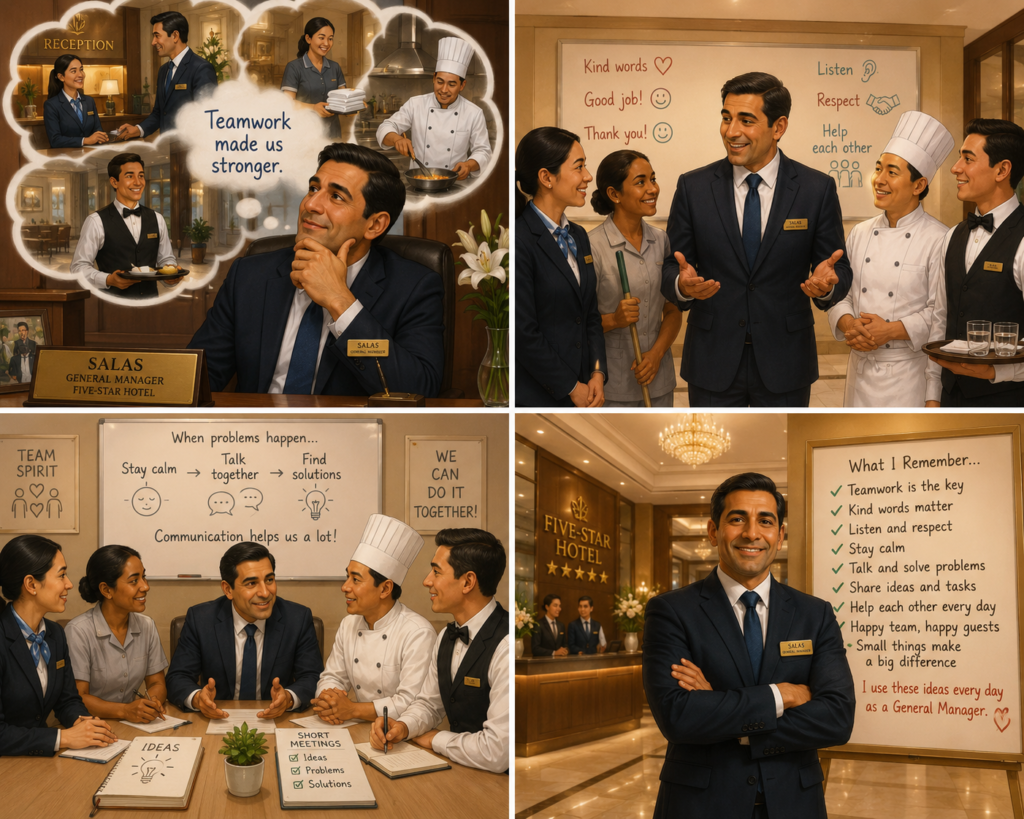
Salas is a general manager of a five-star hotel, looking back at his time when he worked in a team – memories:
I worked with reception workers, cleaners, cooks, and waiters. We helped each other every day. I learned that teamwork was very important.
I always helped my co-workers when they had a lot of work. I was friendly and polite. I listened to other people and respected their ideas.
I used kind words. I said good job and thank you many times. I saw that people felt happy and worked better.
When problems happened, I stayed calm. I talked with my team. We found solutions together. Communication helped us a lot.
I also tried to improve team spirit. We talked more during breaks. We got to know each other better.
We had short meetings. We shared ideas and problems. Sometimes we did small team activities after work.
Now I remember that small things made a big difference. Teamwork helped us give good service and make guests happy. I felt happy when the team worked well. I saw that guests were happy too. I learned that small kind words helped a lot. I believed teamwork was the key to success. We always tried to help each other every day. I remember that problems became smaller when we talked. We also shared tasks to make work easy. I learned to listen more and speak less. I saw that respect made the team stronger. I am proud of my past work in the hotel.
Now I use all these ideas as a general manager. I try to make a good team in my hotel every day. I still say thank you and I still help people. I think teamwork always stays very important for me. It helped me grow as a leader.
___________________
Vocabulary:
- to look back at something — to think about something that happened in the past
- memories — things you remember from the past
- to be polite — to speak and behave in a kind and respectful way
- to respect others’ ideas — to listen to and accept what other people think
- kind words — nice and friendly words
- to stay calm — to remain relaxed and not angry or nervous
- to find a solution — to solve a problem
- communication — talking and sharing information with other people
- to improve team spirit — to make the team feel happier and work better together
- a break — a short time to rest from work
- to share ideas — to tell other people your thoughts or opinions
- a key to success — something very important for success
- to share tasks — to divide work between people
- respect — feeling and showing care for other people
- to grow as a leader — to become a better leader over time
##############
Match word and definition:
- to look back at something
- memories
- to be polite
- to respect others’ ideas
- kind words
- to stay calm
- to find a solution
- communication
- to improve team spirit
- a break
- to share ideas
- a key to success
- to share tasks
- respect
- to grow as a leader
Definitions:
a) to solve a problem
b) to divide work between people
c) nice and friendly words
d) to think about something that happened in the past
e) talking and sharing information with other people
f) to make the team feel happier and work better together
g) things you remember from the past
h) feeling and showing care for other people
i) to become a better leader over time
j) to remain relaxed and not angry or nervous
k) to speak and behave in a kind and respectful way
l) to tell other people your thoughts or opinions
m) something very important for success
n) a short time to rest from work
o) to listen to and accept what other people think
___________________
Answers:
1-d, 2-g, 3-k, 4-o, 5-c, 6-j, 7-a,
8-e, 9-f, 10-n, 11-l, 12-m, 13-b, 14-h, 15-i
##############
Basics in past simple:
Past Simple – Regular Verbs
Rules:
- Most verbs: add -ed
play → played - Verbs ending in -e: add -d
live → lived - Verbs ending in consonant + y: change y to i and add -ed
study → studied - Short verbs ending in vowel + consonant: double the final consonant and add -ed
stop → stopped - List of irregular verbs => LINK
Use:
The past simple is used to talk about finished actions in the past.
##################
Verbs in text:
| Infinitive | Past | Definition |
|---|---|---|
| work | worked | to do a job or activity |
| help | helped | to do something for someone to make it easier |
| learn | learned | to get knowledge or skill |
| be | was / were | to exist or to be |
| feel | felt | to have emotions |
| say | said | to speak words |
| see | saw | to look with your eyes |
| listen | listened | to hear carefully |
| respect | respected | to treat someone in a polite and kind way |
| use | used | to do something with a tool or method |
| stay | stayed | to remain in a place or state |
| talk | talked | to speak with someone |
| find | found | to discover or get something |
| improve | improved | to make something better |
| share | shared | to give part of something to others |
| get | got | to receive or obtain something |
| have | had | to possess or own |
| make | made | to create or produce something |
| believe | believed | to think something is true |
| try | tried | to attempt to do something |
| remember | remembered | to keep information in your mind |
| become | became | to start to be something new |
| grow | grew | to become bigger or better |
| think | thought | to have ideas or opinions |
###################
Fill in the correct form of the verb in past simple:
I ________ (work) in a hotel and ________ (help) reception workers, cleaners, cooks, and waiters. We ________ (learn) to work as a team, and I ________ (be) friendly and polite.
I ________ (listen) to others and ________ (respect) their ideas. I ________ (use) kind words and ________ (say) thank you often. I ________ (see) that people ________ (feel) happier when we worked together well.
When problems ________ (happen), I ________ (stay) calm and ________ (talk) with my team. We ________ (find) solutions together and ________ (share) ideas. Communication ________ (help) us a lot.
We ________ (try) to improve team spirit. We ________ (have) breaks together, ________ (share) tasks, and ________ (get) to know each other better. We also ________ (remember) that small things ________ (make) a big difference.
We ________ (believe) teamwork was the key to success. I ________ (think) about this often and ________ (become) a better leader. I ________ (grow) as a manager because I ________ (learn) from every situation.
—————————–
Correct version:
I worked in a hotel and helped reception workers, cleaners, cooks, and waiters. We learned to work as a team, and I was friendly and polite.
I listened to others and respected their ideas. I used kind words and said thank you often. I saw that people felt happier when we worked together well.
When problems happened, I stayed calm and talked with my team. We found solutions together and shared ideas. Communication helped us a lot.
We tried to improve team spirit. We had breaks together, shared tasks, and got to know each other better. We also remembered that small things made a big difference.
We believed teamwork was the key to success. I thought about this often and became a better leader. I grew as a manager because I learned from every situation.
###################
Short answers, past simple, basics:
| Example Sentence | Yes | No |
|---|---|---|
| I learned letters. | Yes, I did. | No, I didn’t. |
| You read signs. | Yes, you did. | No, you didn’t. |
| He spoke English. | Yes, he did. | No, he didn’t. |
| She watched TV. | Yes, she did. | No, she didn’t. |
| It helped me. | Yes, it did. | No, it didn’t. |
| We used an app. | Yes, we did. | No, we didn’t. |
| You read words. | Yes, you did. | No, you didn’t. |
| They made mistakes. | Yes, they did. | No, they didn’t. |
Questions (Past Simple)
| Question | Yes | No |
|---|---|---|
| Did I learn letters? | Yes, I did. | No, I didn’t. |
| Did you read signs? | Yes, you did. | No, you didn’t. |
| Did he speak English? | Yes, he did. | No, he didn’t. |
| Did she watch TV? | Yes, she did. | No, she didn’t. |
| Did it help me? | Yes, it did. | No, it didn’t. |
| Did we use an app? | Yes, we did. | No, we didn’t. |
| Did you read words? | Yes, you did. | No, you didn’t. |
| Did they make mistakes? | Yes, they did. | No, they didn’t. |
Was / Were
| Question | Yes | No |
|---|---|---|
| Was I happy? | Yes, I was. | No, I wasn’t. |
| Were you happy? | Yes, you were. | No, you weren’t. |
| Was he happy? | Yes, he was. | No, he wasn’t. |
| Was she happy? | Yes, she was. | No, she wasn’t. |
| Was it good? | Yes, it was. | No, it wasn’t. |
| Were we happy? | Yes, we were. | No, we weren’t. |
| Were you happy? | Yes, you were. | No, you weren’t. |
| Were they happy? | Yes, they were. | No, they weren’t. |
#################
Provide short answers:
- The writer helped only guests and did not work with staff.
YOU WRITE:
No, he didn’t. - The writer was friendly with co-workers.
- The writer learned that teamwork was very important.
- The writer always got angry when problems happened.
- The writer worked in a hotel.
- The writer stayed calm when problems happened.
- The writer ignored other people’s ideas during work.
- The writer became a general manager later.
- The team worked without any meetings or discussions.
- The writer used kind words with co-workers.
- The writer worked in a hotel and only cleaned offices in the morning.
- The writer listened to other people’s ideas.
- The writer was responsible for managing the whole hotel alone.
- The team had short meetings during work.
- The writer helped reception workers, cleaners, cooks, and waiters.
- The writer never used polite words at work.
- The team talked together to find solutions.
- The writer learned that working alone was better than teamwork.
- The writer stayed calm when problems happened.
- The writer was friendly with co-workers.
__________________________
Correct version:
1: The writer helped only guests and did not work with staff. — No, he didn’t.
2: The writer was friendly with co-workers. — Yes, he was.
3: The writer learned that teamwork was very important. — Yes, he did.
4: The writer always got angry when problems happened. — No, he didn’t.
5: The writer worked in a hotel. — Yes, he did.
6: The writer stayed calm when problems happened. — Yes, he did.
7: The writer ignored other people’s ideas during work. — No, he didn’t.
8: The writer became a general manager later. — Yes, he did.
9: The team worked without any meetings or discussions. — No, they didn’t.
10: The writer used kind words with co-workers. — Yes, he did.
11: The writer worked in a hotel and only cleaned offices in the morning. — No, he didn’t.
12: The writer listened to other people’s ideas. — Yes, he did.
13: The writer was responsible for managing the whole hotel alone. — No, he wasn’t.
14: The team had short meetings during work. — Yes, they did.
15: The writer helped reception workers, cleaners, cooks, and waiters. — Yes, he did.
16: The writer never used polite words at work. — No, he didn’t.
17: The team talked together to find solutions. — Yes, they did.
18: The writer learned that working alone was better than teamwork. — No, he didn’t.
19: The writer stayed calm when problems happened. — Yes, he did.
20: The writer was friendly with co-workers. — Yes, he was.
####################
Correct the statements, short answer first:
- The writer was responsible for managing the whole hotel alone.
YOU WRITE:
No, he wasn’t. He worked with his team and shared responsibilities. - The writer worked in a hotel and only cleaned offices in the morning.
- The writer ignored other people’s ideas during work.
- The writer never used polite words at work.
- The team worked without any meetings or discussions.
- The writer helped only guests and did not work with staff.
- The workers were all from different companies and never worked together.
- The writer always got angry when problems happened.
- The team solved problems without talking together.
- The writer learned that working alone was better than teamwork.
___________________________
Correct answers:
The writer was responsible for managing the whole hotel alone.
No, he wasn’t. He worked with his team and shared responsibilities.
The writer worked in a hotel and only cleaned offices in the morning.
No, he didn’t. He worked with reception workers, cleaners, cooks, and waiters.
The writer ignored other people’s ideas during work.
No, he didn’t. He listened to other people’s ideas.
The writer never used polite words at work.
No, he didn’t. He used kind and polite words with co-workers.
The team worked without any meetings or discussions.
No, they didn’t. They had short meetings and discussed ideas.
The writer helped only guests and did not work with staff.
No, he didn’t. He helped different hotel staff every day.
The workers were all from different companies and never worked together.
No, they weren’t. They worked together as one team.
The writer always got angry when problems happened.
No, he didn’t. He stayed calm when problems happened.
The team solved problems without talking together.
No, they didn’t. They talked together to find solutions.
The writer learned that working alone was better than teamwork.
No, he didn’t. He learned that teamwork was very important.
####################
Past simple – basics
| Personal Pronoun | Verb (Past) | Object |
|---|---|---|
| I | ate | apples |
| You | ate | apples |
| He | ate | apples |
| She | ate | apples |
| It | ate | apples |
| We | ate | apples |
| You (plural) | ate | apples |
| They | ate | apples |
| I | played | football |
| You | played | football |
| He | played | football |
| She | played | football |
| It | played | football |
| We | played | football |
| You (plural) | played | football |
| They | played | football |
| Personal Pronoun | Verb (Past Negative) | Object |
|---|---|---|
| I | did not eat | apples |
| You | did not eat | apples |
| He | did not eat | apples |
| She | did not eat | apples |
| It | did not eat | apples |
| We | did not eat | apples |
| You (plural) | did not eat | apples |
| They | did not eat | apples |
| I | did not play | football |
| You | did not play | football |
| He | did not play | football |
| She | did not play | football |
| It | did not play | football |
| We | did not play | football |
| You (plural) | did not play | football |
| They | did not play | football |
| Did + Pronoun | Verb | Object |
|---|---|---|
| Did I | eat | apples? |
| Did you | eat | apples? |
| Did he | eat | apples? |
| Did she | eat | apples? |
| Did it | eat | apples? |
| Did we | eat | apples? |
| Did you | eat | apples? |
| Did they | eat | apples? |
| Did I | play | football? |
| Did you | play | football? |
| Did he | play | football? |
| Did she | play | football? |
| Did it | play | football? |
| Did we | play | football? |
| Did you | play | football? |
| Did they | play | football? |
| Didn’t + Pronoun | Verb | Object |
|---|---|---|
| Didn’t I | eat | apples? |
| Didn’t you | eat | apples? |
| Didn’t he | eat | apples? |
| Didn’t she | eat | apples? |
| Didn’t it | eat | apples? |
| Didn’t we | eat | apples? |
| Didn’t you | eat | apples? |
| Didn’t they | eat | apples? |
| Didn’t I | play | football? |
| Didn’t you | play | football? |
| Didn’t he | play | football? |
| Didn’t she | play | football? |
| Didn’t it | play | football? |
| Didn’t we | play | football? |
| Didn’t you | play | football? |
| Didn’t they | play | football? |
Forms of ‚to be‘
| Personal Pronoun | Positive | Negative | Question |
|---|---|---|---|
| I | I was happy. | I was not happy. | Was I happy? |
| You (singular) | You were excited. | You were not excited. | Were you excited? |
| He | He was at home. | He was not at home. | Was he at home? |
| She | She was tired. | She was not tired. | Was she tired? |
| It | It was cold. | It was not cold. | Was it cold? |
| We | We were at the party. | We were not at the party. | Were we at the party? |
| You (plural) | You were friends. | You were not friends. | Were you friends? |
| They | They were in the garden. | They were not in the garden. | Were they in the garden? |
################
_____________________
Write as shown in 1:
- The writer was a hotel worker.
YOU WRITE:
Negation: The writer was not a hotel worker.
Question: Was the writer a hotel worker?
Negatove question: Wasn’t the writer a hotel worker? - The writer had many co-workers in the hotel.
- The writer helped different hotel staff every day.
- The writer said kind words to co-workers.
- The writer saw that teamwork was important.
- The team were busy during working hours.
- The writer took part in short meetings.
- The writer made the team stronger.
- The writer found solutions when problems happened.
- The writer became a general manager later.
_______________________
Correct version:
- The writer was a hotel worker.
Negation: The writer was not a hotel worker.
Question: Was the writer a hotel worker?
Negative question: Wasn’t the writer a hotel worker? - The writer had many co-workers in the hotel.
Negation: The writer did not have many co-workers in the hotel.
Question: Did the writer have many co-workers in the hotel?
Negative question: Didn’t the writer have many co-workers in the hotel? - The writer helped different hotel staff every day.
Negation: The writer did not help different hotel staff every day.
Question: Did the writer help different hotel staff every day?
Negative question: Didn’t the writer help different hotel staff every day? - The writer said kind words to co-workers.
Negation: The writer did not say kind words to co-workers.
Question: Did the writer say kind words to co-workers?
Negative question: Didn’t the writer say kind words to co-workers? - The writer saw that teamwork was important.
Negation: The writer did not see that teamwork was important.
Question: Did the writer see that teamwork was important?
Negative question: Didn’t the writer see that teamwork was important? - The team were busy during working hours.
Negation: The team were not busy during working hours.
Question: Were the team busy during working hours?
Negative question: Weren’t the team busy during working hours? - The writer took part in short meetings.
Negation: The writer did not take part in short meetings.
Question: Did the writer take part in short meetings?
Negative question: Didn’t the writer take part in short meetings? - The writer made the team stronger.
Negation: The writer did not make the team stronger.
Question: Did the writer make the team stronger?
Negative question: Didn’t the writer make the team stronger? - The writer found solutions when problems happened.
Negation: The writer did not find solutions when problems happened.
Question: Did the writer find solutions when problems happened?
Negative question: Didn’t the writer find solutions when problems happened? - The writer became a general manager later.
Negation: The writer did not become a general manager later.
Question: Did the writer become a general manager later?
Negative question: Didn’t the writer become a general manager later?
################
Form questions in past simple:
- he / work / reception workers?
- they / help / each other?
- he / learn / teamwork?
- he / be / friendly and polite?
- he / use / kind words?
- they / solve / problems together?
- he / listen / other people’s ideas?
- they / have / short meetings?
- he / improve / team spirit?
- he / stay / calm in problems?
- they / share / ideas?
- he / become / a general manager?
- he / feel / happy at work?
- they / talk / during breaks?
_____________________
Correct answers:
Did he work with reception workers?
Did they help each other?
Did he learn teamwork?
Was he friendly and polite?
Did he use kind words?
Did they solve problems together?
Did he listen to other people’s ideas?
Did they have short meetings?
Did he improve team spirit?
Did he stay calm in problems?
Did they share ideas?
Did he become a general manager?
Did he feel happy at work?
Did they talk during breaks?
##################
Match the two halves:
- The writer worked in a hotel
- The writer helped reception workers
- The writer learned teamwork
- The writer stayed calm
- The writer used kind words
- The team had short meetings
- The writer listened to others
- The team talked together
- The writer improved team spirit
- The writer became a general manager
a. with cleaners, cooks, and waiters
b. to understand it was very important
c. when problems happened
d. and said thank you often
e. to share ideas and solve problems
f. and respected their ideas
g. during breaks at work
h. and became a general manager later
i. to make the team stronger
j. and worked well as a team
___________________
Answers:
1-a, 2-g, 3-b, 4-c, 5-d,
6-e, 7-f, 8-j, 9-i, 10-h
__________________
- The writer worked in a hotel with cleaners, cooks, and waiters.
- The writer helped reception workers during breaks at work.
- The writer learned teamwork to understand it was very important.
- The writer stayed calm when problems happened.
- The writer used kind words and said thank you often.
- The team had short meetings to share ideas and solve problems.
- The writer listened to others and respected their ideas.
- The team talked together and worked well as a team.
- The writer improved team spirit to make the team stronger.
- The writer became a general manager later and became a general manager later.
############
Fill in, words below:
communication – grew – listened – improve –
reception – breaks – calm –
kind – difference –
solutions
I worked in a hotel and helped __________ workers, cleaners, cooks, and waiters. I learned that teamwork was very important. I was friendly and polite with my co-workers. I __________ to other people’s ideas and respected them. I used __________ words and said thank you often. I saw that __________ helped us solve problems. When problems happened, I stayed __________ and talked with my team. We found __________ together. We shared ideas during short meetings and tried to _________ team spirit. We also had __________ together and got to know each other. Small things made a big __________. I became a general manager and __________ as a leader.
—————————-
Correct version:
I worked in a hotel and helped reception workers, cleaners, cooks, and waiters. I learned that teamwork was very important. I was friendly and polite with my co-workers. I listened to other people’s ideas and respected them. I used kind words and said thank you often. I saw that communication helped us solve problems. When problems happened, I stayed calm and talked with my team. We found solutions together. We shared ideas during short meetings and tried to improve team spirit. We also had breaks together and got to know each other. Small things made a big difference. I became a general manager and grew as a leader.
#############
Schreibe einen Kommentar