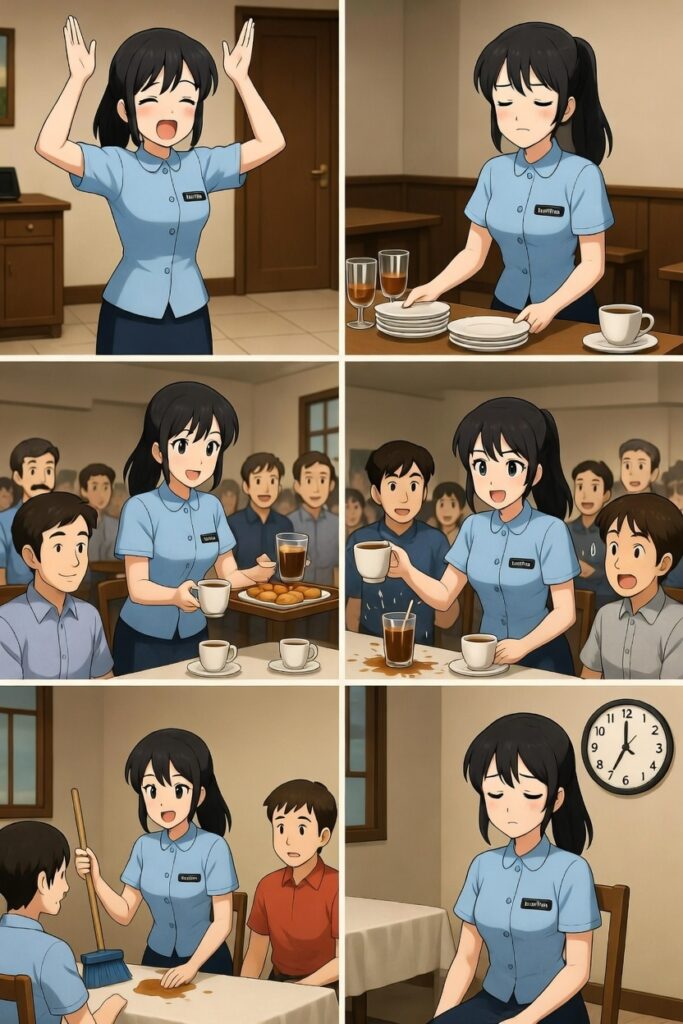
My name is Kunthea. I am a young woman from Cambodia. I work in a big hotel. I am a waitress. I like my job, but some days are very busy.
My work starts at 7 a.m. I put on my uniform and go to the restaurant. I clean the tables and put plates and glasses on them. Everything must look nice for the guests.
Many guests come for breakfast. They say “Good morning” and “Thank you.” I bring coffee and food. Sometimes many guests need help. I must work fast.
Sometimes guests are unhappy. I say “Sorry” and try to help. In the afternoon it is quiet. I clean and talk with my friends. At the end of the day, I am tired but happy.
_____________________
Vocabulary:
- young – not old; a small age
- a waitress – a woman who gives food and drinks in a restaurant
- a waiter – a man who gives food and drinks in a restaurant
- to be busy – to have a lot of work or things to do
- to start at 7 – to begin work or an activity at 7 o’clock
- to put on a uniform – to wear special clothes for work
- to clean a table – to make the table free from dirt or food
- to put glasses on a table – to put cups for drinks on the table
- to look nice – to be clean and good to see
- to work fast – to do work quickly
- unhappy – not happy; feeling sad or angry
- to try to help – to do your best to make someone better or comfortable
- to be quiet – to make no noise; to be calm
- to be tired – to feel weak or need rest
##################

Match the word with the correct definition:
Words:
- young
- a waitress
- a waiter
- to be busy
- to start at 7
- to put on a uniform
- to clean a table
- to put glasses on a table
- to look nice
- to work fast
- unhappy
- to try to help
- to be quiet
- to be tired
Definitions (shuffled):
A. to do work quickly
B. not happy; feeling sad or angry
C. to put cups for drinks on the table
D. to begin work or an activity at 7 o’clock
E. a woman who gives food and drinks in a restaurant
F. not old; a small age
G. to make no noise; to be calm
H. a man who gives food and drinks in a restaurant
I. to wear special clothes for work
J. to feel weak or need rest
K. to have a lot of work or things to do
L. to do your best to make someone better or comfortable
M. to be clean and good to see
N. to make the table free from dirt or food
___________________
Answers:
1-F, 2-E, 3-H, 4-K, 5-D, 6-I, 7-N,
8-C, 9-M, 10-A, 11-B, 12-L, 13-G, 14-J
___________________
Correct version:
- young – not old; a small age
- a waitress – a woman who gives food and drinks in a restaurant
- a waiter – a man who gives food and drinks in a restaurant
- to be busy – to have a lot of work or things to do
- to start at 7 – to begin work or an activity at 7 o’clock
- to put on a uniform – to wear special clothes for work
- to clean a table – to make the table free from dirt or food
- to put glasses on a table – to put cups for drinks on the table
- to look nice – to be clean and good to see
- to work fast – to do work quickly
- unhappy – not happy; feeling sad or angry
- to try to help – to do your best to make someone better or comfortable
- to be quiet – to make no noise; to be calm
- to be tired – to feel weak or need rest
###############
True or false:
- A waitress is a woman who gives food and drinks in a restaurant.
- To be busy means to have a lot of work or things to do.
- To put on a uniform means to wear pajamas at work.
- Unhappy means feeling very happy and excited.
- To clean a table means to make the table free from dirt or food.
- To work fast means to do work slowly.
- Young means not old; a small age.
- To start at 7 means to begin work or an activity at 7 o’clock.
- To be tired means to feel weak or need rest.
- To look nice means to be dirty and messy.
- A waiter is a man who gives food and drinks in a restaurant.
- To try to help means to do your best to make someone better or comfortable.
__________________
Answers:
1-T, 2-T, 3-F, 4-F, 5-T, 6-F,
7-T, 8-T, 9-T, 10-F, 11-T, 12-T
__________________
Correct version:
- A waitress is a woman who gives food and drinks in a restaurant. (T)
- To be busy means to have a lot of work or things to do. (T)
- To put on a uniform means to wear pajamas at work. (F) True is: To put on a uniform means to wear special clothes for work.
- Unhappy means feeling very happy and excited. (F) True is: Unhappy means not happy; feeling sad or angry.
- To clean a table means to make the table free from dirt or food. (T)
- To work fast means to do work slowly. (F) True is: To work fast means to do work quickly.
- Young means not old; a small age. (T)
- To start at 7 means to begin work or an activity at 7 o’clock. (T)
- To be tired means to feel weak or need rest. (T)
- To look nice means to be dirty and messy. (F) True is: To look nice means to be clean and good to see.
- A waiter is a man who gives food and drinks in a restaurant. (T)
- To try to help means to do your best to make someone better or comfortable. (T)
#################
True or false:
- Kunthea is a young woman from Cambodia.
- She works as a chef in a hotel.
- Her work day starts at 7 a.m.
- She puts on pajamas before going to work.
- She cleans the tables and puts plates and glasses on them.
- Many guests come in the evening for breakfast.
- Some guests are very friendly and say “Good morning.”
- She walks a little when the restaurant is busy.
- Sometimes guests are unhappy with the food or service.
- She ignores guests when they are unhappy.
- In the afternoon, the restaurant is quiet.
- At the end of the day, she feels proud and happy.
- She does not talk with her colleagues at work.
- She never carries plates or drinks to the tables.
_______________________
False: 2,4,6,8,10,13,14
_______________________
Correct answers:
- Kunthea is a young woman from Cambodia. (T)
- She works as a chef in a hotel. (F) True is: She works as a waitress in a hotel.
- Her work day starts at 7 a.m. (T)
- She puts on pajamas before going to work. (F) True is: She puts on her uniform before going to work.
- She cleans the tables and puts plates and glasses on them. (T)
- Many guests come in the evening for breakfast. (F) True is: Many guests come in the morning for breakfast.
- Some guests are very friendly and say “Good morning.” (T)
- She walks a little when the restaurant is busy. (F) True is: She walks a lot when the restaurant is busy.
- Sometimes guests are unhappy with the food or service. (T)
- She ignores guests when they are unhappy. (F) True is: She listens and tries to help guests when they are unhappy.
- In the afternoon, the restaurant is quiet. (T)
- At the end of the day, she feels proud and happy. (T)
- She does not talk with her colleagues at work. (F) True is: She talks with her colleagues in the afternoon.
- She never carries plates or drinks to the tables. (F) True is: She carries plates and drinks to the tables.
##############
Answer in a complete sentence:
- Is her name Sochea or Kunthea?
YOU WRITE:
Her name is Kunthea. - Does she work in a small hotel or a big hotel?
- Is she a waitress or a chef?
- Does her work start at 7 a.m. or 9 a.m.?
- Does she put on a uniform or pajamas?
- Does she clean the tables or the floors first?
- Does she put glasses and plates on the tables or on the floor?
- Do guests come in the morning or in the afternoon for breakfast?
- Do some guests say “Good morning” or “Good night”?
- Does she walk a little or a lot when the restaurant is busy?
- Does she ignore unhappy guests or try to help them?
- Is the restaurant quiet in the afternoon or in the morning?
- Does she talk with her colleagues or sit alone?
- At the end of the day, does she feel tired but happy or bored?
________________________
Correct answers:
- Is her name Sochea or Kunthea?
Her name is Kunthea. - Does she work in a small hotel or a big hotel?
She works in a big hotel. - Is she a waitress or a chef?
She is a waitress. - Does her work start at 7 a.m. or 9 a.m.?
Her work starts at 7 a.m. - Does she put on a uniform or pajamas?
She puts on a uniform. - Does she clean the tables or the floors first?
She cleans the tables first. - Does she put glasses and plates on the tables or on the floor?
She puts glasses and plates on the tables. - Do guests come in the morning or in the afternoon for breakfast?
Guests come in the morning for breakfast. - Do some guests say “Good morning” or “Good night”?
Some guests say “Good morning.” - Does she walk a little or a lot when the restaurant is busy?
She walks a lot when the restaurant is busy. - Does she ignore unhappy guests or try to help them?
She tries to help unhappy guests. - Is the restaurant quiet in the afternoon or in the morning?
The restaurant is quiet in the afternoon. - Does she talk with her colleagues or sit alone?
She talks with her colleagues. - At the end of the day, does she feel tired but happy or bored?
At the end of the day, she feels tired but happy.
#################
Fill in, use proper form of verb:
- Kunthea __________ (be) a young woman from Cambodia.
- She __________ (work) as a waitress in a big hotel.
- Her work day __________ (start) at 7 a.m.
- She __________ (put) on a uniform before going to the restaurant.
- She __________ (clean) the tables and puts plates and glasses on them.
- Many guests__________ (come) in the morning for breakfast.
- Some guests __________ (be) very friendly and say “Good morning.”
- She __________ (carry) plates and drinks to the tables when it is busy.
- Sometimes guests __________ (be) unhappy with the food or service.
- She __________ (talk) with her colleagues in the afternoon.
- At the end of the day, she __________ (feel) tired but proud and happy.
- She never __________ (help) guests when they have problems.
_____________________
Correct version:
- Kunthea is a young woman from Cambodia.
- She works as a waitress in a big hotel.
- Her work day starts at 7 a.m.
- She puts on a uniform before going to the restaurant.
- She cleans the tables and puts plates and glasses on them.
- Many guests come in the morning for breakfast.
- Some guests are very friendly and say “Good morning.”
- She carries plates and drinks to the tables when it is busy.
- Sometimes guests are unhappy with the food or service.
- She talks with her colleagues in the afternoon.
- At the end of the day, she feels tired but proud and happy.
- She never helps guests when they have problems.
#################
Basics of present simple:
| Personal Pronoun | am / is / are | |
|---|---|---|
| I | am | 8 years old |
| You | are | 8 years old |
| He | is | 8 years old |
| She | is | 8 years old |
| It | is | 8 years old |
| We | are | 8 years old |
| You (plural) | are | 8 years old |
| They | are | 8 years old |
| Personal Pronoun | am not / is not / are not | |
|---|---|---|
| I | am not | 8 years old |
| You | are not | 8 years old |
| He | is not | 8 years old |
| She | is not | 8 years old |
| It | is not | 8 years old |
| We | are not | 8 years old |
| You (plural) | are not | 8 years old |
| They | are not | 8 years old |
Question:
| Question Word | Personal Pronoun | |
|---|---|---|
| Am | I | 8 years old? |
| Are | you | 8 years old? |
| Is | he | 8 years old? |
| Is | she | 8 years old? |
| Is | it | 8 years old? |
| Are | we | 8 years old? |
| Are | you (plural) | 8 years old? |
| Are | they | 8 years old? |
Statement:
| Personal Pronoun | Verb | |
|---|---|---|
| I | like | ice cream |
| You | like | ice cream |
| He | likes | ice cream |
| She | likes | ice cream |
| It | likes | ice cream |
| We | like | ice cream |
| You (plural) | like | ice cream |
| They | like | ice cream |
Negation:
| Personal Pronoun | Verb (negative) | |
|---|---|---|
| I | do not like | ice cream |
| You | do not like | ice cream |
| He | does not like | ice cream |
| She | does not like | ice cream |
| It | does not like | ice cream |
| We | do not like | ice cream |
| You (plural) | do not like | ice cream |
| They | do not like | ice cream |
Question:
| Do / Does | Personal Pronoun | Verb | Sugar? |
|---|---|---|---|
| Do | I | like | sugar? |
| Do | you | like | sugar? |
| Does | he | like | sugar? |
| Does | she | like | sugar? |
| Does | it | like | sugar? |
| Do | we | like | sugar? |
| Do | you (plural) | like | sugar? |
| Do | they | like | sugar? |
################
Form
a) negation
b) question
c) negative question
as shown in sentence 1:
- She talks with colleagues in the afternoon.
a) She doesn’t talk with colleagues in the afternoon.
b) Does she talk with colleagues in the afternoon?
c) Doesn’t she talk with colleagues in the afternoon? - She wears a uniform.
- Some guests are unhappy.
- Kunthea is from Cambodia.
- Guests come in the morning for breakfast.
- She carries plates and drinks.
- She feels tired but happy at the end of the day.
- Some guests say “Good morning.”
- Her work starts at 7 a.m.
- She cleans the tables.
- She is a waitress in a big hotel.
- She helps guests when they have problems.
______________________
Correct version:
- She talks with colleagues in the afternoon.
a) She doesn’t talk with colleagues in the afternoon.
b) Does she talk with colleagues in the afternoon?
c) Doesn’t she talk with colleagues in the afternoon? - She wears a uniform.
a) She doesn’t wear a uniform.
b) Does she wear a uniform?
c) Doesn’t she wear a uniform? - Some guests are unhappy.
a) Some guests are not unhappy.
b) Are some guests unhappy?
c) Aren’t some guests unhappy? - Kunthea is from Cambodia.
a) Kunthea is not from Cambodia.
b) Is Kunthea from Cambodia?
c) Isn’t Kunthea from Cambodia? - Guests come in the morning for breakfast.
a) Guests do not come in the morning for breakfast.
b) Do guests come in the morning for breakfast?
c) Don’t guests come in the morning for breakfast? - She carries plates and drinks.
a) She doesn’t carry plates and drinks.
b) Does she carry plates and drinks?
c) Doesn’t she carry plates and drinks? - She feels tired but happy at the end of the day.
a) She doesn’t feel tired but happy at the end of the day.
b) Does she feel tired but happy at the end of the day?
c) Doesn’t she feel tired but happy at the end of the day? - Some guests say “Good morning.”
a) Some guests don’t say “Good morning.”
b) Do some guests say “Good morning”?
c) Don’t some guests say “Good morning”? - Her work starts at 7 a.m.
a) Her work does not start at 7 a.m.
b) Does her work start at 7 a.m.?
c) Doesn’t her work start at 7 a.m.? - She cleans the tables.
a) She doesn’t clean the tables.
b) Does she clean the tables?
c) Doesn’t she clean the tables? - She is a waitress in a big hotel.
a) She is not a waitress in a big hotel.
b) Is she a waitress in a big hotel?
c) Isn’t she a waitress in a big hotel? - She helps guests when they have problems.
a) She doesn’t help guests when they have problems.
b) Does she help guests when they have problems?
c) Doesn’t she help guests when they have problems?
################
Short answers, basics:
| Example Sentence | Yes | No |
|---|---|---|
| I learn the alphabet. | Yes, I do. | No, I don’t. |
| You read signs. | Yes, you do. | No, you don’t. |
| He practices speaking. | Yes, he does. | No, he doesn’t. |
| She watches cartoons. | Yes, she does. | No, she doesn’t. |
| It helps us learn English. | Yes, it does. | No, it doesn’t. |
| We use apps like Duolingo. | Yes, we do. | No, we don’t. |
| You read labels. | Yes, you do. | No, you don’t. |
| They make mistakes sometimes. | Yes, they do. | No, they don’t. |
| Question | Yes | No |
|---|---|---|
| Do I learn the alphabet? | Yes, I do. | No, I don’t. |
| Do you read signs? | Yes, you do. | No, you don’t. |
| Does he practice speaking? | Yes, he does. | No, he doesn’t. |
| Does she watch cartoons? | Yes, she does. | No, she doesn’t. |
| Does it help us learn English? | Yes, it does. | No, it doesn’t. |
| Do we use apps like Duolingo? | Yes, we do. | No, we don’t. |
| Do you read labels? | Yes, you do. | No, you don’t. |
| Do they make mistakes sometimes? | Yes, they do. | No, they don’t. |
| Question | Yes | No |
|---|---|---|
| Am I big? | Yes, I am. | No, I am not. |
| Are you big? | Yes, you are. | No, you aren’t. |
| Is he big? | Yes, he is. | No, he isn’t. |
| Is she big? | Yes, she is. | No, she isn’t. |
| Is it big? | Yes, it is. | No, it isn’t. |
| Are we big? | Yes, we are. | No, we aren’t. |
| Are you big? | Yes, you are. | No, you aren’t. |
| Are they big? | Yes, they are. | No, they aren’t. |
####################
Give short answers:
- She puts plates and glasses on the tables.
YOU WRITE:
Yes, she does. - Guests eat dinner in the restaurant.
- Kunthea is from Cambodia.
- She wears pajamas to work.
- She talks with her colleagues in the afternoon.
- She carries coffee and food to the guests.
- Guests come in the evening for breakfast.
- She is a waitress.
- She cleans the tables.
- She goes to the supermarket for work.
- Guests come in the afternoon for breakfast.
- She carries plates and drinks to the tables.
- Her work starts at 7 a.m.
- Some guests say “Good morning.”
- She is a chef in a hotel.
- Guests drink coffee in the morning.
- She puts plates and glasses on the floor.
- She puts on a uniform.
- Guests say “Thank you.”
- Some guests are unhappy with the food.
_________________________
Correct version:
- She puts plates and glasses on the tables. – Yes, she does.
- Guests eat dinner in the restaurant. – No, they don’t.
- Kunthea is from Cambodia. – Yes, she is.
- She wears pajamas to work. – No, she doesn’t.
- She talks with her colleagues in the afternoon. – Yes, she does.
- She carries coffee and food to the guests. – Yes, she does.
- Guests come in the evening for breakfast. – No, they don’t.
- She is a waitress. – Yes, she is.
- She cleans the tables. – Yes, she does.
- She goes to the supermarket for work. – No, she doesn’t.
- Guests come in the afternoon for breakfast. – No, they don’t.
- She carries plates and drinks to the tables. – Yes, she does.
- Her work starts at 7 a.m. – Yes, it does.
- Some guests say “Good morning.” – Yes, they do.
- She is a chef in a hotel. – No, she isn’t.
- Guests drink coffee in the morning. – No, they don’t.
- She puts plates and glasses on the floor. – No, she doesn’t.
- She puts on a uniform. – Yes, she does.
- Guests say “Thank you.” – Yes, they do.
- Some guests are unhappy with the food. – No, they aren’t.
################
Rewrite as shown in 1.:
- Do guests eat dinner in the restaurant?
YOU WRITE:
No, they don’t.
They eat breakfast in the restaurant. - Does she wear pajamas to work?
- Does she work in a small restaurant?
- Does she go to the supermarket for work?
- Do guests come in the evening for breakfast?
- Do guests come in the afternoon for breakfast?
- Is she a chef in a hotel?
- Does she put plates and glasses on the floor?
- Are some guests always unhappy?
- Does she carry food only in the morning?
________________________
Correct version:
- Do guests eat dinner in the restaurant? – No, they don’t. They eat breakfast in the restaurant.
- Does she wear pajamas to work? – No, she doesn’t. She wears a uniform.
- Does she work in a small restaurant? – No, she doesn’t. She works in a big hotel.
- Does she go to the supermarket for work? – No, she doesn’t. She goes to the restaurant.
- Do guests come in the evening for breakfast? – No, they don’t. They come in the morning.
- Do guests come in the afternoon for breakfast? – No, they don’t. They come in the morning.
- Is she a chef in a hotel? – No, she isn’t. She is a waitress.
- Does she put plates and glasses on the floor? – No, she doesn’t. She puts them on the tables.
- Are some guests always unhappy? – No, they aren’t. Sometimes a guest is unhappy.
- Does she carry food only in the morning? – No, she doesn’t. She carries food all day when the restaurant is busy.
#################
Interview with Kunthea
1. Q: Who are you?
A: I am Kunthea.
2. Q: Where do you come from?
A: I come from Cambodia.
3. Q: What job do you do?
A: I am a waitress.
4. Q: Where do you work?
A: I work in a big hotel.
5. Q: When does your work start?
A: My work starts at 7 a.m.
6. Q: Why do you like your job?
A: I like my job because I meet friendly guests.
7. Q: How do you go to work?
A: I go to work by walking.
8. Q: What do you do first at work?
A: I put on my uniform and clean the tables.
9. Q: What do you put on the tables?
A: I put plates, glasses, and cutlery on the tables.
10. Q: How do guests greet you?
A: Guests say “Good morning” and “Thank you.”
11. Q: What do you do when guests need help?
A: I listen and bring them food or drinks.
12. Q: When is the restaurant quiet?
A: The restaurant is quiet in the afternoon.
13. Q: Who do you talk to at work?
A: I talk to my colleagues.
14. Q: How do you feel at the end of the day?
A: I feel tired, but I feel proud and happy.
##################
Interview with her friend, about Kunthea, fill in:
1. Q: Who is she?
A: She is Kunthea.
2. Q: Where does she come from?
A: She __________ (come) from Cambodia.
3. Q: What job does she do?
A: She __________ (be) a waitress.
4. Q: Where does she work?
A: She __________ (work) in a big hotel.
5. Q: When does her work start?
A: Her work __________ (start) at 7 a.m.
6. Q: Why does she like her job?
A: She __________ (like) her job because she __________ (meet) friendly guests.
7. Q: How does she go to work?
A: She __________ (go) to work by walking.
8. Q: What does she do first at work?
A: She __________ (put) on her uniform and __________ (clean) the tables.
9. Q: What does she put on the tables?
A: She __________ (put) plates, glasses, and cutlery [the knives, forks, and spoons that you use to eat] on the tables.
10. Q: How do guests greet her?
A: Guests __________ (say) “Good morning” and “Thank you.”
11. Q: What does she do when guests need help?
A: She __________ (listen) and __________ (bring) them food or drinks.
12. Q: When is the restaurant quiet?
A: The restaurant __________ (be) quiet in the afternoon.
13. Q: Who does she talk to at work?
A: She __________ (talk) to her colleagues.
14. Q: How does she feel at the end of the day?
A: She __________ (feel) tired, but she __________ (feel) proud and happy.
###################
Correct version:
1. Q: Who is she?
A: She is Kunthea.
2. Q: Where does she come from?
A: She comes from Cambodia.
3. Q: What job does she do?
A: She is a waitress.
4. Q: Where does she work?
A: She works in a big hotel.
5. Q: When does her work start?
A: Her work starts at 7 a.m.
6. Q: Why does she like her job?
A: She likes her job because she meets friendly guests.
7. Q: How does she go to work?
A: She goes to work by walking.
8. Q: What does she do first at work?
A: She puts on her uniform and cleans the tables.
9. Q: What does she put on the tables?
A: She puts plates, glasses, and cutlery on the tables.
10. Q: How do guests greet her?
A: Guests say “Good morning” and “Thank you.”
11. Q: What does she do when guests need help?
A: She listens and brings them food or drinks.
12. Q: When is the restaurant quiet?
A: The restaurant is quiet in the afternoon.
13. Q: Who does she talk to at work?
A: She talks to her colleagues.
14. Q: How does she feel at the end of the day?
A: She feels tired, but she feels proud and happy.
###################
Rewrite the sentences in the 3rd person singular, as shown, make all changes necessary:
- My name is Kunthea.
YOU WRITE:
Her name is Kunthea. - I am a young woman from Cambodia.
- I work in a big hotel.
- I am a waitress.
- I like my job, but some days are busy.
- My work starts at 7 a.m.
- I put on my uniform and clean the tables.
- I put plates and glasses on the tables.
- Many guests come for breakfast and say “Good morning” and “Thank you.”
- Sometimes guests are unhappy, and I try to help them.
- At the end of the day, I am tired but happy.
_______________________
Correct version:
- Her name is Kunthea.
- She is a young woman from Cambodia.
- She works in a big hotel.
- She is a waitress.
- She likes her job, but some days are busy.
- Her work starts at 7 a.m.
- She puts on her uniform and cleans the tables.
- She puts plates and glasses on the tables.
- Many guests come for breakfast and say “Good morning” and “Thank you.”
- Sometimes guests are unhappy, and she tries to help them.
- At the end of the day, she is tired but happy.
#################
Schreibe einen Kommentar