Kategorie: Shinta Mani Foundation

  • 😦A bad day, part 2 – a bad ending, fired (A2+)

    audio 1 & 2:


    Check vocabulary and definitions of non-verbal communication and body language at the end of the text first!


    #################

    Setting:
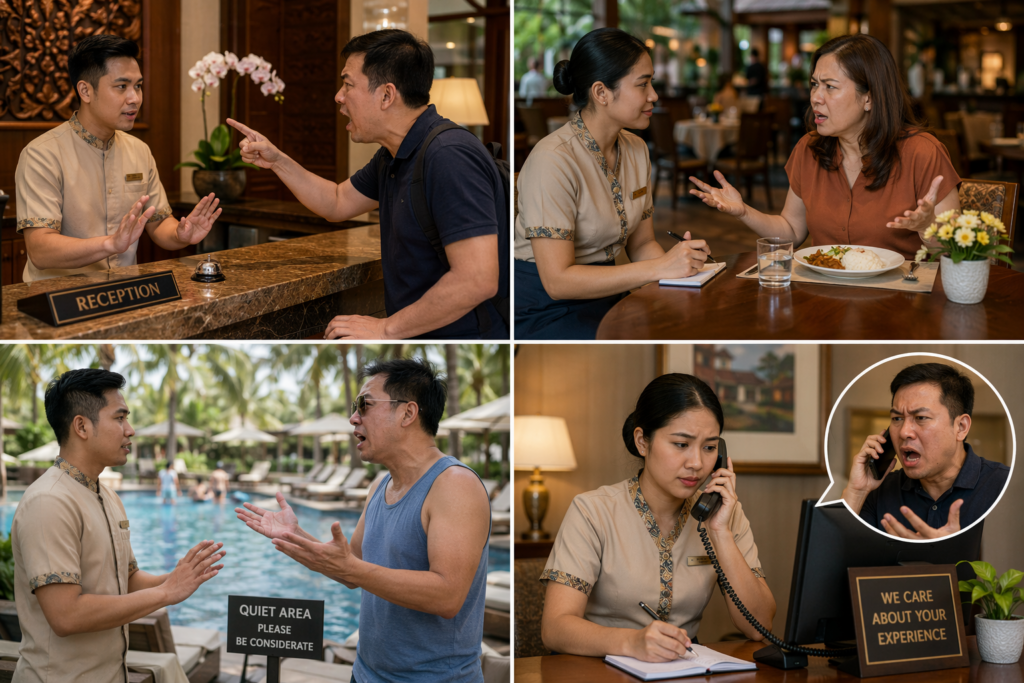
    The GM’s office, late afternoon after a busy lunch shift. The room feels tense. Tom slouches in the chair, arms crossed, avoiding eye contact. The GM sits behind the desk, looking stern and frustrated.

    GM: (sits tall, arms crossed, voice serious) Tom, we have a big problem. Yesterday, many guests complained about you. They said you were rude, ignored them, even shouted. This is a five-star hotel. What happened?

    Tom: (shrugs, looks at wall, mumbles) I don’t know, sir. I had a bad day. Personal stuff. It’s not a big deal.

    GM: (leans forward, frowns, voice louder) Not a big deal? Tom, guests pay a lot for perfect service. You can’t be rude because of a “bad day.” Explain yourself. Now.

    Tom: (rolls eyes, slouches more, voice annoyed) Look, sir, my life’s not easy, okay? I was upset. Guests complain all the time. They’re too picky.

    GM: (stands up, points at Tom, voice angry) That’s not okay, Tom! You ignored a table, you snapped at a guest, you dropped a plate. This isn’t the first time we’ve had problems with you.

    Tom: (leans forward, raises voice) I’m doing my best! It’s hard working here! Guests are never happy. Why is it always my fault?

    GM: (shakes head, paces behind desk) It’s your job, Tom. You’re here to make guests happy, not to argue with them. We warned you before about your attitude. Yesterday was too much.

    Tom: (crosses arms tighter, glares) So what? You’re saying I’m bad at my job? I work hard! One bad day, and you’re mad?

    GM: (stops pacing, looks at Tom, voice calm but cold) It’s not one day, Tom. It’s many times. We’ve talked about your attitude before. Guests complained last month too. We can’t trust you anymore.

    Tom: (stands up, throws hands in air) Fine! You think I’m so bad? I don’t need this job. You’re unfair!

    GM: (sits down, folds hands, voice firm) I’m sorry, Tom, but you’re fired. You can’t work here if you don’t respect the job. Leave your uniform and go.

    ————–end of audio 1————-

    Tom: (grabs bag, points at GM, shouts) This is stupid! You’ll regret this! I’m better than this place! (storms to door, slams it behind him)

    GM: (sighs heavily, rubs forehead, looks out window) (to himself) I didn’t want this… but it’s for the best.

    Outcome: Tom is fired due to his unprofessional behavior, lack of accountability, and history of issues. He leaves angrily, blaming the GM and hotel. The GM feels disappointed but believes the decision protects the hotel’s reputation.

    ————–end of audio 2————-


    #############

    1. Verbal Communication

    GM’s Words:

    • Tone and Style: The GM starts serious (“Tom, we have a big problem”). He uses simple words like “rude,” “complained,” and “problem” to explain clearly. His voice gets louder when Tom doesn’t care (“Not a big deal?”). Later, he sounds angry (“That’s not okay, Tom!”) because Tom is rude. At the end, his voice is calm but cold (“You’re fired”), showing he decided.
    • Main Points: The GM says guests expect perfect service in a five-star hotel. He lists Tom’s mistakes: ignoring guests, shouting, dropping a plate. He says it’s not the first time (“We warned you before”). He asks Tom to explain (“What happened?”), but Tom doesn’t help.
    • Way of Talking: The GM tries to understand at first. He asks questions to give Tom a chance. But when Tom argues, the GM focuses on the job rules and says Tom must go.

    Tom’s Words:

    • Tone and Style: Tom starts quiet and careless (“It’s not a big deal”). His voice gets annoyed (“My life’s not easy, okay?”) and loud (“Why is it always my fault?”). At the end, he shouts (“This is stupid!”) and sounds angry.
    • Main Points: Tom says he had a bad day but doesn’t explain much (“personal stuff”). He blames guests (“They’re too picky”) and says the job is hard. He doesn’t say sorry or promise to do better. He yells he doesn’t need the job.
    • Way of Talking: Tom doesn’t take responsibility. He argues and blames others. His words make the GM angrier.

    Why It Failed:
    Tom’s words show he doesn’t care about the guests or his job. The GM wants Tom to explain and say sorry, but Tom argues and blames. This makes the GM feel Tom can’t change, so he fires him.


    2. Non-Verbal Communication

    GM’s Body Language:

    • Start: The GM sits tall, arms crossed, looking serious. This shows he’s the boss and the talk is important.
    • Middle: He leans forward and frowns when Tom says it’s not a big deal. This shows he’s upset. He stands and points at Tom when angry, showing he’s serious about the problem.
    • End: He paces behind the desk, shakes his head, and looks cold. This shows he’s frustrated and done with Tom. After firing Tom, he sits, rubs his forehead, and looks out the window, showing he’s sad but thinks it’s right.

    Tom’s Body Language:

    • Start: Tom slouches, crosses arms, and looks at the wall. This shows he doesn’t want to talk or care.
    • Middle: He rolls his eyes and slouches more, showing he thinks the GM is wrong. He leans forward and raises his voice, showing he’s angry and fighting back.
    • End: He stands fast, throws hands in the air, and points at the GM. This shows he’s very angry. He grabs his bag, shouts, and slams the door, showing he’s mad and doesn’t respect the GM.

    Why It Failed:
    Tom’s body language (slouching, rolling eyes, pointing) shows disrespect and anger. The GM’s body language (standing, pointing, pacing) shows he’s frustrated and loses patience. Their actions make the talk worse, not better.


    3. Why Things Went Wrong

    Things went wrong because Tom didn’t take responsibility. Here’s why:

    • No Apology: Tom doesn’t say sorry for being rude to guests. He says it’s “not a big deal,” which makes the GM think he doesn’t care.
    • Blaming Others: Tom blames guests (“They’re too picky”) and the job (“It’s hard”). He doesn’t admit his mistakes, like ignoring guests or shouting.
    • Bad Attitude: Tom’s words and actions (rolling eyes, shouting) show he doesn’t respect the GM or the job. He acts like he doesn’t want to fix things.
    • Past Problems: The GM says Tom had problems before (“We warned you”). Tom’s bad day wasn’t the only issue; he has a history of bad behavior.
    • No Effort to Fix: Tom doesn’t promise to change or do better. He argues and says he doesn’t need the job, which makes the GM feel Tom won’t improve.

    4. Chances for Tom to Not Be Fired

    Tom could have avoided being fired if he did these things:

    • Say Sorry: If Tom said, “I’m very sorry, sir. I was wrong,” the GM might listen and give him a chance.
    • Explain Clearly: If Tom said, “My mother is sick, I was upset,” like in Dialogue 1, the GM might understand and help.
    • Promise to Change: If Tom said, “I’ll be better. I won’t let it happen again,” the GM might trust him to try harder.
    • Show Respect: If Tom sat up, looked at the GM, and spoke politely (not rolling eyes or shouting), the GM might feel Tom cares about the job.
    • Ask for Help: If Tom said, “Can you help me do better?” the GM might offer a plan, like time off or training, like in Dialogue 1.

    For example, if Tom said, “I’m sorry, sir. I had a bad day because my family has problems. I know I was wrong. Please give me a chance to be better,” the GM might not fire him. Tom’s attitude was the biggest problem.


    5. Where the GM’s Patience Ran Out

    The GM loses patience at these moments:

    • When Tom Says “It’s Not a Big Deal”: The GM gets upset when Tom doesn’t care about the guest complaints. This is when he leans forward and speaks louder, showing he’s frustrated.
    • When Tom Blames Guests: Tom says guests are “too picky,” which makes the GM angrier. The GM stands and points, showing he thinks Tom’s attitude is wrong.
    • When Tom Argues: Tom says, “Why is it always my fault?” and “I’m doing my best.” This makes the GM pace and shake his head, feeling Tom doesn’t understand the job.
    • When Tom Says He Doesn’t Need the Job: Tom’s final outburst (“I don’t need this job”) and slamming the door make the GM sure firing Tom is right. The GM’s patience is gone because Tom shows no respect or effort to change.

    The GM tries to be patient by asking Tom to explain and mentioning past warnings. But Tom’s rude words and actions make the GM feel he can’t trust Tom anymore.


    ————————–
    Summary

    • Verbal: The GM is clear and serious, but Tom is dismissive and rude. Tom’s arguing and blaming make the talk fail.
    • Non-Verbal: The GM’s standing, pointing, and pacing show frustration. Tom’s slouching, eye-rolling, and shouting show disrespect.
    • Why Wrong: Tom doesn’t say sorry, blames others, and shows a bad attitude. His past problems make it worse.
    • Chances to Stay: Tom could say sorry, explain his problems, promise to change, and show respect to avoid being fired.
    • GM’s Patience: The GM tries to listen but loses patience when Tom doesn’t care, blames guests, argues, and says he doesn’t need the job.

    ##################

    Complete list of all verbs from the dialogue and its analysis, that describe body language or non-verbal communication, listed in the order they appear in the text – remember them!


    🧍‍♂️ Body Language and Non-Verbal Communication

    1. to sit tall – to sit straight and look serious.
    2. to cross arms – to fold your arms over your chest.
    3. to look stern – to have a serious or angry face.
    4. to slouch – to sit or stand with your back bent.
    5. to avoid eye contact – to not look at someone’s eyes.
    6. to look stern and frustrated – to look angry and unhappy.
    7. to shrug – to lift your shoulders to show you don’t care or don’t know.
    8. to look at the wall – to turn your eyes to the wall, not to the person.
    9. to mumble – to speak quietly and unclearly.
    10. to lean forward – to move your body a little closer to someone.
    11. to frown – to make lines on your forehead when upset.
    12. to raise voice – to speak louder when angry.
    13. to roll eyes – to move your eyes up to show you are bored or don’t care.
    14. to slouch more – to sit even lower and look lazy or angry.
    15. to stand up – to move from sitting to standing.
    16. to point at someone – to show someone with your finger.
    17. to shake head – to move your head from side to side to say no.
    18. to pace behind the desk – to walk back and forth while thinking or angry.
    19. to cross arms tighter – to hold your arms even closer to your chest.
    20. to glare – to look at someone angrily.
    21. to stop pacing – to stop walking back and forth.
    22. to look cold – to look without feelings or warmth.
    23. to throw hands in the air – to lift your hands high to show anger.
    24. to grab bag – to take your bag quickly.
    25. to shout – to speak very loudly because of anger.
    26. to storm to the door – to walk fast and angrily to the door.
    27. to slam the door – to close the door very hard and loud.
    28. to sigh heavily – to breathe out loudly to show you are tired or sad.
    29. to rub forehead – to move your hand on your forehead when stressed.
    30. to look out the window – to turn your eyes toward the window.

    💬 Additional Non-Verbal Cues from the Analysis

    1. to sit tall with arms crossed – to show you are strict or serious.
    2. to look serious – to not smile and show importance.
    3. to lean forward and frown – to show you are upset or angry.
    4. to stand and point – to show strong emotion or control.
    5. to pace and shake head – to move when you are nervous or angry.
    6. to sit and rub forehead – to show stress or thinking.
    7. to slouch and cross arms – to show you don’t care or feel bored.
    8. to look at the wall – to avoid the other person.
    9. to roll eyes – to show you think the other person is wrong.
    10. to lean forward and raise voice – to show anger.
    11. to throw hands in the air – to show you give up or are very angry.
    12. to point at someone – to show blame or anger.
    13. to slam the door – to leave with anger and no respect.

  • 🥰A bad day, part 1 – and a happy ending (A2)

    • a second chance: turning a bad day around

    #####################

    🧍‍♂️ Body language verbs and additional non-verbal cues — in the same order they appear in the text and analysis;
    verbs/phrases you should remember:


    1. to sit straight – to sit with your back tall and not bent.
    2. to fold hands on the desk – to put your hands together on the table.
    3. to look directly at someone – to look into someone’s eyes.
    4. to fidget with fingers – to move your fingers when you feel nervous.
    5. to look at the floor – to move your eyes down to the ground.
    6. to lean forward – to move your body a little closer to someone.
    7. to raise eyebrows – to move your eyebrows up in surprise.
    8. to bite one’s lip – to press your teeth on your lip when worried.
    9. to rub eyes – to touch your eyes with your fingers, often when sad or tired.
    10. to take a deep breath – to breathe in a lot of air slowly.
    11. to nod slowly – to move your head up and down slowly to show yes.
    12. to soften expression – to make your face look kind, not angry.
    13. to lean back – to move your body a little backward in your chair.
    14. to tap a pen on the desk – to hit the pen lightly on the table again and again.
    15. to look thoughtful – to look like you are thinking.
    16. to look up – to move your eyes higher.
    17. to have watery eyes – to have eyes full of tears.
    18. to sit up straight – to make your back tall and correct.
    19. to smile slightly – to make a small, soft smile.
    20. to point at someone – to show someone with your finger.
    21. to stand up – to move from sitting to standing.
    22. to walk around the desk – to move your body to the other side of the table.
    23. to pat someone’s shoulder – to touch someone’s shoulder softly with your hand.
    24. to smile warmly – to give a kind and friendly smile.
    25. to shake hands – to hold and move another person’s hand.
    26. to nod eagerly – to move your head up and down quickly to show yes.
    27. to smile big – to give a big, happy smile.
    28. to walk to the door – to move your feet toward the door.
    29. to turn back – to move your body to look behind you.
    30. to wave – to move your hand to say hello or goodbye.

    💬 Additional Non-Verbal Cues (from the analysis)

    1. to have a serious expression – to look serious on your face.
    2. to look nervous – to look worried or scared.
    3. to feel scared – to be afraid something bad will happen.
    4. to feel sorry – to feel bad for doing something wrong.
    5. to show kindness through body language – to make your face and body look friendly.
    6. to show confidence through posture – to stand or sit tall to look sure of yourself.
    7. to express sympathy through gestures – to show you care with your hands or face.
    8. to show understanding by softening tone and expression – to make your voice and face gentle to show you understand.
    9. to express relief through smiling – to smile when you feel better after stress.
    10. to show authority by pointing or sitting upright – to act strong and in control with your body.


    #####################


    Dialogue 1: Happy Ending

    Setting: The GM’s office, a small, tidy room with a wooden desk, two chairs, and a window showing the morning sun. Tom sits across from the GM, his hands shaking slightly. The GM looks serious but calm.

    GM: (sits straight, hands folded on desk, looks directly at Tom) Tom, we need to talk. Yesterday was not good. Many guests complained about you. They said you were rude, slow, not professional. What happened?

    Tom: (fidgets with his fingers, looks at floor, voice low) I’m so sorry, sir. Yesterday was… a very bad day. I wasn’t myself. I know I did wrong.

    GM: (leans forward, raises eyebrows, voice firm) Tom, this is a five-star hotel. Guests expect the best service. Always. You can’t be rude because of a bad day. Tell me, what was wrong?

    Tom: (bites lip, rubs eyes, takes deep breath) It’s my mother, sir. She’s very sick. I got bad news before work. I was so upset, I couldn’t think. I didn’t mean to be rude.

    GM: (nods slowly, softens expression, leans back) I’m sorry about your mother, Tom. That’s hard. But you didn’t tell anyone. Why didn’t you say something? We could help.

    Tom: (looks up, eyes watery, voice shaky) I thought… I could handle it. I didn’t want to cause problems. But I was wrong. I feel terrible about the guests.

    GM: (taps pen on desk, looks thoughtful) Okay, Tom. I understand bad days happen. But you need to talk to us. We’re a team. You can’t let personal things hurt your work.

    Tom: (nods quickly, sits up straighter) You’re right, sir. I should’ve told you. I promise it won’t happen again. I love this job. I want to make it right.

    GM: (smiles slightly, points at Tom) You’re a good waiter, Tom, when you’re focused. I believe you can do better. But we can’t have complaints again. Understand?

    Tom: (nods eagerly, small smile) Yes, sir! I understand. I’ll be professional. No more mistakes. Thank you for talking to me.

    GM: (stands up, walks around desk, voice kind) Good. Here’s what we’ll do. Take today off. Go home, rest, clear your mind. Come back tomorrow ready to work hard.

    Tom: (stands up, eyes wide, voice grateful) Really, sir? Thank you so much! I won’t let you down. I’ll come back better.

    GM: (pats Tom’s shoulder, smiles warmly) I trust you, Tom. If you need help, or if something’s wrong, tell me. My door is always open.

    Tom: (shakes GM’s hand, smiles big) Thank you, sir. I really mean it. I’ll be back tomorrow, ready to work.

    GM: (nods, points to door) Good. Go rest now. See you tomorrow, Tom.

    Tom: (walks to door, turns back, waves) Thank you again, sir. See you tomorrow!

    Outcome:
    Tom feels understood and supported. He takes the day to rest, visits his mother, and returns to work the next day with renewed focus, determined to prove his professionalism. The GM feels confident in giving Tom a second chance, strengthening their trust.


    #################


    Analysis of the dialogue: Happy Ending

    1. About the Dialogue

    • Where: The GM’s office, early morning. It’s quiet and serious. The restaurant is not open yet.
    • People:
      • Tom: A waiter. He was rude to guests yesterday because he had a bad day. He is nervous and sorry. He wants to keep his job.
      • GM: The boss of the restaurant. He is serious but kind. He cares about the hotel but listens to Tom.
    • Why: The dialogue is about Tom’s bad behavior. The GM wants to know why. They talk and find a good solution.
    • End: Tom gets a day off to rest. He feels happy and promises to do better. The GM trusts him.


    2. How the Dialogue Works
    The dialogue has four parts:

    • Start (Problem):
      • The GM says guests complained about Tom. He was rude. This makes Tom nervous.
      • Example: “Tom, we need to talk. Yesterday was not good. Many guests complained about you.”
    • Middle (Tom’s Story):
      • Tom says he’s sorry. He talks about his sick mother. This makes the GM listen.
      • Example: “It’s my mother, sir. She’s very sick.”
    • Solution:
      • The GM understands. He tells Tom to rest today and work better tomorrow.
      • Example: “Take today off. Go home, rest.”
    • End (Happy):
      • Tom says thank you. The GM says he trusts Tom. They smile.
      • Example: “I trust you, Tom. My door is always open.”

    The dialogue starts with a problem but ends happy.


    3. Language:

    • Tone: The GM starts serious (“Guests expect the best service”). Then he is kind (“I’m sorry about your mother”). Tom starts scared but ends happy.
    • Repeating Words: Tom says “sorry” and “promise” many times. This shows he is serious.
      • Example: “I’m so sorry, sir… I promise it won’t happen again.”


    4. Body Language
    The dialogue has actions in parentheses.
    They show feelings:

    • Tom:
      • Scared at Start: “(fidgets with fingers, looks at floor)” shows Tom is nervous. “(bites lip, rubs eyes)” shows he feels bad.
      • Sad: “(eyes watery, voice shaky)” when he talks about his mother shows he is upset.
      • Happy at End: “(nods eagerly, small smile)” and “(stands up, smiles big)” show Tom feels better.
    • GM:
      • Serious at Start: “(sits straight, hands folded on desk)” shows he is the boss. “(points at Tom)” shows he is serious.
      • Kind Later: “(softens expression, leans back)” and “(smiles slightly)” show he cares. “(pats Tom’s shoulder)” shows he is friendly.
    • Why It Works: The actions match the words. Tom’s nervous hands become a happy smile. The GM’s strict look becomes a kind pat. This helps A2 learners see the story.


    5. Feelings in the Dialogue

    • Start: The dialogue feels scary. The GM is serious. Tom is afraid of losing his job.
    • Middle: Tom talks about his mother. The GM listens and feels sorry. This makes the talk kinder.
    • End: Tom is happy because he keeps his job. The GM is happy because he trusts Tom. They shake hands and smile.
    • Why Real: The dialogue feels real. The GM is strict but kind, like a good boss. Tom is sorry and wants to do better, like a real person.


    6. Big Ideas

    • Be Responsible: Tom says, “I know I did wrong.” This makes the GM trust him.
    • Kind Boss: The GM listens to Tom’s problem. He helps Tom, not punishes him.
    • Second Chance: Tom gets another chance. He must work better next time.
    • Talk About Problems: Tom learns to tell the GM if he has problems. This helps the team.


    7. Why the Dialogue Is Good

    • Feelings: The dialogue shows Tom’s fear and happiness. It shows the GM’s strict and kind sides. This makes the story fun.
    • Real Ending: Tom says sorry, so he gets a chance. The GM is kind but clear. This feels like a real job talk.
    • Job Lesson: The dialogue shows how to act at a fancy hotel.


    8. How to Make It Better

    • Tom’s Past: The GM could say, “You’re usually a good waiter.” This shows why he gives Tom a chance.
    • Guest Example: The GM could say, “A guest said you forgot their food.” This makes the problem clear.
    • Tom’s Idea: Tom could say, “I’ll say sorry to the team.” This shows he wants to fix things.

    ——————————–


  • 🧹A day in the life of a housekeeper at a luxury hotel (introductory text A2+/B1; following text, exercises A1, revised version)

    B1:

    Being a housekeeper at a fancy hotel is about more than just cleaning rooms. It’s about making sure guests feel happy and comfortable during their stay. Let me tell you about a typical day in my job.

    First thing in the morning, we have a meeting with the rest of the cleaning team. We talk about what rooms need cleaning and if there are any special things guests want. Then, I start by checking and getting guest rooms ready for new people.

    Checking the rooms means I need to make sure everything is super clean and nice. I make the beds, vacuum or mop the floors, dust all the surfaces, and make sure there are enough towels and soaps. I really pay attention to detail to make the rooms look perfect.

    During the day, I do lots of different tasks. Sometimes guests ask for extra towels or for someone to take away their breakfast trays. I also help out with cleaning other parts of the hotel like the lobby and hallways. It’s important to work together with my team to get everything done.

    Making sure everything is clean and looks nice is a big part of my job. I try to do my best to make sure everything is perfect, like arranging the towels neatly in the bathroom and keeping the lobby shiny.

    I also have to keep track of the cleaning supplies we use. I make sure we have enough soap and towels for the day and let my boss know if we need more.

    At the end of the day, I check one last time to make sure everything is okay. If there are any problems, I tell my boss before I go home. Then, I clean up my stuff and put everything away.

    Being a housekeeper is a good job. I like making the hotel nice for guests and helping them have a good time during their stay. It’s a busy job, but it feels good to know I’m making a difference.

    ######################

    The exercises are about the A1 text below.
    ⬇️⬇️⬇️⬇️⬇️⬇️⬇️⬇️⬇️

    ######################

    I work as a housekeeper in a hotel. My job is to clean rooms and make guests happy. I like my job because I help people have a nice stay.

    In the morning, I have a meeting with my team. We talk about which rooms we clean today. After that, I take my cleaning cart and start work.

    I clean the beds and change the sheets. I sweep and mop the floor. I dust the tables and clean the bathroom. I check that there are enough towels, soap, and toilet paper. I want every room to look clean and beautiful.

    Sometimes guests ask for more towels or water. Sometimes they want me to take their dishes away. I am always happy to help them.

    I also clean other places in the hotel, like the lobby and the hallways. I work with my friends in the team, and we help each other.

    Before I go home, I look at my cleaning things. If something is missing, I tell my boss.

    My job is not easy, but I like it. I feel good when the rooms are clean and the guests are smiling
    ———————————–

    Vocabulary:


    housekeeper – a person who cleans rooms in a hotel or house.

    to clean rooms – to make rooms nice by washing, dusting, or sweeping.

    a nice stay (hotel) – a good time when a person sleeps and relaxes in a hotel.

    a meeting – when people come together to talk about work.

    a cleaning cart – a small trolley with cleaning things like soap, towels, and water.

    to start work – to begin your job.

    to clean beds – to make beds neat and nice.

    to change sheets – to take off dirty bed sheets and put on clean ones.

    to sweep the floor – to clean the floor with a broom.

    to mop – to wash the floor with water and a mop stick.

    to dust tables – to clean small dirt from tables with a cloth.

    a bathroom – a room with a toilet, a sink, and often a shower.

    a towel – a piece of cloth used to dry your body or hands.

    soap – something you use with water to wash your hands or body.

    toilet paper – soft paper you use in the toilet.

    to look clean – to appear tidy and without dirt.

    to take away dishes – to remove dirty plates and cups after people eat.

    a lobby – the front part of a hotel where guests enter and check in.

    a hallway – a long space inside a building that connects rooms.

    something is missing – something is not there but should be.

    to smile – to move your mouth up when you are happy.


    ####################


    🧹 A1 Vocabulary Test

    audio 1-18:


    audio 19-21:

    1. A housekeeper is a person who
      a) cleans rooms in a hotel
      b) cooks food in a restaurant
      c) sells things in a shop
    2. To clean rooms means
      a) to sit and rest in a room
      b) to make rooms nice and tidy
      c) to open windows for air
    3. A nice stay in a hotel means
      a) a bad time in the hotel
      b) a short visit to friends
      c) a good time at the hotel
    4. A meeting is
      a) a place to eat food now
      b) a time to talk with people
      c) a walk in the park area
    5. A cleaning cart is
      a) a box for dirty clothes now
      b) a small trolley with cleaning things
      c) a car for hotel guests today
    6. To start work means
      a) to finish your day at work
      b) to go home from work now
      c) to begin your job at work
    7. To clean beds means
      a) to make beds nice and neat
      b) to sell new beds at store
      c) to sleep in the bed now
    8. To change sheets means
      a) to put on clean bed covers
      b) to wash the floor with mop
      c) to move the bed in room
    9. To sweep the floor means
      a) to wash with water
      b) to clean with a broom
      c) to sit on the floor
    10. To mop means
      a) to close the door at once
      b) to dry the floor with cloth
      c) to wash the floor with water
    11. To dust tables means
      a) to move the table in room
      b) to put things on the table
      c) to clean dirt with a cloth
    12. A bathroom is
      a) a place to eat some food
      b) a big bedroom in the hotel
      c) a room with a toilet and sink
    13. A towel is
      a) cloth to dry your body now
      b) blanket for sleeping on bed
      c) paper for writing or notes
    14. Soap is
      a) something for washing your hands
      b) something for cooking in kitchen
      c) something for reading a book
    15. Toilet paper is
      a) paper for the toilet use
      b) paper for the kitchen
      c) paper for school writing
    16. To look clean means
      a) to be dirty and wet
      b) to be old and dark
      c) to be tidy and nice
    17. To take away dishes means
      a) to give food to hotel guests
      b) to remove dirty plates from table
      c) to wash the table with cloth
    18. A lobby is
      a) the kitchen in a house now
      b) the front part of a hotel
      c) a room for sleeping at night
      ——————-end of audio————-
    19. A hallway is
      a) a big hotel room with beds
      b) a long space that joins rooms
      c) a small garden outside the house
    20. Something is missing means
      a) something is not there
      b) something is broken in the room
      c) something is clean and ready
    21. To smile means
      a) to close your eyes at night
      b) to talk very loud to friends
      c) to move your mouth when happy

    __________________
    Answers:

    1a 2b 3c 4b 5b 6c 7a 8a
    9b 10c 11c 12c 13a 14a
    15a 16c 17b 18b 19b 20a 21c

    ————————–

    Correct answers:


    1. A housekeeper is a person who cleans rooms in a hotel
    2. To clean rooms means to make rooms nice and tidy
    3. A nice stay in a hotel means a good time at the hotel
    4. A meeting is a time to talk with people
    5. A cleaning cart is a small trolley with cleaning things
    6. To start work means to begin your job at work
    7. To clean beds means to make beds nice and neat
    8. To change sheets means to put on clean bed covers
    9. To sweep the floor means to clean with a broom
    10. To mop means to wash the floor with water
    11. To dust tables means to clean dirt with a cloth
    12. A bathroom is a room with a toilet and sink
    13. A towel is cloth to dry your body
    14. Soap is something for washing your hands
    15. Toilet paper is paper for the toilet
    16. To look clean means to be tidy and nice
    17. To take away dishes means to remove dirty plates from the table
    18. A lobby is the front part of a hotel
    19. A hallway is a long space that joins rooms
    20. Something is missing means something is not there
    21. To smile means to move your mouth when happy

    #################


    📝 Gap-Fill Exercise – A1 Vocabulary

    Fill in the blanks with the correct word:

    1. Every morning, the ______ makes the rooms ready for guests.
      a) housekeeper
      b) towel
      c) soap
    2. I use a ______ to dry my hands after washing.
      a) soap
      b) towel
      c) lobby
    3. The maid uses a cloth to ______ the tables.
      a) dust
      b) mop
      c) paint
    4. The corridor that joins the rooms is called a ______.
      a) hallway
      b) lobby
      c) bathroom
    5. After breakfast, someone must ______ the dishes.
      a) take away
      b) clean
      c) sweep
    6. To make the beds, first you must ______ the sheets.
      a) clean
      b) mop
      c) change
    7. A ______ is a small room with a toilet and sink.
      a) hallway
      b) bathroom
      c) lobby
    8. To look nice, the room must be tidy and ______.
      a) clean
      b) towel
      c) soap
    9. When I am happy, I like to ______.
      a) dust tables
      b) smile
      c) mop
    10. I need to ______ the floor before the guests arrive.
      a) mop
      b) take away
      c) sweep
    11. A ______ is the front part of a hotel where guests wait.
      a) bathroom
      b) lobby
      c) hallway
    12. To begin your shift, you have to ______.
      a) clean beds
      b) start work
      c) dust tables
    13. If something is gone, we say that ______ is missing.
      a) something
      b) towel
      c) soap
    14. The maid always makes the beds nice and ______.
      a) clean
      b) hallway
      c) towel

    ——————————-
    Answers:

    1a 2b 3a 4a 5a 6c 7b
    8a 9b 10c 11b 12b 13a 14a
    ——————————

    Correct answers:

    1. Every morning, the housekeeper makes the rooms ready for guests
    2. I use a towel to dry my hands after washing
    3. The maid uses a cloth to dust the tables
    4. The corridor that joins the rooms is called a hallway
    5. After breakfast, someone must take away dishes
    6. To make the beds, first you must change sheets
    7. A bathroom is a small room with a toilet and sink
    8. To look nice, the room must be tidy and clean
    9. When I am happy, I like to smile
    10. I need to sweep the floor before the guests arrive
    11. A lobby is the front part of a hotel
    12. To begin your shift, you have to start work
    13. If something is gone, we say that something is missing
    14. The maid always makes the beds nice and clean

    ####################


    Match the word to Its definition

    Words:

    1. housekeeper
    2. to clean rooms
    3. nice stay
    4. meeting
    5. cleaning cart
    6. to start work
    7. to clean beds
    8. to change sheets
    9. to sweep the floor
    10. to mop
    11. to dust tables
    12. bathroom
    13. towel
    14. soap


    Definitions:

    A. a small room with a toilet and sink
    B. to remove dirt from tables
    C. cloth to dry your body
    D. a time to talk with people
    E. a good time at the hotel
    F. to begin your job
    G. a person who cleans hotel rooms
    H. to make beds neat and tidy
    I. to cover beds with clean sheets
    J. a trolley with cleaning things
    K. to clean the floor with a broom
    L. to clean the floor with water
    M. something for washing your hands
    N. to make rooms clean and tidy


    ________________________
    Answers:

    1G 2N 3E 4D 5J 6F 7H 8I
    9K 10L 11B 12A 13C 14M

    ________________________

    Correct version:


    housekeeper – a person who cleans hotel rooms

    to clean rooms – to make rooms clean and tidy

    nice stay – a good time at the hotel

    meeting – a time to talk with people

    cleaning cart – a trolley with cleaning things

    to start work – to begin your job

    to clean beds – to make beds neat and tidy

    to change sheets – to cover beds with clean sheets

    to sweep the floor – to clean the floor with a broom

    to mop – to clean the floor with water

    to dust tables – to remove dirt from tables

    bathroom – a small room with a toilet and sink

    towel – cloth to dry your body

    soap – something for washing your hands

    #####################

    Rewrite the following story starting with

    >>>>>>>>>>>>>Lindsey is a housekeeper…………….

    and make all changes necessary:


    I am a housekeeper.
    I work in a hotel to help guests feel happy and comfortable.
    Every morning, we have a meeting to plan our work.
    I clean rooms by making beds, changing sheets, sweeping and mopping the floor, and dusting tables.
    I put towels, soap, and toilet paper in the bathroom.
    I also clean the lobby and hallways.
    During the day, I help guests by taking away dishes or giving extra towels.
    At the end of the day, I check that everything is clean and tidy.
    Teamwork and careful work are very important.


    ———————————

    Correct version:

    Lindsey is a housekeeper. She works in a hotel to help guests feel happy and comfortable. Every morning, she has a meeting with her team to plan the day. Lindsey cleans rooms by making beds, changing sheets, sweeping and mopping the floor, and dusting tables. She puts towels, soap, and toilet paper in the bathroom. She also cleans the lobby and hallways. During the day, Lindsey helps guests by taking away dishes or giving extra towels. At the end of the day, she checks that everything is clean and tidy. Teamwork and careful work are very important.

    ###############

    Complete, words below:

    city – clean – guests – ready – make – together – find – housekeeper – about – morning – mop – evening – towels


    _____________________

    Interview with Lindsey the Housekeeper

    1. Who are you?
    I am Lindsey. I am a __________ in a hotel.

    2. What do you do?
    I clean rooms and help __________.

    3. Where do you work?
    I work in a big hotel in the __________

    4. When do you start work?
    I start work at 8 in the __________.

    5. When do you finish work?
    I finish work at 5 in the __________.

    6. Why do you like your job?
    I like my job because I __________ guests happy.

    7. How do you clean rooms?
    I make beds, sweep and __________ the floor, dust tables, and put __________ and soap in the bathroom.

    8. How many rooms do you clean each day?
    I clean _________ ten rooms every day.

    9. What do you do in the lobby?
    I __________ the lobby and help guests if they need something.

    10. Who helps you during the day?
    My team helps me. We work __________.

    11. What do you do if something is missing?
    I tell my boss and __________ it if I can.

    12. How do you feel at the end of the day?
    I feel happy because everything is clean and __________ for guests.


    ———————————

    Correct version:


    1. Who are you?
    I am Lindsey. I am a housekeeper in a hotel.

    2. What do you do?
    I clean rooms and help guests.

    3. Where do you work?
    I work in a big hotel in the city.

    4. When do you start work?
    I start work at 8 in the morning.

    5. When do you finish work?
    I finish work at 5 in the evening.

    6. Why do you like your job?
    I like my job because I make guests happy.

    7. How do you clean rooms?
    I make beds, sweep and mop the floor, dust tables, and put towels and soap in the bathroom

    8. How many rooms do you clean each day?
    I clean about ten rooms every day.

    9. What do you do in the lobby?
    I clean the lobby and help guests if they need something.

    10. Who helps you during the day?
    My team helps me. We work together.

    11. What do you do if something is missing?
    I tell my boss and find it if I can.

    12. How do you feel at the end of the day?
    I feel happy because everything is clean and ready for guests.


    #################

    Fill in, words below – no words given:


    Lindsey is a housekeeper.
    She __________ in a hotel to make guests happy and comfortable.
    Every morning, she has a __________ with her team.
    She starts work by cleaning rooms, making beds, and changing __________.
    Lindsey sweeps the floor, mops, and __________ tables.
    She puts towels, __________, and toilet paper in the bathroom.
    She also cleans the lobby and the __________.
    During the day, she takes away __________and helps guests.
    At the end of the day, she checks that everything is ___________
    Lindsey likes her job and smiles when the __________ looks nice.

    —————————–

    Full version:

    Lindsey is a housekeeper. She works in a hotel to make guests happy and comfortable. Every morning, she has a meeting with her team. She starts work by cleaning rooms, making beds, and changing sheets. Lindsey sweeps the floor, mops, and dusts tables. She puts towels, soap, and toilet paper in the bathroom. She also cleans the lobby and the hallway. During the day, she takes away dishes and helps guests. At the end of the day, she checks that everything is clean. Lindsey likes her job and smiles when the hotel looks nice.


  • 👍 How to be a great team manager in hospitality business and tourism, part 2, how to react when a staff member feels unappreciated (A2)

    • get involved, show understanding

    Before continuing do part 1 first.

    ———————————–

    Key Words:

    >listen,
    >>care,
    >>>praise,
    >>>>apologize,
    >>>>>plan,
    >>>>>>follow up

    ————————

    Situation:
    A staff member says they feel their hard work is not appreciated and gives examples, e.g., “I stayed late to help guests, but no one said thank you,” or “I cleaned extra rooms, but no one noticed.”

    • Listen Carefully
      • What to do:
        Let them talk.
        Don’t interrupt.
        Show you’re listening.
      • Examples:
        • “I hear you, Tom. Can you tell me more about what happened?”
        • “I’m listening, Lisa. What made you feel this way?”
      • Hints:
        • Look at them and nod.
        • Don’t use your phone or look away.
        • Say, “I understand,” to show you care.
    • Show You Care
      • What to do:
        Thank them for sharing.
        Say their work matters.
      • Examples:
        • “Thank you for telling me, Anna. Your work is important.”
        • “I’m glad you spoke up, Mark. We value you.”
      • Hints:
        • Use their name to make it personal.
        • Be sincere; don’t fake it.
        • Keep your voice calm and kind.
    • Ask for Details
      • What to do:
        Ask about their examples to understand better.
      • Examples:
        • “You said you stayed late. Can you explain more?”
        • “What happened when you cleaned extra rooms?”
      • Hints:
        • Ask simple, open questions, e.g., “What else happened?”
        • Take notes if needed to show it’s serious.
        • Don’t argue or say they’re wrong.
    • Say Sorry if Needed
      • What to do:
        Apologize for how they feel, even if you didn’t cause it.
      • Examples:
        • “I’m sorry you feel unappreciated, Sarah.”
        • “I’m sorry if we didn’t notice your hard work, Ali.”
      • Hints:
        • Don’t blame them, e.g., don’t say, “You should have told me sooner.”
        • Keep it short and honest.
        • Say “we” to show it’s a team effort, e.g., “We’ll do better.”
    • Give Specific Praise
      • What to do:
        Mention something they did well to show you notice.
      • Examples:
        • “I saw you stayed late to help that guest. That was great!”
        • “You cleaned extra rooms, and they looked perfect. Thank you!”
      • Hints:
        • Be specific about their work, not general.
        • Connect it to their example, if possible.
        • Smile to show you mean it.
    • Make a Plan
      • What to do:
        Suggest ways to make them feel valued. Ask for their ideas.
      • Examples:
        • “Let’s have a team meeting to thank everyone’s hard work.”
        • “What can I do to make you feel appreciated?”
      • Hints:
        • Offer solutions, e.g., more praise, better schedules, or rewards.
        • Include them in the plan, e.g., “What do you think would help?”
        • Be realistic about what you can do.
    • Follow Up
      • What to do:
        Check in later to see if they feel better.
      • Examples:
        • “Let’s talk next week to see how you’re feeling, okay?”
        • “I’ll check in after the weekend to make sure things are better.”
      • Hints:
        • Set a specific time, e.g., “Next Monday at 10 AM.”
        • Keep your promise to follow up.
        • Ask, “Do you feel better now?” to show you care.

    ———————-
    Example response to a staff member situation:

    John says,
    “I stayed late to help guests, but no one said thank you. I feel like my work doesn’t matter.”

    Response:
    “Thank you for telling me, John. I’m sorry you feel unappreciated. I noticed you stayed late to help those guests, and that was great work! Can you tell me more about what happened? Let’s find a way to make sure you feel valued, like saying thank you more often. What do you think would help? I’ll check in with you next week to see how things are going.”


    ##############

    Dialogue: Team Manager and Front Desk Staff

    Setting: The team manager, Emma, is at the front desk after a busy day. A staff member, Sam, approaches her to share his feelings.


    Sam: Emma, can I talk to you? I work so hard, but I feel no one sees it. I give my best, but I don’t feel appreciated.

    Emma: [Nods, makes eye contact] Oh, Sam, thank you for telling me. [Smiles softly] I’m listening. Can you tell me more? I want to understand how you feel.(Action: Listen carefully; Non-verbal: Nodding, eye contact, soft smile)

    Sam: I stayed late yesterday to help a guest with a lost bag. I checked all the rooms and found it, but no one said thank you. And last week, I fixed a booking mistake, but no one noticed.

    Emma: [Leans forward, nods] I hear you, Sam. That sounds really hard. [Gentle tone, concerned look] I’m so sorry you feel unappreciated. Your work is very important to us, and I want to make this better.(Action: Show you care, say sorry; Non-verbal: Leaning forward, nodding, concerned look)

    Sam: It’s just… I try to be fast and kind to guests, but I feel like it doesn’t matter.

    Emma: [Maintains eye contact, nods slowly] I understand. Can you tell me more about what happened yesterday with the guest? I want to know the details.(Action: Ask for details; Non-verbal: Eye contact, slow nodding)

    Sam: The guest was upset because their bag was missing. I checked every room and called the cleaning team. It took an hour, but I found it. The guest was happy, but no one said anything to me.

    Emma: [Smiles warmly, nods] Wow, Sam, that’s amazing! You did a great job finding that bag and making the guest happy. [Puts hand on heart briefly] I’m so proud of you for staying late to help. Thank you for doing that!(Action: Give specific praise; Non-verbal: Warm smile, nodding, hand on heart)

    Sam: Thanks, Emma. But I still feel like my work is not seen most days.

    Emma: [Softens expression, nods] I’m really sorry you feel that way, Sam. [Gentle pat on shoulder] Let’s make things better. What can I do to make you feel more valued? Maybe we can say thank you more often or share your good work in our team meetings?(Action: Make a plan; Non-verbal: Soft expression, nodding, gentle pat on shoulder)

    Sam: That sounds nice. Maybe if someone says when I do something good, it would help. Like, I also helped a family with a late check-in last week, and it was hard, but no one knew.

    Emma: [Smiles, leans in slightly] You’re right, Sam. You did a great job with that late check-in! [Nods enthusiastically] I saw how you stayed calm and made the family happy. Let’s try this: I’ll make sure we notice your hard work more. For example, I can tell the team about your help with the bag and the check-in at our next meeting. [Points to a notebook, smiles] Is that okay?(Action: Give specific praise, make a plan; Non-verbal: Smiling, leaning in, nodding, pointing to notebook)

    Sam: Yes, that would be good. I just want to know my work matters.

    Emma: [Eye contact, warm smile] It does matter, Sam. You’re a big part of our team. [Nods firmly] To make sure everyone feels valued, I’ll check that we’re fair and thank everyone for their work. I’ll also help you with any hard tasks, like the booking system. [Open hand gesture] Do you need help with anything now?(Action: Be fair, help your team; Non-verbal: Eye contact, warm smile, nodding, open hand gesture)

    Sam: Sometimes the booking system is slow, and I get nervous when guests wait.

    Emma: [Nods, writes in notebook] Okay, thank you for telling me. Let’s practice using the booking system together tomorrow for 10 minutes before your shift. [Points to schedule, smiles] I’ll show you some tricks to make it faster. Does that sound good?(Action: Help your team, communicate clearly; Non-verbal: Nodding, writing in notebook, pointing to schedule, smiling)

    Sam: Yes, that would help a lot. Thank you, Emma.

    Emma: [Big smile, eye contact] You’re welcome, Sam! I want our front desk to be a happy place. [Claps hands lightly] Let’s keep work fun and positive. Maybe we can try a new idea, like a “best guest story” at our team meeting to share your great work. [Tilts head, smiles] What do you think?(Action: Create a positive workplace; Non-verbal: Big smile, eye contact, light clap, head tilt)

    Sam: I like that idea. It sounds fun.

    Emma: [Nods, thumbs up] Great! I’ll check in with you next week to see how you’re feeling. [Points to calendar] Let’s talk on Monday at 10 AM. [Warm smile] If you have more ideas or problems, tell me anytime. You’re doing a fantastic job, Sam!(Action: Follow up, give feedback; Non-verbal: Nodding, thumbs up, pointing to calendar, warm smile)

    Sam: Okay, thank you, Emma. I feel better now.Emma: [Smiles, gentle nod] I’m so glad, Sam. Keep up your great work, and let’s make the front desk the best!


    #################

    Analyzing the dialogue:


    Action/Response StepHow It’s Used in the DialogueEffectiveness & Non-Verbal Communication
    Listen CarefullyEmma listens when Sam says he feels unappreciated.
    She says, “I’m listening. Can you tell me more?” and lets him explain without interrupting.
    Effective:
    Sam feels heard because Emma listens fully.

    Non-Verbal:
    Nodding, eye contact, and leaning forward show she cares and pays attention. This makes Sam comfortable to share more.
    Show You CareEmma says, “Your work is very important to us,” and “I want to make this better,”
    showing she values Sam’s feelings.
    Effective:
    Sam feels valued because Emma shows care.

    Non-Verbal:
    A gentle tone, concerned look, and a pat on the shoulder make her words sincere, helping Sam trust her.
    Ask for DetailsEmma asks, “Can you tell me more about what happened yesterday with the guest?” to understand Sam’s examples, like helping with a lost bag.Effective:
    Asking for details shows Emma takes Sam seriously, encouraging him to explain.

    Non-Verbal:
    Eye contact and slow nodding make Sam feel safe to share specific examples.
    Say SorryEmma says, “I’m so sorry you feel unappreciated,” and “I’m really sorry you feel that way,” to show she regrets Sam’s feelings.Effective:
    The apology makes Sam feel understood, not blamed.

    Non-Verbal:
    A softened expression and nodding reinforce her sincerity, calming Sam’s frustration.
    Give Specific PraiseEmma praises Sam’s work, saying, “You did a great job finding that bag,” and “I saw how you stayed calm and made the family happy,” about the lost bag and late check-in.Effective:
    Specific praise shows Emma notices Sam’s efforts, boosting his confidence.

    Non-Verbal:
    Warm smiles, nodding, and a hand-on-heart gesture make the praise feel genuine and personal.
    Make a PlanEmma suggests, “I’ll tell the team about your help… at our next meeting,” and asks, “What can I do to make you feel more valued?” to plan solutions.Effective:
    The plan gives Sam hope that things will improve. Asking for his ideas makes him feel included.

    Non-Verbal:
    Pointing to a notebook and smiling show Emma is serious about the plan.
    Follow UpEmma says, “I’ll check in with you next week… Let’s talk on Monday at 10 AM,” to ensure Sam feels better later.Effective:
    Planning a follow-up shows Emma cares about Sam’s feelings over time.

    Non-Verbal:
    Pointing to a calendar and a thumbs-up gesture make the promise clear and positive.
    Say Thank YouEmma says, “Thank you for doing that!” about Sam’s help with the guest’s bag, showing appreciation for his effort.Effective:
    Saying thank you makes Sam feel noticed, addressing his main concern.

    Non-Verbal:
    A warm smile and nodding make the thanks feel heartfelt, lifting Sam’s mood.
    Be FairEmma says, “I’ll check that we’re fair and thank everyone for their work,” to ensure all staff are valued equally.Effective:
    Promising fairness builds trust and shows Sam he’s not ignored.

    Non-Verbal:
    Eye contact and a firm nod show Emma is committed to fairness, reassuring Sam.
    Help Your TeamEmma offers, “Let’s practice using the booking system together tomorrow for 10 minutes,” to help Sam with the slow system.Effective:
    Offering help shows Emma supports Sam’s growth, reducing his stress.

    Non-Verbal:
    Writing in a notebook and pointing to a schedule make the offer clear and practical.
    Communicate ClearlyEmma says, “Let’s practice… tomorrow for 10 minutes before your shift,” and checks, “Does that sound good?” to ensure Sam understands.Effective:
    Clear instructions and checking understanding prevent confusion.

    Non-Verbal:
    Pointing to a schedule and smiling make the plan easy to follow and friendly.
    Solve Problems FastEmma addresses Sam’s feeling of being unappreciated by planning to share his work in meetings and offering training, solving the issue quickly.Effective:
    Quick solutions show Sam his concerns matter, improving his mood.

    Non-Verbal:
    Leaning in and nodding show Emma is focused on fixing the problem fast.
    Create a Positive WorkplaceEmma says, “Let’s keep work fun and positive,” and suggests a “best guest story” idea to make work enjoyable.Effective:
    The positive tone and fun idea motivate Sam.

    Non-Verbal:
    A big smile, light clap, and head tilt create a happy, encouraging vibe, making Sam smile.
    Give FeedbackEmma says, “You’re doing so well with guests… try to answer phone calls a bit quicker,” giving praise and an improvement tip.Effective:
    Balanced feedback helps Sam grow and feel noticed.

    Non-Verbal:
    A warm smile and open hand gesture make the feedback kind and supportive, not critical.

    ##################

    Dialogue: Team manager and restaurant staff

    Setting: The team manager, Emma, is in the restaurant after a busy day. A staff member, Sam, approaches him to share his feelings.


    Listen carefully, show you care, ask for details, say sorry if needed, give specific praise, make a plan, and follow up


    Dialogue: Team Manager and Staff Member

    Setting: The restaurant is quiet after the lunch rush.
    The team manager, Emma, notices that Sam, a waiter, looks upset and asks to talk in the office.


    Emma (Manager): (Smiles warmly, leans forward, and makes eye contact) Sam, you look sad. Can we talk? I want to listen to you.

    Sam (Waiter): (Looks down, shrugs) Okay, Emma. I feel bad. I work so hard, but nobody sees it. I give my best, but I feel not appreciated.

    Emma (Listen carefully): (Nods, keeps eye contact, sits closer) I hear you, Sam. Soft voice Thank you for telling me. Can you tell me more? What makes you feel this way?

    Sam: (Sighs) Last week, I stayed late to clean tables and help guests. I served extra tables when we were busy, but nobody said thank you. I feel like my work doesn’t matter.

    Emma (Show you care): (Puts hand on heart, looks concerned) Sam, I’m so glad you told me. (Smiles gently) Your work is very important to us. You help our restaurant so much, and I don’t want you to feel bad. (Nods to encourage him)

    Sam: (Frowns) But nobody notices when I do extra. I try to make guests happy, like when I fixed a wrong order for table 3. I feel ignored.

    Emma (Ask for Details): (Tilts head, keeps eye contact) I understand, Sam. Can you tell me about the wrong order? (Leans forward) I want to know what happened.

    Sam: (Gestures with hands) A guest got the wrong food, so I ran to the kitchen, got the right dish fast, and apologized. The guest was happy, but nobody said anything to me. It’s always like this.

    Emma (Say sorry if needed): (Looks serious, softens voice) I’m really sorry you feel ignored, Sam. (Places hand on table, open posture) We should notice your hard work more. I didn’t know about the order, but that was great work fixing it fast. (Nods slowly)

    Sam: (Shrugs) Thanks, but it happens a lot. I work hard, but I don’t feel valued.

    Emma (Give specific praise): (Smiles big, points to Sam Sam), you do so much for us! (Excited tone, claps hands lightly) I saw you last week helping a family with a baby. You brought a high chair and made them smile. That was amazing! And fixing that order for table 3? Thumbs up That was perfect. You make guests happy, and I see it.

    Sam: (Smiles a little) Really? You noticed that? It feels good to hear, but I want to feel it more.

    Emma (Make a plan): (Leans forward, enthusiastic nod) Let’s make things better, Sam. (Gestures to include him) I’ll say thank you more, like in team meetings. We can have a “Star of the Week” to celebrate great work like yours. (Points to wall) Maybe a thank-you board for everyone’s efforts. What do you think would help you feel valued? (Raises eyebrows, inviting response)

    Sam: (Nods, looks thoughtful) That sounds nice. Maybe just say thank you more? Or if I stay late, someone notices?

    Emma: (Claps hands, smiles) Great idea! (Points to Sam) I’ll make sure we thank you for extra work, like staying late. I’ll tell the team to notice everyone’s efforts. (Gestures to board) We’ll put up a thank-you board for great work like yours. Does that sound okay?

    Sam: (Smiles more) Yes, that would help. I just want to know my work matters.

    Emma (Follow Up): (Nods firmly, makes eye contact) I promise to do better, Sam. (Points to calendar) Let’s talk again next Monday after your shift. (Soft smile) I’ll check if you feel better. If you have more ideas, tell me anytime, okay? (Open hand gesture)

    Sam: (Nods, looks relieved) Okay, Emma. Thank you for listening. I feel better now.

    Emma: (Big smile, leans forward) You’re welcome, Sam. (Thumbs up) You’re a great part of our team. Keep up your amazing work, and I’ll make sure we show you how much we value you. (Nods encouragingly)
    ___________________________


    Explanation of Structure and Non-Verbal Communication

    • Listen Carefully:
      Emma nods, maintains eye contact, and sits closer to show she’s fully focused. She uses a soft voice to encourage Sam to share more.
    • Show You Care:
      Emma puts her hand on her heart, looks concerned, and smiles gently to show empathy. Nodding encourages Sam to keep talking.
    • Ask for Details:
      Emma tilts her head and leans forward to show interest in Sam’s specific example, keeping her body language open.
    • Say Sorry if Needed:
      Emma uses a serious expression and open posture (hand on table) to show sincerity when apologizing, reinforcing her care.
    • Give Specific Praise:
      Emma smiles big, claps lightly, and gives a thumbs-up to show enthusiasm for Sam’s efforts, making her praise feel genuine.
    • Make a Plan:
      Emma gestures to include Sam, points to the wall for the thank-you board, and raises her eyebrows to invite his input, showing collaboration.
    • Follow Up:
      Emma points to a calendar and uses a firm nod to show commitment, with a soft smile to keep the tone warm and supportive.
    • Non-Verbal Emphasis:
      Throughout, Emma uses eye contact, smiles, nods, open gestures, and an enthusiastic tone to show she values Sam. These non-verbal cues make her words feel sincere and help Sam feel heard.

    ################

    Analysis of the dialogue:

    ActionDescription & PurposeNon-Verbal Communication & Examples
    Listen Carefully– Emma listens without interrupting.
    – Asks Sam to share more to understand his feelings.
    – Purpose: Shows Sam his concerns matter, builds trust.
    – Nods to show attention.
    – Maintains eye contact to focus on Sam.
    – Sits closer to seem approachable.
    – Example: Nods, keeps eye contact, sits closer “I hear you, Sam. Can you tell me more?”
    Show You Care– Thanks Sam for sharing, says his work is important.
    – Purpose: Makes Sam feel valued, shows empathy.
    – Puts hand on heart to show sincerity.
    – Looks concerned to show she cares.
    – Smiles gently to comfort Sam.
    – Example: Puts hand on heart, looks concerned “I’m so glad you told me. Your work is very important.”
    Ask for Details– Asks about the wrong order example to understand.
    – Purpose: Shows interest in Sam’s specific issues, clarifies situation.
    – Tilts head to show curiosity.
    – Leans forward to seem engaged.
    – Keeps eye contact to encourage sharing.
    – Example: Tilts head, leans forward “Can you tell me about the wrong order?”
    Say Sorry if Needed– Apologizes for Sam feeling ignored.
    – Takes responsibility for oversight.
    – Purpose: Shows accountability, makes Sam feel heard.
    – Uses serious expression to show sincerity.
    – Places hand on table for open posture.
    – Nods slowly to emphasize apology.
    – Example: Looks serious, places hand on table “I’m really sorry you feel ignored, Sam.”
    Give Specific Praise– Praises Sam for helping a family and fixing an order.
    – Mentions specific actions to show she notices.
    – Purpose: Boosts Sam’s confidence, shows his work is seen.
    – Smiles big to show enthusiasm.
    – Claps hands lightly for excitement.
    – Gives thumbs-up to reinforce praise.
    – Example: Smiles big, claps hands lightly “I saw you helping a family with a baby. That was amazing!”
    Make a Plan– Suggests more thanks, a “Star of the Week,” and a thank-you board.
    – Asks Sam for ideas to include him.
    – Purpose: Creates solutions to make Sam feel valued, encourages teamwork.
    – Gestures to include Sam in planning.
    – Points to wall for thank-you board idea.
    – Raises eyebrows to invite Sam’s input.
    – Example: Points to wall, raises eyebrows “We can have a thank-you board. What do you think?”
    Follow Up– Sets a specific time (next Monday) to check in.
    – Invites ongoing feedback.
    – Purpose: Shows long-term care, ensures Sam feels supported.
    – Points to calendar for clear commitment.
    – Nods firmly to show promise.
    – Soft smile to keep tone warm.
    – Example: Points to calendar, nods firmly “Let’s talk again next Monday after your shift.”

    ___________________________

    Final thoughts, a happy memeber of the staff:

    I feel so much better after talking to Emma. Before, I was sad and tired.
    I work really hard at the restaurant—staying late, helping guests, fixing wrong orders—but nobody noticed.
    I thought, “My work doesn’t matter. I’m invisible here.”
    Emma’s talk changes that.
    She listens with kind eyes, nods, and sits close, so I feel heard.
    Her sorry shows she cares, and that makes me happy.
    When she praises me for helping the family with the baby, I smile big. I think, “She saw me! I’m not invisible!”
    Her plan for more thanks, like a “Star of the Week” and a board, sounds great.
    I hope she checks in next Monday like she said.
    If she does, I’ll feel valued and want to work even harder for the team.
    I’m starting to feel important again.

  • 👍 How to be a great team manager in hospitality business and tourism, part 1, general thoughts (A2)

    • >listen,
      >>appreciate,
      >>>fair,
      >>>>help,
      >>>>>communicate,
      >>>>>> solve,
      >>>>>>>positive,
      >>>>>>>> feedback

    ####################

    A great team manager in the hospitality and tourism business knows how to work well with people. The manager listens, appreciates, is fair, helps, communicates clearly, solves problems, stays positive, and gives feedback. These simple actions build a strong and happy team.

    First, a good manager listens carefully to the team. When staff talk about their problems or ideas, the manager pays attention and shows interest. Listening makes people feel respected and builds trust.

    Second, a manager must appreciate the team’s work. Saying “thank you” and giving praise motivates staff to do their best. Everyone likes to know that their hard work is noticed.

    Being fair is also very important. A manager should treat everyone the same and not have favorites. Fairness helps the team work together peacefully.

    A great manager also helps the team. When someone struggles, the manager offers support, training, or advice. Helping others builds confidence and skills.

    Good managers communicate clearly. They give simple, clear instructions so that everyone understands what to do. This avoids mistakes and stress.

    They also solve problems fast. When conflicts or issues happen, the manager stays calm and finds a fair solution. Quick action keeps the team and guests happy.

    A manager should create a positive workplace. Smiling, greeting people, and encouraging them make the job more enjoyable. A happy team works better together.

    Finally, great managers give feedback. They tell staff what they do well and how to improve. Feedback helps people grow and feel valued.

    In short, a great manager listens, supports, and inspires their team. In hospitality and tourism, where teamwork is essential, these qualities make all the difference.

    __________________________

    Vocabulary:

    • hospitality business – hotels, restaurants, and places that take care of guests.
    • to work well – to do your job in a good way.
    • to appreciate – to say thank you and be happy about what someone does.
    • to be fair – to treat everyone the same way.
    • to communicate – to talk or write to someone to share ideas.
    • to solve problems – to find answers when something is wrong.
    • to stay positive – to be happy and think in a good way.
    • to give feedback – to tell someone what they do well and what they can do better.
    • to pay attention – to listen carefully.
    • to show interest – to look and act like you care about something.
    • to feel respected – to feel that people are kind and listen to you.
    • to build trust – to make people believe in you.
    • to give praise – to say good things about someone’s work.
    • to motivate – to make someone want to do something.
    • to be noticed – when someone sees and knows what you do.
    • to treat the same – to act the same way with everyone.
    • to struggle – to have a hard time doing something.
    • to offer support – to help someone.
    • to offer advice – to tell someone what they can do.
    • to build confidence – to help someone believe in themselves.
    • skills – things you can do well.
    • to avoid mistakes – to stop errors before they happen.
    • a conflict – when two people do not agree.
    • an issue – a problem or something that needs to be fixed.
    • to stay calm – to be quiet and not angry.
    • a fair solution – an answer that is good for everyone.
    • a positive workplace – a happy place to work.
    • to encourage staff – to make workers feel strong and ready to do their job.
    • an enjoyable job – work that is fun and nice to do.
    • feedback – words that tell you how you are doing your work.
    • to improve – to make something better.
    • to feel valued – to feel that people think you are important.
    • to support – to help someone.
    • to inspire somebody – to make someone want to do something good.
    • to be essential – to be very important.
    • to make a difference – to do something that helps or changes things in a good way.

    Before you continue, make sure you understand the text and the vocabulary that is given above.

    ###################

    Key Words:

    listen,
    appreciate,

    fair,
    help,

    communicate,
    solve,

    positive,
    feedback

    • Listen to Your Team
      • What it means: Pay attention when staff talk. Show you care about their ideas or problems.
      • Why it’s important: Staff feel valued when you listen. It builds trust.
      • Examples:
        • A waiter says guests are rude. Listen and ask, “Can you tell me what happened?”
        • A cleaner says they need more time for rooms. Nod and say, “I hear you. Let’s talk about it.”
      • Hints:
        • Look at them when they speak.
        • Don’t interrupt.
        • Repeat what they say to show you understand, e.g., “So, you feel stressed because of…?”
    • Say Thank You
      • What it means: Tell staff they do a good job. Praise their work often.
      • Why it’s important: It makes staff feel appreciated and motivated.
      • Examples:
        • “Great job helping that guest, Maria!”
        • “Thank you, Ahmed, for cleaning the lobby so well.”
      • Hints:
        • Be specific: Say what they did well.
        • Praise in front of others sometimes, e.g., during a team meeting.
        • Write a thank-you note or give a small reward like a coffee voucher.
    • Be Fair
      • What it means: Treat everyone the same. Don’t favor some staff over others.
      • Why it’s important: Fairness makes staff trust you and work as a team.
      • Examples:
        • Give shifts equally, e.g., don’t always give weekends to one person.
        • If a rule is “no phones,” apply it to everyone, not just some.
      • Hints:
        • Make clear rules and share them with everyone.
        • Explain why decisions are made, e.g., “I gave Anna the shift because she asked first.”
        • Check if staff feel rules are fair by asking, “Is this okay for everyone?”
    • Help Your Team
      • What it means: Support staff when they struggle. Teach or train them.
      • Why it’s important: Helping staff improves their skills and confidence.
      • Examples:
        • A new receptionist is slow. Show them how to use the booking system.
        • A cleaner struggles with stains. Give them a new cleaning tool and show how to use it.
      • Hints:
        • Ask, “Do you need help with this task?”
        • Offer short training sessions, e.g., 10 minutes before a shift.
        • Pair new staff with experienced ones for support.
    • Communicate Clearly
      • What it means: Give simple instructions. Check if staff understand.
      • Why it’s important: Clear communication prevents mistakes and confusion.
      • Examples:
        • Say, “Please clean 5 rooms by 2 PM,” not “Clean some rooms.”
        • Ask, “Is this clear?” after explaining a task.
      • Hints:
        • Use short sentences.
        • Write important tasks on a board or paper.
        • Repeat or rephrase if someone looks confused.
    • Solve Problems Fast
      • What it means: Fix conflicts or issues quickly and calmly.
      • Why it’s important: Fast solutions keep the team happy and work smooth.
      • Examples:
        • Two waiters argue about tips. Talk to them separately and agree on a fair way to share.
        • A guest complains about a dirty room. Apologize and fix it immediately.
      • Hints:
        • Stay calm, even if staff are upset.
        • Listen to both sides in a conflict.
        • Make a clear plan to avoid the problem again, e.g., “Let’s check rooms twice.”
    • Create a Positive Workplace
      • What it means: Make work fun and friendly. Smile and encourage staff.
      • Why it’s important: A happy team works better and stays longer.
      • Examples:
        • Say, “Let’s make today a great day!” at the start of a shift.
        • Plan a small team party after a busy week.
      • Hints:
        • Smile and greet staff by name.
        • Celebrate small wins, e.g., “We got great guest reviews this week!”
        • Ask staff for fun ideas, like a team game or theme day.
    • Give Feedback
      • What it means: Tell staff what they do well and what to improve.
      • Why it’s important: Feedback helps staff grow and feel noticed.
      • Examples:
        • “Sara, you’re great with guests, but please be faster with orders.”
        • “John, your cleaning is excellent! Try to finish 5 minutes earlier.”
      • Hints:
        • Start with something positive, then suggest improvement.
        • Be kind and specific, e.g., don’t say, “You’re slow,” but “Let’s work on speed.”
        • Ask, “How can I help you improve?”

    ##################

    Cheat sheet:

    ActionKey Words & Why It’s ImportantExamples & Hints
    Listen to Your TeamKey Words:
    Listen, care

    Why: Staff feel valued when you listen. It builds trust.
    Examples:
    – A waiter says guests are rude.
    Ask, “Can you tell me what happened?”
    – A cleaner needs more time for rooms.
    Nod and say, “I hear you. Let’s talk about it.”

    Hints:
    – Look at them when they speak.
    – Don’t interrupt.
    – Repeat what they say, e.g., “So, you feel stressed because…?”
    Say Thank YouKey Words: Appreciate, praise

    Why: Makes staff feel motivated and valued.
    Examples:
    – “Great job helping that guest, Maria!”
    – “Thank you, Ahmed, for cleaning the lobby so well.”

    Hints:
    – Say what they did well.
    – Praise in team meetings sometimes.
    – Write a thank-you note or give a small reward, like a coffee voucher.
    Be FairKey Words:
    Fair, trust

    Why: Fairness helps staff trust you and work as a team.
    Examples:
    – Give shifts equally, don’t always give weekends to one person.
    – If the rule is “no phones,” apply it to everyone.

    Hints:
    – Share clear rules with all.
    – Explain decisions, e.g., “Anna got the shift because she asked first.”
    – Ask, “Is this okay for everyone?”
    Help Your TeamKey Words:
    Help, train

    Why: Helping improves staff skills and confidence.
    Examples:
    – A new receptionist is slow. Show them the booking system.
    – A cleaner struggles with stains. Give a new tool and show how to use it.

    Hints:
    – Ask, “Do you need help with this task?”
    – Offer short training, e.g., 10 minutes before a shift.
    – Pair new staff with experienced ones.
    Communicate ClearlyKey Words:
    Clear, understand

    Why: Prevents mistakes and confusion.
    Examples:
    – Say, “Clean 5 rooms by 2 PM,” not “Clean some rooms.”
    – Ask, “Is this clear?” after explaining.

    Hints:
    – Use short sentences.
    – Write tasks on a board.
    – Repeat if someone looks confused.
    Solve Problems FastKey Words:
    Solve, calm

    Why: Keeps the team happy and work smooth.
    Examples:
    – Two waiters argue about tips. Talk separately and agree on a fair way.
    – A guest complains about a dirty room. Apologize and fix it fast.

    Hints:
    – Stay calm, even if staff are upset.
    – Listen to both sides in a conflict.
    – Plan to avoid the problem, e.g., “Let’s check rooms twice.”
    Create a Positive WorkplaceKey Words:
    Positive, fun

    Why: A happy team works better and stays longer.
    Examples:
    – Say, “Let’s make today a great day!” at shift start.
    – Plan a small team party after a busy week.

    Hints:
    – Smile and greet staff by name.
    – Celebrate small wins, e.g., “Great guest reviews this week!”
    – Ask staff for fun ideas, like a team game.
    Give FeedbackKey Words:
    Feedback, improve

    Why: Helps staff grow and feel noticed.
    Examples:
    – “Sara, you’re great with guests, but be faster with orders.”
    – “John, your cleaning is excellent! Try to finish 5 minutes earlier.”

    Hints: – Start with something positive.
    – Be kind and specific, e.g., don’t say, “You’re slow.”
    – Ask, “How can I help you improve?”

    ##################

    Another cheat sheet on ‚Actions‘

    ActionKey Words & Why It’s ImportantDialogue (with Examples & Hints)
    Listen to Your TeamKey Words:
    Listen, care

    Why: Staff feel valued when you listen. It builds trust.
    Dialogue:
    Waiter (Ali): “The guests at table 5 were rude to me today.” Manager: “I’m sorry to hear that, Ali. Can you tell me what happened?” Ali: “They shouted because their food was late.” Manager: “I understand. That sounds hard. Let’s talk about how to handle this.”

    Examples:
    – A cleaner says they need more time for rooms. Nod and say, “I hear you. Let’s talk about it.”

    Hints:
    – Look at them when they speak.
    – Don’t interrupt. – Repeat what they say, e.g., “So, you feel stressed because…?”
    Say Thank YouKey Words: Appreciate, praise

    Why: Makes staff feel motivated and valued.
    Dialogue:
    Manager (to receptionist, Sara): “Sara, great job helping that guest with their bags!”
    Sara: “Oh, thank you! I just wanted to make them happy.”
    Manager: “You did! Keep it up, and thank you again.”

    Examples:
    – “Thank you, Ahmed, for cleaning the lobby so well.”

    Hints:
    – Say what they did well.
    – Praise in team meetings sometimes.
    – Write a thank-you note or give a small reward, like a coffee voucher.
    Be FairKey Words:
    Fair, trust

    Why: Fairness helps staff trust you and work as a team.
    Dialogue:
    Waitress (Lina): “Why does Tom always get weekend shifts?”
    Manager: “I’m sorry you feel it’s unfair, Lina. I gave Tom weekends because he asked first. Let’s make a fair schedule together. Is that okay?”
    Lina: “Yes, that sounds good.”

    Examples:
    – If the rule is “no phones,” apply it to everyone.

    Hints:
    – Share clear rules with all.
    – Explain decisions, e.g., “Anna got the shift because she asked first.”
    – Ask, “Is this okay for everyone?”
    Help Your TeamKey Words:
    Help, train

    Why: Helping improves staff skills and confidence.
    Dialogue:
    Receptionist (John): “I’m slow with the booking system. It’s hard.”
    Manager: “That’s okay, John. Let me show you how to use it. Can we practice for 10 minutes now?”
    John: “Yes, please!” Manager: “Great! You’ll get faster soon.”

    Examples:
    – A cleaner struggles with stains. Give a new tool and show how to use it.

    Hints:
    – Ask, “Do you need help with this task?”
    – Offer short training, e.g., 10 minutes before a shift.
    – Pair new staff with experienced ones.
    Communicate ClearlyKey Words:
    Clear, understand

    Why: Prevents mistakes and confusion.
    Dialogue:
    Manager (to cleaner, Maria): “Maria, please clean 5 rooms by 2 PM today.”
    Maria: “Okay, but which rooms?”
    Manager: “Rooms 101 to 105. Is that clear?”
    Maria: “Yes, I understand.”

    Examples:
    – Ask, “Is this clear?” after explaining a task.

    Hints:
    – Use short sentences.
    – Write tasks on a board.
    – Repeat if someone looks confused.
    Solve Problems FastKey Words:
    Solve, calm

    Why: Keeps the team happy and work smooth.
    Dialogue:
    Waiter (Sam): “Anna took my tips yesterday!”
    Manager: “Okay, Sam, let’s stay calm. I’ll talk to
    Anna. Can you tell me what happened?”
    Sam: “She took the tips from table 3.”
    Manager: “I’ll check with her and fix this. Let’s share tips fairly from now on.”

    Examples:
    – A guest complains about a dirty room. Apologize and fix it fast.

    Hints:
    – Stay calm, even if staff are upset.
    – Listen to both sides in a conflict.
    – Plan to avoid the problem, e.g., “Let’s check rooms twice.”
    Create a Positive WorkplaceKey Words: Positive, fun

    Why: A happy team works better and stays longer.
    Dialogue:
    Manager (at shift start): “Good morning, team! Let’s make today a great day for our guests!”
    Waiter (Tom): “I’m tired today.”
    Manager: “I know it’s busy, Tom, but you’re doing great. Let’s smile and have fun!”
    Tom: “Okay, I’ll try!”

    Examples:
    – Plan a small team party after a busy week.

    Hints:
    – Smile and greet staff by name.
    – Celebrate small wins, e.g., “Great guest reviews this week!”
    – Ask staff for fun ideas, like a team game.
    Give FeedbackKey Words:
    Feedback, improve

    Why: Helps staff grow and feel noticed.
    Dialogue: Manager (to waitress, Lisa): “Lisa, you’re great with guests! They love your smile.”
    Lisa: “Thank you!”
    Manager: “Can you try to be faster with orders? I’ll help you if you need it.”
    Lisa: “Okay, I’ll work on that.”

    Examples:
    – “John, your cleaning is excellent! Try to finish 5 minutes earlier.”

    Hints:
    – Start with something positive.
    – Be kind and specific, e.g., don’t say, “You’re slow.”
    – Ask, “How can I help you improve?”

    ####################

    Speech to the housekeeping team

    Dear team,

    I want to start by saying a big thank you for your wonderful work! You make our hotel shine, and I’m so proud of you.
    Guests always tell me how clean the rooms are, how neat the beds look, and how spotless the bathrooms are.
    Your hard work makes their stay special, and I see the effort you put in every day.
    You truly make our hotel a warm and welcoming place.

    To keep doing our best, let’s focus on a few things that help us succeed.
    Please keep smiling and greeting guests kindly—it makes them feel at home.
    Take care when cleaning, checking corners for dust and making beds perfectly.
    Try to finish tasks on time, like cleaning five rooms by 2 PM.
    If you need help or more time, please tell me—I’m here to support you.
    Also, feel free to share fun ideas, like a team game or a special theme day, to make work enjoyable.

    There are a couple of areas where we can improve. Instead of rushing, take a moment to check under beds and tables for any dirt.
    Try to avoid using phones during work, as it can slow us down.
    Let’s also aim to finish rooms a little faster, maybe five minutes earlier, and double-check bathrooms for spots on mirrors or sinks.

    If you have any feedback or ideas, please share them with me now or after your shift.
    I’m always listening, and your thoughts matter.
    You’re an amazing team!
    Let’s keep working together, stay positive, and make our hotel the best.
    Thank you for everything you do!

    #################

    Speech to the restaurant team

    Thank you for your wonderful work!
    You make our restaurant a friendly and happy place. Your big smiles, fast service, and yummy food make guests smile. I’m so proud of how hard you work every day. You help guests want to come back, and I see the care you put in every job.To keep our restaurant great, here are things to keep doing:

    • Say hello to guests with a smile. It makes them feel good.
    • Serve food with care. Check orders are right and plates look nice.
    • Finish jobs on time, like preparing tables before lunch at noon.
    • Ask me for help if something is hard, like using the new coffee machine. I’m here to help.
    • Share fun ideas, like a new dessert or a team game, to make work better.

    Here are things we can do better:

    • Don’t rush when serving. Check orders twice to avoid mistakes.
    • Try not to use phones at work. It takes attention from guests.
    • Be a bit faster when clearing tables after guests leave.
    • Check drink stations two times to make sure they’re clean and full.

    If you have ideas or want to talk, tell me now or after your shift. I listen, and your ideas are important. You’re a great team! Let’s stay happy, work together, and make our restaurant the best. Thank you for your hard work!

    #################

    Speech to the Front Desk Team

    Hello, Front Desk Team!
    Thank you for your amazing work! You make our hotel welcoming and special. Your friendly smiles, quick help, and kind words make guests happy. I’m so proud of how hard you work every day.
    You help guests feel at home, and I see the care you put into every task.
    To keep our front desk great, here are things to keep doing:

    • Greet guests with a big smile and say hello. It makes them feel good.
    • Check guest details carefully, like names and room numbers, to avoid mistakes.
    • Finish tasks on time, like checking in guests before the evening rush.
    • Ask me for help if something is hard, like using the booking system. I’m here for you.
    • Share ideas to make work fun, like a new welcome sign or a team activity.

    Here are things we can do better:

    • Don’t rush check-ins. Take time to check details twice.
    • Try not to use phones during shifts. It takes focus from guests.
    • Be a bit faster when answering phone calls or emails.
    • Check the lobby twice to keep it clean and tidy.

    If you have ideas or want to talk, tell me now or after your shift. I’m listening, and your thoughts matter. You’re a fantastic team! Let’s stay happy, work together, and make our hotel the best.
    Thank you!

    ##################

  • ✈️Tourism English conversations – basics (A2)


    for exceptional guest service


    1. Greetings & Introductions

    Key Phrases:

    • Good morning/afternoon/evening.
    • Welcome to [Hotel/City Name].
    • How can I help you today?
    • May I have your name, please?
    • It’s a pleasure to meet you.

    Dialogue Examples:

    Example 1:
    Staff: Good morning! Welcome to Sunshine Hotel. How can I help you?
    Guest: Hello! I have a reservation under the name Garcia.
    Staff: Thank you, Mr. Garcia. May I see your passport, please?

    Example 2:
    Staff: Good evening! Are you checking in today?
    Guest: Yes, I am.
    Staff: Perfect! Welcome to our hotel. My name is Anna.

    Practice Exercises:

    1. Role-play meeting a guest for the first time. Switch roles.
    2. Write three alternative ways to welcome a guest politely.

    2. Checking In & Out

    Key Phrases:

    • Do you have a reservation?
    • Can I see your ID/passport?
    • Your room number is…
    • Here is your key card.
    • Check-out time is at [time].
    • Would you like help with your luggage?

    Dialogue Examples:

    Example 1:
    Staff: Good afternoon, Mr. Lee. Do you have a reservation?
    Guest: Yes, under Lee.
    Staff: Perfect. Your room is 305. Here is your key card.
    Guest: Thank you.

    Example 2 (Problem):
    Guest: I think my reservation is missing.
    Staff: I’m sorry for the inconvenience. Let me check again. Yes, we have it. You are in room 210.

    Example 3 (Checking Out):
    Staff: Good morning, Ms. Brown. Are you checking out today?
    Guest: Yes, I am.
    Staff: Great. Did you enjoy your stay?
    Guest: Yes, very much! Thank you.

    Practice Exercises:

    1. Role-play a guest arriving without a reservation.
    2. Role-play checking out and asking about taxi services.

    3. Room Service & Facilities

    Key Phrases:

    • Would you like extra towels/pillows?
    • The Wi-Fi password is…
    • The pool/gym is open from [time] to [time].
    • Can I help you with anything else?
    • Your room has [amenity].

    Dialogue Examples:

    Example 1:
    Staff: Good afternoon, Ms. Brown. Would you like extra towels?
    Guest: Yes, please.
    Staff: Here you are. Can I help you with anything else?

    Example 2:
    Guest: Excuse me, I cannot connect to the Wi-Fi.
    Staff: I’m sorry for the inconvenience. The password is ‘Sunny123’.

    Example 3:
    Guest: Is the gym open now?
    Staff: Yes, it is open from 6 AM to 10 PM.

    Practice Exercises:

    1. Role-play a guest asking about different facilities: pool, gym, spa, laundry.
    2. Make a list of 5 items guests often request and practice dialogues.

    4. Providing Directions

    Key Phrases:

    • The [place] is straight ahead.
    • Turn left/right at the traffic lights.
    • It is about 10–15 minutes by taxi.
    • Do you want a map?
    • The nearest [bank/store/restaurant] is…

    Dialogue Examples:

    Example 1:
    Guest: Excuse me, how can I get to the museum?
    Staff: Go straight for two blocks, then turn left. It is about 10 minutes from here.

    Example 2:
    Guest: Where is the nearest pharmacy?
    Staff: Turn right at the traffic lights. It’s next to the bank.

    Example 3:
    Guest: Is it far to the train station?
    Staff: No, it’s about 15 minutes by taxi.

    Practice Exercises:

    1. Draw a small map and practice giving directions.
    2. Role-play a guest asking directions to 3 different places.

    5. Handling Complaints

    Key Phrases:

    • I’m sorry for the inconvenience.
    • We will fix this immediately.
    • Thank you for your patience.
    • Can I offer you a solution?
    • Let me check that for you.

    Dialogue Examples:

    Example 1:
    Guest: My air conditioner is not working.
    Staff: I’m sorry for the inconvenience. We will send maintenance immediately.
    Guest: Thank you.

    Example 2:
    Guest: The room is too noisy.
    Staff: I’m very sorry. We can move you to another room if you like.

    Example 3:
    Guest: My breakfast was cold.
    Staff: I’m sorry about that. Can I offer you another breakfast free of charge?

    Practice Exercises:

    1. Role-play a guest complaint about a dirty room.
    2. Practice polite apologies and offering solutions.

    6. Booking Tours & Activities

    Key Phrases:

    • Do you want to join the city tour?
    • The tour starts at [time] and lasts [duration].
    • Tickets cost [amount] per person.
    • You need to bring your ID.
    • Can I reserve a ticket for you?

    Dialogue Examples:

    Example 1:
    Staff: Good morning, would you like to join our city tour today?
    Guest: Yes, please. What time does it start?
    Staff: It starts at 9 AM. Tickets are $10 per person.

    Example 2:
    Guest: Can I book a boat trip for tomorrow?
    Staff: Of course! It starts at 8 AM and lasts 3 hours.

    Example 3:
    Guest: How much is the temple visit tour?
    Staff: It costs $15 per person. Would you like me to reserve tickets for you?

    Practice Exercises:

    1. Role-play a guest asking about tours, including prices and times.
    2. Make a list of 5 common questions guests ask about tours.

    7. Useful Polite Expressions

    Polite PhraseUse
    Excuse meTo get attention
    Could you please…?Polite request
    I’m sorryTo apologize
    Thank you for your patienceHandling a problem
    Is there anything else I can help you with?Ending a conversation politely
    Enjoy your staySaying goodbye politely

    Practice Exercises:

    1. Write a dialogue using at least 5 polite expressions.
    2. Practice greeting guests with “Good morning” + “Welcome to [Hotel]”.

    Tips for Exceptional Guest Service

    1. Smile and maintain eye contact.
    2. Speak slowly and clearly.
    3. Listen carefully to the guest’s needs.
    4. Use polite expressions and repeat important information.
    5. Always offer solutions, not just apologies.
    6. Learn 10–20 common English phrases for your hotel daily.

    I#################

  • 🏡A day in Preah Dak village – real life, real smiles! (A2)

    • meet happy locals, try fun village life, and come back with muddy shoes and a big smile!

    Additional texts/exercises:

    # Preah Dak
    # Tours
    # Experience

    A guest approaches you at the front desk. He wants to go out into the countryside and experience the ‚real life‘ out there, have a great experience.


    A guest comes to the hotel front desk. He wants to have a great experience in the countryside. The staff welcomes him and says the countryside is very beautiful, quiet, and authentic. The guest asks if it is real or just for tourists. The staff explains it is real life. Visitors can see how local people live, visit their homes, and talk with families.

    The guest wants to know if local people take part in the tour. The staff says yes. Local families help with the tour. Visitors’ money also helps the village. The guest asks about activities. The staff explains visitors can go to markets, see people selling fruits and vegetables, try farm work, learn crafts, and enjoy a home-cooked meal with a family.

    The guest wants to learn about culture. The staff says visitors can see pagodas, monks, customs, and sometimes music or dance performances. The guest asks about history. The guide explains history, farming, and village life, and answers questions.

    The guest asks about safety. The staff says it is safe, and visitors are comfortable. The guest asks about nature. The staff explains responsible tourism and respecting the environment. The guest asks if people speak English. The staff says guides speak English and help visitors communicate.

    Finally, the staff recommends the Preah Dak Experience, explains booking, time, pick-up, return, and price. The guest books the tour, is happy, and looks forward to visiting the countryside.

    _____________________________


    #####################

    🏡 Countryside experience – a dialogue


    Guest: Hello! I would like to have a great experience in the countryside. Can you tell me more about it?

    Staff: Of course! That is a wonderful idea. The countryside is the best place to see the real Cambodia. It is quiet, beautiful, and very authentic. You can see how people live, work, and take care of their families.

    Training note:
    ➡️ Authenticity — Always explain that the experience is real and shows true Cambodian life. Use warm, simple words like “real life,” “authentic,” “local families.”


    Guest: Oh, that sounds nice. Is it a real experience or made for tourists?

    Staff: It is 100% real. We want you to see the true life of the local people. Nothing is made just for tourists. You can visit real homes, talk with families, and learn about their daily life and traditions.

    Training note:
    ➡️ Respect & honesty — Tell guests that it’s not a “show.” The goal is to connect with people in a respectful and natural way.


    Guest: I like that. Do local people take part in the tour?

    Staff: Yes, of course! The tour is made together with the local community. Local families help with the activities. When you visit, it also helps them. Some of the money goes back to the village, so people can improve their lives and their community.

    Training note:
    ➡️ Community involvement — Explain that the tour supports local people and gives back to the community. This makes guests feel good about joining.


    Guest: That’s very good. What kind of activities can I do there?

    Staff: You can do many interesting things! You can visit a local market, see how people sell fruits and vegetables, and maybe try simple farm work like planting rice or feeding animals. You can also learn traditional crafts — for example, weaving baskets or making palm sugar. And you can enjoy a home-cooked meal with a local family.

    Training note:
    ➡️ Activities — Describe hands-on activities. Use easy, friendly verbs like see, learn, help, visit, make, try.


    ———————end of audio——————-

    Guest: That sounds fun! Will I also learn about Cambodian culture?

    Staff: Yes! You can visit a pagoda and see how Buddhist monks live. You can learn about our customs and local traditions. Sometimes there are small music or dance performances in the village. It’s a very special way to understand Cambodian culture.

    Training note:
    ➡️ Cultural immersion — Invite guests to join cultural experiences and explain that it’s a chance to learn, not just watch.


    Guest: I like learning new things. Will the guide explain about the history too?

    Staff: Yes, our guide will tell you about Cambodian history, farming, and life in the countryside. You can ask any questions, and the guide will explain everything clearly.

    Training note:
    ➡️ Education — Make sure the guide is ready to share simple information about history, culture, and farming.


    Guest: That’s great! Is it safe and comfortable?

    Staff: Yes, very safe! We always make sure you are comfortable. The guide gives you clear instructions before each activity. We provide water, and we take care of you during the whole tour.

    Training note:
    ➡️ Safety & comfort — Always mention that guests will be safe and well taken care of. This builds trust.


    Guest: I care about nature. Is the tour good for the environment?

    Staff: Yes, it is! We always practice responsible and sustainable tourism. That means we respect nature, we don’t leave trash, and we don’t disturb animals or people. We want to keep the countryside clean and beautiful for everyone.

    Training note:
    ➡️ Responsible tourism — Tell guests how the tour protects nature and respects people. Guests like to know their visit helps, not harms.


    ———————–end of audio—————

    Guest: I like that very much. Do people speak English there?

    Staff: Yes, our guides speak English and can help you talk with local people. They will translate for you, so you can really understand their stories.

    Training note:
    ➡️ Language & communication — Clear English is very important. Speak slowly, smile, and help guests communicate with locals.


    Guest: That’s wonderful. Can you recommend a good tour like this?

    Staff: Yes! I recommend the Preah Dak Experience. It’s one of the best countryside tours near Siem Reap. You can visit the lovely village of Preah Dak, meet families, see traditional farming, and enjoy real local life. It’s very peaceful and beautiful.

    Training note:
    ➡️ Promotion — Recommend the Preah Dak Experience with a smile and confidence. Use positive words: peaceful, beautiful, real, friendly.

    —————————end of audio—————


    Guest: That sounds perfect! Can you book it for me?

    Staff: Yes, of course! Let me check the schedule for you… (pauses) …All right, there is space for tomorrow. The tour starts at 8:30 in the morning and finishes around 3:30 in the afternoon. It’s a full-day tour.

    Guest: That’s good. How do I go there?

    Staff: A driver will pick you up from the hotel at 8:00 AM in a comfortable car. After the tour, he will bring you back to the hotel around 4:00 PM. You don’t need to worry about transport — everything is included.

    Guest: Great! How much is it?

    Staff: The tour costs $45 per person, including pick-up, guide, activities, and water.

    Guest: That’s perfect. Please book it for me.

    Staff: Sure! (pauses to make booking) The tour is now booked for you. The guide will meet you in the lobby tomorrow morning at 8:00 AM. Please be ready 10 minutes earlier. You will have a wonderful day in Preah Dak!

    Guest: Thank you very much! I’m really looking forward to it.

    Staff: You’re very welcome! I’m sure you’ll love the Preah Dak Experience — it’s the best way to see real Cambodian countryside life.


    Training note:
    ➡️ Booking & service — Always confirm details clearly: time, pick-up, return, price, and what’s included. End with a friendly smile and positive words.


    _____________________
    Vocabulary:


    1. An experience – Something you do and see.
    2. Authentic – Real, not fake.
    3. Respect – Being kind and careful with people or things.
    4. Honesty – Telling the truth.
    5. A goal – Something you want to do or get.
    6. To improve lives – To make people’s life better.
    7. Community involvement – When people help in their village or town.
    8. A hands-on activity – Something you do with your hands, not just watch.
    9. A dance performance – People dancing to show others.
    10. Cultural immersion – Learning and doing things from another culture.
    11. To provide water – To give water to people.
    12. To mention – To say or tell something.
    13. To build trust – To make people believe in you and feel safe.
    14. Environment – Nature and the place around us.
    15. Responsible tourism – Visiting a place in a way that helps people and nature.
    16. Promotion – Telling people about something to make them interested.
    17. Confidence – Feeling sure about yourself.
    18. A schedule – A plan for time and activities.
    19. To confirm details – To check and say that the information is correct.

    ######################


    Match word with definition:

    Words:

    1. An experience
    2. Authentic
    3. Respect
    4. Honesty
    5. A goal
    6. To improve lives
    7. Community involvement
    8. A hands-on activity
    9. A dance performance
    10. Cultural immersion
    11. To provide water
    12. To mention
    13. To build trust
    14. Environment
    15. Responsible tourism
    16. Promotion
    17. Confidence
    18. A schedule
    19. To confirm details


    Definitions:

    A. Something you do and see
    B. Something you want to do or get
    C. Feeling sure about yourself
    D. Being kind and careful with people or things
    E. To check and say that the information is correct
    F. People dancing to show others
    G. Real, not fake
    H. To give water to people
    I. Learning and doing things from another culture
    J. Visiting a place in a way that helps people and nature
    K. To say or tell something
    L. Nature and the place around us
    M. To make people believe in you and feel safe
    N. Telling the truth
    O. Something you do with your hands, not just watch
    P. When people help in their village or town
    Q. To make people’s life better
    R. Telling people about something to make them interested
    S. A plan for time and activities


    _____________________

    Answers:

    1-A, 2-G, 3-D, 4-N, 5-B,
    6-Q, 7-P, 8-O, 9-F, 10-I,
    11-H, 12-K, 13-M, 14-L,
    15-J, 16-R, 17-C, 18-S, 19-E
    _____________________

    Correct version:

    1. An experience is something you do and see
    2. Authentic is real, not fake
    3. Respect is being kind and careful with people or things
    4. Honesty is telling the truth
    5. A goal is something you want to do or get
    6. To improve lives is to make people’s life better
    7. Community involvement is when people help in their village or town
    8. A hands-on activity is something you do with your hands, not just watch
    9. A dance performance is people dancing to show others
    10. Cultural immersion is learning and doing things from another culture
    11. To provide water is to give water to people
    12. To mention is to say or tell something
    13. To build trust is to make people believe in you and feel safe
    14. Environment is nature and the place around us
    15. Responsible tourism is visiting a place in a way that helps people and nature
    16. Promotion is telling people about something to make them interested
    17. Confidence is feeling sure about yourself
    18. A schedule is a plan for time and activities
    19. To confirm details is to check and say that the information is correct

    ######################


    🏡 Training Sheet

    Dialogue (Guest & Staff)Training Note (for staff)
    Guest: Hello! I would like to have a great experience in the countryside. Can you tell me more about it?
    Staff: Of course! That is a wonderful idea. The countryside is the best place to see the real Cambodia. It is quiet, beautiful, and very authentic. You can see how people live, work, and take care of their families.
    Authenticity – Tell the guest this is a real and true experience. Use warm and simple words like “real life,” “authentic,” “local families.”
    Guest: Oh, that sounds nice. Is it a real experience or made for tourists?
    Staff: It is 100% real. We want you to see the true life of the local people. Nothing is made just for tourists. You can visit real homes, talk with families, and learn about their daily life and traditions.
    Respect & honesty – Make clear it’s not a show. The guest will see real life, not something made for tourists.
    Guest: I like that. Do local people take part in the tour?
    Staff: Yes, of course! The tour is made together with the local community. Local families help with the activities. When you visit, it helps them too. Some of the money goes back to the village to improve their lives.
    Community involvement – Explain that the tour supports local people and gives back to the community.
    Guest: That’s very good. What kind of activities can I do there?
    Staff: You can do many things! Visit a local market, see people selling fruits and vegetables, try farm work like planting rice or feeding animals. Learn crafts like weaving baskets or making palm sugar. Enjoy a home-cooked meal with a family.
    Activities – Describe interesting things the guest can do. Use simple verbs: visit, see, learn, try, make, enjoy.
    Guest: That sounds fun! Will I also learn about Cambodian culture?
    Staff: Yes! You can visit a pagoda, see how monks live, and learn about our customs and traditions. Sometimes there are small music or dance shows in the village.
    Cultural immersion – Guests like learning about culture. Explain what they can see and experience.
    Guest: I like learning new things. Will the guide explain about history too?
    Staff: Yes, our guide will tell you about Cambodian history, farming, and countryside life. You can ask any question, and the guide will explain everything clearly.
    Education – The guide should be ready to share information about history, culture, and farming.
    Guest: That’s great! Is it safe and comfortable?
    Staff: Yes, very safe! We always make sure you are comfortable. The guide gives clear instructions before each activity. We provide water and take care of you all day.
    Safety & comfort – Guests need to feel safe. Always mention care, instructions, and comfort.
    Guest: I care about nature. Is the tour good for the environment?
    Staff: Yes! We practice responsible tourism. We respect nature, don’t leave trash, and don’t disturb animals or people. We want to keep the countryside clean and beautiful.
    Responsible tourism – Tell guests the tour protects nature and respects people. Guests appreciate that.
    Guest: I like that very much. Do people speak English there?
    Staff: Yes, our guides speak English and help you talk with local people. They can translate, so you can really understand their stories.
    Language & communication – Speak slowly and clearly. The guide helps guests connect with locals.
    Guest: That’s wonderful. Can you recommend a good tour like this?
    Staff: Yes! I recommend the Preah Dak Experience. It’s one of the best countryside tours near Siem Reap. You can visit the lovely village of Preah Dak, meet families, see farming, and enjoy peaceful village life.
    Promotion – Recommend the Preah Dak Experience confidently. Use friendly words like peaceful, beautiful, authentic.
    Guest: That sounds perfect! Can you book it for me?
    Staff: Yes! Let me check the schedule… There is space for tomorrow. The tour starts at 8:30 AM and ends around 3:30 PM. It’s a full-day tour.
    Information – Give clear tour details: time, duration, what’s included.
    Guest: That’s good. How do I go there?
    Staff: A driver will pick you up at 8:00 AM from the hotel. After the tour, he will bring you back around 4:00 PM. Everything is included.
    Transport details – Always confirm pick-up and return times clearly.
    Guest: Great! How much is it?
    Staff: The tour costs $45 per person, including transport, guide, activities, and water.
    Price clarity – Always say the full price and what it includes.
    Guest: Perfect. Please book it for me.
    Staff: Sure! (pauses) The tour is now booked. The guide will meet you in the lobby tomorrow morning at 8:00 AM. Please be ready 10 minutes earlier. You will have a wonderful day in Preah Dak!
    Booking & confirmation – Confirm booking, remind guest of meeting time, and end with positive words.
    Guest: Thank you very much! I’m really looking forward to it.
    Staff: You’re very welcome! I’m sure you’ll love the Preah Dak Experience — it’s the best way to see real Cambodian countryside life.
    Warm closing – Always end with kindness and enthusiasm. Smile and thank the guest.

    #####################

  • 🐟Tonle Sap – staff, a visit, present simple (A2)

    • life and smoke on the water

    #################

    A guest approaches the front desk of a luxury hotel in Siem Reap, He has heard about Tonle Spa, and that the lake is worth visiting.
    You welcome him, and tell him about how great the trip to Tonle Sap is.


    You really must visit Tonle Sap Lake. First, you take a car from the hotel. The drive takes about 30–40 minutes. When you get there, you take a boat to visit the floating villages. You have a guide with you. The guide shows you the villages and explains how people live on the water.

    On the lake, you see many floating houses. Children go to school on boats. People catch fish to eat and sell. Some have small shops on boats. They sell vegetables, fruits, and fish. Near the lake, farmers work in rice fields, and sometimes buffaloes walk close to the water. You also see many birds, like herons, kingfishers, storks, and egrets. It is very peaceful and quiet. You can take lots of photos and watch people working and children playing.

    The trip is very safe. The boat driver and guide stay with you all the time. You wear comfortable clothes, a hat, and sunglasses. You bring water, a camera, and shoes that can get wet. The best time to enjoy the lake and see birds is in the morning or late afternoon.

    The whole trip takes about 4–5 hours. You return to the hotel in the afternoon. You really see real life on the lake and in the villages. I tell my friend about it, and now he wants to go too. You will enjoy it—it is peaceful, beautiful, and shows how villagers live every day.
    ————————————-

    Vocabulary:

    • to approach – to go near something or someone.
      • Example: “The dog approaches the boy.”
    • to explain – to make something clear or easy to understand.
      • Example: “The teacher explains the lesson.”
    • vegetables – plants that people eat, like carrots, tomatoes, or cabbage.
    • a heron – a tall bird with long legs and a long neck that lives near water.
    • a kingfisher – a small, colorful bird that catches fish in water.
    • a stork – a large bird with long legs and a long beak [the hard, pointed mouth of a bird.].
    • an egret – a white bird with long legs and a long neck that lives near water.
    • peaceful – quiet and calm, without noise or problems.
      • Example: “The park is peaceful.”
    • to be safe – not in danger, protected.
      • Example: “It is safe to cross the street.”
    • comfortable clothes – clothes that are nice to wear and not tight [fitting very close to the body, not loose.] or heavy.
      • Example: “I wear comfortable clothes for walking.”
    • to get wet – when water touches you or your clothes.
      • Example: “I get wet in the rain.”
    • to enjoy – to like something or have fun.
      • Example: “I enjoy swimming.”
    • to take about 4 hours – something needs about 4 hours to finish.
      • Example: “The trip takes about 4 hours.”
    • to return – to go back to a place.
      • Example: “I return home after school.”
    • a village – a small town with houses and people living there, often in the countryside.

    #################

    Multiple-choice, one answer correct:

    audio 1-12:

    audio 13-17:


    1. What does “to approach” mean?
    a) To go near something or someone
    b) To run away very fast from something
    c) To look at something from a distance

    2. What does “to explain” mean?
    a) To hide information from someone else
    b) To make something clear for someone
    c) To finish something quickly without details

    3. What are “vegetables”?
    a) Animals that live in water or land
    b) Plants that people eat every day
    c) Small objects used for decoration

    4. What is a “heron”?
    a) A tall bird with long legs and neck
    b) A small animal that lives in trees
    c) A colorful fish that swims in rivers

    5. What is a “kingfisher”?
    a) A small colorful bird that catches fish
    b) A large bird that walks very slowly
    c) A bird that usually sings at night

    6. What is a “stork”?
    a) A tiny bird that eats only seeds
    b) A large bird with long legs and beak
    c) A fish that swims in fresh water

    7. What is an “egret”?
    a) A white bird with long legs and neck
    b) A small animal that digs underground
    c) A black bird that lives in cities

    8. What does “peaceful” mean?
    a) Very noisy and full of people
    b) Quiet and calm, without any noise
    c) Dangerous and full of problems

    9. What does “to be safe” mean?
    a) To run quickly away from danger
    b) To stay somewhere without problems
    c) To be protected and not in danger

    10. What are “comfortable clothes”?
    a) Clothes that are nice to wear and soft
    b) Clothes that are small or very old
    c) Clothes that are wet or dirty

    11. What does “to get wet” mean?
    a) When the sun shines on your body
    b) When water touches your body or clothes
    c) When clothes are very clean and dry

    12. What does “to enjoy” mean?
    a) To feel bored or very tired
    b) To like something or have fun
    c) To work hard without a break

    13. What does “to take about 4 hours” mean?
    a) Something is finished in a minute
    b) Something happens very fast
    c) Something needs around four hours

    14. What does “to return” mean?
    a) To stay in the same place
    b) To go back to a place again
    c) To go to a new country far away

    15. What is a “village”?
    a) A very big city with many streets
    b) A small town with houses and people
    c) A river or lake in the forest

    16. What is a “beak”?
    a) The soft fur of an animal
    b) The leaf of a tree on a branch
    c) The hard pointed mouth of a bird

    17. What does “tight” mean?
    a) Fitting very close to the body
    b) Very soft and loose around the body
    c) Heavy and long, not comfortable

    ____________________
    Answers:
    1-a, 2-b, 3-b, 4-a, 5-a, 6-b,
    7-a, 8-b, 9-c, 10-a, 11-b, 12-b,
    13-c, 14-b, 15-b, 16-c, 17-a
    ____________________

    Correct version:

    1. To approach – That means: to go near something or someone
    2. To explain – That means: to make something clear for someone
    3. Vegetables – That means: plants that people eat every day
    4. Heron – That means: a tall bird with long legs and neck
    5. Kingfisher – That means: a small colorful bird that catches fish
    6. Stork – That means: a large bird with long legs and beak
    7. Egret – That means: a white bird with long legs and neck
    8. Peaceful – That means: quiet and calm, without any noise
    9. To be safe – That means: to be protected and not in danger
    10. Comfortable clothes – That means: clothes that are nice to wear and soft
    11. To get wet – That means: when water touches your body or clothes
    12. To enjoy – That means: to like something or have fun
    13. To take about 4 hours – That means: something needs around four hours
    14. To return – That means: to go back to a place again
    15. Village – That means: a small town with houses and people
    16. Beak – That means: the hard pointed mouth of a bird
    17. Tight – That means: fitting very close to the body

    #################


    Match the word with the correct definition:

    Words:

    1. To approach
    2. To explain
    3. Vegetables
    4. Heron
    5. Kingfisher
    6. Stork
    7. Egret
    8. Peaceful
    9. To be safe
    10. Comfortable clothes
    11. To get wet
    12. To enjoy
    13. To take about 4 hours
    14. To return
    15. Village
    16. Beak
    17. Tight


    Definitions:

    a. A tall bird with long legs and neck
    b. Quiet and calm, without any noise
    c. Plants that people eat every day
    d. To like something or have fun
    e. Fitting very close to the body
    f. To go near something or someone
    g. To make something clear for someone
    h. When water touches your body or clothes
    i. A small colorful bird that catches fish
    j. A large bird with long legs and beak
    k. Clothes that are nice to wear and soft
    l. The hard pointed mouth of a bird
    m. Something needs around four hours
    n. To go back to a place again
    o. A white bird with long legs and neck
    p. To be protected and not in danger
    q. A small town with houses and people


    _______________________
    Answers:
    1-f, 2-g, 3-c, 4-a, 5-i, 6-j,
    7-o, 8-b, 9-p, 10-k, 11-h, 12-d,
    13-m, 14-n, 15-q, 16-l, 17-e


    ________________________
    Correct version:


    1. To approach – To go near something or someone
    2. To explain – To make something clear for someone
    3. Vegetables – Plants that people eat every day
    4. Heron – A tall bird with long legs and neck
    5. Kingfisher – A small colorful bird that catches fish
    6. Stork – A large bird with long legs and beak
    7. Egret – A white bird with long legs and neck
    8. Peaceful – Quiet and calm, without any noise
    9. To be safe – To be protected and not in danger
    10. Comfortable clothes – Clothes that are nice to wear and soft
    11. To get wet – When water touches your body or clothes
    12. To enjoy – To like something or have fun
    13. To take about 4 hours – Something needs around four hours
    14. To return – To go back to a place again
    15. Village – A small town with houses and people
    16. Beak – The hard pointed mouth of a bird
    17. Tight – Fitting very close to the body

    #################

    Gap-fill exercise, fill in the correct form of the verb:


    1. Today, you _______ Tonle Sap Lake.
    a) visit
    b) visits
    c) visiting

    2. First, you _______ a car from the hotel.
    a) takes
    b) take
    c) taking

    3. The drive _______ about 30–40 minutes.
    a) take
    b) takes
    c) taking

    4. When you _______ at the lake, you take a boat.
    a) arriving
    b) arrive
    c) arrives

    5. You _______ a guide with you.
    a) has
    b) have
    c) having

    6. The guide _______ the villages.
    a) show
    b) showing
    c) shows

    7. The guide also _______ how people live on the water.
    a) explain
    b) explains
    c) explaining

    8. On the lake, you _______ many floating houses.
    a) sees
    b) see
    c) seeing

    9. Children _______ to school on boats.
    a) go
    b) goes
    c) going

    10. People _______ fish to eat and sell.
    a) catches
    b) catch
    c) catching

    11. The trip _______ very safe.
    a) is
    b) are
    c) be

    12. The boat driver and guide _______ with you all the time.
    a) stays
    b) stay
    c) staying


    Answers:
    1-a, 2-b, 3-a, 4-b, 5-b,
    6-c, 7-b, 8-b, 9-a,
    10-b, 11-a, 12-b

    ________________________
    Correct version:


    1. Today, you visit Tonle Sap Lake.
    2. First, you take a car from the hotel.
    3. The drive takes about 30–40 minutes.
    4. When you arrive at the lake, you take a boat.
    5. You have a guide with you.
    6. The guide shows the villages.
    7. The guide also explains how people live on the water.
    8. On the lake, you see many floating houses.
    9. Children go to school on boats.
    10. People catch fish to eat and sell.
    11. The trip is very safe.
    12. The boat driver and guide stay with you all the time.

    #################

    Fill in, words below:

    enjoy – villages – fields – boats –
    floating – stay – take –
    shops – buffaloes –
    sell – safe

    ______________________


    You visit Tonle Sap Lake from the hotel.
    First, you __________ a car to the lake.
    The drive takes about 30–40 minutes.
    When you arrive, you take a boat to see the __________ villages.
    A guide is with you.
    The guide shows the __________ and explains how people live on the water.
    You see many floating houses.
    Children go to school on __________.
    People catch fish to eat and __________.
    Some people have small __________ on boats.
    Near the lake, farmers work in the rice __________.
    You hear birds and see __________.
    The trip is very ___________.
    The boat driver and guide __________ with you all the time.
    You can take photos and __________ the peaceful life on the lake.


    ______________________
    Correct version:


    You visit Tonle Sap Lake from the hotel. First, you take a car to the lake. The drive takes about 30–40 minutes. When you arrive, you take a boat to see the floating villages. A guide is with you. The guide shows the villages and explains how people live on the water. You see many floating houses. Children go to school on boats. People catch fish to eat and sell. Some people have small shops on boats. Near the lake, farmers work in the rice fields. You hear birds and see buffaloes. The trip is very safe. The boat driver and guide stay with you all the time. You can take photos and enjoy the peaceful life on the lake.


    #################

    Tonle Sap cheat sheet:


    🚌 Topicℹ️ Details / Notes
    TransportCar or tuk-tuk from hotel (30–40 min)
    → boat on the lake.
    Guide recommended for explanation & safety.
    ⏱ Trip DurationTotal: 4–5 hours.
    Drive: 30–40 min.
    Boat: 2–3 hours.
    Return in afternoon.
    👀 What to SeeFloating villages & houses.
    Children at floating schools.
    Fishermen.
    Small markets on boats.
    Farmers & buffaloes.
    Birds: herons, kingfishers, storks.
    🌄 Experience / Real LifePeaceful & quiet, very different from city.
    Observe villagers’ daily life.
    Great for photos.
    See how people live, work, and travel.
    ✅ SafetyVery safe for solo travelers.
    Guide & boat driver stay with guest the whole time.
    🎒 Practical TipsComfortable clothes.
    Hat & sunglasses.
    Water & camera.
    Shoes that can get wet.
    Best time for birds & calm scenery: morning / late afternoon.
    💰 Cost (Approx.)50–60 USD per person.
    Includes car, boat, guide.
    📅 BookingPick-up from hotel lobby at 8:00 AM. Return in afternoon.
    📞 Additional Info / ServiceGuests can contact front desk anytime.
    Wish them a safe, enjoyable, and memorable trip!

    #################


    Tonle Sap – guest briefing cheat sheet – more text

    1. Transport to the Lake

    • The guest goes first by car or tuk-tuk from the hotel. It takes about 30–40 minutes.
    • After reaching the lake, a boat takes the guest to visit floating villages.
    • A guide is recommended to explain village life, culture, and ensure safety.

    2. Trip Duration

    • Total time: 4–5 hours.
      • Drive to the lake: 30–40 minutes.
      • Boat on the lake: 2–3 hours.
      • Return drive to the hotel.

    3. What Guests See

    • Floating houses and villages where people live on water.
    • Children going to floating schools.
    • Fishermen catching fish and selling in small markets.
    • Small shops on boats selling vegetables, fish, and fruits.
    • Farmers and buffaloes near the lake.
    • Beautiful birds like herons, kingfishers, and sometimes storks.

    4. Experience & Real Life

    • Peaceful and quiet, very different from the busy city.
    • Guests see real daily life of villagers on water and near the lake.
    • Excellent opportunity for photos and learning about local culture.
    • Observe how people live, work, and travel on the lake.

    5. Safety

    • Very safe for solo travelers.
    • Boat driver and guide stay with the guest the whole time.

    6. Practical Tips

    • Wear comfortable and light clothes.
    • Bring a hat and sunglasses to protect from the sun.
    • Carry water and a camera for photos.
    • Shoes that can get wet are useful for stepping on docks or boats.
    • Best time for birds and peaceful scenery: early morning or late afternoon.

    7. Cost (approx.)

    • Around 50–60 USD per person.
    • Includes transport to the lake, boat, and guide.

    8. Booking

    • Pick-up usually at 8:00 AM from the hotel lobby.
    • Guests return to the hotel in the afternoon.

    9. Additional Guest Service

    • Guests can contact the front desk anytime for more information.
    • Always wish them a safe, enjoyable, and memorable trip!

    #################

    Miniscript -dialogue:

    Receptionist: Good morning, sir! I understand you want to visit Tonle Sap Lake, right?

    Guest: Yes, I do. Can you tell me about it?

    Receptionist: Of course. Tonle Sap is a very big lake. You can see floating villages, small markets on boats, schools, and houses. People live on the water, fish for food, and sell fish in markets. You can also see farmers and buffaloes near the lake. It is very peaceful and different from the city.

    Guest: That sounds interesting. How do I get there?

    Receptionist: First, a car or tuk-tuk will take you from the hotel to the lake. It is about 30–40 minutes. Then, you take a boat to visit the floating villages. I recommend going with a guide. The guide shows you the villages, explains life there, and keeps you safe.

    Guest: How long is the trip?

    Receptionist: About 4–5 hours. You drive to the lake, spend 2–3 hours on the boat, and return to the hotel in the afternoon.

    Guest: What should I bring?

    Receptionist: Comfortable clothes, a hat, sunglasses, water, and a camera. Shoes that can get wet are useful if you step on docks.

    Guest: Is it safe for a solo traveler?

    Receptionist: Yes, very safe. The boat driver and guide stay with you the whole time. Many solo travelers visit every day.

    Guest: Can I see wildlife?

    Receptionist: Yes, herons, kingfishers, and sometimes storks. The best time is morning or late afternoon.

    Guest: Great! Can you help me book it for tomorrow morning?

    Receptionist: Absolutely. The car will pick you up at 8:00 AM. You visit the lake and villages with the guide and return in the afternoon. If you need more information, you can contact us at the front desk anytime. Have a wonderful trip!

    ##################

    A more elaborate [very detailed or with many parts.] dialogue:


    Receptionist: Good morning, sir! I hear you want to visit Tonle Sap Lake. Is that right?

    Guest: Yes, I am interested. Can you tell me more about it?

    Receptionist: Of course! Tonle Sap is a very big lake. You can see floating villages, small markets on boats, houses, and schools. People live on the water, fish for food, and sell fish in markets. You will also see farmers and sometimes buffaloes near the lake. It is very peaceful and different from the city.

    Guest: Wow, real life on the water! How do I get there?

    Receptionist: First, a car or tuk-tuk will take you from the hotel to the lake. It takes about 30–40 minutes. Then, you take a boat to visit the floating villages. I recommend a guide to show you around, explain life there, and make sure everything is safe.

    Guest: How long will it take?

    Receptionist: About 4–5 hours. You drive to the lake, spend 2–3 hours on the boat, and return to the hotel in the afternoon.

    Guest: What should I bring with me?

    Receptionist: Comfortable clothes, a hat, sunglasses, water, and a camera. Shoes that can get wet are useful if you step on docks.

    Guest: Is it safe for a solo traveler?

    Receptionist: Yes, very safe. The guide and boat driver stay with you the whole time. Many solo travelers go every day.

    Guest: Can I see wildlife?

    Receptionist: Yes! You can see herons, kingfishers, and sometimes storks. The best time is morning or late afternoon when it is calm and quiet.

    Guest: That sounds perfect. Can you book it for me tomorrow morning?

    Receptionist: Absolutely! The car will pick you up at 8:00 AM. You will enjoy the lake, the floating villages, and real life there. If you have any questions before or during the trip, you can contact us at the front desk anytime. We wish you a wonderful trip!


    ##################

    One more – full version:


    Guest: Hello, good morning. I want to go to Tonle Sap Lake. Can you help me?

    Receptionist: Good morning, sir! Of course, I can help you. Are you traveling alone?

    Guest: Yes, I am alone. I want to know about the lake. What can I see there?

    Receptionist: Okay. Tonle Sap is a very big lake. You can see floating villages, many birds, and local people fishing. You can also see houses, schools, and small markets on the water. It is very interesting because you see real life on the lake.

    Guest: Real life? Can you explain more?

    Receptionist: Yes. People live on floating houses or boats. They catch fish to eat and sell. Children go to school on the water. You can see small shops on boats. Sometimes, buffaloes are near the lake and farmers work in rice fields. It is peaceful and different from the city.

    Guest: That sounds very interesting. How do I get there? Can I go by myself?

    Receptionist: First, you need transport from the hotel to the lake. It is about 30–40 minutes by car or tuk-tuk. Then, you take a boat on the lake to visit the villages.

    Guest: Can I go alone in the boat?

    Receptionist: Yes, you can, but it is better to go with a guide. The guide explains village life and helps you see the best places safely.

    Guest: How long is the whole trip?

    Receptionist: Usually, it takes 4–5 hours. About 30–40 minutes to reach the lake, 2–3 hours on the water, and then back to the hotel.

    Guest: What can I do on the boat?

    Receptionist: You can take photos, watch birds, see fishermen work, and sometimes visit a floating school. The guide explains local culture and daily life.

    Guest: Is it safe for a solo traveler?

    Receptionist: Yes, very safe. The boat driver and guide stay with you the whole time. Many solo travelers visit every day.

    Guest: Can I see markets on the lake?

    Receptionist: Yes, some floating villages have small markets. People sell fish, vegetables, and fruits. It is very local and quiet. You can see real life there.

    ————end of audio—————–


    Guest: What about wildlife? Can I see birds?

    Receptionist: Yes. Many birds live on the lake. You can see herons, kingfishers, and sometimes storks. The best time is morning or late afternoon.

    Guest: How much does it cost for transport and a boat with a guide?

    Receptionist: For one person, around 50–60 USD for 4–5 hours. This includes car transport to the lake, boat, and guide.

    Guest: Okay. Can you help me book it for tomorrow morning?

    Receptionist: Yes, sir. What time do you want to leave?

    Guest: Around 8:00 AM is good.

    Receptionist: Perfect. A car will pick you up at 8:00 AM. You go to the lake, then the boat will take you to visit the villages. The guide explains everything. You will return to the hotel in the afternoon.

    Guest: Thank you very much. I am excited to see Tonle Sap.

    Receptionist: You are welcome, sir! A few tips: wear comfortable clothes, a hat, and sunglasses. Bring water and a camera. Shoes that can get wet are useful if you step on docks. And if you need more information, you can contact us at the front desk at any time. We wish you a great trip and hope you enjoy the lake and real life in the villages.


    ##################

  • 🙈 A perfect waiter, a nagging guest, a dialogue (A2)

    • a difficult dinner: the guest who never stops complaining

    Characters:

    • Waiter – friendly, calm, always polite
    • Mr. Brown (Guest) – complains often, wants everything perfect
    • Mrs. Brown, Anna, and Tom – his friends, mostly quiet, polite

      —————————————————

    [Scene: Entrance of River View Restaurant. The waiter stands straight, smiling warmly.]

    Waiter (with a friendly voice, small bow):
    Good evening, sir! Welcome to River View Restaurant. Do you have a reservation?

    Mr. Brown (looking around):
    Yes, I do. A table for two, please.

    Waiter (checking tablet, nodding):
    Yes, Mr. Brown. Table for two inside.

    Mr. Brown (frowning):
    No, no. We are four now. We want to sit outside, by the river.

    Waiter (still smiling, with open hands):
    Of course, sir. Let me check if we have a table for four on the terrace. One moment, please.

    [He walks quickly to the hostess stand, checks the list, talks softly to a colleague, then comes back smiling.]

    Waiter:
    Yes, sir. We have one table for four near the river. Please follow me.

    [They walk to the terrace. The guests sit. Mr. Brown waves his hand near his face, looking annoyed.]

    Mr. Brown:
    Oh no, there are many mosquitoes here!

    Waiter (sympathetic smile):
    I’m sorry, sir. I will bring some mosquito repellent.

    [He leaves quickly, returns with a small spray, hands it over with both hands.]

    Waiter:
    Here you are, sir. This will help.

    Mr. Brown (spraying):
    Thank you, but I don’t like this.

    Waiter (still smiling politely):
    Would you like to see the menu?

    Mr. Brown:
    Yes, please.

    [Waiter gives each guest a menu carefully.]

    Waiter:
    Can I bring you something to drink while you choose?

    Mr. Brown:
    Yes. Two lemon juices, one sparkling water, one still water.

    Waiter:
    Very good, sir. I will bring them now.

    [He leaves, comes back with a tray, serves each drink with a small nod.]

    Waiter (smiling):
    Here are your drinks. Please take your time. I’ll come back soon for your order.

    [Waiter walks a few steps back and observes politely from a distance. The group looks at the menu. After a few minutes, he returns, holding his order pad.]

    Waiter (pleasant tone):
    Are you ready to order, sir?

    Mr. Brown (still frowning):
    Actually… no. Too many mosquitoes! We want to move inside.

    Waiter (nodding slowly):
    Of course, sir. I understand. I’ll check if there is a free table inside.

    [He walks away, checks the list, and comes back.]

    Waiter:
    We have a table for four in the middle of the restaurant.

    Mr. Brown (crossing arms):
    Not in the corner? I prefer a corner table.

    Waiter (soft tone, apologetic smile):
    I’m sorry, sir. All the corner tables are reserved tonight.

    Mr. Brown (sighing):
    All right. We’ll take the one in the middle.

    [They move inside. Waiter opens the door, leads them to the table, pulls out the chairs. Everyone sits.]

    Waiter (smiling):
    Here we are, sir. Please take a seat. Are you ready to order now?

    Mr. Brown (looking at the menu again):
    Yes. We’re ready.

    Waiter (pen ready):
    Wonderful. What would you like to have?

    Mr. Brown (deciding):
    I’ll take the grilled beef steak with mashed potatoes.

    Waiter (nodding):
    Excellent choice, sir. Our beef steak is cooked fresh, and the mashed potatoes are made with butter and herbs. Would you like your steak medium or well done?

    Mr. Brown:
    Medium, please.

    Waiter (writing carefully):
    Medium. Very good, sir.

    Mrs. Brown:
    I would like the fried fish with vegetables.

    Waiter (smiling):
    That’s one of our most popular dishes, madam. The fish is very fresh from the market today.

    Anna:
    I’m vegan. Do you have something for me?

    Waiter (smiling warmly):
    Of course! I recommend our vegan curry with tofu and coconut milk. It’s not spicy, just full of vegetables and flavor.

    Anna (smiling):
    That sounds perfect. I’ll take that.

    Tom:
    And I need something gluten-free.

    Waiter:
    Yes, sir. We have a chicken with rice and vegetables, completely gluten-free. Would you like that?

    Tom:
    Yes, that’s good.

    Waiter (checking the order):
    So, one beef steak, one fried fish, one vegan curry, and one gluten-free chicken with rice. Is that correct?

    Mr. Brown:
    Yes, that’s right.

    Waiter (smiling):
    Thank you very much. I’ll bring your meals soon.

    [He leaves. After a short time, he returns with the food on a tray, carefully serving each dish.]

    Waiter:
    Here are your main dishes. Please enjoy your meal.

    [After a few minutes, waiter returns, smiling politely, hands behind his back.]

    Waiter:
    Is everything all right with your meal?

    Mr. Brown (nodding):
    Yes, it’s good.

    Anna:
    The curry is delicious, thank you.

    Waiter (smiling):
    I’m very happy to hear that.

    [He bows slightly and leaves. Later, he returns to the table when they have finished eating.]

    Waiter (pleasant tone):
    Would you like to have dessert?

    Mr. Brown:
    Yes, we want four different desserts.

    Waiter (smiling):
    Of course, sir. May I recommend something?

    Mr. Brown (a bit surprised):
    Yes, go ahead.

    Waiter (enthusiastic but polite):
    We have a chocolate cake with warm sauce — very rich and soft.
    We also have a fruit salad — fresh and light.
    Our mango pudding is very popular, and the ice cream with coconut is perfect after a warm day.

    Mrs. Brown:
    Okay, we’ll take those four.

    Waiter (writing):
    Wonderful. Would you like some coffee with dessert?

    Mr. Brown:
    Yes, two coffees — one normal, one decaffeinated.

    Waiter:
    Of course, sir.

    [He brings desserts and coffee. Guests enjoy. After finishing, Mr. Brown raises his hand slightly.]

    Mr. Brown:
    Can we have the bill, please?

    Waiter (coming quickly, polite smile):
    Of course, sir. Will you pay by cash or card?

    Mr. Brown:
    By card.

    [Waiter brings the bill and card machine, waits patiently. Mr. Brown pays. Waiter smiles politely.]

    Waiter:
    Thank you very much, sir. We hope to see you again.

    [Guests stand, leave without tipping. Waiter keeps smiling, standing straight.]

    Waiter (quietly, with a calm smile):
    Always friendly. Always professional.


    __________________________

    Vocabulary:


    to nag – to talk again and again about something in an annoying way.
    to complain – to say that you are not happy about something.
    an entrance – the place where you go in.
    to stand straight – to stand with your back tall and not bend.
    to bow – to bend your head or body to show respect.
    a terrace – a place outside a building where people can sit and eat.
    a hostess stand – the small desk near the entrance where staff welcome guests.
    to wave one’s hand near one’s face – to move your hand near your face to stop flies or mosquitoes.
    to look annoyed – to have an unhappy or angry face.
    to choose a drink – to decide which drink you want.
    a tray – a flat thing used to carry food or drinks.
    to nod – to move your head up and down to say “yes.”
    to observe – to watch something carefully.
    an order pad – a small notebook for writing what people order.
    to frown – to make a face that shows you are not happy.
    mashed potatoes – soft potatoes that are cooked and pressed smooth.
    herbs – small green plants used to make food taste good.
    vegetables – food like carrots, beans, and cabbage.
    to recommend – to say something is good or to suggest something.
    spicy – with a hot taste from spices.
    flavor – how something tastes.
    delicious – very good to eat.
    a pleasant tone – a nice and friendly way of speaking.
    decaffeinated – without caffeine (for example, coffee with no caffeine).
    to raise one’s hand – to lift your hand up.
    to wait patiently – to wait calmly and politely.
    to tip (in a restaurant) – to give extra money to the waiter for good service.

    ########################

    Complete, words below:

    vegetables – polite – tipping – changes –
    insects – terrace – recommends –
    complains – pleasant –
    stays – table

    —————————-

    Mr. Brown comes to a restaurant with three friends.
    At first, he says he has a __________ for two, but then he _________ his mind and wants a table for four outside on the __________ by the river.
    There are many mosquitoes, and he __________ a lot, waving his hand near his face.
    The waiter stays very friendly and __________, brings mosquito repellent, and speaks in a__________ tone.
    Later, the guests move inside because the __________ are too many.
    They order different meals: grilled beef steak with mashed potatoes, fried fish with __________, vegan curry with tofu, and gluten-free chicken with rice.
    The waiter __________ the food and serves everything carefully.
    After dessert and coffee, the guests pay and leave without __________, but the waiter still smiles and __________ professional.

    ———————————
    Full version:

    Mr. Brown comes to a restaurant with three friends. At first, he says he has a table for two, but then he changes his mind and wants a table for four outside on the terrace by the river. There are many mosquitoes, and he complains a lot, waving his hand near his face. The waiter stays very friendly and polite, brings mosquito repellent, and speaks in a pleasant tone. Later, the guests move inside because the insects are too many. They order different meals: grilled beef steak with mashed potatoes, fried fish with vegetables, vegan curry with tofu, and gluten-free chicken with rice. The waiter recommends the food and serves everything carefully. After dessert and coffee, the guests pay and leave without tipping, but the waiter still smiles and stays professional.
    ################


    Match the definition with the word – not easy:


    Exercise 1

    Definitions:

    1. To say that you are not happy about something.
    2. Soft potatoes that are cooked and pressed smooth.
    3. A flat thing used to carry food or drinks.
    4. To move your head up and down to say “yes.”
    5. Very good to eat.
    6. To lift your hand up.
    7. A small notebook for writing what people order.
    8. A place outside a building where people can sit and eat.
    9. To bend your head or body to show respect.
    10. Food like carrots, beans, and cabbage.
    11. To watch something carefully.
    12. Without caffeine (for example, coffee).

    Words (random order, A–L):
    A. to raise one’s hand
    B. tray
    C. mashed potatoes
    D. decaffeinated
    E. a terrace
    F. to nod
    G. an order pad
    H. to complain
    I. delicious
    J. to observe
    K. vegetables
    L. to bow


    Answers:
    1 – H, 2 – C, 3 – B, 4 – F, 5 – I, 6 – A,
    7 – G, 8 – E, 9 – L, 10 – K, 11 – J, 12 – D


    ######################

    Exercise 2

    Definitions:

    1. To talk again and again about something in an annoying way.
    2. The place where you go in.
    3. To stand with your back tall and not bend.
    4. A nice and friendly way of speaking.
    5. To bend your head slightly to show respect.
    6. To decide which drink you want.
    7. The small desk near the entrance where staff welcome guests.
    8. A nice way to speak to make someone happy.
    9. To move your hand near your face to stop insects.
    10. To wait calmly and politely.
    11. To give extra money to a waiter for good service.
    12. The place where people go in and out of a building.


    Words:

    A. to tip
    B. to wave one’s hand near one’s face
    C. a pleasant tone
    D. to raise one’s hand
    E. an entrance
    F. to bow
    G. a hostess stand
    H. to choose a drink
    I. to nag
    J. to stand straight
    K. to wait patiently
    L. an entrance


    _____________________
    Answers:
    1 – I, 2 – E, 3 – J, 4 – C, 5 – F, 6 – H,
    7 – G, 8 – C, 9 – B, 10 – K, 11 – A, 12 – L
    ###############


    True or false?

    1. Mr. Brown first says he has a table for four.
    2. The guests sit on a terrace by the river.
    3. The waiter brings mosquito repellent.
    4. Mr. Brown is happy with the corner table inside.
    5. The waiter recommends dishes to the guests.
    6. One guest orders a vegan meal.
    7. The guests tip the waiter generously.
    8. Mr. Brown complains about mosquitoes.
    9. The waiter becomes angry at the guests.
    10. The waiter always stays polite and friendly.
    11. The guests order three different meals only.
    12. The waiter asks how the guests want to pay.
    13. The guests drink water and lemon juice.
    14. The waiter ignores the complaints about insects.

    ______________________
    True: 2,3,5,6,8,10,12,13

    ______________________
    Correct version:

    1. Mr. Brown first says he has a table for four. True is: Mr. Brown first says he has a table for two.
    2. The guests sit on a terrace by the river.
    3. The waiter brings mosquito repellent.
    4. Mr. Brown is happy with the corner table inside. True is: Mr. Brown cannot get a corner table; all are reserved.
    5. The waiter recommends dishes to the guests.
    6. One guest orders a vegan meal.
    7. The guests tip the waiter generously. True is: The guests leave without tipping.
    8. Mr. Brown complains about mosquitoes.
    9. The waiter becomes angry at the guests. True is: The waiter stays polite and friendly.
    10. The waiter always stays polite and friendly.
    11. The guests order three different meals only. True is: The guests order four different meals.
    12. The waiter asks how the guests want to pay.
    13. The guests drink water and lemon juice.
    14. The waiter ignores the complaints about insects. True is: The waiter brings mosquito repellent and stays polite.

    ################

    Scene-by-scene analysis

    Scene 1 – Entrance

    Keywords: entrance, reservation, waiter, polite, smile

    • The waiter stands straight at the entrance.
    • He bows and says “Good evening.”
    • The guest (Mr. Brown) says he has a reservation for two.
    • The waiter checks his list and smiles.
    • The guest changes his mind: now they are four and want to sit outside on the terrace.
    • The waiter stays friendly and says he will check availability.

    Scene 2 – Moving to the Terrace

    Keywords: terrace, insects, mosquito repellent, polite waiter

    • The waiter finds a table for four outside.
    • He leads the guests to the terrace by the river.
    • The guest waves his hand near his face, looks annoyed, and complains about mosquitoes.
    • The waiter says sorry and brings mosquito repellent.
    • The waiter gives the menus and asks about drinks.
    • They choose drinks: two lemon juices, one sparkling water, one still water.
    • The waiter brings the drinks on a tray, nods, and leaves them time to choose food.

    Scene 3 – Too Many Mosquitoes

    Keywords: change table, inside, polite, understanding

    • When the waiter comes back to take the order, the guest complains again.
    • He says they want to move inside because there are too many mosquitoes.
    • The waiter stays calm and checks for a free table inside.
    • Only a table in the middle is free.
    • The guest wants a corner table, but all are reserved.
    • The guest frowns, then agrees to move inside.
    • The waiter stays pleasant and helps them move.

    Scene 4 – Ordering the Meals

    Keywords: menu, recommendation, different diets, friendly service

    • The waiter gives the menus again.
    • He asks if they are ready to order.
    • They order:
      • Mr. Brown: grilled beef steak with mashed potatoes
      • Mrs. Brown: fried fish with vegetables
      • Anna: vegan curry with tofu and coconut milk
      • Tom: chicken with rice (gluten-free)
    • The waiter makes recommendations for each dish.
    • He uses a pleasant tone and smiles.
    • The guests agree and the waiter goes to the kitchen.

    Scene 5 – During the Meal

    Keywords: serving, checking, polite waiter

    • The waiter brings the meals on a tray.
    • He says “Enjoy your meal.”
    • The guests start to eat.
    • The waiter observes quietly from a distance.
    • Later he comes and asks, “Is everything all right?”
    • The guests say, “Yes, it’s good,” and the waiter smiles and nods.

    Scene 6 – Desserts and Coffee

    Keywords: dessert, coffee, recommendation, friendly service

    • The waiter returns and offers dessert.
    • The guest says they want four different desserts.
    • The waiter recommends: chocolate cake, fruit salad, mango pudding, and coconut ice cream.
    • The guests agree.
    • They also order two coffees – one normal, one decaffeinated.
    • The waiter brings everything politely and in a pleasant tone.

    Scene 7 – Paying and Leaving

    Keywords: bill, payment, polite waiter, no tip

    • After dessert, the guest raises his hand and asks for the bill.
    • The waiter comes quickly and asks if they want to pay by cash or card.
    • The guest pays by card.
    • The waiter waits patiently, thanks them, and wishes them a good evening.
    • The guests leave without tipping.
    • The waiter stays calm, polite, and smiling.
    • He says softly, “Always friendly. Always professional.”

    Summary – Main Ideas

    Keywords: polite waiter, complaining guest, good service

    • The guest complains many times.
    • The waiter never gets angry.
    • He stays friendly, patient, and professional.
    • The story shows good service and positive attitude in a difficult situation.

  • 🥳At the restaurant — with a happy guest at the end(A2)

    • bad start, happy finish

    Scene:
    A small restaurant in the evening. Soft music plays. A guest sits alone at a table near the window. The waiter comes with a menu.


    Waiter: (smiling politely, standing straight, hands folded) Good evening, madam. Here is the menu.

    Guest: (smiles back, takes the menu with both hands) Thank you.

    (The guest opens the menu slowly, looks carefully at the dishes, moves her finger along the list. Then she looks up.)

    Guest: (calm voice) Excuse me, I have special needs with food. I can’t eat gluten.

    Waiter: (looks around the restaurant, distracted, only nods but doesn’t answer)

    (A short silence. The guest looks surprised, then annoyed.)

    Guest: (frowns, leans forward, louder voice) Hello? Did you hear me? I said I can’t eat gluten!

    Waiter: (turns quickly, eyes wide, looks nervous) Oh! I’m very sorry, madam. (puts a hand on his chest) I didn’t hear you. You can’t eat gluten, yes?

    Guest: (crosses arms, leans back in her chair) Yes, exactly.

    Waiter: (takes a small step back, calm tone) I understand. Please don’t worry. We have gluten-free dishes. (points at the menu) This pasta and the grilled chicken are both gluten-free.

    Guest: (sighs, face relaxes a little) Okay. Then I’ll take the vegetable pasta, please.

    Waiter: (writes in a small notebook) Of course, madam. Would you like something to drink?

    Guest: Just water, please.

    Waiter: (smiles politely) Very good. I’ll bring it right away.

    (He walks quickly to the kitchen. The guest watches him, still not smiling, then looks out of the window. A few minutes later, the waiter returns with her meal.)

    Waiter: (holding the plate with both hands, careful voice) Here is your gluten-free pasta. I hope you enjoy it. (places it gently on the table)

    Guest: (looks at the plate, smells the food, nods slowly) Thank you.

    (She starts eating quietly. Her face softens; she looks more relaxed. The waiter watches her from a distance and smiles slightly.)

    ———————end of audio—————–

    (After some time, the guest finishes. She puts her fork down, wipes her mouth with a napkin, and leans back, looking satisfied.)

    Waiter: (approaches with a gentle smile, hands behind his back) Was everything all right, madam?

    Guest: (looks up, smiles a little) Yes, it was very good. Thank you.

    Waiter: (smiles, nods) I’m happy to hear that. Would you like some dessert or maybe coffee? We have fruit salad, chocolate mousse, and ice cream.

    Guest: (thinks for a moment, tapping her finger on the table) Hmm… fruit salad, please.

    Waiter: (writes it down) Excellent choice, madam.

    (He walks away, then returns with the dessert.)

    Waiter: (sets it carefully on the table) Here you are. I hope you like it.

    Guest: (smiling) That looks delicious. Thank you.

    (She eats slowly, relaxed now. After she finishes, she places her spoon on the plate. The waiter returns with the bill on a small tray.)

    Waiter: (smiling warmly) Madam, here is your bill. The dessert is free — from the restaurant. For the first bad impression before.

    Guest: (eyes widen, smiles kindly) Oh, that’s very nice of you. Thank you very much.

    Waiter: (bows slightly) You are most welcome. Would you like to pay by cash or card?

    Guest: (takes out her purse) By card, please.

    Waiter: (nods) Of course. Which card do you have — Visa or MasterCard?

    Guest: Visa.

    Waiter: (takes the card machine, smiling) Perfect. (holds it out) Please insert your card here.

    (The guest pays. The waiter checks the machine and nods.)

    Waiter: Thank you very much, madam. Everything is fine.

    Guest: (puts her card away, stands up, smiling) Thank you. The service was very nice in the end.

    Waiter: (bows a little, hands in front, honest voice) Madam, I’m truly sorry again for the misunderstanding at the beginning. I should have listened better.

    Guest: (smiles kindly) It’s all right. You were very kind after that.

    Waiter: (hand on his heart) Thank you. I hope to see you again.

    Guest: (waves as she walks toward the door) Maybe you will.
    ——————end of audio—————
    Have a nice evening.

    Waiter: (waves back, smiling warmly) You too, madam. Goodbye.

    (The guest leaves. The waiter stands for a moment, then smiles quietly to himself. The restaurant feels calm again.)


    #################

    An analysis of dialogue, with comments


    Step 1: The Waiter Greets the GuestDialogue:

    Waiter: (smiling politely, standing straight, hands folded) Good evening, madam. Here is the menu.
    Guest: (smiles back, takes the menu with both hands) Thank you.

    Analysis:

    • The waiter starts politely. He smiles and stands straight. This shows respect.
    • His hands are folded, which looks professional.
    • The guest is friendly. She smiles and takes the menu carefully.
    • Both are calm and polite at the start.

    Step 2: The Guest Shares Her NeedsDialogue:

    Guest: (calm voice) Excuse me, I have special needs with food. I can’t eat gluten.
    Waiter: (looks around the restaurant, distracted, only nods but doesn’t answer)

    Analysis:

    • The guest speaks calmly. She explains her food needs clearly.
    • The waiter makes a mistake. He looks away and seems distracted.
    • He nods but doesn’t speak. This shows he’s not listening well.
    • His body language (looking around) makes him seem uninterested.

    Step 3: The Guest Gets AnnoyedDialogue:

    Guest: (frowns, leans forward, louder voice) Hello? Did you hear me? I said I can’t eat gluten!
    Waiter: (turns quickly, eyes wide, looks nervous) Oh! I’m very sorry, madam. (puts a hand on his chest) I didn’t hear you. You can’t eat gluten, yes?

    Analysis:

    • The guest is frustrated. She frowns and leans forward. Her voice gets louder.
    • This shows she feels ignored.
    • The waiter realizes his mistake. His wide eyes and nervous look show he’s surprised.
    • He apologizes quickly. His hand on his chest shows he’s sincere.
    • He repeats her request to confirm he understands now.

    Step 4: The Waiter Fixes the ProblemDialogue:

    Guest: (crosses arms, leans back in her chair) Yes, exactly.
    Waiter: (takes a small step back, calm tone) I understand. Please don’t worry. We have gluten-free dishes. (points at the menu) This pasta and the grilled chicken are both gluten-free.

    Analysis:

    • The guest is still annoyed. Her crossed arms and leaning back show she’s not happy yet.
    • The waiter stays calm. He steps back to give her space.
    • He offers solutions (gluten-free dishes). This shows he wants to help.
    • Pointing at the menu makes his answer clear and helpful.

    Step 5: The Guest OrdersDialogue:

    Guest: (sighs, face relaxes a little) Okay. Then I’ll take the vegetable pasta, please.
    Waiter: (writes in a small notebook) Of course, madam. Would you like something to drink?
    Guest: Just water, please.
    Waiter: (smiles politely) Very good. I’ll bring it right away.

    Analysis:

    • The guest sighs. Her face relaxes, so she’s less annoyed now.
    • She orders the pasta. This shows she trusts the waiter’s suggestion.
    • The waiter writes the order and smiles. He’s polite again.
    • Asking about a drink is normal waiter behavior.
    • The guest’s simple order (water) keeps things easy.

    Step 6: The Waiter Serves the FoodDialogue:

    Waiter: (holding the plate with both hands, careful voice) Here is your gluten-free pasta. I hope you enjoy it. (places it gently on the table)
    Guest: (looks at the plate, smells the food, nods slowly) Thank you.

    Analysis:

    • The waiter is careful. He holds the plate with both hands and speaks gently.
    • This shows he cares about her meal.
    • The guest checks the food (looks and smells). Her slow nod shows she’s okay with it.
    • She says “thank you” but isn’t very warm yet.

    Step 7: The Guest Eats and RelaxesDialogue:

    (She starts eating quietly. Her face softens; she looks more relaxed. The waiter watches her from a distance and smiles slightly.)

    Analysis:

    • The guest eats quietly. Her face softens, so she’s happy with the food.
    • She looks relaxed now. This means the meal is good.
    • The waiter watches from far. His slight smile shows he’s pleased she’s okay.
    • No words are said, but body language shows improvement.

    Step 8: The Waiter Checks on the GuestDialogue:

    Waiter: (approaches with a gentle smile, hands behind his back) Was everything all right, madam?
    Guest: (looks up, smiles a little) Yes, it was very good. Thank you.

    Analysis:

    • The waiter checks politely. His hands behind his back and gentle smile are respectful.
    • The guest smiles a little. This shows she’s happier now.
    • She says the food was good. This is positive feedback.
    • The mood is better between them.

    Step 9: The Guest Orders DessertDialogue:

    Waiter: (smiles, nods) I’m happy to hear that. Would you like some dessert or maybe coffee? We have fruit salad, chocolate mousse, and ice cream.
    Guest: (thinks for a moment, tapping her finger on the table) Hmm… fruit salad, please.
    Waiter: (writes it down) Excellent choice, madam.

    Analysis:

    • The waiter offers dessert kindly. He lists options clearly.
    • The guest thinks and taps her finger. This shows she’s considering her choice.
    • She picks fruit salad. Her choice is simple and healthy.
    • The waiter writes it down and compliments her choice. This keeps the mood friendly.

    Step 10: The Waiter Serves DessertDialogue:

    Waiter: (sets it carefully on the table) Here you are. I hope you like it.
    Guest: (smiling) That looks delicious. Thank you.

    Analysis:

    • The waiter is careful again. He sets the dessert gently.
    • He hopes she likes it, showing he cares.
    • The guest smiles and says it looks delicious. She’s fully relaxed now.
    • The interaction is warm and positive.

    Step 11: The Waiter Apologizes AgainDialogue:

    Waiter: (smiling warmly) Madam, here is your bill. The dessert is free — from the restaurant. For the first bad impression before.
    Guest: (eyes widen, smiles kindly) Oh, that’s very nice of you. Thank you very much.

    Analysis:

    • The waiter gives the bill and offers free dessert. This is a big apology for his earlier mistake.
    • His warm smile shows he’s sincere.
    • The guest’s wide eyes show she’s surprised and pleased.
    • Her kind smile and thanks show she accepts the apology.
    • The situation is now very positive.

    Step 12: PaymentDialogue:

    Waiter: (bows slightly) You are most welcome. Would you like to pay by cash or card?
    Guest: (takes out her purse) By card, please.
    Waiter: (nods) Of course. Which card do you have — Visa or MasterCard?
    Guest: Visa.
    Waiter: (takes the card machine, smiling) Perfect. (holds it out) Please insert your card here.
    (The guest pays. The waiter checks the machine and nods.)
    Waiter: Thank you very much, madam. Everything is fine.

    Analysis:

    • The waiter is polite about payment. His slight bow shows respect.
    • The guest chooses to pay by card. She’s calm and ready to finish.
    • The waiter asks about the card type clearly.
    • The payment process is smooth. Both are polite.
    • The waiter confirms everything is okay, keeping things professional.

    Step 13: Final Apology and GoodbyeDialogue:

    Guest: (puts her card away, stands up, smiling) Thank you. The service was very nice in the end.
    Waiter: (bows a little, hands in front, honest voice) Madam, I’m truly sorry again for the misunderstanding at the beginning. I should have listened better.
    Guest: (smiles kindly) It’s all right. You were very kind after that.
    Waiter: (hand on his heart) Thank you. I hope to see you again.
    Guest: (waves as she walks toward the door) Maybe you will. Have a nice evening.
    Waiter: (waves back, smiling warmly) You too, madam. Goodbye.

    Analysis:

    • The guest is happy now. She smiles and compliments the service.
    • The waiter apologizes again. His hand on his heart and honest voice show he means it.
    • The guest accepts the apology kindly. She says he was nice later.
    • Both hope to meet again. They wave and smile, showing a friendly goodbye.
    • The scene ends calmly. The waiter’s smile shows he’s relieved.

    Summary

    • Start: The waiter and guest are polite, but the waiter makes a mistake by not listening.
    • Conflict: The guest gets annoyed because she feels ignored about her gluten-free needs.
    • Resolution: The waiter apologizes, offers gluten-free options, and serves carefully.
    • Ending: The waiter gives free dessert as an apology. The guest is happy and leaves kindly.
    • Body Language: The waiter’s smiles, bows, and hand on his heart show respect and sincerity. The guest’s frowns, crossed arms, and later smiles show her changing emotions.
    • Apology: The waiter apologizes twice (once during the conflict, once at the end). The free dessert is a big gesture to fix his mistake.

    This dialogue shows how a mistake can be fixed with good communication, apologies, and kind actions.