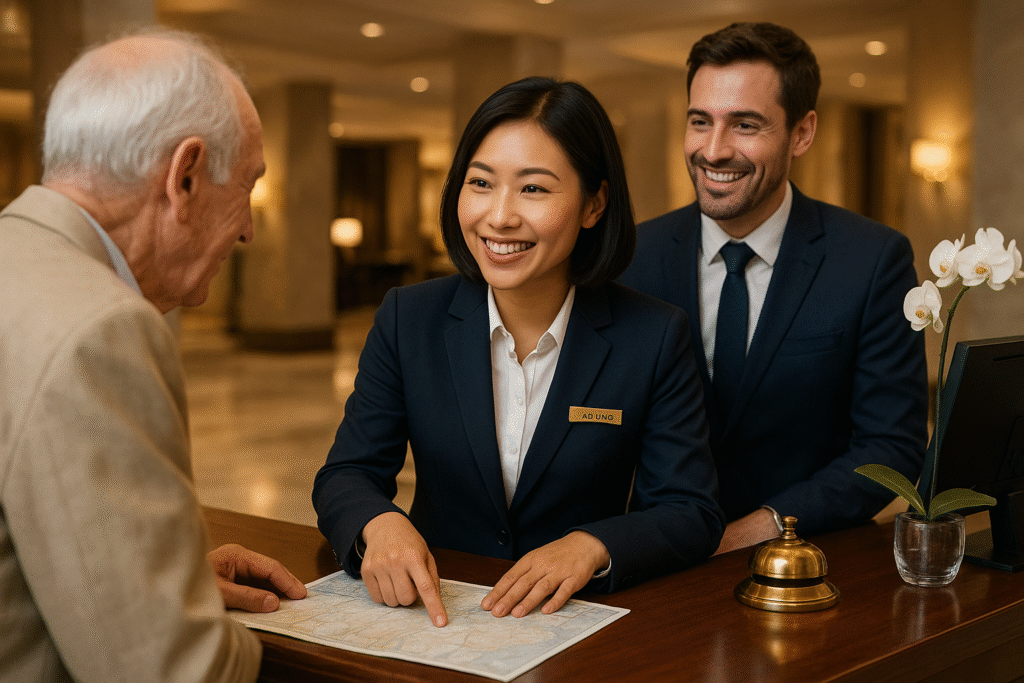
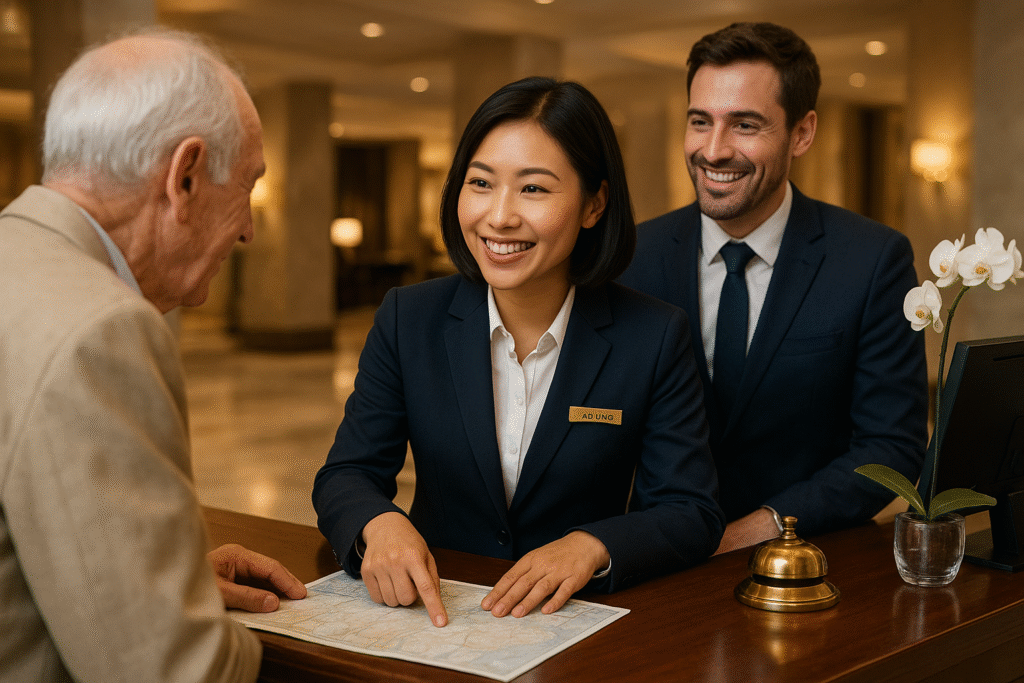
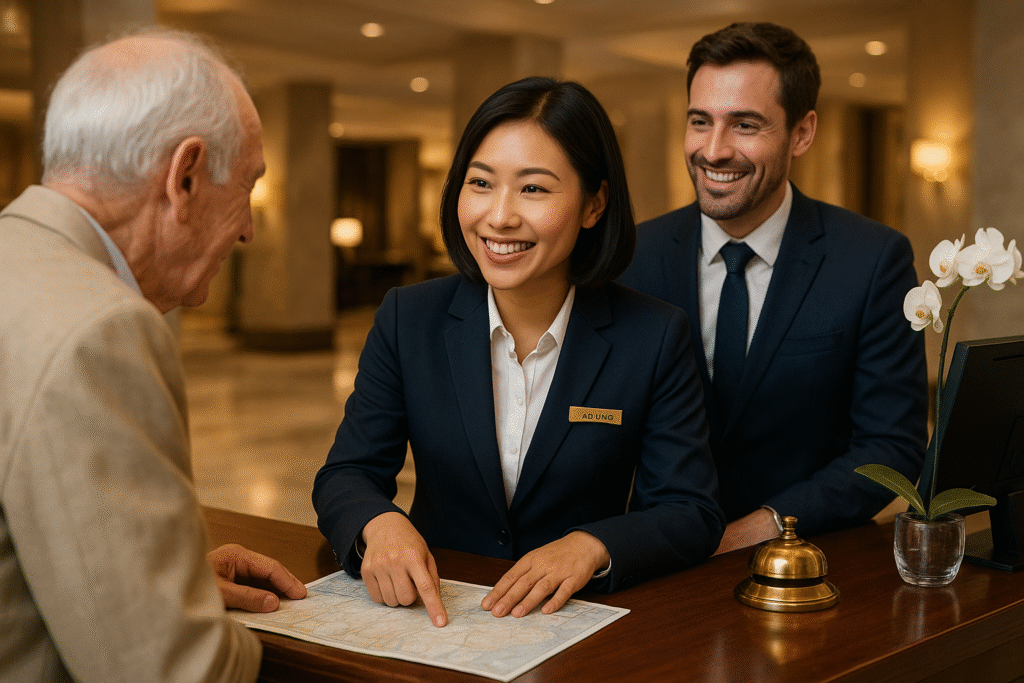
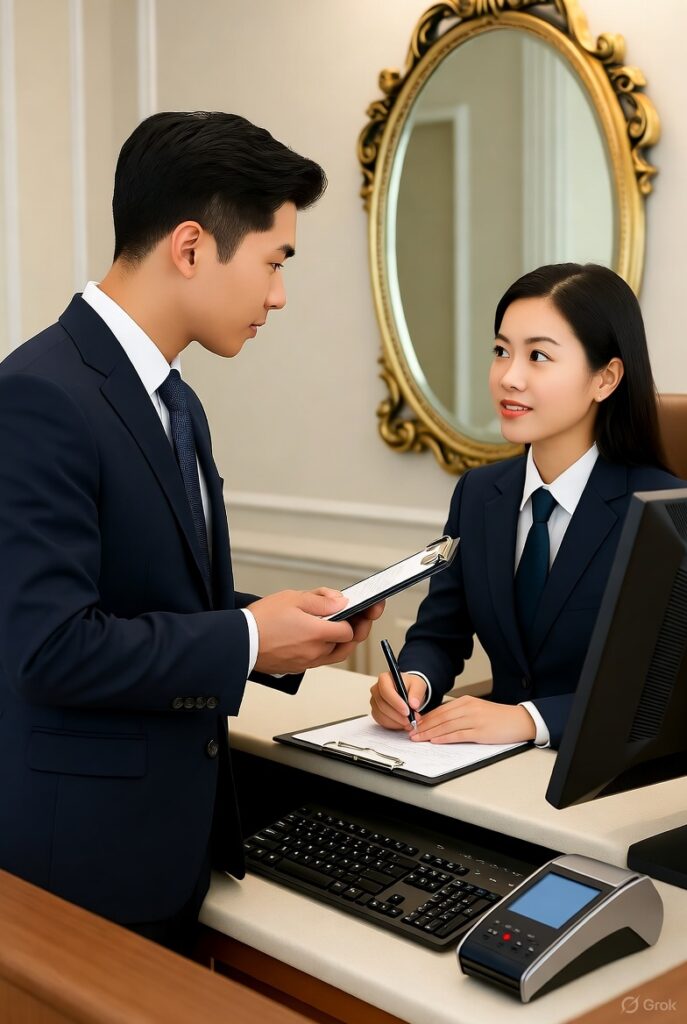
simple tips and daily tasks to make guests feel like royalty
🧹 Housekeeping Staff
Clean rooms every day → In luxury hotels, rooms must look perfect. This includes making the bed neatly, vacuuming, and arranging everything nicely.
Change towels and sheets → Clean towels and sheets are a sign of good service and hygiene. They must always look fresh and smell clean.
Check everything carefully → Housekeepers must notice small details: fingerprints on glass, dust under furniture, or missing items.
Respect guests’ privacy → Housekeepers must knock loudly, say “Housekeeping!”, and wait for an answer before entering. Guests must always feel safe in their room.
Report broken things → If a lamp is broken or water is leaking, housekeeping must inform maintenance quickly. Fast repairs show quality service.
Be quiet and respectful → Housekeepers must move quietly in the hallway and not disturb guests.
#################
Setting:
The manager’s office at the Grand Horizon Hotel, a luxury 5-star hotel.
Characters:
Ms. Elena Carter – Hotel Manager
Mr. Raj Patel – Assistant Manager
[Ms. Carter is sitting at her desk, reading a report. Mr. Patel knocks on the door and enters.]
Ms. Carter: Good morning, Raj. Please, have a seat. Let’s talk about the housekeeping staff. How is everything going?
Mr. Patel: Good morning, Ms. Carter. Overall, the housekeeping team is doing very well. They clean all rooms every day. The beds are made perfectly, and everything looks neat and elegant. Many guests have written positive comments.
Ms. Carter: That’s great news. How are we doing with towels and sheets?
Mr. Patel: They are changed every day. The sheets are white and clean, and the towels smell fresh. This makes a good impression on our guests.
Ms. Carter: Good. And the small details?
Mr. Patel: The team checks the glass and furniture carefully. They look for fingerprints and dust. But I think we can still improve a little here. For example, sometimes they don’t check under the bed or behind the curtains. Guests may leave things there, like socks, chargers, or papers. If we miss these, guests might think the room is not fully cleaned.
Ms. Carter: Yes, you’re right. Those places are easy to forget. What about privacy?
Mr. Patel: The staff always knocks loudly, says “Housekeeping!”, and waits. Guests feel safe, and this is very important. No problems here.
Ms. Carter: Good. And maintenance reports?
Mr. Patel: They are faster now. Yesterday a lamp was broken, and they informed maintenance immediately. It was fixed in less than an hour. However, some staff members forget to report small things like loose hooks or weak water pressure. These are not big problems, but they can give guests a bad impression if not fixed quickly.
Ms. Carter: Exactly. Small problems can make a big difference in a 5-star hotel.
———end of dialogue———
Mr. Patel: Also, we can improve communication between housekeeping and the front desk. For example, if a guest checks out early, the room should be cleaned faster so we can offer it to new guests sooner.
Ms. Carter: That’s a smart point. And the noise?
Mr. Patel: It’s better now. The staff moves quietly, but sometimes when they talk in the hallway, their voices are still a bit too loud. We can remind them to whisper or use radios more carefully.
Ms. Carter: Very good observations, Raj. Please prepare a short training for the team. We will focus on hidden areas in rooms, faster reporting of small problems, and quiet communication.
Mr. Patel: Of course, Ms. Carter. I’ll organize the training this week and talk to the supervisors today.
Ms. Carter: Excellent. Thank you, Raj. Together, we can make the service even better.
Mr. Patel: Thank you, Ms. Carter. I’m sure the team will improve even more.
[Mr. Patel smiles and leaves the office. Ms. Carter writes a note to check the improvements in two days.]
################
🧹 What to Do
🏨 How to Do It
1. Clean the room
Housekeepers clean the guest room every day. The bed must look perfect — sheets straight, pillows in the right place. Vacuum the floor carefully, dust the furniture, clean mirrors and glass. Arrange the chairs, table, and things nicely. A clean room makes guests feel happy and comfortable.
2. Change towels and sheets
Guests must always have clean towels and sheets. Take used towels and sheets out of the room. Replace them with fresh, clean ones from the housekeeping trolley. Fold towels nicely and put them in the correct place. Clean linen must smell nice and look bright.
3. Check the room carefully
After cleaning, look at everything closely. Check the bathroom for hair or water on the floor. Look at mirrors for fingerprints. Check under the bed and behind doors for dust. Make sure all items (remote control, water bottles, hangers) are in the right place. Good housekeepers see small details.
4. Respect guests’ privacy
Always knock on the door 3 times. Say clearly: “Housekeeping!” Then wait a few seconds. If there is no answer, knock again. Only enter when it is safe. If a guest is in the room, ask politely if you can come in later. Guests must always feel safe, private, and respected.
5. Report problems quickly
If something is broken, for example a lamp, toilet, air conditioner, or if water is leaking — tell the maintenance department immediately. Do not try to fix it yourself. Fast reporting means the problem can be fixed quickly, and the guest will be happy.
6. Be quiet and respectful
Speak softly or not at all in the hallway. Close doors slowly and quietly. Do not shout to other staff. If guests are sleeping, be extra careful. Quiet work shows respect and good service.
7. Be clean and professional
Wear a clean uniform. Wash your hands often. Be polite and smile. If a guest talks to you, answer kindly. Professional housekeepers make a good impression.
8. Follow safety rules
Be careful when using cleaning products. Do not leave wet floors without a sign. Use gloves when needed. Keep the trolley in the hallway, but do not block the way. Safety is very important.
simple tips and daily tasks to make guests feel like royalty
🧑💼 Front Desk Staff
Stay professional under pressure → When the lobby is busy, it is important to stay organized and calm.
Welcome guests with a smile → The front desk is the first contact point. A warm welcome sets the tone for the guest’s stay.
Check guests in and out quickly → Fast, correct service makes the guest feel valued. Long waiting times can make guests unhappy.
Give clear information → Guests often need details about breakfast times, Wi-Fi, the gym, pool, or local attractions. Clear answers prevent confusion.
Answer the phone politely → A kind voice on the phone builds trust. Always say hello, give the hotel name, and speak slowly and clearly.
Help with problems → For example, if a key card does not work or if a guest’s room is too noisy, front desk staff must listen carefully and solve it quickly. ##############
Setting: The manager’s office at the Grand Horizon Hotel, a luxury 5-star hotel. Ms. Elena Carter, the manager, is sitting at her desk. Mr. Raj Patel, the assistant manager, comes in for a meeting about guest service at the front desk.
Elena: Good morning, Raj. Please come in. How are you today?
Raj: Good morning, Ms. Carter. I am fine, thank you. And you?
Elena: I am very good, thank you. Today, I want to talk about the front desk. It is very important. The front desk is the first place our guests see when they arrive. If our staff is polite, organized, and friendly, guests feel welcome and happy.
Raj: Yes, I agree. A friendly welcome can make the guest’s day very good. It is the first impression, and the first impression is very important.
Elena: Exactly. When the lobby is busy, the staff must stay professional under pressure. For example, imagine ten guests are at the front desk at the same time. Staff must stay calm, not speak too fast, and keep everything organized. If they are nervous, the guests can feel it, and they may become unhappy.
Raj: That is true. We can remind them to take a deep breath and smile, even when it is busy. A smile is simple but very effective.
Elena: Yes. Also, check-in and check-out must be fast and correct. Guests do not like to wait a long time. For example, if a guest comes after a long flight, they want to get to their room quickly. Fast service shows that we respect their time.
Raj: I agree. But we must also be careful. We cannot make mistakes with room numbers, names, or bills. Fast and correct is the key.
Elena: Very good. Another important point is giving clear information. Guests often ask about breakfast time, Wi-Fi, the gym, the pool, or local attractions. Staff must answer clearly and politely. If the information is not clear, guests can be confused or upset.
Raj: Maybe we can make a small sheet for the staff with all important information. Then they can answer quickly and correctly.
—————–end of audio————-
Elena: Excellent idea. And the phone is very important too. Staff must answer politely. They should say: “Good morning, Grand Horizon Hotel, how can I help you?” Always speak slowly and clearly. A kind voice builds trust.
Raj: Yes, Ms. Carter. Sometimes guests call when they are tired or upset. A polite voice can make them feel better.
Elena: Exactly. And of course, we must help with problems quickly. For example, if a key card does not work, or if a room is too noisy, staff must listen carefully and solve the problem. They must never say: “I don’t know.” They should try to find a solution fast.
Raj: Yes. We can give the staff examples. For example, if a guest says: “My room is too noisy,” we can offer another room quickly. If the key card does not work, we can make a new one in two minutes.
Elena: That is right. Small actions make a big difference. Guests notice if we care about them. And this is what a 5-star hotel should do.
Raj: Should we also talk about teamwork? Sometimes staff work together, and sometimes alone. They need to help each other.
Elena: Very good point. Teamwork is very important. If one staff member is busy, another can help. For example, one can answer the phone while the other checks in a guest.
Raj: Yes, and also, staff should always greet guests with a smile. Even if they are tired or busy.
Elena: Correct. A smile, politeness, clear information, and fast service — these are the most important things.
Raj: I think we can also give small tips for difficult situations. For example, if a guest is unhappy, the staff can say: “I am very sorry. Let me help you.” This shows care and respect.
Elena: Excellent idea, Raj. And one more thing — staff should remember the names of regular guests when possible. It makes guests feel special.
Raj: Yes, Ms. Carter. I will remind the team to practice remembering names and always using polite words.
————-end of audio————
Elena: Good. If we follow all these rules — stay calm, smile, be polite, give clear information, check in/out fast, answer the phone politely, help with problems, and work as a team — our guests will be happy. They will write good reviews and return to our hotel.
Raj: I understand. I will prepare a training session this afternoon. We can practice checking in, answering the phone, giving information, and solving problems.
Elena: That is perfect, Raj. Let’s make sure our front desk service is the best in the city. Thank you for your help.
Raj: Thank you, Ms. Carter. I am excited to start and help the team improve.
simple tips and daily tasks to make guests feel like royalty
🏨 Daily Life of Hotel Staff
Always smile and be friendly → A smile is the first thing a guest sees. It shows respect, kindness, and a positive attitude. Even if the staff is tired, a smile can make the guest feel welcome and comfortable.
Wear a clean and nice uniform → Uniforms make staff look professional and easy to recognize. A clean and ironed uniform shows pride in the job and gives guests trust in the hotel’s quality.
Speak clearly and politely → Guests may come from many countries and speak different languages. Simple, clear, and polite language helps avoid misunderstandings and builds good communication.
Work in different departments → Luxury hotels have many areas: front desk, housekeeping, restaurant, concierge, kitchen, security, and maintenance. Each department works together to give the guest the best experience.
Help guests from many countries → Guests may have different cultures and expectations. Staff need to be respectful and flexible. For example, some guests prefer personal space, others like to chat more.
Stay calm and patient → Guests can be tired, upset, or stressed. Even if a guest complains, staff must stay polite, calm, and professional. A calm attitude can turn a bad situation into a good one.
Be on time → Luxury hotels run like a clock. If one person is late, it can affect the whole team. Punctuality shows respect for colleagues and guests.
Follow hotel rules and standards → Luxury hotels have clear rules about service, behavior, and appearance. Following them keeps service consistent and professional for every guest.
Be polite to other staff members → Good teamwork starts with respect inside the team. When staff treat each other well, they work better and give better service to guests.
############
Setting: The manager’s office at the Grand Horizon Hotel, a luxury 5-star hotel. The manager, Ms. Elena Carter, meets with the assistant manager, Mr. Raj Patel, to talk about how to make guest service better.
Elena (Manager): Good morning, Raj. Thank you for coming. Our guests like our hotel, but we can make service better. Let’s talk about our rules for good service. We can share ideas to improve.
Raj (Assistant Manager): Good morning, Elena. Yes, I agree. Some things can be better. Let’s look at the rules and talk.
Elena: Great. First rule: always smile and be friendly. A smile makes guests feel welcome. It shows respect and kindness. But some staff forget to smile when they’re tired. What can we do?
Raj: Hmm, maybe we can remind staff every day. Like, in morning meetings, say, “Smile, it’s important!” We can also give a small prize, like “Best Smile of the Week,” to make it fun.
Elena: I like that! A prize is a good idea. It makes smiling fun, not just work. Okay, next: wear a clean and nice uniform. Uniforms make staff look professional. But I saw some uniforms looking old or not ironed. How can we fix this?
Raj: We can check uniforms every week. Maybe make a list to see if they’re clean and ironed. If someone’s uniform is old, we can give them a new one fast. Guests notice these things.
Elena: Good plan. Let’s make a uniform check every Monday. Next rule: speak clearly and politely. Our guests come from many countries. They speak different languages. Sometimes staff talk too fast or use hard words. Ideas?
Raj: We can teach staff simple, polite words to use with guests. Like, “Hello, how can I help you?” or “Please wait a moment.” Maybe we do short training every month to practice clear speaking.
—————-end of audio——————-
Elena: Yes, short training is smart. Let’s do it. Now, about departments—front desk, housekeeping, restaurant, concierge, kitchen, security, maintenance. They must work together. Sometimes, housekeeping and front desk don’t talk enough. How can we make teamwork better?
Raj: Maybe we have a team meeting every week for all departments. They can share problems and ideas. Also, we can use a group chat on phones to talk fast, like if a room isn’t ready.
Elena: I like the group chat idea. It’s quick and easy. Okay, next: help guests from many countries. Guests have different cultures. Some like to talk, some want space. How do we help staff understand this?
Raj: We can give staff a small book with tips about cultures. Like, “In some countries, guests like personal space.” Or we can do a training about different cultures. Staff can learn what guests like.
Elena: A culture book is a great idea. Let’s make one. Now, staying calm and patient. Some guests get upset or complain. Staff must stay polite. I saw one staff member get angry last week. How can we help them stay calm?
Raj: We can teach staff to breathe slowly when a guest is upset. Or they can say, “Let me get my manager,” if it’s hard. Maybe we do role-play in training to practice staying calm.
Elena: Role-play is good. Staff can practice hard situations. Next: be on time. If one person is late, it makes problems for everyone. How do we make sure everyone comes on time?
Raj: We can give a small bonus for staff who are always on time each month. Or talk to staff who are late and ask why. Maybe they need help, like a better bus schedule.
Elena: A bonus is a nice idea. Let’s try it. Now, follow hotel rules and standards. Our rules keep service the same for every guest. But some staff forget small rules, like no phones at work. What can we do?
Raj: We can put signs in staff rooms, like “No phones during work.” And managers can check kindly. If someone forgets, we remind them nicely first. ———-end of audio—————
Elena: Good, kind reminders work. Last one: be polite to other staff. When staff respect each other, they work better and help guests better. How do we make sure staff are kind to each other?
Raj: We can have a “Team Star” award for staff who are kind and help others. Also, managers can show respect to staff, so they learn to do it too.
Elena: I love the “Team Star” idea! Okay, Raj, we have many good ideas: prizes for smiling, uniform checks, clear speaking training, team meetings, a culture book, role-play for staying calm, bonuses for being on time, signs for rules, and a “Team Star” award. Let’s make a plan to start these. Can you write a list and share it with me tomorrow?
Raj: Yes, Elena, I’ll write the list and send it tomorrow. I think these ideas will make our service much better!
Elena: Perfect. Thank you, Raj. Let’s make our hotel the best for our guests!
simple tips and daily tasks to make guests feel like royalty
🏨 Daily Life of Hotel Staff
Always smile and be friendly → A smile is the first thing a guest sees. It shows respect, kindness, and a positive attitude. Even if the staff is tired, a smile can make the guest feel welcome and comfortable.
Wear a clean and nice uniform → Uniforms make staff look professional and easy to recognize. A clean and ironed uniform shows pride in the job and gives guests trust in the hotel’s quality.
Speak clearly and politely → Guests may come from many countries and speak different languages. Simple, clear, and polite language helps avoid misunderstandings and builds good communication.
Work in different departments → Luxury hotels have many areas: front desk, housekeeping, restaurant, concierge, kitchen, security, and maintenance. Each department works together to give the guest the best experience.
Help guests from many countries → Guests may have different cultures and expectations. Staff need to be respectful and flexible. For example, some guests prefer personal space, others like to chat more.
Stay calm and patient → Guests can be tired, upset, or stressed. Even if a guest complains, staff must stay polite, calm, and professional. A calm attitude can turn a bad situation into a good one.
Be on time → Luxury hotels run like a clock. If one person is late, it can affect the whole team. Punctuality shows respect for colleagues and guests.
Follow hotel rules and standards → Luxury hotels have clear rules about service, behavior, and appearance. Following them keeps service consistent and professional for every guest.
Be polite to other staff members → Good teamwork starts with respect inside the team. When staff treat each other well, they work better and give better service to guests.
🧑💼 Front Desk Staff
Welcome guests with a smile → The front desk is the first contact point. A warm welcome sets the tone for the guest’s stay.
Check guests in and out quickly → Fast, correct service makes the guest feel valued. Long waiting times can make guests unhappy.
Give clear information → Guests often need details about breakfast times, Wi-Fi, the gym, pool, or local attractions. Clear answers prevent confusion.
Answer the phone politely → A kind voice on the phone builds trust. Always say hello, give the hotel name, and speak slowly and clearly.
Help with problems → For example, if a key card does not work or if a guest’s room is too noisy, front desk staff must listen carefully and solve it quickly.
Stay professional under pressure → When the lobby is busy, it is important to stay organized and calm.
🧹 Housekeeping Staff
Clean rooms every day → In luxury hotels, rooms must look perfect. This includes making the bed neatly, vacuuming, and arranging everything nicely.
Change towels and sheets → Clean towels and sheets are a sign of good service and hygiene. They must always look fresh and smell clean.
Check everything carefully → Housekeepers must notice small details: fingerprints on glass, dust under furniture, or missing items.
Respect guests’ privacy → Housekeepers must knock loudly, say “Housekeeping!”, and wait for an answer before entering. Guests must always feel safe in their room.
Report broken things → If a lamp is broken or water is leaking, housekeeping must inform maintenance quickly. Fast repairs show quality service.
Be quiet and respectful → Housekeepers must move quietly in the hallway and not disturb guests.
🍽 Restaurant and Bar Staff
Welcome guests to the restaurant → A warm welcome and a polite “Good morning / Good evening” make guests feel special.
Serve food and drinks quickly → Guests in a luxury hotel expect fast service without mistakes. Waiting too long can make them unhappy.
Know the menu well → Staff must be able to explain dishes and answer questions (for example, “Is this dish spicy?” or “Does it have nuts?”).
Be careful and polite → Move gently with trays, do not rush, always say “Excuse me” when passing by a guest.
Say ‘thank you’ and ‘enjoy your meal’ → These small polite phrases make the service feel personal and warm.
Check if guests need something → For example, ask politely if they want more water, more bread, or dessert.
🚪 Concierge and Bell Staff
Help with luggage → Bell staff carry bags carefully, always with respect for guests’ personal belongings.
Offer help with transport and tours → Guests often ask about taxis, buses, or day trips. A helpful concierge makes travel easy.
Know local places well → Good knowledge of local restaurants, shops, and attractions helps guests trust the hotel.
Always be polite → Bell staff often meet guests at arrival or departure. A polite goodbye is just as important as a warm welcome.
Assist elderly or disabled guests → Offering extra help shows care and respect.
🌟 How to Improve Service
Listen carefully to guests → When guests speak, look at them, nod, and show interest. This makes them feel important.
Remember guest names → Saying a guest’s name shows personal care. For example: “Good evening, Mr. Lee.”
Be fast and efficient → Good service means solving requests quickly and correctly without making guests wait too long.
Work well as a team → If one person is busy, another can help. Teamwork keeps service smooth and stress low.
Learn more languages → Even simple words like “hello,” “thank you,” or “goodbye” in the guest’s language can make them happy.
Always keep learning → Hotels offer training to improve skills like communication, problem-solving, and guest relations.
Show respect and kindness → Guests should always feel safe, respected, and welcome. Kindness creates good memories.
Solve problems quickly → If something goes wrong, act fast and apologize politely. A quick solution can make a guest even happier than before the problem.
Check small details → A clean table, a polite greeting, or remembering a guest’s favorite drink can make the hotel experience special.
Be proud of your work → When staff are proud of their service, guests can feel it. Pride leads to quality and success.
Guest Journey Mapping means thinking about the guest’s whole experience at the hotel — from the moment they arrive until they leave. It helps us give excellent service at every step.
1️⃣ Before Arrival
Guest books a room online, by phone, or by email.
They may ask questions about the hotel or transport.
Staff should:
Answer politely and quickly.
Give correct information.
Prepare the room for the guest.
Why: The first contact makes a guest feel welcome.
2️⃣ Arrival
Guest arrives at the hotel entrance.
Bell staff opens the door, smiles, and helps with luggage.
Staff should:
Greet the guest warmly.
Smile and say something like: “Welcome to our hotel!”
Offer help to get to the reception or room.
Why: Guests feel welcome immediately.
3️⃣ Check-In
Guest goes to the front desk.
They give ID and receive the key.
Staff should:
Smile and use the guest’s name if possible.
Explain hotel services: breakfast, Wi-Fi, swimming pool.
Make check-in fast and easy.
Why: First impressions are very important.
4️⃣ Room Experience
Guest goes to the room.
They check cleanliness, comfort, and small details.
Staff should:
Make sure the room is clean and ready.
Check air-con, lights, TV, shower work well.
Add small touches: water bottles, welcome card.
Why: Guests feel happy and comfortable.
5️⃣ During Stay
Guest may ask for help or information.
Staff should:
Smile and greet the guest in hallways: “Good morning!”
Help quickly when they ask for something.
Listen carefully and remember guest requests.
Why: Guests feel cared for and important.
6️⃣ Problems
Something may go wrong (room not ready, broken item).
Staff should:
Listen and say: “I am sorry.”
Fix the problem quickly.
Thank the guest for telling you.
Why: Guests remember how staff solve problems.
7️⃣ Check-Out
Guest leaves the hotel.
Staff should:
Ask: “Was your stay good?”
Thank them sincerely.
Help with luggage or transport.
Why: Last impression is very important.
8️⃣ After Departure
Guest goes home.
Hotel may send a message asking for feedback.
Staff should:
Remember guest preferences for next stay.
Encourage them to come back.
Why: Guests feel valued and may return.
⭐ Summary
Every step matters:
Smile, greet, and help guests.
Be fast, polite, and friendly.
Solve problems quickly.
Small details make guests happy.
################
Detailed cheat sheet:
Guest Step
Staff Should
Before Arrival
1. Answer guest questions politely and quickly 2. Give correct information about hotel and transport 3. Confirm room booking details 4. Note special requests in the system 5. Prepare guest preferences (room type, bed) 6. Inform departments about VIPs or arrivals 7. Check the room is clean and ready
Arrival
1. Smile and greet the guest warmly 2. Open the door for the guest 3. Help with luggage 4. Escort the guest to reception or elevator 5. Offer a welcome drink or towel if possible 6. Use polite words: “Good morning / welcome!” 7. Make the guest feel safe and comfortable
Check-In
1. Use the guest’s name if possible 2. Explain hotel services: breakfast, Wi-Fi, pool 3. Explain hotel rules politely 4. Make check-in fast and easy 5. Offer help with luggage or directions 6. Answer guest questions clearly 7. Smile and maintain eye contact
Room Experience
1. Ensure the room is clean and ready 2. Check lights, air-con, TV, shower 3. Provide welcome items: water, card, toiletries 4. Make the room smell fresh 5. Check all equipment works properly 6. Note any special requests for future visits 7. Be ready to help if guest needs something
During Stay
1. Smile and greet guests in hallways 2. Ask: “How is your stay?” 3. Help quickly with requests 4. Listen carefully to guest needs 5. Remember guest preferences 6. Keep public areas clean and tidy 7. Respond politely to all questions
Problems / Complaints
1. Listen carefully 2. Apologize: “I am sorry” 3. Stay calm and polite 4. Solve the problem quickly 5. Keep the guest informed 6. Thank the guest for telling you 7. Follow up to check satisfaction
Check-Out
1. Smile and greet guest politely 2. Ask: “Was your stay good?” 3. Thank the guest sincerely 4. Help with luggage or transport 5. Offer assistance with payment 6. Invite them to return 7. Give directions if needed
After Departure
1. Remember guest preferences 2. Send polite thank-you messages 3. Invite feedback politely 4. Note VIP or repeat guest for next visit 5. Share guest feedback with team 6. Encourage guests to book again 7. Keep records for future service improvements
################
A summary:
The guest journey starts before arrival. Staff answer questions, check the booking, and get the room ready. At arrival, staff smile, greet guests, and help with luggage. During check-in, staff use the guest’s name, explain hotel services, and make it fast. In the room, staff check it is clean and all works, and give small welcome items. During the stay, staff greet guests, listen to needs, and help fast. If there is a problem, staff say sorry and fix it. At check-out, staff thank guests and help with luggage. When the guest leaves, staff think about the guest and say thank you.
################
A more detailed version:
1. Before Arrival
Before the guest comes to the hotel, staff must be ready. They check the booking and prepare the room. Staff answer guest questions politely by phone, email, or message. They note any special requests, for example, room type or bed. Staff tell other departments about the guest. They make sure the room is clean and ready. Staff prepare small welcome items if needed. Good preparation makes the guest happy and comfortable. The first impression starts before the guest arrives. When staff are ready, guests feel welcome from the start.
2. Arrival
When the guest comes to the hotel, staff greet them warmly. Bell staff smile, open doors, and help with luggage. They escort guests to reception or the elevator. Staff use polite words: “Welcome!” or “Good morning!” Staff give attention to the guest and make them feel safe. They help with questions about the hotel or city. Small actions like a smile or helping with bags are very important. Guests feel happy when staff are friendly. A good arrival makes the guest feel respected and welcomed. Staff must always be ready and polite.
3. Check-In
At check-in, staff welcome the guest with a smile. They use the guest’s name if possible. Staff ask for ID and confirm the booking. They explain hotel services like breakfast, Wi-Fi, and pool. Staff answer guest questions politely. They help with luggage or directions if needed. Check-in should be fast and easy. Staff must be friendly and calm. They must listen carefully and note any special requests. A good check-in makes guests feel happy and relaxed. Staff must always be polite and professional. The guest’s first experience inside the hotel is very important.
4. Room Experience
When the guest goes to the room, staff must make sure it is perfect. The room should be clean and tidy. Staff check that lights, air-con, TV, and shower work. They put small welcome items like water, a card, or toiletries. Staff make the room smell fresh. Everything must be ready before the guest arrives. Staff should note guest preferences for next visits. They must be ready to help if the guest needs something. A good room makes guests feel comfortable and happy. Small details are important for a great experience.
5. During Stay
During the stay, staff greet the guest in hallways: “Good morning!” or “How is your stay?” Staff listen carefully to guest needs. They help quickly when the guest asks. Staff must remember guest preferences and special requests. They keep public areas clean and tidy. Staff answer questions politely and clearly. They make the guest feel important and cared for. Staff must always smile and be friendly. During the stay, small actions make guests happy. Staff teamwork is important so the guest experience is excellent. Every day counts to make the guest feel welcome.
6. Problems / Complaints
Sometimes there are problems. A guest may find something broken or missing. Staff must listen carefully. They should say: “I am sorry.” Staff must stay calm and polite. They fix the problem as fast as possible. Staff must explain what they do to help. After solving, they check if the guest is happy. Staff thank the guest for telling them about the problem. Handling problems well makes the guest feel respected. Good service during problems shows professionalism. Staff must always stay friendly and help. Guests remember how staff solve problems more than anything.
7. Check-Out
When the guest leaves, staff greet them politely. They ask: “Was your stay good?” Staff thank the guest sincerely for staying at the hotel. They help with luggage and transport if needed. Staff check the payment and give receipts politely. They invite guests to come back. Staff smile and use the guest’s name if possible. They answer last questions clearly. A good check-out leaves a happy memory. Staff must be friendly and calm. Check-out is the last chance to show excellent service. Guests often remember this moment very well.
8. When the Guest Leaves
When the guest leaves, staff think about the guest. They check guest preferences for next visits. Staff can send polite thank-you messages or emails. They invite feedback politely. Staff note VIPs or repeat guests for the future. They share important information with the team. Remembering the guest helps the hotel improve service. Staff must always be professional and polite. Guests feel valued when staff care after they leave. Small actions after departure can make guests return. Good post-stay service helps the hotel build long-term happy guests.
remember, babies do not read books, they learn a language by listening, imitating, speaking….. DO IT!
When you learn a new language, listening is very important. Listening helps you learn words. You hear the words and sounds. You remember them better.
Listening helps you understand people. People speak fast. If you only read or write, it is hard to understand. Listening helps your brain. You learn words and sentences.
Listening helps you speak. When you hear words, you can say them. You learn pronunciation. You speak better if you listen a lot.
Listening helps you learn grammar. You hear how sentences are made. You do not need to study all the rules. Your brain learns from listening.
You can listen every day. Listen to songs, watch videos, or hear people talk. Even a little every day is good.
When you listen, you learn new words and phrases. You understand more. You can talk with people. You speak better and faster.
Listening is very important. If you listen more, you learn faster. You understand better. You speak better. Listening is the key to learning a language.
______________________
Vocabulary:
to remember – to keep something in your mind
to listen – to hear and pay attention to sounds or people speaking
to imitate – to copy what someone says or does
sounds – things you can hear
a brain – the part of your body that helps you think and learn
to understand – to know what something means
to learn sentences – to study and know groups of words that make meaning
pronunciation – the way we say words
a lot – many or much
to learn grammar – to study how words work together in a language
to need to study – to have to learn something by reading or practicing
rules – things that tell you what is right or how to do something
learn from listening – to learn by hearing people speak
a phrase – a few words that go together and have meaning
a key to learning a language – an important thing that helps you learn a language
################
Match the words with their definitions:
to remember
to listen
to imitate
sounds
a brain
to understand
to learn sentences
pronunciation
a lot
to learn grammar
to need to study
rules
learn from listening
a phrase
a key to learning a language
Definitions (random order): A. to study and know groups of words that make meaning B. to keep something in your mind C. an important thing that helps you learn a language D. things that tell you what is right or how to do something E. to copy what someone says or does F. the part of your body that helps you think and learn G. the way we say words H. to learn by hearing people speak I. to hear and pay attention to sounds or people speaking J. to have to learn something by reading or practicing K. things you can hear L. to study how words work together in a language M. many or much N. to know what something means O. a few words that go together and have meaning
to listen – to hear and pay attention to sounds or people speaking
to imitate – to copy what someone says or does
sounds – things you can hear
a brain – the part of your body that helps you think and learn
to understand – to know what something means
to learn sentences – to study and know groups of words that make meaning
pronunciation – the way we say words
a lot – many or much
to learn grammar – to study how words work together in a language
to need to study – to have to learn something by reading or practicing
rules – things that tell you what is right or how to do something
learn from listening – to learn by hearing people speak
a phrase – a few words that go together and have meaning
a key to learning a language – an important thing that helps you learn a language
##################
Fill in, words below:
rules – remember – brain – practice – pronunciation – imitate – words – learn – repeating
———————– The text is about how people __________ a language.
We use our __________ to listen to sounds and remember them. We _________ what we hear and learn from listening to others. Understanding __________ and phrases helps us speak better. We also need to study grammar and __________ to make correct sentences. Learning sentences and __________ together helps us understand more. We must study a lot to __________ new things. Listening, __________, and practicing every day are keys to learning a language well. The more we listen and __________, the better we understand and speak the new language. ———————-
Correct version:
The text is about how people learn a language. We use our brain to listen to sounds and remember them. We imitate what we hear and learn from listening to others. Understanding pronunciation and phrases helps us speak better. We also need to study grammar and rules to make correct sentences. Learning sentences and words together helps us understand more. We must study a lot to remember new things. Listening, repeating, and practicing every day are keys to learning a language well. The more we listen and practice, the better we understand and speak the new language. #############
Complete, words below:
listen – evening – rules – like – listening – countries – practice – understand – difficult – pronunciation – notebook – watch
——————————
Anna: Hello, Tom! What do you learn at school these days?
Tom: I learn English, and I really __________ it.
Anna: Why do you learn English?
Tom: Because I want to travel and talk with people from other __________.
Anna: How do you learn new words?
Tom: I __________ to my teacher and repeat the words many times.
Anna: Where do you study English?
Tom: I study at school in the morning and at home in the __________.
Anna: When do you practice speaking?
Tom: I __________ speaking with my friends every day after class.
Anna: Who helps you when you don’t __________ something?
Tom: My teacher helps me and sometimes my older sister.
Anna: What do you find __________ in English?
Tom: Grammar is difficult, but I try to learn the _________ slowly.
Anna: Which part of English do you like best?
Tom: I like __________ because I can hear my progress.
Anna: How do you remember new words and phrases?
Tom: I write them in my __________ and read them every night before bed.
Anna: How often do you listen to English songs or __________ English videos?
Tom: I do it almost every day because it helps me learn from__________. —————————
Correct version:
Dialogue: Learning a Language
Anna: Hello, Tom! What do you learn at school these days? Tom: I learn English, and I really like it. Anna: Why do you learn English? Tom: Because I want to travel and talk with people from other countries. Anna: How do you learn new words? Tom: I listen to my teacher and repeat the words many times. Anna: Where do you study English? Tom: I study at school in the morning and at home in the evening. Anna: When do you practice speaking? Tom: I practice speaking with my friends every day after class. Anna: Who helps you when you don’t understand something? Tom: My teacher helps me and sometimes my older sister. Anna: What do you find difficult in English? Tom: Grammar is difficult, but I try to learn the rules slowly. Anna: Which part of English do you like best? Tom: I like pronunciation because I can hear my progress. Anna: How do you remember new words and phrases? Tom: I write them in my notebook and read them every night before bed. Anna: How often do you listen to English songs or watch English videos? Tom: I do it almost every day because it helps me learn from listening.
At the front desk, we work as a team. Good teamwork helps us solve problems and make guests happy. Clear communication, respect, and knowing our tasks are very important.
Here are some points to help us work better together.
Basics outlined
1. Clear Communication and Handovers
Speak clearly and politely to your team.
Give all important information when your shift ends.
with every bullit point eg in 1. examples, structuredWrite notes about guest requests, room changes, or problems.
Make sure the next person knows everything they need.
2. Role Clarity – Know Who Does What
Everyone has a job at the front desk.
Know your tasks and help others if needed.
If you are not sure, ask politely.
Respect everyone’s responsibilities.
3. Proactive Problem-Solving
Think about what could go wrong and prepare.
Fix small problems before they become big problems.
For example, check if VIP rooms are ready before arrival.
Always tell your team if there is an issue.
4. Respectful Collaboration
Be kind and polite to your team members.
Listen carefully to each other.
Share ideas without arguing.
Support each other, especially during busy times.
5. Daily Briefings and Shift Handovers
Meet every morning or shift change to discuss plans.
Share guest arrivals, departures, and special requests.
Talk about VIP guests or guests with problems.
This helps the team work smoothly together.
6. Effective Use of Tools
Use the hotel software (PMS) to write notes and check information.
Use internal messaging to talk to housekeeping, maintenance, or concierge.
Always update the system so everyone knows the latest information.
Double-check details to avoid mistakes.
7. Checking with Other Departments
Talk to housekeeping about room readiness.
Check with maintenance if there are any problems.
Coordinate with concierge for guest requests.
Keep all departments informed about changes.
8. Personal Action Plan
Think about one thing you can do better today.
It can be small, like leaving better notes or helping a colleague.
Try to do it every day.
Good teamwork helps guests and makes work easier.
_____________________
Basics in detail
What to Do
How to Do It / Examples
1. Clear Communication and Handovers
Speak clearly and politely: “Good morning, Mr. Smith, your room is ready.” / “Hello, Ms. Lee, I will help you with check-in.”Give all important information when your shift ends: “Room 502 VIP guest arrives at 3 PM; late check-out requested.” / “Guest in 305 requested extra towels.”Write notes about guest requests, room changes, or problems: Note in PMS: “Extra pillows for room 305.” / “Room 410 AC repaired.”Make sure the next person knows everything they need: Tell next shift: “Two rooms need cleaning before 2 PM.” / “Guest in 502 is waiting for late check-out.”
2. Role Clarity – Know Who Does What
Everyone has a job at the front desk: “I do check-ins; you call taxis.” / “I answer calls; you handle emails.”Know your tasks and help others if needed: Help with luggage while colleague checks in guests / Take reservations while colleague handles VIP guest.If you are not sure, ask politely: “Can you show me how to do a late check-out?” / “I am not sure about the guest request, can you help?”Respect everyone’s responsibilities: Don’t take over tasks assigned to others / Let the concierge handle restaurant bookings.
3. Proactive Problem-Solving
Think about what could go wrong and prepare: Check room readiness before guest arrival / Confirm transport arrangements for VIPs.Fix small problems before they become big problems: Replace a missing towel before guest notices / Fix minibar issue before guest complains.Example: check if VIP rooms are ready before arrival: Call housekeeping: “Room 502 ready for VIP guest?” / Check that welcome amenities are in place.Always tell your team if there is an issue: “Maintenance needed in room 305; AC not working.” / “Guest lost key; need replacement key card.”
4. Respectful Collaboration
Be kind and polite to your team members: “Can I help you with check-ins?” / “Good job handling that guest complaint.”Listen carefully to each other: Pay attention when a colleague explains a guest request / Repeat information to confirm understanding.Share ideas without arguing: Suggest a solution calmly: “We can move the guest to another room.” / “Maybe we can call housekeeping for extra help.”Support each other, especially during busy times: Help with luggage or check-ins when desk is full / Answer phone calls while colleague handles check-in.
5. Daily Briefings and Shift Handovers
Meet every morning or shift change to discuss plans: Quick meeting at 8 AM: “Today we have 3 VIP arrivals.” / “Shift change at 2 PM, brief on guest requests.”Share guest arrivals, departures, and special requests: “Room 410 late check-out, VIP guest in 502.” / “Guest in 305 has allergy request.”Talk about VIP guests or guests with problems: “Guest in 305 complained about AC; maintenance called.” / “VIP guest requests flowers in room 502.”This helps the team work smoothly together: Everyone knows the plan and tasks / Prevents mistakes and confusion.
6. Effective Use of Tools
Use the hotel software (PMS) to write notes and check information: Enter: “Room 410 cleaned and ready.” / “Guest requested wake-up call at 7 AM.”Use internal messaging to talk to housekeeping, maintenance, or concierge: “Housekeeping, room 502 ready?” / “Maintenance, AC fixed in room 305?”Always update the system so everyone knows the latest information: After fixing a problem: “Room 305 AC fixed.” / “Guest late arrival updated in PMS.”Double-check details to avoid mistakes: Check guest request list before arrival / Verify VIP amenities before guest check-in.
7. Checking with Other Departments
Talk to housekeeping about room readiness: “Is room 502 ready for VIP?” / “Room 410 cleaned?”Check with maintenance if there are any problems: “AC fixed in room 305?” / “Light in 402 replaced?”Coordinate with concierge for guest requests: “Taxi arranged for 3 PM.” / “Tickets for show booked for room 502.”Keep all departments informed about changes: “Guest changed arrival time to 2 PM.” / “Guest requested late check-out in 410.”
8. Personal Action Plan
Think about one thing you can do better today: “Write clearer notes for next shift.” / “Check VIP room amenities before arrival.”It can be small, like leaving better notes or helping a colleague: Help a colleague during check-in rush / Update PMS notes accurately.Try to do it every day: Make it a habit / Review guest requests at start of shift.Good teamwork helps guests and makes work easier: Smooth shifts make guests happy / Fewer mistakes mean less stress.
_________________
Basics, dialogues
1. Clear Communication and Handovers
Characters:
Anna – finishing her shift
Ben – starting his shift
Dialogue:
Anna: Hi Ben, good morning. I will tell you about the important things before you start.
Ben: Yes, please.
Anna: Room 502 VIP guest arrives at 3 PM. He wants late check-out.
Ben: Okay, got it. Room 502, VIP, late check-out at 3 PM.
Anna: Guest in room 305 asked for extra towels. I wrote it in the PMS.
Ben: Great, I will check the PMS.
Anna: Room 410 AC was fixed, and housekeeping cleaned the room.
Ben: Thank you. I know everything.
Anna: Also, two rooms need cleaning before 2 PM.
Ben: I will tell housekeeping. Thanks, Anna.
Anna: You’re welcome. Have a good shift!
This dialogue shows:
Speaking clearly and politely
Giving all important information
Writing notes in PMS
Making sure the next person knows everything
####################
2. Role Clarity – Know Who Does What
Characters:
Sara – front desk staff
Tom – front desk staff
Dialogue:
Sara: Hi Tom, can you help me with check-ins today?
Tom: Sure, Sara. I will answer phone calls and emails while you do the check-ins.
Sara: Great! And I will call housekeeping for room 502.
Tom: Okay. What if I am not sure about a guest request?
Sara: Ask me politely. For example: “Sara, can you help me with this request?”
Tom: Yes, I will do that.
Sara: Remember, I handle check-ins and you handle calls. We respect each other’s tasks.
Tom: Understood. I will not take over check-ins.
Sara: Perfect. Let’s work together and make it easy for guests.
This dialogue shows:
Knowing your tasks
Helping others if needed
Asking politely when unsure
Respecting everyone’s responsibilities
###############
3. Proactive Problem-Solving:
Characters:
Lina – front desk staff
Mark – front desk staff
Dialogue:
Lina: Hi Mark, I see a small problem. Room 305 AC is not working.
Mark: Oh no! What should we do?
Lina: I already called maintenance. They will fix it before the guest arrives.
Mark: Good idea. Any other issues?
Lina: Yes, VIP guest in room 502. We need to check the room and amenities before arrival.
Mark: Okay, I will check housekeeping and make sure everything is ready.
Lina: Great! Always tell the team about any problem.
Mark: I will. Thanks, Lina!
This dialogue shows:
Thinking ahead and preparing
Fixing small problems before they become big
Checking VIP rooms before arrival
Always telling the team about issues
###############
4. Respectful Collaboration:
Characters:
Nina – front desk staff
James – front desk staff
Dialogue:
Nina: Hi James, it is busy today. Can I help you with check-ins?
James: Yes, please. Thank you! I will answer the phone while you do check-ins.
Nina: Okay. And if you have an idea, tell me calmly.
James: Sure. For example, if a guest wants a room change, I will suggest a solution politely.
Nina: Perfect. Also, listen carefully to each other and support each other.
James: Yes, I will help you with luggage if it is needed.
Nina: Great teamwork! Guests will be happy.
This dialogue shows:
Being kind and polite to team members
Listening carefully to each other
Sharing ideas without arguing
Supporting each other, especially during busy times
##############
5. Daily Briefings and Shift Handovers:
Characters:
Emma – front desk staff (ending shift)
Liam – front desk staff (starting shift)
Dialogue:
Emma: Hi Liam, let me tell you the important things before your shift.
Liam: Yes, please.
Emma: Today, three VIP guests will arrive: rooms 502, 504, and 510.
Liam: Okay, got it. VIPs in 502, 504, 510.
Emma: Room 410 has a late check-out, and guest in 305 has a special request for extra towels.
Liam: Thank you. I will check the PMS for notes.
Emma: Guest in 305 had an AC problem yesterday. Maintenance fixed it.
Liam: Perfect. I know everything now.
Emma: Good! Daily briefings and shift handovers help the team work smoothly.
This dialogue shows:
Meeting every morning or shift change
Sharing guest arrivals, departures, and special requests
Talking about VIP guests or guests with problems
Helping the team work smoothly together
###############
6. Effective Use of Tools:
Characters:
Mia – front desk staff
Leo – front desk staff
Dialogue:
Mia: Hi Leo, let’s check the PMS before the guests arrive.
Leo: Okay. I see room 410 is ready.
Mia: Good. Also, guest in 502 requested extra pillows. I wrote it in PMS.
Leo: I see it. I will also update the system when the guest checks in.
Mia: Use the messaging system to talk to housekeeping and maintenance too.
Leo: Yes, I will. For example, I can message housekeeping: “Room 502 ready?” and maintenance: “AC fixed in room 305?”
Mia: Perfect! Always double-check details to avoid mistakes.
Leo: Got it! This helps the team and makes guests happy.
This dialogue shows:
Using hotel software (PMS) to write notes and check information
Using internal messaging to communicate with housekeeping, maintenance, concierge
Updating the system so everyone knows the latest information
Double-checking details to avoid mistakes
#################
7. Checking with Other Departments:
Characters:
Olivia – front desk staff
Ryan – front desk staff
Dialogue:
Olivia: Hi Ryan, let’s check with other departments before the VIP guest arrives.
Ryan: Okay. I will call housekeeping.
Olivia: Good. Ask: “Is room 502 ready for the VIP guest?”
Ryan: Done. Housekeeping says yes, the room is ready.
Olivia: Great. Now check with maintenance about room 305.
Ryan: I called maintenance. The AC is fixed.
Olivia: Perfect. Also, coordinate with concierge for guest requests.
Ryan: I arranged a taxi for the VIP guest at 3 PM.
Olivia: Excellent! Keep all departments informed if something changes.
Ryan: I will. This will help the guest and the team.
This dialogue shows:
Talking to housekeeping about room readiness
Checking with maintenance if there are problems
Coordinating with concierge for guest requests
Keeping all departments informed about changes
###############
8. Personal Action Plan:
Characters:
Sophie – front desk staff
Daniel – front desk staff
Dialogue:
Sophie: Hi Daniel, today I want to do one thing better.
Daniel: What is it?
Sophie: I will write clearer notes for the next shift.
Daniel: That’s good. I will help by checking VIP room amenities before arrival.
Sophie: Yes! Small actions like this make our teamwork stronger.
Daniel: I will try to do one thing better every day.
Sophie: Great! Good teamwork helps guests and makes our work easier.
Daniel: I agree. Let’s do it!
This dialogue shows:
Thinking about one thing to do better today
Doing small actions like better notes or helping a colleague
Trying to do it every day
Understanding that good teamwork helps guests and makes work easier
###############
Dialogue about teamwork at the front desk – with supervisor listening:
Characters:
Anna – front desk staff
Ben – front desk staff
Dialogue:
Anna: Hi Ben, good morning! Let’s go through everything before we start the shift.
Ben: Good morning, Anna. Yes, that’s a good idea.
Anna: Okay, first, Room 502 VIP guest arrives at 3 PM. He asked for a late check-out. Room 305 requested extra towels, and Room 410 AC is fixed and ready.
Ben: Great. I will also check the PMS for all the guest notes.
Anna: Perfect. This is part of clear communication and handovers. We write notes, tell each other important information, and make sure nothing is missed.
Ben: Yes, that makes everything easier for both of us.
Anna: Next, role clarity. We both know our tasks. I will handle the check-ins, and you can answer phone calls and emails.
Ben: And we help each other if needed.
Anna: Exactly. If one of us is not sure about something, we ask politely. Like: “Can you show me how to do this request?”
Ben: Yes, that works.
Anna: Proactive problem-solving is also important. We should check rooms and fix small problems before they become big.
Ben: For example, checking the VIP room and making sure the welcome amenities are ready.
Anna: Yes. And if there is a problem, we tell the team immediately. Like if maintenance is needed, we inform each other and the team.
Ben: Got it.
Anna: Respectful collaboration is very important too. We need to be kind and polite, listen carefully, share ideas without arguing, and support each other when it’s busy.
Ben: I can help with luggage or call taxis while you handle check-ins.
Anna: And I can help answer guest questions while you take reservations.
Ben: Exactly.
Anna: We also have daily briefings and shift handovers. Every morning or shift change, we talk about arrivals, departures, and special requests.
Ben: That way, everyone knows the plan, and we avoid mistakes.
Anna: Right. Using tools like PMS and internal messaging is also key. We write notes in PMS, message housekeeping or maintenance if needed, and always update the system.
Anna: Correct. Another point is checking with other departments. We talk to housekeeping, maintenance, and concierge for guest requests.
Ben: For example, asking housekeeping if the VIP room is ready or confirming the taxi for a guest.
Anna: Yes. And we always keep everyone informed if something changes, like guest arrival times.
Ben: That makes everything smoother for guests and for us.
Anna: Finally, personal action plan. Every day we can think of one thing to do better.
Ben: Like today, I will write clear notes for the next shift and check VIP room amenities.
Anna: And I will check all late check-outs and make sure rooms are ready for arrivals.
Ben: Perfect! Small actions every day make teamwork stronger.
Anna: Yes. Good teamwork makes guests happy and our work easier.
Ben: I agree! Let’s have a smooth shift today.
_____________ Vocabulary:
Clear communication – Speaking or writing so that everyone understands easily.
Handover (hotel) – Telling the next shift everything they need to know.
Role clarity (in job) – Knowing exactly what your job is and what other people do.
Proactive problem-solving – Finding and fixing problems before they become big.
Amenities (in hotel) – Things in the hotel for guests, like towels, shampoo, or a pool.
Immediately – Right away, without waiting.
Maintenance (hotel) – Fixing things in the hotel, like AC, lights, or plumbing.
Respectful collaboration – Working together politely and kindly with your team.
Daily briefings – Short meetings every day to share important information.
Shift change (in hotel) – When one team ends work and another team starts.
To avoid mistakes – Doing something carefully so nothing goes wrong.
To update a system – Writing new information in the computer system.
To prevent mistakes – Acting in a way that stops problems before they happen.
Department (in a hotel) – A part of the hotel, like housekeeping, front desk, or maintenance.
Concierge – Hotel staff who help guests with taxis, tickets, or information.
To confirm the taxi – Checking that the taxi is ready for the guest.
Personal action plan – A small plan of what you will do better today at work.
################
An Analysis: A Look at the Hotel Team’s Morning Talk
This is a conversation between Anna and Ben. They both work at the front desk of a 5-star hotel. Anna is finishing her shift, and Ben is starting his. They talk about the work for the day. This talk is very important for a good shift.
Main Points of Their Conversation
Sharing Information Clearly
First, Anna tells Ben the important news. She talks about a VIP guest who will arrive later, a room that needs more towels, and a room where the air conditioner is now fixed. Ben says he will also check the computer system (called PMS) to read all the notes about guests. They both agree: writing notes and talking to each other helps them forget nothing.
Knowing Your Job and Helping
Anna and Ben decide who will do which job. Anna will handle guest check-ins. Ben will answer the phone and emails. But they also promise to help each other. If one person does not know how to do something, they will ask politely. For example, they can say, „Can you show me how to do this?“
Finding Problems Early
They talk about being proactive. This means they should look for small problems and fix them before they become big problems. For example, they will check the VIP room to make sure the welcome gift is there. If they see a problem, they will tell the team immediately.
Working Together with Respect
Anna says that being kind and polite is very important. They must listen to each other carefully. They should share ideas without arguing. When the hotel is very busy, they will support each other. Ben can help a guest with luggage while Anna is busy with a check-in.
Talking to Other Hotel Departments
The front desk does not work alone. Anna and Ben say they must talk to other teams in the hotel. They will talk to housekeeping (for clean rooms), maintenance (for fixing things), and the concierge (for taxis or information). This makes everything smoother for the guests.
A Plan to Improve Every Day
Finally, they make a personal plan. Every day, they will think of one thing they can do better. Today, Ben will write very clear notes for the next shift and check the VIP room. Anna will double-check all the late check-outs. Small actions like this make the team stronger.
About Anna and Ben
Anna: She is experienced and organized. She leads the conversation well. She wants to make sure that she and Ben are a good team. She knows that good teamwork makes guests happy.
Ben: He is a good listener. He agrees with Anna’s ideas and also adds his own thoughts. He is ready to work hard and help his team.
Conclusion: Why This is a Good Talk
This conversation is a perfect example for a 5-star hotel. It is not just a list of tasks. It is a talk about how to work well together. Because of this talk, Anna and Ben will have a smooth shift. They will avoid mistakes, solve problems early, and most importantly, make the guests feel happy and well-cared for.
Anna wakes up and stretches. She yawns, blinks, and scratches her head. She smiles at the sun and leans forward to open the window. She stands up, walks to the bathroom, looks at herself in the mirror, pouts, and blows a kiss to her reflection. Then she shrugs her shoulders and sits down for breakfast. She chews her food and swallows carefully. After eating, she stands up, raises her hands, waves at the cat, and runs outside.
Story 2: At School
Tom walks into the classroom and looks around. He waves at his friend and smiles. The teacher nods at him and points to the board. Tom sits down, crosses his arms, and looks up at the teacher. He blinks, tilts his head, and shrugs his shoulders because he doesn’t understand. Then he raises his hand, stands up, and runs to the teacher to ask a question. After class, Tom waves goodbye and hugs his friend.
Story 3: At the Park
Lina walks in the park and looks around. She points at a bird and laughs. She runs to the swing and jumps on it. Her brother claps and shakes hands. Lina waves at a dog and covers her face with her hands when it barks loudly. She bites her lip, blinks, and tilts her head. Then she stands on her toes to see the fountain and sways her body from side to side. Finally, she hugs her brother and smiles.
Story 4: At Home
Mike sits down on the sofa and crosses his legs. He leans back, blinks, and scratches his head. He looks up at the ceiling and shrugs his shoulders. He taps his foot and moves his legs quickly because he is excited. Mike stands up, turns around, and leans forward to pick up a book. He reads, chews a snack, and yawns. Then he waves at his sister, hugs her, and smiles. He bends down to pet the dog and pats it gently.
—————end of audio———–
Story 5: At the Playground
Sara runs to the slide and jumps onto it. She waves at her friends and laughs loudly. She points at the swing and says something to her brother. He stands up, claps, and shakes hands with a friend. Sara leans forward to grab the rope, sways her body, and bites her lip because it’s a little scary. She looks down, blinks, and hugs her brother for courage. After that, she smiles, winks, and walks to the sandbox.
Story 6: Family Evening
In the living room, Dad sits down on the sofa and crosses his arms. Mom stands up, folds her arms, and looks around the room. The children run to their toys, jump, and shake legs excitedly. Grandpa leans back in his chair and taps fingers on the table. Grandma smiles, blushes, and waves at the children. Everyone hugs and laughs together. Dad shrugs shoulders and stands up to bring snacks. The family sways gently as they dance to music, and the children blink, pucker lips, and giggle happily.
################
Do not look back at the story. First, try to remember the words and what happened. Then read each sentence and decide: true or false!
Try to understand every sentence — this will help you learn and remember the new body language words!
Story 1: Morning Routine
Anna wakes up and stretches. She yawns, blinks, and scratches her head. She smiles at the sun and leans forward to open the window. She stands up, walks to the bathroom, looks at herself in the mirror, pouts, and blows a kiss to her reflection. Then she shrugs her shoulders and sits down for breakfast. She chews her food and swallows carefully. After eating, she stands up, raises her hands, waves at the cat, and runs outside. ———————-
Anna waves at the cat and runs outside.
She frowns at the sun.
Anna blinks her eyes after waking up.
She pouts at the cat.
Anna yawns when she wakes up.
She chews her breakfast and swallows carefully.
Anna shrugs her shoulders after looking in the mirror.
She blows a kiss to her reflection.
Anna laughs at the sun.
She scratches her head because she is confused.
Anna stands up and walks to the bathroom.
She points at the window.
Anna smiles at the sun.
She covers her face with her hands at breakfast.
________________ True: 1,3,5,6,7,8,10,11,13
################
Story 2:
Story 2: At School
Tom walks into the classroom and looks around. He waves at his friend and smiles. The teacher nods at him and points to the board. Tom sits down, crosses his arms, and looks up at the teacher. He blinks, tilts his head, and shrugs his shoulders because he doesn’t understand. Then he raises his hand, stands up, and runs to the teacher to ask a question. After class, Tom waves goodbye and hugs his friend.
Tom walks into the classroom and looks around.
He waves at his friend and smiles.
The teacher shakes hands with Tom.
Tom sits down and crosses his arms.
He looks up at the teacher.
Tom blinks, tilts his head, and shrugs his shoulders because he understands everything.
He raises his hand to ask a question.
Tom runs to the teacher after raising his hand.
After class, Tom waves goodbye.
He hugs his friend.
The teacher pouts at Tom.
Tom yawns during class.
He points at the board while asking the question.
Tom blushes when the teacher talks to him.
___________________ True: 1,2,4,5,7,8,9,10
##############
Story 3: At the Park
Lina walks in the park and looks around. She points at a bird and laughs. She runs to the swing and jumps on it. Her brother claps and shakes hands. Lina waves at a dog and covers her face with her hands when it barks loudly. She bites her lip, blinks, and tilts her head. Then she stands on her toes to see the fountain and sways her body from side to side. Finally, she hugs her brother and smiles.
Lina walks in the park and looks around.
She points at a bird and laughs.
Lina runs to the swing and jumps on it.
Her brother claps and shakes hands.
Lina waves at a dog and covers her face with her hands when it barks.
She bites her lip, blinks, and tilts her head.
Lina stands on her toes to see the fountain.
She sways her body from side to side.
Lina hugs her brother.
She smiles.
Lina pouts at the bird.
Her brother runs away from the park.
Lina blinks and waves at the fountain.
She jumps over a bench.
_____________________ True: 1,2,3,4,5,6,7,8,9,10
################
Story 4: At Home
Mike sits down on the sofa and crosses his legs. He leans back, blinks, and scratches his head. He looks up at the ceiling and shrugs his shoulders. He taps his foot and moves his legs quickly because he is excited. Mike stands up, turns around, and leans forward to pick up a book. He reads, chews a snack, and yawns. Then he waves at his sister, hugs her, and smiles. He bends down to pet the dog and pats it gently.
______________________
Mike jumps on the sofa.
He stands up, turns around, and leans forward to pick up a book.
Mike reads a book.
He chews a snack and yawns.
Mike points at the dog.
Mike waves at his sister.
He bends down to pet the dog.
Mike leans back, blinks, and scratches his head.
Mike shrugs his shoulders.
He hugs his sister.
Mike sways his body from side to side.
Mike sits down on the sofa and crosses his legs.
Mike taps his foot and moves his legs quickly because he is excited.
Before starting with this text, do that one first. Learn the vocabulary and get familiar with past simple.
#######################
Meet Nara. She worked in a big hotel as a waitress. Now she is an assistant manager in a nice restaurant. She remembers her first job. She learned many things. Some things were important then, and they are still important today.
______________________
I had many good skills as a waitress. I was friendly and kind. I always smiled and said hello to the guests. This made people feel happy and welcome.
I talked in a clear and nice way. I listened to guests carefully. When people asked for food or drinks, I understood what they wanted. I brought the food on time and checked if everything was okay.
I knew the menu very well. I could tell guests what food and drinks were good. If guests had questions, I answered them.
I was clean and organized. I kept the tables nice and tidy. I also helped my coworkers when they were busy. Working together made the job easier.
Sometimes there were problems. Maybe a guest got the wrong food, or the restaurant was full. I stayed calm and polite. I said sorry and tried to fix the problem.
I worked hard every day. I smiled, listened, and helped people. The guests felt happy and wanted to come back again.
In the end, I made the restaurant a happy place for everyone.
_______________ a bit slower version, listen again, see if you understand!
______________
Verbs, infinitive and (past):
to have (had)
to be (was / were)
to smile (smiled)
to say (said)
to make (made)
to talk (talked)
to listen (listened)
to ask (asked)
to understand (understood)
to want (wanted)
to bring (brought)
to check (checked)
to know (knew)
to tell (told)
to answer (answered)
to keep (kept)
to help (helped)
to stay (stayed)
to try (tried)
to fix (fixed)
to work (worked)
to feel (felt)
to come (came)
##############
True or false?
Nara worked as a waitress in a big hotel.
She always shouted at the guests.
She smiled and said hello to people.
Nara did not know the menu.
She listened carefully to the guests.
She brought food on time.
The tables were always dirty.
Nara helped her coworkers when it was busy.
She stayed calm and polite when problems happened.
Guests wanted to go away after meeting her.
She worked hard every day.
Nara answered questions from guests.
She was lazy and never helped others.
The restaurant became a happy place because of her.
Correct version – if necessary, check how to give short answers in past simple – more info on past simple => 😦link🥰:
Sample Questions
Short Answer (Affirmative)
Short Answer (Negative)
Did I pass the test?
Yes, you did.
No, you didn’t.
Did you need a pen?
Yes, I did.
No, I didn’t.
Did you both like the movie?
Yes, we did.
No, we didn’t.
Did they finish their dinner?
Yes, they did.
No, they didn’t.
Did he have a good time?
Yes, he did.
No, he didn’t.
Did she want to leave early?
Yes, she did.
No, she didn’t.
Did we have blue shirts?
Yes, we did.
No, we didn’t.
Nara worked as a waitress in a big hotel. – Yes, she did.
She always shouted at the guests. – No, she didn’t. She said hello to the guests.
She smiled and said hello to people. – Yes, she did.
Nara did not know the menu. – Yes, she did. She knew the menu.
She listened carefully to the guests. – Yes, she did.
She brought food on time. – Yes, she did.
The tables were always dirty. – No, they were not. She kept the tables always tidy.
Nara helped her coworkers when it was busy. – Yes, she did.
She stayed calm and polite when problems happened. – Yes, she did.
Guests did not want to come back after meeting her. – Yes, they did. They wanted to come back.
She worked hard every day. – Yes, she did.
Nara answered questions from guests. – Yes, she did.
She was lazy and never helped others. – No, she was not. She helped her coworkers.
The restaurant became a happy place because of her. – Yes, it did.
Nara made the guests feel happy. – Yes, she did.
She forgot all the orders. – No, she did not. She remembered all the orders.
She kept the tables tidy. – Yes, she did.
Nara did not run very fast to the kitchen. – No, she did not. She worked calmly.
Working together with others helped everyone. – Yes, it did.
She always felt angry at the guests. – No, she did not. She stayed calm and polite.
###############
Past simple, negation, question, negative question:
Nara smiled at the guests.
YOU WRITE: a) Nara did not smile at the guests. b) Did Nara smile at the guests? c) Didn’t Nara smile at the guests?
Nara listened carefully to the guests. a) ________________________ b) ________________________ c) ________________________
Nara knew the menu well. a) ________________________ b) ________________________ c) ________________________
Nara brought the food on time. a) ________________________ b) ________________________ c) ________________________
Nara kept the tables tidy. a) ________________________ b) ________________________ c) ________________________
Nara helped her coworkers. a) ________________________ b) ________________________ c) ________________________
Nara stayed calm and polite. a) ________________________ b) ________________________ c) ________________________
Nara worked hard every day. a) ________________________ b) ________________________ c) ________________________
Nara answered questions from guests. a) ________________________ b) ________________________ c) ________________________
Nara made the guests feel happy. a) ________________________ b) ________________________ c) ________________________
———————————– Correct version:
Nara smiled at the guests. a) Nara did not smile at the guests. b) Did Nara smile at the guests? c) Didn’t Nara smile at the guests?
Nara listened carefully to the guests. a) Nara did not listen carefully to the guests. b) Did Nara listen carefully to the guests? c) Didn’t Nara listen carefully to the guests?
Nara knew the menu well. a) Nara did not know the menu well. b) Did Nara know the menu well? c) Didn’t Nara know the menu well?
Nara brought the food on time. a) Nara did not bring the food on time. b) Did Nara bring the food on time? c) Didn’t Nara bring the food on time?
Nara kept the tables tidy. a) Nara did not keep the tables tidy. b) Did Nara keep the tables tidy? c) Didn’t Nara keep the tables tidy?
Nara helped her coworkers. a) Nara did not help her coworkers. b) Did Nara help her coworkers? c) Didn’t Nara help her coworkers?
Nara stayed calm and polite. a) Nara did not stay calm and polite. b) Did Nara stay calm and polite? c) Didn’t Nara stay calm and polite?
Nara worked hard every day. a) Nara did not work hard every day. b) Did Nara work hard every day? c) Didn’t Nara work hard every day?
Nara answered questions from guests. a) Nara did not answer questions from guests. b) Did Nara answer questions from guests? c) Didn’t Nara answer questions from guests?
Nara made the guests feel happy. a) Nara did not make the guests feel happy. b) Did Nara make the guests feel happy? c) Didn’t Nara make the guests feel happy?
#################
Multiple choice, one answer correct:
Where did Nara work first? a) In a big hotel b) In a school c) In a shop
How did Nara greet the guests? a) She ignored them b) She smiled and said hello c) She shouted at them
What did Nara do when guests asked for food? a) She left them waiting b) She gave the wrong food c) She understood what they wanted
Did Nara know the menu? a) She sometimes forgot b) She knew it well c) She did not know it
What did Nara do if the restaurant was busy? a) She helped her coworkers b) She got angry c) She left the job
How did Nara keep the tables? a) Dirty b) Tidy and clean c) Empty
How did Nara feel when problems happened? a) Angry b) Calm and polite c) Sad
Did guests want to come back to the restaurant? a) They were not sure b) They wanted to come back c) They left
How did Nara work every day? a) Lazily b) Hard c) Slowly
What could Nara do when guests had questions? a) Ask someone else b) Ignore them c) Answer them
How did Nara make the restaurant? a) A busy place b) A happy place c) A quiet place
Did Nara bring the food on time? a) Sometimes b) On time c) Late
Who did Nara help in the restaurant? a) Her coworkers b) Only the guests c) The manager only
How did guests feel after Nara helped them? a) Angry b) Happy c) Tired
Did Nara smile at the guests? a) She shouted at them b) She smiled c) She ignored them
Did Nara answer all the questions? a) She answered b) She ignored them c) She asked someone else
Nara stayed calm when there were problems. a) Calm and polite b) Angry c) Sad
Nara sometimes forgot the orders. a) Gave wrong orders b) Forgot the orders c) Remembered the orders
Nara worked hard with her team. a) Hard b) Lazily c) Slowly
Nara made the guests feel happy. a) Made happy b) Made angry c) Ignored them
Nara helped her coworkers when it was busy. a) Left the job b) Helped coworkers c) Ignored them
Did Nara listen carefully to the guests? YOU WRITE: Yes, she did.
Did Nara shout at the guests? ____________________________
Did Nara bring the food on time? ____________________________
Did Nara leave her coworkers alone when it was busy? ____________________________
Did Nara make the guests feel unhappy? ____________________________
Did Nara stay calm and polite when problems happened? ____________________________
Did Nara ignore questions from the guests? ____________________________
Did Nara smile at the guests? ____________________________
Did Nara forget all the orders? ____________________________
Did Nara help her coworkers? ____________________________
Did Nara work in a big hotel? ____________________________
Did Nara get angry when it was busy? ____________________________
Did Nara know the menu well? ____________________________
Did Nara ignore the guests? ____________________________
—————————– Correct answers:
Nara listened carefully to the guests. – Yes, she did.
Nara shouted at the guests. – No, she didn’t.
Nara brought the food on time. – Yes, she did.
Nara left her coworkers alone when it was busy. – No, she didn’t.
Nara made the guests feel unhappy. – No, she didn’t.
Nara stayed calm and polite when problems happened. – Yes, she did.
Nara ignored questions from the guests. – No, she didn’t.
Nara smiled at the guests. – Yes, she did.
Nara forgot all the orders. – No, she didn’t.
Nara helped her coworkers. – Yes, she did.
Nara worked in a big hotel. – Yes, she did.
Nara got angry when it was busy. – No, she didn’t.
Nara knew the menu well. – Yes, she did.
Nara ignored the guests. – No, she didn’t.
###################
Interview with Nara, fill in, words below:
coworkers – waitress – menu – skills – ago – comfortable – hotel – needed – took – tidy – solve – smiled
———————————
Interviewer: Who did you work with in the hotel? Nara: I worked with other waiters and waitresses in the big _________.
Interviewer: Where did you start your first job? Nara: I started my first job in a five-star hotel as a __________.
Interviewer: When did you start working there? Nara: I started working there two years __________.
Interviewer: What did you do every day? Nara: I greeted the guests, __________ orders, and brought food to the tables.
Interviewer: How did you greet the guests? Nara: I __________ and said hello in a friendly way to make them feel welcome.
Interviewer: Why did you listen carefully to the guests? Nara: I listened carefully because I wanted to understand what they __________.
Interviewer: Who did you help when it was busy? Nara: I helped my __________ and made sure everything went smoothly.
Interviewer: What did you do if a guest had a problem? Nara: I stayed calm, said sorry, and tried to __________ the problem politely.
Interviewer: How did you keep the tables? Nara: I kept the tables clean and __________, even when the restaurant was very busy.
Interviewer: What did you know very well in the restaurant? Nara: I knew the __________ very well, so I could answer questions and give suggestions [an idea you give to someone about what they can do.]
Interviewer: When did the guests want to come back? Nara: The guests wanted to come back when they felt happy and __________ in the restaurant.
Interviewer: Why did you enjoy your work? Nara: I enjoyed my work because I helped people, worked with my team, and learned many new __________.
——————————— Correct version:
Interviewer: Who did you work with in the hotel? Nara: I worked with other waiters and waitresses in the big hotel.
Interviewer: Where did you start your first job? Nara: I started my first job in a five-star hotel as a waitress.
Interviewer: When did you start working there? Nara: I started working there two years ago.
Interviewer: What did you do every day? Nara: I greeted the guests, took orders, and brought food to the tables.
Interviewer: How did you greet the guests? Nara: I smiled and said hello in a friendly way to make them feel welcome.
Interviewer: Why did you listen carefully to the guests? Nara: I listened carefully because I wanted to understand what they needed.
Interviewer: Who did you help when it was busy? Nara: I helped my coworkers and made sure everything went smoothly.
Interviewer: What did you do if a guest had a problem? Nara: I stayed calm, said sorry, and tried to solve the problem politely.
Interviewer: How did you keep the tables? Nara: I kept the tables clean and tidy, even when the restaurant was very busy.
Interviewer: What did you know very well in the restaurant? Nara: I knew the menu very well, so I could answer questions and give suggestions.
Interviewer: When did the guests want to come back? Nara: The guests wanted to come back when they felt happy and comfortable in the restaurant.
Interviewer: Why did you enjoy your work? Nara: I enjoyed my work because I helped people, worked with my team, and learned many new skills.
#################
Fill in, no words given, check your vocabulary:
Nara worked in a big hotel as a __________. She was friendly and kind. She always smiled and said __________to the guests. She listened carefully and understood what guests __________. Nara knew the menu very well and could answer __________. She brought the food on time and kept the tables clean and __________ When the restaurant was busy, she helped her __________ and stayed calm. She __________ problems politely and worked well with the team. Nara made the guests feel __________, and they wanted to come back. She helped the restaurant __________ smoothly every day.
_______________________ Correct version:
Nara worked in a big hotel as a waitress. She was friendly and kind. She always smiled and said hello to the guests. She listened carefully and understood what guests wanted. Nara knew the menu very well and could answer questions. She brought the food on time and kept the tables clean and tidy. When the restaurant was busy, she helped her coworkers and stayed calm. She solved problems politely and worked well with the team. Nara made the guests feel happy, and they wanted to come back. She helped the restaurant run smoothly every day.