- a detailed guide to the essential skills and habits for success in tourism
Many young people want to work in hotels, restaurants, and travel. This is a very popular job for young people who like to meet new guests. A successful young worker needs simple personal skills, good work habits, and basic practical knowledge.
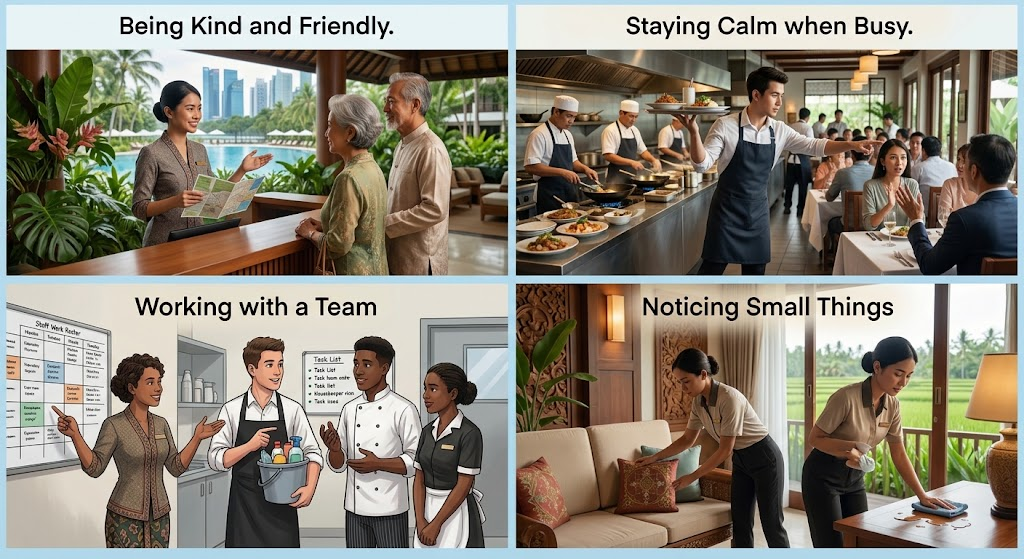
Being Kind and Friendly
The most important thing for a young worker is to be kind and polite. Working in hotels is a people business. A good worker smiles every day and speaks nicely to guests. They must listen to guests carefully when they ask for information. Tourists come from many different countries, so speaking basic English is very helpful. A friendly worker makes guests feel happy and comfortable right away.
Staying Calm when Busy
The second most important quality is staying calm. Hotels, airports, and restaurants are often very busy and noisy. Sometimes, bad things happen. For example, a flight is late, a room is dirty, or a guest loses a key. A good young worker does not panic or get angry. They stay quiet, think simple thoughts, and try to fix the problem fast.
Working with a Team
Working together with other people is also very important. Nobody works alone in a hotel or a restaurant. Receptionists, cooks, and cleaners must help each other every day to do a good job. Also, workers must be flexible with time. Hospitality jobs do not have simple office hours. Young workers often work early in the morning, late at night, and on Saturdays, Sundays, and holidays.
Noticing Small Things
Finally, small details are very important for a good experience. A good worker notices small things around the hotel. They see a dirty table, a missing towel, or a guest who looks lost. They go to the guest and offer help immediately. They also use simple computers to check in guests, answer emails, and write down room bookings.
Summary of the Worker
A typical young worker in tourism is young, active, and polite. They enjoy learning about new cultures, talking to travelers, and working with a friendly team every day.
____________________
Vocabulary:
| Word / Expression | A1 Definition |
|---|---|
| detailed | with many small pieces of information |
| a guide | something that shows you what to do |
| essential | very important |
| skills | things you can do well |
| a habit | something you do often |
| success | when you do something well |
| knowledge | things you know and understand |
| to be polite | to speak and act in a nice way |
| to stay calm | to not become angry or afraid |
| to panic | to become very afraid and not know what to do |
| to stay quiet | to not speak or make noise |
| to think simple thoughts | to think about simple things and not worry too much |
| an experience | something that happens to you and you learn from |
| immediately | at once; very soon |
| to enjoy learning | to like learning new things |
##############
Match the words with the definitions
Words
- detailed
- a guide
- essential
- skills
- a habit
- success
- knowledge
- to be polite
- to stay calm
- to panic
- to stay quiet
- to think simple thoughts
- an experience
- immediately
- to enjoy learning
Definitions
A. to like learning new things
B. things you can do well
C. at once; very soon
D. something you do often
E. to not speak or make noise
F. very important
G. when you do something well
H. something that happens to you and you learn from
I. to become very afraid and not know what to do
J. with many small pieces of information
K. to speak and act in a nice way
L. things you know and understand
M. something that shows you what to do
N. to not become angry or afraid
O. to think about simple things and not worry too much
_____________________
Answers:
1-J, 2-M, 3-F, 4-B, 5-D, 6-G,
7-L, 8-K, 9-N, 10-I, 11-E,
12-O, 13-H, 14-C, 15-A
###############
Match the definitions with the words
Definitions
- with many small pieces of information
- something that shows you what to do
- very important
- things you can do well
- something you do often
- when you do something well
- things you know and understand
- to speak and act in a nice way
- to not become angry or afraid
- to become very afraid and not know what to do
- to not speak or make noise
- to think about simple things and not worry too much
- something that happens to you and you learn from
- at once; very soon
- to like learning new things
Words
A. to panic
B. knowledge
C. immediately
D. a habit
E. to stay calm
F. skills
G. a guide
H. to enjoy learning
I. success
J. detailed
K. to stay quiet
L. an experience
M. essential
N. to think simple thoughts
O. to be polite
____________________
Answers:
1-J, 2-G, 3-M, 4-F, 5-D, 6-I,
7-B, 8-O, 9-E, 10-A, 11-K,
12-N, 13-L, 14-C, 15-H
##############
True or false:
- A good worker listens carefully when guests ask for information.
- Hospitality workers only work during normal office hours.
- Many young people want to work in hotels, restaurants, and travel.
- Workers should become angry when a hotel is busy.
- Receptionists, cooks, and cleaners need to help each other.
- Basic English is useful when speaking with tourists.
- A guest who looks lost should wait until someone else helps them.
- A late flight can create a problem for a tourism worker.
- Young tourism workers should avoid learning about other cultures.
- Small details are not important for a guest’s experience.
- Computers can be used to write down room bookings.
- Hospitality workers never work on Saturdays or Sundays.
- A good worker stays calm when something goes wrong.
- A missing towel is not something a hotel worker needs to notice.
- Tourism workers may work early in the morning or late at night.
- A friendly worker can make guests feel happy and comfortable.
- Workers should panic when a guest loses a key.
- Young tourism workers can enjoy talking to travelers.
- Hotel workers normally work alone instead of helping colleagues.
- A typical young tourism worker is described as lazy and inactive.
____________________
False: 2,4,7,9,10,12,14,17,19,20
____________________
Correct version:
- A good worker listens carefully when guests ask for information.
- Hospitality workers only work during normal office hours. True is: Hospitality jobs do not have simple office hours.
- Many young people want to work in hotels, restaurants, and travel.
- Workers should become angry when a hotel is busy. True is: Workers should stay calm when a hotel is busy.
- Receptionists, cooks, and cleaners need to help each other.
- Basic English is useful when speaking with tourists.
- A guest who looks lost should wait until someone else helps them. True is: A worker should offer help to a guest who looks lost.
- A late flight can create a problem for a tourism worker.
- Young tourism workers should avoid learning about other cultures. True is: Young tourism workers can enjoy learning about other cultures.
- Small details are not important for a guest’s experience. True is: Small details are important for a guest’s experience.
- Computers can be used to write down room bookings.
- Hospitality workers never work on Saturdays or Sundays. True is: Hospitality workers may work on Saturdays and Sundays.
- A good worker stays calm when something goes wrong.
- A missing towel is not something a hotel worker needs to notice. True is: A good worker notices a missing towel.
- Tourism workers may work early in the morning or late at night.
- A friendly worker can make guests feel happy and comfortable.
- Workers should panic when a guest loses a key. True is: Workers should stay calm when a guest loses a key.
- Young tourism workers can enjoy talking to travelers.
- Hotel workers normally work alone instead of helping colleagues. True is: Hotel workers need to help their colleagues.
- A typical young tourism worker is described as lazy and inactive. True is: A typical young tourism worker is young, active, and polite.
##############
Choose the correct answer.:
- Why do many young people like tourism jobs?
a) They work alone.
b) They meet new guests.
c) They work only in the morning. - What should a good worker do with guests?
a) Listen carefully.
b) Speak loudly.
c) Avoid questions. - Why is basic English useful?
a) Hotels teach English.
b) Workers write reports.
c) Tourists come from abroad. - What should a worker do when a problem happens?
a) Get angry.
b) Stay calm.
c) Leave the workplace. - Who needs to help each other?
a) Guests and tourists.
b) Managers and visitors.
c) Hotel workers. - When may hospitality workers work?
a) Only on weekdays.
b) At different times.
c) Only in the afternoon. - What may a good worker notice?
a) A new airport.
b) A busy street.
c) A dirty table. - What can workers use computers for?
a) Cleaning tables.
b) Answering emails.
c) Cooking meals. - What should a worker do when a guest looks lost?
a) Ignore the guest.
b) Ask another tourist.
c) Offer help. - What can happen in a busy hotel?
a) Problems can happen.
b) Everyone goes home.
c) Guests stop traveling. - What is important for a good guest experience?
a) Large offices.
b) Small details.
c) Long meetings. - What do workers need to do in a team?
a) Avoid colleagues.
b) Work alone.
c) Help each other. - What can young workers enjoy?
a) Learning about cultures.
b) Staying away from travelers.
c) Working without guests. - What can workers write down on computers?
a) Travel stories.
b) Room bookings.
c) Guest opinions. - How is a typical young tourism worker described?
a) Slow and unfriendly.
b) Quiet and tired.
c) Young and active.
_________________________
Answers
1. b, 2. a, 3. c, 4. b, 5. c, 6. b,
7. c, 8. b, 9. c, 10. a, 11. b,
12. c, 13. a, 14. b, 15. c
##################
Find the information in the text:
- Find two places where tourism workers may work.
- Find two personal qualities of a good worker.
- Find two problems that can happen at work.
- Find three types of hotel workers.
- Find three times or days when hospitality workers may work.
- Find three small things a worker may notice.
- Find three things workers can do with computers.
- Find two things young tourism workers enjoy.
- Find two things a good worker does when speaking to guests.
- Find two things a good worker does when there is a problem.
- Find two reasons why basic English is helpful.
- Find three words that describe a typical young tourism worker.
__________________________
Correct answers:
- Find two places where tourism workers may work. — Hotels and restaurants.
- Find two personal qualities of a good worker. — Kind and polite.
- Find two problems that can happen at work. — A late flight and a dirty room.
- Find three types of hotel workers. — Receptionists, cooks, and cleaners.
- Find three times or days when hospitality workers may work. — Early in the morning, late at night, and on Sundays.
- Find three small things a worker may notice. — A dirty table, a missing towel, and a guest who looks lost.
- Find three things workers can do with computers. — Check in guests, answer emails, and write down room bookings.
- Find two things young tourism workers enjoy. — Learning about new cultures and talking to travelers.
- Find two things a good worker does when speaking to guests. — Smiles and speaks nicely.
- Find two things a good worker does when there is a problem. — Stays calm and tries to fix the problem fast.
- Find two reasons why basic English is helpful. — Tourists come from many countries, and workers need to communicate with guests.
- Find three words that describe a typical young tourism worker. — Young, active, and polite.
###################
Match the beginning of each sentence with the correct ending:
Beginnings
- Many young people want to work
- A successful young worker needs
- A good worker smiles every day
- Tourists come from many different countries,
- A friendly worker makes guests feel
- Hotels, airports, and restaurants are often
- A good young worker does not panic
- Receptionists, cooks, and cleaners must help each other
- Hospitality jobs do not have simple office hours
- A good worker notices small things
- They go to the guest
- Workers use simple computers
Endings
A. and speaks nicely to guests.
B. and try to fix the problem fast.
C. to do a good job.
D. so speaking basic English is very helpful.
E. happy and comfortable right away.
F. busy and noisy.
G. when something goes wrong.
H. to check in guests, answer emails, and write down room bookings.
I. in hotels, restaurants, and travel.
J. around the hotel.
K. and offer help immediately.
L. because workers may work early in the morning, late at night, and on weekends and holidays.
__________________________
Answers:
1-I, 2-C, 3-A, 4-D, 5-E, 6-F,
7-B, 8-C, 9-L, 10-J, 11-K, 12-H
__________________________
Full version:
Many young people want to work in hotels, restaurants, and travel.
A successful young worker needs to do a good job.
A good worker smiles every day and speaks nicely to guests.
Tourists come from many different countries, so speaking basic English is very helpful.
A friendly worker makes guests feel happy and comfortable right away.
Hotels, airports, and restaurants are often busy and noisy.
A good young worker does not panic and try to fix the problem fast.
Receptionists, cooks, and cleaners must help each other to do a good job.
Hospitality jobs do not have simple office hours because workers may work early in the morning, late at night, and on weekends and holidays.
A good worker notices small things around the hotel.
They go to the guest and offer help immediately.
Workers use simple computers to check in guests, answer emails, and write down room bookings.
###################
Find a word in the text that has the opposite meaning:
- old → __________
- rude → __________
- angry → __________
- noisy → __________
- late → __________
- alone → __________
- uncomfortable → __________
—————————————
Answers
- old → young
- rude → polite
- angry → calm
- noisy → quiet
- late → early
- alone → together
- uncomfortable → comfortable
###################
Match each situation with the best action:
Situations
- A guest asks for information.
YOUR ANSWER:
G. Listen carefully. - A flight is late.
- A guest loses a key.
- A table is dirty.
- A guest looks lost.
- A hotel is very busy.
- A colleague needs help.
- A guest comes from another country.
- A guest feels uncomfortable.
- A worker sees a problem in a room.
Actions
A. Help the colleague.
B. Notice the problem.
C. Use basic English.
D. Stay calm.
E. Offer help.
F. Work together.
G. Listen carefully.
H. Try to fix the problem.
I. Speak nicely to the guest.
J. Think about a simple solution.
__________________________
Answers:
1-G, 2-D, 3-H, 4-B, 5-E, 6-F, 7-A, 8-C, 9-I, 10-H
###################
Match the questions with the answers:
Questions
- What are the most important qualities for tourism staff?
- Why is being friendly important?
- Why is basic English useful?
- What should staff do when the hotel is very busy?
- Why is teamwork important?
- When may tourism workers have to work?
- What does noticing small things mean?
- What should a worker do when a guest looks lost?
- What computer skills are useful for tourism staff?
- What makes a young worker successful?
- What can a smile do for a guest?
- What is the most important advice for young tourism workers?
Answers
A. They may work early, late, at weekends, or on holidays.
B. A smile can make guests feel happy and comfortable.
C. Good staff see things like a dirty table or a missing towel.
D. Basic computer skills help with check-in, emails, and bookings.
E. Kindness, politeness, friendliness, and helpfulness are important.
F. Staff should stay calm and try to solve the problem.
G. Guests come from many different countries.
H. A successful worker is active, polite, friendly, and helpful.
I. They should go to the guest and offer help.
J. Colleagues need to help each other.
K. Be kind, stay calm, help your team, and notice small things.
L. Friendly staff help guests feel welcome.
__________________________
Answer Key:
1-E, 2-L, 3-G, 4-F, 5-J, 6-A, 7-C,
8-I, 9-D, 10-H, 11-B, 12-K
__________________________
Correct version:
What is the most important advice for young tourism workers? — Be kind, stay calm, help your team, and notice small things.
What are the most important qualities for tourism staff? — Kindness, politeness, friendliness, and helpfulness are important.
Why is being friendly important? — Friendly staff help guests feel welcome.
Why is basic English useful? — Guests come from many different countries.
What should staff do when the hotel is very busy? — Staff should stay calm and try to solve the problem.
Why is teamwork important? — Colleagues need to help each other.
When may tourism workers have to work? — They may work early, late, at weekends, or on holidays.
What does noticing small things mean? — Good staff see things like a dirty table or a missing towel.
What should a worker do when a guest looks lost? — They should go to the guest and offer help.
What computer skills are useful for tourism staff? — Basic computer skills help with check-in, emails, and bookings.
What makes a young worker successful? — A successful worker is active, polite, friendly, and helpful.
What can a smile do for a guest? — A smile can make guests feel happy and comfortable.
###################
Complete the sentences with a word or phrase from the text:
- Many young people want to work in hotels, restaurants, and __________.
- A successful young worker needs good personal __________.
- A good worker is kind and __________.
- A good worker smiles and speaks __________ to guests.
- Workers should listen __________ when guests ask for information.
- Tourists come from many different __________.
- Basic __________ is very helpful in tourism.
- A good worker stays __________ when the workplace is busy.
- A good worker does not panic or get __________.
- Workers should try to __________ problems quickly.
- Receptionists, cooks, and cleaners must help __________.
- Hospitality workers need to be flexible with __________.
- Workers may work early in the morning or late at __________.
- A good worker notices small __________ around the hotel.
- A worker may see a dirty table or a missing __________.
- A worker may notice a guest who looks __________.
- Workers should offer __________ to a guest who needs it.
- Computers can help workers check __________ guests.
- Workers can use computers to answer __________.
- Young workers can enjoy learning about new __________.
—————————————–
Answers:
- Many young people want to work in hotels, restaurants, and travel.
- A successful young worker needs good personal skills.
- A good worker is kind and polite.
- A good worker smiles and speaks nicely to guests.
- Workers should listen carefully when guests ask for information.
- Tourists come from many different countries.
- Basic English is very helpful in tourism.
- A good worker stays calm when the workplace is busy.
- A good worker does not panic or get angry.
- Workers should try to fix problems quickly.
- Receptionists, cooks, and cleaners must help each other.
- Hospitality workers need to be flexible with time.
- Workers may work early in the morning or late at night.
- A good worker notices small things around the hotel.
- A worker may see a dirty table or a missing towel.
- A worker may notice a guest who looks lost.
- Workers should offer help to a guest who needs it.
- Computers can help workers check in guests.
- Workers can use computers to answer emails.
- Young workers can enjoy learning about new cultures.
###################
Cheat Sheet:
A Detailed Guide to the Essential Skills and Habits for Success in Tourism
1. Main Topic
The text explains what young people need to be successful in tourism and hospitality.
It focuses on:
- personal skills
- good work habits
- practical knowledge
- working with guests
- teamwork
- handling busy situations
- noticing small details
2. Who is the Text About?
A young worker in tourism
They may work in:
- a hotel
- a restaurant
- an airport
- the travel industry
Young workers often:
- meet new guests
- talk to tourists
- learn about different cultures
- work with other people
- work different hours
3. The Four Main Skills
| Skill | What does it mean? | Example from the text |
|---|---|---|
| Being kind and friendly | Be polite, smile, speak nicely and listen | Help a guest who asks for information |
| Staying calm when busy | Do not panic or get angry | Stay calm when a flight is late |
| Working with a team | Help colleagues and work together | Receptionists, cooks and cleaners help each other |
| Noticing small things | See problems and guest needs quickly | Notice a dirty table or a guest who looks lost |
4. Being Kind and Friendly
This is described as the most important thing for a young worker.
A good worker:
- is kind
- is polite
- smiles
- speaks nicely
- listens carefully
- gives guests information
- uses basic English
Why is it important?
Hotels are a people business.
Guests should feel:
- happy
- comfortable
- welcome
Tourists come from many different countries, so basic English is useful.
5. Staying Calm When Busy
This is described as the second most important quality.
Tourism workplaces can be:
- busy
- noisy
- stressful
Problems can happen.
Examples of problems:
- a flight is late
- a room is dirty
- a guest loses a key
A good worker:
- does not panic
- does not get angry
- stays quiet
- thinks simply
- tries to fix the problem fast
Important idea:
A good worker stays calm and looks for a solution.
6. Working With a Team
People in hospitality do not work alone.
Different workers need to help each other.
Examples:
- receptionists
- cooks
- cleaners
They must:
- work together
- help each other
- communicate
- do their jobs well
Flexible Working Hours
Hospitality jobs often do not have normal office hours.
Young workers may work:
- early in the morning
- late at night
- Saturdays
- Sundays
- holidays
Key word:
flexible = able to change according to the situation
7. Noticing Small Things
Small details can make a big difference to a guest’s experience.
A good worker notices problems quickly.
Things a worker may notice:
- a dirty table
- a missing towel
- a guest who looks lost
The worker should:
- notice the problem
- go to the guest
- offer help
- solve the problem if possible
Computers
Workers also use simple computers to:
- check in guests
- answer emails
- write down room bookings
8. The Typical Young Tourism Worker
According to the summary, a typical young worker is:
- young
- active
- polite
They enjoy:
- learning about new cultures
- talking to travelers
- working with a friendly team
9. Important Vocabulary
| Word / Expression | Meaning |
|---|---|
| successful | doing well and achieving good results |
| personal skills | abilities that help you work with people |
| work habits | the way you normally work |
| practical knowledge | knowledge that you can use at work |
| kind | nice and caring |
| polite | having good manners |
| guest | a person staying at or visiting a hotel |
| carefully | with attention |
| helpful | ready to help |
| comfortable | relaxed and happy |
| quality | a good characteristic |
| busy | having a lot of work or activity |
| noisy | with a lot of sound |
| panic | become very afraid or confused |
| fix a problem | solve a problem |
| team | a group of people working together |
| receptionist | a person who works at a hotel reception |
| cook | a person who prepares food |
| cleaner | a person who cleans |
| flexible | able to change when necessary |
| shift | a period of time when someone works |
| detail | a small part of something |
| missing | not there when it should be |
| lost | not knowing where you are |
| immediately | very soon / at once |
| check in | register a guest at a hotel |
| booking | an arrangement to reserve something |
| culture | the way of life of a group of people |
| traveler | a person who travels |
10. Important Examples to Remember
Guest service
A guest asks for information → listen carefully → speak nicely → give help.
Problem
A flight is late → stay calm → do not get angry → try to fix the problem.
Teamwork
Reception + kitchen + cleaning → help each other → work together.
Attention to detail
Dirty table → notice it → take action.
Missing towel → notice it → help the guest.
Lost guest → notice them → offer help.
11. Important Contrasts
The text gives several useful good/bad behavior contrasts.
| Good worker | Not good worker |
|---|---|
| kind | unkind |
| polite | impolite |
| smiles | does not smile |
| listens carefully | does not listen |
| stays calm | panics |
| stays quiet | gets angry |
| fixes problems | ignores problems |
| helps colleagues | works alone |
| is flexible | only wants normal hours |
| notices details | does not notice problems |
| offers help | ignores guests |
12. Main Message of Each Section
Being Kind and Friendly
Good personal behavior helps guests feel welcome and comfortable.
Staying Calm When Busy
Tourism can be stressful, so workers need to stay calm and solve problems.
Working with a Team
Hospitality workers need to cooperate and be flexible with working hours.
Noticing Small Things
Small details can improve the guest experience, and workers should act quickly.
Summary of the Worker
A successful young tourism worker is active, polite, interested in other cultures and comfortable working with a team.
13. Key Facts to Learn
- Tourism is a popular job for young people.
- Tourism workers often meet new guests.
- Being kind and polite is the most important quality.
- Basic English is helpful.
- A good worker listens carefully.
- Staying calm is the second most important quality.
- Hotels and restaurants can be busy and noisy.
- Good workers do not panic.
- Workers need to fix problems quickly.
- Hospitality workers work as a team.
- They need to be flexible with time.
- They may work mornings, nights, weekends and holidays.
- Small details are important for a good guest experience.
- Workers should notice things such as dirty tables and missing towels.
- Workers use computers for check-in, emails and bookings.
- A typical young tourism worker is young, active and polite.
- They enjoy new cultures and talking to travelers.
14. One-Sentence Summary
A successful young tourism worker is kind, calm, flexible, helpful, good at teamwork, and able to notice and solve small problems quickly.
###################
##################
##################
Please use the box below
to write your feedback.
Only I can read it.
It is not public.
Please tell me:
- Are the texts and exercises OK?
- Are the topics OK?
- Is the level OK?
- Is it too easy or too difficult?
- Do you want texts about other topics?
Thank you! I appreciate your feedback.
##################
##################
##################
Remember how babies
learn a language:
Babies learn a language by listening.
They use their ears to hear sounds.
Their brain remembers these sounds.
Babies connect sounds with people and things.
They listen to their parents.
Then they copy the sounds they hear. They imitate words.
Slowly, babies learn to speak.
So,
LISTEN, LISTEN, LISTEN, LISTEN………………
Schreibe einen Kommentar