- how good body language builds trust, improves service and creates better guest experiences
Vocabulary, B1 only:
| B1 word / phrase | Definition |
|---|---|
| nonverbal | without using words |
| signal | a sign that gives information |
| atmosphere | the feeling of a place |
| encourage | to help someone want to do something |
| satisfaction | the good feeling you have when something is good |
| maintain | to keep something in good condition |
| appropriate | right or suitable for a situation |
| defensive | trying to protect yourself |
| alert | ready to notice what is happening |
| personal space | the space around a person that they need |
| adjust | to change something a little |
| appreciate | to be thankful for something |
| occasional | happening sometimes, but not often |
| suitable | right for a person or situation |
| alternative | another choice or possibility |
| recommend | to suggest something as a good choice |
| judgment | an opinion about someone or something |
| uncomfortable | not feeling relaxed or comfortable |
| fixed | decided and not changing |
| sensitivity | understanding that people have different feelings and needs |
| prolonged | continuing for a long time |
| offensive | rude and likely to make someone angry |
| impolite | not polite |
| disrespectful | showing no respect |
| authentic | real and not false |
| role-play | an activity where people act like other people |
| observation | watching something carefully |
| feedback | advice about how someone is doing |
| attentive | listening or watching carefully |
| tension | a feeling of stress or worry |
| irritation | a feeling of being annoyed |
| genuine | real and honest |
| adapt | to change so that you can work well in a new situation |
| front-line staff | workers who deal directly with customers |
##############
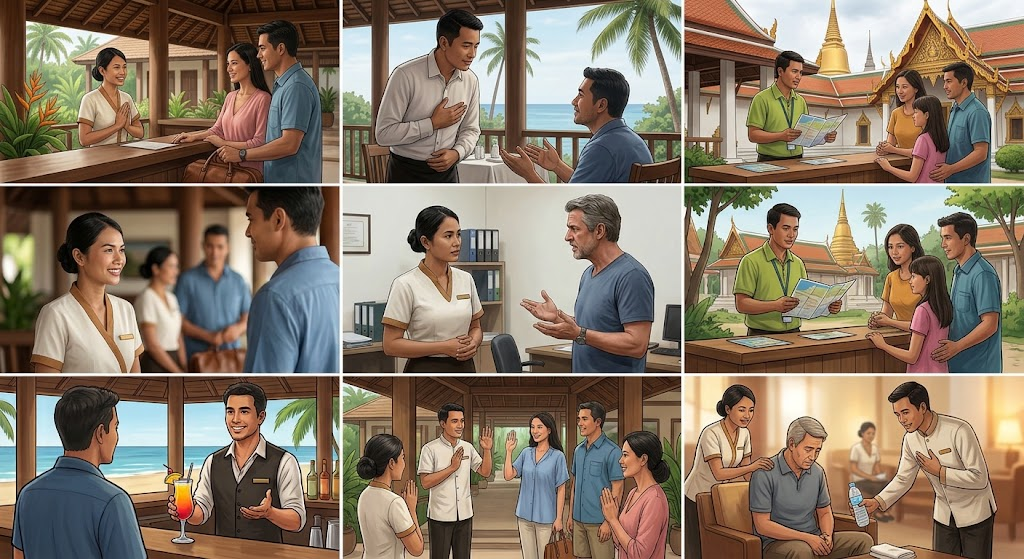
Body language (kinesics) is a very important part of communication in tourism and hospitality. It often has more power than words, especially for first impressions, guest satisfaction, building trust, and talking with people from different cultures. Studies and industry sources often say that nonverbal signals — body language, tone of voice, and similar things — make up a large part of how people understand messages.
In hotels, restaurants, tour companies and similar services, positive body language helps create a friendly atmosphere. It also helps staff notice what guests need, fix problems, sell extra services, and encourage guests to come back. Training in this area has been connected to higher guest satisfaction scores and more repeat bookings in some hotel studies.
1. Key Components of Body Language in Hospitality
Staff are usually trained to manage these common elements.
1.1 Facial Expressions
- A real smile that includes the eyes, called a Duchenne smile, is a strong signal of warmth and friendliness.
- A light or full smile can make conversations calmer.
- A friendly facial expression improves how guests see the staff member.
- Avoid looking serious, angry, sad or bored.
- Avoid a smile that looks forced or fake.
1.2 Eye Contact
- Try to keep eye contact for about 50–70% of the conversation.
- Good eye contact shows interest and can help build trust.
- The “triangle technique” — looking between the eyes and the mouth — can feel natural.
- Too little eye contact can look like a lack of interest.
- Too much eye contact can make the guest uncomfortable.
- Remember that eye-contact rules are different in different cultures.
1.3 Posture and Stance
- Stand or sit with a straight back.
- Keep the shoulders relaxed, back and down.
- Keep an open chest.
- Face the guest instead of turning away.
- Do not slouch.
- Good posture shows that you are alert, confident and professional.
1.4 Gestures and Hands
- Keep your hands visible, relaxed and open.
- Use clear and natural gestures.
- Avoid crossing your arms because this can look defensive.
- Do not point directly at people.
- Avoid nervous movements.
- Nodding can show that you are listening carefully.
1.5 Personal Space — Proxemics
- Keep a comfortable distance from the guest.
- In many Western countries, about 1–1.2 metres can be comfortable in professional situations.
- Adjust the distance according to the guest’s signals.
- Cultural preferences are important.
- Some people from Latin American or Middle Eastern cultures may prefer closer distance.
- People from Northern Europe or East Asia may often prefer more personal space.
- Avoid touching guests unless it is clearly appropriate.
1.6 Overall Appearance and Hygiene
- Keep hair clean and tidy.
- Wear clean, neat and professional clothes or a uniform.
- Keep hands and fingernails clean.
- Maintain good personal hygiene.
- Avoid strong body odour.
- Use perfume or aftershave carefully.
- Avoid a messy or careless appearance.
- Remember that appearance is also part of the message you give to guests.
2. Positive Practices for Staff
2.1 Greeting and the First 10 Seconds
The first few seconds can strongly influence the guest’s first impression.
Staff should:
- smile naturally;
- make suitable eye contact;
- turn fully towards the guest;
- keep an open body position;
- stand or sit professionally;
- show that they are ready to help.
Staff should also watch for early signs of:
- tiredness;
- worry;
- confusion;
- impatience;
- hurry.
For example, a tired guest may appreciate fast check-in, while a thirsty guest may appreciate a bottle of water.
2.2 Active Listening
Good body language shows that you are listening.
Useful signals include:
- a small head tilt;
- a light smile;
- occasional nodding;
- an open posture;
- suitable eye contact;
- facing the guest.
These signals can build trust even when the guest and staff member do not speak the same language perfectly.
2.3 Service Moments
Body language is especially important during:
- taking restaurant orders;
- explaining a menu;
- recommending a service;
- checking in guests;
- giving directions;
- helping at reception;
- serving food and drinks;
- working as a concierge.
Staff should:
- lean slightly towards the guest when appropriate;
- move calmly and professionally;
- use open hands when offering help;
- avoid sudden or nervous movements;
- give the guest their full attention.
2.4 Handling Complaints and Difficult Moments
When a guest is unhappy, staff should remain calm.
Use:
- an open posture;
- relaxed shoulders;
- soft eye contact;
- a calm facial expression;
- occasional nodding;
- a respectful distance.
Avoid:
- crossing your arms;
- looking angry;
- rolling your eyes;
- turning away;
- pointing at the guest;
- showing impatience.
The body should communicate: “I am listening and I want to help.”
2.5 Upselling
Body language can also support sales.
When making an offer:
- smile naturally;
- use an open posture;
- make suitable eye contact;
- speak calmly and confidently;
- use open-hand gestures;
- give the guest enough personal space.
The body language should match the words. The offer should feel like helpful advice, not pressure.
3. Reading Guest Body Language
Staff should learn to observe guests without making quick judgments.
3.1 Guest Needs Attention
Possible signs:
- looking around several times;
- looking towards staff;
- raising a hand slightly;
- making eye contact with a staff member.
Possible response: Approach the guest and offer help.
3.2 Guest May Be Uncomfortable or Unhappy
Possible signs:
- crossed arms;
- leaning away;
- a tight facial expression;
- little eye contact;
- turning the body away.
Possible response: Give the guest attention, listen carefully and check if they need help.
3.3 Guest May Be in a Hurry
Possible signs:
- checking a watch;
- checking a phone repeatedly;
- looking towards the exit;
- feet pointing towards the door;
- short answers.
Possible response: Offer faster service or a quick alternative, such as takeaway service.
3.4 Guest Is Interested
Possible signs:
- relaxed posture;
- leaning slightly forward;
- frequent eye contact;
- smiling;
- asking questions.
Possible response: Continue the conversation and offer useful information or recommendations.
3.5 Guest May Be Tired or Worried
Possible signs:
- holding the chin;
- touching the face or ear;
- slow movements;
- looking down;
- weak eye contact.
Possible response: Offer comfort, information or faster service where possible.
Important: One body-language signal does not always have one fixed meaning. Staff should look at the whole situation, not just one gesture.
4. Cultural Sensitivity
Tourism is international, so body language is not the same everywhere.
4.1 Smiling
- Smiling is generally a positive signal.
- However, a very large or constant smile may have different meanings in some cultures.
- Staff should avoid assuming that every culture uses smiles in exactly the same way.
4.2 Eye Contact
- Eye contact is important in many Western cultures.
- In some Asian cultures, strong or prolonged eye contact may be less appropriate.
- Staff should respect the guest’s behaviour rather than forcing eye contact.
4.3 Gestures
Gestures can have very different meanings.
For example:
- Thumbs-up: positive in many countries but offensive in some places.
- OK sign: positive in some countries but rude or offensive in others.
- One-finger pointing/calling: can be impolite in parts of Asia.
- Showing the bottom of your shoes: disrespectful in many Asian and Middle Eastern cultures.
- Pointing directly at a guest: generally best avoided.
4.4 Personal Space
- Some cultures are comfortable standing close together.
- Others prefer more distance.
- Staff should watch the guest’s signals and adjust their position.
- Avoid moving closer when the guest is clearly moving away.
4.5 Touching
- Touching rules vary greatly between cultures.
- A gesture that feels friendly to one person may feel uncomfortable to another.
- Staff should be especially careful with physical contact.
- Professional service normally requires little or no unnecessary touching.
4.6 Local Greetings and Gestures
Using appropriate local customs can make service feel more authentic.
Examples include:
- the Balinese sembah;
- bowing;
- traditional greetings;
- culturally appropriate hand gestures.
Staff should learn when and how to use such gestures rather than using them simply because they look interesting.
5. Training Staff in Body Language
Hotels, restaurants and tourism businesses can include body language in regular staff training.
5.1 Role-Play
Staff can practise:
- greeting a guest;
- taking an order;
- answering questions;
- dealing with a complaint;
- making an upselling offer;
- saying goodbye.
5.2 Video Training
Staff can watch short examples of:
- good body language;
- poor body language;
- professional greetings;
- difficult guest situations.
They can then discuss what they noticed.
5.3 Observation Exercises
Staff can practise watching:
- guest posture;
- facial expressions;
- eye contact;
- hand movements;
- position in the room;
- signs of hurry or discomfort.
5.4 Feedback
Managers can give simple feedback such as:
- “Your posture was very professional.”
- “You looked away too often.”
- “Your arms were crossed while the guest was speaking.”
- “Your smile made the guest feel welcome.”
- “You stood a little too close.”
6. The Most Important Service Moments
Body language is particularly important at key points in the guest journey.
6.1 Arrival
Goal: Make the guest feel welcome.
Use:
- smile;
- eye contact;
- open posture;
- full attention.
6.2 Check-In
Goal: Create confidence and trust.
Use:
- professional posture;
- calm movements;
- suitable eye contact;
- attentive listening.
6.3 During the Service
Goal: Show care and professionalism.
Use:
- open gestures;
- calm movements;
- good listening;
- appropriate personal space.
6.4 Complaints
Goal: Reduce tension and show understanding.
Use:
- calm face;
- relaxed posture;
- soft eye contact;
- nodding;
- patient listening.
6.5 Departure
Goal: End the experience positively.
Use:
- smile;
- eye contact;
- open posture;
- friendly farewell.
7. What Staff Should Avoid
Staff should avoid:
- Crossed arms
- Slouching
- Looking at the phone while speaking to a guest
- Looking bored or tired
- Rolling the eyes
- Pointing at guests
- Standing too close
- Turning away while a guest is speaking
- Nervous movements
- Strong perfume or body odour
- Dirty or untidy uniforms
- Looking at the watch during a conversation
- Unnecessary touching
- Looking at another colleague while the guest is speaking
- Showing irritation or impatience
8. Practical Golden Rules
Rule 1 — Look professional
Clean clothes, neat hair and good hygiene create a positive first impression.
Rule 2 — Look interested
Face the guest, make suitable eye contact and listen.
Rule 3 — Stay open
Keep your arms and hands relaxed and avoid defensive positions.
Rule 4 — Stay calm
Especially during complaints, your body should communicate calmness.
Rule 5 — Watch the guest
Look for signs of interest, confusion, discomfort, hurry or tiredness.
Rule 6 — Respect personal space
Do not stand too close or touch guests unnecessarily.
Rule 7 — Respect culture
A gesture that is friendly in one country may be rude in another.
Rule 8 — Match words and body language
Your facial expression, posture, gestures and voice should support what you say.
Rule 9 — Be natural
Good body language should look friendly and genuine, not like a performance.
Rule 10 — Remember the whole experience
Guests notice staff body language throughout their stay, not only during the first greeting.
9. The Main Message
Good body language turns ordinary service into a better guest experience.
Professional staff should learn to:
Look professional → Welcome warmly → Listen carefully → Read guest signals → Respect personal space → Adapt to culture → Stay calm → End positively.
Positive body language, combined with good communication and cultural awareness, is one of the most useful soft skills for front-line staff in tourism and hospitality.
##################
SOME MORE LINKS ON BODYLANGUAGE:
##################
##################
##################
Please use the box below
to write your feedback.
Only I can read it.
It is not public.
Please tell me:
- Are the texts and exercises OK?
- Are the topics OK?
- Is the level OK?
- Is it too easy or too difficult?
- Do you want texts about other topics?
Thank you! I appreciate your feedback.
##################
##################
##################
Remember how babies
learn a language:
Babies learn a language by listening.
They use their ears to hear sounds.
Their brain remembers these sounds.
Babies connect sounds with people and things.
They listen to their parents.
Then they copy the sounds they hear. They imitate words.
Slowly, babies learn to speak.
So,
LISTEN, LISTEN, LISTEN, LISTEN………………
Schreibe einen Kommentar