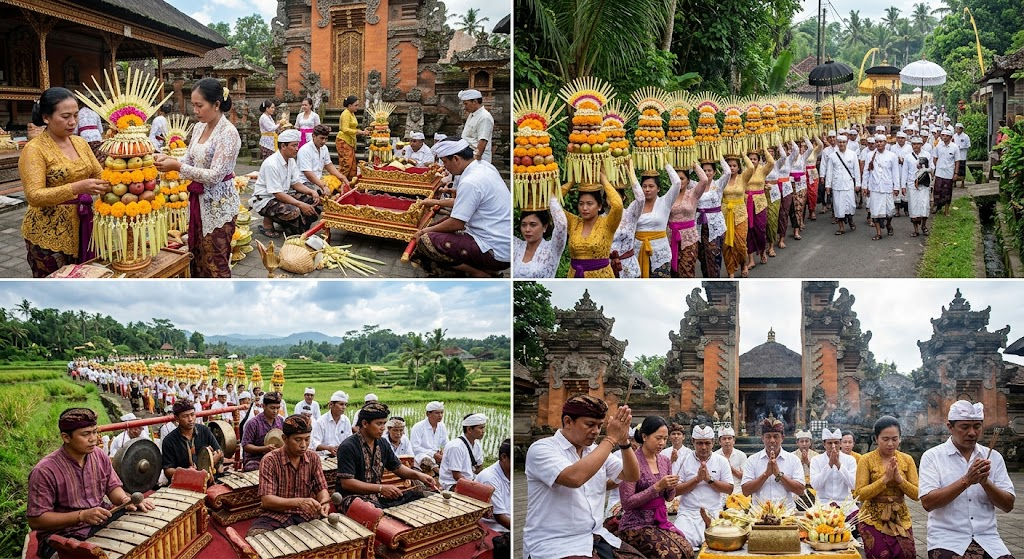
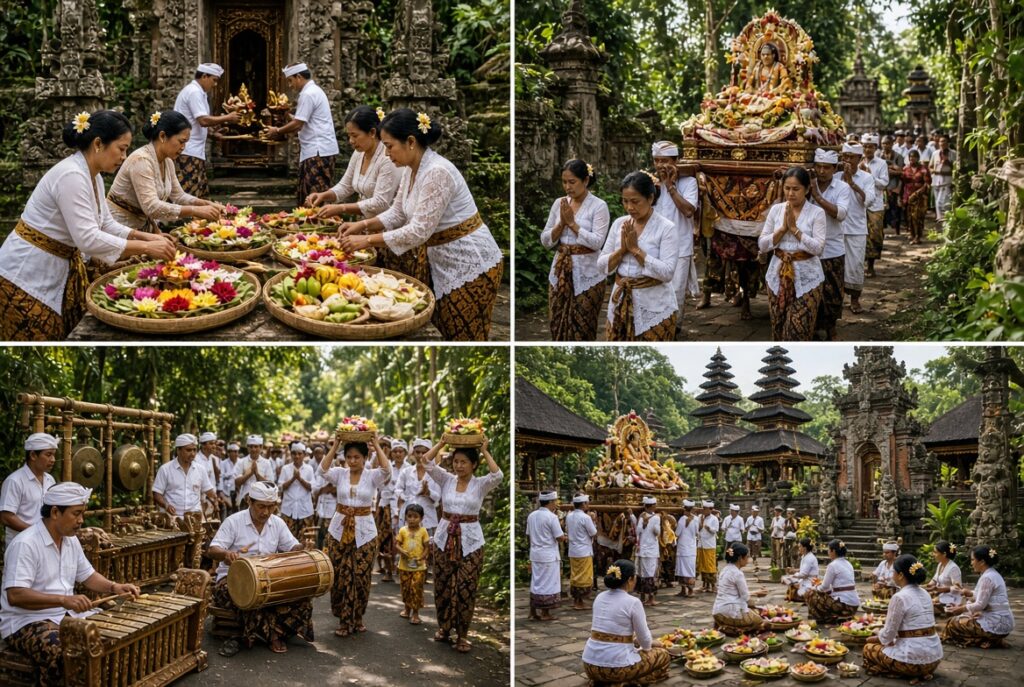
The Sacred Procession of the Deities is an important Balinese religious ceremony. It takes place between Pura Dalem in Kelusa Traditional Village and the Great Temple of Puri Ubud. The ceremony brings people together and shows their respect for the gods and their traditions.
Before the procession starts, people prepare the temple and the sacred objects. Men and women wear traditional Balinese clothes. The women often carry offerings with flowers, fruit, and food. The men help prepare the sacred objects and the procession.
The sacred pretima, or holy image of a deity, is carefully carried from Pura Dalem in Kelusa. People walk together in a large group. They pray and show respect during the journey. Traditional music can be heard along the way. Gamelan musicians play their instruments, and the sound gives the procession a special feeling.
The journey to Ubud is not only a walk from one place to another. It is a spiritual journey. People believe that the sacred objects must be treated with great care. Family members and other people from the village take part in the ceremony.
When the procession arrives at the Great Temple of Puri Ubud, people continue their prayers. They bring the sacred pretima into the temple. Offerings are placed in special areas. People pray together and ask for peace, safety, and good health.
The ceremony is also an important part of Balinese culture. Older people can teach younger people about the traditions of their community. Children can see how people prepare and take part in the ceremony.
For the people of Kelusa and Ubud, this sacred procession is a special time. It connects religion, community, family, and tradition. It also shows how Balinese people continue to respect their spiritual and cultural heritage.
______________________________
Vocabulary:
heritage – the culture and traditions that people get from older generations
a sacred procession – a special religious walk with many people
a ceremony – a special event for a religious or important day
to show respect – to show that you think someone or something is important
an offering – food, flowers, or other things given to a god
a deity – a god or goddess
a journey – a trip from one place to another
gamelan – traditional Balinese music played on instruments
to treat with care – to be very careful with someone or something
to ask for peace – to ask for a time without war or fighting
safety – being safe and not in danger
a community – people who live in the same place or share the same life
to take part in something – to join an activity or event
to connect – to bring people or things together
##################
Match the words with the definitions
- a sacred procession
- a ceremony
- to show respect
- an offering
- a deity
- a journey
- gamelan
- to treat with care
- to ask for peace
- safety
- a community
- to take part in something
- to connect
- heritage
A. to join an activity or event
B. traditional Balinese music played on instruments
C. food, flowers, or other things given to a god
D. being safe and not in danger
E. to bring people or things together
F. a special event for a religious or important day
G. a trip from one place to another
H. a god or goddess
I. a special religious walk with many people
J. the culture and traditions that people get from older generations
K. to be very careful with someone or something
L. to show that you think someone or something is important
M. people who live in the same place or share the same life
N. to ask for a time without war or fighting
________________________
Answers:
1-I, 2-F, 3-L, 4-C, 5-H, 6-G, 7-B, 8-K,
9-N, 10-D, 11-M, 12-A, 13-E, 14-J
#################
Match the definitions with the words
- A special religious walk with many people.
- A special event for a religious or important day.
- To show that you think someone or something is important.
- Food, flowers, or other things given to a god.
- A god or goddess.
- A trip from one place to another.
- Traditional Balinese music played on instruments.
- To be very careful with someone or something.
- To ask for a time without war or fighting.
- Being safe and not in danger.
- People who live in the same place or share the same life.
- To join an activity or event.
- To bring people or things together.
- The culture and traditions that people get from older generations.
A. a deity
B. a journey
C. safety
D. to connect
E. an offering
F. a community
G. to take part in something
H. a ceremony
I. heritage
J. to show respect
K. a sacred procession
L. gamelan
M. to ask for peace
N. to treat with care
_______________________
Answers:
1-K, 2-H, 3-J, 4-E, 5-A, 6-B, 7-L, 8-N,
9-M, 10-C, 11-F, 12-G, 13-D, 14-I
#################
Choose the correct answer: A, B, or C.
- A sacred procession is …
- A. a special religious walk with many people
- B. a group of people who live in one place
- C. a trip from one place to another
- A ceremony is …
- A. traditional music played on instruments
- B. a special event for a religious or important day
- C. food or flowers given to a god
- To show respect means …
- A. to join an activity or event
- B. to bring people or things together
- C. to show that someone or something is important
- An offering is …
- A. a trip from one place to another
- B. food, flowers, or other things given to a god
- C. a special religious walk
- A deity is …
- A. a god or goddess
- B. a person who plays traditional music
- C. a person who takes part in a ceremony
- A journey is …
- A. a special religious event
- B. a group of people from the same place
- C. a trip from one place to another
- Gamelan is …
- A. a special offering
- B. traditional Balinese music played on instruments
- C. a religious walk
- To treat something with care means …
- A. to be very careful with it
- B. to carry it to another place
- C. to give it to another person
- To ask for peace means …
- A. to ask people to join a ceremony
- B. to ask for food and flowers
- C. to ask for a time without war or fighting
- Safety means …
- A. being safe and not in danger
- B. being part of a community
- C. being careful with sacred objects
- A community is …
- A. people who play traditional instruments
- B. people who live in the same place or share the same life
- C. people who carry offerings
- To take part in something means …
- A. to watch an event
- B. to prepare something carefully
- C. to join an activity or event
- To connect means …
- A. to bring people or things together
- B. to move from one place to another
- C. to protect something from danger
- Heritage means …
- A. a special place for religious events
- B. the culture and traditions from older generations
- C. food and flowers given to a god
_______________________
Answers:
1-A, 2-B, 3-C, 4-B, 5-A, 6-C, 7-B, 8-A,
9-C, 10-A, 11-B, 12-C, 13-A, 14-B
_______________________
Correct version:
- A sacred procession is a special religious walk with many people
- A ceremony is a special event for a religious or important day
- To show respect means to show that you think someone or something is important
- An offering is food, flowers, or other things given to a god
- A deity is a god or goddess
- A journey is a trip from one place to another
- Gamelan is traditional Balinese music played on instruments
- To treat something with care means to be very careful with someone or something
- To ask for peace means to ask for a time without war or fighting
- Safety is being safe and not in danger
- A community is people who live in the same place or share the same life
- To take part in something means to join an activity or event
- To connect means to bring people or things together
- Heritage is the culture and traditions that people get from older generations
################
Fill in – words below:
a sacred procession · a ceremony · to show respect · an offering ·
a deity · a journey · gamelan · to treat with care ·
to ask for peace · safety · a community ·
to take part in something ·
to connect · heritage
- The __________ is an important Balinese religious event.
- The people prepare for the __________ before the procession starts.
- The women often carry __________ with flowers, fruit, and food.
- The sacred pretima is a holy image of __________.
- People walk together during the __________ to Ubud.
- Traditional __________ can be heard along the way.
- People pray and __________ during the journey.
- People believe that the sacred objects must be __________.
- The people pray together and __________, __________, and good health.
- Family members and other people from the village __________ the ceremony.
- The ceremony brings people together and helps __________ religion, family, and tradition.
- The people of Kelusa and Ubud are part of the same __________.
- The ceremony helps young people learn about their cultural __________.
- The journey is more than a walk; it is a special religious __________.
- The ceremony shows how people continue to respect their spiritual and cultural __________.
————————————–
Correct version:
- The sacred procession is an important Balinese religious event.
- The people prepare for the ceremony before the procession starts.
- The women often carry offerings with flowers, fruit, and food.
- The sacred pretima is a holy image of a deity.
- People walk together during the journey to Ubud.
- Traditional gamelan can be heard along the way.
- People pray and show respect during the journey.
- People believe that the sacred objects must be treated with care.
- The people pray together and ask for peace, safety, and good health.
- Family members and other people from the village take part in the ceremony.
- The ceremony helps connect religion, family, and tradition.
- The people of Kelusa and Ubud are part of the same community.
- The ceremony helps young people learn about their cultural heritage.
- The journey is more than a walk; it is a special religious journey.
- The ceremony shows how people continue to respect their spiritual and cultural heritage.
####################
Read each statement.
Find the exact sentence in the text that gives this information.
- People put on traditional clothes before the procession.
You write – evidence:
Men and women wear traditional Balinese clothes.
- Women bring flowers, fruit, and food as gifts.
→ Evidence: ______________________________ - The pretima represents a god.
→ Evidence: ______________________________ - Music is part of the procession.
→ Evidence: ______________________________ - The journey has a religious meaning.
→ Evidence: ______________________________ - People handle the sacred objects very carefully.
→ Evidence: ______________________________ - The prayers include wishes for peace, safety, and good health.
→ Evidence: ______________________________ - People from the village join the ceremony.
→ Evidence: ______________________________ - The sacred pretima enters the temple in Ubud.
→ Evidence: ______________________________ - People leave offerings at special places in the temple.
→ Evidence: ______________________________ - Older people pass their traditions to younger people.
→ Evidence: ______________________________ - Children watch how people prepare for the ceremony.
→ Evidence: ______________________________ - The ceremony brings religion, family, community, and tradition together.
→ Evidence: ______________________________ - The ceremony helps keep Balinese culture and traditions alive.
→ Evidence: ______________________________
——————————————-
Correct version:
- People put on traditional clothes before the procession.
→ “Men and women wear traditional Balinese clothes.” - Women bring flowers, fruit, and food as gifts.
→ “The women often carry offerings with flowers, fruit, and food.” - The pretima represents a god.
→ “The sacred pretima, or holy image of a deity, is carefully carried from Pura Dalem in Kelusa.” - Music is part of the procession.
→ “Traditional music can be heard along the way.” - The journey has a religious meaning.
→ “It is a spiritual journey.” - People handle the sacred objects very carefully.
→ “People believe that the sacred objects must be treated with great care.” - The prayers include wishes for peace, safety, and good health.
→ “People pray together and ask for peace, safety, and good health.” - People from the village join the ceremony.
→ “Family members and other people from the village take part in the ceremony.” - The sacred pretima enters the temple in Ubud.
→ “They bring the sacred pretima into the temple.” - People leave offerings at special places in the temple.
→ “Offerings are placed in special areas.” - Older people pass their traditions to younger people.
→ “Older people can teach younger people about the traditions of their community.” - Children watch how people prepare for the ceremony.
→ “Children can see how people prepare and take part in the ceremony.” - The ceremony brings religion, family, community, and tradition together.
→ “It connects religion, community, family, and tradition.” - The ceremony helps keep Balinese culture and traditions alive.
→ “It also shows how Balinese people continue to respect their spiritual and cultural heritage.”
##################
Read each sentence from the text. Identify who or what the word/s refer/s to.
- They pray and show respect during the journey.
→ Who are “they”?
YOU WRITE:
The people in the procession - It is a spiritual journey.
→ What is “it”? ______________________ - They bring the sacred pretima into the temple.
→ Who are “they”? ______________________ - They place offerings in special areas.
→ Who are “they”? ______________________ - It connects religion, community, family, and tradition.
→ What is “it”? ______________________ - They walk together in a large group.
→ Who are “they”? ______________________ - Their sound gives the procession a special feeling.
→ Whose sound is it? ______________________ - They prepare the sacred objects and the procession.
→ Who are “they”? ______________________ - It is carefully carried from Pura Dalem in Kelusa.
→ What is “it”? ______________________ - They pray together and ask for peace, safety, and good health.
→ Who are “they”? ______________________ - They take part in the ceremony.
→ Who are “they”? ______________________ - They can see how people prepare and take part in the ceremony.
→ Who are “they”? ______________________ - Their community has important traditions.
→ Whose community is it? ______________________ - It also shows how Balinese people continue to respect their spiritual and cultural heritage.
→ What is “it”? ______________________ - They wear traditional Balinese clothes.
→ Who are “they”? ______________________
————————————-
Correct answers:
They wear traditional Balinese clothes.
→ Who are “they”? Men and women.
They pray and show respect during the journey.
→ Who are “they”? The people in the procession.
It is a spiritual journey.
→ What is “it”? The journey to Ubud.
They bring the sacred pretima into the temple.
→ Who are “they”? The people in the procession.
They place offerings in special areas.
→ Who are “they”? The people at the temple.
It connects religion, community, family, and tradition.
→ What is “it”? The ceremony.
They walk together in a large group.
→ Who are “they”? The people in the procession.
Their sound gives the procession a special feeling.
→ Whose sound is it? The gamelan musicians‘ sound.
They prepare the sacred objects and the procession.
→ Who are “they”? The men.
It is carefully carried from Pura Dalem in Kelusa.
→ What is “it”? The sacred pretima.
They pray together and ask for peace, safety, and good health.
→ Who are “they”? The people in the ceremony.
They take part in the ceremony.
→ Who are “they”? Family members and other people from the village.
They can see how people prepare and take part in the ceremony.
→ Who are “they”? Children.
Their community has important traditions.
→ Whose community is it? The people of Kelusa and Ubud.
It also shows how Balinese people continue to respect their spiritual and cultural heritage.
→ What is “it”? The ceremony.
###################
Put the events in order:
A. People bring the sacred pretima into the temple.
B. People prepare the temple and sacred objects.
C. People walk together from Kelusa towards Ubud.
D. People continue their prayers at the Great Temple of Puri Ubud.
E. Women carry offerings with flowers, fruit, and food.
F. Gamelan musicians play their instruments during the procession.
G. People wear traditional Balinese clothes.
H. People pray and show respect during the journey.
_________________________
Answers: B-1, G-2, E-3, C-4, F-5, H-6, A-7, D-8
_________________________
Correct order:
People prepare the temple and sacred objects.
People wear traditional Balinese clothes.
Women carry offerings with flowers, fruit, and food.
People walk together from Kelusa towards Ubud.
Gamelan musicians play their instruments during the procession.
People pray and show respect during the journey.
People bring the sacred pretima into the temple.
People continue their prayers at the Great Temple of Puri Ubud.
####################
Find two pieces of information in the text for each question.
- What do women carry?
→ ______________________________
→ ______________________________ - What do people do during the journey?
→ ______________________________
→ ______________________________ - What do people ask for in their prayers?
→ ______________________________
→ ______________________________ - What can children learn from the ceremony?
→ ______________________________
→ ______________________________ - What do people prepare before the procession starts?
→ ______________________________
→ ______________________________ - What do people do when the procession arrives at the temple?
→ ______________________________
→ ______________________________ - What does the ceremony connect?
→ ______________________________
→ ______________________________ - What can older people teach younger people?
→ ______________________________
→ ______________________________
————————————-
Correct answers:
- What do women carry?
→ Flowers
→ Fruit and food - What do people do during the journey?
→ They pray.
→ They show respect. - What do people ask for in their prayers?
→ Peace
→ Safety and good health - What can children learn from the ceremony?
→ They can learn about the traditions of their community.
→ They can see how people prepare and take part in the ceremony. - What do people prepare before the procession starts?
→ The temple
→ The sacred objects - What do people do when the procession arrives at the temple?
→ They continue their prayers.
→ They bring the sacred pretima into the temple. - What does the ceremony connect?
→ Religion and community
→ Family and tradition - What can older people teach younger people?
→ The traditions of their community.
→ How to respect their culture and traditions.
##################
General idea or specific detail?
When you read a text, you can find general ideas and specific details.
A general idea gives the big picture. It tells you something important about the whole text or a larger part of it.
A specific detail gives one exact piece of information. It can tell you about a person, place, thing, action, or event.
Remember:
General idea = the big picture
Specific detail = one exact fact
- The ceremony is an important part of Balinese culture.
→ __________________ - Women often carry offerings with flowers, fruit, and food.
→ __________________ - The procession brings people together.
→ __________________ - Gamelan musicians play their instruments along the way.
→ __________________ - People pray for peace, safety, and good health.
→ __________________ - The ceremony connects religion, community, family, and tradition.
→ __________________ - The sacred pretima is carried from Pura Dalem in Kelusa.
→ __________________ - Older people teach younger people about their traditions.
→ __________________ - The procession is an important religious event.
→ __________________ - The women carry flowers, fruit, and food.
→ __________________
———————————-
Correct answers:
- The ceremony is an important part of Balinese culture.
→ GENERAL IDEA
Why? It tells us about the importance of the ceremony as a whole. - Women often carry offerings with flowers, fruit, and food.
→ SPECIFIC DETAIL
Why? It gives exact information about what the women carry. - The procession brings people together.
→ GENERAL IDEA
Why? It tells us one important general purpose of the ceremony. - Gamelan musicians play their instruments along the way.
→ SPECIFIC DETAIL
Why? It gives one exact action during the procession. - People pray for peace, safety, and good health.
→ SPECIFIC DETAIL
Why? It tells us exactly what people ask for in their prayers. - The ceremony connects religion, community, family, and tradition.
→ GENERAL IDEA
Why? It describes the wider meaning of the ceremony. - The sacred pretima is carried from Pura Dalem in Kelusa.
→ SPECIFIC DETAIL
Why? It gives exact information about the pretima and its starting place. - Older people teach younger people about their traditions.
→ SPECIFIC DETAIL
Why? It describes one particular way the ceremony helps younger people. - The procession is an important religious event.
→ GENERAL IDEA
Why? It gives a broad idea about the importance of the procession. - The women carry flowers, fruit, and food.
→ SPECIFIC DETAIL
Why? It gives exact information about what the women carry.
#####################
What Happens Where?
Match each place or part of the ceremony with what happens there.
Places and parts
- Pura Dalem in Kelusa
- Before the procession starts
- The temple
- During the journey
- Along the way
- The Great Temple of Puri Ubud
- Special areas in the temple
- The village
- The community
- The procession
- The ceremony
- The journey to Ubud
What happens?
A. People place offerings in special areas.
B. People pray and show respect.
C. The sacred pretima is carefully carried from there.
D. People prepare the temple and sacred objects.
E. Gamelan musicians play their instruments.
F. People bring the sacred pretima into the temple.
G. People learn about their traditions.
H. People from the village take part in the ceremony.
I. People walk together in a large group.
J. People continue their prayers.
K. It connects religion, community, family, and tradition.
L. It is a spiritual journey.
______________________
Answers:
1-C, 2-D, 3-J, 4-B, 5-E, 6-F,
7-A, 8-H, 9-G, 10-I, 11-K, 12-L
______________________
Correct version:
Pura Dalem in Kelusa – The sacred pretima is carefully carried from there.
Before the procession starts – People prepare the temple and sacred objects.
The temple – People continue their prayers.
During the journey – People pray and show respect.
Along the way – Gamelan musicians play their instruments.
The Great Temple of Puri Ubud – People bring the sacred pretima into the temple.
Special areas in the temple – People place offerings there.
The village – People from the village take part in the ceremony.
The community – People learn about their traditions.
The procession – People walk together in a large group.
The ceremony – It connects religion, community, family, and tradition.
The journey to Ubud – It is a spiritual journey.
##################
Use this cheat sheet,
give a speech,
record it on your mobile phone,
listen to it……
1. Introduction
- Name of the ceremony
- Balinese religious ceremony
- Kelusa and Ubud
- Importance for the people
2. Before the Procession
- Preparing the temple
- Preparing sacred objects
- Traditional Balinese clothes
- Women and offerings
- Men and sacred objects
3. The Procession
- Sacred pretima
- Pura Dalem in Kelusa
- People walking together
- Prayers and respect
- Gamelan music
- Spiritual journey
4. At the Great Temple
- Arrival at Puri Ubud
- Continuing prayers
- Sacred pretima entering the temple
- Offerings
- Peace, safety, and good health
5. People and Tradition
- Families
- Village community
- Older people and younger people
- Children
- Learning traditions
- Balinese culture
6. Importance
- Religion
- Community
- Family
- Tradition
- Spiritual and cultural heritage
- Respect for the gods and traditions
7. Conclusion
- Special time for Kelusa and Ubud
- Importance of the ceremony
- Continuing traditions
- Connection between people, religion, and culture
##################
##################
##################
##################
Please use the box below
to write your feedback.
Only I can read it.
It is not public.
Please tell me:
- Are the texts and exercises OK?
- Are the topics OK?
- Is the level OK?
- Is it too easy or too difficult?
- Do you want texts about other topics?
Thank you! I appreciate your feedback.
##################
##################
##################
Remember how babies
learn a language:
Babies learn a language by listening.
They use their ears to hear sounds.
Their brain remembers these sounds.
Babies connect sounds with people and things.
They listen to their parents.
Then they copy the sounds they hear. They imitate words.
Slowly, babies learn to speak.
So,
LISTEN, LISTEN, LISTEN, LISTEN………………
Schreibe einen Kommentar