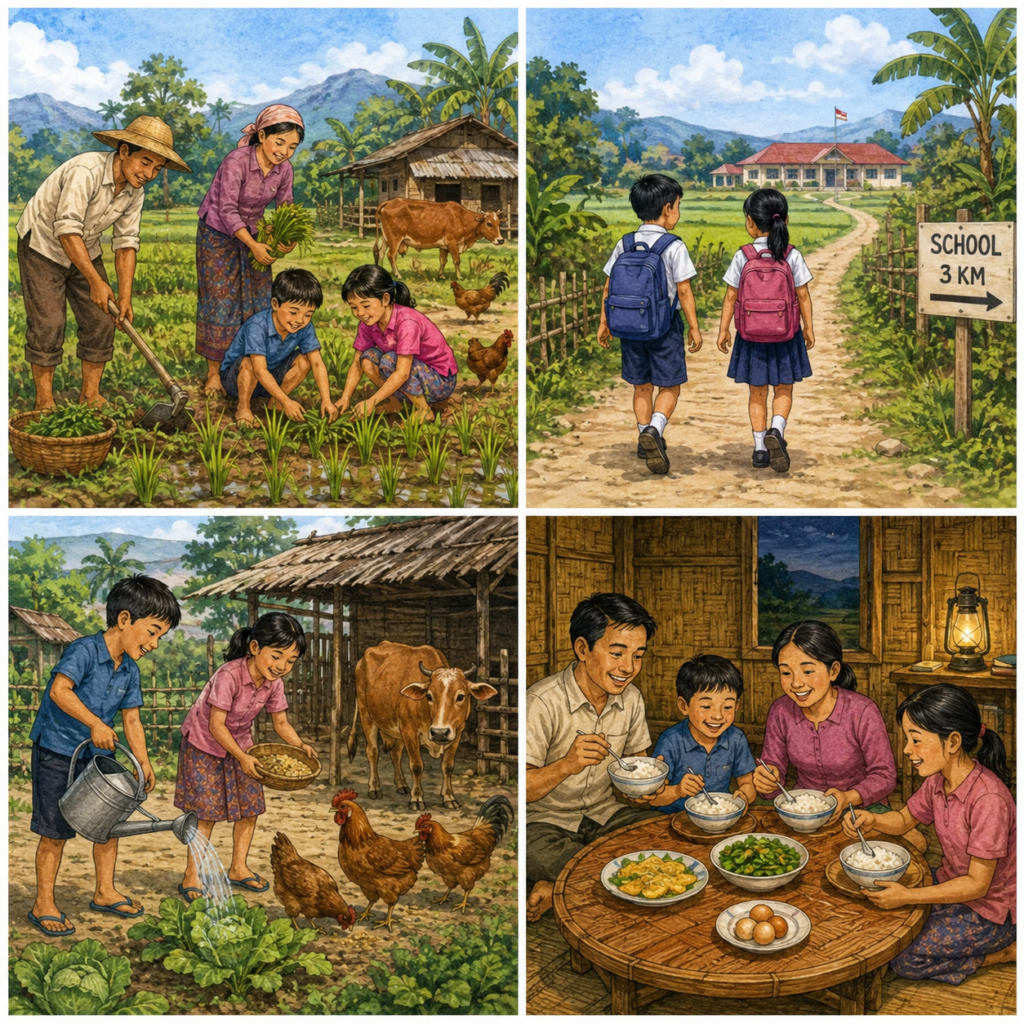
The Lee family lives in a small village in the Asian countryside. They are farmers. The father and mother work on the farm every day. They grow rice and vegetables. They also have two chickens and one cow.
The family has two children. Their names are Min and Lila. They are eight and ten years old. They go to the village school. The school is three kilometers from their home. Every morning, they walk three kilometers to school. After school, they walk three kilometers home again. They walk six kilometers every day.
The children like school. They learn to read, write, count, and draw. They like their teacher and their friends. Sometimes it is hot. Sometimes it rains. They still walk to school with happy smiles.
After they get home, Min and Lila help their parents. They give water to the vegetables. They feed the chickens and the cow. Then they do their homework together.
In the evening, the family eats rice, vegetables, and eggs. They talk about their day. They laugh and tell stories. After dinner, the children read a book for a short time. Then everyone goes to bed early. They are happy because they work hard, learn new things, and help each other every day.
______________________
Vocabulary:
- countryside – an area outside a city with farms, fields, trees, and nature.
- a village – a small place where people live, smaller than a town.
- to grow vegetables – to plant and take care of vegetables so they become bigger.
- a chicken – a small farm bird that gives eggs.
- a cow – a large farm animal that gives milk.
- to count – to say numbers to know how many things there are.
- to draw – to make a picture with a pencil, pen, or other tool.
- a smile – a happy expression on your face.
- to give water to plants – to put water on plants so they can grow.
- to feed the chicken – to give food to a chicken.
- to laugh – to make a happy sound when something is funny or you feel happy.
################
Match the words with the correct definitions
Words
- countryside
- a village
- to grow vegetables
- a chicken
- a cow
- to count
- to draw
- a smile
- to give water to plants
- to feed the chicken
- to laugh
Definitions
A. To make a happy sound when something is funny or you feel happy.
B. A large farm animal that gives milk.
C. To put water on plants so they can grow.
D. A small place where people live, smaller than a town.
E. To give food to a chicken.
F. To say numbers to know how many things there are.
G. An area outside a city with farms, fields, trees, and nature.
H. To make a picture with a pencil, pen, or other tool.
I. A small farm bird that gives eggs.
J. A happy expression on your face.
K. To plant and take care of vegetables so they become bigger.
__________________
Answer:
1-G, 2-D, 3-K, 4-I, 5-B, 6-F,
7-H, 8-J, 9-C, 10-E, 11-A
#############
Which word/s are we looking for?
Definitions
- To make a happy sound when something is funny or you feel happy: ___________
- A large farm animal that gives milk: ___________
- To put water on plants so they can grow: ___________
- A small place where people live, smaller than a town: ___________
- To give food to a chicken: ___________
- To say numbers to know how many things there are: ___________
- An area outside a city with farms, fields, trees, and nature: ___________
- To make a picture with a pencil, pen, or other tool: ___________
- A small farm bird that gives eggs: ___________
- A happy expression on your face: ___________
- To plant and take care of vegetables so they become bigger: ___________
————————–
Answers:
- To make a happy sound when something is funny or you feel happy: to laugh
- A large farm animal that gives milk: a cow
- To put water on plants so they can grow: to give water to plants
- A small place where people live, smaller than a town: a village
- To give food to a chicken: to feed the chicken
- To say numbers to know how many things there are: to count
- An area outside a city with farms, fields, trees, and nature: countryside
- To make a picture with a pencil, pen, or other tool: to draw
- A small farm bird that gives eggs: a chicken
- A happy expression on your face: a smile
- To plant and take care of vegetables so they become bigger: to grow vegetables
##################
True or false:
- The family lives in the countryside.
- The family has three chickens and two cows.
- Min and Lila walk three kilometers to school every morning.
- The children learn to read, write, count, and draw at school.
- Sometimes the children do not go to school when it rains.
- After school, Min and Lila help their parents at home.
- The children feed the vegetables and water the chickens.
- The family eats rice, vegetables, and eggs in the evening.
- The children watch TV after dinner before going to bed.
- The family is happy because they help each other every day.
______________________
True: 1,3,4,6,8,10
______________________
Correct version:
- The family lives in the countryside.
- The family has three chickens and two cows.
True is: The family has two chickens and one cow. - Min and Lila walk three kilometers to school every morning.
- The children learn to read, write, count, and draw at school.
- Sometimes the children do not go to school when it rains.
True is: Sometimes it rains, but they still walk to school with happy smiles. - After school, Min and Lila help their parents at home.
- The children feed the vegetables and water the chickens.
True is: They give water to the vegetables and feed the chickens and the cow. - The family eats rice, vegetables, and eggs in the evening.
- The children watch TV after dinner before going to bed.
True is: After dinner, the children read a book for a short time. - The family is happy because they help each other every day.
##############
Scrambled Sentences (Put the words in the correct order)
- countryside / the / lives / family / in / the
- two / family / has / children / the
- school / walk / every / they / morning / to
- kilometers / home / their / is / three / from / school
- learn / children / the / write / and / read / to
- after / help / parents / their / Min / and / Lila / school
- water / vegetables / give / they / the / to
- chickens / feed / they / the / and / cow / the
- and / eats / family / the / vegetables / rice / eggs
- each / help / they / other / every / day
____________________
Answers:
- The family lives in the countryside.
- The family has two children.
- They walk to school every morning.
- Their school is three kilometers from home.
- The children learn to read and write.
- After school, Min and Lila help their parents.
- They give water to the vegetables.
- They feed the chickens and the cow.
- The family eats rice, vegetables, and eggs.
- They help each other every day.
##############
Short answers, basics:
| Example Sentence | Yes | No |
|---|---|---|
| I learn the alphabet. | Yes, I do. | No, I don’t. |
| You read signs. | Yes, you do. | No, you don’t. |
| He practices speaking. | Yes, he does. | No, he doesn’t. |
| She watches cartoons. | Yes, she does. | No, she doesn’t. |
| It helps us learn English. | Yes, it does. | No, it doesn’t. |
| We use apps like Duolingo. | Yes, we do. | No, we don’t. |
| You read labels. | Yes, you do. | No, you don’t. |
| They make mistakes sometimes. | Yes, they do. | No, they don’t. |
| Question | Yes | No |
|---|---|---|
| Do I learn the alphabet? | Yes, I do. | No, I don’t. |
| Do you read signs? | Yes, you do. | No, you don’t. |
| Does he practice speaking? | Yes, he does. | No, he doesn’t. |
| Does she watch cartoons? | Yes, she does. | No, she doesn’t. |
| Does it help us learn English? | Yes, it does. | No, it doesn’t. |
| Do we use apps like Duolingo? | Yes, we do. | No, we don’t. |
| Do you read labels? | Yes, you do. | No, you don’t. |
| Do they make mistakes sometimes? | Yes, they do. | No, they don’t. |
| Question | Yes | No |
|---|---|---|
| Am I big? | Yes, I am. | No, I am not. |
| Are you big? | Yes, you are. | No, you aren’t. |
| Is he big? | Yes, he is. | No, he isn’t. |
| Is she big? | Yes, she is. | No, she isn’t. |
| Is it big? | Yes, it is. | No, it isn’t. |
| Are we big? | Yes, we are. | No, we aren’t. |
| Are you big? | Yes, you are. | No, you aren’t. |
| Are they big? | Yes, they are. | No, they aren’t. |
Gie a short answer, as shown:
- He grows rice and vegetables.
YOU WRITE:
Yes, he does. - She has two chickens and one cow.
- They are eight and ten years old.
- She walks three kilometers to school every morning.
- He learns to read, write, count, and draw at school.
- They like their teacher and their friends.
- He helps his parents after school.
- She gives water to the chickens after school.
- They walk ten kilometers every day.
- He feeds only the cow after school.
- She eats rice, vegetables, and eggs in the evening.
- They play games after dinner.
- He reads a book after dinner.
- She goes to bed early every evening.
____________________
Correct answers ( you can also write ‚doesn’t‘, ‚don’t)
- He grows rice and vegetables. Yes, he does.
- She has two chickens and one cow. Yes, she does.
- They are eight and ten years old. Yes, they are.
- She walks three kilometers to school every morning. Yes, she does.
- He learns to read, write, count, and draw at school. Yes, he does.
- They like their teacher and their friends. Yes, they do.
- He helps his parents after school. Yes, he does.
- She gives water to the chickens after school. No, she does not.
- They walk ten kilometers every day. No, they do not.
- He feeds only the cow after school. No, he does not.
- She eats rice, vegetables, and eggs in the evening. Yes, she does.
- They play games after dinner. No, they do not.
- He reads a book after dinner. Yes, he does.
- She goes to bed early every evening. Yes, she does.
################
Answer as shown:
- He grows rice and fruit in the countryside.
YOU WRITE:
No, he doesn’t. He grows rice and vegetables in the countryside. - She has three chickens and two cows.
- They are twelve and fourteen years old.
- Her father is a teacher at the village school.
- She walks five kilometers to school every morning.
- They learn only to sing and dance at school.
- He feeds the vegetables and waters the chickens after school.
- She reads a newspaper after dinner.
_____________________
Correct answer:
- He grows rice and fruit in the countryside. No, he doesn’t. He grows rice and vegetables in the countryside.
- She has three chickens and two cows. No, she doesn’t. She has two chickens and one cow.
- They are twelve and fourteen years old. No, they aren’t. They are eight and ten years old.
- Her father is a teacher at the village school. No, he isn’t. Her father grows rice and vegetables.
- She walks five kilometers to school every morning. No, she doesn’t. She walks three kilometers to school every morning.
- They learn only to sing and dance at school. No, they don’t. They learn to read, write, count, and draw at school.
- He feeds the vegetables and waters the chickens after school. No, he doesn’t. He gives water to the vegetables and feeds the chickens and the cow.
- She reads a newspaper after dinner. No, she doesn’t. She reads a book after dinner.
##################
Odd one out, choose the word that does not belong
- school – home – village – book
- water – feed – draw – help
- chicken – cow – teacher – farm animal
- countryside – village – city – chicken
- morning – evening – dinner – kilometer
- rice – vegetables – eggs – milk
- Min – Lila – teacher – cow
- read – write – count – walk
________________________
Correct answers:
- school – home – village – book
Answer: book – A book is something you read. The others are places. - water – feed – draw – help
Answer: draw – Draw is a school activity. The others are things you do to help or care for something. - chicken – cow – teacher – farm animal
Answer: teacher – A teacher is a person. The others are animals or describe farm animals. - countryside – village – city – chicken
Answer: chicken – A chicken is an animal. The others are places. - morning – evening – dinner – kilometer
Answer: kilometer – A kilometer is a unit of distance. The others relate to time or a meal time. - rice – vegetables – eggs – milk
Answer: milk – Milk is a drink. The others are foods mentioned in the text. - Min – Lila – teacher – cow
Answer: cow – A cow is an animal. The others are people. - read – write – count – walk
Answer: walk – Walking is a movement activity. The others are things learned at school.
################
Fill in, words below:
rains – teacher – chickens – walk – vegetables –
feed – watch – village – count –
eggs – every day – old –
everyone – parents –
family
- The ________ grows rice and vegetables.
- The family has two ________ and one cow.
- Min and Lila are eight and ten years ________.
- The ________ school is three kilometers from their home.
- The children ________ to school every morning.
- They walk six kilometers ________.
- The children learn to read, write, ________, and draw.
- They like their ________ and their friends.
- Sometimes it ________, but they still walk to school.
- After school, Min and Lila help their ________.
- They give water to the ________ and ________ the chickens and the cow.
- The family eats rice, vegetables, and __________ in the evening.
- After dinner, the children do not ________ television.
- ________ goes to bed early.
————————–
Correct version:
The family grows rice and vegetables.
The family has two chickens and one cow.
Min and Lila are eight and ten years old.
The village school is three kilometers from their home.
The children walk to school every morning.
They walk six kilometers every day.
The children learn to read, write, count, and draw.
They like their teacher and their friends.
Sometimes it rains, but they still walk to school.
After school, Min and Lila help their parents.
They give water to the vegetables and feed the chickens and the cow.
The family eats rice, vegetables, and eggs in the evening.
After dinner, the children do not watch television.
Everyone goes to bed early.
###############
Basics of present simple:
| Personal Pronoun | am / is / are | |
|---|---|---|
| I | am | 8 years old |
| You | are | 8 years old |
| He | is | 8 years old |
| She | is | 8 years old |
| It | is | 8 years old |
| We | are | 8 years old |
| You (plural) | are | 8 years old |
| They | are | 8 years old |
| Personal Pronoun | am not / is not / are not | |
|---|---|---|
| I | am not | 8 years old |
| You | are not | 8 years old |
| He | is not | 8 years old |
| She | is not | 8 years old |
| It | is not | 8 years old |
| We | are not | 8 years old |
| You (plural) | are not | 8 years old |
| They | are not | 8 years old |
Question:
| Question Word | Personal Pronoun | |
|---|---|---|
| Am | I | 8 years old? |
| Are | you | 8 years old? |
| Is | he | 8 years old? |
| Is | she | 8 years old? |
| Is | it | 8 years old? |
| Are | we | 8 years old? |
| Are | you (plural) | 8 years old? |
| Are | they | 8 years old? |
Statement:
| Personal Pronoun | Verb | |
|---|---|---|
| I | like | ice cream |
| You | like | ice cream |
| He | likes | ice cream |
| She | likes | ice cream |
| It | likes | ice cream |
| We | like | ice cream |
| You (plural) | like | ice cream |
| They | like | ice cream |
Negation:
| Personal Pronoun | Verb (negative) | |
|---|---|---|
| I | do not like | ice cream |
| You | do not like | ice cream |
| He | does not like | ice cream |
| She | does not like | ice cream |
| It | does not like | ice cream |
| We | do not like | ice cream |
| You (plural) | do not like | ice cream |
| They | do not like | ice cream |
Question:
| Do / Does | Personal Pronoun | Verb | Sugar? |
|---|---|---|---|
| Do | I | like | sugar? |
| Do | you | like | sugar? |
| Does | he | like | sugar? |
| Does | she | like | sugar? |
| Does | it | like | sugar? |
| Do | we | like | sugar? |
| Do | you (plural) | like | sugar? |
| Do | they | like | sugar? |
################
Rewrite as shown in 1:
- Her father grows rice and vegetables.
YOU WRITE:
negation: Her father does not grow rice and vegetable.
question: Does her father grow rice and vegatables?
negative questions: Doesn’t her father grow rice and vegetables? - Min and Lila are eight and ten years old.
- They learn to read, write, count, and draw at school.
- The school is three kilometers from their home.
- After school, Min and Lila help their parents.
- They have two chickens and one cow.
- The family eats rice, vegetables, and eggs in the evening.
- The children walk to school every morning.
- When it rains, they still walk to school.
- Everyone goes to bed early.
_______________________
Correct version:
1-8
- Her father grows rice and vegetables.
Negation: Her father does not grow rice and vegetables.
Question: Does her father grow rice and vegetables?
Negative question: Doesn’t her father grow rice and vegetables? - Min and Lila are eight and ten years old.
Negation: Min and Lila are not eight and ten years old.
Question: Are Min and Lila eight and ten years old?
Negative question: Aren’t Min and Lila eight and ten years old? - They learn to read, write, count, and draw at school.
Negation: They do not learn to read, write, count, and draw at school.
Question: Do they learn to read, write, count, and draw at school?
Negative question: Don’t they learn to read, write, count, and draw at school? - The school is three kilometers from their home.
Negation: The school is not three kilometers from their home.
Question: Is the school three kilometers from their home?
Negative question: Isn’t the school three kilometers from their home? - After school, Min and Lila help their parents.
Negation: After school, Min and Lila do not help their parents.
Question: Do Min and Lila help their parents after school?
Negative question: Don’t Min and Lila help their parents after school? - They have two chickens and one cow.
Negation: They do not have two chickens and one cow.
Question: Do they have two chickens and one cow?
Negative question: Don’t they have two chickens and one cow? - The family eats rice, vegetables, and eggs in the evening.
Negation: The family does not eat rice, vegetables, and eggs in the evening.
Question: Does the family eat rice, vegetables, and eggs in the evening?
Negative question: Doesn’t the family eat rice, vegetables, and eggs in the evening? - The children walk to school every morning.
Negation: The children do not walk to school every morning.
Question: Do the children walk to school every morning?
Negative question: Don’t the children walk to school every morning.
################### - When it rains, they still walk to school.
Negation: When it rains, they do not walk to school.
Question: Do they still walk to school when it rains, ?
Negative question: Don’t they still walk to school when it rains? - Everyone goes to bed early.
Negation: Everyone does not go to bed early.
Question: Does everyone go to bed early?
Negative question: Doesn’t everyone go to bed early?
9-10
################
Form questions with the question words given:
- The family grows rice and vegetables. (What)
- Min and Lila are eight and ten years old. (Who)
- They learn to read, write, count, and draw at school. (Where)
- The school is three kilometers from their home. (How far away)
- After school, Min and Lila help their parents. (When)
- They have two chickens and one cow. (How many chickens)
- The family eats rice, vegetables, and eggs in the evening. (What)
- The children walk to school every morning. (Who)
- When it rains, they still walk to school. (When)
- Everyone goes to bed early. (When)
______________________
Correct version:
- The family grows rice and vegetables. (What)
Question: What does the family grow? - Min and Lila are eight and ten years old. (Who)
Question: Who are eight and ten years old? - They learn to read, write, count, and draw at school. (Where)
Question: Where do they learn to read, write, count, and draw? - The school is three kilometers from their home. (How far away)
Question: How far away is the school from their home? - After school, Min and Lila help their parents. (When)
Question: When do Min and Lila help their parents? - They have two chickens and one cow. (How many chickens)
Question: How many chickens do they have? - The family eats rice, vegetables, and eggs in the evening. (What)
Question: What does the family eat in the evening? - The children walk to school every morning. (Who)
Question: Who walks to school every morning? - When it rains, they still walk to school. (When)
Question: When do they still walk to school? - Everyone goes to bed early. (When)
Question: When does everyone go to bed?
################
Form questions:
- Min’s family lives in the countryside.
YOU WRITE:
a) Min’s family: Who lives in the countryside?
b) in the countryside: Where does Min’s family live?
c) Min’s: Whose family lives in the countryside?
2. The village school is three kilometers from their home.
a) The village school:
b) village:
c) three:
d) three kilometers:
3. Min and his sister live in the countryside.
a) Min and his sister:
b) in the countryside:
4. They walk to school every morning.
a) They:
b) walk to school every morning:
c) school
d) every morning
5. The children like their teacher and their friends.
a) The children:
b) like their teacher and their friends:
c) their teacher and their friends:
d) their:
6. Their father grows rice and vegetables.
a) Their father:
b) Their:
c) grows rice and vegetables
d) rice and vegetables
7. They feed the chickens and the cow after school.
a) They:
b) feed the chickens and the cow :
c) the chickens and the cow:
d) after school:
8. The family talks and laughs together in the evening.
a) The family:
b) talks and laughs together in the evening:
c) in the evening:
_________________________
Correct questions:
- Min’s family lives in the countryside.
a) Min’s family: Who lives in the countryside?
b) in the countryside: Where does Min’s family live?
c) Min’s: Whose family lives in the countryside?
- The village school is three kilometers from their home.
a) The village school: What is three kilometers from their home?
b) village: What kind of/ Which school is three kilometers from their home?
c) three: How many kilometers is the village school from their home?
d) three kilometers: How far is the village school from their home?
- Min and his sister live in the countryside.
a) Min and his sister: Who lives in the countryside?
b) in the countryside: Where do Min and his sister live?
- They walk to school every morning.
a) They: Who walks to school every morning?
b) walk to school every morning: What do they do every morning?
c) school: Where do they walk to every morning?
d) every morning: When do they walk to school?
- The children like their teacher and their friends.
a) The children: Who likes their teacher and their friends?
b) like their teacher and their friends: What do the children do?
c) their teacher and their friends: Who do the children like?
d) their: Whose teacher and friends do the children like?
- Their father grows rice and vegetables.
a) Their father: Who grows rice and vegetables?
b) Their: Whose father grows rice and vegetables?
c) grows rice and vegetables: What does their father do?
d) rice and vegetables: What does their father grow?
- They feed the chickens and the cow after school.
a) They: Who feeds the chickens and the cow after school?
b) feed the chickens and the cow: What do they do after school?
c) the chickens and the cow: What do they feed?
d) after school: When do they feed the chickens and the cow?
- The family talks and laughs together in the evening.
a) The family: Who talks and laughs together in the evening?
b) talks and laughs together in the evening: What does the family do?
c) in the evening: When does the family talk and laugh together?
##################
Rewrite the following story as instructed below:
I live in the countryside with my family. My father grows rice and vegetables. We have two chickens and one cow. My sister Lila and I go to the village school every day. We walk three kilometers to school. We learn to read, write, count, and draw. After school, we help our parents, feed the animals, and water the vegetables. In the evening, we eat together, talk, laugh, read a book, and go to bed early.
= > Continue, complete, make all changes necessary:
She lives in the countryside with her family…………..
_______________________
Correct version:
She lives in the countryside with her family. Her father grows rice and vegetables. They have two chickens and one cow. She and her sister Lila go to the village school every day. They walk three kilometers to school. They learn to read, write, count, and draw. After school, they help their parents, feed the animals, and water the vegetables. In the evening, they eat together, talk, laugh, read a book, and go to bed early.
#################
Interview with Min – complete:
Interviewer: Hello, Min. Can you tell me about your family?
Min: I live in the ________with my family. My father ________ rice and vegetables.
Interviewer: Do you ________any animals?
Min: Yes, we have two ________and one ________.
Interviewer: ________old are you?
Min: I am eight years old. My ________ Lila is ten years old.
Interviewer: ________do you go to school?
Min: I go to the ________ school.
Interviewer: How do you get to ________?
Min: I ________ three kilometers to school every ________.
Interviewer: ________ do you learn at school?
Min: I learn to ________ write, ________, and draw.
Interviewer: What do you do after ________?
Min: I help my ________. I give________to the vegetables and ________ the chickens and the cow.
Interviewer: What do you do in the ________?
Min: I eat ________ with my family, read a ________, and go to ________ early.
_______________________
Correct dialogue:
Interview with Mr. Min
Interviewer: Hello, Min. Can you tell me about your family?
Min: I live in the countryside with my family. My father grows rice and vegetables.
Interviewer: Do you have any animals?
Min: Yes, we have two chickens and one cow.
Interviewer: How old are you?
Min: I am eight years old. My sister Lila is ten years old.
Interviewer: Where do you go to school?
Min: I go to the village school.
Interviewer: How do you get to school?
Min: I walk three kilometers to school every morning.
Interviewer: What do you learn at school?
Min: I learn to read, write, count, and draw.
Interviewer: What do you do after school?
Min: I help my parents. I give water to the vegetables and feed the chickens and the cow.
Interviewer: What do you do in the evening?
Min: I eat dinner with my family, read a book, and go to bed early.
##################
Complete – interview with Min about his sister:
Interview with Min About His Sister
Interviewer: Hello, Min. Can you ________ me about your sister?
Min: Yes. My sister’s ________ is Lila.
Interviewer: How ________ is Lila?
Min: She is ten ________ old.
Interviewer: Does ________ go to school?
Min: Yes, she goes to the ________ with me.
Interviewer: How does she ________to school?
Min: She ________ three kilometers to ________ every morning.
Interviewer: What does Lila ________ at school?
Min: She ________ to read, ________, count, and draw.
Interviewer: Does Lila ________ school?
Min: Yes, she ________ school, her teacher, and her ________.
Interviewer: What does Lila ________ after school?
Min: She ________ our parents. She gives water to the ________ and feeds the ________ and the cow.
Interviewer: What does Lila do in the ________?
Min: She ________ dinner with our family, ________ a book, and ________ to bed early.
—————————————-
Complete dialogue:
Interviewer: Hello, Min . Can you tell me about your sister?
Min : Yes. My sister’s name is Lila.
Interviewer: How old is Lila?
Min : She is ten years old.
Interviewer: Does Lila go to school?
Min : Yes, she goes to the village school with me.
Interviewer: How does she get to school?
Min : She walks three kilometers to school every morning.
Interviewer: What does Lila learn at school?
Min : She learns to read, write, count, and draw.
Interviewer: Does Lila like school?
Min : Yes, she likes school, her teacher, and her friends.
Interviewer: What does Lila do after school?
Min : She helps our parents. She gives water to the vegetables and feeds the chickens and the cow.
Interviewer: What does Lila do in the evening?
Min : She eats dinner with our family, reads a book, and goes to bed early.
##################
##################
Please use the box below to write your feedback.
Only I can read it.
It is not public.
Please tell me:
- Are the texts and exercises OK?
- Are the topics OK?
- Is the level OK?
- Is it too easy or too difficult?
- Do you want texts about other topics?
Thank you! I appreciate your feedback.
Schreibe einen Kommentar