Tourism can harm nature if it is not controlled. But it can also help protect it.
What businesses can do:
- Do not disturb animals in natural areas
- Limit the number of visitors in sensitive places
- Support beach cleaning or forest projects
- Teach tourists how to behave in nature
Example:
Some travel programs work with UNEP to protect oceans, forests, and animals.
################
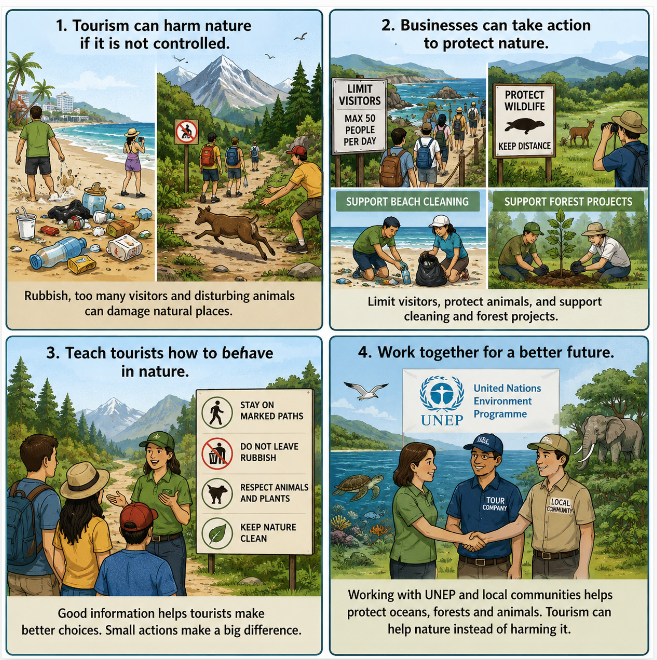
Tourism can harm nature if it is not controlled. Many people travel to beaches, forests, and mountains every year. Sometimes tourists leave rubbish behind or disturb animals. Too many visitors can also damage natural areas. However, tourism can also help protect nature. For this reason, tourism businesses should take care of the environment.
There are several ways businesses can help. First, they can make sure that tourists do not disturb animals in natural areas. Animals need safe places to live. Second, businesses can limit the number of visitors in sensitive places. This can reduce damage to nature. Businesses can also support beach cleaning and forest projects. These activities help keep nature clean and healthy.
Another important step is teaching tourists how to behave in nature. For example, tourists should not leave rubbish on the ground and should stay on marked paths. Small actions can make a big difference.
Some travel programs work with UNEP to protect oceans, forests, and animals. In this way, tourism can help protect nature instead of harming it.
###############
True or false:
- Tourism always improves nature without any control.
- Many people travel to beaches, forests, and mountains every year.
- Limiting visitors has no effect on environmental protection.
- Businesses should take care of the environment.
- Tourism can always improve nature without any control.
- Tourists sometimes leave rubbish behind or disturb animals.
- Staying off marked paths is recommended to protect nature.
- Some travel programs work with UNEP to protect oceans, forests, and animals.
- Too many visitors can damage natural areas.
- Businesses should encourage unlimited visitors to sensitive places.
- Tourism can harm nature if it is not controlled.
- UNEP works to discourage all tourism worldwide.
- Businesses can limit the number of visitors in sensitive places.
- Tourism can also help protect nature.
- Leaving rubbish on beaches helps ecosystems stay balanced.
__________________
Answers:
1F 2T 3F 4T 5F 6T 7T 8T 9T
10F 11T 12F 13T 14T 15F
__________________
Correct verson:
Tourism always improves nature without any control. True is: Tourism can harm nature if it is not controlled.
Many people travel to beaches, forests, and mountains every year.
Limiting visitors has no effect on environmental protection. True is: Limiting the number of visitors can reduce damage to nature.
Businesses should take care of the environment.
Tourism can always improve nature without any control. True is: Tourism can harm nature if it is not controlled.
Tourists sometimes leave rubbish behind or disturb animals.
Staying off marked paths is recommended to protect nature.
Some travel programs work with UNEP to protect oceans, forests, and animals.
Too many visitors can damage natural areas.
Businesses should encourage unlimited visitors to sensitive places. True is: Businesses can limit the number of visitors in sensitive places.
Tourism can harm nature if it is not controlled.
UNEP works to discourage all tourism worldwide. True is: Some travel programs work with UNEP to protect nature.
Businesses can limit the number of visitors in sensitive places.
Tourism can also help protect nature.
Leaving rubbish on beaches helps ecosystems stay balanced. True is: Tourists should not leave rubbish on the ground and should keep nature clean.
####################
Match the words with the correct definitions:
Words
- Tourism
- Environment
- Visitors
- Nature
- Businesses
- Protect
- Damage
- Sensitive areas
- Animals
- Rubbish
- Disturb
- Limit
- Clean-up
- Projects
- UNEP
Definitions
A. Places that are easily harmed by human activity
B. To cause harm or destruction
C. United Nations Environment Programme
D. Trash or waste left behind
E. Activities related to travelling for pleasure
F. To keep safe from harm
G. Natural world including forests, beaches, and mountains
H. People who travel to a place
I. Companies or organisations that provide services
J. Actions to remove waste and make areas clean
K. Living creatures such as birds, fish, and mammals
L. To interrupt or bother something or someone
M. To set a maximum number or control something
N. Activities or plans to achieve environmental goals
O. The surroundings in which plants and animals live
______________________
Answer Key
1-E 2-O 3-H 4-G 5-I 6-F 7-B 8-A
9-K 10-D 11-L 12-M 13-J 14-N 15-C
################
Find evidence in the text:
A. Statements (What is said)
- Tourism can damage natural areas when it is not controlled.
- People often visit beaches, forests, and mountains each year.
- Tourism businesses have a responsibility to protect nature.
- Tourists sometimes disturb wildlife or leave waste behind.
- Overcrowding can harm natural environments.
- Companies can reduce visitor numbers in fragile [easy to break or easily damaged] areas.
- Some places in nature are very fragile and need protection.
- Businesses can help fund environmental clean-up activities.
- Visitors should be taught how to behave responsibly in nature.
- Walking only on designated paths helps protect the environment.
- Some tourism projects cooperate with UNEP to protect ecosystems.
- Tourism can support environmental protection efforts.
- Animals require safe habitats to survive.
- Education is important for responsible tourism behaviour.
- Small actions from tourists can have a big environmental impact.
B. Evidence from the text
A. “Many people travel to beaches, forests, and mountains every year.”
B. “Tourism businesses should take care of the environment.”
C. “Tourists should not leave rubbish on the ground.”
D. “Too many visitors can also damage natural areas.”
E. “Businesses can limit the number of visitors in sensitive places.”
F. “Sensitive places need protection from damage.”
G. “Businesses can also support beach cleaning and forest projects.”
H. “Tourism can harm nature if it is not controlled.”
I. “Tourists should learn how to behave in nature.”
J. “Stay on marked paths.”
K. “Some travel programs work with UNEP to protect oceans, forests, and animals.”
L. “Tourism can also help protect nature instead of harming it.”
M. “Animals need safe places to live.”
N. “Tourism businesses should make sure tourists do not disturb animals.”
O. “Small actions can make a big difference.”
Answer (one line)
1-H 2-A 3-B 4-N 5-D 6-E 7-F 8-G
9-I 10-J 11-K 12-L 13-M 14-I 15-O
###############
Multiple choice, one answer is correct
1. What can happen if tourism is not controlled?
A. Tourism stops
B. Nature becomes stronger
C. Nature can be damaged
2. Where do many people travel every year?
A. Beaches, forests, and mountains
B. Cities only
C. Private buildings
3. What is one problem tourists may cause?
A. Build forests
B. Help animals
C. Leave rubbish
4. What can tourism businesses do to protect nature?
A. Care for environment
B. Ignore nature
C. Increase pollution
5. What happens when there are too many visitors?
A. Animals grow faster
B. Nature is damaged
C. Weather improves
6. What is one way to reduce environmental damage?
A. Add tourists
B. Build hotels
C. Limit visitors
7. What do fragile areas need?
A. More roads
B. Protection
C. Tourism growth
8. What can businesses support?
A. Racing events
B. Clean-up projects
C. Factories
9. What should tourists learn?
A. Behaviour in nature
B. Avoiding travel
C. Building houses
10. Why should tourists stay on marked paths?
A. Save money
B. Find shortcuts
C. Protect nature
11. Which organization is mentioned?
A. WHO
B. UNEP
C. NATO
12. What can tourism sometimes do for nature?
A. Destroy it
B. Replace it
C. Protect it
13. What do animals need?
A. Safe places
B. Roads
C. Loud places
14. What role do businesses have?
A. Ignore tourists
B. Teach tourists
C. Ban nature
15. What can small actions do?
A. Change weather
B. Stop tourism
C. Make difference
________________
Answers:
1C 2A 3C 4A 5B 6C 7B 8B 9A
10C 11B 12C 13A 14B 15C
############
Answer in brief:
- What can happen to nature if tourism is not controlled?
- Where do many people travel every year according to the text?
- What problems can tourists cause in natural areas?
- How can tourism businesses help protect the environment?
- What effect can too many visitors have on nature?
- How can businesses reduce damage in sensitive places?
- What does the text say about fragile or sensitive areas?
- What type of projects can businesses support?
- What should tourists be taught before visiting natural places?
- Why is it important to stay on marked paths?
- Which organisation works with travel programs in the text?
- How can tourism sometimes benefit nature?
- What do animals need according to the text?
- What is an important role of tourism businesses?
- Why are small actions important in protecting nature?
_________________________
Possible answers:
What can happen to nature if tourism is not controlled? – It can be damaged.
Where do many people travel every year according to the text? – They travel to beaches, forests, and mountains.
What problems can tourists cause in natural areas? – They can leave rubbish and disturb animals.
How can tourism businesses help protect the environment? – They can take care of the environment.
What effect can too many visitors have on nature? – They can damage natural areas.
How can businesses reduce damage in sensitive places? – They can limit the number of visitors.
What does the text say about fragile or sensitive areas? – They need protection from damage.
What type of projects can businesses support? – They can support beach cleaning and forest projects.
What should tourists be taught before visiting natural places? – They should learn how to behave in nature.
Why is it important to stay on marked paths? – It helps protect nature.
Which organisation works with travel programs in the text? – UNEP works with travel programs.
How can tourism sometimes benefit nature? – It can help protect nature.
What do animals need according to the text? – They need safe places to live.
What is an important role of tourism businesses? – They should educate tourists and protect nature.
Why are small actions important in protecting nature? – They can make a big difference.
################
Schreibe einen Kommentar