- family and temple day.
If you are not too familiar
with past simple,
try that text/exercise first
=> LINK
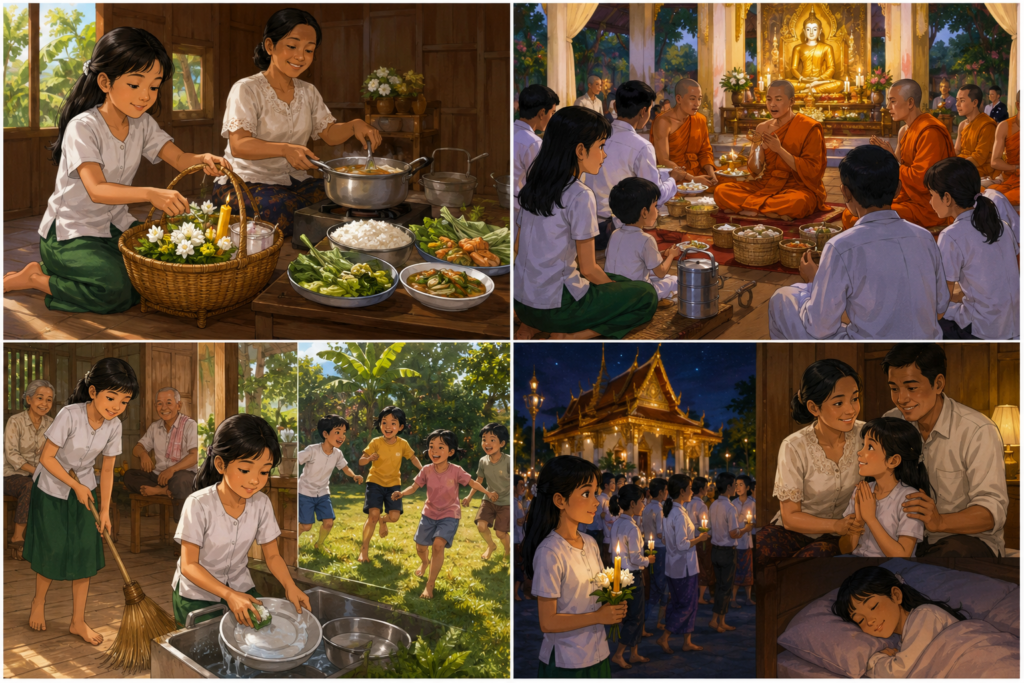
On Visaka Bochea Day, Samnang visited her parents in their village in May 2025. It was an important Buddhist day. She woke up early in the morning. She felt happy.
Her mother cooked rice, vegetables, and soup for the monks. Samnang helped her mother. She put food, flowers, and candles in a basket.
After breakfast, the family walked to the temple. Many people wore white clothes. They carried flowers and candles.
At the temple, the monks prayed. They talked about the life of the Buddha in simple words. Samnang listened.
People gave food to the monks. They lit candles near the Buddha image.
Visaka Bochea Day is a special day for Buddhists. People remember the Buddha. They think about being kind and calm.
In the afternoon, Samnang visited her grandparents. She helped clean the house. She swept the floor and washed dishes.
Later, she played with her cousins in the garden. They laughed and ran together. Everyone was happy.
In the evening, Samnang went back to the temple with her parents. People walked slowly around the temple. They held candles and flowers.
The night was quiet. Samnang felt calm and happy. She liked spending time with her family and helping others on this special day.
She said thank you to her parents. She learned about kindness. She went home and slept early because she was tired but happy.
She was glad to spend the day with her family and friends at the temple and at home.
It was a good day for Samnang.
__________________
Vocabulary:
kindness: being kind and good to others
to wake up: to stop sleeping
to feel happy: to have a good feeling
to cook vegetables: to make vegetables ready to eat with heat
a monk: a man who lives in a temple and prays
a candle: a stick that gives light when it burns
a basket: a container to carry things
to wear clothes: to have clothes on your body
to carry something: to hold and take something with you
to pray: to talk to God or the Buddha
to listen to something: to hear and pay attention
to light a candle: to make a candle burn
a Buddha image: a picture or statue of the Buddha
to be kind: to be nice and good to people
to be calm: to be quiet and not worried
to sweep the floor: to clean the floor with a broom
to wash the dishes: to clean plates and cups
to be quiet: to make no noise
to spend time with the family: to stay and do things with your family
##############
#Regular verbs in past simple
Rules:
- Most verbs: add -ed
play → played - Verbs ending in -e: add -d
live → lived - Verbs ending in consonant + y: change y to i and add -ed
study → studied - Short verbs ending in vowel + consonant: double the final consonant and add -ed
stop → stopped
#Irregular verbs (the complete list)
Irregular verbs change their form in the past tense. They do not add “-ed.”
Examples:
- go → went
- eat → ate
- have → had
- see → saw
- come → came
##############
Verbs in text:
| Infinitive | Past simple | A1 definition |
|---|---|---|
| be | was / were | to exist or to be in a place or state |
| visit | visited | to go and see someone |
| wake up | woke up | to stop sleeping |
| feel | felt | to have a feeling |
| cook | cooked | to make food with heat |
| help | helped | to give support |
| put | put | to place something somewhere |
| walk | walked | to move on foot |
| wear | wore | to have clothes on your body |
| carry | carried | to take something in your hands |
| pray | prayed | to talk to God or the Buddha |
| talk | talked | to speak with someone |
| listen | listened | to hear and pay attention |
| give | gave | to offer something to someone |
| light | lit | to make a candle burn |
| remember | remembered | to keep something in your mind |
| think | thought | to use your mind about something |
| clean | cleaned | to make something not dirty |
| sweep | swept | to clean the floor with a broom |
| wash | washed | to clean with water |
| play | played | to do games or fun activities |
| laugh | laughed | to make a happy sound |
| run | ran | to move very fast on foot |
| go | went | to move from one place to another |
| hold | held | to take something in your hands |
| like | liked | to enjoy something |
| spend | spent | to use time doing something |
| say | said | to speak words |
| learn | learned | to get knowledge or skills |
| sleep | slept | to rest in bed at night |
################
Match the words to the correct definitions:
Words
- kindness
- to wake up
- to feel happy
- to cook vegetables
- a monk
- a candle
- a basket
- to wear clothes
- to carry something
- to pray
- to listen to something
- to light a candle
- a Buddha image
- to be kind
- to be calm
- to sweep the floor
- to wash the dishes
- to be quiet
Definitions:
A. to stop sleeping
B. a stick that gives light when it burns
C. to clean plates and cups
D. to talk to God or the Buddha
E. to have a good feeling
F. a picture or statue of the Buddha
G. to be quiet and not worried
H. a container to carry things
I. to carry something with you by holding it
J. to hear and pay attention
K. to make vegetables ready to eat with heat
L. to have clothes on your body
M. to clean the floor with a broom
N. to make a candle burn
O. to be kind and good to people
P. a man who lives in a temple and prays
Q. being kind and good to others
R. to make no noise
___________________
Answers:
1-Q, 2-A, 3-E, 4-K, 5-P, 6-B,
7-H, 8-L, 9-I, 10-D, 11-J, 12-N, 13-F,
14-O, 15-G, 16-M, 17-C, 18-R
##############
Match the definitions to the correct words:
Definitions:
- to stop sleeping
- a stick that gives light when it burns
- to clean plates and cups
- to talk to God or the Buddha
- to have a good feeling
- a picture or statue of the Buddha
- to be quiet and not worried
- a container to carry things
- to carry something with you by holding it
- to hear and pay attention
- to make vegetables ready to eat with heat
- to have clothes on your body
- to clean the floor with a broom
- to make a candle burn
- to be kind and good to people
- a man who lives in a temple and prays
- kindness: being kind and good to others
- to make no noise
Words:
A. to cook vegetables
B. to be calm
C. to pray
D. to wear clothes
E. a candle
F. to wash the dishes
G. to be kind
H. a Buddha image
I. to sweep the floor
J. to feel happy
K. to wake up
L. a monk
M. to light a candle
N. to carry something
O. to listen to something
P. a basket
Q. to be quiet
R. kindness
_____________________
Answers:
1-K, 2-E, 3-F, 4-C, 5-J, 6-H,
7-B, 8-P, 9-N, 10-O, 11-A, 12-D, 13-I,
14-M, 15-G, 16-L, 17-R, 18-Q
###############
Fill in, past simple:
- On Visaka Bochea Day, Samnang _________ (visit) her parents’ village, _________ (wake up) early, and _________ (feel) happy on this special Buddhist day.
- Her mother _________ (cook) vegetables, rice, and soup for monks while Samnang _________ (help) and _________ (carry) food, flowers, and candles in a basket.
- The family _________ (wear) white clothes, _________ (walk) to the temple, and _________ (carry) candles and flowers with care.
- At the temple, monks _________ (pray), and Samnang _________ (listen) carefully, _________ (see) a Buddha image, and _________ (light) a candle.
- People _________ (give) food to monks, and everyone tried to be kind, calm, and quiet during the ceremony.
- In the afternoon, Samnang _________ (visit) her grandparents, _________ (help) _________ sweep the floor, and _________ (wash) dishes at home.
- Later, she _________ (spend) time with her family, _________ (play) with her cousins, _________ (laugh), and _________ (feel) very happy together.
- In the evening, she _________ (go) back to the temple, _________ (walk) slowly, and _________ (hold) a candle in her hand.
- The night _________ (be) quiet, and Samnang _________ (feel) calm, thankful, and happy before she _________ (go) home to sleep early.
_____________________
Correct version:
- On Visaka Bochea Day, Samnang visited her parents’ village, woke up early, and felt happy on this special Buddhist day.
- Her mother cooked vegetables, rice, and soup for monks while Samnang helped and carried food, flowers, and candles in a basket.
- The family wore white clothes, walked to the temple, and carried candles and flowers with care.
- At the temple, monks prayed, and Samnang listened carefully, saw a Buddha image, and lit a candle.
- People gave food to monks, and everyone tried to be kind, calm, and quiet during the ceremony.
- In the afternoon, Samnang visited her grandparents, helped sweep the floor, and washed dishes at home.
- Later, she spent time with her family, played with her cousins, laughed, and felt very happy together.
- In the evening, she went back to the temple, walked slowly, and held a candle in her hand.
- The night was quiet, and Samnang felt calm, thankful, and happy before she went home to sleep early.
################
Odd one out – which word does not belong to that group?
Odd one out (based on the text)
1.
temple – school – basket – village
2.
visited – woke up – cooked – felt
3.
rice – candle – flower – monk
4.
prayed – shouted – listened – carried
5.
calm – kind – angry – happy
6.
washed – swept – played – cleaned
7.
Buddha image – television – candle – flowers
8.
afternoon – morning – evening – temple
9.
held – carried – flew – lit
10.
family – monks – hospital – cousins
_________________
Answers:
1.
temple – school – basket – village
school — because it is not a place from the story or related to the temple or family village activities, while the others are connected to the setting.
2.
visited – woke up – cooked – felt
cooked — because it is done by the mother in the story, while the others describe Samnang’s actions or feelings.
3.
rice – candle – flower – monk
monk — because it is a person, while the others are objects used or offered on Visaka Bochea Day.
4.
prayed – shouted – listened – carried
shouted — because it is a noisy action, while the others are calm or respectful temple activities.
5.
calm – kind – angry – happy
angry — because it is a negative feeling, while the others are positive or peaceful feelings.
6.
washed – swept – played – cleaned
played — because it is a leisure activity, while the others are cleaning actions done in the house.
7.
Buddha image – television – candle – flowers
television — because it is not mentioned in the story or used in the temple, while the others are related to worship.
8.
afternoon – morning – evening – temple
temple — because it is a place, while the others are times of the day.
9.
held – carried – flew – lit
flew — because it is not related to temple actions, while the others are actions with candles or objects.
10.
family – monks – hospital – cousins
hospital — because it is not part of the story setting, while the others are people or groups in the family/temple context.
##############
True or false:
- Samnang went to school in the morning.
- People at the temple behaved quietly and respectfully.
- The monks danced and sang loudly during the ceremony.
- Samnang helped with cleaning activities at home.
- The temple was empty on that day.
- The family shared food with Buddhist monks.
- Samnang broke objects during the visit.
- The family took part in religious activities at a temple.
- Everyone shouted and ran inside the temple.
- Samnang visited her grandparents during the day.
- The day had no connection to Buddhist traditions.
- Samnang spent time with relatives and played with children.
- People carried objects when they went to the temple.
- Samnang reflected on being kind during the day.
- The family ignored the monks completely.
- Samnang stayed alone all day without seeing anyone.
- The day included both family time and temple activities.
- Samnang returned home after visiting the temple again.
- People ate meat during the temple visit.
- Samnang refused to help her family at home.
_____________
True: 2,4,6,8,10,12,13,14,17,18
_____________
Correct version:
- False: Samnang went to school in the morning.
True is: Samnang visited her parents’ village and went to the temple with her family. - People at the temple behaved quietly and respectfully.
- False: The monks danced and sang loudly during the ceremony.
True is: The monks prayed and talked about the Buddha in simple words. - Samnang helped with cleaning activities at home.
- False: The temple was empty on that day.
True is: Many people were at the temple on Visaka Bochea Day. - The family shared food with Buddhist monks.
- False: Samnang broke objects during the visit.
True is: Samnang behaved respectfully and helped her family and others. - The family took part in religious activities at a temple.
- False: Everyone shouted and ran inside the temple.
True is: People behaved calmly and quietly at the temple. - Samnang visited her grandparents during the day.
- False: The day had no connection to Buddhist traditions.
True is: The day was a Buddhist festival called Visaka Bochea Day. - Samnang spent time with relatives and played with children.
- People carried objects when they went to the temple.
- Samnang reflected on being kind during the day.
- False: The family ignored the monks completely.
True is: The family respected the monks and gave them food. - False: Samnang stayed alone all day without seeing anyone.
True is: Samnang spent the day with her family and friends. - The day included both family time and temple activities.
- Samnang returned home after visiting the temple again.
- False: People ate meat during the temple visit.
True is: People offered food respectfully to the monks and followed Buddhist practice. - False: Samnang refused to help her family at home.
True is: Samnang helped her family with cleaning and activities.
###############
Sentence ordering – based on story, correct order is?
A. Samnang felt happy during the special Buddhist day.
B. The family went to the temple.
C. Monks prayed and spoke about the Buddha.
D. Samnang woke up early in the morning.
E. Samnang helped her mother at home.
F. Samnang played with her cousins in the garden.
G. The family returned to the temple in the evening.
H. Samnang went home and slept early.
_____________________
Correct Order
D. Samnang woke up early in the morning.
A. Samnang felt happy during the special Buddhist day.
E. Samnang helped her mother at home.
B. The family went to the temple.
C. Monks prayed and spoke about the Buddha.
F. Samnang played with her cousins in the garden.
G. The family returned to the temple in the evening.
H. Samnang went home and slept early.
###############
Short answers wanted:
- Where did Samnang go on Visaka Bochea Day?
2. When did Samnang wake up?
3. Why did Samnang feel happy in the morning?
4. What did her mother cook for the monks?
5. Who helped her mother in the kitchen?
6. What did Samnang put in the basket?
7. Which clothes did the family wear to the temple?
8. Where did the family walk after breakfast?
9. Who prayed at the temple?
10. What did Samnang do while monks were speaking?
11. What did people give to the monks?
12. What did Samnang do at her grandparents’ house in the afternoon?
13. How did Samnang help clean the house?
14. What did Samnang do with her cousins in the garden?
15. How did Samnang feel at the end of the day?
16. Why did Samnang go to bed early?
_______________________
Answers:
- Where did Samnang go on Visaka Bochea Day?
She went to her parents’ village and the temple. - When did Samnang wake up?
She woke up early in the morning. - Why did Samnang feel happy in the morning?
Because it was a special Buddhist day. - What did her mother cook for the monks?
She cooked rice, vegetables, and soup. - Who helped her mother in the kitchen?
Samnang helped her mother. - What did Samnang put in the basket?
She put food, flowers, and candles. - Which clothes did the family wear to the temple?
They wore white clothes. - Where did the family walk after breakfast?
They walked to the temple. - Who prayed at the temple?
The monks prayed. - What did Samnang do while monks were speaking?
She listened carefully. - What did people give to the monks?
They gave food. - What did Samnang do at her grandparents’ [a Saxon genitive, for details see below] house in the afternoon?
She helped clean the house. - How did Samnang help clean the house?
She swept the floor and washed dishes. - What did Samnang do with her cousins in the garden?
She played with them. - How did Samnang feel at the end of the day?
She felt calm and happy. - Why did Samnang go to bed early?
Because she was tired but happy.
#################
Saxon genitive (’s) –
showing possession
The Saxon genitive shows that something belongs to someone.
We add >> ’s << to a name or noun.
Basic rule:
👉 person/animal + ’s + thing
Examples:
- John’s book = the book belongs to John
- Anna’s bag = the bag belongs to Anna
- The cat’s food = the food belongs to the cat
If the name ends in -s (like James):
We still usually add ’s:
- James’s book = the book belongs to James
- James’s car = the car belongs to James
Plural nouns:
If the word is plural and already ends in -s, we just add an apostrophe ’:
- the boys’ room = the room of the boys
- the teachers’ office = the office of the teachers
Easy way to remember:
Instead of saying “the book of John”, we say:
👉 John’s book
#################
Rewrite with Saxon genitive
- the book of James → __________
YOU WRITE:
James’s book - the car of Lucas → __________
- the house of Elias → __________
- the toys of the boys → __________
- the bag of Anna → __________
- the bike of Tom → __________
- the room of the students → __________
- the phone of James → __________
- the dog of Lucas → __________
- the jacket of Elias → __________
- the games of the children → __________
- the house of the teachers → __________
- the birthday of James → __________
- the notebook of Lucas → __________
- the pencil of Elias → __________
- the cars of the boys → __________
- the work of the students → __________
- the garden of James → __________
- the friends of Lucas → __________
- the school of Elias → __________
————————
Correct answers:
- James’s book
- Lucas’s car
- Elias’s house
- the boys’ toys
- Anna’s bag
- Tom’s bike
- the students’ room
- James’s phone
- Lucas’s dog
- Elias’s jacket
- the children’s games
- the teachers’ house
- James’s birthday
- Lucas’s notebook
- Elias’s pencil
- the boys’ cars
- the students’ work
- James’s garden
- Lucas’s friends
- Elias’s school
##################
Fill in, words below:
prayed – woke up – swept – cooked – lit – wore – basket – calm – village – image – carry – cousins – tired – candles
On Visaka Bochea Day, Samnang __________ early, felt happy, and visited her parents in their __________ for the special Buddhist celebration.
Her mother __________ vegetables, rice, and soup for the monks, and Samnang helped __________ food, flowers, and candles in a __________.
After breakfast, the family __________ white clothes, walked to the temple, and carried __________ and flowers with many other people.
At the temple, the monks __________ and talked about the Buddha, and Samnang listened carefully near the Buddha _________ during the ceremony.
People __________ candles, gave food to the monks, and tried to be kind, __________, and quiet on this important day.
In the afternoon, Samnang __________ the floor, washed dishes, spent time with her family, played with __________, and learned about kindness before going home __________ but happy.
————————————-
Full version:
On Visaka Bochea Day, Samnang woke up early, felt happy, and visited her parents in their village for the special Buddhist celebration.
Her mother cooked vegetables, rice, and soup for the monks, and Samnang helped carry food, flowers, and candles in a basket.
After breakfast, the family wore white clothes, walked to the temple, and carried candles and flowers with many other people.
At the temple, the monks prayed and talked about the Buddha, and Samnang listened carefully near the Buddha image during the ceremony.
People lit candles, gave food to the monks, and tried to be kind, calm, and quiet on this important day.
In the afternoon, Samnang swept the floor, washed dishes, spent time with her family, played with cousins, and learned about kindness before going home tired but happy.
#################
Match question and answer:
Questions
- Where did you spend Visaka Bochea Day?
- When did you get up in the morning?
- Why were you happy that day?
- Who prepared food for the monks?
- What did you place in the basket?
- Which clothes did your family have on at the temple?
- How did your family travel to the temple?
- Whose house did you visit in the afternoon?
- What did the monks talk about?
- How did you act during the ceremony?
- What did people give to the monks?
- Which activity did you do to help clean the house?
- Who played with you in the garden?
- How did you feel at the end of the day?
_________________
Answers:
A. I stayed calm and quiet.
B. My mother made rice, vegetables, and soup.
C. We had white clothes on our bodies.
D. I put flowers, food, and candles inside it.
E. My cousins ran and laughed with me.
F. I was calm, thankful, and tired.
G. I stayed in my parents’ village and at the temple.
H. It was an important Buddhist celebration.
I. I spent time at my grandparents’ home.
J. They offered food and respect.
K. I left my bed very early.
L. We went there on foot together.
M. They spoke about the Buddha’s life.
N. I swept the floor and washed dishes.
_______________________
Full version:
- Where did you spend Visaka Bochea Day?
I stayed in my parents’ village and at the temple. G - When did you get up in the morning?
I left my bed very early. K - Why were you happy that day?
It was an important Buddhist celebration. H - Who prepared food for the monks?
My mother made rice, vegetables, and soup. B - What did you place in the basket?
I put flowers, food, and candles inside it. D - Which clothes did your family have on at the temple?
We had white clothes on our bodies. C - How did your family travel to the temple?
We went there on foot together. L - Whose house did you visit in the afternoon?
I spent time at my grandparents’ home. I - What did the monks talk about?
They spoke about the Buddha’s life. M - How did you act during the ceremony?
I stayed calm and quiet. A - What did people give to the monks?
They offered food and respect. J - Which activity did you do to help clean the house?
I swept the floor and washed dishes. N - Who played with you in the garden?
My cousins ran and laughed with me. E - How did you feel at the end of the day?
I was calm, thankful, and tired. F
Schreibe einen Kommentar