- her daily routine
After having completed
this unit, go to
„A day in Malis’s life„,
the story in in past simple
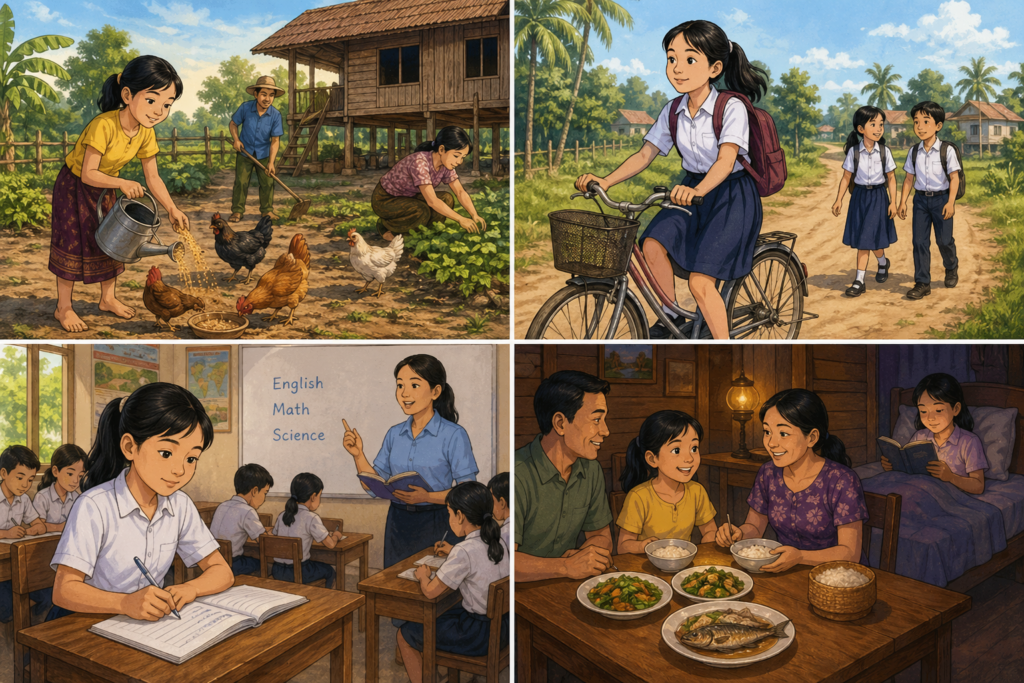
Malis is 12 years old. She lives in the countryside with her parents. Her parents are farmers.
She wakes up early in the morning. She helps her parents at home. She feeds the chickens and brings water. Sometimes she helps in the field.
After that, she gets ready for school. She wears her uniform and goes to school. She walks or rides a bike. She meets her friends on the way.
At school, she studies English, math, and science. She likes learning new things. She listens to her teacher and works hard.
At noon, she goes home for lunch. She eats rice, vegetables, and sometimes fish. Then she rests for a short time.
In the afternoon, she helps her parents again or does her homework.
In the evening, she has dinner with her family. They talk together. Then she goes to bed early.
________________________
Vocabulary:
- countryside → the area in the country, not the city
- to wake up → to stop sleeping
- early → before the usual time (not late)
- at home → in your house
- to feed the chickens → to give food to chickens
- to get ready for school → to prepare for school (wash, dress, etc.)
- to wear a uniform → to have special school clothes on
- to ride a bike → to go on a bicycle
- to meet friends → to see friends
- to study science → to learn about science [subject where students learn about the natural world, about plants, animals, the human body, weather, and do simple experiments.]
- to listen to somebody → to hear and pay attention to someone
- at noon → at 12:00 in the day
- lunch → the meal in the middle of the day
- vegetables → plants we eat (like carrots, tomatoes)
- to rest → to relax or stop working
- for a short time → for a little time
- afternoon → the time after 12:00 (after noon)
- to do homework → to do school work at home
- to go to bed → to lie down and sleep
#################
Match the words with the definitions
Words:
- countryside
- to wake up
- early
- at home
- to feed the chickens
- to get ready for school
- to wear a uniform
- to ride a bike
- to meet friends
- to study science
- to listen to somebody
- at noon
- lunch
- vegetables
- to rest
- for a short time
- afternoon
- to do homework
- to go to bed
Definitions:
A. to relax or stop working
B. the meal in the middle of the day
C. to stop sleeping
D. to prepare for school
E. plants we eat
F. after 12:00 in the day
G. in your house
H. to give food to chickens
I. to learn about science
J. to see friends
K. to lie down and sleep
L. before the usual time
M. at 12:00 in the day
N. the area in the country, not the city
O. to hear and pay attention to someone
P. to go on a bicycle
Q. to do school work at home
R. for a little time
S. to have special school clothes on
_______________________
Answer:
1-N, 2-C, 3-L, 4-G, 5-H, 6-D,
7-S, 8-P, 9-J, 10-I, 11-O, 12-M, 13-B,
14-E, 15-A, 16-R, 17-F, 18-Q, 19-K
#################
Match definitions and words:
- to see friends → ___
- at 12:00 in the day → ___
- to go on a bicycle → ___
- plants we eat (like carrots, tomatoes) → ___
- to relax or stop working → ___
- to prepare for school (wash, dress, etc.) → ___
- to learn about science → ___
- the area in the country, not the city → ___
- to stop sleeping → ___
- to hear and pay attention to someone → ___
- to lie down and sleep → ___
- in your house → ___
- to give food to chickens → ___
- to have special school clothes on → ___
- to do school work at home → ___
- before the usual time (not late) → ___
- for a little time → ___
- the meal in the middle of the day → ___
- the time after 12:00 (after noon) → ___
Word bank:
A. countryside
B. to wake up
C. early
D. at home
E. to feed the chickens
F. to get ready for school
G. to wear a uniform
H. to ride a bike
I. to meet friends
J. to study science
K. to listen to somebody
L. at noon
M. lunch
N. vegetables
O. to rest
P. for a short time
Q. afternoon
R. to do homework
S. to go to bed
___________________
Answers:
1I, 2L, 3H, 4N, 5O, 6F, 7J, 8A,
9B, 10K, 11S, 12D, 13E, 14G,
15R, 16C, 17P, 18M, 19Q
#############
True or false:
- to go to bed means to wake up in the morning.
- to feed the chickens means to give food to chickens.
- vegetables means animals we eat.
- to wake up means to stop sleeping.
- to ride a bike means to go on a bicycle.
- at noon means at 6:00 in the evening.
- countryside means the area in the country, not the city.
- for a short time means for a very long time.
- to study science means to learn about science.
- lunch means the meal in the morning.
- to meet friends means to see friends.
- to listen to somebody means to ignore someone speaking.
- afternoon means the time before 12:00.
- to get ready for school means to prepare for school (wash, dress, etc.).
- early means before the usual time (not late).
- to do homework means to play games at school.
- at home means in your house.
- to rest means to work hard.
- to wear a uniform means to have special school clothes on.
_____________________
True: 2,4,5,7,9,11,14,15,17,19
###############
True or false:
- She uses a bicycle only on weekends for fun.
- She has dinner with her family in the evening.
- She studies only science at school.
- Malis is 12 years old.
- She wakes up early in the morning.
- She carries food from the kitchen to the chickens every day.
- She lives in a town near the sea.
- She gets ready for school after her morning tasks.
- She eats dinner alone in her room.
- She feeds the chickens and brings water.
- She changes clothes at school after arriving.
- Her parents work in a shop in the evening.
- She helps her parents at home.
- She wears a uniform for school.
- She studies English, math, and science.
- She starts her day by going straight to school.
- She lives in the countryside with her parents.
- She spends the morning reading books at home only.
- Her parents are farmers.
____________________
True: 2,4,5,8,10,13,14,15,17,19
##############
True is – short answers only:
- Is Malis 11 or 12 years old?
- Does she wake up late or early every day?
- Does she live in a city or in the countryside?
- Are her parents teachers or farmers?
- Does she help her parents at home or only at school?
- Does she feed dogs or chickens?
- Does she bring water or toys to the chickens?
- Does she get ready for school after or before helping at home?
- Does she wear casual clothes or a uniform for school?
- Does she go to school by car or by walking/riding a bike?
- Does she meet friends on the way to school or stay alone?
- Does she study English or cooking at school?
- Does she study cooking or math at school?
- Does she study painting or science at school?
- Does she ignore the teacher or listen to the teacher in class?
- Does she have lunch in the evening or at noon?
- Does she eat fast food or rice and vegetables for lunch?
- Does she work all afternoon or rest for a short time after lunch?
- Does she only play games or do homework in the afternoon?
- Does she go to bed very late or early every night?
_________________________
Correct version:
- Is Malis 11 or 12 years old? 12
- Does she wake up late or early every day? early
- Does she live in a city or in the countryside? countryside
- Are her parents teachers or farmers? farmers
- Does she help her parents at home or only at school? at home
- Does she feed dogs or chickens? chickens
- Does she bring water or toys to the chickens? water
- Does she get ready for school after or before helping at home? after
- Does she wear casual clothes or a uniform for school? uniform
- Does she go to school by car or by walking/riding a bike? walking/riding a bike
- Does she meet friends on the way to school or stay alone? meet friends
- Does she study English or cooking at school? English
- Does she study cooking or math at school? math
- Does she study painting or science at school? science
- Does she ignore the teacher or listen to the teacher in class? listen
- Does she have lunch in the evening or at noon? noon
- Does she eat fast food or rice and vegetables for lunch? rice and vegetables
- Does she work all afternoon or rest for a short time after lunch? rest
- Does she only play games or do homework in the afternoon? do homework
- Does she go to bed very late or early every night? early
################
Odd one out:
- city – countryside – village – farm
- eat – sleep – wake up – get up
- rice – vegetables – water – fish
- pajamas – uniform – school clothes – shoes
- ride a bike – walk – drive a car – run
- cooking – English – math – science
- breakfast – lunch – school – dinner
- bicycle – morning – afternoon – evening
- rest – relax – work – sleep
- home – school – kitchen – science
______________________
Correct version:
city – countryside – village – farm
Odd one: city
Why: the others are rural places linked to farming life in the story, while a city is not.
eat – sleep – wake up – get up
Odd one: eat
Why: the others are sleeping or starting-day actions, but “eat” is a meal activity.
rice – vegetables – water – fish
Odd one: water
Why: rice, vegetables, and fish are foods; water is a drink, not food.
pajamas – uniform – school clothes – shoes
Odd one: pajamas
Why: the others are worn for school, but pajamas are for sleeping.
ride a bike – walk – drive a car – run
Odd one: drive a car
Why: the story mentions walking and biking; driving a car is not used.
cooking – English – math – science
Odd one: cooking
Why: English, math, and science are school subjects; cooking is not.
breakfast – lunch – school – dinner
Odd one: school
Why: the others are meals; school is a place/activity.
bicycle – morning – afternoon – evening
Odd one: bicycle
Why: morning, afternoon, and evening are times of day; bicycle is a vehicle.
rest – relax – work – sleep
Odd one: work
Why: rest, relax, and sleep are recovery actions; work is activity/effort.
home – school – kitchen – science
Odd one: science
Why: home, school, and kitchen are places; science is a subject.
##################
Short answers, basics:
| Example Sentence | Yes | No |
|---|---|---|
| I learn the alphabet. | Yes, I do. | No, I don’t. |
| You read signs. | Yes, you do. | No, you don’t. |
| He practices speaking. | Yes, he does. | No, he doesn’t. |
| She watches cartoons. | Yes, she does. | No, she doesn’t. |
| It helps us learn English. | Yes, it does. | No, it doesn’t. |
| We use apps like Duolingo. | Yes, we do. | No, we don’t. |
| You read labels. | Yes, you do. | No, you don’t. |
| They make mistakes sometimes. | Yes, they do. | No, they don’t. |
| Question | Yes | No |
|---|---|---|
| Do I learn the alphabet? | Yes, I do. | No, I don’t. |
| Do you read signs? | Yes, you do. | No, you don’t. |
| Does he practice speaking? | Yes, he does. | No, he doesn’t. |
| Does she watch cartoons? | Yes, she does. | No, she doesn’t. |
| Does it help us learn English? | Yes, it does. | No, it doesn’t. |
| Do we use apps like Duolingo? | Yes, we do. | No, we don’t. |
| Do you read labels? | Yes, you do. | No, you don’t. |
| Do they make mistakes sometimes? | Yes, they do. | No, they don’t. |
| Question | Yes | No |
|---|---|---|
| Am I big? | Yes, I am. | No, I am not. |
| Are you big? | Yes, you are. | No, you aren’t. |
| Is he big? | Yes, he is. | No, he isn’t. |
| Is she big? | Yes, she is. | No, she isn’t. |
| Is it big? | Yes, it is. | No, it isn’t. |
| Are we big? | Yes, we are. | No, we aren’t. |
| Are you big? | Yes, you are. | No, you aren’t. |
| Are they big? | Yes, they are. | No, they aren’t. |
####################
Provide short answers as shown in 1.:
- She uses a bicycle only on weekends for fun.
YOU WRITE:
No, she doesn’t. - She has dinner with her family in the evening.
- She studies only science at school.
- Malis is 12 years old.
- She wakes up early in the morning.
- She carries food from the kitchen to the chickens every day.
- She lives in a town near the sea.
- She gets ready for school after her morning tasks.
- She eats dinner alone in her room.
- She feeds the chickens and brings water.
- She changes clothes at school after arriving.
- Her parents work in a shop in the evening.
- She helps her parents at home.
- She wears a uniform for school.
- She studies English, math, and science.
- She starts her day by going straight to school.
- She lives in the countryside with her parents.
- She spends the morning reading books at home only.
- Her parents are farmers.
_______________________
Correct answers:
- She uses a bicycle only on weekends for fun. — No, she doesn’t.
- She has dinner with her family in the evening. — Yes, she does.
- She studies only science at school. — No, she doesn’t.
- Malis is 12 years old. — Yes, she is.
- She wakes up early in the morning. — Yes, she does.
- She carries food from the kitchen to the chickens every day. — No, she doesn’t.
- She lives in a town near the sea. — No, she doesn’t.
- She gets ready for school after her morning tasks. — Yes, she does.
- She eats dinner alone in her room. — No, she doesn’t.
- She feeds the chickens and brings water. — Yes, she does.
- She changes clothes at school after arriving. — No, she doesn’t.
- Her parents work in a shop in the evening. — No, they don’t.
- She helps her parents at home. — Yes, she does.
- She wears a uniform for school. — Yes, she does.
- She studies English, math, and science. — Yes, she does.
- She starts her day by going straight to school. — No, she doesn’t.
- She lives in the countryside with her parents. — Yes, she does.
- She spends the morning reading books at home only. — No, she doesn’t.
- Her parents are farmers. — Yes, they are.
#####################
Basics of present simple:
| Personal Pronoun | am / is / are | |
|---|---|---|
| I | am | 8 years old |
| You | are | 8 years old |
| He | is | 8 years old |
| She | is | 8 years old |
| It | is | 8 years old |
| We | are | 8 years old |
| You (plural) | are | 8 years old |
| They | are | 8 years old |
| Personal Pronoun | am not / is not / are not | |
|---|---|---|
| I | am not | 8 years old |
| You | are not | 8 years old |
| He | is not | 8 years old |
| She | is not | 8 years old |
| It | is not | 8 years old |
| We | are not | 8 years old |
| You (plural) | are not | 8 years old |
| They | are not | 8 years old |
Question:
| Question Word | Personal Pronoun | |
|---|---|---|
| Am | I | 8 years old? |
| Are | you | 8 years old? |
| Is | he | 8 years old? |
| Is | she | 8 years old? |
| Is | it | 8 years old? |
| Are | we | 8 years old? |
| Are | you (plural) | 8 years old? |
| Are | they | 8 years old? |
Statement:
| Personal Pronoun | Verb | |
|---|---|---|
| I | like | ice cream |
| You | like | ice cream |
| He | likes | ice cream |
| She | likes | ice cream |
| It | likes | ice cream |
| We | like | ice cream |
| You (plural) | like | ice cream |
| They | like | ice cream |
Negation:
| Personal Pronoun | Verb (negative) | |
|---|---|---|
| I | do not like | ice cream |
| You | do not like | ice cream |
| He | does not like | ice cream |
| She | does not like | ice cream |
| It | does not like | ice cream |
| We | do not like | ice cream |
| You (plural) | do not like | ice cream |
| They | do not like | ice cream |
Question:
| Do / Does | Personal Pronoun | Verb | Sugar? |
|---|---|---|---|
| Do | I | like | sugar? |
| Do | you | like | sugar? |
| Does | he | like | sugar? |
| Does | she | like | sugar? |
| Does | it | like | sugar? |
| Do | we | like | sugar? |
| Do | you (plural) | like | sugar? |
| Do | they | like | sugar? |
################
Make the following sentences negative:
- Malis is 15 years old.
YOU WRITE:
Malis is not 15 years old. - She lives in a city with her grandparents.
- Her parents work in a shop.
- She wakes up late in the afternoon.
- She never helps her parents at home.
- She feeds cows instead of chickens.
- She does not bring water for animals.
- She gets ready for school before doing any morning tasks.
- She wears casual clothes to school.
- She goes to school by car every day.
- She meets friends only at home, not on the way to school.
- She studies only music at school.
- She eats pizza and drinks soda for lunch.
- She goes to bed very late every night.
_________________________
Correct version:
- Malis is not 15 years old.
- She does not live in a city with her grandparents.
- Her parents do not work in a shop.
- She does not wake up late in the afternoon.
- She does not help her parents at home.
- She does not feed cows instead of chickens.
- She does not bring water for animals.
- She does not get ready for school before doing any morning tasks.
- She does not wear casual clothes to school.
- She does not go to school by car every day.
- She does not meet friends only at home, not on the way to school.
- She does not study only music at school.
- She does not eat pizza and drink soda for lunch.
- She does not go to bed very late every night.
##################
Rewrite as questions:
- Malis is 12 years old.
YOU WRITE:
Is Malis 12 years old? - She lives in the countryside with her parents.
- Her parents are farmers.
- She wakes up early in the morning.
- She and her brother help their parents at home.
- She feeds the chickens.
- She brings water.
- She sometimes helps in the field.
- She gets ready for school after her morning tasks.
- She and her friends wear uniforms for school.
- She walks or rides a bike to school.
- She and her brother meet their friends on the way to school.
- She studies English, math, and science.
- She goes to bed early.
_____________________
Correct questions:
- Is Malis 12 years old?
- Does she live in the countryside with her parents?
- Are her parents farmers?
- Does she wake up early in the morning?
- Do she and her brother help their parents at home?
- Does she feed the chickens?
- Does she bring water?
- Does she sometimes help in the field?
- Does she get ready for school after her morning tasks?
- Do she and her friends wear uniforms for school?
- Does she walk or ride a bike to school?
- Do she and her brother meet their friends on the way to school?
- Does she study English, math, and science?
- Does she go to bed early?
################
Answer as shown in 1:
- Malis is 15 years old.
YOU WRITE:
No, she isn’t.
She is 12 years old. - She lives in a city with her grandparents.
- Her parents are doctors.
- She and her parents wake up late in the afternoon.
- She often helps her grandparents.
- She feeds cows instead of chickens.
- Her father works in a shop.
- She helps in the field on Sundays only.
- She gets ready for school before doing any morning tasks.
- She and her friends wear casual clothes for school.
- She goes to school by car every day.
- She meets her friends only at home.
- She and her friends study only music at school.
- She goes to bed very late every night.
______________________
Correct answers:
- Malis is 15 years old.
No, she isn’t.
She is 12 years old. - She lives in a city with her grandparents.
No, she doesn’t.
She lives in the countryside with her parents. - Her parents are doctors.
No, they aren’t.
They are farmers. - She and her parents wake up late in the afternoon.
No, they don’t.
She wakes up early in the morning. - She often helps her grandparents.
No, she doesn’t.
She helps her parents at home. - She feeds cows instead of chickens.
No, she doesn’t.
She feeds the chickens. - Her father works in a shop.
No, he doesn’t.
He is a farmer. - She helps in the field on Sundays only.
No, she doesn’t.
She sometimes helps in the field. - She gets ready for school before doing any morning tasks.
No, she doesn’t.
She gets ready for school after her morning tasks. - She and her friends wear casual clothes for school.
No, they don’t.
She wears a uniform for school. - She goes to school by car every day.
No, she doesn’t.
She walks or rides a bike to school. - She meets her friends only at home.
No, she doesn’t.
She meets her friends on the way to school. - She and her friends study only music at school.
No, they don’t.
She studies English, math, and science. - She goes to bed very late every night.
No, she doesn’t.
She goes to bed early.
###################
Form questions – write as shown in 1:
- Malis / wake up early in the morning
YOU WRITE:
→ Does Malis wake up early in the morning ? - she / feed the chickens
→ __________________________________ ? - she and her friends / wear uniforms for school
→ __________________________________ ? - she / ride a bike to school
→ __________________________________ ? - she and her friends / study English, math, science
→ __________________________________ ? - Malis / live in the countryside with her parents
→ __________________________________ ? - her parents / be farmers
→ __________________________________ ? - Malis and her parents / help at home
→ __________________________________ ? - she and her parents / bring water every morning
→ __________________________________ ? - Malis / get ready for school after her morning tasks
→ __________________________________ ? - she and her friends / meet on the way to school
→ __________________________________ ? - Malis / have lunch at noon
→ __________________________________ ? - she and her friends / do homework in the afternoon
→ __________________________________ ? - Malis / go to bed early
→ __________________________________ ?
_________________________
Correct version:
- Malis / wake up early in the morning
→ Does Malis wake up early in the morning? - she / feed the chickens
→ Does she feed the chickens? - she and her friends / wear uniforms for school
→ Do she and her friends wear uniforms for school? - she / ride a bike to school
→ Does she ride a bike to school? - she and her friends / study English, math, science
→ Do she and her friends study English, math, and science? - Malis / live in the countryside with her parents
→ Does Malis live in the countryside with her parents? - her parents / be farmers
→ Are her parents farmers? - Malis and her parents / help at home
→ Do Malis and her parents help at home? - she and her parents / bring water every morning
→ Do she and her parents bring water every morning? - Malis / get ready for school after her morning tasks
→ Does Malis get ready for school after her morning tasks? - she and her friends / meet on the way to school
→ Do she and her friends meet on the way to school? - Malis / have lunch at noon
→ Does Malis have lunch at noon? - she and her friends / do homework in the afternoon
→ Do she and her friends do homework in the afternoon? - Malis / go to bed early
→ Does Malis go to bed early?
##################
Complete, words below:
at home, countryside, ride a bike, science, vegetables,
lunch, bed, field, friends, early, homework,
at home, uniform, wake up, short time,
afternoon, feeds the chickens,
school, class
- Malis lives in the __________ with her parents.
- She __________ early in the morning.
- She helps her parents __________.
- She __________.
- She gets ready for __________.
- She wears a __________ for school.
- She __________ or walks to school.
- She meets her __________ on the way to school.
- She studies __________ at school.
- She listens to somebody in __________.
- She has __________ at noon.
- She eats rice, __________, and sometimes fish.
- She rests for a __________ after lunch.
- In the __________, she does homework or helps at home.
- She does __________ at home.
- She goes to __________ early in the evening.
- She wakes up __________ every morning.
- She is __________ in the morning before school.
- She sometimes helps in the __________.
————————————
Correct version:
- Malis lives in the countryside with her parents.
- She wakes up early in the morning.
- She helps her parents at home.
- She feeds the chickens.
- She gets ready for school.
- She wears a uniform for school.
- She rides a bike or walks to school.
- She meets her friends on the way to school.
- She studies science at school.
- She listens to somebody in class.
- She has lunch at noon.
- She eats rice, vegetables, and sometimes fish.
- She rests for a short time after lunch.
- In the afternoon, she does homework or helps at home.
- She does homework at home.
- She goes to bed early in the evening.
- She wakes up early every morning.
- She is at home in the morning before school.
- She sometimes helps in the field.
###################
Sentence transformation, change the form, as shown, short answers:
- Malis lives in the countryside. (Where)
→ YOU WRITE:
Where does she live?
>>in the countryside - She wakes up early in the morning. (Does)
→ YOU WRITE:
Does she wake up early in the morning?
>>Yes, she does. - She feeds the chickens every day. (What)
→ __________________________________________ - She goes to school by bike. (How)
→ __________________________________________ - She studies science at school. (Does)
→ __________________________________________ - She has lunch at noon. (When)
→ __________________________________________ - She wears a uniform for school. (Does)
→ __________________________________________ - She meets her friends on the way to school. (Who)
→ __________________________________________ - She does homework in the afternoon. (When)
→ __________________________________________ - She goes to bed early. (Does)
→ __________________________________________ - Malis helps her parents at home. (Where)
→ __________________________________________ - She brings water for the chickens. (What)
→ __________________________________________ - She rides a bike to school every day. (How)
→ __________________________________________ - She studies English, math, and science. (Does)
→ __________________________________________ - She eats rice and vegetables for lunch. (What)
→ __________________________________________ - She rests for a short time after lunch. (When)
→ __________________________________________ - She gets ready for school after her morning tasks. (When)
→ __________________________________________ - She wakes up early every day. (Does)
→ __________________________________________ - Malis feeds chickens in the morning. (Who)
→ __________________________________________ - She walks or rides a bike to school. (How)
→ __________________________________________ - She meets friends on the way to school. (Who)
→ __________________________________________ - She studies English at school. (Does)
→ __________________________________________ - She has dinner with her family. (Who)
→ __________________________________________ - She goes to school after helping at home. (When)
→ __________________________________________ - She wears a uniform every day. (Does)
→ __________________________________________ - She brings water every morning. (What)
→ __________________________________________ - She helps in the field sometimes. (Where)
→ __________________________________________ - She eats fish sometimes for lunch. (What)
→ __________________________________________ - She goes to bed in the evening. (When)
→ __________________________________________ - She lives with her parents. (Who)
→ __________________________________________
————————–
Correct version:
Where does Malis live?
→ In the countryside.
Does she wake up early in the morning?
→ Yes, she does.
What does she feed every day?
→ The chickens.
How does she go to school?
→ By bike (or walks / rides a bike).
Does she study science at school?
→ Yes, she does.
When does she have lunch?
→ At noon.
Does she wear a uniform for school?
→ Yes, she does.
Who does she meet on the way to school?
→ Her friends.
When does she do homework?
→ In the afternoon.
Does she go to bed early?
→ Yes, she does.
Where does Malis help her parents?
→ At home.
What does she bring for the chickens?
→ Water.
How does she go to school every day?
→ By bike or on foot.
Does she study English, math, and science?
→ Yes, she does.
What does she eat for lunch?
→ Rice and vegetables.
When does she rest for a short time?
→ After lunch.
When does she get ready for school?
→ After her morning tasks.
Does she wake up early every day?
→ Yes, she does.
Who feeds chickens in the morning?
→ Malis does
How does she travel to school?
→ By walking or riding a bike.
Who does she meet on the way to school?
→ Her friends.
Does she study English at school?
→ Yes, she does.
Who does she have dinner with?
→ Her family.
When does she go to school?
→ After helping at home.
Does she wear a uniform every day?
→ Yes, she does.
What does she bring every morning?
→ Water.
Where does she sometimes help?
→ In the field.
What does she sometimes eat for lunch?
→ Fish.
When does she go to bed?
→ In the evening.
Who does she live with?
→ Her parents.
###############
Interview with Malis:
1. Interviewer: Where do you live?
Malis: I live in the countryside with my parents.
2. Interviewer: Who do you live with?
Malis: I live with my parents.
3. Interviewer: What do your parents do?
Malis: They are farmers.
4. Interviewer: Do you wake up early in the morning?
Malis: Yes, I do.
5. Interviewer: What do you usually do before school?
Malis: I help my parents at home.
6. Interviewer: What animals do you take care of?
Malis: I feed the chickens.
7. Interviewer: How do you travel to school?
Malis: I walk or ride a bike to school.
8. Interviewer: What do you wear for school?
Malis: I wear a uniform.
9. Interviewer: Which subjects do you study at school?
Malis: I study English, math, and science.
10. Interviewer: When do you have lunch?
Malis: I have lunch at noon.
11. Interviewer: What do you eat for lunch?
Malis: I eat rice, vegetables, and sometimes fish.
12. Interviewer: Do you rest after lunch?
Malis: Yes, I rest for a short time.
13. Interviewer: What do you do in the afternoon?
Malis: I do homework or help at home.
14. Interviewer: When do you go to bed?
Malis: I go to bed early in the evening.
###################
Interview with Malis’s teacher – use interview above, make all changes necessary:
1. Interviewer: Where ______________ (she live)?
Teacher: ______________in the countryside with my parents.
YOU WRITE:
Where does she live?
She lives in the countryside with her parents.
2. Interviewer: Who _____________(she live) with?
Teacher:She__________________
3. Interviewer: What __________ (parents do)?
Teacher: _____________
4. Interviewer: _________ (wake up )early in the morning?
Teacher: Yes,__________
5. Interviewer: What ___________ (usually do) before school?
Teacher: _______________ (help) parents at home.
6. Interviewer: What animals ____________ (take care of)?
Teacher: _____________ (feed) the chickens.
7. Interviewer: How ___________ (travel) to school?
Teacher:________ (walk) or __________ (ride) a bike to school.
8. Interviewer: What ________ (wear) for school?
Teacher: ___________ (wear) a uniform.
9. Interviewer: Which subjects ________ (study) at school?
Teacher: __________ (study) English, math, and science.
10. Interviewer: When _________ (have) lunch?
Teacher: _________ (have) lunch at noon.
11. Interviewer: What __________ (eat) for lunch?
Teacher: _________ (eat) rice, vegetables, and sometimes fish.
12. Interviewer:__________ (rest) after lunch?
Teacher: Yes,__________ (rest) for a short time.
13. Interviewer: What ____________ (do)in the afternoon?
Teacher: ____________ (do) homework or help at home.
14. Interviewer: When _______ (go) to bed?
Teacher:___________ (go) to bed early in the evening
———————————-
Correct dialogue:
| Interview | Answer |
|---|---|
| 1. Where does she live? | She lives in the countryside with her parents. |
| 2. Who does she live with? | She lives with her parents. |
| 3. What do her parents do? | They are farmers. |
| 4. Does she wake up early in the morning? | Yes, she does. |
| 5. What does she usually do before school? | She helps her parents at home. |
| 6. What animals does she take care of? | She feeds the chickens. |
| 7. How does she travel to school? | She walks or rides a bike to school. |
| 8. What does she wear for school? | She wears a uniform. |
| 9. Which subjects does she study at school? | She studies English, math, and science. |
| 10. When does she have lunch? | She has lunch at noon. |
| 11. What does she eat for lunch? | She eats rice, vegetables, and sometimes fish. |
| 12. Does she rest after lunch? | Yes, she rests for a short time. |
| 13. What does she do in the afternoon? | She does homework or helps at home. |
| 14. When does she go to bed? | She goes to bed early in the evening. |
Schreibe einen Kommentar