VOCABULARY UNIT 14
(110)
| Deutsch | English | Definition (A1) |
|---|---|---|
| Bildschirmzeit | screen time | time you look at a screen |
| verstehen | to understand | to know what something means |
| eine Geschichte | a story | something with people and events |
| ein Zeichentrickfilm | a cartoon | a funny animated film |
| eine Spielshow | a game show | a TV show with games |
| ein Science-Fiction-Film | a science fiction film | a film about space or future |
| eine Reality-Show | a reality show | a show with real people |
| ein Detektivfilm | a detective film | a film about solving crimes |
(111)
| Deutsch | English | Definition (A1) |
|---|---|---|
| zwei Stunden am Tag | two hours a day | 2 hours every day |
| eine Naturdokumentation | a nature programme | a show about animals/plants |
| fernsehen | to watch TV | to look at TV |
| einen Film streamen | to stream a film | to watch online |
| eine Folge | an episode | one part of a series |
| immer | always | every time |
| normalerweise | usually | most of the time |
| manchmal | sometimes | not always |
| nie | never | not at any time |
| ein YouTube-Kanal | a YouTube channel | a page with videos |
(112)
| Deutsch | English | Definition (A1) |
|---|---|---|
| eine Fernbedienung | a remote control | a device to control TV |
| verkaufen | to sell | to give something for money |
| sehen | to see | to look at something |
| gehen | to go | to move somewhere |
| eine neue brauchen | to need a new one | to want a new thing |
| hinter dem Tisch | behind the desk | at the back of the desk |
| etwas aufheben | to pick something up | to take something from floor |
| eine besondere Kraft | a special power | something magic you can do |
| antworten | to reply | to answer |
| einen Knopf drücken | to press a button | to push a button |
| auf etwas zeigen | to point to something | to show with finger |
| bezahlen | to pay | to give money |
| seltsam sein | to be strange | to be unusual |
| einfrieren | to freeze (a person) | to stop moving |
| eine Pause-Taste | a pause button | button to stop for a time |
| eine Zurückspul-Taste | a rewind button | button to go back |
| rückwärts sprechen | to talk backwards | to speak reverse |
| eine Vorspul-Taste | a fast forward button | button to go fast |
| sich erinnern | to remember | to not forget |
| eine Stern-Taste | a star button | button with a star |
| ein Geräusch | a noise | a sound |
| winzig sein | to be tiny | very very small |
| riesig sein | to be huge | very very big |
(113)
| Deutsch | English | Definition (A1) |
|---|---|---|
| kämpfen | to fight | to hit or attack |
| fangen | to catch | to take something moving |
| eine Tasche | a bag | something to carry things |
| eine Parkbank | a park bench | a seat in a park |
| verschwinden | to disappear | to go away suddenly |
| ein Gedicht | a poem | a short text with rhyme |
| ein spannendes Buch | a thrilling book | a very exciting book |
(114)
| Deutsch | English | Definition (A1) |
|---|---|---|
| schwach sein | to be weak | not strong |
| die Haut | skin | the outside of your body |
| eine Umarmung | a hug | to hold someone |
| ein Blatt (Blätter) | a leaf (leaves) | part of a tree |
| sich bücken | to bend down | to move your body down |
| jagen | to hunt | to chase animals |
| ein See | a lake | big water in land |
| magisch sein | to be magic | not real, special power |
(115)
| Deutsch | English | Definition (A1) |
|---|---|---|
| eine Abenteuergeschichte | an adventure story | a story with action |
| Freundschaft | friendship | being friends |
(116)
| Deutsch | English | Definition (A1) |
|---|---|---|
| sterben | to die | to stop living |
| ein Huhn | a chicken | a farm bird |
| eine Schlange | a snake | a long animal |
| Angst haben | to be scared | to feel afraid |
(117)
| Deutsch | English | Definition (A1) |
|---|---|---|
| ein Nachbar | a neighbour | a person next to your home |
###############
Basics in past simple:
Past Simple – Regular Verbs
Rules:
- Most verbs: add -ed
play → played - Verbs ending in -e: add -d
live → lived - Verbs ending in consonant + y: change y to i and add -ed
study → studied - Short verbs ending in vowel + consonant: double the final consonant and add -ed
stop → stopped - List of irregular verbs => LINK
Use:
The past simple is used to talk about finished actions in the past
________________________________________
List of irregular verbs => LINK
another list – with translations =>
################
Verbs – regular and irregular
(Unit 14)
| German | Infinitive | Past | Past Participle |
|---|---|---|---|
| verkaufen | to sell | sold | sold |
| sehen | to see | saw | seen |
| gehen | to go | went | gone |
| brauchen | to need | needed | needed |
| sein | to be | was/were | been |
| aufheben | to pick up | picked up | picked up |
| anschauen | to look at somebody | looked at | looked at |
| haben | to have | had | had |
| lachen | to laugh | laughed | laughed |
| drücken | to press | pressed | pressed |
| zeigen | to point out | pointed out | pointed out |
| bezahlen | to pay | paid | paid |
| laufen | to walk | walked | walked |
| schauen | to watch | watched | watched |
| antworten | to reply | replied | replied |
| nehmen | to take | took | taken |
| zeigen | to point | pointed | pointed |
| tun | to do | did | done |
| anfangen | to start | started | started |
| kontrollieren | to control | controlled | controlled |
| stoppen | to stop | stopped | stopped |
| aufspringen | to jump up | jumped up | jumped up |
| versuchen | to try | tried | tried |
| schauen | to look | looked | looked |
| hören | to hear | heard | heard |
| halten | to hold | held | held |
| rennen | to run | ran | run |
| verlassen | to leave | left | left |
| legen | to put | put | put |
| fangen | to catch | caught | caught |
| geben | to give | gave | given |
| erzählen | to tell | told | told |
| sagen | to say | said | said |
| denken | to think | thought | thought |
| finden | to find | found | found |
| sitzen | to sit | sat | sat |
| essen | to eat | ate | eaten |
| sterben | to die | died | died |
| einfrieren | to freeze | froze | frozen |
| treffen | to meet | met | met |
| lesen | to read [i:] | read [e] | read [e] |
| kommen | to come | came | come |
| bekommen | to get | got | got |
| werden | to become | became | become |
| kämpfen | to fight | fought | fought |
| sich biegen | to bend | bent | bent |
#################
Basics in past simple:
| Personal Pronoun | Verb (Past) | Object |
|---|---|---|
| I | ate | apples |
| You | ate | apples |
| He | ate | apples |
| She | ate | apples |
| It | ate | apples |
| We | ate | apples |
| You (plural) | ate | apples |
| They | ate | apples |
| I | played | football |
| You | played | football |
| He | played | football |
| She | played | football |
| It | played | football |
| We | played | football |
| You (plural) | played | football |
| They | played | football |
| Personal Pronoun | Verb (Past Negative) | Object |
|---|---|---|
| I | did not eat | apples |
| You | did not eat | apples |
| He | did not eat | apples |
| She | did not eat | apples |
| It | did not eat | apples |
| We | did not eat | apples |
| You (plural) | did not eat | apples |
| They | did not eat | apples |
| I | did not play | football |
| You | did not play | football |
| He | did not play | football |
| She | did not play | football |
| It | did not play | football |
| We | did not play | football |
| You (plural) | did not play | football |
| They | did not play | football |
##################
Forms of ‚to be‘
| Personal Pronoun | Positive | Negative | Question |
|---|---|---|---|
| I | I was happy. | I was not happy. | Was I happy? |
| You (singular) | You were excited. | You were not excited. | Were you excited? |
| He | He was at home. | He was not at home. | Was he at home? |
| She | She was tired. | She was not tired. | Was she tired? |
| It | It was cold. | It was not cold. | Was it cold? |
| We | We were at the party. | We were not at the party. | Were we at the party? |
| You (plural) | You were friends. | You were not friends. | Were you friends? |
| They | They were in the garden. | They were not in the garden. | Were they in the garden? |
##################
Fill in the correct form of past tense:
- The robber ______________________ (come) into the bank.
- He ______________________ (be) very nervous.
- He ______________________ (have) a bag in his hand.
- He ______________________ (take) a gun.
- He ______________________ (go) to the counter.
- He ______________________ (say) “Give me the money!”
- The worker ______________________ (look) at him.
- She ______________________ (be) scared.
- The robber ______________________ (point) at her.
- He ______________________ (put) money into the bag.
- He ______________________ (take) the bag.
- He ______________________ (run) out of the bank.
- The police ______________________ (see) him outside.
- They ______________________ (try) to stop him.
- The robber ______________________ (fight) with the police.
- The police ______________________ (control) him.
- The robber ______________________ (stop) running.
- He ______________________ (leave) the street.
- One officer ______________________ (look) at him.
- He ______________________ (run) again.
- The police ______________________ (hear) him.
- They ______________________ (come) quickly.
- The robber ______________________ (think) about escaping.
- He ______________________ (try) to run away.
- The police ______________________ (find) him.
- One officer ______________________ (point out) the robber.
- The police ______________________ (fight) him again.
- They ______________________ (stop) him.
- The robber ______________________ (sit) on the ground.
- He ______________________ (reply) nothing.
- The police ______________________ (take) him away.
- He ______________________ (tell) them nothing.
- People ______________________ (watch) the scene.
- The police ______________________ (give) instructions.
- The robber ______________________ (become) tired.
- He ______________________ (hold) the bag tightly.
- The police ______________________ (catch) him.
- The story ______________________ (leave) the street.
- The robber ______________________ (die) in prison.
- He ______________________ (do) a bad thing.
———————————-
Correct version:
- The robber came (come) into the bank.
- He was (be) very nervous.
- He had (have) a bag in his hand.
- He took (take) a gun.
- He went (go) to the counter.
- He said (say) “Give me the money!”
- The worker looked (look) at him.
- She was (be) scared.
- The robber pointed (point) at her.
- He put (put) money into the bag.
- He took (take) the bag.
- He ran (run) out of the bank.
- The police saw (see) him outside.
- They tried (try) to stop him.
- The robber fought (fight) with the police.
- The police controlled (control) him.
- The robber stopped (stop) running.
- He left (leave) the street.
- One officer looked (look) at him.
- He ran (run) again.
- The police heard (hear) him.
- They came (come) quickly.
- The robber thought (think) about escaping.
- He tried (try) to run away.
- The police found (find) him.
- One officer pointed out (point out) the robber.
- The police fought (fight) him again.
- They stopped (stop) him.
- The robber sat (sit) on the ground.
- He replied (reply) nothing.
- The police took (take) him away.
- He told (tell) them nothing.
- People watched (watch) the scene.
- The police gave (give) instructions.
- The robber became (become) tired.
- He held (hold) the bag tightly.
- The police caught (catch) him.
- The story left (leave) the street.
- The robber died (die) in prison.
- He did (do) a bad thing.
##################
Now make the sentences negative:
EXAMPLE:
The robber ______________________ (come) into the bank.
YOU WRITE:
The robber didn’t come into the bank.
- He ______________________ (be) very nervous.
- He ______________________ (have) a bag in his hand.
- He ______________________ (take) a gun.
- He ______________________ (go) to the counter.
- He ______________________ (say) “Give me the money!”
- The worker ______________________ (look) at him.
- She ______________________ (be) scared.
- The robber ______________________ (point) at her.
- He ______________________ (put) money into the bag.
- He ______________________ (take) the bag.
- He ______________________ (run) out of the bank.
- The police ______________________ (see) him outside.
- They ______________________ (try) to stop him.
- The robber ______________________ (fight) with the police.
- The police ______________________ (control) him.
- The robber ______________________ (stop) running.
- He ______________________ (leave) the street.
- One officer ______________________ (look) at him.
- He ______________________ (run) again.
- The police ______________________ (hear) him.
- They ______________________ (come) quickly.
- The robber ______________________ (think) about escaping.
- He ______________________ (try) to run away.
- The police ______________________ (find) him.
- One officer ______________________ (point out) the robber.
- The police ______________________ (fight) him again.
- They ______________________ (stop) him.
- The robber ______________________ (sit) on the ground.
- He ______________________ (reply) nothing.
- The police ______________________ (take) him away.
- He ______________________ (tell) them nothing.
- People ______________________ (watch) the scene.
- The police ______________________ (give) instructions.
- The robber ______________________ (become) tired.
- He ______________________ (hold) the bag tightly.
- The police ______________________ (catch) him.
- The story ______________________ (leave) the street.
- The robber ______________________ (die) in prison.
- He ______________________ (do) a bad thing.
———————————–
Correct version:
- He wasn’t nervous.
- He didn’t have a bag in his hand.
- He didn’t take a gun.
- He didn’t go to the counter.
- He didn’t say “Give me the money!”
- The worker didn’t look at him.
- She wasn’t scared.
- The robber didn’t point at her.
- He didn’t put money into the bag.
- He didn’t take the bag.
- He didn’t run out of the bank.
- The police didn’t see him outside.
- They didn’t try to stop him.
- The robber didn’t fight with the police.
- The police didn’t control him.
- The robber didn’t stop running.
- He didn’t leave the street.
- One officer didn’t look at him.
- He didn’t run again.
- The police didn’t hear him.
- They didn’t come quickly.
- The robber didn’t think about escaping.
- He didn’t try to run away.
- The police didn’t find him.
- One officer didn’t point out the robber.
- The police didn’t fight him again.
- They didn’t stop him.
- The robber didn’t sit on the ground.
- He didn’t reply.
- The police didn’t take him away.
- He didn’t tell them anything.
- People didn’t watch the scene.
- The police didn’t give instructions.
- The robber didn’t become tired.
- He didn’t hold the bag tightly.
- The police didn’t catch him.
- The story didn’t leave the street.
- The robber didn’t die in prison.
- He didn’t do a bad thing.
####################
Complete, in past simple:
- He __________ (not put) money into the bag. He __________ (put) apples into the bag.
- He __________ (not take) a gun. He __________ (take) a bag.
- He __________ (not go) to the bank. He __________ (go) to the shop.
- He __________ (not see) a car. He __________ (see) a man.
- He __________ (not sit) on a chair. He __________ (sit) on a bench.
- He __________ (not give) money. He __________ (give) food.
- He __________ (not say) “Stop!”. He __________ (say) “Go!”.
- He __________ (not have) a bag. He __________ (have) a box.
- He __________ (not leave) the house. He __________ (leave) the shop.
- He __________ (not look at) the man. He __________ (look at) the woman.
- He __________ (not catch) the cat. He __________ (catch) the dog.
- He __________ (not run) fast. He __________ (run) slowly.
- He __________ (not think about) money. He __________ (think about) food.
- He __________ (not find) a phone. He __________ (find) a bag.
- He __________ (not come) to school. He __________ (come) to the park.
- He __________ (not see) the police. He __________ (see) his friend.
- He __________ (not take) the money. He __________ (take) the apples.
- He __________ (not give) her the apples. He __________ (give) her the bag.
- He __________ (not leave) the park. He __________ (leave) the house.
- He __________ (not think about) the bank. He __________ (think about) the shop.
——————————————-
Correct version:
- He didn’t put money into the bag. He put apples into the bag.
- He didn’t take a gun. He took a bag.
- He didn’t go to the bank. He went to the shop.
- He didn’t see a car. He saw a man.
- He didn’t sit on a chair. He sat on a bench.
- He didn’t give money. He gave food.
- He didn’t say “Stop!”. He said “Go!”.
- He didn’t have a bag. He had a box.
- He didn’t leave the house. He left the shop.
- He didn’t look at the man. He looked at the woman.
- He didn’t catch the cat. He caught the dog.
- He didn’t run fast. He ran slowly.
- He didn’t think about money. He thought about food.
- He didn’t find a phone. He found a bag.
- He didn’t come to school. He came to the park.
- He didn’t see the police. He saw his friend.
- He didn’t take the money. He took the apples.
- He didn’t give her the apples. He gave her the bag.
- He didn’t leave the park. He left the house.
- He didn’t think about the bank. He thought about the shop.
Fill in the correct form
of the past tense
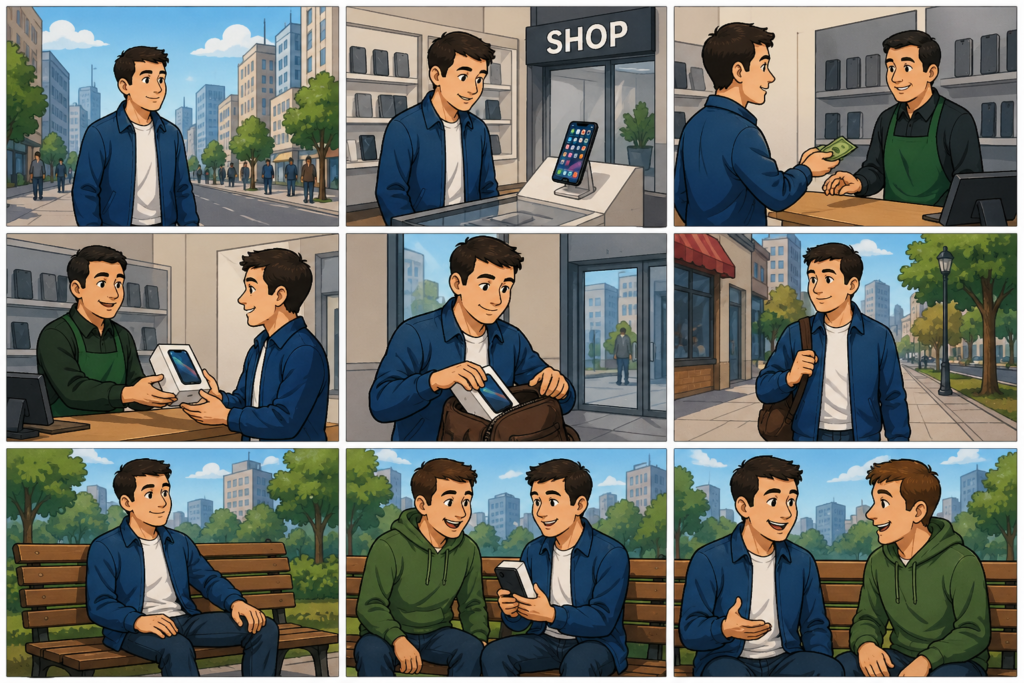
Story 1:
There __________ (be) a man in a city. He __________ (go) to a shop and __________ (see) a mobile phone. He __________ (want) it and __________ (pay) for it. The shopkeeper __________ (give) him the phone. The man __________ (take) it and __________ (put) it in his bag. He __________ (walk) outside and __________ (sit) on a bench. A friend __________ (come) and __________ (look at) the mobile phone. They both __________ (like) it and __________ (talk) aboout it. Both men __________ (be) happy.
———————————
Correct version:
There was a man in a city. He went to a shop and saw a mobile phone. He wanted it and paid for it. The shopkeeper gave him the phone. The man took it and put it in his bag. He walked outside and sat on a bench. A friend came and looked at the mobile phone. They both liked it and talked about it. Both men were happy.
###############
Story 2:
There __________ (be) a boy at school. He __________ (go) to the classroom. He __________ (see) the teacher. He __________ (sit) at his desk. He __________ (look) at the board. The teacher __________ (say) “Start.” The boy __________ (do) the test. He __________ (think) a little. He __________ (write) slowly. He __________ (hear) the clock. He __________ (stop). A boy __________ (point out) a mistake. He __________ (laugh). He __________ (change) it. He __________ (give) the paper to the teacher. The teacher __________ (read) it. He __________ (say) “Good.” The boy __________ (be) happy. He __________ (leave) the classroom.
——————————–
Correct version:
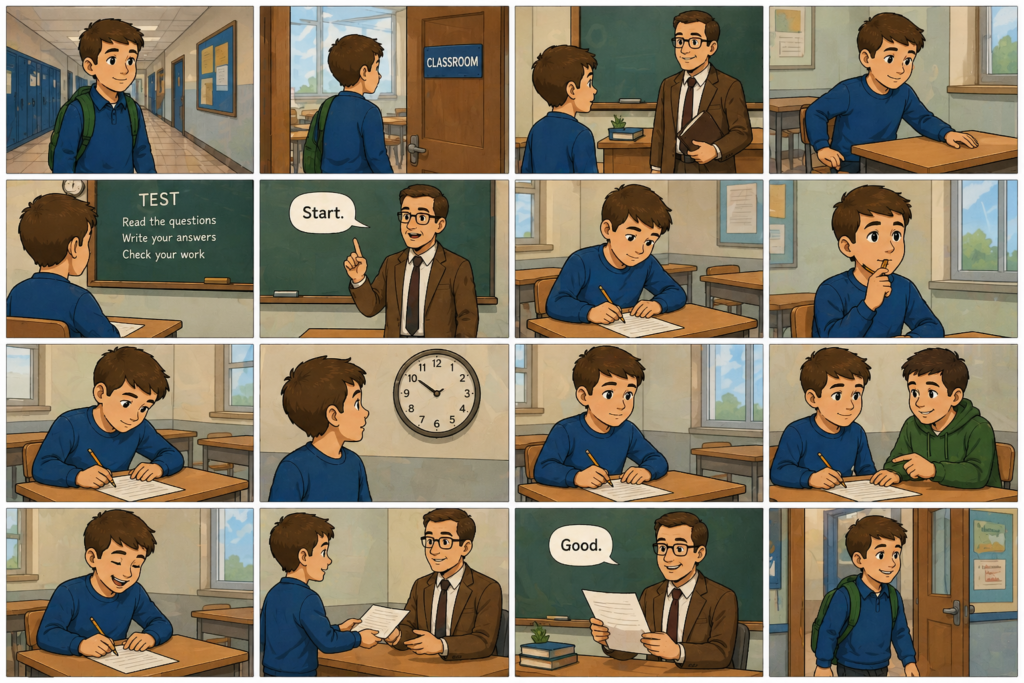
There was a boy at school. He went to the classroom. He saw the teacher. He sat at his desk. He looked at the board. The teacher said “Start.” The boy did the test. He thought a little. He wrote slowly. He heard the clock. He stopped. A boy pointed out a mistake. He laughed. He changed it. He gave the paper to the teacher. The teacher read it. He said “Good.” The boy was happy. He left the classroom.
################
Story 3:
There __________ (be) a football match. A boy __________ (go) to the stadium. He __________ (see) his friends. They __________ (sit) on the seats. The match __________ (start). The boy __________ (watch) the game. He __________ (hear) the crowd. His team __________ (do) well and __________ (take) the lead. The fans __________ (jump up) and __________ (laugh). The boy __________ (point) at the field. He __________ (look) at the players. The referee __________ (stop) the game for a moment. The boy __________ (think) about the game. Later the match __________ (end). The boy __________ (be) happy and __________ (leave) the stadium.
——————————–
Correct version:
There was a football match. A boy went to the stadium. He saw his friends. They sat on the seats. The match started. The boy watched the game. He heard the crowd. His team took the lead. The fans jumped up and laughed. The boy pointed at the field. He looked at the players. The referee stopped the game for a moment. The boy thought about the game. Later the match ended. The boy was happy and left the stadium.
################
Schreibe einen Kommentar