- her work for women
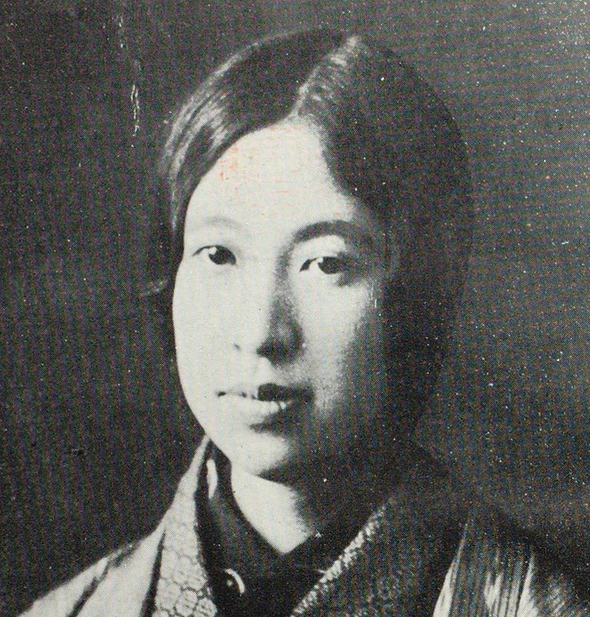
Raichō Hiratsuka was a woman from Japan. She wanted more rights for women.
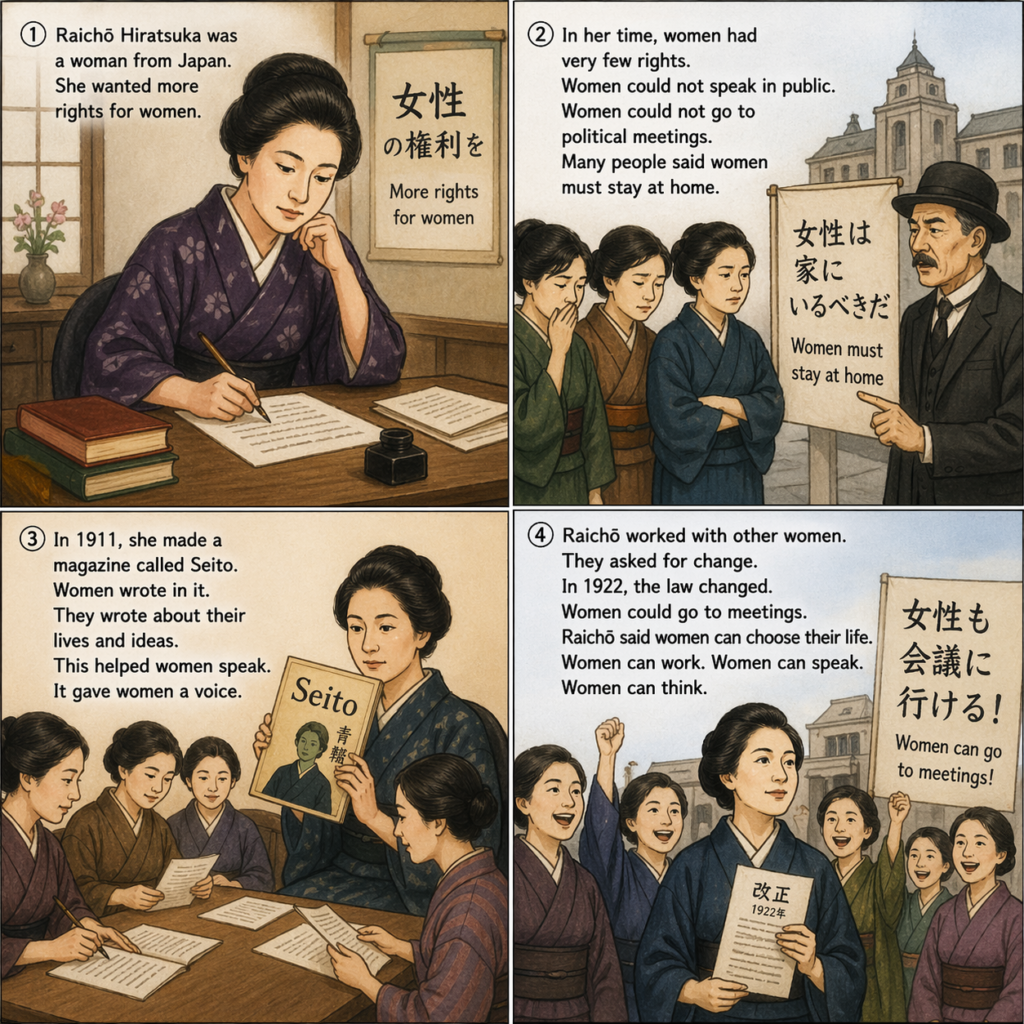
In her time, women had very few rights. Women could not speak in public. Women could not go to political meetings. Many people said women must stay at home. Raichō did not like this. She wanted change.
In 1911, she made a magazine called Seito. It was for women. Women wrote in it. They wrote about their lives and ideas. This helped women speak. It gave women a voice.
Raichō also worked to change the law. Women could not go to political meetings. Raichō worked with other women. They asked for change. They spoke and wrote.
In 1922, the law changed. Women could go to meetings. This was very good for women. Women could listen and talk about politics.
Raichō said women can choose their life. Women can work. Women can speak. Women can think.
She helped many women in Japan. She helped women have a voice and more rights.
___________________________
Vocabulary:
- a right – something you can do
- in public – in a place with other people
- a meeting – people come together and talk
- to stay at home – to be at home, not go out
- to want change – to want things to be different
- to give women a voice – to help women speak
- to change a law – to make a new law or make it different
- to ask for a change – to say “please change this”
- politics – ideas and talk about how a country works
- to choose – to pick what you want
###################
Basics in past simple:
Past Simple – Regular Verbs
Rules:
- Most verbs: add -ed
play → played - Verbs ending in -e: add -d
live → lived - Verbs ending in consonant + y: change y to i and add -ed
study → studied - Short verbs ending in vowel + consonant: double the final consonant and add -ed
stop → stopped - List of irregular verbs => LINK
Use:
The past simple is used to talk about finished actions in the past.
################
Verbs in text:
| Infinitive | Past Simple |
|---|---|
| be | was / were |
| can | could |
| want | wanted |
| have | had |
| say | said |
| stay | stayed |
| like | liked |
| make | made |
| write | wrote |
| help | helped |
| give | gave |
| work | worked |
| change | changed |
| go | went |
| listen | listened |
| talk | talked |
| ask | asked |
| speak | spoke |
| choose | chose |
| think | thought |
###################
Match the words with the definitions:
Words:
- a right
- in public
- a meeting
- to stay at home
- to want change [when something becomes different, or when you make something different]
- to give women a voice
- to change a law
- to ask for a change
- politics
- to choose
Definitions:
A. to say “please change this”
B. ideas and talk about how a country works
C. to be at home, not go out
D. something you can do
E. people come together and talk
F. to help women speak
G. to want things to be different
H. in a place with other people
I. to make a new law or make it different
J. to pick what you want
____________________
Answers:
1-D, 2-H, 3-E, 4-C, 5-G,
6-F, 7-I, 8-A, 9-B, 10-J
###############
Match the definitions with the words:
Words:
- ideas and talk about how a country works
- to be at home, not go out
- to pick what you want
- people come together and talk
- something you can do
- to make a new law or make it different
- in a place with other people
- when things become different or you make them different
- to say “please change this”
- to help women speak
Definitions:
A. to choose
B. a meeting
C. change
D. a right
E. politics
F. in public
G. to stay at home
H. to give women a voice
I. to change a law
J. to ask for a change
_____________________
Answers:
1-E, 2-G, 3-A, 4-B, 5-D,
6-I, 7-F, 8-C, 9-J, 10-H
###############
Fill in the correct form of the verb in past simple:
Raichō Hiratsuka __________(be) a writer from Japan.
She __________(want) more rights for women.
Women __________(have) few rights in her time.
Women __________(speak) in public.
Women __________(go) to political meetings.
Many people __________(say) women __________ (have) to stay at home.
Raichō __________(like) change.
She __________(want) change in society.
She __________(make) a magazine called Seito in 1911.
Women __________(write) in Seito magazine.
Women __________(write) about their lives.
The magazine __________(help) women speak.
Raichō __________(work) with other women.
She __________(ask) for changes in laws.
Women __________(join) her work for change.
In 1922, women __________(go) to meetings.
The law __________(change) in 1922.
Raichō __________(say) women __________ (have) to choose their life.
She __________(say) women __________(think) and __________(work) freely.
She __________(help) many women have more rights.
———————————–
Correct version:
- Raichō Hiratsuka was a writer from Japan.
- She wanted more rights for women.
- Women had few rights in her time.
- Women spoke in public.
- Women went to political meetings.
- Many people said women had to stay at home.
- Raichō liked change.
- She wanted change in society.
- She made a magazine called Seito in 1911.
- Women wrote in Seito magazine.
- Women wrote about their lives.
- The magazine helped women speak.
- Raichō worked with other women.
- She asked for changes in laws.
- Women joined her work for change.
- In 1922, women went to meetings.
- The law changed in 1922.
- Raichō said women had to choose their life.
- She said women thought and worked freely.
- She helped many women have more rights.
###############
True or false:
- To change a law means to make a law different or new.
- To stay at home means to travel to another country.
- In public means in a place with other people.
- Politics is ideas and talk about how a country works.
- A meeting is when people come together and talk.
- A right means something you are not allowed to do.
- To give women a voice means to stop women from speaking.
- To ask for a change means to forget about a problem.
- To choose means to pick what you want.
- Change means everything stays the same.
_______________
True: 1,3,4,5,9
###########
True or false:
- Raichō Hiratsuka was a writer from Japan.
- She helped create a magazine for women.
- The magazine Seito was made only for men.
- She worked for women’s rights in Japan.
- In 1922, women could go to political meetings in Japan.
- She wanted women to stay silent in public life.
- She did not support changes in laws for women.
- She believed women should have a voice.
- She worked alone and did not work with other women.
- She helped women have more rights and speak more freely.
__________________
True: 1,2,4,5,8,10
#############
Short answers, past simple, basics:
| Example Sentence | Yes | No |
|---|---|---|
| I learned letters. | Yes, I did. | No, I didn’t. |
| You read signs. | Yes, you did. | No, you didn’t. |
| He spoke English. | Yes, he did. | No, he didn’t. |
| She watched TV. | Yes, she did. | No, she didn’t. |
| It helped me. | Yes, it did. | No, it didn’t. |
| We used an app. | Yes, we did. | No, we didn’t. |
| You read words. | Yes, you did. | No, you didn’t. |
| They made mistakes. | Yes, they did. | No, they didn’t. |
Questions (Past Simple)
| Question | Yes | No |
|---|---|---|
| Did I learn letters? | Yes, I did. | No, I didn’t. |
| Did you read signs? | Yes, you did. | No, you didn’t. |
| Did he speak English? | Yes, he did. | No, he didn’t. |
| Did she watch TV? | Yes, she did. | No, she didn’t. |
| Did it help me? | Yes, it did. | No, it didn’t. |
| Did we use an app? | Yes, we did. | No, we didn’t. |
| Did you read words? | Yes, you did. | No, you didn’t. |
| Did they make mistakes? | Yes, they did. | No, they didn’t. |
Was / Were
| Question | Yes | No |
|---|---|---|
| Was I happy? | Yes, I was. | No, I wasn’t. |
| Were you happy? | Yes, you were. | No, you weren’t. |
| Was he happy? | Yes, he was. | No, he wasn’t. |
| Was she happy? | Yes, she was. | No, she wasn’t. |
| Was it good? | Yes, it was. | No, it wasn’t. |
| Were we happy? | Yes, we were. | No, we weren’t. |
| Were you happy? | Yes, you were. | No, you weren’t. |
| Were they happy? | Yes, they were. | No, they weren’t. |
#################
Short answers:
- Raichō Hiratsuka was a writer from Japan.
YOU WRITE:
Yes, she was. - Women could always speak in public.
- She made a magazine called Seito in 1911.
- Raichō worked only alone.
- Women had few rights in her time.
- The magazine stopped women from speaking.
- She wanted more rights for women.
- Men wrote in Seito magazine.
- Many people said women must stay at home.
- Raichō worked with other women.
- Women wrote in Seito magazine.
- She never asked for changes in laws.
- The magazine helped women speak.
- Raichō Hiratsuka was a farmer from Japan.
- She asked for changes in laws.
- Women had many rights in her time.
- Raichō made a magazine about food only.
- Women could not speak in public.
- She wanted to stop women from learning.
- People said women must always travel.
______________________
Answers:
- Raichō Hiratsuka was a writer from Japan. – Yes, she was.
- Women could always speak in public. – No, they couldn’t.
- She made a magazine called Seito in 1911. – Yes, she did.
- Raichō worked only alone. – No, she didn’t.
- Women had few rights in her time. – Yes, they did.
- The magazine stopped women from speaking. – No, it didn’t.
- She wanted more rights for women. – Yes, she did.
- Men wrote in Seito magazine. – No, they didn’t.
- Many people said women must stay at home. – Yes, they did.
- Raichō worked with other women. – Yes, she did.
- Women wrote in Seito magazine. – Yes, they did.
- She never asked for changes in laws. – No, she didn’t.
- The magazine helped women speak. – Yes, it did.
- Raichō Hiratsuka was a farmer from Japan. – No, she wasn’t.
- She asked for changes in laws. – Yes, she did.
- Women had many rights in her time. – No, they didn’t.
- Raichō made a magazine about food only. – No, it wasn’t.
- Women could not speak in public. – Yes, they did.
- She wanted to stop women from learning. – No, she didn’t.
- People said women must always travel. – No, they didn’t.
################
Answer as shown:
- Raichō Hiratsuka was a queen from Japan.
YOU WRITE:
No, she wasn’t. She was a writer in Japan. - She wanted to stop women from writing and speaking.
- Women had full rights in her time.
- Women could always go to political meetings.
- Seito magazine was written only by men.
- The magazine was about cooking and fashion only.
- Raichō worked only as a teacher in a school.
- She did not care about women’s rights.
- Women did not write in Seito magazine.
- Raichō said women should not have a voice.
_____________________
Answers:
- No, she wasn’t. Raichō Hiratsuka was a writer in Japan.
- No, she didn’t. She wanted more rights for women.
- No, they didn’t. Women had few rights in her time.
- No, they couldn’t. Women could not always go to political meetings.
- No, it wasn’t. Seito magazine was written by women.
- No, it wasn’t. The magazine was for women’s ideas and lives.
- No, she didn’t. She was a writer and activist for women’s rights.
- No, she didn’t. She worked for women’s rights.
- No, they did. Women wrote in Seito magazine.
- No, she didn’t. Raichō said women should have a voice.
##############
Past simple – basics
| Personal Pronoun | Verb (Past) | Object |
|---|---|---|
| I | ate | apples |
| You | ate | apples |
| He | ate | apples |
| She | ate | apples |
| It | ate | apples |
| We | ate | apples |
| You (plural) | ate | apples |
| They | ate | apples |
| I | played | football |
| You | played | football |
| He | played | football |
| She | played | football |
| It | played | football |
| We | played | football |
| You (plural) | played | football |
| They | played | football |
| Personal Pronoun | Verb (Past Negative) | Object |
|---|---|---|
| I | did not eat | apples |
| You | did not eat | apples |
| He | did not eat | apples |
| She | did not eat | apples |
| It | did not eat | apples |
| We | did not eat | apples |
| You (plural) | did not eat | apples |
| They | did not eat | apples |
| I | did not play | football |
| You | did not play | football |
| He | did not play | football |
| She | did not play | football |
| It | did not play | football |
| We | did not play | football |
| You (plural) | did not play | football |
| They | did not play | football |
| Did + Pronoun | Verb | Object |
|---|---|---|
| Did I | eat | apples? |
| Did you | eat | apples? |
| Did he | eat | apples? |
| Did she | eat | apples? |
| Did it | eat | apples? |
| Did we | eat | apples? |
| Did you | eat | apples? |
| Did they | eat | apples? |
| Did I | play | football? |
| Did you | play | football? |
| Did he | play | football? |
| Did she | play | football? |
| Did it | play | football? |
| Did we | play | football? |
| Did you | play | football? |
| Did they | play | football? |
| Didn’t + Pronoun | Verb | Object |
|---|---|---|
| Didn’t I | eat | apples? |
| Didn’t you | eat | apples? |
| Didn’t he | eat | apples? |
| Didn’t she | eat | apples? |
| Didn’t it | eat | apples? |
| Didn’t we | eat | apples? |
| Didn’t you | eat | apples? |
| Didn’t they | eat | apples? |
| Didn’t I | play | football? |
| Didn’t you | play | football? |
| Didn’t he | play | football? |
| Didn’t she | play | football? |
| Didn’t it | play | football? |
| Didn’t we | play | football? |
| Didn’t you | play | football? |
| Didn’t they | play | football? |
Forms of ‚to be‘
| Personal Pronoun | Positive | Negative | Question |
|---|---|---|---|
| I | I was happy. | I was not happy. | Was I happy? |
| You (singular) | You were excited. | You were not excited. | Were you excited? |
| He | He was at home. | He was not at home. | Was he at home? |
| She | She was tired. | She was not tired. | Was she tired? |
| It | It was cold. | It was not cold. | Was it cold? |
| We | We were at the party. | We were not at the party. | Were we at the party? |
| You (plural) | You were friends. | You were not friends. | Were you friends? |
| They | They were in the garden. | They were not in the garden. | Were they in the garden? |
##############
Answer in full sentences:
- Was Raichō Hiratsuka a writer or a queen in Japan?
- Did she want to support men or women?
- Did women have many rights or few rights in her time?
- Could women speak in public or not speak in public?
- Did women go to political meetings or stay at home?
- Was Seito a magazine or a book?
- Did women or men write in Seito magazine?
- Did the magazine help women speak or stop women speaking?
- Did Raichō work alone or with other women?
- Did she ask for changes in laws or ignore laws?
- In 1922, did women go to meetings or stay away from meetings?
- Did Raichō want women to have a voice or no voice?
- Did she support women’s rights or stop women’s rights?
- Did Raichō help many women or few women?
____________________
Correct answers:
- Was Raichō Hiratsuka a writer or a queen in Japan? – She was a writer in Japan, not a queen.
- Did she want to support men or women? – She wanted to support women.
- Did women have many rights or few rights in her time? – Women had few rights in her time.
- Could women speak in public or not speak in public? – Women could not speak in public.
- Did women go to political meetings or stay at home? – Women stayed at home and did not go to political meetings.
- Was Seito a magazine or a book? – Seito was a magazine.
- Did women or men write in Seito magazine? – Women wrote in Seito magazine.
- Did the magazine help women speak or stop women speaking? – The magazine helped women speak.
- Did Raichō work alone or with other women? – She worked with other women.
- Did she ask for changes in laws or ignore laws? – She asked for changes in laws.
- In 1922, did women go to meetings or stay away from meetings? – Women went to meetings.
- Did Raichō want women to have a voice or no voice? – She wanted women to have a voice.
- Did she support women’s rights or stop women’s rights? – She supported women’s rights.
- Did Raichō help many women or few women? – She helped many women.
#################
Make the following sentences negative:
- Raichō Hiratsuka was a queen from Japan.
YOU WRITE:
Raichō Hiratsuka was not a queen from Japan. - She wanted to stop women from speaking in public.
- Women had full rights in her time.
- Women could always go to political meetings.
- Seito magazine was written only by men.
- The magazine was about cooking only.
- Raichō worked only as a farmer.
- She did not support women’s rights.
- Women did not write in Seito magazine.
- Raichō said women should not have a voice.
- Women were free to vote in all elections at that time.
- Raichō ignored problems about women in society.
- Seito was a newspaper about sports only.
- Raichō believed women should not read or learn.
________________________
Correct version:
- Raichō Hiratsuka was not a queen from Japan.
- She did not want to stop women from speaking in public.
- Women did not have full rights in her time.
- Women could not always go to political meetings.
- Seito magazine was not written only by men.
- The magazine was not about cooking only.
- Raichō did not work only as a farmer.
- She did support women’s rights.
- Women did write in Seito magazine.
- Raichō did not say women should not have a voice.
- Women were not free to vote in all elections at that time.
- Raichō did not ignore problems about women in society.
- Seito was not a newspaper about sports only.
- Raichō did not believe women should not read or learn.
#################
Answer as shown:
1.Was Raichō Hiratsuka a queen from Japan?
2.Did she want to stop women from speaking in public?
3.Did women have full rights in her time?
4.Could women always go to political meetings?
5.Was Seito magazine written by men?
6.Was the magazine about cooking?
7.Did Raichō work as a farmer?
8.Did she support women’s rights?
9.Did women write in Seito magazine?
10.Did Raichō say women should not have a voice?
11.Were women free to vote in all elections at that time?
12.Did Raichō ignore problems about women in society?
13.Was Seito a newspaper about sports?
14.Did Raichō believe women should not read or learn?
______________________
Correct answers:
- Was Raichō Hiratsuka a queen from Japan?
- Did she want to stop women from speaking in public?
- Did women have full rights in her time?
- Could women always go to political meetings?
- Was Seito magazine written by men?
- Was the magazine about cooking?
- Did Raichō work as a farmer?
- Did she support women’s rights?
- Did women write in Seito magazine?
- Did Raichō say women should not have a voice?
- Were women free to vote in all elections at that time?
- Did Raichō ignore problems about women in society?
- Was Seito a newspaper about sports?
- Did Raichō believe women should not read or learn?
#################
Form questions to which the word/s is/are the answer:
- Raichō Hiratsuka was a writer in Japan.
a) Raichō Hiratsuka
b) a writer
c) in Japan - She wanted more rights for women.
a) She
b) wanted more rights for women:
c) more rights - Women had few rights in her time.
a) Women:
b) few rights:
d) in her time:
e) her: - She made a magazine called Seito.
a) She:
b) made a magazine called Seito
c) a magazine - The magazine helped women speak.
a) The magazine:
b) women:
6. Women wrote in Seito magazine.
a) Women:
b) wrote in Seito magazine:
c) in Seito magazine:
d) Seito:
________________________
Correct version:
- Raichō Hiratsuka was a writer in Japan.
a) Who was a writer from Japan?
b) What was she?
c) Where was she a writer ? - She wanted more rights for women.
a) Who wanted more rights for women?
b) What did she do for women?
c) What did she want for women? - Women had few rights in her time.
a) Who had few rights?
b) What did women have?
d) When did they have few rights?
e) In whose time did they have few rights? - She made a magazine called Seito.
a) Who made a magazine called Seito?
b) What did she do?
c) What did she make? - The magazine helped women speak.
a) What helped women speak?
b) Who did the magazine help speak? - Women wrote in Seito magazine.
a) Who wrote in Seito magazine?
b) What did women do in Seito magazine?
c) Where did women write?
d) In which magazine did women write?
################
Fill in, words below:
called – rights – changes – meetings – changed –
gave – wrote – voice -choose –
women – stay
Raichō Hiratsuka was a woman from Japan.
She wanted more rights for __________.
In her time, women had few __________.
Women could not speak in public.
Women could not go to political __________ .
Many people said women must _________ at home.
She did not like this.
She wanted change.
In 1911, she made a magazine __________ Seito.
Women wrote in the magazine.
They __________ about their lives and ideas.
This helped women speak.
It gave them a __________.
She worked with other women.
They asked for__________ in the law.
In 1922, the law __________.
Women could go to meetings.
She said women can __________, think, and work freely.
She helped many women in Japan.
She __________ them more rights and a stronger voice.
—————————————
Correct version:
Raichō Hiratsuka was a woman from Japan.
She wanted more rights for women.
In her time, women had few rights.
Women could not speak in public.
Women could not go to political meetings.
Many people said women must stay at home.
She did not like this.
She wanted change.
In 1911, she made a magazine called Seito.
Women wrote in the magazine.
They wrote about their lives and ideas.
This helped women speak.
It gave them a voice.
She worked with other women.
They asked for changes in the law.
In 1922, the law changed.
Women could go to meetings.
She said women can choose, think, and work freely.
She helped many women in Japan.
She gave them more rights and a stronger voice.
################
Interview – just listen:
- Q: Who was Raichō Hiratsuka?
A: She was a woman from Japan and a writer. - Q: Did she want more rights for women?
A: Yes, she wanted more rights for women. - Q: What was life like for women in her time?
A: Women had few rights in her time. - Q: Could women speak in public?
A: No, women could not speak in public. - Q: Could women go to political meetings?
A: No, women could not go to political meetings. - Q: What did many people say about women?
A: Many people said women must stay at home. - Q: Did Raichō like this situation?
A: No, she did not like this situation. - Q: What did she want?
A: She wanted change. - Q: What did she make in 1911?
A: She made a magazine called Seito. - Q: Who wrote in Seito magazine?
A: Women wrote in Seito magazine. - Q: What did women write about?
A: They wrote about their lives and ideas. - Q: Did the magazine help women?
A: Yes, it helped women speak. - Q: Did she work alone?
A: No, she worked with other women. - Q: What changed in 1922?
A: Women could go to political meetings.
Schreibe einen Kommentar