- How R.A. Kartini’s ideas about education and equality improved the position of women in society and their rights
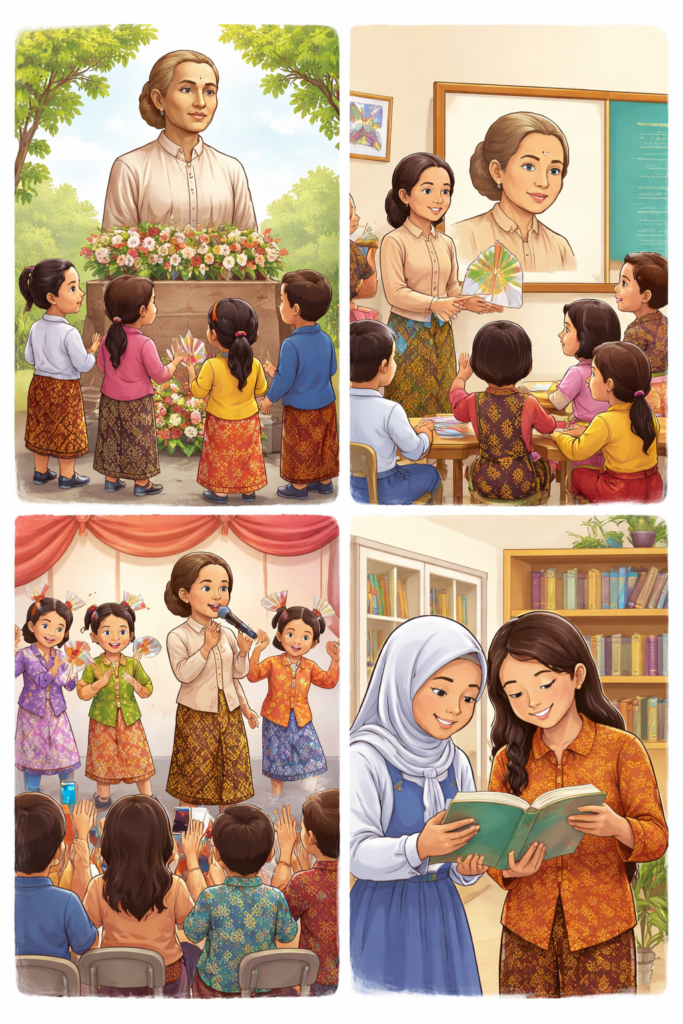
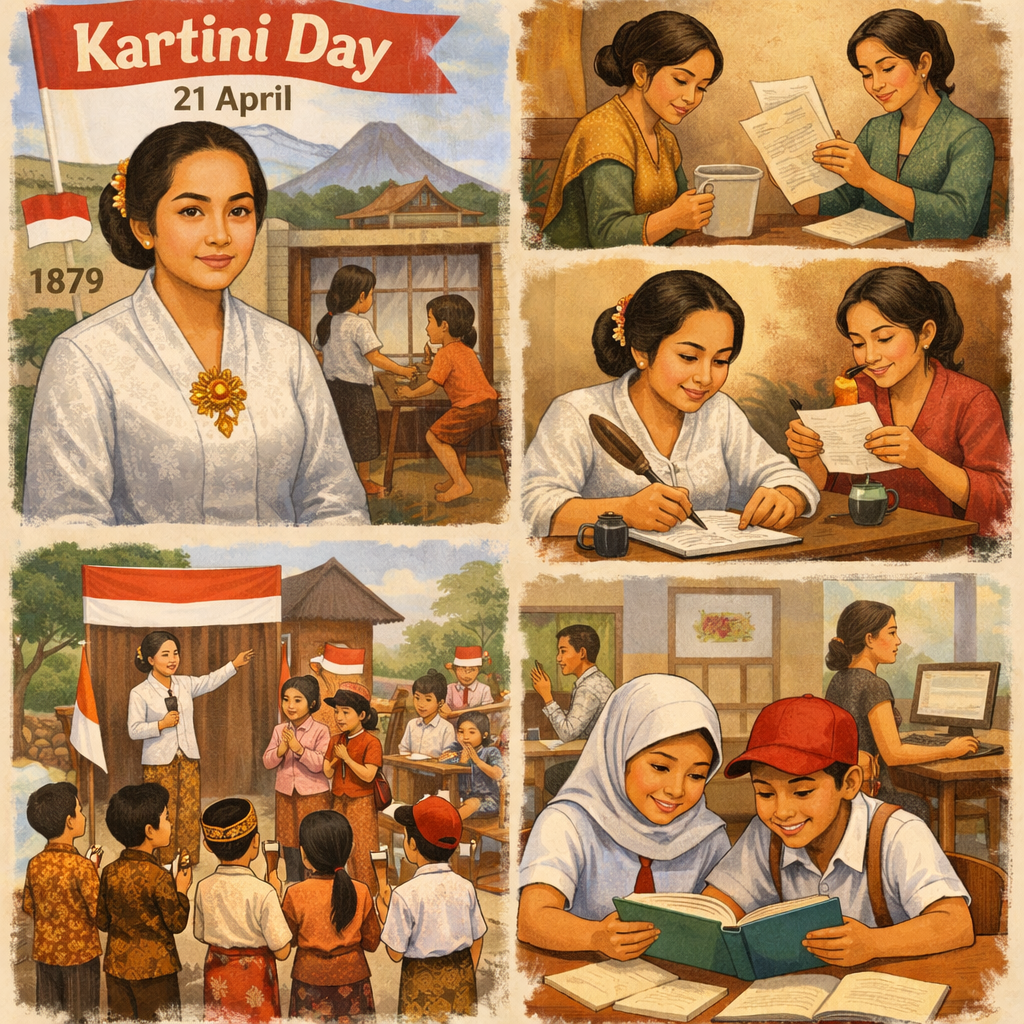
Kartini Day is in Indonesia. It is on 21 April every year. It is not a public holiday, but schools have activities.
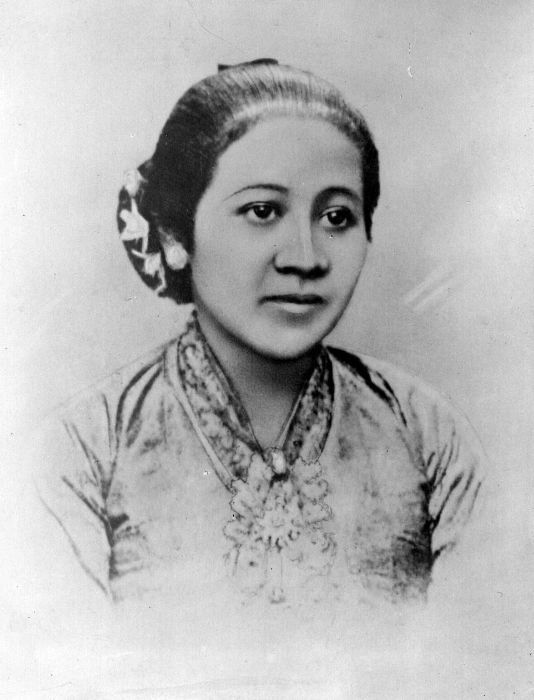
Kartini Day is for Raden Ajeng Kartini. She was born in 1879 in Java. She is known for helping women in Indonesia.
In the past, many girls did not go to school. Women stayed at home. Women had few rights. Life was not easy for women.
Kartini wanted girls to go to school. She said women should learn. She said education is important for girls. She wrote letters about her ideas. People read her letters.
Kartini’s ideas were important. They helped people think about women in a new way. Women started to have more chances.
Today, Kartini Day is in schools. Students wear traditional clothes. They join school ceremonies. Teachers talk about Kartini. Students also sing songs and do simple performances.
Today, girls can go to school in Indonesia. Women can study and work. Life is better for women now.
Kartini Day is a special day. It is about education and women. It reminds people about Kartini and her work. It also shows that girls and boys can learn.
________________________
Vocabulary:
- education → learning at school
- equality → when people are the same and treated the same
- to improve → to make something better
- rights → things people can do or have
- to stay at home → to be at home, not go out
- to wear clothes → to have clothes on your body
- traditional → old and from the past
- to join ceremonies → to go to and take part in special events
- a performance → when people sing, dance, or act for others
- to remind somebody → to help someone remember something
#################
Verbs in text – regular, irregular
| Infinitive | Past | Past Participle |
|---|---|---|
| be | was / were | been |
| bear | bore | borne |
| know | knew | known |
| do | did | done |
| go | went | gone |
| have | had | had |
| help | helped | helped |
| stay | stayed | stayed |
| want | wanted | wanted |
| say | said | said |
| learn | learned | learned |
| write | wrote | written |
| read | read | read |
| think | thought | thought |
| start | started | started |
| wear | wore | worn |
| join | joined | joined |
| talk | talked | talked |
| sing | sang | sung |
| remind | reminded | reminded |
| show | showed | shown |
| can | could | had been able |
#################
Basics in past simple:
Past Simple –
- Regular Verbs:
- Most verbs: add -ed
play → played - Verbs ending in -e: add -d
live → lived - Verbs ending in consonant + y: change y to i and add -ed
study → studied - Short verbs ending in vowel + consonant: double the final consonant and add -ed
stop → stopped - List of irregular verbs => LINK
Use:
The past simple is used to talk about finished actions in the past.
#################
Match the words with the definitions:
Words:
- education
- equality
- to improve
- rights
- to stay at home
- to wear clothes
- traditional
- to join ceremonies
- a performance
- to remind somebody
Definitions:
A. to help someone remember something
B. learning at school
C. to go to and take part in special events
D. when people sing, dance, or act for others
E. things people can do or have
F. to make something better
G. old and from the past
H. to be at home, not go out
I. to have clothes on your body
J. when people are the same and treated the same
_______________________
Answers: 1–B, 2–J, 3–F, 4–E, 5–H,
6–I, 7–G, 8–C, 9–D, 10–A
#################
Match the definitions with the words:
Definitions:
A. to make something better
B. to have clothes on your body
C. learning at school
D. to help someone remember something
E. when people are the same and treated the same
F. to be at home, not go out
G. things people can do or have
H. old and from the past
I. when people sing, dance, or act for others
J. to go to and take part in special events
Words:
- education
- equality
- to improve
- rights
- to stay at home
- to wear clothes
- traditional
- to join ceremonies
- a performance
- to remind somebody
_________________________
Answers:
A–3, B–6, C–1, D–10, E–2,
F–5, G–4, H–7, I–9, J–8
##################
True or false:
- Kartini Day is not a public holiday.
- Kartini Day is only for teachers.
- Kartini Day is celebrated in Indonesia.
- Students can sing songs.
- Kartini wanted girls to stay at home.
- Kartini is an important historical person.
- Kartini Day is in December.
- Women today can work and study.
- There are no ceremonies in schools.
- She spoke about women’s education.
- People did not read Kartini’s ideas.
- Schools have special activities on this day.
- Kartini did not write anything.
- The day shows that education is important for everyone.
- Students wear school uniforms on Kartini Day.
- Teachers talk about Kartini in class.
- Women had many rights in the past.
- Her ideas changed how people think.
- Kartini Day is not important today.
- Boys cannot learn on Kartini Day.
____________________________
True: 1,3,4,6,8,10,12,14,16,18
####################
Short answers:
- When is Kartini Day?
- Where is Kartini Day celebrated?
- Is Kartini Day a public holiday?
- Who is Kartini?
- Where was Kartini born?
- When was Kartini born?
- What did Kartini help women with?
- Why did Kartini’s ideas become important?
- What problem did girls have in the past?
- Where did many women stay in the past?
- What did Kartini want for girls?
- How did Kartini share her ideas?
- Who read Kartini’s letters?
- Why did Kartini write letters?
- What do students wear on Kartini Day?
- What do students do at school on Kartini Day?
- How do teachers teach about Kartini?
- What can women do today in Indonesia?
- Why is Kartini Day important today?
- What is Kartini Day about?
__________________
Answers:
- When is Kartini Day? – 21 April
- Where is Kartini Day celebrated? – Indonesia
- Is Kartini Day a public holiday? – No
- Who is Kartini? – Indonesian woman, women’s rights
- Where was Kartini born? – Java
- When was Kartini born? – 1879
- What did Kartini help women with? – education, rights
- Why did Kartini’s ideas become important? – changed thinking, women
- What problem did girls have in the past? – no school, few rights
- Where did many women stay in the past? – at home
- What did Kartini want for girls? – education, school
- How did Kartini share her ideas? – letters
- Who read Kartini’s letters? – people
- Why did Kartini write letters? – ideas, education
- What do students wear on Kartini Day? – traditional clothes
- What do students do at school on Kartini Day? – ceremonies, performances
- How do teachers teach about Kartini? – talk, explain Kartini
- What can women do today in Indonesia? – study, work
- Why is Kartini Day important today? – remember Kartini, education
- What is Kartini Day about? – women, education
################
Odd [different from others in a group] one out :
- education – school – letters – hospital
- women – girls – teachers – apples
- ceremony – performance – football – songs
- Java – Indonesia – Bali – school
- Kartini – letters – football – education
- students – teachers – books – bananas
- traditional – modern – clothes – banana
- rights – equality – education – pizza
- school – classroom – ceremony – elephant
- Indonesia – Kartini – Europe – Java
________________________
Correct version:
1. education – school – letters – hospital
Odd one out: hospital
→ The others are related to learning or communication in education.
2. women – girls – teachers – apples
Odd one out: apples
→ The others are people.
3. ceremony – performance – football – songs
Odd one out: football
→ The others are school/cultural activities.
4. Java – Indonesia – Bali – school
Odd one out: school
→ The others are places (islands/country).
5. Kartini – letters – football – education
Odd one out: football
→ The others relate to Kartini and education.
6. students – teachers – books – bananas
Odd one out: bananas
→ The others are related to school.
7. traditional – modern – clothes – banana
Odd one out: banana
→ The others describe style or clothing.
8. rights – equality – education – pizza
Odd one out: pizza
→ The others are social/learning concepts.
9. school – classroom – ceremony – elephant
Odd one out: elephant
→ The others are related to school life.
10. Indonesia – Kartini – Europe – Java
Odd one out: Kartini
→ The others are places; Kartini is a person.
####################
Fill in, words below:
education – improve – equality – celebrated –
ceremonies – activities – important –
rights – letters
- Kartini Day is __________ in Indonesia on 21 April.
- It is not a public holiday, but schools have special __________.
- Kartini was an __________ woman from Java, born in 1879.
- She is known for helping women and supporting _________ and equality.
- In the past, many girls did not go to school and women had few __________.
- Kartini wanted girls to learn and __________ their lives.
- She wrote __________ about her ideas, and people read them.
- Today, students wear traditional clothes, join __________, and take part in performances.
- Kartini Day reminds people about education, rights, and __________ for women and girls.
___________________________
Correct version:
- Kartini Day is celebrated in Indonesia on 21 April.
- It is not a public holiday, but schools have special activities.
- Kartini was an important woman from Java, born in 1879.
- She is known for helping women and supporting education and equality.
- In the past, many girls did not go to school and women had few rights.
- Kartini wanted girls to learn and improve their lives.
- She wrote letters about her ideas, and people read them.
- Today, students wear traditional clothes, join ceremonies, and take part in performances.
- Kartini Day reminds people about education, rights, and equality for women and girls.
#################
Match the questions with the answers:
Questions:
- When is Kartini Day?
- Where was Kartini born?
- Who is Kartini?
- What was life like for girls in the past?
- Where did women stay in the past?
- What did Kartini want for girls?
- What did Kartini write?
- Why are her ideas important?
- What do students do on Kartini Day?
- What is Kartini Day about?
- How do students take part in Kartini Day?
- What do teachers do on Kartini Day?
- What changed because of Kartini?
- Why is Kartini remembered today?
Answers:
a. School was her hope for girls.
b. Women now have more opportunities.
c. The date is 21 April in Indonesia.
d. Her work for education and women is still valued [to be important and liked by people].
e. Singing and performances take place in schools.
f. Many girls had no school.
g. Kartini’s life is taught in class.
h. Traditional clothes and ceremonies happen at school.
i. Letters were used for her ideas.
j. She is a woman who helps women in Indonesia.
k. Women are now seen in a new way.
l. Java was her birthplace in 1879.
m. Education and women are the focus [to be the most important thing].
n. Their home was the main place for them.
_______________________
Answers:
1-c, 2-l, 3-j, 4-f, 5-n, 6-a, 7-i, 8-k,
9-h, 10-m, 11-e, 12-g, 13-b, 14-d
_______________________
Full version:
Interview with a historian about Kartini
1. Interviewer: When is Kartini Day?
Historian: The date is 21 April in Indonesia.
2. Interviewer: Where was Kartini born?
Historian: Java was her birthplace in 1879.
3. Interviewer: Who is Kartini?
Historian: She is a woman who helps women in Indonesia.
4. Interviewer: What was life like for girls in the past?
Historian: Many girls had no school.
5. Interviewer: Where did women stay in the past?
Historian: Their home was the main place for them.
6. Interviewer: What did Kartini want for girls?
Historian: School was her hope for girls.
7. Interviewer: What did Kartini write?
Historian: Letters were used for her ideas.
8. Interviewer: Why are her ideas important?
Historian: Women are now seen in a new way.
9. Interviewer: What do students do on Kartini Day?
Historian: Traditional clothes and ceremonies happen at school.
10. Interviewer: What is Kartini Day about?
Historian: Education and women are the focus.
11. Interviewer: How do students take part in Kartini Day?
Historian: Singing and performances take place in schools.
12. Interviewer: What do teachers do on Kartini Day?
Historian: Kartini’s life is taught in class.
13. Interviewer: What changed because of Kartini?
Historian: Women now have more opportunities.
14. Interviewer: Why is Kartini remembered today?
Historian: Her work for education and women is still valued.
##################
Fill in the correct form of the verb in brackets in past simple:
Two weeks ago __________ (be) Kartini Day in Indonesia. It __________ (be) on 21 April. It __________ (be) not a public holiday, but schools __________ (have) activities.
Kartini Day __________ (be) for Raden Ajeng Kartini. She __________ (be born) in 1879 in Java. She __________ (be known) for helping women in Indonesia.
In the past, many girls __________ (do) not go to school. Women __________ (stay) at home. Women __________ (have) few rights. Life __________ (be) not easy for women.
Kartini __________ (want) girls to go to school. She __________ (write) letters. People __________ (read) her letters.
Her ideas __________ (be) important. They __________ (help) people think about women in a new way. Women __________ (start) to have more chances.
Yesterday, students __________ (go) to school. They __________ (wear) traditional clothes. They __________ (join) school ceremonies. Teachers __________ (talk) about Kartini. Students __________ (sing) songs and __________ (do) simple performances.
Girls and boys __________ (learn) together. It __________ (be) a special day about education and women.
——————————
Correct version:
Two weeks ago was Kartini Day in Indonesia. It was on 21 April. It was not a public holiday, but schools had activities.
Kartini Day was for Raden Ajeng Kartini. She was born in 1879 in Java. She was known for helping women in Indonesia.
In the past, many girls did not go to school. Women stayed at home. Women had few rights. Life was not easy for women.
Kartini wanted girls to go to school. She wrote letters. People read her letters.
Her ideas were important. They helped people think about women in a new way. Women started to have more chances.
Yesterday, students went to school. They wore traditional clothes. They joined school ceremonies. Teachers talked about Kartini. Students sang songs and did simple performances.
Girls and boys learned together. It was a special day about education and women.
Schreibe einen Kommentar