- if you are not familiar with numbers, do NUMBERS first
| Deutsch | English | Simple definition |
|---|---|---|
| (93) | ||
| Wie spät ist es? | What’s the time? | You ask for the time |
| senden | to send | to give something to someone |
| reiten / fahren | to ride | to sit on and go |
| spielen | to play | to have fun |
| ein Skateboard | a skateboard | a board with wheels |
| anschauen | to watch | to look at something |
| skaten | to skate | to move on skates |
| kochen | to cook | to make food |
| machen | to make | to create something |
| ein Pferd | a horse | a big animal |
| Computerspiele | computer games | games on a computer |
| ein Fahrrad | a bike | you ride it |
| ein Klavier | a piano | a music instrument |
| ein Video | a video | moving pictures |
| eine Textnachricht | a text message | short phone message |
| Fußball | football | a game with a ball |
| (94) | ||
| Freizeitaktivität | free time activity | fun activity |
| wahr sein | to be true | it is correct |
| (95) | ||
| lesen | to read | look at words |
| trinken | to drink | have water |
| eine Zeitung | a newspaper | paper with news |
| Skateboard fahren | to skateboard | ride a skateboard |
| (96) | ||
| Musik hören | to listen to music | hear songs |
| Spaß haben | to have fun | feel happy |
| ein schlimmer Tag | a terrible day | very bad day |
| Kannst du zu mir kommen? | Can you come to my place? | ask someone to visit |
| (97) | ||
| Tagesablauf | daily routine | things every day |
| Komm schnell her! | Get here soon! | come fast |
| kaputt sein | to be broken | not working |
| morgens aufstehen | to get up in the morning | leave bed |
| Sachen packen | to pack things | put in a bag |
| gehen / verlassen | to leave | go away |
| Hausaufgaben machen | to do one’s homework | school work |
| normalerweise | usually | most days |
| ins Bett gehen | to go to bed | go to sleep |
| (98) | ||
| ankommen | to arrive | come to a place |
| ein Regenschirm | an umbrella | keeps you dry |
| Angst haben | to be scared | feel afraid |
| plötzlich | suddenly | very fast |
| Das Telefon klingelt | the phone is ringing | phone is making a sound |
| (99) | ||
| sich beeilen | to hurry | go fast |
| nur eine Minute | just a minute | short time |
| eine Tasche finden | to find a bag | see and get it |
| (100) | ||
| Roller fahren | to ride a scooter | ride a small vehicle |
| skaten | to skate | move on skates |
| Snowboard fahren | to snowboard | ride on snow |
| (101) | ||
| Freizeit | free time | time for fun |
| täglich | daily | every day |
| Wie spät ist es? | What’s the time? | ask the time |
| Entschuldigung | Excuse me | polite word |
| sich beeilen | to hurry | go fast |
| eine Uhr | a clock | shows time |
| Schlafenszeit | bedtime | time to sleep |
| eine Pause | a break | short rest |
| eine Übung | an exercise | practice |
| draußen | outside | not inside |
| draußen schneien | to snow outside | snow falls |
| lernen | to study | learn |
| jemanden aufwecken | to wake somebody up | stop sleeping |
| unglaublich | amazing | very good |
| die Tür öffnen | to answer the door | open door |
| ein Busch | a bush | small plant |
| sich verstecken | to hide | not be seen |
| an die Tür klopfen | to knock at the door | hit the door |
| ein Wohnzimmer | a living room | room with sofa |
| eine Überraschung | a surprise | not expected |
| schieben | to push | move with hands |
| kochen | to cook | make food |
| eine Textnachricht | a text message | phone message |
| aufpassen auf | to look after | take care |
| eine Straße | a road | cars drive |
| ein Ort (Zuhause) | a place (home) | where you live |
| ein Hinweis | a clue | helps find |
| Bis bald | See you soon | goodbye |
| das Wetter | weather | sun, rain |
| eine halbe Stunde | half an hour | 30 minutes |
| eine Viertelstunde | a quarter of an hour | 15 minutes |
| drei Viertelstunden | three quarters of an hour | 45 minutes |
| genau zur vollen Stunde | on the hour | exact time |
| Beeil dich! | to hurry up | go faster |
#######################
What time is it?
- It is quarter past two.
YOU WRITE:
2:15 - It is half past eight.
YOU WRITE:
8:30 - It is quarter to nine.
___________________ - It is twenty past seven.
___________________ - It is ten to four.
___________________ - It is five to one.
___________________ - It is half past five.
___________________ - It is quarter past ten.
___________________ - It is twenty-five past three.
___________________ - It is quarter to twelve.
___________________ - It is five past twelve.
___________________ - It is twenty to six.
___________________ - It is half past eleven.
___________________ - It is quarter past six.
___________________ - It is five past three.
___________________ - It is ten past eleven.
___________________ - It is twenty-five to eight.
___________________ - It is quarter to one.
___________________ - It is half past two.
___________________ - It is twenty past nine.
___________________ - It is ten to seven.
___________________ - It is quarter past four.
___________________ - It is five to ten.
___________________ - It is twenty-five past six.
___________________ - It is half past three.
___________________ - It is quarter to eight.
___________________ - It is five past nine.
___________________ - It is twenty past twelve.
___________________ - It is ten past five.
___________________ - It is quarter to three.
___________________
——————————
Correct answers:
- It is quarter past two — 2:15
- It is half past eight — 8:30
- It is quarter to nine — 8:45
- It is twenty past seven — 7:20
- It is ten to four — 3:50
- It is five to one — 12:55
- It is half past five — 5:30
- It is quarter past ten — 10:15
- It is twenty-five past three — 3:25
- It is quarter to twelve — 11:45
- It is five past twelve — 12:05
- It is twenty to six — 5:40
- It is half past eleven — 11:30
- It is quarter past six — 6:15
- It is five past three — 3:05
- It is ten past eleven — 11:10
- It is twenty-five to eight — 7:35
- It is quarter to one — 12:45
- It is half past two — 2:30
- It is twenty past nine — 9:20
- It is ten to seven — 6:50
- It is quarter past four — 4:15
- It is five to ten — 9:55
- It is twenty-five past six — 6:25
- It is half past three — 3:30
- It is quarter to eight — 7:45
- It is five past nine — 9:05
- It is twenty past twelve — 12:20
- It is ten past five — 5:10
- It is quarter to three — 2:45
###############
PRESENT CONTINUOUS
1. When to use it (Present Continuous = “-ing” form)
We use the present continuous to talk about things that are happening right now, at the moment of speaking, at this moment.
Examples:
- I am eating. (I am eating now.)
- She is reading a book. (She is reading now.)
- They are playing football. (They are playing now.)
2. How to form it
Formula:
Subject + be + verb + -ing
Step 1: Use the right form of be
- I → am
- He / She / It → is
- You / We / They → are
Step 2: Add verb + -ing
3. How to make -ing verbs (rules)
- Normal verbs: just add -ing
- eat → eating
- play → playing
- read → reading
- Verbs ending with -e: remove -e and add -ing
- make → making
- write → writing
- dance → dancing
- One-syllable verbs with one vowel + one consonant: double the last consonant and add -ing
- run → running
- sit → sitting
- swim → swimming
- Verbs ending with -ie: change -ie to -y and add -ing
- lie → lying
- die → dying
✅ Quick tip:
- Words like now, at the moment, today often show we use present continuous.
- Don’t forget -ing at the end of the verb!
################
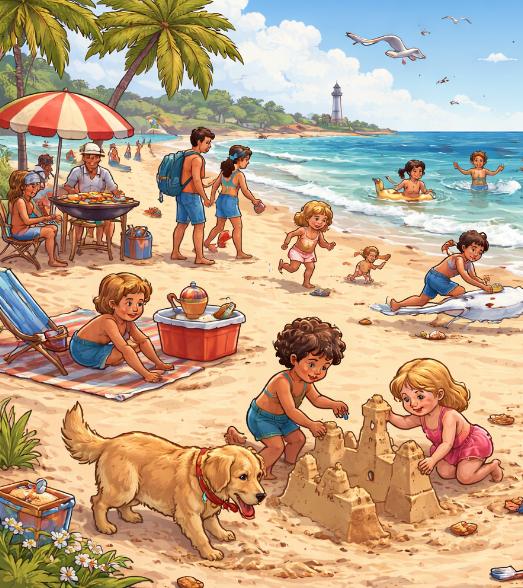
FILL IN the correct form of the verb:
People ___________ (be) on a beach.
The sun ___________ (shine).
Children __________ ( play) in the sand.
Two children __________ (build) a sandcastle.
A dog __________ (walk) near the sandcastle.
One child __________ (run).
A baby __________ (crawl) on the sand.
Some people__________ (walk) on the beach.
A man __________ (cook) food at a table.
People __________ (swim) in the sea.
Children __________ (play) in the water.
A woman __________ (take) a photo.
Birds __________ (fly) in the sky.
Everyone__________ (have) fun on the beach.
—————————–
Correct version – audio file => listen:
People are on a beach.
The sun is shining.
Children are playing in the sand.
Two children are building a sandcastle.
A dog is walking near the sandcastle.
One child is running.
A baby is crawling on the sand.
Some people are walking on the beach.
A man is cooking food at a table.
People are swimming in the sea.
Children are playing in the water.
A woman is taking a photo.
Birds are flying in the sky.
Everyone is having fun on the beach.
###################
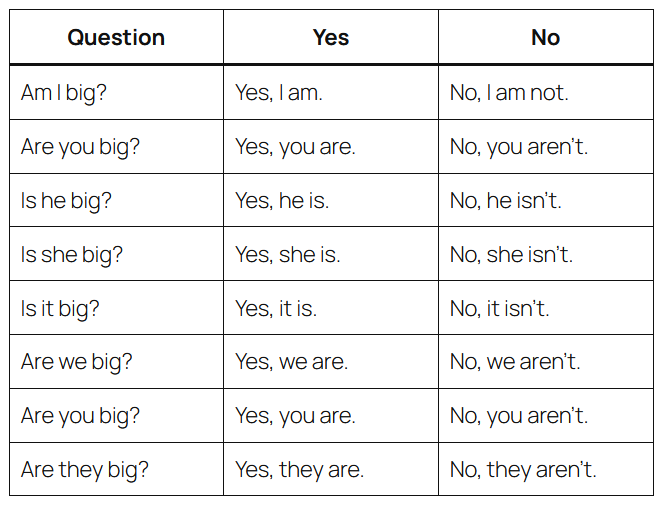
Short answers, how to………
___________________________
Give short answers as shown:
People are on a beach.
YOU WRITE:
Yes, they are.
No, they aren’t (=are not)
The sun is shining.
YOU WRITE:
Yes, he is.
No, he isn’t (=is not)
“The sun is he,
and the moon is she.”
Children are playing in the sand.
___________________
___________________
Two children are building a sandcastle.
___________________
___________________
A dog is walking near the sandcastle.
___________________
___________________
One child is running.
___________________
___________________
A baby is crawling on the sand.
___________________
___________________
Some people are walking on the beach.
___________________
___________________
A man is cooking food at a table.
___________________
___________________
People are swimming in the sea.
___________________
___________________
Children are playing in the water.
___________________
___________________
———————————————
Correct answers:
Children are playing in the sand.
Yes, they are.
No, they aren’t (=are not)
Two children are building a sandcastle.
Yes, they are.
No, they aren’t (=are not)
A dog is walking near the sandcastle.
Yes, it is.
No, it isn’t (=is not)
One child is running.
Yes, he/she is.
No, he/she isn’t (=is not)
A baby is crawling on the sand.
Yes, he/she is.
No, he/she isn’t (=is not)
Some people are walking on the beach.
Yes, they are.
No, they aren’t (=are not)
A man is cooking food at a table.
Yes, he is.
No, he isn’t (=is not)
People are swimming in the sea.
Yes, they are.
No, they aren’t (=are not)
Children are playing in the water.
Yes, they are.
No, they aren’t (=are not)
####################
Sandra’s day:
Interviewer: Who gets up first in your family?
Sandra: I do. I get up at ten past six.
Interviewer: What do you do first?
Sandra: I wash my face and brush my teeth.
Interviewer: When do you have breakfast?
Sandra: At half past six.
Interviewer: How do you go to school?
Sandra: I walk to school.
Interviewer: What time does school start?
Sandra: At eight o’clock.
Interviewer: What do you do at school?
Sandra: I have lessons and play with friends.
Interviewer: When do you have lunch?
Sandra: At half past twelve.
Interviewer: Who do you play with after lunch?
Sandra: I play with my classmates.
Interviewer: When does school finish?
Sandra: At three o’clock.
Interviewer: What do you do after school?
Sandra: I do my homework and play a little.
Interviewer: When do you have a snack?
Sandra: At half past four.
Interviewer: Who cooks dinner?
Sandra: My mum cooks dinner at half past six.
Interviewer: What do you do in the evening?
Sandra: I watch TV and read a book.
Interviewer: When do you go to bed?
Sandra: At nine o’clock.
################
Present simple (always, every day, never) and
present continuous (now, at the moment)
- Sandra: I get up at ten past six (every day, always).
YOU WRITE:
Now (present continuous) it is ten past six.
Sandra is getting up. - I have breakfast at half past six (every day, always).
_____________________
_____________________ - School starts at eight o’clock.
_____________________
_____________________ - I have lunch at half past twelve.
_____________________
_____________________ - School finishes at three o’clock.
_____________________
_____________________ - I have a snack at half past four.
_____________________
_____________________ - Dinner is at half past six.
_____________________
_____________________ - I go to bed at nine o’clock.
_____________________
_____________________
————————————–
Correct answers:
Sandra: I get up at ten past six (every day, always).
Now (present continuous) it is ten past six.
Sandra is getting up.
I have breakfast at half past six.
Now it is half past six.
Sandra is having breakfast.
School starts at eight o’clock.
Now it is eight o’clock.
School is starting.
I have lunch at half past twelve.
Now it is half past twelve.
Sandra is having lunch.
School finishes at three o’clock.
Now it is three o’clock.
School is finishing.
I have a snack at half past four.
Now it is half past four.
Sandra is having a snack.
Dinner is at half past six.
Now it is half past six.
Sandra is having dinner.
I go to bed at nine o’clock.
Now it is nine o’clock.
Sandra is going to bed.
##################
Salas’s day:
Interviewer: Who gets up first in your family?
Salas: I do. I get up at (6:10)__________________
YOU WRITE: ten past six
Interviewer: What do you do first?
Salas: At (6:29)__________________, I wash my face and brush my teeth.
Interviewer: When do you have breakfast?
Salas: At __________________ (6:30), I have breakfast.
Interviewer: How do you go to school?
Salas: At __________________ (6:55), I walk to school.
Interviewer: What time does school start?
Salas: At __________________ (8:00), school starts.
Interviewer: What do you do at school?
Salas: At __________________ (9:10), I have lessons and play with my friends.
Interviewer: When do you have lunch?
Salas: At __________________ (12:30), I have lunch.
Interviewer: Who do you play with after lunch?
Salas: At __________________ (12:55), I play with my classmates.
Interviewer: When does school finish?
Salas: At __________________ (3:00), school finishes.
Interviewer: What do you do after school?
Salas: At __________________ (3:10), I do my homework and play.
Interviewer: When do you have a snack?
Salas: At __________________ (4:20), I have a snack.
Interviewer: Who cooks dinner?
Salas: At __________________ (5:30), my mum cooks dinner.
Interviewer: What do you do in the evening?
Salas: At __________________ (7:55), I watch TV.
Interviewer: When do you go to bed?
Salas: At __________________ (9:00), I go to bed.
———————————
Correct answers:
Salas’s day:
Interviewer: Who gets up first in your family?
Salas: I do. I get up at ten past six.
Interviewer: What do you do first?
Salas: At twenty past six, I wash my face and brush my teeth.
Interviewer: When do you have breakfast?
Salas: At half past six, I have breakfast.
Interviewer: How do you go to school?
Salas: At five to seven, I walk to school.
Interviewer: What time does school start?
Salas: At eight o’clock, school starts.
Interviewer: What do you do at school?
Salas: At ten past nine, I have lessons and play with my friends.
Interviewer: When do you have lunch?
Salas: At half past twelve, I have lunch.
Interviewer: Who do you play with after lunch?
Salas: At five to one, I play with my classmates.
Interviewer: When does school finish?
Salas: At three o’clock, school finishes.
Interviewer: What do you do after school?
Salas: At ten past three, I do my homework and play.
Interviewer: When do you have a snack?
Salas: At twenty past four, I have a snack.
Interviewer: Who cooks dinner?
Salas: At half past six, my mum cooks dinner.
Interviewer: What do you do in the evening?
Salas: At five to eight, I watch TV.
Interviewer: When do you go to bed?
Salas: At nine o’clock, I go to bed.
###############
Oum’s day:
Interviewer: Who gets up first in your family?
Oum: My sister does. I get up at _______________ (6:55).
Interviewer: What do you do first?
Oum: At _______________ (7:10), I wash my face.
Interviewer: When do you brush your teeth?
Oum: At _______________ (7:15), I brush my teeth.
Interviewer: When do you have breakfast?
Oum: At _______________ (7:30), I have breakfast.
Interviewer: How do you go to school?
Oum: At _______________ (7:40), I go to school by bus.
Interviewer: What time does school start?
Oum: At _______________ (8:00), school starts.
Interviewer: What do you do at school?
Oum: At _______________ (10:10), I have lessons and play with my friends.
Interviewer: When do you have lunch?
Oum: At _______________ (12:55), I have lunch.
Interviewer: Who do you play with after lunch?
Oum: At _______________ (1:10), I play with my friends.
Interviewer: When does school finish?
Oum: At _______________ (2:30), school finishes.
Interviewer: What do you do after school?
Oum: At _______________ (3:00), I do my homework.
Interviewer: When do you have a snack?
Oum: At _______________ (4:20), I have a snack.
Interviewer: Who cooks dinner?
Oum: At _______________ (6:00), my dad cooks dinner.
Interviewer: What do you do in the evening?
Oum: At _______________ (7:55), I read a book.
Interviewer: When do you go to bed?
Oum: At _______________ (8:30), I go to bed.
——————————–
Correct version:
Oum’s day:
Interviewer: Who gets up first in your family?
Oum: My sister does. I get up at five to seven.
Interviewer: What do you do first?
Oum: At ten past seven, I wash my face.
Interviewer: When do you brush your teeth?
Oum: At quarter past seven, I brush my teeth.
Interviewer: When do you have breakfast?
Oum: At half past seven, I have breakfast.
Interviewer: How do you go to school?
Oum: At twenty to eight, I go to school by bus.
Interviewer: What time does school start?
Oum: At eight o’clock, school starts.
Interviewer: What do you do at school?
Oum: At ten past ten, I have lessons and play with my friends.
Interviewer: When do you have lunch?
Oum: At five to one, I have lunch.
Interviewer: Who do you play with after lunch?
Oum: At ten past one, I play with my friends.
Interviewer: When does school finish?
Oum: At half past two, school finishes.
Interviewer: What do you do after school?
Oum: At three o’clock, I do my homework.
Interviewer: When do you have a snack?
Oum: At twenty past four, I have a snack.
Interviewer: Who cooks dinner?
Oum: At six o’clock, my dad cooks dinner.
Interviewer: What do you do in the evening?
Oum: At five to eight, I read a book.
Interviewer: When do you go to bed?
Oum: At half past eight, I go to bed.
#################
Schreibe einen Kommentar