Kategorie: MAN Solok City

  • πŸŽ‰πŸ§šβ€β™‚οΈA day in Malis’s life (A1, beginners, present simple, negations, questions, short answers, part 1/2) πŸ§šβ€β™‚οΈπŸŽ‰

    • her daily routine

    After having completed
    this unit, go to
    „A day in Malis’s life„,
    the story in in past simple
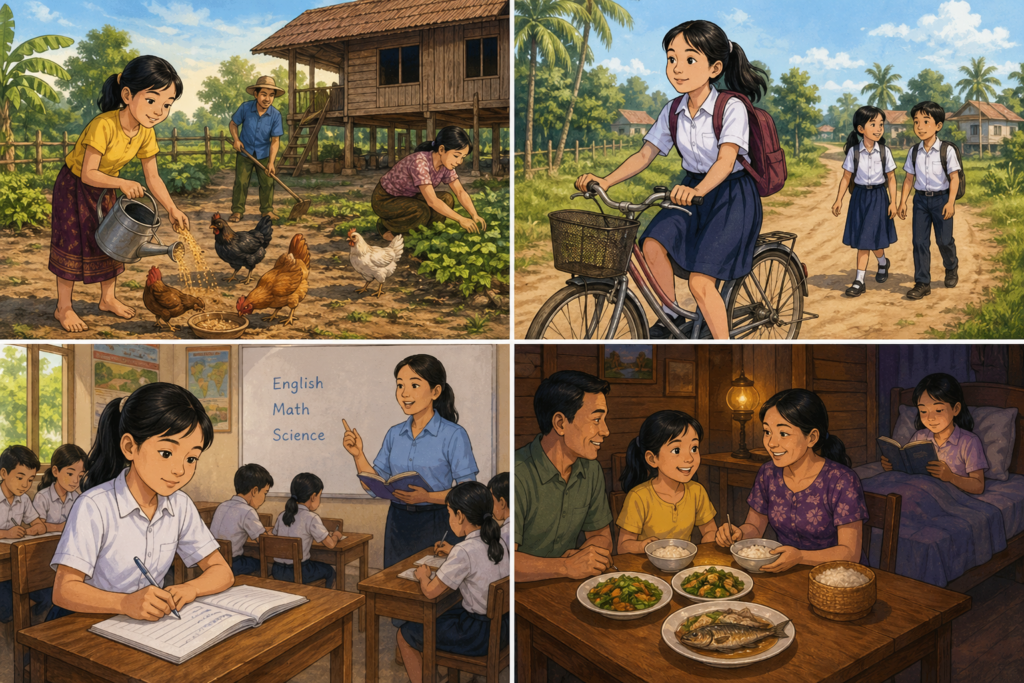
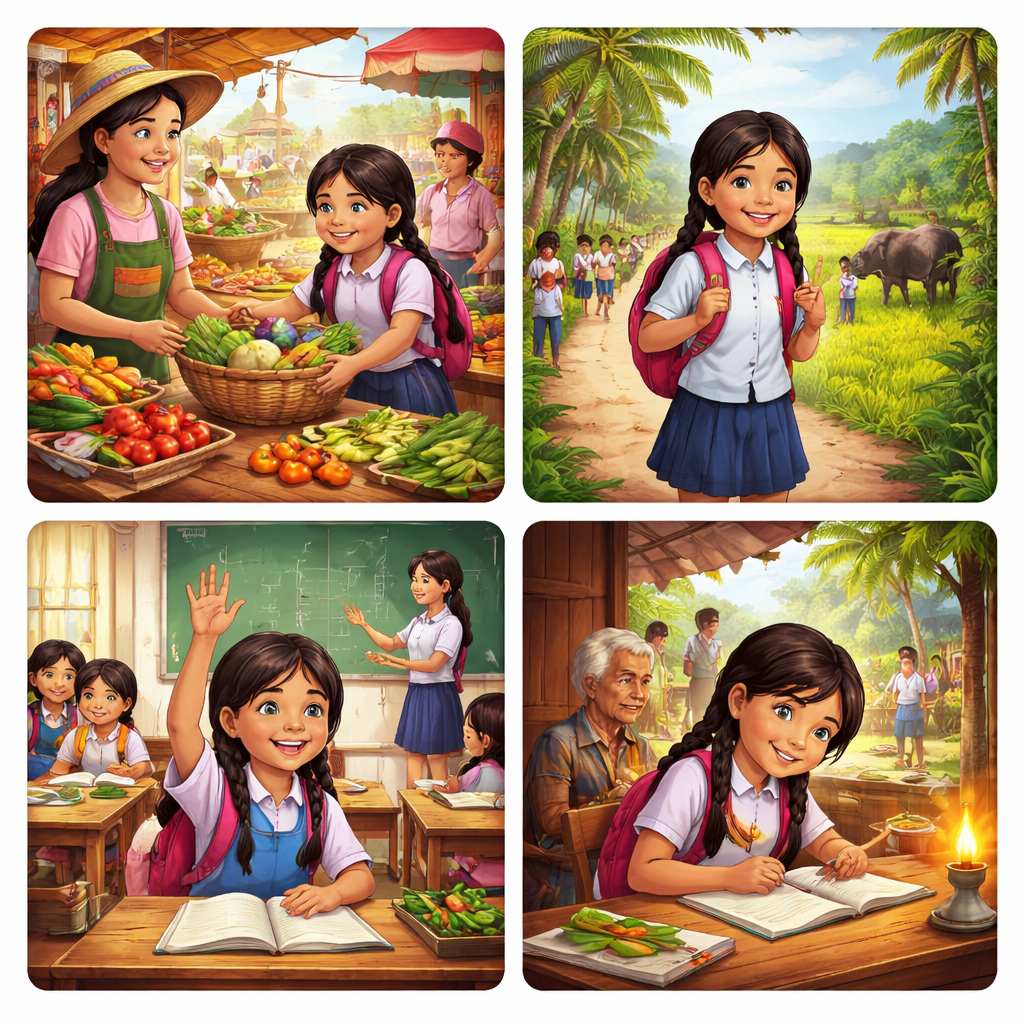
    Malis is 12 years old. She lives in the countryside with her parents. Her parents are farmers.

    She wakes up early in the morning. She helps her parents at home. She feeds the chickens and brings water. Sometimes she helps in the field.

    After that, she gets ready for school. She wears her uniform and goes to school. She walks or rides a bike. She meets her friends on the way.

    At school, she studies English, math, and science. She likes learning new things. She listens to her teacher and works hard.

    At noon, she goes home for lunch. She eats rice, vegetables, and sometimes fish. Then she rests for a short time.

    In the afternoon, she helps her parents again or does her homework.

    In the evening, she has dinner with her family. They talk together. Then she goes to bed early.

    ________________________

    Vocabulary:

    • countryside β†’ the area in the country, not the city
    • to wake up β†’ to stop sleeping
    • early β†’ before the usual time (not late)
    • at home β†’ in your house
    • to feed the chickens β†’ to give food to chickens
    • to get ready for school β†’ to prepare for school (wash, dress, etc.)
    • to wear a uniform β†’ to have special school clothes on
    • to ride a bike β†’ to go on a bicycle
    • to meet friends β†’ to see friends
    • to study science β†’ to learn about science [subject where students learn about the natural world, about plants, animals, the human body, weather, and do simple experiments.]
    • to listen to somebody β†’ to hear and pay attention to someone
    • at noon β†’ at 12:00 in the day
    • lunch β†’ the meal in the middle of the day
    • vegetables β†’ plants we eat (like carrots, tomatoes)
    • to rest β†’ to relax or stop working
    • for a short time β†’ for a little time
    • afternoon β†’ the time after 12:00 (after noon)
    • to do homework β†’ to do school work at home
    • to go to bed β†’ to lie down and sleep

    #################

    Match the words with the definitions

    Words:

    1. countryside
    2. to wake up
    3. early
    4. at home
    5. to feed the chickens
    6. to get ready for school
    7. to wear a uniform
    8. to ride a bike
    9. to meet friends
    10. to study science
    11. to listen to somebody
    12. at noon
    13. lunch
    14. vegetables
    15. to rest
    16. for a short time
    17. afternoon
    18. to do homework
    19. to go to bed


    Definitions:

    A. to relax or stop working
    B. the meal in the middle of the day
    C. to stop sleeping
    D. to prepare for school
    E. plants we eat
    F. after 12:00 in the day
    G. in your house
    H. to give food to chickens
    I. to learn about science
    J. to see friends
    K. to lie down and sleep
    L. before the usual time
    M. at 12:00 in the day
    N. the area in the country, not the city
    O. to hear and pay attention to someone
    P. to go on a bicycle
    Q. to do school work at home
    R. for a little time
    S. to have special school clothes on

    _______________________

    Answer:
    1-N, 2-C, 3-L, 4-G, 5-H, 6-D,
    7-S, 8-P, 9-J, 10-I, 11-O, 12-M, 13-B,
    14-E, 15-A, 16-R, 17-F, 18-Q, 19-K

    #################

    Match definitions and words:

    1. to see friends β†’ ___
    2. at 12:00 in the day β†’ ___
    3. to go on a bicycle β†’ ___
    4. plants we eat (like carrots, tomatoes) β†’ ___
    5. to relax or stop working β†’ ___
    6. to prepare for school (wash, dress, etc.) β†’ ___
    7. to learn about science β†’ ___
    8. the area in the country, not the city β†’ ___
    9. to stop sleeping β†’ ___
    10. to hear and pay attention to someone β†’ ___
    11. to lie down and sleep β†’ ___
    12. in your house β†’ ___
    13. to give food to chickens β†’ ___
    14. to have special school clothes on β†’ ___
    15. to do school work at home β†’ ___
    16. before the usual time (not late) β†’ ___
    17. for a little time β†’ ___
    18. the meal in the middle of the day β†’ ___
    19. the time after 12:00 (after noon) β†’ ___

    Word bank:

    A. countryside
    B. to wake up
    C. early
    D. at home
    E. to feed the chickens
    F. to get ready for school
    G. to wear a uniform
    H. to ride a bike
    I. to meet friends
    J. to study science
    K. to listen to somebody
    L. at noon
    M. lunch
    N. vegetables
    O. to rest
    P. for a short time
    Q. afternoon
    R. to do homework
    S. to go to bed


    ___________________
    Answers:

    1I, 2L, 3H, 4N, 5O, 6F, 7J, 8A,
    9B, 10K, 11S, 12D, 13E, 14G,
    15R, 16C, 17P, 18M, 19Q
    #############

    True or false:

    1. to go to bed means to wake up in the morning.
    2. to feed the chickens means to give food to chickens.
    3. vegetables means animals we eat.
    4. to wake up means to stop sleeping.
    5. to ride a bike means to go on a bicycle.
    6. at noon means at 6:00 in the evening.
    7. countryside means the area in the country, not the city.
    8. for a short time means for a very long time.
    9. to study science means to learn about science.
    10. lunch means the meal in the morning.
    11. to meet friends means to see friends.
    12. to listen to somebody means to ignore someone speaking.
    13. afternoon means the time before 12:00.
    14. to get ready for school means to prepare for school (wash, dress, etc.).
    15. early means before the usual time (not late).
    16. to do homework means to play games at school.
    17. at home means in your house.
    18. to rest means to work hard.
    19. to wear a uniform means to have special school clothes on.

    _____________________

    True: 2,4,5,7,9,11,14,15,17,19

    ###############

    True or false:

    1. She uses a bicycle only on weekends for fun.
    2. She has dinner with her family in the evening.
    3. She studies only science at school.
    4. Malis is 12 years old.
    5. She wakes up early in the morning.
    6. She carries food from the kitchen to the chickens every day.
    7. She lives in a town near the sea.
    8. She gets ready for school after her morning tasks.
    9. She eats dinner alone in her room.
    10. She feeds the chickens and brings water.
    11. She changes clothes at school after arriving.
    12. Her parents work in a shop in the evening.
    13. She helps her parents at home.
    14. She wears a uniform for school.
    15. She studies English, math, and science.
    16. She starts her day by going straight to school.
    17. She lives in the countryside with her parents.
    18. She spends the morning reading books at home only.
    19. Her parents are farmers.

    ____________________

    True: 2,4,5,8,10,13,14,15,17,19

    ##############

    True is – short answers only:

    1. Is Malis 11 or 12 years old?
    2. Does she wake up late or early every day?
    3. Does she live in a city or in the countryside?
    4. Are her parents teachers or farmers?
    5. Does she help her parents at home or only at school?
    6. Does she feed dogs or chickens?
    7. Does she bring water or toys to the chickens?
    8. Does she get ready for school after or before helping at home?
    9. Does she wear casual clothes or a uniform for school?
    10. Does she go to school by car or by walking/riding a bike?
    11. Does she meet friends on the way to school or stay alone?
    12. Does she study English or cooking at school?
    13. Does she study cooking or math at school?
    14. Does she study painting or science at school?
    15. Does she ignore the teacher or listen to the teacher in class?
    16. Does she have lunch in the evening or at noon?
    17. Does she eat fast food or rice and vegetables for lunch?
    18. Does she work all afternoon or rest for a short time after lunch?
    19. Does she only play games or do homework in the afternoon?
    20. Does she go to bed very late or early every night?

    _________________________

    Correct version:

    1. Is Malis 11 or 12 years old? 12
    2. Does she wake up late or early every day? early
    3. Does she live in a city or in the countryside? countryside
    4. Are her parents teachers or farmers? farmers
    5. Does she help her parents at home or only at school? at home
    6. Does she feed dogs or chickens? chickens
    7. Does she bring water or toys to the chickens? water
    8. Does she get ready for school after or before helping at home? after
    9. Does she wear casual clothes or a uniform for school? uniform
    10. Does she go to school by car or by walking/riding a bike? walking/riding a bike
    11. Does she meet friends on the way to school or stay alone? meet friends
    12. Does she study English or cooking at school? English
    13. Does she study cooking or math at school? math
    14. Does she study painting or science at school? science
    15. Does she ignore the teacher or listen to the teacher in class? listen
    16. Does she have lunch in the evening or at noon? noon
    17. Does she eat fast food or rice and vegetables for lunch? rice and vegetables
    18. Does she work all afternoon or rest for a short time after lunch? rest
    19. Does she only play games or do homework in the afternoon? do homework
    20. Does she go to bed very late or early every night? early

    ################

    Odd one out:

    1. city – countryside – village – farm
    2. eat – sleep – wake up – get up
    3. rice – vegetables – water – fish
    4. pajamas – uniform – school clothes – shoes
    5. ride a bike – walk – drive a car – run
    6. cooking – English – math – science
    7. breakfast – lunch – school – dinner
    8. bicycle – morning – afternoon – evening
    9. rest – relax – work – sleep
    10. home – school – kitchen – science

    ______________________

    Correct version:


    city – countryside – village – farm
    Odd one: city
    Why: the others are rural places linked to farming life in the story, while a city is not.

    eat – sleep – wake up – get up
    Odd one: eat
    Why: the others are sleeping or starting-day actions, but β€œeat” is a meal activity.

    rice – vegetables – water – fish
    Odd one: water
    Why: rice, vegetables, and fish are foods; water is a drink, not food.

    pajamas – uniform – school clothes – shoes
    Odd one: pajamas
    Why: the others are worn for school, but pajamas are for sleeping.

    ride a bike – walk – drive a car – run
    Odd one: drive a car
    Why: the story mentions walking and biking; driving a car is not used.

    cooking – English – math – science
    Odd one: cooking
    Why: English, math, and science are school subjects; cooking is not.

    breakfast – lunch – school – dinner
    Odd one: school
    Why: the others are meals; school is a place/activity.

    bicycle – morning – afternoon – evening
    Odd one: bicycle
    Why: morning, afternoon, and evening are times of day; bicycle is a vehicle.

    rest – relax – work – sleep
    Odd one: work
    Why: rest, relax, and sleep are recovery actions; work is activity/effort.

    home – school – kitchen – science
    Odd one: science
    Why: home, school, and kitchen are places; science is a subject.

    ##################

    Short answers, basics:

    Example SentenceYesNo
    I learn the alphabet.Yes, I do.No, I don’t.
    You read signs.Yes, you do.No, you don’t.
    He practices speaking.Yes, he does.No, he doesn’t.
    She watches cartoons.Yes, she does.No, she doesn’t.
    It helps us learn English.Yes, it does.No, it doesn’t.
    We use apps like Duolingo.Yes, we do.No, we don’t.
    You read labels.Yes, you do.No, you don’t.
    They make mistakes sometimes.Yes, they do.No, they don’t.
    QuestionYesNo
    Do I learn the alphabet?Yes, I do.No, I don’t.
    Do you read signs?Yes, you do.No, you don’t.
    Does he practice speaking?Yes, he does.No, he doesn’t.
    Does she watch cartoons?Yes, she does.No, she doesn’t.
    Does it help us learn English?Yes, it does.No, it doesn’t.
    Do we use apps like Duolingo?Yes, we do.No, we don’t.
    Do you read labels?Yes, you do.No, you don’t.
    Do they make mistakes sometimes?Yes, they do.No, they don’t.
    QuestionYesNo
    Am I big?Yes, I am.No, I am not.
    Are you big?Yes, you are.No, you aren’t.
    Is he big?Yes, he is.No, he isn’t.
    Is she big?Yes, she is.No, she isn’t.
    Is it big?Yes, it is.No, it isn’t.
    Are we big?Yes, we are.No, we aren’t.
    Are you big?Yes, you are.No, you aren’t.
    Are they big?Yes, they are.No, they aren’t.

    ####################

    Provide short answers as shown in 1.:

    1. She uses a bicycle only on weekends for fun.

      YOU WRITE:
      No, she doesn’t.

    2. She has dinner with her family in the evening.
    3. She studies only science at school.
    4. Malis is 12 years old.
    5. She wakes up early in the morning.
    6. She carries food from the kitchen to the chickens every day.
    7. She lives in a town near the sea.
    8. She gets ready for school after her morning tasks.
    9. She eats dinner alone in her room.
    10. She feeds the chickens and brings water.
    11. She changes clothes at school after arriving.
    12. Her parents work in a shop in the evening.
    13. She helps her parents at home.
    14. She wears a uniform for school.
    15. She studies English, math, and science.
    16. She starts her day by going straight to school.
    17. She lives in the countryside with her parents.
    18. She spends the morning reading books at home only.
    19. Her parents are farmers.

    _______________________

    Correct answers:

    1. She uses a bicycle only on weekends for fun. β€” No, she doesn’t.
    2. She has dinner with her family in the evening. β€” Yes, she does.
    3. She studies only science at school. β€” No, she doesn’t.
    4. Malis is 12 years old. β€” Yes, she is.
    5. She wakes up early in the morning. β€” Yes, she does.
    6. She carries food from the kitchen to the chickens every day. β€” No, she doesn’t.
    7. She lives in a town near the sea. β€” No, she doesn’t.
    8. She gets ready for school after her morning tasks. β€” Yes, she does.
    9. She eats dinner alone in her room. β€” No, she doesn’t.
    10. She feeds the chickens and brings water. β€” Yes, she does.
    11. She changes clothes at school after arriving. β€” No, she doesn’t.
    12. Her parents work in a shop in the evening. β€” No, they don’t.
    13. She helps her parents at home. β€” Yes, she does.
    14. She wears a uniform for school. β€” Yes, she does.
    15. She studies English, math, and science. β€” Yes, she does.
    16. She starts her day by going straight to school. β€” No, she doesn’t.
    17. She lives in the countryside with her parents. β€” Yes, she does.
    18. She spends the morning reading books at home only. β€” No, she doesn’t.
    19. Her parents are farmers. β€” Yes, they are.

    #####################

    Basics of present simple:

    Personal Pronounam / is / are
    Iam8 years old
    Youare8 years old
    Heis8 years old
    Sheis8 years old
    Itis8 years old
    Weare8 years old
    You (plural)are8 years old
    Theyare8 years old
    Personal Pronounam not / is not / are not
    Iam not8 years old
    Youare not8 years old
    Heis not8 years old
    Sheis not8 years old
    Itis not8 years old
    Weare not8 years old
    You (plural)are not8 years old
    Theyare not8 years old

    Question:

    Question WordPersonal Pronoun
    AmI8 years old?
    Areyou8 years old?
    Ishe8 years old?
    Isshe8 years old?
    Isit8 years old?
    Arewe8 years old?
    Areyou (plural)8 years old?
    Arethey8 years old?

    Statement:

    Personal PronounVerb
    Ilikeice cream
    Youlikeice cream
    Helikesice cream
    Shelikesice cream
    Itlikesice cream
    Welikeice cream
    You (plural)likeice cream
    Theylikeice cream

    Negation:

    Personal PronounVerb (negative)
    Ido not likeice cream
    Youdo not likeice cream
    Hedoes not likeice cream
    Shedoes not likeice cream
    Itdoes not likeice cream
    Wedo not likeice cream
    You (plural)do not likeice cream
    Theydo not likeice cream

    Question:

    Do / DoesPersonal PronounVerbSugar?
    DoIlikesugar?
    Doyoulikesugar?
    Doeshelikesugar?
    Doesshelikesugar?
    Doesitlikesugar?
    Dowelikesugar?
    Doyou (plural)likesugar?
    Dotheylikesugar?

    ################

    Make the following sentences negative:

    1. Malis is 15 years old.

      YOU WRITE:
      Malis is not 15 years old.

    2. She lives in a city with her grandparents.
    3. Her parents work in a shop.
    4. She wakes up late in the afternoon.
    5. She never helps her parents at home.
    6. She feeds cows instead of chickens.
    7. She does not bring water for animals.
    8. She gets ready for school before doing any morning tasks.
    9. She wears casual clothes to school.
    10. She goes to school by car every day.
    11. She meets friends only at home, not on the way to school.
    12. She studies only music at school.
    13. She eats pizza and drinks soda for lunch.
    14. She goes to bed very late every night.

    _________________________

    Correct version:

    1. Malis is not 15 years old.
    2. She does not live in a city with her grandparents.
    3. Her parents do not work in a shop.
    4. She does not wake up late in the afternoon.
    5. She does not help her parents at home.
    6. She does not feed cows instead of chickens.
    7. She does not bring water for animals.
    8. She does not get ready for school before doing any morning tasks.
    9. She does not wear casual clothes to school.
    10. She does not go to school by car every day.
    11. She does not meet friends only at home, not on the way to school.
    12. She does not study only music at school.
    13. She does not eat pizza and drink soda for lunch.
    14. She does not go to bed very late every night.

    ##################

    Rewrite as questions:

    1. Malis is 12 years old.

      YOU WRITE:
      Is Malis 12 years old?

    2. She lives in the countryside with her parents.
    3. Her parents are farmers.
    4. She wakes up early in the morning.
    5. She and her brother help their parents at home.
    6. She feeds the chickens.
    7. She brings water.
    8. She sometimes helps in the field.
    9. She gets ready for school after her morning tasks.
    10. She and her friends wear uniforms for school.
    11. She walks or rides a bike to school.
    12. She and her brother meet their friends on the way to school.
    13. She studies English, math, and science.
    14. She goes to bed early.

    _____________________
    Correct questions:

    1. Is Malis 12 years old?
    2. Does she live in the countryside with her parents?
    3. Are her parents farmers?
    4. Does she wake up early in the morning?
    5. Do she and her brother help their parents at home?
    6. Does she feed the chickens?
    7. Does she bring water?
    8. Does she sometimes help in the field?
    9. Does she get ready for school after her morning tasks?
    10. Do she and her friends wear uniforms for school?
    11. Does she walk or ride a bike to school?
    12. Do she and her brother meet their friends on the way to school?
    13. Does she study English, math, and science?
    14. Does she go to bed early?

    ################

    Answer as shown in 1:

    1. Malis is 15 years old.

      YOU WRITE:
      No, she isn’t.
      She is 12 years old.

    2. She lives in a city with her grandparents.
    3. Her parents are doctors.
    4. She and her parents wake up late in the afternoon.
    5. She often helps her grandparents.
    6. She feeds cows instead of chickens.
    7. Her father works in a shop.
    8. She helps in the field on Sundays only.
    9. She gets ready for school before doing any morning tasks.
    10. She and her friends wear casual clothes for school.
    11. She goes to school by car every day.
    12. She meets her friends only at home.
    13. She and her friends study only music at school.
    14. She goes to bed very late every night.

    ______________________

    Correct answers:

    1. Malis is 15 years old.
      No, she isn’t.
      She is 12 years old.
    2. She lives in a city with her grandparents.
      No, she doesn’t.
      She lives in the countryside with her parents.
    3. Her parents are doctors.
      No, they aren’t.
      They are farmers.
    4. She and her parents wake up late in the afternoon.
      No, they don’t.
      She wakes up early in the morning.
    5. She often helps her grandparents.
      No, she doesn’t.
      She helps her parents at home.
    6. She feeds cows instead of chickens.
      No, she doesn’t.
      She feeds the chickens.
    7. Her father works in a shop.
      No, he doesn’t.
      He is a farmer.
    8. She helps in the field on Sundays only.
      No, she doesn’t.
      She sometimes helps in the field.
    9. She gets ready for school before doing any morning tasks.
      No, she doesn’t.
      She gets ready for school after her morning tasks.
    10. She and her friends wear casual clothes for school.
      No, they don’t.
      She wears a uniform for school.
    11. She goes to school by car every day.
      No, she doesn’t.
      She walks or rides a bike to school.
    12. She meets her friends only at home.
      No, she doesn’t.
      She meets her friends on the way to school.
    13. She and her friends study only music at school.
      No, they don’t.
      She studies English, math, and science.
    14. She goes to bed very late every night.
      No, she doesn’t.
      She goes to bed early.

    ###################

    Form questions – write as shown in 1:

    1. Malis / wake up early in the morning

      YOU WRITE:
      β†’ Does Malis wake up early in the morning ?

    2. she / feed the chickens
      β†’ __________________________________ ?
    3. she and her friends / wear uniforms for school
      β†’ __________________________________ ?
    4. she / ride a bike to school
      β†’ __________________________________ ?
    5. she and her friends / study English, math, science
      β†’ __________________________________ ?
    6. Malis / live in the countryside with her parents
      β†’ __________________________________ ?
    7. her parents / be farmers
      β†’ __________________________________ ?
    8. Malis and her parents / help at home
      β†’ __________________________________ ?
    9. she and her parents / bring water every morning
      β†’ __________________________________ ?
    10. Malis / get ready for school after her morning tasks
      β†’ __________________________________ ?
    11. she and her friends / meet on the way to school
      β†’ __________________________________ ?
    12. Malis / have lunch at noon
      β†’ __________________________________ ?
    13. she and her friends / do homework in the afternoon
      β†’ __________________________________ ?
    14. Malis / go to bed early
      β†’ __________________________________ ?

    _________________________

    Correct version:

    1. Malis / wake up early in the morning
      β†’ Does Malis wake up early in the morning?
    2. she / feed the chickens
      β†’ Does she feed the chickens?
    3. she and her friends / wear uniforms for school
      β†’ Do she and her friends wear uniforms for school?
    4. she / ride a bike to school
      β†’ Does she ride a bike to school?
    5. she and her friends / study English, math, science
      β†’ Do she and her friends study English, math, and science?
    6. Malis / live in the countryside with her parents
      β†’ Does Malis live in the countryside with her parents?
    7. her parents / be farmers
      β†’ Are her parents farmers?
    8. Malis and her parents / help at home
      β†’ Do Malis and her parents help at home?
    9. she and her parents / bring water every morning
      β†’ Do she and her parents bring water every morning?
    10. Malis / get ready for school after her morning tasks
      β†’ Does Malis get ready for school after her morning tasks?
    11. she and her friends / meet on the way to school
      β†’ Do she and her friends meet on the way to school?
    12. Malis / have lunch at noon
      β†’ Does Malis have lunch at noon?
    13. she and her friends / do homework in the afternoon
      β†’ Do she and her friends do homework in the afternoon?
    14. Malis / go to bed early
      β†’ Does Malis go to bed early?

    ##################

    Complete, words below:

    at home, countryside, ride a bike, science, vegetables,
    lunch, bed, field, friends, early, homework,
    at home, uniform, wake up, short time,
    afternoon, feeds the chickens,
    school, class

    1. Malis lives in the __________ with her parents.
    2. She __________ early in the morning.
    3. She helps her parents __________.
    4. She __________.
    5. She gets ready for __________.
    6. She wears a __________ for school.
    7. She __________ or walks to school.
    8. She meets her __________ on the way to school.
    9. She studies __________ at school.
    10. She listens to somebody in __________.
    11. She has __________ at noon.
    12. She eats rice, __________, and sometimes fish.
    13. She rests for a __________ after lunch.
    14. In the __________, she does homework or helps at home.
    15. She does __________ at home.
    16. She goes to __________ early in the evening.
    17. She wakes up __________ every morning.
    18. She is __________ in the morning before school.
    19. She sometimes helps in the __________.

    ————————————

    Correct version:

    1. Malis lives in the countryside with her parents.
    2. She wakes up early in the morning.
    3. She helps her parents at home.
    4. She feeds the chickens.
    5. She gets ready for school.
    6. She wears a uniform for school.
    7. She rides a bike or walks to school.
    8. She meets her friends on the way to school.
    9. She studies science at school.
    10. She listens to somebody in class.
    11. She has lunch at noon.
    12. She eats rice, vegetables, and sometimes fish.
    13. She rests for a short time after lunch.
    14. In the afternoon, she does homework or helps at home.
    15. She does homework at home.
    16. She goes to bed early in the evening.
    17. She wakes up early every morning.
    18. She is at home in the morning before school.
    19. She sometimes helps in the field.

    ###################

    Sentence transformation, change the form, as shown, short answers:

    1. Malis lives in the countryside. (Where)

      β†’ YOU WRITE:
      Where does she live?

      >>in the countryside

    2. She wakes up early in the morning. (Does)

      β†’ YOU WRITE:
      Does she wake up early in the morning?
      >>Yes, she does.

    3. She feeds the chickens every day. (What)
      β†’ __________________________________________
    4. She goes to school by bike. (How)
      β†’ __________________________________________
    5. She studies science at school. (Does)
      β†’ __________________________________________
    6. She has lunch at noon. (When)
      β†’ __________________________________________
    7. She wears a uniform for school. (Does)
      β†’ __________________________________________
    8. She meets her friends on the way to school. (Who)
      β†’ __________________________________________
    9. She does homework in the afternoon. (When)
      β†’ __________________________________________
    10. She goes to bed early. (Does)
      β†’ __________________________________________
    11. Malis helps her parents at home. (Where)
      β†’ __________________________________________
    12. She brings water for the chickens. (What)
      β†’ __________________________________________
    13. She rides a bike to school every day. (How)
      β†’ __________________________________________
    14. She studies English, math, and science. (Does)
      β†’ __________________________________________
    15. She eats rice and vegetables for lunch. (What)
      β†’ __________________________________________
    16. She rests for a short time after lunch. (When)
      β†’ __________________________________________
    17. She gets ready for school after her morning tasks. (When)
      β†’ __________________________________________
    18. She wakes up early every day. (Does)
      β†’ __________________________________________
    19. Malis feeds chickens in the morning. (Who)
      β†’ __________________________________________
    20. She walks or rides a bike to school. (How)
      β†’ __________________________________________
    21. She meets friends on the way to school. (Who)
      β†’ __________________________________________
    22. She studies English at school. (Does)
      β†’ __________________________________________
    23. She has dinner with her family. (Who)
      β†’ __________________________________________
    24. She goes to school after helping at home. (When)
      β†’ __________________________________________
    25. She wears a uniform every day. (Does)
      β†’ __________________________________________
    26. She brings water every morning. (What)
      β†’ __________________________________________
    27. She helps in the field sometimes. (Where)
      β†’ __________________________________________
    28. She eats fish sometimes for lunch. (What)
      β†’ __________________________________________
    29. She goes to bed in the evening. (When)
      β†’ __________________________________________
    30. She lives with her parents. (Who)
      β†’ __________________________________________

    ————————–
    Correct version:

    Where does Malis live?
    β†’ In the countryside.

    Does she wake up early in the morning?
    β†’ Yes, she does.

    What does she feed every day?
    β†’ The chickens.

    How does she go to school?
    β†’ By bike (or walks / rides a bike).

    Does she study science at school?
    β†’ Yes, she does.

    When does she have lunch?
    β†’ At noon.

    Does she wear a uniform for school?
    β†’ Yes, she does.

    Who does she meet on the way to school?
    β†’ Her friends.

    When does she do homework?
    β†’ In the afternoon.

    Does she go to bed early?
    β†’ Yes, she does.

    Where does Malis help her parents?
    β†’ At home.

    What does she bring for the chickens?
    β†’ Water.

    How does she go to school every day?
    β†’ By bike or on foot.

    Does she study English, math, and science?
    β†’ Yes, she does.

    What does she eat for lunch?
    β†’ Rice and vegetables.

    When does she rest for a short time?
    β†’ After lunch.

    When does she get ready for school?
    β†’ After her morning tasks.

    Does she wake up early every day?
    β†’ Yes, she does.

    Who feeds chickens in the morning?
    β†’ Malis does

    How does she travel to school?
    β†’ By walking or riding a bike.

    Who does she meet on the way to school?
    β†’ Her friends.

    Does she study English at school?
    β†’ Yes, she does.

    Who does she have dinner with?
    β†’ Her family.

    When does she go to school?
    β†’ After helping at home.

    Does she wear a uniform every day?
    β†’ Yes, she does.

    What does she bring every morning?
    β†’ Water.

    Where does she sometimes help?
    β†’ In the field.

    What does she sometimes eat for lunch?
    β†’ Fish.

    When does she go to bed?
    β†’ In the evening.

    Who does she live with?
    β†’ Her parents.

    ###############

    Interview with Malis:


    1. Interviewer: Where do you live?
    Malis: I live in the countryside with my parents.

    2. Interviewer: Who do you live with?
    Malis: I live with my parents.

    3. Interviewer: What do your parents do?
    Malis: They are farmers.

    4. Interviewer: Do you wake up early in the morning?
    Malis: Yes, I do.

    5. Interviewer: What do you usually do before school?
    Malis: I help my parents at home.

    6. Interviewer: What animals do you take care of?
    Malis: I feed the chickens.

    7. Interviewer: How do you travel to school?
    Malis: I walk or ride a bike to school.

    8. Interviewer: What do you wear for school?
    Malis: I wear a uniform.

    9. Interviewer: Which subjects do you study at school?
    Malis: I study English, math, and science.

    10. Interviewer: When do you have lunch?
    Malis: I have lunch at noon.

    11. Interviewer: What do you eat for lunch?
    Malis: I eat rice, vegetables, and sometimes fish.

    12. Interviewer: Do you rest after lunch?
    Malis: Yes, I rest for a short time.

    13. Interviewer: What do you do in the afternoon?
    Malis: I do homework or help at home.

    14. Interviewer: When do you go to bed?
    Malis: I go to bed early in the evening.

    ###################

    Interview with Malis’s teacher – use interview above, make all changes necessary:

    1. Interviewer: Where ______________ (she live)?
    Teacher: ______________in the countryside with my parents.

    YOU WRITE:
    Where does she live?
    She lives in the countryside with her parents.

    2. Interviewer: Who _____________(she live) with?
    Teacher:She__________________

    3. Interviewer: What __________ (parents do)?
    Teacher: _____________

    4. Interviewer: _________ (wake up )early in the morning?
    Teacher: Yes,__________

    5. Interviewer: What ___________ (usually do) before school?
    Teacher: _______________ (help) parents at home.

    6. Interviewer: What animals ____________ (take care of)?
    Teacher: _____________ (feed) the chickens.

    7. Interviewer: How ___________ (travel) to school?
    Teacher:________ (walk) or __________ (ride) a bike to school.

    8. Interviewer: What ________ (wear) for school?
    Teacher: ___________ (wear) a uniform.

    9. Interviewer: Which subjects ________ (study) at school?
    Teacher: __________ (study) English, math, and science.

    10. Interviewer: When _________ (have) lunch?
    Teacher: _________ (have) lunch at noon.

    11. Interviewer: What __________ (eat) for lunch?
    Teacher: _________ (eat) rice, vegetables, and sometimes fish.

    12. Interviewer:__________ (rest) after lunch?
    Teacher: Yes,__________ (rest) for a short time.

    13. Interviewer: What ____________ (do)in the afternoon?
    Teacher: ____________ (do) homework or help at home.

    14. Interviewer: When _______ (go) to bed?
    Teacher:___________ (go) to bed early in the evening

    ———————————-
    Correct dialogue:

    InterviewAnswer
    1. Where does she live?She lives in the countryside with her parents.
    2. Who does she live with?She lives with her parents.
    3. What do her parents do?They are farmers.
    4. Does she wake up early in the morning?Yes, she does.
    5. What does she usually do before school?She helps her parents at home.
    6. What animals does she take care of?She feeds the chickens.
    7. How does she travel to school?She walks or rides a bike to school.
    8. What does she wear for school?She wears a uniform.
    9. Which subjects does she study at school?She studies English, math, and science.
    10. When does she have lunch?She has lunch at noon.
    11. What does she eat for lunch?She eats rice, vegetables, and sometimes fish.
    12. Does she rest after lunch?Yes, she rests for a short time.
    13. What does she do in the afternoon?She does homework or helps at home.
    14. When does she go to bed?She goes to bed early in the evening.
  • πŸ€“πŸ₯³It’s my favourite (U 14, pp 110-117, past tense, negations, beginners, A1)πŸ₯³πŸ€“


    VOCABULARY UNIT 14

    (110)

    DeutschEnglishDefinition (A1)
    Bildschirmzeitscreen timetime you look at a screen
    verstehento understandto know what something means
    eine Geschichtea storysomething with people and events
    ein Zeichentrickfilma cartoona funny animated film
    eine Spielshowa game showa TV show with games
    ein Science-Fiction-Filma science fiction filma film about space or future
    eine Reality-Showa reality showa show with real people
    ein Detektivfilma detective filma film about solving crimes

    (111)

    DeutschEnglishDefinition (A1)
    zwei Stunden am Tagtwo hours a day2 hours every day
    eine Naturdokumentationa nature programmea show about animals/plants
    fernsehento watch TVto look at TV
    einen Film streamento stream a filmto watch online
    eine Folgean episodeone part of a series
    immeralwaysevery time
    normalerweiseusuallymost of the time
    manchmalsometimesnot always
    nienevernot at any time
    ein YouTube-Kanala YouTube channela page with videos

    (112)

    DeutschEnglishDefinition (A1)
    eine Fernbedienunga remote controla device to control TV
    verkaufento sellto give something for money
    sehento seeto look at something
    gehento goto move somewhere
    eine neue brauchento need a new oneto want a new thing
    hinter dem Tischbehind the deskat the back of the desk
    etwas aufhebento pick something upto take something from floor
    eine besondere Krafta special powersomething magic you can do
    antwortento replyto answer
    einen Knopf drΓΌckento press a buttonto push a button
    auf etwas zeigento point to somethingto show with finger
    bezahlento payto give money
    seltsam seinto be strangeto be unusual
    einfrierento freeze (a person)to stop moving
    eine Pause-Tastea pause buttonbutton to stop for a time
    eine ZurΓΌckspul-Tastea rewind buttonbutton to go back
    rΓΌckwΓ€rts sprechento talk backwardsto speak reverse
    eine Vorspul-Tastea fast forward buttonbutton to go fast
    sich erinnernto rememberto not forget
    eine Stern-Tastea star buttonbutton with a star
    ein GerΓ€uscha noisea sound
    winzig seinto be tinyvery very small
    riesig seinto be hugevery very big

    (113)

    DeutschEnglishDefinition (A1)
    kΓ€mpfento fightto hit or attack
    fangento catchto take something moving
    eine Taschea bagsomething to carry things
    eine Parkbanka park bencha seat in a park
    verschwindento disappearto go away suddenly
    ein Gedichta poema short text with rhyme
    ein spannendes Bucha thrilling booka very exciting book

    (114)

    DeutschEnglishDefinition (A1)
    schwach seinto be weaknot strong
    die Hautskinthe outside of your body
    eine Umarmunga hugto hold someone
    ein Blatt (BlΓ€tter)a leaf (leaves)part of a tree
    sich bΓΌckento bend downto move your body down
    jagento huntto chase animals
    ein Seea lakebig water in land
    magisch seinto be magicnot real, special power

    (115)

    DeutschEnglishDefinition (A1)
    eine Abenteuergeschichtean adventure storya story with action
    Freundschaftfriendshipbeing friends

    (116)

    DeutschEnglishDefinition (A1)
    sterbento dieto stop living
    ein Huhna chickena farm bird
    eine Schlangea snakea long animal
    Angst habento be scaredto feel afraid

    (117)

    DeutschEnglishDefinition (A1)
    ein Nachbara neighboura person next to your home

    ###############

    Basics in past simple:

    Past Simple – Regular Verbs

    Rules:

    • Most verbs: add -ed
      play β†’ played
    • Verbs ending in -e: add -d
      live β†’ lived
    • Verbs ending in consonant + y: change y to i and add -ed
      study β†’ studied
    • Short verbs ending in vowel + consonant: double the final consonant and add -ed
      stop β†’ stopped
    • List of irregular verbs => LINK

    Use:
    The past simple is used to talk about finished actions in the past
    ________________________________________

    List of irregular verbs => LINK

    another list – with translations =>

    ################

    Verbs – regular and irregular
    (Unit 14)

    GermanInfinitivePastPast Participle
    verkaufento sellsoldsold
    sehento seesawseen
    gehento gowentgone
    brauchento needneededneeded
    seinto bewas/werebeen
    aufhebento pick uppicked uppicked up
    anschauento look at somebodylooked atlooked at
    habento havehadhad
    lachento laughlaughedlaughed
    drΓΌckento presspressedpressed
    zeigento point outpointed outpointed out
    bezahlento paypaidpaid
    laufento walkwalkedwalked
    schauento watchwatchedwatched
    antwortento replyrepliedreplied
    nehmento taketooktaken
    zeigento pointpointedpointed
    tunto dodiddone
    anfangento startstartedstarted
    kontrollierento controlcontrolledcontrolled
    stoppento stopstoppedstopped
    aufspringento jump upjumped upjumped up
    versuchento trytriedtried
    schauento looklookedlooked
    hΓΆrento hearheardheard
    haltento holdheldheld
    rennento runranrun
    verlassento leaveleftleft
    legento putputput
    fangento catchcaughtcaught
    gebento givegavegiven
    erzΓ€hlento telltoldtold
    sagento saysaidsaid
    denkento thinkthoughtthought
    findento findfoundfound
    sitzento sitsatsat
    essento eatateeaten
    sterbento diedieddied
    einfrierento freezefrozefrozen
    treffento meetmetmet
    lesento read [i:]read [e]read [e]
    kommento comecamecome
    bekommento getgotgot
    werdento becomebecamebecome
    kΓ€mpfento fightfoughtfought
    sich biegento bendbentbent

    #################

    Basics in past simple:

    Personal PronounVerb (Past)Object
    Iateapples
    Youateapples
    Heateapples
    Sheateapples
    Itateapples
    Weateapples
    You (plural)ateapples
    Theyateapples
    Iplayedfootball
    Youplayedfootball
    Heplayedfootball
    Sheplayedfootball
    Itplayedfootball
    Weplayedfootball
    You (plural)playedfootball
    Theyplayedfootball
    Personal PronounVerb (Past Negative)Object
    Idid not eatapples
    Youdid not eatapples
    Hedid not eatapples
    Shedid not eatapples
    Itdid not eatapples
    Wedid not eatapples
    You (plural)did not eatapples
    Theydid not eatapples
    Idid not playfootball
    Youdid not playfootball
    Hedid not playfootball
    Shedid not playfootball
    Itdid not playfootball
    Wedid not playfootball
    You (plural)did not playfootball
    Theydid not playfootball

    ##################

    Forms of β€što beβ€˜

    Personal PronounPositiveNegativeQuestion
    II was happy.I was not happy.Was I happy?
    You (singular)You were excited.You were not excited.Were you excited?
    HeHe was at home.He was not at home.Was he at home?
    SheShe was tired.She was not tired.Was she tired?
    ItIt was cold.It was not cold.Was it cold?
    WeWe were at the party.We were not at the party.Were we at the party?
    You (plural)You were friends.You were not friends.Were you friends?
    TheyThey were in the garden.They were not in the garden.Were they in the garden?

    ##################

    Fill in the correct form of past tense:

    1. The robber ______________________ (come) into the bank.
    2. He ______________________ (be) very nervous.
    3. He ______________________ (have) a bag in his hand.
    4. He ______________________ (take) a gun.
    5. He ______________________ (go) to the counter.
    6. He ______________________ (say) β€œGive me the money!”
    7. The worker ______________________ (look) at him.
    8. She ______________________ (be) scared.
    9. The robber ______________________ (point) at her.
    10. He ______________________ (put) money into the bag.
    11. He ______________________ (take) the bag.
    12. He ______________________ (run) out of the bank.
    13. The police ______________________ (see) him outside.
    14. They ______________________ (try) to stop him.
    15. The robber ______________________ (fight) with the police.
    16. The police ______________________ (control) him.
    17. The robber ______________________ (stop) running.
    18. He ______________________ (leave) the street.
    19. One officer ______________________ (look) at him.
    20. He ______________________ (run) again.
    21. The police ______________________ (hear) him.
    22. They ______________________ (come) quickly.
    23. The robber ______________________ (think) about escaping.
    24. He ______________________ (try) to run away.
    25. The police ______________________ (find) him.
    26. One officer ______________________ (point out) the robber.
    27. The police ______________________ (fight) him again.
    28. They ______________________ (stop) him.
    29. The robber ______________________ (sit) on the ground.
    30. He ______________________ (reply) nothing.
    31. The police ______________________ (take) him away.
    32. He ______________________ (tell) them nothing.
    33. People ______________________ (watch) the scene.
    34. The police ______________________ (give) instructions.
    35. The robber ______________________ (become) tired.
    36. He ______________________ (hold) the bag tightly.
    37. The police ______________________ (catch) him.
    38. The story ______________________ (leave) the street.
    39. The robber ______________________ (die) in prison.
    40. He ______________________ (do) a bad thing.

    ———————————-
    Correct version:

    1. The robber came (come) into the bank.
    2. He was (be) very nervous.
    3. He had (have) a bag in his hand.
    4. He took (take) a gun.
    5. He went (go) to the counter.
    6. He said (say) β€œGive me the money!”
    7. The worker looked (look) at him.
    8. She was (be) scared.
    9. The robber pointed (point) at her.
    10. He put (put) money into the bag.
    11. He took (take) the bag.
    12. He ran (run) out of the bank.
    13. The police saw (see) him outside.
    14. They tried (try) to stop him.
    15. The robber fought (fight) with the police.
    16. The police controlled (control) him.
    17. The robber stopped (stop) running.
    18. He left (leave) the street.
    19. One officer looked (look) at him.
    20. He ran (run) again.
    21. The police heard (hear) him.
    22. They came (come) quickly.
    23. The robber thought (think) about escaping.
    24. He tried (try) to run away.
    25. The police found (find) him.
    26. One officer pointed out (point out) the robber.
    27. The police fought (fight) him again.
    28. They stopped (stop) him.
    29. The robber sat (sit) on the ground.
    30. He replied (reply) nothing.
    31. The police took (take) him away.
    32. He told (tell) them nothing.
    33. People watched (watch) the scene.
    34. The police gave (give) instructions.
    35. The robber became (become) tired.
    36. He held (hold) the bag tightly.
    37. The police caught (catch) him.
    38. The story left (leave) the street.
    39. The robber died (die) in prison.
    40. He did (do) a bad thing.

    ##################

    Now make the sentences negative:

    EXAMPLE:
    The robber ______________________ (come) into the bank.

    YOU WRITE:
    The robber didn’t come into the bank.

    1. He ______________________ (be) very nervous.
    2. He ______________________ (have) a bag in his hand.
    3. He ______________________ (take) a gun.
    4. He ______________________ (go) to the counter.
    5. He ______________________ (say) β€œGive me the money!”
    6. The worker ______________________ (look) at him.
    7. She ______________________ (be) scared.
    8. The robber ______________________ (point) at her.
    9. He ______________________ (put) money into the bag.
    10. He ______________________ (take) the bag.
    11. He ______________________ (run) out of the bank.
    12. The police ______________________ (see) him outside.
    13. They ______________________ (try) to stop him.
    14. The robber ______________________ (fight) with the police.
    15. The police ______________________ (control) him.
    16. The robber ______________________ (stop) running.
    17. He ______________________ (leave) the street.
    18. One officer ______________________ (look) at him.
    19. He ______________________ (run) again.
    20. The police ______________________ (hear) him.
    21. They ______________________ (come) quickly.
    22. The robber ______________________ (think) about escaping.
    23. He ______________________ (try) to run away.
    24. The police ______________________ (find) him.
    25. One officer ______________________ (point out) the robber.
    26. The police ______________________ (fight) him again.
    27. They ______________________ (stop) him.
    28. The robber ______________________ (sit) on the ground.
    29. He ______________________ (reply) nothing.
    30. The police ______________________ (take) him away.
    31. He ______________________ (tell) them nothing.
    32. People ______________________ (watch) the scene.
    33. The police ______________________ (give) instructions.
    34. The robber ______________________ (become) tired.
    35. He ______________________ (hold) the bag tightly.
    36. The police ______________________ (catch) him.
    37. The story ______________________ (leave) the street.
    38. The robber ______________________ (die) in prison.
    39. He ______________________ (do) a bad thing.

    ———————————–

    Correct version:

    1. He wasn’t nervous.
    2. He didn’t have a bag in his hand.
    3. He didn’t take a gun.
    4. He didn’t go to the counter.
    5. He didn’t say β€œGive me the money!”
    6. The worker didn’t look at him.
    7. She wasn’t scared.
    8. The robber didn’t point at her.
    9. He didn’t put money into the bag.
    10. He didn’t take the bag.
    11. He didn’t run out of the bank.
    12. The police didn’t see him outside.
    13. They didn’t try to stop him.
    14. The robber didn’t fight with the police.
    15. The police didn’t control him.
    16. The robber didn’t stop running.
    17. He didn’t leave the street.
    18. One officer didn’t look at him.
    19. He didn’t run again.
    20. The police didn’t hear him.
    21. They didn’t come quickly.
    22. The robber didn’t think about escaping.
    23. He didn’t try to run away.
    24. The police didn’t find him.
    25. One officer didn’t point out the robber.
    26. The police didn’t fight him again.
    27. They didn’t stop him.
    28. The robber didn’t sit on the ground.
    29. He didn’t reply.
    30. The police didn’t take him away.
    31. He didn’t tell them anything.
    32. People didn’t watch the scene.
    33. The police didn’t give instructions.
    34. The robber didn’t become tired.
    35. He didn’t hold the bag tightly.
    36. The police didn’t catch him.
    37. The story didn’t leave the street.
    38. The robber didn’t die in prison.
    39. He didn’t do a bad thing.

    ####################

    Complete, in past simple:

    1. He __________ (not put) money into the bag. He __________ (put) apples into the bag.
    2. He __________ (not take) a gun. He __________ (take) a bag.
    3. He __________ (not go) to the bank. He __________ (go) to the shop.
    4. He __________ (not see) a car. He __________ (see) a man.
    5. He __________ (not sit) on a chair. He __________ (sit) on a bench.
    6. He __________ (not give) money. He __________ (give) food.
    7. He __________ (not say) β€œStop!”. He __________ (say) β€œGo!”.
    8. He __________ (not have) a bag. He __________ (have) a box.
    9. He __________ (not leave) the house. He __________ (leave) the shop.
    10. He __________ (not look at) the man. He __________ (look at) the woman.
    11. He __________ (not catch) the cat. He __________ (catch) the dog.
    12. He __________ (not run) fast. He __________ (run) slowly.
    13. He __________ (not think about) money. He __________ (think about) food.
    14. He __________ (not find) a phone. He __________ (find) a bag.
    15. He __________ (not come) to school. He __________ (come) to the park.
    16. He __________ (not see) the police. He __________ (see) his friend.
    17. He __________ (not take) the money. He __________ (take) the apples.
    18. He __________ (not give) her the apples. He __________ (give) her the bag.
    19. He __________ (not leave) the park. He __________ (leave) the house.
    20. He __________ (not think about) the bank. He __________ (think about) the shop.

    ——————————————-
    Correct version:

    1. He didn’t put money into the bag. He put apples into the bag.
    2. He didn’t take a gun. He took a bag.
    3. He didn’t go to the bank. He went to the shop.
    4. He didn’t see a car. He saw a man.
    5. He didn’t sit on a chair. He sat on a bench.
    6. He didn’t give money. He gave food.
    7. He didn’t say β€œStop!”. He said β€œGo!”.
    8. He didn’t have a bag. He had a box.
    9. He didn’t leave the house. He left the shop.
    10. He didn’t look at the man. He looked at the woman.
    11. He didn’t catch the cat. He caught the dog.
    12. He didn’t run fast. He ran slowly.
    13. He didn’t think about money. He thought about food.
    14. He didn’t find a phone. He found a bag.
    15. He didn’t come to school. He came to the park.
    16. He didn’t see the police. He saw his friend.
    17. He didn’t take the money. He took the apples.
    18. He didn’t give her the apples. He gave her the bag.
    19. He didn’t leave the park. He left the house.
    20. He didn’t think about the bank. He thought about the shop.

    Fill in the correct form
    of the past tense


    Story 1:

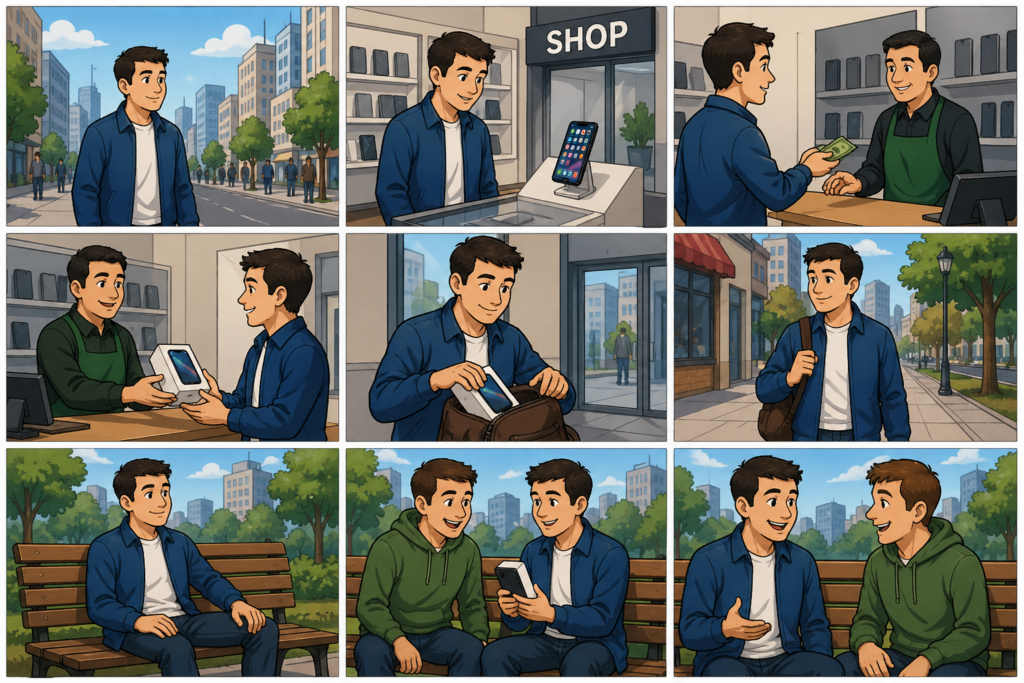
    There __________ (be) a man in a city. He __________ (go) to a shop and __________ (see) a mobile phone. He __________ (want) it and __________ (pay) for it. The shopkeeper __________ (give) him the phone. The man __________ (take) it and __________ (put) it in his bag. He __________ (walk) outside and __________ (sit) on a bench. A friend __________ (come) and __________ (look at) the mobile phone. They both __________ (like) it and __________ (talk) aboout it. Both men __________ (be) happy.

    ———————————

    Correct version:

    There was a man in a city. He went to a shop and saw a mobile phone. He wanted it and paid for it. The shopkeeper gave him the phone. The man took it and put it in his bag. He walked outside and sat on a bench. A friend came and looked at the mobile phone. They both liked it and talked about it. Both men were happy.


    ###############

    Story 2:

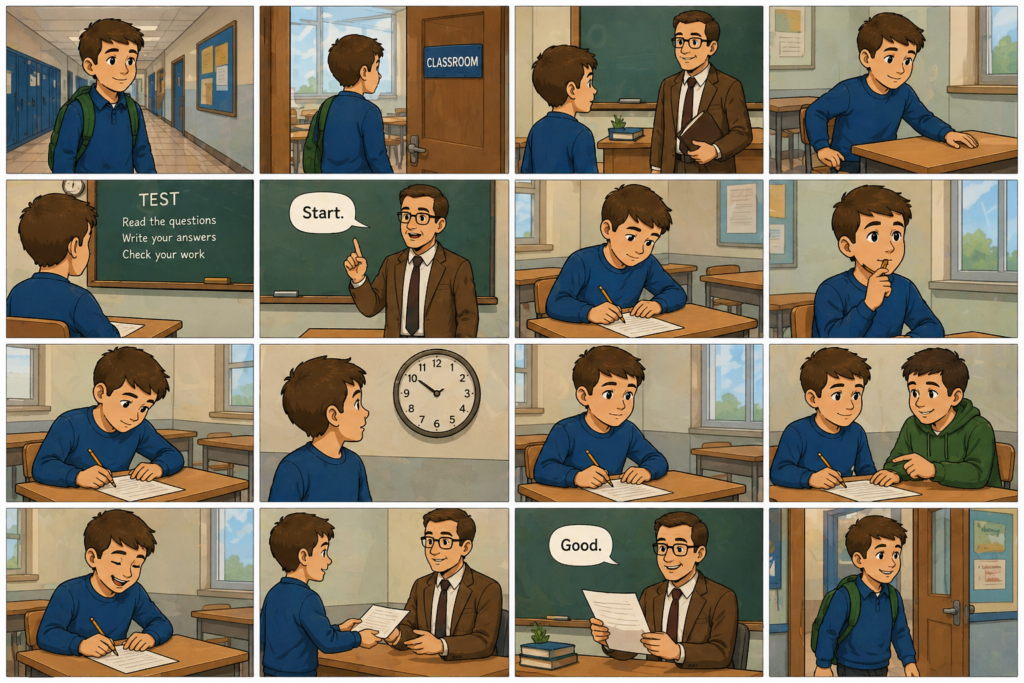
    There __________ (be) a boy at school. He __________ (go) to the classroom. He __________ (see) the teacher. He __________ (sit) at his desk. He __________ (look) at the board. The teacher __________ (say) β€œStart.” The boy __________ (do) the test. He __________ (think) a little. He __________ (write) slowly. He __________ (hear) the clock. He __________ (stop). A boy __________ (point out) a mistake. He __________ (laugh). He __________ (change) it. He __________ (give) the paper to the teacher. The teacher __________ (read) it. He __________ (say) β€œGood.” The boy __________ (be) happy. He __________ (leave) the classroom.

    ——————————–

    Correct version:

    There was a boy at school. He went to the classroom. He saw the teacher. He sat at his desk. He looked at the board. The teacher said β€œStart.” The boy did the test. He thought a little. He wrote slowly. He heard the clock. He stopped. A boy pointed out a mistake. He laughed. He changed it. He gave the paper to the teacher. The teacher read it. He said β€œGood.” The boy was happy. He left the classroom.

    ################

    Story 3:

    There __________ (be) a football match. A boy __________ (go) to the stadium. He __________ (see) his friends. They __________ (sit) on the seats. The match __________ (start). The boy __________ (watch) the game. He __________ (hear) the crowd. His team __________ (do) well and __________ (take) the lead. The fans __________ (jump up) and __________ (laugh). The boy __________ (point) at the field. He __________ (look) at the players. The referee __________ (stop) the game for a moment. The boy __________ (think) about the game. Later the match __________ (end). The boy __________ (be) happy and __________ (leave) the stadium.


    ——————————–

    Correct version:

    There was a football match. A boy went to the stadium. He saw his friends. They sat on the seats. The match started. The boy watched the game. He heard the crowd. His team took the lead. The fans jumped up and laughed. The boy pointed at the field. He looked at the players. The referee stopped the game for a moment. The boy thought about the game. Later the match ended. The boy was happy and left the stadium.

    ################

  • πŸ₯ΈπŸ˜³πŸ‘»πŸ€ A dark street (A1, beginners, present tense, listening comprehension only) πŸ€ πŸ‘»πŸ˜³πŸ₯Έ

    • boy and a girl walk home at night and feel scared

    ________________________

    Vocabulary:

    • dark: no light
    • listening comprehension: you listen and understand
    • to feel scared: you feel afraid
    • to be scared: you are afraid
    • crunch: a sound like crack when you step on something
    • leaves (one leaf): green parts of a tree
    • a sound: something you hear
    • to hold one’s arm: to take someone’s arm with your hand
    • to beat fast (heart): the heart goes very fast
    • to flap: to move wings up and down
    • a bat: a small animal that flies at night
    • to be quiet: no sound
    • maybe: not sure, it can be yes or no

    ##############

    LISTEN ONLY,
    DO NOT LOOK AT TEXTS

    Listen to the story, then do the following exercises below
    (full text at the end of the exercise)

    ##############

    True is:


    1. (a) The boy and the girl walk home.
      (b) The boy and the girl walk to school.
    2. (a) It is night. It is dark.
      (b) It is day. It is bright.
    3. (a) They go into a big street with many cars.
      (b) They go into a small street with many trees.
    4. (a) β€œI am excited,” says the girl.
      (b) β€œI am scared,” says the girl.
    5. (a) They walk slowly.
      (b) They walk quickly.
    6. (a) The girl lets go of his arm.
      (b) The girl holds his arm.
    7. (a) There are no lights.
      (b) There are many lights.
    8. (a) They keep walking.
      (b) They stop.
    9. (a) A bat flies over them.
      (b) A bird flies over them.
    10. (a) They hear a sound.
      (b) They hear nothing.
    11. (a) β€œRun now,” says the boy.
      (b) β€œIt is okay,” says the boy.
    12. (a) They walk slowly.
      (b) They run fast.

    ___________________
    Correct Answers:

    1a, 2a, 3b, 4b, 5a, 6b, 7a, 8b, 9a, 10a, 11b, 12b

    #############

    (a) or (b)?


    1. Do the boy and the girl walk (a) to school or (b) home?
    2. Is it (a) day or (b) night?
    3. Are there (a) lights or (b) no lights?
    4. Is the street (a) small or (b) big?
    5. Is the girl (a) scared or (b) happy?
    6. Does the boy say (a) β€œIt is okay” or (b) β€œRun now”?
    7. Do they walk (a) slowly or (b) fast?
    8. Does a (a) bird or (b) bat fly over them?
    9. Do they (a) stop or (b) keep running?
    10. Does the girl (a) hold his arm or (b) let go of his arm?

    _________________

    Answers:
    1b, 2b, 3b, 4a, 5a, 6a, 7b, 8b, 9a, 10a


    #############

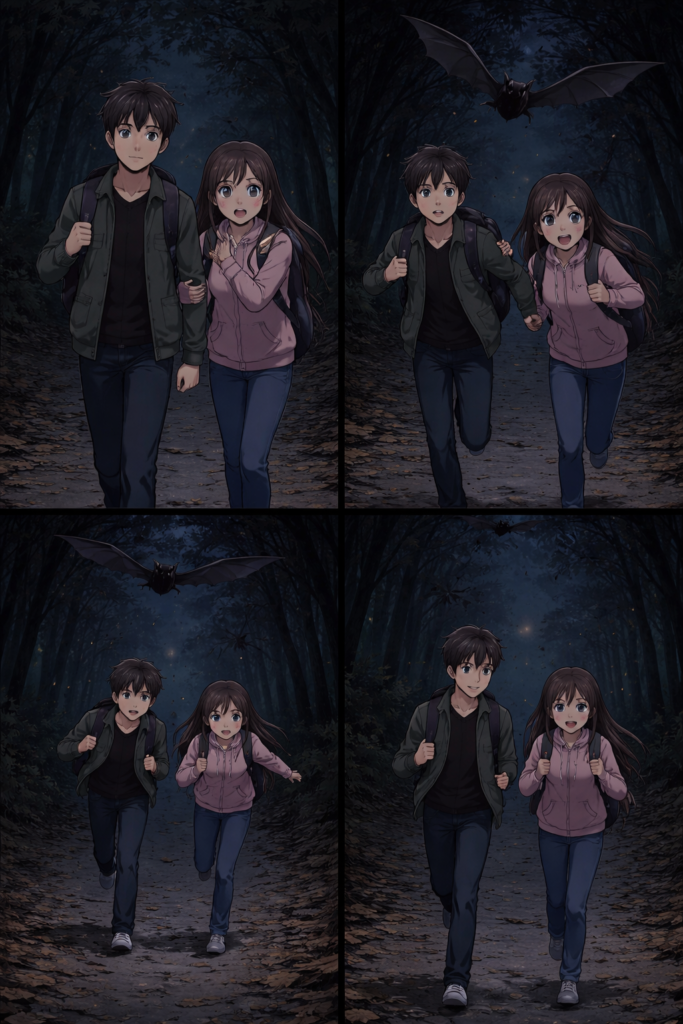
    A dark street

    The boy and the girl walk home.

    It is night. It is dark.

    They go into a small street with many trees. There are no lights.

    β€œI am scared,” says the girl.

    β€œIt is okay,” says the boy.

    They walk.

    Crunch.

    They stop.

    β€œWhat is that?” she says.

    β€œLeaves,” he says.

    They walk again.

    They hear a sound.

    The girl holds his arm. Their hearts beat fast.

    β€œLet’s go,” he says.

    They walk fast.

    Flap!

    A bat flies over them.

    β€œAaa!” says the girl.

    β€œIt is just a bat,” says the boy.

    They stop.

    It is quiet.

    Crunch.

    They look back.

    Flap!

    Another bat flies out.

    They run.

    They run fast.

    They do not stop.

    Maybe more bats are there.

    #####################

    #####################

    Listen to the story and fill in,
    if necessary click on

    The boy and the girl __________ home at night.
    The street is small and dark.
    There are many __________.
    There are no lights.

    The girl feels __________.
    The boy feels calm.
    They walk __________.
    They hear a sound on the ground.
    It is leaves.
    They continue __________.

    Suddenly, a bat flies over them.
    The girl is __________.
    They run fast.
    Another __________ flies near them.
    They do not stop.
    They keep ___________.
    The street is quiet again.
    They are __________.

    ————————————–

    Full version:

    The boy and the girl walk home at night. The street is small and dark. There are many trees. There are no lights.

    The girl feels scared. The boy feels calm. They walk slowly. They hear a sound on the ground. It is leaves. They continue walking.

    Suddenly, a bat flies over them. The girl is frightened. They run fast. Another bat flies near them. They do not stop. They keep running. The street is quiet again. They are safe.

  • πŸ₯ΈπŸ˜³πŸ‘»πŸ€ Night walk in the dark woods (A1, beginners, present simple, listening comprehension only) πŸ€ πŸ‘»πŸ˜³πŸ₯Έ

    • A boy and a girl hear a strange sound in the night forest and feel afraid.

    LISTEN ONLY,
    DO NOT LOOK AT TEXTS

    Listen to the story, then do the following exercises below
    (full text at the end of the exercise)

    Β΄___________________
    Vocabulary:

    to beat fast (heart): when your heart goes very quickly

    dark woods: a forest with no light

    listening comprehension: understanding what you hear

    to be quiet: not make noise

    a torch: a small light you hold in your hand

    a path: a small way to walk on

    to feel scared: to feel afraid

    a soft sound: a quiet sound

    to walk slowly: to walk not fast

    leaves: green parts of a tree

    suddenly: very quickly, without warning

    to shake: to move fast up and down or side to side

    a shadow: a dark shape from light

    to be still: not move

    a step: one movement when you walk

    to shine like stars: to be bright like stars

    to gasp: to take a quick breath in surprise

    a fox: a small wild animal with red fur

    to laugh a little: to laugh a small amount

    ###############

    LISTEN ONLY

    True is:

    1. (a) Tom and Anna walk at night. (b) They walk in the morning.
    2. (a) The sky is bright and blue. (b) It is very dark in the woods.
    3. (a) Tom has a torch in his hand. (b) Anna drops the torch.
    4. (a) They walk slowly on the path. (b) They run very fast all the time.
    5. (a) Anna hears a sound. (b) Anna has no fear.
    6. (a) The animal talks to them. (b) The animal is small.
    7. (a) They see eyes in the dark. (b) They see a big dog.
    8. (a) They go home before the end. (b) They feel scared in the woods.
    9. (a) Tom looks around. (b) Tom says nothing.
    10. (a) The torch light moves. (b) The light stays still.

    ____________________

    Correct:

    1. (a) Tom and Anna walk at night. (b) They walk in the morning. βœ… a
    2. (a) The sky is bright and blue. (b) It is very dark in the woods. βœ… b
    3. (a) Tom has a torch in his hand. (b) Anna drops the torch. βœ… a
    4. (a) They walk slowly on the path. (b) They run very fast all the time. βœ… a
    5. (a) Anna hears a sound. (b) Anna has no fear. βœ… a
    6. (a) The animal talks to them. (b) The animal is small. βœ… b
    7. (a) They see eyes in the dark. (b) They see a big dog. βœ… a
    8. (a) They go home before the end. (b) They feel scared in the woods. βœ… b
    9. (a) Tom looks around. (b) Tom says nothing. βœ… a
    10. (a) The torch light moves. (b) The light stays still. βœ… a

    ##############

    LISTEN ONLY


    Which one is correct?

    1. Does Anna hold (a) the torch or (b) Tom’s arm?

    2. Does Anna walk in the woods (a) at night or (b) in the morning?

    3. Is the forest (a) very dark or (b) very bright?

    4. Who has the torch? (a) Anna or (b) Tom?

    5. Do they walk (a) slowly or (b) very fast?

    6. Does Anna hear a (a) loud sound or (b) soft sound?

    7. Is the animal they see (a) small or (b) big?

    8. Do they see (a) a big dog or (b) two eyes in the dark?

    9. Do they feel (a) happy or (b) scared in the woods?

    10. Does Tom (a) sit down or (b) look around?

    11. Does the torch light (a) stay still or (b) move?

    12. Do they walk on (a) the grass or (b) a path?

    13. Does the fox (a) stay near them or (b) run away?

    14. Is the wind in the forest (a) cold or (b) hot?

    ______________________
    Correct answers:

    1. Does Anna walk in the woods (a) at night or (b) in the morning? βœ… a
    2. Is the forest (a) very dark or (b) very bright? βœ… a
    3. Who has the torch? (a) Anna or (b) Tom? βœ… b
    4. Do they walk (a) slowly or (b) very fast? βœ… a
    5. Does Anna hear a (a) loud sound or (b) soft sound? βœ… b
    6. Is the animal they see (a) small or (b) big? βœ… a
    7. Do they see (a) a big dog or (b) two eyes in the dark? βœ… b
    8. Do they feel (a) happy or (b) scared in the woods? βœ… a
    9. Does Tom (a) sit down or (b) look around? βœ… b
    10. Does the torch light (a) stay still or (b) move? βœ… a
    11. Do they walk on (a) the grass or (b) a path? βœ… b
    12. Does the fox (a) stay near them or (b) run away? βœ… b
    13. Is the wind in the forest (a) cold or (b) hot? βœ… a
    14. Does Anna hold (a) the torch or (b) Tom’s arm? βœ… b

    ###############

    LISTEN ONLY

    1. Is Anna
      a) a girl
      b) a boy
    2. Is Tom
      a) a boy
      b) a girl
    3. Where do they walk?
      a) in the woods
      b) in the city
    4. When do they walk?
      a) in the morning
      b) at night
    5. Who has the torch?
      a) Tom
      b) Anna
    6. How do they walk?
      a) very fast
      b) slowly
    7. What do they hear?
      a) a soft sound
      b) a loud song
    8. What moves in the dark?
      a) a car
      b) a shadow
    9. What animal do they see?
      a) a fox
      b) a dog
    10. How does Anna feel?
      a) happy
      b) scared
    11. What do they walk on?
      a) the grass
      b) a path
    12. What does the torch do?
      a) moves
      b) stays still
    13. Who does Anna hold?
      a) the torch
      b) Tom’s arm
    14. What is the wind like?
      a) cold
      b) hot

    ____________________

    Answers:

    1a, 2a, 3a, 4b, 5a, 6b, 7a,
    8b, 9a, 10b, 11b, 12a, 13b, 14a

    ###############

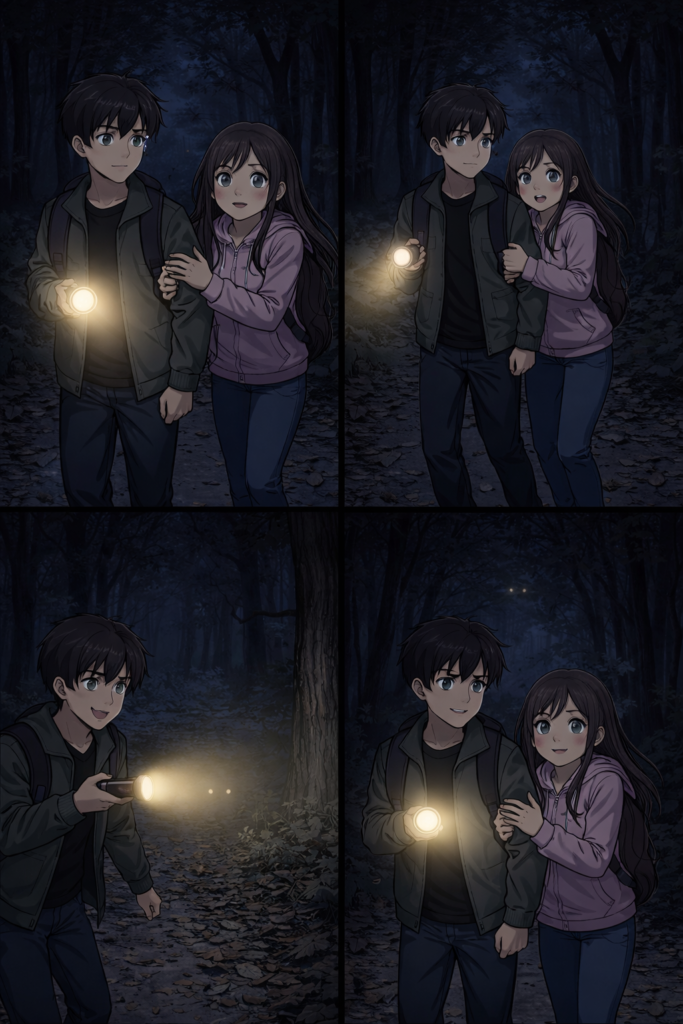
    Tom is a boy. Anna is a girl. They walk in the woods at night. It is very dark. The trees are tall and quiet. The wind is cold. Tom has a torch. The light is small, but it helps them see the path.

    Anna feels scared. She hears a soft sound. β€œDid you hear that?” she asks. Tom looks around, but he sees nothing. They walk slowly. The leaves move under their feet.

    Suddenly, the torch light shakes. It goes left, then right. A shadow moves behind a tree. Tom stops. Anna holds his arm. They are very still.

    The sound comes again. Step… step… step…

    β€œWho is there?” Tom says. No answer.

    The torch light shows two small eyes in the dark. They shine like stars. Anna gasps.

    Then, a small animal runs away. It is only a fox.

    Tom and Anna laugh a little, but their hearts still beat fast.

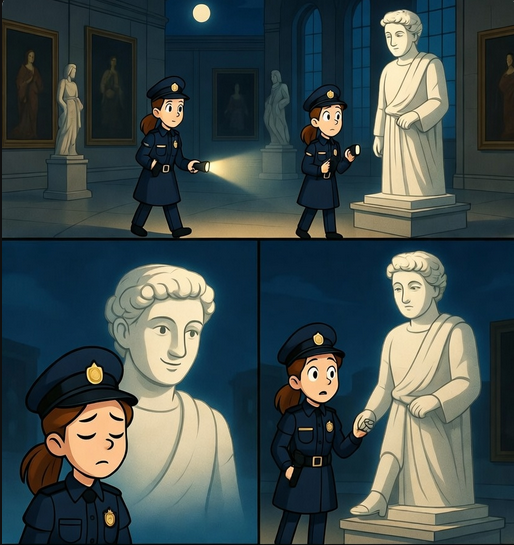
  • πŸ₯ΈπŸ˜³πŸ‘»πŸ€ The moving statue (A1, beginners, present simple, listening comprehension only)πŸ€ πŸ‘»πŸ˜³πŸ₯Έ

    • a guard sees something strange in the museum


    Vocabulary:

    • a statue β†’ a big figure of a person or animal (stone or metal)
    • a guard β†’ a person who watches a place and keeps it safe
    • something strange β†’ something not normal, a little different
    • to check paintings β†’ to look at paintings to see if they are okay
    • to be quiet β†’ to make no noise
    • to hear a noise β†’ to hear a sound
    • to move one’s head β†’ to turn or change the position of your head
    • to be surprised β†’ to feel something new or unexpected
    • to smile β†’ to show you are happy with your face
    • to close one’s eyes β†’ to shut your eyes
    • to laugh β†’ to make a happy sound (ha ha)
    • to be sure β†’ to know something is true

    LISTEN ONLY,
    DO NOT LOOK AT TEXTS

    Listen to the story, then do the following exercises below
    (full text at the end of the exercise):

    ##############

    LISTEN ONLY

    True or false:

    1. Anna hears a noise.
    2. Anna works in a school.
    3. The statue smiles at Anna.
    4. The boss believes Anna.
    5. The museum is quiet at night.
    6. Anna runs through the museum.
    7. She checks the paintings and statues.
    8. The statue moves its head.
    9. Anna works in a museum.
    10. The noise comes from a door.
    11. Anna tells her boss in the morning.
    12. Anna laughs when she sees the statue.
    13. She is a night guard.
    14. The museum is very loud at night.
    15. The statue talks to Anna.
    16. Anna walks through the rooms.
    17. The statue runs fast.
    18. Anna is sure the statue is normal.
    19. The noise comes from a statue.
    20. She works in the morning.

    ____________________________

    True: 1,3,5,7,8,9,11,13,16,19

    ####################

    LISTEN ONLY


    Which one is correct?


    1. Does Anna work in a school or in a museum?
    2. Is she a manager or a night guard?
    3. Is the museum noisy or quiet at night?
    4. Does Anna check paintings and statues or books and computers?
    5. Does she run through the rooms or walk through the rooms?
    6. Does Anna see a light or hear a noise?
    7. Does the noise come from a statue or a door?
    8. Does the statue move its head or its arms?
    9. Does the statue frown or smile at Anna?
    10. Does Anna tell her boss in the morning or in the evening?
    11. Is Anna bored or surprised when the statue moves?
    12. Does Anna close her eyes or laugh when she sees the statue?
    13. Does the boss laugh at her or believe Anna?
    14. Does the statue talk to Anna or stay silent?
    15. Does the statue walk slowly or run fast?
    16. Is Anna not sure or sure about the statue?
    17. Does Anna work at night or in the morning?
    18. Does she feel happy or surprised in the museum?
    19. Does the museum have paintings or computers?
    20. Does Anna like her job or dislike her job?

    __________________
    Correct answers:


    1. Does Anna work in a school or in a museum? – museum
    2. Is she a manager or a night guard? – night guard
    3. Is the museum noisy or quiet at night? – quiet
    4. Does Anna check paintings and statues or books and computers? – paintings and statues
    5. Does she run through the rooms or walk through the rooms? – walk
    6. Does Anna see a light or hear a noise? – hear a noise
    7. Does the noise come from a statue or a door? – statue
    8. Does the statue move its head or its arms? – head
    9. Does the statue frown or smile at Anna? – smile
    10. Does Anna tell her boss in the morning or in the evening? – morning
    11. Is Anna bored or surprised when the statue moves? – surprised
    12. Does Anna close her eyes or laugh when she sees the statue? – close her eyes
    13. Does the boss laugh at her or believe Anna? – laugh
    14. Does the statue talk to Anna or stay silent? – stay silent
    15. Does the statue walk slowly or run fast? – slowly
    16. Is Anna not sure or sure about the statue? – not sure
    17. Does Anna work at night or in the morning? – at night
    18. Does she feel happy or surprised in the museum? – surprised
    19. Does the museum have paintings or computers? – paintings
    20. Does Anna like her job or dislike her job? – like

    ###################

    LISTEN ONLY


    1. What is Anna’s job?
      • a) Night guard
      • b) Teacher
    2. Where does Anna work?
      • a) School
      • b) Museum
    3. When does Anna walk through the rooms?
      • a) At night
      • b) During the day
    4. What does Anna hear one night?
      • a) Music
      • b) A noise
    5. Where does the noise come from?
      • a) A statue
      • b) A door
    6. What does the statue do?
      • a) Runs fast
      • b) Moves its head
    7. How does Anna feel when she sees the statue move?
      • a) Surprised
      • b) Bored
    8. What does Anna do after she sees the statue move?
      • a) Shouts
      • b) Closes her eyes
    9. When does Anna tell her boss about the statue?
      • a) In the evening
      • b) In the morning
    10. What does the boss say?
      • a) It is only a statue
      • b) He believes her
    11. Does Anna check paintings and statues or books?
      • a) Paintings and statues
      • b) Books
    12. Is the museum quiet or noisy at night?
      • a) Noisy
      • b) Quiet
    13. Does the statue smile or frown at Anna?
      • a) Smile
      • b) Frown
    14. Does Anna walk or run through the museum?
      • a) Run
      • b) Walk
    15. Is Anna sure or not sure about the statue?
      • a) Not sure
      • b) Sure
    16. Does Anna work during the day or at night?
      • a) During the day
      • b) At night
    17. Does the statue stay silent or talk to Anna?
      • a) Talk
      • b) Stay silent
    18. Does the statue move slowly or fast?
      • a) Fast
      • b) Slowly
    19. Does Anna feel happy or surprised in the museum?
      • a) Happy
      • b) Surprised
    20. Does the boss laugh or believe Anna?
      • a) Believe
      • b) Laugh

    _________________________

    Correct answers:


    1. a, 2. b, 3. a, 4. b, 5. a, 6. b, 7. a,
      8. b, 9. b, 10. a, 11. a, 12. b, 13. a, 14. b,
      15. a, 16. b, 17. b, 18. b, 19. b, 20. b

    #############


    Anna works in a museum. She is a night guard. Every evening, she walks through the rooms and checks the paintings and statues. The museum is very quiet at night.

    One night, Anna hears a noise. She stops and listens. The noise comes from a big statue. It is a statue of a man.

    Anna looks at the statue. At first, nothing happens. Then, the statue moves its head. Anna is very surprised. She cannot speak.

    The statue looks at Anna and smiles. Then it walks slowly across the room.

    Anna closes her eyes. When she opens them again, the statue is still. It does not move.

    In the morning, Anna tells her boss. He laughs and says, β€œIt is only a statue.”

    But Anna is not sure.

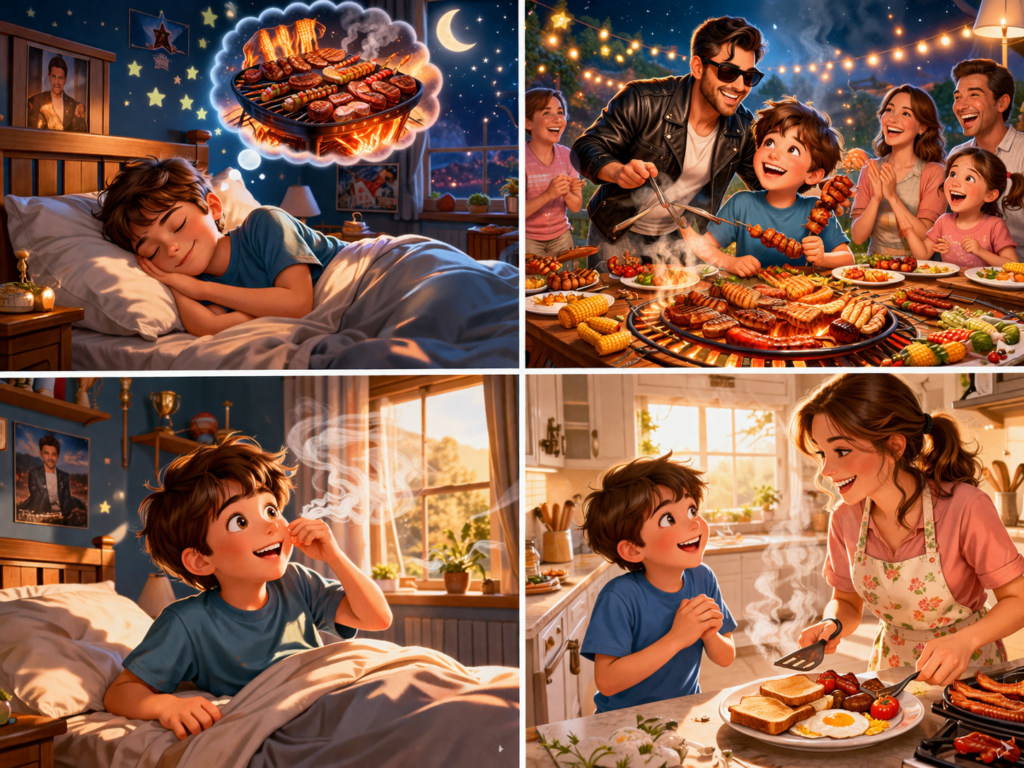
  • πŸ₯³πŸ‘»πŸ³When dreams come true (A1, beginners, present simple, listening comprehension only)πŸ³πŸ‘»πŸ₯³

    • from dream to reality


    ___________________________

    Vocabulary:

    • to come true β†’ to really happen
    • BBQ (barbecue) β†’ food cooked on a fire (like meat)
    • a dream β†’ pictures and stories in your sleep
    • at night β†’ when it is dark and you sleep
    • an idol β†’ a person you really like and look up to
    • a movie star β†’ a famous actor in movies
    • to wake up β†’ to stop sleeping
    • to smell something β†’ to feel a smell with your nose
    • a kitchen β†’ a room where you cook food
    • to make breakfast β†’ to cook food in the morning
    • to smile β†’ to look happy with your face
    • to be happy β†’ to feel good and glad

    ___________________________

    LISTEN ONLY,
    DO NOT LOOK AT TEXTS

    full text at the end of the exercise

    the do the following exercises:

    ###################

    True or false:

    1. The boy eats breakfast in his bedroom.
    2. The boy wakes up in the morning.
    3. The movie star is the boy’s teacher.
    4. The boy goes to the kitchen after he wakes up.
    5. The family is sad in the dream.
    6. The boy smells BBQ in the bathroom.
    7. The BBQ in the dream is not good.
    8. The boy has a dream at night.
    9. The boy is happy at the end.
    10. The boy goes back to sleep after breakfast.
    11. The mom says β€œGood morning!”
    12. The boy sleeps in his bed.
    13. The movie star eats BBQ with the boy’s family.
    14. The boy’s mom sleeps in the kitchen.

    ______________________

    True: 2,4,8,9,11,12,13


    ################

    LISTEN ONLY


    1. Does the boy dream at night or during the day?
    2. Does he go to the kitchen or to the garden after waking up?
    3. Is his idol a football star or a movie star?
    4. Does his mom smile or frown and say β€œGood morning”?
    5. Does the boy eat pizza or BBQ in his dream?
    6. Does the boy wake up at night or in the morning?
    7. Is the boy happy or angry at the end of the story?
    8. Does the boy sleep on a sofa or in his bed?
    9. Does the dream disappear without effect or come true?
    10. Does the boy smell flowers or BBQ in his bedroom?
    11. Is the BBQ in the dream very bad or very good?
    12. Does the boy’s family feel sad or happy in the dream?
    13. Does the movie star have BBQ with his friends or with the boy’s family?
    14. Does his mom make lunch or breakfast?

    ___________________

    Correct answers:


    1. Does the boy dream at night or during the day? β†’ night
    2. Does he go to the kitchen or to the garden after waking up? β†’ kitchen
    3. Is his idol a football star or a movie star? β†’ movie star
    4. Does his mom smile or frown and say β€œGood morning”? β†’ smile
    5. Does the boy eat pizza or BBQ in his dream? β†’ BBQ
    6. Does the boy wake up at night or in the morning? β†’ morning
    7. Is the boy happy or angry at the end of the story? β†’ happy
    8. Does the boy sleep on a sofa or in his bed? β†’ bed
    9. Does the dream disappear without effect or come true? β†’ come true
    10. Does the boy smell flowers or BBQ in his bedroom? β†’ BBQ
    11. Is the BBQ in the dream very bad or very good? β†’ very good
    12. Does the boy’s family feel sad or happy in the dream? β†’ happy
    13. Does the movie star have BBQ with his friends or with the boy’s family? β†’ boy’s family
    14. Does his mom make lunch or breakfast? β†’ breakfast

    ##################


    LISTEN ONLY

    1. The person who sleeps in a bed is
      a) a boy
      b) a girl
    2. The person loves
      a) pizza
      b) BBQ
    3. The person dreams
      a) during the day
      b) at night
    4. In the dream, the person eats
      a) pizza
      b) BBQ
    5. The BBQ in the dream is
      a) very good
      b) very bad
    6. The person’s idol is
      a) a football star
      b) a movie star
    7. The movie star eats BBQ with
      a) the person’s family
      b) the person’s friends
    8. The family in the dream feels
      a) sad
      b) happy
    9. When the person wakes up, it is
      a) night
      b) morning
    10. The person smells
      a) BBQ
      b) flowers
    11. After waking up, the person goes to
      a) the garden
      b) the kitchen
    12. The mom makes
      a) lunch
      b) breakfast
    13. The mom is
      a) smiling
      b) frowning
    14. At the end of the story, the person feels
      a) happy
      b) angry

    _________________

    Answers:
    1a, 2b, 3b, 4b, 5a, 6b, 7a,
    8b, 9b, 10a, 11b, 12b, 13a, 14a

    The BBQ Dream

    The boy sleeps in his bed.
    He likes BBQ very much.

    He dreams at night.
    In his dream, he eats BBQ.
    The BBQ is very good.

    His idol is a movie star.
    The movie star is in the dream.
    He has BBQ with the boy and his family.
    They are happy. It is great.

    The boy wakes up.
    He smells BBQ in his bedroom.

    He goes to the kitchen.
    His mom makes breakfast.
    She smiles and says, β€œGood morning!”

    The boy is happy.

  • πŸ₯ΈπŸŽ’βš½A day in Lina’s life – memories (A1, beginners, questions, short answers, past simple, part 2/2)βš½πŸŽ’πŸ₯Έ

    • Lina is a teacher now, remembering her time when she was 10

    There is a present simple A1 version,
    Lina as a child => link

    ###############


    Lina was a 10-year-old girl. She lived in a small village in Southeast Asia. She lived with her parents and grandparents. Her father was a farmer. Her mother sold vegetables and fruits at the morning market.

    Lina woke up early every day. She helped her mother prepare food and carry things. Then she walked to school. The walk was long, but she liked it. She saw trees, animals, and her friends.

    At school, Lina was happy. She loved learning. Her favorite subjects were Maths and English. She listened to her teacher and worked hard. She also played with her friends during breaks.

    After school, Lina walked home. She helped her family again. In the evening, she did her homework and studied.

    Lina wanted to be a teacher one day. She wanted to help young children in her village learn and have a better life.

    And she has lived her dream – SHE IS A TEACHER NOW.

    ________________________

    Vocabulary:

    • to remember: to keep something in your mind and not forget it
    • to dream of something: to want something very much in the future
    • a village: a small place where people live, smaller than a town
    • grandparents: the parents of your mother or father
    • to sell vegetables: to give vegetables to people for money
    • morning market: a place where people buy and sell things in the morning
    • to wake up: to stop sleeping
    • to prepare food: to make food ready to eat
    • to carry things: to hold and take things from one place to another
    • a favorite subject: the school subject you like best
    • to listen to somebody: to hear and pay attention to someone
    • to work hard: to do a lot of work with effort
    • a break (school): a short time to rest at school
    • to study: to learn and read for school
    • to have a better life: to live in a happier and easier way

    ###################

    Dieses Bild hat ein leeres Alt-Attribut. Der Dateiname ist grafik-2.png

    Verbs in text, regular and irregular:

    InfinitivePastA1 Definition
    bewas / wereto exist; to be something
    livelivedto have a home in a place
    sellsoldto give something for money
    wake upwoke upto stop sleeping
    helphelpedto do something for someone
    preparepreparedto get something ready
    carrycarriedto hold and take something
    walkwalkedto move on your feet
    likelikedto think something is good
    seesawto use your eyes
    lovelovedto like something very much
    listenlistenedto hear and pay attention
    workworkedto do a job or task
    playplayedto have fun or do a game
    dodidto make or finish something
    studystudiedto learn about something
    wantwantedto wish for something
    learnlearnedto get knowledge or skill
    havehadto own or get something

    ###############

    Basics in past simple:

    Past Simple – Regular Verbs

    Rules:

    • Most verbs: add -ed
      play β†’ played
    • Verbs ending in -e: add -d
      live β†’ lived
    • Verbs ending in consonant + y: change y to i and add -ed
      study β†’ studied
    • Short verbs ending in vowel + consonant: double the final consonant and add -ed
      stop β†’ stopped
    • List of irregular verbs => LINK

    Use:
    The past simple is used to talk about finished actions in the past.

    ################

    Match the words with the definitions:

    1. to dream of something
    2. a village
    3. grandparents
    4. to sell vegetables
    5. morning market
    6. to wake up
    7. to prepare food
    8. to carry things
    9. a favorite subject
    10. to listen to somebody
    11. to work hard
    12. a break (school)
    13. to study
    14. to have a better life

      Definitions:

    A. to stop sleeping
    B. to give vegetables to people for money
    C. to hear and pay attention to someone
    D. the parents of your mother or father
    E. to want something very much in the future
    F. to make food ready to eat
    G. a small place where people live, smaller than a town
    H. a short time to rest at school
    I. to hold and take things from one place to another
    J. a place where people buy and sell things in the morning
    K. to do a lot of work with effort
    L. the school subject you like best
    M. to learn and read for school
    N. to live in a happier and easier way

    ___________________
    Answers:
    1-E, 2-G, 3-D, 4-B, 5-J,
    6-A, 7-F, 8-I, 9-L, 10-C,
    11-K, 12-H, 13-M, 14-N

    ###############

    Find words that match the definitions below:

    Definitions:

    1. to hold and take things from one place to another
    2. to live in a happier and easier way
    3. to stop sleeping
    4. a short time to rest at school
    5. to make food ready to eat
    6. the parents of your mother or father
    7. a place where people buy and sell things in the morning
    8. to do a lot of work with effort
    9. to want something very much in the future
    10. to hear and pay attention to someone
    11. a small place where people live, smaller than a town
    12. to learn and read for school
    13. the school subject you like best
    14. to give vegetables to people for money

    Words:

    a. to study
    b. to wake up
    c. to carry things
    d. grandparents
    e. to work hard
    f. a village
    g. to prepare food
    h. to sell vegetables
    i. to listen to somebody
    j. a break (school)
    k. to dream of something
    l. a favorite subject
    m. morning market
    n. to have a better life

    _____________________
    Answers:
    1-c, 2-n, 3-b, 4-j, 5-g,
    6-d, 7-m, 8-e, 9-k, 10-i,
    11-f, 12-a, 13-l, 14-h

    #################

    True or false:

    1. To carry things means to take things from one place to another.
    2. To work hard means to do very little work.
    3. A favorite subject is the subject you like best.
    4. To dream of something means to not want anything.
    5. A morning market happens at night.
    6. Grandparents are your mother’s or father’s parents.
    7. To prepare food means to make food ready to eat.
    8. To wake up means to start sleeping.
    9. To study means to learn for school.
    10. To sell vegetables means to buy vegetables.
    11. To listen to somebody means to ignore them.
    12. A break at school is time to rest.
    13. A village is a small place where people live.
    14. To have a better life means to live in a worse way.

    _____________________

    True: 1,3,6,7,9,12,13

    #################

    True or false:

    1. Lina went to school by bus.
    2. Her favorite subjects were Maths and English.
    3. She lived in a small village in Southeast Asia.
    4. Lina wanted to be a doctor.
    5. Lina walked to school every day.
    6. She never helped her family.
    7. Lina became a teacher in the end.
    8. Her mother worked in a school.
    9. Lina was a 10-year-old girl.
    10. She lived only with her parents.
    11. She did not like learning.
    12. Her father was a farmer.
    13. Lina lived in a big city.
    14. She liked the walk to school.

    _______________________

    True: 2,3,5,7,9,12,14

    #################

    Short answers, past simple, basics:

    Example SentenceYesNo
    I learned letters.Yes, I did.No, I didn’t.
    You read signs.Yes, you did.No, you didn’t.
    He spoke English.Yes, he did.No, he didn’t.
    She watched TV.Yes, she did.No, she didn’t.
    It helped me.Yes, it did.No, it didn’t.
    We used an app.Yes, we did.No, we didn’t.
    You read words.Yes, you did.No, you didn’t.
    They made mistakes.Yes, they did.No, they didn’t.

    Questions (Past Simple)

    QuestionYesNo
    Did I learn letters?Yes, I did.No, I didn’t.
    Did you read signs?Yes, you did.No, you didn’t.
    Did he speak English?Yes, he did.No, he didn’t.
    Did she watch TV?Yes, she did.No, she didn’t.
    Did it help me?Yes, it did.No, it didn’t.
    Did we use an app?Yes, we did.No, we didn’t.
    Did you read words?Yes, you did.No, you didn’t.
    Did they make mistakes?Yes, they did.No, they didn’t.

    Was / Were

    QuestionYesNo
    Was I happy?Yes, I was.No, I wasn’t.
    Were you happy?Yes, you were.No, you weren’t.
    Was he happy?Yes, he was.No, he wasn’t.
    Was she happy?Yes, she was.No, she wasn’t.
    Was it good?Yes, it was.No, it wasn’t.
    Were we happy?Yes, we were.No, we weren’t.
    Were you happy?Yes, you were.No, you weren’t.
    Were they happy?Yes, they were.No, they weren’t.

    #################

    Give short answers:

    1. Lina became a doctor.

      YOU WRITE:
      Yes, she did.

    2. Lina was a 10-year-old girl.
    3. She played with her friends during breaks.
    4. Lina did not go to school.
    5. Her favorite subjects Maths and English were.
    6. She woke up late every day.
    7. Lina lived with her parents and grandparents.
    8. Lina was unhappy at school.
    9. She helped her mother in the morning.
    10. The walk to school was long.
    11. Her favorite subjects History and Art were.
    12. Her father was a teacher.
    13. In the evening, she did her homework.
    14. Lina lived alone.
    15. She was happy at school.
    16. The school was very close to her house.
    17. She hated Maths and English.
    18. Her mother sold vegetables and fruits.
    19. Lina woke up early every day.
    20. Lina was 15 years old.

    _______________________

    Correct version:


    Lina became a doctor. – No, she didn’t.

    Lina was a 10-year-old girl. – Yes, she was.

    She played with her friends during breaks. – Yes, she did.

    Lina did not go to school. – No, she didn’t.

    Her favorite subjects Maths and English were. – Yes, they were.

    She woke up late every day. – No, she didn’t.

    Lina lived with her parents and grandparents. – Yes, she did.

    Lina was unhappy at school. – No, she wasn’t.

    She helped her mother in the morning. – Yes, she did.

    The walk to school was long. – Yes, it was.

    Her favorite subjects History and Art were. – No, they weren’t.

    Her father was a teacher. – No, he wasn’t.

    In the evening, she did her homework. – Yes, she did.

    Lina lived alone. – No, she didn’t.

    She was happy at school. – Yes, she was.

    The school was very close to her house. – No, it wasn’t.

    She hated Maths and English. – No, she didn’t.

    Her mother sold vegetables and fruits. – Yes, she did.

    Lina woke up early every day. – Yes, she did.

    Lina was 15 years old. – No, she wasn’t.

    #################

    Short answers, if false, provide short answer and then the corrected version:

    1. Did Lina play with her teachers during breaks?

      YOU WRITE:
      No, she didn’t.
      She played with her friends during breaks.

    2. Did she help carry things for her mother?
    3. Did Lina ride a car to school?
    4. Did she help her father sell fruits at the market?
    5. Were two of Lina’s favorite subjects Maths and English?
    6. Did Lina love learning at school?
    7. Did she spend all her time away from her family?
    8. Did Lina see animals and friends on her way to school?
    9. Was Lina 10 years old?
    10. Did Lina walk to school every day?
    11. Was Lina’s father a teacher?
    12. Did Lina dislike learning at school?
    13. Did her mother sell vegetables and fruits at the morning market?
    14. Was her favorite subject Science only?
    15. Did she help her mother prepare food?
    16. Did Lina live in a big city?
    17. Were her favorite subjects Science and History?
    18. Did she want to be a teacher in the future?
    19. Did she sleep all morning?
    20. Did Lina become a teacher in the end?

    _______________________

    Correct version:

    1. Did Lina play with her teachers during breaks? – No, she didn’t.
    2. Did she help carry things for her mother? – Yes, she did.
    3. Did Lina ride a car to school? – No, she didn’t. She walked to school every day.
    4. Did she help her father sell fruits at the market? – No, she didn’t. Her mother sold fruits and vegetables at the market.
    5. Were two of Lina’s favorite subjects Maths and English? – Yes, they were.
    6. Did Lina love learning at school? – Yes, she did.
    7. Did she spend all her time away from her family? – No, she didn’t. She helped her family at home every day.
    8. Did Lina see animals and friends on her way to school? – Yes, she did.
    9. Was Lina 10 years old? – Yes, she was.
    10. Did Lina walk to school every day? – Yes, she did.
    11. Was Lina’s father a teacher? – No, he wasn’t. He was a farmer.
    12. Did Lina dislike learning at school? – No, she didn’t. She loved learning at school.
    13. Did her mother sell vegetables and fruits at the morning market? – Yes, she did.
    14. Was her favorite subject Science only? – No, it wasn’t. Her favorite subjects were Maths and English.
    15. Did she help her mother prepare food? – Yes, she did.
    16. Did Lina live in a big city? – No, she didn’t. She lived in a small village.
    17. Were her favorite subjects Science and History? – No, they weren’t. Her favorite subjects were Maths and English.
    18. Did she want to be a teacher in the future? – Yes, she did.
    19. Did she sleep all morning? – No, she didn’t. She woke up early every day.
    20. Did Lina become a teacher in the end? – Yes, she did.

    #################

    Fill in:

    Lina was ______ years old.

    She lived in a small ______ in Southeast Asia.

    Her father worked as a ______.

    Her mother sold ______ and ______ at the morning market.

    Lina walked to ______ every day.

    She helped her mother prepare ______ and carry ______.

    Lina’s favorite subjects were ______ and ______.

    In the evening, Lina did her ______ and studied.

    She wanted to be a ______ in the future.

    She wanted to help ______ in her village.

    Lina woke up ______ every day.

    On her way to school, she saw ______ and ______.

    She played with her ______ during school breaks.

    Her father worked hard as a ______.

    ————————————-
    Correct version:

    Lina was 10 years old.

    She lived in a small village in Southeast Asia.

    Her father worked as a farmer.

    Her mother sold vegetables and fruits at the morning market.

    Lina walked to school every day.

    She helped her mother prepare food and carry things.

    Lina’s favorite subjects were Maths and English.

    In the evening, Lina did her homework and studied.

    She wanted to be a teacher in the future.

    She wanted to help young children in her village.

    Lina woke up early every day.

    On her way to school, she saw trees and animals.

    She played with her friends during school breaks.

    Her father worked hard as a farmer.

    #################

    #################

    Past simple – basics

    Personal PronounVerb (Past)Object
    Iateapples
    Youateapples
    Heateapples
    Sheateapples
    Itateapples
    Weateapples
    You (plural)ateapples
    Theyateapples
    Iplayedfootball
    Youplayedfootball
    Heplayedfootball
    Sheplayedfootball
    Itplayedfootball
    Weplayedfootball
    You (plural)playedfootball
    Theyplayedfootball
    Personal PronounVerb (Past Negative)Object
    Idid not eatapples
    Youdid not eatapples
    Hedid not eatapples
    Shedid not eatapples
    Itdid not eatapples
    Wedid not eatapples
    You (plural)did not eatapples
    Theydid not eatapples
    Idid not playfootball
    Youdid not playfootball
    Hedid not playfootball
    Shedid not playfootball
    Itdid not playfootball
    Wedid not playfootball
    You (plural)did not playfootball
    Theydid not playfootball
    Did + PronounVerbObject
    Did Ieatapples?
    Did youeatapples?
    Did heeatapples?
    Did sheeatapples?
    Did iteatapples?
    Did weeatapples?
    Did youeatapples?
    Did theyeatapples?
    Did Iplayfootball?
    Did youplayfootball?
    Did heplayfootball?
    Did sheplayfootball?
    Did itplayfootball?
    Did weplayfootball?
    Did youplayfootball?
    Did theyplayfootball?
    Didn’t + PronounVerbObject
    Didn’t Ieatapples?
    Didn’t youeatapples?
    Didn’t heeatapples?
    Didn’t sheeatapples?
    Didn’t iteatapples?
    Didn’t weeatapples?
    Didn’t youeatapples?
    Didn’t theyeatapples?
    Didn’t Iplayfootball?
    Didn’t youplayfootball?
    Didn’t heplayfootball?
    Didn’t sheplayfootball?
    Didn’t itplayfootball?
    Didn’t weplayfootball?
    Didn’t youplayfootball?
    Didn’t theyplayfootball?

    Forms of β€što beβ€˜

    Personal PronounPositiveNegativeQuestion
    II was happy.I was not happy.Was I happy?
    You (singular)You were excited.You were not excited.Were you excited?
    HeHe was at home.He was not at home.Was he at home?
    SheShe was tired.She was not tired.Was she tired?
    ItIt was cold.It was not cold.Was it cold?
    WeWe were at the party.We were not at the party.Were we at the party?
    You (plural)You were friends.You were not friends.Were you friends?
    TheyThey were in the garden.They were not in the garden.Were they in the garden?

    ##############

    Rewrite as shown below:

    1. Lina was 10 years old.

      YOU WRITE:
      a) Lina was not 10 years old.
      b) Was Lina 10 years old?
      c) Wasn’t Lina 10 years old?

    2. She lived in a small village in Southeast Asia.
    3. Her father worked as a farmer.
    4. Her mother sold vegetables and fruits at the morning market.
    5. Lina woke up early every day.
    6. She helped her mother prepare food and carry things.
    7. Lina walked to school and saw trees, animals, and friends.
    8. Her favorite subjects were Maths and English.
    9. Lina wanted to be a teacher in the future.
    10. She played with her friends during school breaks.

    ______________________

    Correct version:


    Lina was 10 years old.
    a) Lina was not 10 years old.
    b) Was Lina 10 years old?
    c) Wasn’t Lina 10 years old?

    She lived in a small village in Southeast Asia.
    a) She did not live in a small village in Southeast Asia.
    b) Did she live in a small village in Southeast Asia?
    c) Didn’t she live in a small village in Southeast Asia?

    Her father worked as a farmer.
    a) Her father did not work as a farmer.
    b) Did her father work as a farmer?
    c) Didn’t her father work as a farmer?

    Her mother sold vegetables and fruits at the morning market.
    a) Her mother did not sell vegetables and fruits at the morning market.
    b) Did her mother sell vegetables and fruits at the morning market?
    c) Didn’t her mother sell vegetables and fruits at the morning market?

    Lina woke up early every day.
    a) Lina did not wake up early every day.
    b) Did Lina wake up early every day?
    c) Didn’t Lina wake up early every day?

    She helped her mother prepare food and carry things.
    a) She did not help her mother prepare food and carry things.
    b) Did she help her mother prepare food and carry things?
    c) Didn’t she help her mother prepare food and carry things?

    Lina walked to school and saw trees, animals, and friends.
    a) Lina did not walk to school and see trees, animals, and friends.
    b) Did Lina walk to school and see trees, animals, and friends?
    c) Didn’t Lina walk to school and see trees, animals, and friends?

    Her favorite subjects were Maths and English.
    a) Her favorite subjects were not Maths and English.
    b) Were her favorite subjects Maths and English?
    c) Weren’t her favorite subjects Maths and English?

    Lina wanted to be a teacher in the future.
    a) Lina did not want to be a teacher in the future.
    b) Did Lina want to be a teacher in the future?
    c) Didn’t Lina want to be a teacher in the future?
    ___end of audio___

    She played with her friends during school breaks.
    a) She did not play with her friends during school breaks.
    b) Did she play with her friends during school breaks?
    c) Didn’t she play with her friends during school breaks?


    ################

    Form questions to which the word/s given is/are the correct answer:

    1. Her mother sold vegetables and fruits at the morning market.
      a) Her mother:
      b) Her:
      c) sold vegetables and fruits at the morning market:
      d) vegetables and fruits:
      e) at the morning market:

    2. Lina woke up early every day.
      a) Lina:
      b) woke up early every day:
      c) early:
      d) every day:

    3. She helped her mother.
      a) She:
      b) helped her mother prepare food :
      c) her mother:
      d) her:

    4. Lina walke to school with her friends.
      a) Lina:
      b) walked to school with her friends:
      c) to school:
      d) with her friends:
      e) her:

    5. Lina wanted to be a teacher in the future.
      a) Lina:
      b) wanted to be a teacher in the future:
      c) a teacher:
      d) in the future:

    ____________________

    Correct version:


    Her mother sold vegetables and fruits at the morning market.
    a) Her mother: Who sold vegetables and fruits at the morning market?
    b) Her: Whose mother sold vegetables and fruits at the morning market?
    c) sold vegetables and fruits at the morning market: What did her mother do at the morning market?
    d) vegetables and fruits: What did her mother sell?
    e) at the morning market: Where did her mother sell vegetables and fruits?


    Lina woke up early every day.
    a) Lina: Who woke up early every day?
    b) woke up early every day: What did Lina do every day?
    c) early: When did Lina wake up every day?
    d) every day: How often did Lina wake up early?


    She helped her mother.
    a) She: Who helped her mother?
    b) helped her mother prepare food: What did she do?
    c) her mother: Who did she help?
    d) her: Whose mother did she help?


    Lina walked to school with her friends.
    a) Lina: Who walked to school with friends?
    b) walked to school with her friends: What did Lina do?
    c) to school: Where did Lina walk to?
    d) with her friends: Who did Lina walk with?
    e) her: With whose friends did she walk to school?


    Lina wanted to be a teacher in the future.
    a) Lina: Who wanted to be a teacher?
    b) wanted to be a teacher in the future: What did Lina want to do?
    c) a teacher: What did Lina want to be?
    d) in the future: When did Lina want to be a teacher?


    ##############

    Complete:


    Interviewer: Hello, Lina! Can you tell us about your childhood?

    Lina: Hello! Yes, I can.

    Interviewer: How old were you when you were a ____________?
    Lina: I was 10 years old.

    Interviewer: Where did you live?
    Lina: I lived in a small _____________ in Southeast Asia.

    Interviewer: Who did you live with?
    Lina: I lived with my parents and ______________.

    Interviewer: What did your father do?
    Lina: My father worked as a ___________.

    Interviewer: What did your mother do?
    Lina: My mother ______________vegetables and fruits at the morning market.

    Interviewer: How did you help your mother?
    Lina: I helped her prepare food and ____________ things.

    Interviewer: How did you go to school?
    Lina: I _______________ to school every day.

    Interviewer: What did you see on your way to school?
    Lina: I saw trees, animals, and my ______________.

    Interviewer: When did you wake up?
    Lina: I woke up ___________ every day.

    Interviewer: Which subjects did you like best?
    Lina: My ___________ subjects were Maths and English.

    Interviewer: Why did you like learning?
    Lina: I loved learning because it was________________.

    Interviewer: Who did you play with at school?
    Lina: I played with my friends during school ______________.

    Interviewer: What did you want to be when you were a child?
    Lina: I wanted to be a ______________ in the future.

    Interviewer: Why did you want to be a teacher?
    Lina: I wanted to help children in my _____________ learn.

    Interviewer: How did you spend your evenings?
    Lina: I did my _____________ and studied in the evening.

    Interviewer: Thank you, Lina!
    Lina: You’re______________!


    _______________________

    Full version:


    Interviewer: Hello, Lina! Can you tell us about your childhood?

    Lina: Hello! Yes, I can.

    Interviewer: How old were you when you were a child?
    Lina: I was 10 years old.

    Interviewer: Where did you live?
    Lina: I lived in a small village in Southeast Asia.

    Interviewer: Who did you live with?
    Lina: I lived with my parents and grandparents.

    Interviewer: What did your father do?
    Lina: My father worked as a farmer.

    Interviewer: What did your mother do?
    Lina: My mother sold vegetables and fruits at the morning market.

    Interviewer: How did you help your mother?
    Lina: I helped her prepare food and carry things.

    Interviewer: How did you go to school?
    Lina: I walked to school every day.

    Interviewer: What did you see on your way to school?
    Lina: I saw trees, animals, and my friends.

    Interviewer: When did you wake up?
    Lina: I woke up early every day.

    Interviewer: Which subjects did you like best?
    Lina: My favorite subjects were Maths and English.

    Interviewer: Why did you like learning?
    Lina: I loved learning because it was interesting.

    Interviewer: Who did you play with at school?
    Lina: I played with my friends during school breaks.

    Interviewer: What did you want to be when you were a child?
    Lina: I wanted to be a teacher in the future.

    Interviewer: Why did you want to be a teacher?
    Lina: I wanted to help children in my village learn.

    Interviewer: How did you spend your evenings?
    Lina: I did my homework and studied in the evening.

    Interviewer: Thank you, Lina!
    Lina: You’re welcome!


  • 🍐🍌πŸ₯₯🌢️A day in Lina’s life (A1, beginners, questions, short answers, present simple, part 1/2)🌢️πŸ₯₯🍌🍐

    • a young girl learns, helps her family, and dreams of becoming a teacher

    There is a past simple A1 version,
    Lina as a teacher,

    and her memories => link

    ##############


    Lina is a 10-year-old girl. She lives in a small village in Southeast Asia. She lives with her parents and grandparents. Her father is a farmer. Her mother sells vegetables and fruits at the morning market.

    Lina wakes up early every day. She helps her mother prepare food and carry things. Then she walks to school. The walk is long, but she likes it. She sees trees, animals, and her friends.

    At school, Lina is happy. She loves learning. Her favorite subjects are Maths and English. She listens to her teacher and works hard. She also plays with her friends during breaks.

    After school, Lina walks home. She helps her family again. In the evening, she does her homework and studies.

    Lina wants to be a teacher one day. She wants to help young children in her village learn and have a better life.

    _____________________

    Vocabulary:

    • to dream of something: to want something very much in the future
    • a village: a small place where people live, smaller than a town
    • grandparents: the parents of your mother or father
    • to sell vegetables: to give vegetables to people for money
    • morning market: a place where people buy and sell things in the morning
    • to wake up: to stop sleeping
    • to prepare food: to make food ready to eat
    • to carry things: to hold and take things from one place to another
    • a favorite subject: the school subject you like best
    • to listen to somebody: to hear and pay attention to someone
    • to work hard: to do a lot of work with effort
    • a break (school): a short time to rest at school
    • to study: to learn and read for school
    • to have a better life: to live in a happier and easier way

    ###############

    Match the words with the definitions:

    1. to dream of something
    2. a village
    3. grandparents
    4. to sell vegetables
    5. morning market
    6. to wake up
    7. to prepare food
    8. to carry things
    9. a favorite subject
    10. to listen to somebody
    11. to work hard
    12. a break (school)
    13. to study
    14. to have a better life

      Definitions:

    A. to stop sleeping
    B. to give vegetables to people for money
    C. to hear and pay attention to someone
    D. the parents of your mother or father
    E. to want something very much in the future
    F. to make food ready to eat
    G. a small place where people live, smaller than a town
    H. a short time to rest at school
    I. to hold and take things from one place to another
    J. a place where people buy and sell things in the morning
    K. to do a lot of work with effort
    L. the school subject you like best
    M. to learn and read for school
    N. to live in a happier and easier way

    ___________________
    Answers:
    1-E, 2-G, 3-D, 4-B, 5-J,
    6-A, 7-F, 8-I, 9-L, 10-C,
    11-K, 12-H, 13-M, 14-N

    ###############
    Find words that match the definitions below:

    Definitions:

    1. to hold and take things from one place to another
    2. to live in a happier and easier way
    3. to stop sleeping
    4. a short time to rest at school
    5. to make food ready to eat
    6. the parents of your mother or father
    7. a place where people buy and sell things in the morning
    8. to do a lot of work with effort
    9. to want something very much in the future
    10. to hear and pay attention to someone
    11. a small place where people live, smaller than a town
    12. to learn and read for school
    13. the school subject you like best
    14. to give vegetables to people for money

    Words:

    a. to study
    b. to wake up
    c. to carry things
    d. grandparents
    e. to work hard
    f. a village
    g. to prepare food
    h. to sell vegetables
    i. to listen to somebody
    j. a break (school)
    k. to dream of something
    l. a favorite subject
    m. morning market
    n. to have a better life

    _____________________
    Answers:
    1-c, 2-n, 3-b, 4-j, 5-g,
    6-d, 7-m, 8-e, 9-k, 10-i,
    11-f, 12-a, 13-l, 14-h

    ###############

    True or false:

    1. To carry things means to take things from one place to another.
    2. To work hard means to do very little work.
    3. A favorite subject is the subject you like best.
    4. To dream of something means to not want anything.
    5. A morning market happens at night.
    6. Grandparents are your mother’s or father’s parents.
    7. To prepare food means to make food ready to eat.
    8. To wake up means to start sleeping.
    9. To study means to learn for school.
    10. To sell vegetables means to buy vegetables.
    11. To listen to somebody means to ignore them.
    12. A break at school is time to rest.
    13. A village is a small place where people live.
    14. To have a better life means to live in a worse way.

    _____________________

    True: 1,3,6,7,9,12,13

    ###############

    True or false:


    1. Lina is 10 years old.
    2. She lives in a big city.
    3. Her father is a farmer.
    4. Her mother sells vegetables at the night market.
    5. Lina helps her mother prepare food and carry things.
    6. Lina walks a short distance to school.
    7. She likes seeing trees and animals on her way to school.
    8. Lina does not like learning at school.
    9. Her favorite subjects are Maths and English.
    10. She ignores her teacher in class.
    11. Lina wants to be a doctor one day.
    12. She wants to help children in her village.
    13. Lina plays with her friends during school breaks.
    14. In the evening, Lina does her homework and studies.

    ______________________

    True: 1,3,5,7,9,12,13,14

    ###############

    Short answers, basics:

    Example SentenceYesNo
    I learn the alphabet.Yes, I do.No, I don’t.
    You read signs.Yes, you do.No, you don’t.
    He practices speaking.Yes, he does.No, he doesn’t.
    She watches cartoons.Yes, she does.No, she doesn’t.
    It helps us learn English.Yes, it does.No, it doesn’t.
    We use apps like Duolingo.Yes, we do.No, we don’t.
    You read labels.Yes, you do.No, you don’t.
    They make mistakes sometimes.Yes, they do.No, they don’t.
    QuestionYesNo
    Do I learn the alphabet?Yes, I do.No, I don’t.
    Do you read signs?Yes, you do.No, you don’t.
    Does he practice speaking?Yes, he does.No, he doesn’t.
    Does she watch cartoons?Yes, she does.No, she doesn’t.
    Does it help us learn English?Yes, it does.No, it doesn’t.
    Do we use apps like Duolingo?Yes, we do.No, we don’t.
    Do you read labels?Yes, you do.No, you don’t.
    Do they make mistakes sometimes?Yes, they do.No, they don’t.
    QuestionYesNo
    Am I big?Yes, I am.No, I am not.
    Are you big?Yes, you are.No, you aren’t.
    Is he big?Yes, he is.No, he isn’t.
    Is she big?Yes, she is.No, she isn’t.
    Is it big?Yes, it is.No, it isn’t.
    Are we big?Yes, we are.No, we aren’t.
    Are you big?Yes, you are.No, you aren’t.
    Are they big?Yes, they are.No, they aren’t.

    ###############

    Give short answers:


    1. Lina walks to school and sees trees, animals, and friends.

      YOU WRITE:
      Yes, she does.

    2. Lina rides a car to school.
    3. Lina wakes up early every day.
    4. Her favorite subject is Science only.
    5. She helps her mother prepare food and carry things.
    6. Lina plays only and does not study in the evening.
    7. Lina loves learning at school.
    8. Lina lives in a big city.
    9. Her father works as a farmer.
    10. One of Lina’s favorite subjects is Maths.
    11. She spends all her time away from her family.
    12. Lina is 10 years old.
    13. Two of Lina’s favorite subjects are Maths and English.
    14. She wants to be a teacher and help children in her village.
    15. Her mother sells vegetables and fruits at the morning market.
    16. Lina sees buildings and traffic on her way to school.
    17. She wants to be a doctor.
    18. Lina sleeps all morning.
    19. Lina lives in a small village in Southeast Asia.
    20. She helps her father sell fruits at the market.
    21. Lina dislikes learning at school.

    __________________

    Correct version:


    1. Lina walks to school and sees trees, animals, and friends.
      Yes, she does.
    2. Lina rides a car to school.
      No, she doesn’t.
    3. Lina wakes up early every day.
      Yes, she does.
    4. Her favorite subject is Science only.
      No, it isn’t.
    5. She helps her mother prepare food and carry things.
      Yes, she does.
    6. Lina plays only and does not study in the evening.
      No, she doesn’t.
    7. Lina loves learning at school.
      Yes, she does.
    8. Lina lives in a big city.
      No, she doesn’t.
    9. Her father works as a farmer.
      Yes, he does.
    10. One of Lina’s favorite subjects is Maths.
      Yes, it is.
    11. She spends all her time away from her family.
      No, she doesn’t.
    12. Lina is 10 years old.
      Yes, she is.
    13. Two of Lina’s favorite subjects are Maths and English.
      Yes, they are.
    14. She wants to be a teacher and help children in her village.
      Yes, she does.
    15. Her mother sells vegetables and fruits at the morning market.
      Yes, she does.
    16. Lina sees buildings and traffic on her way to school.
      No, she doesn’t.
    17. She wants to be a doctor.
      No, she doesn’t.
    18. Lina sleeps all morning.
      No, she doesn’t.
    19. Lina lives in a small village in Southeast Asia.
      Yes, she does.
    20. She helps her father sell fruits at the market.
      No, she doesn’t.
    21. Lina dislikes learning at school.
      No, she doesn’t.

    ###############

    Short answers, if false, provide short answer and then the corrected version:


    1. Does Lina wake up late every day?

      YOU WRITE:
      No, she doesn’t.
      She wakes up early every day.
    2. Does Lina play with her friends during breaks?
    3. Does she help carry things for her mother?
    4. Does Lina ride a car to school?
    5. Does she help her father sell fruits at the market?
    6. Are two of Lina’s favorite subjects Maths and English?
    7. Does Lina love learning at school?
    8. Does she spend all her time away from her family?
    9. Does Lina see animals and friends on her way to school?
    10. Is Lina 10 years old?
    11. Does Lina walk to school every day?
    12. Is Lina’s father a teacher?
    13. Does Lina dislike learning at school?
    14. Does her mother sell vegetables and fruits at the morning market?
    15. Is her favorite subject Science only?
    16. Does she help her mother prepare food?
    17. Does Lina live in a big city?
    18. Are her favorite subjects Science and History?
    19. Does she want to be a teacher in the future?
    20. Does she sleep all morning?

    _______________________

    Correct answers:


    1. Does Lina wake up late every day?
      No, she doesn’t. She wakes up early every day.
    2. Does Lina play with her friends during breaks?
      Yes, she does.
    3. Does she help carry things for her mother?
      Yes, she does.
    4. Does Lina ride a car to school?
      No, she doesn’t. She walks to school every day.
    5. Does she help her father sell fruits at the market?
      No, she doesn’t. She helps her mother sell vegetables and fruits.
    6. Are two of Lina’s favorite subjects Maths and English?
      Yes, they are.
    7. Does Lina love learning at school?
      Yes, she does.
    8. Does she spend all her time away from her family?
      No, she doesn’t. She helps her family at home.
    9. Does Lina see animals and friends on her way to school?
      Yes, she does.
    10. Is Lina 10 years old?
      Yes, she is.
    11. Does Lina walk to school every day?
      Yes, she does.
    12. Is Lina’s father a teacher?
      No, he isn’t. He is a farmer.
    13. Does Lina dislike learning at school?
      No, she doesn’t. She loves learning at school.
    14. Does her mother sell vegetables and fruits at the morning market?
      Yes, she does.
    15. Is her favorite subject Science only?
      No, it isn’t. Her favorite subjects are Maths and English.
    16. Does she help her mother prepare food?
      Yes, she does.
    17. Does Lina live in a big city?
      No, she doesn’t. She lives in a small village in Southeast Asia.
    18. Are her favorite subjects Science and History?
      No, they aren’t. Her favorite subjects are Maths and English.
    19. Does she want to be a teacher in the future?
      Yes, she does.
    20. Does she sleep all morning?
      No, she doesn’t. She wakes up early every day.

    ###############


    Fill in:

    1. Lina is ______ years old.
    2. She lives in a small ______ in Southeast Asia.
    3. Her father works as a ______.
    4. Her mother sells ______ and ______ at the morning market.
    5. Lina walks to ______ every day.
    6. She helps her mother prepare ______ and carry ______.
    7. Lina’s favorite subjects are ______ and ______.
    8. In the evening, Lina does her ______ and studies.
    9. She wants to be a ______ in the future.
    10. She wants to help ______ in her village.
    11. Lina wakes up ______ every day.
    12. On her way to school, she sees ______ and ______.
    13. She plays with her ______ during school breaks.
    14. Her father works hard as a ______.

    ———————————
    Correct answers:


    1. Lina is 10 years old.
    2. She lives in a small village in Southeast Asia.
    3. Her father works as a farmer.
    4. Her mother sells vegetables and fruits at the morning market.
    5. Lina walks to school every day.
    6. She helps her mother prepare food and carry things.
    7. Lina’s favorite subjects are Maths and English.
    8. In the evening, Lina does her homework and studies.
    9. She wants to be a teacher in the future.
    10. She wants to help children in her village.
    11. Lina wakes up early every day.
    12. On her way to school, she sees trees and animals.
    13. She plays with her friends during school breaks.
    14. Her father works hard as a farmer.

    ###############

    Basics of present simple:

    Personal Pronounam / is / are
    Iam8 years old
    Youare8 years old
    Heis8 years old
    Sheis8 years old
    Itis8 years old
    Weare8 years old
    You (plural)are8 years old
    Theyare8 years old
    Personal Pronounam not / is not / are not
    Iam not8 years old
    Youare not8 years old
    Heis not8 years old
    Sheis not8 years old
    Itis not8 years old
    Weare not8 years old
    You (plural)are not8 years old
    Theyare not8 years old

    Question:

    Question WordPersonal Pronoun
    AmI8 years old?
    Areyou8 years old?
    Ishe8 years old?
    Isshe8 years old?
    Isit8 years old?
    Arewe8 years old?
    Areyou (plural)8 years old?
    Arethey8 years old?

    Statement:

    Personal PronounVerb
    Ilikeice cream
    Youlikeice cream
    Helikesice cream
    Shelikesice cream
    Itlikesice cream
    Welikeice cream
    You (plural)likeice cream
    Theylikeice cream

    Negation:

    Personal PronounVerb (negative)
    Ido not likeice cream
    Youdo not likeice cream
    Hedoes not likeice cream
    Shedoes not likeice cream
    Itdoes not likeice cream
    Wedo not likeice cream
    You (plural)do not likeice cream
    Theydo not likeice cream

    Question:

    Do / DoesPersonal PronounVerbSugar?
    DoIlikesugar?
    Doyoulikesugar?
    Doeshelikesugar?
    Doesshelikesugar?
    Doesitlikesugar?
    Dowelikesugar?
    Doyou (plural)likesugar?
    Dotheylikesugar?

    ###############

    Rewrite as shown below:


    1. Lina is 10 years old.

      YOU WRITE:
      a) Lina is not 10 years old.
      b) Is Lina 10 years old?
      c) Isn’t Lina 10 years old?

    2. She lives in a small village in Southeast Asia.
    3. Her father works as a farmer.
    4. Her mother sells vegetables and fruits at the morning market.
    5. Lina wakes up early every day.
    6. She helps her mother prepare food and carry things.
    7. Lina walks to school and sees trees, animals, and friends.
    8. Her favorite subjects are Maths and English.
    9. Lina wants to be a teacher in the future.
    10. She plays with her friends during school breaks.

    _____________________
    Correct answers:


    1. Lina is 10 years old.
      a) Lina is not 10 years old.
      b) Is Lina 10 years old?
      c) Isn’t Lina 10 years old?
    2. She lives in a small village in Southeast Asia.
      a) She does not live in a small village in Southeast Asia.
      b) Does she live in a small village in Southeast Asia?
      c) Doesn’t she live in a small village in Southeast Asia?
    3. Her father works as a farmer.
      a) Her father does not work as a farmer.
      b) Does her father work as a farmer?
      c) Doesn’t her father work as a farmer?
    4. Her mother sells vegetables and fruits at the morning market.
      a) Her mother does not sell vegetables and fruits at the morning market.
      b) Does her mother sell vegetables and fruits at the morning market?
      c) Doesn’t her mother sell vegetables and fruits at the morning market?
    5. Lina wakes up early every day.
      a) Lina does not wake up early every day.
      b) Does Lina wake up early every day?
      c) Doesn’t Lina wake up early every day?
    6. She helps her mother prepare food and carry things.
      a) She does not help her mother prepare food and carry things.
      b) Does she help her mother prepare food and carry things?
      c) Doesn’t she help her mother prepare food and carry things?
    7. Lina walks to school and sees trees, animals, and friends.
      a) Lina does not walk to school and see trees, animals, and friends.
      b) Does Lina walk to school and see trees, animals, and friends?
      c) Doesn’t Lina walk to school and see trees, animals, and friends?
    8. Her favorite subjects are Maths and English.
      a) Her favorite subjects are not Maths and English.
      b) Are her favorite subjects Maths and English?
      c) Aren’t her favorite subjects Maths and English?
    9. Lina wants to be a teacher in the future.
      a) Lina does not want to be a teacher in the future.
      b) Does Lina want to be a teacher in the future?
      c) Doesn’t Lina want to be a teacher in the future?
      __end of audio__
    10. She plays with her friends during school breaks.
      a) She does not play with her friends during school breaks.
      b) Does she play with her friends during school breaks?
      c) Doesn’t she play with her friends during school breaks?

    ###############

    Form questions to which the word/s given is/are the correct answer:

    1. Her mother sells vegetables and fruits at the morning market.
      a) Her mother:
      b) Her:
      c) sells vegetables and fruits at the morning market:
      d) vegetables and fruits:
      e) at the morning market:

    2. Lina wakes up early every day.
      a) Lina:
      b) wakes up early every day:
      c) early:
      d) every day:

    3. She helps her mother.
      a) She:
      b) helps her mother prepare food :
      c) her mother:
      d) her:

    4. Lina walks to school with her friends.
      a) Lina:
      b) walks to school with her friends:
      c) to school:
      d) with her friends:
      e) her:

    5. Lina wants to be a teacher in the future.
      a) Lina:
      b) wants to be a teacher in the future:
      c) a teacher:
      d) in the future:

    _____________________________

    Answers:


    1. Her mother sells vegetables and fruits at the morning market.

    a) Her mother:
    Who sells vegetables and fruits at the morning market?

    b) Her:
    Whose mother sells vegetables and fruits at the morning market?

    c) sells vegetables and fruits at the morning market:
    What does her mother do at the morning market?

    d) vegetables and fruits:
    What does her mother sell at the morning market?

    e) at the morning market:
    Where does her mother sell vegetables and fruits?


    2. Lina wakes up early every day.

    a) Lina:
    Who wakes up early every day?

    b) wakes up early every day:
    What does Lina do every day?

    c) early:
    When does Lina wake up every day?

    d) every day:
    When does Lina wake up early?


    3. She helps her mother.

    a) She:
    Who helps her mother prepare food?

    b) helps her mother prepare food:
    What does she do ?

    c) her mother:
    Who does she help prepare food?

    d) her:
    Whose mother does she help prepare food?


    4. Lina walks to school with her friends.

    a) Lina:
    Who walks to school with her friends?

    b) walks to school with her friends:
    What does Lina do?

    c) to school:
    Where does Lina walk with her friends to?

    d) with her friends:
    Who does Lina walk to school with?

    e) her:
    Whose friends does Lina walk with to school?


    5. Lina wants to be a teacher in the future.

    a) Lina:
    Who wants to be a teacher in the future?

    b) wants to be a teacher in the future:
    What does Lina want to do in the future?

    c) a teacher:
    What does Lina want to be in the future?

    d) in the future:
    When does Lina want to be a teacher?


    ################

    Rewrite story as shown below:


    I am Lina. I am 10 years old. I live in a small village in Southeast Asia with my parents and grandparents. My father is a farmer. My mother sells vegetables and fruits at the morning market. I wake up early every day. I help my mother prepare food and carry things. I walk to school. I like the walk. I see trees, animals, and my friends. I love learning. My favorite subjects are Maths and English. After school, I help my family. I do my homework and study. I want to be a teacher one day.

    Rewrite, make all changes necessary:

    She is Lina. She is 10 years old. She lives in a small village in Southeast Asia with her ……………………

    __________________

    Correct version:


    She is Lina. She is 10 years old. She lives in a small village in Southeast Asia with her parents and grandparents. Her father is a farmer. Her mother sells vegetables and fruits at the morning market. She wakes up early every day. She helps her mother prepare food and carry things. She walks to school. She likes the walk. She sees trees, animals, and her friends. She loves learning. Her favorite subjects are Maths and English. After school, she helps her family. She does her homework and studies. She wants to be a teacher one day.

    ##############


    Interview with Lina:


    Interviewer: Hello! What is your name?
    Lina: My name is Lina.

    Interviewer: How old are you?
    Lina: I am 10 years old.

    Interviewer: Where do you live?
    Lina: I live in a small village in Southeast Asia.

    Interviewer: Who do you live with?
    Lina: I live with my parents and grandparents.

    Interviewer: What does your father do?
    Lina: My father is a farmer.

    Interviewer: Does your mother work at home or in a market?
    Lina: She works at the morning market.

    Interviewer: What does your mother sell?
    Lina: She sells vegetables and fruits.

    Interviewer: When do you wake up every day?
    Lina: I wake up early every day.

    Interviewer: How do you go to school?
    Lina: I walk to school.

    Interviewer: Which subjects do you like the most, Maths or English?
    Lina: I like both Maths and English.

    Interviewer: What do you do after school?
    Lina: I help my family and do my homework.

    Interviewer: Why do you want to be a teacher?
    Lina: I want to help children in my village learn.


    ===================

    Rewrite the exact interview with Lina’s friend as shown below, make all changes necessary:


    Interviewer: Hello, Salas. What is your friend’s name
    Salas: Her name is Lina.

    Interviewer: How old is she?
    Salas: She is 10 years old.

    Interviewer:……………………..

    ===================

    Full version:


    Interviewer: Hello, Salas. What is your friend’s name?
    Salas: Her name is Lina.

    Interviewer: How old is she?
    Salas: She is 10 years old.

    Interviewer: Where does she live?
    Salas: She lives in a small village in Southeast Asia.

    Interviewer: Who does she live with?
    Salas: She lives with her parents and grandparents.

    Interviewer: What does her father do?
    Salas: Her father is a farmer.

    Interviewer: What does her mother do?
    Salas: Her mother sells vegetables and fruits at the morning market.

    Interviewer: What time does she wake up every day?
    Salas: She wakes up early every day.

    Interviewer: How does she go to school?
    Salas: She walks to school.

    Interviewer: What are her favorite subjects?
    Salas: Her favorite subjects are Maths and English.

    Interviewer: What does she do after school?
    Salas: She helps her family and does her homework.

    Interviewer: Does she like learning?
    Salas: Yes, she loves learning.

    Interviewer: What does she want to be in the future?
    Salas: She wants to be a teacher.


  • πŸŒπŸ’‘Earth Hour, March 28, 2026 (A1, beginners, present tense)

    – One hour for our planet

    Earth Hour is a special day for the Earth. It happens every year. In 2026, Earth Hour is on 28 March. People all around the world take part. They turn off the lights for one hour. The hour is from 8:30 pm to 9:30 pm.

    Earth Hour is important. It helps people think about the planet. The Earth needs help. There is pollution in the air and water. There is also too much plastic. Many animals are in danger. When people turn off the lights, they remember the Earth.

    Many people take part in Earth Hour. Families stay at home and turn off the lights. Some people light a candle. Others sit together and talk. Children can learn about nature and animals. It is a quiet and peaceful hour.

    Earth Hour is a simple action, but it is very good. One hour can help people think and change. People can save energy and protect the Earth. We all live on the same planet. We must care for it. Earth Hour helps us remember this.

    _________________________-

    Vocabulary:

    • to take part in something β†’ to join an activity
    • to turn off the light β†’ to make the light go dark
    • pollution β†’ dirty air, water, or land
    • to be in danger β†’ not safe
    • to remember β†’ to keep something in your mind
    • to stay at home β†’ to be at home, not go out
    • to light a candle β†’ to make a candle burn
    • peaceful β†’ calm and quiet
    • to change (people) β†’ to become different
    • to care for something β†’ to look after something, keep it safe

    ###################

    Match the words with the correct definitions:

    Words:

    A. to take part in something
    B. to turn off the light
    C. pollution
    D. to be in danger
    E. to remember
    F. to stay at home
    G. to light a candle
    H. peaceful
    I. to change (people)
    J. to care for something


    Definitions:

    1. calm and quiet
    2. to keep something in your mind
    3. to make a candle burn
    4. to be at home, not go out
    5. to join an activity
    6. to become different
    7. dirty air, water, or land
    8. to make the light go dark
    9. not safe
    10. to look after something, keep it safe

    ________________________________

    Answers:
    A-5, B-8, C-7, D-9, E-2,
    F-4, G-3, H-1, I-6, J-10

    ########################

    Match the definitions to the words:

    1. to become different : __________________________
    2. dirty air, water, or land : __________________________
    3. to keep something in your mind : __________________________
    4. calm and quiet : __________________________
    5. to make the light go dark : __________________________
    6. to join an activity : __________________________
    7. to be at home, not go out : __________________________
    8. to make a candle burn : __________________________
    9. to look after something, keep it safe : __________________________
    10. not safe : __________________________

    Words:
    A. to take part in something
    B. to turn off the light
    C. pollution
    D. to be in danger
    E. to remember
    F. to stay at home
    G. to light a candle
    H. peaceful
    I. to change (people)
    J. to care for something

    ———————————-

    Answer key:
    1-I, 2-C, 3-E, 4-H, 5-B,
    6-A, 7-F, 8-G, 9-J, 10-D

    ###############

    True or false:

    1. To light a candle means to make a candle burn.
    2. To stay at home means to go outside.
    3. To take part in something means to join an activity.
    4. Pollution means clean air and water.
    5. To turn off the light means to make the light go dark.
    6. Peaceful means calm and quiet.
    7. To remember means to forget something.
    8. To be in danger means not safe.
    9. To care for something means to look after it.
    10. To change means to stay the same.

    _____________________

    Answer key:
    True: 1,3,5,6,8,9

    ###############

    True or false:

    1. Earth Hour happens every year.
    2. People turn on extra lights during Earth Hour.
    3. Earth Hour lasts for one hour.
    4. Pollution is good for animals and plants.
    5. Many people take part in Earth Hour.
    6. Earth Hour helps people think about the Earth.
    7. Earth Hour is only celebrated in one country.
    8. Families can have a candlelight dinner during Earth Hour.
    9. Earth Hour teaches people to care for the planet.
    10. Earth Hour is not related [to be about something] to saving energy.

    ___________________

    Answer key:True: 1,3,5,6,8,9

    ##############

    Fill in, words below:

    candle – helping – happens – Earth Hour –
    turn off – protect – during –
    local time – remember –
    peaceful

    1. Earth Hour _________ every year.
    2. People __________ lights for one hour during Earth Hour.
    3. The event [something that happens, often with people together] is about __________ the Earth.
    4. Earth Hour starts at 8:30 pm __________.
    5. The World Wide Fund for Nature organizes __________.
    6. Pollution is one reason we need to __________ the planet.
    7. Families can stay at home __________ Earth Hour.
    8. People can light a __________ instead of using electric lights.
    9. Earth Hour is__________ and quiet.
    10. The event helps people __________ to care for the Earth.

    ————————————-

    Correct version:

    1. Earth Hour happens every year.
    2. People turn off lights for one hour during Earth Hour.
    3. The event is about helping the Earth.
    4. Earth Hour starts at 8:30 pm local time.
    5. The World Wide Fund for Nature organizes Earth Hour.
    6. Pollution is one reason we need to protect the planet.
    7. Families can stay at home during Earth Hour.
    8. People can light a candle instead of using electric lights.
    9. Earth Hour is peaceful and quiet.
    10. The event helps people remember to care for the Earth.

    ##################

    Fill in, words below:

    light – event – care – learn – at home –
    WWF – one hour – from –
    pollution – children


    Interviewer: Who organizes Earth Hour?
    Somalena: The World Wide Fund for Nature, __________, organizes it.

    Interviewer: What is Earth Hour?
    Somalena: It is an __________ to help the Earth.

    Interviewer: When is Earth Hour in 2026?
    Somalena: It is on 28 March, __________ 8:30 pm to 9:30 pm.

    Interviewer: Where do people take part in Earth Hour?
    Somalena: People take part __________ or in public places.

    Interviewer: Why is Earth Hour important?
    Somalena: It helps people think about the Earth and __________.

    Interviewer: How do people celebrate Earth Hour?
    Somalena: They turn off the lights and can __________ a candle.

    Interviewer: Which people can join Earth Hour?
    Somalena: Everyone can join, families and __________ too.

    Interviewer: How long does Earth Hour last?
    Somalena: It lasts for __________.

    Interviewer: What can families do during Earth Hour?
    Somalena: They can stay at home, talk, or __________ about nature.

    Interviewer: What should people remember during Earth Hour?
    Somalena: They should remember to __________ for the planet.


    ————————————

    Full version:


    Interviewer: Who organizes Earth Hour?
    Somalena: The World Wide Fund for Nature, WWF, organizes it.

    Interviewer: What is Earth Hour?
    Somalena: It is an event to help the Earth.

    Interviewer: When is Earth Hour in 2026?
    Somalena: It is on 28 March, from 8:30 pm to 9:30 pm.

    Interviewer: Where do people take part in Earth Hour?
    Somalena: People take part at home or in public places.

    Interviewer: Why is Earth Hour important?
    Somalena: It helps people think about the Earth and pollution.

    Interviewer: How do people celebrate Earth Hour?
    Somalena: They turn off the lights and can light a candle.

    Interviewer: Which people can join Earth Hour?
    Somalena: Everyone can join, families and children too.

    Interviewer: How long does Earth Hour last?
    Somalena: It lasts for one hour.

    Interviewer: What can families do during Earth Hour?
    Somalena: They can stay at home, talk, or learn about nature.

    Interviewer: What should people remember during Earth Hour?
    Somalena: They should remember to care for the planet.


    ###################

  • πŸ’§πŸ’§πŸ’§Water is Life (A1, beginners, present simple, questions, negations)πŸ’§πŸ’§πŸ’§

    • we need clean water every day

    Water is very important for life. People, animals, and plants need water every day. We drink water to live and stay healthy. Our bodies need water.

    We use water for many things. We drink it and cook with it. We wash our hands with water. We wash food, clothes, and our homes with water.

    Water is also important for animals and plants. Fish live in rivers and lakes. Plants need water to grow.

    We must keep water clean. Dirty water can make people and animals sick. We should not throw trash in rivers or lakes. We should use water carefully.

    Clean water helps people, animals, and plants live. We must take care of water every day.

    __________________________

    Vocabulary:

    • to be important – something is needed or very useful
    • an animal – a living thing that is not a person or a plant
    • a plant – a living thing that grows in the ground, like a tree or flower
    • to drink – to put water or another liquid in your mouth and swallow
    • to stay healthy – to be strong and not get sick
    • to cook – to make food ready to eat with heat
    • to wash hands – to clean your hands with water and soap
    • food – something we eat to live
    • clothes – what we wear on our body
    • a river – a long line of water that moves on the ground
    • a lake – a big area of water that does not move much
    • to need – to want something to live or be okay
    • to grow – to become bigger or taller
    • to keep water clean – to stop water from being dirty
    • dirty water – water that is not clean
    • to make sick – to make someone feel bad or ill
    • to throw trash into a river – to put rubbish in the river
    • to use carefully – to not waste or break something
    • to take care of water – to keep water clean and safe

    #############

    Word-definition match exercise:

    Words:

    1. to be important
    2. an animal
    3. a plant
    4. to drink
    5. to stay healthy
    6. to cook
    7. to wash hands
    8. food
    9. clothes
    10. a river

    Definitions:

    A. A living thing that grows in the ground, like a tree or flower
    B. Something we eat to live
    C. To clean your hands with water and soap
    D. What we wear on our body
    E. To put water or another liquid in your mouth and swallow
    F. Something is needed or very useful
    G. To be strong and not get sick
    H. A living thing that is not a person or a plant
    I. To make food ready to eat with heat
    J. A long line of water that moves on the ground

    ____________________

    Answers:
    1=F, 2=H, 3=A, 4=E, 5=G,
    6=I, 7=C, 8=B, 9=D, 10=J

    ##############

    Definition-to-word match exercise:

    Definitions:

    1. Something we eat to live
    2. To clean your hands with water and soap
    3. A living thing that grows in the ground, like a tree or flower
    4. To make food ready to eat with heat
    5. Something is needed or very useful
    6. A living thing that is not a person or a plant
    7. To put water or another liquid in your mouth and swallow
    8. To be strong and not get sick
    9. What we wear on our body
    10. A long line of water that moves on the ground

    Words:

    A. to drink
    B. a plant
    C. food
    D. to stay healthy
    E. an animal
    F. to cook
    G. clothes
    H. a river
    I. to wash hands
    J. to be important

    _____________________

    Answers:
    1=C, 2=I, 3=B, 4=F, 5=J,
    6=E, 7=A, 8=D, 9=G, 10=H

    ###############

    True or false:

    1. Water is important for people, animals, and plants.
    2. We only need water for cooking.
    3. Dirty water can make people and animals sick.
    4. Clothes grow in rivers.
    5. We should keep water clean.
    6. We can drink water to stay healthy.
    7. Rivers and lakes are homes for animals and plants.
    8. We should throw trash into rivers.
    9. Water is not needed for plants to grow.
    10. We use water to wash hands, food, and clothes.

    _______________________

    True: 1,3,5,6,7,10

    #################

    Basics – present simple

    Negation:

    Personal PronounVerb (negative)
    Ido not likeice cream
    Youdo not likeice cream
    Hedoes not likeice cream
    Shedoes not likeice cream
    Itdoes not likeice cream
    Wedo not likeice cream
    You (plural)do not likeice cream
    Theydo not likeice cream

    Questions:

    Do / DoesPersonal PronounVerbSugar?
    DoIlikesugar?
    Doyoulikesugar?
    Doeshelikesugar?
    Doesshelikesugar?
    Doesitlikesugar?
    Dowelikesugar?
    Doyou (plural)likesugar?
    Dotheylikesugar?

    β€što beβ€˜ – basics:

    Personal Pronounam / is / are
    Iam8 years old
    Youare8 years old
    Heis8 years old
    Sheis8 years old
    Itis8 years old
    Weare8 years old
    You (plural)are8 years old
    Theyare8 years old

    Negation:

    Personal Pronounam not / is not / are not
    Iam not8 years old
    Youare not8 years old
    Heis not8 years old
    Sheis not8 years old
    Itis not8 years old
    Weare not8 years old
    You (plural)are not8 years old
    Theyare not8 years old

    Questions:

    Question WordPersonal Pronoun
    AmI8 years old?
    Areyou8 years old?
    Ishe8 years old?
    Isshe8 years old?
    Isit8 years old?
    Arewe8 years old?
    Areyou (plural)8 years old?
    Arethey8 years old?

    Make the following statements negative:

    1. People live without water.
    2. Animals live without water.
    3. Plants grow without water.
    4. We use water only for drinking.
    5. Dirty water is healthy for people.
    6. Throw trash into rivers and lakes.
    7. Clothes grow in rivers.
    8. Rivers and lakes have no animals or plants.
    9. Water is unimportant for life.
    10. Keep water dirty is good.

    ______________________________

    Correct answer:

    1. People do not live without water.
    2. Animals do not live without water.
    3. Plants do not grow without water.
    4. We do not use water only for drinking.
    5. Dirty water does not make people healthy.
    6. We do not throw trash into rivers and lakes.
    7. Clothes do not grow in rivers.
    8. Rivers and lakes do not have no animals or plants.
    9. Water does not become unimportant for life.
    10. We do not keep water dirty.

    ################

    Rewrite as a question:

    1. Water helps life.

      YOU WRITE:
      Does water help life?

    2. People want water every day.
    3. Animals drink water to live.
    4. Plants grow with water.
    5. We drink water to feel strong.
    6. We make food with water.
    7. We clean our hands with water.
    8. Rivers and lakes have fish and plants.
    9. Dirty water can make people ill.
    10. We take care of water.

    ______________________

    Correct version:

    1. Does water help life?
    2. Do people want water every day?
    3. Do animals drink water to live?
    4. Do plants grow with water?
    5. Do we drink water to feel strong?
    6. Do we make food with water?
    7. Do we clean our hands with water?
    8. Do rivers and lakes have fish and plants?
    9. Can dirty water make people ill?
    10. Do we take care of water?

    ################

    Fill in, verb in correct form:

    1. Water __________ (be) important for people.
    2. An animal __________ (need) water to live.
    3. Plants __________ (grow) with water.
    4. A child __________ (drink) water every day.
    5. Farmers __________ (use) water to cook food.
    6. We __________ (wash) our hands with water.
    7. Rivers __________ (have) fish and animals.
    8. A tree __________ (grow) with water.
    9. Dirty water __________ (can) make people sick.
    10. Families __________ (keep) water clean.

    ______________________
    Correct version:

    1. Water is important for people.
    2. An animal needs water to live.
    3. Plants grow with water.
    4. A child drinks water every day.
    5. Farmers use water to cook food.
    6. We wash our hands with water.
    7. Rivers have fish and animals.
    8. A tree grows with water.
    9. Dirty water can make people sick.
    10. Families keep water clean.

    ################

    Fill in, words below:

    clothes – full of – people – carefully –
    grow – drink – live –
    fish – cook –
    dirty

    1. Water is needed by all __________.
    2. Animals drink water to__________.
    3. Plants need water to __________ tall.
    4. We use water to ___________ food every day.
    5. People wash __________ with water.
    6. Rivers have many animals and __________.
    7. Lakes are __________ water.
    8. __________ water can make animals sick.
    9. We __________ water to stay strong.
    10. Families use water ___________.

    ——————————–

    Correct version:

    1. Water is needed by all people.
    2. Animals drink water to live.
    3. Plants need water to grow tall.
    4. We use water to cook food every day.
    5. People wash clothes with water.
    6. Rivers have many animals and fish.
    7. Lakes are full of water.
    8. Dirty water can make animals sick.
    9. We drink water to stay strong.
    10. Families use water carefully.

    ################

    What is the full sentence?


    1. life / important / water / for / very / is
    2. cook / we / food / use / water / to
    3. to / healthy / water / stay / people / drink
    4. wash / clothes / and / with / hands / we / water
    5. lakes / have / and / animals / rivers / fish / and
    6. grow / with / plants / water
    7. can / make / water / people / dirty / sick
    8. keep / families / water / clean / should
    9. drink / live / to / animals / water
    10. need / day / water / every / people


    _______________________

    Correct sentences:

    1. Water is very important for life.
    2. We use water to cook food.
    3. People drink water to stay healthy.
    4. We wash hands and clothes with water.
    5. Rivers and lakes have animals and fish.
    6. Plants grow with water.
    7. Dirty water can make people sick.
    8. Families should keep water clean.
    9. Animals drink water to live.
    10. People need water every day.

    ##################

    Dialogue:


    1. Q: What is very important for life?
    A: Water is very important for life.

    2. Q: Who needs water every day?
    A: People need water every day.

    3. Q: Do animals drink water?
    A: Yes, animals drink water.

    4. Q: What do plants need to grow?
    A: Plants need water to grow.

    5. Q: How do we cook food?
    A: We use __________ to cook food.

    6. Q: What do we wash with water?
    A: We wash hands and clothes with water.

    7. Q: Where do animals live?
    A: Animals live in rivers and lakes.

    8. Q: Can dirty water make people sick?
    A: Yes, dirty water can make people sick.

    9. Q: Why do we drink water?
    A: We drink water to stay healthy.

    10. Q: Who should keep water clean?
    A: We should keep water clean.