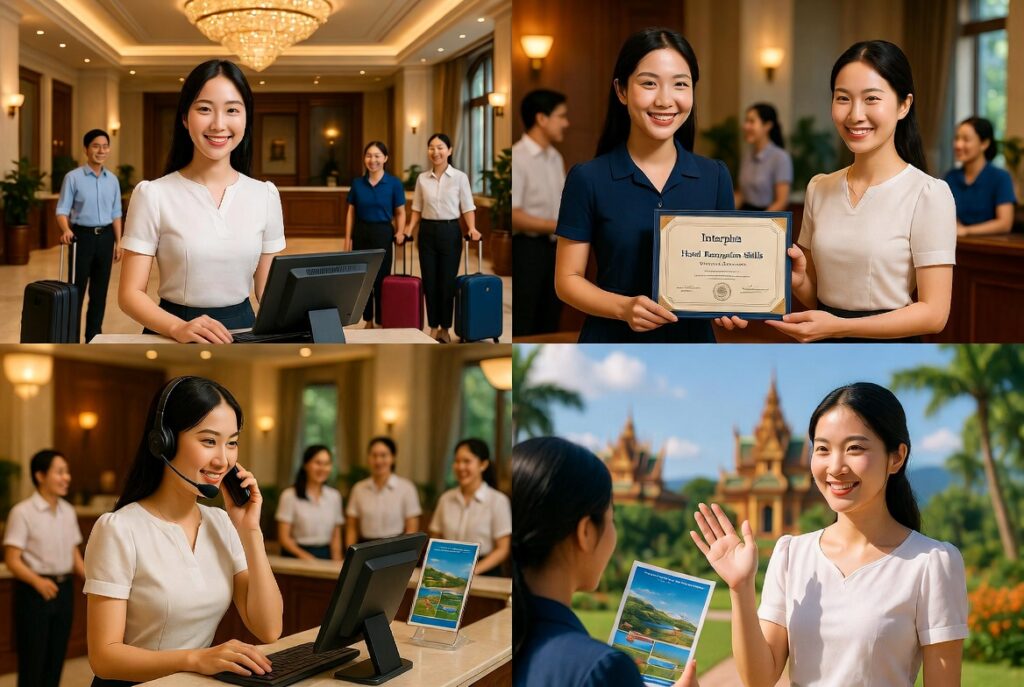
Guest: Good morning. I have a small problem in my room. Receptionist: Good morning, sir. I’m sorry to hear that. May I have your room number, please? Guest: Yes, it’s room 1024. Receptionist: Thank you. What seems to be the problem? Guest: The air conditioning is not working properly. It’s very warm in the room. Receptionist: I see. Since when have you noticed this problem? Guest: It started last night. I thought it was just slow, but it never got cold. Receptionist: Did you try to change the temperature or fan speed on the remote control? Guest: Yes, I tried both, but it didn’t help. Receptionist: Is the air conditioner making any sound, or is it completely off? Guest: It makes a sound, but only warm air comes out. Receptionist: I understand. Would you like me to send our engineer to check it now? Guest: Yes, please. That would be good. Receptionist: Would you prefer him to come while you are in the room or while you are out? Guest: Maybe while I’m out. I’m going for breakfast soon. Receptionist: That’s perfect. Around what time will you return to your room? Guest: Around 10 a.m., I think. Receptionist: Thank you. I’ll ask the engineer to fix it before 10 a.m. Would you like me to inform you once it’s done? Guest: Yes, please call me when it’s ready. Receptionist: Of course, sir. In the meantime, would you like us to provide a fan or move you to another room if it’s not fixed soon? Guest: A fan will be fine for now. Receptionist: Very well. I’ll send a fan to your room immediately. Thank you for your patience, sir.
2. Request for information on visiting a famous temple
Guest: Hello, good afternoon. I’d like some information about visiting the Royal Temple. Receptionist: Good afternoon, ma’am. Of course. Do you mean the Royal Temple on the river, near the old city? Guest: Yes, that’s the one. I heard it’s very beautiful. Receptionist: It really is. Would you like to visit today or tomorrow morning? Guest: Maybe tomorrow morning. Is that a good time? Receptionist: Yes, morning is the best. It’s cooler and less crowded. Would you like to go by taxi or tuk-tuk? Guest: Which one do you recommend? Receptionist: A taxi is more comfortable, especially in the heat. The trip takes about 25 minutes. Would you like me to arrange a taxi for you? Guest: Yes, please. How much does it cost? Receptionist: Around 250 baht one way. Would you like a return trip as well? Guest: Yes, please. I’ll probably stay there about two hours. Receptionist: Perfect. Shall I book the taxi for 8:30 a.m.? Guest: That’s fine. What time does the temple open? Receptionist: It opens at 8 a.m. and closes at 5 p.m. Please note that you need to cover your shoulders and knees. Guest: Oh, thank you for telling me. Can I buy a scarf there? Receptionist: Yes, there are small shops near the entrance. Would you like me to prepare a small temple guide map for you? Guest: That would be nice. Do they have guides at the temple too? Receptionist: Yes, there are local guides at the entrance who speak English. Would you like me to reserve one for you in advance? Guest: No, I’ll decide there. Thank you very much. Receptionist: You’re very welcome, ma’am. I’ll confirm the taxi for 8:30 a.m. and have the map ready for you.
3. Guest needs information about the bill
Guest: Good evening. I’m checking out tomorrow, and I’d like to see my bill, please. Receptionist: Good evening, sir. Of course. May I have your room number, please? Guest: Room 712. Receptionist: Thank you. Would you like me to print your bill or show it on the screen? Guest: Please print it. I’d like to check everything. Receptionist: Certainly. Here you are. Would you like me to go through the charges with you? Guest: Yes, please. There are a few things I don’t understand. Receptionist: Sure. Let’s see — here’s the room charge for three nights, and this one is for minibar items. Did you take anything from the minibar yesterday? Guest: Yes, I took a bottle of water and a small chocolate. Receptionist: Great, those are included here. And this laundry charge — two shirts and one pair of trousers, correct? Guest: Yes, that’s right. What about this restaurant charge? Receptionist: That’s from the dinner you had at our rooftop restaurant on Wednesday. Would you like me to print the restaurant receipt as well? Guest: Yes, please. I’d like to check it. Receptionist: Of course. Here it is. Do you see this line for beverages — two glasses of wine? Guest: Oh yes, now I remember. Are the taxes already included in the total? Receptionist: Yes, all taxes and service charges are included. Would you like to pay today or tomorrow morning? Guest: I think tomorrow, during check-out. Receptionist: Certainly. Would you like a copy of this bill sent to your email as well? Guest: Yes, please. Receptionist: May I confirm your email address, sir? Guest: Yes, it’s john.anderson@mail.com. Receptionist: Thank you very much, sir. I’ll send it right away. Please let us know if you have any questions before check-out.
how apps, social media, and websites make travel easy
Digital Technology in Hotels and Tourism
Digital technology is important for hotels and travel. People use apps, social media, and websites. These tools make work and travel easier.
Apps help tourists find hotels, restaurants, and tours. People can see pictures, prices, and reviews. They can book rooms or tours with an app. Apps help staff too. Workers can check bookings, see free rooms, and send messages to guests.
Social media is very useful. Hotels and travel companies use Facebook, Instagram, and TikTok. They show photos and videos. Tourists see the posts and want to visit. Social media helps staff answer questions and help guests quickly.
Online booking websites, like Booking.com, let tourists book hotels, flights, and tours. Staff need to know how to use computers, apps, and websites.
Digital technology makes tourism easier. Young people who want to work in hotels or travel should learn apps, social media, and booking websites. These skills help them get good jobs.
_____________________________
Vocabulary:
digital technology: machines, computers, or apps that use the internet or electronics.
travel: to go to another city, country, or place.
a tool: something you use to do a job or work.
to make something easier: to help do something faster or with less effort.
a tour: a trip to see places, often with a guide.
a price: how much money you pay for something.
a review: an opinion or comment about a hotel, restaurant, or tour.
to book a room: to arrange and pay for a hotel room before you arrive.
staff: people who work in a hotel, restaurant, or company.
to check bookings: to look at the list of reservations or rooms that are already booked.
to send a message: to write or send information to someone, for example by phone or computer.
to be useful: to help do a job or make something easier.
a company: a business that sells goods or services.
to visit: to go to a place for a short time.
to answer a question: to give information when someone asks something.
quickly: to do something fast.
online booking: booking a hotel, tour, or flight using the internet.
staff need to know: workers must understand or learn something.
a skill: the ability to do something well.
to get somebody a good job: to help someone have work that is nice and pays well.
#################
Multiple choice test, one answer correct:
what is digital technology? a) machines, computers, apps b) a place to eat food c) a kind of car
what does travel mean? a) to stay at home b) to go to another city c) to read a book
what is a tool? a) something you use for work b) a kind of food c) a hotel
what does it mean to make something easier? a) to play games with friends b) to help do a job fast c) to clean the floor
what is a tour? a) a kind of smartphone b) a piece of furniture c) a trip to see places
what is a price? a) a type of hotel b) how much money you pay c) a type of food
what is a review? a) a type of bag b) a type of car c) an opinion about a hotel
what does it mean to book a room? a) to cook food in a hotel b) to walk in the city c) to arrange and pay for a room
who are staff? a) tourists who visit a hotel b) people who work in a hotel c) people who sleep in a hotel
what does it mean to check bookings? a) to look at the list of bookings b) to eat breakfast c) to sleep in a hotel
what does it mean to send a message? a) to write or send information b) to sleep in a hotel c) to buy food
what does it mean to be useful? a) to help do a job b) to sing a song c) to watch TV
what is a company? a) a kind of restaurant b) a type of hotel room c) a business that sells goods
what does it mean to visit? a) to go to a place for a short time b) to stay home all day c) to cook food
what does it mean to answer a question? a) to give information when someone asks b) to sleep in a hotel c) to write a song
what does quickly mean? a) to do nothing b) to do something slowly c) to do something fast
what is online booking? a) cleaning a hotel room b) booking a hotel, tour, or flight c) cooking food in a restaurant
what does staff need to know? a) workers must sleep in hotels b) workers must understand or learn c) workers must eat food
what is a skill? a) the ability to sleep well b) the ability to do something well c) the ability to read a book ————–end of audio————–
what does it mean to get somebody a good job? a) to help someone cook food b) to help someone walk in c) to help someone have work that is nice
_______________________ Answers: 1 A, 2 B, 3 A, 4 B, 5 C, 6 B, 7 C, 8 C, 9 B, 10 A, 11 A, 12 A, 13 C, 14 A, 15 A, 16 C, 17 B, 18 B, 19 B, 20 C
_______________________
Correct version:
what is digital technology? – machines, computers, apps
what does travel mean? – to go to another city
what is a tool? – something you use for work
what does it mean to make something easier? – to help do a job fast
what is a tour? – a trip to see places
what is a price? – how much money you pay
what is a review? – an opinion about a hotel
what does it mean to book a room? – to arrange and pay for a room
who are staff? – people who work in a hotel
what does it mean to check bookings? – to look at the list of bookings
what does it mean to send a message? – to write or send information
what does it mean to be useful? – to help do a job
what is a company? – a business that sells goods
what does it mean to visit? – to go to a place for a short time
what does it mean to answer a question? – to give information when someone asks
what does quickly mean? – to do something fast
what is online booking? – booking a hotel, tour, or flight
what does staff need to know? – workers must understand or learn
what is a skill? – the ability to do something well
what does it mean to get somebody a good job? – to help someone have work that is nice
#################
Gap-fill exercise:
Many tourists use ______ to find hotels and tours. a) apps b) chairs c) food
When people go to another city or country, it is called ______. a) cooking b) travel c) sleeping
A hammer or a computer is an example of ______. a) something you use for work b) a car c) a bag
Apps help workers ______ their jobs easier. a) to play games b) to make c) to sleep
A ______ is a trip to see interesting places. a) a kind of smartphone b) a piece of furniture c) tour
You look at the ______ to see how much you pay. a) bag b) price c) hotel
A ______ is what people write about hotels or tours. a) box b) car c) review
To ______ a room means you arrange and pay for it. a) cook b) clean c) book
The people who work in hotels or restaurants are called ______. a) tourists b) staff c) visitors
Workers must ______ to see which rooms are free. a) sleep b) check bookings c) cook food
To ______ a friend means you send information to them. a) cook b) send a message c) sleep
Something that helps you do a job is ______. a) boring b) useful c) heavy
A ______ sells goods or services. a) bag b) chair c) company
To ______ a place means to go there for a short time. a) stay b) visit c) cook
When someone asks something, you ______. a) answer a question b) sleep c) run
To do something fast is to do it ______. a) slowly b) carefully c) quickly
Booking a hotel or flight on the internet is called ______. a) cooking b) online booking c) cleaning
Workers must understand tools and apps. Staff ______ this. a) sleep b) play c) need to know
The ability to do something well is a ______. a) bag b) skill c) chair
To help someone get work that is nice and pays well is to ______. a) cook food b) sleep c) get somebody a good job
When people go to another city or country, it is called travel.
A hammer or a computer is an example of something you use for work.
Apps help workers to make their jobs easier.
A tour is a trip to see interesting places.
You look at the price to see how much you pay.
A review is what people write about hotels or tours.
To book a room means you arrange and pay for it.
The people who work in hotels or restaurants are called staff.
Workers must check bookings to see which rooms are free.
To send a message to a friend means you send information to them.
Something that helps you do a job is useful.
A company sells goods or services.
To visit a place means to go there for a short time.
When someone asks something, you answer a question.
To do something fast is to do it quickly.
Booking a hotel or flight on the internet is called online booking.
Workers must understand tools and apps. Staff need to know this.
The ability to do something well is a skill.
To help someone get work that is nice and pays well is to get somebody a good job.
##’##############
Match the word to its definition:
Words:
digital technology
travel
a tool
to make something easier
a tour
a price
a review
to book a room
staff
to check bookings
to send a message
to be useful
a company
to visit
to answer a question
quickly
online booking
staff need to know
a skill
to get somebody a good job
Definitions:
a. to help someone have work that is nice and pays well b. people who work in a hotel, restaurant, or office c. to do something fast d. a trip to see places, often with a guide e. machines, computers, or apps that use the internet f. how much money you pay for something g. to give information when someone asks something h. to help do something faster or with less work i. the ability to do something well j. booking a hotel or flight using the internet k. to look at the list of reservations l. something that helps do work m. to go to another city or country n. an opinion about a hotel or restaurant o. to go to a place for a short time p. to help do a job or make something easier q. workers must understand or learn something r. to write or send information to someone s. a business that sells goods or services t. to arrange and pay for a hotel room before you arrive
_______________________ Answers: 1 e, 2 m, 3 l, 4 h, 5 d, 6 f, 7 n, 8 t, 9 b, 10 k, 11 r, 12 p, 13 s, 14 o, 15 g, 16 c, 17 j, 18 q, 19 i, 20 a
_______________________ Correct version:
digital technology – machines, computers, or apps that use the internet
travel – to go to another city or country
a tool – something that helps do work
to make something easier – to help do something faster or with less work
a tour – a trip to see places, often with a guide
a price – how much money you pay for something
a review – an opinion about a hotel or restaurant
to book a room – to arrange and pay for a hotel room before you arrive
staff – people who work in a hotel, restaurant, or office
to check bookings – to look at the list of reservations
to send a message – to write or send information to someone
to be useful – to help do a job or make something easier
a company – a business that sells goods or services
to visit – to go to a place for a short time
to answer a question – to give information when someone asks something
quickly – to do something fast
online booking – booking a hotel or flight using the internet
staff need to know – workers must understand or learn something
a skill – the ability to do something well
to get somebody a good job – to help someone have work that is nice and pays well
#################
True or false statements:
Many hotels use apps to help guests book rooms.
Digital technology makes hotel work more difficult.
Staff can use computers to check bookings quickly.
Guests never use the internet to find hotels.
Social media helps hotels show pictures and news.
A review is a kind of food served in a hotel.
People can book rooms online before they travel.
Staff do not need to know about technology.
Online booking is faster and easier for guests.
A tool is something that helps people do work.
Technology is not important in tourism today.
Staff can send messages to guests using apps.
A tour is a short visit to see a place.
Digital tools are not useful in the hotel business.
_______________________
True: 1,3,5,7,9,10,12,13 ________________________
Correct version:
Many hotels use apps to help guests book rooms.
Digital technology makes hotel work more difficult. True is: Digital technology makes hotel work easier.
Staff can use computers to check bookings quickly.
Guests never use the internet to find hotels. True is: Guests often use the internet to find hotels.
Social media helps hotels show pictures and news.
A review is a kind of food served in a hotel. True is: A review is an opinion about a hotel or service.
People can book rooms online before they travel.
Staff do not need to know about technology. True is: Staff need to know about technology.
Online booking is faster and easier for guests.
A tool is something that helps people do work.
Technology is not important in tourism today. True is: Technology is very important in tourism today.
Staff can send messages to guests using apps.
A tour is a short visit to see a place.
Digital tools are not useful in the hotel business. True is: Digital tools are useful in the hotel business.
Staff use digital tools. ____________________________
The Star Hotel sends messages to guests. ____________________________
Digital skills help get jobs. ____________________________
———————————————- Correct answers:
Hotels use digital technology. Do hotels use digital technology?
A guest books rooms online. Does a guest book rooms online?
Apps help find hotels. Do apps help find hotels?
Staff check bookings fast. Do staff check bookings fast?
A hotel posts photos online. Does a hotel post photos online?
Guests write reviews online. Do guests write reviews online?
Online booking saves time. Does online booking save time?
Staff use digital tools. Do staff use digital tools?
The Star Hotel sends messages to guests. Does the Star Hotel send messages to guests?
Digital skills help get jobs. Do digital skills help get jobs?
#####################
Short answers, basics:
Example Sentence
Yes
No
I learn the alphabet.
Yes, I do.
No, I don’t.
You read signs.
Yes, you do.
No, you don’t.
He practices speaking.
Yes, he does.
No, he doesn’t.
She watches cartoons.
Yes, she does.
No, she doesn’t.
It helps us learn English.
Yes, it does.
No, it doesn’t.
We use apps like Duolingo.
Yes, we do.
No, we don’t.
You read labels.
Yes, you do.
No, you don’t.
They make mistakes sometimes.
Yes, they do.
No, they don’t.
Question
Yes
No
Do I learn the alphabet?
Yes, I do.
No, I don’t.
Do you read signs?
Yes, you do.
No, you don’t.
Does he practice speaking?
Yes, he does.
No, he doesn’t.
Does she watch cartoons?
Yes, she does.
No, she doesn’t.
Does it help us learn English?
Yes, it does.
No, it doesn’t.
Do we use apps like Duolingo?
Yes, we do.
No, we don’t.
Do you read labels?
Yes, you do.
No, you don’t.
Do they make mistakes sometimes?
Yes, they do.
No, they don’t.
Question
Yes
No
Am I big?
Yes, I am.
No, I am not.
Are you big?
Yes, you are.
No, you aren’t.
Is he big?
Yes, he is.
No, he isn’t.
Is she big?
Yes, she is.
No, she isn’t.
Is it big?
Yes, it is.
No, it isn’t.
Are we big?
Yes, we are.
No, we aren’t.
Are you big?
Yes, you are.
No, you aren’t.
Are they big?
Yes, they are.
No, they aren’t.
####################
Short answers wanted:
Do hotels use digital technology?
YOU WRITE: Yes, they do.
Are guests paying in cash at all hotels?
Do staff use digital tools in their work?
Is online booking slow for guests?
Do guests book rooms online before they travel?
Does a hotel send messages to guests?
Do apps help find hotels and tours?
Do guests write reviews online?
Do social media help hotels show photos to guests?
Is technology difficult for hotel staff?
Do guests always pay at the front desk?
Do digital skills help people get good jobs?
Are apps useless for finding hotels?
Does online booking save time for guests?
______________________ Correct version:
Do hotels use digital technology? Yes, they do.
Are guests paying in cash at all hotels? No, they aren’t.
Do staff use digital tools in their work? Yes, they do.
Is online booking slow for guests? No, it isn’t.
Do guests book rooms online before they travel? Yes, they do.
Does a hotel send messages to guests? Yes, it does.
Do apps help find hotels and tours? Yes, they do.
Do guests write reviews online? Yes, they do.
Do social media help hotels show photos to guests? Yes, they do.
Is technology difficult for hotel staff? No, it isn’t.
Do guests always pay at the front desk? No, they don’t.
Do digital skills help people get good jobs? Yes, they do.
Are apps useless for finding hotels? No, they aren’t.
Does online booking save time for guests? Yes, it does.
####################
Answer in complete sentences:
Do people write letters or use websites to book a room? YOU WRITE: People use websites to book a room.
Do guests check the price online or at the hotel? _______________________________
Do staff send messages to guests or ignore them? _______________________________
Do apps help find hotels or only restaurants? _______________________________
Do people write reviews online or in a notebook? _______________________________
Do hotels show photos on social media or hide them? _______________________________
Do guests book rooms online or always pay in cash? _______________________________
Do staff use digital tools or just paper? _______________________________
Do guests visit tours in the city or only stay in the hotel? _______________________________
Do online bookings save time or make work slower? _______________________________
Do hotels answer questions online or only in person? _______________________________
Do digital skills help staff get jobs or do nothing? _______________________________
Do apps help tourists plan trips or confuse them? _______________________________
Do social media help hotels show news or are not useful? _______________________________
—————————————
Correct version:
Do people write letters or use websites to book a room? People use websites to book a room.
Do guests check the price online or at the hotel? Guests check the price online.
Do staff send messages to guests or ignore [to not pay attention to someone or something] them? Staff send messages to guests.
Do apps help find hotels or only restaurants? Apps help find hotels.
Do people write reviews online or in a notebook? People write reviews online.
Do hotels show photos on social media or hide them? Hotels show photos on social media.
Do guests book rooms online or always pay in cash? Guests book rooms online.
Do staff use digital tools or just paper? Staff use digital tools.
Do guests visit tours in the city or only stay in the hotel? Guests visit tours in the city.
Do online bookings save time or make work slower? Online bookings save time.
Do hotels answer questions online or only in person? Hotels answer questions online.
Do digital skills help staff get jobs or do nothing? Digital skills help staff get jobs.
Do apps help tourists plan trips or confuse [to make someone not understand something or make someone unsure what to do] them? Apps help tourists plan trips.
Do social media help hotels show news or are not useful? Social media help hotels show news.
##################
Correct the statements as follows:
People write letters to book a room. YOU WRITE: No, they don’t. People use websites to book a room.
Guests always pay in cash at hotels. ________________________________
Staff ignore messages from guests. ________________________________
Apps only help find restaurants. ________________________________
People write reviews in notebooks. ________________________________
Guests do not book rooms online. ________________________________
Staff use only paper at work. ________________________________
Guests only stay in the hotel. ________________________________
Online booking takes more time. ________________________________
Hotels answer questions only in person. ________________________________
Social media ignore hotel photos. ________________________________
Social media is not useful for hotels. ________________________________
Apps make life of tourists harder. ________________________________
———————————————-
Correct answers:
People write letters to book a room. No, they don’t. People use websites to book a room.
Guests always pay in cash at hotels. No, they don’t. Guests can book online and pay digitally.
Staff ignore messages from guests. No, they don’t. Staff send messages to guests.
Apps only help find restaurants. No, they don’t. Apps help find hotels and tours.
People write reviews in notebooks. No, they don’t. People write reviews online.
Hotels hide photos online. No, they don’t. Hotels show photos online.
Guests do not book rooms online. No, they don’t. Guests book rooms online before they travel.
Staff use only paper at work. No, they don’t. Staff use digital tools at work.
Guests only stay in the hotel. No, they don’t. Guests visit tours and see places.
Online booking takes more time. No, it doesn’t. Online booking saves time.
Hotels answer questions only in person. No, they don’t. Hotels answer questions online.
Social media ignore hotel photos. No, they don’t. Social media help hotels show news and photos.
Social media is not useful for hotels. No, they aren’t. Social media help hotels show news and photos.
Apps make life of tourists harder. No, they don’t. Apps help tourists plan trips.
##################
Correct version, complete, words below:
websites – guests – easy – phones – tourists – photos – hotel staff – before – online – skills – after – online
__________________________________
Interviewer: Hello, Salas! Thank you for joining us.
Salas: Hello! Thank you for having me.
Q: Who uses digital technology in hotels? A: Staff and guests use digital technology.
Q: What is digital technology in tourism? A: It is computers, apps, and __________ booking.
Q: Where do people book rooms? A: ___________ book rooms on websites and apps.
Q: When do guests write reviews? A: Guests write reviews ___________ they visit a hotel.
Q: Why do hotels use social media? A: Hotels use social media to show __________ and news.
Q: How do staff check bookings? A: Staff check bookings on computers or __________.
Q: Who answers questions online? A: __________ answer questions online.
Q: What helps guests find hotels? A: Apps and __________ help guests find hotels.
Q: Where can tourists plan trips? A: Tourists can plan trips __________ with apps.
Q: When do staff send messages to guests? A: Staff send messages _________ or during a guest’s stay.
Q: Why are digital skills important? A: Digital __________ help staff get good jobs.
Q: How does online booking save time? A: Online booking is fast and__________ for guests.
Q: Who writes reviews online? A: Guests write reviews online after their stay.
Q: What is useful for __________ in hotels? A: Apps, social media, and websites are useful.
###################
Correct version:
Interviewer: Hello, Salas! Thank you for joining us.
Salas: Hello! Thank you for having me.
Q: Who uses digital technology in hotels? A: Staff and guests use digital technology.
Q: What is digital technology in tourism? A: It is computers, apps, and online booking.
Q: Where do people book rooms? A: Guests book rooms on websites and apps.
Q: When do guests write reviews? A: Guests write reviews after they visit a hotel.
Q: Why do hotels use social media? A: Hotels use social media to show photos and news.
Q: How do staff check bookings? A: Staff check bookings on computers or phones.
Q: Who answers questions online? A: Hotel staff answer questions online.
Q: What helps guests find hotels? A: Apps and websites help guests find hotels.
Q: Where can tourists plan trips? A: Tourists can plan trips online with apps.
Q: When do staff send messages to guests? A: Staff send messages before or during a guest’s stay.
Q: Why are digital skills important? A: Digital skills help staff get good jobs.
Q: How does online booking save time? A: Online booking is fast and easy for guests.
Q: Who writes reviews online? A: Guests write reviews online after their stay.
Q: What is useful for tourists in hotels? A: Apps, social media, and websites are useful.
######################## Fill in, words below:
social media – digital – skills – book – reviews – plan – useful – online – time
——————— Digital technology is very important in hotels and tourism. Guests use websites and apps to ___________ rooms and find hotels. Online booking saves _________ and is easy. Guests can also write __________ online and see hotel photos on __________. Staff use computers and __________ tools to check bookings and send messages to guests. Hotels answer questions ___________. Digital __________ are important for staff to get good jobs. Apps, websites, and social media help tourists _________ trips and make travel easier. Technology is __________ for hotels, staff, and guests every day.
_______________________________
Correct version:
Digital technology is very important in hotels and tourism. Guests use websites and apps to book rooms and find hotels. Online booking saves time and is easy. Guests can also write reviews online and see hotel photos on social media. Staff use computers and digital tools to check bookings and send messages to guests. Hotels answer questions online. Digital skills are important for staff to get good jobs. Apps, websites, and social media help tourists plan trips and make travel easier. Technology is useful for hotels, staff, and guests every day.
Naya works at the pool of a five-star hotel. Her job is to help the guests. She gives them clean towels and shows them the chairs. She brings drinks and sometimes small food. She makes the pool area clean and safe.
Naya smiles to the guests. She talks politely. She tries to help the guests with everything. She wants them to be happy and relaxed. Sometimes she brings cold water, juice, or fruit. Guests like this service.
The work is busy. Many people come at the same time. It is hot in the sun. Sometimes it is difficult, but Naya stays calm. Some guests forget their towels or other things. She finds the things and gives them back.
Sometimes a guest is unhappy. Naya listens and tries to help. She explains politely.
Naya likes her job because she meets many people. She meets people from different countries. She learns new things and sees happy faces. She feels proud when guests are satisfied. Her job is nice and interesting.
__________________________
Vocabulary:
a guest – a person who comes to visit or stay
a clean towel – a towel that is not dirty
a chair (at pool) – a seat near the pool
small food – little food to eat
clean – not dirty
safe – not in danger
to smile – to make your mouth happy
to talk politely – to speak in a nice way
everything – all things
to be relaxed – to feel calm and not worried
busy work – work that has a lot to do
to stay calm – to keep feeling relaxed
to forget – to not remember
to try to help – to do your best to help someone
to explain politely – to give information in a nice way
to meet people – to see or talk to new people
different countries – many countries that are not the same
a happy face – a face that looks happy
to feel proud – to feel good about what you do
to be satisfied – to feel happy with something
to be interesting – to make people want to learn or know more
##################
Multiple choice, one answer correct:
Who is a person who comes to visit or stay? a) a guest b) a chair c) a towel
What is not dirty? a) happy face b) small food c) clean
Where do you sit near the pool? a) food b) chair c) everything
What is little food to eat? a) smile b) small food c) satisfied
What means not in danger? a) to meet people b) safe c) to stay calm
To make your mouth happy? a) to smile b) busy work c) to explain politely
To speak in a nice way? a) a happy face b) to be interesting c) to talk politely
To feel calm and not worried? a) clean towel b) to forget c) to be relaxed
To do your best to help someone? a) a guest b) to try to help c) small food
A face that looks happy? a) everything b) different countries c) a happy face
To feel good about what you do? a) to be proud b) to be satisfied c) to meet people
To meet new people? a) to explain politely b) to meet people c) busy work
All things? a) to stay calm b) everything c) to be interesting
To not remember? a) to smile b) to forget c) clean
Work that has a lot to do? a) small food b) happy face c) busy work
To give information in a nice way? a) to explain politely b) to be satisfied c) to be interesting
Many countries that are not the same? a) a guest b) different countries c) clean towel
To feel happy with something? a) to stay calm b) to be satisfied c) to be proud
To make people want to learn more? a) to be interesting b) to meet people c) a chair
To feel calm and forget problems? a) to smile b) busy work c) to be relaxed
Who is a person who comes to visit or stay? – a guest
What is not dirty? – clean
Where do you sit near the pool? – chair
What is little food to eat? – small food
What means not in danger? – safe
To make your mouth happy? – to smile
To speak in a nice way? – to talk politely
To feel calm and not worried? – to be relaxed
To do your best to help someone? – to try to help
A face that looks happy? – a happy face
To feel good about what you do? – to be proud
To meet new people? – to meet people
All things? – everything
To not remember? – to forget
Work that has a lot to do? – busy work
To give information in a nice way? – to explain politely
Many countries that are not the same? – different countries
To feel happy with something? – to be satisfied
To make people want to learn more? – to be interesting
To feel calm and forget problems? – to stay calm
##################
Match the words with their meanings:
Words:
a guest
a clean towel
a chair (at pool)
small food
clean
safe
to smile
to talk politely
everything
to be relaxed
busy work
to stay calm
to forget
to try to help
to explain politely
to meet people
different countries
a happy face
to feel proud
to be satisfied
Definitions:
A. A towel that is not dirty B. To do your best to help someone C. All things D. A face that looks happy E. To speak in a nice way F. To feel happy with something G. Little food to eat H. A person who comes to visit or stay I. To keep feeling calm J. Not in danger K. To feel calm and not worried L. To make your mouth happy M. A seat near the pool N. To meet new people O. Work that has a lot to do P. Many countries that are not the same Q. To give information in a nice way R. To feel good about what you do S. To not remember T. Not dirty
to explain politely – To give information in a nice way
to meet people – To meet new people
different countries – Many countries that are not the same
a happy face – A face that looks happy
to feel proud – To feel good about what you do
to be satisfied – To feel happy with something
#################
Fill in, words below:
meets – drinks – back – politely – help – chairs – safe – towels – busy – clean – smiles – works
————————————-
Naya __________ at the pool of a five-star hotel.
Her job is to __________ the guests.
She gives them ________ towels.
She shows them the __________.
She brings __________ and small food.
She makes the pool area clean and __________.
Naya __________ to the guests.
She talks __________ and helps them.
The work is __________.
Some guests forget their __________ or things.
Naya finds the things and gives them _________.
She likes her job because she __________ many people.
————————————
Correct version:
Naya works at the pool of a five-star hotel.
Her job is to help the guests.
She gives them clean towels.
She shows them the chairs.
She brings drinks and small food.
She makes the pool area clean and safe.
Naya smiles to the guests.
She talks politely and helps them.
The work is busy.
Some guests forget their towels or things.
Naya finds the things and gives them back.
She likes her job because she meets many people.
################
True or false:
Naya works at the pool of a five-star hotel.
The work is easy and slow.
Some guests forget their towels.
Naya never smiles to the guests.
She talks politely and helps the guests.
She feels sad when guests are happy.
Naya brings only hot drinks.
She makes the pool area clean and safe.
She likes her job because she meets many people.
Naya works in a restaurant, not at the pool.
She finds lost things and gives them back.
Naya does not help the guests.
____________________________
True: 1,3,5,8,9,11
____________________________
Correct answers:
Naya works at the pool of a five-star hotel.
The work is easy and slow. True is: The work is busy.
Some guests forget their towels.
Naya never smiles to the guests. True is: Naya smiles to the guests.
She talks politely and helps the guests.
She feels sad when guests are happy. True is: She feels proud when guests are happy.
Naya brings only hot drinks. True is: Naya brings cold water, juice, or fruit.
She makes the pool area clean and safe.
She likes her job because she meets many people.
Naya works in a restaurant, not at the pool. True is: Naya works at the pool, not in a restaurant.
She finds lost things and gives them back.
Naya does not help the guests. True is: Naya helps the guests.
##################
Short answers, basics:
Example Sentence
Yes
No
I learn the alphabet.
Yes, I do.
No, I don’t.
You read signs.
Yes, you do.
No, you don’t.
He practices speaking.
Yes, he does.
No, he doesn’t.
She watches cartoons.
Yes, she does.
No, she doesn’t.
It helps us learn English.
Yes, it does.
No, it doesn’t.
We use apps like Duolingo.
Yes, we do.
No, we don’t.
You read labels.
Yes, you do.
No, you don’t.
They make mistakes sometimes.
Yes, they do.
No, they don’t.
Question
Yes
No
Do I learn the alphabet?
Yes, I do.
No, I don’t.
Do you read signs?
Yes, you do.
No, you don’t.
Does he practice speaking?
Yes, he does.
No, he doesn’t.
Does she watch cartoons?
Yes, she does.
No, she doesn’t.
Does it help us learn English?
Yes, it does.
No, it doesn’t.
Do we use apps like Duolingo?
Yes, we do.
No, we don’t.
Do you read labels?
Yes, you do.
No, you don’t.
Do they make mistakes sometimes?
Yes, they do.
No, they don’t.
Question
Yes
No
Am I big?
Yes, I am.
No, I am not.
Are you big?
Yes, you are.
No, you aren’t.
Is he big?
Yes, he is.
No, he isn’t.
Is she big?
Yes, she is.
No, she isn’t.
Is it big?
Yes, it is.
No, it isn’t.
Are we big?
Yes, we are.
No, we aren’t.
Are you big?
Yes, you are.
No, you aren’t.
Are they big?
Yes, they are.
No, they aren’t.
#####################
Short answers:
Naya works at the pool of a five-star hotel.
YOU WRITE: Yes, she does.
The work is easy and slow.
Some guests forget their towels.
Naya always smiles to the guests.
She talks politely and helps the guests.
She feels sad when guests are happy.
Naya brings only hot drinks.
She makes the pool area clean and safe.
She likes her job because she meets many people.
Naya works in a restaurant, not at the pool.
She finds lost things and gives them back.
Naya does not help the guests.
_________________________
Corrrect answers:
Naya works at the pool of a five-star hotel. – Yes, she does.
The work is easy and slow. – No, it isn’t.
Some guests forget their towels. – Yes, they do.
Naya smiles to the guests. – Yes, she does.
She talks politely and helps the guests. – Yes, she does.
She feels sad when guests are happy. – No, she doesn’t.
Naya brings only hot drinks. – No, she doesn’t.
She makes the pool area clean and safe. – Yes, she does.
She likes her job because she meets many people. – Yes, she does.
Naya works in a restaurant, not at the pool. – No, she doesn’t.
She finds lost things and gives them back. – Yes, she does.
Naya does not help the guests. – No, she doesn’t.
#################
True or false, correct answers:
Naya works at the restaurant of a five-star hotel.
YOU WRITE: No, she doesn’t. She works at the pool.
The work is easy and slow.
Some guests forget their newspapers.
Naya always smiles to her general manager.
She talks loud.
She feels sad when guests are happy.
Naya brings only hot drinks.
She makes the pool area unsafe.
She likes her job because she meets all her friends.
Naya works in the spa, not at the pool.
She finds lost things and gives them to poor people.
________________________
Correct answers:
No, she doesn’t. She works at the pool of a five-star hotel.
No, it isn’t. The work is busy.
No, they don’t. Some guests forget their towels.
No, she doesn’t. Naya smiles to the guests.
No, she doesn’t. She talks politely and helps the guests.
No, she doesn’t. She feels proud when guests are happy.
No, she doesn’t. Naya brings cold water, juice, or fruit.
No, she doesn’t. She makes the pool area clean and safe.
No, she doesn’t. She likes her job because she meets many people.
No, she doesn’t. Naya works at the pool, not in the spa.
No, she doesn’t. She finds lost things and gives them back to the guests.
###################
Answer in complete sentences:
Does Naya work at the pool or in a restaurant?
YOU WRITE: Naya works at the pool, not in a restaurant.
Is the work easy and slow or busy? ______________________________
Do some guests forget their towels or their newspapers? ______________________________
Does Naya smile to her friends or smile to the guests? ______________________________
Does Naya talk loudly or politely? ______________________________
Does Naya feel sad or proud when guests are happy? ______________________________
Does Naya bring only hot drinks or cold water, juice, or fruit? ______________________________
Is the pool area unsafe or clean and safe? ______________________________
Does Naya like her job because she meets all her friends or many people from different countries? ______________________________
Does Naya work in the spa or at the pool? ______________________________
Does Naya give lost things to poor people or back to the guests? ______________________________
Does Naya forget about the guests or help the guests? ______________________________
_____________________
Correct answers:
Naya works at the pool, not in a restaurant.
The work is busy, not easy and slow.
Some guests forget their towels, not their newspapers.
Naya smiles to the guests, not to her friends.
Naya talks politely, not loudly.
Naya feels proud when guests are happy, not sad.
Naya brings cold water, juice, or fruit, not only hot drinks.
The pool area is clean and safe, not unsafe.
Naya likes her job because she meets many people from different countries, not all her friends.
Naya works at the pool, not in the spa.
Naya gives lost things back to the guests, not to poor people.
Naya helps the guests, she does not forget them.
################
Answer these questions:
Where does Naya work?
What does Naya give to the guests?
Who does Naya help?
What does Naya bring to the guests to drink?
Does Naya smile to the guests?
Is the pool area clean or dirty?
Does Naya like her job?
What does Naya do if guests forget their towels?
How does Naya talk to the guests?
Why does Naya feel proud?
______________________
Correct answers:
Naya works at the pool of a five-star hotel.
Naya gives clean towels to the guests.
Naya helps the guests.
Naya brings cold water, juice, or fruit to the guests.
Yes, Naya smiles to the guests.
The pool area is clean and safe.
Yes, Naya likes her job.
Naya finds the lost towels and gives them back to the guests.
Naya talks politely to the guests.
Naya feels proud when guests are happy.
##################
Interview with Naya, fill in, words below:
politely – help – proud – towels – guests – check – pool – juice – back – people – five-star ———————————–
1. Who do you work for? I work for a __________ hotel.
2. Where do you work? I work at the pool.
3. What is your job? My job is to __________ the guests.
4. What do you give to the guests? I give clean __________.
5. Who do you help the most? I help all the guests at the __________.
6. How do you talk to the guests? I talk __________ to them.
7. What do you bring to the guests? I bring cold water, __________, or fruit.
8. When is the work busy? The work is busy when many __________ come at the same time.
9. Why do you like your job? I like my job because I meet many __________.
10. How do you feel when guests are happy? I feel __________when guests are happy.
11. What do you do if guests forget their towels? I find the towels and give them __________.
12. How do you make the pool area safe? I keep it clean and __________everything is safe.
————————————- Correct version:
1. Who do you work for? I work for a five-star hotel.
2. Where do you work? I work at the pool.
3. What is your job? My job is to help the guests.
4. What do you give to the guests? I give clean towels.
5. Who do you help the most? I help all the guests at the pool.
6. How do you talk to the guests? I talk politely to them.
7. What do you bring to the guests? I bring cold water, juice, or fruit.
8. When is the work busy? The work is busy when many guests come at the same time.
9. Why do you like your job? I like my job because I meet many people.
10. How do you feel when guests are happy? I feel proud when guests are happy.
11. What do you do if guests forget their towels? I find the towels and give them back.
12. How do you make the pool area safe? I keep it clean and check everything is safe.
####################
Now you interview Ari about Naya and you want to know as much as possible about Naya Use dialogue above.
START WITH:
1. Who does she work for? She works for a five-star hotel.
2. Where does she…………
——————————————
Corrrect version:
Who does she work for? She works for a five-star hotel.
Where does she work? She works at the pool.
What is her job? Her job is to help the guests.
What does she give to the guests? She gives clean towels.
Who does she help the most? She helps all the guests at the pool.
How does she talk to the guests? She talks politely to them.
What does she bring to the guests? She brings cold water, juice, or fruit.
When is the work busy? The work is busy when many guests come at the same time.
Why does she like her job? She likes her job because she meets many people.
How does she feel when guests are happy? She feels proud when guests are happy.
What does she do if guests forget their towels? She finds the towels and gives them back.
How does she make the pool area safe? She keeps it clean and checks everything is safe.
###############
Read the follwoing story:
My name is Naya. I work in a big 5-star hotel. I work at the pool. My job is to help the guests. I give them clean towels and show them the chairs. I bring drinks and sometimes small food. I make the pool area clean and safe. I smile to the guests and talk politely. The work is busy, but I stay calm. Some guests forget their towels, and I give them back. I like my job because I meet many people. I feel proud when guests are happy.
____________________
Rewrite the story, starting with:
>>>>>>>>>>>>Her name is Naya. She works……………….
and make all changes necessary.
____________________
Correct version:
Her name is Naya. She works in a big 5-star hotel. She works at the pool. Her job is to help the guests. She gives them clean towels and shows them the chairs. She brings drinks and sometimes small food. She makes the pool area clean and safe. She smiles to the guests and talks politely. The work is busy, but she stays calm. Some guests forget their towels, and she gives them back. She likes her job because she meets many people. She feels proud when guests are happy.
###############
BONUS version:
Her name is Naya. She works in a big 5-star hotel. She works at the pool. Her job is to help the guests. She gives them clean towels and shows them the chairs. She brings cold water, juice, or fruit. Sometimes she brings small food. She makes the pool area clean and safe. She checks everything to help the guests.
Naya smiles to the guests. She talks politely and helps them with everything. She answers questions and gives information about the hotel. She shows the guests the pool and the chairs. Many guests come at the same time. The work is busy. It is hot in the sun, but she stays calm.
Some guests forget their towels or other things. Naya finds them and gives them back. She likes her job because she meets many people. She meets people from different countries. She likes to see the guests happy. She feels proud when the guests enjoy their time at the pool.
Naya works hard. She cleans the area, brings drinks, and helps everyone. She makes the guests’ holiday better. Her job is important and interesting. She feels happy when guests smile and relax. Naya loves her job at the pool.
Staff: “Would you like some water or tea before your treatment?” Guest may answer: “Yes, please, water.” / “Tea would be nice, thank you.”
Staff: “We hope you enjoy your visit.” Guest may answer: “Thank you, I’m sure I will.” / “I’m looking forward to it.”
2. Booking & Appointments
Staff: “Do you have a spa appointment today?” Guest may answer: “Yes, I have an appointment at 14:00.” / “No, I’d like to book one, please.”
Staff: “At what time would you like your treatment?” Guest may answer: “I’d like 10:30, please.” / “Is 15:00 available?”
Staff: “We have different types of massages and treatments.” Guest may answer: “Can you tell me more?” / “I’d like a massage, please.”
Staff: “Would you like a single treatment or a package?” Guest may answer: “A single treatment, please.” / “I’ll take a package.”
Staff: “Would you like a 30, 60, or 90-minute massage?” Guest may answer: “60 minutes, please.” / “90 minutes sounds good.”
Staff: “May I have your name, please?” Guest may answer: “My name is John Smith.” / “It’s Sarah Lee.”
Staff: “Can you please confirm your treatment and time?” Guest may answer: “Yes, Swedish massage at 14:00.” / “Facial treatment at 15:30, that’s correct.”
Staff: “Do you prefer a male or female therapist?” Guest may answer: “Female, please.” / “Male is fine.”
3. Asking About Preferences & Comfort
Staff: “Do you like light, medium, or firm pressure?” Guest may answer: “Medium, please.” / “Firm pressure, if possible.”
Staff: “Is the pressure comfortable for you?” Guest may answer: “Yes, it’s perfect.” / “A little lighter, please.”
Staff: “Do you want me to focus on your back, shoulders, or legs?” Guest may answer: “Back and shoulders, please.” / “Just my legs today.”
Staff: “Is the room temperature comfortable?” Guest may answer: “Yes, it’s very nice.” / “It’s a little cold, please.”
Staff: “Would you like a pillow or extra towel?” Guest may answer: “Yes, a pillow would be great.” / “No, thank you, I’m fine.”
Staff: “Do you prefer soft music or silence?” Guest may answer: “Soft music, please.” / “I prefer silence, thank you.”
4. Health & Safety Questions
Staff: “Do you have any allergies?” Guest may answer: “No, I don’t.” / “Yes, I am allergic to lavender.”
Staff: “Do you have sensitive skin?” Guest may answer: “Yes, a little sensitive.” / “No, my skin is normal.”
Staff: “Are you allergic to any oils, creams, or products?” Guest may answer: “No, I’m not allergic.” / “Yes, I can’t use almond oil.”
Staff: “Are you pregnant?” Guest may answer: “Yes, I am.” / “No, I’m not.”
Staff: “Do you have any injuries, pain, or health conditions?” Guest may answer: “I have back pain.” / “No, everything is fine.”
Staff: “Have you had any recent surgery?” Guest may answer: “Yes, three months ago.” / “No, I haven’t.”
Staff: “This helps us give you a safe and comfortable treatment.” Guest may answer: “I understand, thank you.” / “Sure, that’s fine.”
5. Spa Treatments Vocabulary
Massages:
Swedish massage – light pressure, relaxation
Deep tissue massage – strong pressure, muscle relief
Hot stone massage – stones for warmth and relaxation
Aromatherapy massage – massage with essential oils
Thai massage – stretching and pressure points
Reflexology – pressure on feet and hands
Facials:
Hydrating facial – for dry skin
Anti-aging facial – reduce wrinkles
Brightening facial – for glowing skin
Exfoliating facial – removes dead skin
Rejuvenating facial – refreshes skin
Body treatments:
Body scrub – removes dead skin, smooths skin
Body wrap – nourishes and detoxifies skin
Aromatherapy bath – relaxing bath with essential oils
Mud bath – detoxifying and relaxing
Other services:
Sauna – dry heat
Steam room – moist heat
Hot tub / Jacuzzi – warm water relaxation
6. Products & Ingredients Vocabulary
Essential oils – lavender, peppermint, eucalyptus, rose
Moisturizer / cream – hydrates skin
Serum – concentrated skincare product
Scrub / exfoliant – removes dead skin
Clay / mud – detoxifying
Herbal compress – warm herbs for massage
7. During Treatment Phrases
Staff: “Please relax and enjoy your treatment.” Guest may answer: “Thank you.” / “I will, thanks.”
Staff: “I will be just outside if you need anything.” Guest may answer: “Okay, thank you.” / “Sure, that’s fine.”
Staff: “Feel free to change position anytime.” Guest may answer: “Thank you.” / “I will.”
Staff: “Is the pressure okay?” Guest may answer: “Yes, it’s perfect.” / “A little stronger, please.”
Staff: “Would you like more or less pressure?” Guest may answer: “Less, please.” / “More is fine.”
Staff: “Please breathe deeply and relax.” Guest may answer: “I am, thank you.” / “Okay.”
8. After Treatment Phrases
Staff: “I hope you enjoyed your treatment.” Guest may answer: “Yes, it was wonderful.” / “I feel very relaxed, thank you.”
Staff: “Here is your robe and towel.” Guest may answer: “Thank you.” / “Thanks, that’s great.”
Staff: “Would you like some water or tea?” Guest may answer: “Water, please.” / “Tea, thank you.”
Staff: “You can take your time to relax in the spa area.” Guest may answer: “Thank you, I will.” / “Okay, that sounds good.”
Staff: “Would you like to book your next session now?” Guest may answer: “Yes, please.” / “Not today, thank you.”
Staff: “We offer some products for home care if you like.” Guest may answer: “Yes, I would like to see them.” / “No, thank you.”
Staff: “Thank you for visiting our spa. Have a wonderful day!” Guest may answer: “Thank you, I will.” / “Thanks, you too.”
9. Polite Expressions & Guest Service Vocabulary
Certainly – Yes, of course
Right away – I will do it immediately
Of course – Yes, gladly
I’ll be happy to assist you
Please enjoy your stay
We are here to help you
Thank you for coming to our spa
We hope to see you again soon
10. Practical Guest Service Tips
Always smile and make eye contact
Speak slowly and clearly
Use “please” and “thank you” often
Listen carefully to guest preferences and complaints
Staff: Hello! Welcome to Serenity Spa. How are you today? Guest: Hello. I am fine, thank you. And you? Staff: I am good, thank you. Please, follow me. Would you like some water or tea before your treatment? Guest: Water, please. Thank you. Staff: You are welcome. Please have a seat. Here is a comfortable chair. You can sit and relax. Guest: Thank you. The chair is very comfortable. Staff: We are happy to see you. If you need anything, please tell me.
2. Booking & Appointments
Staff: Do you have a spa appointment today? Guest: Yes, I have one at 3:00 PM. Staff: Great. May I have your name, please? Guest: My name is Anna Smith. Staff: Thank you, Ms. Smith. You booked a 60-minute Swedish massage, correct? Guest: Yes, that is correct. Staff: Do you prefer a male or female therapist? Guest: Female, please. Staff: Very well. I will prepare everything for you. Do you want a single treatment or a package? Guest: Only a single treatment today. Staff: Okay. Would you like a 60-minute or 90-minute massage? Guest: 60 minutes, please. Staff: Perfect. Your appointment is confirmed. Please take your time and relax while waiting.
3. Spa Treatments – Massages & Body
Staff: Today you will have a Swedish massage. Do you like light, medium, or firm pressure? Guest: Medium, please. Staff: Okay. Would you like me to focus on your back, shoulders, legs, or all parts? Guest: Shoulders and back, please. Staff: Very good. If the pressure is too strong or too soft, please tell me. Guest: I will. Thank you. Staff: We use massage cream and essential oils. They will help your muscles relax. Guest: The smell is very nice. What oil is this? Staff: This is lavender oil. It helps you feel calm and relaxed. Guest: Wonderful. I like lavender. Staff: During the massage, you can change position anytime. Please breathe deeply and enjoy.
4. Facial & Skin Treatments
Staff: We also have facial treatments. Do you want a facial today? Guest: No, only massage today. Staff: Of course. We offer hydrating, anti-aging, and brightening facials if you want next time. Guest: Hydrating facial sounds nice. Staff: Great! It gives water to your skin and makes it soft. We can book it for your next visit. Guest: Yes, please. That is good. Staff: After your massage, we can also do a foot treatment or hand treatment if you like. Guest: Maybe next time. Today only massage.
5. Spa Products & Equipment
Staff: Please lie down on the massage table. Here is a pillow for your head. Guest: Thank you. The table is comfortable. Staff: Good. I will use massage cream and essential oils. These are lavender and peppermint. Guest: Lavender smells very nice. What is peppermint for? Staff: Peppermint helps you feel fresh and relieves tired muscles. Guest: Oh, I like that. Staff: I also have a hot towel for your shoulders and neck. It helps the muscles relax more. Guest: Perfect. Thank you. Staff: If you need a blanket or another pillow, please tell me.
6. Spa Facilities & Rooms
Staff: After your massage, you can relax in the spa garden or the rest area. Guest: That is good. Is the pool open? Staff: Yes, the pool and Jacuzzi are open. You can also use the steam room or sauna. Guest: I like the sauna. Can I go there after my massage? Staff: Of course. You can take your time. Please bring your robe and towel from the locker. Guest: Thank you. How about the changing room? Staff: The changing room is this way. It has lockers, towels, and slippers for your comfort.
7. Comfort & Guest Preferences
Staff: How is the room temperature? Is it comfortable? Guest: Yes, it is very comfortable. Staff: Would you like soft music or silence during the massage? Guest: Soft music, please. Staff: Okay. We have relaxing instrumental music or gentle nature sounds. Which do you prefer? Guest: Nature sounds, please. Staff: Very good. If you want to change the music, pillow, or lighting during the massage, just tell me. Guest: Thank you. I will.
8. Guest Interaction & Service
Staff: Are you comfortable now, Ms. Smith? Guest: Yes, I feel very relaxed. Staff: That is good. During the massage, if anything is not comfortable, please let me know. Guest: Okay, I will. Staff: After your massage, would you like water or herbal tea? Guest: Tea, please. Thank you. Staff: You are welcome. Please take your time and enjoy your relaxation. Guest: Thank you. Your massage is very nice. Staff: I am happy you enjoy it. Your wellness and comfort are our priority.
9. Staff & Roles
Staff: My name is Lisa. I am your massage therapist today. Guest: Nice to meet you, Lisa. Staff: Nice to meet you too. If you need anything, I am here to help. Guest: Thank you. I feel very safe and comfortable. Staff: That is our goal. The spa manager and reception staff also make sure everything is perfect for you. Guest: I can see that. Everyone is very polite and kind. Staff: Thank you. We want all guests to feel welcome and relaxed.
10. Health & Wellness
Staff: Before we finish, may I ask about your health? Do you have any injuries, pain, or sensitive skin? Guest: No injuries. My skin is normal. Staff: Good. This massage will help you relax, reduce stress, and make your body feel better. Guest: I already feel relaxed. Staff: Wonderful. Would you like to book your next session now? Guest: Yes, please. I would like another Swedish massage next week. Staff: Perfect. We will schedule it for you. Guest: Thank you very much. I will come again soon. Staff: We look forward to seeing you again. Enjoy your wellness and have a nice day!
When a guest asks about excursions, the front desk gives information. The staff explains one-day trips in the country. They tell the guest about temples, villages, markets, rivers, and nature. The staff asks what kind of trip the guest likes. They also give details: time, price, guide, and transport. If the guest has questions or special requests, the staff can help. Finally, they confirm the booking and tell the guest the pickup time and place.
______________
1. Greeting / Starting the Conversation
Purpose: Make the guest feel welcome and introduce trip options.
“Good morning! Welcome to [Hotel Name].”
“How can I help you today?”
“Are you interested in booking a one-day trip or excursion?”
“We have trips to visit local temples, villages, markets, and nature.”
“You can explore famous sights in the city or nearby countryside.”
“We also have cultural experiences, like traditional crafts, dance, or local workshops.”
Examples / Tips (general for Indonesia / Asia):
“Many guests enjoy visiting temples near the city in the morning and local villages in the afternoon.”
“You can take a trip to a nearby rice farm or mountain for nature views.”
“A boat trip on a river or lake is also popular to see local life.”
Extra Phrases:
“Would you like me to show you the available trips today?”
“We have trips for half-day or full-day.”
2. Asking About Guest Preferences
Purpose: Understand what the guest wants and suggest suitable trips.
“What kind of trip do you like?”
“Do you want to see temples, nature, villages, or markets?”
“Do you prefer a short morning trip or a full-day excursion?”
“Are you traveling alone, with family, or in a group?”
“Do you want a private trip or a shared tour with other guests?”
“Do you enjoy cultural experiences, local life, or walking in nature?”
Examples / Tips:
“Some guests enjoy visiting a local village to see traditional farming and crafts.”
“Others like a boat trip on a nearby river or lake to see local houses and markets.”
“Would you like to see a traditional dance or cultural performance in the evening?”
Extra Phrases:
“Do you prefer a trip with more walking or more relaxing transportation?”
“Do you want to take photos during the trip?”
3. Explaining Options
Purpose: Present the trips clearly and explain what guests will see and do.
“We have several one-day trips available.”
“You can visit temples, pagodas, or historical sites nearby.”
“You can go to a local village and see daily life and traditional crafts.”
“We offer boat trips on rivers or lakes to see local markets and houses.”
“Some trips include a guide, transportation, and entrance fees.”
“We can also arrange cultural experiences, such as craft workshops or music and dance shows.”
Examples / Tips:
“A morning trip to local temples lasts 4–5 hours and includes a guide.”
“A full-day trip can include temple visits in the morning and a village visit in the afternoon.”
“The boat trip on the river includes a visit to local houses and floating markets.”
Extra Phrases:
“The guide will explain the history and culture in English.”
“Some tours are small groups, which are quiet and personal.”
“Private tours are available if you prefer more privacy.”
4. Talking About Practical Details
Purpose: Give the guest all necessary information for booking.
“The trip starts at 8:00 a.m. and ends around 5:00 p.m.”
“The price is 35 USD per person.”
“The price includes guide, transportation, and entrance fees.”
“We can pick you up from the hotel and bring you back.”
“Some trips require booking one day in advance.”
“Do you want me to check availability for your preferred day?”
Examples / Tips:
“The boat trip starts early at 6:30 a.m. because the market is busiest in the morning.”
“The village visit allows you to see rice fields, local schools, and traditional crafts.”
“Temple visits require modest clothing: long pants and covered shoulders.”
Extra Phrases:
“Half-day trips last 3–5 hours; full-day trips last 7–9 hours.”
“You will travel by car, van, or boat depending on the trip.”
5. Handling Requests or Concerns
Purpose: Solve problems, answer questions, and make guests feel confident.
“Let me check if the trip is available for you.”
“Sorry, that trip is full today, but we have other options.”
“Do you have any special requests or needs?”
“We can organize a private tour if you want.”
“Some trips are small groups; others are larger.”
“Please tell us if you have children or need help with walking.”
Examples / Tips:
“If you want a private boat trip on the river, we can arrange it.”
“For temple visits, the guide can explain history and culture in simple English.”
“For village visits, bring a hat and sunscreen—it can be sunny.”
Extra Phrases:
“Would you like me to recommend a trip based on your interests?”
“All trips have English-speaking guides and safe transportation.”
6. Closing / Confirming Booking
Purpose: Confirm the booking politely and clearly.
“Shall I reserve a spot for you?”
“Here is your ticket and itinerary.”
“You can pay at the front desk or directly to the tour guide.”
“Your pickup time is 8:00 a.m. at the hotel lobby.”
“Please be ready 10 minutes before pickup.”
“Enjoy your trip! Let us know if you need any help.”
Examples / Tips:
“Have a great time visiting the local temples and villages!”
“Enjoy the boat trip and see local life on the river or lake!”
“The guide will meet you in the hotel lobby with a sign with your name.”
Extra Phrases:
“If you have any questions during the trip, you can call the front desk.”
“We hope you enjoy learning about local culture and seeing traditional life.”
##################
A dialogue between guest and staff
1. Greeting / Starting the Conversation
Staff: “Good morning! Welcome to [Hotel Name]. How can I help you today?” Guest: “Good morning. I want to visit a famous temple today. Can you help me?” Staff: “Of course! We have several one-day trips in the area. You can visit temples, villages, markets, rivers, or nature sites.” Guest: “I am interested only in temples.” Staff: “That is perfect. We can take you to the most famous temple in the region. You can also see smaller temples nearby and learn about local history. You can also see traditional life in the village close to the temple if you want.” Guest: “That sounds interesting. I like history and culture.” Staff: “Great! Our tours include an English-speaking guide. The guide explains the history and traditions of the temples.”
2. Asking About Guest Preferences
Staff: “Which kind of trip do you like more? Temples only, or temples and villages together?” Guest: “I want to see the temples first, and maybe a village later.” Staff: “Do you prefer a short trip in the morning or a full-day trip?” Guest: “Full day is better. I want to see as much as possible.” Staff: “Are you traveling alone or with family or friends?” Guest: “I am alone.” Staff: “Do you want a private tour just for you, or a shared tour with other guests?” Guest: “Private, please.” Staff: “Do you enjoy walking a lot, or do you prefer a trip with more transport?” Guest: “I like walking a little, but not too much.” Staff: “Perfect. The trip has some walking at the temples, but most transportation is by car.” Staff: “Do you want to take photos during the trip?” Guest: “Yes, of course!”
3. Explaining Options
Staff: “We have a full-day trip to the famous temple. In the morning, you will visit the main temple and a smaller temple nearby. The guide will explain the history, the architecture, and the traditions.” Guest: “How long do we stay at each temple?” Staff: “About 1–1.5 hours at the main temple, and 45 minutes at the smaller temple. After that, you can visit a village close to the temples.” Guest: “What can I see in the village?” Staff: “You can see local houses, rice fields, and traditional crafts. You can also meet local people and see how they live every day.” Guest: “That is great!” Staff: “We also offer a boat ride on the river if you like. You can see floating houses and local markets from the boat.” Guest: “I like that. Can we include the boat ride?” Staff: “Yes, we can include it. The tour will last about 8 hours. Transportation, guide, and entrance fees are included.” Guest: “Does the guide speak English?” Staff: “Yes, the guide speaks English and can answer your questions. The guide can also take photos for you if you want.”
4. Talking About Practical Details
Staff: “The trip starts at 8:00 a.m. We pick you up from the hotel lobby. Please be ready 10 minutes before pickup. The trip ends around 4:30 p.m.” Guest: “What is the price?” Staff: “The full-day trip is 40 USD per person. Half-day trips are 25 USD. The price includes guide, transportation, and entrance fees.” Guest: “Do I need to bring anything?” Staff: “Yes. Wear long pants and cover your shoulders for temple visits. Bring sunscreen, a hat, and water. Comfortable shoes are recommended because there is some walking.” Guest: “Do we have lunch during the trip?” Staff: “Yes. We can stop at a local restaurant, or you can bring your own lunch. Some guests like to eat small snacks from the village.” Guest: “I will bring my own lunch.” Staff: “Perfect. The car is comfortable and air-conditioned. You can relax during transportation between sites.”
5. Handling Requests or Concerns
Guest: “What if it rains?” Staff: “If it rains, we provide umbrellas and raincoats. The tour can continue safely. Some areas have covered walkways.” Guest: “Can I change the trip during the day if I want?” Staff: “Yes, you can speak with the guide. They can help you adjust the schedule if needed.” Guest: “I am interested in seeing a smaller temple after the main temple. Can we do that?” Staff: “Yes, we can visit a peaceful temple nearby. It is quiet and beautiful, and you can take photos.” Guest: “Is it safe?” Staff: “Yes, all trips are safe. The guide has experience, and the transportation is secure. You can also call the front desk if you have any questions during the trip.”
6. Closing / Confirming Booking
Staff: “Shall I reserve a spot for you for today’s full-day temple trip?” Guest: “Yes, please.” Staff: “Here is your ticket and itinerary. Your pickup time is 8:00 a.m. at the hotel lobby. Please be ready 10 minutes before pickup.” Guest: “Thank you. How do I pay?” Staff: “You can pay at the front desk now or directly to the tour guide during the trip.” Guest: “I will pay now.” Staff: “Great. Enjoy your trip! You will see beautiful temples, a peaceful village, and learn about local culture. The guide will meet you in the hotel lobby with a sign with your name.” Guest: “Thank you very much. I am excited.” Staff: “You are welcome. Have a wonderful day and enjoy your visit!”
Perfect! I will continue the list in the same format with lowercase first letters, three columns (vocabulary, definition in A1, translation empty), adding all the sections you requested. This will be very long and cover most of what a 5-star hotel receptionist needs.
greet – to say hello to someone welcome – to receive someone politely smile – to make a happy face speak – to talk with someone talk – to have a conversation listen – to pay attention to what someone says ask – to say something to get an answer answer – to reply to a question explain – to make something clear repeat – to say again describe – to tell what something is like thank – to say you are grateful apologize – to say sorry promise – to say you will do something suggest – to give an idea advise – to give an opinion or recommendation inform – to tell information recommend – to say something is good confirm – to say something is correct discuss – to talk about something
🍽️ Serving, Food & Restaurant Work
serve – to bring food or drinks to guests carry – to take things in your hands bring – to take something to someone clear – to take things away from a table clean – to remove dirt or mess prepare – to make ready before serving set – to arrange things on a table place – to put something in a position fill – to make something full pour – to make liquid flow into a glass open – to make not closed close – to shut something cut – to divide with a knife mix – to combine ingredients taste – to try food by eating a little check – to make sure everything is fine remove – to take something away deliver – to bring something to someone bring – to deliver food to a guest serve – to give food or drinks
🧹 Cleaning & Setup
wash – to use water and soap wipe – to make something dry or clean dry – to remove water sweep – to clean the floor mop – to wash the floor polish – to make something shine arrange – to put things in order tidy – to make a place neat fold – to bend cloth neatly refill – to add more items replace – to put a new one instead collect – to take things together store – to keep something safely decorate – to make something look nice cover – to put a cloth or lid on something move – to change position prepare – to get ready for guests check – to look if it is ready set – to arrange for service organize – to put everything in order
🕰️ Work & Daily Routine
start – to begin something finish – to end something come – to arrive somewhere go – to leave or move away work – to do your job help – to give support learn – to get new knowledge train – to practice a skill check – to look carefully follow – to do what someone says wait – to stay until something happens stand – to be on your feet sit – to be on a chair move – to change place use – to do something with an object wear – to have clothes on hold – to keep in your hands look – to direct your eyes think – to use your mind try – to make an effort
🏨 Hotel & Teamwork
meet – to see or talk to people join – to become part of a group support – to help or back up someone manage – to organize or direct people organize – to plan and arrange report – to give information to a manager communicate – to share information plan – to decide what to do prepare – to get ready follow – to do what is asked respect – to show care for others understand – to know what someone means share – to give part of something listen – to pay attention thank – to show appreciation smile – to be friendly help – to support someone assist – to work together greet – to welcome someone explain – to make clear something
💰 Taking Orders & Payment
order – to ask for food or drink write – to put words on paper note – to write down something important check – to look at carefully bring – to take food to the table confirm – to say the order is correct serve – to give food or drinks repeat – to say again to be sure charge – to ask for payment pay – to give money for something count – to say numbers one by one receive – to get money or items return – to give change or something back prepare – to get ready call – to phone or contact someone sign – to write your name check – to look at the bill finish – to complete the payment thank – to say thank you for visiting invite – to welcome them again
🔄 Everyday Actions
accept – to say yes to something add – to put something more agree – to have the same opinion allow – to let someone do something believe – to think something is true bring – to take or deliver something buy – to get something with money choose – to decide what you want close – to make not open come – to move toward someone continue – to keep doing something decide – to make a choice do – to perform an action draw – to make a picture drink – to take liquid into your mouth eat – to put food in your mouth enjoy – to like something find – to discover something forget – to not remember get – to receive something
🔧 Actions & Tools
fix – to repair something hold – to keep in your hand keep – to continue having something let – to allow something look – to use your eyes make – to create or produce something move – to change place or position open – to make not closed pick – to choose or take something place – to put somewhere put – to move something to a place read – to look at and understand words remove – to take away something replace – to put something new instead of old run – to move fast with your legs say – to speak words see – to use your eyes sell – to give something for money send – to make something go to another place show – to let someone see something
🏃♂️ Movement & Travel
arrive – to get to a place depart – to leave a place drive – to control a car or vehicle fly – to travel by plane go – to move from one place to another leave – to go away from somewhere return – to come back run – to move fast walk – to move on your feet follow – to go after someone turn – to change direction move – to change place pass – to go by something stay – to not move away stop – to finish or end travel – to go from one place to another reach – to arrive at a place explore – to see or visit a place climb – to go up something
💡 Thinking & Feeling
think – to use your mind know – to understand something learn – to get knowledge remember – to keep in your mind understand – to know the meaning believe – to think something is true consider – to think about carefully decide – to make a choice expect – to think something will happen imagine – to think of something not real notice – to see or hear something prefer – to like one thing more than another realize – to understand something suddenly recognize – to know someone or something worry – to feel anxious hope – to want something to happen like – to enjoy something love – to like something very much hate – to not like something enjoy – to like doing something
When you talk about a controversial topic, people may not always say what they really feel. But their body language can tell you many things. Here is how you can understand it better.
1. Posture (how someone sits or stands)
Posture shows how relaxed or defensive a person is.
If someone sits straight and faces you, they are open and interested.
If they lean a little forward, they want to listen or say something important.
If they lean back, they may feel uncomfortable or want distance.
Arms crossed can mean they are protecting themselves, disagreeing, or not ready to listen.
Arms relaxed at the sides or hands on the table show they feel calm and safe.
If a person turns their body away from you, they may want to stop or change the topic.
➡️ Tip: Notice if their body moves closer (interest) or away (discomfort).
2. Eyes
The eyes show emotions very clearly.
Normal eye contact (looking at you sometimes, then away) shows they are paying attention.
Too much eye contact (staring) can feel aggressive or angry.
Too little eye contact (looking down or to the side) can mean they feel shy, guilty, or nervous.
Blinking quickly can mean stress or confusion.
Closing eyes for a moment might mean they don’t like what they heard.
If their pupils (black part of eyes) get bigger, they are interested or emotional.
➡️ Tip: If eye contact changes suddenly, something in the topic affected them.
3. Face
Facial expressions show the person’s emotions before they speak.
Smiling with eyes and mouth means they feel friendly or happy.
Smiling only with the mouth means it’s a polite or fake smile.
Tight lips, clenched jaw, or red face can mean anger or stress.
Raised eyebrows can mean surprise, doubt, or disbelief.
Frowning (brows down, forehead lines) shows confusion or disagreement.
Biting lips can show worry or uncertainty.
➡️ Tip: Watch if the face becomes tighter or softer during the talk — it tells how they feel inside.
4. Hands and arms
Hands often show what a person feels, even when the face looks calm.
Open hands mean they are honest or want to connect.
Hiding hands, putting hands in pockets, or folding arms can mean they feel unsure or defensive.
Pointing fingers, chopping the air, or hitting the table show strong emotion or anger.
Playing with objects (pen, phone, hair) can mean nervousness.
Touching face or neck can mean they feel stressed or insecure.
Hands moving slowly and softly show calm and comfort.
➡️ Tip: When a person’s hands become very still, they might be angry or holding back feelings.
5. Voice
The voice can change with emotion even if the words are polite.
Higher voice often means nervousness, stress, or excitement.
Lower voice can mean calmness or trying to control emotions.
Speaking very fast means they are emotional or want to finish quickly.
Speaking slowly means they are thinking carefully.
Pausing often can show they are unsure or want to choose words carefully.
Flat tone (no emotion) can mean they are tired, angry inside, or have given up.
➡️ Tip: If the voice changes suddenly, it usually means the topic touched something important.
6. Changes during the discussion
It’s important to notice how the person changes while you talk.
Maybe they were relaxed at the beginning but became tense later.
Maybe they smiled before, but now look serious.
Maybe they moved closer, but now move away. All these are signals that their emotions are changing. It may mean the topic became too strong, personal, or uncomfortable.
➡️ Tip: If you see this, you can pause or say something friendly like, “Maybe this topic is a bit difficult — what do you think?”
7. Context (the situation and culture)
Not everyone uses body language the same way.
In some cultures, eye contact is polite; in others, it can feel rude.
Some people naturally move more, others stay still.
Some are shy and may cross arms just because they feel cold or careful, not angry.
So, don’t judge from one sign only. Always look for groups of signs — for example: Crossed arms + no eye contact + short answers = possible disagreement.
➡️ Tip: Think about who the person is and what the situation is before deciding what it means.
8. How to react when you see tension
If you see that the other person is getting tense, angry, or defensive:
Stay calm. Don’t copy their anger or tension.
Speak slowly and softly. A quiet tone helps them relax.
Show respect with words like:
“I see what you mean.”
“That’s interesting — tell me more.”
Keep your body open:
Don’t cross your arms.
Sit or stand in a relaxed way.
Nod sometimes to show you listen.
Smile a little (if it feels natural).
Don’t interrupt. Let them finish.
If it’s too emotional, you can suggest to take a short break.
➡️ Tip: When you stay calm and friendly, the other person often does the same.
How to Sit in Meetings and Use Body Language in Tourism and Hospitality
Meetings are very important in tourism and hospitality. They help people talk, share ideas, and plan work. Meetings can be with guests, colleagues, managers, or tour groups. In tourism, you meet many people every day. How you sit, move, and use your body is very important. Your body can speak before you talk. Good body language shows confidence, politeness, and friendliness. Bad body language can give a bad impression.
This guide is for young people starting a career in tourism and hospitality. It shows where to sit in meetings and how to use your body. It has many examples, mistakes to avoid, and practical tips.
Part 1: Where to Sit in Meetings
1.1 General Rules
Always arrive early. Early people can choose a good seat.
Sit where you can see the leader or speaker.
Do not sit at the far end if you want to participate.
Sit straight and politely.
1.2 Big Tables in Hotels or Offices
Hotels often have big rectangular tables. Sometimes meetings are in conference rooms.
Tips:
The head of the table is for the manager or team leader.
Sit near the leader if you are a new employee.
Sit in the middle of one side if you need to speak.
Avoid sitting with your back to the door. This can be distracting.
Example: You are a new receptionist. The hotel manager calls a meeting about guest services. You sit on the side, near the manager, hands on the table, looking at the speaker. This shows interest.
1.3 Round Tables
Round tables are common in tourism workshops or small group meetings.
Everyone can see each other.
Sit near the leader or trainer.
Sit next to a friendly colleague if you are nervous.
Example: A tour company organizes a training session for guides. You sit next to someone you know and near the trainer. You can ask questions if needed.
1.4 Small Tables
Small meetings may have 2–4 people, for example, talking with a guest or manager.
Sit opposite the other person if you are discussing something important.
Sit next to them if you work together.
Do not sit with your back to the window. Light on your face is polite.
Example: A guest comes to the hotel reception to ask about a tour. You sit opposite the guest, listen carefully, smile, and take notes.
1.5 Meetings Without Tables
Sometimes you meet in a room with just chairs, like a tour briefing or group discussion.
Here is very important advice for beginners:
Sit in the middle row. Not the first row, not the last row.
The first row can be too close, and some people feel nervous.
The last row is too far, you may not hear clearly and people may not see you.
The middle row is just right. You can see the speaker, hear everything, and people can see you.
Sitting in the middle row makes you look interested and polite.
Example: In a hotel training session, you sit in the middle row. You can see the trainer’s slides, hear everything, and the trainer can see that you are paying attention.
Sit near people you know if the meeting is informal.
Meetings can feel nervous for beginners.
Sitting near people you know makes you comfortable.
You can ask questions quietly if you do not understand.
You can work together easily in group activities.
Example: During a tour guide meeting, you sit next to a friendly colleague. When the trainer asks a question, you can whisper your answer and feel more confident.
Sit near the speaker if you want to listen carefully.
When you sit near the speaker, you can hear every word.
You can see gestures and slides clearly.
You can ask questions easily.
Sitting near the speaker shows interest and respect.
Example: During a guest briefing, you sit close to the speaker. You notice small details about the tour, so you can help guests better later.
Summary:
Middle row = comfortable, polite, easy to see and hear.
Near people you know = less nervous, easy to participate.
Near speaker = clear understanding, good impression.
1.6 Special Seats
Some seats have special meaning:
Near the leader: Shows respect.
Near the exit: Shows you want to leave early. Not always polite.
Corner seat: Shows you are quiet. You may not speak much.
Middle seat: Shows you are active. You want to speak and join.
Part 2: Body Language in Tourism Meetings
Body language is very important. In tourism, your body communicates politeness and confidence. Guests and managers notice your hands, arms, legs, posture, face, and eyes.
2.1 Hands
Hands show interest, confidence, and respect.
Good hand positions:
Hands on the table or on your lap.
Hands moving slowly when explaining.
Hands visible, not in pockets.
Bad hand positions:
Hands in pockets = nervous or lazy.
Arms crossed = defensive or angry.
Playing with phone or pen = not interested.
Example: During a meeting with tour guides, you explain a new schedule. You move your hands slowly to show points, hands visible, looking confident.
2.2 Arms
Keep arms relaxed, not tense.
Open arms = friendly and polite.
Crossed arms = closed or negative.
Example: A guest asks for help. You stand with open arms, smile, and nod. The guest feels welcome.
2.3 Legs
Legs also show feelings.
Sit with legs together or crossed at the knee. Polite.
Do not bounce legs = nervousness.
Do not put feet on the table = rude.
Example: During a briefing with your team, you sit calmly, legs together, listening carefully.
2.4 Posture
Sit straight but relaxed.
Lean slightly forward = interest.
Lean too much back = lazy or disinterested.
Slouching = boredom.
Example: In a hotel staff meeting, you lean slightly forward, hands visible, looking at the speaker. You appear interested and polite.
2.5 Face and Eyes
Face and eyes are very important.
Look at the speaker = respect.
Smile politely = friendly.
Nod sometimes = understanding.
Avoid frowning = can show anger or confusion.
Example: During a guest meeting, you look at the guest, smile, and nod. The guest feels valued.
2.6 Head Movements
Nod head = agreement.
Tilt head slightly = listening carefully.
Shake head = disagreement. Use carefully.
Example: During a tour guide training, you tilt your head and nod. The trainer knows you are paying attention.
2.7 Speaking with Body
Stand up if explaining or presenting.
Use slow hand gestures.
Maintain eye contact with the group.
Lean slightly forward = confident.
Do not point at people = rude.
Example: Explaining a tour schedule to new colleagues. You stand, hands moving slowly, look at everyone, and smile.
2.8 Listening with Body
Lean forward slightly.
Hands visible and relaxed.
Nod sometimes.
Smile when appropriate.
Take notes to show interest.
Example: During a guest feedback session, you lean forward, nod, and take notes. Guest sees you are serious and polite.
2.9 Group Meetings
Face the group.
Turn body to speaker.
Keep open posture, do not close yourself.
Avoid whispering = rude.
Example: In a hotel weekly staff meeting, you sit in the middle, hands on table, listening to everyone, nodding sometimes.
2.10 Virtual Meetings
Sit in a quiet place.
Sit straight, look at camera.
Hands visible, not playing with objects.
Smile politely.
Keep background clean.
Example: During an online tour company meeting, you sit straight, look at camera, nod and smile. Colleagues see you are polite and professional.
2.11 Combining Sitting and Body Language
Where you sit + body language = strong impression.
Sit near the leader + good posture = confident and respectful.
Sit in middle + smile + nod = active and interested.
Sit far + slouch + crossed arms = bored or nervous.
2.12 Common Mistakes in Tourism Meetings
Sitting at the far end and looking away.
Slouching or resting head on hand.
Checking phone or fidgeting.
Crossing arms in a guest meeting.
Feet on chair or table.
Talking too fast or too loud.
Avoiding eye contact.
Tip: Always observe your body and adjust posture.
2.13 Cultural Differences
In some countries, smiling is very important.
In others, direct eye contact can be seen as rude.
Use polite gestures according to the culture.
Always observe colleagues and guests.
Example: A Japanese guest prefers slight bow and polite nod, not strong eye contact.
2.14 Practical Tips for Tourism Beginners
Arrive early. Choose good seat.
Keep hands visible, relaxed.
Sit straight, slightly forward.
Smile politely.
Nod sometimes.
Avoid fidgeting or phone.
Observe others’ body language.
Use hands to explain slowly.
Keep legs still, feet on floor.
Look at speaker and guests.
2.15 Mini Scenarios
Scenario 1: Hotel Manager Meeting
You are new receptionist. Manager explains new check-in process.
Sit side, near manager, hands on table, lean forward slightly, nod and smile.
Scenario 2: Tour Briefing
Tour guide explains next trip.
Sit in middle, take notes, hands relaxed, nod when you understand.
Scenario 3: Guest Feedback
Guest gives suggestions.
Sit opposite guest, hands visible, smile, nod, write notes.
Scenario 4: Online Training
You join Zoom call for new software.
Sit straight, look at camera, take notes, smile occasionally.
Scenario 5: Team Brainstorm
Group meeting to plan events.
Sit near active colleagues, hands visible, nod, participate politely.
Body language is very important. People can understand you without words. Your body shows your feelings and your thoughts. Good body language makes people feel happy. Bad body language can make people feel sad, nervous, or angry. Learning body language helps you communicate better. In this text, we will talk about body, hands, and legs. We will see good and bad examples. We also give examples for school and everyday life.
Body
Good Body Posture
Good body posture shows that you are confident and polite. It is important to stand and sit properly.
Stand straight.
Shoulders back.
Head up.
Relax your body.
Examples:
When you meet a teacher, stand straight and smile. Look at the teacher in the eyes.
When you speak in class, sit straight. Look at your friends or teacher.
When you walk in school or a market, walk slowly with head up.
Good feelings from good posture:
Confidence
Politeness
Friendliness
Calmness
Bad Body Posture
Bad body posture shows that you are tired, sad, lazy, or not confident.
Slouching (back is not straight)
Head down
Shoulders forward
Arms crossed
Examples:
When you sit in class and slouch, the teacher thinks you are not interested.
When you walk with your head down, people may think you are sad.
When you cross your arms all the time, people may think you are angry or unfriendly.
Bad feelings from bad posture:
Weakness
Shyness
Rudeness
Nervousness
Tips for Body Posture
Look at people in the eyes. Not too long, just a little.
Stand like a tree: feet on the ground, body straight.
Sit with your back straight. Hands can rest on the table or lap.
Relax your shoulders. Do not make them tense.
Exercise:
Every morning, look in the mirror and practice standing straight.
Sit in class and check your posture every 10 minutes.
Hands
Good Hand Gestures
Hands are important. Good gestures help you speak clearly and politely.
Open hands show honesty and friendship.
Small movements are calm and polite.
Hands on the table when you speak show respect.
Examples:
When you greet a teacher, shake hands politely or wave your hand.
When you explain something in class, use small hand movements.
When you meet friends, open your hands and smile.
Good feelings from good gestures:
Respect
Friendliness
Confidence
Calmness
Bad Hand Gestures
Bad gestures can make people feel uncomfortable.
Hands in pockets show laziness.
Fists show anger.
Too many hand movements show nervousness.
Pointing at people can be rude.
Examples:
When you talk to friends with hands in pockets, it looks lazy.
Showing a fist to someone can make them feel scared.
Moving hands too fast while talking shows you are nervous.
Pointing at a teacher or elder is bad in many countries.
Bad feelings from bad gestures:
Anger
Nervousness
Laziness
Rudeness
Tips for Hands
Keep hands open, but not too big.
Use small movements to explain ideas.
Do not touch your face or hair too much.
Hands can rest on your lap or table if you do not move them.
Exercise:
Practice talking to a friend with open hands.
Watch yourself in the mirror. Move hands slowly and calmly.
Legs
Good Leg Positions
Legs also show your feelings. Good positions make you look polite and confident.
Feet on the ground.
Legs together when sitting.
Stand straight with feet apart, but not too wide.
Examples:
Sit in class with legs together. Look at the teacher.
Stand straight in front of friends. Keep feet stable.
Walk slowly with feet straight and steady.
Good feelings from good leg positions:
Respect
Confidence
Calmness
Politeness
Bad Leg Positions
Bad leg positions can show laziness, disrespect, or nervousness.
Crossed legs when speaking to someone older
Moving feet too much
Leaning on one leg all the time
Legs open too wide when sitting
Examples:
Crossed legs in front of a teacher can look rude.
Moving feet while sitting shows impatience.
Leaning too much on one leg shows laziness.
Sitting with legs open too wide can look rude.
Bad feelings from bad leg positions:
Rudeness
Impatience
Laziness
Nervousness
Tips for Legs
Keep feet on the ground.
Sit with legs together or crossed politely.
Stand straight, feet shoulder-width apart.
Move legs slowly when walking.
Exercise:
Practice sitting straight in class or at home.
Walk slowly in your house. Keep feet straight.
Summary
Body language is very important. Body, hands, and legs show how we feel and what we think. Good posture, good hand gestures, and good leg positions make people feel happy and calm. Bad posture, bad gestures, and bad leg positions make people feel nervous, uncomfortable, or angry.
Remember:
Stand and sit straight.
Smile and relax your body.
Use small hand movements. Open your hands.
Keep feet on the ground. Move slowly.
Practice daily:
Look in the mirror. Check body, hands, and legs.
Practice with friends or family.
Learn good habits slowly.
If you practice every day, your body language will be good, polite, and confident. People will like talking with you, and you will feel happy and calm.