- My experiences in tourism and hospitality this year
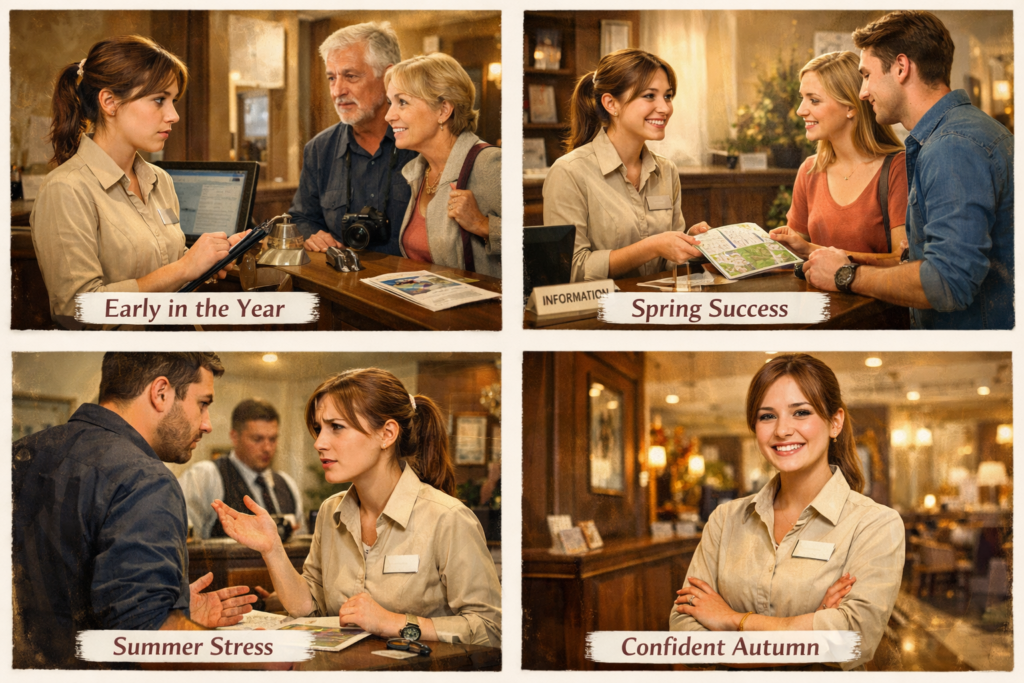
This year was important for me. I worked in tourism and hospitality. I worked in a small hotel with international guests. At the beginning of the year, I felt nervous. My English was not good, and I was afraid to speak with guests every day.
In spring, I learned many new things at work. I helped guests at the reception and answered simple questions. I gave information about breakfast, rooms, and tours. Some guests were friendly, and I felt happy and proud. One guest thanked me for my help, and this moment made my day better.
In summer, work was busy and sometimes stressful. The hotel was full, and I worked long hours. I felt tired in the evenings. One day a guest was angry because of a problem with the room. I listened carefully and stayed polite. I asked my colleague for help. In the end, we solved the problem together.
In autumn, I felt more confident at work. I spoke more English and made fewer mistakes. I learned from difficult situations and tried my best every day. At the end of the year, I felt proud because I learned a lot and grew as a person this year.
_________________________
Vocabulary:
- spring (season) – the season after winter
- to be proud – to feel happy about yourself or your work
- to make one’s day – to make someone very happy
- to be stressful – to make you feel worried or nervous
- to feel tired – to have no energy
- to be angry – to feel mad or upset
- to listen carefully – to listen and pay attention
- to stay polite – to be friendly and respectful
- a colleague – a person you work with
- to solve a problem – to fix a problem
- autumn – the season after summer
- to feel confident – to feel sure about yourself
- fewer mistakes – not many mistakes
- to feel proud – to feel happy about what you did
- to grow as a person – to learn and become better
##################
| Verb (Infinitive) | Past Simple | Verb (Infinitive) | Past Simple | |
|---|---|---|---|---|
| to be | was / were | to work | worked | |
| to feel | felt | to speak | spoke | |
| to learn | learned | to help | helped | |
| to answer | answered | to give | gave | |
| to thank | thanked | to make | made | |
| to listen | listened | to stay | stayed | |
| to ask | asked | to solve | solved | |
| to try | tried | to grow | grew |
#########################
Match the word with the correct definition:
- spring
- to be proud
- to make one’s day
- to be stressful
- to feel tired
- to be angry
- to listen carefully
- to stay polite
- a colleague
- to solve a problem
- autumn
- to feel confident
- fewer mistakes
- to grow as a person
Definitions:
a. the season after summer
b. to fix a problem
c. to pay attention when someone speaks
d. to feel happy about what you did
e. not many errors
f. to feel sure about yourself
g. a person you work with
h. the season after winter
i. to feel mad or upset
j. to make someone very happy
k. to learn and become better
l. to have no energy
m. to be friendly and respectful
n. to make you feel worried or nervous
_____________________________
Answers:
1‑h, 2‑d, 3‑j, 4‑n, 5‑l, 6‑i,
7‑c, 8‑m, 9‑g, 10‑b, 11‑a,
12‑f, 13‑e, 14‑k
_____________________________
Correct answers:
spring – the season after winter
to be proud – to feel happy about what you did
to make one’s day – to make someone very happy
to be stressful – to make you feel worried or nervous
to feel tired – to have no energy
to be angry – to feel mad or upset
to listen carefully – to pay attention when someone speaks
to stay polite – to be friendly and respectful
a colleague – a person you work with
to solve a problem – to fix a problem
autumn – the season after summer
to feel confident – to feel sure about yourself
fewer mistakes – not many errors
to grow as a person – to learn and become better
#########################
True or false:
- The person worked in a hotel this year.
- The text is written in present simple.
- The person felt nervous at the beginning of the year.
- The person never helped guests at the reception.
- One guest thanked the person for help.
- Summer was very busy and sometimes stressful.
- The person ignored angry guests.
- In autumn, the person felt more confident.
- The text mentions working in a restaurant.
- The person made fewer mistakes at the end of the year.
- The person traveled abroad this year.
- The person asked a colleague for help with a problem.
- The person spoke more English at the end of the year.
- The hotel was empty during summer.
- The person felt proud at the end of the year.
- The text describes a good and a difficult experience.
- The person quit the job at the end of the year.
- The person learned a lot and grew as a person.
- The person worked only in winter.
- One guest was angry because of a problem with the room.
______________
Answers:
1-T, 2-F, 3-T, 4-F, 5-T, 6-T, 7-F, 8-T,
9-F, 10-T, 11-F, 12-T, 13-T, 14-F,
15-T, 16-T, 17-F, 18-T, 19-F, 20-T
______________
Correct version:
The person worked in a hotel this year.
The text is written in present simple. True is: The text is written in past simple.
The person felt nervous at the beginning of the year.
The person never helped guests at the reception. True is: The person helped guests at the reception.
One guest thanked the person for help.
Summer was very busy and sometimes stressful.
The person ignored angry guests. True is: The person listened carefully to angry guests.
In autumn, the person felt more confident.
The text mentions working in a restaurant. True is: The text mentions working in a hotel.
The person made fewer mistakes at the end of the year.
The person traveled abroad this year. True is: The text does not mention traveling abroad.
The person asked a colleague for help with a problem.
The person spoke more English at the end of the year.
The hotel was empty during summer. True is: The hotel was full during summer.
The person felt proud at the end of the year.
The text describes a good and a difficult experience.
The person quit the job at the end of the year. True is: The person continued working and learned a lot.
The person learned a lot and grew as a person.
The person worked only in winter. True is: The person worked throughout the year.
One guest was angry because of a problem with the room.
#########################
List of irregular verbs:
################
Fill in (past simple):
- The person __________ (work) in a hotel this year.
- The person __________ (feel) nervous at the beginning of the year.
- The person __________ (help) guests at the reception.
- Some guests __________ (to be) friendly.
- One guest __________ (thank) the person for help.
- Summer __________ (be) very busy.
- Summer __________ (be) sometimes stressful.
- One guest __________ (be) angry because of a problem with the room.
- The person __________ (ask) a colleague for help.
- In autumn, the person felt more confident.
- The person __________ (speak) more English at the end of the year.
- The person __________ (make) fewer mistakes at the end of the year.
- The person __________ (feel) proud at the end of the year.
- The person ___________ (learn) a lot this year.
- The person __________ (grow) as a person during the year.
————————————-
Correct version:
- The person worked in a hotel this year.
- The person felt nervous at the beginning of the year.
- The person helped guests at the reception.
- Some guests were friendly.
- One guest thanked the person for help.
- Summer was very busy.
- Summer was sometimes stressful.
- One guest was angry because of a problem with the room.
- The person asked a colleague for help.
- In autumn, the person felt more confident.
- The person spoke more English at the end of the year.
- The person made fewer mistakes at the end of the year.
- The person felt proud at the end of the year.
- The person learned a lot this year.
- The person grew as a person during the year.

################
Basics in past simple:
| Personal Pronoun | Verb (Past) | Object |
|---|---|---|
| I | ate | apples |
| You | ate | apples |
| He | ate | apples |
| She | ate | apples |
| It | ate | apples |
| We | ate | apples |
| You (plural) | ate | apples |
| They | ate | apples |
| I | played | football |
| You | played | football |
| He | played | football |
| She | played | football |
| It | played | football |
| We | played | football |
| You (plural) | played | football |
| They | played | football |
| Personal Pronoun | Verb (Past Negative) | Object |
|---|---|---|
| I | did not eat | apples |
| You | did not eat | apples |
| He | did not eat | apples |
| She | did not eat | apples |
| It | did not eat | apples |
| We | did not eat | apples |
| You (plural) | did not eat | apples |
| They | did not eat | apples |
| I | did not play | football |
| You | did not play | football |
| He | did not play | football |
| She | did not play | football |
| It | did not play | football |
| We | did not play | football |
| You (plural) | did not play | football |
| They | did not play | football |
| Did + Pronoun | Verb | Object |
|---|---|---|
| Did I | eat | apples? |
| Did you | eat | apples? |
| Did he | eat | apples? |
| Did she | eat | apples? |
| Did it | eat | apples? |
| Did we | eat | apples? |
| Did you | eat | apples? |
| Did they | eat | apples? |
| Did I | play | football? |
| Did you | play | football? |
| Did he | play | football? |
| Did she | play | football? |
| Did it | play | football? |
| Did we | play | football? |
| Did you | play | football? |
| Did they | play | football? |
| Didn’t + Pronoun | Verb | Object |
|---|---|---|
| Didn’t I | eat | apples? |
| Didn’t you | eat | apples? |
| Didn’t he | eat | apples? |
| Didn’t she | eat | apples? |
| Didn’t it | eat | apples? |
| Didn’t we | eat | apples? |
| Didn’t you | eat | apples? |
| Didn’t they | eat | apples? |
| Didn’t I | play | football? |
| Didn’t you | play | football? |
| Didn’t he | play | football? |
| Didn’t she | play | football? |
| Didn’t it | play | football? |
| Didn’t we | play | football? |
| Didn’t you | play | football? |
| Didn’t they | play | football? |
Forms of ‚to be‘
| Personal Pronoun | Positive | Negative | Question |
|---|---|---|---|
| I | I was happy. | I was not happy. | Was I happy? |
| You (singular) | You were excited. | You were not excited. | Were you excited? |
| He | He was at home. | He was not at home. | Was he at home? |
| She | She was tired. | She was not tired. | Was she tired? |
| It | It was cold. | It was not cold. | Was it cold? |
| We | We were at the party. | We were not at the party. | Were we at the party? |
| You (plural) | You were friends. | You were not friends. | Were you friends? |
| They | They were in the garden. | They were not in the garden. | Were they in the garden? |
######################

Correct the following sentences as shown:
- The person worked in a restaurant this year.
YOU WRITE:
The person did not work in a restaurant this year. The person worked at the reception. - The text is written in present simple.
- The hotel was empty during summer.
- The person ignored angry guests.
- The person traveled abroad this year.
- The person quit the job at the end of the year.
- The person worked only in winter.
- Guests always shouted at the person.
- The person felt bored at work.
- The person learned nothing this year.
- The person spoke only French with guests.
- The hotel was closed during summer.
- The person made more mistakes at the end of the year.
- The person felt relaxed at the beginning of the year.
- The person worked alone without any colleagues.
_____________________
Correct version:
- The person did not work in a restaurant this year. The person worked at the reception.
- The text is not written in present simple. The text is written in past simple.
- The hotel was not empty during summer. The hotel was full.
- The person did not ignore angry guests. The person listened to a guest with a problem.
- The person did not travel abroad this year. The person worked at the hotel.
- The person did not quit the job at the end of the year. The person continued working.
- The person did not work only in winter. The person worked during the year.
- Guests did not always shout at the person. One guest was angry because of a problem.
- The person did not feel bored at work. The person sometimes felt tired.
- The person did not learn nothing this year. The person learned a lot.
- The person did not speak only French with guests. The person spoke English.
- The hotel was not closed during summer. The hotel was full.
- The person did not make more mistakes at the end of the year. The person made fewer mistakes.
- The person did not feel relaxed at the beginning of the year. The person felt nervous.
- The person did not work alone without any colleagues. The person asked a colleague for help.
######################
Short answers in past simple:
| Question | Short Answer (Yes/Positive) | Short Answer (No/Negative) |
|---|---|---|
| Did she check reservations? | Yes, she did. | No, she didn’t. |
| Did she give keys to guests? | Yes, she did. | No, she didn’t. |
| Did she talk to many guests? | Yes, she did. | No, she didn’t. |
| Was she happy? | Yes, she was. | No, she wasn’t. |
| Were the guests satisfied? | Yes, they were. | No, they weren’t. |
#################
Provide short answers:
- The hotel was empty during summer.
YOU WRITE:
No, it wasn’t. - One guest thanked the person for help.
_______________________________ - The person worked in a restaurant this year.
_______________________________ - The person helped guests at the reception.
_______________________________ - The person worked in a hotel this year.
_______________________________ - Summer was very busy.
_______________________________ - The person ignored angry guests.
_______________________________ - The person spoke more English at the end of the year.
_______________________________ - The text is written in present simple.
_______________________________ - The person felt nervous at the beginning of the year.
_______________________________ - One guest was angry because of a problem with the room.
_______________________________ - In autumn, the person felt more confident.
_______________________________ - The person traveled abroad this year.
_______________________________ - The person worked alone without any colleagues.
_______________________________ - Some guests were friendly.
_______________________________ - The person worked only in winter.
_______________________________ - The person quit the job at the end of the year.
_______________________________ - The hotel was closed during summer.
_______________________________ - Summer was sometimes stressful.
_______________________________ - The person spoke only French with guests.
_______________________________
———————————
Correct answers:
- The hotel was empty during summer. – No, it wasn’t.
- One guest thanked the person for help. – Yes, he did.
- The person worked in a restaurant this year. – No, he didn’t.
- The person helped guests at the reception. – Yes, he did.
- The person worked in a hotel this year. – Yes, he did.
- Summer was very busy. – Yes, it was.
- The person ignored angry guests. – No, he didn’t.
- The person spoke more English at the end of the year. – Yes, he did.
- The text is written in present simple. – No, it isn’t.
- The person felt nervous at the beginning of the year. – Yes, he did.
- One guest was angry because of a problem with the room. – Yes, he was.
- In autumn, the person felt more confident. – Yes, he did.
- The person traveled abroad this year. – No, he didn’t.
- The person worked alone without any colleagues. – No, he didn’t.
- Some guests were friendly. – Yes, they were.
- The person worked only in winter. – No, he didn’t.
- The person quit the job at the end of the year. – No, he didn’t.
- The hotel was closed during summer. – No, it wasn’t.
- Summer was sometimes stressful. – Yes, it was.
- The person spoke only French with guests. – No, he didn’t.
#################
Answer the following questions:
- Did he work in tourism or in a restaurant?
- Was his English good or bad at the beginning of the year?
- Did he help guests at the reception or in the kitchen?
- Was summer very busy or quiet?
- Did he feel nervous or confident at the beginning of the year?
- Did one guest thank him or complain?
- Was one guest angry because of a problem or happy?
- Did he ask a colleague for help or solve the problem alone?
- Did he speak more English or less English at the end of the year?
- Did he work only in winter or throughout the year [during all the months of the year / during the whole year]?
- Was the hotel full or empty during summer?
- Did he quit the job [to stop working in a job / to leave your job] at the end of the year or continue working?
- Did he make more mistakes or fewer mistakes at the end of the year?
- Did he feel proud or disappointed [sad or unhappy because something did not happen as you wanted] at the end of the year?
- Did he grow as a person or stay the same?
- Did he meet international guests or only local guests?
- Did he have stressful days or easy days in summer?
- Did he feel tired or relaxed after busy days?
- Was he more confident in autumn or in spring?
- Did he enjoy helping guests or dislike it?
_______________________
Correct version:
- Did he work in tourism or in a restaurant? – He worked in tourism.
- Was his English good or bad at the beginning of the year? – His English was bad at the beginning of the year.
- Did he help guests at the reception or in the kitchen? – He helped guests at the reception.
- Was summer very busy or quiet? – Summer was very busy.
- Did he feel nervous or confident at the beginning of the year? – He felt nervous at the beginning of the year.
- Did one guest thank him or complain? – One guest thanked him.
- Was one guest angry because of a problem or happy? – One guest was angry because of a problem.
- Did he ask a colleague for help or solve the problem alone? – He asked a colleague for help.
- Did he speak more English or less English at the end of the year? – He spoke more English at the end of the year.
- Did he work only in winter or throughout the year? – He worked throughout the year.
- Was the hotel full or empty during summer? – The hotel was full during summer.
- Did he quit the job at the end of the year or continue working? – He continued working.
- Did he make more mistakes or fewer mistakes at the end of the year? – He made fewer mistakes at the end of the year.
- Did he feel proud or disappointed at the end of the year? – He felt proud at the end of the year.
- Did he grow as a person or stay the same? – He grew as a person.
- Did he meet international guests or only local guests? – He met international guests.
- Did he have stressful days or easy days in summer? – He had stressful days in summer.
- Did he feel tired or relaxed after busy days? – He felt tired after busy days.
- Was he more confident in autumn or in spring? – He was more confident in autumn.
- Did he enjoy helping guests or dislike it? – He enjoyed helping guests.
##################
Schreibe einen Kommentar