- a brief history
Many countries celebrate the New Year as a time for a new start. People think about the past year and make plans for the next one. They hope for good health, happiness, and success. Families and friends often celebrate together.
The idea of celebrating the New Year is very old. About 4,000 years ago, the Babylonians in Mesopotamia had a festival called Akitu. It took place in March and lasted several days. This festival was connected to farming and the start of spring. People gave gifts to their gods and showed respect to their king.
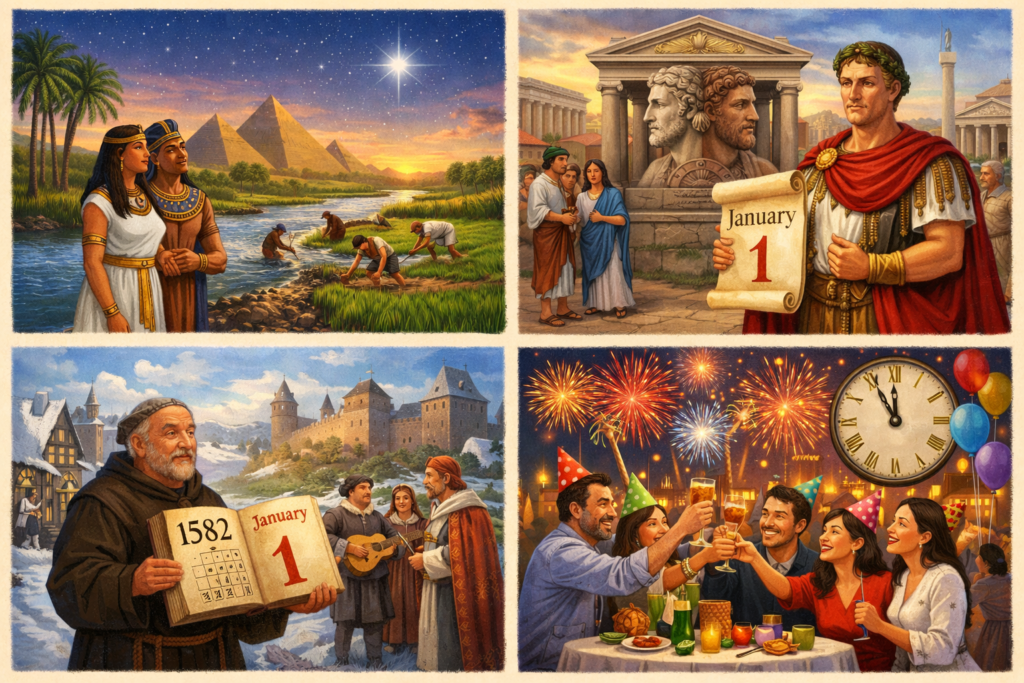
In ancient Egypt, the New Year was also linked to nature. It began when the Nile River flooded. The flood made the land good for farming. At the same time, a bright star called Sirius appeared in the sky. This was an important sign for the Egyptians.
In ancient Rome, the New Year first began in March. Later, in 46 BCE, Julius Caesar changed the calendar. He made January 1 the start of the year. This day honored Janus, the god of beginnings and endings. Janus looked to the past and the future. [more details below (1)]
During the Middle Ages, different countries in Europe celebrated the New Year on different dates. After the Gregorian calendar began in 1582, January 1 became the common New Year’s Day. [more details below (2)]
Today, people around the world celebrate the New Year with parties, fireworks, food, and family time. It is a special moment full of hope and new plans.
____________________
Vocabulary:
- to celebrate: to do something special and be happy for a day or event
- to make a plan: to decide what you will do in the future
- health: how well your body feels and works
- success: when you do something well or get what you want
- a festival: a special day or time with celebrations
- to take place: to happen
- to last several days: to continue for many days
- to connect to farming: to be about growing food from the land
- spring (season): the season after winter and before summer
- a gift: something you give to another person
- to show respect to somebody: to be kind and polite to someone
- ancient: very old, from a long time ago
- to be linked to nature: to be connected to the natural world
- to flood: when water covers the land
- a bright star: a star that shines very strongly
- to appear: to be seen
- the sky: the space above the earth
- BCE (before common era): a time before the year 1
- to change: to make something different
- to honor somebody: to show that someone is important
- hope: a good feeling about the future
################
Appendix:
(1)Julius Caesar changed the New Year to January 1 because he wanted a better calendar.
The old calendar was confusing [to be hard to understand]. The months did not match the seasons [to be right for the time of year]. This caused problems [to make things difficult or wrong]for farming and for the government.
January was a good time to start new things. It was named after Janus, the Roman god of beginnings. Roman leaders also started their work in January.
So Julius Caesar made January 1 the start of the year to make life easier and more clear.
################
(2) During the Middle Ages [the time in Europe a long time ago, between the old Roman times and modern times, about 500–1500 AD], there was no one calendar in Europe.
Each country used its own rules [things you must do or follow], so the New Year started on different days. This was confusing [to be difficult to understand or not clear]for people, travel, and work.
In 1582, a new calendar began. It was called the Gregorian calendar.
This calendar was clear and better. It helped people count [to say numbers one by one or know how many things there are]days and years in the same way.
With this new calendar, January 1 became the start of the year.
Slowly, many countries followed this rule.
That is why January 1 became the common New Year’s Day in Europe.
################
Schreibe einen Kommentar