- three hundred steps into the past, one way only, both, six hundred
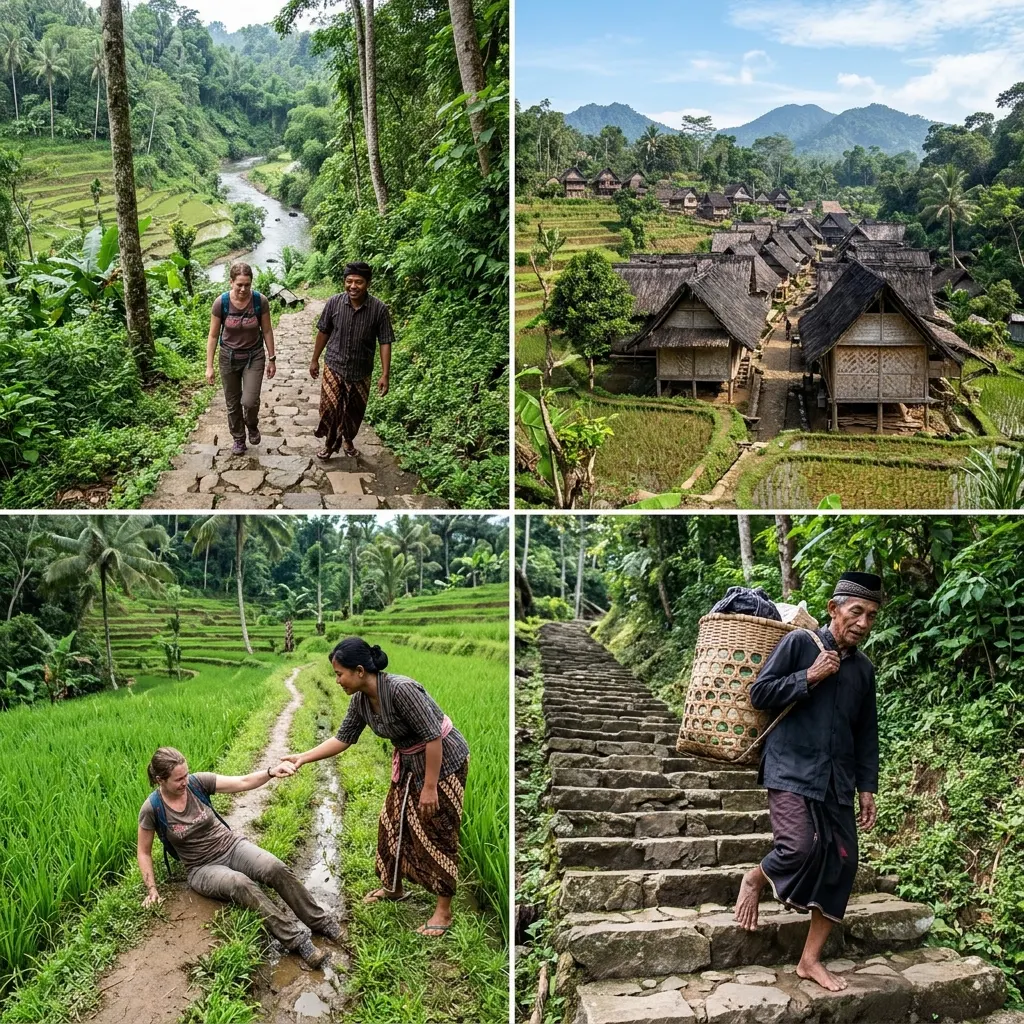
In September 2026, I visited Kampung Naga in Indonesia. It was a beautiful trip. I went there with a guide. My guide was very nice. He talked about the old village.
First, I walked down many stone steps. There were about three hundred steps. The view was very green and nice. I saw big trees, a river, and rice fields. The air was good.
Kampung Naga is a quiet place. People there live a simple life. They do not have electricity. They do not have televisions or computers. Their houses are special. The houses are made of bamboo and wood. All houses look the same.
We walked in the village. We walked on small paths between the rice fields. The paths were very narrow. Suddenly, I lost my balance. I almost fell into the wet mud! My guide helped me. I was safe. I was happy.
The people in the village were very friendly. They smiled at us. They love their old culture and live with nature.
After two hours, we went back. Walking up the steps was very hard. I was very tired and hot. I walked slowly. Then, an old man walked past me. He was very old, but he was fast. He carried a big basket on his back. It was very impressive. He did not stop.
My trip to Kampung Naga was great. I was tired, but I was happy. I learned many new things.
____________________________
Vocabulary:
| Word | Definition |
| exhausting | making you feel very tired |
| a guide | a person who shows the way |
| to be quiet | to make no noise |
| a path | a small way for walking |
| to be narrow | small from side to side |
| to lose one’s balance | to start to fall over |
| mud | soft wet earth |
| to be safe | away from any danger |
| a basket | a box for holding things |
| to be impressive | making people say „wow“ |
#####################
Match word and definition
Words
- exhausting
- a guide
- to be quiet
- a path
- to be narrow
- to lose one’s balance
- mud
- to be safe
- a basket
- to be impressive
Definitions
A. soft wet earth
B. making people say „wow“
C. small from side to side
D. away from any danger
E. making you feel very tired
F. a box for holding things
G. a small way for walking
H. a person who shows the way
I. to start to fall over
J. to make no noise
____________________________
Answer key:
1-E, 2-H, 3-J, 4-G, 5-C, 6-I, 7-A, 8-D, 9-F, 10-B
####################
Match definition and word:
Definitions
- soft wet earth
- making people say „wow“
- small from side to side
- away from any danger
- making you feel very tired
- a box for holding things
- a small way for walking
- a person who shows the way
- to start to fall over
- to make no noise
Words
A. exhausting
B. a guide
C. to be quiet
D. a path
E. to be narrow
F. to lose one’s balance
G. mud
H. to be safe
I. a basket
J. to be impressive
_________________________
Answer key:
1-G, 2-J, 3-E, 4-H, 5-A, 6-I, 7-D, 8-B, 9-F, 10-C
##################
True or false:
- The narrator went to Kampung Naga in September 2026.
- The narrator was alone on the trip.
- The narrator walked down about three hundred stone steps.
- People in Kampung Naga have televisions and computers.
- The houses are made of bamboo and wood.
- All houses in Kampung Naga look different.
- The narrator almost fell into the wet mud.
- The guide did not help the narrator.
- The narrator stayed in the village for five hours.
- The narrator went to Kampung Naga in August.
- Walking back up the steps was very easy.
- An old man carried a big basket on his back.
- The old man walked very slowly and stopped.
- The narrator was tired but happy after the trip.
- The narrator saw big trees, a river, and rice fields.
- The paths between the rice fields were very wide.
- The people in Kampung Naga love their old culture.
- The people in the village were very friendly.
- The air in Kampung Naga was good.
- The trip to Kampung Naga was bad.
________________________
Answer key:
1-T, 2-F, 3-T, 4-F, 5-T, 6-F, 7-T, 8-F, 9-F, 10-F, 11-F,
12-T, 13-F, 14-T, 15-T, 16-F, 17-T, 18-T, 19-T, 20-F
________________________
- The narrator went to Kampung Naga in September 2026.
- The narrator was alone on the trip. True is: The narrator was with a guide.
- The narrator walked down about three hundred stone steps.
- People in Kampung Naga have televisions and computers. True is: People in Kampung Naga do not have televisions or computers.
- The houses are made of bamboo and wood.
- All houses in Kampung Naga look different. True is: All houses in Kampung Naga look the same.
- The narrator almost fell into the wet mud.
- The guide did not help the narrator. True is: The guide helped the narrator.
- The narrator stayed in the village for five hours. True is: The narrator stayed in the village for two hours.
- The narrator went to Kampung Naga in August. True is: The narrator went to Kampung Naga in September.
- Walking back up the steps was very easy. True is: Walking back up the steps was very hard.
- An old man carried a big basket on his back.
- The old man walked very slowly and stopped. True is: The old man walked fast and did not stop.
- The narrator was tired but happy after the trip.
- The narrator saw big trees, a river, and rice fields.
- The paths between the rice fields were very wide. True is: The paths between the rice fields were very narrow.
- The people in Kampung Naga love their old culture.
- The people in the village were very friendly.
- The air in Kampung Naga was good.
- The trip to Kampung Naga was bad. True is: The trip to Kampung Naga was great.
########################
Multiple choice:
- When did the narrator visit Kampung Naga?
A) August 2026 B) September 2026 C) July 2026 - Who did the narrator go to Kampung Naga with?
A) A group of tourists B) Alone C) A guide - How many stone steps did the narrator walk down?
A) About three hundred steps B) About five hundred steps C) About one hundred steps - What did the narrator see while walking down the steps?
A) Tall buildings and cars B) High mountains and snow C) Big trees, a river, and rice fields - How was the air described in Kampung Naga?
A) Good B) Bad C) Dusty - What kind of place is Kampung Naga?
A) A loud city B) A busy market C) A quiet place - What modern items do the villagers live without?
A) Water and fire B) Electricity, televisions, and computers C) Clothes and shoes - What are the houses in Kampung Naga made of?
A) Concrete and steel B) Bamboo and wood C) Bricks and glass - What do all the houses in Kampung Naga look like?
A) All houses look the same B) All houses look different C) Some houses are very tall towers - Where were the narrow paths located?
A) Next to a highway B) Inside a shopping center C) Between the rice fields - What happened to the narrator on the narrow path?
A) Found a lost dog B) Dropped a camera into the river C) Lost balance and almost fell into wet mud - Who helped the narrator after losing balance?
A) The guide B) An old man C) A local farmer - How were the villagers in Kampung Naga described?
A) Angry and rude B) Very friendly C) Shy and silent - How long did the narrator spend walking in the village?
A) Two hours B) Five hours C) Ten minutes - How did the narrator feel while walking back up the steps?
A) Energetic and fast B) Very tired and hot C) Cold and refreshed - Who walked past the narrator on the steps going up?
A) A young child running B) The guide carrying all the bags C) An old man carrying a big basket - How did the old man walk up the steps?
A) Slowly, stopping often B) Fast, without stopping C) With a walking stick, resting every minute - What did the villagers love to live with?
A) Modern technology B) Big machines C) Nature and their old culture - How did the narrator feel at the end of the trip?
A) Disappointed and angry B) Happy, despite being tired C) Bored and sleepy - What did the narrator think about the overall trip?
A) It was great B) It was bad C) It was frightening
______________________________
Answer key:
1-B, 2-C, 3-A, 4-C, 5-A, 6-C, 7-B, 8-B,
9-A, 10-C, 11-C, 12-A, 13-B, 14-A, 15-B,
16-C, 17-B, 18-C, 19-B, 20-A
#####################
Match sentence halves
First half:
- The narrator went to Kampung Naga
- The narrator walked down
- The view was green with big trees,
- The people in the village live
- They do not have electricity,
- The houses in the village are made of
- All the houses in Kampung Naga
- The paths between the rice fields
- The narrator lost balance and
- The guide helped the narrator
- An old man walked fast and
- The narrator was tired after the trip,
Second half:
A. bamboo and wood.
B. televisions, or computers.
C. look the same.
D. to stay safe.
E. in September 2026.
F. a river, and rice fields.
G. a simple life.
H. carried a big basket.
I. about three hundred steps.
J. but was very happy.
K. were very narrow.
L. almost fell into the mud.
______________________________
Answer key:
1-E, 2-I, 3-F, 4-G, 5-B, 6-A, 7-C,
8-K, 9-L, 10-D, 11-H, 12-J
#####################
Fill in the blanks – words below
mud – simple – wood – fast – steps – balance –
electricity – paths – hours – friendly –
guide – same – river –
hard
- The narrator went to Kampung Naga with a ____________.
- They walked down about three hundred stone ____________.
- The narrator saw big trees, a ____________, and rice fields.
- The people in Kampung Naga live a ____________ life.
- The villagers do not have ____________, televisions, or computers.
- The houses are made of bamboo and ____________.
- All houses in the village look the ____________.
- The ____________ between the rice fields were very narrow.
- On the path, the narrator lost their ____________ and almost fell.
- The narrator almost fell into the wet ____________.
- The people in the village were very ____________ and smiled at them.
- The narrator spent two ____________ walking in the village.
- Walking back up the steps was very ____________.
- An old man carrying a big basket walked past very ____________.
———————————————-
Answer key:
1-guide, 2-steps, 3-river, 4-simple, 5-electricity, 6-wood,
7-same, 8-paths, 9-balance, 10-mud, 11-friendly,
12-hours, 13-hard, 14-fast
#####################
Cause and Effect – match the cause with the correct effect
Cause
- The narrator went with a guide,
- The narrator walked down many steps,
- The villagers do not have electricity,
- The houses are made of bamboo and wood,
- The paths were very narrow,
- The guide helped the narrator,
- The villagers love their culture,
- Walking up the steps was very hard,
- An old man was very strong,
- The trip was wonderful,
Effect
A. so they live a simple life without TVs.
B. so the narrator was safe after losing balance.
C. so he walked fast carrying a big basket.
D. so the narrator learned about the old village.
E. so the narrator felt very tired and hot.
F. so all the houses look the same.
G. so the narrator reached the green village below.
H. so the narrator felt happy at the end.
I. so the narrator almost fell into the wet mud.
J. so they live in harmony with nature.
________________________
Answer key:
1-D, 2-G, 3-A, 4-F, 5-I, 6-B, 7-J, 8-E, 9-C, 10-H
#################
Match question and answer:
Questions
- When was your trip to the village?
- Who came with you on this trip?
- How many stone steps were on the path down?
- What was in the view?
- How is the air in the village?
- What machines do the people have in their homes?
- What things do the people use to make their houses?
- Do the houses have different styles?
- What happened on the small rice field path?
- Who helped you after your slip?
- How long was your time in the village?
- What do you think about this trip?
Answers
A. Every home looks the same.
B. The villagers live without televisions, phones, or computers.
C. I visited Kampung Naga in September 2026.
D. We stayed there for two hours.
E. The good guide saved me fast.
F. The villagers build with strong bamboo and wood.
G. I saw big trees, a long river, and green fields.
H. A local guide walked with me.
I. The air feels clean and very good.
J. I counted about three hundred steps.
K. This short visit gave me great joy.
L. My feet slipped near the wet mud.
_______________________
Answer key:
1-C, 2-H, 3-J, 4-G, 5-I, 6-B, 7-F, 8-A,
9-L, 10-E, 11-D, 12-K
_______________________
Correct version:
Question: When was your trip to the village?
Answer: I visited Kampung Naga in September 2026.
Question: Who came with you on this trip?
Answer: A local guide walked with me.
Question: How many stone steps were on the path down?
Answer: I counted about three hundred steps.
Question: What was in the view?
Answer: I saw big trees, a long river, and green fields.
Question: How is the air in the village?
Answer: The air feels clean and very good.
Question: What machines do the people have in their homes?
Answer: The villagers live without televisions, phones, or computers.
Question: What things do the people use to make their houses?
Answer: The villagers build with strong bamboo and wood.
Question: Do the houses have different styles?
Answer: Every home looks the same.
Question: What happened on the small rice field path?
Answer: My feet slipped near the wet mud.
Question: Who helped you after your slip?
Answer: The good guide saved me fast.
Question: How long was your time in the village?
Answer: We stayed there for two hours.
Question: What do you think about this trip?
Answer: This short visit gave me great joy.
###################
##################
################
Please use the box below
to write your feedback.
Only I can read it.
It is not public.
Please tell me:
- Are the texts and exercises OK?
- Are the topics OK?
- Is the level OK?
- Is it too easy or too difficult?
- Is it too short, too long?
- Do you want texts about other topics?
Thank you! I appreciate your feedback.
___________________________________
Remember how babies
learn a language:
Babies learn a language by listening.
They use their ears to hear sounds.
Their brain remembers these sounds.
Babies connect sounds with people and things.
They listen to their parents.
Then they copy the sounds they hear. They imitate words.
Slowly, babies learn to speak.
So,
LISTEN, LISTEN, LISTEN, LISTEN………………

SMFrockZ@gmx.at
##################
Schreibe einen Kommentar