- how one small restaurant in Southeast Asia helps people and nature.
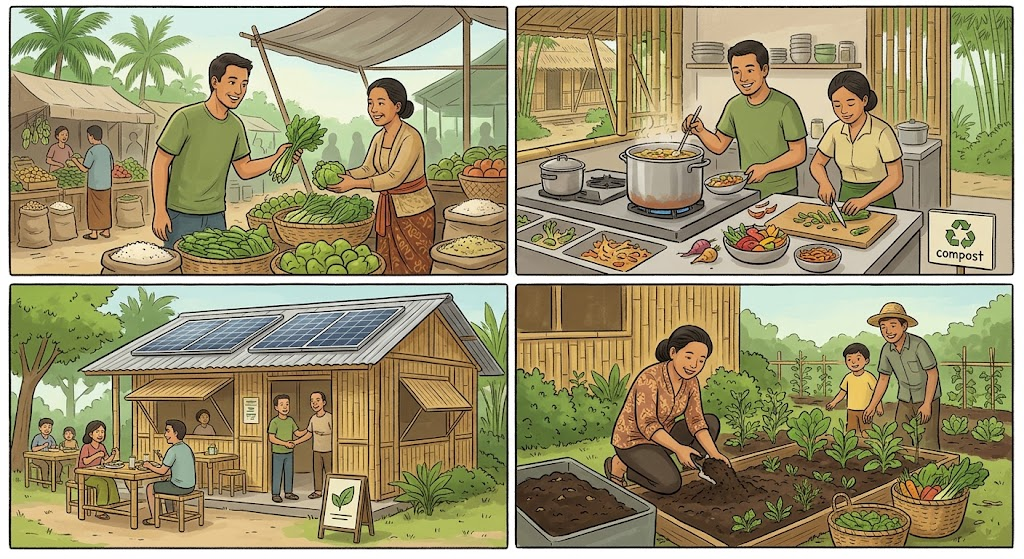
Siti and Budi love good food. They also want to help the Earth. Last year, they opened a small restaurant near their town in Southeast Asia. They called it The Green Bamboo. Their idea is simple: serve good food and care for nature.
Fresh food from local farmers
Every morning, Budi visits farmers and fishermen near the village. He buys fresh vegetables, fruit, fish, and rice. The food comes from nearby places, so it does not travel far. It stays fresh, and there is less air pollution.
The menu changes during the year. In the dry season, guests enjoy fresh mangoes and green vegetables. In the rainy season, they can eat hot curry and warm soup.
Siti and Budi pay the farmers a good price. The farmers are happy because they can sell more food. The restaurant also gets fresh food every day.
No food waste
Siti and Budi try not to waste food. Budi uses parts of vegetables to make soup and sauces. He also saves food that he can use later.
Siti puts old fruit, vegetable parts, and other food waste in a box in the garden. After some time, this waste becomes good soil for plants. Farmers can use it to help new plants grow.
The restaurant also uses less plastic. Guests drink from glass bottles and use bamboo straws. They do not need plastic bottles or straws. This helps keep the streets, rivers, and land clean.
A green and friendly place
The restaurant is warm and friendly. The tables and chairs are made from bamboo and old wood. Solar panels on the roof use sunlight to make electricity. This helps the restaurant use less electricity from other sources.
Guests come to enjoy good food and spend time with friends and family. They can also learn how local farmers work and how to help nature. Some guests even talk to Siti and Budi about their ideas.
Small actions, big changes
Siti and Budi are happy with their restaurant. They know that they cannot solve every problem, but they can do something useful every day.
They believe that small actions can make a difference. For them, a good restaurant is more than a place to eat. It is a place where people come together, local farmers earn money, and everyone can learn to care for the Earth.
SUSTAINABILITY AT ITS BEST
______________________________
Vocabulary:
| Word/phrase | Simple definition |
|---|---|
| to serve food | to give food to people to eat |
| to care for nature | to help keep the Earth clean and safe |
| air pollution | dirty air that is bad for people, animals, and plants |
| to enjoy | to like something |
| to sell food | to give food to people who pay for it |
| food waste | food that people throw away |
| a sauce | a liquid food that you eat with other food |
| soil | the earth where plants grow |
| solar panels | things that use sunlight to make electricity |
| sources (e.g. electricity) | places or things that give us something |
| to earn money | to get money for work |
| to care for something | to look after something and keep it safe |
| sustainability | using things in a way that is good for the Earth and its future |
#######################
Match the words with the correct definitions
- to serve food
- to care for nature
- air pollution
- to enjoy
- to sell food
- food waste
- a sauce
- soil
- solar panels
- sources
- to earn money
- to care for something
- sustainability
A. to like something
B. places or things that give us something
C. food that people throw away
D. to help keep the Earth clean and safe
E. a liquid food that you eat with other food
F. to get money for work
G. dirty air that is bad for people, animals, and plants
H. things that use sunlight to make electricity
I. to give food to people who pay for it
J. using things in a way that is good for the Earth and its future
K. the earth where plants grow
L. to give food to people to eat
M. to look after something and keep it safe
________________________________
Answer key:
1–L, 2–D, 3–G, 4–A, 5–I, 6–C, 7–E,
8–K, 9–H, 10–B, 11–F, 12–M, 13–J
#######################
Match the definitions with the correct words
- to give food to people to eat
- dirty air that is bad for people, animals, and plants
- to get money for work
- the earth where plants grow
- to like something
- things that use sunlight to make electricity
- food that people throw away
- to look after something and keep it safe
- a liquid food that you eat with other food
- using things in a way that is good for the Earth and its future
- to give food to people who pay for it
- places or things that give us something
- to help keep the Earth clean and safe
A. sustainability
B. to sell food
C. solar panels
D. to care for something
E. soil
F. to enjoy
G. sources
H. to serve food
I. food waste
J. to care for nature
K. air pollution
L. a sauce
M. to earn money
________________________________
Answer key:
1–H, 2–K, 3–M, 4–E, 5–F, 6–C, 7–I,
8–D, 9–L, 10–A, 11–B, 12–G, 13–J
#######################
Multiple-choice
1. Where is The Green Bamboo?
- A. Near a beach
- B. Near a town
- C. In a big city
2. When did Siti and Budi open the restaurant?
- A. Last month
- B. Two years ago
- C. Last year
3. What does Budi buy from local farmers?
- A. Vegetables and fruit
- B. Bread and cheese
- C. Meat and eggs
4. Why does the food stay fresh?
- A. It stays in the fridge.
- B. It does not travel far.
- C. It comes in big trucks.
5. What changes during the year?
- A. The tables
- B. The restaurant name
- C. The menu
6. What can guests eat in the dry season?
- A. Fresh mangoes
- B. Coconut cake
- C. Hot soup
7. Why are the farmers happy?
- A. They get free meals.
- B. They sell more food.
- C. They work in the restaurant.
8. What does Budi use to make soup?
- A. Plastic bottles
- B. Old pieces of wood
- C. Parts of vegetables
9. Where does Siti put food waste?
- A. In the kitchen
- B. In a garden box
- C. In the river
10. What does food waste become after some time?
- A. Fresh fruit
- B. Clean water
- C. Good soil
11. Who can use the soil?
- A. Farmers
- B. Guests
- C. Fishermen
12. What do guests use instead of plastic straws?
- A. Paper cups
- B. Bamboo straws
- C. Metal plates
13. What are the tables and chairs made from?
- A. Glass and metal
- B. Plastic and stone
- C. Bamboo and old wood
14. What do the solar panels use?
- A. Sunlight
- B. Rainwater
- C. Wind
15. What do the solar panels make?
- A. Hot water
- B. Electricity
- C. Fresh food
16. Why do guests visit the restaurant?
- A. To buy furniture
- B. To meet farmers
- C. To enjoy good food
17. What can guests learn about?
- A. Local farms
- B. Hotel jobs
- C. City traffic
18. Can Siti and Budi solve every problem?
- A. Yes, they can.
- B. No, they cannot.
- C. They do not know.
19. What do Siti and Budi believe?
- A. Only big actions help.
- B. Small actions matter.
- C. Food waste is always bad.
20. What is the restaurant more than just a place to do?
- A. Sleep
- B. Work
- C. Eat
________________________________
Answer key:
1–B, 2–C, 3–A, 4–B, 5–C, 6–A, 7–B,
8–C, 9–B, 10–C, 11–A, 12–B, 13–C, 14–A,
15–B, 16–C, 17–A, 18–B, 19–B, 20–C
#######################
True or false
- The restaurant buys all its food from far away.
- Guests can learn about local farms.
- Siti and Budi opened their restaurant last year.
- The tables and chairs are made from plastic.
- Food waste can help plants grow.
- Budi buys food from local farmers and fishermen.
- The restaurant uses plastic straws.
- The menu stays the same all year.
- Solar panels make electricity from sunlight.
- Siti puts food waste in the river.
- The farmers get a good price for their food.
- Guests can eat fresh mangoes in the rainy season.
- Budi uses parts of vegetables to make soup.
- Siti and Budi can solve every problem.
- The restaurant uses bamboo straws.
- Siti and Budi want to help the Earth.
________________________________
Answer key:
1–F, 2–T, 3–T, 4–F, 5–T, 6–T, 7–F, 8–F, 9–T,
10–F, 11–T, 12–F, 13–T, 14–F, 15–T, 16–T
#######################
Cause and effect – match each cause with the correct effect
Causes
- Siti and Budi buy food from local farmers.
- The food does not travel far.
- Budi uses parts of vegetables.
- Siti puts food waste in a box in the garden.
- Farmers use the good soil.
- The restaurant does not use plastic straws.
- Guests use glass bottles again.
- Solar panels use sunlight.
- Siti and Budi pay farmers a good price.
- The menu changes during the year.
- Guests visit The Green Bamboo.
- The restaurant uses bamboo and old wood.
- Siti and Budi try not to waste food.
- Siti and Budi care about the Earth.
Effects
A. They can grow new plants.
B. The restaurant makes less food waste.
C. Guests can enjoy different food during the year.
D. The restaurant makes electricity.
E. The farmers are happy.
F. The food stays fresh.
G. The restaurant uses fewer plastic items.
H. People can eat good meals and learn about local farms.
I. The restaurant has tables and chairs made from these materials.
J. The food waste becomes good soil.
K. Budi can make soup and sauces.
L. They want to keep nature clean.
M. Guests can drink from the same bottles many times.
N. Local farmers can sell their food.
________________________________
Answer key:
1–N, 2–F, 3–K, 4–J, 5–A, 6–G, 7–M, 8–D,
9–E, 10–C, 11–H, 12–I, 13–B, 14–L
#######################
Give short answers
- What is the name of Siti and Budi’s restaurant?
- Where is the restaurant?
- When did Siti and Budi open it?
- Who does Budi buy food from?
- Why does the food stay fresh?
- How often does the menu change?
- Which fruits can guests eat in the dry season?
- What kind of food can guests eat in the rainy season?
- Why are the local farmers happy?
- What does Budi use to make soup and sauces?
- Where does Siti put food waste?
- What does the food waste become?
- Who can use the good soil?
- Which straws do guests use?
- What materials are used for the tables and chairs?
- What do the solar panels use to make electricity?
- How does the restaurant reduce plastic waste?
- What can guests learn about at the restaurant?
- Can Siti and Budi solve every problem?
- What do Siti and Budi believe about small actions?
______________________________
Answer key – keywords
- The Green Bamboo
- Near their town in Southeast Asia
- Last year
- Local farmers and fishermen
- Food does not travel far
- During the year / with the seasons
- Mangoes
- Hot curry and warm soup
- Good price; sell more food
- Vegetable parts
- In a box in the garden
- Good soil
- Farmers
- Bamboo straws
- Bamboo and old wood
- Sunlight
- Uses fewer plastic items
- Local farms; helping nature
- No
- Small actions make a difference
#######################
Match the sentence halves
Beginning
- Siti and Budi opened a small restaurant
- Budi buys fresh vegetables, fruit and fish
- Local food travels only a short distance
- The menu changes
- Local farmers are happy
- Budi uses parts of vegetables
- Siti puts food waste
- The restaurant uses bamboo straws
- Solar panels on the roof
- Siti and Budi believe
Ending
A. because they can sell more food at a good price.
B. to make soup and sauces.
C. near their town in Southeast Asia.
D. and causes less air pollution.
E. in a box in the garden.
F. with the seasons.
G. that small actions make a difference.
H. and reuses glass bottles to reduce plastic waste.
I. make electricity from sunlight.
J. from local farmers and fishermen every morning.
_______________________________
Answer key
1–C, 2–J, 3–D, 4–F, 5–A, 6–B,
7–E, 8–H, 9–I, 10–G
#######################
Fill in the blanks
1. Last year, Siti and Budi __________ a small restaurant near their town in Southeast Asia.
2. Their goal was to serve delicious meals and protect __________.
3. Every morning, Budi visits local farmers and fishermen to buy __________ vegetables, fruit and fish.
4. Because the food does not travel far, it causes less air __________.
5. During the dry season, guests can enjoy __________ and green vegetables.
6. When the rainy season comes, the restaurant serves hot curry and warm __________.
7. Local farmers receive a good price, so they can __________ more food.
8. Budi uses parts of vegetables to make soup and __________.
9. Siti puts food waste in a box in the garden. Later, it becomes good __________.
10. Farmers use this soil to help new __________ grow.
11. To reduce plastic waste, the restaurant reuses glass __________.
12. Guests drink through __________ straws instead of plastic ones.
13. The restaurant’s tables and chairs are made from bamboo and __________ wood.
14. The solar panels on the roof use sunlight to produce __________.
15. Siti and Budi believe that even small actions can make a __________.
————————————————-
Answer key
- opened
- nature
- fresh
- pollution
- mangoes
- soup
- sell
- sauces
- soil
- plants
- bottles
- bamboo
- old
- electricity
- difference
#######################
Matching exercise
Questions
- What is the name of your restaurant?
- Where can visitors find your restaurant?
- When did you open the restaurant?
- Who brings fresh food to your restaurant?
- Why is local food good for the environment?
- Which fruit can guests enjoy in the dry season?
- How often does the menu change?
- What happens to food waste in your garden?
- What do you use instead of plastic straws?
- What materials make up your tables and chairs?
- What do your solar panels use to make electricity?
- What do you hope your guests will learn?
Answers
A. Bamboo and old wood are the main materials.
B. It becomes good soil in our garden.
C. We started our business last year.
D. Sunlight provides the energy for electricity production.
E. The menu varies with the seasons.
F. Our restaurant has the name The Green Bamboo.
G. We hope our guests discover more about local farms and ways to help nature.
H. Local farmers and fishermen supply fresh food to us.
I. Bamboo straws are our choice instead of plastic straws.
J. It travels only a short distance and causes less air pollution.
K. Fresh mangoes are popular with our guests during the dry season.
L. Our restaurant is near our town in Southeast Asia.
________________________________
Answer key:
1–F, 2–L, 3–C, 4–H, 5–J, 6–K, 7–E,
8–B, 9–I, 10–A, 11–D, 12-G
________________________________
Correct version
1. What is the name of your restaurant?
Our restaurant has the name The Green Bamboo.
2. Where can visitors find your restaurant?
Our restaurant is near our town in Southeast Asia.
3. When did you open the restaurant?
We started our business last year.
4. Who brings fresh food to your restaurant?
Local farmers and fishermen supply fresh food to us.
5. Why is local food good for the environment?
It travels only a short distance and causes less air pollution.
6. Which fruit can guests enjoy in the dry season?
Fresh mangoes are popular with our guests during the dry season.
7. How often does the menu change?
The menu varies with the seasons.
8. What happens to food waste in your garden?
It becomes good soil in our garden.
9. What do you use instead of plastic straws?
Bamboo straws are our choice instead of plastic straws.
10. What materials make up your tables and chairs?
Bamboo and old wood are the main materials.
11. What do your solar panels use to make electricity?
Sunlight provides the energy for electricity production.
12. What do you hope your guests will learn?
We hope our guests discover more about local farms and ways to help nature.
#######################
#######################
Please use the box below
to write your feedback.
Only I can read it.
It is not public.
Please tell me:
- Are the texts and exercises OK?
- Are the topics OK?
- Is the level OK?
- Is it too easy or too difficult?
- Is it too short, too long?
- Do you want texts about other topics?
Thank you! I appreciate your feedback.
##################
##################
##################
Remember how babies
learn a language:
Babies learn a language by listening.
They use their ears to hear sounds.
Their brain remembers these sounds.
Babies connect sounds with people and things.
They listen to their parents.
Then they copy the sounds they hear. They imitate words.
Slowly, babies learn to speak.
So,
LISTEN, LISTEN, LISTEN, LISTEN………………

SMFrockZ@gmx.at
Schreibe einen Kommentar