- some information
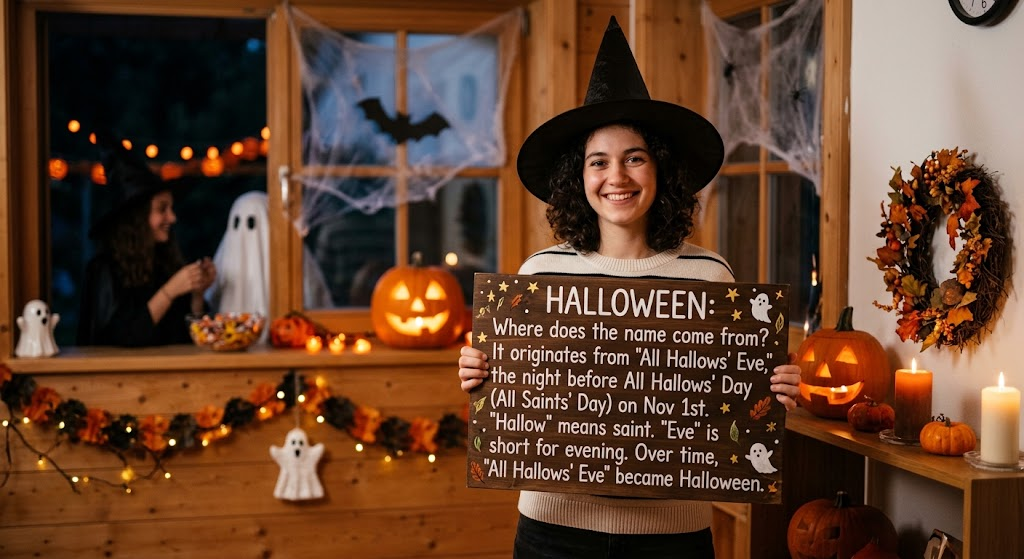
Halloween happens every year on October 31st.
A very long time ago (more than 2,000 years ago), an ancient group of people called the Celts lived in Europe. They celebrated a festival called Samhain on November 1st to mark the end of summer and the beginning of a cold, dark winter. They believed that on the night before the new year (October 31st), the spirits of dead people could visit the living world.
To protect themselves from bad spirits, people built big fires and wore costumes made of animal skins. Over time, these old traditions mixed with Christian holidays (like All Saints‘ Day or All Hallows‘ Day). The word „Hallow“ means saint, and „Eve“ means evening. The night before became known as All Hallows‘ Eve, which later became Halloween.
What is Celebrated on Halloween?
Today, Halloween is not usually a religious or scary holiday for most people. Instead, it is a fun autumn tradition celebrated in many countries around the world (especially in the US, Canada, the UK, and Ireland).
People celebrate:
- Autumn and Harvest: The changing of seasons and the pumpkin harvest.
- Fun and Imagination: Dressing up as monsters, superheroes, or movie characters.
- Community: Visiting neighbors and playing games together.
How Do People Celebrate Halloween?
There are several traditional activities people do on October 31st:
- Trick-or-Treating
Children put on costumes and walk from house to house in their neighborhood. They knock on doors and say, „Trick or treat!“ People give them candy, chocolates, or sweets. - Carving Jack-o‘-Lanterns
People buy big orange pumpkins, cut off the top, and remove the seeds inside. Then, they cut a face (scary or funny) into the pumpkin and put a light or candle inside. These illuminated pumpkins are placed outside homes for decoration. - Wearing Costumes
Children and adults dress up in creative clothes. Some choose scary costumes like ghosts, witches, or vampires, while others dress up as animals, princesses, or superheroes. - Decorating Houses
Many families decorate the outside of their houses with fake spider webs, paper bats, skeletons, and orange lights to make their homes look festive and spooky. - Playing Halloween Games
At Halloween parties, people like to play games such as apple bobbing—trying to catch floating apples in a tub of water using only their teeth. They also watch scary movies or tell ghost stories.
___________________________
Vocabulary:
| Word / Phrase | Definition |
| ancient | very, very old; from a long time ago. |
| to celebrate | to do something fun on a special day. |
| to believe | to think that something is real or true. |
| a spirit | a ghost or soul of a person who is not alive. |
| to protect oneself from something | to keep yourself safe from danger or bad things. |
| to wear a costume | to put on special clothes to look like a different character or animal. |
| animal skin | the outside cover of an animal. |
| to be scary | making you feel afraid. |
| autumn | the season between summer and winter. |
| a pumpkin | a large, round, orange vegetable that grows in autumn. |
| harvest | the time when farmers collect fruits and vegetables from the field. |
| trick-or-treat | an activity where children dress up, go to houses, and ask for candy. |
| to carve Jack-o‘-Lanterns | to cut shapes or faces into a pumpkin to make a light decoration. |
| seeds | small hard parts inside a fruit or vegetable that can grow into new plants. |
| to illuminate something | to put light on something so it is bright. |
| a witch | a magic woman in stories who wears a black hat and flies on a broom. |
| a fake spider web | a decoration made of thin threads that looks like a spider’s home. |
| a bat | a small animal with wings that flies at night. |
| spooky | a little bit scary, strange, or mysterious. |
| apple bobbing | a game where you try to catch floating apples in water using your teeth. |
| a tub of water | a large, open container filled with water. |
Match each word or phrase with its correct definition
1. ancient
2. to celebrate
3. to believe
4. a spirit
5. to protect oneself from something
6. to wear a costume
7. animal skin
8. to be scary
9. autumn
10. a pumpkin
11. harvest
12. trick-or-treat
13. to carve Jack-o‘-Lanterns
14. seeds
15. to illuminate something
16. a witch
17. a fake spider web
18. a bat
19. spooky
20. apple bobbing
21. a tub of water
Definitions:
A. a small animal with wings that flies at night.
B. small hard parts inside a fruit or vegetable that can grow into new plants.
C. to cut shapes or faces into a pumpkin to make a light decoration.
D. to put light on something so it is bright.
E. a decoration made of thin threads that looks like a spider’s home.
F. making you feel afraid.
G. very, very old; from a long time ago.
H. the time when farmers collect fruits and vegetables from the field.
I. a ghost or soul of a person who is not alive.
J. to put on special clothes to look like a different character or animal.
K. a magic woman in stories who wears a black hat and flies on a broom.
L. a game where you try to catch floating apples in water using your teeth.
M. to keep yourself safe from danger or bad things.
N. an activity where children dress up, go to houses, and ask for candy.
O. a large, round, orange vegetable that grows in autumn.
P. to do something fun on a special day.
Q. the season between summer and winter.
R. a large, open container filled with water.
S. the outside cover of an animal.
T. a little bit scary, strange, or mysterious.
U. to think that something is real or true.
____________________________
Answer key:
1-G, 2-P, 3-U, 4-I, 5-M, 6-J, 7-S, 8-F,
9-Q, 10-O, 11-H, 12-N, 13-C, 14-B, 15-D,
16-K, 17-E, 18-A, 19-T, 20-L, 21-R
####################
Match each definition with its correct word or phrase
1. a small animal with wings that flies at night.
2. small hard parts inside a fruit or vegetable that can grow into new plants.
3. to cut shapes or faces into a pumpkin to make a light decoration.
4. to put light on something so it is bright.
5. a decoration made of thin threads that looks like a spider’s home.
6. making you feel afraid.
7. very, very old; from a long time ago.
8. the time when farmers collect fruits and vegetables from the field.
9. a ghost or soul of a person who is not alive.
10. to put on special clothes to look like a different character or animal.
11. a magic woman in stories who wears a black hat and flies on a broom.
12. a game where you try to catch floating apples in water using your teeth.
13. to keep yourself safe from danger or bad things.
14. an activity where children dress up, go to houses, and ask for candy.
15. a large, round, orange vegetable that grows in autumn.
16. to do something fun on a special day.
17. the season between summer and winter.
18. a large, open container filled with water.
19. the outside cover of an animal.
20. a little bit scary, strange, or mysterious.
21. to think that something is real or true.
Words / Phrases:
A. a spirit
B. trick-or-treat
C. autumn
D. spooky
E. ancient
F. to carving Jack-o‘-Lanterns
G. to illuminate something
H. animal skin
I. harvest
J. to be scary
K. a fake spider web
L. a tub of water
M. seeds
N. to wear a costume
O. a bat
P. to celebrate
Q. to protect oneself from something
R. apple bobbing
S. to believe
T. a pumpkin
U. a witch
___________________________
Answer key:
1-O, 2-M, 3-F, 4-G, 5-K, 6-J, 7-E, 8-I,
9-A, 10-N, 11-U, 12-R, 13-Q, 14-B, 15-T,
16-P, 17-C, 18-L, 19-H, 20-D, 21-S
###################
Multiple choice – choose the correct answer for each question
1. Who were the Celts?
- A. An ancient group of people
- B. A modern group of farmers
- C. A famous family of writers
2. What holiday did the Celts celebrate on November 1st?
- A. All Hallows‘ Eve
- B. Samhain
- C. A spring festival
3. When did spirits visit the living world?
- A. On November 1st
- B. On October 31st
- C. In middle winter
4. What did the Celts wear to protect themselves?
- A. Bright clothes bought in town
- B. Colorful suits made of leaves
- C. Costumes made of animal skins
5. What does the word „Hallow“ mean?
- A. Saint
- B. Night
- C. Ghost
6. Which country is mentioned in the text?
- A. Germany
- B. Canada
- C. France
7. What season’s changing is celebrated?
- A. Autumn
- B. Spring
- C. Summer
8. What do children do during trick-or-treating?
- A. Play games in the park
- B. Walk from house to house
- C. Carve big pumpkins at school
9. What phrase do children say at doors?
- A. „Happy New Year!“
- B. „Give us sweets!“
- C. „Trick or treat!“
10. What do people remove from inside the pumpkin?
- A. The seeds
- B. The light
- C. The skin
11. Where do people place illuminated Jack-o‘-Lanterns?
- A. Inside cars
- B. Outside homes
- C. Under tables
12. Which scary costume is mentioned?
- A. A ghost
- B. A princess
- C. A superhero
13. What decoration do families put outside?
- A. Fresh flowers
- B. Green trees
- C. Fake spider webs
14. What object is used in apple bobbing?
- A. A wooden broom
- B. A bag of sweets
- C. A tub of water
15. How do people catch apples in the game?
- A. Using their hands
- B. Using their teeth
- C. Using long spoons
16. What activity do people do at parties?
- A. Watch scary movies
- B. Swim in large pools
- C. Bake fresh food items
17. What does the word „Eve“ mean?
- A. Morning
- B. Evening
- C. Season
18. What colour are Halloween pumpkins?
- A. Purple
- B. Orange
- C. Yellow
19. Today, Halloween is mostly a:
- A. Scary test
- B. Serious event
- C. Fun tradition
20. How long ago did the Celts live?
- A. 100 years ago
- B. Over 2,000 years ago
- C. 500 years ago
___________________________
Answer key:
1-A, 2-B, 3-B, 4-C, 5-A, 6-B, 7-A, 8-B,
9-C, 10-A, 11-B, 12-A, 13-C, 14-C, 15-B,
16-A, 17-B, 18-B, 19-C, 20-B
###################
True or false
- The festival of Samhain was celebrated to welcome the start of warm spring weather.
- The Celts wore animal skins to stay safe from bad spirits.
- The word „Hallow“ means saint, and the word „Eve“ means evening.
- Today, Halloween is a very serious religious holiday for most people.
- People cut funny or scary faces into big orange pumpkins.
- In the game of apple bobbing, children catch apples in water with their hands.
- Families put fake spider webs and paper bats outside their houses.
- The Celts believed ghosts could visit the living world on October 31st.
- The text mentions that people only celebrate Halloween in the USA today.
- To make a Jack-o‘-Lantern, people cut off the bottom of the pumpkin.
- Children knock on doors and say „Trick or treat!“ to get sweets.
- Halloween is a tradition that celebrates autumn and the pumpkin harvest.
- Adults are not allowed to dress up in costumes for Halloween.
- People keep their lighted pumpkins inside the kitchen under the table.
- The ancient Celts lived in Europe more than 3,000 years ago.
- People like to watch scary movies or tell ghost stories at Halloween parties.
_________________________
Answer Key
1-False, 2-True, 3-True, 4-False, 5-True, 6-False, 7-True,
8-True, 9-False, 10-False, 11-True, 12-True,
13-False, 14-False, 15-False, 16-True
##################
Cause & effect matching exercise – match
First parts
- To protect themselves from bad spirits,
- Because old traditions mixed with Christian holidays,
- When children go trick-or-treating,
- To illuminate Jack-o‘-Lanterns at night,
- During apple bobbing at parties,
- Because October 31st was the night before the new year,
- When children say „Trick or treat!“,
- To cut faces into pumpkins,
- To make their homes look festive and spooky,
- Because Halloween is a fun autumn tradition,
- To mark the end of summer and the start of winter,
- Because the word „Hallow“ means saint,
- When people carve pumpkins,
- Because people like scary stories at parties,
- To take part in trick-or-treating,
Endings
A. people give them candy, chocolates, or sweets.
B. they watch scary movies or tell ghost stories.
C. the name All Hallows‘ Eve later became Halloween.
D. people built big fires and wore animal skins.
E. children and adults dress up in creative clothes.
F. they decorate the outside of their houses with fake spider webs and skeletons.
G. the Celts believed dead spirits could visit the living world.
H. they remove the seeds inside before making a face.
I. the holiday was connected to all sacred or holy people.
J. people put candles or lights inside them.
K. they knock on doors and say „Trick or treat!“.
L. people buy big orange pumpkins and cut off the top.
M. the Celts celebrated the ancient festival of Samhain.
N. people dress up as monsters, superheroes, or movie characters.
O. players catch floating apples in water using only their teeth.
_________________________
Answer Key
1-D, 2-C, 3-K, 4-J, 5-O, 6-G, 7-A, 8-L,
9-F, 10-N, 11-M, 12-I, 13-H, 14-B, 15-E
##################
Odd one out – choose the word in each row that does NOT belong based on the text.
- a. spring b. autumn c. winter d. harvest
- a. top b. seeds c. face d. bottom
- a. candy b. chocolates c. sweets d. apples
- a. spirits b. ghosts c. saints d. skeletons
- a. Canada b. Ireland c. France d. UK
- a. teeth b. hands c. water d. tub
- a. animal skins b. paper bats c. spider webs d. skeletons
- a. saint b. evening c. morning d. ghost
- a. movies b. games c. stories d. sports
- a. fires b. costumes c. sweets d. skins
___________________________
Answer key:
1-a, 2-d, 3-d, 4-c, 5-c, 6-b, 7-a, 8-c, 9-d, 10-c
___________________________
(Details:
1. spring — Samhain/Halloween marks autumn, winter, and harvest;
2. bottom — people cut off the top, not the bottom;
3. apples — given in a game, not given to trick-or-treaters at doors;
4. saints — the others are scary/dead spirits;
5. France — not mentioned in the text;
6. hands — hands are not used in apple bobbing;
7. animal skins — worn by Celts, not house decorations;
8. morning — text defines „Hallow“ as saint, „Eve“ as evening, and mentions spirits/ghosts;
9. sports — not mentioned as a Halloween activity;
10. sweets — sweets are modern, whereas fires, costumes, and skins were Celtic protections)
##################
Fill in each blank with the correct word from the box below. Use each word only once.
ancient | spirits | harvest | autumn | costumes | illuminate | seeds | decorations | neighborhood | floating | tradition | skeletons | evening | protect
- The Celts were an __________ group of people who lived in Europe long ago.
- The Celts celebrated a festival to mark the end of summer and the pumpkin __________.
- People built big fires to __________ themselves from bad spirits.
- The Celts believed that the __________ of dead people could visit the living world.
- Halloween is a popular holiday that takes place during the season of __________.
- The word „Eve“ in All Hallows‘ Eve means __________.
- Today, Halloween is not a scary event, but a fun __________ for many people.
- Children walk from house to house in their __________ to ask for candy.
- Both children and adults like to wear creative __________ for Halloween.
- Before carving a face into a pumpkin, people must remove the __________ inside.
- People put candles inside Jack-o‘-Lanterns to __________ them at night.
- Families put spooky __________ like paper bats outside their homes.
- People decorate the outside of their houses with fake spider webs and paper __________.
- In apple bobbing, players try to catch __________ apples in a tub of water using their teeth.
______________________________
Answer key
1-ancient, 2-harvest, 3-protect, 4-spirits, 5-autumn, 6-evening, 7-tradition, 8-neighborhood, 9-costumes, 10-seeds, 11-illuminate, 12-decorations, 13-skeletons, 14-floating
______________________________
Correct answers
- The Celts were an ancient group of people who lived in Europe long ago.
- The Celts celebrated a festival to mark the end of summer and the pumpkin harvest.
- People built big fires to protect themselves from bad spirits.
- The Celts believed that the spirits of dead people could visit the living world.
- Halloween is a popular holiday that takes place during the season of autumn.
- The word „Eve“ in All Hallows‘ Eve means evening.
- Today, Halloween is not a scary event, but a fun tradition for many people.
- Children walk from house to house in their neighborhood to ask for candy.
- Both children and adults like to wear creative costumes for Halloween.
- Before carving a face into a pumpkin, people must remove the seeds inside.
- People put candles inside Jack-o‘-Lanterns to illuminate them at night.
- Families put spooky decorations like paper bats outside their homes.
- People decorate the outside of their houses with fake spider webs and paper skeletons.
- In apple bobbing, players try to catch floating apples in a tub of water using their teeth.
####################
Interview: match question and answer
Questions
- Who was responsible for starting the original festival long ago?
- What took place on the first day of November?
- Why did people put on costumes made of animal skins?
- What does the word „Hallow“ mean in old English?
- Where is this holiday popular today?
- What action do children take during trick-or-treating?
- Which phrase comes out of their mouths at every door?
- What items do neighbors hand out to the visitors?
- How do people prepare a pumpkin for carving?
- Where do families display their Jack-o‘-Lanterns at night?
- How do players catch apples during the game?
- Which activities are common at modern parties?
Answers
A. They walk from house to house in their neighborhood.
B. Children use only their teeth in a tub of water.
C. People give sweet treats like candy and chocolates.
D. They shout „Trick or treat!“ to their neighbors.
E. They remove the top section and clean out the seeds.
F. An ancient group called the Celts created it in Europe.
G. Guests watch scary movies and tell ghost stories.
H. The term signifies a holy person or saint.
I. They wanted safety from bad spirits during the night.
J. Families celebrate it in the US, Canada, the UK, and Ireland.
K. People held a special autumn celebration named Samhain.
L. They put the orange pumpkins outside their front door.
___________________________
Answer key
1-F, 2-K, 3-I, 4-H, 5-J, 6-A, 7-D,
8-C, 9-E, 10-L, 11-B, 12-G
___________________________
Correct version:
1. Q: Who was responsible for starting the original festival long ago?
- A: An ancient group called the Celts created it in Europe.
2. Q: What took place on the first day of November?
- A: People held a special autumn celebration named Samhain.
3. Q: Why did people put on costumes made of animal skins?
- A: They wanted safety from bad spirits during the night.
4. Q: What does the word „Hallow“ mean in old English?
- A: The term signifies a holy person or saint.
5. Q: Where is this holiday popular today?
- A: Families celebrate it in the US, Canada, the UK, and Ireland.
6. Q: What action do children take during trick-or-treating?
- A: They walk from house to house in their neighborhood.
7. Q: Which phrase comes out of their mouths at every door?
- A: They shout „Trick or treat!“ to their neighbors.
8. Q: What items do neighbors hand out to the visitors?
- A: People give sweet treats like candy and chocolates.
9. Q: How do people prepare a pumpkin for carving?
- A: They remove the top section and clean out the seeds.
10. Q: Where do families display their Jack-o‘-Lanterns at night?
- A: They put the orange pumpkins outside their front door.
11. Q: How do players catch apples during the game?
- A: Children use only their teeth in a tub of water.
12. Q: Which activities are common at modern parties?
- A: Guests watch scary movies and tell ghost stories.
#######################
#######################
Please use the box below
to write your feedback.
Only I can read it.
It is not public.
Please tell me:
- Are the texts and exercises OK?
- Are the topics OK?
- Is the level OK?
- Is it too easy or too difficult?
- Is it oo short, too long?
- Do you want texts about other topics?
Thank you! I appreciate your feedback.
##################
##################
##################
Remember how babies
learn a language
Babies learn a language by listening.
They use their ears to hear sounds.
Their brain remembers these sounds.
Babies connect sounds with people and things.
They listen to their parents.
Then they copy the sounds they hear. They imitate words.
Slowly, babies learn to speak.
So,
LISTEN, LISTEN, LISTEN, LISTEN………………

SMFrockZ@gmx.at
Schreibe einen Kommentar