- festival of lights, hope and new beginnings
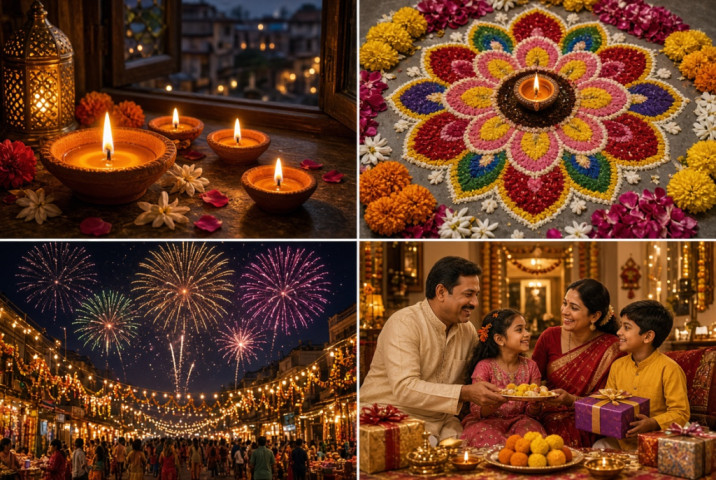
Diwali is one of the most important festivals in India. People also call it the Festival of Lights. In 2026, the main day of Diwali is Sunday, 8 November. Millions of people celebrate this festival in India and other countries.
Diwali is important to Hindus, Sikhs and Jains. These groups celebrate it for different reasons. For many Hindus, Diwali is about Prince Rama. He was away from home for fourteen years. When he returned, people welcomed him with small lights. Today, these lights are still an important part of Diwali.
Before Diwali, families clean their homes and decorate them with flowers and colourful lights. Many people light small oil lamps called diyas. They put them near doors and windows. People also make colourful pictures on the ground with flowers or coloured powder. These pictures are called rangoli.
On Diwali, people often wear new clothes and visit family members. They give presents to friends and relatives. Children enjoy the festival because they often receive sweets and small gifts. Families prepare special meals and eat together. Many people also visit their neighbours and share sweets with them.
Many Hindus pray to Lakshmi, the goddess of wealth. They ask for health, happiness and success in the coming year. Some families visit a temple, while others pray at home. For them, this is an important part of the festival.
In the evening, houses, shops and streets shine with thousands of lights. In some places, people also enjoy fireworks. Families and friends meet, talk and celebrate together. The streets are often full of people, music and bright colours.
Diwali is more than a festival with lights and presents. It brings families and friends together. It also reminds people to be kind and help others.
The main message of Diwali is that good can win over evil and light can win over darkness. For millions of people, Diwali is a time of happiness, hope and new beginnings.
___________________________
Vocabulary:
| Word or phrase | Simple definition |
|---|---|
| a festival | a special day or time when people celebrate. |
| the main day | the most important day. |
| to celebrate | to do something special for a happy event. |
| different reasons | not the same reasons; more than one reason. |
| to return | to come back. |
| to decorate | to make a place look nice. |
| colourful | having many different colours. |
| coloured powder | a fine, dry substance with colour. |
| relatives | people in your family, like aunts and uncles. |
| to enjoy | to like something and have a good time. |
| a neighbour | a person who lives near you. |
| wealth | having a lot of money or valuable things. |
| success | when you do something well or get what you want. |
| to shine | to give out light. |
| bright colours | strong, clear colours that are easy to see. |
| a present | something you give to another person. |
| to remind somebody of something | to help somebody remember something. |
| to be kind | to be nice and helpful to other people. |
| evil | very bad actions or behaviour. |
| darkness | when there is little or no light. |
####################
Match words and definitions
Words
- a festival
- the main day
- to celebrate
- different reasons
- to return
- to decorate
- colourful
- coloured powder
- relatives
- to enjoy
- a neighbour
- wealth
- success
- to shine
- bright colours
- a present
- to remind somebody of something
- to be kind
- evil
- darkness
Definitions
A. to come back
B. a person who lives near you
C. to help somebody remember something
D. having many different colours
E. to give out light
F. very bad actions or behaviour
G. something you give to another person
H. to make a place look nice
I. when there is little or no light
J. to like something and have a good time
K. the most important day
L. having a lot of money or valuable things
M. a special day or time when people celebrate
N. to be nice and helpful to other people
O. strong, clear colours that are easy to see
P. not the same reasons; more than one reason
Q. a fine, dry substance with colour
R. to do something special for a happy event
S. people in your family, like aunts and uncles
T. when you do something well or get what you want
____________________________
Answer key
1M, 2K, 3R, 4P, 5A, 6H, 7D, 8Q, 9S, 10J, 11B, 12L,
13T, 14E, 15O, 16G, 17C, 18N, 19F, 20I
###################
True or false
- Diwali is also called the Festival of Lights.
- The main day of Diwali in 2026 is Monday, 8 November.
- Millions of people celebrate Diwali in India and other countries.
- Only Hindus celebrate Diwali.
- Prince Rama was away from home for fourteen years.
- People clean and decorate their homes before Diwali.
- Diyas are small paper decorations.
- Rangoli pictures can be made with coloured powder.
- People never wear new clothes for Diwali.
- Children often receive sweets and small gifts.
- Families usually eat their special meals alone in their rooms.
- People may visit their neighbours and share sweets.
- Lakshmi is the goddess of wealth.
- All families must visit a temple during Diwali.
- People ask Lakshmi for health, happiness and success.
- Houses and streets are often dark in the evening.
- Some people enjoy fireworks during Diwali.
- Diwali is only about lights and presents.
- Diwali reminds people to be kind and help others.
- One message of Diwali is that darkness can win over light.
______________________
False: 2,4,7,9,11,14,16,18,20
______________________
Correct version:
- Diwali is also called the Festival of Lights.
- The main day of Diwali in 2026 is Monday, 8 November. True is: The main day of Diwali in 2026 is Sunday, 8 November.
- Millions of people celebrate Diwali in India and other countries.
- Only Hindus celebrate Diwali. True is: Hindus, Sikhs and Jains celebrate Diwali.
- Prince Rama was away from home for fourteen years.
- People clean and decorate their homes before Diwali.
- Diyas are small paper decorations. True is: Diyas are small oil lamps.
- Rangoli pictures can be made with coloured powder.
- People never wear new clothes for Diwali. True is: People often wear new clothes for Diwali.
- Children often receive sweets and small gifts.
- Families usually eat their special meals alone in their rooms. True is: Families prepare special meals and eat together.
- People may visit their neighbours and share sweets.
- Lakshmi is the goddess of wealth.
- All families must visit a temple during Diwali. True is: Some families visit a temple, while others pray at home.
- People ask Lakshmi for health, happiness and success.
- Houses and streets are often dark in the evening. True is: Houses and streets shine with thousands of lights in the evening.
- Some people enjoy fireworks during Diwali.
- Diwali is only about lights and presents. True is: Diwali also brings families and friends together and reminds people to be kind and help others.
- Diwali reminds people to be kind and help others.
- One message of Diwali is that darkness can win over light. True is: One message of Diwali is that light can win over darkness.
####################
Match the definitions with the words
Definitions
- to give out light
- people in your family, like aunts and uncles
- when there is little or no light
- to make a place look nice
- something you give to another person
- the most important day
- to be nice and helpful to other people
- a special day or time when people celebrate
- to come back
- strong, clear colours that are easy to see
- to help somebody remember something
- having a lot of money or valuable things
- to do something special for a happy event
- very bad actions or behaviour
- a person who lives near you
- a fine, dry substance with colour
- not the same reasons; more than one reason
- to like something and have a good time
- having many different colours
- when you do something well or get what you want
Words
A. a present
B. to decorate
C. wealth
D. to return
E. evil
F. colourful
G. to celebrate
H. a neighbour
I. success
J. to remind somebody of something
K. darkness
L. a festival
M. to enjoy
N. coloured powder
O. to shine
P. the main day
Q. relatives
R. different reasons
S. bright colours
T. to be kind
_______________________________
Answer key
1O, 2Q, 3K, 4B, 5A, 6P, 7T, 8L, 9D, 10S, 11J,
12C, 13G, 14E, 15H, 16N, 17R, 18M, 19F, 20I
######################
Match the causes with the effects
Causes
- Families clean their homes before Diwali.
- People light small oil lamps called diyas.
- People make rangoli pictures.
- Prince Rama returned home after fourteen years.
- Children celebrate Diwali with their families.
- People visit their relatives.
- Some families pray to Lakshmi.
- People visit their neighbours.
- Families prepare special meals.
- Houses and streets have thousands of lights.
- People celebrate Diwali together.
- Diwali reminds people of an important message.
Effects
A. They ask for health, happiness and success.
B. Children often receive sweets and small gifts.
C. The festival brings families and friends together.
D. They make their homes look nice for the festival.
E. People can see colourful pictures on the ground.
F. People share sweets with other people.
G. People remember that good can win over evil.
H. People have food together.
I. The lights help make the festival special.
J. People welcomed him with small lights.
K. They can spend time together.
L. The lamps give light near doors and windows.
______________________________
Answer key
1D, 2L, 3E, 4J, 5B, 6K, 7A, 8F, 9H, 10I, 11C, 12G
#####################
Multiple-choice questions
1. What is another name for Diwali?
- a) The Festival of Rain
- b) The Festival of Lights
- c) The Festival of Flowers and Trees
2. When is the main day of Diwali in 2026?
- a) 8 November
- b) 8 December
- c) 8 October
3. Which groups celebrate Diwali?
- a) Only Hindus
- b) Hindus and Christians
- c) Hindus, Sikhs and Jains
4. How long was Prince Rama away from home?
- a) Four years
- b) Forty years
- c) Fourteen years
5. What are diyas?
- a) Colourful pictures
- b) Small oil lamps
- c) Special festival clothes
6. What do people use to make rangoli pictures?
- a) Water and paper
- b) Wood and stones
- c) Flowers or coloured powder
7. What do children often receive during Diwali?
- a) School books
- b) New bicycles
- c) Sweets and small gifts
8. Who is Lakshmi?
- a) A famous Indian prince
- b) The goddess of wealth
- c) A festival dancer
9. What do people ask Lakshmi for?
- a) Health, happiness and success
- b) New clothes
- c) More festivals
10. Where do some families pray?
- a) At school
- b) In the street
- c) At home or in a temple
11. What do people share with their neighbours?
- a) Books
- b) Sweets
- c) Clothes
12. What shines in the evening?
- a) Houses, shops and streets
- b) Only temples
- c) Only gardens
13. What do some people enjoy during Diwali?
- a) Boat trips
- b) Mountain walks
- c) Fireworks
14. What does Diwali remind people to do?
- a) Buy more presents
- b) Be kind and help others
- c) Stay at home all day
15. What is one important message of Diwali?
- a) Good can win over evil
- b) Darkness is stronger than light
- c) Presents are the most important thing in life
____________________________
Answer key
1b, 2a, 3c, 4c, 5b, 6a, 7c, 8b, 9a,
10c, 11b, 12a, 13c, 14b, 15a
####################
Match the sentence halves
Sentence beginnings
- Diwali is also called
- Prince Rama was away from home
- Before Diwali, families clean
- People light small oil lamps
- Rangoli pictures are made with
- Children often receive
- Many Hindus pray to Lakshmi
- Families prepare special meals
- In the evening, houses and streets
- Diwali reminds people
Sentence endings
A. and eat together.
B. to be kind and help others.
C. sweets and small gifts.
D. for fourteen years.
E. shine with thousands of lights.
F. the Festival of Lights.
G. called diyas.
H. their homes and decorate them.
I. flowers or coloured powder.
J. the goddess of wealth.
_________________________
Answer key:
1F, 2D, 3H, 4G, 5I, 6C, 7J, 8A, 9E, 10B
_________________________
Full version:
- Diwali is also called the Festival of Lights.
- Prince Rama was away from home for fourteen years.
- Before Diwali, families clean their homes and decorate them.
- People light small oil lamps called diyas.
- Rangoli pictures are made with flowers or coloured powder.
- Children often receive sweets and small gifts.
- Many Hindus pray to Lakshmi, the goddess of wealth.
- Families prepare special meals and eat together.
- In the evening, houses and streets shine with thousands of lights.
- Diwali reminds people to be kind and help others.
##################
Match the questions and answers
Questions
- What do children often receive during the festival?
- Who is Lakshmi?
- When does Diwali fall in 2026?
- What do people use to make rangoli?
- Why do many Hindus remember Prince Rama?
- Where do some families pray during Diwali?
- What is Diwali called by many people?
- What does Diwali remind people of?
- How do families prepare their homes before Diwali?
- Which three religious groups celebrate Diwali?
- Whom do children often visit during Diwali?
- What are the small oil lamps called?
Answers
A. They clean their homes and add flowers and colourful lights.
B. They get sweets and small gifts.
C. She represents the Hindu goddess of wealth.
D. Their name is diyas.
E. Hindus, Sikhs and Jains take part in this festival.
F. Flowers or coloured powder are needed for these colourful pictures.
G. It teaches them that good can win over evil and light over darkness.
H. The main day is Sunday, 8 November.
I. Some families go to a temple, while others stay at home.
J. He came home after fourteen years away.
K. It is known as the Festival of Lights.
L. They spend time with family members and relatives.
________________________
Answer key:
1B, 2C, 3H, 4F, 5J, 6I, 7K, 8G, 9A, 10E, 11L, 12D
________________________
Correct version:
1. Question: What is Diwali called by many people?
Answer: It is known as the Festival of Lights.
2. Question: When does Diwali fall in 2026?
Answer: The main day is Sunday, 8 November.
3. Question: Which three religious groups celebrate Diwali?
Answer: Hindus, Sikhs and Jains take part in this festival.
4. Question: Why do many Hindus remember Prince Rama?
Answer: He came home after fourteen years away.
5. Question: How do families prepare their homes before Diwali?
Answer: They clean their homes and add flowers and colourful lights.
6. Question: What are the small oil lamps called?
Answer: Their name is diyas.
7. Question: What do people use to make rangoli?
Answer: Flowers or coloured powder are needed for these colourful pictures.
8. Question: Whom do children often visit during Diwali?
Answer: They spend time with family members and relatives.
9. Question: What do children often receive during the festival?
Answer: They get sweets and small gifts.
10. Question: Who is Lakshmi?
Answer: She represents the Hindu goddess of wealth.
11. Question: Where do some families pray during Diwali?
Answer: Some families go to a temple, while others stay at home.
12. Question: What does Diwali remind people of?
Answer: It teaches them that good can win over evil and light over darkness.
####################
####################
####################
Please use the box below
to write your feedback.
Only I can read it.
It is not public.
Please tell me:
- Are the texts and exercises OK?
- Are the topics OK?
- Is the level OK?
- Is it too easy or too difficult?
- Is it oo short, too long?
- Do you want texts about other topics?
Thank you! I appreciate your feedback.
##################
##################
##################
Remember how babies
learn a language:
Babies learn a language by listening.
They use their ears to hear sounds.
Their brain remembers these sounds.
Babies connect sounds with people and things.
They listen to their parents.
Then they copy the sounds they hear. They imitate words.
Slowly, babies learn to speak.
So,
LISTEN, LISTEN, LISTEN, LISTEN………………

SMFrockZ@gmx.at
Schreibe einen Kommentar