- Made writes to his friend Anna about Galungan and Kuningan
If you are not too familiar with
past simple,
check out that exercise

Basics in past simple:
| Personal Pronoun | Verb (Past) | Object |
|---|---|---|
| I | ate | apples |
| You | ate | apples |
| He | ate | apples |
| She | ate | apples |
| It | ate | apples |
| We | ate | apples |
| You (plural) | ate | apples |
| They | ate | apples |
| I | played | football |
| You | played | football |
| He | played | football |
| She | played | football |
| It | played | football |
| We | played | football |
| You (plural) | played | football |
| They | played | football |
| Personal Pronoun | Verb (Past Negative) | Object |
|---|---|---|
| I | did not eat | apples |
| You | did not eat | apples |
| He | did not eat | apples |
| She | did not eat | apples |
| It | did not eat | apples |
| We | did not eat | apples |
| You (plural) | did not eat | apples |
| They | did not eat | apples |
| I | did not play | football |
| You | did not play | football |
| He | did not play | football |
| She | did not play | football |
| It | did not play | football |
| We | did not play | football |
| You (plural) | did not play | football |
| They | did not play | football |
| Personal Pronoun | Question | Object |
|---|---|---|
| I | Did I eat | apples? |
| You | Did you eat | apples? |
| He | Did he eat | apples? |
| She | Did she eat | apples? |
| It | Did it eat | apples? |
| We | Did we eat | apples? |
| You (plural) | Did you eat | apples? |
| They | Did they eat | apples? |
| I | Did I play | football? |
| You | Did you play | football? |
| He | Did he play | football? |
| She | Did she play | football? |
| It | Did it play | football? |
| We | Did we play | football? |
| You (plural) | Did you play | football? |
| They | Did they play | football? |
##################
Forms of ‚to be‘
| Personal Pronoun | Positive | Negative | Question |
|---|---|---|---|
| I | I was happy. | I was not happy. | Was I happy? |
| You (singular) | You were excited. | You were not excited. | Were you excited? |
| He | He was at home. | He was not at home. | Was he at home? |
| She | She was tired. | She was not tired. | Was she tired? |
| It | It was cold. | It was not cold. | Was it cold? |
| We | We were at the party. | We were not at the party. | Were we at the party? |
| You (plural) | You were friends. | You were not friends. | Were you friends? |
| They | They were in the garden. | They were not in the garden. | Were they in the garden? |
########################
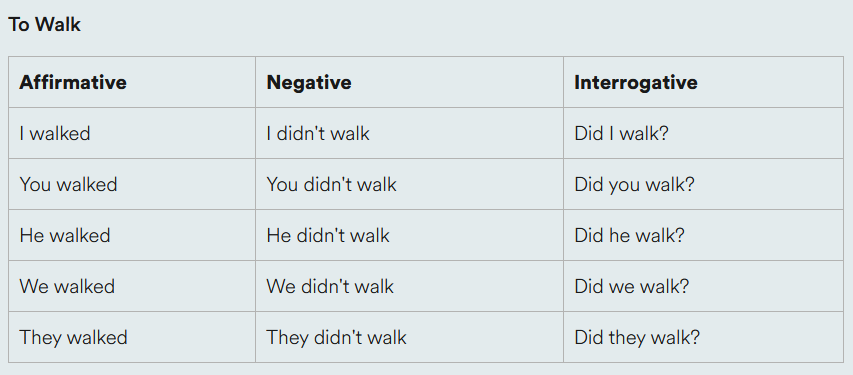
How to form the past simple
We use the past simple to talk about things that happened in the past. We often use words like yesterday, last week, last year, ago.
1. Regular verbs
For most verbs, we add -ed to the verb.
Verb + ed = past simple
Examples:
- walk → walked
I walked to school yesterday. - play → played
She played football last Saturday. - start → started
I started my training last July. - clean → cleaned
He cleaned his room.
2. Verbs ending in -e
If a verb already ends in -e, we only add -d.
Examples:
- live → lived
I lived in a small village. - like → liked
I liked the place. - love → loved
She loved the music.
3. Verbs ending in consonant + y
Change y to i and add -ed.
Examples:
- study → studied
I studied English. - try → tried
I tried again.
4. Irregular verbs
Some verbs do not use -ed. Their past forms are different. You need to learn them.
5. Negative sentences
Use did not (didn’t) + verb.
The verb goes back to the present form.
Examples:
- I played football.
- I did not play football.
- She went home.
- She did not go home.
6. Questions
Use Did + person + verb?
Examples:
- Did you watch the film?
- Did she run yesterday?
- Did they visit the village?
Remember:
✅ Regular verbs → add -ed
✅ Irregular verbs → learn the special past form
✅ After did / didn’t → use the normal verb
####################
Short answers, past simple, basics:
| Example Sentence | Yes | No |
|---|---|---|
| I learned letters. | Yes, I did. | No, I didn’t. |
| You read signs. | Yes, you did. | No, you didn’t. |
| He spoke English. | Yes, he did. | No, he didn’t. |
| She watched TV. | Yes, she did. | No, she didn’t. |
| It helped me. | Yes, it did. | No, it didn’t. |
| We used an app. | Yes, we did. | No, we didn’t. |
| You read words. | Yes, you did. | No, you didn’t. |
| They made mistakes. | Yes, they did. | No, they didn’t. |
Questions (Past Simple)
| Question | Yes | No |
|---|---|---|
| Did I learn letters? | Yes, I did. | No, I didn’t. |
| Did you read signs? | Yes, you did. | No, you didn’t. |
| Did he speak English? | Yes, he did. | No, he didn’t. |
| Did she watch TV? | Yes, she did. | No, she didn’t. |
| Did it help me? | Yes, it did. | No, it didn’t. |
| Did we use an app? | Yes, we did. | No, we didn’t. |
| Did you read words? | Yes, you did. | No, you didn’t. |
| Did they make mistakes? | Yes, they did. | No, they didn’t. |
Was / Were
| Question | Yes | No |
|---|---|---|
| Was I happy? | Yes, I was. | No, I wasn’t. |
| Were you happy? | Yes, you were. | No, you weren’t. |
| Was he happy? | Yes, he was. | No, he wasn’t. |
| Was she happy? | Yes, she was. | No, she wasn’t. |
| Was it good? | Yes, it was. | No, it wasn’t. |
| Were we happy? | Yes, we were. | No, we weren’t. |
| Were you happy? | Yes, you were. | No, you weren’t. |
| Were they happy? | Yes, they were. | No, they weren’t. |
#################
Vocabulary:
| Verb | Past simple | A1 definition |
|---|---|---|
| to be | was / were | to exist or be in a place |
| to live | lived | to have your home in a place |
| to want | wanted | to like to have or do something |
| to tell | told | to give information to someone |
| to come | came | to go to a place where someone is |
| to work | worked | to do a job or activity |
| to make | made | to create or prepare something |
| to cook | cooked | to prepare food with heat |
| to put | put | to place something somewhere |
| to look | looked | to seem or appear |
| to wear | wore | to have clothes on your body |
| to go | went | to move from one place to another |
| to pray | prayed | to speak to God |
| to give | gave | to offer something to someone |
| to think | thought | to have an idea in your mind |
| to feel | felt | to have a feeling |
| to continue | continued | to keep doing something |
| to visit | visited | to go and see a person or place |
| to eat | ate | to have food in your mouth and swallow it |
| to play | played | to do something for fun |
| to walk | walked | to move on your feet |
| to use | used | to do something with a thing |
| to finish | finished | to stop because something is complete |
| to stop | stopped | to end an activity |
| to like | liked | to enjoy something |
| to stay | stayed | to remain in a place |
| to hope | hoped | to want something good to happen |
| to write | wrote | to make words with a pen or keyboard |
########################
| a festival | a special time when people celebrate something |
| a family spirit | a spirit of a person from your family who died |
| a lot | many or much |
| a rice cake | a small cake made from rice |
| chicken | a bird that people often eat |
| a stick | a thin, long piece of wood |
| to be curved | to have a shape that is not straight |
| a leaf (pl. leaves) | the green part of a plant or tree |
| to continue | to keep doing something |
| a mask | something you wear on your face to hide or change it |
| the sky | the space above the Earth where we see the sun, moon and stars |
########################
Fill in the correct form of past simple:
Dear Eulis,
Hello! How are you? I hope you are well. My name is Made. I live in Bali, Indonesia. I want to tell you about a festival. I _______ (be) there.
Galungan _______ (be) on Wednesday, 17 June 2026. Kuningan _______ (be) on Saturday, 27 June 2026. The festival _______ (be) important for people in Bali. It _______ (be) about good and bad. Our family spirits _______ (come) to visit.
Before Galungan, my family _______ (work) a lot. We _______ (make) food for the gods. We _______ (cook) bananas. We _______ (make) rice cakes. One day before, we _______ (cook) chicken. Then we _______ (put) up penjor. Penjor are long bamboo sticks. They are high and curved. We _______ (put) leaves, fruits and flowers on them. The streets _______ (look) nice with many penjor.
On Galungan day, we _______ (wear) special clothes. We _______ (go) to the temple in the morning. We _______ (pray). We _______ (give) food and flowers. Many people _______ (come) to the temple. The temple _______ (be) full. We _______ (think) about our family spirits. They _______ (come) to earth that day. I _______ (feel) happy.
For ten days, the festival _______ (continue). We _______ (visit) our family. We _______ (eat) good food together. Children _______ (play) in the village. Some children _______ (walk) with a big mask.
On Kuningan day, we _______ (use) yellow things. We _______ (use) yellow rice. Yellow is for good things. We _______ (pray) in the morning again. The family spirits _______ (go) back to the sky that day. The prayers _______ (finish) before twelve o’clock. Then the festival _______ (stop).
I _______ (like) the festival a lot. Bali _______ (look) different. The penjor _______ (stay) for some days. People _______ (be) kind. Families _______ (stay) together. It _______ (be) quiet. It _______ (be) not a loud party.
I hope you can come to Bali one day. You can see the festival. Write to me soon. Tell me about your life.
Best wishes,
Made
########################
Full version:
Dear Eulis,
Hello! How are you? I hope you are well. My name is Made. I live in Bali, Indonesia. I want to tell you about a festival. I was there.
Galungan was on Wednesday, 17 June 2026. Kuningan was on Saturday, 27 June 2026. The festival was important for people in Bali. It was about good and bad. Our family spirits came to visit.
Before Galungan, my family worked a lot. We made food for the gods. We cooked bananas. We made rice cakes. One day before, we cooked chicken. Then we put up penjor. Penjor are long bamboo sticks. They are high and curved. We put leaves, fruits and flowers on them. The streets looked nice with many penjor.
On Galungan day, we wore special clothes. We went to the temple in the morning. We prayed. We gave food and flowers. Many people came to the temple. The temple was full. We thought about our family spirits. They came to earth that day. I felt happy.
For ten days, the festival continued. We visited our family. We ate good food together. Children played in the village. Some children walked with a big mask.
On Kuningan day, we used yellow things. We used yellow rice. Yellow is for good things. We prayed in the morning again. The family spirits went back to the sky that day. The prayers finished before twelve o’clock. Then the festival stopped.
I liked the festival a lot. Bali looked different. The penjor stayed for some days. People were kind. Families stayed together. It was quiet. It was not a loud party.
I hope you can come to Bali one day. You can see the festival. Write to me soon. Tell me about your life.
Best wishes,
Made
#####################
True or false – short answers
- The festival continued for ten days.
YOU WRITE:
Yes, it did. - Made prayed in the afternoon.
- Families stayed together.
- Kuningan was on 27 June 2025.
- Children played in the village.
- Penjor had only flowers on them.
- Made lived in Bali, Indonesia.
- The prayers finished after twelve o’clock.
- Many people came to the temple.
- Made wrote the letter to Anna.
- The yellow rice was for bad things.
- Made’s family made rice cakes.
- The festival was a loud party.
- Galungan was on Wednesday, 17 June 2026.
- The children stayed inside their homes.
- Penjor were long bamboo sticks.
- Made did not like the festival.
- The family spirits went back to the sky on Kuningan day.
- Made’s family cooked chicken one day before Galungan.
- The streets looked ugly with the penjor.
___________________________
Short answers
- The festival continued for ten days. — Yes, it did.
- Made prayed in the afternoon. — No, he didn’t.
- Families stayed together. — Yes, they did.
- Kuningan was on 27 June 2025. — No, it wasn’t.
- Children played in the village. — Yes, they did.
- Penjor had only flowers on them. — No, they didn’t.
- Made lived in Bali, Indonesia. — Yes, he did.
- The prayers finished after twelve o’clock. — No, they didn’t.
- Many people came to the temple. — Yes, they did.
- Made wrote the letter to Anna. — No, he didn’t.
- The yellow rice was for bad things. — No, it wasn’t.
- Made’s family made rice cakes. — Yes, they did.
- The festival was a loud party. — No, it wasn’t.
- Galungan was on Wednesday, 17 June 2026. — Yes, it was.
- The children stayed inside their homes. — No, they didn’t.
- Penjor were long bamboo sticks. — Yes, they were.
- Made did not like the festival. — No, he didn’t.
- The family spirits went back to the sky on Kuningan day. — Yes, they did.
- Made’s family cooked chicken one day before Galungan. — Yes, they did.
- The streets looked ugly with the penjor. — No, they didn’t.
###################
Give answers, in complete sentences:
- Did Made cook chicken or bananas?
- Was Galungan on 17 June or 18 June 2026?
- Did Made’s family make rice cakes or bread?
- Were the penjor long or short?
- Did Made go to the temple in the morning or evening?
- Did many people come to the temple or village?
- Was the temple empty or full?
- Did Made think about his family spirits or friends?
- Did the family spirits come to the sky or earth that day?
- Did Made feel happy or sad?
- Did the festival continue for ten days or five days?
- Did Made visit his family or friends?
- Did the children play in the village or temple?
- Did some children walk with a big mask or big hat?
- Did they use yellow rice or white rice?
- Were people kind or unfriendly?
- Did the family spirits go back to the sky or earth?
- Did the prayers finish before or after twelve o’clock?
- Was the festival quiet or loud?
- Did Made like or dislike the festival?
__________________________
Correct version:
- Did Made cook chicken or bananas? → Made cooked bananas.
- Was Galungan on 17 June or 18 June 2026? → Galungan was on 17 June 2026.
- Did Made’s family make rice cakes or bread? → Made’s family made rice cakes.
- Were the penjor long or short? → The penjor were long.
- Did Made go to the temple in the morning or evening? → Made went to the temple in the morning.
- Did many people come to the temple or village? → Many people came to the temple.
- Was the temple empty or full? → The temple was full.
- Did Made think about his family spirits or friends? → Made thought about his family spirits.
- Did the family spirits come to the sky or earth that day? → The family spirits came to earth that day.
- Did Made feel happy or sad? → Made felt happy.
- Did the festival continue for ten days or five days? → The festival continued for ten days.
- Did Made visit his family or friends? → Made visited his family.
- Did the children play in the village or temple? → The children played in the village.
- Did some children walk with a big mask or big hat? → Some children walked with a big mask.
- Did they use yellow rice or white rice? → They used yellow rice.
- Were people kind or unfriendly? → People were kind.
- Did the family spirits go back to the sky or earth? → The family spirits went back to the sky.
- Did the prayers finish before or after twelve o’clock? → The prayers finished before twelve o’clock.
- Was the festival quiet or loud? → The festival was quiet.
- Did Made like or dislike the festival? → Made liked the festival.
###################
Correct as shown:
- Made cooked apples before Galungan.
YOU WRITE:
No, he didn’t. He cooked bananas. - Galungan was on Friday, 19 June 2026.
- The festival was unimportant for people in Bali.
- The family spirits went to another country.
- Made’s family bought food for the gods.
- They made bread instead of rice cakes.
- Penjor were short bamboo sticks.
- The streets looked ugly with many penjor.
- Made went to the temple in the evening.
- The temple had no people inside.
- The children played inside the temple.
- People were unfriendly during the festival.
- Families stayed in different places during the festival.
- The festival was a loud party.
___________________________
Correct answers:
- Made cooked apples before Galungan. No, he didn’t. He cooked bananas.
- Galungan was on Friday, 19 June 2026. No, it wasn’t. It was on Wednesday, 17 June 2026.
- The festival was unimportant for people in Bali. No, it wasn’t. It was important for people in Bali.
- The family spirits went to another country. No, they didn’t. They came to earth.
- Made’s family bought food for the gods. No, they didn’t. They made food for the gods.
- They made bread instead of rice cakes. No, they didn’t. They made rice cakes.
- Penjor were short bamboo sticks. No, they weren’t. They were long bamboo sticks.
- The streets looked ugly with many penjor. No, they didn’t. They looked nice with many penjor.
- Made went to the temple in the evening. No, he didn’t. He went in the morning.
- The temple had no people inside. No, it didn’t. The temple was full.
- The children played inside the temple. No, they didn’t. They played in the village.
- People were unfriendly during the festival. No, they weren’t. They were kind.
- Families stayed in different places during the festival. No, they didn’t. Families stayed together.
- The festival was a loud party. No, it wasn’t. It was quiet.
####################
Answer as shown:
- Did Made cook apples before Galungan?
- Was Galungan on Friday, 19 June 2026?
- Was the festival unimportant for people in Bali?
- Did the family spirits go to another country?
- Did Made’s family buy food for the gods?
- Did they make bread instead of rice cakes?
- Were penjor short bamboo sticks?
- Did the streets look ugly with many penjor?
- Did Made go to the temple in the evening?
- Did the temple have no people inside?
- Did the children play inside the temple?
- Were people unfriendly during the festival?
- Did families stay in different places during the festival?
- Was the festival a loud party?
###################
Make the sentences negative
- Made went to the temple.
YOU WRITE:
Made did not go to the temple. - His family made rice cakes.
- They cooked chicken.
- Many people came to the temple.
- Made felt happy.
- The children played in the village.
- They ate good food.
- The family spirits went back to the sky.
- The prayers finished before twelve o’clock.
- Made liked the festival.
- The streets looked nice with many penjor.
- Made wore special clothes.
- They prayed in the morning.
- The family spirits came to earth.
- Families stayed together.
__________________________
Answers:
- Made went to the temple. Made did not go to the temple.
- His family made rice cakes. His family did not make rice cakes.
- They cooked chicken. They did not cook chicken.
- Many people came to the temple. Many people did not come to the temple.
- Made felt happy. Made did not feel happy.
- The children played in the village. The children did not play in the village.
- They ate good food. They did not eat good food.
- The family spirits went back to the sky. The family spirits did not go back to the sky.
- The prayers finished before twelve o’clock. The prayers did not finish before twelve o’clock.
- Made liked the festival. Made did not like the festival.
- The streets looked nice with many penjor. The streets did not look nice with many penjor.
- Made wore special clothes. Made did not wear special clothes.
- They prayed in the morning. They did not pray in the morning.
- The family spirits came to earth. The family spirits did not come to earth.
- Families stayed together. Families did not stay together.
###################
Answer as shown:
- Did Made cook apples before Galungan?
YOU WRITE:
No, he didn’t. He cooked bananas. - Was Galungan on Friday, 19 June 2026?
- Was the festival unimportant for people in Bali?
- Did the family spirits go to another country?
- Did Made’s family buy food for the gods?
- Did they make bread instead of rice cakes?
- Were penjor short bamboo sticks?
- Did the streets look ugly with many penjor?
- Did Made go to the temple in the evening?
- Did the temple have no people inside?
- Did the children play inside the temple?
- Were people unfriendly during the festival?
- Did families stay in different places during the festival?
- Was the festival a loud party?
__________________________
Correct answers:
- Did Made cook apples before Galungan? No, he didn’t. He cooked bananas.
- Was Galungan on Friday, 19 June 2026? No, it wasn’t. It was on Wednesday, 17 June 2026.
- Was the festival unimportant for people in Bali? No, it wasn’t. It was important for people in Bali.
- Did the family spirits go to another country? No, they didn’t. They came to earth.
- Did Made’s family buy food for the gods? No, they didn’t. They made food for the gods.
- Did they make bread instead of rice cakes? No, they didn’t. They made rice cakes.
- Were penjor short bamboo sticks? No, they weren’t. They were long bamboo sticks.
- Did the streets look ugly with many penjor? No, they didn’t. They looked nice with many penjor.
- Did Made go to the temple in the evening? No, he didn’t. He went in the morning.
- Did the temple have no people inside? No, it didn’t. The temple was full.
- Did the children play inside the temple? No, they didn’t. They played in the village.
- Were people unfriendly during the festival? No, they weren’t. They were kind.
- Did families stay in different places during the festival? No, they didn’t. Families stayed together.
- Was the festival a loud party? No, it wasn’t. It was quiet.
################
Why do we say “Who left at seven?” but “Who did you leave at seven?”
The difference is who.
1. Who left at seven?
Here, who is the subject.
The person did the action.
- Who = person
- left = action
So we do not use “did”.
👉 Who left at seven?
= Who went away at seven?
Answer: Anna left at seven.
2. Who did you leave at seven?
Here, you are the subject.
Who is the person who received the action.
- you = subject
- left = action
- who = object
So we use did.
👉 Who did you leave at seven?
= Which person did you leave at seven?
Answer: I left Anna at seven.
Easy rule
Who + past verb?
→ Who did the action?
Who + did + subject + verb?
→ Who received the action?
Compare:
- Who left at seven? → Anna left.
- Who did you leave at seven? → You left Anna.
#################
Form questions to which the word/s given is/are the answer:
1. His family made rice cakes:
YOU WRITE:
aI His family: Who made rice cakes.
b) His: Whose family made rice cakes?
c) mad rice cakes: What did his family do?
d) rice: Which cakes did his family make.
2) They cooked chicken in the morning.
a) They:
b) cooked chicken in the morning:
c) chicken:
d) morning:
3) The children played in the village every day.
a) The children:
b) played in the village every day:
c) in the village:
d) every day:
4) Made wore traditional clothes:
a) Made:
b) wore traditional clothes:
c) traditional clothes:
d) traditional:
5) The family spirits came to earth.
a) The family spirits:
b) came to earth:
c) family:
d) came to earth:
e) earth:
6) Hundreds of people came to the golden temple in the morning.
a) Hundreds of people:
b) came to the golden temple in the morning:
c) the golden temple:
d) in the morning:
_____________________________
Correct questions:
His family made rice cakes:
a) His family: Who made rice cakes?
b) His: Whose family made rice cakes?
c) made rice cakes: What did his family do?
d) rice: Which cakes did his family make?
They cooked chicken in the morning.
a) They: Who cooked chicken in the morning?
b) cooked chicken in the morning: What did they do?
c) chicken: What did they cook in the morning?
d) morning: When did they cook chicken?
The children played in the village every day.
a) The children: Who played in the village every day?
b) played in the village every day: What did the children do?
c) in the village: Where did the children play?
d) every day: How often did the children play in the village?
Made wore traditional clothes.
a) Made: Who wore traditional clothes?
b) wore traditional clothes: What did Made do?
c) traditional clothes: What did Made wear?
d) traditional: Which clothes did Made wear?
The family spirits came to earth.
a) The family spirits: Who came to earth?
b) came to earth: What did the family spirits do?
c) family: What kind of spirits came to earth?
d) came to earth: Where did the family spirits come?
e) earth: Where did the family spirits come to?
Hundreds of people came to the golden temple in the morning.
a) Hundreds of people: Who came to the golden temple in the morning?
b) came to the golden temple in the morning: What did hundreds of people do?
c) the golden temple: Where did hundreds of people come to?
d) in the morning: When did hundreds of people come to the golden temple?
####################
Why do we say “Who left at seven?” but “Who did you leave at seven?”
The difference is who.
1. Who left at seven?
Here, who is the subject.
The person did the action.
- Who = person
- left = action
So we do not use “did”.
👉 Who left at seven?
= Who went away at seven?
Answer: Anna left at seven.
2. Who did you leave at seven?
Here, you are the subject.
Who is the person who received the action.
- you = subject
- left = action
- who = object
So we use did.
👉 Who did you leave at seven?
= Which person did you leave at seven?
Answer: I left Anna at seven.
Easy rule
Who + past verb?
→ Who did the action?
Who + did + subject + verb?
→ Who received the action?
Compare:
- Who left at seven? → Anna left.
- Who did you leave at seven? → You left Anna.
####################
Complete – if necessary change order of words:
Eulis: When _____ (be) Galungan in 2026?
Made: It _____ (be) on Wednesday, 17 June 2026.
Eulis: When _____ (be) Kuningan?
Made: It _____ (be) on Saturday, 27 June 2026.
Eulis: Where you _____ (celebrate) the festival?
Made: I _____ (celebrate) it in Bali.
Eulis: Who you _____ (celebrate) it with?
Made: I _____ (celebrate) it with my family.
Eulis: How your family _____ (prepare) for Galungan?
Made: We _____ (work) a lot and _____ (make) food for the gods.
Eulis: Which food you _____ (make)?
Made: We _____ (make) rice cakes and _____ (cook) bananas.
Eulis: When you _____ (cook) chicken?
Made: We _____ (cook) chicken one day before Galungan.
Eulis: What you _____ (put) up after that?
Made: We _____ (put) up penjor.
Eulis: How the penjor _____ (be)?
Made: They _____ (be) long, high and curved bamboo sticks.
Eulis: Where you _____ (go) in the morning?
Made: We _____ (go) to the temple.
Eulis: Who _____ (come) to the temple?
Made: Many people _____ (come) to the temple.
Eulis: Why you _____ (go) to the temple?
Made: We _____ (go) there to pray and give food and flowers.
Eulis: How you _____ (feel)?
Made: I _____ (feel) happy.
___________________________
Correct version:
Eulis: When was Galungan in 2026?
Made: It was on Wednesday, 17 June 2026.
Eulis: When was Kuningan?
Made: It was on Saturday, 27 June 2026.
Eulis: Where did you celebrate the festival?
Made: I celebrated it in Bali.
Eulis: Who did you celebrate it with?
Made: I celebrated it with my family.
Eulis: How did your family prepare for Galungan?
Made: We worked a lot and made food for the gods.
Eulis: Which food did you make?
Made: We made rice cakes and cooked bananas.
Eulis: When did you cook chicken?
Made: We cooked chicken one day before Galungan.
Eulis: What did you put up after that?
Made: We put up penjor.
Eulis: How were the penjor?
Made: They were long, high and curved bamboo sticks.
Eulis: Where did you go in the morning?
Made: We went to the temple.
Eulis: Who came to the temple?
Made: Many people came to the temple.
Eulis: Why did you go to the temple?
Made: We went there to pray and give food and flowers.
Eulis: How did you feel?
Made: I felt happy.
########################
##################
##################
##################
Please use the box below
to write your feedback.
Only I can read it.
It is not public.
Please tell me:
- Are the texts and exercises OK?
- Are the topics OK?
- Is the level OK?
- Is it too easy or too difficult?
- Do you want texts about other topics?
Thank you! I appreciate your feedback.
##################
##################
##################
Remember how babies
learn a language:
Babies learn a language by listening.
They use their ears to hear sounds.
Their brain remembers these sounds.
Babies connect sounds with people and things.
They listen to their parents.
Then they copy the sounds they hear. They imitate words.
Slowly, babies learn to speak.
So,
LISTEN, LISTEN, LISTEN, LISTEN………………
Schreibe einen Kommentar