– living a dream
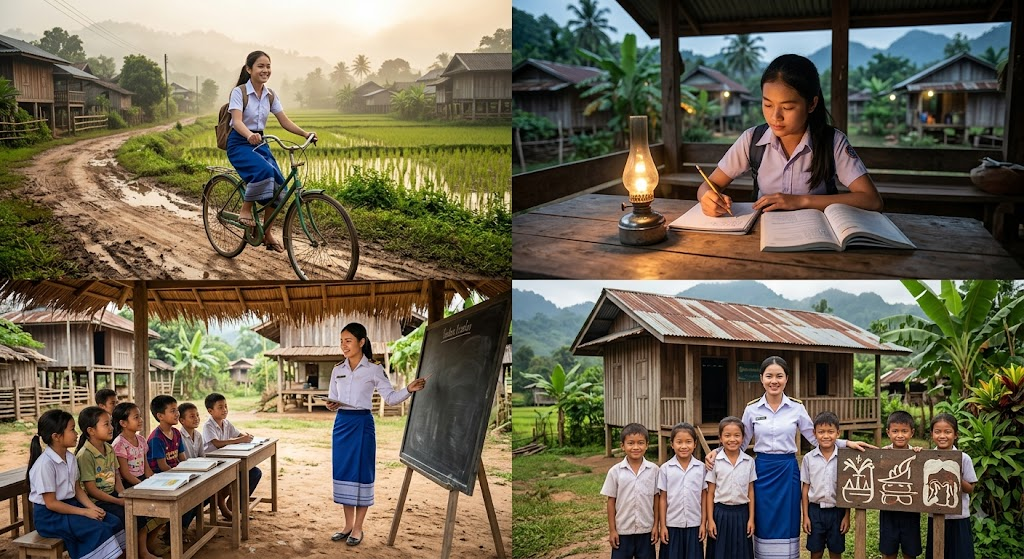
Present Simple
We use the present simple for things that happen regularly, every day, or are generally true.
- Lina rides her bicycle every morning.
- She studies English every day.
- She likes her bicycle.
1. I / You / We / They
Use the basic form of the verb.
- I live in a village.
- You like English.
- We study every day.
- They work hard.
2. He / She / It
Usually, add -s.
- She lives in a village.
- He likes English.
- She wants to be a teacher.
- It works well.
Most verbs: add -s
| Basic verb | He / She / It |
|---|---|
| live | lives |
| like | likes |
| want | wants |
| work | works |
| help | helps |
| read | reads |
| listen | listens |
| talk | talks |
| learn | learns |
3. Verbs ending in -y
If a verb ends in consonant + y, change y to ies.
- study → studies
- try → tries
- carry → carries
Examples:
- I study English.
- She studies English.
- They try hard.
- He tries hard.
But: vowel [a,e,i,o,u] + y → just add -s
- play → plays
- stay → stays
- enjoy → enjoys
Example:
- I play football.
- She plays football.
4. Have → Has
Have is different.
- I have a bicycle.
- You have a bicycle.
- We have a bicycle.
- They have a bicycle.
- She has a bicycle.
- He has a bicycle.
- It has four legs.
5. Be → am / is / are
Be is also different.
| Subject | Be |
|---|---|
| I | am |
| You | are |
| We | are |
| They | are |
| He | is |
| She | is |
| It | is |
Examples:
- I am 16 years old.
- You are happy.
- We are students.
- They are from Cambodia.
- She is 16 years old.
- He is a teacher.
6. Questions
With most verbs, use do or does.
I / you / we / they → DO
- Do you like English?
- Do they study every day?
he / she / it → DOES
- Does Lina like English?
- Does she study every day?
Important!
After does, use the basic verb.
❌ Does she studies English?
✅ Does she study English?
❌ Does Lina likes her bicycle?
✅ Does Lina like her bicycle?
7. Negative sentences
Use don’t or doesn’t.
I / you / we / they → don’t
- I don’t like English.
- They don’t study every day.
he / she / it → doesn’t
- She doesn’t like English.
- Lina doesn’t study every day.
Again, after doesn’t, use the basic verb.
❌ She doesn’t studies English.
✅ She doesn’t study English.
❌ Lina doesn’t likes her bicycle.
✅ Lina doesn’t like her bicycle.
The most important rule
Positive sentences:
I / You / We / They → basic verb
I study.
He / She / It → verb + s
She studies.
Questions and negatives:
do / does + basic verb
Does she study?
She doesn’t study.
Remember:
I study → She studies
I live → She lives
I like → She likes
I have → She has
I am → She is
##################
Vocabulary:
- a village – a small place where people live, smaller than a town
- to ride a bicycle – to sit on a bicycle and move with it
- to be far from home – to be a long way from your house
- at first – at the beginning
- short stories – stories that are not long
- to listen to songs – to hear songs carefully
- to work hard – to do a lot of work and try very much
- to believe in a dream – to think that your dream can happen
- to teach English – to help people learn English
- a dream comes true – something you want really happens
- a small step – a small action that helps you move forward
- tomorrow – the day after today
__________________________
My name is Lina. I am 16 years old. I live in a small village with my family.
Every morning, I ride my bicycle to school. My school is far from my home, so I ride many kilometres every day. I like my bicycle very much.
I love English. I want to be an English teacher. I want to help the children in my village.
At first, English is difficult for me. I know only a few English words. But I study every day. I learn new words. I read short English stories. I listen to English songs. When tourists come to my village, I talk to them in English.
I work hard. I am happy when I learn new words. My English gets better every day. I believe in my dream.
Many years later, I come back to my village. I am an English teacher now.
The children are happy to see me. I teach them English. I help them read, write and speak.
I am happy too. I have a good job, and I help the children in my village.
My dream comes true.
####################
Now rewrite the story, make all changes necessary:
Her name is Lina. She _____ (be) 16 years old. She _____ (live) in a small village with her family.
Every morning, Lina _____ (ride) her bicycle to school. Her school is far from her home, so she _____ (ride) many kilometres every day. She _____ (like) her bicycle very much.
Lina _____ (love) English. She _____ (want) to be an English teacher. She _____ (want) to help the children in her village.
At first, English is difficult for Lina. She _____ (know) only a few English words. But she _____ (study) every day. She _____ (learn) new words. She reads short English stories. She listens to English songs. When tourists come to her village, she _____ (talk) to them in English.
Lina _____ (work) hard. She is happy when she _____ (learn) new words. Her English _____ (get) better every day. She _____ (believe) in her dream.
Many years later, Lina _____ (come) back to her village. She is an English teacher now.
The children are happy to see her. Lina _____ (teach) them English. She _____ (help) them read, write and speak.
Lina is happy too. She _____ (have) a good job, and she _____ (help) the children in her village.
Her dream _____ (come) true.
———————————
Correct version:
Her name is Lina. She is 16 years old. She lives in a small village with her family.
Every morning, Lina rides her bicycle to school. Her school is far from her home, so she rides many kilometres every day. She likes her bicycle very much.
Lina loves English. She wants to be an English teacher. She wants to help the children in her village.
At first, English is difficult for Lina. She knows only a few English words. But she studies every day. She learns new words. She reads short English stories. She listens to English songs. When tourists come to her village, she talks to them in English.
Lina works hard. She is happy when she learns new words. Her English gets better every day. She believes in her dream.
Many years later, Lina comes back to her village. She is an English teacher now.
The children are happy to see her. Lina teaches them English. She helps them read, write and speak.
Lina is happy too. She has a good job, and she helps the children in her village.
Her dream comes true.
##################
Match the words and definitions
Words
- a village
- to ride a bicycle
- to be far from home
- at first
- short stories
- to listen to songs
- to work hard
- to believe in a dream
- to teach English
- a dream comes true
- a small step
- tomorrow
Definitions
A. The day after today.
B. To help people learn English.
C. A small action that helps you move forward.
D. To sit on a bicycle and move with it.
E. To do a lot of work and try very much.
F. Stories that are not long.
G. At the beginning.
H. To think that your dream can happen.
I. A small place where people live, smaller than a town.
J. Something you want really happens.
K. To hear songs carefully.
L. To be a long way from your house.
_____________________
Answers:
1–I, 2–D, 3–L, 4–G, 5–F, 6–K,
7–E, 8–H, 9–B, 10–J, 11–C, 12–A
###############
Match the definitions with the words
Definitions
- At the beginning.
- To hear songs carefully.
- A small place where people live, smaller than a town.
- To think that your dream can happen.
- The day after today.
- To do a lot of work and try very much.
- Something you want really happens.
- To sit on a bicycle and move with it.
- A small action that helps you move forward.
- Stories that are not long.
- To help people learn English.
- To be a long way from your house.
Words
A. tomorrow
B. to work hard
C. a dream comes true
D. short stories
E. to ride a bicycle
F. a small step
G. to teach English
H. a village
I. to believe in a dream
J. to listen to songs
K. to be far from home
L. at first
______________________
Answers:
1–L, 2–J, 3–H, 4–I, 5–A, 6–B,
7–C, 8–E, 9–F, 10–D, 11–G, 12–K
################
True or false
- Lina works hard for her dream.
- Lina wants to become a doctor.
- She comes back to her village many years later.
- Lina stops studying when English is difficult.
- She talks to tourists in English.
- Lina has a bad job when she becomes a teacher.
- Lina lives with her family.
- She never speaks to tourists.
- Lina knows only a few English words at first.
- Lina wants to be an English teacher.
- The children are angry when Lina returns.
- She learns new words every day.
- Lina rides a bicycle only on weekends.
- Lina forgets her dream after leaving school.
- She teaches English in another country.
- Lina helps the children read, write and speak.
________________________
True: 1,3,5,7,9,10,12,16
________________________
Correct version:
Lina works hard for her dream.
Lina wants to become a doctor. True is: Lina wants to be an English teacher.
She comes back to her village many years later.
Lina stops studying when English is difficult. True is: Lina studies every day when English is difficult.
She talks to tourists in English.
Lina has a bad job when she becomes a teacher. True is: Lina has a good job when she becomes a teacher.
Lina lives with her family.
She never speaks to tourists. True is: She talks to tourists in English.
Lina knows only a few English words at first.
Lina wants to be an English teacher.
The children are angry when Lina returns. True is: The children are happy when Lina returns.
She learns new words every day.
Lina rides a bicycle only on weekends. True is: Lina rides her bicycle to school every morning.
Lina forgets her dream after leaving school. True is: Lina believes in her dream.
She teaches English in another country. True is: She teaches English in her village.
Lina helps the children read, write and speak.
#################
What is the correct answer?
- How old is Lina?
a) 14
b) 16
c) 18 - Where does Lina live?
a) In a city
b) In a village
c) In a hotel - How does Lina go to school?
a) By bus
b) By car
c) By bicycle - What does Lina love?
a) English
b) Maths
c) Music - What does Lina want to be?
a) A teacher
b) A doctor
c) A tourist - What does Lina listen to?
a) The radio
b) The news
c) English songs - Who does Lina talk to?
a) Doctors
b) Tourists
c) Farmers - What does Lina become?
a) A writer
b) A doctor
c) An English teacher - How does Lina feel when she learns new words?
a) Happy
b) Angry
c) Tired - What does Lina read?
a) Short English stories
b) Long newspapers
c) School books - When is English difficult for Lina?
a) Tomorrow
b) At the end
c) At first - What does Lina want to help the children do?
a) Run and swim
b) Read, write and speak
c) Cook and dance - What does Lina do every morning?
a) Plays with her friends
b) Walks to the market
c) Rides her bicycle to school - What happens to Lina’s English?
a) It gets better every day
b) It gets worse every day
c) It stays the same - Where does Lina teach English?
a) In another country
b) In a big city
c) In her village - What happens to Lina’s dream?
a) It disappears
b) It comes true
c) It changes completely
________________________
Answers:
1–b, 2–b, 3–c, 4–a, 5–a, 6–c,
7–b, 8–c, 9–a, 10–a, 11–c, 12–b,
13–c, 14–a, 15–c, 16–b
_______________________
Correct version:
- How old is Lina? – 16
- Where does Lina live? – In a village
- How does Lina go to school? – By bicycle
- What does Lina love? – English
- What does Lina want to be? – A teacher
- What does Lina listen to? – English songs
- Who does Lina talk to? – Tourists
- What does Lina become? – An English teacher
- How does Lina feel when she learns new words? – Happy
- What does Lina read? – Short English stories
- When is English difficult for Lina? – At first
- What does Lina want to help the children do? – Read, write and speak
- What does Lina do every morning? – Rides her bicycle to school
- What happens to Lina’s English? – It gets better every day
- Where does Lina teach English? – In her village
- What happens to Lina’s dream? – It comes true
##################
Fill in, words below:
tomorrow – tourists – reads – bicycle – dream – children –
studies – school – songs – teacher – village –
listens – English – teaches –
words – stories
- Lina lives in a small __________.
- Every morning, Lina rides her __________ to school.
- Her __________ is far from her home.
- Lina loves __________.
- She wants to be an English __________.
- She wants to help the __________ in her village.
- She learns new __________ every day.
- Lina __________ short English stories.
- She __________ to English songs.
- Lina talks to __________ in her village.
- Lina believes in her __________.
- She __________ English every day.
- Lina __________ English to the children.
- Her English gets better every day, and her __________ comes true.
- A small step today can help make a better __________.
- Lina has a good job, and she __________ the children in her village.
————————————-
Full version:
- Lina lives in a small village.
- Every morning, Lina rides her bicycle to school.
- Her school is far from her home.
- Lina loves English.
- She wants to be an English teacher.
- She wants to help the children in her village.
- She learns new words every day.
- Lina reads short English stories.
- She listens to English songs.
- Lina talks to tourists in her village.
- Lina believes in her dream.
- She studies English every day.
- Lina teaches English to the children.
- Her English gets better every day, and her dream comes true.
- A small step today can help make a better tomorrow.
- Lina has a good job, and she teaches the children in her village.
#################
Short answers, basics:
| Example Sentence | Yes | No |
|---|---|---|
| I learn the alphabet. | Yes, I do. | No, I don’t. |
| You read signs. | Yes, you do. | No, you don’t. |
| He practices speaking. | Yes, he does. | No, he doesn’t. |
| She watches cartoons. | Yes, she does. | No, she doesn’t. |
| It helps us learn English. | Yes, it does. | No, it doesn’t. |
| We use apps like Duolingo. | Yes, we do. | No, we don’t. |
| You read labels. | Yes, you do. | No, you don’t. |
| They make mistakes sometimes. | Yes, they do. | No, they don’t. |
| Question | Yes | No |
|---|---|---|
| Do I learn the alphabet? | Yes, I do. | No, I don’t. |
| Do you read signs? | Yes, you do. | No, you don’t. |
| Does he practice speaking? | Yes, he does. | No, he doesn’t. |
| Does she watch cartoons? | Yes, she does. | No, she doesn’t. |
| Does it help us learn English? | Yes, it does. | No, it doesn’t. |
| Do we use apps like Duolingo? | Yes, we do. | No, we don’t. |
| Do you read labels? | Yes, you do. | No, you don’t. |
| Do they make mistakes sometimes? | Yes, they do. | No, they don’t. |
| Question | Yes | No |
|---|---|---|
| Am I big? | Yes, I am. | No, I am not. |
| Are you big? | Yes, you are. | No, you aren’t. |
| Is he big? | Yes, he is. | No, he isn’t. |
| Is she big? | Yes, she is. | No, she isn’t. |
| Is it big? | Yes, it is. | No, it isn’t. |
| Are we big? | Yes, we are. | No, we aren’t. |
| Are you big? | Yes, you are. | No, you aren’t. |
| Are they big? | Yes, they are. | No, they aren’t. |
#################
Short answers:
- Lina works hard for her dream.
YOU WRITE:
Yes, she does. - Lina wants to become a doctor.
- Lina is 14 years old.
- She comes back to her village many years later.
- Lina stops studying when English is difficult.
- She talks to tourists in English.
- Lina has a bad job when she becomes a teacher.
- Lina lives with her family.
- She never speaks to tourists.
- Lina knows only a few English words at first.
- Lina wants to be an English teacher.
- The children are angry when Lina returns.
- She learns new words every day.
- Lina rides a bicycle only on weekends.
- Lina forgets her dream after leaving school.
- She teaches English in another country.
- Lina helps the children read, write and speak.
- The children are happy with a great teacher.
_________________________
Correct version:
- Lina works hard for her dream. Yes, she does.
- Lina wants to become a doctor. No, she doesn’t.
- Lina is 14 years old. No, she isn’t.
- She comes back to her village many years later. Yes, she does.
- Lina stops studying when English is difficult. No, she doesn’t.
- She talks to tourists in English. Yes, she does.
- Lina has a bad job when she becomes a teacher. No, she doesn’t.
- Lina lives with her family. Yes, she does.
- She never speaks to tourists. No, she doesn’t.
- Lina knows only a few English words at first. Yes, she does.
- Lina wants to be an English teacher. Yes, she does.
- The children are angry when Lina returns. No, they aren’t.
- She learns new words every day. Yes, she does.
- Lina rides a bicycle only on weekends. No, she doesn’t.
- Lina forgets her dream after leaving school. No, she doesn’t.
- She teaches English in another country. No, she doesn’t.
- Lina helps the children read, write and speak. Yes, she does.
- The children are happy with a great teacher. Yes, they are.
#################
Answer in full sentences:
- Who is Lina?
YOU WRITE:
Lina is a girl. - How old is Lina?
- Where does Lina live?
- Who does Lina live with?
- How does Lina go to school?
- When does Lina ride her bicycle to school?
- How far is her school from her home?
- What does Lina like very much?
- What subject does Lina love?
- What does Lina want to be?
- Why does Lina want to be an English teacher?
- What is difficult for Lina at first?
- How many English words does Lina know at first?
- What does Lina learn every day?
- What does Lina read?
- What does Lina listen to?
- Who does Lina talk to in English?
- How does Lina feel when she learns new words?
- When does Lina come back to her village?
- What does Lina do for the children
__________________________
Correct answers:
- Who is Lina? Lina is a girl.
- How old is Lina? Lina is 16 years old.
- Where does Lina live? Lina lives in a small village.
- Who does Lina live with? Lina lives with her family.
- How does Lina go to school? Lina goes to school by bicycle.
- When does Lina ride her bicycle to school? Lina rides her bicycle to school every morning.
- How far is her school from her home? Her school is far from her home.
- What does Lina like very much? Lina likes her bicycle very much.
- What subject does Lina love? Lina loves English.
- What does Lina want to be? Lina wants to be an English teacher.
- Why does Lina want to be an English teacher? Lina wants to help the children in her village.
- What is difficult for Lina at first? English is difficult for Lina at first.
- How many English words does Lina know at first? Lina knows only a few English words at first.
- What does Lina learn every day? Lina learns new words every day.
- What does Lina read? Lina reads short English stories.
- What does Lina listen to? Lina listens to English songs.
- Who does Lina talk to in English? Lina talks to tourists in English.
- How does Lina feel when she learns new words? Lina is happy when she learns new words.
- When does Lina come back to her village? Lina comes back to her village many years later.
- What does Lina do for the children? Lina teaches the children English and helps them read, write and speak.
#################
Answer:
- Is Lina a boy or a girl?
YOU WRITE:
Lina is a girl. - Does she live in a city or in a village?
- Is Lina 16 or 18 years old?
- Does Lina live with her family or her friends?
- Does she go to school by bicycle or by bus?
- Is her school near or far from her home?
- Does Lina like her bicycle or her school?
- Does Lina love English or maths?
- Does Lina want to be an English teacher or a doctor?
- Does she want to help the children or the tourists?
- Is English easy or difficult for Lina at first?
- Does Lina know many English words or only a few?
- Does Lina study English every day or every week?
- Does she read short English stories or long books?
- Does Lina listen to English songs or watch English films?
- Does Lina talk to tourists in English or German?
- Is Lina happy or sad when she learns new words?
- Does Lina come back to her village many years later or the next day?
- Does Lina teach English or maths?
- Does Lina help the children read, write and speak or only listen?
________________________
Correct version:
- Is Lina a boy or a girl? Lina is a girl.
- Does she live in a city or in a village? She lives in a village.
- Is Lina 16 or 18 years old? Lina is 16 years old.
- Does Lina live with her family or her friends? Lina lives with her family.
- Does she go to school by bicycle or by bus? She goes to school by bicycle.
- Is her school near or far from her home? Her school is far from her home.
- Does Lina like her bicycle or her school? Lina likes her bicycle.
- Does Lina love English or maths? Lina loves English.
- Does Lina want to be an English teacher or a doctor? Lina wants to be an English teacher.
- Does she want to help the children or the tourists? She wants to help the children.
- Is English easy or difficult for Lina at first? English is difficult for Lina at first.
- Does Lina know many English words or only a few? Lina knows only a few English words.
- Does Lina study English every day or every week? Lina studies English every day.
- Does she read short English stories or long books? She reads short English stories.
- Does Lina listen to English songs or watch English films? Lina listens to English songs.
- Does Lina talk to tourists in English or German? Lina talks to tourists in English.
- Is Lina happy or sad when she learns new words? Lina is happy when she learns new words.
- Does Lina come back to her village many years later or the next day? Lina comes back to her village many years later.
- Does Lina teach English or maths? Lina teaches English.
- Does Lina help the children read, write and speak or only listen? Lina helps the children read, write and speak.
#################
Answer as shown:
- Lina is 18 years old.
YOU WRITE:
No, she isn’t. She is 16 years old. - Lina lives in a big city.
- Lina lives with her friends.
- Lina goes to school by bus.
- Her school is near her home.
- Lina likes her school very much.
- Lina loves maths.
- Lina wants to be a doctor.
- Lina wants to help tourists.
- English is easy for Lina at first.
- Lina knows many English words at first.
- Lina studies English once a week.
- Lina reads long English books.
- Lina listens to English news.
- Lina becomes a doctor many years later.
_______________________
Correct answers:
- Lina is 18 years old. No, she isn’t. She is 16 years old.
- Lina lives in a big city. No, she doesn’t. She lives in a small village.
- Lina lives with her friends. No, she doesn’t. She lives with her family.
- Lina goes to school by bus. No, she doesn’t. She goes to school by bicycle.
- Her school is near her home. No, it isn’t. Her school is far from her home.
- Lina likes her school very much. No, she doesn’t. She likes her bicycle very much.
- Lina loves maths. No, she doesn’t. She loves English.
- Lina wants to be a doctor. No, she doesn’t. She wants to be an English teacher.
- Lina wants to help tourists. No, she doesn’t. She wants to help the children.
- English is easy for Lina at first. No, it isn’t. English is difficult for Lina at first.
- Lina knows many English words at first. No, she doesn’t. She knows only a few English words.
- Lina studies English once a week. No, she doesn’t. She studies English every day.
- Lina reads long English books. No, she doesn’t. She reads short English stories.
- Lina listens to English news. No, she doesn’t. She listens to English songs.
- Lina becomes a doctor many years later. No, she doesn’t. She becomes an English teacher.
####################
Match the first half of each sentence with the correct second half.
A
- Lina is 16
- She lives in a small
- Every morning, Lina rides
- Her school is far
- Lina loves
- She wants to be an English
- She wants to help the children
- Lina studies English
- She reads short English
- She listens to English
- She talks to tourists
- Lina works
- Many years later, Lina comes back
- She is an English teacher
B
a. in her village.
b. every day.
c. years old.
d. to her village.
e. hard.
f. her bicycle to school.
g. in English.
h. from her home.
i. stories.
j. songs.
k. village with her family.
l. teacher.
m. now.
n. English.
_______________________
Answer key:
1c, 2k, 3f, 4h, 5n, 6l, 7a, 8b,
9i, 10j, 11g, 12e, 13d, 14m
_______________________
Correct version:
Lina is 16 years old.
She lives in a small village with her family.
Every morning, Lina rides her bicycle to school.
Her school is far from her home.
Lina loves English.
She wants to be an English teacher.
She wants to help the children in her village.
Lina studies English every day.
She reads short English stories.
She listens to English songs.
She talks to tourists in English.
Lina works hard.
Many years later, Lina comes back to her village.
She is an English teacher now.
#################
Basics of present simple:
| Personal Pronoun | am / is / are | |
|---|---|---|
| I | am | 8 years old |
| You | are | 8 years old |
| He | is | 8 years old |
| She | is | 8 years old |
| It | is | 8 years old |
| We | are | 8 years old |
| You (plural) | are | 8 years old |
| They | are | 8 years old |
| Personal Pronoun | am not / is not / are not | |
|---|---|---|
| I | am not | 8 years old |
| You | are not | 8 years old |
| He | is not | 8 years old |
| She | is not | 8 years old |
| It | is not | 8 years old |
| We | are not | 8 years old |
| You (plural) | are not | 8 years old |
| They | are not | 8 years old |
Question:
| Question Word | Personal Pronoun | |
|---|---|---|
| Am | I | 8 years old? |
| Are | you | 8 years old? |
| Is | he | 8 years old? |
| Is | she | 8 years old? |
| Is | it | 8 years old? |
| Are | we | 8 years old? |
| Are | you (plural) | 8 years old? |
| Are | they | 8 years old? |
Statement:
| Personal Pronoun | Verb | |
|---|---|---|
| I | like | ice cream |
| You | like | ice cream |
| He | likes | ice cream |
| She | likes | ice cream |
| It | likes | ice cream |
| We | like | ice cream |
| You (plural) | like | ice cream |
| They | like | ice cream |
Negation:
| Personal Pronoun | Verb (negative) | |
|---|---|---|
| I | do not like | ice cream |
| You | do not like | ice cream |
| He | does not like | ice cream |
| She | does not like | ice cream |
| It | does not like | ice cream |
| We | do not like | ice cream |
| You (plural) | do not like | ice cream |
| They | do not like | ice cream |
Question:
| Do / Does | Personal Pronoun | Verb | Sugar? |
|---|---|---|---|
| Do | I | like | sugar? |
| Do | you | like | sugar? |
| Does | he | like | sugar? |
| Does | she | like | sugar? |
| Does | it | like | sugar? |
| Do | we | like | sugar? |
| Do | you (plural) | like | sugar? |
| Do | they | like | sugar? |
########################
Rewrite as shown in 1:
- Lina is 16 years old.
YOU WRITE:
a) negation: Lina is not 16 years old.
b) question: Is Lina 16 years old?
c) negative question: Isn’t Lina 16 years old? - She lives in a small village with her family.
- Her school is far from her home.
- Lina loves English.
- She wants to be an English teacher.
- English is difficult for Lina at first.
- She knows only a few English words.
- Lina studies English every day.
- She reads short English stories.
- She listens to English songs.
- Lina talks to tourists in English.
- Her English gets better every day.
- The children are happy to see Lina.
- Lina has a good job.
- Her dream comes true.
_________________________________
Correct answers:
- Lina is 16 years old.
a) negation: Lina is not 16 years old.
b) question: Is Lina 16 years old?
c) negative question: Isn’t Lina 16 years old? - She lives in a small village with her family.
a) negation: She does not live in a small village with her family.
b) question: Does she live in a small village with her family?
c) negative question: Doesn’t she live in a small village with her family? - Her school is far from her home.
a) negation: Her school is not far from her home.
b) question: Is her school far from her home?
c) negative question: Isn’t her school far from her home? - Lina loves English.
a) negation: Lina does not love English.
b) question: Does Lina love English?
c) negative question: Doesn’t Lina love English? - She wants to be an English teacher.
a) negation: She does not want to be an English teacher.
b) question: Does she want to be an English teacher?
c) negative question: Doesn’t she want to be an English teacher? - English is difficult for Lina at first.
a) negation: English is not difficult for Lina at first.
b) question: Is English difficult for Lina at first?
c) negative question: Isn’t English difficult for Lina at first? - She knows only a few English words.
a) negation: She does not know only a few English words.
b) question: Does she know only a few English words?
c) negative question: Doesn’t she know only a few English words? - Lina studies English every day.
a) negation: Lina does not study English every day.
b) question: Does Lina study English every day?
c) negative question: Doesn’t Lina study English every day? - She reads short English stories.
a) negation: She does not read short English stories.
b) question: Does she read short English stories?
c) negative question: Doesn’t she read short English stories? - She listens to English songs.
a) negation: She does not listen to English songs.
b) question: Does she listen to English songs?
c) negative question: Doesn’t she listen to English songs? - Lina talks to tourists in English.
a) negation: Lina does not talk to tourists in English.
b) question: Does Lina talk to tourists in English?
c) negative question: Doesn’t Lina talk to tourists in English? - Her English gets better every day.
a) negation: Her English does not get better every day.
b) question: Does her English get better every day?
c) negative question: Doesn’t her English get better every day? - The children are happy to see Lina.
a) negation: The children are not happy to see Lina.
b) question: Are the children happy to see Lina?
c) negative question: Aren’t the children happy to see Lina? - Lina has a good job.
a) negation: Lina does not have a good job.
b) question: Does Lina have a good job?
c) negative question: Doesn’t Lina have a good job? - Her dream comes true.
a) negation: Her dream does not come true.
b) question: Does her dream come true?
c) negative question: Doesn’t her dream come true?
###################
Find the word in the story
- a person who visits a place → __________
- a place where people live → __________
- a two-wheeled vehicle → __________
- a person who teaches → __________
- young persons under 18 → __________
- a place where children learn → __________
- to get knowledge about something → __________
- something you want to do or become in the future → __________
- a group of people who live together → __________
- to use your eyes to understand words → __________
- to hear music or sounds → __________
- to give lessons to children → __________
- a job that Lina has → __________
————————————-
Correct answers:
- a person who visits a place → tourist
- a place where people live → village
- a two-wheeled vehicle → bicycle
- a person who teaches → teacher
- young persons under 18 → children
- a place where children learn → school
- to get knowledge about something → learn
- something you want to do or become in the future → dream
- a group of people who live together → family
- to use your eyes to understand words → read
- to hear music or sounds → listen
- to give lessons to children → teach
- a job that Lina has → teacher
##################
Choose the word that does not belong, the odd one:
- bicycle – banana – school – teacher
- bicycle – English – stories – songs
- village – family – teacher – children
- village – read – listen – talk
- happy – difficult – school – good
- bicycle – English – car – bus
- bicycle – teacher – student – tourist
- learn – family – study – read
- song – village – school – home
- children – tourists – family – bicycle
- doctor – teacher – student – tourist
- bicycle – school – English – village
- read – listen – family – talk
- city – village – home – school
- happy – bicycle – good – difficult
_________________________
Correct answers:
- bicycle – banana – school – teacher → banana is the odd one out because it is a fruit.
- bicycle – English – stories – songs → bicycle is the odd one out because the other words are connected with English.
- village – family – teacher – children → teacher is the odd one out because the other words are connected with people or a place in Lina’s village.
- village – read – listen – talk → village is the odd one out because the other words are actions.
- happy – difficult – school – good → school is the odd one out because the other words are describing words.
- bicycle – English – car – bus → English is the odd one out because the other words are vehicles.
- bicycle – teacher – student – tourist → bicycle is the odd one out because the other words are people.
- learn – family – study – read → family is the odd one out because the other words are actions.
- song – village – school – home → song is the odd one out because the other words are places.
- children – tourists – family – bicycle → bicycle is the odd one out because the other words are people.
- doctor – teacher – student – tourist → doctor is the odd one out because the other words are in the Lina story.
- bicycle – school – English – village → English is the odd one out because the other words are places or things.
- read – listen – family – talk → family is the odd one out because the other words are actions.
- city – village – home – school → city is the odd one out because Lina lives in a village.
- happy – bicycle – good – difficult → bicycle is the odd one out because the other words are describing words.
################
Fill in, words below
songs, teacher, village, dream, words, bicycle,
job, tourists, study, children,
family, English, stories,
learn, school
Lina is 16 years old. She lives in a small __________ with her __________. Every morning, she rides her __________ to __________. Her school is far from her home.
Lina loves __________. She wants to be an English __________ because she wants to help the __________ in her village. At first, English is difficult for her. She knows only a few English __________, but she __________ every day.
Lina reads short English __________ and listens to English __________. She also talks to __________ in English. Her English gets better every day. She __________ new words.
Many years later, Lina comes back to her village. She is an English teacher now. She has a good __________. Her __________ comes true.
————————————–
Correct version:
Lina is 16 years old. She lives in a small <village> with her <family>. Every morning, she rides her <bicycle> to <school>. Her school is far from her home.
Lina loves <English>. She wants to be an English <teacher> because she wants to help the <children> in her village. At first, English is difficult for her. She knows only a few English <words>, but she <studies> every day.
Lina reads short English <stories> and listens to English <songs>. She also talks to <tourists> in English. Her English gets better every day. She <learns> new words.
Many years later, Lina comes back to her village. She is an English teacher now. She has a good <job>.
Her <dream> comes true.
#################
Rewrite the interview with Lina as shown below:
- Interviewer: How old are you?
Lina: I am 16 years old. - Interviewer: Where do you live?
Lina: I live in a small village. - Interviewer: Who do you live with?
Lina: I live with my family. - Interviewer: How do you go to school?
Lina: I go to school by bicycle. - Interviewer: What subject do you love?
Lina: I love English. - Interviewer: What do you want to be?
Lina: I want to be an English teacher. - Interviewer: Why do you want to be a teacher?
Lina: I want to help the children in my village. - Interviewer: What do you do every day?
Lina: I study English every day. - Interviewer: What do you do when tourists come to your village?
Lina: I talk to them in English. - Interviewer: What is your dream?
Lina: My dream is to be an English teacher and help the children.
________________________
Interview with Lina’s friend,
YOU WRITE:
1. Interviewer: How old is she?
Friend: She is 16 years old.
2. Interviewer: Where does she live?
Friend:_____________
————————————
Correct version:
- Interviewer: How old is she?
Friend: She is 16 years old. - Interviewer: Where does she live?
Friend: She lives in a small village. - Interviewer: Who does she live with?
Friend: She lives with her family. - Interviewer: How does she go to school?
Friend: She goes to school by bicycle. - Interviewer: What subject does she love?
Friend: She loves English. - Interviewer: What does she want to be?
Friend: She wants to be an English teacher. - Interviewer: Why does she want to be a teacher?
Friend: She wants to help the children in her village. - Interviewer: What does she do every day?
Friend: She studies English every day. - Interviewer: What does she do when tourists come to the village?
Friend: She talks to them in English. - Interviewer: What is her dream?
Friend: Her dream is to be an English teacher.
####################
Bonus text in B1
Her name is Lina, and she is 16 years old. She lives with her family in a small village.
Every morning, Lina cycles to school. Since her school is a long way from home, she rides several kilometres each day. She is very fond of her bicycle.
Lina has always loved English, and she dreams of becoming an English teacher. Her main goal is to help the children in her village have better opportunities.
In the beginning, English is quite difficult for Lina, and she knows only a few words. However, she works hard and studies every day. She learns new vocabulary, reads short English stories and listens to English songs. Whenever tourists visit her village, she takes the opportunity to speak English with them.
Lina is happy when she learns new words, and her English gradually improves. She believes that hard work can help her achieve her dream.
Many years later, Lina returns to her village as a qualified English teacher. The children are delighted to see her. She teaches them English and helps them improve their reading, writing and speaking skills.
Lina is happy with her life. She has a good job, and she can support the children in her village. In the end, her dream becomes a reality.
####################
Please use the box below
to write your feedback.
Only I can read it.
It is not public.
Please tell me:
- Are the texts and exercises OK?
- Are the topics OK?
- Is the level OK?
- Is it too easy or too difficult?
- Do you want texts about other topics?
Thank you! I appreciate your feedback.
##################
##################
##################
Remember how babies
learn a language:
Babies learn a language by listening.
They use their ears to hear sounds.
Their brain remembers these sounds.
Babies connect sounds with people and things.
They listen to their parents.
Then they copy the sounds they hear. They imitate words.
Slowly, babies learn to speak.
So,
LISTEN, LISTEN, LISTEN, LISTEN………………
Schreibe einen Kommentar