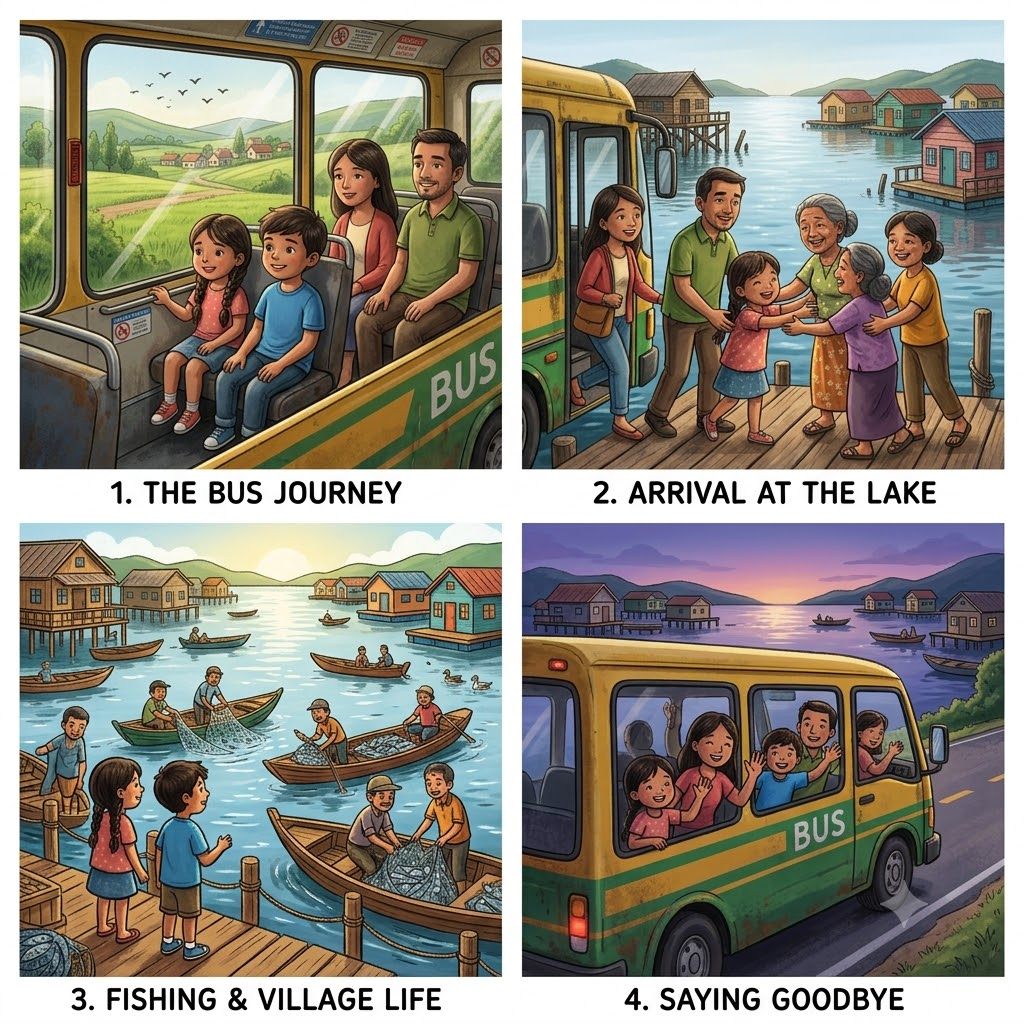
Lina and Salas are siblings. Every year, they visit their relatives. Their relatives live on a big lake. Some live in stilted houses. The houses are on long wooden poles over the water. Other relatives live in floating houses. These houses stay on the water and move a little with the wind.
First, Lina, Salas, their mother, and their father go by bus. The bus ride is long, but it is nice. They look out of the window. They see green fields, trees, small villages, and many birds. At last, they arrive at the lake. Their relatives are happy to see them.
The relatives live by fishing. Every morning, they go out in small boats. They catch fish in the lake. Lina and Salas watch them. Sometimes they help to carry the fish. Their mother cooks fresh fish for lunch. Their father talks and laughs with the family. In the afternoon, Lina and Salas play near the water. They watch the boats and feed the ducks.
They stay for three days. Then they say goodbye and go home by bus. They are tired but happy. Every year, they make the same trip because they love their family and the beautiful lake.
___________________________
Vocabulary:
| Word / Phrase | Definition |
|---|---|
| relatives | people in your family, like your grandparents, aunts, uncles, or cousins |
| siblings | your brothers and sisters |
| to visit | to go and see a person or a place |
| a stilted house | a house that stands on tall poles above the ground or water |
| a pole | a long, thin piece of wood, metal, or other material |
| a floating house | a house that stays on water and moves a little |
| to ride a bus | to travel by bus |
| at last | finally; after a long time |
| a lake | a large area of water with land around it |
| to live by fishing | to get food or money by catching fish |
| to catch fish | to take fish out of water, usually with a net or a fishing rod |
| to carry something | to hold and move something from one place to another |
| to feed the ducks | to give food to ducks |
| to stay for three days | to remain in a place for three days |
| to be tired | to need rest because you have used a lot of energy |
##################
Match the words with the definitions
- relatives
- siblings
- to visit
- a stilted house
- a pole
- a floating house
- to ride a bus
- at last
- a lake
- to live by fishing
- to catch fish
- to carry something
- to feed the ducks
- to stay for three days
- to be tired
A. to give food to ducks
B. a large area of water with land around it
C. to travel by bus
D. to hold and move something from one place to another
E. people in your family, like grandparents, aunts, uncles, or cousins
F. a house that stays on water
G. to get food or money by catching fish
H. to need rest because you have used a lot of energy
I. your brothers and sisters
J. a long, thin piece of wood, metal, or other material
K. to remain in a place for three days
L. finally, after a long time
M. to go and see a person or place
N. to take fish out of water
O. a house that stands on tall poles above the ground or water
__________________________
Answers:
1-E, 2-I, 3-M, 4-O, 5-J, 6-F,
7-C, 8-L, 9-B, 10-G, 11-N,
12-D, 13-A, 14-K, 15-H
##################
Match the words with the definitions :
- relatives
- siblings
- to visit
- a stilted house
- a pole
- a floating house
- to ride a bus
- at last
- a lake
- to live by fishing
- to catch fish
- to carry something
- to feed the ducks
- to stay for three days
- to be tired
A. to give food to ducks
B. a large area of water with land around it
C. to travel by bus
D. to hold and move something from one place to another
E. people in your family, like grandparents, aunts, uncles, or cousins
F. a house that stays on water
G. to get food or money by catching fish
H. to need rest because you have used a lot of energy
I. your brothers and sisters
J. a long, thin piece of wood, metal, or other material
K. to remain in a place for three days
L. finally, after a long time
M. to go and see a person or place
N. to take fish out of water
O. a house that stands on tall poles above the ground or water
________________________
Answers:
1-E, 2-I, 3-M, 4-O, 5-J, 6-F,
7-C, 8-L, 9-B, 10-G, 11-N,
12-D, 13-A, 14-K, 15-H
#################
Fill in, words below:
travel – siblings – family – relatives – poles – lake – by – bus –
floating – catch – feed – wind – mother – window –
boats – stilted – children –
long – birds –
fishing
- Lina and Salas are _______ who visit their relatives every year.
- Their relatives live on a big _______
- Some of their relatives live in _______ houses.
- The houses are built on long wooden _______ over the water.
- Other relatives live in _______ houses.
- Floating houses stay on the water and move with the _______.
- Lina and Salas _______ to the lake by bus with their parents.
- The bus ride is_______ but nice.
- They look out of the _______ during the journey.
- They see green fields, trees, small villages, and many _______.
- The _______ are happy to see Lina and Salas.
- The family lives _______ fishing in the lake.
- Every morning, the relatives go out in small _______.
- They _______ fish and bring them home.
- Lina and Salas watch the relatives_______.
- Sometimes the _______ help to carry the fish.
- Their _______ cooks fresh fish for lunch.
- In the afternoon, they play near the water and _______ the ducks.
- After three days, they say goodbye and return home by _______.
- Lina and Salas love their _______ and the beautiful lake.
——————————–
Correct version:
Lina and Salas are siblings who visit their relatives every year.
Their relatives live on a big lake.
Some of their relatives live in stilted houses.
The houses are built on long wooden poles over the water.
Other relatives live in floating houses.
Floating houses stay on the water and move with the wind.
Lina and Salas travel to the lake by bus with their parents.
The bus ride is long but nice.
They look out of the window during the journey.
They see green fields, trees, small villages, and many birds.
The family are happy to see Lina and Salas.
The family lives by fishing in the lake.
Every morning, the relatives go out in small boats.
They catch fish and bring them home.
Lina and Salas watch the relatives fishing.
Sometimes the children help to carry the fish.
Their mother cooks fresh fish for lunch.
In the afternoon, they play near the water and feed the ducks.
After three days, they say goodbye and return home by bus.
Lina and Salas love their relatives and the beautiful lake.
##################
Which is correct?
- Lina and Salas are ______.
a) siblings
b) farmers
c) teachers - Their relatives live on a big ______.
a) village
b) lake
c) field - Some relatives live in ______ houses.
a) green
b) small
c) stilted - The stilted houses are on long wooden ______.
a) poles
b) boats
c) trees - Floating houses move a little with the ______.
a) water
b) wind
c) fish - Lina and Salas go to the lake by ______.
a) bus
b) boat
c) train - The bus ride is ______.
a) short
b) long
c) fast - They look out of the ______ during the trip.
a) window
b) house
c) lake - They see many ______ on the way.
a) ducks
b) fish
c) birds - The relatives are happy to ______ Lina and Salas.
a) carry
b) see
c) feed - The relatives live by ______.
a) cooking
b) travelling
c) fishing - Every morning, they go out in small ______.
a) boats
b) houses
c) villages - They ______ fish in the lake.
a) feed
b) watch
c) catch - Lina and Salas sometimes help to carry the ______.
a) ducks
b) fish
c) birds - Their ______ cooks fresh fish for lunch.
a) father
b) family
c) mother - In the afternoon, they play near the water and ______ the ducks.
a) feed
b) catch
c) carry - They stay for ______ days.
a) two
b) three
c) four - They return home by ______.
a) boat
b) train
c) bus - Lina and Salas love their ______.
a) lake
b) family
c) houses - The relatives live in stilted houses and ______ houses.
a) wooden
b) small
c) floating
———————————————
Answer Key:
1A, 2B, 3C, 4A, 5B, 6A, 7B, 8A,
9C, 10B, 11C, 12A, 13C, 14B,
15C, 16A, 17B, 18C, 19B, 20C
___________________________
Correct version:
Lina and Salas are siblings who visit their relatives every year.
Their relatives live on a big lake.
Some relatives live in stilted houses.
The houses are built on long wooden poles over the water.
Other relatives live in floating houses.
Floating houses move a little with the wind.
Lina and Salas go to the lake by bus.
The bus ride is long but nice.
They look out of the window during the journey.
They see green fields, trees, small villages, and many birds.
The family are happy to see Lina and Salas.
The relatives live by fishing.
Every morning, they go out in small boats.
They catch fish in the lake.
Their mother cooks fresh fish for lunch.
Lina and Salas help to carry the fish.
In the afternoon, they feed the ducks.
They stay for three days.
They return home by bus after the trip.
Lina and Salas love their family and the beautiful lake.
####################
True or false:
- Lina and Salas visit their relatives every year.
- The relatives live in a small village near the mountains.
- Some relatives live in stilted houses over the water.
- Lina and Salas travel to the lake by train.
- Floating houses move a little with the wind.
- The relatives work by growing trees and plants.
- The bus ride to the lake is long but nice.
- Lina and Salas see many birds during the journey.
- The relatives catch fish in the lake every morning.
- Lina and Salas stay at the lake for one week.
- Their mother cooks fresh fish for lunch.
- The family lives in a big city.
- Lina and Salas play near the water in the afternoon.
- The relatives go out in large ships to catch fish.
- Their father talks and laughs with the family.
- Lina and Salas feed the ducks near the water.
_____________________
False: 2,4,6,10,12,14,
_____________________
Correct version:
- Lina and Salas visit their relatives every year.
- The relatives live in a small village near the mountains. True is: The relatives live on a big lake.
- Some relatives live in stilted houses over the water.
- Lina and Salas travel to the lake by train. True is: Lina and Salas travel to the lake by bus.
- Floating houses move a little with the wind.
- The relatives work by growing trees and plants. True is: The relatives live by fishing.
- The bus ride to the lake is long but nice.
- Lina and Salas see many birds during the journey.
- The relatives catch fish in the lake every morning.
- Lina and Salas stay at the lake for one week. True is: Lina and Salas stay at the lake for three days.
- Their mother cooks fresh fish for lunch.
- The family lives in a big city. True is: The family lives near a big lake.
- Lina and Salas play near the water in the afternoon.
- The relatives go out in large ships to catch fish. True is: The relatives go out in small boats to catch fish.
- Their father talks and laughs with the family.
- Lina and Salas feed the ducks near the water.
#####################
Put the sentences into the correct order:
A. Lina and Salas play near the water and feed the ducks in the afternoon.
B. Lina, Salas, their mother, and their father travel to the lake by bus.
C. The relatives are happy to see Lina and Salas when they arrive.
D. The family goes home by bus after three days at the lake.
E. Every morning, the relatives go out in small boats and catch fish.
F. Lina and Salas see green fields, trees, small villages, and many birds during the trip.
G. Their mother cooks fresh fish for lunch, and their father talks with the family.
H. Lina and Salas visit their relatives who live on a big lake every year.
___________________________
Answer Key: 1-H, 2-B, 3-F, 4-C, 5-E, 6-G, 7-A, 8-D
__________________________
Correct version:
H. Lina and Salas visit their relatives who live on a big lake every year.
B. Lina, Salas, their mother, and their father travel to the lake by bus.
F. Lina and Salas see green fields, trees, small villages, and many birds during the trip.
C. The relatives are happy to see Lina and Salas when they arrive.
E. Every morning, the relatives go out in small boats and catch fish.
G. Their mother cooks fresh fish for lunch, and their father talks with the family.
A. Lina and Salas play near the water and feed the ducks in the afternoon.
D. The family goes home by bus after three days at the lake.
##################
Match the questions with the answers:
Questions
- Who are Lina and Salas?
- Where do their relatives live?
- How do Lina and Salas travel to the lake?
- What do the relatives live by?
- What do the relatives catch in the lake?
- Where are the stilted houses built?
- How long do Lina and Salas stay at the lake?
- What do Lina and Salas do in the afternoon?
- Who cooks fresh fish for lunch?
- Why do Lina and Salas make the same trip every year?
Answers
A. They stay for three days.
B. They love their family and the beautiful lake.
C. They are siblings.
D. They catch fish.
E. Their mother cooks fresh fish.
F. They play near the water and feed the ducks.
G. Their relatives live on a big lake.
H. The houses are built on long wooden poles over the water.
I. They travel by bus.
J. They live by fishing.
___________________
Answer Key:
1-C, 2-G, 3-I, 4-J, 5-D, 6-H, 7-A, 8-F, 9-E, 10-B
__________________
- Who are Lina and Salas?
C. They are siblings. - Where do their relatives live?
G. Their relatives live on a big lake. - How do Lina and Salas travel to the lake?
I. They travel by bus. - What do the relatives live by?
J. They live by fishing. - What do the relatives catch in the lake?
D. They catch fish. - Where are the stilted houses built?
H. The houses are built on long wooden poles over the water. - How long do Lina and Salas stay at the lake?
A. They stay for three days. - What do Lina and Salas do in the afternoon?
F. They play near the water and feed the ducks. - Who cooks fresh fish for lunch?
E. Their mother cooks fresh fish. - Why do Lina and Salas make the same trip every year?
B. They love their family and the beautiful lake.
#################
Answer the questions with: Yes, they do. / No, they don’t.
- Do Lina and Salas see snow during the bus ride?
- Do the relatives catch fish every morning?
- Do their relatives live in houses on the mountains?
- Do Lina and Salas visit their relatives every year?
- Do Lina and Salas travel to the lake by boat?
- Do some relatives live in stilted houses?
- Do the relatives live by farming?
- Do floating houses move a little with the wind?
- Do Lina and Salas stay at the lake for three days?
- Do the relatives catch birds in the lake?
- Do Lina and Salas play near the water in the afternoon?
- Do their relatives live in a big city?
- Do Lina and Salas travel to the lake by bus?
- Do the children help to carry the fish?
___________________________
Full version:
- Do Lina and Salas see snow [Snow is white ice that falls from the sky when it is cold, in winter] during the bus ride? — No, they don’t.
- Do the relatives catch fish every morning? — Yes, they do.
- Do their relatives live in houses on the mountains? — No, they don’t.
- Do Lina and Salas visit their relatives every year? — Yes, they do.
- Do Lina and Salas travel to the lake by boat? — No, they don’t.
- Do some relatives live in stilted houses? — Yes, they do.
- Do the relatives live by farming? — No, they don’t.
- Do floating houses move a little with the wind? — Yes, they do.
- Do Lina and Salas stay at the lake for three days? — Yes, they do.
- Do the relatives catch birds in the lake? — No, they don’t.
- Do Lina and Salas play near the water in the afternoon? — Yes, they do.
- Do their relatives live in a big city? — No, they don’t.
- Do Lina and Salas travel to the lake by bus? — Yes, they do.
- Do the children help to carry the fish? — Yes, they do.
###################
| Personal pronoun | Verb | Object |
|---|---|---|
| I | like | chocolate |
| You | like | chocolate |
| He | l i k e s | chocolate |
| She | l i k e s | chocolate |
| It | l i k e s | chocolate |
| We | like | chocolate |
| You | like | chocolate |
| They | like | chocolate |
__________________________
How to……………
1. With I / You / We / They
Use the verb as it is:
Examples:
- I live near the lake.
- You visit your relatives.
- We travel by bus.
- They catch fish.
Rule:
I / You / We / They + verb
2. With He / She / It
Add -s to the verb:
Examples:
- He talks with his family.
- She cooks fresh fish.
- It moves with the wind.
Rule:
He / She / It + verb + s
3. Add -es after some verbs
Add -es when a verb ends in:
-s, -sh, -ch, -x, -o
Examples:
- go → He goes
- catch → She catches
- wash → He washes
- fix → It fixes
4. Change y → ies
If a verb ends in consonant + y:
Examples:
- carry → He carries
- study → She studies
But:
- play → He plays
5. Remember: have is special
- I / You / We / They have
- He / She / It has
Examples:
- They have a boat.
- She has a house.
######################
Fill in:
- They _____ (live) by fishing on the big lake.
- She _____ (cook) fresh fish for lunch.
- We _____ (visit) our relatives every year.
- It _____ (move) a little with the wind.
- You _____ (see) green fields and trees from the bus.
- He _____ (talk) and laughs with the family.
- They _____ (go) out in small boats every morning.
- I _____ (watch) the boats near the water.
- She _____ (live) in a stilted house.
- We _____ (travel) to the lake by bus.
- It _____ (stay) on the water.
- They _____ (catch) fish in the lake.
- You _____ (feed) the ducks in the afternoon.
- He _____ (carry) the fish.
- I _____ (love) the beautiful lake.
- They _____ (live) in floating houses.
- She _____ (visit) her relatives every year.
- We _____ (see) many birds during the trip.
- It _____ (be) on long wooden poles over the water.
- You _____ (play) near the water.
- He _____ (go) fishing in the morning.
- I _____ (look) out of the window.
- They _____ (stay) for three days.
- We _____ (say) goodbye and go home by bus.
————————————
Full version:
- They live by fishing on the big lake.
- She cooks fresh fish for lunch.
- We visit our relatives every year.
- It moves a little with the wind.
- You see green fields and trees from the bus.
- He talks and laughs with the family.
- They go out in small boats every morning.
- I watch the boats near the water.
- She lives in a stilted house.
- We travel to the lake by bus.
- It stays on the water.
- They catch fish in the lake.
- You feed the ducks in the afternoon.
- He carries the fish.
- I love the beautiful lake.
- They live in floating houses.
- She visits her relatives every year.
- We see many birds during the trip.
- It is on long wooden poles over the water.
- You play near the water.
- He goes fishing in the morning.
- I look out of the window.
- They stay for three days.
- We say goodbye and go home by bus.
##################
Please use the box below
to write your feedback.
Only I can read it.
It is not public.
Please tell me:
- Are the texts and exercises OK?
- Are the topics OK?
- Is the level OK?
- Is it too easy or too difficult?
- Do you want texts about other topics?
Thank you! I appreciate your feedback.
##################
##################
##################
Remember how babies learn a language:
Babies learn a language by listening.
They use their ears to hear sounds.
Their brain remembers these sounds.
Babies connect sounds with people and things.
They listen to their parents.
Then they copy the sounds they hear. They imitate words.
Slowly, babies learn to speak.
So,
LISTEN, LISTEN, LISTEN, LISTEN………………
Schreibe einen Kommentar