- preserve tradition, protect the sky, protect the city
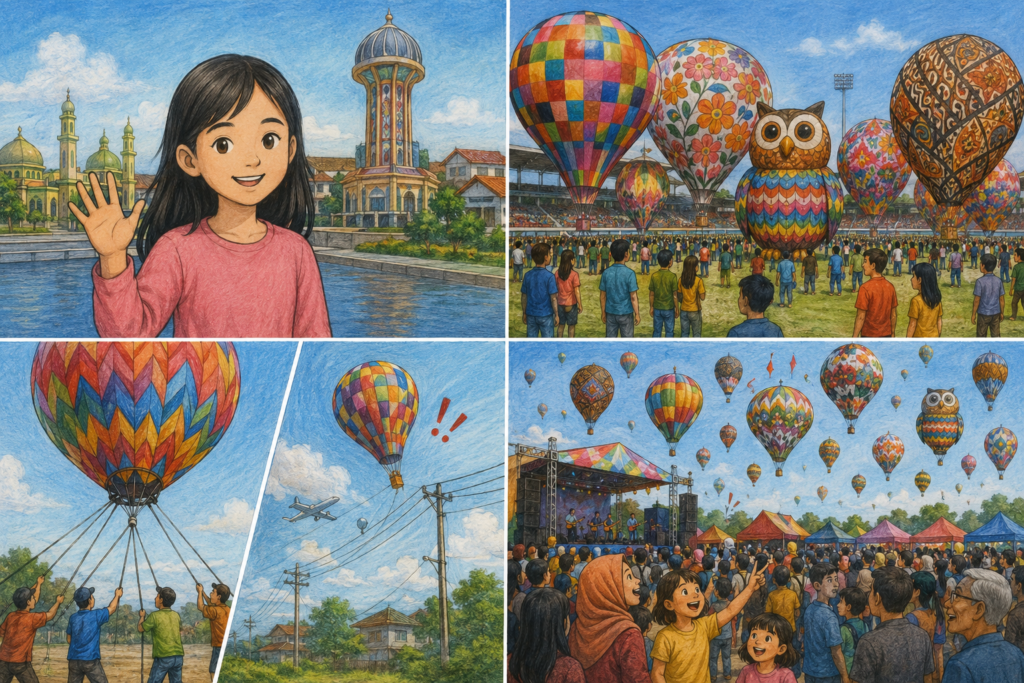
Hello, my name is Wulandari. I am a young girl from Pekalongan, Central Java.
In 2026, after Idul Fitri (Idul Fitri is a special day for Muslims) on 21 March, I went to a big and beautiful event called the Pekalongan (city in central Java) Balloon Festival.
The festival happened during Syawalan (Syawalan is a celebration one week after Idul Fitri), about one week after Lebaran (Muslim holiday).
People made big hot air balloons from paper and plastic. The balloons had many bright colours. Some looked like animals, flowers, or batik patterns.
Around 79 teams joined the event. They flew the balloons at Stadion Hoegeng.
In the past, people released the balloons freely without ropes. This was dangerous because the balloons could hit planes or power lines.
But in 2026, the government made a safe festival. They tied all the balloons with strong ropes. This is called “balon tambat (a balloon tied with ropes so it cannot fly away)”. Everyone enjoyed the show safely.
On the festival day, I went to the stadium with my family. Many people came. Families, children, and old people watched together. The sky became full of colourful balloons. It looked very beautiful. There was music, food, and many places to take photos. People felt happy and proud of our culture.
The festival was very important for us. It kept our old tradition alive in a safe way. Young people like me learned how to make balloons from our parents.
Many visitors came from other cities.
I liked this festival very much. When I saw the balloons go up into the sky, I felt excited and happy. It showed our creativity and togetherness. The theme this year was “Jaga Tradisi, Jaga Langit, Jaga Kota” (Preserve Tradition, Protect the Sky, Protect the City).
It was one of the best events in my city.
Vocabulary:
- an event: a special occasion when people meet or do something together
- a balloon: a light rubber object you fill with air or gas so it floats or becomes round
- a bright colour: a strong, clear colour that is easy to see (like red, yellow, or blue)
- a batik pattern: a traditional cloth design made with wax and dye
- to join an event: to take part in an event with other people
- to fly a balloon: to make a balloon go up into the air
- to release: to let something go free
- a rope: a long, thick string used to tie or pull things
- to hit a plane: to touch or crash into an airplane (usually dangerous)
- a power line: wires that carry electricity
- to be safe: to be free from danger
- to tie something: to use a string or rope to hold something together
- to enjoy the show: to have fun watching a performance or event
- to be proud of one’s culture: to feel happy and positive about your traditions and way of life
- to keep a tradition alive: to continue doing customs from the past
- to feel excited: to feel very happy and energetic about something
- to show creativity: to make or do something in a new and imaginative way
- togetherness: the feeling of being close and united with others
- to preserve: to keep something safe so it does not change or get lost
- to protect: to keep someone or something safe from harm
#################
Verbs and their past tense forms (regular, irregular):
| Infinitive | Past Simple | A1 Definition |
|---|---|---|
| be | was / were | exist; be in a state |
| go | went | move from one place to another |
| happen | happened | take place |
| make | made | create or produce |
| have | had | own or possess something |
| look | looked | seem or appear |
| join | joined | become part of a group |
| fly | flew | move through the air |
| release | released | let something go |
| hit | hit | strike with force |
| can | could | be able to |
| tie | tied | fasten with a rope |
| call | called | give a name to something |
| enjoy | enjoyed | get pleasure from something |
| come | came | move to a place |
| watch | watched | look at something for a time |
| become | became | change into something |
| feel | felt | experience an emotion |
| keep | kept | continue to have or maintain |
| learn | learned | get knowledge or skill |
| like | liked | enjoy something |
| see | saw | use your eyes |
| show | showed | make something visible |
| preserve | preserved | keep something safe or unchanged |
| protect | protected | keep safe from harm |
################
Match the words with the correct definitions
Words
- an event
- a balloon
- a bright colour
- a batik pattern
- to join an event
- to fly a balloon
- to release
- a rope
- to hit a plane
- a power line
- to be safe
- to tie something
- to enjoy the show
- to be proud of one’s culture
- to keep a tradition alive
- to feel excited
- to show creativity
- togetherness
- to preserve
- to protect
Definitions
A. to feel very happy and energetic about something
B. a long, thick string used to tie or pull things
C. a traditional cloth design made with wax and dye
D. to take part in an event with other people
E. to keep something safe so it does not change or get lost
F. a special occasion when people meet or do something together
G. to have fun watching a performance or event
H. to let something go free
I. to feel happy and positive about your traditions and way of life
J. to keep someone or something safe from harm
K. wires that carry electricity
L. a light rubber object you fill with air or gas
M. to make or do something in a new and imaginative way
N. to make a balloon go up into the air
O. to be free from danger
P. to continue doing customs from the past
Q. to use a string or rope to hold something together
R. to touch or crash into an airplane (usually dangerous)
S. a strong, clear colour that is easy to see
T. the feeling of being close and united with others
______________________
Answers:
1-F, 2-L, 3-S, 4-C, 5-D, 6-N, 7-H,
8-B, 9-R, 10-K, 11-O, 12-Q, 13-G,
14-I, 15-P, 16-A, 17-M, 18-T, 19-E, 20-J
################
Match the definitions with the correct words:
Definitions
- to keep someone or something safe from harm
- a light rubber object you fill with air or gas
- a strong, clear colour that is easy to see
- to take part in an event with other people
- a long, thick string used to tie or pull things
- a traditional cloth design made with wax and dye
- to feel very happy and energetic about something
- to let something go free
- to make or do something in a new and imaginative way
- to be free from danger
- to make a balloon go up into the air
- a special occasion when people meet or do something together
- wires that carry electricity
- to touch or crash into an airplane (usually dangerous)
- to have fun watching a performance or event
- to continue doing customs from the past
- to feel happy and positive about your traditions and way of life
- the feeling of being close and united with others
- to use a string or rope to hold something together
- to keep something safe so it does not change or get lost
Words
A. to fly a balloon
B. togetherness
C. a rope
D. to preserve
E. to enjoy the show
F. to be safe
G. to protect
H. to join an event
I. a balloon
J. to show creativity
K. an event
L. to keep a tradition alive
M. to feel excited
N. to release
O. to hit a plane
P. a batik pattern
Q. a power line
R. to tie something
S. to be proud of one’s culture
T. a bright colour
______________________
Answers:
1-G, 2-I, 3-T, 4-H, 5-C, 6-P, 7-M,
8-N, 9-J, 10-F, 11-A, 12-K, 13-Q, 14-O,
15-E, 16-L, 17-R, 18-B, 19-R, 20-D
################
True or false:
- A rope is a digital tool used to control music during cultural shows.
- A balloon is a light thing filled with air or gas.
- To join an event means to watch the festival from home without going outside.
- A batik pattern is a traditional design on cloth.
- To release means to collect all festival items and lock them in storage.
- A power line carries electricity to houses.
- Togetherness means people stay alone and do activities without others.
- An event is a time when people meet and do activities.
- To preserve means to keep something safe for the future.
- A power line is a type of cloth used to decorate batik clothes at festivals.
- A balloon is a heavy metal object used to build festival stages in cities.
- To be safe means to not be in danger.
- A rope is a long string used to tie things.
- To release means to let something go free.
- A batik pattern is a machine used to clean the stadium after events.
- An event is a small private room used only for storing festival food supplies.
- To join an event means to take part in it.
- Togetherness means people are happy and united.
- To be safe means to increase danger during balloon flights at the stadium.
- To preserve means to change traditions quickly into new modern sports.
_____________________
True: 2,4,6,8,9,12,13,14,16,17
_____________________
Correct version:
- A rope is a digital tool used to control music during cultural shows. True is: A rope is a long string used to tie things.
- A balloon is a light thing filled with air or gas.
- To join an event means to watch the festival from home without going outside. True is: To join an event means to take part in it.
- A batik pattern is a traditional design on cloth.
- To release means to collect all festival items and lock them in storage. True is: To release means to let something go free.
- A power line carries electricity to houses.
- Togetherness means people stay alone and do activities without others. True is: Togetherness means people are happy and united.
- An event is a time when people meet and do activities.
- To preserve means to keep something safe for the future.
- A power line is a type of cloth used to decorate batik clothes at festivals. True is: A power line carries electricity to houses.
- A balloon is a heavy metal object used to build festival stages in cities. True is: A balloon is a light thing filled with air or gas.
- To be safe means to not be in danger.
- A rope is a long string used to tie things.
- To release means to let something go free.
- A batik pattern is a machine used to clean the stadium after events. True is: A batik pattern is a traditional design on cloth.
- An event is a small private room used only for storing festival food supplies. True is: An event is a time when people meet and do activities.
- To join an event means to take part in it.
- Togetherness means people are happy and united.
- To be safe means to increase danger during balloon flights at the stadium. True is: To be safe means to not be in danger.
- To preserve means to change traditions quickly into new modern sports. True is: To preserve means to keep something safe for the future.
###############
Short answers, past simple, basics:
| Example Sentence | Yes | No |
|---|---|---|
| I learned letters. | Yes, I did. | No, I didn’t. |
| You read signs. | Yes, you did. | No, you didn’t. |
| He spoke English. | Yes, he did. | No, he didn’t. |
| She watched TV. | Yes, she did. | No, she didn’t. |
| It helped me. | Yes, it did. | No, it didn’t. |
| We used an app. | Yes, we did. | No, we didn’t. |
| You read words. | Yes, you did. | No, you didn’t. |
| They made mistakes. | Yes, they did. | No, they didn’t. |
Questions (Past Simple)
| Question | Yes | No |
|---|---|---|
| Did I learn letters? | Yes, I did. | No, I didn’t. |
| Did you read signs? | Yes, you did. | No, you didn’t. |
| Did he speak English? | Yes, he did. | No, he didn’t. |
| Did she watch TV? | Yes, she did. | No, she didn’t. |
| Did it help me? | Yes, it did. | No, it didn’t. |
| Did we use an app? | Yes, we did. | No, we didn’t. |
| Did you read words? | Yes, you did. | No, you didn’t. |
| Did they make mistakes? | Yes, they did. | No, they didn’t. |
Was / Were
| Question | Yes | No |
|---|---|---|
| Was I happy? | Yes, I was. | No, I wasn’t. |
| Were you happy? | Yes, you were. | No, you weren’t. |
| Was he happy? | Yes, he was. | No, he wasn’t. |
| Was she happy? | Yes, she was. | No, she wasn’t. |
| Was it good? | Yes, it was. | No, it wasn’t. |
| Were we happy? | Yes, we were. | No, we weren’t. |
| Were you happy? | Yes, you were. | No, you weren’t. |
| Were they happy? | Yes, they were. | No, they weren’t. |
#################
Short answers wanted:
- Did Wulandari go to the balloon festival?
YOU WRITE:
Yes, she did. - Was the festival in Jakarta?
- Did people use ropes to hold the balloons?
- Were the balloons made only from metal?
- Did the festival happen after Idul Fitri?
- Did the government make the festival safer in 2026?
- Was the sky empty during the festival?
- Were there about 79 teams in the event?
- Did families watch the festival together?
- Did the festival have music and food?
- Did the balloons fly freely without ropes in 2026?
- Was the stadium called Jakarta Stadium?
- Did visitors come from other cities?
- Were there only 10 teams in the festival?
- Did young people learn to make balloons?
- Was the festival not important for culture?
- Did people feel happy at the festival?
- Was the theme about ignoring traditions?
- Did the balloons look like animals and flowers?
- Was the festival dangerous in 2026?
______________________
Answers:
Did Wulandari go to the balloon festival? — Yes, she did.
Was the festival in Jakarta? — No, it wasn’t.
Did people use ropes to hold the balloons? — Yes, they did.
Were the balloons made only from metal? — No, they weren’t.
Did the festival happen after Idul Fitri? — Yes, it did.
Did the government make the festival safer in 2026? — Yes, it did.
Was the sky empty during the festival? — No, it wasn’t.
Were there about 79 teams in the event? — Yes, there were.
Did families watch the festival together? — Yes, they did.
Did the festival have music and food? — Yes, it did.
Did the balloons fly freely without ropes in 2026? — No, they didn’t.
Was the stadium called Jakarta Stadium? — No, it wasn’t.
Did visitors come from other cities? — Yes, they did.
Were there only 10 teams in the festival? — No, there weren’t.
Did young people learn to make balloons? — Yes, they did.
Was the festival not important for culture? — No, it wasn’t.
Did people feel happy at the festival? — Yes, they did.
Was the theme about ignoring traditions? — No, it wasn’t.
Did the balloons look like animals and flowers? — Yes, they did.
Was the festival dangerous in 2026? — No, it wasn’t.
##############
Basics in past simple:
| Personal Pronoun | Verb (Past) | Object |
|---|---|---|
| I | ate | apples |
| You | ate | apples |
| He | ate | apples |
| She | ate | apples |
| It | ate | apples |
| We | ate | apples |
| You (plural) | ate | apples |
| They | ate | apples |
| I | played | football |
| You | played | football |
| He | played | football |
| She | played | football |
| It | played | football |
| We | played | football |
| You (plural) | played | football |
| They | played | football |
| Personal Pronoun | Verb (Past Negative) | Object |
|---|---|---|
| I | did not eat | apples |
| You | did not eat | apples |
| He | did not eat | apples |
| She | did not eat | apples |
| It | did not eat | apples |
| We | did not eat | apples |
| You (plural) | did not eat | apples |
| They | did not eat | apples |
| I | did not play | football |
| You | did not play | football |
| He | did not play | football |
| She | did not play | football |
| It | did not play | football |
| We | did not play | football |
| You (plural) | did not play | football |
| They | did not play | football |
| Did + Pronoun | Verb | Object |
|---|---|---|
| Did I | eat | apples? |
| Did you | eat | apples? |
| Did he | eat | apples? |
| Did she | eat | apples? |
| Did it | eat | apples? |
| Did we | eat | apples? |
| Did you | eat | apples? |
| Did they | eat | apples? |
| Did I | play | football? |
| Did you | play | football? |
| Did he | play | football? |
| Did she | play | football? |
| Did it | play | football? |
| Did we | play | football? |
| Did you | play | football? |
| Did they | play | football? |
| Didn’t + Pronoun | Verb | Object |
|---|---|---|
| Didn’t I | eat | apples? |
| Didn’t you | eat | apples? |
| Didn’t he | eat | apples? |
| Didn’t she | eat | apples? |
| Didn’t it | eat | apples? |
| Didn’t we | eat | apples? |
| Didn’t you | eat | apples? |
| Didn’t they | eat | apples? |
| Didn’t I | play | football? |
| Didn’t you | play | football? |
| Didn’t he | play | football? |
| Didn’t she | play | football? |
| Didn’t it | play | football? |
| Didn’t we | play | football? |
| Didn’t you | play | football? |
| Didn’t they | play | football? |
##################
Past simple forms of ‚to be‘:
| Person | Past |
|---|---|
| I | was |
| You | were |
| He/She/It | was |
| We | were |
| You (pl) | were |
| They | were |
| Person | Question |
|---|---|
| I | Was I …? |
| You | Were you …? |
| He/She/It | Was he/she/it …? |
| We | Were we …? |
| You (pl) | Were you …? |
| They | Were they …? |
| Person | Negative |
|---|---|
| I | I was not (I wasn’t) |
| You | You were not (You weren’t) |
| He/She/It | He/She/It was not (He/She/It wasn’t) |
| We | We were not (We weren’t) |
| You (pl) | You were not (You weren’t) |
| They | They were not (They weren’t) |
| Person | Negative Question |
|---|---|
| I | Wasn’t I …? |
| You | Weren’t you …? |
| He/She/It | Wasn’t he/she/it …? |
| We | Weren’t we …? |
| You (pl) | Weren’t you …? |
| They | Weren’t they …? |
####################
Answers as shown:
a) negation
b) question
c) negative question
- Wulandari went to the balloon festival.
YOU WRITE:
a) Wulandari did not go to the balloon festilva.
b) Did Wulanari go to the balloon festival?
c) Didn’t Wulanari go to the balloon festival? - The festival was in Jakarta.
- People used ropes to hold the balloons.
- The balloons were made only from metal.
- The festival happened after Idul Fitri.
- The government made the festival safer in 2026.
- The sky was empty during the festival.
- There were about 79 teams in the event.
- Families watched the festival together.
- The festival had music and food.
- The balloons flew freely without ropes in 2026.
- The stadium was called Jakarta Stadium.
- Visitors came from other cities.
- There were only 10 teams in the festival.
- Young people learned to make balloons.
- The festival was important for culture.
- The festival showed creativity and togetherness.
- People felt happy at the festival.
- The balloons looked like animals and flowers.
- The festival was dangerous in 2026.
___________________________
Correct version:
- Wulandari went to the balloon festival.
a) Wulandari did not go to the balloon festival.
b) Did Wulandari go to the balloon festival?
c) Didn’t Wulandari go to the balloon festival? - The festival was in Jakarta.
a) The festival was not in Jakarta.
b) Was the festival in Jakarta?
c) Wasn’t the festival in Jakarta? - People used ropes to hold the balloons.
a) People did not use ropes to hold the balloons.
b) Did people use ropes to hold the balloons?
c) Didn’t people use ropes to hold the balloons? - The balloons were made only from metal.
a) The balloons were not made only from metal.
b) Were the balloons made only from metal?
c) Weren’t the balloons made only from metal? - The festival happened after Idul Fitri.
a) The festival did not happen after Idul Fitri.
b) Did the festival happen after Idul Fitri?
c) Didn’t the festival happen after Idul Fitri? - The government made the festival safer in 2026.
a) The government did not make the festival safer in 2026.
b) Did the government make the festival safer in 2026?
c) Didn’t the government make the festival safer in 2026? - The sky was empty during the festival.
a) The sky was not empty during the festival.
b) Was the sky empty during the festival?
c) Wasn’t the sky empty during the festival? - There were about 79 teams in the event.
a) There were not about 79 teams in the event.
b) Were there about 79 teams in the event?
c) Weren’t there about 79 teams in the event? - Families watched the festival together.
a) Families did not watch the festival together.
b) Did families watch the festival together?
c) Didn’t families watch the festival together? - The festival had music and food.
a) The festival did not have music and food.
b) Did the festival have music and food?
c) Didn’t the festival have music and food? - The balloons flew freely without ropes in 2026.
a) The balloons did not fly freely without ropes in 2026.
b) Did the balloons fly freely without ropes in 2026?
c) Didn’t the balloons fly freely without ropes in 2026? - The stadium was called Jakarta Stadium.
a) The stadium was not called Jakarta Stadium.
b) Was the stadium called Jakarta Stadium?
c) Wasn’t the stadium called Jakarta Stadium? - Visitors came from other cities.
a) Visitors did not come from other cities.
b) Did visitors come from other cities?
c) Didn’t visitors come from other cities? - There were only 10 teams in the festival.
a) There were not only 10 teams in the festival.
b) Were there only 10 teams in the festival?
c) Weren’t there only 10 teams in the festival? - Young people learned to make balloons.
a) Young people did not learn to make balloons.
b) Did young people learn to make balloons?
c) Didn’t young people learn to make balloons? - The festival was important for culture.
a) The festival was not important for culture.
b) Was the festival important for culture?
c) Wasn’t the festival important for culture? - The festival showed creativity and togetherness. (REPLACED)
a) The festival did not show creativity and togetherness.
b) Did the festival show creativity and togetherness?
c) Didn’t the festival show creativity and togetherness? - People felt happy at the festival.
a) People did not feel happy at the festival.
b) Did people feel happy at the festival?
c) Didn’t people feel happy at the festival? - The balloons looked like animals and flowers.
a) The balloons did not look like animals and flowers.
b) Did the balloons look like animals and flowers?
c) Didn’t the balloons look like animals and flowers? - The festival was dangerous in 2026.
a) The festival was not dangerous in 2026.
b) Was the festival dangerous in 2026?
c) Wasn’t the festival dangerous in 2026?
##################
Complete in past simple:
Wulandari ________ (go) to a balloon festival in Pekalongan after Idul Fitri. The festival ________ (happen) in 2026 at Hoegeng Stadium. She ________ (see) many people who ________ (come) with their families. About 79 teams ________ (make) colourful balloons from paper and plastic. People ________ (tie) the balloons with ropes for safety. In the past, balloons ________ (fly) freely, but now the government ________ (make) the event safer. There ________ (be) music, food, and many visitors. People ________ (see) the balloons in the sky and ________ (feel) happy. Wulandari ________ (go) around the stadium and ________ (meet) many friends. She ________ (take) photos and ________ (show) them to her parents. Young people ________ (learn) how to make balloons from older people. The festival ________ (keep) old traditions alive in a safe way. Wulandari ________ (feel) very excited and ________ (think) the event was beautiful. She ________ (know) it was one of the best moments she ________ (have) in her life.
________________________
Correct version:
Wulandari went to a balloon festival in Pekalongan after Idul Fitri. The festival happened in 2026 at Hoegeng Stadium. She saw many people who came with their families. About 79 teams made colourful balloons from paper and plastic. People tied the balloons with ropes for safety. In the past, balloons flew freely, but now the government made the event safer. There was music, food, and many visitors. People saw the balloons in the sky and felt happy. Wulandari went around the stadium and met many friends. She took photos and showed them to her parents. Young people learned how to make balloons from older people. The festival kept old traditions alive in a safe way. Wulandari felt very excited and thought the event was beautiful. She knew it was one of the best moments she had in her life.
##################
Match question and answer:
- Where did you go?
2.When did the festival happen?
3.Who did you see there?
4.What did people make?
5.How did they keep the balloons safe?
6.What did you see in the sky?
7.How did you feel?
8.Where did you go during the festival?
9.Who did you meet?
10.What did you do with photos?
11.Who learned about balloons?
12.What did the festival keep?
13.How did you think about the event?
14.What did the festival show?
Answers:
a. I felt very happy and excited.
b. It displayed creativity and togetherness.
c. I moved around the stadium.
d. I attended a balloon festival in Pekalongan.
e. I greeted many friends.
f. I noticed many colourful balloons.
g. It took place in 2026 after Idul Fitri.
h. I met many people with their families.
i. I found it beautiful.
j. They created colourful balloons from paper and plastic.
k. Young people gained skills [to learn how to do something better] from older people.
l. I captured [take ] pictures and gave them to my parents.
m. They controlled them with ropes.
n. It maintained [keep] old traditions alive.
______________________
Answers:
1-d, 2-g, 3-h, 4-j, 5-m, 6-f, 7-a, 8-c, 9-e, 10-l, 11-k, 12-n, 13-i, 14-b
______________________
Full dialogue:
- Where did you go? — I attended a balloon festival in Pekalongan.
- When did the festival happen? — It took place in 2026 after Idul Fitri.
- Who did you see there? — I met many people with their families.
- What did people make? — They created colourful balloons from paper and plastic.
- How did they keep the balloons safe? — They controlled them with ropes.
- What did you see in the sky? — I noticed many colourful balloons.
- How did you feel? — I felt very happy and excited.
- Where did you go during the festival? — I moved around the stadium.
- Who did you meet? — I greeted many friends.
- What did you do with photos? — I captured pictures and gave them to my parents.
- Who learned about balloons? — Young people gained skills from older people.
- What did the festival keep? — It maintained old traditions alive.
- How did you think about the event? — I found it beautiful.
- What did the festival show? — It displayed creativity and togetherness.
##################
Answer the following questions:
- Where did Wulandari go after Idul Fitri?
- What is the name of the city?
- When did the festival happen?
- Where did the festival take place?
- Who went to the festival with Wulandari?
- What did people make at the festival?
- What materials did they use for balloons?
- How did they keep the balloons safe?
- What did Wulandari see in the sky?
- Was there music at the festival?
- Was there food at the festival?
- How did Wulandari feel at the festival?
- What did young people learn?
- What did the festival show?
- Was the festival important for culture?
________________________
Answers:
Where did Wulandari go after Idul Fitri? — She went to a balloon festival in Pekalongan.
What is the name of the city? — The city is Pekalongan.
When did the festival happen? — It happened in 2026.
Where did the festival take place? — It took place at Hoegeng Stadium.
Who went to the festival with Wulandari? — Her family went with her.
What did people make at the festival? — They made colourful balloons.
What materials did they use for balloons? — They used paper and plastic.
How did they keep the balloons safe? — They tied them with ropes.
What did Wulandari see in the sky? — She saw many colourful balloons.
Was there music at the festival? — Yes, there was.
Was there food at the festival? — Yes, there was.
How did Wulandari feel at the festival? — She felt happy and excited.
What did young people learn? — They learned how to make balloons.
What did the festival show? — It showed creativity and togetherness.
Was the festival important for culture? — Yes, it was.
###################
Schreibe einen Kommentar