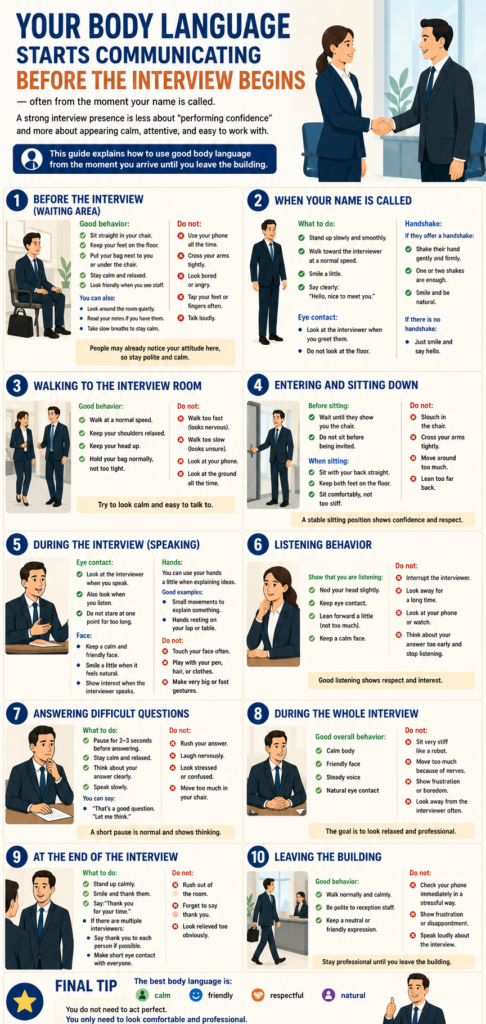
Your body language starts communicating before the interview begins — often from the moment your name is called. A strong interview presence is less about “performing confidence” and more about appearing calm, attentive, and easy to work with.
This guide explains how to use good body language from the moment you arrive until you leave the building.
1. Before the Interview (Waiting Area)
When you arrive at the company, you may need to wait.
Good behavior:
- Sit straight in your chair.
- Keep your feet on the floor.
- Put your bag next to you or under the chair.
- Stay calm and relaxed.
- Look friendly when you see staff.
You can also:
- Look around the room quietly.
- Read your notes if you have them.
- Take slow breaths to stay calm.
Do not:
- Use your phone all the time.
- Cross your arms tightly.
- Look bored or angry.
- Tap your feet or fingers often.
- Talk loudly.
People may already notice your attitude here, so stay polite and calm.
2. When Your Name Is Called
This is your first direct contact with the interviewer.
What to do:
- Stand up slowly and smoothly.
- Walk toward the interviewer at a normal speed.
- Smile a little.
- Say clearly:“Hello, nice to meet you.”
Eye contact:
- Look at the interviewer when you greet them.
- Do not look at the floor.
Handshake:
If they offer a handshake:
- Shake their hand gently and firmly.
- One or two shakes are enough.
- Smile and be natural.
If there is no handshake:
- Just smile and say hello.
3. Walking to the Interview Room
You may walk with the interviewer.
Good behavior:
- Walk at a normal speed.
- Keep your shoulders relaxed.
- Keep your head up.
- Hold your bag normally, not too tight.
Do not:
- Walk too fast (looks nervous).
- Walk too slow (looks unsure).
- Look at your phone.
- Look at the ground all the time.
Try to look calm and easy to talk to.
4. Entering and Sitting Down
When you enter the room:
Before sitting:
- Wait until they show you the chair.
- Do not sit before being invited.
When sitting:
- Sit with your back straight.
- Keep both feet on the floor.
- Sit comfortably, not too stiff.
Do not:
- Slouch in the chair.
- Cross your arms tightly.
- Move around too much.
- Lean too far back.
A stable sitting position shows confidence and respect.
5. During the Interview (Speaking)
Eye contact:
- Look at the interviewer when you speak.
- Also look when you listen.
- Do not stare at one point for too long.
Face:
- Keep a calm and friendly face.
- Smile a little when it feels natural.
- Show interest when the interviewer speaks.
Hands:
You can use your hands a little when explaining ideas.
Good examples:
- Small movements to explain something.
- Hands resting on your lap or table.
Do not:
- Touch your face often.
- Play with your pen, hair, or clothes.
- Make very big or fast gestures.
6. Listening Behavior
Good listening is very important.
Show that you are listening:
- Nod your head slightly.
- Keep eye contact.
- Lean forward a little (not too much).
- Keep a calm face.
Do not:
- Interrupt the interviewer.
- Look away for a long time.
- Look at your phone or watch.
- Think about your answer too early and stop listening.
Good listening shows respect and interest.
7. Answering Difficult Questions
Sometimes questions are hard.
What to do:
- Pause for 2–3 seconds before answering.
- Stay calm and relaxed.
- Think about your answer clearly.
- Speak slowly.
You can say:
“That’s a good question. Let me think.”
Do not:
- Rush your answer.
- Laugh nervously.
- Look stressed or confused.
- Move too much in your chair.
A short pause is normal and shows thinking.
8. During the Whole Interview
Try to keep a balanced style:
Good overall behavior:
- Calm body
- Friendly face
- Steady voice
- Natural eye contact
Do not:
- Sit very stiff like a robot.
- Move too much because of nerves.
- Show frustration or boredom.
- Look away from the interviewer often.
The goal is to look relaxed and professional.
9. At the End of the Interview
When the interview finishes:
What to do:
- Stand up calmly.
- Smile and thank them.
- Say:“Thank you for your time.”
If there are multiple interviewers:
- Say thank you to each person if possible.
- Make short eye contact with everyone.
Do not:
- Rush out of the room.
- Forget to say thank you.
- Look relieved too obviously.
10. Leaving the Building
Even after the interview ends, people may still see you.
Good behavior:
- Walk normally and calmly.
- Be polite to reception staff.
- Keep a neutral or friendly expression.
Do not:
- Check your phone immediately in a stressful way.
- Show frustration or disappointment.
- Speak loudly about the interview.
Stay professional until you leave the building.
Final Tip
The best body language is:
- calm
- friendly
- respectful
- natural
You do not need to act perfect.
You only need to look comfortable and professional.
Schreibe einen Kommentar