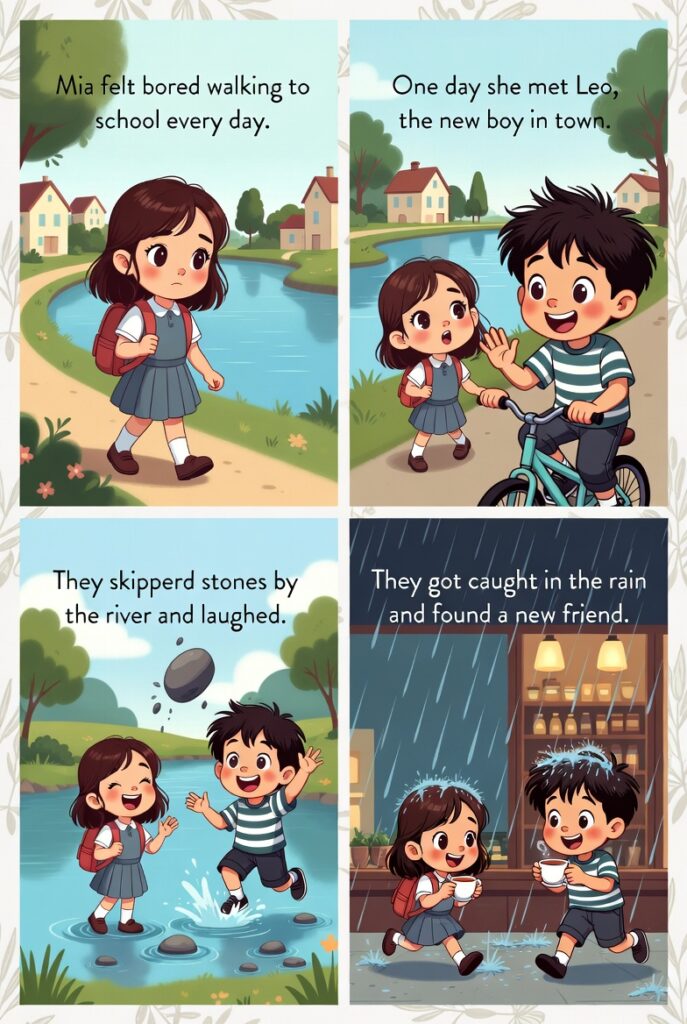
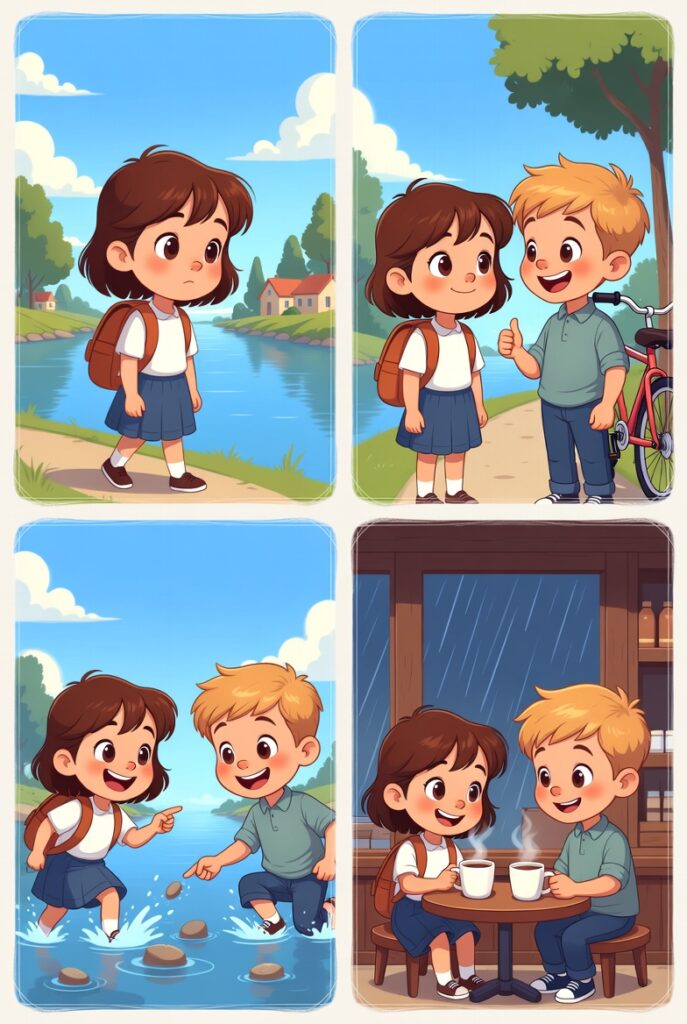
- Mia meets Leo by the river and a new friendship begins.
Vocabulary:
to feel excited: to feel very happy and full of energy
to change everything: to make everything different
to feel bored: to feel like nothing is interesting
a little bit: a small amount
a bike: a bicycle you ride
to wave: to move your hand to say hello or goodbye
to smile: to show happiness with your mouth
to walk with somebody: to go on foot together with someone
to laugh: to make a happy sound because something is funny
to be calm (river): to be quiet and not moving fast
to throw stones: to send stones through the air with your hand
to watch: to look at something carefully
to jump: to move quickly up into the air
to skip a big stone: to throw a stone so it bounces on water
a splash: the sound or drops of water when something hits water
to get wet: to have water on your body or clothes
#################
Reorganize the paragraphs to get the full story:
- Leo had a funny idea. He tried to skip a big stone, but it fell with a loud splash. Mia laughed a lot.
- Mia went home later that day. She felt happy and excited. Now she had a new friend, and every day felt new.
- One day, Mia saw a boy on a bike. He waved and smiled. His name was Leo, and he was new in town.
- After school, Leo asked Mia to walk with him. They talked and laughed. Mia felt happy and not bored anymore.
- They found a small shop and went inside. The shop was warm. They drank hot tea and smiled.
- Mia was a young girl. She lived in a small town near a river. Every day she walked to school and felt a little bored.
- Soon, it started to rain. Big drops fell from the sky. They ran fast and got very wet.
- They went to the river. The water was blue and calm. They threw small stones and watched them jump.
__________________________
Answers: 6 -3 -4 -8 -5 -7 -1 2
__________________________
Correct version:
Mia was a young girl. She lived in a small town near a river. Every day she walked to school and felt a little bored.
One day, Mia saw a boy on a bike. He waved and smiled. His name was Leo, and he was new in town.
After school, Leo asked Mia to walk with him. They talked and laughed. Mia felt happy and not bored anymore.
They went to the river. The water was blue and calm. They threw small stones and watched them jump.
Leo had a funny idea. He tried to skip a big stone, but it fell with a loud splash. Mia laughed a lot.
Soon, it started to rain. Big drops fell from the sky. They ran fast and got very wet.
They found a small shop and went inside. The shop was warm. They drank hot tea and smiled.
Mia went home later that day. She felt happy and excited. Now she had a new friend, and every day felt new.
______________________
Basics in past simple:
Past Simple – Regular Verbs
Rules:
- Most verbs: add -ed
play → played - Verbs ending in -e: add -d
live → lived - Verbs ending in consonant + y: change y to i and add -ed
study → studied - Short verbs ending in vowel + consonant: double the final consonant and add -ed
stop → stopped - List of irregular verbs => LINK
Use:
The past simple is used to talk about finished actions in the past.
#################
Verbs in text, regular and irregular past tense:
| Infinitive | Past Simple |
|---|---|
| to be | was / were |
| to live | lived |
| to walk | walked |
| to feel | felt |
| to see | saw |
| to wave | waved |
| to smile | smiled |
| to ask | asked |
| to talk | talked |
| to laugh | laughed |
| to go | went |
| to throw | threw |
| to watch | watched |
| to have | had |
| to try | tried |
| to skip | skipped |
| to fall | fell |
| to start | started |
| to rain | rained |
| to run | ran |
| to get | got |
| to find | found |
| to drink | drank |
################
Match the words to the definitions
Words:
- to feel excited
- to throw stones
- to change everything
- to smile
- to wave
- to laugh
- to be calm (river)
- a bike
- to feel bored
- to get wet
- to watch
- to walk with somebody
- to skip a big stone
- a splash
- a little bit
- to jump
Definitions:
A. to move your hand to say hello or goodbye
B. to feel very happy and full of energy
C. to look at something carefully
D. to be quiet and not moving fast
E. to show happiness with your mouth
F. to make everything different
G. a bicycle you ride
H. to go on foot together with someone
I. to make a happy sound because something is funny
J. to have water on your body or clothes
K. to throw a stone so it bounces on water
L. the sound or drops of water when something hits water
M. to feel like nothing is interesting
N. to move quickly up into the air
O. to send stones through the air with your hand
P. a small amount
______________________
Answers:
1-B, 2-O, 3-F, 4-E, 5-A, 6-I,
7-D, 8-G, 9-M, 10-J, 11-C,
12-H, 13-K, 14-L, 15-P, 16-N
################
Find the correct word:
- to make a happy sound because something is funny
- to show happiness with your mouth
- a bicycle you ride
- to move your hand to say hello or goodbye
- to feel very happy and full of energy
- to have water on your body or clothes
- to move quickly up into the air
- to make everything different
- to look at something carefully
- to feel like nothing is interesting
- to go on foot together with someone
- to be quiet and not moving fast
- the sound or drops of water when something hits water
- to send stones through the air with your hand
- to throw a stone so it bounces on water
- a small amount
Words :
A. to feel bored
B. to smile
C. a bike
D. to wave
E. to feel excited
F. to get wet
G. to jump
H. to change everything
I. to watch
J. to laugh
K. to walk with somebody
L. to be calm (river)
M. a splash
N. to throw stones
O. to skip a big stone
P. a little bit
______________________
Answers:
1-J, 2-B, 3-C, 4-D, 5-E, 6-F,
7-G, 8-H, 9-I, 10-A, 11-K, 12-L,
13-M, 14-N, 15-O, 16-P
################
True or False:
- To throw stones means to keep stones in your pocket without moving them.
- To be calm (river) means the water is quiet and not moving fast.
- To smile means to cry loudly when you are sad.
- To wave means to move your hand to say hello or goodbye.
- A splash is the sound when fire burns wood.
- To change everything means to keep everything exactly the same.
- To walk with somebody means to go on foot together with someone.
- To laugh means to make a happy sound because something is funny.
- To feel excited means to feel very happy and full of energy.
- To skip a big stone means to eat the stone quickly.
- A bike is something you ride with two wheels.
- To get wet means to have water on your body or clothes.
- To watch means to close your eyes and sleep.
- To feel bored means everything feels very interesting.
________________________
Answers:
1F, 2T, 3F, 4T, 5F, 6F, 7T, 8T,
9T, 10F, 11T, 12T, 13F, 14F
#################
True or false:
- Mia and Leo went to school together in the morning.
- They went to the river and threw stones.
- Leo was Mia’s brother.
- Mia felt bored at the beginning of the story.
- They flew a kite [a light toy that flies in the wind, you hold it with a string] in the rain.
- Mia and Leo laughed together.
- It was sunny all day and nothing changed.
- Mia went home feeling sad and bored again.
- The river water was blue and calm.
- They drank hot tea in a small shop.
- Leo fell into the river and got very angry.
- Mia and Leo walked together after school.
- Mia did not like Leo at all.
- It started to rain while they were outside.
- Leo was new in town.
- The river water was dirty and brown.
- Mia lived in a small town near a river.
- They went to a big supermarket to buy food.
___________________________
Answers:
1F, 2T, 3F, 4T, 5F, 6T, 7F,
8F, 9T, 10T, 11F, 12T, 13F,
14T, 15T, 16F, 17T, 18F
###################
Short answer questions:
- Where did Mia live?
- How did Mia feel at the beginning of the story?
- Who did Mia meet?
- What was Leo riding?
- What did Leo do when he saw Mia?
- What did Leo ask Mia to do after school?
- Where did Mia and Leo go together?
- What did they throw at the river?
- What was the river like?
- What did Mia and Leo do at the river?
- What happened when Leo tried to skip a big stone?
- What started to happen while they were outside?
- Where did they go when it rained?
- What did they drink in the shop?
- How did Mia feel in the shop?
- How did Mia feel at the end of the story?
- What kind of friend did Mia get?
- Did Mia’s life feel the same or different after meeting Leo?
_____________________
Short answers:
- Where did Mia live? – small town, near river
- How did Mia feel at the beginning of the story? – bored
- Who did Mia meet on the way to school? – Leo
- What was Leo riding when Mia saw him? – bike
- What did Leo do when he saw Mia for the first time? – waved, smiled
- What did Leo ask Mia to do after school? – walk together
- When did Mia and Leo walk together? – after school
- Where did Mia and Leo go after school? – river
- What did they do at the river? – talked, laughed, threw stones
- What did they throw into the river? – stones
- Why did Leo’s stone fall into the water? – big stone, splash
- What happened when Leo tried to skip a big stone? – fell, splash
- When did it start to rain? – while outside, later
- Where did Mia and Leo go when it started to rain? – shop
- What did Mia and Leo drink in the shop? – hot tea
- How did Mia feel while she was in the shop? – warm, happy
- How did Mia feel at the end of the day? – happy, excited
- What changed in Mia’s life after meeting Leo? – new friend, not bored, different days
#################
Short answers, past simple, basics:
| Example Sentence | Yes | No |
|---|---|---|
| I learned letters. | Yes, I did. | No, I didn’t. |
| You read signs. | Yes, you did. | No, you didn’t. |
| He spoke English. | Yes, he did. | No, he didn’t. |
| She watched TV. | Yes, she did. | No, she didn’t. |
| It helped me. | Yes, it did. | No, it didn’t. |
| We used an app. | Yes, we did. | No, we didn’t. |
| You read words. | Yes, you did. | No, you didn’t. |
| They made mistakes. | Yes, they did. | No, they didn’t. |
Questions (Past Simple)
| Question | Yes | No |
|---|---|---|
| Did I learn letters? | Yes, I did. | No, I didn’t. |
| Did you read signs? | Yes, you did. | No, you didn’t. |
| Did he speak English? | Yes, he did. | No, he didn’t. |
| Did she watch TV? | Yes, she did. | No, she didn’t. |
| Did it help me? | Yes, it did. | No, it didn’t. |
| Did we use an app? | Yes, we did. | No, we didn’t. |
| Did you read words? | Yes, you did. | No, you didn’t. |
| Did they make mistakes? | Yes, they did. | No, they didn’t. |
Was / Were
| Question | Yes | No |
|---|---|---|
| Was I happy? | Yes, I was. | No, I wasn’t. |
| Were you happy? | Yes, you were. | No, you weren’t. |
| Was he happy? | Yes, he was. | No, he wasn’t. |
| Was she happy? | Yes, she was. | No, she wasn’t. |
| Was it good? | Yes, it was. | No, it wasn’t. |
| Were we happy? | Yes, we were. | No, we weren’t. |
| Were you happy? | Yes, you were. | No, you weren’t. |
| Were they happy? | Yes, they were. | No, they weren’t. |
#################
Short answers:
- Leo rode a bike when Mia saw him.
YOU WRITE:
Yes, he did. - Mia went home feeling sad and bored again.
- Mia and Leo walked together after school.
- They played football in a big stadium.
- Mia lived in a small town near a river.
- They went to a cinema to watch a movie.
- It was sunny all day and nothing changed.
- The river was blue and calm.
- Mia met Leo on her way to school.
- Leo was Mia’s brother.
- They stayed inside all day and never went outside.
- Mia felt bored at the beginning of the story.
- Leo fell into the river and got very angry.
- They drank hot tea in a small shop.
- Mia and Leo did not talk to each other.
- They went to the river and threw stones.
- Leo was new in town.
- The river water was dirty and dangerous.
________________________
Answers:
- Leo rode a bike when Mia saw him. – Yes, he did.
- Mia went home feeling sad and bored again. – No, she didn’t.
- Mia and Leo walked together after school. – Yes, they did.
- They played football in a big stadium. – No, they didn’t.
- Mia lived in a small town near a river. – Yes, she did.
- They went to a cinema to watch a movie. – No, they didn’t.
- It was sunny all day and nothing changed. – No, it wasn’t.
- The river was blue and calm. – Yes, it was.
- Mia met Leo on her way to school. – Yes, she did.
- Leo was Mia’s brother. – No, he wasn’t.
- They stayed inside all day and never went outside. – No, they didn’t.
- Mia felt bored at the beginning of the story. – Yes, she did.
- Leo fell into the river and got very angry. – No, he didn’t.
- They drank hot tea in a small shop. – Yes, they did.
- Mia and Leo did not talk to each other. – No, they didn’t.
- They went to the river and threw stones. – Yes, they did.
- Leo was new in town. – Yes, he was.
- The river water was dirty and dangerous. – No, it wasn’t.
#################
Basics in past simple:
| Personal Pronoun | Verb (Past) | Object |
|---|---|---|
| I | ate | apples |
| You | ate | apples |
| He | ate | apples |
| She | ate | apples |
| It | ate | apples |
| We | ate | apples |
| You (plural) | ate | apples |
| They | ate | apples |
| I | played | football |
| You | played | football |
| He | played | football |
| She | played | football |
| It | played | football |
| We | played | football |
| You (plural) | played | football |
| They | played | football |
| Personal Pronoun | Verb (Past Negative) | Object |
|---|---|---|
| I | did not eat | apples |
| You | did not eat | apples |
| He | did not eat | apples |
| She | did not eat | apples |
| It | did not eat | apples |
| We | did not eat | apples |
| You (plural) | did not eat | apples |
| They | did not eat | apples |
| I | did not play | football |
| You | did not play | football |
| He | did not play | football |
| She | did not play | football |
| It | did not play | football |
| We | did not play | football |
| You (plural) | did not play | football |
| They | did not play | football |
| Did + Pronoun | Verb | Object |
|---|---|---|
| Did I | eat | apples? |
| Did you | eat | apples? |
| Did he | eat | apples? |
| Did she | eat | apples? |
| Did it | eat | apples? |
| Did we | eat | apples? |
| Did you | eat | apples? |
| Did they | eat | apples? |
| Did I | play | football? |
| Did you | play | football? |
| Did he | play | football? |
| Did she | play | football? |
| Did it | play | football? |
| Did we | play | football? |
| Did you | play | football? |
| Did they | play | football? |
| Didn’t + Pronoun | Verb | Object |
|---|---|---|
| Didn’t I | eat | apples? |
| Didn’t you | eat | apples? |
| Didn’t he | eat | apples? |
| Didn’t she | eat | apples? |
| Didn’t it | eat | apples? |
| Didn’t we | eat | apples? |
| Didn’t you | eat | apples? |
| Didn’t they | eat | apples? |
| Didn’t I | play | football? |
| Didn’t you | play | football? |
| Didn’t he | play | football? |
| Didn’t she | play | football? |
| Didn’t it | play | football? |
| Didn’t we | play | football? |
| Didn’t you | play | football? |
| Didn’t they | play | football? |
##################
Past simple forms of ‚to be‘:
| Person | Past |
|---|---|
| I | was |
| You | were |
| He/She/It | was |
| We | were |
| You (pl) | were |
| They | were |
| Person | Question |
|---|---|
| I | Was I …? |
| You | Were you …? |
| He/She/It | Was he/she/it …? |
| We | Were we …? |
| You (pl) | Were you …? |
| They | Were they …? |
| Person | Negative |
|---|---|
| I | I was not (I wasn’t) |
| You | You were not (You weren’t) |
| He/She/It | He/She/It was not (He/She/It wasn’t) |
| We | We were not (We weren’t) |
| You (pl) | You were not (You weren’t) |
| They | They were not (They weren’t) |
| Person | Negative Question |
|---|---|
| I | Wasn’t I …? |
| You | Weren’t you …? |
| He/She/It | Wasn’t he/she/it …? |
| We | Weren’t we …? |
| You (pl) | Weren’t you …? |
| They | Weren’t they …? |
##################
Answer as shown:
- Mia lived in a big city far away from any river.
YOU WRITE:
No, she didn’t.
She lived in a city near the river - Leo was Mia’s brother.
- Mia felt excited and happy at the beginning of the story.
- Mia and Leo went to school together every morning.
- The river water was dirty and dangerous.
- Mia and Leo never talked to each other.
- They went to a cinema to watch a movie.
- It was sunny all day and never rained.
- Leo fell into the river and got very angry.
- Mia went home feeling sad and bored again.
- Mia and Leo did not meet each other at all.
- Leo stayed in town for only one hour.
- They rode horses to school together.
- The river was red and full of fire.
- Mia threw a big stone into the sky like a ball.
- They ate pizza inside the river.
- Leo could not ride a bike.
- Mia stayed home all day and never went outside.
- They did not laugh together at all.
- The shop where they went was cold and dark, and they left immediately.
_________________________
Answers:
- Mia lived in a big city far away from any river. – No, she didn’t. She lived in a small town near the river.
- Leo was Mia’s brother. – No, he wasn’t. He was a new boy in town.
- Mia felt excited and happy at the beginning of the story. – No, she didn’t. She felt bored.
- Mia and Leo went to school together every morning. – No, they didn’t. They met on the way to school.
- The river water was dirty and dangerous. – No, it wasn’t. It was blue and calm.
- Mia and Leo never talked to each other. – No, they didn’t. They talked and laughed together.
- They went to a cinema to watch a movie. – No, they didn’t. They went to the river.
- It was sunny all day and never rained. – No, it wasn’t. It started to rain.
- Leo fell into the river and got very angry. – No, he didn’t. He dropped a stone into the water.
- Mia went home feeling sad and bored again. – No, she didn’t. She went home happy and excited.
- Mia and Leo did not meet each other at all. – No, they didn’t. They met and became friends.
- Leo stayed in town for only one hour. – No, he didn’t. He lived there as a new student.
- They rode horses to school together. – No, they didn’t. Leo rode a bike.
- The river was red and full of fire. – No, it wasn’t. It was blue and calm.
- Mia threw a big stone into the sky like a ball. – No, she didn’t. She threw stones into the river.
- They ate pizza inside the river. – No, they didn’t. They drank hot tea in a shop.
- Leo could not ride a bike. – No, he couldn’t. He rode a bike.
- Mia stayed home all day and never went outside. – No, she didn’t. She went to school and met Leo.
- They did not laugh together at all. – No, they didn’t. They laughed together.
- The shop where they went was cold and dark, and they left immediately. – No, it wasn’t. It was warm, and they stayed and drank tea.
##################
Form questions to which the words given are the answer:
- Mia’s town was near a river.
a) Mia’s town:
b) Mia’s:
c) near a river: - Leo’s bike was from Germany.
a) Leo’s bike:
b) Leo’s:
c) Germany - Mia walked to school every day.
a) Mia:
b) walked to school every day:
c) school:
d) every day: - Leo rode a bike in the afternoon.
a) Leo:
b) rode a bike in the afternoon:
c) a bike:
d) in the afternoon: - Mia and Leo went to the river after school.
a) Mia and Leo:
b) went to the river after school:
c) the river:
d) after school: - They threw stones into the river.
a) They:
b) threw stones at the river:
c) stones:
d) the river: - Mia’s day was a good one.
a) Mia’s day:
b) Mia’s:
c) a good one:
_______________________
Correct version:
Mia’s town was near a river.
a) Mia’s town: What was near a river?
b) Mia’s: Whose town was near a river?
c) near a river: Where was Mia’s town?
Leo’s bike was from Germany.
a) Leo’s bike: What was from Germany?
b) Leo’s: Whose bike was from Germany?
c) Germany: Where was Leo’s bike from?
Mia walked to school every day.
a) Mia: Who walked to school every day?
b) walked to school every day: What did Mia do every day?
c) school: Where did Mia walk to?
d) every day: How often/When did Mia walk to school?
Leo rode a bike in the afternoon.
a) Leo: Who rode a bike in the afternoon?
b) rode a bike in the afternoon: What did Leo do in the afternoon?
c) a bike: What did Leo ride?
d) in the afternoon: When did Leo ride a bike?
Mia and Leo went to the river after school.
a) Mia and Leo: Who went to the river?
b) went to the river after school: What did Mia and Leo do after school?
c) the river: Where did Mia and Leo go?
d) after school: When did they go to the river?
They threw stones into the river.
a) They: Who threw stones into the river?
b) threw stones at the river: What did they do?
c) stones: What did they throw into the river?
d) the river: Where did they throw the stones into?
Mia’s day was a good one.
a) Mia’s day: What was a good one?
b) Mia’s: Whose day was a good one?
c) a good one: What kind of day was Mia’s day?
###############
Fill in – past simple:
Mia ______________ (live) in a small town near a river.
She ______________ (feel) bored every day when she ______________ (walk) to school.
One day, she ______________ (meet) a boy named Leo who ______________ (ride) a bike and ______________ (be) new in town.
He ______________ (wave) and ______________ (smile) at her.
After school, Leo ______________ (ask) Mia to walk with him, and they ______________ (go) to the river together.
They ______________ (talk), ______________ (laugh), and ______________ (throw) stones into the calm blue water.
Leo ______________ (try) to skip a big stone, but it ______________ (fall) with a splash.
Suddenly, it ______________ (start) to rain, and they ______________ (run) to a small shop.
They ______________ (drink) hot tea and ______________ (stay) warm inside.
Later, Mia ______________ (go) home feeling happy and excited.
She ______________ (have) a new friend, and her life ______________ (change).
Every day ______________ (become) more interesting because she ______________ (spend) time with Leo and ______________ (enjoy) their small adventures together by the river.
———————————–
Correct version:
Mia lived in a small town near a river.
She felt bored every day when she walked to school.
One day, she met a boy named Leo who rode a bike and was new in town.
He waved and smiled at her.
After school, Leo asked Mia to walk with him, and they went to the river together.
They talked, laughed, and threw stones into the calm blue water.
Leo tried to skip a big stone, but it fell with a splash.
Suddenly, it started to rain, and they ran to a small shop.
They drank hot tea and stayed warm inside.
Later, Mia went home feeling happy and excited.
She had a new friend, and her life changed.
Every day became more interesting because she spent time with Leo and enjoyed their small adventures together by the river.
###############
Schreibe einen Kommentar