a. My name is Lina. b. I am fine. c. Good morning.
3. Someone asks: “How are you?”
You say:
a. My name is Budi. b. I am fine. c. Goodbye.
4. The teacher says “Stand up!”
You:
a. sit down b. stand up c. say your name
5. The teacher says “Sit down!”
You:
a. sit down b. stand up c. run
14. Teacher–Class Game
The teacher says one of the four commands:
Stand up! Sit down! Look! Listen!
The children must do the correct action.
Then the teacher can make a mistake.
For example, the teacher says:
“Stand up!”
but sits down.
The children should say the correct action:
“Stand up!”
This makes the lesson fun without needing difficult English.
15. Final Speaking Challenge
At the end of the lesson, each child speaks to another child:
Hello! What is your name? My name is ______. How are you? I am fine. Goodbye!
If a child can do this without help, the teacher can say:
“Very good!”
For the first lesson, I would concentrate on speaking and listening rather than writing. The teachers can use these dialogues repeatedly, changing only the children’s names. This gives teachers with weak English a safe script they can follow while the children get lots of real speaking practice.
##################
##################
Please use the box below to write your feedback. Only I can read it. It is not public.
Babies learn a language by listening. They use their ears to hear sounds. Their brain remembers these sounds. Babies connect sounds with people and things. They listen to their parents. Then they copy the sounds they hear. They imitate words. Slowly, babies learn to speak.
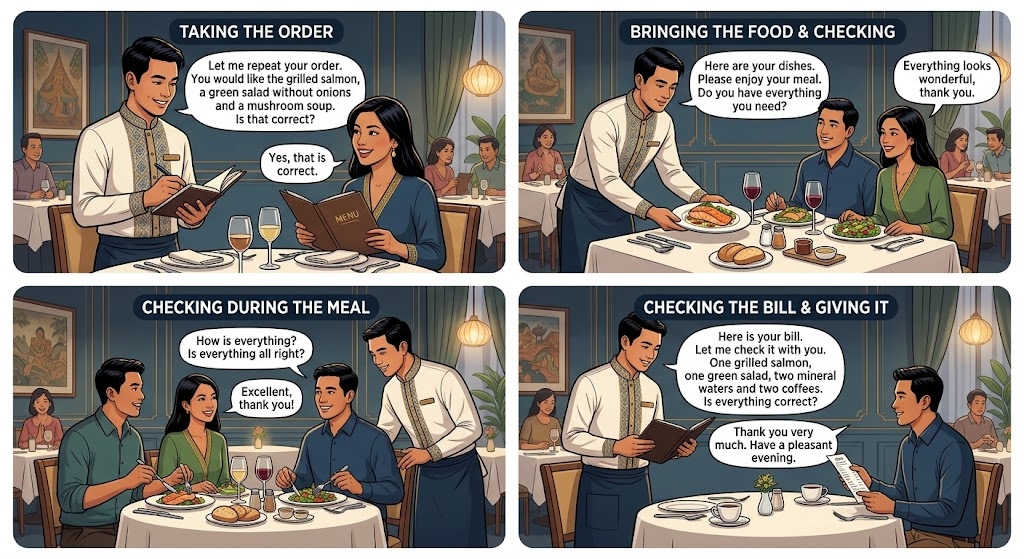
Good service is very important in a 5-star restaurant. The waiter should listen carefully, speak politely and check that everything is correct.
1. Taking the Order
The waiter should listen carefully to the guest.
He should write the order down.
After taking the order, he should repeat the order to the guest. This helps to make sure that he has the correct order.
For example:
“Let me repeat your order. You would like the grilled salmon, a green salad without onions and a mushroom soup. Is that correct?”
The guest can then say if something is wrong.
If the waiter does not understand something, he should ask.
For example:
“Would you like the steak medium or well done?”
The waiter should not guess.
2. Bringing the Food
The waiter should bring the correct food to the correct guest.
He should put the plates on the table carefully.
He should also check that the guests have everything they need.
For example:
forks and knives
glasses
bread
sauces
Then he can say:
“Please enjoy your meal.”
After this, he should give the guests time to eat.
3. Checking During the Meal
The waiter should not ask questions as soon as he puts the food on the table.
He should give the guests some time to eat.
Later, he can come back and ask:
“How is everything?”
or:
“Is everything all right?”
The waiter should listen to the guest.
If there is a problem, he should help.
For example:
“I am sorry. Let me help you.”
The guest should feel that the waiter cares about the meal.
4. Checking the Bill
Before bringing the bill, the waiter should check it carefully.
He should check:
the food
the drinks
the number of items
the prices
the table number
any discount
the service charge and tax
The waiter should make sure that the bill is correct before giving it to the guest.
5. Giving the Bill to the Guest
The waiter should bring the bill in a clean bill folder or holder.
He should not just put the bill on the table and leave.
If the restaurant checks the bill with the guest, the waiter should go through the items with the guest.
For example:
“Here is your bill. Let me check it with you.”
Then the waiter can say:
“One grilled salmon, one green salad, two mineral waters and two coffees. Is everything correct?”
The guest can check the bill too.
If everything is correct, the waiter can say:
“Thank you. Please take your time.”
This is good service because the waiter checks that the guest has the correct bill.
6. Saying Goodbye
When the guests leave, the waiter should thank them.
He can say:
“Thank you very much. It was a pleasure serving you.”
or:
“Thank you very much. Have a pleasant evening.”
If the guest is staying at the hotel, he can say:
“Thank you very much. Enjoy the rest of your evening.”
Try not to use the same sentence with every guest.
For example:
“I hope you enjoyed your meal.”
and:
“I hope to see you again.”
These sentences are not wrong, but they can sound like sentences that the waiter has learned by heart.
It is better to speak in a natural and friendly way.
7. The Full Service
Good restaurant service follows a simple order:
Take the order → repeat the order → check anything that is not clear → bring the correct food → say “Please enjoy your meal” → give the guests time → ask “How is everything?” → check the bill → read the items on the bill → ask “Is everything correct?” → thank the guest → say goodbye.
The guest should feel:
“The waiter listened to me. He understood my order. He checked my bill. He wanted to make sure everything was correct.”
This is good 5-star service.
##################
##################
##################
Please use the box below to write your feedback. Only I can read it. It is not public.
Babies learn a language by listening. They use their ears to hear sounds. Their brain remembers these sounds. Babies connect sounds with people and things. They listen to their parents. Then they copy the sounds they hear. They imitate words. Slowly, babies learn to speak.
all the best to the youngsters, work on your English, the key to success, live your dreams
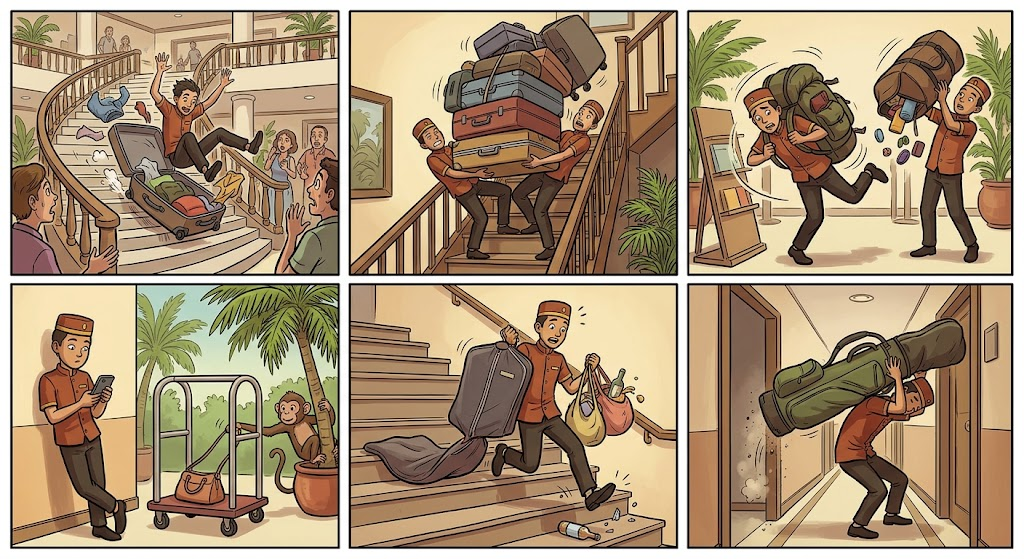
Hotel staff help guests with their bags. There are many types of bags. Staff must carry bags carefully.
Rolling Suitcase
A rolling suitcase has wheels. It has a handle. You can pull the handle out. You can pull the suitcase on the floor.
Pull it slowly. Do not pull it on the stairs. Carry it on the stairs.
Large Suitcase
A large suitcase can be heavy. Use both hands. Carry it slowly.
If it is too heavy, ask for help.
Small Suitcase
A small suitcase is easy to carry. Hold the handle. Carry it slowly on the stairs.
Backpack
A backpack has two straps. It also has a handle. You can carry it on your back.
You can also hold it by the handle. Do not pull it by the straps.
Duffel Bag
A duffel bag is a soft bag. It has handles. Hold the handles when you carry it.
Look at the handles before you lift the bag.
Handbag
A handbag is usually small. It may have money or a phone inside.
Carry it carefully. Do not leave it alone.
Garment Bag
A garment bag is for clothes. It can have a suit or a dress inside.
Hold it by the handle. Keep it clean and dry. Do not put other bags on it.
Golf Bag
A golf bag is long. It can be heavy.
Hold it well. Be careful near doors and on the stairs.
Bags with Things That Can Break
Some bags have things that can break. They may have glasses or bottles.
Ask the guest if the bag needs care. Carry the bag slowly.
Bags and Stairs
The hotel has three floors. There is no elevator.
Walk slowly on the stairs. Hold the bag well. Look at the steps.
If a bag is too heavy, ask for help.
___________________________
Vocabulary:
Word / phrase
A1 meaning
luggage
bags and suitcases
staff
people who work in a hotel
a bag
something to carry your things in
to carry carefully
to carry something with care
a handle
the part you hold
to pull out
to move something out
slowly
not fast
stairs
steps that go up or down
to be heavy
to weigh a lot
a backpack
a bag you carry on your back
straps
long parts that you hold or put on your shoulders
to leave alone
to go away and not touch something
garment
a piece of clothing
clothes
things you wear
a suit
a jacket and trousers worn together
to break
to become damaged
a bottle
a container for water or other drinks
a bag needs care
you must carry the bag carefully
#####################
Match each word (1–18) with the correct definition (A–R).
luggage
staff
a bag
to carry carefully
a handle
to pull out
slowly
stairs
to be heavy
a backpack
straps
to leave alone
garment
clothes
a suit
to break
a bottle
a bag needs care
A. things you wear B. to move something out C. a container for water or other drinks D. people who work in a hotel E. to carry something with care F. a piece of clothing G. bags and suitcases H. not fast I. to become damaged J. something to carry your things in K. the part you hold L. a bag you carry on your back M. long parts you hold or put on your shoulders N. to go away and not touch something O. to weigh a lot P. a jacket and trousers worn together Q. steps that go up or down R. you must carry the bag carefully
Match each definition (1–18) with the correct word (A–R).
Bags and suitcases
People who work in a hotel
Something to carry your things in
To carry something with care
The part you hold
To move something out
Not fast
Steps that go up or down
To weigh a lot
A bag you carry on your back
Long parts you put on your shoulders
To go away and not touch something
A piece of clothing
Things you wear
A jacket and trousers worn together
To become damaged
A container for water or other drinks
You must carry the bag carefully
A. a suit B. to leave alone C. straps D. a bottle E. luggage F. to be heavy G. a garment H. staff I. to carry carefully J. a backpack K. a bag L. to break M. slowly N. stairs O. clothes P. a handle Q. to pull out R. a bag needs care
Babies learn a language by listening. They use their ears to hear sounds. Their brain remembers these sounds. Babies connect sounds with people and things. They listen to their parents. Then they copy the sounds they hear. They imitate words. Slowly, babies learn to speak.
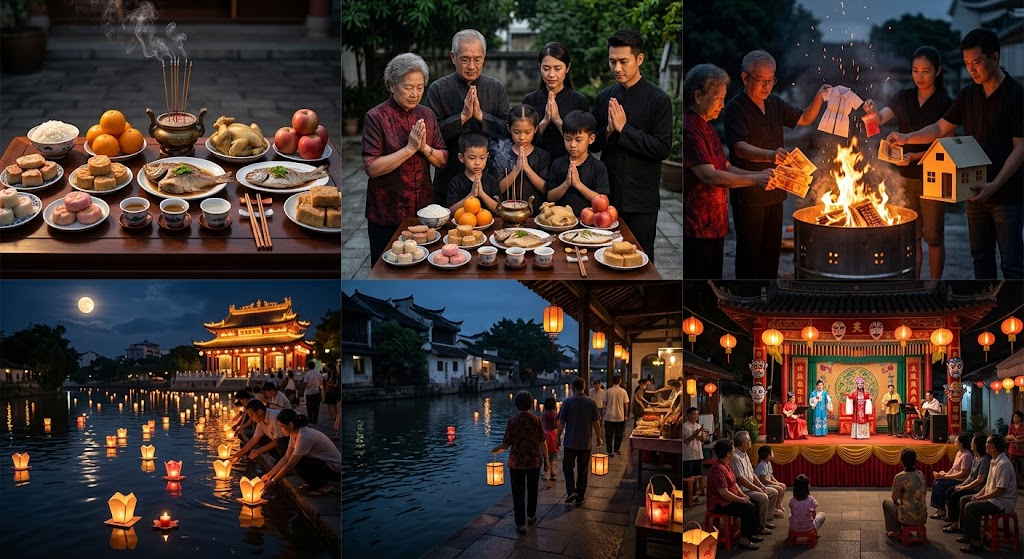
The Chinese Ghost Festival is a traditional festival in China. It is also called the Hungry Ghost Festival. It takes place on the 15th day of the seventh month in the Chinese lunar calendar. The whole seventh month is sometimes called Ghost Month. In 2026, the main festival day is August 27.
During this time, many people believe that the dead can return to the world of the living. Some are family members who have died. Other spirits may have no family to remember them. People believe that these spirits can be hungry, so families prepare food for them.
Families may put rice, fruit, meat, fish, cakes and drinks on a table. They may also burn incense and pray for their dead family members. These actions show love and respect for the people who have died.
Another important tradition is burning paper money. People believe that the dead can use this money in the other world. Some people also burn paper clothes, houses, cars and other things. These are gifts for the spirits.
In some places, people put small lanterns on rivers. The lanterns can help the spirits find their way. Temples may also have special events during the festival. People can pray, listen to music and watch traditional performances.
There are also some rules during Ghost Month. Some people do not swim in rivers or lakes at night. They also try not to stay outside very late. Some people do not move to a new home or have a wedding during this month. These are old traditions, and not everyone follows them.
The festival is an important part of Chinese culture. It brings families together and helps people remember the dead. It shows that family love and respect can continue even after a person has died.
_______________________
Vocabulary:
Word / phrase
A1 definition
a lunar calendar
a calendar that follows the moon
the main festival
the most important day of a festival
to believe
to think that something is true
to return
to come back
a spirit
the part of a dead person that people believe can still exist
to remember
to think about someone or something from the past
to burn incense
to burn special sticks that make a nice smell
to pray
to speak to God or a spirit
to show respect
to show that you think someone is important
to burn paper money
to burn paper money as a gift for dead people
a gift
something you give to another person
a lantern
a light in a container, often made of paper
a performance
a show for people to watch
a rule
something you must or must not do
to stay outside
to remain outdoors
a wedding
a special day when two people get married
to follow a tradition
to do something because people have done it for a long time
##################### Match word and definition:
a lunar calendar
the main festival
to believe
to return
a spirit
to remember
to burn incense
to pray
to show respect
to burn paper money
a gift
a lantern
a performance
a rule
to stay outside
a wedding
to follow a tradition
A. a show for people to watch B. to think that something is true C. something you must or must not do D. to burn paper money as a gift for dead people E. a light in a container, often made of paper F. to come back G. to speak to God or a spirit H. the most important day of a festival I. to remain outdoors J. a special day when two people get married K. to think about someone or something from the past L. a calendar that follows the moon M. to burn special sticks that make a nice smell N. the part of a dead person that people believe can still exist O. to show that you think someone is important P. something you give to another person Q. to do something because people have done it for a long time
A. a show for people to watch B. to think that something is true C. something you must or must not do D. to burn paper money as a gift for dead people E. a light in a container, often made of paper F. to come back G. to speak to God or a spirit H. the most important day of a festival I. to remain outdoors J. a special day when two people get married K. to think about someone or something from the past L. a calendar that follows the moon M. to burn special sticks that make a nice smell N. the part of a dead person that people believe can still exist O. to show that you think someone is important P. something you give to another person Q. to do something because people have done it for a long time
Some people burn paper clothes and houses for the spirits.
The whole seventh month is sometimes called Ghost Month.
People believe that all spirits have a family waiting for them.
Temples are closed during the festival.
The Chinese Ghost Festival is also called the Hungry Ghost Festival.
People always have weddings during Ghost Month.
Families may prepare food for spirits during the festival.
People do not pray for family members who have died.
The festival is also about family and respect.
The festival is only about frightening people with stories about ghosts.
The main festival day is on the 15th day of the seventh lunar month.
Lanterns may be placed on rivers in some places.
People believe that lanterns make the spirits disappear.
Families may burn incense for their dead family members.
Everyone follows all the old Ghost Month rules.
Temples may have special events during the festival.
People may put fruit, meat and fish on a table.
The Chinese Ghost Festival takes place in the first month of the lunar calendar.
Burning paper money is not part of the festival.
Families never put drinks on the table during the festival.
________________________
False: 3,4,6,8,10,13,15,18,19,20
________________________
Correct answers:
Some people burn paper clothes and houses for the spirits.
The whole seventh month is sometimes called Ghost Month.
People believe that all spirits have a family waiting for them. True is: Some spirits may have no family to remember them.
Temples are closed during the festival. True is: Temples may have special events during the festival.
The Chinese Ghost Festival is also called the Hungry Ghost Festival.
People always have weddings during Ghost Month. True is: Some people do not have weddings during Ghost Month.
Families may prepare food for spirits during the festival.
People do not pray for family members who have died. True is: People may pray for their dead family members.
The festival is also about family and respect.
The festival is only about frightening people with stories about ghosts. True is: The festival is not only about scary ghosts.
The main festival day is on the 15th day of the seventh lunar month.
Lanterns may be placed on rivers in some places.
People believe that lanterns make the spirits disappear. True is: People believe lanterns can help the spirits find their way.
Families may burn incense for their dead family members.
Everyone follows all the old Ghost Month rules. True is: Not everyone follows these old traditions.
Temples may have special events during the festival.
People may put fruit, meat and fish on a table.
The Chinese Ghost Festival takes place in the first month of the lunar calendar. True is: The festival takes place in the seventh month of the Chinese lunar calendar.
Burning paper money is not part of the festival. True is: Burning paper money is an important tradition.
Families never put drinks on the table during the festival. True is: Families may put drinks on the table.
######################
Match the sentence halves
The Chinese Ghost Festival takes place
The whole seventh month is sometimes called
Many people believe that the dead can
Families prepare food because the spirits
Families may burn incense and pray
Burning paper money is another
Some people burn paper clothes, houses and cars
Small lanterns on rivers can help
Temples may have special events where people
Some people do not swim in rivers or lakes
The festival is also about family
People remember that family love and respect
A. can continue after a person has died. B. can return to the world of the living. C. important tradition during the festival. D. and respect for people who have died. E. Ghost Month. F. because these are gifts for the spirits. G. on the 15th day of the seventh lunar month. H. can be hungry. I. pray, listen to music and watch performances. J. at night during Ghost Month. K. their dead family members. L. the spirits find their way.
The Chinese Ghost Festival takes place on the 15th day of the seventh lunar month.
The whole seventh month is sometimes called Ghost Month.
Many people believe that the dead can return to the world of the living.
Families prepare food because the spirits can be hungry.
Families may burn incense and pray for their dead family members.
Burning paper money is another important tradition during the festival.
Some people burn paper clothes, houses and cars because these are gifts for the spirits.
Small lanterns on rivers can help the spirits find their way.
Temples may have special events where people pray, listen to music and watch performances.
Some people do not swim in rivers or lakes at night during Ghost Month.
The festival is also about family and respect for people who have died.
People remember that family love and respect can continue after a person has died.
###################
Find the information in the text:
The day of the main festival in 2026: _____
The name of the seventh month: _____
Three kinds of food families may prepare: _____
Two things people may burn: _____
Two things made of paper that people may burn: _____
Two places where people should be careful at night: _____
Two events people may watch or listen to at temples: _____
Two drinks or foods that families may put on a table: _____
Two family members whom people may remember: _____
Two things people may do at temples: _____
Two things that some people do not do during Ghost Month: _____
Two things that may help spirits during the festival: _____
Two reasons why people take part in the festival: _____
Two things that the festival can bring or help people do: _____
————————————
Correct answers:
The day of the main festival in 2026: August 27
The name of the seventh month: Ghost Month
Three kinds of food families may prepare: rice, fruit, meat
Two things people may burn: incense and paper money
Two things made of paper that people may burn: paper clothes and paper houses
Two places where people should be careful at night: rivers and lakes
Two events people may watch or listen to at temples: music and traditional performances
Two drinks or foods that families may put on a table: cakes and drinks
Two family members whom people may remember: parents and grandparents
Two things people may do at temples: pray and listen to music
Two things that some people do not do during Ghost Month: swim at night and move to a new home
Two things that may help spirits during the festival: food and lanterns
Two reasons why people take part in the festival: to remember the dead and show respect
Two things that the festival can bring or help people do: bring families together and remember the dead
####################
Put the events in order, according to the text
a) People may burn paper money and other paper gifts. b) The festival brings families together. c) Families prepare food for the spirits. d) Some people follow old rules during Ghost Month. e) The dead may return to the world of the living. f) People remember their dead family members. g) Temples may have special events. h) People may put lanterns on rivers. ___________________________
Answers: 1. e, 2. c, 3. a, 4. h, 5. g, 6. d, 7. f, 8. b
___________________________
Correct order:
The dead may return to the world of the living.
Families prepare food for the spirits.
People may burn paper money and other paper gifts.
People may put lanterns on rivers.
Temples may have special events.
Some people follow old rules during Ghost Month.
People remember their dead family members.
The festival brings families together.
###################
Complete the sentences
The Chinese Ghost Festival is a traditional festival in ________.
Some spirits may have no ________ to remember them.
Families may put rice, fruit, meat, fish, cakes and ________ on a table.
People may burn ________ and pray.
Paper clothes, houses and cars are ________ for the spirits.
Small lanterns can help the spirits find their ________.
Some people do not stay outside very ________.
The festival brings ________ together.
—————————————
Correct version:
The Chinese Ghost Festival is a traditional festival in China.
The main festival day in 2026 is August 27.
The whole seventh month is sometimes called Ghost Month.
Some spirits may have no family to remember them.
Families may put rice, fruit, meat, fish, cakes and drinks on a table.
People may burn incense and pray for their dead family members.
These actions show love and respect for the people who have died.
People believe that the dead can use paper money in the other world.
Some people burn paper clothes, houses, cars and other things.
Small lanterns can help the spirits find their way.
Temples may have special events during the festival.
People can pray, listen to music and watch traditional performances.
Some people do not swim in rivers or lakes at night.
People remember their parents, grandparents and other family members who have died.
The festival brings families together.
####################
Choose the correct answer
When does the Ghost Festival take place?
a) In the seventh lunar month
b) In the first lunar month
c) In the twelfth lunar month
Why do families prepare food?
a) For a party
b) For the spirits
c) For tourists
What do people burn as gifts for the spirits?
a) Real clothes
b) Paper clothes
c) Old clothes
Where may people put small lanterns?
a) On rivers
b) On roads
c) On houses
What does the festival show?
a) The importance of sports
b) The start of summer
c) Family love and respect
What may families put on a table for the spirits?
a) Food and drinks
b) Books and toys
c) Shoes and bags
What do people sometimes burn and pray with?
a) Paper houses
b) Incense
c) Lanterns
What can people watch at temples?
a) Traditional performances
b) Football matches
c) Films
What do some people avoid at night during Ghost Month?
a) Eating fruit
b) Listening to music
c) Swimming in rivers or lakes
Who do people remember during the festival?
a) Only their friends
b) Their parents, grandparents and other family members
Clothes – houses – fish – cars — Fish is not a paper gift.
Grandparents – family – lanterns – parents — Lanterns are not people.
Listen – swim – watch – pray — Swim is not something people do at temples.
Water – temples – rivers – lakes — Temples are not water.
Paper money – paper clothes – rice – incense — Rice is not something people burn.
Houses – grandparents – parents – family — Houses are not people.
Rivers – cars – lanterns – lakes — Cars are not connected with rivers, lakes or lanterns.
Swim – respect – remember – pray — Swim is not connected with remembering and respecting the dead.
Fish – cars – fruit – cakes — Cars are not food.
################
Find one word in the text that answers each question.
When does the main festival take place in 2026? ________
Where is the Ghost Festival a traditional festival? ________
What do families prepare for the spirits? __________
Who can return to the world of the living? __________
Why do families prepare food? __________
What do people burn and pray with? __________
What can people burn as gifts for the spirits? __________
Where may people put small lanterns? __________
What can lanterns help the spirits find? __________
Where may people have special events? __________
What can people watch at temples? __________
When do some people avoid swimming in rivers and lakes? __________
Who do people remember during the festival? __________
What does the festival bring together? __________
What can continue even after a person has died? __________
——————————–
Correct version:
When does the main festival take place in 2026? August
Where is the Ghost Festival a traditional festival? China
What do families prepare for the spirits? food
Who can return to the world of the living? spirits
Why do families prepare food? hungry
What do people burn and pray with? incense
What can people burn as gifts for the spirits? paper
Where may people put small lanterns? rivers
What can lanterns help the spirits find? way
Where may people have special events? temples
What can people watch at temples? performances
When do some people avoid swimming in rivers and lakes? night
Who do people remember during the festival? family
What does the festival bring together? families
What can continue even after a person has died? respect
###################
Match the questions and answers
Questions
What is the Chinese Ghost Festival?
When does the main festival day come in 2026?
What can happen during Ghost Month?
Why do families prepare food?
What do families put on a table?
What do people burn during the festival?
What can people burn for the spirits?
Where do people put small lanterns?
What can people see at temples?
Who do people remember?
What do some people avoid during Ghost Month?
What does the festival show?
Answers
a) Families honour their parents, grandparents and other family members. b) The festival demonstrates family love and respect for people who have died. c) The dead may return to the world of the living. d) People place the small lanterns on rivers. e) The spirits may be hungry. f) The main festival day falls on August 27. g) People offer paper clothes, houses, cars and other things to the spirits. h) Visitors watch traditional performances at temples. i) People use incense and paper money as part of the traditions. j) Families offer rice, fruit, meat, fish, cakes and drinks. k) The Chinese Ghost Festival takes place in China as a traditional festival. l) Some people stay away from rivers and lakes at night.
Babies learn a language by listening. They use their ears to hear sounds. Their brain remembers these sounds. Babies connect sounds with people and things. They listen to their parents. Then they copy the sounds they hear. They imitate words. Slowly, babies learn to speak.
but they will remember this holiday for a very long time!
Last summer, Anna and her husband Mark went to Italy for a week. They were very happy. They had a hotel near the sea and a list of places they wanted to see.
But their holiday started badly.
At the airport, they waited for their suitcase. It did not come. They waited for twenty minutes, but it was still missing. A woman at the airport told them that maybe it was on another plane.
Anna was not happy.
They took a taxi to their hotel. Mark gave the driver the hotel address. But the driver took them to a different hotel with almost the same name. The hotel looked nice, but the person at the desk could not find their names.
After ten minutes, Anna looked at the hotel address again.
“This is the wrong hotel!” she said.
Their hotel was on the other side of town. They were tired and a little angry, but then they started to laugh.
At last, they arrived at the right hotel. They went to their room. Mark opened his bag.
“My passport!” he shouted. “It is not here!”
He looked in his bag again. Then he looked under the bed.
Anna started to laugh.
“What?” Mark asked.
She opened her handbag and took out his passport.
“You gave it to me at the airport,” she said. “You said you were afraid of losing it.”
Mark looked at his passport.
“Oh, yes!” he said. “I forgot!”
The next morning, Anna and Mark wanted to visit an old castle. They got on a bus. After thirty minutes, Anna looked out of the window.
“This is not the right bus,” she said.
They got off at the next stop. They were in a small village. They could not find the castle, so they went into a small café. They had some food and met two friendly local people.
That evening, they went back to the hotel. Their missing suitcase was there!
Anna and Mark looked at each other and laughed.
“We had a lot of problems,” Mark said.
“Yes,” Anna said, “but we will remember this holiday for a very long time!”
##################
##################
##################
##################
Please use the box below to write your feedback. Only I can read it. It is not public.
Babies learn a language by listening. They use their ears to hear sounds. Their brain remembers these sounds. Babies connect sounds with people and things. They listen to their parents. Then they copy the sounds they hear. They imitate words. Slowly, babies learn to speak.
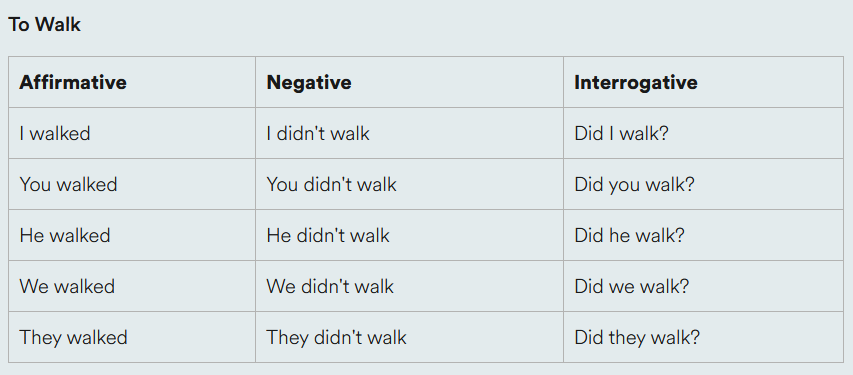
Some verbs do not use -ed. Their past forms are different. You need to learn them.
5. Negative sentences
Use did not (didn’t) + verb.
The verb goes back to the present form.
Examples:
I played football.
I did not play football.
She went home.
She did not go home.
6. Questions
Use Did + person + verb?
Examples:
Did you watch the film?
Did she run yesterday?
Did they visit the village?
Remember:
✅ Regular verbs → add -ed ✅ Irregular verbs → learn the special past form ✅ After did / didn’t → use the normal verb
####################
Short answers, past simple, basics:
Example Sentence
Yes
No
I learned letters.
Yes, I did.
No, I didn’t.
You read signs.
Yes, you did.
No, you didn’t.
He spoke English.
Yes, he did.
No, he didn’t.
She watched TV.
Yes, she did.
No, she didn’t.
It helped me.
Yes, it did.
No, it didn’t.
We used an app.
Yes, we did.
No, we didn’t.
You read words.
Yes, you did.
No, you didn’t.
They made mistakes.
Yes, they did.
No, they didn’t.
Questions (Past Simple)
Question
Yes
No
Did I learn letters?
Yes, I did.
No, I didn’t.
Did you read signs?
Yes, you did.
No, you didn’t.
Did he speak English?
Yes, he did.
No, he didn’t.
Did she watch TV?
Yes, she did.
No, she didn’t.
Did it help me?
Yes, it did.
No, it didn’t.
Did we use an app?
Yes, we did.
No, we didn’t.
Did you read words?
Yes, you did.
No, you didn’t.
Did they make mistakes?
Yes, they did.
No, they didn’t.
Was / Were
Question
Yes
No
Was I happy?
Yes, I was.
No, I wasn’t.
Were you happy?
Yes, you were.
No, you weren’t.
Was he happy?
Yes, he was.
No, he wasn’t.
Was she happy?
Yes, she was.
No, she wasn’t.
Was it good?
Yes, it was.
No, it wasn’t.
Were we happy?
Yes, we were.
No, we weren’t.
Were you happy?
Yes, you were.
No, you weren’t.
Were they happy?
Yes, they were.
No, they weren’t.
#################
Vocabulary:
Verb
Past simple
A1 definition
to be
was / were
to exist or be in a place
to live
lived
to have your home in a place
to want
wanted
to like to have or do something
to tell
told
to give information to someone
to come
came
to go to a place where someone is
to work
worked
to do a job or activity
to make
made
to create or prepare something
to cook
cooked
to prepare food with heat
to put
put
to place something somewhere
to look
looked
to seem or appear
to wear
wore
to have clothes on your body
to go
went
to move from one place to another
to pray
prayed
to speak to God
to give
gave
to offer something to someone
to think
thought
to have an idea in your mind
to feel
felt
to have a feeling
to continue
continued
to keep doing something
to visit
visited
to go and see a person or place
to eat
ate
to have food in your mouth and swallow it
to play
played
to do something for fun
to walk
walked
to move on your feet
to use
used
to do something with a thing
to finish
finished
to stop because something is complete
to stop
stopped
to end an activity
to like
liked
to enjoy something
to stay
stayed
to remain in a place
to hope
hoped
to want something good to happen
to write
wrote
to make words with a pen or keyboard
########################
a festival
a special time when people celebrate something
a family spirit
a spirit of a person from your family who died
a lot
many or much
a rice cake
a small cake made from rice
chicken
a bird that people often eat
a stick
a thin, long piece of wood
to be curved
to have a shape that is not straight
a leaf (pl. leaves)
the green part of a plant or tree
to continue
to keep doing something
a mask
something you wear on your face to hide or change it
the sky
the space above the Earth where we see the sun, moon and stars
########################
Fill in the correct form of past simple:
Dear Eulis,
Hello! How are you? I hope you are well. My name is Made. I live in Bali, Indonesia. I want to tell you about a festival. I _______ (be) there.
Galungan _______ (be) on Wednesday, 17 June 2026. Kuningan _______ (be) on Saturday, 27 June 2026. The festival _______ (be) important for people in Bali. It _______ (be) about good and bad. Our family spirits _______ (come) to visit.
Before Galungan, my family _______ (work) a lot. We _______ (make) food for the gods. We _______ (cook) bananas. We _______ (make) rice cakes. One day before, we _______ (cook) chicken. Then we _______ (put) up penjor. Penjor are long bamboo sticks. They are high and curved. We _______ (put) leaves, fruits and flowers on them. The streets _______ (look) nice with many penjor.
On Galungan day, we _______ (wear) special clothes. We _______ (go) to the temple in the morning. We _______ (pray). We _______ (give) food and flowers. Many people _______ (come) to the temple. The temple _______ (be) full. We _______ (think) about our family spirits. They _______ (come) to earth that day. I _______ (feel) happy.
For ten days, the festival _______ (continue). We _______ (visit) our family. We _______ (eat) good food together. Children _______ (play) in the village. Some children _______ (walk) with a big mask.
On Kuningan day, we _______ (use) yellow things. We _______ (use) yellow rice. Yellow is for good things. We _______ (pray) in the morning again. The family spirits _______ (go) back to the sky that day. The prayers _______ (finish) before twelve o’clock. Then the festival _______ (stop).
I _______ (like) the festival a lot. Bali _______ (look) different. The penjor _______ (stay) for some days. People _______ (be) kind. Families _______ (stay) together. It _______ (be) quiet. It _______ (be) not a loud party.
I hope you can come to Bali one day. You can see the festival. Write to me soon. Tell me about your life.
Best wishes, Made
########################
Full version:
Dear Eulis,
Hello! How are you? I hope you are well. My name is Made. I live in Bali, Indonesia. I want to tell you about a festival. I was there.
Galungan was on Wednesday, 17 June 2026. Kuningan was on Saturday, 27 June 2026. The festival was important for people in Bali. It was about good and bad. Our family spirits came to visit.
Before Galungan, my family worked a lot. We made food for the gods. We cooked bananas. We made rice cakes. One day before, we cooked chicken. Then we put up penjor. Penjor are long bamboo sticks. They are high and curved. We put leaves, fruits and flowers on them. The streets looked nice with many penjor.
On Galungan day, we wore special clothes. We went to the temple in the morning. We prayed. We gave food and flowers. Many people came to the temple. The temple was full. We thought about our family spirits. They came to earth that day. I felt happy.
For ten days, the festival continued. We visited our family. We ate good food together. Children played in the village. Some children walked with a big mask.
On Kuningan day, we used yellow things. We used yellow rice. Yellow is for good things. We prayed in the morning again. The family spirits went back to the sky that day. The prayers finished before twelve o’clock. Then the festival stopped.
I liked the festival a lot. Bali looked different. The penjor stayed for some days. People were kind. Families stayed together. It was quiet. It was not a loud party.
I hope you can come to Bali one day. You can see the festival. Write to me soon. Tell me about your life.
Best wishes, Made
#####################
True or false – short answers
The festival continued for ten days.
YOU WRITE: Yes, it did.
Made prayed in the afternoon.
Families stayed together.
Kuningan was on 27 June 2025.
Children played in the village.
Penjor had only flowers on them.
Made lived in Bali, Indonesia.
The prayers finished after twelve o’clock.
Many people came to the temple.
Made wrote the letter to Anna.
The yellow rice was for bad things.
Made’s family made rice cakes.
The festival was a loud party.
Galungan was on Wednesday, 17 June 2026.
The children stayed inside their homes.
Penjor were long bamboo sticks.
Made did not like the festival.
The family spirits went back to the sky on Kuningan day.
Made’s family cooked chicken one day before Galungan.
The streets looked ugly with the penjor.
___________________________
Short answers
The festival continued for ten days. — Yes, it did.
Made prayed in the afternoon. — No, he didn’t.
Families stayed together. — Yes, they did.
Kuningan was on 27 June 2025. — No, it wasn’t.
Children played in the village. — Yes, they did.
Penjor had only flowers on them. — No, they didn’t.
Made lived in Bali, Indonesia. — Yes, he did.
The prayers finished after twelve o’clock. — No, they didn’t.
Many people came to the temple. — Yes, they did.
Made wrote the letter to Anna. — No, he didn’t.
The yellow rice was for bad things. — No, it wasn’t.
Made’s family made rice cakes. — Yes, they did.
The festival was a loud party. — No, it wasn’t.
Galungan was on Wednesday, 17 June 2026. — Yes, it was.
The children stayed inside their homes. — No, they didn’t.
Penjor were long bamboo sticks. — Yes, they were.
Made did not like the festival. — No, he didn’t.
The family spirits went back to the sky on Kuningan day. — Yes, they did.
Made’s family cooked chicken one day before Galungan. — Yes, they did.
The streets looked ugly with the penjor. — No, they didn’t.
###################
Give answers, in complete sentences:
Did Made cook chicken or bananas?
Was Galungan on 17 June or 18 June 2026?
Did Made’s family make rice cakes or bread?
Were the penjor long or short?
Did Made go to the temple in the morning or evening?
Did many people come to the temple or village?
Was the temple empty or full?
Did Made think about his family spirits or friends?
Did the family spirits come to the sky or earth that day?
Did Made feel happy or sad?
Did the festival continue for ten days or five days?
Did Made visit his family or friends?
Did the children play in the village or temple?
Did some children walk with a big mask or big hat?
Did they use yellow rice or white rice?
Were people kind or unfriendly?
Did the family spirits go back to the sky or earth?
Did the prayers finish before or after twelve o’clock?
Was the festival quiet or loud?
Did Made like or dislike the festival?
__________________________
Correct version:
Did Made cook chicken or bananas? → Made cooked bananas.
Was Galungan on 17 June or 18 June 2026? → Galungan was on 17 June 2026.
Did Made’s family make rice cakes or bread? → Made’s family made rice cakes.
Were the penjor long or short? → The penjor were long.
Did Made go to the temple in the morning or evening? → Made went to the temple in the morning.
Did many people come to the temple or village? → Many people came to the temple.
Was the temple empty or full? → The temple was full.
Did Made think about his family spirits or friends? → Made thought about his family spirits.
Did the family spirits come to the sky or earth that day? → The family spirits came to earth that day.
Did Made feel happy or sad? → Made felt happy.
Did the festival continue for ten days or five days? → The festival continued for ten days.
Did Made visit his family or friends? → Made visited his family.
Did the children play in the village or temple? → The children played in the village.
Did some children walk with a big mask or big hat? → Some children walked with a big mask.
Did they use yellow rice or white rice? → They used yellow rice.
Were people kind or unfriendly? → People were kind.
Did the family spirits go back to the sky or earth? → The family spirits went back to the sky.
Did the prayers finish before or after twelve o’clock? → The prayers finished before twelve o’clock.
Was the festival quiet or loud? → The festival was quiet.
Did Made like or dislike the festival? → Made liked the festival.
###################
Correct as shown:
Made cooked apples before Galungan.
YOU WRITE: No, he didn’t. He cooked bananas.
Galungan was on Friday, 19 June 2026.
The festival was unimportant for people in Bali.
The family spirits went to another country.
Made’s family bought food for the gods.
They made bread instead of rice cakes.
Penjor were short bamboo sticks.
The streets looked ugly with many penjor.
Made went to the temple in the evening.
The temple had no people inside.
The children played inside the temple.
People were unfriendly during the festival.
Families stayed in different places during the festival.
The festival was a loud party.
___________________________ Correct answers:
Made cooked apples before Galungan. No, he didn’t. He cooked bananas.
Galungan was on Friday, 19 June 2026. No, it wasn’t. It was on Wednesday, 17 June 2026.
The festival was unimportant for people in Bali. No, it wasn’t. It was important for people in Bali.
The family spirits went to another country. No, they didn’t. They came to earth.
Made’s family bought food for the gods. No, they didn’t. They made food for the gods.
They made bread instead of rice cakes. No, they didn’t. They made rice cakes.
Penjor were short bamboo sticks. No, they weren’t. They were long bamboo sticks.
The streets looked ugly with many penjor. No, they didn’t. They looked nice with many penjor.
Made went to the temple in the evening. No, he didn’t. He went in the morning.
The temple had no people inside. No, it didn’t. The temple was full.
The children played inside the temple. No, they didn’t. They played in the village.
People were unfriendly during the festival. No, they weren’t. They were kind.
Families stayed in different places during the festival. No, they didn’t. Families stayed together.
The festival was a loud party. No, it wasn’t. It was quiet.
####################
Answer as shown:
Did Made cook apples before Galungan?
Was Galungan on Friday, 19 June 2026?
Was the festival unimportant for people in Bali?
Did the family spirits go to another country?
Did Made’s family buy food for the gods?
Did they make bread instead of rice cakes?
Were penjor short bamboo sticks?
Did the streets look ugly with many penjor?
Did Made go to the temple in the evening?
Did the temple have no people inside?
Did the children play inside the temple?
Were people unfriendly during the festival?
Did families stay in different places during the festival?
Was the festival a loud party?
###################
Make the sentences negative
Made went to the temple.
YOU WRITE: Made did not go to the temple.
His family made rice cakes.
They cooked chicken.
Many people came to the temple.
Made felt happy.
The children played in the village.
They ate good food.
The family spirits went back to the sky.
The prayers finished before twelve o’clock.
Made liked the festival.
The streets looked nice with many penjor.
Made wore special clothes.
They prayed in the morning.
The family spirits came to earth.
Families stayed together.
__________________________
Answers:
Made went to the temple. Made did not go to the temple.
His family made rice cakes. His family did not make rice cakes.
They cooked chicken. They did not cook chicken.
Many people came to the temple. Many people did not come to the temple.
Made felt happy. Made did not feel happy.
The children played in the village. The children did not play in the village.
They ate good food. They did not eat good food.
The family spirits went back to the sky. The family spirits did not go back to the sky.
The prayers finished before twelve o’clock. The prayers did not finish before twelve o’clock.
Made liked the festival. Made did not like the festival.
The streets looked nice with many penjor. The streets did not look nice with many penjor.
Made wore special clothes. Made did not wear special clothes.
They prayed in the morning. They did not pray in the morning.
The family spirits came to earth. The family spirits did not come to earth.
Families stayed together. Families did not stay together.
###################
Answer as shown:
Did Made cook apples before Galungan?
YOU WRITE: No, he didn’t. He cooked bananas.
Was Galungan on Friday, 19 June 2026?
Was the festival unimportant for people in Bali?
Did the family spirits go to another country?
Did Made’s family buy food for the gods?
Did they make bread instead of rice cakes?
Were penjor short bamboo sticks?
Did the streets look ugly with many penjor?
Did Made go to the temple in the evening?
Did the temple have no people inside?
Did the children play inside the temple?
Were people unfriendly during the festival?
Did families stay in different places during the festival?
Was the festival a loud party?
__________________________
Correct answers:
Did Made cook apples before Galungan? No, he didn’t. He cooked bananas.
Was Galungan on Friday, 19 June 2026? No, it wasn’t. It was on Wednesday, 17 June 2026.
Was the festival unimportant for people in Bali? No, it wasn’t. It was important for people in Bali.
Did the family spirits go to another country? No, they didn’t. They came to earth.
Did Made’s family buy food for the gods? No, they didn’t. They made food for the gods.
Did they make bread instead of rice cakes? No, they didn’t. They made rice cakes.
Were penjor short bamboo sticks? No, they weren’t. They were long bamboo sticks.
Did the streets look ugly with many penjor? No, they didn’t. They looked nice with many penjor.
Did Made go to the temple in the evening? No, he didn’t. He went in the morning.
Did the temple have no people inside? No, it didn’t. The temple was full.
Did the children play inside the temple? No, they didn’t. They played in the village.
Were people unfriendly during the festival? No, they weren’t. They were kind.
Did families stay in different places during the festival? No, they didn’t. Families stayed together.
Was the festival a loud party? No, it wasn’t. It was quiet.
################
Why do we say “Who left at seven?” but “Who did you leave at seven?”
The difference is who.
1. Who left at seven?
Here, who is the subject. The person did the action.
Who = person
left = action
So we do not use “did”.
👉 Who left at seven? = Who went away at seven?
Answer: Anna left at seven.
2. Who did you leave at seven?
Here, you are the subject. Who is the person who received the action.
you = subject
left = action
who = object
So we use did.
👉 Who did you leave at seven? = Which person did you leave at seven?
Answer: I left Anna at seven.
Easy rule
Who + past verb? → Who did the action?
Who + did + subject + verb? → Who received the action?
Compare:
Who left at seven? → Anna left.
Who did you leave at seven? → You left Anna.
#################
Form questions to which the word/s given is/are the answer:
1. His family made rice cakes:
YOU WRITE: aI His family: Who made rice cakes. b) His: Whose family made rice cakes? c) mad rice cakes: What did his family do? d) rice: Which cakes did his family make.
2) They cooked chicken in the morning. a) They: b) cooked chicken in the morning: c) chicken: d) morning:
3) The children played in the village every day. a) The children: b) played in the village every day: c) in the village: d) every day:
4) Made wore traditional clothes: a) Made: b) wore traditional clothes: c) traditional clothes: d) traditional:
5) The family spirits came to earth. a) The family spirits: b) came to earth: c) family: d) came to earth: e) earth:
6) Hundreds of people came to the golden temple in the morning. a) Hundreds of people: b) came to the golden temple in the morning: c) the golden temple: d) in the morning:
_____________________________
Correct questions:
His family made rice cakes: a) His family: Who made rice cakes? b) His: Whose family made rice cakes? c) made rice cakes: What did his family do? d) rice: Which cakes did his family make?
They cooked chicken in the morning. a) They: Who cooked chicken in the morning? b) cooked chicken in the morning: What did they do? c) chicken: What did they cook in the morning? d) morning: When did they cook chicken?
The children played in the village every day. a) The children: Who played in the village every day? b) played in the village every day: What did the children do? c) in the village: Where did the children play? d) every day: How often did the children play in the village?
Made wore traditional clothes. a) Made: Who wore traditional clothes? b) wore traditional clothes: What did Made do? c) traditional clothes: What did Made wear? d) traditional: Which clothes did Made wear?
The family spirits came to earth. a) The family spirits: Who came to earth? b) came to earth: What did the family spirits do? c) family: What kind of spirits came to earth? d) came to earth: Where did the family spirits come? e) earth: Where did the family spirits come to?
Hundreds of people came to the golden temple in the morning. a) Hundreds of people: Who came to the golden temple in the morning? b) came to the golden temple in the morning: What did hundreds of people do? c) the golden temple: Where did hundreds of people come to? d) in the morning: When did hundreds of people come to the golden temple?
####################
Why do we say “Who left at seven?” but “Who did you leave at seven?”
The difference is who.
1. Who left at seven?
Here, who is the subject. The person did the action.
Who = person
left = action
So we do not use “did”.
👉 Who left at seven? = Who went away at seven?
Answer: Anna left at seven.
2. Who did you leave at seven?
Here, you are the subject. Who is the person who received the action.
you = subject
left = action
who = object
So we use did.
👉 Who did you leave at seven? = Which person did you leave at seven?
Answer: I left Anna at seven.
Easy rule
Who + past verb? → Who did the action?
Who + did + subject + verb? → Who received the action?
Compare:
Who left at seven? → Anna left.
Who did you leave at seven? → You left Anna.
####################
Complete – if necessary change order of words:
Eulis: When _____ (be) Galungan in 2026?
Made: It _____ (be) on Wednesday, 17 June 2026.
Eulis: When _____ (be) Kuningan?
Made: It _____ (be) on Saturday, 27 June 2026.
Eulis: Where you _____ (celebrate) the festival?
Made: I _____ (celebrate) it in Bali.
Eulis: Who you _____ (celebrate) it with?
Made: I _____ (celebrate) it with my family.
Eulis: How your family _____ (prepare) for Galungan?
Made: We _____ (work) a lot and _____ (make) food for the gods.
Eulis: Which food you _____ (make)?
Made: We _____ (make) rice cakes and _____ (cook) bananas.
Eulis: When you _____ (cook) chicken?
Made: We _____ (cook) chicken one day before Galungan.
Eulis: What you _____ (put) up after that?
Made: We _____ (put) up penjor.
Eulis: How the penjor _____ (be)?
Made: They _____ (be) long, high and curved bamboo sticks.
Eulis: Where you _____ (go) in the morning?
Made: We _____ (go) to the temple.
Eulis: Who _____ (come) to the temple?
Made: Many people _____ (come) to the temple.
Eulis: Why you _____ (go) to the temple?
Made: We _____ (go) there to pray and give food and flowers.
Eulis: How you _____ (feel)?
Made: I _____ (feel) happy.
___________________________ Correct version:
Eulis: When was Galungan in 2026?
Made: It was on Wednesday, 17 June 2026.
Eulis: When was Kuningan?
Made: It was on Saturday, 27 June 2026.
Eulis: Where did you celebrate the festival?
Made: I celebrated it in Bali.
Eulis: Who did you celebrate it with?
Made: I celebrated it with my family.
Eulis: How did your family prepare for Galungan?
Made: We worked a lot and made food for the gods.
Eulis: Which food did you make?
Made: We made rice cakes and cooked bananas.
Eulis: When did you cook chicken?
Made: We cooked chicken one day before Galungan.
Eulis: What did you put up after that?
Made: We put up penjor.
Eulis: How were the penjor?
Made: They were long, high and curved bamboo sticks.
Eulis: Where did you go in the morning?
Made: We went to the temple.
Eulis: Who came to the temple?
Made: Many people came to the temple.
Eulis: Why did you go to the temple?
Made: We went there to pray and give food and flowers.
Eulis: How did you feel?
Made: I felt happy.
########################
##################
##################
##################
Please use the box below to write your feedback. Only I can read it. It is not public.
Babies learn a language by listening. They use their ears to hear sounds. Their brain remembers these sounds. Babies connect sounds with people and things. They listen to their parents. Then they copy the sounds they hear. They imitate words. Slowly, babies learn to speak.
Every year, people in Banyuwangi have a special day. Banyuwangi is a city in Java, Indonesia. People do a dance here. The dance is called Seblang.
People want a good life. They want good food, a clean village, and healthy bodies.
Two villages do this dance. In one village, a young girl dances. In the other village, an old woman dances.
First, a man puts food on a table. He uses rice, fruit, and red flowers. He prays. The dancer wears a big hat. The hat has green leaves and flowers.
The dancer sits on a chair. She closes her eyes and goes to sleep. Then, a spirit comes. The dancer wakes up and stands up.
She dances to the music. Women play music and sing. The dancer moves her arms. She holds a small fan. She throws rice and flowers to the people. People catch the flowers. They smile because the flowers bring good luck.
Many people come to watch. Fathers, mothers, and children sit together. They watch the dancer. They are happy.
This dance is very old. People love this day because families stay together.
_____________________
Vocabulary:
Word / phrase
A1 definition
to be called Seblang
to have the name Seblang
clean
not dirty
a village
a small place where people live
a healthy body
a body that is well and strong
to put food on a table
to place food on a table
to pray
to speak to God
to wear a hat
to have a hat on your head
a leaf (pl. leaves)
the green part of a plant
to close one’s eyes
to shut your eyes
a spirit
a special person or thing that people cannot see
to wake up
to stop sleeping
to stand up
to move from sitting to standing
a fan
a small thing you hold and move to make air
to throw something
to send something through the air with your hand
to catch something
to take something with your hands when it comes to you
good luck
something good that you hope happens
to stay together
to remain with other people
###################
Present Simple
We use the present simple for things that happen regularly, every day, or are generally true.
Lina rides her bicycle every morning.
She studies English every day.
She likes her bicycle.
1. I / You / We / They
Use the basic form of the verb.
I live in a village.
You like English.
We study every day.
They work hard.
2. He / She / It
Usually, add -s.
She lives in a village.
He likes English.
She wants to be a teacher.
It works well.
Most verbs: add -s
Basic verb
He / She / It
live
lives
like
likes
want
wants
work
works
help
helps
read
reads
listen
listens
talk
talks
learn
learns
3. Verbs ending in -y
If a verb ends in consonant + y, change y to ies.
study → studies
try → tries
carry → carries
Examples:
I study English.
She studies English.
They try hard.
He tries hard.
But: vowel [a,e,i,o,u] + y → just add -s
play → plays
stay → stays
enjoy → enjoys
Example:
I play football.
She plays football.
4. Have → Has
Have is different.
I have a bicycle.
You have a bicycle.
We have a bicycle.
They have a bicycle.
She has a bicycle.
He has a bicycle.
It has four legs.
5. Be → am / is / are
Be is also different.
Subject
Be
I
am
You
are
We
are
They
are
He
is
She
is
It
is
Examples:
I am 16 years old.
You are happy.
We are students.
They are from Cambodia.
She is 16 years old.
He is a teacher.
6. Questions
With most verbs, use do or does.
I / you / we / they → DO
Do you like English?
Do they study every day?
he / she / it → DOES
Does Lina like English?
Does she study every day?
Important!
After does, use the basic verb.
❌ Does she studies English? ✅ Does she study English?
❌ Does Lina likes her bicycle? ✅ Does Lina like her bicycle?
7. Negative sentences
Use don’t or doesn’t.
I / you / we / they → don’t
I don’t like English.
They don’t study every day.
he / she / it → doesn’t
She doesn’t like English.
Lina doesn’t study every day.
Again, after doesn’t, use the basic verb.
❌ She doesn’t studies English. ✅ She doesn’t study English.
❌ Lina doesn’t likes her bicycle. ✅ Lina doesn’t like her bicycle.
The most important rule
Positive sentences:
I / You / We / They → basic verb
I study.
He / She / It → verb + s
She studies.
Questions and negatives:
do / does + basic verb
Does she study? She doesn’t study.
Remember:
I study → She studies I live → She lives I like → She likes I have → She has I am → She is
###################
Match the words with the definitions
to wake up
a village
good luck
to wear a hat
a fan
clean
to catch something
a spirit
to stay together
a leaf (pl. leaves)
to pray
to stand up
a healthy body
to put food on a table
to throw something
to close one’s eyes
to be called Seblang
A. to remain with other people B. to have a hat on your head C. to speak to God D. the green part of a plant E. to take something with your hands when it comes to you F. a small place where people live G. something good that you hope happens H. to stop sleeping I. not dirty J. to send something through the air with your hand K. a special person or thing that people cannot see L. to move from sitting to standing M. a body that is well and strong N. to place food on a table O. to shut your eyes P. a small thing you hold and move to make air Q. to have the name Seblang
to take something with your hands when it comes to you
a small place where people live
something good that you hope happens
to stop sleeping
not dirty
to send something through the air with your hand
a special person or thing that people cannot see
to move from sitting to standing
a body that is well and strong
to place food on a table
to shut your eyes
a small thing you hold and move to make air
to have the name Seblang
A. a healthy body B. to throw something C. to stay together D. a spirit E. to wear a hat F. a fan G. clean H. to catch something I. a village J. to put food on a table K. to close one’s eyes L. to be called Seblang M. to wake up N. good luck O. a leaf (pl. leaves) P. to stand up Q. to pray
The dancer wears a big hat with green leaves and flowers.
The Seblang dance is very new.
People catch the flowers that the dancer throws.
Banyuwangi is a city in Java, Indonesia.
The dancer sits on a chair before she dances.
Men play the music while women watch.
People want a clean village.
The dancer holds a small fan.
A man puts rice, fruit, and red flowers on a table.
The dancer dances without music.
In one village, an old man dances.
The dancer throws flowers to the people.
The dancer wears a small blue hat.
Only women and children come to watch the dance.
The dancer stays awake before the spirit comes.
People are happy because the flowers bring bad luck.
_____________________
False: 2,6,10,11,13,14,15,16
_____________________
Correct version:
The dancer wears a big hat with green leaves and flowers.
The Seblang dance is very new. True is: The Seblang dance is very old.
People catch the flowers that the dancer throws.
Banyuwangi is a city in Java, Indonesia.
The dancer sits on a chair before she dances.
Men play the music while women watch. True is: Women play the music and sing.
People want a clean village.
The dancer holds a small fan.
A man puts rice, fruit, and red flowers on a table.
The dancer dances without music. True is: The dancer dances to the music.
In one village, an old man dances. True is: In one village, an old woman dances.
The dancer throws flowers to the people.
The dancer wears a small blue hat. True is: The dancer wears a big hat with green leaves and flowers.
Only women and children come to watch the dance. True is: Fathers, mothers, and children come to watch the dance.
The dancer stays awake before the spirit comes. True is: The dancer closes her eyes and goes to sleep before the spirit comes.
People are happy because the flowers bring bad luck. True is: People are happy because the flowers bring good luck.
###############
Match the Sentence Halves
Every year, people in Banyuwangi
People want
Two villages
A man puts food
The dancer wears
The dancer closes her eyes
A spirit comes
Women play music
The dancer throws rice and flowers
Families stay
A. to the people. B. a good life. C. and goes to sleep. D. a big hat. E. on a table. F. do this dance. G. and sing. H. together. I. have a special day. J. to the dancer.
Every year, people in Banyuwangi have a special day.
People want a good life.
Two villages do this dance.
A man puts food on a table.
The dancer wears a big hat.
The dancer closes her eyes and goes to sleep.
A spirit comes to the dancer.
Women play music and sing.
The dancer throws rice and flowers to the people.
Families stay together.
###############
Basics of present simple:
Personal Pronoun
am / is / are
I
am
8 years old
You
are
8 years old
He
is
8 years old
She
is
8 years old
It
is
8 years old
We
are
8 years old
You (plural)
are
8 years old
They
are
8 years old
Personal Pronoun
am not / is not / are not
I
am not
8 years old
You
are not
8 years old
He
is not
8 years old
She
is not
8 years old
It
is not
8 years old
We
are not
8 years old
You (plural)
are not
8 years old
They
are not
8 years old
Question:
Question Word
Personal Pronoun
Am
I
8 years old?
Are
you
8 years old?
Is
he
8 years old?
Is
she
8 years old?
Is
it
8 years old?
Are
we
8 years old?
Are
you (plural)
8 years old?
Are
they
8 years old?
Statement:
Personal Pronoun
Verb
I
like
ice cream
You
like
ice cream
He
likes
ice cream
She
likes
ice cream
It
likes
ice cream
We
like
ice cream
You (plural)
like
ice cream
They
like
ice cream
Negation:
Personal Pronoun
Verb (negative)
I
do not like
ice cream
You
do not like
ice cream
He
does not like
ice cream
She
does not like
ice cream
It
does not like
ice cream
We
do not like
ice cream
You (plural)
do not like
ice cream
They
do not like
ice cream
Question:
Do / Does
Personal Pronoun
Verb
Sugar?
Do
I
like
sugar?
Do
you
like
sugar?
Does
he
like
sugar?
Does
she
like
sugar?
Does
it
like
sugar?
Do
we
like
sugar?
Do
you (plural)
like
sugar?
Do
they
like
sugar?
###############
Fill in the correct form:
Where ______ (be) Banyuwangi? Banyuwangi ______ (be) in Java, Indonesia.
What ______ (be) the dance called? The dance ______ (be) called Seblang.
How many villages ______ (do) the dance? Two villages ______ (do) the dance.
What ______ (do) the man put on the table? The man ______ (put) rice, fruit, and red flowers on the table.
What ______ (do) the dancer wear? The dancer ______ (wear) a big hat with green leaves and flowers.
What ______ (do) the dancer do before the spirit comes? The dancer ______ (close) her eyes and ______ (go) to sleep before the spirit comes.
Who ______ (play) music and ______ (sing)? Women ______ (play) music and ______ (sing).
What ______ (do) the dancer hold? The dancer ______ (hold) a small fan.
What ______ (do) the dancer throw to the people? The dancer ______ (throw) rice and flowers to the people.
Why ______ (do) people smile? People ______ (smile) because the flowers bring good luck.
——————————
Correct answers:
Where is Banyuwangi? Banyuwangi is in Java, Indonesia.
What is the dance called? The dance is called Seblang.
How many villages do the dance? Two villages do the dance.
What does the man put on the table? The man puts rice, fruit, and red flowers on the table.
What does the dancer wear? The dancer wears a big hat with green leaves and flowers.
What does the dancer do before the spirit comes? The dancer closes her eyes and goes to sleep before the spirit comes.
Who plays music and sings? Women play music and sing.
What does the dancer hold? The dancer holds a small fan.
What does the dancer throw to the people? The dancer throws rice and flowers to the people.
Why do people smile? People smile because the flowers bring good luck.
#################
Make negative sentences
The dancer wears a small hat.
People want a bad life.
Women play football.
The dancer holds a drum.
Families stay apart.
The man puts vegetables on the table.
The dancer sings alone.
People catch the fruit.
________________________
Correct negations:
The dancer doesn’t [does not] wear a small hat.
People don’t catch the fruit.
People don’t want a bad life.
Women don’t play football.
The dancer doesn’t hold a drum.
Families don’t stay apart.
The man doesn’t put vegetables on the table.
The dancer doesn’t sing alone.
People don’t catch the fruit.
#################
Make questions
People want a good life.
The dancer wears a big hat.
Women play music.
The dancer holds a fan.
Families stay together.
A young girl dances in one village.
Banyuwangi is in Java, Indonesia.
The flowers are beautiful.
The dancer throws rice and flowers.
People catch the flowers.
________________________
Correct answer:
Do people want a good life?
Does the dancer wear a big hat?
Do women play music?
Does the dancer hold a fan?
Do families stay together?
Does a young girl dance in one village?
Is Banyuwangi in Java, Indonesia?
Are the flowers beautiful?
Does the dancer throw rice and flowers?
Do people catch the flowers?
#################
Choose do, does, is or are
______ the dancer wear a big hat?
______ people catch the flowers?
______ women sing?
______ the man put food on the table?
______ families stay together?
______ the dancer hold a fan?
______ people want a clean village?
______ a young girl dance in one village?
______ Banyuwangi a city in Java?
______ the flowers beautiful?
______ the dancer move her arms?
______ two villages do the dance?
______ the dancer asleep?
______ many people watch the dance?
______ the old woman dance in the other village?
______ the flowers on the table?
______ people smile when they catch the flowers?
______ the dancer wear a big hat?
______ women play music?
______ the families together?
#################
Correct answer:
Does the dancer wear a big hat?
Do people catch the flowers?
Do women sing?
Does the man put food on the table?
Do families stay together?
Does the dancer hold a fan?
Do people want a clean village?
Does a young girl dance in one village?
Is Banyuwangi a city in Java?
Are the flowers beautiful?
Does the dancer move her arms?
Do two villages do the dance?
Is the dancer asleep?
Do many people watch the dance?
Does the old woman dance in the other village?
Are the flowers on the table?
Do people smile when they catch the flowers?
Does the dancer wear a big hat?
Do women play music?
Are the families together?
#################
Rewrite the statement as a) question: b) negation: c) negative question:
Banyuwangi is a city in Java, Indonesia.
YOU WRITE: a) Is Banyuwang a city in Java, Indonesia? b) Banyuwangi is not a city in Java, Indonesia. c) Isn’t Banyuwang a city in Jaca, indonesia?
Two villages do the Seblang dance.
People want a good life.
The dancer wears a big hat.
The dancer has green leaves and flowers on her hat.
Women play music and sing during the dance.
The dancer holds a small fan.
The flowers are a sign of good luck.
Many people watch the dancer.
Families stay together on this special day.
_________________________
Correct version:
Banyuwangi is a city in Java, Indonesia.
a) Is Banyuwangi a city in Java, Indonesia? b) Banyuwangi is not a city in Java, Indonesia. c) Isn’t Banyuwangi a city in Java, Indonesia?
Two villages do the Seblang dance.
a) Do two villages do the Seblang dance? b) Two villages do not do the Seblang dance. c) Don’t two villages do the Seblang dance?
People want a good life.
a) Do people want a good life? b) People do not want a good life. c) Don’t people want a good life?
The dancer wears a big hat.
a) Does the dancer wear a big hat? b) The dancer does not wear a big hat. c) Doesn’t the dancer wear a big hat?
The dancer has green leaves and flowers on her hat.
a) Does the dancer have green leaves and flowers on her hat? b) The dancer does not have green leaves and flowers on her hat. c) Doesn’t the dancer have green leaves and flowers on her hat?
Women play music and sing during the dance.
a) Do women play music and sing during the dance? b) Women do not play music and sing during the dance. c) Don’t women play music and sing during the dance?
The dancer holds a small fan.
a) Does the dancer hold a small fan? b) The dancer does not hold a small fan. c) Doesn’t the dancer hold a small fan?
The flowers are a sign of good luck.
a) Are the flowers a sign of good luck? b) The flowers are not a sign of good luck. c) Aren’t the flowers a sign of good luck?
Many people watch the dancer.
a) Do many people watch the dancer? b) Many people do not watch the dancer. c) Don’t many people watch the dancer?
Families stay together on this special day.
a) Do families stay together on this special day? b) Families do not stay together on this special day. c) Don’t families stay together on this special day?
##################
Form questions to which the word/s given is/are the answer:
Banyuwangi is in Java, Indonesia.
YOU WRITE: a) Banyuwangi: What is in Java, Indonesia? b) Java, Indonesia: Where is Banyuwangi?
The dance is called Seblang. a) The dane: b) Seblang
Two villages do the dance. a) Two villages: b) do the dance: c) Two:
A young girl dances in one village. a) A young girl: b) young: c) dances in one viallge: d) in one village:
An old woman dances in the other village. a) An old woman: b) old: c) dances in the other viallge: d) in the other village: e) other:
The dancer holds a small fan. a) The dance: b) holds a small fan: c) a small fan: d) small
People catch the colourful flowers. a) People: b) catch the colourful flowers: c) the colourful flowers: d) colourful:
___________________________
Correct version:
Banyuwangi is in Java, Indonesia. a) Banyuwangi: What is in Java, Indonesia? b) Java, Indonesia: Where is Banyuwangi?
The dance is called Seblang. a) The dance: What is called Seblang? b) Seblang: What is the dance called?
Two villages do the dance. a) Two villages: Who does the dance? b) do the dance: What do two villages do? c) Two: How many villages do the dance?
A young girl dances in one village. a) A young girl: Who dances in one village? b) young: Which girl dances in one village? c) dances in one village: What does a young girl do? d) in one village: Where does a young girl dance?
An old woman dances in the other village. a) An old woman: Who dances in the other village? b) old: Which woman dances in the other village? c) dances in the other village: What does an old woman do? d) in the other village: Where does an old woman dance? e) other: Which village does an old woman dance in?
The dancer holds a small fan. a) The dancer: Who holds a small fan? b) holds a small fan: What does the dancer do? c) a small fan: What does the dancer hold? d) small: Which fan does the dancer hold?
People catch the colourful flowers. a) People: Who catches the colourful flowers? b) catch the colourful flowers: What do people do? c) the colourful flowers: What do people catch? d) colourful: Which flowers do people catch?
##################
Interview – just listen:
Interviewer: What is the special dance in Banyuwangi called? Answer: The special dance is called Seblang.
Interviewer: Where is Banyuwangi? Answer: Banyuwangi is in Java, Indonesia.
Interviewer: When do people have this special day? Answer: People have this special day every year.
Interviewer: Who dances in one of the villages? Answer: A young girl dances in one of the villages.
Interviewer: Who dances in the other village? Answer: An old woman dances in the other village.
Interviewer: What does the man put on the table? Answer: He puts rice, fruit, and red flowers on the table.
Interviewer: What does the dancer wear? Answer: She wears a big hat with green leaves and flowers.
Interviewer: When does the spirit come? Answer: The spirit comes after the dancer goes to sleep.
Interviewer: Who plays music and sings? Answer: Women play music and sing.
Interviewer: What does the dancer hold? Answer: She holds a small fan.
Interviewer: Why do people smile? Answer: They smile because the flowers bring good luck.
Interviewer: Why do people love this special day? Answer: They love it because families stay together.
####################
Final exercise, fill in words below:
food – together – special – chair – villages – throws – clean – spirit – fan – city – old – leaves
Every year, people in Banyuwangi have a _____ day. Banyuwangi is a _____ in Java, Indonesia. People do the Seblang dance. Two _____ do the dance. In one village, a young girl dances, and in the other, an _____ woman dances. People want good food, a _____ village, and a healthy body. A man puts _____ on a table and prays. The dancer wears a big hat with green _____ and flowers. She sits on a _____, closes her eyes, and goes to sleep. A _____ comes, and she wakes up and stands up. Women play music and sing. She holds a _____, moves her arms, and _____ rice and flowers. People catch them for good luck. Families stay _____.
——————————–
Correct version:
Every year, people in Banyuwangi have a special day. Banyuwangi is a city in Java, Indonesia. People do the Seblang dance. Two villages do the dance. In one village, a young girl dances, and in the other, an old woman dances. People want good food, a clean village, and a healthy body. A man puts food on a table and prays. The dancer wears a big hat with green leaves and flowers. She sits on a chair, closes her eyes, and goes to sleep. A spirit comes, and she wakes up and stands up. Women play music and sing. She holds a fan, moves her arms, and throws rice and flowers. People catch them for good luck. Families stay together.
##################
##################
##################
Please use the box below to write your feedback. Only I can read it. It is not public.
Babies learn a language by listening. They use their ears to hear sounds. Their brain remembers these sounds. Babies connect sounds with people and things. They listen to their parents. Then they copy the sounds they hear. They imitate words. Slowly, babies learn to speak.
Drawn to the Wild is a special art festival in Siem Reap, Cambodia. The festival is about art, Cambodian wildlife, and nature. It brings together artists, local people, visitors, and people who care about animals and the environment.
The festival will take place from 18 to 20 September 2026. During the festival, visitors can see many artworks about Cambodian wildlife and nature. The artworks show the beauty and importance of animals and the natural world.
Drawn to the Wild is also an art competition. People who live in Cambodia can enter their artwork. There are different groups for children and adults. Artists can create pictures of Cambodian animals, wildlife, and nature.
The competition has a total of US$15,000 in prize money. There are prizes for the best artworks in the different groups. There is also a People’s Choice Award. Visitors can have a chance to choose their favourite artwork.
The festival is interesting for people who like art, animals, nature, photography, and Cambodian culture. It is also a good opportunity to learn more about Cambodia’s wildlife.
The festival is connected with conservation, which means protecting animals, plants, and nature. The event helps people understand why Cambodian wildlife is important and why it needs protection.
After the festival, the artworks will also be shown in an exhibition. This gives visitors more time to see the artwork.
The official website has the latest information about the festival, the competition, the different groups, and the programme.
Festival: Drawn to the Wild Place: Siem Reap, Cambodia Dates: 18–20 September 2026 Theme: Cambodian wildlife and nature Prize money: US$15,000
_________________________
Vocabulary:
Word / phrase
A1 meaning
an art festival
A special event with art, pictures, and artists.
to care about the environment
To think the air, water, animals, and nature are important.
an artwork
A picture or other art made by a person.
an adult
A person who is 18 years old or older.
a competition
An event where people try to be the best.
prize money
Money that a person gets for winning a competition.
a People’s Choice Award
A prize for the artwork that people like most.
to choose
To say which person or thing you want.
favourite
The person or thing you like most.
an opportunity
A good chance to do something.
to be connected
To have a link with something.
conservation (wildlife)
The work of protecting wild animals and nature.
to protect
To keep a person, animal, or thing safe.
an event
Something special that happens at a planned time and place.
protection
The act of keeping someone or something safe.
an exhibition
A place or event where people can see art, pictures, or other things.
##################
Match the words with the definitions
Words:
an art festival
to care about the environment
an artwork
an adult
a competition
prize money
a People’s Choice Award
to choose
favourite
an opportunity
to be connected
conservation
to protect
an event
protection
an exhibition
Definitions: A. To keep a person, animal, or thing safe. B. A person who is 18 years old or older. C. A special event with art, pictures, and artists. D. A good chance to do something. E. Money that a person gets for winning a competition. F. A place or event where people can see art, pictures, or other things. G. To say which person or thing you want. H. To think the air, water, animals, and nature are important. I. The act of keeping someone or something safe. J. An event where people try to be the best. K. A picture or other art made by a person. L. The person or thing you like most. M. To have a link with something. N. The work of protecting wild animals and nature. O. Something special that happens at a planned time and place. P. A prize for the artwork that people like most.
Money that a person gets for winning a competition.
A place or event where people can see art, pictures, or other things.
To say which person or thing you want.
To think the air, water, animals, and nature are important.
The act of keeping someone or something safe.
An event where people try to be the best.
A picture or other art made by a person.
The person or thing you like most.
To have a link with something.
The work of protecting wild animals and nature.
Something special that happens at a planned time and place.
A prize for the artwork that people like most.
Words: A. an opportunity B. protection C. to choose D. an exhibition E. an artwork F. to protect G. a competition H. an adult I. favourite J. an event K. to care about the environment L. a People’s Choice Award M. an art festival N. prize money O. conservation P. to be connected
The event is only for people who work with animals.
Visitors can see artworks about Cambodian animals.
The People’s Choice Award is for the most expensive artwork.
The festival starts on 18 September 2026.
The competition is only for adults.
The festival takes place every month.
The festival is held in Phnom Penh.
There is a total of US$15,000 in prize money.
The festival has no prizes for artists.
The exhibition gives people a chance to see the artworks.
____________________________
False: 3,5,7,9,11,12,13,15
___________________________
Correct answers:
Drawn to the Wild takes place in Siem Reap.
The festival brings art and wildlife together.
The festival is about cars and motorbikes. True is: The festival is about Cambodian wildlife, nature, and art.
Children can take part in the art competition.
The total prize money is US$50,000. True is: The total prize money is US$15,000.
The festival also focuses on protecting nature.
The event is only for people who work with animals. True is: The event is for people who are interested in art, wildlife, and nature.
Visitors can see artworks about Cambodian animals.
The People’s Choice Award is for the most expensive artwork. True is: The People’s Choice Award is for the artwork that people choose as their favourite.
The festival starts on 18 September 2026.
The competition is only for adults. True is: Children and adults can take part in the competition.
The festival takes place every month. True is: The festival takes place from 18 to 20 September 2026.
The festival is held in Phnom Penh. True is: The festival is held in Siem Reap.
There is a total of US$15,000 in prize money.
The festival has no prizes for artists. True is: The festival has prizes for the best artworks.
The exhibition gives people a chance to see the artworks.
##################
Match the statement with the evidence
Statements
The festival is in Siem Reap.
The festival is about animals and nature.
The first festival day is 18 September 2026.
Young people can join the competition.
Grown-ups can also enter the competition.
Winners can receive money.
Visitors can decide which artwork they like best.
The event teaches people about wild animals.
People can see the artworks after the main festival.
People who enjoy art may like the event.
Evidence
A. “It brings together artists, local people, visitors, and people who care about animals and the environment.” B. “The total prize fund is US$15,000.” C. “The festival opening is 18 September 2026.” D. “It is a special art festival in Siem Reap, Cambodia.” E. “There is also a People’s Choice Award.” F. “There are different groups for children and adults.” G. “The artworks will also be shown in an exhibition.” H. “The artworks show the beauty and importance of animals and the natural world.” I. “The festival is an opportunity to enjoy art and support a good idea.” J. “The event helps people understand why Cambodian wildlife is important and why it needs protection.”
The festival is in Siem Reap. – It is a special art festival in Siem Reap, Cambodia.
The festival is about animals and nature. – The artworks show the beauty and importance of animals and the natural world.
The first festival day is 18 September 2026. – The festival opening is 18 September 2026.
Young people can join the competition. – There are different groups for children and adults.
Grown-ups can also enter the competition. – There are different groups for children and adults.
Winners can receive money. – The total prize fund is US$15,000.
Visitors can decide which artwork they like best. – There is also a People’s Choice Award.
The event teaches people about wild animals. – The event helps people understand why Cambodian wildlife is important and why it needs protection.
People can see the artworks after the main festival. – The artworks will also be shown in an exhibition.
People who enjoy art may like the event. – The festival is an opportunity to enjoy art and support a good idea.
###################
Find the exact word or phrase in the text that matches each definition:
A person who makes art → ________________
Money for the winners of a competition → ________________
A place where people can see art → ________________
Wild animals in a country or area → ________________
A person who comes to see something → ________________
The air, water, land, plants, and animals around us → ________________
A prize chosen by the public → ________________
Pictures or other works made by artists → ________________
A planned activity or occasion → ________________
The natural world, including plants and animals → ________________
__________________________ Answers:
A person who makes art → artist
Money for the winners of a competition → prize money
A place where people can see art → exhibition
Wild animals in a country or area → wildlife
A person who comes to see something → visitor
The air, water, land, plants, and animals around us → environment
A prize chosen by the public → People’s Choice Award
Pictures or other works made by artists → artworks
A planned activity or occasion → event
The natural world, including plants and animals → nature
#####################
Complete the Information Table
Information
Answer
Festival name
__________
City
__________
Country
__________
Opening date
__________
Closing date
__________
Prize money
__________
Main subject
__________
Special award
__________
———————————————-
Correct table:
Complete the Information Table – Answers
Information
Answer
1. Festival name
Drawn to the Wild
2. City
Siem Reap
3. Country
Cambodia
4. Opening date
18 September 2026
5. Closing date
20 September 2026
6. Prize money
US$15,000
7. Main subject
Cambodian wildlife and nature
8. Special award
People’s Choice Award
9. Exhibition dates
19 September to 19 October 2026
10. People who can enter
Children and adults
#####################
Read the answer. Then choose the question that matches it:
Answer: Siem Reap a) Where can visitors take part in the art competition? b) Who can enter the different groups? c) When does the exhibition finish?
Answer: US$15,000 a) How many artworks can one person enter? b) How much money is there in total for prizes? c) Where does the competition take place?
Answer: 18 September 2026 a) When does the festival open? b) Who can choose the favourite artwork? c) What is the main subject of the event?
Answer: Cambodian wildlife and nature a) Where can guests see the exhibition? b) Who can enter the competition? c) What is the festival mainly about?
Answer: Children and adults a) When does the exhibition end? b) Who can take part in the competition? c) What can visitors see at the festival?
Answer: People’s Choice Award a) Which special prize lets people choose their favourite artwork? b) How much prize money is available? c) Where is the festival held?
Answer: 19 September to 19 October 2026 a) Who can enter the competition? b) What animals are shown in the artworks? c) When can people see the artworks in the exhibition?
Answer: Artists, local people, and visitors a) What is the total prize fund? b) Who does the festival bring together? c) When does the festival begin?
Answer: To protect Cambodian wildlife and nature a) What is one important aim connected with the festival? b) Where is the competition held? c) How long is the exhibition?
Answer: 30 days a) Who can enter the adult group? b) What can people choose? c) How long is the exhibition?
Answer: Artworks about animals and nature a) When does the festival open? b) What can visitors see at the event? c) Who can enter the competition?
Answer: Siem Reap, Cambodia a) What is the total prize money? b) Who chooses the People’s Choice Award? c) Where does the festival take place?
Babies learn a language by listening. They use their ears to hear sounds. Their brain remembers these sounds. Babies connect sounds with people and things. They listen to their parents. Then they copy the sounds they hear. They imitate words. Slowly, babies learn to speak.
Sari is 10 years old. She lives in a small village in Asia. She lives with her family.
Sari gets up at about 6 o’clock in the morning. She starts her day early.
🌅 Morning
First, Sari helps her family.
She gets water for the house. She feeds the chickens and ducks. Then she cleans the house.
Sometimes she helps her mother in the kitchen. She cuts vegetables and helps make breakfast.
Sari also helps with her little brother or sister.
Then Sari has breakfast with her family. She often eats rice, vegetables, and fish.
After breakfast, Sari goes to school. She usually walks to school with other children.
At school, she learns English, maths, and other subjects. She likes school and likes learning new things.
☀️ Afternoon
At midday, Sari goes home for lunch.
She has lunch with her family. After lunch, she helps her family again.
Sometimes Sari works in the fields. Her family grows rice and other food.
Sari helps with the rice plants. Sometimes she collects vegetables or fruit.
Sometimes she stays at home. She looks after her little brother or sister.
After this work, Sari is often tired.
🌙 Evening
In the evening, Sari takes a bath.
Then she helps her mother or grandmother make dinner.
The family eats dinner together. They talk and laugh.
After dinner, Sari has some free time.
She plays with other children. They play outside near their homes.
Sari also does her homework. She reads her books and writes in her school book.
At about 8 or 9 o’clock, Sari goes to bed.
She gets up early the next morning, so she needs to sleep.
🌅A busy day🌙
Sari has a busy day.
She goes to school. She helps her family. She plays with her friends. She does her homework.
She is tired at the end of the day, but she is happy to be with her family.
__________________________
Vocabulary:
Verbs:
Infinitive
A1 definition
to be
to say what someone or something is
to live
to have your home in a place
to get up
to leave your bed after sleeping
to start
to begin something
to help
to do something for someone because they need you
to get
to take or bring something
to feed
to give food to a person or animal
to clean
to make something not dirty
to cut
to use a knife to divide food or something
to make
to create or prepare something
to have
to eat, drink, or own something
to eat
to put food in your mouth and swallow it
to go
to move from one place to another
to walk
to move on your feet
to learn
to get new knowledge or skills
to like
to enjoy something
to do
to perform an action or activity
to work
to do a job or activity
to grow
to make plants produce food; to become bigger
to collect
to take things and bring them together
to stay
to remain in a place
to look after
to take care of a person or animal
to take
to move something or someone with you
to talk
to speak with someone
to laugh
to make a happy sound
to play
to do something for fun
to read
to look at words and understand them
to write
to put words on paper or on a screen
to need
to want or require something because it is important
to sleep
to rest with your eyes closed
to feel
to have a feeling or experience something
2. Others:
Word / phrase
A1 definition
countryside
an area outside a town or city, with farms, fields, and nature
a village
a small place where people live, smaller than a town
a chicken
a farm bird that gives eggs and can also be food
a duck
a bird that lives near water and can swim
a kitchen
a room where people cook food
vegetables
food that comes from plants, such as carrots, potatoes, and beans
a subject
something that you learn at school, such as English or maths
lunch
the meal you eat in the middle of the day
again
one more time
a rice plant
a plant that grows rice
to be tired
to need rest because you have little energy
a bath
washing your body in a bath with water
free time
time when you do not work or study and can do what you like
#################
Match the verbs with their definitions
Verbs
to be
to live
to get up
to start
to help
to get
to feed
to clean
to cut
to make
to have
to eat
to go
to walk
to learn
Definitions
A. to move on your feet B. to give food to a person or animal C. to begin something D. to put food in your mouth and swallow it E. to have your home in a place F. to say what someone or something is G. to get new knowledge or skills H. to do something for someone because they need you I. to leave your bed after sleeping J. to make something not dirty K. to move from one place to another L. to create or prepare something M. to take or bring something N. to eat, drink, or own something O. to use a knife to divide food or something
A. to put words on paper or on a screen B. to remain in a place C. to speak with someone D. to do something for fun E. to rest with your eyes closed F. to enjoy something G. to take care of a person or animal H. to do a job or activity I. to take things and bring them together J. to want or require something because it is important K. to have a feeling or experience something L. to make a happy sound M. to move something or someone with you N. to perform an action or activity O. to look at words and understand them P. to make plants produce food or become bigger
a bath – rice plants – a subject – countryside – again – free time – chickens – lunch – vegetables – be tired – the kitchen – a duck – a village
Sari lives in the __________ with her family.
She lives in __________ in Asia.
Sari feeds __________ and ducks in the morning.
She also feeds a __________ near her home.
Her mother works in the __________.
Sari cuts __________ to help make breakfast.
English is one __________ at school.
At midday, Sari goes home for __________.
After lunch, she helps her family __________.
Sari helps with __________ in the fields.
After a busy day, Sari can __________.
In the evening, Sari takes __________.
After dinner, Sari has some __________.
————————————
Full version:
Sari lives in the countryside with her family.
She lives in a village in Asia.
Sari feeds a chicken and ducks in the morning.
She also feeds a duck near her home.
Her mother works in a kitchen.
Sari cuts vegetables to help make breakfast.
English is a subject at school.
At midday, Sari goes home for lunch.
After lunch, she helps her family again.
Sari helps with a rice plant in the fields.
After a busy day, Sari can be tired.
In the evening, Sari takes a bath.
After dinner, Sari has some free time.
################
True or false
Sari cleans the house in the morning.
Sari goes to school by bus.
Her family grows rice and other food.
Sari is ten years old.
Sari eats lunch at school.
Sari usually walks to school with other children.
Sari goes to bed at about eleven o’clock.
Sari gets up at about six o’clock.
Sari feeds the family’s dogs and cats.
Sari does her homework in the evening.
Sari lives in a big city.
She often eats rice, vegetables, and fish for breakfast.
Sari studies only English at school.
Sari always works in the fields in the afternoon.
______________________
False: 2,5,7,9,11,13,14
______________________
Correct answers:
Sari cleans the house in the morning.
Sari goes to school by bus. True is: Sari usually walks to school with other children.
Her family grows rice and other food.
Sari is ten years old.
Sari eats lunch at school. True is: Sari goes home for lunch.
Sari usually walks to school with other children.
Sari goes to bed at about eleven o’clock. True is: Sari goes to bed at about 8 or 9 o’clock.
Sari gets up at about six o’clock.
Sari feeds the family’s dogs and cats. True is: Sari feeds chickens and ducks.
Sari does her homework in the evening.
Sari lives in a big city. True is: Sari lives in a small village in Asia.
She often eats rice, vegetables, and fish for breakfast.
Sari studies only English at school. True is: Sari learns English, maths, and other subjects at school.
Sari always works in the fields in the afternoon. True is: Sometimes Sari works in the fields, and sometimes she stays at home.
#################
Multiple choice – choose the correct answer.
How old is Sari? a) 8 years old b) 10 years old c) 12 years old
Where does Sari live? a) In a small village b) In a big city c) In a hotel
What does Sari get in the morning? a) Water b) Milk c) Tea
What animals does Sari feed? a) Cats and dogs b) Chickens and ducks c) Cows and horses
What does Sari often eat for breakfast? a) Rice, vegetables, and fish b) Bread, cheese, and eggs c) Soup, meat, and fruit
How does Sari usually go to school? a) By bus b) By bicycle c) On foot
What subjects does Sari learn at school? a) English and maths b) Music and art c) History and science
What does Sari sometimes do in the fields? a) She grows flowers. b) She helps with rice plants. c) She plays football.
Who does Sari sometimes look after? a) Her little brother or sister b) Her teacher c) Her neighbour
What does Sari do after dinner? a) She goes to school. b) She goes to work. c) She has free time, plays, and does her homework.
____________________________
Answers: 1. b, 2. a, 3. a, 4. b, 5. a, 6. c, 7. a, 8. b, 9. a, 10. c ____________________________
Correct version:
How old is Sari? – 10 years old
Where does Sari live? – In a small village
What does Sari get in the morning? – Water
What animals does Sari feed? – Chickens and ducks
What does Sari often eat for breakfast? – Rice, vegetables, and fish
How does Sari usually go to school? – On foot
What subjects does Sari learn at school? – English and maths
What does Sari sometimes do in the fields? – She helps with rice plants
Who does Sari sometimes look after? – Her little brother or sister
What does Sari do after dinner? – She has free time, plays, and does her homework
####################
Who? What? When? Where? Short answers:
Who lives with Sari?
YOU WRITE: Her family
Who does Sari sometimes help in the kitchen?
What does Sari get for the house?
What does Sari feed in the morning?
When does Sari go home for lunch?
Where does Sari usually eat lunch?
What does Sari help with in the fields?
Who does Sari sometimes look after?
When does Sari take a bath?
What does Sari do before she goes to bed?
__________________________
Correct answers:
Who lives with Sari? – Her family
Who does Sari sometimes help in the kitchen? – Her mother
What does Sari get for the house? – Water
What does Sari feed in the morning? – Chickens and ducks
When does Sari go home for lunch? – At midday
Where does Sari usually eat lunch? – At home
What does Sari help with in the fields? – Rice plants
Who does Sari sometimes look after? – Her little brother or sister
When does Sari take a bath? – In the evening
What does Sari do before she goes to bed? – Her homework
##################
Match the two halves:
First half
Sari gets up
She feeds
Sari cleans
She has breakfast
Sari walks to school
She helps
Sari takes a bath
She plays
Sari reads
She goes to bed
Second half
A. with her family. B. her books. C. at about 8 or 9 o’clock. D. the house. E. with other children. F. her little brother or sister. G. chickens and ducks. H. in the evening. I. with other children outside. J. at about 6 o’clock.
Babies learn a language by listening. They use their ears to hear sounds. Their brain remembers these sounds. Babies connect sounds with people and things. They listen to their parents. Then they copy the sounds they hear. They imitate words. Slowly, babies learn to speak.
First, prepare a clean Margarita glass or coupe. If the guest wants a salt rim, rub a lime wedge around the rim of the glass. Then put the rim into salt. Make sure the salt is even and not too thick.
Next, put 50 ml tequila, 25 ml fresh lime juice and 20 ml orange liqueur into a shaker. Add plenty of ice.
Close the shaker and shake it well for about 10–15 seconds. Shaking mixes and chills the ingredients. It also adds a little dilution from the melting ice.
Now strain the cocktail into the prepared glass.
Finish with a lime wedge as a garnish.
Professional tip
The Margarita should be cold, fresh and balanced. The glass should be clean and have no fingerprints.
You can describe it to the guest:
“This is our classic Margarita with tequila, fresh lime and orange liqueur. It is fresh and slightly sweet and sour.”
2. Old Fashioned
Ingredients
60 ml bourbon or whiskey
1 sugar cube or 5 ml simple syrup
2–3 dashes bitters
Ice
Orange twist
How to make it
First, prepare a clean rocks glass.
Add the sugar and bitters to the glass. If you use a sugar cube, add a little water. Use a bar spoon to mix until the sugar starts to dissolve.
Add the whiskey or bourbon.
Now add one large ice cube. Stir the drink slowly for about 20–30 seconds.
Stirring makes the drink cold and adds some dilution. It also keeps the cocktail clear and smooth.
Prepare an orange twist with a peeler. Squeeze the orange peel gently over the drink. This releases the orange aroma.
Place the twist in the glass.
Professional tip
An Old Fashioned should look simple and elegant. Do not add too many garnishes.
You can say:
“This is a classic Old Fashioned with bourbon, bitters and a little sweetness. It is rich, smooth and slightly bitter.”
3. Negroni
Ingredients
30 ml gin
30 ml Campari
30 ml sweet vermouth
Ice
Orange twist
How to make it
Prepare a clean rocks glass and add one large ice cube.
Use a jigger to measure the three ingredients. Traditionally, the ratio is equal: 30 ml gin, 30 ml Campari and 30 ml sweet vermouth.
Pour all three ingredients over the ice.
Use a bar spoon to stir the cocktail slowly for about 20–30 seconds.
Stirring makes the drink cold and gives it some dilution.
Prepare an orange twist. Squeeze it gently over the drink to release the orange oils. Then place it in the glass.
Professional tip
The Negroni has a strong bitter taste because of the Campari. It is a good idea to explain this to a guest who has never tried one.
“The Negroni is made with equal parts gin, Campari and sweet vermouth. It is rich, balanced and slightly bitter.”
4. Martini
Ingredients
60 ml gin or vodka
10 ml dry vermouth
Ice
Olive or lemon twist
How to make it
First, chill the Martini glass or coupe.
Fill a mixing glass with ice. Add the gin or vodka and dry vermouth.
Use a bar spoon to stir the drink slowly for about 20–30 seconds.
A Martini is normally stirred, not shaken. Stirring keeps the drink clear and gives it a smooth texture.
Put a strainer over the mixing glass and pour the cocktail into the chilled glass.
For the garnish, use an olive or a lemon twist.
At a five-star hotel, it is good to ask the guest:
“Would you prefer an olive or a lemon twist?”
Professional tip
The Martini should be very cold, clear and elegant. The glass should be perfectly clean.
5. Mojito
Ingredients
50 ml white rum
25 ml fresh lime juice
15–20 ml simple syrup
8–10 fresh mint leaves
Soda water
Crushed ice
Lime wedge
Mint sprig
How to make it
Prepare a clean highball glass.
Add the mint leaves, lime juice and simple syrup.
Use a muddler gently to press the mint. Do not crush the mint too strongly. The aim is to release the fresh flavour and aroma.
Add the white rum.
Fill the glass with crushed ice. Stir gently with a bar spoon.
Now top up the glass with soda water. Stir once more, but do not stir too strongly because the drink contains bubbles.
Add more crushed ice if necessary.
Finish with a fresh mint sprig and lime wedge.
Professional tip
A Mojito should look fresh and refreshing. The mint should be green and the glass should be full of clean ice.
“This is our classic Mojito with white rum, fresh lime, mint and soda. It is light, fresh and slightly sweet and sour.”
6. Cosmopolitan
Ingredients
40 ml vodka
20 ml orange liqueur
20 ml cranberry juice
10 ml fresh lime juice
Ice
Orange twist
How to make it
First, chill a Martini glass or coupe.
Measure the vodka, orange liqueur, cranberry juice and lime juice with a jigger.
Put all the ingredients into a shaker and add ice.
Close the shaker and shake well for about 10–15 seconds.
Shaking makes the cocktail cold and mixes the flavours together.
Now strain the cocktail into the chilled glass.
Prepare a thin orange twist. Squeeze it gently over the drink to release its aroma, then place it in the glass.
Professional tip
The Cosmopolitan should have an attractive pink colour. The glass should be clean and the garnish should be neat.
“This is a classic Cosmopolitan with vodka, orange liqueur, cranberry and fresh lime. It is fresh, slightly sweet and sour.”
7. Daiquiri
Ingredients
50 ml white rum
25 ml fresh lime juice
15–20 ml simple syrup
Ice
Lime wheel or twist
How to make it
First, chill a coupe or cocktail glass.
Measure the rum, lime juice and simple syrup with a jigger.
Put them into a shaker and add plenty of ice.
Shake firmly for about 10–15 seconds. This makes the drink cold and adds a small amount of dilution.
Now strain the cocktail into the chilled glass.
Finish with a lime wheel or lime twist.
Professional tip
A good Daiquiri should have a good balance between rum, lime and sweetness. It should taste fresh and slightly sweet and sour.
You can say:
“This is our classic Daiquiri with white rum, fresh lime and simple syrup. It is fresh, balanced and slightly sweet and sour.”
8. Whiskey Sour
Ingredients
50 ml bourbon or whiskey
25 ml fresh lemon juice
20 ml simple syrup
Optional: egg white
Ice
Lemon twist or cherry
How to make it
Put the whiskey, fresh lemon juice and simple syrup into a shaker.
If the guest wants egg white, add it before the ice.
First, shake the ingredients without ice. This is called a dry shake. It helps create a light foam.
Then add ice and shake again for about 10–15 seconds. This chills the drink and adds dilution.
Now strain the cocktail into a rocks glass with fresh ice, or into a coupe without ice.
Finish with a lemon twist or cherry.
Professional tip
If you use egg white, the foam should be smooth and even.
You can describe the drink like this:
“This is a classic Whiskey Sour with bourbon, fresh lemon and simple syrup. It is smooth, fresh and balanced.”
9. Manhattan
Ingredients
60 ml rye or bourbon whiskey
30 ml sweet vermouth
2–3 dashes bitters
Ice
Cherry
How to make it
First, chill a coupe or Martini glass.
Fill a mixing glass with ice.
Add the whiskey, sweet vermouth and bitters.
Use a bar spoon to stir the cocktail slowly for about 20–30 seconds.
Stirring makes the drink cold and adds a small amount of dilution. It also keeps the cocktail clear.
Place a strainer over the mixing glass and pour the drink into the chilled glass.
Finish with a cocktail cherry.
Professional tip
The Manhattan should be clear, cold and elegant.
You can say:
“This is a classic Manhattan with whiskey, sweet vermouth and bitters. It is rich, smooth and slightly sweet.”
10. Moscow Mule
Ingredients
50 ml vodka
15–20 ml fresh lime juice
Ginger beer
Ice
Lime wedge
How to make it
A Moscow Mule is normally served in a Mule mug, but you can also use a highball glass.
Fill the mug with ice.
Add the vodka and fresh lime juice.
Top up with ginger beer.
Use a bar spoon to stir gently. Do not stir too strongly because the ginger beer contains bubbles.
Add more ice if necessary.
Finish with a fresh lime wedge.
Professional tip
The Moscow Mule should be very cold and refreshing. The ginger beer gives it a fizzy and slightly spicy taste.
“This is a classic Moscow Mule with vodka, fresh lime and ginger beer. It is refreshing, fizzy and slightly spicy.”
The 10 Cocktails: Quick Reference
Cocktail
Main technique
Glass
Garnish
Margarita
Shake and strain
Margarita glass / coupe
Lime wedge
Old Fashioned
Stir
Rocks glass
Orange twist
Negroni
Stir
Rocks glass
Orange twist
Martini
Stir and strain
Martini glass / coupe
Olive / lemon twist
Mojito
Muddle and build
Highball glass
Mint and lime
Cosmopolitan
Shake and strain
Martini glass / coupe
Orange twist
Daiquiri
Shake and strain
Coupe
Lime wheel / twist
Whiskey Sour
Shake and strain
Rocks glass / coupe
Lemon twist / cherry
Manhattan
Stir and strain
Coupe
Cherry
Moscow Mule
Build and stir
Mule mug / highball
Lime wedge
The professional routine
For every cocktail, the mixologist should:
Check the order → prepare the glass → prepare the ingredients → measure carefully → use the correct technique → control the ice and dilution → strain or pour → add the garnish → check the presentation → serve the guest.
In a five-star hotel, a good cocktail is not only about the recipe. The taste, temperature, balance, appearance, glass, garnish and service should all be of a high standard.