- money stolen
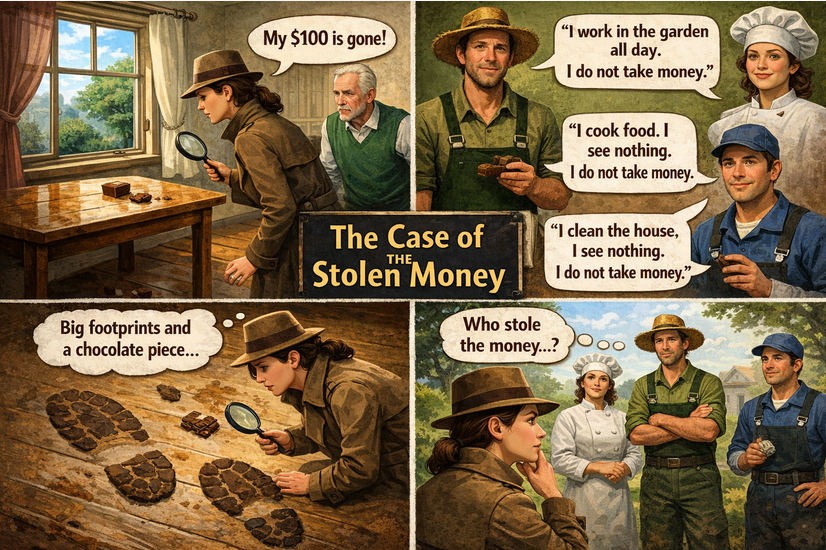
The Case of the Stolen Money
Detective Anna is in a small town. Today, she has a new case. Someone stole money from Mr. Green.
Mr. Green says: “I put 100 dollars on the table. Now it is gone! I need help.”
There are three people in the house:
- Tom, the gardener. He works in the garden all day.
- Lily, the cook. She cooks food for Mr. Green.
- Sam, the cleaner. He cleans the house every day.
Detective Anna asks them questions.
- Tom says: “I work outside. I do not see the money.”
- Lily says: “I cook in the kitchen. I do not take money.”
- Sam says: “I clean the house. I see nothing. I do not take money.”
Anna looks for clues. She sees:
- The table is near the window. The window is open.
- There are footprints on the floor. Big footprints.
- There is a small piece of chocolate on the table.
- A chair is near the window. The chair has dust under it.
Anna asks more questions:
- Tom wears big shoes. Lily wears small shoes. Sam wears medium shoes.
- Tom does not eat chocolate. Lily eats chocolate every day. Sam eats chocolate sometimes.
- Tom is tall. Lily is short. Sam is medium height.
Anna thinks carefully. She looks at the footprints. They are big. She looks at the chocolate. Someone ate it. She looks at the chair. The dust is moved.
Anna says: “The person who stole the money is near the table. The person left big footprints. The person eats chocolate.”
Who stole the money?
_____________________________
Vocabulary:
- to steal (past: stole) – to take something that is not yours.
- a case (detective) – a problem or crime that a detective tries to solve.
- a gardener – a person who works with plants and flowers outside.
- a cleaner – a person who cleans rooms and houses.
- a question – something you ask to get information.
- outside – not inside, in the open air.
- kitchen – a room where people cook food.
- money – coins or paper you use to buy things.
- a clue – information that helps you find something or solve a problem.
- a footprint – the mark of a foot on the ground.
- a chair – something you sit on.
- dust – small pieces of dirt in a room.
- to wear shoes – to have shoes on your feet.
- sometimes – not always, but now and then.
- to be tall – to have a high height.
- to be short – to have a low height.
- to eat (past: ate) – to put food in your mouth and swallow it.
- to move dust – to push or change the place of dust.
#################
You got it? You solved the case?
We have three suspects:
- Tom – big shoes, does not eat chocolate, works outside.
- Lily – small shoes, eats chocolate every day, works in the kitchen.
- Sam – medium shoes, eats chocolate sometimes, cleans the house.
Clues:
- Footprints on the floor are big → matches Tom.
- There is chocolate eaten → matches Lily and Sam, not Tom.
- Table is near the window, chair moved, dust moved → person was near the table and window.
Now combine:
- The thief left big footprints → Tom.
- The thief ate chocolate → only Lily or Sam.
Notice the conflict: Tom has big shoes but does not eat chocolate.
The chocolate clue shows the thief ate chocolate, so it is not Tom.
Sam’s shoes are medium → footprints too small.
Lily’s shoes are small → footprints too small.
But the footprints are big, and someone ate chocolate → this is tricky!
Look at the text carefully:
- The footprints were big and the chocolate was on the table, not necessarily eaten by the thief.
- The chocolate clue says: “There is a small piece of chocolate on the table.”
- Tom does not eat chocolate, but the chocolate is left there → it’s not about eating, just a clue to the table.
So the main clues for the thief:
- Big footprints → Tom.
- Near the table / window / chair → yes, Tom could reach it.
- Chocolate is just a distraction.
✅ Solution: Tom stole the money.
Why:
- Only Tom has big shoes, which match the footprints.
- The thief must have been near the table → the window is open, footprints lead from the table → Tom had access.
- The chocolate clue was meant to distract the reader.
_____________________
Vocabulary:
- a suspect → a person who might have done something wrong
- to match somebody/something → to look good together or be the same as something
- a thief (plural: thieves) → a person who steals things
- tricky → difficult or not easy
- necessarily → it must happen; it is needed
- to lead from the table → to take someone away from the table (like in a game or meal)
- to have access → to be able to use or reach something
- to distract → to take someone’s attention away from something
Schreibe einen Kommentar