- helping young people protect Cambodia’s forests
The Cardamom Mountains in Cambodia have large forests. Many wild animals live there. Local families also live near these forests. They grow rice, vegetables and other crops.
But life is not always easy for these families. Sometimes they do not earn enough money from farming. Some families cut down more trees to get new land for their farms. This is a problem because forests are important for people, animals and nature.
The Southern Cardamom REDD+ Project wants to protect these forests and help local people. It works to stop people from cutting down trees, protect wild animals and reduce damage to nature. It also helps local families find better ways to earn money.
Tourism can also help protect the forests. Shinta Mani Wild is a luxury camp with tents in the Cardamom Mountains. It works with Wildlife Alliance, an organisation that protects forests and wild animals in Cambodia. Tourism can create jobs for local people and give them another way to earn money.
One important part of the REDD+ project (Reducing Emissions from Deforestation and Forest Degradation)is education.
Since 2021, the project has given scholarships to young people from local communities. The scholarships help them go to university in Phnom Penh. They pay for university fees, a place to live and other important costs. Students can also get help with English and study materials.
The aim is simple: young people can get a good education and later help their own communities.
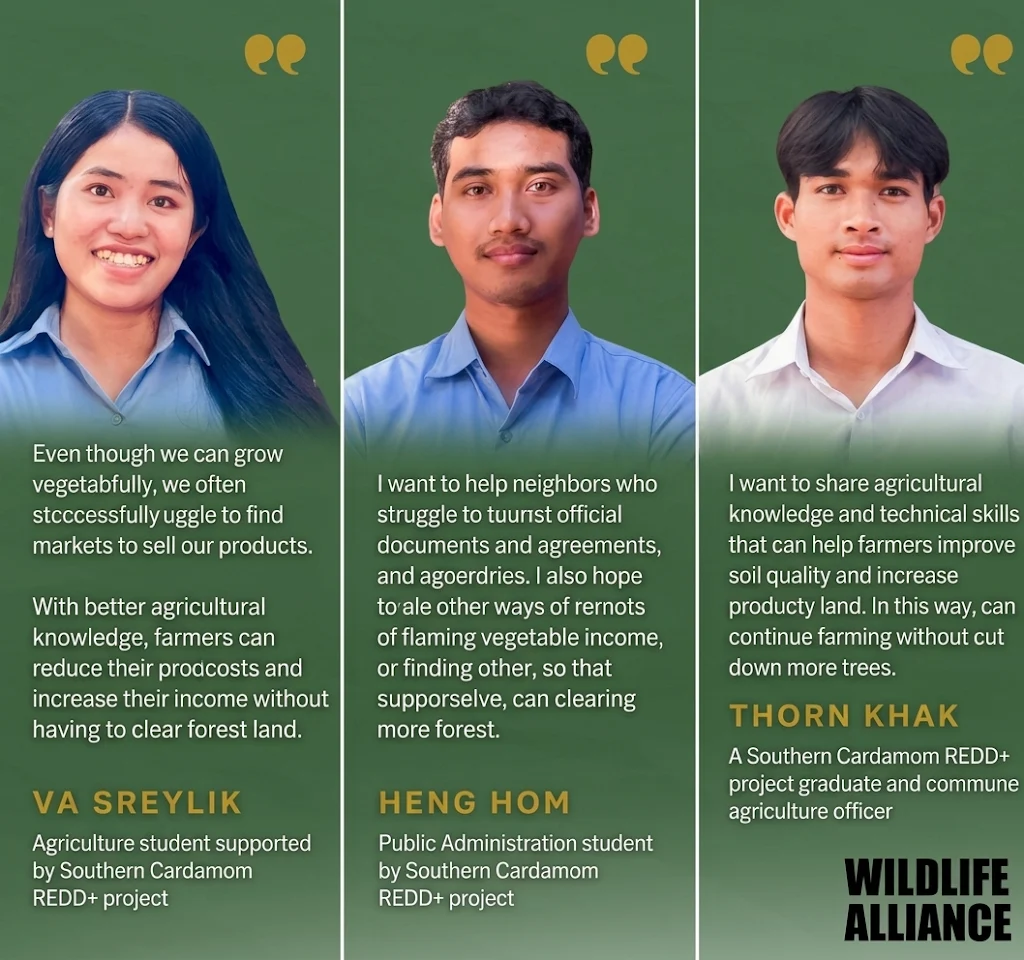
Three students have special plans for the future.
Thorn Khak studied agriculture. He now helps farmers improve their soil and find better markets for their products.
Va Sreylik studies agriculture. She wants to teach families how to make their own fertilizer. This can help them save money and grow better crops.
Heng Hom wants to help local people understand official papers and documents before they sign them.
These activities can also help protect nature. Farmers can grow more food on the land they already have instead of cutting down trees to make new fields. Better farming methods can protect the soil. Fewer trees are cut down, and wild animals can keep their homes.
The scholarship is more than financial help. It gives young people a chance to build a better future. They can use their knowledge to help their neighbours and protect the forests.
Education can help both people and nature.
__________________________
Vocabulary:
| Word / phrase | Definition |
|---|---|
| a forest | a large area with many trees |
| to grow crops | to grow plants such as rice or vegetables |
| to earn money | to get money from work |
| to protect | to keep someone or something safe |
| damage to nature | harm to plants, animals or the environment |
| to create jobs | to give people new work |
| emissions | gases that go into the air |
| deforestation | cutting down many trees in a forest |
| degradation | when something becomes worse |
| a scholarship | money to help a student pay for their studies |
| a local community | people who live in the same area |
| university fees | money you pay to study at a university |
| to improve soil | to make the earth better for growing plants |
| a fertilizer | something you put on the soil to help plants grow |
| knowledge | information and things you learn |
| education | learning at school, college or university |
#######################
Match word and definition:
Words
- a forest
- to grow crops
- to earn money
- to protect
- damage to nature
- to create jobs
- emissions
- deforestation
- degradation
- a scholarship
- a local community
- university fees
- to improve soil
- a fertilizer
- knowledge
- education
Definitions
A. money you pay to study at a university
B. to keep someone or something safe
C. information and things you learn
D. when something becomes worse
E. to get money from work
F. something you put on the soil to help plants grow
G. a large area with many trees
H. gases that go into the air
I. to make the earth better for growing plants
J. people who live in the same area
K. harm to plants, animals or the environment
L. learning at school, college or university
M. to give people new work
N. cutting down many trees in a forest
O. to grow plants such as rice or vegetables
P. money to help a student pay for their studies
___________________________________
Answer key:
1G, 2O, 3E, 4B, 5K, 6M, 7H, 8N, 9D,
10P, 11J, 12A, 13I, 14F, 15C, 16L
#########################
Match the definitions with the words
Definitions
- a large area with many trees
- money to help a student pay for their studies
- to make the earth better for growing plants
- gases that go into the air
- people who live in the same area
- to get money from work
- cutting down many trees in a forest
- learning at school, college or university
- to keep someone or something safe
- something you put on the soil to help plants grow
- harm to plants, animals or the environment
- to grow plants such as rice or vegetables
- information and things you learn
- money you pay to study at a university
- when something becomes worse
- to give people new work
Words
A. a fertilizer
B. deforestation
C. to protect
D. knowledge
E. university fees
F. to grow crops
G. degradation
H. a scholarship
I. emissions
J. to earn money
K. education
L. to improve soil
M. a forest
N. to create jobs
O. damage to nature
P. a local community
_________________________________
Answer key:
1M, 2H, 3L, 4I, 5P, 6J, 7B, 8K, 9C, 10A,
11O, 12F, 13D, 14E, 15G, 16N
########################
Multiple-choice:
1. Where are the Cardamom Mountains?
- A. In southern Laos
- B. In northern Thailand
- C. In western Cambodia
2. What do local families grow?
- A. Rice and vegetables
- B. Tea and oranges
- C. Coffee and bananas
3. Why do some families cut down more trees?
- A. To find wild animals
- B. To get more farmland
- C. To build new roads
4. Why are forests important?
- A. They provide many jobs
- B. They make farming easier
- C. They are homes for animals
5. What is the main aim of the REDD+ Project?
- A. To build hotels and roads
- B. To protect forests and help people
- C. To increase farming and tourism
6. How can tourism help local people?
- A. It creates jobs for them.
- B. It gives them free houses.
- C. It brings them new animals.
7. What is Shinta Mani Wild?
- A. A school for local children
- B. A centre for wild animals
- C. A luxury camp with tents
8. Which organisation works with Shinta Mani Wild?
- A. Phnom Penh University
- B. Wildlife Alliance
- C. Southern Cardamom School
9. When did the scholarship programme start?
- A. In 2021
- B. In 2019
- C. In 2020
10. Where can scholarship students study?
- A. In Siem Reap
- B. In Battambang
- C. In Phnom Penh
11. What do the scholarships pay for?
- A. Travel tickets and clothes
- B. University fees and living costs
- C. Food supplies and farm tools
12. What additional help can students receive?
- A. Driving lessons and sports
- B. Cooking lessons and travel
- C. English and study materials
13. What did Thorn Khak study?
- A. Agriculture
- B. Tourism
- C. Business
14. How does Thorn Khak help farmers?
- A. He helps build houses and roads.
- B. He helps improve soil and find markets.
- C. He helps buy animals and machines.
15. What does Va Sreylik want to teach families?
- A. How to sell their land
- B. How to build new farms
- C. How to make their own fertilizer
16. How can making their own fertilizer help families?
- A. They can save money.
- B. They can buy more land.
- C. They can find new jobs.
17. What does Heng Hom want to help people understand?
- A. English books and lessons
- B. Official papers and documents
- C. Farming methods and soil
18. What can better farming methods help farmers do?
- A. Open farms in new forests
- B. Sell trees to other countries
- C. Grow food on existing farmland
19. Why is protecting the soil important?
- A. It helps crops grow better.
- B. It brings more tourists.
- C. It helps people build roads.
20. How can education help nature?
- A. It brings more people to forests.
- B. It helps people use land better.
- C. It makes farming more expensive.
________________________________
Answer key:
1C, 2A, 3B, 4C, 5B, 6A, 7C, 8B, 9A, 10C, 11B,
12C, 13A, 14B, 15C, 16A, 17B, 18C, 19A, 20B
#######################
True or false:
- The Cardamom Mountains are in Thailand.
- The scholarships pay for university fees, accommodation and other important costs.
- All local families earn enough money from farming.
- Shinta Mani Wild is a luxury camp with tents.
- The REDD+ Project wants families to cut down fewer trees.
- Thorn Khak studied tourism at university.
- Wildlife Alliance works to protect forests and wild animals.
- The scholarship programme started in 2023.
- Students can receive help with English and study materials.
- Va Sreylik wants to teach families how to make their own fertilizer.
- Heng Hom helps farmers find better markets for their products.
- The project only helps people who work in tourism.
- Better farming methods can help protect the soil.
- Thorn Khak helps farmers improve their soil.
- The scholarships help young people study in Siem Reap.
- Education can help local people and protect nature.
_____________________________
Answer key:
1F, 2T, 3F, 4T, 5T, 6F, 7T, 8F, 9T, 10T,
11F, 12F, 13T, 14T, 15F, 16T
#####################
Cause and effect – match each cause with the correct effect:
Causes
- Some families do not earn enough money from farming.
- Families cut down trees to get more farmland.
- Tourism creates jobs for local people.
- Young people receive scholarships.
- Farmers learn to improve their soil.
- Families learn to make their own fertilizer.
- Students receive help with English.
- Farmers find better markets for their products.
Effects
A. They can sell their products more easily.
B. They can study at university in Phnom Penh.
C. Forests become smaller and animals lose their homes.
D. They can communicate better and improve their studies.
E. People have another way to earn money.
F. They can save money on farming costs.
G. Some families look for other ways to earn money.
H. They can grow better crops on their existing land.
____________________________
Answer key:
1G, 2C, 3E, 4B, 5H, 6F, 7D, 8A
####################
Short answers, keywords only
- Where are the Cardamom Mountains?
- Why do some families cut down more trees?
- How does the REDD+ Project help local people?
- Which organisation works with Shinta Mani Wild?
- When did the scholarship programme start?
- Where can scholarship students study?
- Who helps farmers improve their soil and find better markets?
- How can families save money on fertilizer?
- What does Heng Hom help local people understand?
- Why can better farming methods protect forests?
___________________________
Answer key:
- Cambodia
- To get more farmland
- Better ways to earn money
- Wildlife Alliance
- 2021
- Phnom Penh
- Thorn Khak
- Make their own fertilizer
- Official papers and documents
- Less need for new farmland
###################
A fictitional interview with the CEO of Wildlife Alliance – match questions and answers
Questions
- What is the main goal of Wildlife Alliance?
- Where does your organisation operate?
- Why are the Cardamom forests so important?
- How do you stop illegal tree cutting?
- What happens when rangers find illegal hunters?
- Which animals need special protection?
- How do local families benefit from your projects?
- Can tourism also help protect forests?
- Why is education important for forest protection?
- Why do you offer scholarships to young people?
- What difficulties does your organisation face?
- What are your hopes for the future?
Answers
A. They are homes for many wild animals and help keep nature healthy.
B. Illegal hunting, cutting down trees and a lack of money are big problems.
C. We want students from local communities to study at university.
D. Yes, tourism creates jobs and gives local people another way to earn money.
E. Our forest rangers walk through the forests and look for people who cut down trees illegally.
F. We hope for healthy forests, safe wild animals and better lives for local families.
G. We are active in different parts of Cambodia, especially in the Cardamom Mountains.
H. They get new chances to earn money and improve their lives.
I. Elephants, bears, monkeys and many rare birds need our help.
J. We want to keep forests, wild animals and nature safe in Cambodia.
K. It gives young people knowledge and better chances for the future.
L. They report these people to the police.
__________________________
Answer key:
1J, 2G, 3A, 4E, 5L, 6I, 7H, 8D, 9K, 10C, 11B, 12F
__________________________
Full version:
1. Journalist: What is the main goal of Wildlife Alliance?
CEO: We want to keep forests, wild animals and nature safe in Cambodia.
2. Journalist: Where does your organisation operate?
CEO: We are active in different parts of Cambodia, especially in the Cardamom Mountains.
3. Journalist: Why are the Cardamom forests so important?
CEO: They are homes for many wild animals and help keep nature healthy.
4. Journalist: How do you stop illegal tree cutting?
CEO: Our forest rangers walk through the forests and look for people who cut down trees illegally.
5. Journalist: What happens when rangers find illegal hunters?
CEO: They report these people to the police.
6. Journalist: Which animals need special protection?
CEO: Elephants, bears, monkeys and many rare birds need our help.
7. Journalist: How do local families benefit from your projects?
CEO: They get new chances to earn money and improve their lives.
8. Journalist: Can tourism also help protect forests?
CEO: Yes, tourism creates jobs and gives local people another way to earn money.
9. Journalist: Why is education important for forest protection?
CEO: It gives young people knowledge and better chances for the future.
10. Journalist: Why do you offer scholarships to young people?
CEO: We want students from local communities to study at university.
11. Journalist: What difficulties does your organisation face?
CEO: Illegal hunting, cutting down trees and a lack of money are big problems.
12. Journalist: What are your hopes for the future?
CEO: We hope for healthy forests, safe wild animals and better lives for local families.
#####################
################
############
#######
##
Please use the box below
to write your feedback.
Only I can read it.
It is not public.
Please tell me:
- Are the texts and exercises OK?
- Are the topics OK?
- Is the level OK?
- Is it too easy or too difficult?
- Is it too short, too long?
- Do you want texts about other topics?
Thank you! I appreciate your feedback.
___________________________________
Remember how babies
learn a language:
Babies learn a language by listening.
They use their ears to hear sounds.
Their brain remembers these sounds.
Babies connect sounds with people and things.
They listen to their parents.
Then they copy the sounds they hear. They imitate words.
Slowly, babies learn to speak.
So,
LISTEN, LISTEN, LISTEN, LISTEN………………

SMFrockZ@gmx.at
##################
Schreibe einen Kommentar