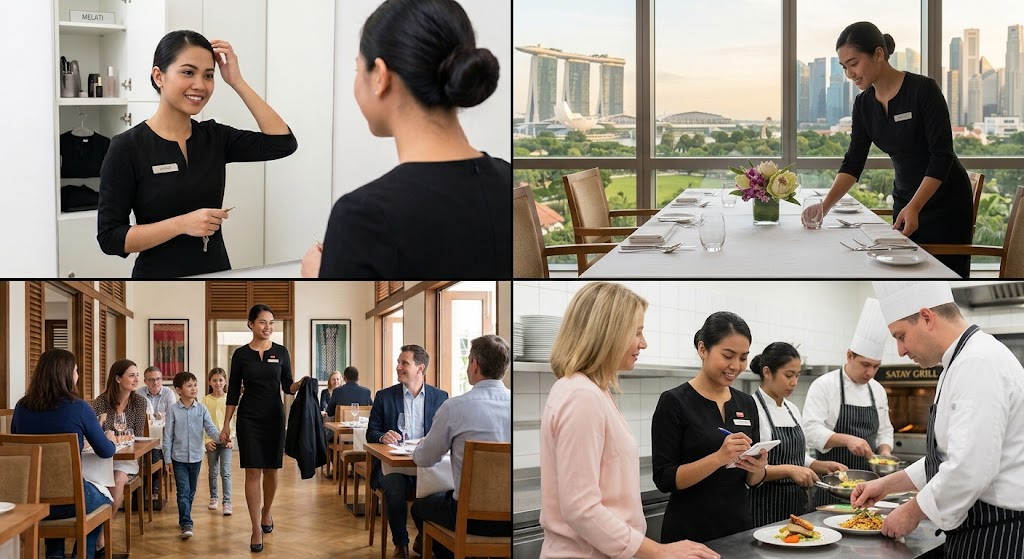
A2 text
1. Arriving at Work and Starting Duty
Hello, my name is Melati. I am an employee and a staff member on the restaurant team. My employer owns a beautiful 5-star hotel. Today is a normal working day for me, and I work the morning shift. I arrive at the staff entrance with good punctuality. I walk down the staff corridor to the changing room. I use my locker key to open my locker. I put on my staff ID card and check my personal appearance. Then, I go to the staff canteen to drink some water. After that, I check the duty roster on the staff notice board to see my working hours. Finally, I join the daily briefing with my department manager, my supervisor, and the head waiter.
2. Personal Appearance, Uniform and Hygiene
I always keep a good personal appearance and a professional appearance. I wear a clean uniform, a fresh uniform, and a well-ironed uniform. I follow our uniform policy and dress code. I wear my name badge and identification badge on my shirt. My shoes are comfortable shoes, non-slip shoes, and well-polished shoes. My hairstyle is simple, and I use a hair tie to keep neat hair. I follow all hygiene standards, hygiene regulations, and personal hygiene rules. I take care of my hand hygiene with frequent hand washing. I use the soap dispenser, dry my hands with a paper towel, and use hand sanitiser. I care about my personal cleanliness to stop body odour, so I use deodorant and keep fresh breath. I keep clean fingernails and short nails without nail polish. I do not wear jewellery, but I wear a simple wristwatch.
3. Preparing the Restaurant Before Opening
Before we open, I walk into the dining room and dining area of the restaurant. I check the main entrance, reception area, waiting area, and terrace with outdoor seating. I also clean the indoor seating, private dining room, function room, breakfast room, service area, service station, side station, preparation area, and storage room or storeroom. I use our equipment and restaurant equipment to set the tables. I put a tablecloth, table runner, and placemat on each table. For every table setting and place setting, I arrange the tableware. I set out the cutlery and silverware, including the dinner knife, steak knife, butter knife, dinner fork, dessert fork, soup spoon, dessert spoon, teaspoon, serving spoon, and serving fork. I place the dinner plate, side plate, dessert plate, soup bowl, bread basket, butter dish, salt shaker, and pepper shaker. I polish all glassware, such as the water glass, wine glass, champagne flute, champagne coupe, tumbler, highball glass, carafe, and jug. I do the napkin folding with a napkin ring. I place a flower arrangement, candle holder, and centrepiece as a table decoration. Then, I check the table number, table plan, tray, tray stand, trolley, menu holder, and reservation book in our reservation system.
4. Food, Ingredients and Kitchen Communication
I go to the kitchen to talk to the head chef, executive chef, sous-chef, pastry chef, cook, kitchen assistant, and kitchen porter. The kitchen team works in the cooking station, cold kitchen, hot kitchen, bakery, and pastry section. They prepare the à la carte menu, set menu, tasting menu, buffet, lunch menu, dinner menu, seasonal menu, children’s menu, vegetarian menu, and vegan menu. They use fresh ingredients, fresh produce, and local produce from a local farmer and supplier. I learn about today’s starter, appetiser, soup, salad, main course, side dish, dessert, cheese board, and bread selection. The chefs explain the fresh herbs, spices, seasoning, sauce, dressing, and garnish. I check the food quality, food freshness, food temperature, food safety, portion size, and food presentation. If a guest has a food allergy or food intolerance, I can recommend gluten-free, dairy-free, nut-free, vegetarian, vegan, or organic dishes.
5. Welcoming Guests and Seating Them
At 12:00 PM, the first guest, diner, and visitor arrive. I welcome every regular guest, first-time guest, VIP guest, hotel resident, and outside guest. I show hospitality, politeness, and friendliness. I keep good eye contact, positive body language, a nice facial expression, good posture, and a warm smile while greeting guests. When a walk-in guest arrives, I check for an available table. If a guest has a reservation, I check the booking, booking confirmation, booking details, reservation time, and party size. If the restaurant is fully booked, I check the waiting list and state the waiting time. I look at our seating arrangement and take them to their reserved table, such as a window table, corner table, quiet table, or private table. I make sure we have wheelchair access when needed. I listen to any special request and remember each guest preference. I escort a guest, lead someone, seat a guest, pull out a chair, help with a coat, and present the menu.
6. Taking Orders and Talking to Guests
I walk to the table with my order pad. I take the food order and drink order from the guests. Then, I put everything into our ordering system using the correct order number. When guests want a recommendation or suggestion, I read the menu description and suggest our daily special. I listen to every request, question, and preference. I always give a clear answer, explanation, and description.
7. Serving Food and Drinks
When the food is ready, I use a serving tray to start the food service and beverage service. I serve every course in order: the appetiser, the starter course, the main course, and the dessert course. I bring a welcome drink, pour aperitifs, show the wine list, serve a digestif, and bring hot beverages like tea and coffee. I bring each hot plate and serving dish using silver service. I place plates from the left side or right side of the guest. I pour water from the water jug and wine from the wine bottle with a clean napkin. I offer extra sauce, bread, and butter. I check guest satisfaction and keep good service timing. Later, I remove used plates, empty glasses, and used cutlery using a trolley.
8. Handling Guest Complaints and Difficult Situations
Sometimes, a difficult guest, an unhappy guest, or an impatient guest has a problem. They might talk about cold food, a wrong order, a long waiting time, a dirty plate, a broken glass, a wrong bill, or a noisy table. When I handle a guest complaint, I show empathy, patience, and professionalism. I listen to the problem, give an apology, and try to resolve a problem. I offer a solution, like a replacement dish, a free drink, a complimentary dessert, or a discount. If I need help, I talk to the duty manager or supervisor.
9. Payments, Billing and Guest Departure
When guests finish their meal, they ask for the bill or check. I check the itemised bill for accuracy and bring it in a bill folder on a bill tray. Guests can pay with cash, a credit card, a debit card, a room charge, or a gift voucher. I use the payment terminal for a card payment, or I take a cash payment and give back the change with the receipt. Guests often leave a tip or gratuity in the tip box. I say thank you, give a warm farewell, wish them a safe journey, and tell them, „We hope to see you again soon.“
10. Closing Duties and End of Shift
At the end of my late shift, I do my closing duties. I help with clearing tables, wiping tables, sanitising tables, sweeping the floor, and mopping the floor. I put dirty linen into the linen bin. I put all service equipment back in the side station and storage room. I make sure everything is restocked and reloaded. I finish the shift handover, check tomorrow’s duty roster, change clothes in the changing room, and use the time clock to clock out. My work for the day is complete!
######################
######################
A1 text
1. Arriving at Work and Starting Duty
Hello! My name is Melati. I am a waitress. I work in a very big hotel in the city. I go to work by bus every day. Today, I work in the morning. I arrive at work at seven o’clock. I walk through the big staff door. I walk down a long hall. I open my locker with my small key. I put my bag and my coat inside. I put my name card on my shirt. I walk to the staff room. I sit down and drink a glass of water. Then, I see my boss and my team. My boss talks to us about our work today. I listen to my boss. I am happy and ready to work!
2. Personal Appearance, Uniform and Hygiene
I look clean and neat every day. I wear my work clothes. My work clothes are clean, white, and black. They have no dirt. I iron my clothes at home so they look nice. My shoes are black, clean, and very comfortable. I walk a lot, so good shoes are important. My hair is short, neat, and combed. I wash my hands with warm water and soap. I wash my hands for twenty seconds. I dry my hands with a paper towel. My hands are very clean. My fingernails are short and clean. I do not wear big rings or hot perfume. I wear a small black watch on my arm. I check my face in the mirror, smile, and walk out.
3. Preparing the Restaurant Before Opening
I go into the big dining room. The room is very large and beautiful. First, I open the curtains. The sun comes in. I check all the tables and chairs. I wipe every table with a clean cloth. I put a long white cloth on every table. I place plates, big knives, small knives, forks, and spoons on the table. Every knife goes on the right. Every fork goes on the left. I put a water glass and a wine glass at every place. I put salt, pepper, and a small flower vase in the middle of each table. The flowers are red and yellow. I fold the white paper napkins nicely. The dining room looks clean, bright, and ready for people.
4. Food, Ingredients and Kitchen Communication
I walk into the hotel kitchen. The kitchen is hot and busy. I see four cooks. The head cook is a nice man. He shows me the food for today. The cooks use fresh red tomatoes, green salads, eggs, meat, fish, and bread. They get fresh food from local farmers every morning. I look at the menu paper. Today we have hot tomato soup, fresh green salad, chicken with rice, and grilled fish. For dessert, we have chocolate cake and fruit. I ask the cook, „Is the soup hot?“ He says, „Yes, it is very hot.“ I learn about all the food so I can help my guests choose.
5. Welcoming Guests and Seating Them
At twelve o’clock, the door opens. People start to arrive. I stand near the front door. I see a man and a woman walk in. I look at them, smile big, and say, „Hello! Welcome to our restaurant!“ They smile back at me. I ask, „Do you have a table today?“ The man says his name. I look at my notebook. I find his name. I say, „Yes! Please follow me.“ I walk with them into the dining room. I show them a nice table near a big window. I pull out the chair for the woman. She sits down. I give them two menu papers and say, „Enjoy your time.“
6. Taking Orders and Talking to Guests
I give the guests five minutes to look at the menu. Then, I walk to their table. I hold a small notebook and a pen in my hands. I say, „Are you ready to order?“ The man asks, „What food is good today?“ I say, „The chicken with rice is very good today. The fish is also very fresh.“ The man smiles and says, „Okay, I want the chicken.“ The woman says, „I want the tomato soup and the green salad.“ I write everything down in my notebook. I ask, „Would you like water or juice to drink?“ They order two glasses of water. I read the order back to them. Then, I say, „Thank you!“ and go to the kitchen.
7. Serving Food and Drinks
In the kitchen, the cooks put the food on big white plates. The plates are heavy and hot. I put the food and glasses on a large round tray. I carry the tray carefully into the dining room. First, I put two glasses of cold water on the table. Then, I put the hot tomato soup in front of the woman. I put the chicken and rice in front of the man. I say, „Be careful, the plates are hot.“ I give them extra bread and butter. I walk away. After ten minutes, I come back and ask, „Is your food good?“ They say, „Yes, the food is delicious!“ When they finish eating, I take away the empty plates and dirty glasses.
8. Handling Guest Complaints and Difficult Situations
Sometimes, a guest is not happy with the food or service. Today, a man at table four calls me. He looks angry. He points at his bowl and says, „Look! My soup is cold!“ I do not get angry. I stand nicely and listen to him. I say, „I am very sorry, sir. I will fix this right now.“ I take the cold soup bowl and walk fast to the kitchen. I speak to the cook. The cook makes a fresh bowl of very hot soup. I bring the new hot soup back to the guest. I also bring him a free glass of fruit juice. The man tastes the soup. He smiles and says, „Thank you, Melati. This is very good now.“
9. Payments, Billing and Guest Departure
After their dessert, the guests at table two look at me. The man lifts his hand and asks, „Can we have the bill, please?“ I say, „Yes, of course.“ I go to the small computer. I print the paper with the prices. I put the paper inside a small black folder. I bring it to the table. The total price is fifty dollars. The man gives me his credit card. I take the card to the card machine. The payment works. I bring back his card and the receipt paper. He gives me five extra dollars for my good work. I am happy. I say, „Thank you very much! Have a wonderful day!“ I walk with them to the door as they leave.
10. Closing Duties and End of Shift
At three o’clock in the afternoon, the lunch service is finished. The last guests walk out. Now, it is time to clean up. I wipe all the table
s with soap and water. I pick up food pieces from the floor. I wash the floor with a mop. I carry dirty napkins to the laundry box. I restock the salt and pepper shakers. I put all the clean glasses back in the glass cabinet. Everything is clean and quiet again. I go to the staff room, take off my work clothes, and put on my street clothes. I put my key in my locker. I walk out of the hotel. My work day is done, and I go home to rest!
######################
Table-side service guide,
how to present food served –
examples
#######################
#######################
#######################
Please use the box below
to write your feedback.
Only I can read it.
It is not public.
Please tell me:
- Are the texts and exercises OK?
- Are the topics OK?
- Is the level OK?
- Is it too easy or too difficult?
- Is it too short, too long?
- Do you want texts about other topics?
Thank you! I appreciate your feedback.
##################
##################
##################
Remember how babies
learn a language:
Babies learn a language by listening.
They use their ears to hear sounds.
Their brain remembers these sounds.
Babies connect sounds with people and things.
They listen to their parents.
Then they copy the sounds they hear. They imitate words.
Slowly, babies learn to speak.
So,
LISTEN, LISTEN, LISTEN, LISTEN………………

SMFrockZ@gmx.at
Schreibe einen Kommentar