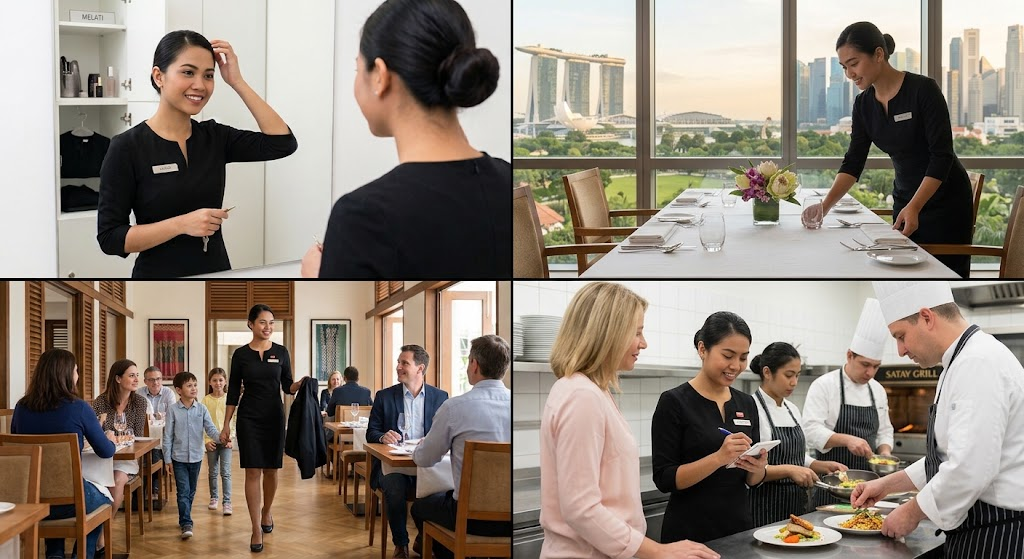
1. Arriving at work and starting duty
| Vocabulary | Definition (A2) | Translation / notes |
|---|---|---|
| employee | A person who works for a company. | |
| employer | A person or company that gives people work. | |
| staff member | A person who works in a hotel. | |
| restaurant team | All employees who work in the restaurant. | |
| department | A part of a hotel with its own jobs. | |
| department manager | The person who leads a hotel department. | |
| supervisor | A person who checks and guides employees. | |
| head waiter | The person who leads the waiters. | |
| assistant manager | A person who helps the manager. | |
| duty manager | The manager responsible during a working shift. | |
| colleague | A person who works with you. | |
| co-worker | Another person who works in the same place. | |
| new employee | A person who has just started working. | |
| experienced employee | A person who has worked in the job for a long time. | |
| trainee | A person who is learning a job. | |
| training | Learning how to do a job. | |
| working day | A day when you have to work. | |
| working hours | The time you spend doing your job. | |
| shift | A fixed period of working time. | |
| morning shift | A shift that starts in the morning. | |
| afternoon shift | A shift that starts in the afternoon. | |
| evening shift | A shift that starts in the evening. | |
| night shift | A shift that takes place at night. | |
| split shift | A working day with two separate working periods. | |
| early shift | A shift that starts very early. | |
| late shift | A shift that finishes late. | |
| shift change | The time when one team replaces another. | |
| duty roster | A plan showing when each employee works. | |
| work schedule | A plan showing working days and hours. | |
| attendance | Being present at work. | |
| attendance record | A record showing when employees come to work. | |
| time clock | A machine used to record working hours. | |
| to clock in | To record the time when you start work. | |
| to clock out | To record the time when you finish work. | |
| staff entrance | A door used by hotel employees. | |
| staff corridor | A passage used by hotel employees. | |
| staff facilities | Rooms and services provided for employees. | |
| staff canteen | A place where employees can eat. | |
| changing room | A room where employees change clothes. | |
| locker | A small cupboard for personal belongings. | |
| locker key | A key used to open your locker. | |
| staff ID card | A card that shows who you are as an employee. | |
| staff notice board | A board with information for employees. | |
| daily briefing | A short meeting before work begins. | |
| team meeting | A meeting with members of your team. | |
| to report for duty | To arrive at work and be ready to start. | |
| to check the roster | To look at the working schedule. | |
| to check attendance | To see which employees are present. | |
| to prepare for work | To get ready to start your duties. | |
| to receive instructions | To get information about what you must do. | |
| to ask for information | To ask someone to explain something. | |
| to follow instructions | To do what someone has told you to do. | |
| to take responsibility | To accept that something is your duty. | |
| punctuality | Being on time. | |
| punctual | Arriving at the correct time. | |
| late | Arriving after the correct time. | |
| absent | Not being at work when expected. | |
| absence | A time when someone is not at work. | |
| sick leave | Time away from work because of illness. | |
| annual leave | Days when an employee can take a holiday. | |
| day off | A day when you do not have to work. |
2. Personal appearance, uniform and hygiene
| Vocabulary | Definition (A2) | Translation / notes |
|---|---|---|
| personal appearance | The way a person looks. | |
| professional appearance | A clean and tidy look that is right for work. | |
| uniform | Special clothes worn at work. | |
| uniform policy | Rules about the clothes employees must wear. | |
| dress code | Rules about suitable clothes at work. | |
| clean uniform | Work clothes without dirt or stains. | |
| fresh uniform | Uniform that has been washed. | |
| well-ironed uniform | Uniform without unwanted folds or lines. | |
| name badge | A small sign showing your name. | |
| identification badge | A card or sign showing who you are. | |
| polished shoes | Shoes that are clean and shiny. | |
| comfortable shoes | Shoes that are easy to wear for many hours. | |
| non-slip shoes | Shoes that help prevent falling on wet floors. | |
| hairstyle | The way your hair is cut or arranged. | |
| neat hair | Hair that looks clean and tidy. | |
| hairnet | A net worn over the hair. | |
| hair tie | A band used to hold long hair together. | |
| facial hair | Hair growing on a man’s face. | |
| beard | Hair growing on the chin and cheeks. | |
| moustache | Hair growing above the upper lip. | |
| fingernails | The hard parts at the ends of your fingers. | |
| clean fingernails | Nails without dirt underneath them. | |
| short nails | Nails that are not long. | |
| nail polish | Coloured liquid put on fingernails. | |
| hand hygiene | Keeping your hands clean. | |
| hand washing | Cleaning your hands with soap and water. | |
| hand sanitiser | A product used to clean your hands. | |
| soap dispenser | A container that gives out liquid soap. | |
| paper towel | Paper used to dry your hands. | |
| personal cleanliness | Keeping your body clean. | |
| body odour | An unpleasant smell from the body. | |
| deodorant | A product that helps prevent body odour. | |
| fresh breath | Breath that does not smell bad. | |
| jewellery | Things such as rings and necklaces. | |
| wristwatch | A small clock worn on the wrist. | |
| make-up | Products used to change or improve the appearance of the face. | |
| skin care | Keeping your skin clean and healthy. | |
| hygiene standards | Rules about keeping people and places clean. | |
| hygiene regulations | Official rules about cleanliness. | |
| personal hygiene | Keeping your body clean and healthy. | |
| to wash your hands | To clean your hands with soap and water. | |
| to change your uniform | To put on a different set of work clothes. | |
| to check your appearance | To make sure you look clean and tidy. | |
| to keep your uniform clean | To make sure your work clothes are not dirty. | |
| to maintain a professional look | To keep a clean and suitable appearance. |
3. Preparing the restaurant before opening
| Vocabulary | Definition (A2) | Translation / notes |
|---|---|---|
| restaurant | A place where people can eat meals. | |
| dining room | The room where guests eat. | |
| dining area | The part of a restaurant where guests sit. | |
| entrance | The place where people enter. | |
| main entrance | The most important entrance to a building. | |
| reception area | The place where visitors are welcomed. | |
| waiting area | A place where guests can wait. | |
| terrace | An outside area where guests can sit. | |
| outdoor seating | Tables and chairs outside the building. | |
| indoor seating | Tables and chairs inside the building. | |
| private dining room | A separate room for a small group of guests. | |
| function room | A room used for meetings and special events. | |
| breakfast room | A room where guests eat breakfast. | |
| service area | A place where employees prepare for service. | |
| service station | A place where waiters keep things they need. | |
| side station | A small working area near the tables. | |
| preparation area | A place where things are made ready. | |
| storage room | A room where things are kept. | |
| storeroom | A room used to keep supplies. | |
| equipment | Tools and machines needed for work. | |
| restaurant equipment | Things used for preparing and serving meals. | |
| table | A piece of furniture where people eat. | |
| chair | A piece of furniture for sitting. | |
| armchair | A comfortable chair with sides for your arms. | |
| high chair | A special chair for a small child. | |
| baby chair | A chair made for a young child. | |
| tablecloth | A cloth that covers a table. | |
| table runner | A long piece of cloth placed along a table. | |
| placemat | A small mat placed under a plate. | |
| table decoration | An object used to make a table look attractive. | |
| flower arrangement | Flowers placed together as a decoration. | |
| candle holder | An object used to hold a candle. | |
| centrepiece | A decoration placed in the middle of a table. | |
| table number | A number used to identify a table. | |
| table plan | A plan showing where guests will sit. | |
| table setting | The plates, glasses and cutlery prepared for a guest. | |
| place setting | Everything one guest needs at the table. | |
| cutlery | Knives, forks and spoons used for eating. | |
| silverware | Metal cutlery used for eating. | |
| dinner knife | A knife used for eating the main course. | |
| steak knife | A sharp knife used for cutting meat. | |
| butter knife | A small knife used for spreading butter. | |
| dinner fork | A fork used for the main course. | |
| dessert fork | A small fork used for eating dessert. | |
| soup spoon | A large spoon used for eating soup. | |
| dessert spoon | A spoon used for eating dessert. | |
| teaspoon | A small spoon used for tea or coffee. | |
| serving spoon | A large spoon used for serving food. | |
| serving fork | A large fork used for serving food. | |
| side plate | A small plate for bread or other food. | |
| dinner plate | A large plate used for the main meal. | |
| dessert plate | A small plate used for dessert. | |
| soup bowl | A deep dish used for soup. | |
| bread basket | A basket used for serving bread. | |
| butter dish | A small dish used for serving butter. | |
| salt shaker | A small container used for serving salt. | |
| pepper shaker | A small container used for serving pepper. | |
| glassware | All the glasses used in a restaurant. | |
| wine glass | A glass used for drinking wine. | |
| water glass | A glass used for drinking water. | |
| champagne flute | A tall, narrow glass for champagne. | |
| champagne coupe | A wide, shallow glass for champagne. | |
| tumbler | A short drinking glass. | |
| highball glass | A tall glass used for drinks. | |
| carafe | A glass container used for serving water or wine. | |
| jug | A container used for pouring drinks. | |
| napkin | A piece of cloth or paper used during a meal. | |
| napkin ring | A small ring used to hold a folded napkin. | |
| napkin folding | Making special shapes with a napkin. | |
| tray | A flat object used for carrying food and drinks. | |
| tray stand | A small stand used to hold a tray. | |
| trolley | A small vehicle with wheels used to move things. | |
| menu holder | An object used to hold a menu. | |
| reservation book | A book with information about table bookings. | |
| reservation system | A computer system used to manage bookings. | |
| to arrange | To put things in the correct order or position. | |
| to set the tables | To prepare tables for guests. | |
| to polish | To clean something until it shines. | |
| to check | To make sure something is correct. | |
| to replace | To put something new in the place of something else. | |
| to refill | To put more of something into a container. | |
| to stock | To fill a place with the things needed. | |
| to organise | To put things in the correct order. | |
| to decorate | To make a place look more attractive. | |
| to prepare the restaurant | To make the restaurant ready for guests. |
4. Food, ingredients and kitchen communication
| Vocabulary | Definition (A2) | Translation / notes |
|---|---|---|
| kitchen | The place where food is prepared and cooked. | |
| chef | A professional cook. | |
| head chef | The person who leads the kitchen team. | |
| executive chef | The chef responsible for the whole kitchen. | |
| sous-chef | The person who helps the head chef. | |
| pastry chef | A cook who makes cakes and desserts. | |
| kitchen assistant | A person who helps in the kitchen. | |
| kitchen porter | A person who cleans dishes and kitchen equipment. | |
| cook | A person who prepares and cooks food. | |
| cooking station | A place where a cook prepares a certain type of food. | |
| cold kitchen | The part of the kitchen where cold dishes are prepared. | |
| hot kitchen | The part of the kitchen where hot dishes are cooked. | |
| bakery | A place where bread and cakes are made. | |
| pastry section | The part of the kitchen where desserts are prepared. | |
| menu | A list of food and drinks in a restaurant. | |
| à la carte menu | A menu where guests choose each dish separately. | |
| set menu | A menu with a fixed selection of dishes. | |
| tasting menu | A meal with several small dishes. | |
| buffet | A meal where guests choose food from a large selection. | |
| breakfast buffet | A selection of breakfast foods for guests. | |
| lunch menu | A list of food available at lunchtime. | |
| dinner menu | A list of food available in the evening. | |
| seasonal menu | A menu with food available at a certain time of year. | |
| children’s menu | A menu with dishes for children. | |
| vegetarian menu | A selection of dishes without meat or fish. | |
| vegan menu | A selection of dishes without animal products. | |
| starter | A small dish eaten before the main course. | |
| appetiser | A small dish served before the main meal. | |
| soup | A liquid dish made with vegetables, meat or other ingredients. | |
| salad | A dish made with raw or cooked vegetables. | |
| main course | The most important dish of a meal. | |
| side dish | Food served together with the main course. | |
| dessert | Sweet food eaten at the end of a meal. | |
| cheese board | A selection of different cheeses served together. | |
| bread selection | Different types of bread offered to guests. | |
| ingredients | The foods used to prepare a dish. | |
| fresh produce | Fresh fruit and vegetables. | |
| local produce | Food grown or made in the nearby area. | |
| local farmer | A person who grows food or keeps farm animals nearby. | |
| supplier | A person or company that provides products. | |
| delivery | Products brought to the hotel. | |
| fresh herbs | Fresh leaves used to add flavour to food. | |
| spices | Dried plants used to give food more flavour. | |
| seasoning | Salt, pepper and other things added to food. | |
| sauce | A liquid or soft food served with a dish. | |
| dressing | A sauce added to a salad. | |
| garnish | A small decoration added to a dish. | |
| portion | The amount of food served to one person. | |
| portion size | The amount of food on one plate. | |
| food presentation | The way food looks when served. | |
| food quality | How good or fresh food is. | |
| food freshness | How fresh the food is. | |
| food temperature | How hot or cold the food is. | |
| food allergy | A bad reaction to a certain food. | |
| food intolerance | A problem when the body cannot easily accept certain food. | |
| gluten-free | Food without gluten. | |
| dairy-free | Food without milk products. | |
| nut-free | Food without nuts. | |
| vegetarian | A person who does not eat meat or fish. | |
| vegan | A person who does not eat animal products. | |
| organic | Food produced without many artificial chemicals. | |
| sustainable | Produced in a way that is better for nature. | |
| food waste | Food that is thrown away instead of being eaten. | |
| food safety | Rules for preparing and serving food safely. | |
| expiry date | The date after which food should not be used. | |
| best-before date | The date until which food is expected to have good quality. | |
| to prepare | To make food ready for cooking or serving. | |
| to cook | To prepare food using heat. | |
| to grill | To cook food over or under strong heat. | |
| to fry | To cook food in hot oil or fat. | |
| to bake | To cook food in an oven. | |
| to boil | To cook food in very hot water. | |
| to steam | To cook food using hot water vapour. | |
| to roast | To cook food in an oven using dry heat. | |
| to chop | To cut food into small pieces. | |
| to slice | To cut food into thin pieces. | |
| to peel | To remove the outside skin of fruit or vegetables. | |
| to mix | To put different things together. | |
| to stir | To move food around with a spoon. | |
| to taste | To try a small amount of food. | |
| to season | To add salt, pepper or other spices to food. | |
| to garnish | To add a small decoration to a dish. | |
| to plate up | To put prepared food onto a plate. | |
| to send an order | To tell the kitchen what a guest has ordered. | |
| to check an order | To make sure the correct food has been prepared. | |
| to return a dish | To send food back to the kitchen. | |
| sold out | No more of a product or dish is available. | |
| unavailable | Not possible to get or order at that time. |
5. Welcoming guests and seating them
| Vocabulary | Definition (A2) | Translation / notes |
|---|---|---|
| guest | A person who visits or stays at the hotel. | |
| diner | A person who eats in a restaurant. | |
| visitor | A person who comes to a place. | |
| regular guest | A person who visits the restaurant often. | |
| first-time guest | A person visiting the restaurant for the first time. | |
| VIP guest | A very important guest who may receive special service. | |
| hotel resident | A person staying at the hotel. | |
| outside guest | A person who visits the restaurant but does not stay at the hotel. | |
| greeting | Friendly words used when meeting someone. | |
| welcome | A friendly way to receive a guest. | |
| first impression | The first feeling someone has about a person or place. | |
| hospitality | Friendly care and service for guests. | |
| politeness | Good manners when speaking and behaving. | |
| friendliness | Being kind and pleasant to other people. | |
| eye contact | Looking at another person’s eyes when speaking. | |
| body language | Messages we give with our face and body. | |
| facial expression | The way your face shows feelings. | |
| posture | The way you stand or sit. | |
| smile | A happy expression on your face. | |
| greeting guests | Saying hello and welcoming people. | |
| reservation | An arrangement to keep a table for a guest. | |
| booking | An arrangement made before visiting. | |
| booking confirmation | Information showing that a reservation is accepted. | |
| booking details | Information about a guest’s reservation. | |
| reservation time | The time when a guest has booked a table. | |
| party size | The number of people in a group. | |
| walk-in guest | A guest who arrives without a reservation. | |
| waiting list | A list of people waiting for a table. | |
| waiting time | The time a guest must wait. | |
| available table | A table that is free for guests. | |
| occupied table | A table that is being used by guests. | |
| reserved table | A table kept for a guest with a booking. | |
| fully booked | When all tables have been reserved. | |
| seating arrangement | The way guests are placed at tables. | |
| window table | A table next to a window. | |
| corner table | A table in a corner of the restaurant. | |
| quiet table | A table in a place with less noise. | |
| private table | A table in a separate or quiet area. | |
| wheelchair access | The possibility for wheelchair users to enter a place. | |
| special request | Something extra a guest asks for. | |
| guest preference | Something a guest likes or wants. | |
| to greet | To say hello to someone. | |
| to welcome | To receive someone in a friendly way. | |
| to introduce yourself | To tell someone your name. | |
| to confirm | To say that something is correct or agreed. | |
| to check a booking | To look at the details of a reservation. | |
| to ask for a name | To ask what someone is called. | |
| to escort a guest | To go with a guest and show the way. | |
| to lead someone | To show someone where to go. | |
| to seat a guest | To show a guest to a table. | |
| to pull out a chair | To move a chair back for someone. | |
| to present the menu | To give the menu to the guest. | |
| to help with a coat | To help a guest take off or put on a coat. | |
| to offer assistance | To ask if someone needs help. |
6. Taking orders and talking to guests
| Vocabulary | Definition (A2) | Translation / notes |
|---|---|---|
| order | A request for food or drinks. | |
| food order | A request for a dish or meal. | |
| drink order | A request for a drink. | |
| order pad | A small book used to write down orders. | |
| order number | A number used to identify an order. | |
| ordering system | A computer system used to record orders. | |
| menu description | Words explaining what a dish contains. | |
| daily special | A dish offered only on that day. | |
| recommendation | An idea about something good to choose. | |
| suggestion | An idea offered to another person. | |
| choice | Something selected from different possibilities. | |
| preference | Something a person likes more than other things. | |
| request | Something a guest asks for. | |
| question | Words used to ask for information. | |
| answer | Information given in reply to a question. | |
| explanation | Information that makes something clear. | |
| clarification | Information that makes something easier to understand. | |
| description | Words that explain what something is like. | |
| conversation | A talk between two or more people. | |
| communication | Sharing information with other people. | |
| active listening | Giving full attention when someone speaks. | |
| to take an order | To write down what a guest wants. | |
| to recommend | To tell someone what you think is a good choice. | |
| to suggest | To give someone an idea. | |
| to explain | To make something clear. | |
| to describe | To say what something looks or tastes like. | |
| to ask | To say something because you want information. | |
| to answer | To give information in reply. | |
| to listen carefully | To pay full attention to what someone says. | |
| to speak clearly | To use words that are easy to understand. | |
| to speak politely | To use friendly and respectful words. | |
| to repeat | To say something again. | |
| to confirm an order | To check that the order is correct. | |
| to write down | To put information on paper. | |
| to enter an order | To put an order into the computer system. | |
| to change an order | To make a different choice from the first one. | |
| to cancel an order | To say that you no longer want something. | |
| to make a request | To ask someone to do something. | |
| to meet a request | To do what a guest has asked. | |
| to check a preference | To find out what a guest likes. | |
| to inform a guest | To give a guest important information. | |
| to thank a guest | To show that you are grateful. | |
| to apologise | To say that you are sorry. | |
| to offer help | To ask if a guest needs assistance. | |
| to deal with a question | To answer or find an answer to a question. | |
| to avoid misunderstandings | To make sure people understand each other. | |
| to speak a foreign language | To communicate in a language from another country. | |
| language skills | The ability to speak and understand languages. |
7. Drinks, wine and beverage service
| Vocabulary | Definition (A2) | Translation / notes |
|---|---|---|
| beverage | A drink. | |
| beverage menu | A list of drinks available. | |
| soft drink | A drink without alcohol. | |
| alcoholic drink | A drink that contains alcohol. | |
| still water | Water without bubbles. | |
| sparkling water | Water with bubbles. | |
| mineral water | Water from a natural source with minerals. | |
| tap water | Water that comes from a tap. | |
| bottled water | Water sold in a bottle. | |
| water jug | A container used for serving water. | |
| carafe of water | A glass container filled with water. | |
| fresh juice | Juice made from fresh fruit. | |
| orange juice | Juice made from oranges. | |
| apple juice | Juice made from apples. | |
| lemonade | A drink made with lemon. | |
| iced tea | Cold tea served with ice. | |
| coffee beans | The seeds used to make coffee. | |
| espresso | A small, strong coffee. | |
| double espresso | A coffee made with twice the amount of espresso. | |
| cappuccino | Coffee with milk and milk foam. | |
| latte | Coffee with a large amount of hot milk. | |
| flat white | Coffee with espresso and smooth milk. | |
| Americano | Espresso mixed with hot water. | |
| decaffeinated coffee | Coffee without most of its caffeine. | |
| herbal tea | A hot drink made from herbs or plants. | |
| green tea | Tea made from green tea leaves. | |
| black tea | Tea made from dark tea leaves. | |
| tea pot | A container used to prepare and serve tea. | |
| cocktail | A drink made by mixing different ingredients. | |
| mocktail | A mixed drink without alcohol. | |
| wine | An alcoholic drink made from grapes. | |
| red wine | Wine made from dark grapes. | |
| white wine | Wine usually made from light-coloured grapes. | |
| rosé wine | Pink wine made from grapes. | |
| sparkling wine | Wine with bubbles. | |
| champagne | A famous sparkling wine from France. | |
| dessert wine | A sweet wine served with dessert. | |
| wine list | A list of wines available in the restaurant. | |
| wine bottle | A bottle containing wine. | |
| wine glass | A glass used for drinking wine. | |
| wine menu | A list of wines and their details. | |
| wine region | An area where wine is produced. | |
| vineyard | Land where grapevines grow. | |
| grape variety | A type of grape used to make wine. | |
| vintage | The year when the grapes were picked. | |
| wine pairing | Choosing a wine that goes well with food. | |
| wine temperature | The temperature at which wine should be served. | |
| wine bucket | A container used to keep wine cold. | |
| ice bucket | A container filled with ice. | |
| cork | The stopper used to close a wine bottle. | |
| corkscrew | A tool used to remove a cork. | |
| bottle opener | A tool used to open bottles. | |
| wine stopper | An object used to close an open wine bottle. | |
| wine label | The information printed on a wine bottle. | |
| to pour | To make a liquid flow into a glass. | |
| to open a bottle | To remove the cap or cork. | |
| to serve wine | To bring wine to a guest in the correct way. | |
| to present a bottle | To show the wine bottle to a guest. | |
| to offer a tasting | To give a guest a small amount to try. | |
| to refill a glass | To put more drink into a glass. | |
| to chill a bottle | To make a bottle cold. | |
| to mix a drink | To put different drink ingredients together. | |
| to garnish a cocktail | To add a small decoration to a mixed drink. | |
| ice cubes | Small pieces of frozen water. | |
| coaster | A small object placed under a glass. | |
| straw | A small tube used for drinking. |
8. Serving guests and providing excellent service
| Vocabulary | Definition (A2) | Translation / notes |
|---|---|---|
| table service | Service given to guests at their tables. | |
| food service | Bringing food to guests. | |
| beverage service | Bringing drinks to guests. | |
| room service | Food and drinks brought to a hotel room. | |
| breakfast service | The work of serving breakfast. | |
| lunch service | The work of serving lunch. | |
| dinner service | The work of serving dinner. | |
| service standard | The level of service employees must provide. | |
| service quality | How good the service is. | |
| service speed | How quickly the service is provided. | |
| service sequence | The correct order of steps during service. | |
| first course | The first dish of a meal. | |
| main course | The most important dish of a meal. | |
| side dish | Food served with the main course. | |
| dessert course | The sweet dish served at the end. | |
| food presentation | The way food looks when served. | |
| serving temperature | How hot or cold food should be. | |
| hot plate | A plate kept warm before food is served. | |
| cold plate | A plate kept cold before food is served. | |
| serving tray | A tray used to carry food and drinks. | |
| tray stand | A stand used to hold a tray. | |
| service trolley | A trolley used to carry food or equipment. | |
| cloche | A metal cover placed over a dish. | |
| food cover | A cover that protects food. | |
| serving spoon | A large spoon used to serve food. | |
| serving fork | A large fork used to serve food. | |
| bread basket | A basket used to serve bread. | |
| butter dish | A small dish used to serve butter. | |
| wine bucket | A container used to keep wine cold. | |
| to serve from the left | To bring food to a guest from the left side. | |
| to clear from the right | To remove used items from the right side. | |
| to carry a tray | To move a tray while holding it. | |
| to balance a tray | To keep a tray steady while carrying it. | |
| to place a plate | To put a plate in front of a guest. | |
| to present a dish | To show a prepared dish to a guest. | |
| to announce a dish | To tell the guest the name of the food. | |
| to serve all guests together | To bring food to everyone at the same time. | |
| to check back | To return to a guest to ask if everything is fine. | |
| to check satisfaction | To find out if guests are happy. | |
| to clear the table | To remove used plates and glasses. | |
| to remove empty glasses | To take away glasses that are no longer needed. | |
| to replace cutlery | To bring clean cutlery for the next course. | |
| to change a plate | To take away one plate and bring another. | |
| to top up water | To add more water to a glass. | |
| to offer another drink | To ask if a guest wants an additional drink. | |
| to bring the next course | To serve the next part of the meal. | |
| to serve dessert | To bring the dessert to the guest. | |
| to offer coffee | To ask if a guest would like coffee. | |
| to watch the tables | To check what guests need. | |
| to notice a guest’s needs | To see when someone needs help. | |
| to work efficiently | To complete tasks well and without wasting time. | |
| to work under pressure | To work well when there is a lot to do. | |
| to serve with confidence | To serve guests in a calm and sure way. | |
| to pay attention to details | To notice and take care of small things. |
9. Complaints, problems and difficult situations
| Vocabulary | Definition (A2) | Translation / notes |
|---|---|---|
| complaint | When a guest says that something is not good. | |
| dissatisfied guest | A guest who is not happy with the service. | |
| unhappy customer | A person who is not pleased with something. | |
| problem | Something that is not right. | |
| mistake | Something done in the wrong way. | |
| misunderstanding | A situation where people do not understand each other. | |
| delay | Something that happens later than expected. | |
| waiting time | The time someone must wait. | |
| wrong order | Food or drinks that are not what the guest asked for. | |
| missing item | Something that should be there but is not. | |
| cold food | Food that should be hot but is not. | |
| overcooked | Food cooked for too long. | |
| undercooked | Food that has not been cooked enough. | |
| burnt food | Food damaged by too much heat. | |
| dirty cutlery | Knives, forks or spoons that are not clean. | |
| broken glass | A glass that is damaged. | |
| spilled drink | A drink that has fallen onto a surface. | |
| noisy environment | A place with too much noise. | |
| uncomfortable seat | A chair that is not pleasant to sit on. | |
| poor service | Service that is not good enough. | |
| service failure | A situation where the service does not meet expectations. | |
| apology | Words used to say that you are sorry. | |
| solution | An answer to a problem. | |
| compensation | Something given to a guest because of a problem. | |
| replacement | A new item given instead of another one. | |
| refund | Money given back to a customer. | |
| guest feedback | Information from guests about their experience. | |
| positive feedback | Comments saying that something was good. | |
| negative feedback | Comments saying that something was not good. | |
| to apologise | To say that you are sorry. | |
| to listen carefully | To pay attention to what a guest says. | |
| to remain calm | To stay relaxed in a difficult situation. | |
| to show understanding | To show that you understand another person’s feelings. | |
| to take a complaint seriously | To treat a complaint as important. | |
| to solve a problem | To find a way to make a problem better. | |
| to offer a solution | To suggest a way to correct a problem. | |
| to inform the manager | To give important information to the manager. | |
| to report an incident | To tell someone about an unusual event. | |
| to replace a dish | To bring a different dish instead. | |
| to correct an order | To make sure the guest receives the right order. | |
| to call the chef | To contact the person responsible for the kitchen. | |
| to ask for assistance | To ask someone to help you. | |
| to follow up | To check later if a problem has been solved. | |
| patience | The ability to wait without becoming angry. | |
| understanding | Being able to understand another person’s situation. | |
| respect | Treating other people in a good and polite way. | |
| responsibility | Something you must take care of. | |
| guest privacy | Keeping a guest’s personal life and information private. | |
| confidentiality | Keeping private information secret. |
10. Billing, payment and farewell
| Vocabulary | Definition (A2) | Translation / notes |
|---|---|---|
| bill | A paper showing how much a guest must pay. | |
| invoice | A document showing the money that must be paid. | |
| receipt | A paper showing that someone has paid. | |
| payment | Money given for something. | |
| total amount | The full amount of money to pay. | |
| amount due | The money that must be paid. | |
| cash | Money in notes and coins. | |
| banknote | A piece of paper money. | |
| coin | A small, round piece of metal money. | |
| credit card | A card used to pay for things. | |
| debit card | A card linked to a bank account. | |
| card machine | A machine used for card payments. | |
| contactless payment | Paying by holding a card or phone near a machine. | |
| cash register | A machine used to record payments. | |
| till | A place or machine where money is kept. | |
| change | Money returned when someone pays too much in cash. | |
| tip | Extra money given for good service. | |
| service charge | An extra amount added to a bill for service. | |
| room charge | The cost of something added to a hotel room bill. | |
| room number | The number of a guest’s hotel room. | |
| guest signature | The guest’s name written by hand. | |
| payment method | The way a person pays. | |
| split bill | A bill divided between different people. | |
| separate bills | Different bills for different guests. | |
| refund | Money given back to a customer. | |
| discount | A lower price than usual. | |
| tax | Money paid to the government. | |
| service tax | Tax added to the cost of a service. | |
| to present the bill | To bring the bill to the guest. | |
| to check the bill | To make sure the bill is correct. | |
| to explain a charge | To tell someone why an amount must be paid. | |
| to process a payment | To complete a payment using a machine or system. | |
| to accept payment | To receive money from a guest. | |
| to give change | To return the extra money to a guest. | |
| to print a receipt | To produce a paper showing the payment. | |
| to settle the bill | To pay the full amount. | |
| to charge to the room | To add the cost to the hotel room bill. | |
| to ask for a signature | To ask a guest to write their name. | |
| farewell | Words used when someone leaves. | |
| goodbye | Words said when leaving someone. | |
| to thank a guest | To show that you are grateful. | |
| to wish someone a pleasant day | To hope that someone has a good day. | |
| to invite someone back | To tell someone they are welcome to visit again. | |
| to escort a guest out | To walk with a guest towards the exit. | |
| departure | The time when someone leaves a place. |
11. Cleaning, closing and going home
| Vocabulary | Definition (A2) | Translation / notes |
|---|---|---|
| closing time | The time when the restaurant closes. | |
| end of service | The time when restaurant service finishes. | |
| end of shift | The time when your working hours finish. | |
| closing duties | Jobs employees must do before leaving. | |
| final cleaning | The last cleaning before the restaurant closes. | |
| cleaning schedule | A plan showing when cleaning must be done. | |
| cleaning equipment | Tools used to clean a place. | |
| cleaning products | Liquids and other things used for cleaning. | |
| disinfectant | A product used to kill harmful germs. | |
| cleaning cloth | A cloth used for cleaning. | |
| broom | A tool used to sweep the floor. | |
| mop | A tool used to clean floors with water. | |
| bucket | A container used for carrying water. | |
| vacuum cleaner | A machine used to clean floors and carpets. | |
| rubbish bin | A container for things people throw away. | |
| rubbish bag | A bag used for collecting rubbish. | |
| waste separation | Putting different types of rubbish into different containers. | |
| recycling bin | A container for materials that can be used again. | |
| dishwasher | A machine that washes plates, glasses and cutlery. | |
| washing-up area | The place where dishes are cleaned. | |
| dirty dishes | Plates and other items that need washing. | |
| clean dishes | Plates and other items that are ready to use. | |
| storage area | A place where things are kept. | |
| stockroom | A room where extra supplies are stored. | |
| stock check | A check of the items available. | |
| inventory | A list of all the things a business has. | |
| missing equipment | Tools or items that cannot be found. | |
| damaged equipment | Tools or machines that are broken. | |
| maintenance | Work needed to keep things in good condition. | |
| repair | Work done to make something work again. | |
| final inspection | The last check before a place is closed. | |
| handover | Giving important information to the next team. | |
| handover notes | Written information for the next employees. | |
| daily report | Information about what happened during the day. | |
| unfinished tasks | Jobs that are not yet complete. | |
| to clear the tables | To remove everything used by guests. | |
| to clean the tables | To remove dirt and food from tables. | |
| to wipe the surfaces | To clean surfaces with a cloth. | |
| to sweep the floor | To clean the floor with a broom. | |
| to mop the floor | To clean the floor with a wet mop. | |
| to empty the bins | To remove rubbish from the bins. | |
| to wash the dishes | To clean plates and other kitchen items. | |
| to polish the glasses | To clean glasses until they shine. | |
| to store equipment | To put tools in the correct place. | |
| to restock supplies | To fill the storage area with new items. | |
| to count the stock | To find out how many items are available. | |
| to check the equipment | To make sure that everything works correctly. | |
| to report damage | To tell someone that something is broken. | |
| to switch off the lights | To turn the lights off. | |
| to switch off equipment | To stop machines from working. | |
| to lock the doors | To close the doors with a key. | |
| to complete the checklist | To finish all the jobs on a list. | |
| to finish your duties | To complete all your work. | |
| to change out of your uniform | To take off your work clothes. | |
| personal belongings | Things that belong to you. | |
| to collect your belongings | To take your personal things with you. | |
| to clock out | To record the time when you finish work. | |
| to leave the workplace | To go away from the place where you work. | |
| to say goodbye to colleagues | To say farewell to the people you work with. | |
| to go home | To leave work and return to your home. | |
| free time | Time when you do not have to work. | |
| rest | Time when you relax after working. | |
| tired | Needing rest after working. | |
| exhausted | Very tired and needing a lot of rest. | |
| work-life balance | Having enough time for work and private life. |
######################
details about
BREAKFAST
(A1/A2)
=> link
#######################
#######################
#######################
Please use the box below
to write your feedback.
Only I can read it.
It is not public.
Please tell me:
- Are the texts and exercises OK?
- Are the topics OK?
- Is the level OK?
- Is it too easy or too difficult?
- Is it too short, too long?
- Do you want texts about other topics?
Thank you! I appreciate your feedback.
##################
##################
##################
Remember how babies
learn a language:
Babies learn a language by listening.
They use their ears to hear sounds.
Their brain remembers these sounds.
Babies connect sounds with people and things.
They listen to their parents.
Then they copy the sounds they hear. They imitate words.
Slowly, babies learn to speak.
So,
LISTEN, LISTEN, LISTEN, LISTEN………………
SMFrockZ@gmx.at
Schreibe einen Kommentar