- a young Indonesian girl shares her experience of a colourful Chinese-Indonesian festival in Jakarta
Make sure you are familiar with present and past simple.
Sinta’s friend Rani has heard about Cap Go Meh, but she does not know much about this festival. She wants to learn more about it, so she sends Sinta an email and asks her about the celebration. Sinta writes back and describes the festival she attended in Jakarta in 2026. She tells her friend about the activities, the food, and what she learned from this special day.
_____________________________
Hi Rani,
How are you? You asked me about the Cap Go Meh festival, so I want to tell you about my experience.
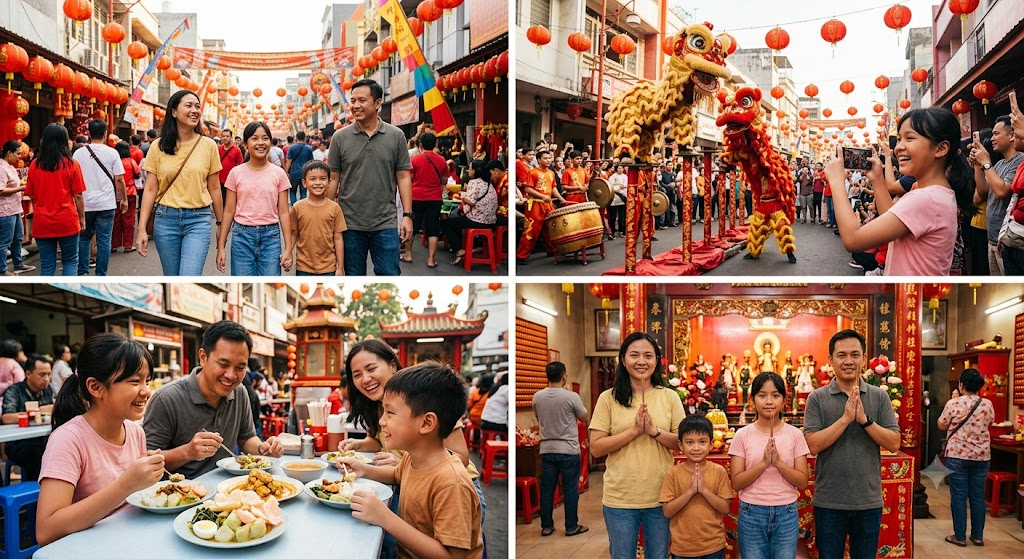
On 3 March 2026, I went to a Cap Go Meh festival in Jakarta with my parents and my little brother. It was a very special day for me. Cap Go Meh is a Chinese-Indonesian festival and it is the last day of the Chinese New Year celebrations. Many families celebrate it with prayers, special food, music, and traditional performances.
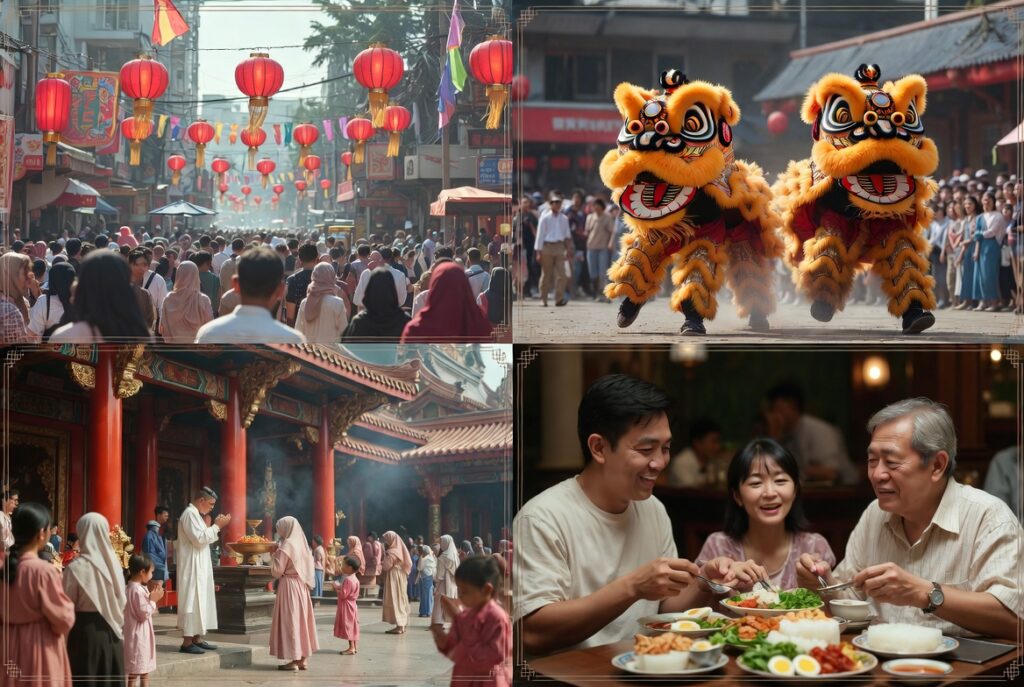
When we arrived in the afternoon, I saw many people in the streets. There were many beautiful red lanterns and colourful decorations everywhere. I watched a barongsai dance for the first time. Two dancers wore a lion costume and danced with loud drums. It was exciting, and many people took photos.
After the show, we visited a temple. People prayed and gave thanks for health and happiness. My family also ate special food. I tried lontong Cap Go Meh with rice cakes, vegetables, eggs, and sauce. It was very delicious.
I really liked this festival because I learned more about Chinese-Indonesian culture. I think it is wonderful that people with different traditions can celebrate together peacefully.
I hope you can visit Cap Go Meh with me one day!
Best wishes,
Sinta
Vocabulary:
- to share an experience – to tell other people about something that happened to you
- a celebration – a happy event for a special day
- to describe – to tell what something or someone is like
- to attend – to go to an event
- to learn from something – to get new ideas or knowledge from it
- to celebrate – to do something special for a happy day or event
- a prayer – words that people say to God
- a traditional performance – a dance, song, or show from a culture
- a lantern – a light inside a small box or cover
- a decoration – something that makes a place look nice
- a lion costume – clothes that make a person look like a lion
- a drum – a musical instrument that you hit with your hands or sticks
- to be exciting – to be very interesting and fun
- to take a photo – to make a picture with a camera or phone
- to pray – to speak to God
- to give thanks – to say thank you
- health – how well your body feels
- peaceful – calm, quiet, and without fighting
##################
| Infinitive | Past simple | Definition |
|---|---|---|
| to hear | heard | to get information with your ears |
| to know | knew | to have information in your mind |
| to want | wanted | to like to do or have something |
| to learn | learned | to get new knowledge |
| to send | sent | to give something to a person |
| to ask | asked | to say a question |
| to write | wrote | to make words with a pen or keyboard |
| to describe | described | to tell what something is like |
| to attend | attended | to go to an event |
| to tell | told | to give information to someone |
| to be | was/were | to exist or happen |
| to go | went | to move to another place |
| to have | had | to own or hold something |
| to celebrate | celebrated | to do something special for a happy day |
| to live | lived | to have your home in a place |
| to want | wanted | to like to do or have something |
| to share | shared | to tell or give something to other people |
| to experience | experienced | to have something happen to you |
| to arrive | arrived | to come to a place |
| to see | saw | to use your eyes to look at something |
| to be | was/were | to exist or happen |
| to watch | watched | to look at something for some time |
| to wear | wore | to have clothes on your body |
| to dance | danced | to move your body to music |
| to take | took | to get or make something with your hands or a camera |
| to visit | visited | to go to a place for a short time |
| to pray | prayed | to speak to God |
| to give | gave | to let someone have something |
| to thank | thanked | to say that you are grateful |
| to eat | ate | to put food in your mouth and swallow it |
| to try | tried | to do or taste something for the first time |
| to like | liked | to enjoy something |
| to think | thought | to have an idea in your mind |
| to hope | hoped | to want something good to happen |
| to visit | visited | to go to a place for a short time |
#####################
Match the words with the definitions
- to share an experience
- a celebration
- to describe
- to attend
- to learn from something
- to celebrate
- a prayer
- a traditional performance
- a lantern
- a decoration
- a lion costume
- a drum
- to be exciting
- to take a photo
- to pray
- to give thanks
- health
- peaceful
A. ___ to say thank you
B. ___ a light inside a small box or cover
C. ___ to go to an event
D. ___ calm, quiet, and without fighting
E. ___ a dance, song, or show from a culture
F. ___ to tell other people about something that happened to you
G. ___ to speak to God
H. ___ something that makes a place look nice
I. ___ to get new ideas or knowledge from it
J. ___ to do something special for a happy day or event
K. ___ a happy event for a special day
L. ___ how well your body feels
M. ___ to tell what something or someone is like
N. ___ a musical instrument that you hit with your hands or sticks
O. ___ to be very interesting and fun
P. ___ clothes that make a person look like a lion
Q. ___ words that people say to God
R. ___ to make a picture with a camera or phone
———————————————
Correct answers:
1-F, 2-K, 3-M, 4-C, 5-I, 6-J, 7-Q,
8-E, 9-B, 10-H, 11-P, 12-N, 13-O,
14-R, 15-G, 16-A, 17-L, 18-D
#####################
Fill in, past simple:
Sinta ______________ (visit) the Cap Go Meh festival in Jakarta on 3 March 2026.
She ______________ (go) with her parents and her little brother.
She ______________ (write) an email to her friend Rani.
She ______________ (describe) the special Chinese-Indonesian celebration.
Cap Go Meh ______________ (be) the last day of Chinese New Year.
Many families ______________ (celebrate) it with prayers, food, music, and shows.
Sinta ______________ (arrive) in the afternoon.
She ______________ (see) many people in the streets.
She ______________ (look) at red lanterns and colourful decorations.
She ______________ (watch) a barongsai dance for the first time.
Two dancers ______________ (wear) a lion costume.
They ______________ (dance) and ______________ (use) loud drums.
Many people ______________ (take) photos of the show.
Sinta ______________ (visit) a temple with her family.
People ______________ (pray) and ______________ (give) thanks for health and happiness.
Her family ______________ (eat) lontong Cap Go Meh.
They ______________ (try) rice cakes, vegetables, eggs, and sauce.
Sinta ______________ (like) the festival because she ______________ (learn) more about Chinese-Indonesian culture.
She ______________ (think) it ______________ (be) wonderful that people ______________ (celebrate) together peacefully.
———————————-
Correct version:
Sinta visited the Cap Go Meh festival in Jakarta on 3 March 2026.
She went with her parents and her little brother.
She wrote an email to her friend Rani.
She described the special Chinese-Indonesian celebration.
Cap Go Meh was the last day of Chinese New Year.
Many families celebrated it with prayers, food, music, and shows.
Sinta arrived in the afternoon.
She saw many people in the streets.
She looked at red lanterns and colourful decorations.
She watched a barongsai dance for the first time.
Two dancers wore a lion costume.
They danced and used loud drums.
Many people took photos of the show.
Sinta visited a temple with her family.
People prayed and gave thanks for health and happiness.
Her family ate lontong Cap Go Meh.
They tried rice cakes, vegetables, eggs, and sauce.
Sinta liked the festival because she learned more about Chinese-Indonesian culture.
She thought it was wonderful that people celebrated together peacefully.
####################
True or false:
- Sinta visited the festival with her parents and her little brother.
- Cap Go Meh is the first day of Chinese New Year celebrations.
- Sinta saw red lanterns and colourful decorations.
- Sinta wrote an email to her teacher about the festival.
- People prayed and gave thanks at the temple.
- Sinta ate pizza during the celebration.
- The festival took place in Jakarta.
- The dancers wore a lion costume during the performance.
- Sinta visited the festival in 2025.
- Sinta learned more about Chinese-Indonesian culture.
- The barongsai dance used loud drums.
- Sinta travelled to the festival by train.
- Sinta watched a barongsai dance for the first time.
- Cap Go Meh is a Chinese-Indonesian festival.
- Sinta went to the festival alone.
- Many people took photos of the show.
- Sinta visited a temple after the performance.
- Sinta ate lontong Cap Go Meh with her family.
- The festival happened on 3 March 2026.
- Sinta celebrated the festival with her classmates.
___________________________
False: 2,4,6,9,11,12,15,16,20
__________________________
Correct version:
- Sinta visited the festival with her parents and her little brother.
- Cap Go Meh is the first day of Chinese New Year celebrations.
True is: Cap Go Meh is the last day of Chinese New Year celebrations. - Sinta saw red lanterns and colourful decorations.
- Sinta wrote an email to her teacher about the festival.
True is: Sinta wrote an email to her friend Rani about the festival. - People prayed and gave thanks at the temple.
- Sinta ate pizza during the celebration.
True is: Sinta ate lontong Cap Go Meh during the celebration. - The festival took place in Jakarta.
- The dancers wore a lion costume during the performance.
- Sinta visited the festival in 2025.
True is: Sinta visited the festival in 2026. - Sinta learned more about Chinese-Indonesian culture.
- The barongsai dance used guitars during the performance.
True is: The barongsai dance used loud drums during the performance. - Sinta travelled to the festival by train.
True is: Sinta went to the festival with her parents and her little brother. - Sinta watched a barongsai dance for the first time.
- Cap Go Meh is a Chinese-Indonesian festival.
- Sinta went to the festival alone.
True is: Sinta went to the festival with her parents and her little brother. - Many people watched the show at home.
True is: Many people took photos of the show. - Sinta visited a temple after the performance.
- Sinta ate lontong Cap Go Meh with her family.
- The festival happened on 3 March 2026.
- Sinta celebrated the festival with her classmates.
True is: Sinta celebrated the festival with her parents and her little brother.
#####################
Match the two halves of the sentences:
- Sinta visited the Cap Go Meh festival
- She went to the festival
- Cap Go Meh is
- Many families celebrate it
- Sinta saw many people
- She watched a barongsai dance
- Two dancers wore
- Many people took photos
- Sinta visited a temple
- People prayed and gave thanks
- Sinta ate lontong Cap Go Meh
- The food had rice cakes, vegetables, eggs,
- Sinta learned more about
- She liked the festival because people celebrated
- Sinta hoped Rani could visit the festival
A. Chinese-Indonesian culture
B. one day with her
C. after the show
D. a Chinese-Indonesian festival
E. in the streets of Jakarta
F. together peacefully
G. with her parents and her little brother
H. for health and happiness
I. with rice cakes, vegetables, eggs, and sauce
J. in Jakarta on 3 March 2026
K. of the show
L. a lion costume
M. with prayers, food, music, and traditional performances
N. for the first time
O. and sauce
________________________
Answers
1–J, 2–G, 3–D, 4–M, 5–E, 6–N,
7–L, 8–K, 9–C, 10–H, 11–I, 12–O,
13–A, 14–F, 15–B
________________________
Full version:
- Sinta visited the Cap Go Meh festival in Jakarta on 3 March 2026.
- She went to the festival with her parents and her little brother.
- Cap Go Meh is a Chinese-Indonesian festival.
- Many families celebrate it with prayers, food, music, and traditional performances.
- Sinta saw many people in the streets of Jakarta.
- She watched a barongsai dance for the first time.
- Two dancers wore a lion costume.
- Many people took photos of the show.
- Sinta visited a temple after the show.
- People prayed and gave thanks for health and happiness.
- Sinta ate lontong Cap Go Meh with rice cakes, vegetables, eggs, and sauce.
- The food had rice cakes, vegetables, eggs, and sauce.
- Sinta learned more about Chinese-Indonesian culture.
- She liked the festival because people celebrated together peacefully.
- Sinta hoped Rani could visit the festival one day with her.
##################
Match sentences and evidence from text:
- Sinta visited the Cap Go Meh festival in Jakarta on 3 March 2026.
- She went to the festival with her parents and her little brother.
- Cap Go Meh is a Chinese-Indonesian festival.
- Many families celebrate it with prayers, food, music, and traditional performances.
- Sinta saw many people in the streets of Jakarta.
- She watched a barongsai dance for the first time.
- Two dancers wore a lion costume.
- Many people took photos of the show.
- Sinta visited a temple after the show.
- People prayed and gave thanks for health and happiness.
- Sinta ate lontong Cap Go Meh with rice cakes, vegetables, eggs, and sauce.
- The food had rice cakes, vegetables, eggs, and sauce.
- Sinta learned more about Chinese-Indonesian culture.
- She liked the festival because people celebrated together peacefully.
- Sinta hoped Rani could visit the festival one day with her.
________________________
Evidence:
A. “People prayed and gave thanks for health and happiness.”
B. “I learned more about Chinese-Indonesian culture.”
C. “Two dancers wore a lion costume and danced with loud drums.”
D. “There were many beautiful red lanterns and colourful decorations everywhere.”
E. “I tried lontong Cap Go Meh with rice cakes, vegetables, eggs, and sauce.”
F. “On 3 March 2026, I went to a Cap Go Meh festival in Jakarta.”
G. “Many people took photos.”
H. “Cap Go Meh is a Chinese-Indonesian festival and it is the last day of the Chinese New Year celebrations.”
I. “I watched a barongsai dance for the first time.”
J. “I went with my parents and my little brother.”
________________________
Correct matches:
1–F, 2–J, 3–H, 4–D, 5–I, 6–C,
7–G, 8–A, 9–E, 10–B
_______________________
Correct matches:
- Sinta experienced a special event in Jakarta. – On 3 March 2026, I went to a Cap Go Meh festival in Jakarta.
- Sinta shared the day with close family members. – I went with my parents and my little brother.
- The festival belongs to two different cultures. – Cap Go Meh is a Chinese-Indonesian festival and it is the last day of the Chinese New Year celebrations.
- The place had colourful things for people to see. – There were many beautiful red lanterns and colourful decorations everywhere.
- Sinta saw a special cultural show. – I watched a barongsai dance for the first time.
- The performers used a special animal image. – Two dancers wore a lion costume and danced with loud drums.
- The audience showed interest in the show. – Many people took photos.
- Visitors showed respect for their beliefs. – People prayed and gave thanks for health and happiness.
- Sinta tasted a traditional meal. – I tried lontong Cap Go Meh with rice cakes, vegetables, eggs, and sauce.
- The festival gave Sinta more understanding of local culture. – I learned more about Chinese-Indonesian culture.
#####################
Answer:
- Who wrote the email?
- Who received the email?
- When did Sinta visit the festival?
- Where did Sinta go?
- Who went with Sinta?
- What festival did Sinta visit?
- What dance did Sinta watch?
- What food did Sinta try?
- Why did Sinta write to Rani?
- Why did Sinta like the festival?
- How did the dancers perform?
- How did people celebrate Cap Go Meh?
- Where did Sinta go after the show?
- What did people do at the temple?
- What did Sinta learn from the festival?
________________________
Answers
- Sinta
- Rani
- 3 March 2026
- Jakarta
- Her parents and her little brother
- Cap Go Meh
- A barongsai dance
- Lontong Cap Go Meh
- She wanted to tell Rani about her experience.
- She learned more about Chinese-Indonesian culture.
- They danced with a lion costume and loud drums.
- They celebrated with prayers, special food, music, and traditional performances.
- She went to a temple.
- They prayed and gave thanks for health and happiness.
- She learned more about Chinese-Indonesian culture.
________________________
Full version:
- Who wrote the email? – Sinta wrote the email to her friend Rani.
- Who received the email? – Rani received the email from Sinta.
- When did Sinta visit the festival? – Sinta visited the festival on 3 March 2026.
- Where did Sinta go? – Sinta went to a Cap Go Meh festival in Jakarta.
- Who went with Sinta? – Sinta went with her parents and her little brother.
- What festival did Sinta visit? – Sinta visited the Cap Go Meh festival.
- What dance did Sinta watch? – Sinta watched a barongsai dance for the first time.
- What food did Sinta try? – Sinta tried lontong Cap Go Meh with rice cakes, vegetables, eggs, and sauce.
- Why did Sinta write to Rani? – Sinta wrote to Rani because she wanted to tell her about her Cap Go Meh experience.
- Why did Sinta like the festival? – Sinta liked the festival because she learned more about Chinese-Indonesian culture.
- How did the dancers perform? – The dancers performed by wearing a lion costume and dancing with loud drums.
- How did people celebrate Cap Go Meh? – People celebrated Cap Go Meh with prayers, special food, music, and traditional performances.
- Where did Sinta go after the show? – Sinta went to a temple after the show.
- What did people do at the temple? – People prayed and gave thanks for health and happiness at the temple.
- What did Sinta learn from the festival? – Sinta learned more about Chinese-Indonesian culture from the festival.
###################
Interview – match question and answer:
Questions
- What is your name?
- How old are you?
- Where do you live?
- When did you visit the Cap Go Meh festival?
- Who joined you at the festival?
- Why did you go to the festival?
- What did you see in the streets?
- Which performance did you watch?
- What did the dancers wear?
- Where did you go after the show?
- What food did you try?
- Why did you enjoy the festival?
- What did you discover about the culture?
- Who would you like to visit the festival with one day?
_______________________
Answers
A. The special event took place on 3 March 2026.
B. I discovered more about Chinese-Indonesian traditions and culture.
C. My parents and my little brother came with me.
D. The celebration was interesting because I learned more about traditions and people celebrated peacefully.
E. My family and I visited a temple afterwards.
F. I hope Rani can come with me in the future.
G. The streets had many red lanterns and colourful decorations.
H. The dancers had a lion costume during the show.
I. I am 15 years old.
J. My name is Sinta.
K. Lontong Cap Go Meh with rice cakes, vegetables, eggs, and sauce was my meal.
L. I live in Jakarta, Indonesia.
M. I wanted to experience the Chinese-Indonesian celebration.
N. The barongsai dance was the performance I saw.
__________________________
Answers:
1-J, 2-I, 3-L, 4-A, 5-C, 6-M,
7-G, 8-N, 9-H, 10-E, 11-K,
12-D, 13-B, 14-F
__________________________
Full version:
Interviewer: What is your name?
Sinta: My name is Sinta.
Interviewer: How old are you?
Sinta: I am 15 years old.
Interviewer: Where do you live?
Sinta: I live in Jakarta, Indonesia.
Interviewer: When did you visit the Cap Go Meh festival?
Sinta: The special event took place on 3 March 2026.
Interviewer: Who joined you at the festival?
Sinta: My parents and my little brother came with me.
Interviewer: Why did you go to the festival?
Sinta: I wanted to experience the Chinese-Indonesian celebration.
Interviewer: What did you see in the streets?
Sinta: The streets had many red lanterns and colourful decorations.
Interviewer: Which performance did you watch?
Sinta: The barongsai dance was the performance I saw.
Interviewer: What did the dancers wear?
Sinta: The dancers had a lion costume during the show.
Interviewer: Where did you go after the show?
Sinta: My family and I visited a temple afterwards.
Interviewer: What food did you try?
Sinta: Lontong Cap Go Meh with rice cakes, vegetables, eggs, and sauce was my meal.
Interviewer: Why did you enjoy the festival?
Sinta: The celebration was interesting because I learned more about traditions and people celebrated peacefully.
Interviewer: What did you discover about the culture?
Sinta: I discovered more about Chinese-Indonesian traditions and culture.
Interviewer: Who would you like to visit the festival with one day?
Sinta: I hope Rani can come with me in the future.
I can also turn this into a matching exercise with shuffled questions and answers for students.
################
##################
##################
##################
##################
Please use the box below
to write your feedback.
Only I can read it.
It is not public.
Please tell me:
- Are the texts and exercises OK?
- Are the topics OK?
- Is the level OK?
- Is it too easy or too difficult?
- Do you want texts about other topics?
Thank you! I appreciate your feedback.
##################
##################
##################
Remember how babies
learn a language:
Babies learn a language by listening.
They use their ears to hear sounds.
Their brain remembers these sounds.
Babies connect sounds with people and things.
They listen to their parents.
Then they copy the sounds they hear. They imitate words.
Slowly, babies learn to speak.
So,
LISTEN, LISTEN, LISTEN, LISTEN………………
Schreibe einen Kommentar