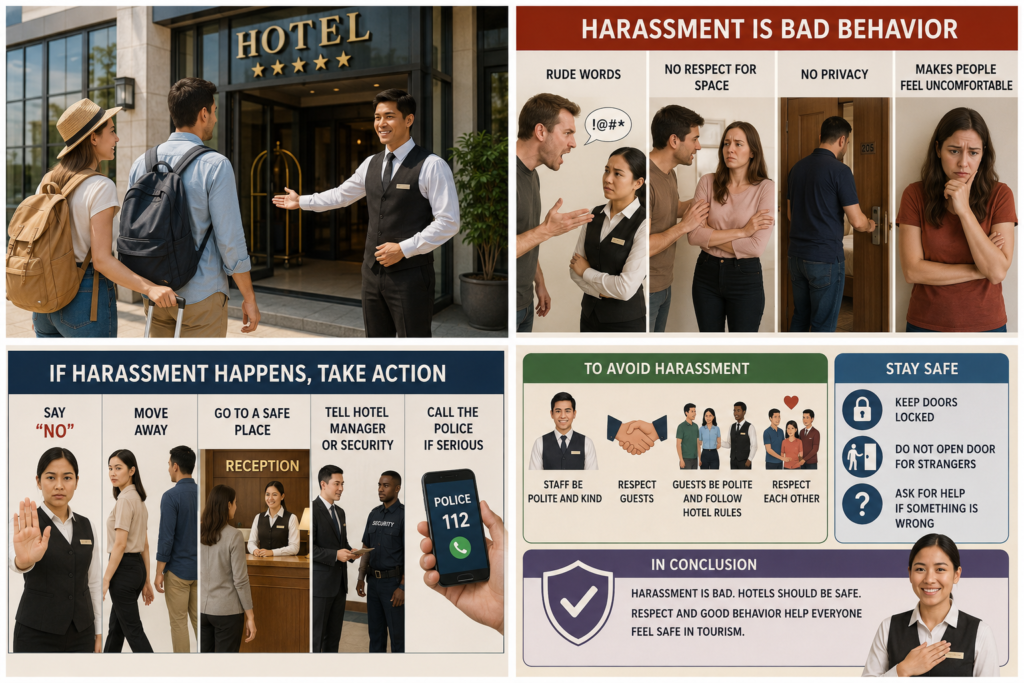
Tourism means people travel to other places. Many tourists stay in hotels. Hotel staff work in hotels and help guests. Most hotels are safe and good places.
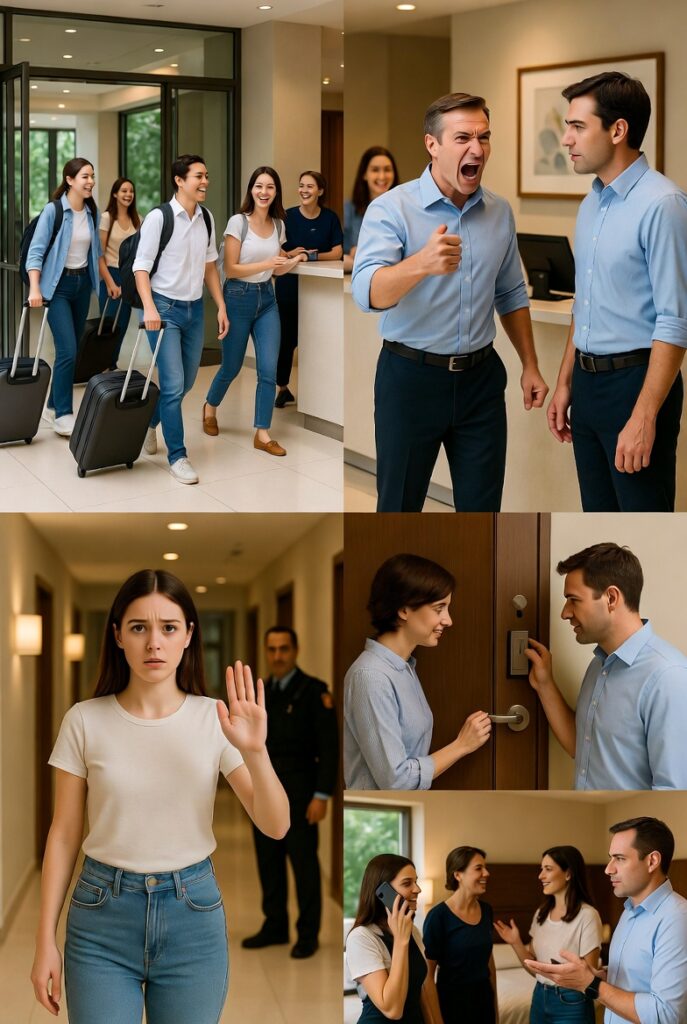
Harassment means bad or rude behavior. It makes people feel unsafe or uncomfortable. In hotels, harassment can happen. A staff member can be rude to a guest. A guest can also be rude to hotel staff. Sometimes someone says bad words. Sometimes someone does not respect privacy. This is harassment.
We can identify harassment when a person feels scared or unhappy. If someone is rude, or does not respect space, it can be harassment. If someone enters a room without permission, it is also harassment. People feel uncomfortable in these situations.
If harassment happens, we must stay calm. We should say “No”. We should move away from the person. We should go to a safe place like the hotel reception. We should tell the hotel manager or security. We can also call the police if it is serious.
To avoid harassment, we should be careful. Hotel staff should be polite and kind. They should respect guests. Guests should also be polite and follow hotel rules. We should respect each other.
We should also keep doors locked. We should not open the door for strangers. We should ask for help if something is wrong.
In conclusion, harassment is bad. Hotels should be safe. Respect and good behavior help everyone feel safe in tourism.
_______________________
Vocabulary:
harassment – bad or rude behavior that makes someone feel unsafe or uncomfortable.
reading comprehension – understanding what you read in a text.
a safe place – a place where you are not in danger and feel protected.
rude behavior – impolite actions or words that can hurt or upset others.
to feel uncomfortable – to feel not relaxed, worried, or not happy in a situation.
to respect privacy – to not look into or enter someone’s personal space or life without permission.
to identify something – to recognize something and understand what it is.
to feel scared – to feel afraid or worried about danger.
to respect space – to give someone their personal area and not go too close.
without permission – doing something without asking or getting agreement first.
to stay calm – to stay relaxed and not get angry or panicked.
to avoid something – to stay away from something or not do it.
to be kind – to be nice, friendly, and helpful to others.
to respect somebody – to treat someone well and show care for their feelings and rights.
to lock a door – to close a door with a key so nobody can enter.
in conclusion – the final part of something where you give a short summary.
#############
Match word and defintion:
Words
- harassment
- reading comprehension
- a safe place
- rude behavior
- to feel uncomfortable
- to respect privacy
- to identify something
- to feel scared
- to respect space
- without permission
- to stay calm
- to avoid something
- to be kind
- to respect somebody
- to lock a door
- in conclusion
Definitions
a. to stay away from something or not do it.
b. to not look into or enter someone’s personal space or life without permission.
c. the final part of something where you give a short summary.
d. bad or rude behavior that makes someone feel unsafe or uncomfortable.
e. to feel not relaxed, worried, or not happy in a situation.
f. to close a door with a key so nobody can enter.
g. to recognize something and understand what it is.
h. to feel afraid or worried about danger.
i. impolite actions or words that can hurt or upset others.
j. to give someone their personal area and not go too close.
k. to be nice, friendly, and helpful to others.
l. to understand what you read in a text.
m. to stay relaxed and not get angry or panicked.
n. a place where you are not in danger and feel protected.
o. doing something without asking or getting agreement first.
p. to treat someone well and show care for their feelings and rights.
Answer
1-d, 2-l, 3-n, 4-i, 5-e, 6-b, 7-g, 8-h, 9-j, 10-o, 11-m, 12-a, 13-k, 14-p, 15-f, 16-c
####################
True or false:
- Guests can be rude to hotel staff.
- Tourism means people stay only in their home and never travel.
- Harassment means bad or rude behavior.
- Entering a room without permission is always a normal action.
- Hotel staff work in hotels and help guests.
- Harassment makes people feel happy and comfortable in all cases.
- Many tourists stay in hotels.
- Guests are never allowed to interact with hotel staff at all.
- People should report harassment to hotel staff or security.
- Tourism means people travel to other places.
- Hotel staff do not work in hotels and never help guests.
- Harassment can happen in hotels.
- All hotels are unsafe places and should be avoided always.
- Harassment makes people feel unsafe or uncomfortable.
- Reporting harassment is unnecessary because hotels automatically ignore all complaints.
- Most hotels are safe and good places.
- Hotel staff are not allowed to communicate with guests at any time.
- Harassment cannot happen in any hotel or tourism place.
- Entering a hotel room without permission is a normal part of hotel service.
- A guest is never allowed to speak to any hotel employee under any condition.
_____________________
Answers:
1F, 2F, 3T, 4F, 5T, 6F, 7T, 8F,
9T, 10T, 11F, 12T, 13F, 14T,
15F, 16T, 17F, 18F, 19F, 20F
_____________________
Correct version:
- Guests can be rude to hotel staff. True is: Guests should be polite and respectful to hotel staff.
- Tourism means people stay only in their home and never travel. True is: Tourism means people travel to other places.
- Harassment means bad or rude behavior.
- Entering a room without permission is always a normal action. True is: Entering a room without permission is harassment.
- Hotel staff work in hotels and help guests.
- Harassment makes people feel happy and comfortable in all cases. True is: Harassment makes people feel unsafe or uncomfortable.
- Many tourists stay in hotels.
- Guests are never allowed to interact with hotel staff at all. True is: Guests can interact with hotel staff.
- People should report harassment to hotel staff or security.
- Tourism means people travel to other places.
- Hotel staff do not work in hotels and never help guests. True is: Hotel staff work in hotels and help guests.
- Harassment can happen in hotels.
- All hotels are unsafe places and should be avoided always. True is: Most hotels are safe and good places.
- Harassment makes people feel unsafe or uncomfortable.
- Reporting harassment is unnecessary because hotels automatically ignore all complaints. True is: People should report harassment to hotel staff or security.
- Most hotels are safe and good places.
- Hotel staff are not allowed to communicate with guests at any time. True is: Hotel staff are allowed to communicate with guests.
- Harassment cannot happen in any hotel or tourism place. True is: Harassment can happen in hotels and tourism places.
- Entering a hotel room without permission is a normal part of hotel service. True is: Entering a room without permission is harassment.
- A guest is never allowed to speak to any hotel employee under any condition. True is: Guests are allowed to speak to hotel employees.
###############
Match Statements with Evidence
Statements
- Tourism involves people visiting other places.
- Hotels are places where travelers stay overnight.
- Hotel employees assist guests during their stay.
- Harassment can make someone feel unsafe or uncomfortable.
- Entering a hotel room without permission is considered inappropriate behavior.
- Both guests and staff should behave politely toward each other.
- Reporting serious problems helps maintain safety in hotels.
- Hotels usually have rules to protect guests and ensure comfort.
- Respectful communication is expected in hotel settings.
- Protecting personal space is important in accommodation places.
Evidence (shuffled)
A. Speaking in a polite way is expected between workers and visitors.
B. Going into someone’s hotel room without asking is not allowed.
C. Travel to different locations is part of tourism activities.
D. Guests and employees are expected to treat each other properly.
E. Hotels normally include guidelines to keep guests safe and comfortable.
F. Telling hotel management or security can solve serious issues.
G. People often stay in hotels when they travel away from home.
H. Personal space should be respected in lodging environments.
I. Saying or doing rude actions can cause fear or discomfort in others.
J. Staff members in hotels support visitors with services and guidance.
__________________
Answers. 1C, 2G, 3J, 4I, 5B, 6D, 7F, 8E, 9A, 10H
#############
Fill in, words below:
permission, tourism, respect, tourists, accommodation,
rules, communication, harassment,
space, report, polite, safe,
staff, privacy,
tourism
- __________ means people travel to different places for leisure or work.
- Hotel staff help guests with services and information.
- Protecting personal __________ helps prevent uncomfortable situations.
- Many __________ stay in hotels during their trips.
- Entering a room without __________ is not allowed in hotels.
- Good __________ between guests and staff helps create a safe environment.
- __________ means rude or harmful behavior that makes people uncomfortable.
- Hotels provide __________ for travelers who need a place to stay.
- Hotel staff should always be __________ and respectful to guests.
- Respecting __________ is important in all accommodation places.
- Most hotels are considered __________ and comfortable places.
- Guests should follow hotel __________ to ensure safety and order.
- If harassment happens, people should __________ it to hotel management or security.
- __________ means people travel to different places for leisure or work.
- Both guests and staff must treat each other with __________.
_______________________
Correct version:
- Tourism means people travel to different places for leisure or work.
- Hotel staff help guests with services and information.
- Protecting personal space helps prevent uncomfortable situations.
- Many tourists stay in hotels during their trips.
- Entering a room without permission is not allowed in hotels.
- Good communication between guests and staff helps create a safe environment.
- Harassment means rude or harmful behavior that makes people uncomfortable.
- Hotels provide accommodation for travelers who need a place to stay.
- Hotel staff should always be polite and respectful to guests.
- Respecting privacy is important in all accommodation places.
- Most hotels are considered safe and comfortable places.
- Guests should follow hotel rules to ensure safety and order.
- If harassment happens, people should report it to hotel management or security.
- Tourism means people travel to different places for leisure or work.
- Both guests and staff must treat each other with respect.
################
Find the correct idea:
Ideas
A. Traveling to different places for leisure or work
B. Places where travelers stay overnight
C. Rude or unsafe behavior toward others
D. Reporting problems to hotel staff or security
E. Treating people with politeness and care
F. Protecting personal space and privacy
G. Staying in hotels during a trip
H. Moving from one place to another
I. Hotel staff helping guests with services
J. Following rules in hotels for safety
K. Feeling unsafe or uncomfortable because of behavior
L. Communication between guests and staff
M. Respecting others in shared spaces
N. Keeping hotels safe and comfortable
Topics
e.g. Tourism → _A_H_
Hotels → ___
Harassment → ___
Safety actions → ___
Respect → ___
_________________
Answer key:
Tourism → A, H
Hotels → B, G, I
Harassment → C, K
Safety actions → D, J, N
Respect → E, F, L, M
#################
Put the actions in the correct order if harassment happens in a hotel:
A. Tell hotel staff or security
B. Move away from the person
C. Stay calm
D. Go to a safe place like reception
E. Say “No” clearly
______________________
ANswers: 1c, 2e, 3b, 4d, 5a
################
Problems and solutions – match:
Problems
A. Someone enters a hotel room without permission
B. A guest feels unsafe in the hotel
C. A staff member is spoken to in a rude way
D. A hotel rule is not followed
E. A guest feels uncomfortable because of someone’s behavior
F. A visitor ignores safety instructions from hotel staff
Solutions
- Speak politely and set clear boundaries
- Move away from the situation and go to reception
- Follow all hotel rules carefully
- Report the issue to hotel security or management
- Stay calm and ask hotel staff for help
- Remind the visitor about safety instructions
_______________________
Answers:
A → 4
B → 2
C → 1
D → 3
E → 5
F → 6
################
Answer:
- Why is respect important in hotels?
- What makes a hotel safe?
- What should a guest do if they feel uncomfortable?
- Why should hotel rules be followed?
- How can communication help in hotels?
- Why do tourists stay in hotels?
- Who helps guests in a hotel?
- What should you do if someone is rude?
- Why is privacy important in a hotel?
- What should you do if there is a problem in a hotel?
_____________________
Answers:
Why is respect important in hotels?
Respect is important because it helps guests and staff feel safe and comfortable.
What makes a hotel safe?
A hotel is safe when there are rules, staff, and security.
What should a guest do if they feel uncomfortable?
A guest should stay calm and tell hotel staff or go to reception.
Why should hotel rules be followed?
Hotel rules should be followed to keep everyone safe and organized.
How can communication help in hotels?
Communication helps guests and staff understand each other and solve problems.
Why do tourists stay in hotels?
Tourists stay in hotels because they need a place to sleep and stay during travel.
Who helps guests in a hotel?
Hotel staff help guests during their stay.
What should you do if someone is rude?
You should stay calm and tell hotel staff.
Why is privacy important in a hotel?
Privacy is important because guests need personal space and comfort.
What should you do if there is a problem in a hotel?
You should report the problem to hotel staff or reception.
################
Interview, find answer to question:
Questions
- Why should people report harassment?
- What is the main purpose of hotels?
- Can harassment occur in hotels?
- Why is privacy necessary in hotels?
- What should hotel staff do?
- What does harassment mean?
- Should guests behave politely in hotels?
- Where can a guest seek help?
- What is a safe action in such a situation?
- Who may take part in harassment?
- What should a guest do during harassment?
- Is reporting harassment important?
Answers
A. Moving away from the person is a safe choice.
B. It refers to rude or unsafe behavior that makes people feel uncomfortable.
C. They need to listen carefully and support the guest.
D. Yes, it plays an important role in safety.
E. Polite behavior is expected from all guests.
F. Help can be found at reception or with security.
G. The main purpose is ensuring safety and comfort for guests.
H. This action helps protect others and keeps the hotel safe.
I. Staying calm and telling hotel staff is the right step.
J. Both guests and hotel employees can be involved.
K. Guests require personal space to feel comfortable.
L. It may happen in hotels as well.
________________________
Answers:
1H, 2G, 3L, 4K, 5C, 6B, 7E,
8F, 9A, 10J, 11I, 12D
________________________
Full dialogue:
Interviewer: What does harassment mean?
Expert: It means rude or unsafe behavior that makes people feel uncomfortable.
Interviewer: Can harassment occur in hotels?
Expert: Yes, it can happen in hotels as well.
Interviewer: Who may take part in harassment?
Expert: Both guests and hotel employees can be involved.
Interviewer: What should a guest do during harassment?
Expert: The guest should stay calm and tell hotel staff.
Interviewer: Where can a guest seek help?
Expert: Help can be found at reception or with security.
Interviewer: Is reporting harassment important?
Expert: Yes, it is very important for safety.
Interviewer: Why should people report harassment?
Expert: It helps protect others and keeps the hotel safe.
Interviewer: What should hotel staff do?
Expert: They should listen carefully and support the guest.
Interviewer: What is a safe action in such a situation?
Expert: Moving away from the person is a safe choice.
Interviewer: Should guests behave politely in hotels?
Expert: Yes, polite behavior is expected from all guests.
Interviewer: Why is privacy necessary in hotels?
Expert: Guests need personal space to feel comfortable.
Interviewer: What is the main purpose of hotels?
Expert: The main purpose is to ensure safety and comfort for guests.
################
################
Bonus text in B1:
Tourism refers to the activity of people travelling from one place to another for leisure, business, or other personal reasons. During their journeys, many tourists choose to stay in hotels, which provide accommodation, services, and support throughout their visit. Hotel staff play an important role in ensuring guests feel comfortable, safe, and well cared for. In general, most hotels are considered safe environments where people can relax and enjoy their stay.
Harassment is understood as unwanted, rude, or inappropriate behaviour that causes discomfort, fear, or distress to another person. In hotel settings, harassment can occur in different situations and may involve either staff or guests. For example, a staff member might treat a guest disrespectfully, or a guest might behave inappropriately towards a staff member. Harassment can also include offensive language, ignoring personal boundaries, or failing to respect a person’s privacy.
It is possible to identify harassment when someone feels unsafe, frightened, or uncomfortable in a situation. Behaviours such as invading personal space, using insulting language, or entering a hotel room without permission are clear examples of harassment. These actions often lead to emotional discomfort and a loss of trust in the environment.
If harassment takes place, it is important to respond in a calm and controlled manner. The person affected should clearly say “no” to stop the behaviour, then remove themselves from the situation. They should move to a safe location, such as the hotel reception, where assistance is available. Reporting the incident to hotel management or security is also important. In serious cases, contacting the police may be necessary.
Preventing harassment requires awareness and respectful behaviour from everyone involved. Hotel staff are expected to remain professional, polite, and supportive towards guests. At the same time, guests should follow hotel rules and treat staff and other visitors with respect. Mutual respect helps create a safe and welcoming environment for everyone.
In addition, personal safety measures are important. Guests should keep their room doors locked and avoid opening them to unknown individuals. If something feels wrong or unsafe, it is always better to seek help immediately from hotel staff or security personnel.
In conclusion, harassment is unacceptable in any environment, including hotels. Maintaining respect, following rules, and practising good communication are essential for ensuring safety and comfort in tourism settings.
Schreibe einen Kommentar