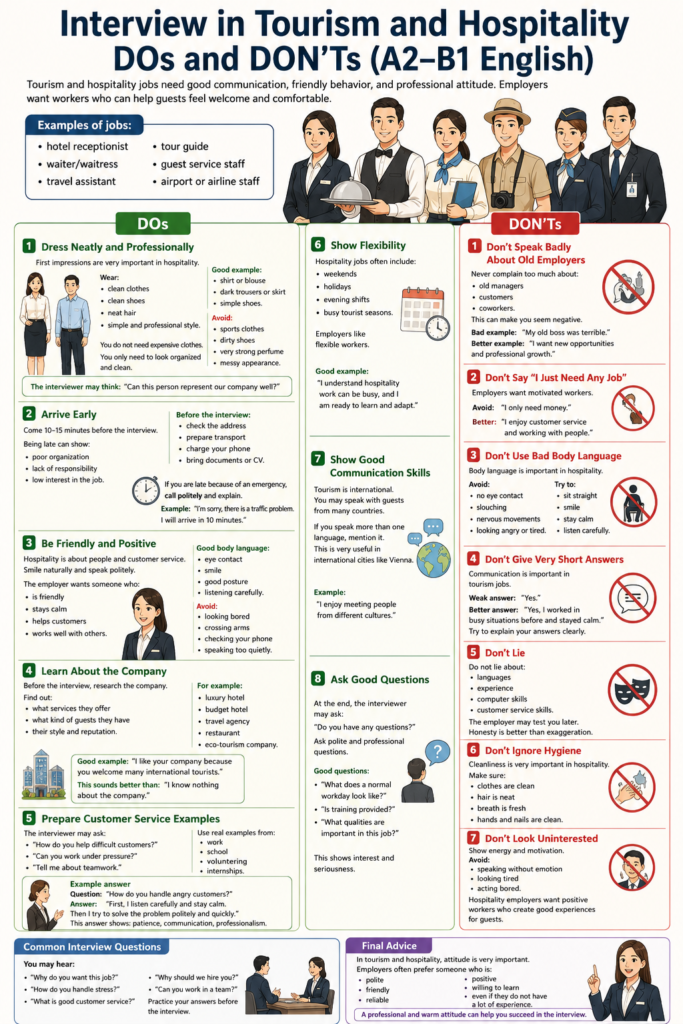
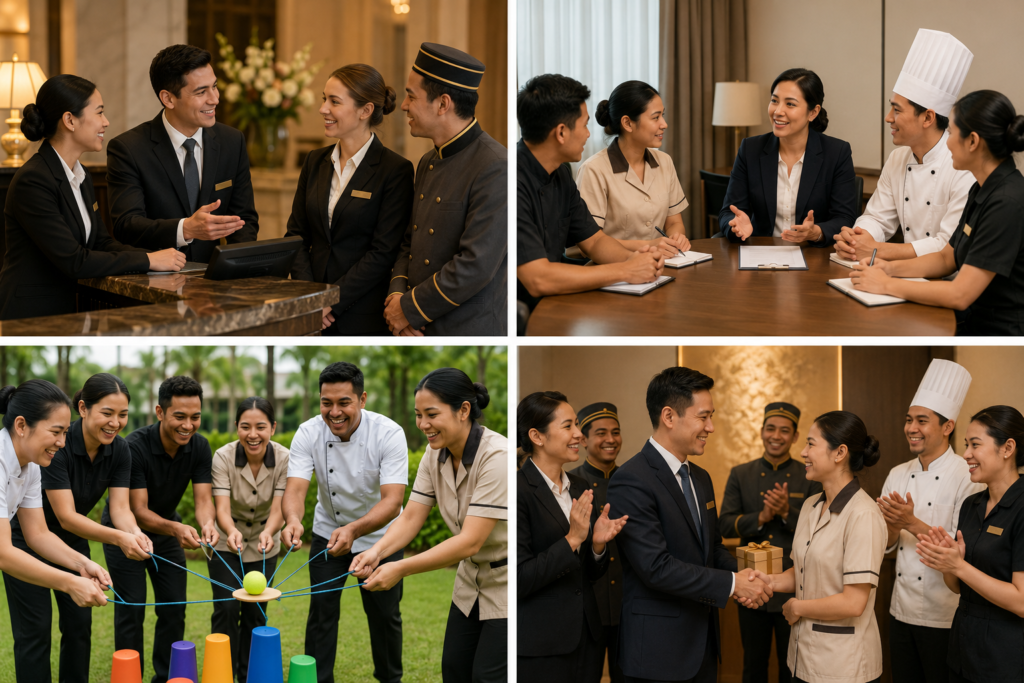
Tourism and hospitality jobs need good communication, friendly behavior, and professional attitude. Employers want workers who can help guests feel welcome and comfortable.
Examples of jobs:
hotel receptionist,
waiter/waitress,
travel assistant,
tour guide,
guest service staff,
airport or airline staff.
DOs
1. Dress Neatly and Professionally
First impressions are very important in hospitality.
Wear:
clean clothes,
clean shoes,
neat hair,
simple and professional style.
You do not need expensive clothes. You only need to look organized and clean.
Good example:
shirt or blouse,
dark trousers or skirt,
simple shoes.
Avoid:
sports clothes,
dirty shoes,
very strong perfume,
messy appearance.
The interviewer may think:
“Can this person represent our company well?”
2. Arrive Early
Come 10–15 minutes before the interview.
Being late can show:
poor organization,
lack of responsibility,
low interest in the job.
Before the interview:
check the address,
prepare transport,
charge your phone,
bring documents or CV.
If you are late because of an emergency, call politely and explain.
Example:
“I’m sorry, there is a traffic problem. I will arrive in 10 minutes.”
3. Be Friendly and Positive
Hospitality is about people and customer service.
Smile naturally and speak politely.
The employer wants someone who:
is friendly,
stays calm,
helps customers,
works well with others.
Good body language:
eye contact,
smile,
good posture,
listening carefully.
Avoid:
looking bored,
crossing arms,
checking your phone,
speaking too quietly.
4. Learn About the Company
Before the interview, research the company.
Find out:
what services they offer,
what kind of guests they have,
their style and reputation.
For example:
luxury hotel,
budget hotel,
travel agency,
restaurant,
eco-tourism company.
This shows motivation and preparation.
Good example:
“I like your company because you welcome many international tourists.”
This sounds better than:
“I know nothing about the company.”
5. Prepare Customer Service Examples
The interviewer may ask:
“How do you help difficult customers?”
“Can you work under pressure?”
“Tell me about teamwork.”
Use real examples from:
work,
school,
volunteering,
internships.
Example answer
Question:
“How do you handle angry customers?”
Answer:
“First, I listen carefully and stay calm. Then I try to solve the problem politely and quickly.”
This answer shows:
patience,
communication,
professionalism.
6. Show Flexibility
Hospitality jobs often include:
weekends,
holidays,
evening shifts,
busy tourist seasons.
Employers like flexible workers.
Good example:
“I understand hospitality work can be busy, and I am ready to learn and adapt.”
7. Show Good Communication Skills
Tourism is international. You may speak with guests from many countries.
If you speak more than one language, mention it.
This is very useful in international cities like Vienna.
Example:
“I enjoy meeting people from different cultures.”
8. Ask Good Questions
At the end, the interviewer may ask:
“Do you have any questions?”
Ask polite and professional questions.
Good questions:
“What does a normal workday look like?”
“Is training provided?”
“What qualities are important in this job?”
This shows interest and seriousness.
DON’Ts
1. Don’t Speak Badly About Old Employers
Never complain too much about:
old managers,
customers,
coworkers.
This can make you seem negative.
Bad example:
“My old boss was terrible.”
Better example:
“I want new opportunities and professional growth.”
2. Don’t Say “I Just Need Any Job”
Employers want motivated workers.
Avoid:
“I only need money.”
Better:
“I enjoy customer service and working with people.”
3. Don’t Use Bad Body Language
Body language is important in hospitality.
Avoid:
no eye contact,
slouching,
nervous movements,
looking angry or tired.
Try to:
sit straight,
smile,
stay calm,
listen carefully.
4. Don’t Give Very Short Answers
Communication is important in tourism jobs.
Weak answer:
“Yes.”
Better answer:
“Yes, I worked in busy situations before and stayed calm.”
Try to explain your answers clearly.
5. Don’t Lie
Do not lie about:
languages,
experience,
computer skills,
customer service skills.
The employer may test you later.
Honesty is better than exaggeration.
6. Don’t Ignore Hygiene
Cleanliness is very important in hospitality.
Make sure:
clothes are clean,
hair is neat,
breath is fresh,
hands and nails are clean.
Small details matter.
7. Don’t Look Uninterested
Show energy and motivation.
Avoid:
speaking without emotion,
looking tired,
acting bored.
Hospitality employers want positive workers who create good experiences for guests.
Common Interview Questions
You may hear:
“Why do you want this job?”
“How do you handle stress?”
“What is good customer service?”
“Why should we hire you?”
“Can you work in a team?”
Practice your answers before the interview.
Final Advice
In tourism and hospitality, attitude is very important.
Employers often prefer someone who is:
polite,
friendly,
reliable,
positive,
willing to learn,
even if they do not have a lot of experience.
A professional and warm attitude can help you succeed in the interview.
It might be a good idea to do that story first => link
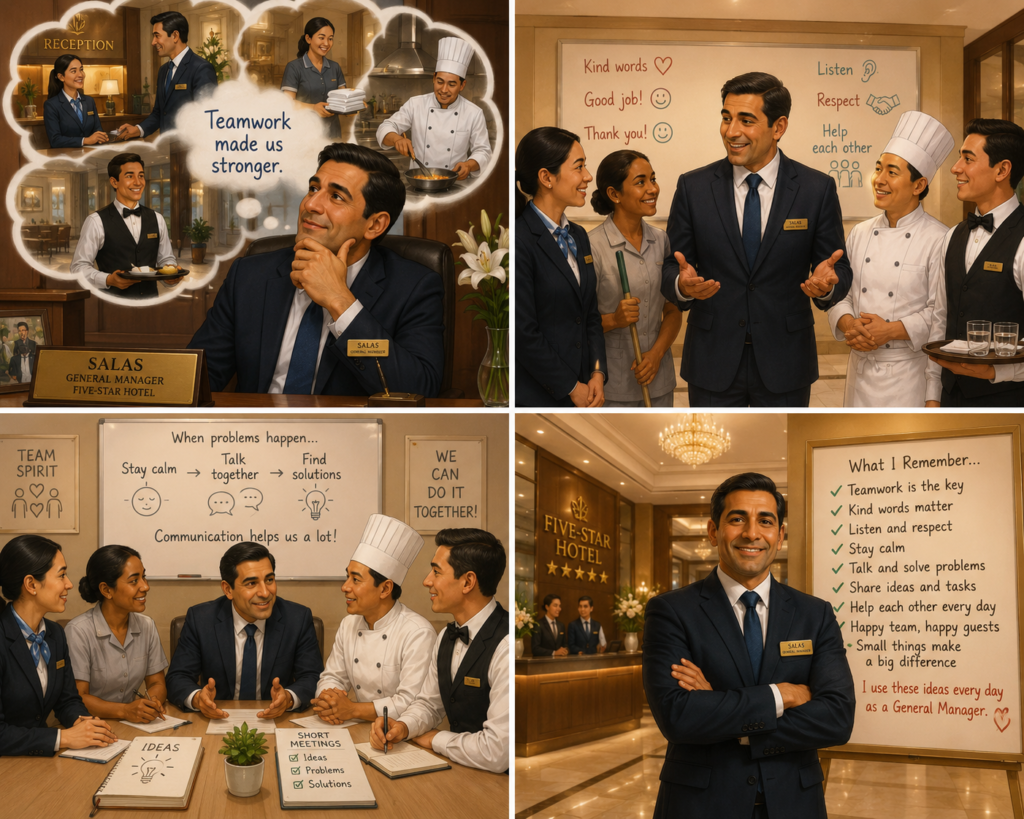
Salas is a general manager of a five-star hotel, looking back at his time when he worked in a team – memories:
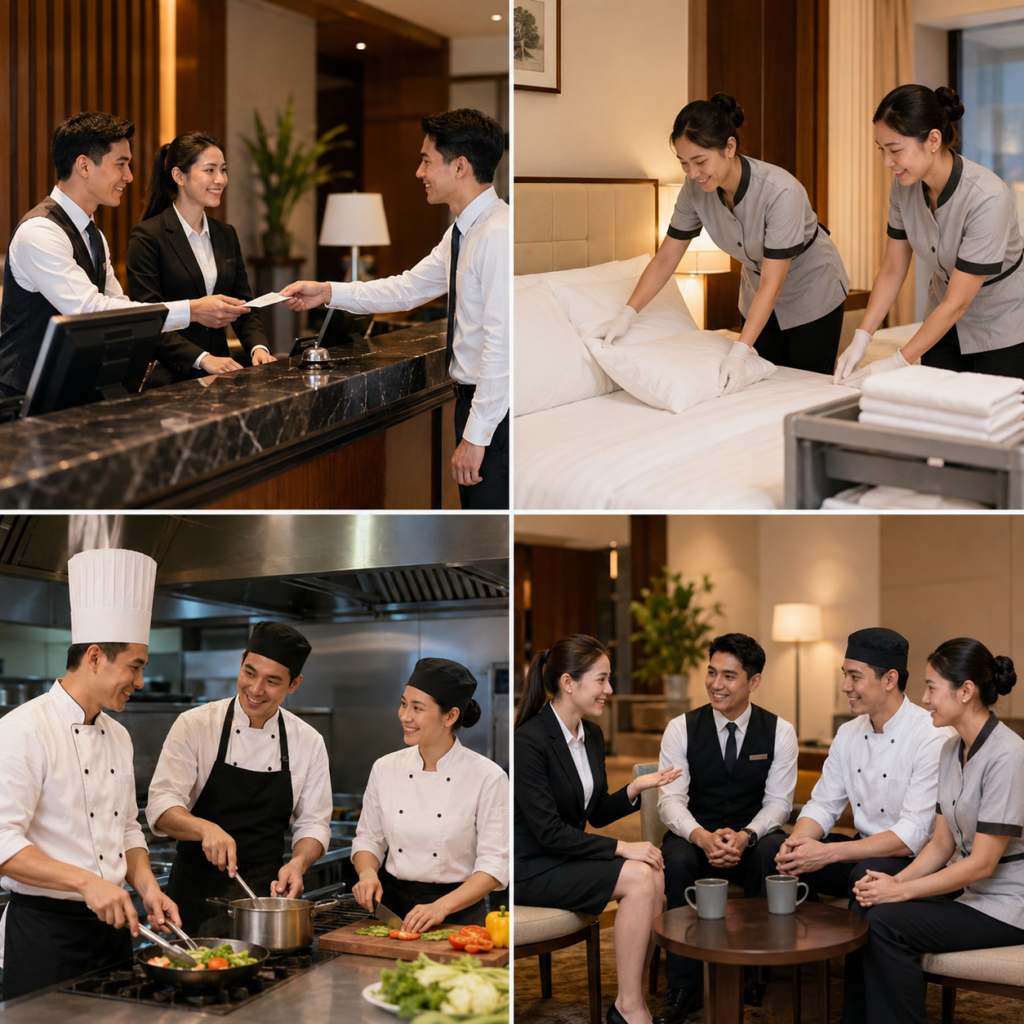
I worked with reception workers, cleaners, cooks, and waiters. We helped each other every day. I learned that teamwork was very important.
I always helped my co-workers when they had a lot of work. I was friendly and polite. I listened to other people and respected their ideas.
I used kind words. I said good job and thank you many times. I saw that people felt happy and worked better.
When problems happened, I stayed calm. I talked with my team. We found solutions together. Communication helped us a lot.
I also tried to improve team spirit. We talked more during breaks. We got to know each other better.
We had short meetings. We shared ideas and problems. Sometimes we did small team activities after work.
Now I remember that small things made a big difference. Teamwork helped us give good service and make guests happy. I felt happy when the team worked well. I saw that guests were happy too. I learned that small kind words helped a lot. I believed teamwork was the key to success. We always tried to help each other every day. I remember that problems became smaller when we talked. We also shared tasks to make work easy. I learned to listen more and speak less. I saw that respect made the team stronger. I am proud of my past work in the hotel.
Now I use all these ideas as a general manager. I try to make a good team in my hotel every day. I still say thank you and I still help people. I think teamwork always stays very important for me. It helped me grow as a leader.
___________________
Vocabulary:
to look back at something — to think about something that happened in the past
memories — things you remember from the past
to be polite — to speak and behave in a kind and respectful way
to respect others’ ideas — to listen to and accept what other people think
kind words — nice and friendly words
to stay calm — to remain relaxed and not angry or nervous
to find a solution — to solve a problem
communication — talking and sharing information with other people
to improve team spirit — to make the team feel happier and work better together
a break — a short time to rest from work
to share ideas — to tell other people your thoughts or opinions
a key to success — something very important for success
to share tasks — to divide work between people
respect — feeling and showing care for other people
to grow as a leader — to become a better leader over time
##############
Match word and definition:
to look back at something
memories
to be polite
to respect others’ ideas
kind words
to stay calm
to find a solution
communication
to improve team spirit
a break
to share ideas
a key to success
to share tasks
respect
to grow as a leader
Definitions:
a) to solve a problem b) to divide work between people c) nice and friendly words d) to think about something that happened in the past e) talking and sharing information with other people f) to make the team feel happier and work better together g) things you remember from the past h) feeling and showing care for other people i) to become a better leader over time j) to remain relaxed and not angry or nervous k) to speak and behave in a kind and respectful way l) to tell other people your thoughts or opinions m) something very important for success n) a short time to rest from work o) to listen to and accept what other people think
Use: The past simple is used to talk about finished actions in the past.
##################
Verbs in text:
Infinitive
Past
Definition
work
worked
to do a job or activity
help
helped
to do something for someone to make it easier
learn
learned
to get knowledge or skill
be
was / were
to exist or to be
feel
felt
to have emotions
say
said
to speak words
see
saw
to look with your eyes
listen
listened
to hear carefully
respect
respected
to treat someone in a polite and kind way
use
used
to do something with a tool or method
stay
stayed
to remain in a place or state
talk
talked
to speak with someone
find
found
to discover or get something
improve
improved
to make something better
share
shared
to give part of something to others
get
got
to receive or obtain something
have
had
to possess or own
make
made
to create or produce something
believe
believed
to think something is true
try
tried
to attempt to do something
remember
remembered
to keep information in your mind
become
became
to start to be something new
grow
grew
to become bigger or better
think
thought
to have ideas or opinions
################### Fill in the correct form of the verb in past simple:
I ________ (work) in a hotel and ________ (help) reception workers, cleaners, cooks, and waiters. We ________ (learn) to work as a team, and I ________ (be) friendly and polite.
I ________ (listen) to others and ________ (respect) their ideas. I ________ (use) kind words and ________ (say) thank you often. I ________ (see) that people ________ (feel) happier when we worked together well.
When problems ________ (happen), I ________ (stay) calm and ________ (talk) with my team. We ________ (find) solutions together and ________ (share) ideas. Communication ________ (help) us a lot.
We ________ (try) to improve team spirit. We ________ (have) breaks together, ________ (share) tasks, and ________ (get) to know each other better. We also ________ (remember) that small things ________ (make) a big difference.
We ________ (believe) teamwork was the key to success. I ________ (think) about this often and ________ (become) a better leader. I ________ (grow) as a manager because I ________ (learn) from every situation.
—————————–
Correct version:
I worked in a hotel and helped reception workers, cleaners, cooks, and waiters. We learned to work as a team, and I was friendly and polite.
I listened to others and respected their ideas. I used kind words and said thank you often. I saw that people felt happier when we worked together well.
When problems happened, I stayed calm and talked with my team. We found solutions together and shared ideas. Communication helped us a lot.
We tried to improve team spirit. We had breaks together, shared tasks, and got to know each other better. We also remembered that small things made a big difference.
We believed teamwork was the key to success. I thought about this often and became a better leader. I grew as a manager because I learned from every situation.
###################
Short answers, past simple, basics:
Example Sentence
Yes
No
I learned letters.
Yes, I did.
No, I didn’t.
You read signs.
Yes, you did.
No, you didn’t.
He spoke English.
Yes, he did.
No, he didn’t.
She watched TV.
Yes, she did.
No, she didn’t.
It helped me.
Yes, it did.
No, it didn’t.
We used an app.
Yes, we did.
No, we didn’t.
You read words.
Yes, you did.
No, you didn’t.
They made mistakes.
Yes, they did.
No, they didn’t.
Questions (Past Simple)
Question
Yes
No
Did I learn letters?
Yes, I did.
No, I didn’t.
Did you read signs?
Yes, you did.
No, you didn’t.
Did he speak English?
Yes, he did.
No, he didn’t.
Did she watch TV?
Yes, she did.
No, she didn’t.
Did it help me?
Yes, it did.
No, it didn’t.
Did we use an app?
Yes, we did.
No, we didn’t.
Did you read words?
Yes, you did.
No, you didn’t.
Did they make mistakes?
Yes, they did.
No, they didn’t.
Was / Were
Question
Yes
No
Was I happy?
Yes, I was.
No, I wasn’t.
Were you happy?
Yes, you were.
No, you weren’t.
Was he happy?
Yes, he was.
No, he wasn’t.
Was she happy?
Yes, she was.
No, she wasn’t.
Was it good?
Yes, it was.
No, it wasn’t.
Were we happy?
Yes, we were.
No, we weren’t.
Were you happy?
Yes, you were.
No, you weren’t.
Were they happy?
Yes, they were.
No, they weren’t.
#################
Provide short answers:
The writer helped only guests and did not work with staff.
YOU WRITE: No, he didn’t.
The writer was friendly with co-workers.
The writer learned that teamwork was very important.
The writer always got angry when problems happened.
The writer worked in a hotel.
The writer stayed calm when problems happened.
The writer ignored other people’s ideas during work.
The writer became a general manager later.
The team worked without any meetings or discussions.
The writer used kind words with co-workers.
The writer worked in a hotel and only cleaned offices in the morning.
The writer listened to other people’s ideas.
The writer was responsible for managing the whole hotel alone.
The team had short meetings during work.
The writer helped reception workers, cleaners, cooks, and waiters.
The writer never used polite words at work.
The team talked together to find solutions.
The writer learned that working alone was better than teamwork.
The writer stayed calm when problems happened.
The writer was friendly with co-workers.
__________________________
Correct version:
1: The writer helped only guests and did not work with staff. — No, he didn’t. 2: The writer was friendly with co-workers. — Yes, he was. 3: The writer learned that teamwork was very important. — Yes, he did. 4: The writer always got angry when problems happened. — No, he didn’t. 5: The writer worked in a hotel. — Yes, he did. 6: The writer stayed calm when problems happened. — Yes, he did. 7: The writer ignored other people’s ideas during work. — No, he didn’t. 8: The writer became a general manager later. — Yes, he did. 9: The team worked without any meetings or discussions. — No, they didn’t. 10: The writer used kind words with co-workers. — Yes, he did. 11: The writer worked in a hotel and only cleaned offices in the morning. — No, he didn’t. 12: The writer listened to other people’s ideas. — Yes, he did. 13: The writer was responsible for managing the whole hotel alone. — No, he wasn’t. 14: The team had short meetings during work. — Yes, they did. 15: The writer helped reception workers, cleaners, cooks, and waiters. — Yes, he did. 16: The writer never used polite words at work. — No, he didn’t. 17: The team talked together to find solutions. — Yes, they did. 18: The writer learned that working alone was better than teamwork. — No, he didn’t. 19: The writer stayed calm when problems happened. — Yes, he did. 20: The writer was friendly with co-workers. — Yes, he was.
####################
Correct the statements, short answer first:
The writer was responsible for managing the whole hotel alone.
YOU WRITE: No, he wasn’t. He worked with his team and shared responsibilities.
The writer worked in a hotel and only cleaned offices in the morning.
The writer ignored other people’s ideas during work.
The writer never used polite words at work.
The team worked without any meetings or discussions.
The writer helped only guests and did not work with staff.
The workers were all from different companies and never worked together.
The writer always got angry when problems happened.
The team solved problems without talking together.
The writer learned that working alone was better than teamwork.
___________________________
Correct answers:
The writer was responsible for managing the whole hotel alone. No, he wasn’t. He worked with his team and shared responsibilities.
The writer worked in a hotel and only cleaned offices in the morning. No, he didn’t. He worked with reception workers, cleaners, cooks, and waiters.
The writer ignored other people’s ideas during work. No, he didn’t. He listened to other people’s ideas.
The writer never used polite words at work. No, he didn’t. He used kind and polite words with co-workers.
The team worked without any meetings or discussions. No, they didn’t. They had short meetings and discussed ideas.
The writer helped only guests and did not work with staff. No, he didn’t. He helped different hotel staff every day.
The workers were all from different companies and never worked together. No, they weren’t. They worked together as one team.
The writer always got angry when problems happened. No, he didn’t. He stayed calm when problems happened.
The team solved problems without talking together. No, they didn’t. They talked together to find solutions.
The writer learned that working alone was better than teamwork. No, he didn’t. He learned that teamwork was very important.
####################
Past simple – basics
Personal Pronoun
Verb (Past)
Object
I
ate
apples
You
ate
apples
He
ate
apples
She
ate
apples
It
ate
apples
We
ate
apples
You (plural)
ate
apples
They
ate
apples
I
played
football
You
played
football
He
played
football
She
played
football
It
played
football
We
played
football
You (plural)
played
football
They
played
football
Personal Pronoun
Verb (Past Negative)
Object
I
did not eat
apples
You
did not eat
apples
He
did not eat
apples
She
did not eat
apples
It
did not eat
apples
We
did not eat
apples
You (plural)
did not eat
apples
They
did not eat
apples
I
did not play
football
You
did not play
football
He
did not play
football
She
did not play
football
It
did not play
football
We
did not play
football
You (plural)
did not play
football
They
did not play
football
Did + Pronoun
Verb
Object
Did I
eat
apples?
Did you
eat
apples?
Did he
eat
apples?
Did she
eat
apples?
Did it
eat
apples?
Did we
eat
apples?
Did you
eat
apples?
Did they
eat
apples?
Did I
play
football?
Did you
play
football?
Did he
play
football?
Did she
play
football?
Did it
play
football?
Did we
play
football?
Did you
play
football?
Did they
play
football?
Didn’t + Pronoun
Verb
Object
Didn’t I
eat
apples?
Didn’t you
eat
apples?
Didn’t he
eat
apples?
Didn’t she
eat
apples?
Didn’t it
eat
apples?
Didn’t we
eat
apples?
Didn’t you
eat
apples?
Didn’t they
eat
apples?
Didn’t I
play
football?
Didn’t you
play
football?
Didn’t he
play
football?
Didn’t she
play
football?
Didn’t it
play
football?
Didn’t we
play
football?
Didn’t you
play
football?
Didn’t they
play
football?
Forms of ‚to be‘
Personal Pronoun
Positive
Negative
Question
I
I was happy.
I was not happy.
Was I happy?
You (singular)
You were excited.
You were not excited.
Were you excited?
He
He was at home.
He was not at home.
Was he at home?
She
She was tired.
She was not tired.
Was she tired?
It
It was cold.
It was not cold.
Was it cold?
We
We were at the party.
We were not at the party.
Were we at the party?
You (plural)
You were friends.
You were not friends.
Were you friends?
They
They were in the garden.
They were not in the garden.
Were they in the garden?
################
_____________________
Write as shown in 1:
The writer was a hotel worker.
YOU WRITE: Negation: The writer was not a hotel worker. Question: Was the writer a hotel worker? Negatove question: Wasn’t the writer a hotel worker?
The writer had many co-workers in the hotel.
The writer helped different hotel staff every day.
The writer said kind words to co-workers.
The writer saw that teamwork was important.
The team were busy during working hours.
The writer took part in short meetings.
The writer made the team stronger.
The writer found solutions when problems happened.
The writer became a general manager later.
_______________________
Correct version:
The writer was a hotel worker. Negation: The writer was not a hotel worker. Question: Was the writer a hotel worker? Negative question: Wasn’t the writer a hotel worker?
The writer had many co-workers in the hotel. Negation: The writer did not have many co-workers in the hotel. Question: Did the writer have many co-workers in the hotel? Negative question: Didn’t the writer have many co-workers in the hotel?
The writer helped different hotel staff every day. Negation: The writer did not help different hotel staff every day. Question: Did the writer help different hotel staff every day? Negative question: Didn’t the writer help different hotel staff every day?
The writer said kind words to co-workers. Negation: The writer did not say kind words to co-workers. Question: Did the writer say kind words to co-workers? Negative question: Didn’t the writer say kind words to co-workers?
The writer saw that teamwork was important. Negation: The writer did not see that teamwork was important. Question: Did the writer see that teamwork was important? Negative question: Didn’t the writer see that teamwork was important?
The team were busy during working hours. Negation: The team were not busy during working hours. Question: Were the team busy during working hours? Negative question: Weren’t the team busy during working hours?
The writer took part in short meetings. Negation: The writer did not take part in short meetings. Question: Did the writer take part in short meetings? Negative question: Didn’t the writer take part in short meetings?
The writer made the team stronger. Negation: The writer did not make the team stronger. Question: Did the writer make the team stronger? Negative question: Didn’t the writer make the team stronger?
The writer found solutions when problems happened. Negation: The writer did not find solutions when problems happened. Question: Did the writer find solutions when problems happened? Negative question: Didn’t the writer find solutions when problems happened?
The writer became a general manager later. Negation: The writer did not become a general manager later. Question: Did the writer become a general manager later? Negative question: Didn’t the writer become a general manager later?
################
Form questions in past simple:
he / work / reception workers?
they / help / each other?
he / learn / teamwork?
he / be / friendly and polite?
he / use / kind words?
they / solve / problems together?
he / listen / other people’s ideas?
they / have / short meetings?
he / improve / team spirit?
he / stay / calm in problems?
they / share / ideas?
he / become / a general manager?
he / feel / happy at work?
they / talk / during breaks?
_____________________
Correct answers:
Did he work with reception workers?
Did they help each other?
Did he learn teamwork?
Was he friendly and polite?
Did he use kind words?
Did they solve problems together?
Did he listen to other people’s ideas?
Did they have short meetings?
Did he improve team spirit?
Did he stay calm in problems?
Did they share ideas?
Did he become a general manager?
Did he feel happy at work?
Did they talk during breaks?
##################
Match the two halves:
The writer worked in a hotel
The writer helped reception workers
The writer learned teamwork
The writer stayed calm
The writer used kind words
The team had short meetings
The writer listened to others
The team talked together
The writer improved team spirit
The writer became a general manager
a. with cleaners, cooks, and waiters b. to understand it was very important c. when problems happened d. and said thank you often e. to share ideas and solve problems f. and respected their ideas g. during breaks at work h. and became a general manager later i. to make the team stronger j. and worked well as a team
I worked in a hotel and helped __________ workers, cleaners, cooks, and waiters. I learned that teamwork was very important. I was friendly and polite with my co-workers. I __________ to other people’s ideas and respected them. I used __________ words and said thank you often. I saw that __________ helped us solve problems. When problems happened, I stayed __________ and talked with my team. We found __________ together. We shared ideas during short meetings and tried to _________ team spirit. We also had __________ together and got to know each other. Small things made a big __________. I became a general manager and __________ as a leader.
—————————- Correct version:
I worked in a hotel and helped reception workers, cleaners, cooks, and waiters. I learned that teamwork was very important. I was friendly and polite with my co-workers. I listened to other people’s ideas and respected them. I used kind words and said thank you often. I saw that communication helped us solve problems. When problems happened, I stayed calm and talked with my team. We found solutions together. We shared ideas during short meetings and tried to improve team spirit. We also had breaks together and got to know each other. Small things made a big difference. I became a general manager and grew as a leader.
my name is Salas and I share my experience of working as part of a team
My name is Salas, and I work in a hotel. I like my job very much because I like working with other people. In a hotel, teamwork is very important. Many people work together every day. The reception workers, cleaners, cooks, and waiters all help each other. I think good teamwork helps the hotel work better and also makes the guests happy. Without teamwork, the work is more difficult and slow.
I always try to be a good team member. I like helping my co-workers when they need help. If somebody has a lot of work, I try to help them when I can. I am friendly and polite to everyone. I also listen to other people and respect their ideas. I think it is important to be kind at work and to work together as a team.
I also try to encourage my co-workers to work as a team. I often say “good job” or “thank you” because I think kind words are very important. They can make people feel happy and give them more energy to work. When there is a problem at work, I try to stay calm. Then I talk with my team and we try to find a solution together. I think communication is very important in a hotel.
Even if our team already works well, I still see chances to improve the team spirit more. For example, we can talk more during breaks and know each other better. We can also have short team meetings where we share ideas and problems. Sometimes we can do small team activities after work. I think these things can help us become a stronger team.
I also think it is important to say thank you more often and help each other every day. Small things can make a big difference in a team. When people feel respected, they work better and feel happier at work.
In conclusion, I am happy to work in a hotel. I enjoy teamwork, helping my co-workers, and encouraging a good atmosphere. I want our team to become even stronger in the future because teamwork is very important for good service and happy guests.
_______________________
Vocabulary:
a cleaner: a person who cleans rooms or places (like in a hotel or office)
to be slow: to do something not fast
a co-worker: a person you work with
to be polite: to be kind and say nice words (like “please” and “thank you”)
to respect ideas: to listen to other people’s thoughts and think they are important
to be kind: to be nice and friendly to people
to encourage: to say or do something that helps someone feel more confident or happy
to stay calm: to not get angry or nervous
to find a solution: to solve a problem
communication: talking and sharing information with other people
to improve team spirit: to make a team work better and feel happier together
a break: a short time to rest during work
to share an idea: to tell your thoughts to other people
to feel respected: to feel that other people are kind to you and value you
in conclusion: at the end of something you say or write
to enjoy teamwork: to like working together with other people
###############
Match word and definition:
Words:
a cleaner
to be slow
a co-worker
to be polite
to respect ideas
to be kind
to encourage
to stay calm
to find a solution
communication
to improve team spirit
a break
to share an idea
to feel respected
in conclusion
to enjoy teamwork
Definitions:
A. talking and sharing information with other people B. a short time to rest during work C. to not get angry or nervous D. a person you work with E. to solve a problem F. to like working together with other people G. to do something not fast H. to say or do something that helps someone feel confident or happy I. at the end of something you say or write J. to be nice and friendly to people K. a person who cleans rooms or places L. to listen to other people’s thoughts and think they are important M. to tell your thoughts to other people N. to be kind and say nice words O. to make a team work better and feel happier together P. to feel that other people are kind to you and value you
to feel that other people are kind to you and value you
a short time to rest during work
to not get angry or nervous
to make a team work better and feel happier together
to listen to other people’s thoughts and think they are important
to do something not fast
to say or do something that helps someone feel confident or happy
a person you work with
to be kind and say nice words
to tell your thoughts to other people
to like working together with other people
talking and sharing information with other people
a person who cleans rooms or places
Words:
a) communication b) to be slow c) a cleaner d) to improve team spirit e) to enjoy teamwork f) in conclusion g) a co-worker h) to stay calm i) to respect ideas j) to find a solution k) to be kind l) to share an idea m) a break n) to encourage o) to feel respected p) to be polite
The text is about a hotel worker who enjoys teamwork.
In the hotel, only reception workers help guests. True is: In a hotel, many types of workers help each other (reception, cleaners, cooks, waiters).
Different hotel staff work together every day.
Teamwork makes the hotel work better and guests happier.
Without teamwork, work becomes easier and faster. True is: Without teamwork, work becomes more difficult and slow.
The worker likes helping co-workers when they need help.
He is unfriendly and ignores other people’s ideas. True is: He is friendly and respects other people’s ideas.
Communication is not important in the hotel. True is: Communication is very important in the hotel.
He often says “thank you” and “good job” to others.
When there is a problem, he stays calm and talks with the team.
The team never talks during breaks. True is: The team can talk during breaks and share ideas or get to know each other better.
They try to find solutions together when problems happen.
He thinks small actions cannot change a team. True is: Small actions can make a big difference in a team.
Talking more during breaks can help the team know each other better.
The worker is unhappy in his job and dislikes teamwork. True is: The worker enjoys his job and likes teamwork.
##############
Match the sentence halves
Sentences (1–10):
We stay calm when…
Teamwork helps…
A cleaner…
We share ideas…
Communication helps…
A co-worker…
We take a break when…
We try to find a solution when…
We are polite when…
We improve team spirit when…
Options (A–J):
A. we work together and support each other B. cleans rooms in the hotel C. we feel tired during work D. there is a problem at work E. people understand each other F. we speak to guests or co-workers G. works with us in the hotel H. we talk and listen to each other I. we have a problem J. the hotel work better
______________
Correct answers:
1-D, 2-J, 3-B, 4-H, 5-E, 6-G, 7-C, 8-I, 9-F, 10-A
____________________
Correct version:
We stay calm when there is a problem at work.
Teamwork helps the hotel work better.
A cleaner cleans rooms in the hotel.
We share ideas when we talk and listen to each other.
Communication helps people understand each other.
A co-worker works with us in the hotel.
We take a break when we feel tired during work.
We try to find a solution when we have a problem.
We are polite when we speak to guests or co-workers.
We improve team spirit when we work together and support each other.
###############
Fill in, words below:
break – guests – encourages [to say or do something that makes someone feel happy, strong, or more confident] – polite – understand – teamwork – in conclusion – calm – cleaner – team spirit
The text is about a hotel worker who likes__________. In the hotel, many people work together, like a __________ and a co-worker. Communication is very important in the hotel. The worker tries to be kind and be __________ to everyone. He also tries to respect ideas from other people. He often __________ his co-workers with kind words. When there is a problem, he stays __________ and tries to find a solution. During a __________, workers can talk and share an idea. This helps to improve __________. Good communication helps people __________ each other and feel respected. The worker enjoys teamwork and helping others. __________, teamwork, kindness, and communication are very important for good work in a hotel and happy _________.
——————————–
Correct version:
The text is about a hotel worker who likes teamwork. In the hotel, many people work together, like a cleaner and a co-worker. Communication is very important in the hotel. The worker tries to be kind and be polite to everyone. He also tries to respect ideas from other people. He often encourages his co-workers with kind words. When there is a problem, he stays calm and tries to find a solution. During a break, workers can talk and share an idea. This helps to improve team spirit. Good communication helps people understand each other and feel respected. The worker enjoys teamwork and helping others. In conclusion, teamwork, kindness, and communication are very important for good work in a hotel and happy guests. ###############
Hotel interview – match the question with the answer
Questions (1–10):
Do you like working in the hotel?
Why is teamwork important in your hotel?
Who do you work with in the hotel?
How do you act with your co-workers?
What do you do when someone is very busy?
What kind of language do you use at work?
What do you do when a problem happens?
What happens during team discussions?
How do you support team spirit?
What is your hope for your team?
Answers (A–J):
A. I stay calm and talk with my team to solve it. B. I am friendly and always ready to help when someone needs support. C. It matters because many different staff must help each other to do the work well. D. I listen carefully and share my ideas with others. E. I want us to work even better together in the future. F. I speak in a kind and polite way to everyone. G. I work with reception staff, cleaners, cooks, and waiters. H. Yes, I really enjoy my job because I work with many people every day. I. I try to help if I have free time. J. I use kind words and work well with my team.
____________________
Answers:
1-H, 2-C, 3-G, 4-B, 5-I, 6-F, 7-A, 8-D, 9-J, 10-E
____________________
Correct version:
Q: Do you like working in the hotel? A: Yes, I really enjoy my job because I work with many people every day.
Q: Why is teamwork important in your hotel? A: It matters because many different staff must help each other to do the work well.
Q: Who do you work with in the hotel? A: I work with reception staff, cleaners, cooks, and waiters.
Q: How do you act with your co-workers? A: I am friendly and always ready to help when someone needs support.
Q: What do you do when someone is very busy? A: I try to help if I have free time.
Q: What kind of language do you use at work? A: I speak in a kind and polite way to everyone.
Q: What do you do when a problem happens? A: I stay calm and talk with my team to solve it.
Q: What happens during team discussions? A: I listen carefully and share my ideas with others.
Q: How do you support team spirit? A: I use kind words and work well with my team.
Q: What is your hope for your team? A: I want us to work even better together in the future.
how communication between staff and tourists affects service quality, satisfaction, and well-being across Asia
Tourism in Asia is very important for many countries. Asia has many popular destinations such as beaches, cities, mountains, and cultural sites. Every year, millions of tourists visit from different parts of the world. These visitors often do not speak local languages, so English is commonly used in tourism services.
In hotels, airports, restaurants, and tourist attractions, staff often need to speak with international guests. Many workers are not native English speakers and may only have basic English skills. This can create communication problems. Guests may not clearly understand information about booking, transport, food, or safety rules. Staff may also misunderstand guest requests. This can lead to confusion or delays in service.
When English communication is clear, the quality of service improves. Staff can explain things in a simple and correct way. Guests can ask questions and get helpful answers. This makes travel easier and more comfortable for visitors across Asia. It also reduces stress when people are in a new place.
Great communication between staff and guests also increases the well-being of tourists. When guests feel understood, they feel more relaxed and secure. They do not feel lost or frustrated. Even small clear conversations can improve their mood and comfort. This makes their overall travel experience more positive and enjoyable.
Good communication also builds trust between guests and tourism workers. When trust is strong, guests are more likely to enjoy their stay and return in the future. They may also recommend the destination to others. This supports the tourism industry in many Asian countries.
Because of this, English training is important for hospitality workers in Asia. Simple speaking practice and common phrases can already improve service a lot. Tourism companies can benefit from better communication because it leads to happier guests and better reviews.
In conclusion, English communication in Asian tourism is very important. It improves service quality and also increases the well-being of guests, making travel experiences better for everyone.
____________________
Vocabulary:
a barrier – something that stops or makes it hard to do something a guest experience – what a visitor feels and lives during a stay or trip a destination – a place where people travel to a cultural site – a place with history or culture, like a temple or museum to be commonly used – to be used by many people often a native speaker – a person who grew up speaking a language basic skills – simple abilities needed to do something to create a problem – to cause trouble or difficulty safety rules – rules that keep people safe a request – when someone asks for something confusion – when something is not clear or is hard to understand delay – when something happens later than planned to improve service – to make service better to reduce stress – to make people feel less worried well-being – how healthy and happy someone feels to feel understood – to feel that others know what you mean to feel relaxed – to feel calm and not stressed to be secure – to feel safe and protected to improve a guest’s mood – to make a visitor feel happier to be enjoyable – to be fun or pleasant to build trust – to make people believe and feel safe with someone to recommend – to tell others something is good speaking practice – training to improve speaking a language to benefit from something – to get help or advantage from something in conclusion – at the end, to finish an idea
#################
Match the word with the correct definition:
Words:
a barrier
a guest experience
a destination
a cultural site
to be commonly used
a native speaker
basic skills
to create a problem
safety rules
a request
confusion
delay
to improve service
to reduce stress
well-being
to feel understood
to feel relaxed
to be secure
to improve a guest’s mood
to be enjoyable
to build trust
to recommend
speaking practice
to benefit from something
in conclusion
Definitions:
A. to make service better B. when something is not clear or hard to understand C. a place where people travel to D. to feel calm and not stressed E. rules that keep people safe F. a person who grew up speaking a language G. to cause trouble or difficulty H. something that stops or makes something hard I. to feel safe and protected J. to tell others something is good K. simple abilities needed to do something L. when something happens later than planned M. at the end, to finish an idea N. when many people use something often O. to feel that others understand you P. training to improve speaking a language Q. how healthy and happy someone feels R. to make visitors feel happier S. a place with history or culture T. to get help or advantage from something U. when someone asks for something V. to make people believe and feel safe with someone W. what a visitor feels during a stay or trip X. to be fun or pleasant Y. to make people feel less worried
English ______ in many hotels and tourist places across Asia.
Poor communication can ______ between staff and international guests.
Hotels often train workers ______ and make guest experiences better.
Clear instructions from staff can ______ for tourists in a new country.
When staff listen carefully, guests ______ during their stay.
A quiet and clean room helps tourists ______ after a long journey.
Visitors want ______ when they travel to unfamiliar countries.
A friendly welcome can ______ and make guests feel happier.
A good holiday should ______ for all visitors from different countries.
Honest and clear communication helps ______ between guests and staff.
Happy tourists often ______ the hotel to their friends and family.
Many tourism businesses ______ better language skills in their staff.
Verbs:
A. feel relaxed B. recommend C. is commonly used D. build trust E. reduce stress F. to be secure G. create a problem H. improve a guest’s mood I. feel understood J. be enjoyable K. benefit from L. to improve service
English is commonly used in many hotels and tourist places across Asia.
Poor communication always improves the guest experience. True is: Poor communication can make the guest experience worse.
Clear communication can reduce stress for tourists.
Guests never feel confused when staff cannot speak English well. True is: Guests can feel confused when staff cannot speak English well.
Good communication helps build trust between guests and staff.
Tourism businesses do not benefit from better language skills. True is: Tourism businesses benefit from better language skills.
Visitors want to feel secure when they travel to new countries.
A friendly welcome can improve a guest’s mood.
All hotel workers in Asia are native English speakers. True is: Many hotel workers in Asia are not native English speakers.
Good service can make a trip enjoyable for tourists.
Poor communication can create a problem between staff and guests.
Guests always feel relaxed even when there is confusion. True is: Guests may not feel relaxed when there is confusion.
Training staff in English can improve service quality.
Guests who feel understood are usually more satisfied.
Communication has no effect on tourist well-being. True is: Communication affects tourist well-being.
Happy tourists often recommend the hotel to others.
Clear instructions help reduce confusion for guests.
Tourism in Asia is not important for many countries. True is: Tourism in Asia is very important for many countries.
Better communication can improve the guest experience.
Language skills are not important in tourism jobs. True is: Language skills are important in tourism jobs.
##############
Match the half sentences:
Start:
Tourists feel relaxed when…
Communication is important because…
Guests feel confused when…
Good service helps because…
Hotels improve when…
Visitors enjoy their trip when…
Staff reduce stress for guests when…
Trust between guests and staff grows when…
Language skills are useful because…
Guest experience becomes better when…
End:
A. staff can explain things clearly B. they understand each other well C. they stay in a quiet and clean place D. staff and guests communicate well E. communication is clear and simple F. staff cannot explain information well G. it helps avoid problems for guests H. tourists feel understood and safe I. hotels invest in language training J. service quality improves
__________________
Answers:
1-C, 2-G, 3-F, 4-D, 5-I, 6-B, 7-A, 8-E, 9-H, 10-J
#############
Fill in, words below:
confusion – improves – destinations – enjoyable – communication – local – experience – benefit from – understood
Tourism in Asia is very important for many countries and has many popular __________ like beaches and cultural sites. Many tourists do not speak __________ languages, so English is commonly used in hotels and restaurants. Staff often have only basic skills, so they may create a problem or __________ when they do not understand a request. This can cause delay in service and lower guest __________.
Good __________ helps improve service and reduce stress for tourists. When guests feel __________, they feel relaxed and be secure. Clear service can also improve a guest’s mood and make the stay more __________. It helps build trust, so tourists may recommend places. Tourism businesses __________ something like better English training. This__________ well-being and makes travel better.
——————————– Correct version:
Tourism in Asia is very important for many countries and has many popular destinations like beaches and cultural sites. Many tourists do not speak local languages, so English is commonly used in hotels and restaurants. Staff often have only basic skills, so they may create a problem or confusion when they do not understand a request. This can cause delay in service and lower guest experience.
Good communication helps improve service and reduce stress for tourists. When guests feel understood, they feel relaxed and be secure. Clear service can also improve a guest’s mood and make the stay more enjoyable. It helps build trust, so tourists may recommend places. Tourism businesses benefit from something like better English training. This improves well-being and makes travel better.
###############
Match questions and answers:
Questions
Why is communication important in tourism?
What happens when staff cannot speak English well?
Where do tourists need communication most?
Who benefits from good communication in tourism?
How does clear communication help guests?
When do guests feel relaxed during travel?
What problems can language barriers create?
How can staff improve guest experience?
Do tourists feel safe with good communication? Why?
Why do tourists recommend a place?
Can training improve tourism service? How?
Which factor is most important for guest well-being?
Answers
A. Clear information that helps guests feel calm and understood. B. Both tourists and workers get positive results from clear communication. C. Guests often feel confused and service problems can appear. D. Tourists share positive opinions because they like good service and friendly staff. E. Guests feel relaxed when staff give clear help and friendly support. F. Yes, tourists feel safe because they understand rules and information clearly. G. Staff can make the guest experience better by using simple English and clear information. H. Language barriers can cause delay, mistakes, and confusion for guests. I. Tourists need help with information in hotels, airports, restaurants, and tourist places. J. Communication is important in tourism because it helps staff and visitors understand each other and makes travel easy. K. Clear communication gives correct information and makes travel less stressful for guests. L. Yes, training helps staff speak better and give better help to guests.
1. Why is communication important in tourism? Communication is important in tourism because it helps staff and visitors understand each other and makes travel easy.
2. What happens when staff cannot speak English well? Guests often feel confused and service problems can appear.
3. Where do tourists need communication most? Tourists need help with information in hotels, airports, restaurants, and tourist places.
4. Who benefits from good communication in tourism? Both tourists and workers get positive results from clear communication.
5. How does clear communication help guests? Clear communication gives correct information and makes travel less stressful for guests.
6. When do guests feel relaxed during travel? Guests feel relaxed when staff give clear help and friendly support.
7. What problems can language barriers create? Language barriers can cause delay, mistakes, and confusion for guests.
8. How can staff improve guest experience? Staff can make the guest experience better by using simple English and clear information.
9. Do tourists feel safe with good communication? Why? Yes, tourists feel safe because they understand rules and information clearly.
10. Why do tourists recommend a place? Tourists share positive opinions because they like good service and friendly staff.
11. Can training improve tourism service? How? Yes, training helps staff speak better and give better help to guests.
12. Which factor is most important for guest well-being? The most important factor is clear information that helps guests feel calm and understood.
give flowers and money in Siem Reap to support education and families
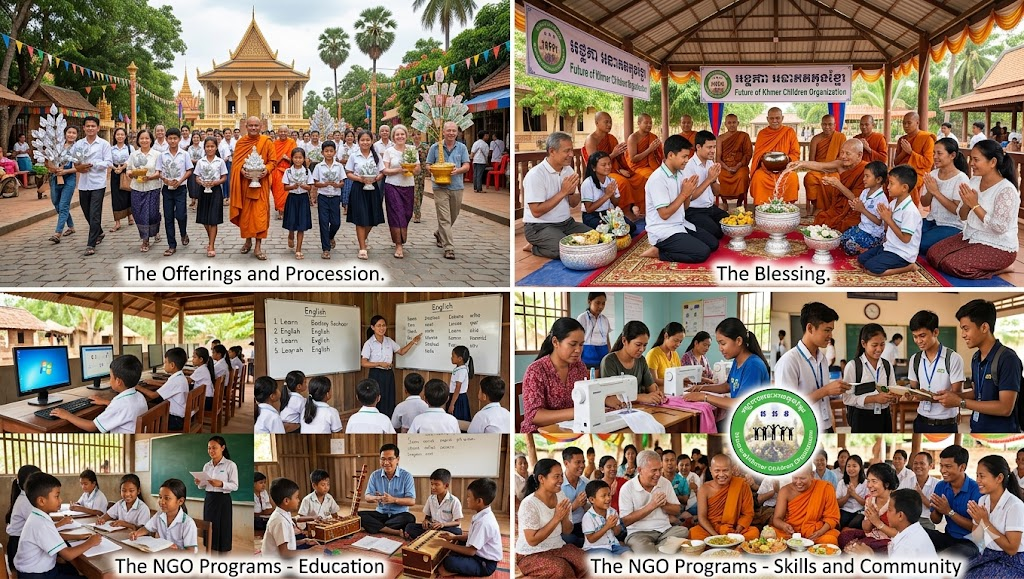
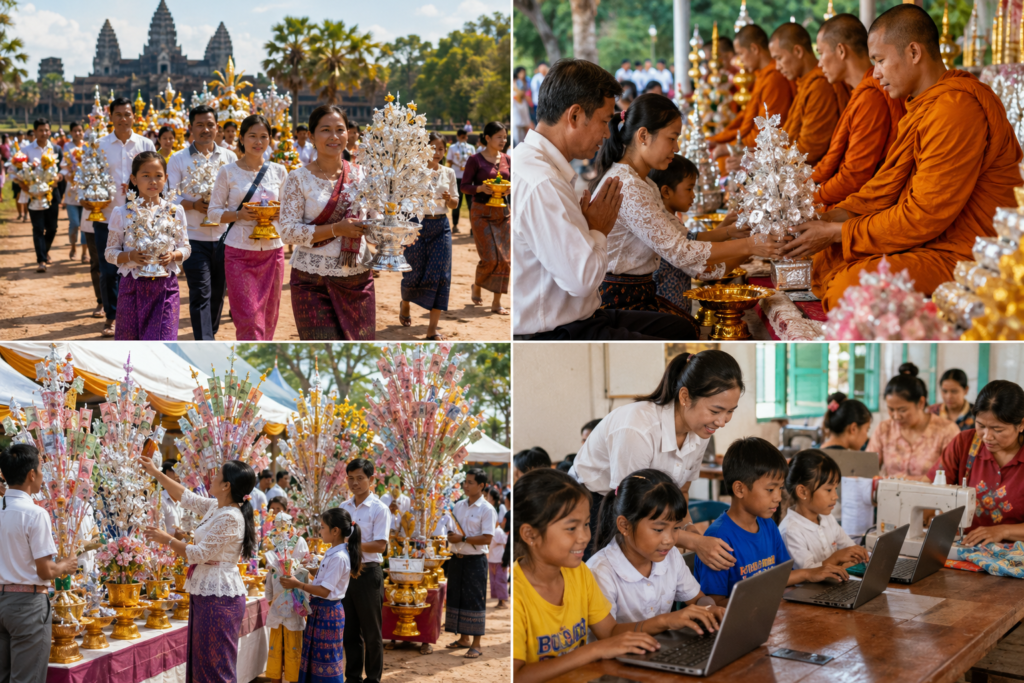
The Silver Flower Solidarity Festival is a community event in Cambodia. It happened on May 15–16, 2026 in Siem Reap. It was made by the Future of Khmer Children Organization. The event is part of a Khmer tradition called the Silver Flower ceremony.
People come together to give silver flowers, money trees, and donations. These items are symbols of respect and kindness. Monks, students, families, and donors take part in the event. They walk in small groups and give offerings. They also pray and receive blessings. The atmosphere is calm and friendly.
The festival helps children and families in need. The NGO uses the money for education programs. Children learn English, math, computer skills, music, and dance. Young people also get job training. Mothers can learn sewing and language skills. The goal is to help families have a better life.
The festival also builds unity in the community. People share time, help each other, and show care. It is a simple event but it has a strong meaning. It gives hope and support to many people.
a festival: a big public event with music, dance, or traditions
solidarity: people helping and standing together
a community event: an event for people in one place or group
a ceremony: a formal and special act for an important reason
a money tree: a tree with money or paper money used for giving
a donation: money or things given to help others
an item: one thing or object
kindness: being nice and good to other people
a monk: a religious man in Buddhism
a donor: a person who gives money or help
to take part in something: to join and do something with others
to give an offering: to give something in a religious or special way
to receive blessing: to get good wishes or good words for luck and peace
to be calm: to be quiet, relaxed, and not worried
a family in need: a family that needs help
an education program: a plan to teach people skills and knowledge
computer skills: ability to use a computer
a job training: learning skills for a job
to sew: to make or repair clothes with a needle and thread
a language skill: ability to speak or understand a language
a goal: something you want to achieve
to build unity in a community: to make people in a group come together
to share time: to spend time together with others
to show care: to be kind and help others
a strong meaning: something with deep importance
to give support: to help someone with money, work, or care
###############
Match the words with the definitions:
a festival
solidarity
a community event
a ceremony
a money tree
a donation
an item
kindness
a monk
a donor
to take part in something
to give an offering
to receive blessing
to be calm
a family in need
an education program
computer skills
a job training
to sew
a language skill
a goal
to build unity in a community
to share time
to show care
to give support
Definitions:
A. to be quiet, relaxed, and not worried B. a plan to teach people skills and knowledge C. to help someone with money, work, or care D. a religious man in Buddhism E. a family that needs help F. a big public event with music, dance, or traditions G. ability to use a computer H. a tree with money or paper money used for giving I. to join and do something with others J. to give something in a religious or special way K. a person who gives money or help L. being nice and good to other people M. people helping and standing together N. one thing or object O. to spend time together with others P. a formal and special act for an important reason Q. to get good wishes or good words for luck and peace R. a job learning program for skills S. to make or repair clothes with a needle and thread T. ability to speak or understand a language U. something you want to achieve V. to make people in a group come together W. to be kind and help others X. something with deep importance Y. an event for people in one place or group
A money tree is a normal plant used to grow food like vegetables. True is: A money tree is a tree with money or paper money used for giving.
A festival is a regular school day with normal lessons and homework. True is: A festival is a big public event with music, dance, or traditions.
Kindness is being nice and good to other people.
A ceremony is a formal and special act for an important reason.
Solidarity is a feeling when people only work for themselves in a group. True is: Solidarity is people helping and standing together.
An item is one thing or object.
A donation is money or things given to help others.
A monk is a religious man in Buddhism.
A community event is an event for people in one place or group.
Solidarity is people helping and standing together.
A ceremony is a short conversation used to plan daily work. True is: A ceremony is a formal and special act for an important reason.
A festival is a big public event with music, dance, or traditions.
Kindness is a rule that controls how fast people must work. True is: Kindness is being nice and good to other people.
A donor is someone who only receives help from others. True is: A donor is a person who gives money or help.
A community event is a private meeting between two companies. True is: A community event is an event for people in one place or group.
A money tree is a tree with money or paper money used for giving.
A monk is a person who manages money in a bank. True is: A monk is a religious man in Buddhism.
A donation is a payment people get back later with interest. True is: A donation is money or things given to help others.
An item is always a large group of things, not a single object. True is: An item is one thing or object.
##################
Short answers, basics:
Example Sentence
Yes
No
I learn the alphabet.
Yes, I do.
No, I don’t.
You read signs.
Yes, you do.
No, you don’t.
He practices speaking.
Yes, he does.
No, he doesn’t.
She watches cartoons.
Yes, she does.
No, she doesn’t.
It helps us learn English.
Yes, it does.
No, it doesn’t.
We use apps like Duolingo.
Yes, we do.
No, we don’t.
You read labels.
Yes, you do.
No, you don’t.
They make mistakes sometimes.
Yes, they do.
No, they don’t.
Question
Yes
No
Do I learn the alphabet?
Yes, I do.
No, I don’t.
Do you read signs?
Yes, you do.
No, you don’t.
Does he practice speaking?
Yes, he does.
No, he doesn’t.
Does she watch cartoons?
Yes, she does.
No, she doesn’t.
Does it help us learn English?
Yes, it does.
No, it doesn’t.
Do we use apps like Duolingo?
Yes, we do.
No, we don’t.
Do you read labels?
Yes, you do.
No, you don’t.
Do they make mistakes sometimes?
Yes, they do.
No, they don’t.
Question
Yes
No
Am I big?
Yes, I am.
No, I am not.
Are you big?
Yes, you are.
No, you aren’t.
Is he big?
Yes, he is.
No, he isn’t.
Is she big?
Yes, she is.
No, she isn’t.
Is it big?
Yes, it is.
No, it isn’t.
Are we big?
Yes, we are.
No, we aren’t.
Are you big?
Yes, you are.
No, you aren’t.
Are they big?
Yes, they are.
No, they aren’t.
Give short answers:
The festival takes place on May 15–16, 2026.
YOU WRITE: Yes, it does.
The festival creates problems in the community.
People come together to give silver flowers, money trees, and donations.
The festival happens in Phnom Penh.
Monks, students, families, and donors take part in the event.
The NGO uses the money for education programs.
The festival is made by the Future of Khmer Children Organization.
People give only food at the festival.
The atmosphere is calm and friendly.
The Cambodian government makes the festival.
People walk in small groups and give offerings.
The festival takes place in April 2026.
The festival helps children and families in need.
Monks and families stay at home during the event.
People also pray and receive blessings.
The event lasts for one week.
The atmosphere is noisy and angry.
Children learn only sewing and dance.
The NGO uses the money for building roads.
The festival happens in Siem Reap.
_______________________
Correct version:
The festival takes place on May 15–16, 2026. Yes, it does.
The festival creates problems in the community. No, it does not.
People come together to give silver flowers, money trees, and donations. Yes, they do.
The festival happens in Phnom Penh. No, it does not.
Monks, students, families, and donors take part in the event. Yes, they do.
The NGO uses the money for education programs. Yes, it does.
The festival is made by the Future of Khmer Children Organization. Yes, it is.
People give only food at the festival. No, they do not.
The atmosphere is calm and friendly. Yes, it is.
The Cambodian government makes the festival. No, it does not.
People walk in small groups and give offerings. Yes, they do.
The festival takes place in April 2026. No, it does not.
The festival helps children and families in need. Yes, it does.
Monks and families stay at home during the event. No, they do not.
People also pray and receive blessings. Yes, they do.
The event lasts for one week. No, it does not.
The atmosphere is noisy and angry. No, it is not.
Children learn only sewing and dance. No, they do not.
The NGO uses the money for building roads. No, it does not.
The festival happens in Siem Reap. Yes, it does.
#################
Basics of present simple:
Personal Pronoun
am / is / are
I
am
8 years old
You
are
8 years old
He
is
8 years old
She
is
8 years old
It
is
8 years old
We
are
8 years old
You (plural)
are
8 years old
They
are
8 years old
Personal Pronoun
am not / is not / are not
I
am not
8 years old
You
are not
8 years old
He
is not
8 years old
She
is not
8 years old
It
is not
8 years old
We
are not
8 years old
You (plural)
are not
8 years old
They
are not
8 years old
Question:
Question Word
Personal Pronoun
Am
I
8 years old?
Are
you
8 years old?
Is
he
8 years old?
Is
she
8 years old?
Is
it
8 years old?
Are
we
8 years old?
Are
you (plural)
8 years old?
Are
they
8 years old?
Statement:
Personal Pronoun
Verb
I
like
ice cream
You
like
ice cream
He
likes
ice cream
She
likes
ice cream
It
likes
ice cream
We
like
ice cream
You (plural)
like
ice cream
They
like
ice cream
Negation:
Personal Pronoun
Verb (negative)
I
do not like
ice cream
You
do not like
ice cream
He
does not like
ice cream
She
does not like
ice cream
It
does not like
ice cream
We
do not like
ice cream
You (plural)
do not like
ice cream
They
do not like
ice cream
Question:
Do / Does
Personal Pronoun
Verb
Sugar?
Do
I
like
sugar?
Do
you
like
sugar?
Does
he
like
sugar?
Does
she
like
sugar?
Does
it
like
sugar?
Do
we
like
sugar?
Do
you (plural)
like
sugar?
Do
they
like
sugar?
################
Rewrite as shown in sentence 1:
The Silver Flower Solidarity Festival happens in Siem Reap.
YOU WRITE: a) Does the Silver Flower Solidarity Festival happen in Siem Reap? b) The Silver Flower Solidarity Festival does not happen in Siem Reap.
The festival takes place on May 15–16, 2026.
The festival is made by the Future of Khmer Children Organization.
People come together to give silver flowers, money trees, and donations.
Monks, students, families, and donors take part in the event.
People walk in small groups and give offerings.
People also pray and receive blessings.
The atmosphere is calm and friendly.
The festival helps children and families in need.
The NGO uses the money for education programs.
______________________
Correct version:
The Silver Flower Solidarity Festival happens in Siem Reap. a) Does the Silver Flower Solidarity Festival happen in Siem Reap? b) The Silver Flower Solidarity Festival does not happen in Siem Reap.
The festival takes place on May 15–16, 2026. a) Does the festival take place on May 15–16, 2026? b) The festival does not take place on May 15–16, 2026.
The festival is made by the Future of Khmer Children Organization. a) Is the festival made by the Future of Khmer Children Organization? b) The festival is not made by the Future of Khmer Children Organization.
People come together to give silver flowers, money trees, and donations. a) Do people come together to give silver flowers, money trees, and donations? b) People do not come together to give silver flowers, money trees, and donations.
Monks, students, families, and donors take part in the event. a) Do monks, students, families, and donors take part in the event? b) Monks, students, families, and donors do not take part in the event.
People walk in small groups and give offerings. a) Do people walk in small groups and give offerings? b) People do not walk in small groups and give offerings.
People also pray and receive blessings. a) Do people also pray and receive blessings? b) People do not also pray and receive blessings.
The atmosphere is calm and friendly. a) Is the atmosphere calm and friendly? b) The atmosphere is not calm and friendly.
The festival helps children and families in need. a) Does the festival help children and families in need? b) The festival does not help children and families in need.
The NGO uses the money for education programs. a) Does the NGO use the money for education programs? b) The NGO does not use the money for education programs.
###################
Match the halves:
People come together
The festival happens
Monks, students, families, and donors
People walk
People also pray
The atmosphere
The NGO uses the money
The festival
a) for education programs b) in small groups c) and receive blessings d) is calm and friendly e) on May 15–16, 2026 f) take part in the event g) helps children and families in need h) to give silver flowers, money trees, and donations
________________________
Answer:
1-h, 2-e, 3-f, 4-b, 5-c, 6-d, 7-a, 8-g
#################
Correct version:
People come together to give silver flowers, money trees, and donations.
The festival happens on May 15–16, 2026.
Monks, students, families, and donors take part in the event.
People walk in small groups.
People also pray and receive blessings.
The atmosphere is calm and friendly.
The NGO uses the money for education programs.
The festival helps children and families in need.
################# Give answers in complete sentences:
Where does the Silver Flower Solidarity Festival happen?
When does the festival take place?
Who makes the festival?
Who takes part in the event?
What do people give at the festival?
How do people walk during the event?
Why does the festival help children and families?
What do people do at the festival?
What does the NGO use the money for?
How is the atmosphere at the festival?
_______________________
Possible answers:
Where does the Silver Flower Solidarity Festival happen? The Silver Flower Solidarity Festival happens in Siem Reap.
When does the festival take place? The festival takes place on May 15–16, 2026.
Who makes the festival? The festival is made by the Future of Khmer Children Organization.
Who takes part in the event? Monks, students, families, and donors take part in the event.
What do people give at the festival? People give silver flowers, money trees, and donations at the festival.
How do people walk during the event? People walk in small groups during the event.
Why does the festival help children and families? The festival helps children and families in need.
What do people do at the festival? People come together, give offerings, pray, and receive blessings at the festival.
What does the NGO use the money for? The NGO uses the money for education programs.
How is the atmosphere at the festival? The atmosphere is calm and friendly at the festival.
The Silver Flower Solidarity Festival __________ in Siem Reap on May 15–16, 2026. The event is made by the Future of Khmer Children Organization and is part of a Khmer __________ called the Silver Flower ceremony. People come together to give __________ flowers, money trees, and __________. Monks, students, families, and __________ take part in the event. People walk in small groups, give offerings, pray, and __________ blessings. The atmosphere is __________ and friendly. The festival helps children and families in need. The NGO uses the money for __________ programs, including English, math, computer __________, music, and dance, and job training.
———————————
Correct version:
The Silver Flower Solidarity Festival happens in Siem Reap on May 15–16, 2026. The event is made by the Future of Khmer Children Organization and is part of a Khmer tradition called the Silver Flower ceremony. People come together to give silver flowers, money trees, and donations. Monks, students, families, and donors take part in the event. People walk in small groups, give offerings, pray, and receive blessings. The atmosphere is calm and friendly. The festival helps children and families in need. The NGO uses the money for education programs, including English, math, computer skills, music, and dance, and job training.
###############
Match question and answer:
Where does the Silver Flower Solidarity Festival happen?
When does the festival take place?
Who makes the festival?
What is the festival part of?
Who takes part in the event?
What do people give at the festival?
How do people take part in the ceremony?
What do people do during the event?
What does the NGO use the money for?
How is the atmosphere at the festival?
a) A calm and friendly feeling is present during the festival. b) The Future of Khmer Children Organization is the creator of the festival. c) Silver flowers, money trees, and donations are common offerings. d) Small groups with walking and offering activities are seen during the event. e) Siem Reap is the location of the Silver Flower Solidarity Festival. f) Education programs such as English, math, computer skills, music, and dance are supported by the NGO. g) Monks, students, families, and donors are present at the event. h) May 15–16, 2026 is the date of the event. i) A Khmer tradition called the Silver Flower ceremony is its cultural background. j) Praying and receiving blessings are part of the activities.
Where does the Silver Flower Solidarity Festival happen? Siem Reap is the location of the Silver Flower Solidarity Festival.
When does the festival take place? May 15–16, 2026 is the date of the event.
Who makes the festival? The Future of Khmer Children Organization is the creator of the festival.
What is the festival part of? A Khmer tradition called the Silver Flower ceremony is its cultural background.
Who takes part in the event? Monks, students, families, and donors are present at the event.
What do people give at the festival? Silver flowers, money trees, and donations are common offerings.
How do people take part in the ceremony? Small groups with walking and offering activities are seen during the event.
What do people do during the event? Praying and receiving blessings are part of the activities.
What does the NGO use the money for? Education programs such as English, math, computer skills, music, and dance are supported by the NGO.
How is the atmosphere at the festival? A calm and friendly feeling is present during the festival.
##################
##################
Brief summary in A1
The Silver Flower Festival is in Siem Reap, Cambodia. It happened on May 15–16, 2026.
People come together for this event. They give silver flowers, money trees, and donations. Monks, families, and students join. They pray and get blessings.
The money helps children and poor families. Children learn English, math, computers, music, and dance. Mothers learn sewing and language skills.
The festival is about kindness and helping people. It brings the community together and gives hope.
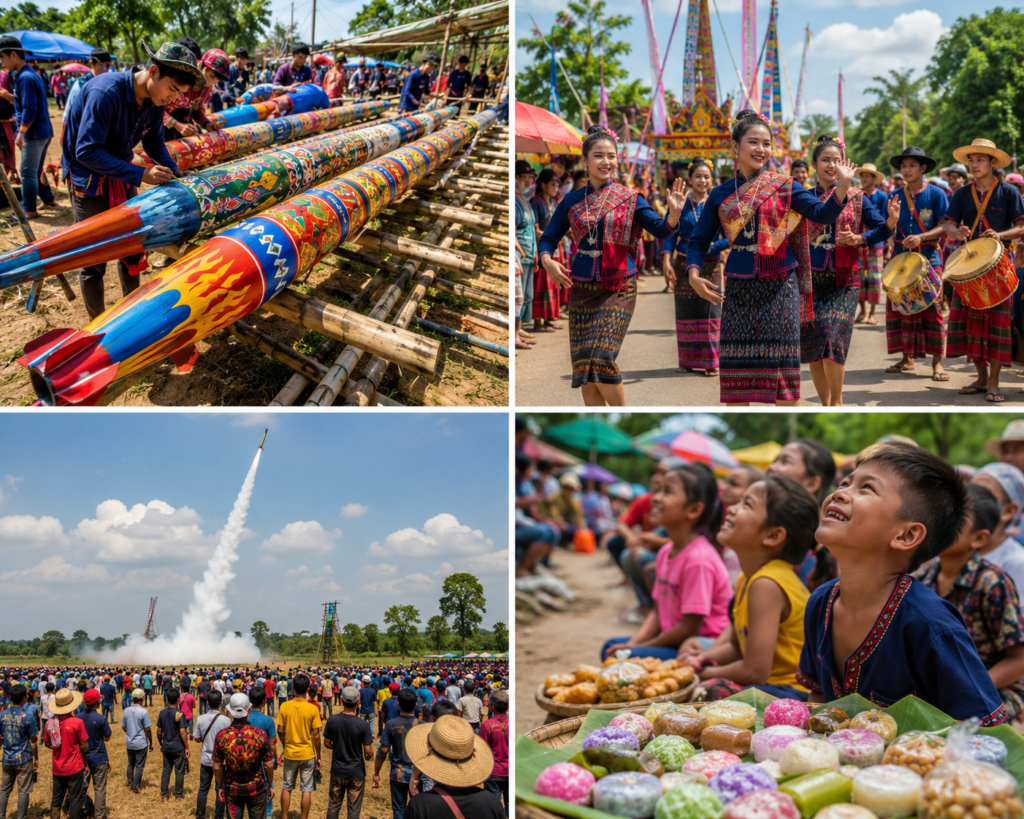
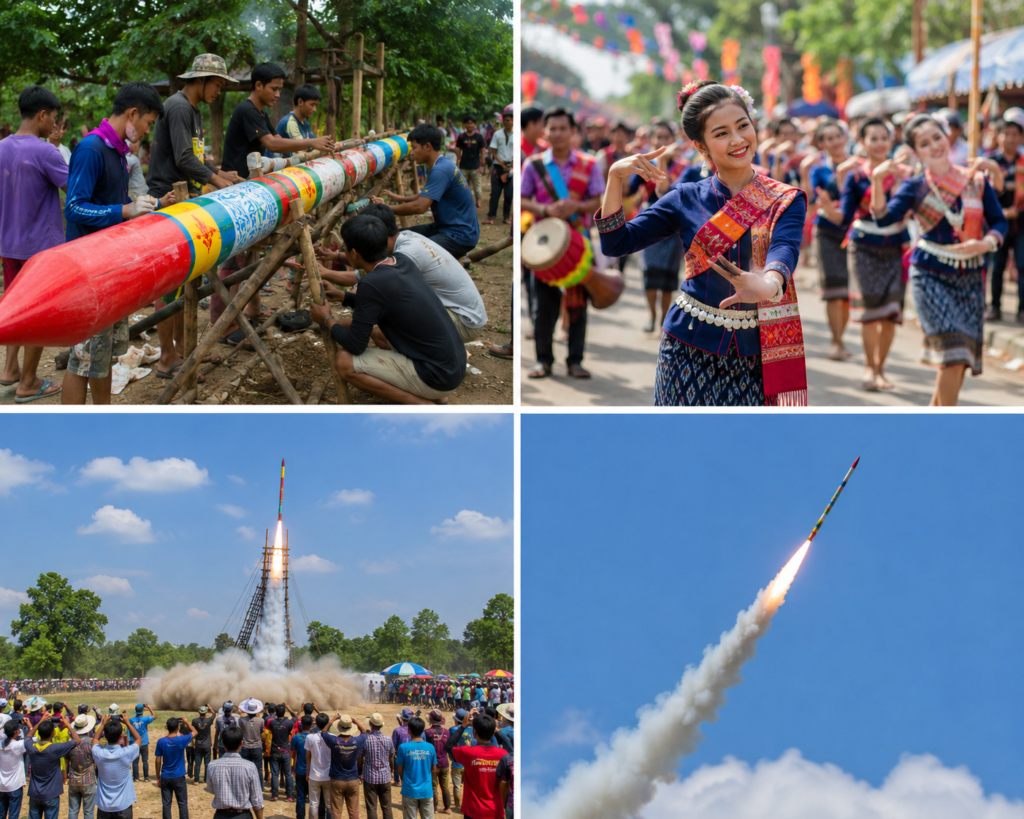
My name is Malivanh and I visited the Bun Bang Fai Festival from May 4 to May 10, 2026. I went with my family to a village in Laos. We stayed there for one week. I felt very happy and excited.
The festival had a long history. People said it started many years ago. They believed rockets could bring rain for the rice fields. Farmers needed rain for their crops. I learned this from my guide. It was interesting and simple.
On the first day, I saw people making rockets. They used bamboo and paint. The rockets were big and colorful. I helped my cousins carry small things. We worked together and smiled a lot.
On the festival day, we went to the field. Many people waited and looked at the sky. A rocket went up very high. Everyone shouted and clapped. I felt very proud and happy to see it.
After the festival, we ate food and talked with friends. We went home with good memories. I will never forget this festival in Laos.
I also met many people from different villages. They were friendly and kind. We talked about the festival and daily life. I made new friends during the trip.
The weather was warm and sunny every day. At night, we sat together and listened to music. I felt safe and very happy in Laos.
This festival taught me about old culture in Laos. I understood why people respect the rockets. I hope I can visit again next year with my family.
I will remember the sounds, the colors, and the smiles. It was one of the best moments of my life. I was very thankful for this experience.
____________________
Vocabulary:
to be excited: to feel very happy and full of energy about something
to believe: to think something is true
a rocket: a flying object that goes very fast into the sky
crops: plants that farmers grow for food (like rice or corn)
a guide: a person who helps and shows you a place
paint: colored liquid used to make things colorful
colorful: having many bright colors
the sky: the space above us where clouds and the sun are
to shout: to say something very loudly
to clap: to hit your hands together to show happiness
a village: a small place where people live, smaller than a town
to be kind: to be nice and helpful to other people
daily life: normal things people do every day
to make friends: to become friends with someone
to feel safe: to feel not in danger
to teach somebody something: to help someone learn something
to respect: to think someone or something is important and good
to remember: to keep something in your mind
a sound: something you hear
an experience: something you do or live through in your life
##################
Basics in past simple:
Past Simple – Regular Verbs
Rules:
Most verbs: add -ed play → played
Verbs ending in -e: add -d live → lived
Verbs ending in consonant + y: change y to i and add -ed study → studied
Short verbs ending in vowel + consonant: double the final consonant and add -ed stop → stopped
Use: The past simple is used to talk about finished actions in the past.
##################
List of verbs in text, regular and irregular:
Infinitive
Past tense
Definition
be
was / were
to exist / to be in a state
visit
visited
to go and see a place
go
went
to move from one place to another
stay
stayed
to live somewhere for a short time
feel
felt
to have an emotion or physical feeling
have
had
to own or hold something
say
said
to speak words
start
started
to begin
believe
believed
to think something is true
bring
brought
to take something to a place
need
needed
to want something important
learn
learned
to get new knowledge
see
saw
to look at and notice something
make
made
to create or produce something
help
helped
to give support to someone
carry
carried
to take something from one place to another
work
worked
to do a job or activity
smile
smiled
to show happiness with your mouth
use
used
to take something and do something with it
wait
waited
to stay until something happens
look
looked
to turn your eyes toward something
shout
shouted
to say something very loudly
clap
clapped
to hit your hands together to show happiness
eat
ate
to take food into your body
talk
talked
to speak with someone
meet
met
to see and talk to someone for the first time
sit
sat
to rest on a chair or ground
listen
listened
to hear carefully
teach
taught
to help someone learn something
understand
understood
to know the meaning of something
hope
hoped
to want something good in the future
forget
forgot
to not remember something
remember
remembered
to keep something in your mind
stay
stayed
to live somewhere for a short time
#################
Match word and definition:
Words
to feel safe
a guide
to clap
a village
to remember
to shout
a rocket
to respect
crops
to believe
to make friends
daily life
paint
to teach somebody something
colorful
a sound
to be kind
an experience
the sky
to be excited
Definitions
A. to hit your hands together to show happiness B. to think someone or something is important and good C. plants that farmers grow for food (like rice or corn) D. a flying object that goes very fast into the sky E. to be nice and helpful to other people F. normal things people do every day G. to help someone learn something H. to feel not in danger I. having many bright colors J. to become friends with someone K. to think something is true L. a small place where people live, smaller than a town M. to keep something in your mind N. something you hear O. to feel very happy and full of energy about something P. colored liquid used to make things colorful Q. to say something very loudly R. a person who helps and shows you a place S. something you do or live through in your life T. the space above us where clouds and the sun are U. to exist / be in a state
a small place where people live, smaller than a town
to keep something in your mind
to say something very loudly
a flying object that goes very fast into the sky
to think someone or something is important and good
plants that farmers grow for food (like rice or corn)
to think something is true
to become friends with someone
normal things people do every day
colored liquid used to make things colorful
to help someone learn something
having many bright colors
something you hear
to be nice and helpful to other people
something you do or live through in your life
the space above us where clouds and the sun are
to feel very happy and full of energy about something
Words
a. a guide b. crops c. to believe d. to respect e. to feel safe f. to shout g. to remember h. a village i. to clap j. to make friends k. daily life l. paint m. to teach somebody something n. colorful o. a sound p. to be kind q. an experience r. the sky s. to be excited t. a rocket
Rockets were made only from plastic materials imported from cities.
Malivanh visited the Bun Bang Fai Festival in Laos.
The festival was a private event with no other visitors besides his family.
Farmers said rain was not important for agriculture in that region.
Malivanh met friendly people from different villages.
People made rockets using bamboo and paint.
The festival was mainly focused on boat racing in rivers.
A rocket went very high into the sky during the festival.
Malivanh spent the whole trip studying in a classroom instead of joining activities.
The festival lasted for one week.
The guide explained that the festival was originally from Europe.
He traveled with his family.
During the trip, Malivanh stayed in a hotel in a large modern city far away from the village.
People believed rockets could bring rain for rice fields.
Most activities in the festival were held indoors inside temples only.
Farmers needed rain for their crops.
Malivanh learned about the festival from a guide.
Malivanh attended the festival during winter season.
Rockets were described as big and colorful.
The festival took place in a tropical rural village in Laos.
_____________________
True: 2,5,6,8,10,12,14,16,17,19,20
_____________________
Correct version:
Rockets were made only from plastic materials imported from cities. True is: Rockets were made using bamboo and paint.
Malivanh visited the Bun Bang Fai Festival in Laos.
The festival was a private event with no other visitors besides his family. True is: Malivanh met many people from different villages at the festival.
Farmers said rain was not important for agriculture in that region. True is: Farmers needed rain for their crops.
Malivanh met friendly people from different villages.
People made rockets using bamboo and paint.
The festival was mainly focused on boat racing in rivers. True is: The festival was about rockets that are believed to bring rain for crops.
A rocket went very high into the sky during the festival.
Malivanh spent the whole trip studying in a classroom instead of joining activities. True is: Malivanh took part in festival activities with his family.
The festival lasted for one week.
The guide explained that the festival was originally from Europe. True is: The guide explained the festival has a long history in Laos.
He traveled with his family.
During the trip, Malivanh stayed in a hotel in a large modern city far away from the village. True is: Malivanh stayed in a village in Laos.
People believed rockets could bring rain for rice fields.
Most activities in the festival were held indoors inside temples only. True is: The festival activities took place in open fields.
Farmers needed rain for their crops.
Malivanh learned about the festival from a guide.
Malivanh attended the festival during winter season. True is: The festival took place in warm weather in May.
Rockets were described as big and colorful.
The festival took place in a tropical rural village in Laos.
##################
Put the events in the correct order:
A. People made rockets using bamboo and paint B. Malivanh visited a village in Laos with his family C. A rocket went high into the sky D. People ate food and talked after the festival E. Malivanh learned about the festival from a guide F. People went to the field to watch the rockets
_______________________
Correct order: B E A F C D
#################
Short answers, past simple, basics:
Example Sentence
Yes
No
I learned letters.
Yes, I did.
No, I didn’t.
You read signs.
Yes, you did.
No, you didn’t.
He spoke English.
Yes, he did.
No, he didn’t.
She watched TV.
Yes, she did.
No, she didn’t.
It helped me.
Yes, it did.
No, it didn’t.
We used an app.
Yes, we did.
No, we didn’t.
You read words.
Yes, you did.
No, you didn’t.
They made mistakes.
Yes, they did.
No, they didn’t.
Questions (Past Simple)
Question
Yes
No
Did I learn letters?
Yes, I did.
No, I didn’t.
Did you read signs?
Yes, you did.
No, you didn’t.
Did he speak English?
Yes, he did.
No, he didn’t.
Did she watch TV?
Yes, she did.
No, she didn’t.
Did it help me?
Yes, it did.
No, it didn’t.
Did we use an app?
Yes, we did.
No, we didn’t.
Did you read words?
Yes, you did.
No, you didn’t.
Did they make mistakes?
Yes, they did.
No, they didn’t.
Was / Were
Question
Yes
No
Was I happy?
Yes, I was.
No, I wasn’t.
Were you happy?
Yes, you were.
No, you weren’t.
Was he happy?
Yes, he was.
No, he wasn’t.
Was she happy?
Yes, she was.
No, she wasn’t.
Was it good?
Yes, it was.
No, it wasn’t.
Were we happy?
Yes, we were.
No, we weren’t.
Were you happy?
Yes, you were.
No, you weren’t.
Were they happy?
Yes, they were.
No, they weren’t.
#################
Provide short answers as shown in 1.:
Rockets were made only from plastic materials imported from cities.
YOU WRITE: No, they weren’t.
Malivanh visited the Bun Bang Fai Festival in Laos.
The festival was a private event with no other visitors besides his family.
Farmers said rain was not important for agriculture in that region.
Malivanh met friendly people from different villages.
People made rockets using bamboo and paint.
The festival was mainly focused on boat racing in rivers.
A rocket went very high into the sky during the festival.
Malivanh spent the whole trip studying in a classroom instead of joining activities.
The festival lasted for one week.
The guide explained that the festival was originally from Europe.
He traveled with his family.
During the trip, Malivanh stayed in a hotel in a large modern city far away from the village.
People believed rockets could bring rain for rice fields.
Most activities in the festival were held indoors inside temples only.
Farmers needed rain for their crops.
Malivanh learned about the festival from a guide.
Malivanh attended the festival during winter season.
Rockets were described as big and colorful.
The festival took place in a tropical rural village in Laos.
________________________
Correct answers:
Rockets were made only from plastic materials imported from cities. No, they weren’t.
Malivanh visited the Bun Bang Fai Festival in Laos. Yes, she did.
The festival was a private event with no other visitors besides her family. No, it wasn’t.
Farmers said rain was not important for agriculture in that region. No, they didn’t.
Malivanh met friendly people from different villages. Yes, she did.
People made rockets using bamboo and paint. Yes, they did.
The festival was mainly focused on boat racing in rivers. No, it wasn’t.
A rocket went very high into the sky during the festival. Yes, it did.
Malivanh spent the whole trip studying in a classroom instead of joining activities. No, she didn’t.
The festival lasted for one week. Yes, it did.
The guide explained that the festival was originally from Europe. No, it didn’t.
She traveled with her family. Yes, she did.
During the trip, Malivanh stayed in a hotel in a large modern city far away from the village. No, she didn’t.
People believed rockets could bring rain for rice fields. Yes, they did.
Most activities in the festival were held indoors inside temples only. No, they weren’t.
Farmers needed rain for their crops. Yes, they did.
Malivanh learned about the festival from a guide. Yes, she did.
Malivanh attended the festival during winter season. No, she didn’t.
Rockets were described as big and colorful. Yes, they were.
The festival took place in a tropical rural village in Laos. Yes, it did.
####################
#################
Past simple – basics
Personal Pronoun
Verb (Past)
Object
I
ate
apples
You
ate
apples
He
ate
apples
She
ate
apples
It
ate
apples
We
ate
apples
You (plural)
ate
apples
They
ate
apples
I
played
football
You
played
football
He
played
football
She
played
football
It
played
football
We
played
football
You (plural)
played
football
They
played
football
Personal Pronoun
Verb (Past Negative)
Object
I
did not eat
apples
You
did not eat
apples
He
did not eat
apples
She
did not eat
apples
It
did not eat
apples
We
did not eat
apples
You (plural)
did not eat
apples
They
did not eat
apples
I
did not play
football
You
did not play
football
He
did not play
football
She
did not play
football
It
did not play
football
We
did not play
football
You (plural)
did not play
football
They
did not play
football
Did + Pronoun
Verb
Object
Did I
eat
apples?
Did you
eat
apples?
Did he
eat
apples?
Did she
eat
apples?
Did it
eat
apples?
Did we
eat
apples?
Did you
eat
apples?
Did they
eat
apples?
Did I
play
football?
Did you
play
football?
Did he
play
football?
Did she
play
football?
Did it
play
football?
Did we
play
football?
Did you
play
football?
Did they
play
football?
Didn’t + Pronoun
Verb
Object
Didn’t I
eat
apples?
Didn’t you
eat
apples?
Didn’t he
eat
apples?
Didn’t she
eat
apples?
Didn’t it
eat
apples?
Didn’t we
eat
apples?
Didn’t you
eat
apples?
Didn’t they
eat
apples?
Didn’t I
play
football?
Didn’t you
play
football?
Didn’t he
play
football?
Didn’t she
play
football?
Didn’t it
play
football?
Didn’t we
play
football?
Didn’t you
play
football?
Didn’t they
play
football?
Forms of ‚to be‘
Personal Pronoun
Positive
Negative
Question
I
I was happy.
I was not happy.
Was I happy?
You (singular)
You were excited.
You were not excited.
Were you excited?
He
He was at home.
He was not at home.
Was he at home?
She
She was tired.
She was not tired.
Was she tired?
It
It was cold.
It was not cold.
Was it cold?
We
We were at the party.
We were not at the party.
Were we at the party?
You (plural)
You were friends.
You were not friends.
Were you friends?
They
They were in the garden.
They were not in the garden.
Were they in the garden?
##############
Answer in full sentences:
Did she go to Laos or Vietnam?
YOU WRITE: She went to laos.
Were the rockets made of bamboo or plastic?
Did she travel with her family or alone?
Was the festival in May or December?
Did people believe rockets bring rain or snow?
Did she learn from a guide or a teacher?
Were the rockets big or small?
Did people shout or whisper when the rocket flew?
Did she feel happy or sad during the festival?
Did the rocket go into the sky or stay on the ground?
Did they use bamboo or metal to make rockets?
Did she meet villagers or stay alone all the time?
Was the weather warm or cold?
Did people clap or stay silent?
Did she eat food after or before the festival?
Did she visit a village or a city?
Did the festival last one day or one week?
Did she remember or forget the experience?
Did farmers need rain or snow for crops?
Did she feel safe or in danger during the trip?
__________________________
Correct answers:
Did she go to Laos or Vietnam? She went to Laos.
Were the rockets made of bamboo or plastic? They were made of bamboo.
Did she travel with her family or alone? She traveled with her family.
Was the festival in May or December? It was in May.
Did people believe rockets bring rain or snow? They believed rockets bring rain.
Did she learn from a guide or a teacher? She learned from a guide.
Were the rockets big or small? They were big.
Did people shout or whisper when the rocket flew? They shouted when the rocket flew.
Did she feel happy or sad during the festival? She felt happy.
Did the rocket go into the sky or stay on the ground? It went into the sky.
Did they use bamboo or metal to make rockets? They used bamboo.
Did she meet villagers or stay alone all the time? She met villagers.
Was the weather warm or cold? The weather was warm.
Did people clap or stay silent? They clapped.
Did she eat food after or before the festival? She ate food after the festival.
Did she visit a village or a city? She visited a village.
Did the festival last one day or one week? It lasted one week.
Did she remember or forget the experience? She remembered the experience.
Did farmers need rain or snow for crops? They needed rain.
Did she feel safe or in danger during the trip? She felt safe.
#################
Fill in the correct form of the verb in past simple:
Malivanh ______________ (go) to a village in Laos with her family.
She ______________ (be) very happy and excited about the festival.
They ______________ (see) people making rockets from bamboo.
The guide ______________ (tell) her about the history of the festival.
People ______________ (believe) rockets could bring rain for crops.
Farmers ______________ (need) rain for their rice fields.
Malivanh ______________ (learn) many new things during the trip.
She ______________ (meet) people from different villages.
Everyone ______________ (feel) proud when the rocket flew into the sky.
People ______________ (make) colorful rockets together.
The rocket ______________ (go) very high into the sky.
Everyone ______________ (shout) and ______________ (clap) when it happened.
After the launch, people ______________ (eat) food together.
They ______________ (sit) and talked about the festival.
Malivanh ______________ (hear) music at night.
She ______________ (see) the beautiful colors of the rockets again in her mind.
She ______________ (remember) the sounds and smiles clearly.
She ______________ (understand) why the festival was important.
She ______________ (take) many good memories home with her.
She ______________ (forget) nothing about this experience.
———————————– Correct version:
Malivanh went to a village in Laos with her family.
She was very happy and excited about the festival.
They saw people making rockets from bamboo.
The guide told her about the history of the festival.
People believed rockets could bring rain for crops.
Farmers needed rain for their rice fields.
Malivanh learned many new things during the trip.
She met people from different villages.
Everyone felt proud when the rocket flew into the sky.
People made colorful rockets together.
The rocket went very high into the sky.
Everyone shouted and clapped when it happened.
After the launch, people ate food together.
They sat and talked about the festival.
Malivanh heard music at night.
She saw the beautiful colors of the rockets again in her mind.
She remembered the sounds and smiles clearly.
She understood why the festival was important.
She took many good memories home with her.
She forgot nothing about this experience.
##################
Form questions in past simple, then answer them as shown in 1.:
(she / visit / Laos?)
YOU WRITE: Did she visit Laos? Yes, she did. She visited Laos.
(she / travel / with her family?)
(she / go / to a village?)
(farmers / need / rain / for crops?)
(she / learn / from a guide?)
(they / make / rockets / from bamboo?)
(she / meet / people / from other villages?)
(people / shout and clap / when rocket flew?)
(rocket / go / into the sky?)
(she / remember / the experience?)
_________________________
Correct version:
Did she visit Laos? Yes, she did. She visited Laos.
Did she travel with her family? Yes, she did. She traveled with her family.
Did she go to a village? Yes, she did. She went to a village.
Did farmers need rain for crops? Yes, they did. Farmers needed rain for crops.
Did she learn from a guide? Yes, she did. She learned from a guide.
Did they make rockets from bamboo? Yes, they did. They made rockets from bamboo.
Did she meet people from other villages? Yes, she did. She met people from other villages.
Did people shout and clap when the rocket flew? Yes, they did. They shouted and clapped when the rocket flew.
Did the rocket go into the sky? Yes, it did. The rocket went into the sky.
Did she remember the experience? Yes, she did. She remembered the experience.
###################
Match question and answer:
Where did you go during the festival?
Who did you travel with?
When did the festival happen?
Why did people use rockets?
What did you see there?
How did you feel at the festival?
What did the guide explain?
Who made the rockets?
What happened when the rocket went up?
Where did the event take place?
What did you do after the festival?
How long did you stay there?
What did you learn from the trip?
Who did you meet there?
What did you enjoy most?
How will you remember this experience?
Answers
a. I felt full of joy and very excited. b. The crowd became very loud and full of happiness. c. I shared food and spoke with new friends. d. I was together with my family members. e. I noticed long bamboo tubes with bright colors. f. A simple story about the festival was shared with me. g. I gained more understanding about old traditions in Laos. h. It was in early May this year. i. Local villagers prepared them together. j. The visit lasted about seven days. k. I spent time in a small countryside place in Laos. l. It will stay in my mind as a very special time in life. m. The flying rockets and happy crowd were my favourite part. n. I spoke with people from different nearby villages. o. It was held in an open field near the village. p. They thought those objects could bring water for rice plants.
Improving team spirit in a hotel workplace is very important for good service and a positive working environment. Team spirit means how well employees work together, support each other, and solve problems as a group. When team spirit is strong, work becomes easier, faster, and more efficient. Guests also receive better service.
One important way to improve team spirit is through clear communication. Employees should speak in a polite and simple way. It is important to listen carefully and ask questions when something is not clear. This helps to avoid mistakes and confusion during daily work.
Regular team meetings can also help. In these meetings, staff can share ideas, discuss problems, and find solutions together. This creates better understanding between colleagues and improves cooperation in the workplace.
Team building activities are another useful method. Simple activities like group tasks, short games, or shared breaks can help employees get to know each other better. This builds trust and makes the working atmosphere friendlier.
Respect is also very important in a hotel environment. Every employee should be treated fairly and supported when needed. Helping each other during busy times creates a stronger team. Managers should also give clear instructions and listen to feedback from staff.
Motivation can be improved by recognizing good work. Saying thank you, giving small rewards, or praising teamwork can increase confidence and happiness at work.
In conclusion, team spirit can be improved through communication, meetings, team activities, respect, and motivation. These simple steps create a better workplace. When employees work well together, the hotel runs more smoothly and guests receive higher quality service. A strong team spirit benefits everyone in the hotel.
______________________
Vocabulary:
to improve – to make something better
team spirit – how well a group works together and helps each other
working environment – the place and feeling where people work
an employee – a person who works for a company or place
to support each other – to help one another
to solve a problem – to find an answer to a problem
to be efficient – to work well and not waste time
to receive better service – to get better help or care
to be polite – to speak and act in a kind way
to avoid a mistake – not to make a mistake
a confusion – a situation where things are not clear
to share an idea – to tell others your idea
to find a solution – to find an answer to a problem
a colleague – a person you work with
to improve cooperation – to work better together
to be useful – to help or be good for something
a task – a job or duty
to share a break – to have a break together
to build trust – to make people believe in each other
to treat fairly – to be kind and equal to everyone
a busy time – a time with a lot of work
to listen to feedback – to listen to opinions or advice
to recognize good work – to notice good work
a reward – something given for good work
to praise teamwork – to say good things about working together
to increase confidence – to make someone feel more sure
in conclusion – at the end
to run smoothly – to work well without problems
to benefit everyone – to be good for all people
##################
Match the words with the correct definitions:
to run smoothly
a confusion
to praise teamwork
an employee
to share an idea
to avoid a mistake
a reward
to support each other
working environment
to increase confidence
a task
to be polite
to build trust
to solve a problem
team spirit
to receive better service
to listen to feedback
a colleague
to be efficient
to treat fairly
Definitions:
A. a person you work with B. to make someone feel more sure C. to speak and act in a kind way D. a job or duty E. to help one another F. a situation where things are not clear G. how well a group works together and helps each other H. to work well without problems I. to find an answer to a problem J. to make something better K. to be good for all people L. to notice good work M. a place and feeling where people work N. to not make a mistake O. to give opinions or advice P. to work well and not waste time Q. to get better help or care R. to give something for good work S. to be kind and equal to everyone T. to say good things about working together
how well a group works together and helps each other – ___
to work well without problems – ___
to find an answer to a problem – ___
to be good for all people – ___
to notice good work – ___
a place and feeling where people work – ___
to not make a mistake – ___
to work well and not waste time – ___
to be kind and equal to everyone – ___
Word
A. to treat fairly B. to solve a problem C. a confusion D. to be efficient E. a colleague F. to run smoothly G. team spirit H. a working environment I. to recognize good work J. to increase confidence K. to avoid a mistake L. a task M. to be polite N. to support each other O. to benefit everyone
Employees should (ignore each other / leave each other / support each other).
A confusion happens when things are not (heavy / new / clear).
Good communication helps people (forget / break / understand) each other.
Team building activities help (lose time / break work / build trust).
A meeting is a time to (cook / sleep / talk about work).
_________________
Correct version:
Team spirit helps people work together.
A working environment means the place where people work.
Good communication helps avoid problems.
A colleague is a person you work with.
Team meetings help staff share ideas.
Motivation helps people work better.
Respect at work means being polite.
A task is a job.
Teamwork helps cooperation.
Employees should support each other.
A confusion happens when things are not clear.
Good communication helps people understand each other.
Team building activities help build trust.
A meeting is a time to talk about work.
##############
Short answers:
What is team spirit?
Why is good communication important at work?
Where do employees work in a hotel?
Who is a colleague?
What does motivation do for workers?
When do employees need to support each other?
How can team meetings help staff?
Why is respect important in a working environment?
What is a task at work?
How can employees avoid a confusion?
What do team building activities help to do?
Why should employees listen to feedback?
What makes a good working environment?
How does teamwork help a hotel?
_____________________
Answers:
What is team spirit? working together, helping each other
Why is good communication important at work? understand work, avoid problems
Where do employees work in a hotel? working environment, hotel
Who is a colleague? person you work with
What does motivation do for workers? work better, more energy
When do employees need to support each other? busy times, help colleagues
How can team meetings help staff? share ideas, solve problems
Why is respect important in a working environment? better workplace, good feeling
What is a task at work? job, duty
How can employees avoid a confusion? clear communication, ask questions
What do team building activities help to do? build trust, know each other
Why should employees listen to feedback? improve work, learn ideas
What makes a good working environment? respect, teamwork, communication
How does teamwork help a hotel? better service, smooth work
##################
Odd one out:
teamwork – communication – colleague – motivation
polite – respectful – friendly – rude
holiday – meeting – discussion – feedback
support – cooperate – help – ignore
restaurant – task – duty – job
confidence – guest – motivation – energy
communication – understanding – feedback – confusion
teamwork – colleague – employee – manager
rude – clear – polite – respectful
support – silence – teamwork – cooperation
________________________
Correct answers:
teamwork – communication – colleague – motivation – colleague: a person, others are about work skills or cooperation
polite – respectful – friendly – rude – rude: it is negative, others are positive behaviour
holiday – meeting – discussion – feedback – holiday: not related to work communication
support – cooperate – help – ignore – ignore: it means not helping, others mean working together
restaurant – task – duty – job – restaurant: a place, others are work words
confidence – guest – motivation – energy – guest: a person, others are feelings or work energy
communication – understanding – feedback – confusion – confusion: it is a problem, others help communication
teamwork – colleague – employee – manager – teamwork: a concept, others are people
rude – clear – polite – respectful – rude: negative behaviour, others are positive or neutral
support – silence – teamwork – cooperation – silence: not related to teamwork or action at work
#################
One-word answers:
A person you work with → __________
A short talk about work → __________
Something you must do at work → __________
Working well with other people → __________
The place where people work → __________
How people feel when they trust each other at work → __________
The ability to work fast and well → __________
A problem at work when things are not clear → __________
The help and kindness between workers → __________
A person who works in a hotel or company → __________
To make something better → __________
To speak in a kind and clear way → __________
A short time when staff talk about work → __________
The feeling that helps people work better → __________
—————————
Correct answers:
A person you work with → colleague
A short talk about work → meeting
Something you must do at work → task
Working well with other people → teamwork
The place where people work → working environment
How people feel when they trust each other at work → team spirit
The ability to work fast and well → efficiency
A problem at work when things are not clear → confusion
The help and kindness between workers → support
A person who works in a hotel or company → employee
To make something better → improve
To speak in a kind and clear way → be polite
A short time when staff talk about work → meeting
The feeling that helps people work better → motivation
################
Match the questions (1–14) with answers (A–N)
Questions
When do employees support each other?
What makes hotel work run smoothly?
Why do employees attend meetings?
Who works together in a hotel team?
What helps people understand each other?
How do workers show respect?
Where does teamwork matter most?
What do team building activities create?
Why is motivation important?
What is important in a hotel workplace?
How do employees improve cooperation?
When do misunderstandings appear?
Who benefits from a good working environment?
Where do workers usually talk about problems?
Answers
A. Communication and teamwork are important in a hotel workplace. B. Information sharing and problem solving are the purpose of meetings. C. Staff meetings are the place for problems. D. Colleagues and staff are in the hotel team. E. Busy times at work are the moment for support. F. Polite behaviour and kind words show respect. G. Clear communication helps understanding between people. H. More energy and better work come from motivation. I. Daily hotel work is the place for teamwork. J. Trust and better relationships are the result of team building activities. K. Employees and guests benefit from a good working environment. L. Unclear communication is the moment for misunderstandings. M. Shared tasks help cooperation between employees. N. Strong teamwork and organisation make hotel work smooth.
Improving team spirit in a hotel is important for good service and a positive __________. Team spirit means that employees work together and help each other. Strong team __________ makes work easier and faster. Guests also get better service in this case.
Clear communication helps employees __________ mistakes and confusion. __________ should speak politely and listen carefully to others. Team meetings help staff share ideas and solve __________ together. These meetings improve understanding between __________.
Team building __________ help workers get to know each other better. Simple group tasks and shared breaks build __________. Respect is important because all employees should be treated fairly. Helping each other during __________ times makes the team stronger.
Motivation grows when good work is noticed and praised. Small _________ and kind words increase confidence at work.
In conclusion, communication, meetings, respect, and motivation __________ team spirit. A strong team helps the __________ run smoothly and gives better service.
———————————-
Correct version:
Improving team spirit in a hotel is important for good service and a positive workplace. Team spirit means that employees work together and help each other. Strong team spirit makes work easier and faster. Guests also get better service in this case.
Clear communication helps employees avoid mistakes and confusion. Employees should speak politely and listen carefully to others. Team meetings help staff share ideas and solve problems together. These meetings improve understanding between colleagues.
Team building activities help workers get to know each other better. Simple group tasks and shared breaks build trust. Respect is important because all employees should be treated fairly. Helping each other during busy times makes the team stronger.
Motivation grows when good work is noticed and praised. Small rewards and kind words increase confidence at work.
In conclusion, communication, meetings, respect, and motivation improve team spirit. A strong team helps the hotel run smoothly and gives better service.
Future workers need soft skills. Soft skills are not technical skills. They are simple human skills. They help people work well with other people. In tourism and hospitality, soft skills are very important because workers meet guests every day.
One important skill is communication. Communication means talking clearly and politely. Workers must use simple words. Good communication helps guests understand information. It also helps to avoid problems.
Another skill is adaptability. Adaptability means accepting change. In the future, jobs will change. Workers must learn new things and change their work when needed.
Creativity is also important. Creativity means finding new ideas. Workers can use creativity to help guests and improve services. It also helps to solve small problems.
Teamwork means working with other people. In hotels and tourism, many people work together. Good teamwork makes work easier and faster.
Problem-solving is another skill. Problem-solving means fixing problems. For example, if a guest has a problem, the worker must help and find a solution quickly.
Intercultural skills are very important. This means understanding other cultures. In tourism, guests come from many countries. Workers must respect all people and cultures.
Emotional intelligence means understanding feelings. Workers must notice how guests feel. If a guest is sad or angry, the worker must stay calm and kind.
Leadership means guiding other people. A leader helps a team. A leader gives simple instructions and supports other workers.
In conclusion, soft skills are very important for future jobs. Communication, adaptability, creativity, teamwork, problem-solving, intercultural skills, emotional intelligence, and leadership help workers in tourism and hospitality. These skills help workers give good service to guests.
__________________
Vocabulary:
Here are simple A1-level definitions:
soft skills: simple human skills for working with people
to talk politely: to speak in a nice and respectful way
to avoid a problem: to stop a problem from happening
to accept change: to be okay when things are different
to improve service: to make the service better
to solve problems: to fix problems
to find a solution: to get an answer or way to fix a problem
to respect people: to be nice and show care for other people
to be angry: to feel strong bad feelings (mad)
to stay calm: to not get angry or nervous
to be kind: to be nice and friendly to others
to guide people: to show people what to do or where to go
to support other people: to help other people
in conclusion: at the end of a text or speech communication: talking and sharing information with other people
_________________
adaptability: being able to change when things are different
creativity: having new ideas and thinking in new ways
teamwork: working with other people in a group
problem-solving: finding ways to fix problems
intercultural skills: understanding and respecting people from different countries and cultures
emotional intelligence: understanding your feelings and other people’s feelings
leadership: guiding and helping a group of people
#############
Match the words with the definitions
Words
soft skills
communication
adaptability
creativity
teamwork
problem-solving
intercultural skills
emotional intelligence
leadership
to talk politely
to avoid a problem
to accept change
to improve service
to solve problems
to find a solution
to respect people
to be angry
to stay calm
to be kind
to guide people
to support other people
in conclusion
Definitions:
A. to show people what to do or where to go B. to stop a problem from happening C. to speak in a nice and respectful way D. to make the service better E. to understand your feelings and other people’s feelings F. simple human skills for working with people G. to be nice and friendly to others H. working with other people in a group I. to be able to change when things are different J. to fix problems K. to feel strong bad feelings (mad) L. to help other people M. at the end of a text or speech N. to have new ideas and thinking in new ways O. to be nice and show care for other people P. to not get angry or nervous Q. to get an answer or way to fix a problem R. to understand and respect people from different countries and cultures S. to be okay when things are different T. to guide and help a group of people U. to talk and share information with other people V. to solve problems
understanding and respecting people from different countries and cultures
understanding your feelings and other people’s feelings
guiding and helping a group of people
to speak in a nice and respectful way
to stop a problem from happening
to be okay when things are different
to make the service better
to fix problems
to get an answer or way to fix a problem
to be nice and show care for other people
to feel strong bad feelings (mad)
to not get angry or nervous
to be nice and friendly to others
to show people what to do or where to go
to help other people
at the end of a text or speech
Words
A. creativity B. communication C. in conclusion D. teamwork E. adaptability F. emotional intelligence G. problem-solving H. soft skills I. to guide people J. to avoid a problem K. to stay calm L. to solve problems M. to respect people N. to accept change O. to find a solution P. to improve service Q. to be kind R. to be angry S. intercultural skills T. to talk politely U. to support other people V. leadership
Tourism work does not involve contact with people. True is: Tourism work involves contact with people.
Creativity can improve how services are done.
Communication is only useful for writing emails. True is: Communication helps people understand information.
Workers often meet guests in hotels and tourism places.
Staff should ignore guest emotions. True is: Staff should understand guest emotions.
Emotional intelligence helps workers understand how guests feel.
Hotel staff only work at night. True is: Hotel staff work at different times of the day.
Problem-solving is used when something goes wrong.
Soft skills are important in tourism and hospitality jobs.
Employees are not allowed to work with others. True is: Employees work together with others.
Intercultural skills help workers with international guests.
Workers must do the same tasks forever without changes. True is: Workers learn new tasks and adapt to changes.
Creativity is not connected to service work. True is: Creativity is connected to improving service work.
Adaptability helps workers deal with new situations at work.
Problems in service jobs do not need attention. True is: Problems in service jobs need attention and solutions.
Communication helps guests understand information.
Workers only deal with guests from one country. True is: Workers deal with guests from different countries.
Teamwork helps people work better together.
Leadership means guiding and supporting a group.
################
Odd one out – find the word that does not belong in each group.
creativity – suitcase – communication – teamwork
classroom – hotel – teamwork – restaurant
leadership – passport – suitcase – ticket
to guide people – to be angry – to accept change – to stay calm
communication – airport – creativity – adaptability
hotel – to solve problems – to find a solution – to support other people
ticket – teamwork – emotional intelligence – communication
to improve service – to guide people – suitcase – to talk politely
restaurant – creativity – airport – classroom
teamwork – passport – leadership – communication
_____________________
Correct answers:
passport – leadership – teamwork – communication The odd one is: passport — It is a thing, the others are skills.
creativity – suitcase – communication – teamwork The odd one is: suitcase — It is a thing, the others are soft skills.
classroom – hotel – teamwork – restaurant The odd one is: teamwork — It is a skill, the others are places.
leadership – passport – suitcase – ticket The odd one is: leadership — It is a skill, the others are travel things.
to guide people – to be angry – to accept change – to stay calm The odd one is: to be angry — It is a bad feeling, the others are positive actions.
communication – airport – creativity – adaptability The odd one is: airport — It is a place, the others are skills.
hotel – to solve problems – to find a solution – to support other people The odd one is: hotel — It is a place, the others are actions.
ticket – teamwork – emotional intelligence – communication The odd one is: ticket — It is a thing, the others are skills.
to talk politely – suitcase – to improve service – to guide people The odd one is: suitcase — It is a thing, the others are actions.
restaurant – creativity – airport – classroom The odd one is: creativity — It is a skill, the others are places.
#################
Fill in, words below:
accept – calm – guests – hospitality – solution – avoid – improve – different – solve – support
Soft skills are important for future workers in tourism and __________. Workers use communication to talk politely with guests and __________ problems. Adaptability helps workers __________ change in their jobs. Creativity helps__________ service and find new ideas. Teamwork helps people work together and __________ problems. Problem-solving means finding a __________ when there is a problem. Intercultural skills help workers respect people from __________ countries. Emotional intelligence helps workers stay __________ and understand feelings. Leadership helps guide people and __________ other people. Soft skills help workers give good service to __________.
_______________________
Correct version:
Soft skills are important for future workers in tourism and hospitality. Workers use communication to talk politely with guests and avoid problems. Adaptability helps workers accept change in their jobs. Creativity helps improve service and find new ideas. Teamwork helps people work together and solve problems. Problem-solving means finding a solution when there is a problem. Intercultural skills help workers respect people from different countries. Emotional intelligence helps workers stay calm and understand feelings. Leadership helps guide people and support other people. Soft skills help workers give good service to guests.
#################
Match question and answer:
What are soft skills?
Why are soft skills important?
What does communication mean?
How do workers use communication?
What is adaptability?
When do workers use adaptability?
What is creativity?
How can creativity help?
What is teamwork?
Where do people use teamwork?
What is problem-solving?
What do workers do when guests have problems?
Answers :
A. It helps to make services better and more interesting. B. Workers speak with guests and give information. C. It is the ability to accept change. D. It is finding ways to fix difficult situations. E. Soft skills are simple human skills for working with people. F. In hotels, restaurants, and tourism places. G. It is thinking in new and different ways. H. They are very useful in tourism and hospitality jobs. I. It is working together in a group. J. During new or different situations at work. K. It means clear and polite speaking and sharing information. L. Workers give help and look for a solution quickly.
The Cambodian Ségne Dance is a traditional dance from Cambodia. It is very old and has been part of Cambodian culture for many centuries. It comes from the time of the Angkor kingdom, which was a long time ago.
People perform the Ségne Dance at special events. It is used during festivals, religious ceremonies, and important celebrations. It is also performed when people want to show respect or ask for good luck. Many people in Cambodia see the dance as something special.
The dance has slow and soft movements. The dancers move their hands, arms, and fingers in careful ways. The hand movements are very important because they help show meaning. The dance does not use fast steps. It is calm and quiet.
The dancers wear traditional clothes. These clothes are often made from silk and are very colorful. They also wear jewelry like necklaces and bracelets. Some dancers wear a special head decoration. The clothes are important because they make the dance look beautiful.
Music is played during the dance. The music is slow and peaceful. It uses traditional instruments like drums and flutes. The music and dance go together.
There are different types of Ségne Dance. Some dances are used to give blessings for a new house or temple. Some are used to celebrate festivals. Some are used to honor ancestors and family members.
Today, the Ségne Dance is still important in Cambodia. People learn it in schools and arts programs. It is also shown at cultural events for visitors. It helps people remember their history and traditions.
_________________________
Vocabulary:
traditional: something from the past that people still use or do
a century: 100 years
a kingdom: a country ruled by a king or queen
to perform a dance: to do a dance in front of people
a special event: an important occasion
a ceremony: a formal event for a special reason
a celebration: a happy event for something special
to show respect: to be polite and show you value someone
soft movements: slow and gentle body actions
to show meaning: to express an idea or message
to be calm: to be quiet and relaxed
to wear traditional clothes: to put on clothes from a culture or the past
to be made from silk: to be produced using silk fabric
a necklace: jewelry you wear around your neck
a bracelet: jewelry you wear around your wrist
a head decoration: something worn on the head for decoration
peaceful: quiet, calm, and not noisy
a flute: a musical instrument you blow into
to give a blessing: to wish someone good luck or protection
to honor an ancestor: to show respect to family members from the past
a family member: someone in your family
an arts program: a school or activity where people learn art, music, or dance
to remember: to keep something in your mind or not forget it
#################
Match the words to the definitions
Words
traditional
a century
a kingdom
to perform a dance
a special event
a ceremony
a celebration
to show respect
soft movements
to show meaning
to be calm
to wear traditional clothes
to be made from silk
a necklace
a bracelet
a head decoration
peaceful
a flute
to give a blessing
to honor an ancestor
a family member
an arts program
to remember
Definitions
A. to keep something in your mind or not forget it B. a musical instrument you blow into C. slow and gentle body actions D. a happy event for something special E. something from the past that people still use or do F. to show you value and are polite to someone G. a country ruled by a king or queen H. a formal event for a special reason I. jewelry you wear around your wrist J. someone in your family K. to wish someone good luck or protection L. to express an idea or message M. 100 years N. quiet, calm, and not noisy O. to do a dance in front of people P. something worn on the head for decoration Q. a school or activity where people learn art, music, or dance R. jewelry you wear around your neck S. to be produced using silk fabric T. an important occasion U. to show respect to family members from the past V. to be calm and relaxed W. clothes from a culture or the past X. a quiet and peaceful feeling
something from the past that people still use or do
100 years
a country ruled by a king or queen
to do a dance in front of people
an important occasion
a formal event for a special reason
a happy event for something special
to be polite and show you value someone
slow and gentle body actions
to express an idea or message
to be quiet and relaxed
to put on clothes from a culture or the past
to be produced using silk fabric
jewelry you wear around your neck
jewelry you wear around your wrist
something worn on the head for decoration
quiet, calm, and not noisy
a musical instrument you blow into
to wish someone good luck or protection
to show respect to family members from the past
someone in your family
a school or activity where people learn art, music, or dance
to keep something in your mind or not forget it
Words
A. a flute B. to remember C. a ceremony D. traditional E. a bracelet F. peaceful G. to give a blessing H. to show meaning I. a celebration J. a kingdom K. a head decoration L. a century M. to perform a dance N. soft movements O. a necklace P. to honor an ancestor Q. a special event R. to be calm S. a family member T. to show respect U. an arts program V. to be made from silk W. to wear traditional clothes
The dance is still taught in schools and arts programs today.
The Ségne Dance is a traditional dance from Cambodia.
The dance is only performed once every hundred years in secret tunnels. True is: It is performed at festivals, ceremonies, and special cultural events.
It is used in important celebrations.
Dancers usually wear modern sports uniforms made of plastic. True is: Dancers wear colorful traditional silk clothes with jewelry and head decorations.
Traditional music uses instruments like drums and flutes.
Jewelry such as necklaces and bracelets is worn by dancers.
The dance originated in South America in recent decades. True is: It comes from the time of the Angkor kingdom in Cambodia.
Hand movements are very important in the dance.
The dance includes slow and soft movements.
It comes from the time of the Angkor kingdom.
Loud rock concerts are the traditional setting for the dance. True is: It is performed at cultural festivals, religious ceremonies, and celebrations.
It is performed at festivals and ceremonies.
Movements focus on running at high speed across the stage. True is: The dance uses slow, calm, and careful movements.
Dancers wear colorful traditional silk clothes.
The dance is used to train professional chefs in cooking skills. True is: It is used for blessings, ceremonies, celebrations, and honoring ancestors.
It is performed at special cultural events.
Electronic video game sounds replace all traditional music. True is: Traditional instruments like drums and flutes are used.
The dance is performed only during sports competitions. True is: It is performed during festivals, ceremonies, and important celebrations.
The dance includes calm, careful movement rather than fast steps.
#################
Odd one out:
flute – bracelet – computer – silk clothes
basketball – ceremony – celebration – festival
peaceful – noisy – calm – respectful
Cambodia – Thailand – necklace – Angkor kingdom
to show respect – to cook pasta – to honor an ancestor – to remember
slow steps – hand gestures – sprinting – soft movements
The Cambodian Ségne Dance is a traditional dance from Cambodia from the time of the Angkor __________. It is performed at special __________ such as ceremonies, celebrations, and festivals. People perform the dance to show __________, give blessings, and honor ancestors and family members. The dancers use soft movements and slow steps to show __________. They try to be __________ while performing the dance. Dancers wear traditional clothes made from __________. They also wear a __________, a bracelet, and a head decoration. The clothing makes the __________ more beautiful. The music is __________ and uses instruments like a flute and drums. There are different types of dances for different purposes, such as giving blessings or honoring __________. Today, the dance is still taught in __________ and schools. It helps people __________ their history and traditions in Cambodia.
———————————
Correct version:
The Cambodian Ségne Dance is a traditional dance from Cambodia from the time of the Angkor kingdom. It is performed at special events such as ceremonies, celebrations, and festivals. People perform the dance to show respect, give blessings, and honor ancestors and family members. The dancers use soft movements and slow steps to show meaning. They try to be calm while performing the dance. Dancers wear traditional clothes made from silk. They also wear a necklace, a bracelet, and a head decoration. The clothing makes the performance more beautiful. The music is peaceful and uses instruments like a flute and drums. There are different types of dances for different purposes, such as giving blessings or honoring ancestors. Today, the dance is still taught in arts programs and schools. It helps people remember their history and traditions in Cambodia.
###############
Match question with answer:
Questions
What is the Ségne Dance?
Where does it come from?
When does it happen?
Why does it take place?
Who is part of it?
How do dancers move?
What feeling is in the dance?
What do dancers wear?
What appears on dancers’ bodies?
What is on the head of dancers?
What is the music like?
Which instruments appear in the music?
Answers
A. It sounds slow and peaceful. B. It comes from Cambodia and the Angkor kingdom. C. It shows respect and gives blessings. D. It includes ancestors and family members. E. It uses drums and flutes. F. It takes place during festivals and ceremonies. G. It belongs to Cambodian culture as a traditional dance. H. They have necklaces and bracelets. I. It creates a calm and peaceful feeling. J. They wear traditional silk clothes. K. They add head decoration. L. They use slow and soft movements.