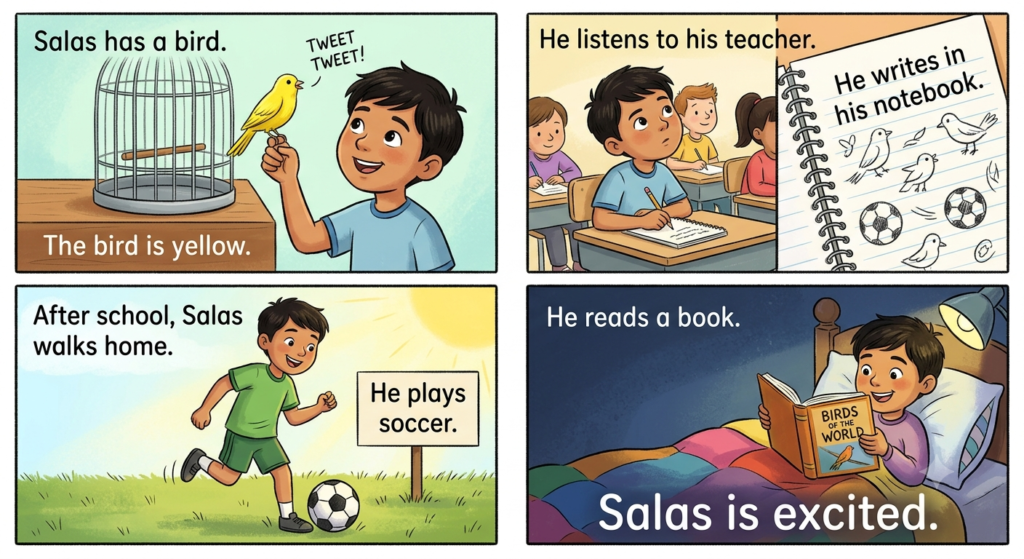
Salas is a boy. Salas is eleven years old. Salas has a bird. The bird is yellow. The bird is loud. Salas loves his bird. He talks to his bird. Every morning, Salas wakes up. He eats cereal. He takes the bus to school. He listens to his teacher. He writes in his notebook. After school, Salas walks home. He plays soccer. He eats an apple. He reads a book. He goes to bed. Salas is excited.
Sentence
Salas is a boy.
👦 a boy
Salas is eleven years old.
1️⃣1️⃣ eleven years old
Salas has a bird.
🐦 a bird
The bird is yellow.
🟡 yellow
The bird is loud.
🔊 loud
Salas loves his bird.
❤️ to love
He talks to his bird.
🗣️ to talk
Every morning, Salas wakes up.
🌅 every morning / 🛏️ to wake up
He eats cereal.
🥣 cereal / 🍽️ to eat
He takes the bus to school.
🚌 a bus / 🏫 a school
He listens to his teacher.
👂 to listen / 👩🏫 a teacher
He writes in his notebook.
✏️ to write / 📒 a notebook
After school, Salas walks home.
🏫 a school / 🚶 to walk / 🏠 a home
He plays soccer.
⚽ soccer / 🎲 to play
He eats an apple.
🍎 an apple / 🍽️ to eat
He reads a book.
📖 a book / 👀 to read
He goes to bed.
🛏️ to go to bed
Salas is excited.
😄 excited
##################
Match the words with the pictures
a boy ______
eleven years old ______
a bird ______
yellow ______
loud ______
to love ______
to talk ______
to wake up ______
cereal ______
a bus ______
a teacher ______
to listen ______
a notebook ______
to write ______
to walk ______
a home ______
soccer ______
an apple ______
a book ______
to sleep ______
excited ______
Pictures: A 🚌 B 🐦 C 📖 D ⚽ E 👦 F 🍎 G 👩🏫 H 🟡 I 🥣 J 🏠 K 📒 L 😄 M 🗣️ N ❤️ O 🔊 P 🛏️ Q 🚶 R 👂 S 1️⃣1️⃣ T 🌅 U 😴
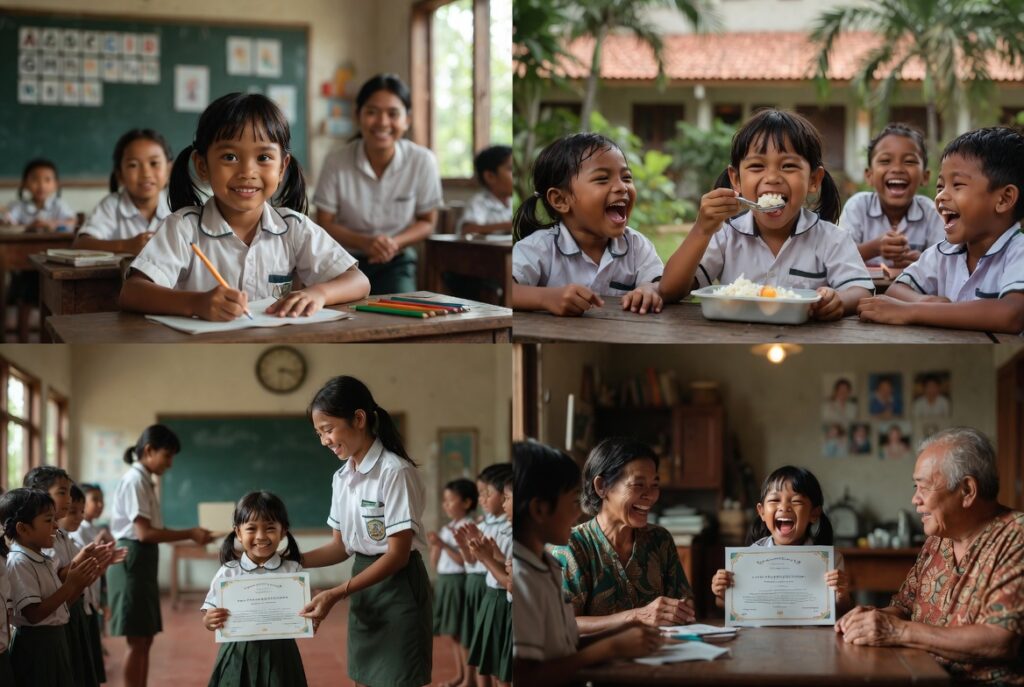
Char is a young lady in South East Asia. She is twenty-one and remembers her first school year very well.
Her teacher was kind and friendly. Char liked her class because the children were nice. They learned the alphabet, simple words, and numbers. They read short stories and wrote easy sentences. They sang songs together and played games in the classroom. Char liked drawing pictures with coloured pencils. She always listened to her teacher and finished her work.
At break time, Char ate rice and fruit. She talked with her friends and laughed with them. After the break, the class went back to the room. Char enjoyed every school day. She felt happy because she learned something new every week.
At the end of the school year, the school had a small ceremony. The teacher called every child to the front. Char walked to her teacher with a big smile. The teacher gave her a certificate for her good work. Char held it carefully in her hands. Her parents smiled and clapped for her. They were very happy.
Char went home with her certificate. She showed it to her family. They were happy and proud. They looked at it together and smiled. Char felt proud. She kept the certificate in a safe place.
________________________
Vocabulary:
to remember – to keep something in your mind from the past.
a sound – something that you hear.
to be kind – to be nice and helpful to other people.
numbers (in school) – 1, 2, 3, 4, 5, and other counting words.
to write a sentence – to write a group of words that makes a complete idea.
to draw pictures – to make pictures with a pencil, pen, or crayons.
to clap for somebody – to hit your hands together to show you are happy for someone.
to be proud – to feel happy because you or another person did something well.
coloured pencils – pencils in different colours for drawing and colouring.
to listen to somebody – to hear and pay attention to what a person says.
to finish work – to complete your work.
break time (school) – a short time when children stop lessons to eat, play, or rest.
to laugh – to make a happy sound because something is funny or makes you happy.
to enjoy something – to like something and feel happy doing it.
a ceremony (school) – a special school event to celebrate something.
to call to the front (school) – to ask a student to come to the front of the classroom or room.
a certificate (school) – a paper that shows a student did something well or finished something.
a safe place – a place where something is protected and will not be lost or damaged.
################
Verbs in text, regular, irregular:
Infinitive
Past Simple
Definition
to be
was / were
to exist or describe a person or thing
to remember
remembered
to keep something in your mind from the past
to like
liked
to think something is good or nice
to learn
learned
to get new knowledge or skills
to read [ri:d]
read [red]
to look at words and understand them
to write
wrote
to put words on paper with a pen or pencil
to sing
sang
to make music with your voice
to play
played
to do a game or have fun
to draw
drew
to make a picture with a pencil or pen
to listen (to)
listened
to hear and pay attention
to finish
finished
to complete something
to eat
ate
to have food
to talk
talked
to speak with someone
to laugh
laughed
to make a happy sound because something is funny
to go
went
to move from one place to another
to enjoy
enjoyed
to like something and feel happy doing it
to feel
felt
to have an emotion or a feeling
to have
had
to own or experience something
to call
called
to ask someone to come
to walk
walked
to move on your feet
to give
gave
to let someone have something
to hold
held
to keep something in your hands
to smile
smiled
to show happiness with your face
to clap
clapped
to hit your hands together to show you are happy
to show
showed
to let someone see something
to keep
kept
to leave something in a place or continue to have it
################
Match word and definition:
Words
to remember
a sound
to be kind
numbers (in school)
to write a sentence
to draw pictures
to clap for somebody
to be proud
coloured pencils
to listen to somebody
to finish work
break time (school)
to laugh
to enjoy something
a ceremony (school)
to call to the front (school)
a certificate (school)
a safe place
Definitions
A. to hit your hands together to show you are happy for someone. B. a paper that shows a student did something well or finished something. C. to make pictures with a pencil, pen, or crayons. D. to keep something in your mind from the past. E. a short time when children stop lessons to eat, play, or rest. F. to ask a student to come to the front of the classroom or room. G. to feel happy because you or another person did something well. H. 1, 2, 3, 4, 5, and other counting words. I. to make a happy sound because something is funny or makes you happy. J. to be nice and helpful to other people. K. to hear and pay attention to what a person says. L. to complete your work. M. to like something and feel happy doing it. N. a sound that you hear. O. a special school event to celebrate something. P. to write a group of words that makes a complete idea. Q. pencils in different colours for drawing and colouring. R. a place where something is protected and will not be lost or damaged.
Char _____ (remember) her first school year yesterday. YOU WRITE: Char _remembered_ her first school year yesterday.
She _____ (hear) a sound in the classroom.
The teacher _____ (be) kind to all children.
The children _____ (learn) numbers in school like 1, 2, 3.
Char _____ (write) a sentence in class.
She _____ (draw) pictures with coloured pencils.
The class _____ (clap for somebody) after the song.
Char _____ (be) proud of her certificate.
She _____ (use) coloured pencils to draw.
The children _____ (listen) in class.
Char always _____ (finish work) before break.
Break time _____ (be) fun for all children.
The children _____ (laugh) in the playground.
Char _____ (enjoy) every lesson.
The school _____ (have) a ceremony at the end of the year.
The teacher _____ (call) a student to the front.
Char _____ (receive) a certificate for good work.
Char _____ (keep) it in a safe place at home.
——————————-
Correct version:
Char remembered her first school year yesterday.
She heard a sound in the classroom.
The teacher was kind to all children.
The children learned numbers in school like 1, 2, 3.
Char wrote a sentence in class.
She drew pictures with coloured pencils.
The class clapped after the song.
Char was proud of her certificate.
She used coloured pencils to draw.
The children listened in class.
Char always finished work before break.
Break time was fun for all children.
The children laughed in the playground.
Char enjoyed every lesson.
The school had a ceremony at the end of the year.
The teacher called a student to the front
Char received a certificate for good work.
Char kept it in a safe place at home.
################
True or false:
Char moved to a new school in another country during the year.
The teacher gave each child a certificate at the ceremony.
Char remembered her first school year very well.
The children studied only mathematics during lessons.
Char showed her certificate to her family at home.
The ceremony happened in a large stadium with many schools.
The teacher was kind and friendly.
Char liked drawing pictures with coloured pencils.
Char spent break time eating noodles alone in the classroom.
The children learned the alphabet, simple words, and numbers.
Char returned home without speaking to her family.
The teacher gave certificates before the school year started.
______________________ False: 1, 4,6, 9, 11, 12
______________________
Correct answers:
Char moved to a new school in another country during the year. True is: Char went home with her certificate, showed it to her family, and they were proud.
The teacher gave each child a certificate at the ceremony.
Char remembered her first school year very well.
The children studied only mathematics during lessons. True is: The children learned the alphabet, simple words, and numbers, read short stories, and wrote easy sentences.
Char showed her certificate to her family at home.
The ceremony happened in a large stadium with many schools. True is: The school had a small ceremony at the end of the school year.
The teacher was kind and friendly.
Char liked drawing pictures with coloured pencils.
Char spent break time eating noodles alone in the classroom. True is: Char spent break time eating rice and fruit, talking and laughing with her friends.
The children learned the alphabet, simple words, and numbers.
Char returned home without speaking to her family. True is: Char went home with her certificate, showed it to her family, and they were proud.
The teacher gave certificates before the school year started. True is: The teacher called every child to the front at the end of the school year and gave them a certificate.
#################
Short answers, past simple, basics:
Example Sentence
Yes
No
I learned letters.
Yes, I did.
No, I didn’t.
You read signs.
Yes, you did.
No, you didn’t.
He spoke English.
Yes, he did.
No, he didn’t.
She watched TV.
Yes, she did.
No, she didn’t.
It helped me.
Yes, it did.
No, it didn’t.
We used an app.
Yes, we did.
No, we didn’t.
You read words.
Yes, you did.
No, you didn’t.
They made mistakes.
Yes, they did.
No, they didn’t.
Questions (Past Simple)
Question
Yes
No
Did I learn letters?
Yes, I did.
No, I didn’t.
Did you read signs?
Yes, you did.
No, you didn’t.
Did he speak English?
Yes, he did.
No, he didn’t.
Did she watch TV?
Yes, she did.
No, she didn’t.
Did it help me?
Yes, it did.
No, it didn’t.
Did we use an app?
Yes, we did.
No, we didn’t.
Did you read words?
Yes, you did.
No, you didn’t.
Did they make mistakes?
Yes, they did.
No, they didn’t.
Was / Were
Question
Yes
No
Was I happy?
Yes, I was.
No, I wasn’t.
Were you happy?
Yes, you were.
No, you weren’t.
Was he happy?
Yes, he was.
No, he wasn’t.
Was she happy?
Yes, she was.
No, she wasn’t.
Was it good?
Yes, it was.
No, it wasn’t.
Were we happy?
Yes, we were.
No, we weren’t.
Were you happy?
Yes, you were.
No, you weren’t.
Were they happy?
Yes, they were.
No, they weren’t.
#################
Give short answers:
Char was a young student in Southeast Asia.
YOU WRITE: Yes, she was.
Char travelled to school by boat every day.
Her teacher was very kind.
The class studied advanced chemistry in the first year.
Char went to school when she was young.
The children were unhappy in the classroom.
The students sang songs together.
Char ate pizza and burgers at break time.
She read short stories with her class.
The teacher gave Char a certificate.
The school had a large sports tournament every week.
Char liked drawing with coloured pencils.
The class learned the alphabet and simple words.
Char never attended school.
Her parents smiled and clapped proudly.
The teacher punished all students every day.
Char kept her certificate in a safe place.
The class wrote only long essays every day.
The school year ended with a small ceremony.
Char forgot everything she learned at school.
_______________________
Correct answers:
Char was a young student in Southeast Asia. Yes, she was.
Char travelled to school by boat every day. No, she didn’t.
Her teacher was very kind. Yes, she was.
The class studied advanced chemistry in the first year. No, they didn’t.
Char went to school when she was young. Yes, she did.
The children were unhappy in the classroom. No, they weren’t.
The students sang songs together. Yes, they did.
Char ate pizza and burgers at break time. No, she didn’t.
She read short stories with her class. Yes, she did.
The teacher gave Char a certificate. Yes, she did.
The school had a large sports tournament every week. No, it didn’t.
Char liked drawing with coloured pencils. Yes, she did.
The class learned the alphabet and simple words. Yes, they did.
Char never attended school. No, she didn’t.
Her parents smiled and clapped proudly. Yes, they did.
The teacher punished [to feel pain or feel bad] all students every day. No, she didn’t.
Char kept her certificate in a safe place. Yes, she did.
The class wrote only long essays every day. No, they didn’t.
The school year ended with a small ceremony. Yes, it did.
Char forgot everything she learned at school. No, she didn’t.
###############
Basics in past simple:
Personal Pronoun
Verb (Past)
Object
I
ate
apples
You
ate
apples
He
ate
apples
She
ate
apples
It
ate
apples
We
ate
apples
You (plural)
ate
apples
They
ate
apples
I
played
football
You
played
football
He
played
football
She
played
football
It
played
football
We
played
football
You (plural)
played
football
They
played
football
Personal Pronoun
Verb (Past Negative)
Object
I
did not eat
apples
You
did not eat
apples
He
did not eat
apples
She
did not eat
apples
It
did not eat
apples
We
did not eat
apples
You (plural)
did not eat
apples
They
did not eat
apples
I
did not play
football
You
did not play
football
He
did not play
football
She
did not play
football
It
did not play
football
We
did not play
football
You (plural)
did not play
football
They
did not play
football
Did
Personal Pronoun
Verb (Infinitive)
Object
Did
I
eat
an apple?
Did
you
eat
an apple?
Did
he
eat
an apple?
Did
she
eat
an apple?
Did
it
eat
an apple?
Did
we
eat
an apple?
Did
you
eat
an apple?
Did
they
eat
an apple?
##################
Forms of ‚to be‘
Personal Pronoun
Positive
Negative
Question
I
I was happy.
I was not happy.
Was I happy?
You
You were excited.
You were not excited.
Were you excited?
He
He was at home.
He was not at home.
Was he at home?
She
She was tired.
She was not tired.
Was she tired?
It
It was cold.
It was not cold.
Was it cold?
We
We were at the party.
We were not at the party.
Were we at the party?
You
You were friends.
You were not friends.
Were you friends?
They
They were in the garden.
They were not in the garden.
Were they in the garden?
Was/Were
Personal Pronoun
Place
Was
I
in America?
Were
you
in America?
Was
he
in America?
Was
she
in America?
Was
it
in America?
Were
we
in America?
Were
you
in America?
Were
they
in America?
#############
Answer as shown:
Char lived in Europe when she went to school.
YOU WRITE: Char did not live in Euope when she went to school. She lived in South East Asia.
Her teacher was strict.
The children learned science.
The class read long books.
Char wrote long stories.
Char painted with watercolours.
Char ate bread and cheese at break time.
The class played football after the break.
Char learned something new every day.
The school had a big sports festival.
The teacher gave Char a medal.
Char went home with a new book.
Char put the certificate on the wall.
Her family gave her a bicycle.
________________________
Answers:
Char did not live in Europe when she went to school. She lived in South East Asia.
Her teacher was not strict. She was kind and friendly.
The children did not learn science. They learned the alphabet, simple words, and numbers.
The class did not read long books. They read short stories.
Char did not write long stories. She wrote easy sentences.
Char did not paint with watercolours. She drew pictures with coloured pencils.
Char did not eat bread and cheese at break time. She ate rice and fruit.
The class did not play football after the break. They went back to the room.
Char did not learn something new every day. She learned something new every week.
The school did not have a big sports festival. It had a small ceremony.
The teacher did not give Char a medal. She gave her a certificate.
Char did not go home with a new book. She went home with her certificate.
Char did not put the certificate on the wall. She kept it in a safe place.
Her family did not give her a bicycle. They smiled and looked at her certificate together.
################
Form questions to which the word/s given is/are the answer:
Char went home.
YOU WRITE: a) Char: Who went home? b) went home: What did Char do? c) home: Where did she go?
Char showed her family the certificate. a) Char: b) showed her family the certificate: c) her family: d) her: e) the certficate:
Her family were proud a) Her family: b) Her:
They looked at the certificate. a) They: b) looked at the certificate: c) th certificate:
Char smiled. a) Char: b) smiled:
The teacher called every child to the front. a) The teacher: b) called every child to the front: c) every child: d) every: e) the front:
Char walked to her teacher. a) Char: b) walked to her teacher: c) her teacher:
The children sang songs. a) The children: b) sang songs: c) songs:
Char played 5 games. a) Char: b) played 5 games: c) 5 games: d) 5:
Char kept the certificate in a safe place. a) Char: b) kept the certificate in a safe place: c) the certificate: d) in a safe place: e) safe:
________________________
Answers:
Char showed her family the certificate. a) Char: Who showed her family the certificate? b) showed her family the certificate: What did Char do? c) her family: Who did Char show the certificate to? d) her: Whose family did Char show the certificate to? e) the certificate: What did Char show her family?
Her family were proud. a) Her family: Who were proud? b) Her: Whose family were proud?
They looked at the certificate. a) They: Who looked at the certificate? b) looked at the certificate: What did they do? c) the certificate: What did they look at?
Char smiled. a) Char: Who smiled? b) smiled: What did Char do?
The teacher called every child to the front. a) The teacher: Who called every child to the front? b) called every child to the front: What did the teacher do? c) every child: Who did the teacher call to the front? d) every: Which child did the teacher call to the front? e) the front: Where did the teacher call every child to?
Char walked to her teacher. a) Char: Who walked to her teacher? b) walked to her teacher: What did Char do? c) her teacher: To whom did Char walk?
The children sang songs. a) The children: Who sang songs? b) sang songs: What did the children do? c) songs: What did the children sing?
Char played 5 games. a) Char: Who played 5 games? b) played 5 games: What did Char do? c) 5 games: What did Char play? d) 5: How many games did Char play?
Char kept the certificate in a safe place. a) Char: Who kept the certificate in a safe place? b) kept the certificate in a safe place: What did Char do? c) the certificate: What did Char keep in a safe place? d) in a safe place: Where did Char keep the certificate? e) safe: What kind of place did she keep the certificate?
#################
Fill in, past simple:
The children _______ (be) nice.
Char _______ (go) home with her certificate.
Her teacher _______ (be) kind and friendly.
The school _______ (have) a small ceremony.
Char _______ (learn) the alphabet.
The children _______ (sing) songs.
The classroom _______ (be) happy.
Char _______ (hold) the certificate carefully.
The children _______ (play) games in the classroom.
Char _______ (feel) happy.
The school _______ (be) small.
The teacher _______ (give) a certificate to Char.
Her parents _______ (smile) and _______ (clap).
The class _______ (read) short stories.
Char _______ (write) easy sentences.
The children _______ (be) in the classroom.
Char _______ (draw) pictures with coloured pencils.
The teacher _______ (be) friendly.
Char _______ (eat) rice and fruit.
The school _______ (be) a nice place.
_____________________
Answers:
The children were nice.
Char went home with her certificate.
Her teacher was kind and friendly.
The school had a small ceremony.
Char learned the alphabet.
The children sang songs.
The classroom was happy.
Char held the certificate carefully.
The children played games in the classroom.
Char felt happy.
The school was small.
The teacher gave a certificate to Char.
Her parents smiled and clapped.
The class read short stories.
Char wrote easy sentences.
The children were in the classroom.
Char drew pictures with coloured pencils.
The teacher was friendly.
Char ate rice and fruit.
The school was a nice place.
###############
Fill in, words below:
certificate – learned – break time – looked – friendly – safe – drew – new – played – sentences – ceremony
Char was a young student in Southeast Asia. Her teacher was kind and ________. The children were nice and ________ the alphabet, simple words, and numbers. They read short stories and wrote easy ________. They sang songs and ________ games in the classroom. Char ________ pictures and listened carefully. At ________, she ate rice and fruit and talked with friends. She felt happy every day because she learned ________ things. At the end of the school year, the school had a small ________. The teacher gave Char a ________. Char held it and went home. She showed it to her family. They were proud and smiled. They________ at the certificate together. Char kept it in a ________ place and felt very happy about her first school year.
—————————- Correct version:
Char was a young student in Southeast Asia. Her teacher was kind and friendly. The children were nice and learned the alphabet, simple words, and numbers. They read short stories and wrote easy sentences. They sang songs and played games in the classroom. Char drew pictures and listened carefully. At break time, she ate rice and fruit and talked with friends. She felt happy every day because she learned new things. At the end of the school year, the school had a small ceremony. The teacher gave Char a certificate. Char held it and went home. She showed it to her family. They were proud and smiled. They looked at the certificate together. Char kept it in a safe place and felt very happy about her first school year.
#############
Match the questions with the answers (Char interview)
Questions
Who was your teacher?
Where did you go to school?
How was your teacher?
What did you learn in class?
What did you read?
What did you write?
When did you sing songs?
How did you feel at school?
What did you eat at break time?
Who did you talk with?
What did the teacher give you?
How did your family react?
Where did you keep the certificate?
Answers (mixed order)
a. I felt very happy. b. I placed it in a safe box. c. Miss Lee taught us in class. d. I had rice and fruit. e. I spoke with my friends. f. I studied in Southeast Asia. g. I received a certificate. h. I made easy sentences. i. They showed pride and smiled. j. I looked at short stories. k. She helped us and smiled a lot. l. I knew the alphabet, simple words, and numbers. m. I sang during lessons.
before doing that exercise check out part 1 and part 2
###############
###############
When to use which tense….
🔵 Present Simple (habit, facts)
Signal words:
every day
always
often
usually
sometimes
never
on Mondays
in the morning / evening
Example:
I always go to school.
🟢 Past Simple (finished past)
Signal words:
yesterday
last night
last week / month / year
ago
in 2020
then
Example:
I went home yesterday.
🟡 Present Progressive (NOW, AT THE MOMENT OF SPEAKING)
Signal words:
now
right now
at the moment
today (sometimes)
Look!
Listen!
Example:
She is studying now.
🟣 Future (plan = present progressive)
Signal words:
tomorrow
next week / month / year
tonight
on Monday (future meaning)
this evening
Example:
I am meeting him tomorrow.
🔴 Future with WILL (no plan / prediction (saying what you think will happen in the future))
Signal words:
I think…
maybe
probably
I’m sure
tomorrow (prediction)
one day
Example:
I think it will rain tomorrow.
⭐ Super simple rule:
🟢 present simple = every day / often
🟡 present progressive = now / at the moment
🔵 past = yesterday / last / ago
🟣 future with a plan = present progressive, tomorrow / next
🔴 will future = maybe / I think
###############
###############
Fill in:
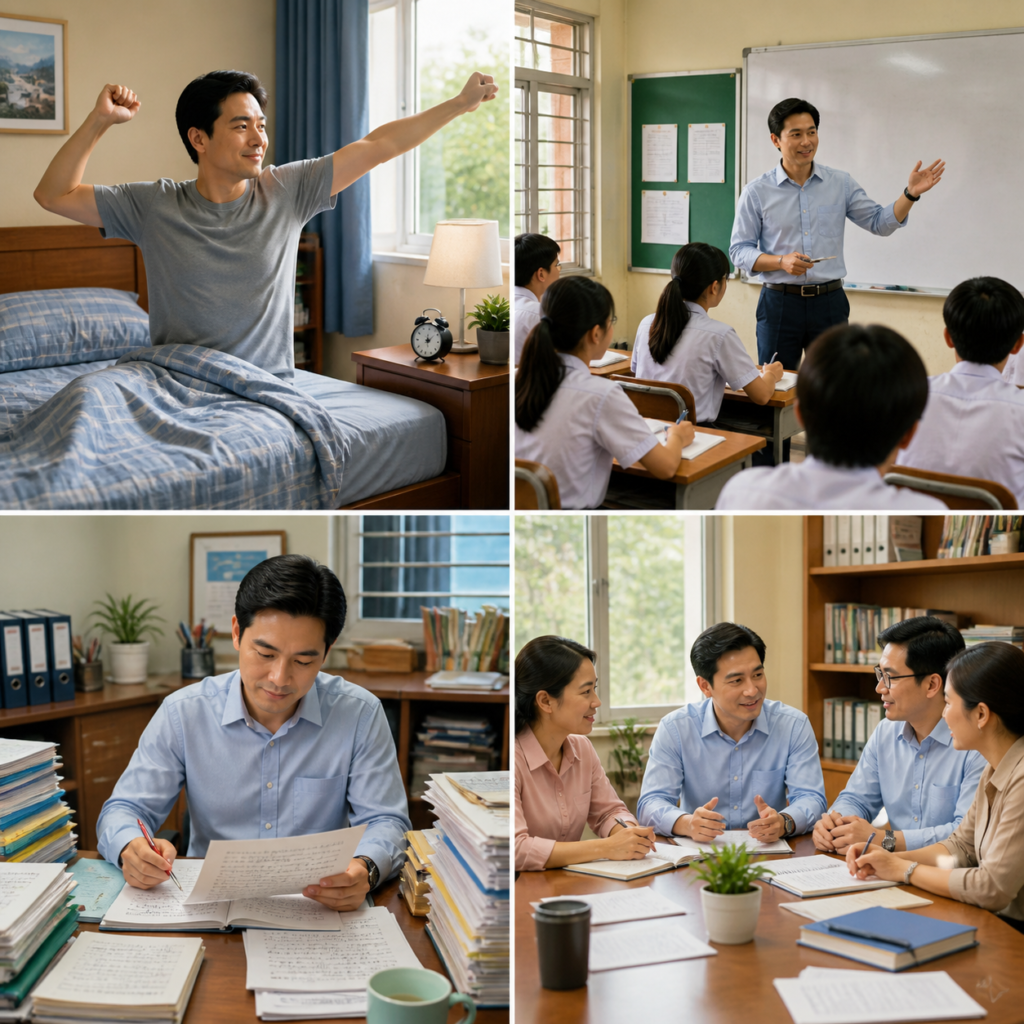
Mr. Vongg is at school now. He is in his classroom.
Interviewer: Hello, Mr. Vongg. Mr. Vongg: Hello.
Interviewer: What time ______ you ______ (wake up)? Mr. Vongg: I ______ (wake up) at 6:00.
Interviewer: Where ______ you ______ (work)? Mr. Vongg: I ______ (work) at a school.
Interviewer: What ______ you ______ (teach)? Mr. Vongg: I ______ (teach) English.
Interviewer: What ______ you ______ (do) now? Mr. Vongg: I ______ (teach) grammar.
Interviewer: What ______ the students ______ (do)? Mr. Vongg: They ______ (listen and write).
Interviewer: ______ you ______ (like) your job? Mr. Vongg: Yes, I ______ (like) my job. I ______ (like) teaching students.
Interviewer: How many students ______ (be) there in your class? Mr. Vongg: There ______ (be) 20 students in my class.
Interviewer: What time ______ your school ______ (start)? Mr. Vongg: My school ______ (start) at 8:00.
Interviewer: What ______ you ______ (do) yesterday? Mr. Vongg: Yesterday, I ______ (give) a test.
Interviewer: ______ (be) the students good? Mr. Vongg: Yes, they ______ (be) good.
Interviewer: ______ (be) teaching difficult for you? Mr. Vongg: Sometimes it ______ (be) difficult, but I enjoy it.
Interviewer: What ______ you ______ (do) after class yesterday? Mr. Vongg: I ______ (check) homework.
Interviewer: What ______ you ______ (do) tomorrow? Mr. Vongg: I ______ (have) a meeting with other teachers.
Interviewer: What ______ you usually ______ (do) after school? Mr. Vongg: I ______ (go) home and rest.
Interviewer: What ______ you ______ (do) last week? Mr. Vongg: Last week, I ______ (organize) a school activity.
———————————
Correct version:
Interviewer: Hello, Mr. Vongg. Mr. Vongg: Hello.
Interviewer: What time do you wake up? Mr. Vongg: I wake up at 6:00.
Interviewer: Where do you work? Mr. Vongg: I work at a school.
Interviewer: What do you teach? Mr. Vongg: I teach English.
Interviewer: What are you doing now? Mr. Vongg: I am teaching grammar.
Interviewer: What are the students doing? Mr. Vongg: They are listening and writing.
Interviewer: Do you like your job? Mr. Vongg: Yes, I like my job. I like teaching students.
Interviewer: How many students are there in your class? Mr. Vongg: There are 20 students in my class.
Interviewer: What time does your school start? Mr. Vongg: My school starts at 8:00.
Interviewer: What did you do yesterday? Mr. Vongg: Yesterday, I gave a test.
Interviewer: Were the students good? Mr. Vongg: Yes, they were good.
Interviewer: Is teaching difficult for you? Mr. Vongg: Sometimes it is difficult, but I enjoy it.
Interviewer: What did you do after class yesterday? Mr. Vongg: I checked homework.
Interviewer: What are you having tomorrow? Mr. Vongg: I am having a meeting with other teachers.
Interviewer: What do you usually do after school? Mr. Vongg: I go home and rest.
Interviewer: What did you do last week? Mr. Vongg: Last week, I organized a school activity.
#################
Fill in:
Interviewer: Hello, Oum. Oum: Hello.
Interviewer: What time ______ you usually ______ (wake up)? Oum: I usually ______ (wake up) at 7:00.
Interviewer: What ______ you usually ______ (do) in the morning? Oum: I ______ (eat) breakfast with my sister.
Interviewer: What ______ you ______ (do) now? Oum: I ______ (run) to the bus stop.
Interviewer: Why ______ you ______ (run)? Oum: Because I ______ (be) late for school.
Interviewer: Where ______ (be) your friends now? Oum: They ______ (be) at school.
Interviewer: What ______ you ______ (do) yesterday? Oum: Yesterday, I ______ (study) for a math test. I also ______ (watch) a movie.
Interviewer: What ______ you ______ (do) in the evening then? Oum: I ______ (go) to bed late.
Interviewer: What ______ your teacher ______ (do) today? Oum: My teacher ______ (teach) animals in class.
Interviewer: What ______ you ______ (think) about now? Oum: I ______ (think) about the weekend.
Interviewer: Why ______ (be) you excited? Oum: Because we always ______ (have) fun together.
Interviewer: What ______ you ______ (do) for this Saturday? Oum: I ______ (meet) my cousin in Salzburg. We ______ (go) to Salzburg by train at 10:00.
Interviewer: What ______ you ______ (do) last weekend? Oum: We ______ (play) volleyball, ______ (cook) pizza, and ______ (dance) at a party.
Interviewer: Thank you, Oum. Oum: You’re welcome.
———————————
Correct version:
Interviewer: Hello, Oum. Oum: Hello.
Interviewer: What time do you usually wake up? Oum: I usually wake up at 7:00.
Interviewer: What do you usually do in the morning? Oum: I eat breakfast with my sister.
Interviewer: What are you doing now? Oum: I am running to the bus stop.
Interviewer: Why are you running? Oum: Because I am late for school.
Interviewer: Where are your friends now? Oum: They are at school.
Interviewer: What did you do yesterday? Oum: Yesterday, I studied for a math test. I also watched a movie.
Interviewer: What did you do in the evening then? Oum: I went to bed late.
Interviewer: What is your teacher doing today? Oum: My teacher is teaching animals in class.
Interviewer: What are you thinking about now? Oum: I am thinking about the weekend.
Interviewer: Why are you excited? Oum: Because we always have fun together.
Interviewer: What are you doing for this Saturday? Oum: I am meeting my cousin in Salzburg. We are going to Salzburg by train at 10:00.
Interviewer: What did you do last weekend? Oum: We played volleyball, cooked pizza, and danced at a party.
Interviewer: Thank you, Oum. Oum: You’re welcome.
################# Fill in:
Interviewer: What time ___________ you usually __________ (wake up)? Salas: I usually __________ (wake up) at 6:30.
Interviewer: How ___________ you __________ (go) to school? Salas: I __________ (go) to school by bus.
Interviewer: What ___________ you usually __________ (eat) in the morning? Salas: I __________ (eat) breakfast quickly.
Interviewer: What ___________ you __________ (do) now? Salas: I __________ (sit) in the classroom and __________ (listen) to my teacher.
Interviewer: What ___________ your classmates __________ (do) now? Salas: They __________ (write) a test.
Interviewer: What ___________ you __________ (do) yesterday? Salas: Yesterday, I __________ (visit) my uncle in the city, I______________ (spend) some time in the park..
Interviewer: What ___________ you __________ (do) in the park? Salas: We __________ (walk) in the park and __________ (eat) ice cream.
Interviewer: ___________ you __________ (take) photos yesterday? Salas: Yes, I __________ (take) many photos.
Interviewer: What ___________ your mother __________ (do) now? Salas: She __________ (cook) lunch.
Interviewer: What ___________ your father __________ (do) now? Salas: He __________ (work) at home.
Interviewer: What ___________ you __________ (think) about now? Salas: I __________ (think) about my homework.
Interviewer: What ___________ you __________ (do) next Sunday? Salas: I __________ (meet) my best friend in the city center. We __________ (go) to the cinema.
Interviewer: Why ___________ (be) you excited? Salas: Because we always __________ (have) a great time together.
Interviewer: What ___________ you __________ (do) last weekend? Salas: We __________ (play) football, __________ (watch) a match, and __________ (laugh) a lot.
Interviewer: Thank you, Salas. Salas: You’re welcome.
——————————
Correct version:
Interviewer: What time do you usually wake up? Salas: I usually wake up at 6:30.
Interviewer: How do you go to school? Salas: I go to school by bus.
Interviewer: What do you usually eat in the morning? Salas: I eat breakfast quickly.
Interviewer: What are you doing now? Salas: I am sitting in the classroom and am listening to my teacher.
Interviewer: What are your classmates doing now? Salas: They are writing a test.
Interviewer: What did you do yesterday? Salas: Yesterday, I visited my uncle in the city, I spent some time in the park.
Interviewer: What did you do in the park? Salas: We walked in the park and ate ice cream.
Interviewer: Did you take photos yesterday? Salas: Yes, I took many photos.
Interviewer: What is your mother doing now? Salas: She is cooking lunch.
Interviewer: What is your father doing now? Salas: He is working at home.
Interviewer: What are you thinking about now? Salas: I am thinking about my homework.
Interviewer: What are you doing next Sunday? Salas: I am meeting my best friend in the city center. We are going to the cinema.
Interviewer: Why are you excited? Salas: Because we always have a great time together.
Interviewer: What did you do last weekend? Salas: We played football, watched a match, and laughed a lot.
Interviewer: Thank you, Salas. Salas: You’re welcome.
##################
Fill in:
Interviewer: What time ____________ you usually ____________ (wake up)? Somalena: I usually ____________ (wake up) at 6:00.
Interviewer: Where ____________ you ____________ (work)? Somalena: I ____________ (work) at a luxury hotel.
Interviewer: What ____________ you ____________ (do) in your job? Somalena: I ____________ (help) guests and ____________ (organize) the spa schedule.
Interviewer: What ____________ you ____________ (do) now? Somalena: I ____________ (talk) to a guest at the reception.
Interviewer: What ____________ your team ____________ (do) now? Somalena: My team ____________ (clean) the spa rooms.
Interviewer: What ____________ you ____________ (do) yesterday? Somalena: Yesterday, I ____________ (have) a very busy day. I ____________ (meet) many guests and ____________ (solve) problems.
Interviewer: What time ____________ you ____________ (finish) work yesterday? Somalena: I ____________ (finish) work late.
Interviewer: What ____________ (happen) at the hotel now? Somalena: The hotel ____________ (be) very busy, and new guests ____________ (arrive).
Interviewer: What ____________ you ____________ (do) now at work? Somalena: I ____________ (check) the bookings.
Interviewer: What ____________ you ____________ (do) tomorrow? Somalena: I ____________ (have) an important meeting with the hotel director. I ____________ (prepare) new plans for the spa.
Interviewer: What ____________ you ____________ (do) last weekend? Somalena: I ____________ (work) on Saturday and Sunday.
Interviewer: How ____________ (be) you today? Somalena: I ____________ (be) tired but happy.
Interviewer: Why ____________ (be) you happy? Somalena: Because many guests ____________ (enjoy) the spa now.
Remember? Here’s a very simple explanation of when to use each tense:
🟢 Present Simple
When?
For things you do every day
For routines and habits
For facts that are always true
Keywords: always, usually, often, every day, never
Examples:
I go to school every day.
She likes pizza.
The sun rises in the morning.
🔵 Present Progressive (Present Continuous)
When?
For actions happening right now
For actions happening around this time
For future plans (fixed arrangements)
Keywords: now, right now, at the moment, today
Examples:
I am studying now.
She is reading a book at the moment.
We are meeting Tom tomorrow. (future plan)
🟡 Past Simple
When?
For finished actions in the past
When we say when something happened (yesterday, last week, in 2020)
Keywords: yesterday, last night, last week, ago, in 2003
Examples:
I watched a movie yesterday.
She went to Paris last year.
They played football last weekend.
🧠 Easy way to remember
🟢 Present Simple = always / usually / every day
🔵 Present Progressive = now / right now / at the moment
🟡 Past Simple = yesterday / last week / ago
🔵 (also) Present Progressive = future plans (tomorrow, next week)
#################
Fill in, present simple, present progressive (continuous), past simple:
Story #1: Oum’s busy week
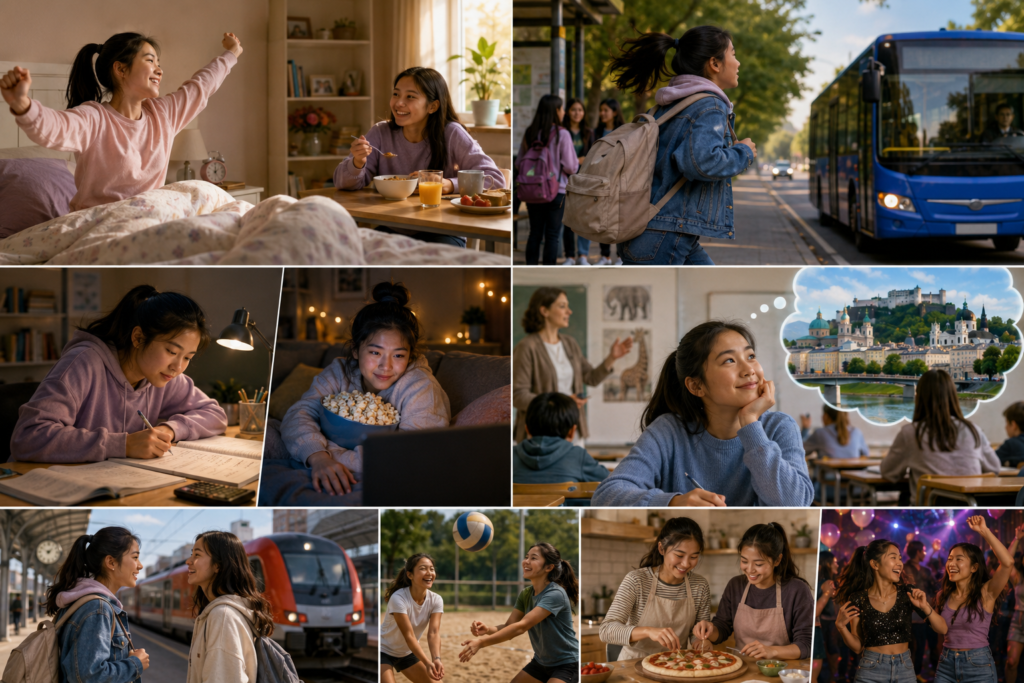
Oum usually __________ (wake up) at 7:00. She __________ (eat) breakfast with her sister every morning.
Today is different. Right now, she __________ (run) to the bus stop because she is late. Her friends __________ (wait) for her at school now.
Yesterday, Oum __________ (study) for a math test and __________ (watch) a movie in the evening. She __________ (go) to bed very late.
At the moment, her teacher __________ (talk) about animals, but Oum __________ (think) about the weekend.
This Saturday, Oum __________ (meet) her cousin in Salzburg. They __________ (travel) by train at 10:00 in the morning. Oum is very excited because they always __________ (have) fun together.
Last weekend, they __________ (play) volleyball, __________ (cook) pizza, and __________ (dance) at a party.
——————————-
Oum’s Busy Week
Oum usually wakes up at 7:00. She eats breakfast with her sister every morning.
Today is different. Right now, she is running to the bus stop because she is late. Her friends are waiting for her at school now.
Yesterday, Oum studied for a math test and watched a movie in the evening. She went to bed very late.
At the moment, her teacher is talking about animals, but Oum is thinking about the weekend.
This Saturday, Oum is meeting her cousin in Salzburg. They are traveling by train at 10:00 in the morning. Oum is very excited because they always have fun together.
Last weekend, they played volleyball, cooked pizza, and danced at a party.
###################
Story #2: Salas in the city
Salas usually __________ (wake up) at 6:30. He __________ (eat) breakfast quickly and __________ (go) to school by bus.
Today is a busy day. Right now, he __________ (sit) in the classroom and he __________ (listen) to his teacher. His classmates __________ (write) a test at the moment.
Yesterday, Salas __________ (visit) his uncle in the city. They __________ (walk) in the park and __________ (eat) ice cream. Salas __________ (take) many photos.
At the moment, Salas’s mother __________ (cook) lunch, and his father __________ (work) at home. Salas __________ (think) about his homework.
Next Sunday, Salas __________ (meet) his best friend in the city center. They __________ (go) to the cinema at 5:00. Salas is excited because they always __________ (have) a great time together.
Last weekend, they __________ (play) football, __________ (watch) a match, and __________ (laugh) a lot.
__________________________
Salas in the city
Salas usually wakes up at 6:30. He eats breakfast quickly and goes to school by bus.
Today is a busy day. Right now, he is sitting in the classroom and he is listening to his teacher. His classmates are writing a test at the moment.
Yesterday, Salas visited his uncle in the city. They walked in the park and ate ice cream. Salas took many photos.
At the moment, Salas’s mother is cooking lunch, and his father is working at home. Salas is thinking about his homework.
Next Sunday, Salas is meeting his best friend in the city center. They are going to the cinema at 5:00. Salas is excited because they always have a great time together.
Last weekend, they played football, watched a match, and laughed a lot.
##################
Story #3: Somalena at the hotel
Somalena usually __________ (wake up) at 6:00. She __________ (go) to work at a luxury hotel every morning.
Somalena __________ (work) as a manager in the spa. She __________ (help) guests and __________ (organize) the spa schedule.
Right now, she __________ (talk) to a guest at the reception. Her team __________ (clean) the spa rooms at the moment.
Yesterday, Somalena __________ (have) a very busy day. She __________ (meet) many guests and __________ (solve) problems in the spa. She __________ (finish) work late.
At the moment, the hotel __________ (be) very busy, and new guests __________ (arrive). Somalena __________ (check) the bookings.
Tomorrow, Somalena __________ (have) an important meeting with the hotel director. She __________ (prepare) new plans for the spa.
Last weekend, she __________ (work) on Saturday and Sunday. She __________ (feel) tired but happy because many guests __________ (enjoy) the spa.
—————————–
Somalena at the Hotel
Somalena usually wakes up at 6:00. She goes to work at a luxury hotel every morning.
Somalena works as a manager in the spa. She helps guests and organizes the spa schedule.
Right now, she is talking to a guest at the reception. Her team is cleaning the spa rooms at the moment.
Yesterday, Somalena had a very busy day. She met many guests and solved problems in the spa. She finished work late.
At the moment, the hotel is very busy, and new guests are arriving. Somalena is checking the bookings.
Tomorrow, Somalena is having an important meeting with the hotel director. She is preparing new plans for the spa.
Last weekend, she worked on Saturday and Sunday. She felt tired but happy because many guests enjoyed the spa.
###################
Story #4: Rafi and his family
Rafi usually __________ (wake up) very early in the morning. He __________ (help) his family on the rice fields.
Rafi’s family __________ (work) together on a big rice farm. They __________ (plant) rice and __________ (take care) of the fields.
Right now, Rafi __________ (work) in the field. His father __________ (cut) grass, and his mother __________ (carry) water.
Yesterday, Rafi __________ (work) all day in the sun. He __________ (feel) tired, but he __________ (finish) a lot of work. His family __________ (eat) dinner together in the evening.
At the moment, the sun __________ (shine), and Rafi’s sister __________ (help) in the field too. Everyone __________ (be) busy.
Next week, Rafi __________ (help) to harvest the rice. His family __________ (plan) a big day for the harvest.
Last year, they __________ (have) a very good rice harvest. They __________ (sell) rice at the market and __________ (earn) some money.
———————————-
Rafi and his family
Rafi usually wakes up very early in the morning. He helps his family on the rice fields.
Rafi’s family works together on a big rice farm. They plant rice and take care of the fields.
Right now, Rafi is working in the field. His father is cutting grass, and his mother is carrying water.
Yesterday, Rafi worked all day in the sun. He felt tired, but he finished a lot of work. His family ate dinner together in the evening.
At the moment, the sun is shining, and Rafi’s sister is helping in the field too. Everyone is busy.
Next week, Rafi is going to help to harvest the rice. His family is planning a big day for the harvest.
Last year, they had a very good rice harvest. They sold rice at the market and earned some money.
################
Story #5: Mr. Vongg at school
Mr. Vongg usually __________ (wake up) at 6:00. He __________ (go) to school early every morning.
Mr. Karim __________ (work) as a teacher at a school. He __________ (teach) English to young students.
Right now, he __________ (stand) in front of the class and he __________ (explain) a grammar rule. The students __________ (listen) carefully and __________ (write) in their notebooks.
Yesterday, Mr. Karim __________ (give) a test. The students __________ (do) very well. He __________ (be) very happy.
At the moment, the school __________ (be) very quiet, and another class __________ (take) a test in the next room. Mr. Karim __________ (check) homework.
Tomorrow, Mr. Karim __________ (have) a meeting with other teachers. He __________ (prepare) new lessons.
Last week, he __________ (organize) a school activity. The students __________ (play) games and __________ (learn) new words.
—————————————
Mr. Vongg at school
Mr. Vongg usually wakes up at 6:00. He goes to school early every morning.
Mr. Vongg works as a teacher at a school. He teaches English to young students.
Right now, he is standing in front of the class and he is explaining a grammar rule. The students are listening carefully and are writing in their notebooks.
Yesterday, Mr. Vongg gave a test. The students did very well. He was very happy.
At the moment, the school is very quiet, and another class is taking a test in the next room. Mr. Vongg is checking homework.
Tomorrow, Mr. Vongg is having a meeting with other teachers. He is preparing new lessons.
Last week, he organized a school activity. The students played games and learned new words.
…………………. can be used to talk about the future when something is already planned or arranged.
Form
am / is / are + verb + -ing
A. Most verbs
Add -ing to the verb.
play → playing
visit → visiting
swim → swimming
Examples:
We are playing games.
They are visiting Italy next week.
B. Verbs ending in -e
Remove -e and add -ing.
live → living
make → making
come → coming
Examples:
We are living in Vienna.
She is coming tomorrow.
C. Short verbs with one vowel + one consonant
Double the last consonant and add -ing.
swim → swimming
run → running
sit → sitting
Examples:
They are swimming in the sea.
He is running in the park.
1. Use: Fixed plans in the future
We use it for things that are already decided and organized.
Examples:
I am meeting my friend tomorrow.
She is flying to Berlin next week.
We are having dinner at 6 pm.
👉 These are not spontaneous ideas — they are planned.
2. Time expressions are usually needed
We often say when the action will happen:
tonight
tomorrow
next week
at 5 pm
on Monday
Example:
They are playing football on Saturday.
3. Difference from “will”
Present progressive = planned
I am visiting my grandma tomorrow. (already planned)
will = decision made now / prediction
I think I will visit my grandma tomorrow. (decided now)
4. Important idea
We use present progressive for the future when the plan is:
organized
already arranged
usually with other people involved
#################
Fill in present progressive:
We _____ (go) to Italy for a beach holiday. We _____ (stay) at a seaside resort with our family and friends. We _____ (spend) our days on the beach. We _____ (build) sandcastles near the water and we _____ (swim) in the sea to cool off. We _____ (drink) fruit drinks and _____ (relax) in the sun.
In the afternoon, we _____ (play) beach games and _____ (enjoy) time together. In the evening, we _____ (watch) a show and _____ (eat) ice cream. We _____ (walk) along the shore as the sun sets.
Before bed, we _____ (play) games or _____ (rest) after a fun day.
_____________________
Correct version:
We are going to Italy for a beach holiday. We are staying at a seaside resort with our family and friends. We are spending our days on the beach. We are building sandcastles near the water and we are swimming in the sea to cool off. We are drinking fruit drinks and are relaxing in the sun.
In the afternoon, we are playing beach games and are enjoying time together. In the evening, we are watching a show and are eating ice cream. We are walking along the shore as the sun sets.
Before bed, we are playing games or are resting after a fun day.
###############
Fill in, present progressive:
We _____ (go) on holiday to Cambodia with our parents and my twin sister. We _____ (stay) in a hotel with a swimming pool, and we _____ (spend) our days swimming and relaxing in the sun.
We _____ (visit) ancient temples and we _____ (meet) friendly monks who _____ (teach) us about their traditions. We _____ (go) to the local market, and we _____ (try) new foods and buy souvenirs.
We _____ (take) a boat ride on Tonlé Sap, where we _____ (meet) people living in floating houses.
In the evening, we _____ (watch) an Apsara show with traditional dances, and we _____ (enjoy) delicious local food.
Later, in our hotel room, we _____ (relax) and _____ (enjoy) the air conditioning after a long day.
___________________
Correct version:
We are going on holiday to Cambodia with our parents and my twin sister. We are staying in a hotel with a swimming pool, and we are spending our days swimming and relaxing in the sun.
We are visiting ancient temples and we are meeting friendly monks who are teaching us about their traditions. We are going to the local market, and we are trying new foods and buying souvenirs.
We are taking a boat ride on Tonlé Sap, where we are meeting people living in floating houses.
In the evening, we are watching an Apsara show with traditional dances, and we are enjoying delicious local food.
Later, in our hotel room, we are relaxing and are enjoying the air conditioning after a long day.
##############
Fill in, present progressive:
We _____ (go) on holiday to our grandparents’ house in the Vienna Woods. Our mother _____ (have) to work, and our father _____ (work) too, so we _____ (stay) with our grandparents.
We _____ (spend) our days outside and we _____ (roam) through the woods, exploring nature and enjoying the fresh air. When it is hot, our grandparents _____ (invite) us to the whirlpool, and we _____ (cool) off and _____ (have) fun in the water.
In the evening, we _____ (watch) movies together in the living room. If it is too hot inside, we _____ (switch) on the air conditioning and _____ (relax) comfortably.
________________
Correct version:
We are going on holiday to our grandparents’ house in the Vienna Woods. Our mother is having to work, and our father is working too, so we are staying with our grandparents.
We are spending our days outside and we are roaming through the woods, exploring nature and enjoying the fresh air. When it is hot, our grandparents are inviting us to the whirlpool, and we are cooling off and are having fun in the water.
In the evening, we are watching movies together in the living room. If it is too hot inside, we are switching on the air conditioning and are relaxing comfortably.
############
Fill in, present progressive:
Somalena _____ (spend) her holidays at home in the city. When it is hot, she _____ (stay) inside and she _____ (play) games. She _____ (switch) on the air conditioning and _____ (relax) in the cool air.
Somalena _____ (visit) her friends on Mondays and Wednesdays and she _____ (enjoy) spending time together. If it is too hot, she _____ (go) to the public pool, where she _____ (meet) her friends, _____ (have) fun, and _____ (splash) in the water. She _____ (stay) in the shade and _____ (avoid) sunburn.
In the evening, Somalena _____ (go) into the city with her parents. She _____ (have) a light lunch and she _____ (eat) ice cream while she _____ (walk) around and ______ (enjoy) the warm night air.
_________________
Somalena is spending her holidays at home in the city. When it is hot, she is staying inside and she is playing games. She is switching on the air conditioning and is relaxing in the cool air.
Somalena is visiting her friends on Mondays and Wednesdays and she is enjoying spending time together. If it is too hot, she is going to the public pool, where she is meeting her friends, is having fun, and is splashing in the water. She is staying in the shade and is avoiding sunburn.
In the evening, Somalena is going into the city with her parents. She is having a light lunch and she is eating ice cream while she is walking around and enjoying the warm night air.
#############
An email – birthday, invitation, fill in:
I _____ (invite) you to my birthday party this Thursday. The party _____ (start) at 5 PM. Then it is not so hot anymore, so we _____ (have) the party in the garden.
My grandmother _____ (make) a fruit cake, and my mother _____ (prepare) fruit juices for everyone. We _____ (play) music and we _____ (dance), so we _____ (have) a lot of fun together.
We _____ (eat) birthday cake and we _____ (enjoy) the evening with food, music, and friends.
I hope you _____ (come) and _____ (celebrate) with me!
—————————
Correct version:
Subject: 🎉 Birthday Party Invitation 🎉
Hi friends,
I am inviting you to my birthday party this Thursday. The party is starting at 5 PM. Then it is not so hot anymore, so we are having the party in the garden.
My grandmother is making a fruit cake, and my mother is preparing fruit juices for everyone. We are playing music and we are dancing, so we are having a lot of fun together.
We are eating birthday cake and we are enjoying the evening with food, music, and friends.
I hope you are coming and are celebrating with me!
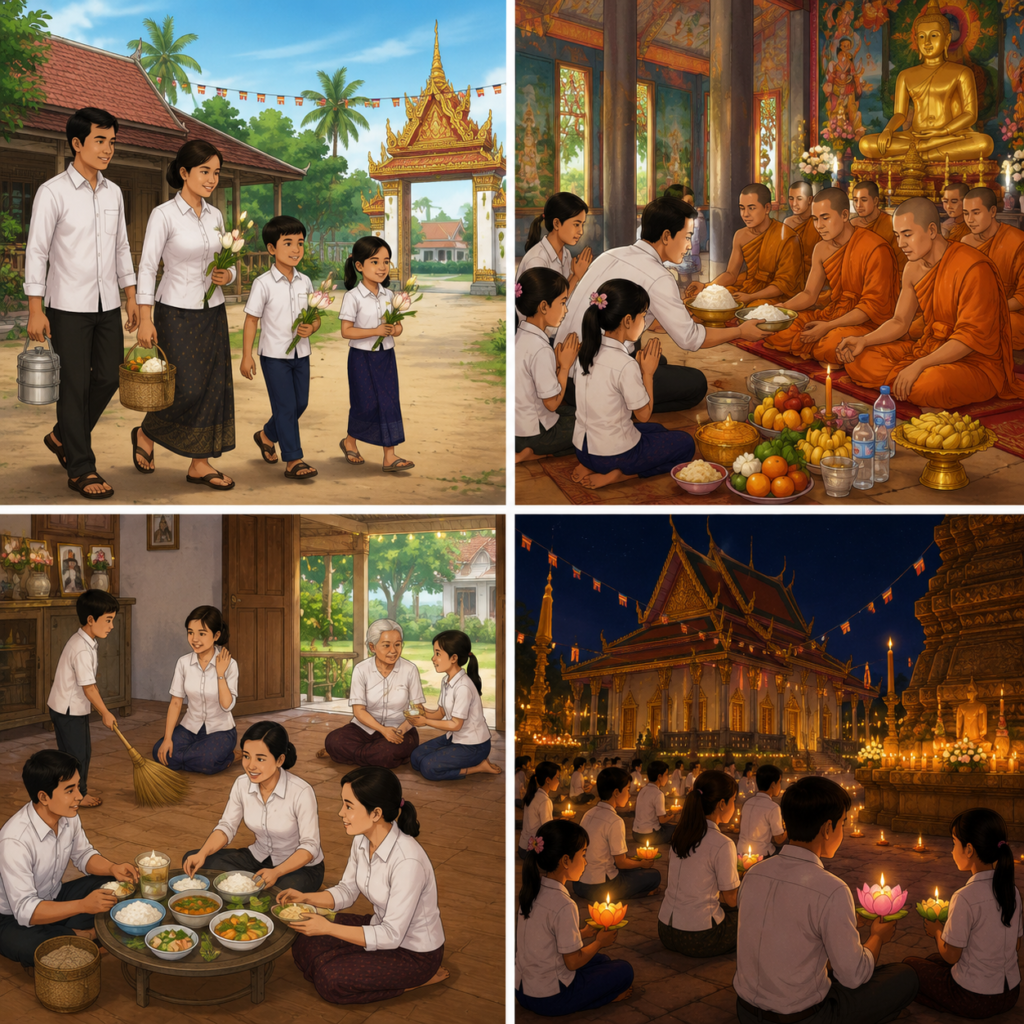
Visak Bochea Day is an important day in Cambodia. Many people know this day. Buddhist people celebrate it every year. On this day, people wake up early in the morning. They wash, eat breakfast, and get ready to go out. Many people wear white clothes. They go to the pagoda with their family.
At the pagoda, people see many monks. The pagoda is quiet and clean. People bring rice, fruit, water, flowers, and candles. They give food to the monks. Then they sit and listen. The monks talk to the people. Many people pray quietly.
Children also go to the pagoda. They stay with their parents and grandparents. Some children carry flowers or candles. They feel happy to be there.
In the afternoon, families go home. They eat food together and talk. Some people clean the house or help old people. In the evening, people light candles and pray again.
Visak Bochea Day is a calm and special day. People feel happy, peaceful, and close to their family.
______________________
Vocabulary:
to be important — to be very special or needed
to celebrate — to do something happy for a special day
to wake up — to stop sleeping
to get ready — to prepare to go somewhere or do something
to wear clothes — to have clothes on your body
a pagoda — a Buddhist holy place
a monk — a Buddhist man who lives and works in a pagoda
to be quiet — to make little or no noise
a candle — a small stick with fire for light
to pray quietly — to speak to God or Buddha in a soft voice
to stay with one’s parents — to be together with mother and father
grandparents — the mother and father of your mother or father
afternoon — the time after lunch and before evening
to clean the house — to make the house clean
to light a candle — to make a candle burn with fire
to be calm — to feel relaxed and not worried
to be peaceful — to be quiet and calm
to be close to one’s family — to love and spend time with family members
#################
Match word and defintion:
to be important
to celebrate
to wake up
to get ready
to wear clothes
a pagoda
a monk
to be quiet
a candle
to pray quietly
to stay with one’s parents
grandparents
afternoon
to clean the house
to light a candle
to be calm
to be peaceful
to be close to one’s family
Definition:
a. to make little or no noise b. to have clothes on your body c. to feel relaxed and not worried d. a Buddhist holy place e. to make the house clean f. to prepare to go somewhere or do something g. to stop sleeping h. the mother and father of your mother or father i. to make a candle burn with fire j. to be very special or needed k. to be together with mother and father l. a Buddhist man who lives and works in a pagoda m. a small stick with fire for light n. to do something happy for a special day o. to speak to God or Buddha in a soft voice p. the time after lunch and before evening q. to be quiet and calm r. to love and spend time with family members
a. to be important b. to celebrate c. to wake up d. to get ready e. to wear clothes f. a pagoda g. a monk h. to be quiet i. a candle j. to pray quietly k. to stay with one’s parents l. grandparents m. afternoon n. to clean the house o. to light a candle p. to be calm q. to be peaceful r. to be close to one’s family
Correct answers: People travel to the city on this day. True is: People go to the pagoda on this day.
Monks talk about peace and kindness.
The day is quiet and peaceful.
People go to the beach on this day. True is: People go to the pagoda on this day.
People wear white clothes.
Children do exams in the pagoda. True is: Children go to the pagoda with their family.
People bring flowers and candles.
Monks sing loud pop songs in the street. True is: Monks talk about peace and kindness.
Visak Bochea Day is in Cambodia.
People eat only pizza at the pagoda. True is: People bring rice, fruit, and food to the pagoda.
Families stay together on this day.
People swim in the ocean at midnight. True is: People pray at home or at the pagoda.
Schools are open and students study all day. True is: People go to the pagoda and celebrate.
People give food to monks.
People go to the pagoda on this day.
The day is very loud and full of traffic. True is: The day is quiet and peaceful.
################
The odd one out – try to find it:
banana / monk / candle / pagoda
flowers / incense / candles / white clothes
pray / eat / listen / think
calm / peaceful / noisy / quiet
morning / afternoon / candle / evening
family / parents / teacher / grandparents
sit / swim / give food / light candle
rice / school / fruit / water
stand / sit / listen / pray
happy / kind / peaceful / loud
______________________
Correct answers:
banana – monk – candle – pagoda Odd one: banana Why: banana is a fruit, the others are in a pagoda or used there.
flowers – incense – candles – white clothes Odd one: white clothes Why: white clothes are worn, the others are things you give or burn at a pagoda.
pray – eat – listen – think Odd one: eat Why: the others are mental or spiritual actions, eat is a physical action for food.
calm – peaceful – noisy – quiet Odd one: noisy Why: the others mean no sound or soft feeling, noisy is loud.
morning – afternoon – candle – evening Odd one: candle Why: the others are times of day, candle is an object.
family – parents – teacher – grandparents Odd one: teacher Why: the others are family members, teacher is not family.
sit – swim – give food – light candle Odd one: swim Why: the others are actions done at the pagoda, swim is not.
rice – school – fruit – water Odd one: school Why: the others are food or drink, school is a place.
stand – sit – listen – pray Odd one: pray Why: the others are simple body actions, pray is a religious action.
happy – kind – peaceful – loud Odd one: loud Why: the others are positive feelings, loud is about sound.
###############
Give short answers:
Where is Visak Bochea Day?
YOU WRITE: It is in Cambodia.
When do people celebrate Visak Bochea Day?
What do people wear on this day?
What do people bring to the pagoda?
Who goes to the pagoda with children?
Who lives in a pagoda?
What do monks do at the pagoda?
Why do people go to the pagoda?
How do people feel on this day?
Is the pagoda noisy?
Do people give food to monks?
Do people light candles?
Can children go to the pagoda?
Do families stay together?
Are people quiet at the pagoda?
Does everyone wear white clothes?
Do monks eat pizza?
Do people swim in the ocean that day?
Are there many candles at the pagoda?
Do people think about kindness?
_____________________
Correct answers:
Where is Visak Bochea Day? It is in Cambodia.
When do people celebrate Visak Bochea Day? People celebrate it in May.
What do people wear on this day? People wear white clothes.
What do people bring to the pagoda? People bring flowers and candles.
Who goes to the pagoda with children? Families go to the pagoda with children.
Who lives in a pagoda? Monks live in a pagoda.
What do monks do at the pagoda? Monks talk and pray.
Why do people go to the pagoda? People go to the pagoda to pray.
How do people feel on this day? People feel calm and happy.
Is the pagoda noisy? The pagoda is not noisy.
Do people give food to monks? People give food to monks.
Do people light candles? People light candles.
Can children go to the pagoda? Children can go to the pagoda.
Do families stay together? Families stay together.
Are people quiet at the pagoda? People are quiet at the pagoda.
Does everyone wear white clothes? People wear white clothes.
Do monks eat pizza? Monks do not eat pizza.
Do people swim in the ocean that day? People do not swim in the ocean that day.
Are there many candles at the pagoda? There are many candles at the pagoda.
Do people think about kindness? People think about kindness.
###############
Fill in, words below:
monks – peaceful – important – grandparents – candles – family – stay – pray – pagoda – kindness
Visak Bochea Day is__________in Cambodia. People wake up and get ready. They go to the _________ with family. People wear white clothes. They bring flowers, __________, fruit, rice, and water. People give food to monks. __________ live in a pagoda. People sit, listen, and __________ quietly. Monks talk about __________, peace, and good actions. Children stay with parents and __________. In the afternoon, families go home. Families __________ together. In the evening, people light candles and pray. The day is calm, __________, and quiet. People feel happy and close to __________.
—————————
Correct version:
Visak Bochea Day is important in Cambodia. People wake up and get ready. They go to the pagoda with family. People wear white clothes. They bring flowers, candles, fruit, rice, and water. People give food to monks. Monks live in a pagoda. People sit, listen, and pray quietly. Monks talk about kindness, peace, and good actions. Children stay with parents and grandparents. In the afternoon, families go home. Families stay together. In the evening, people light candles and pray. The day is calm, peaceful, and quiet. People feel happy and close to family.
#############
Interview with a monk on Visak Bochea Day – find the correct answers:
Questions:
Where do you live?
What do you do every day?
What do people bring to you today?
What food do people give you?
Why do people come here?
What do you tell people?
Who comes with the people?
Do children come here?
What clothes do people wear?
Is the pagoda quiet today?
Do you feel happy today?
What do you do with candles?
Do you eat pizza?
What is this day for you?
Answers:
a. I speak about kindness and peace. b. Yes, children arrive with parents. c. People come for prayer. d. I stay in a pagoda. e. People have white clothes. f. It is a calm and important day. g. I feel happiness. h. People bring flowers and candles. i. No, I do not eat pizza. j. People make light from candles. k. I pray and speak to people. l. Yes, the pagoda has quiet. m. Families come together. n. People give rice, fruit, and water.
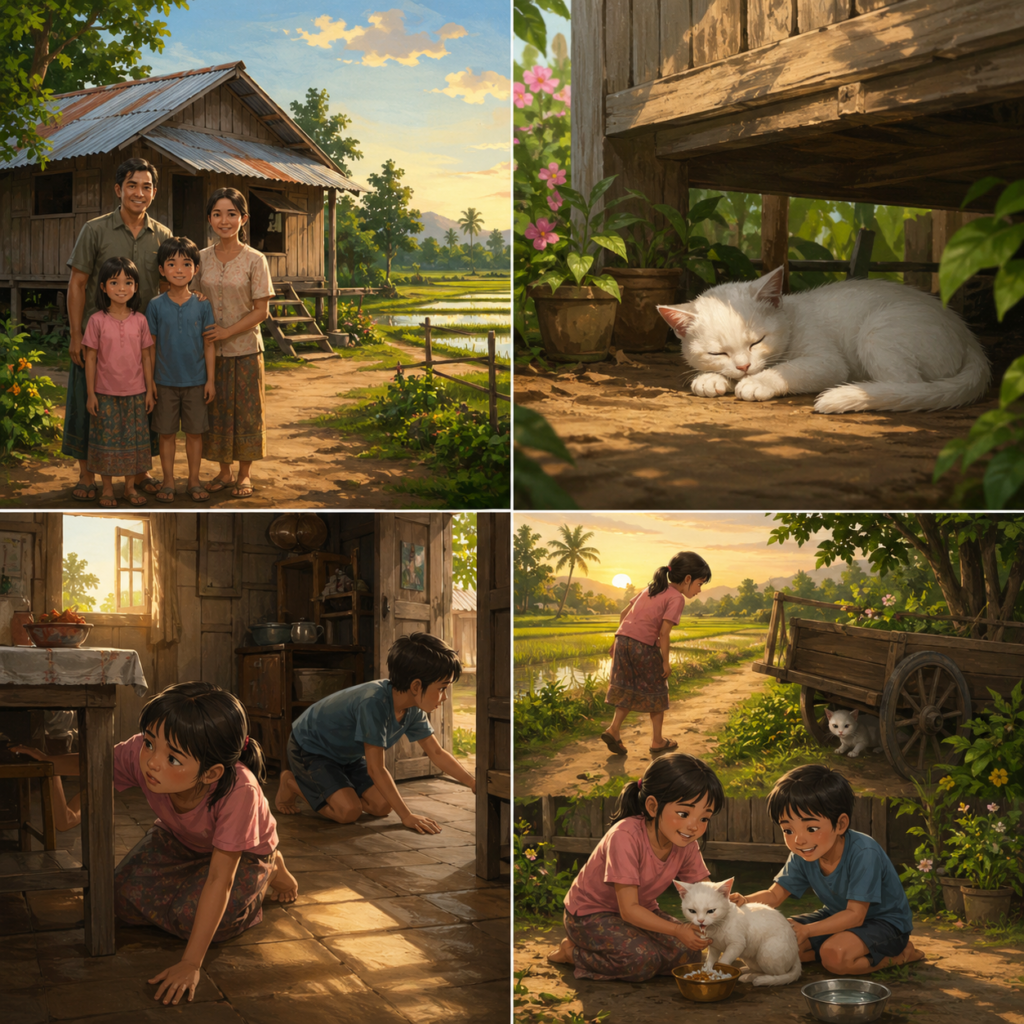
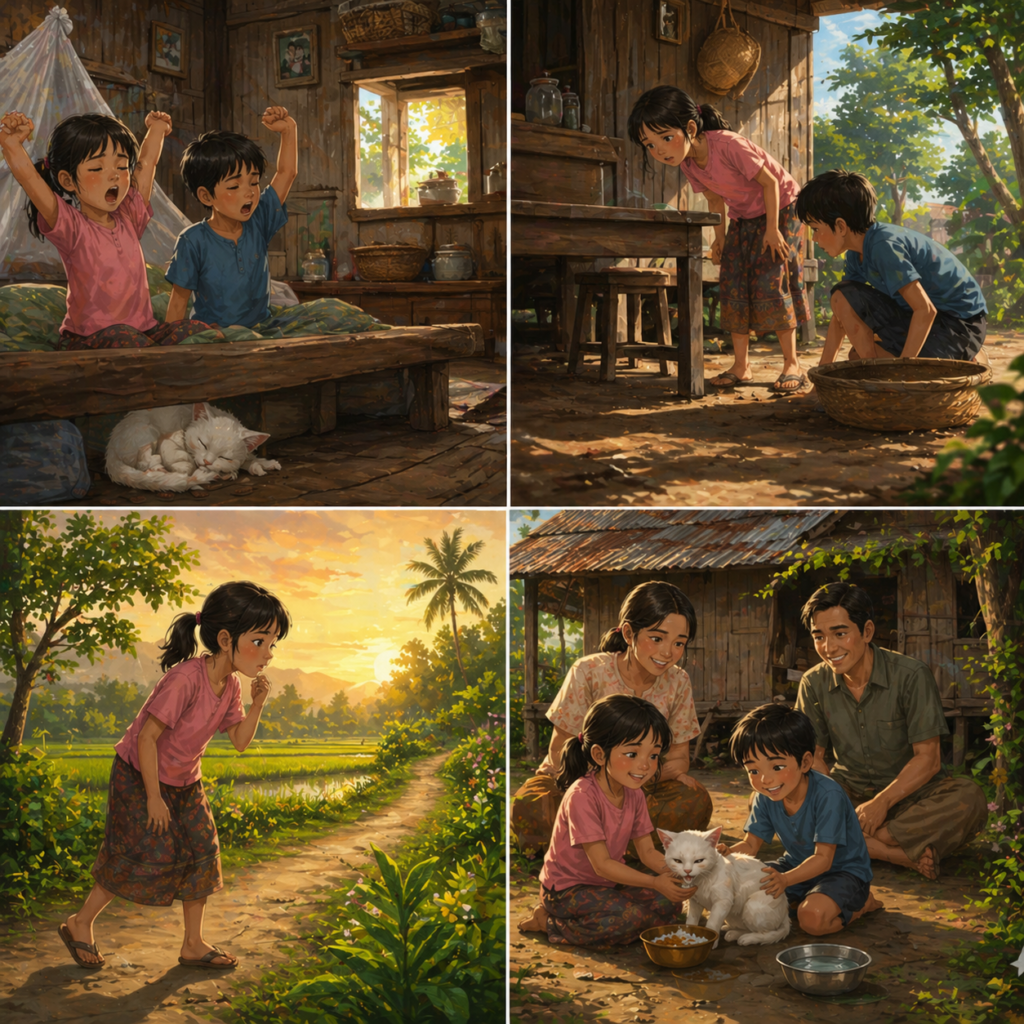
Rina lives with her brother and her parents in a small village in the countryside. Their house is made of wood with a tin roof. Near her house are rice fields, trees, and a dirt path. Life in the village is quiet and simple.
Rina has a white cat named Mimi. Mimi is small and friendly. The cat often sleeps under the house or walks in the garden. It likes warm places and quiet corners.
One morning, Rina and her brother wake up early. They cannot find Mimi. They look inside the house, under the table, and near the kitchen, but Mimi is not there. Rina and her brother feel worried. Then Rina goes outside and looks around the yard and the garden. The sun rises over the rice fields.
Rina walks along the dirt path near the fields. She looks near the grass and small trees. After a while, she hears a soft sound near a wooden cart. Mimi hides there. The cat is safe but a little scared.
Rina carefully carries Mimi back home. She and her brother give it food and water. Mimi eats and rests. Rina and her family feel happy again. The village becomes quiet, and the day continues peacefully.
________________
Vocabulary:
a village – a small place where many people live, with houses and farms
countryside – land outside cities, with fields, trees, and nature
to be made of wood – built using wood
a tin roof – a roof made from thin metal sheets
a dirt path – a small road made of soil, not concrete
to be quiet – with little or no noise
a corner – a small place where two sides meet
to wake up – to stop sleeping
to feel worried – to feel not calm because something may be wrong
a yard – open space around a house
sunrise – when the sun comes up in the morning
a soft sound – a quiet, gentle noise
a wooden cart – a small vehicle made of wood, used to carry things
to hide – to stay in a place where others cannot see you
to be safe – to not be in danger
to be scared – to feel afraid
carefully – doing something slowly and with attention
to carry – to hold and move something
to rest – to relax or sleep
to continue – to keep going
to be peaceful – to be calm and quiet, with no problems
################
Match the words with the correct definitions :
Words:
a village
countryside
to be made of wood
a tin roof
a dirt path
to be quiet
a corner
to wake up
to feel worried
a yard
sunrise
a soft sound
a wooden cart
to hide
to be safe
to be scared
carefully
to carry
to rest
to continue
Definitions:
A. to feel afraid B. a small road made of soil C. to hold and move something D. land outside cities with nature and fields E. to relax or sleep F. to stay in a place where others cannot see you G. a roof made from thin metal sheets H. to stop sleeping I. a small place where many people live J. a quiet gentle noise K. to keep going L. a small vehicle made of wood for carrying things M. to be calm and have no danger N. open space around a house O. with attention and slowly P. when the sun comes up in the morning Q. a small place where two sides meet R. to feel not calm because something may be wrong S. to be built using wood T. with little or no noise
Words (mixed order): A. to be made of wood B. countryside C. to carry D. a tin roof E. to feel scared F. a village G. to rest H. a dirt path I. a soft sound J. to continue K. carefully L. sunrise M. to be safe N. a yard O. a corner P. to wake up Q. to hide R. to feel worried S. a wooden cart T. to be quiet
tin roof / wood / house / a / with / is / made / of / the
near / rice fields / the / are / house / the
sleeps / under / Mimi / house / the
wakes up / Rina / early
looks / Rina / yard / the / in
wooden cart / near / Mimi / a / is found
brother / Rina / and / search / Mimi / for / her
feels / happy / family / Rina / and / her
goes / Rina / outside
there / dirt path / a / near / house / the / is
garden / looks / Rina / in / the
soft sound / hears / Rina / a
Mimi / safe / is
_________________
Correct order:
Rina lives in a small village.
The house is made of wood with a tin roof.
The rice fields are near the house.
Mimi sleeps under the house.
Rina wakes up early.
Rina looks in the yard.
Mimi is found near a wooden cart.
Rina and her brother search for Mimi.
Rina and her family feel happy.
Rina goes outside.
There is a dirt path near the house.
Rina looks in the garden.
Rina hears a soft sound.
Mimi is safe.
############
Odd one out, which?
village – city – house – countryside
wood – glass – dirt path – tin roof
rice fields – computer – garden – trees
Mimi – cat – dog – Rina
wake up – run – tin roof – sleep
yard – sunrise – kitchen – garden
wooden cart – rice fields – dirt path – car
quiet – loud – soft sound – peaceful
wood – happy – scared – safe
carry – walk – rest – tin roof
____________________
Answers:
village – city – house – countryside Odd one: house → because it is a building, others are areas/places
wood – glass – dirt path – tin roof Odd one: dirt path → because it is a road outside, others are materials
rice fields – computer – garden – trees Odd one: computer → because it is not part of nature or village life
Mimi – cat – dog – Rina Odd one: Rina → because Rina is a person, others are animals/names for animals
wake up – run – tin roof – sleep Odd one: tin roof → because it is an object, others are actions
yard – sunrise – kitchen – garden Odd one: sunrise → because it is a time/event, others are places
wooden cart – rice fields – dirt path – car Odd one: car → because it is a modern vehicle, others are village things
quiet – loud – soft sound – peaceful Odd one: loud → because it is the opposite meaning of the others
wood – happy – scared – safe Odd one: wood → because it is a material, others are feelings
carry – walk – rest – tin roof Odd one: tin roof → because it is an object, others are actions
############
Short answers, basics:
Example Sentence
Yes
No
I learn the alphabet.
Yes, I do.
No, I don’t.
You read signs.
Yes, you do.
No, you don’t.
He practices speaking.
Yes, he does.
No, he doesn’t.
She watches cartoons.
Yes, she does.
No, she doesn’t.
It helps us learn English.
Yes, it does.
No, it doesn’t.
We use apps like Duolingo.
Yes, we do.
No, we don’t.
You read labels.
Yes, you do.
No, you don’t.
They make mistakes sometimes.
Yes, they do.
No, they don’t.
Question
Yes
No
Do I learn the alphabet?
Yes, I do.
No, I don’t.
Do you read signs?
Yes, you do.
No, you don’t.
Does he practice speaking?
Yes, he does.
No, he doesn’t.
Does she watch cartoons?
Yes, she does.
No, she doesn’t.
Does it help us learn English?
Yes, it does.
No, it doesn’t.
Do we use apps like Duolingo?
Yes, we do.
No, we don’t.
Do you read labels?
Yes, you do.
No, you don’t.
Do they make mistakes sometimes?
Yes, they do.
No, they don’t.
Question
Yes
No
Am I big?
Yes, I am.
No, I am not.
Are you big?
Yes, you are.
No, you aren’t.
Is he big?
Yes, he is.
No, he isn’t.
Is she big?
Yes, she is.
No, she isn’t.
Is it big?
Yes, it is.
No, it isn’t.
Are we big?
Yes, we are.
No, we aren’t.
Are you big?
Yes, you are.
No, you aren’t.
Are they big?
Yes, they are.
No, they aren’t.
####################
Short answers:
Mimi is very big.
YOU WRITE: No, it isn’t.
Rina finds Mimi near a wooden cart.
YOU WRITE: Yes, she does.
The house is made of stone and glass.
Rina lives with her family in a small village.
Mimi sleeps under the house.
Rina goes to school and forgets Mimi.
There are rice fields near the house.
Rina has a cat named Mimi.
The area has only buildings and roads.
Rina and her brother look for Mimi in the morning.
Mimi works in the rice fields.
Rina finds Mimi at a shop in the village.
Mimi is small and white.
Rina does not take Mimi home.
Their house is made of wood with a tin roof.
Rina lives alone in the city.
Mimi likes quiet corners.
Rina has a dog named Mimi.
Rina and her brother look for Mimi in the morning.
Mimi goes back home with Rina.
####################
Correct the false statements, give short answer, followed by correct statement:
Rina lives in a big city.
YOU WRITE: No, she doens’t. She lives in a small village.
Her house is made of stone.
The house has a grass roof.
There are cars near the house.
Mimi is a big black dog.
Mimi sleeps on the roof.
Rina wakes up in the evening.
Rina walks in the river.
Mimi sits in a tree.
Her father and mother eat in the rice fields.
Rina walks on the road in the city.
Mimi plays on the table all day.
Rina finds Mimi near the kitchen.
Mimi stays in the house all day.
___________________________
Answers:
Rina lives in a big city. No, she doesn’t. She lives in a small village in the countryside.
Her house is made of stone. No, it isn’t. Her house is made of wood.
The house has a grass roof. No, it doesn’t. The house has a tin roof.
There are cars near the house. No, there aren’t. There are rice fields and trees near the house.
Mimi is a big black dog. No, it isn’t. Mimi is a small white cat.
Mimi sleeps on the roof. No, it doesn’t. Mimi sleeps under the house.
Rina wakes up in the evening. No, she doesn’t. Rina wakes up in the morning.
Rina walks in the river. No, she doesn’t. Rina walks along the dirt path.
Mimi sits in a tree. No, it doesn’t. Mimi hides near a wooden cart.
Her father and mother eat in the rice fields. No, they don’t. They eat at home.
Rina walks on the road in the city. No, she doesn’t. Rina walks on a dirt path near the fields.
Mimi plays on the table all day. No, it doesn’t. Mimi sleeps under the house or walks in the garden.
Rina finds Mimi near the kitchen. No, she doesn’t. Rina finds Mimi near a wooden cart.
Mimi stays in the house all day. No, it doesn’t. Mimi walks in the garden and sleeps under the house.
####################
Basics of present simple:
Personal Pronoun
am / is / are
I
am
8 years old
You
are
8 years old
He
is
8 years old
She
is
8 years old
It
is
8 years old
We
are
8 years old
You (plural)
are
8 years old
They
are
8 years old
Personal Pronoun
am not / is not / are not
I
am not
8 years old
You
are not
8 years old
He
is not
8 years old
She
is not
8 years old
It
is not
8 years old
We
are not
8 years old
You (plural)
are not
8 years old
They
are not
8 years old
Question:
Question Word
Personal Pronoun
Am
I
8 years old?
Are
you
8 years old?
Is
he
8 years old?
Is
she
8 years old?
Is
it
8 years old?
Are
we
8 years old?
Are
you (plural)
8 years old?
Are
they
8 years old?
Statement:
Personal Pronoun
Verb
I
like
ice cream
You
like
ice cream
He
likes
ice cream
She
likes
ice cream
It
likes
ice cream
We
like
ice cream
You (plural)
like
ice cream
They
like
ice cream
Negation:
Personal Pronoun
Verb (negative)
I
do not like
ice cream
You
do not like
ice cream
He
does not like
ice cream
She
does not like
ice cream
It
does not like
ice cream
We
do not like
ice cream
You (plural)
do not like
ice cream
They
do not like
ice cream
Question:
Do / Does
Personal Pronoun
Verb
Sugar?
Do
I
like
sugar?
Do
you
like
sugar?
Does
he
like
sugar?
Does
she
like
sugar?
Does
it
like
sugar?
Do
we
like
sugar?
Do
you (plural)
like
sugar?
Do
they
like
sugar?
################
Form (a)a negation, (b) a question as shown in #1:
Rina lives in a small village.
YOU WRITE: a) Rina does not live in a small village. b) Does Rina live in a small viallge.
Rina and her family live in the countryside.
The house is made of wood with a tin roof.
Rice fields are near the house.
Trees grow near the dirt path.
Mimi is a small white cat.
Mimi sleeps under the house.
Rina and her brother wake up early.
Rina looks around the yard.
The garden is near the house.
Rina and her brother search for Mimi.
A wooden cart is near the fields.
Mimi rests at home after the search.
Rina and her family feel happy at the end of the day.
______________________
Correct answers:
Rina lives in a small village. a) Rina does not live in a small village. b) Does Rina live in a small village?
Rina and her family live in the countryside. a) Rina and her family do not live in the countryside. b) Do Rina and her family live in the countryside?
The house is made of wood with a tin roof. a) The house is not made of wood with a tin roof. b) Is the house made of wood with a tin roof?
Rice fields are near the house. a) Rice fields are not near the house. b) Are rice fields near the house?
Trees grow near the dirt path. a) Trees do not grow near the dirt path. b) Do trees grow near the dirt path?
Mimi is a small white cat. a) Mimi is not a small white cat. b) Is Mimi a small white cat?
Mimi sleeps under the house. a) Mimi does not sleep under the house. b) Does Mimi sleep under the house?
Rina and her brother wake up early. a) Rina and her brother do not wake up early. b) Do Rina and her brother wake up early?
Rina looks around the yard. a) Rina does not look around the yard. b) Does Rina look around the yard?
The garden is near the house. a) The garden is not near the house. b) Is the garden near the house?
Rina and her brother search for Mimi. a) Rina and her brother do not search for Mimi. b) Do Rina and her brother search for Mimi?
A wooden cart is near the fields. a) A wooden cart is not near the fields. b) Is a wooden cart near the fields?
Mimi rests at home after the search. a) Mimi does not rest at home after the search. b) Does Mimi rest at home after the search?
Rina and her family feel happy at the end of the day. a) Rina and her family do not feel happy at the end of the day. b) Do Rina and her family feel happy at the end of the day?
################
Form questions, no answers:
Rina and her family feel happy. (How)
YOU WRITE: How do Rina and her family feel?
Rina lives in a small village. (Where)
Rina and her brother live with their parents. (Who)
The house is made of wood. (What)
All the houses have tin roofs. (How many)
There is a dirt path near the house. (Where)
There are rice fields near the house. (What)
Mimi is a small cat. (What kind of)
The cats are friendly animals. (What kind of)
Rina wakes up early. (When)
Rina and her brother wake up early. (Who)
Rina looks in the yard. (Where)
Rina and her brother look for Mimi. (Who)
Mimi is safe. (How)
____________________________
Answers:
Rina lives in a small village. (Where) Where does Rina live?
Rina and her brother live with their parents. (Who) Who lives with their parents?
The house is made of wood. (What) What is the house made of?
All the houses have tin roofs. (How many) How many roofs have tin roofs?
There is a dirt path near the house. (Where) Where is there a dirt path?
There are rice fields near the house. (What) What is near the house?
Mimi is a small cat. (What kind of) What kind of cat is Mimi?
The cats are friendly animals. (What kind of) What kind of animals are the cats?
Rina wakes up early. (When) When does Rina wake up?
Rina and her brother wake up early. (Who) Who wakes up early?
Rina looks in the yard. (Where) Where does Rina look?
Rina and her brother look for Mimi. (Who) Who do Rina and her brother look for? Who looks for Mimi.
Mimi is safe. (How) How is Mimi?
Rina and her family feel happy. (How) How do Rina and her family feel?
####################
Interview with Rina about what they do when they cannot find the cat – complete, words below:
white – happy – tin – village – wood – house – your – yard – family – under – brother – cart
Q: Where do you live? A: I live in a small __________.
Q: Who do you live with? A: I live with my __________.
Q: What is your house made of? A: My house is made of __________.
Q: What is on your roof? A: I have a _________ roof.
Q: What is near your house? A: Rice fields are near my house.
Q: Do you like __________ village? A: Yes, I like my village.
Q: What is your cat’s name? A: My cat’s name is Mimi.
Q: What does Mimi look like? A: Mimi is small and __________.
Q: Where does Mimi sleep? A: Mimi sleeps __________ the house.
Q: What happens one morning? A: Mimi is not in the __________.
Q: Who looks for Mimi? A: My __________ and I look for Mimi.
Q: Where do you look for Mimi? A: We look in the __________ and garden.
Q: Where do you find Mimi? A: I find Mimi near a wooden __________.
Q: How do you feel at the end? A: I feel _________.
———————————– Correct version:
Q: Where do you live? A: I live in a small village.
Q: Who do you live with? A: I live with my family.
Q: What is your house made of? A: My house is made of wood.
Q: What is on your roof? A: I have a tin roof.
Q: What is near your house? A: Rice fields are near my house.
Q: Do you like your village? A: Yes, I like my village.
Q: What is your cat’s name? A: My cat’s name is Mimi.
Q: What does Mimi look like? A: Mimi is small and white.
Q: Where does Mimi sleep? A: Mimi sleeps under the house.
Q: What happens one morning? A: Mimi is not in the house.
Q: Who looks for Mimi? A: My brother and I look for Mimi.
Q: Where do you look for Mimi? A: We look in the yard and garden.
Q: Where do you find Mimi? A: I find Mimi near a wooden cart.
Q: How do you feel at the end? A: I feel happy.
################
Raed, then rewrite story as shown below:
My name is Rina. I live in a small village in the countryside with my family. My house is made of wood and has a tin roof. Near my house there are rice fields, trees, and a dirt path. I have a small white cat named Mimi. It is friendly and likes quiet places. One morning, I wake up and cannot find Mimi. My brother and I search in the house, the yard, and the garden. We feel worried. I go outside and walk along the dirt path. I hear a soft sound near a wooden cart. I find Mimi there. It is safe but a little scared. I carefully carry her home. We give it food and water. Mimi rests, and I feel happy. The village becomes quiet again, and our day continues peacefully. _______________________
>>>>>Continue and >>>>>make all changes >>>>>necessary!
Her name is Rina. She lives in a small village in the countryside with her family. …………………………………………………..
_______________________
Correct version:
Her name is Rina. She lives in a small village in the countryside with her family. Her house is made of wood and has a tin roof. Near her house there are rice fields, trees, and a dirt path. She has a small white cat named Mimi. Mimi is friendly and likes quiet places. One morning, Rina wakes up and cannot find Mimi. Rina and her brother search in the house, the yard, and the garden. They feel worried. Rina goes outside and walks along the dirt path. She hears a soft sound near a wooden cart. She finds Mimi there. The cat is safe but a little scared. Rina carefully carries Mimi home. They give her food and water. Mimi rests, and Rina feels happy. The village becomes quiet again, and their day continues peacefully.
Malis was 12 years old when she he lived in the countryside with her parents. Her parents were farmers. She woke up early in the morning. She helped her parents at home. She fed the chickens and brought water. Sometimes she helped in the field. After that, she got ready for school. She wore her uniform and went to school. She walked or rode a bike. She met her friends on the way. At school, she studied English, math, and science. She liked learning new things. She listened to her teacher and worked hard. At noon, she went home for lunch. She ate rice, vegetables, and sometimes fish. Then she rested for a short time. In the afternoon, she helped her parents again or did her homework. In the evening, she had dinner with her family. They talked together. Then she went to bed early.
____________________________
Vocabulary:
countryside → the area in the country, not the city
to wake up → to stop sleeping
early → before the usual time (not late)
at home → in your house
to feed the chickens → to give food to chickens
to get ready for school → to prepare for school (wash, dress, etc.)
to wear a uniform → to have special school clothes on
to ride a bike → to go on a bicycle
to meet friends → to see friends
to study science → to learn about science [subject where students learn about the natural world, about plants, animals, the human body, weather, and do simple experiments.]
to listen to somebody → to hear and pay attention to someone
at noon → at 12:00 in the day
lunch → the meal in the middle of the day
vegetables → plants we eat (like carrots, tomatoes)
to rest → to relax or stop working
for a short time → for a little time
afternoon → the time after 12:00 (after noon)
to do homework → to do school work at home
to go to bed → to lie down and sleep
#################
Basics in past simple:
Past Simple – Regular Verbs
Rules:
Most verbs: add -ed play → played
Verbs ending in -e: add -d live → lived
Verbs ending in consonant + y: change y to i and add -ed study → studied
Short verbs ending in vowel + consonant: double the final consonant and add -ed stop → stopped
Use: The past simple is used to talk about finished actions in the past
#################
Verbs in text – past tense forms & definitions (A1)
Infinitive
Past Simple
A1 Definition
be
was / were
to exist or live
live
lived
to stay in a place
wake up
woke up
to stop sleeping
help
helped
to do something for someone
feed
fed
to give food to animals or people
bring
brought
to take something to a place
help
helped
to do something for someone
get ready
got ready
to prepare
wear
wore
to have clothes on your body
go
went
to move to a place
walk
walked
to move on foot
ride
rode
to travel on a bike
meet
met
to see someone
study
studied
to learn
like
liked
to enjoy something
learn
learned
to get knowledge
listen
listened
to hear carefully
work
worked
to do a job or task
go
went
to move to a place
eat
ate
to have food
rest
rested
to relax
help
helped
to do something for someone
do
did
to make or complete something
have
had
to eat or own something
talk
talked
to speak
go
went
to move to a place
##################
Fill in the correct past tense form, then say if statement is true or false:
She ________ (use) a bicycle on weekends for fun. T/F?
She ________ (have) dinner with her family in the evening. T/F?
She ________ (study) only science at school. T/F?
Malis ________ (be) 12 years old. T/F?
She ________ (wake up) early in the morning. T/F?
She ________ (carry) food from the kitchen to the chickens every day. T/F?
She ________ (live) in a town near the sea. T/F?
She ________ (get ready) for school after her morning tasks. T/F?
She ________ (eat) dinner alone in her room. T/F?
She ________ (feed) the chickens and ________ (bring) water. T/F?
She ________ (change) clothes at school after arriving. T/F?
Her parents ________ (work) in a shop in the evening. T/F?
She ________ (help) her parents at home. T/F?
She ________ (wear) a uniform for school. T/F?
She ________ (study) English, math, and science. T/F?
She ________ (start) her day by going straight to school. T/F?
She ________ (live) in the countryside with her parents. T/F?
She ________ (spend) the morning reading books at home only. T/F?
Her parents ________ (be) farmers. T/F?
———————————- Correct version:
She used a bicycle on weekends for fun. F
She had dinner with her family in the evening. T
She studied only science at school. F
Malis was 12 years old. T
She woke up early in the morning. T
She carried food from the kitchen to the chickens every day. F
She lived in a town near the sea. F
She got ready for school after her morning tasks. T
She ate dinner alone in her room. F
She fed the chickens and brought water. T
She changed clothes at school after arriving. F
Her parents worked in a shop in the evening. F
She helped her parents at home. T
She wore a uniform for school. T
She studied English, math, and science. T
She started her day by going straight to school. F
She lived in the countryside with her parents. T
She spent the morning reading books at home only. F
Her parents were farmers. T
################ Basics in past simple:
Personal Pronoun
Verb (Past)
Object
I
ate
apples
You
ate
apples
He
ate
apples
She
ate
apples
It
ate
apples
We
ate
apples
You (plural)
ate
apples
They
ate
apples
I
played
football
You
played
football
He
played
football
She
played
football
It
played
football
We
played
football
You (plural)
played
football
They
played
football
Personal Pronoun
Verb (Past Negative)
Object
I
did not eat
apples
You
did not eat
apples
He
did not eat
apples
She
did not eat
apples
It
did not eat
apples
We
did not eat
apples
You (plural)
did not eat
apples
They
did not eat
apples
I
did not play
football
You
did not play
football
He
did not play
football
She
did not play
football
It
did not play
football
We
did not play
football
You (plural)
did not play
football
They
did not play
football
##################
Forms of ‚to be‘
Personal Pronoun
Positive
Negative
Question
I
I was happy.
I was not happy.
Was I happy?
You (singular)
You were excited.
You were not excited.
Were you excited?
He
He was at home.
He was not at home.
Was he at home?
She
She was tired.
She was not tired.
Was she tired?
It
It was cold.
It was not cold.
Was it cold?
We
We were at the party.
We were not at the party.
Were we at the party?
You (plural)
You were friends.
You were not friends.
Were you friends?
They
They were in the garden.
They were not in the garden.
Were they in the garden?
###############
Rewrite the false statements as shown:
Malis was 15 years old.
YOU WRITE: Malis was not 15 years old. She was eleven years old.
She lived in a city with her parents.
Her parents were teachers.
She woke up late in the morning.
She played all morning instead of helping at home.
She fed dogs on the farm.
She brought toys for the chickens.
She spent the morning only reading books at home.
She went to school before doing her morning tasks.
She wore casual clothes to school.
She went to school by car every day.
She stayed alone on the way to school.
She studied only cooking at school.
She ate fast food for lunch every day.
She had lunch in the evening.
She played games all afternoon after lunch.
She did sports all afternoon instead of homework.
She went shopping after school every day.
She ignored her teacher in class.
She went to bed very late every night.
__________________________
Correct version:
Malis was not 15 years old. She was 12 years old.
She did not live in a city with her parents. She lived in the countryside with her parents.
Her parents were not teachers. They were farmers.
She did not wake up late in the morning. She woke up early in the morning.
She did not play all morning instead of helping at home. She helped her parents at home in the morning.
She did not feed dogs on the farm. She fed chickens.
She did not bring toys for the chickens. She brought water for the chickens.
She did not spend the morning only reading books at home. She helped at home and sometimes worked in the field.
She did not go to school before doing her morning tasks. She went to school after her morning tasks.
She did not wear casual clothes to school. She wore a uniform to school.
She did not go to school by car every day. She walked or rode a bike to school.
She did not stay alone on the way to school. She met her friends on the way to school.
She did not study only cooking at school. She studied English, math, and science.
She did not eat fast food for lunch every day. She ate rice and vegetables.
She did not have lunch in the evening. She had lunch at noon.
She did not play games all afternoon after lunch. She rested and did her homework.
She did not do sports all afternoon instead of homework. She did her homework after lunch.
She did not go shopping after school every day. She went home after school.
She did not ignore her teacher in class. She listened to her teacher.
She did not go to bed very late every night. She went to bed early every night.
###############
Form correct questions in past simple, and give full answer:
___________ (be) Malis 11 or 12 years old? YOU WRITE: Was Malis 11 or 12 years old? She was 11 years old.
___________ (she wake up) late or early every day?
___________ (her parents live) in a city or in the countryside?
___________ (be) her parents teachers or farmers?
___________ (she help) her parents at home or only at school?
___________ (her mother and father work) in a shop or in the fields?
___________ (she bring) water or toys to the chickens?
___________ (she and her brother get ready) for school after or before helping at home?
___________ (she wear) casual clothes or a uniform for school?
___________ (she and her friends go) to school by car or by walking/riding a bike?
___________ (she meet) friends on the way to school or stay alone?
___________ (the students study) English or cooking at school?
___________ (she study) cooking or math at school?
___________ (she study) painting or science at school?
___________ (she and her friends listen) to the teacher in class?
___________ (she have) lunch in the evening or at noon?
___________ (she eat) fast food or rice and vegetables for lunch?
___________ (she work) all afternoon or rest for a short time after lunch?
___________ (she play) only games or do homework in the afternoon?
___________ (she go) to bed very late or early every night?
————————————– Correct version:
Was Malis 11 or 12 years old? – Malis was 12 years old.
Did she wake up late or early every day? – She woke up early every day.
Did her parents live in a city or in the countryside? – Her parents lived in the countryside.
Were her parents teachers or farmers? – Her parents were farmers.
Did she help her parents at home or only at school? – She helped her parents at home.
Did her mother and father work in a shop or in the fields? – Her parents worked in the fields as farmers.
Did she bring water or toys to the chickens? – She brought water to the chickens.
Did she and her brother get ready for school after or before helping at home? – She and her brother got ready for school after helping at home.
Did she wear casual clothes or a uniform for school? – She wore a uniform for school.
Did she and her friends go to school by car or by walking/riding a bike? – She and her friends went to school by walking or riding a bike.
Did she meet friends on the way to school or stay alone? – She met friends on the way to school.
Did the students study English or cooking at school? – The students studied English at school.
Did she study cooking or math at school? – She studied math at school.
Did she study painting or science at school? – She studied science at school.
Did she and her friends ignore the teacher or listen to the teacher in class? – She and her friends listened to the teacher in class.
Did she have lunch in the evening or at noon? – She had lunch at noon.
Did she eat fast food or rice and vegetables for lunch? – She ate rice and vegetables for lunch.
Did she work all afternoon or rest for a short time after lunch? – She rested for a short time after lunch.
Did she only play games or do homework in the afternoon? – She did homework in the afternoon.
Did she go to bed very late or early every night? – She went to bed early every night.
###############
Short answers, past simple, basics:
Example Sentence
Yes
No
I learned letters.
Yes, I did.
No, I didn’t.
You read signs.
Yes, you did.
No, you didn’t.
He spoke English.
Yes, he did.
No, he didn’t.
She watched TV.
Yes, she did.
No, she didn’t.
It helped me.
Yes, it did.
No, it didn’t.
We used an app.
Yes, we did.
No, we didn’t.
You read words.
Yes, you did.
No, you didn’t.
They made mistakes.
Yes, they did.
No, they didn’t.
Questions (Past Simple)
Question
Yes
No
Did I learn letters?
Yes, I did.
No, I didn’t.
Did you read signs?
Yes, you did.
No, you didn’t.
Did he speak English?
Yes, he did.
No, he didn’t.
Did she watch TV?
Yes, she did.
No, she didn’t.
Did it help me?
Yes, it did.
No, it didn’t.
Did we use an app?
Yes, we did.
No, we didn’t.
Did you read words?
Yes, you did.
No, you didn’t.
Did they make mistakes?
Yes, they did.
No, they didn’t.
Was / Were
Question
Yes
No
Was I happy?
Yes, I was.
No, I wasn’t.
Were you happy?
Yes, you were.
No, you weren’t.
Was he happy?
Yes, he was.
No, he wasn’t.
Was she happy?
Yes, she was.
No, she wasn’t.
Was it good?
Yes, it was.
No, it wasn’t.
Were we happy?
Yes, we were.
No, we weren’t.
Were you happy?
Yes, you were.
No, you weren’t.
Were they happy?
Yes, they were.
No, they weren’t.
####################
Give short answers:
1. Malis was 15 years old.
YOU WRITE: No, she wasn’t. She was 12 years old.
2. She lived in a city with her parents.
3. Her parents were teachers.
4. She woke up late in the morning.
5. She played all morning instead of helping at home.
6. She fed dogs on the farm.
7. She brought toys for the chickens.
8. She spent the morning only reading books at home.
9. She went to school before doing her morning tasks.
10. She wore casual clothes to school.
11. She went to school by car every day.
12.She stayed alone on the way to school.
13. She studied only cooking at school.
14. She ate fast food for lunch every day.
15. She had lunch in the evening.
16. She played games all afternoon after lunch.
17. She did sports all afternoon instead of homework.
18. She went shopping after school every day.
19. She ignored her teacher in class.
20. She went to bed very late every night.
_______________________
Correct answers:
Malis was 15 years old. – No, she wasn’t. She was 12 years old.
She lived in a city with her parents. – No, she didn’t. She lived in the countryside with her parents.
Her parents were teachers. – No, they weren’t. They were farmers.
She woke up late in the morning. – No, she didn’t. She woke up early in the morning.
She played all morning instead of helping at home. – No, she didn’t. She helped her parents at home.
She fed dogs on the farm. – No, she didn’t. She fed chickens.
She brought toys for the chickens. – No, she didn’t. She brought water for the chickens.
She spent the morning only reading books at home. – No, she didn’t. She helped at home and sometimes worked in the field.
She went to school before doing her morning tasks. – No, she didn’t. She went to school after her morning tasks.
She wore casual clothes to school. – No, she didn’t. She wore a uniform to school.
She went to school by car every day. – No, she didn’t. She walked or rode a bike to school.
She stayed alone on the way to school. – No, she didn’t. She met her friends on the way to school.
She studied only cooking at school. – No, she didn’t. She studied English, math, and science.
She ate fast food for lunch every day. – No, she didn’t. She ate rice and vegetables for lunch.
She had lunch in the evening. – No, she didn’t. She had lunch at noon.
She played games all afternoon after lunch. – No, she didn’t. She rested and did her homework.
She did sports all afternoon instead of homework. – No, she didn’t. She did her homework after lunch.
She went shopping after school every day. – No, she didn’t. She went home after school.
She ignored her teacher in class. – No, she didn’t. She listened to her teacher.
She went to bed very late every night. – No, she didn’t. She went to bed early every night.
#################
Form questions – write as shown in 1:
Malis / wake up early in the morning YOU WRITE: → Did Malis wake up early in the morning ?
she / feed the chickens → __________________________________ ?
she and her friends / wear uniforms for school → __________________________________ ?
she / ride a bike to school → __________________________________ ?
she and her friends / study English, math, science → __________________________________ ?
Malis / live in the countryside with her parents → __________________________________ ?
her parents / be farmers → __________________________________ ?
Malis and her parents / help at home → __________________________________ ?
she and her parents / bring water every morning → __________________________________ ?
Malis / get ready for school after her morning tasks → __________________________________ ?
she and her friends / meet on the way to school → __________________________________ ?
Malis / have lunch at noon → __________________________________ ?
she and her friends / do homework in the afternoon → __________________________________ ?
Malis / go to bed early → __________________________________ ?
———————————- Correct answers:
Malis / wake up early in the morning → Did Malis wake up early in the morning?
she / feed the chickens → Did she feed the chickens?
she and her friends / wear uniforms for school → Did she and her friends wear uniforms for school?
she / ride a bike to school → Did she ride a bike to school?
she and her friends / study English, math, science → Did she and her friends study English, math, and science?
Malis / live in the countryside with her parents → Did Malis live in the countryside with her parents?
her parents / be farmers → Were her parents farmers?
Malis and her parents / help at home → Did Malis and her parents help at home?
she and her parents / bring water every morning → Did she and her parents bring water every morning?
Malis / get ready for school after her morning tasks → Did Malis get ready for school after her morning tasks?
#################
Fill in, past simple forms:
Malis __________ (be) 12 years old and _______ (live) in the countryside with her parents, who __________ (be) farmers.
She __________ (wake up) early every morning and __________ (help) her parents at home.
She __________ (feed) the chickens and __________ (bring) water.
Sometimes she __________ (work) in the field.
After her tasks, she __________ (get ready) for school, __________ (wear) a uniform, and __________ (go) to school by walking or riding a bike.
She __________ (meet) her friends on the way.
At school she __________ (study) English, math, and science, __________ (listen) to her teacher, and __________ (work) hard.
At noon she __________ (have) lunch and __________ (rest).
She __________ (do) homework in the afternoon.
In the evening she __________ (have) dinner and __________ (go) to bed early.
———————————— Correct version:
Malis was 12 years old and lived in the countryside with her parents, who were farmers.
She woke up early every morning and helped her parents at home.
She fed the chickens and brought water.
Sometimes she worked in the field.
After her tasks, she got ready for school, wore a uniform, and went to school by walking or riding a bike.
She met her friends on the way.
At school she studied English, math, and science, listened to her teacher, and worked hard.
At noon she had lunch.
She rested and did homework in the afternoon.
In the evening she had dinner and went to bed early.
#################
Sentence transformation, change the form, as shown:
She fed the chickens every day. (What)
→ YOU WRITE: What did she feed every day?
She went to school by bike. (How) → __________________________________________
She studied science at school. (Did) → __________________________________________
She had lunch at noon. (When) → __________________________________________
She wore a uniform for school. (Did) → __________________________________________
She met her friends on the way to school. (Who) → __________________________________________
She did homework in the afternoon. (When) → __________________________________________
She went to bed early. (Did) → __________________________________________
Malis helped her parents at home. (Where) → __________________________________________
She brought water for the chickens. (What) → __________________________________________
She rode a bike to school every day. (How) → __________________________________________
She studied English, math, and science. (Did) → __________________________________________
She ate rice and vegetables for lunch. (What) → __________________________________________
She rested for a short time after lunch. (When) → __________________________________________
She got ready for school after her morning tasks. (When) → __________________________________________
She woke up early every day. (Did) → __________________________________________
Malis fed chickens in the morning. (Who) → __________________________________________
She walked or rode a bike to school. (How) → __________________________________________
She met friends on the way to school. (Who) → __________________________________________
She studied English at school. (Did) → __________________________________________
She had dinner with her family. (Who) → __________________________________________
She went to school after helping at home. (When) → __________________________________________
She wore a uniform every day. (Did) → __________________________________________
She brought water every morning. (What) → __________________________________________
She helped in the field sometimes. (Where) → __________________________________________
She ate fish sometimes for lunch. (What) → __________________________________________
She went to bed in the evening. (When) → __________________________________________
—————end of sound file—————
She lived with her parents. (Who) → __________________________________________
—————————- Correct version:
She fed the chickens every day. (What) → What did she feed every day?
She went to school by bike. (How) → How did she go to school?
She studied science at school. (Did) → Did she study science at school?
She had lunch at noon. (When) → When did she have lunch?
She wore a uniform for school. (Did) → Did she wear a uniform for school?
She met her friends on the way to school. (Who) → Who did she meet on the way to school?
She did homework in the afternoon. (When) → When did she do homework?
She went to bed early. (Did) → Did she go to bed early?
Malis helped her parents at home. (Where) → Where did Malis help her parents?
She brought water for the chickens. (What) → What did she bring for the chickens?
She rode a bike to school every day. (How) → How did she go to school every day?
She studied English, math, and science. (Did) → Did she study English, math, and science?
She ate rice and vegetables for lunch. (What) → What did she eat for lunch?
She rested for a short time after lunch. (When) → When did she rest?
She got ready for school after her morning tasks. (When) → When did she get ready for school?
She woke up early every day. (Did) → Did she wake up early every day?
Malis fed chickens in the morning. (Who) → Who fed chickens in the morning?
She walked or rode a bike to school. (How) → How did she go to school?
She met friends on the way to school. (Who) → Who did she meet on the way to school?
She studied English at school. (Did) → Did she study English at school?
She had dinner with her family. (Who) → Who did she have dinner with?
She went to school after helping at home. (When) → When did she go to school?
She wore a uniform every day. (Did) → Did she wear a uniform every day?
She brought water every morning. (What) → What did she bring every morning?
She helped in the field sometimes. (Where) → Where did she help sometimes?
She ate fish sometimes for lunch. (What) → What did she eat sometimes for lunch?
She went to bed in the evening. (When) → When did she go to bed?
—————end of sound file—————
She lived with her parents. (Who) → Who did she live with?
############### Rewrite interview, match question and answer:
Where did you live when you were a child?
Who were your parents?
What time did you wake up every day?
What did you do after waking up?
How did you go to school?
Who did you meet on the way to school?
What did you study at school?
Did you like school?
What did you eat for lunch?
When did you have lunch?
What did you do after lunch?
Did you help your parents in the afternoon?
What did you wear to school?
What time did you go to bed?
A. I enjoyed learning and going to class. B. I lived in a village with my family. C. I ate rice and vegetables every day. D. I saw my classmates on the road. E. I finished my homework and then relaxed. F. I slept early in the evening. G. I had lessons in English, math, and science. H. I went on foot or used a bicycle. I. I wore a school outfit. J. I spent time helping at home and caring for animals. K. I came from a family of farmers. L. I got up very early in the morning. M. I had lunch around midday. N. I supported my parents in the afternoon.