a. My name is Lina. b. I am fine. c. Good morning.
3. Someone asks: “How are you?”
You say:
a. My name is Budi. b. I am fine. c. Goodbye.
4. The teacher says “Stand up!”
You:
a. sit down b. stand up c. say your name
5. The teacher says “Sit down!”
You:
a. sit down b. stand up c. run
14. Teacher–Class Game
The teacher says one of the four commands:
Stand up! Sit down! Look! Listen!
The children must do the correct action.
Then the teacher can make a mistake.
For example, the teacher says:
“Stand up!”
but sits down.
The children should say the correct action:
“Stand up!”
This makes the lesson fun without needing difficult English.
15. Final Speaking Challenge
At the end of the lesson, each child speaks to another child:
Hello! What is your name? My name is ______. How are you? I am fine. Goodbye!
If a child can do this without help, the teacher can say:
“Very good!”
For the first lesson, I would concentrate on speaking and listening rather than writing. The teachers can use these dialogues repeatedly, changing only the children’s names. This gives teachers with weak English a safe script they can follow while the children get lots of real speaking practice.
##################
##################
Please use the box below to write your feedback. Only I can read it. It is not public.
Babies learn a language by listening. They use their ears to hear sounds. Their brain remembers these sounds. Babies connect sounds with people and things. They listen to their parents. Then they copy the sounds they hear. They imitate words. Slowly, babies learn to speak.
Babies learn a language by listening. They use their ears to hear sounds. Their brain remembers these sounds. Babies connect sounds with people and things. They listen to their parents. Then they copy the sounds they hear. They imitate words. Slowly, babies learn to speak.
– how A2 teachers can help children learn, speak, and feel good in class
For a teacher who teaches absolute beginners, the most important thing is not perfect English. The teacher needs simple ways to motivate children, understand their behaviour, and react calmly.
1. Be friendly first
Children learn better when they feel safe and happy.
Smile when the children come into the room. Say:
“Hello!”
“Good morning!”
“How are you?”
“Nice to see you!”
Use a friendly voice. Look at the children when you speak.
You do not need difficult English. Use the same simple words every lesson.
For example:
“Hello, Siti!”
“Hello, Budi!”
“How are you?”
“I am fine.”
This helps children learn the same English again and again.
2. Do not speak too much
Absolute beginners understand very little English.
If the teacher speaks for five minutes, the children may stop listening.
Use short sentences.
Instead of:
“Today we are going to learn some new words about things that we can find in our classroom.”
Say:
“Today: classroom words.”
Then show a book.
“Book.”
Show a pen.
“Pen.”
Show a chair.
“Chair.”
Let the children repeat.
“Book.”
“Pen.”
“Chair.”
Show things when you speak.
Your hands, face and objects can help the children understand.
3. Use the children’s names
Children like to hear their own names.
Use names often.
“Rina, book.”
“Adi, stand up.”
“Budi, your turn.”
“Good, Sari!”
This helps children feel that the teacher sees them.
But do not always choose the same children.
Give every child a chance.
4. Praise small successes
Beginners need a lot of encouragement.
A child may know only one English word. That is still a success.
If a child says:
“Apple.”
Say:
“Good!”
“Very good!”
“Great!”
“Good English!”
You can also smile, clap, or give a thumbs-up.
Do not wait for perfect English before you praise a child.
Praise the effort, not only the correct answer.
A child says:
“Book.”
You say:
“Yes! Good!”
A child says:
“Bok.”
You can say:
“Good try. Book.”
Do not make the child feel bad.
5. When a child says nothing
Sometimes a child does not answer.
Do not think:
“He does not like English.”
The child may be shy.
The child may not understand.
The child may be afraid of making a mistake.
The child may need more time.
First, smile.
Then repeat the question.
For example:
“What is it?”
Wait.
Then show the answer:
“Book.”
Ask the child again:
“Book?”
The child can say:
“Book.”
Say:
“Good!”
Give the child time
Do not ask a question and give the answer immediately.
Wait a few seconds.
The child needs time to think.
6. When children speak Indonesian
This is normal.
They are beginners, so they need Indonesian sometimes.
Do not say:
“No Indonesian!”
Instead, try to use the Indonesian word to help them learn the English word.
For example, a child says:
“Guru!”
You say:
“Yes. Teacher.”
The child:
“Teacher.”
You:
“Good!”
The goal is to move slowly from Indonesian to English.
7. When a child says something you do not understand
Do not become nervous.
Say:
“Sorry?”
Or:
“Again, please.”
You can also say:
“Slowly, please.”
If you still do not understand, smile and say:
“Show me.”
The child can point, show something, or use actions.
Remember:
You do not need to understand every word.
8. When a child gives a wrong answer
Do not laugh.
Do not say:
“No! Wrong!”
This can make children afraid to speak.
Instead, help them.
Child:
“Dog.”
Teacher:
“Good try. Cat.”
Child:
“Cat.”
Teacher:
“Yes! Cat. Good!”
The child learns the correct word but does not feel bad.
9. When children laugh
Children may laugh when someone speaks English.
This can happen because the English sounds funny to them.
Stay calm.
Smile and say:
“English is fun!”
Then continue.
If one child laughs at another child, say:
“Be kind.”
Or:
“We help each other.”
Teach the children that mistakes are normal.
You can say:
“Everybody makes mistakes.”
Then smile.
10. When children are very quiet
A quiet class is not always a good class.
Children may be quiet because they are afraid.
Use easy activities.
For example:
Teacher:
“Stand up!”
Children stand up.
“Sit down!”
Children sit down.
“Stand up!”
“Sit down!”
Now the children are moving and using English.
You can also use songs, pictures, games and actions.
Beginners often learn better when they move.
11. When children are very active
Sometimes children talk, move around, or play.
Do not shout immediately.
Use a simple classroom signal.
For example:
Teacher:
“Eyes on me.”
Children:
“Eyes on you.”
Or:
Teacher:
“One, two, three!”
Children:
“Look at me!”
Use the same signal every lesson.
The children will learn what it means.
12. When a child does not want to take part
Do not force the child immediately.
First, give the child an easy job.
For example:
“Can you hold the picture?”
“Can you give me the pen?”
“Can you point to the cat?”
The child can take part without speaking.
Later, ask for one small English word.
“Cat?”
The child says:
“Cat.”
Teacher:
“Good!”
Small steps can build confidence.
13. When one child answers all the time
Some children are very confident.
That is good, but other children also need a chance.
Say:
“Good, Andi. Now, Siti.”
Or:
“Now another person.”
You can also ask children to work in pairs.
Child A:
“What is it?”
Child B:
“It is a cat.”
Then they change.
This gives more children time to speak.
14. When children do not listen
Do not speak louder and louder.
Stop.
Look at the children.
Wait.
Then use your simple classroom signal.
For example:
“Hands down.”
“Eyes on me.”
“Listen, please.”
Then start again.
Keep your instructions short.
15. Use games
Games can make English fun.
But the game must be very simple.
For example, put three pictures on the board:
🐱 Cat 🐶 Dog 🐟 Fish
Say:
“Touch the cat!”
The children touch the cat.
Then:
“Touch the dog!”
You can make it a team game.
But do not make children feel bad when they lose.
Say:
“Good game!”
“Good try!”
“Let’s play again!”
16. Use movement
Young children often like to move.
Use English with actions.
“Stand up.”
“Sit down.”
“Clap.”
“Jump.”
“Turn around.”
“Touch your head.”
“Touch your nose.”
The children hear the English and show that they understand by moving.
This is a very good way to teach beginners.
17. Use pictures and real things
You do not need many books or special materials.
Use things in the classroom.
Hold up a pen.
“Pen.”
Hold up a book.
“Book.”
Point to the door.
“Door.”
Point to the window.
“Window.”
Children can touch, point to, or find the things.
This makes English real and easy to understand.
18. Repeat, repeat, repeat
Beginners need a lot of repetition.
Do not think:
“We learned this word last week. They should know it.”
They may need to hear it many times.
For example:
Monday:
“Book.”
Tuesday:
“Book.”
Wednesday:
“Book.”
Later:
“What is it?”
“Book!”
Repetition is not boring for beginners.
Repetition helps them remember.
19. Make children feel successful
The lesson should have many small successes.
Do not teach ten new words if five words are enough.
For example:
Today:
“cat”
“dog”
“fish”
The children can hear them.
They can repeat them.
They can point to them.
They can play a game with them.
At the end, ask:
“What is it?”
The child says:
“Cat!”
The child feels:
“I can speak English!”
This feeling is very important.
20. What the teacher should NOT do
Do not:
shout all the time
laugh at mistakes
make children feel stupid
speak very fast
use long sentences
give too many new words
ask difficult questions
compare children all the time
only praise the best students
speak English for a long time without actions or pictures
Instead:
smile
speak slowly
use short sentences
repeat
show things
use actions
play simple games
praise children
give every child a chance
Simple Teacher English
An A2 teacher can use these sentences every lesson.
Starting the lesson
“Hello, everyone!”
“Good morning!”
“How are you?”
“Are you ready?”
“Let’s start!”
Giving instructions
“Listen, please.”
“Look here.”
“Look at me.”
“Repeat, please.”
“Say it again.”
“Stand up.”
“Sit down.”
“Come here.”
“Go back.”
“Open your book.”
“Close your book.”
“Work with a partner.”
“Your turn.”
“My turn.”
Helping children
“Try again.”
“Take your time.”
“Listen again.”
“Look at the picture.”
“Look here.”
“Show me.”
“Point to it.”
“Say it slowly.”
Praising children
“Good!”
“Very good!”
“Great!”
“Excellent!”
“Good try!”
“Nice!”
“Well done!”
“You can do it!”
When there is a problem
“Please listen.”
“Please stop.”
“Be kind.”
“Wait, please.”
“One at a time.”
“Your turn is next.”
“No problem.”
“Try again.”
The Most Important Rule
The teacher does not need to be a perfect English speaker.
The teacher needs to be:
friendly + patient + clear + positive
A beginner may say only one English word today.
Tomorrow, the child may say two words.
After some weeks, the child may say a sentence.
The teacher’s job is to help the child think:
“English is fun. I can do it. I am not afraid to make mistakes.”
That is how motivation starts.
#################
##################
##################
Please use the box below to write your feedback. Only I can read it. It is not public.
Babies learn a language by listening. They use their ears to hear sounds. Their brain remembers these sounds. Babies connect sounds with people and things. They listen to their parents. Then they copy the sounds they hear. They imitate words. Slowly, babies learn to speak.
Every year, people in Banyuwangi have a special day. Banyuwangi is a city in Java, Indonesia. People do a dance here. The dance is called Seblang.
People want a good life. They want good food, a clean village, and healthy bodies.
Two villages do this dance. In one village, a young girl dances. In the other village, an old woman dances.
First, a man puts food on a table. He uses rice, fruit, and red flowers. He prays. The dancer wears a big hat. The hat has green leaves and flowers.
The dancer sits on a chair. She closes her eyes and goes to sleep. Then, a spirit comes. The dancer wakes up and stands up.
She dances to the music. Women play music and sing. The dancer moves her arms. She holds a small fan. She throws rice and flowers to the people. People catch the flowers. They smile because the flowers bring good luck.
Many people come to watch. Fathers, mothers, and children sit together. They watch the dancer. They are happy.
This dance is very old. People love this day because families stay together.
_____________________
Vocabulary:
Word / phrase
A1 definition
to be called Seblang
to have the name Seblang
clean
not dirty
a village
a small place where people live
a healthy body
a body that is well and strong
to put food on a table
to place food on a table
to pray
to speak to God
to wear a hat
to have a hat on your head
a leaf (pl. leaves)
the green part of a plant
to close one’s eyes
to shut your eyes
a spirit
a special person or thing that people cannot see
to wake up
to stop sleeping
to stand up
to move from sitting to standing
a fan
a small thing you hold and move to make air
to throw something
to send something through the air with your hand
to catch something
to take something with your hands when it comes to you
good luck
something good that you hope happens
to stay together
to remain with other people
###################
Present Simple
We use the present simple for things that happen regularly, every day, or are generally true.
Lina rides her bicycle every morning.
She studies English every day.
She likes her bicycle.
1. I / You / We / They
Use the basic form of the verb.
I live in a village.
You like English.
We study every day.
They work hard.
2. He / She / It
Usually, add -s.
She lives in a village.
He likes English.
She wants to be a teacher.
It works well.
Most verbs: add -s
Basic verb
He / She / It
live
lives
like
likes
want
wants
work
works
help
helps
read
reads
listen
listens
talk
talks
learn
learns
3. Verbs ending in -y
If a verb ends in consonant + y, change y to ies.
study → studies
try → tries
carry → carries
Examples:
I study English.
She studies English.
They try hard.
He tries hard.
But: vowel [a,e,i,o,u] + y → just add -s
play → plays
stay → stays
enjoy → enjoys
Example:
I play football.
She plays football.
4. Have → Has
Have is different.
I have a bicycle.
You have a bicycle.
We have a bicycle.
They have a bicycle.
She has a bicycle.
He has a bicycle.
It has four legs.
5. Be → am / is / are
Be is also different.
Subject
Be
I
am
You
are
We
are
They
are
He
is
She
is
It
is
Examples:
I am 16 years old.
You are happy.
We are students.
They are from Cambodia.
She is 16 years old.
He is a teacher.
6. Questions
With most verbs, use do or does.
I / you / we / they → DO
Do you like English?
Do they study every day?
he / she / it → DOES
Does Lina like English?
Does she study every day?
Important!
After does, use the basic verb.
❌ Does she studies English? ✅ Does she study English?
❌ Does Lina likes her bicycle? ✅ Does Lina like her bicycle?
7. Negative sentences
Use don’t or doesn’t.
I / you / we / they → don’t
I don’t like English.
They don’t study every day.
he / she / it → doesn’t
She doesn’t like English.
Lina doesn’t study every day.
Again, after doesn’t, use the basic verb.
❌ She doesn’t studies English. ✅ She doesn’t study English.
❌ Lina doesn’t likes her bicycle. ✅ Lina doesn’t like her bicycle.
The most important rule
Positive sentences:
I / You / We / They → basic verb
I study.
He / She / It → verb + s
She studies.
Questions and negatives:
do / does + basic verb
Does she study? She doesn’t study.
Remember:
I study → She studies I live → She lives I like → She likes I have → She has I am → She is
###################
Match the words with the definitions
to wake up
a village
good luck
to wear a hat
a fan
clean
to catch something
a spirit
to stay together
a leaf (pl. leaves)
to pray
to stand up
a healthy body
to put food on a table
to throw something
to close one’s eyes
to be called Seblang
A. to remain with other people B. to have a hat on your head C. to speak to God D. the green part of a plant E. to take something with your hands when it comes to you F. a small place where people live G. something good that you hope happens H. to stop sleeping I. not dirty J. to send something through the air with your hand K. a special person or thing that people cannot see L. to move from sitting to standing M. a body that is well and strong N. to place food on a table O. to shut your eyes P. a small thing you hold and move to make air Q. to have the name Seblang
to take something with your hands when it comes to you
a small place where people live
something good that you hope happens
to stop sleeping
not dirty
to send something through the air with your hand
a special person or thing that people cannot see
to move from sitting to standing
a body that is well and strong
to place food on a table
to shut your eyes
a small thing you hold and move to make air
to have the name Seblang
A. a healthy body B. to throw something C. to stay together D. a spirit E. to wear a hat F. a fan G. clean H. to catch something I. a village J. to put food on a table K. to close one’s eyes L. to be called Seblang M. to wake up N. good luck O. a leaf (pl. leaves) P. to stand up Q. to pray
The dancer wears a big hat with green leaves and flowers.
The Seblang dance is very new.
People catch the flowers that the dancer throws.
Banyuwangi is a city in Java, Indonesia.
The dancer sits on a chair before she dances.
Men play the music while women watch.
People want a clean village.
The dancer holds a small fan.
A man puts rice, fruit, and red flowers on a table.
The dancer dances without music.
In one village, an old man dances.
The dancer throws flowers to the people.
The dancer wears a small blue hat.
Only women and children come to watch the dance.
The dancer stays awake before the spirit comes.
People are happy because the flowers bring bad luck.
_____________________
False: 2,6,10,11,13,14,15,16
_____________________
Correct version:
The dancer wears a big hat with green leaves and flowers.
The Seblang dance is very new. True is: The Seblang dance is very old.
People catch the flowers that the dancer throws.
Banyuwangi is a city in Java, Indonesia.
The dancer sits on a chair before she dances.
Men play the music while women watch. True is: Women play the music and sing.
People want a clean village.
The dancer holds a small fan.
A man puts rice, fruit, and red flowers on a table.
The dancer dances without music. True is: The dancer dances to the music.
In one village, an old man dances. True is: In one village, an old woman dances.
The dancer throws flowers to the people.
The dancer wears a small blue hat. True is: The dancer wears a big hat with green leaves and flowers.
Only women and children come to watch the dance. True is: Fathers, mothers, and children come to watch the dance.
The dancer stays awake before the spirit comes. True is: The dancer closes her eyes and goes to sleep before the spirit comes.
People are happy because the flowers bring bad luck. True is: People are happy because the flowers bring good luck.
###############
Match the Sentence Halves
Every year, people in Banyuwangi
People want
Two villages
A man puts food
The dancer wears
The dancer closes her eyes
A spirit comes
Women play music
The dancer throws rice and flowers
Families stay
A. to the people. B. a good life. C. and goes to sleep. D. a big hat. E. on a table. F. do this dance. G. and sing. H. together. I. have a special day. J. to the dancer.
Every year, people in Banyuwangi have a special day.
People want a good life.
Two villages do this dance.
A man puts food on a table.
The dancer wears a big hat.
The dancer closes her eyes and goes to sleep.
A spirit comes to the dancer.
Women play music and sing.
The dancer throws rice and flowers to the people.
Families stay together.
###############
Basics of present simple:
Personal Pronoun
am / is / are
I
am
8 years old
You
are
8 years old
He
is
8 years old
She
is
8 years old
It
is
8 years old
We
are
8 years old
You (plural)
are
8 years old
They
are
8 years old
Personal Pronoun
am not / is not / are not
I
am not
8 years old
You
are not
8 years old
He
is not
8 years old
She
is not
8 years old
It
is not
8 years old
We
are not
8 years old
You (plural)
are not
8 years old
They
are not
8 years old
Question:
Question Word
Personal Pronoun
Am
I
8 years old?
Are
you
8 years old?
Is
he
8 years old?
Is
she
8 years old?
Is
it
8 years old?
Are
we
8 years old?
Are
you (plural)
8 years old?
Are
they
8 years old?
Statement:
Personal Pronoun
Verb
I
like
ice cream
You
like
ice cream
He
likes
ice cream
She
likes
ice cream
It
likes
ice cream
We
like
ice cream
You (plural)
like
ice cream
They
like
ice cream
Negation:
Personal Pronoun
Verb (negative)
I
do not like
ice cream
You
do not like
ice cream
He
does not like
ice cream
She
does not like
ice cream
It
does not like
ice cream
We
do not like
ice cream
You (plural)
do not like
ice cream
They
do not like
ice cream
Question:
Do / Does
Personal Pronoun
Verb
Sugar?
Do
I
like
sugar?
Do
you
like
sugar?
Does
he
like
sugar?
Does
she
like
sugar?
Does
it
like
sugar?
Do
we
like
sugar?
Do
you (plural)
like
sugar?
Do
they
like
sugar?
###############
Fill in the correct form:
Where ______ (be) Banyuwangi? Banyuwangi ______ (be) in Java, Indonesia.
What ______ (be) the dance called? The dance ______ (be) called Seblang.
How many villages ______ (do) the dance? Two villages ______ (do) the dance.
What ______ (do) the man put on the table? The man ______ (put) rice, fruit, and red flowers on the table.
What ______ (do) the dancer wear? The dancer ______ (wear) a big hat with green leaves and flowers.
What ______ (do) the dancer do before the spirit comes? The dancer ______ (close) her eyes and ______ (go) to sleep before the spirit comes.
Who ______ (play) music and ______ (sing)? Women ______ (play) music and ______ (sing).
What ______ (do) the dancer hold? The dancer ______ (hold) a small fan.
What ______ (do) the dancer throw to the people? The dancer ______ (throw) rice and flowers to the people.
Why ______ (do) people smile? People ______ (smile) because the flowers bring good luck.
——————————
Correct answers:
Where is Banyuwangi? Banyuwangi is in Java, Indonesia.
What is the dance called? The dance is called Seblang.
How many villages do the dance? Two villages do the dance.
What does the man put on the table? The man puts rice, fruit, and red flowers on the table.
What does the dancer wear? The dancer wears a big hat with green leaves and flowers.
What does the dancer do before the spirit comes? The dancer closes her eyes and goes to sleep before the spirit comes.
Who plays music and sings? Women play music and sing.
What does the dancer hold? The dancer holds a small fan.
What does the dancer throw to the people? The dancer throws rice and flowers to the people.
Why do people smile? People smile because the flowers bring good luck.
#################
Make negative sentences
The dancer wears a small hat.
People want a bad life.
Women play football.
The dancer holds a drum.
Families stay apart.
The man puts vegetables on the table.
The dancer sings alone.
People catch the fruit.
________________________
Correct negations:
The dancer doesn’t [does not] wear a small hat.
People don’t catch the fruit.
People don’t want a bad life.
Women don’t play football.
The dancer doesn’t hold a drum.
Families don’t stay apart.
The man doesn’t put vegetables on the table.
The dancer doesn’t sing alone.
People don’t catch the fruit.
#################
Make questions
People want a good life.
The dancer wears a big hat.
Women play music.
The dancer holds a fan.
Families stay together.
A young girl dances in one village.
Banyuwangi is in Java, Indonesia.
The flowers are beautiful.
The dancer throws rice and flowers.
People catch the flowers.
________________________
Correct answer:
Do people want a good life?
Does the dancer wear a big hat?
Do women play music?
Does the dancer hold a fan?
Do families stay together?
Does a young girl dance in one village?
Is Banyuwangi in Java, Indonesia?
Are the flowers beautiful?
Does the dancer throw rice and flowers?
Do people catch the flowers?
#################
Choose do, does, is or are
______ the dancer wear a big hat?
______ people catch the flowers?
______ women sing?
______ the man put food on the table?
______ families stay together?
______ the dancer hold a fan?
______ people want a clean village?
______ a young girl dance in one village?
______ Banyuwangi a city in Java?
______ the flowers beautiful?
______ the dancer move her arms?
______ two villages do the dance?
______ the dancer asleep?
______ many people watch the dance?
______ the old woman dance in the other village?
______ the flowers on the table?
______ people smile when they catch the flowers?
______ the dancer wear a big hat?
______ women play music?
______ the families together?
#################
Correct answer:
Does the dancer wear a big hat?
Do people catch the flowers?
Do women sing?
Does the man put food on the table?
Do families stay together?
Does the dancer hold a fan?
Do people want a clean village?
Does a young girl dance in one village?
Is Banyuwangi a city in Java?
Are the flowers beautiful?
Does the dancer move her arms?
Do two villages do the dance?
Is the dancer asleep?
Do many people watch the dance?
Does the old woman dance in the other village?
Are the flowers on the table?
Do people smile when they catch the flowers?
Does the dancer wear a big hat?
Do women play music?
Are the families together?
#################
Rewrite the statement as a) question: b) negation: c) negative question:
Banyuwangi is a city in Java, Indonesia.
YOU WRITE: a) Is Banyuwang a city in Java, Indonesia? b) Banyuwangi is not a city in Java, Indonesia. c) Isn’t Banyuwang a city in Jaca, indonesia?
Two villages do the Seblang dance.
People want a good life.
The dancer wears a big hat.
The dancer has green leaves and flowers on her hat.
Women play music and sing during the dance.
The dancer holds a small fan.
The flowers are a sign of good luck.
Many people watch the dancer.
Families stay together on this special day.
_________________________
Correct version:
Banyuwangi is a city in Java, Indonesia.
a) Is Banyuwangi a city in Java, Indonesia? b) Banyuwangi is not a city in Java, Indonesia. c) Isn’t Banyuwangi a city in Java, Indonesia?
Two villages do the Seblang dance.
a) Do two villages do the Seblang dance? b) Two villages do not do the Seblang dance. c) Don’t two villages do the Seblang dance?
People want a good life.
a) Do people want a good life? b) People do not want a good life. c) Don’t people want a good life?
The dancer wears a big hat.
a) Does the dancer wear a big hat? b) The dancer does not wear a big hat. c) Doesn’t the dancer wear a big hat?
The dancer has green leaves and flowers on her hat.
a) Does the dancer have green leaves and flowers on her hat? b) The dancer does not have green leaves and flowers on her hat. c) Doesn’t the dancer have green leaves and flowers on her hat?
Women play music and sing during the dance.
a) Do women play music and sing during the dance? b) Women do not play music and sing during the dance. c) Don’t women play music and sing during the dance?
The dancer holds a small fan.
a) Does the dancer hold a small fan? b) The dancer does not hold a small fan. c) Doesn’t the dancer hold a small fan?
The flowers are a sign of good luck.
a) Are the flowers a sign of good luck? b) The flowers are not a sign of good luck. c) Aren’t the flowers a sign of good luck?
Many people watch the dancer.
a) Do many people watch the dancer? b) Many people do not watch the dancer. c) Don’t many people watch the dancer?
Families stay together on this special day.
a) Do families stay together on this special day? b) Families do not stay together on this special day. c) Don’t families stay together on this special day?
##################
Form questions to which the word/s given is/are the answer:
Banyuwangi is in Java, Indonesia.
YOU WRITE: a) Banyuwangi: What is in Java, Indonesia? b) Java, Indonesia: Where is Banyuwangi?
The dance is called Seblang. a) The dane: b) Seblang
Two villages do the dance. a) Two villages: b) do the dance: c) Two:
A young girl dances in one village. a) A young girl: b) young: c) dances in one viallge: d) in one village:
An old woman dances in the other village. a) An old woman: b) old: c) dances in the other viallge: d) in the other village: e) other:
The dancer holds a small fan. a) The dance: b) holds a small fan: c) a small fan: d) small
People catch the colourful flowers. a) People: b) catch the colourful flowers: c) the colourful flowers: d) colourful:
___________________________
Correct version:
Banyuwangi is in Java, Indonesia. a) Banyuwangi: What is in Java, Indonesia? b) Java, Indonesia: Where is Banyuwangi?
The dance is called Seblang. a) The dance: What is called Seblang? b) Seblang: What is the dance called?
Two villages do the dance. a) Two villages: Who does the dance? b) do the dance: What do two villages do? c) Two: How many villages do the dance?
A young girl dances in one village. a) A young girl: Who dances in one village? b) young: Which girl dances in one village? c) dances in one village: What does a young girl do? d) in one village: Where does a young girl dance?
An old woman dances in the other village. a) An old woman: Who dances in the other village? b) old: Which woman dances in the other village? c) dances in the other village: What does an old woman do? d) in the other village: Where does an old woman dance? e) other: Which village does an old woman dance in?
The dancer holds a small fan. a) The dancer: Who holds a small fan? b) holds a small fan: What does the dancer do? c) a small fan: What does the dancer hold? d) small: Which fan does the dancer hold?
People catch the colourful flowers. a) People: Who catches the colourful flowers? b) catch the colourful flowers: What do people do? c) the colourful flowers: What do people catch? d) colourful: Which flowers do people catch?
##################
Interview – just listen:
Interviewer: What is the special dance in Banyuwangi called? Answer: The special dance is called Seblang.
Interviewer: Where is Banyuwangi? Answer: Banyuwangi is in Java, Indonesia.
Interviewer: When do people have this special day? Answer: People have this special day every year.
Interviewer: Who dances in one of the villages? Answer: A young girl dances in one of the villages.
Interviewer: Who dances in the other village? Answer: An old woman dances in the other village.
Interviewer: What does the man put on the table? Answer: He puts rice, fruit, and red flowers on the table.
Interviewer: What does the dancer wear? Answer: She wears a big hat with green leaves and flowers.
Interviewer: When does the spirit come? Answer: The spirit comes after the dancer goes to sleep.
Interviewer: Who plays music and sings? Answer: Women play music and sing.
Interviewer: What does the dancer hold? Answer: She holds a small fan.
Interviewer: Why do people smile? Answer: They smile because the flowers bring good luck.
Interviewer: Why do people love this special day? Answer: They love it because families stay together.
####################
Final exercise, fill in words below:
food – together – special – chair – villages – throws – clean – spirit – fan – city – old – leaves
Every year, people in Banyuwangi have a _____ day. Banyuwangi is a _____ in Java, Indonesia. People do the Seblang dance. Two _____ do the dance. In one village, a young girl dances, and in the other, an _____ woman dances. People want good food, a _____ village, and a healthy body. A man puts _____ on a table and prays. The dancer wears a big hat with green _____ and flowers. She sits on a _____, closes her eyes, and goes to sleep. A _____ comes, and she wakes up and stands up. Women play music and sing. She holds a _____, moves her arms, and _____ rice and flowers. People catch them for good luck. Families stay _____.
——————————–
Correct version:
Every year, people in Banyuwangi have a special day. Banyuwangi is a city in Java, Indonesia. People do the Seblang dance. Two villages do the dance. In one village, a young girl dances, and in the other, an old woman dances. People want good food, a clean village, and a healthy body. A man puts food on a table and prays. The dancer wears a big hat with green leaves and flowers. She sits on a chair, closes her eyes, and goes to sleep. A spirit comes, and she wakes up and stands up. Women play music and sing. She holds a fan, moves her arms, and throws rice and flowers. People catch them for good luck. Families stay together.
##################
##################
##################
Please use the box below to write your feedback. Only I can read it. It is not public.
Babies learn a language by listening. They use their ears to hear sounds. Their brain remembers these sounds. Babies connect sounds with people and things. They listen to their parents. Then they copy the sounds they hear. They imitate words. Slowly, babies learn to speak.
Sari is 10 years old. She lives in a small village in Asia. She lives with her family.
Sari gets up at about 6 o’clock in the morning. She starts her day early.
🌅 Morning
First, Sari helps her family.
She gets water for the house. She feeds the chickens and ducks. Then she cleans the house.
Sometimes she helps her mother in the kitchen. She cuts vegetables and helps make breakfast.
Sari also helps with her little brother or sister.
Then Sari has breakfast with her family. She often eats rice, vegetables, and fish.
After breakfast, Sari goes to school. She usually walks to school with other children.
At school, she learns English, maths, and other subjects. She likes school and likes learning new things.
☀️ Afternoon
At midday, Sari goes home for lunch.
She has lunch with her family. After lunch, she helps her family again.
Sometimes Sari works in the fields. Her family grows rice and other food.
Sari helps with the rice plants. Sometimes she collects vegetables or fruit.
Sometimes she stays at home. She looks after her little brother or sister.
After this work, Sari is often tired.
🌙 Evening
In the evening, Sari takes a bath.
Then she helps her mother or grandmother make dinner.
The family eats dinner together. They talk and laugh.
After dinner, Sari has some free time.
She plays with other children. They play outside near their homes.
Sari also does her homework. She reads her books and writes in her school book.
At about 8 or 9 o’clock, Sari goes to bed.
She gets up early the next morning, so she needs to sleep.
🌅A busy day🌙
Sari has a busy day.
She goes to school. She helps her family. She plays with her friends. She does her homework.
She is tired at the end of the day, but she is happy to be with her family.
__________________________
Vocabulary:
Verbs:
Infinitive
A1 definition
to be
to say what someone or something is
to live
to have your home in a place
to get up
to leave your bed after sleeping
to start
to begin something
to help
to do something for someone because they need you
to get
to take or bring something
to feed
to give food to a person or animal
to clean
to make something not dirty
to cut
to use a knife to divide food or something
to make
to create or prepare something
to have
to eat, drink, or own something
to eat
to put food in your mouth and swallow it
to go
to move from one place to another
to walk
to move on your feet
to learn
to get new knowledge or skills
to like
to enjoy something
to do
to perform an action or activity
to work
to do a job or activity
to grow
to make plants produce food; to become bigger
to collect
to take things and bring them together
to stay
to remain in a place
to look after
to take care of a person or animal
to take
to move something or someone with you
to talk
to speak with someone
to laugh
to make a happy sound
to play
to do something for fun
to read
to look at words and understand them
to write
to put words on paper or on a screen
to need
to want or require something because it is important
to sleep
to rest with your eyes closed
to feel
to have a feeling or experience something
2. Others:
Word / phrase
A1 definition
countryside
an area outside a town or city, with farms, fields, and nature
a village
a small place where people live, smaller than a town
a chicken
a farm bird that gives eggs and can also be food
a duck
a bird that lives near water and can swim
a kitchen
a room where people cook food
vegetables
food that comes from plants, such as carrots, potatoes, and beans
a subject
something that you learn at school, such as English or maths
lunch
the meal you eat in the middle of the day
again
one more time
a rice plant
a plant that grows rice
to be tired
to need rest because you have little energy
a bath
washing your body in a bath with water
free time
time when you do not work or study and can do what you like
#################
Match the verbs with their definitions
Verbs
to be
to live
to get up
to start
to help
to get
to feed
to clean
to cut
to make
to have
to eat
to go
to walk
to learn
Definitions
A. to move on your feet B. to give food to a person or animal C. to begin something D. to put food in your mouth and swallow it E. to have your home in a place F. to say what someone or something is G. to get new knowledge or skills H. to do something for someone because they need you I. to leave your bed after sleeping J. to make something not dirty K. to move from one place to another L. to create or prepare something M. to take or bring something N. to eat, drink, or own something O. to use a knife to divide food or something
A. to put words on paper or on a screen B. to remain in a place C. to speak with someone D. to do something for fun E. to rest with your eyes closed F. to enjoy something G. to take care of a person or animal H. to do a job or activity I. to take things and bring them together J. to want or require something because it is important K. to have a feeling or experience something L. to make a happy sound M. to move something or someone with you N. to perform an action or activity O. to look at words and understand them P. to make plants produce food or become bigger
a bath – rice plants – a subject – countryside – again – free time – chickens – lunch – vegetables – be tired – the kitchen – a duck – a village
Sari lives in the __________ with her family.
She lives in __________ in Asia.
Sari feeds __________ and ducks in the morning.
She also feeds a __________ near her home.
Her mother works in the __________.
Sari cuts __________ to help make breakfast.
English is one __________ at school.
At midday, Sari goes home for __________.
After lunch, she helps her family __________.
Sari helps with __________ in the fields.
After a busy day, Sari can __________.
In the evening, Sari takes __________.
After dinner, Sari has some __________.
————————————
Full version:
Sari lives in the countryside with her family.
She lives in a village in Asia.
Sari feeds a chicken and ducks in the morning.
She also feeds a duck near her home.
Her mother works in a kitchen.
Sari cuts vegetables to help make breakfast.
English is a subject at school.
At midday, Sari goes home for lunch.
After lunch, she helps her family again.
Sari helps with a rice plant in the fields.
After a busy day, Sari can be tired.
In the evening, Sari takes a bath.
After dinner, Sari has some free time.
################
True or false
Sari cleans the house in the morning.
Sari goes to school by bus.
Her family grows rice and other food.
Sari is ten years old.
Sari eats lunch at school.
Sari usually walks to school with other children.
Sari goes to bed at about eleven o’clock.
Sari gets up at about six o’clock.
Sari feeds the family’s dogs and cats.
Sari does her homework in the evening.
Sari lives in a big city.
She often eats rice, vegetables, and fish for breakfast.
Sari studies only English at school.
Sari always works in the fields in the afternoon.
______________________
False: 2,5,7,9,11,13,14
______________________
Correct answers:
Sari cleans the house in the morning.
Sari goes to school by bus. True is: Sari usually walks to school with other children.
Her family grows rice and other food.
Sari is ten years old.
Sari eats lunch at school. True is: Sari goes home for lunch.
Sari usually walks to school with other children.
Sari goes to bed at about eleven o’clock. True is: Sari goes to bed at about 8 or 9 o’clock.
Sari gets up at about six o’clock.
Sari feeds the family’s dogs and cats. True is: Sari feeds chickens and ducks.
Sari does her homework in the evening.
Sari lives in a big city. True is: Sari lives in a small village in Asia.
She often eats rice, vegetables, and fish for breakfast.
Sari studies only English at school. True is: Sari learns English, maths, and other subjects at school.
Sari always works in the fields in the afternoon. True is: Sometimes Sari works in the fields, and sometimes she stays at home.
#################
Multiple choice – choose the correct answer.
How old is Sari? a) 8 years old b) 10 years old c) 12 years old
Where does Sari live? a) In a small village b) In a big city c) In a hotel
What does Sari get in the morning? a) Water b) Milk c) Tea
What animals does Sari feed? a) Cats and dogs b) Chickens and ducks c) Cows and horses
What does Sari often eat for breakfast? a) Rice, vegetables, and fish b) Bread, cheese, and eggs c) Soup, meat, and fruit
How does Sari usually go to school? a) By bus b) By bicycle c) On foot
What subjects does Sari learn at school? a) English and maths b) Music and art c) History and science
What does Sari sometimes do in the fields? a) She grows flowers. b) She helps with rice plants. c) She plays football.
Who does Sari sometimes look after? a) Her little brother or sister b) Her teacher c) Her neighbour
What does Sari do after dinner? a) She goes to school. b) She goes to work. c) She has free time, plays, and does her homework.
____________________________
Answers: 1. b, 2. a, 3. a, 4. b, 5. a, 6. c, 7. a, 8. b, 9. a, 10. c ____________________________
Correct version:
How old is Sari? – 10 years old
Where does Sari live? – In a small village
What does Sari get in the morning? – Water
What animals does Sari feed? – Chickens and ducks
What does Sari often eat for breakfast? – Rice, vegetables, and fish
How does Sari usually go to school? – On foot
What subjects does Sari learn at school? – English and maths
What does Sari sometimes do in the fields? – She helps with rice plants
Who does Sari sometimes look after? – Her little brother or sister
What does Sari do after dinner? – She has free time, plays, and does her homework
####################
Who? What? When? Where? Short answers:
Who lives with Sari?
YOU WRITE: Her family
Who does Sari sometimes help in the kitchen?
What does Sari get for the house?
What does Sari feed in the morning?
When does Sari go home for lunch?
Where does Sari usually eat lunch?
What does Sari help with in the fields?
Who does Sari sometimes look after?
When does Sari take a bath?
What does Sari do before she goes to bed?
__________________________
Correct answers:
Who lives with Sari? – Her family
Who does Sari sometimes help in the kitchen? – Her mother
What does Sari get for the house? – Water
What does Sari feed in the morning? – Chickens and ducks
When does Sari go home for lunch? – At midday
Where does Sari usually eat lunch? – At home
What does Sari help with in the fields? – Rice plants
Who does Sari sometimes look after? – Her little brother or sister
When does Sari take a bath? – In the evening
What does Sari do before she goes to bed? – Her homework
##################
Match the two halves:
First half
Sari gets up
She feeds
Sari cleans
She has breakfast
Sari walks to school
She helps
Sari takes a bath
She plays
Sari reads
She goes to bed
Second half
A. with her family. B. her books. C. at about 8 or 9 o’clock. D. the house. E. with other children. F. her little brother or sister. G. chickens and ducks. H. in the evening. I. with other children outside. J. at about 6 o’clock.
Babies learn a language by listening. They use their ears to hear sounds. Their brain remembers these sounds. Babies connect sounds with people and things. They listen to their parents. Then they copy the sounds they hear. They imitate words. Slowly, babies learn to speak.
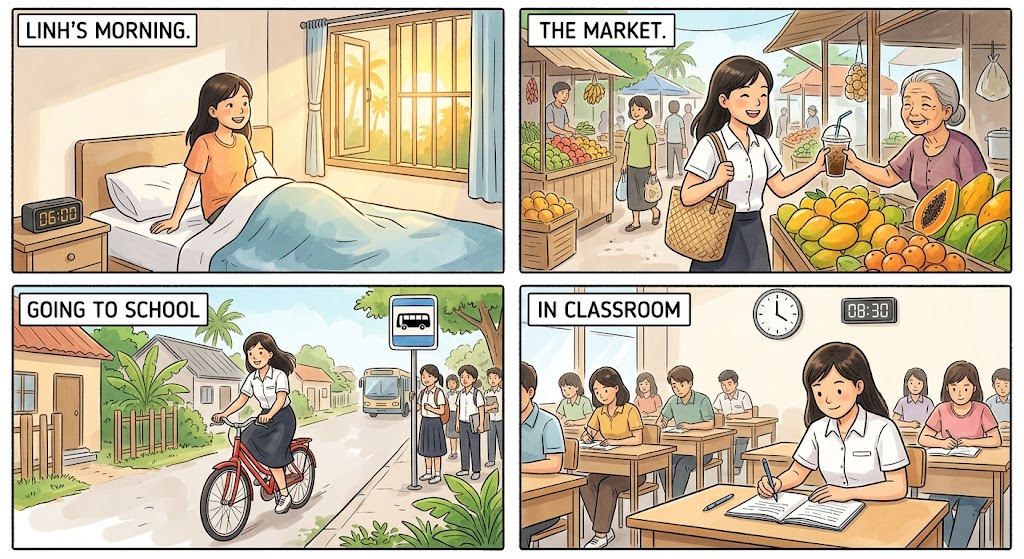
I wake up at 6:00 AM. The morning is warm and sunny.
I walk to the local market. I see fresh mangoes and papayas.
I buy an iced coffee. The drink is sweet and cold.
I ride my red bicycle. I go to the bus stop.
I am a university student. I sit in my classroom at 8:30 AM.
I open my notebook. I write the lesson.
I study hard. I love learning English.
##################s
Present Simple – how to………….
We use the present simple for things that happen every day, often, or generally.
1. I / You / We / They
Use the simple form of the verb.
I live in Asia.
You walk to school.
We study English.
They work in a hotel.
Be careful: Do not add -s.
❌ I lives in Asia. ✅ I live in Asia.
❌ They works in a hotel. ✅ They work in a hotel.
2. He / She / It
Add -s to the verb.
He lives in Asia.
She walks to school.
It looks nice.
❌ She walk to school. ✅ She walks to school.
3. Some verbs need -es
Add -es after verbs ending in -s, -sh, -ch, -x or -o.
wash → washes
watch → watches
go → goes
fix → fixes
Examples:
She goes to university.
He watches TV.
She washes her hands.
4. Verbs ending in -y
If a verb ends in consonant + y, change y to i and add -es.
study → studies
She studies English.
But:
play → plays
She plays tennis.
The verb BE
BE is different from normal verbs.
We use am, are, or is.
Positive form
Subject
BE
I
am
You
are
He
is
She
is
It
is
We
are
You
are
They
are
Examples:
I am a student.
You are happy.
He is tired.
She is from Asia.
It is hot.
We are students.
You are busy.
They are happy.
Important: BE and normal verbs are different
Normal verbs
With I / You / We / They:
I live here.
You work here.
We study English.
They play football.
With He / She / It:
He lives here.
She works here.
It looks good.
BE
I am a student.
You are a student.
He is a student.
She is a student.
It is good.
We are students.
You are students.
They are students.
Easy rule
Normal verb:
I / You / We / They → verb
I work. You work. We work. They work.
He / She / It → verb + s
He works. She works. It works.
BE:
I → am You → are He → is She → is It → is We → are You → are They → are
#################
Rewrite the story above, continue:
Her name is Linh. She _____ (live) in Southeast Asia. She _____ (wake) up at 6:00 AM. The morning _____ (be) warm and sunny. She _____ (walk) to the local market. She _____ (see) fresh mangoes and papayas. She _____ (buy) an iced coffee. The drink _____ (be) sweet and cold. She _____ (ride) her red bicycle. She _____ (go) to the bus stop. She _____ (be) a university student. She _____ (sit) in her classroom at 8:30 AM. She _____ (open) her notebook. She _____ (write) the lesson. She _____ (study) hard. She _____ (love) learning English.
##################
Correct version:
Her name is Linh. She lives in Southeast Asia. She wakes up at 6:00 AM. The morning is warm and sunny. She walks to the local market. She sees fresh mangoes and papayas. She buys an iced coffee. The drink is sweet and cold. She rides her red bicycle. She goes to the bus stop. She is a university student. She sits in her classroom at 8:30 AM. She opens her notebook. She writes the lesson. She studies hard. She loves learning English.
###################
True or false
Linh buys an iced coffee.
She wakes up at 7:00 AM.
Linh lives in Southeast Asia.
The drink is hot and sweet.
She walks to the local market.
Linh rides a red bicycle.
She sees fresh apples and bananas.
Linh is a university student.
She goes to the train station.
The morning is warm and sunny.
She sits in her classroom at 9:30 AM.
Linh opens a book.
She writes the lesson.
Linh studies French.
She loves learning English.
Linh rides a blue bicycle.
She sees fresh mangoes and papayas.
Linh buys a hot tea.
She goes to the bus stop.
Linh lives in Europe.
________________________
True: 1,3,5,6,8,10,13,15,17,19
_______________________
Correct version:
Linh buys an iced coffee.
She wakes up at 7:00 AM. – True is: She wakes up at 6:00 AM.
Linh lives in Southeast Asia.
The drink is hot and sweet. – True is: The drink is sweet and cold.
She walks to the local market.
Linh rides a red bicycle.
She sees fresh apples and bananas. – True is: She sees fresh mangoes and papayas.
Linh is a university student.
She goes to the train station. – True is: She goes to the bus stop.
The morning is warm and sunny.
She sits in her classroom at 9:30 AM. – True is: She sits in her classroom at 8:30 AM.
Linh opens a book. – True is: Linh opens her notebook.
She writes the lesson.
Linh studies French. – True is: Linh studies English.
She loves learning English.
Linh rides a blue bicycle. – True is: Linh rides a red bicycle.
She sees fresh mangoes and papayas.
Linh buys a hot tea. – True is: Linh buys an iced coffee.
She goes to the bus stop.
Linh lives in Europe. – True is: Linh lives in Southeast Asia.
#################
Complete the short answers from the text:
Where does Linh live? → She lives in __________.
What time does Linh wake up? → She wakes up at __________.
How is the morning? → The morning is __________ and __________.
Where does Linh walk? → She walks to the __________.
What does Linh see? → She sees fresh __________ and __________.
What does Linh buy? → She buys an __________.
How is the drink? → The drink is __________ and __________.
What does Linh ride? → She rides her __________ bicycle.
Where does Linh go? → She goes to the __________.
What is Linh? → She is a __________ student.
Where does Linh sit? → She sits in her __________.
What time does she sit in her classroom? → She sits in her classroom at __________.
What does Linh open? → She opens her __________.
What does Linh write? → She writes the __________.
What does Linh love? → She loves learning __________.
————————————-
Correct answers:
Where does Linh live? → She lives in Southeast Asia.
What time does Linh wake up? → She wakes up at 6:00 AM.
How is the morning? → The morning is warm and sunny.
Where does Linh walk? → She walks to the local market.
What does Linh see? → She sees fresh mangoes and papayas.
What does Linh buy? → She buys an iced coffee.
How is the drink? → The drink is sweet and cold.
What does Linh ride? → She rides her red bicycle.
Where does Linh go? → She goes to the bus stop.
What is Linh? → She is a university student.
Where does Linh sit? → She sits in her classroom.
What time does she sit in her classroom? → She sits in her classroom at 8:30 AM.
What does Linh open? → She opens her notebook.
What does Linh write? → She writes the lesson.
What does Linh love? → She loves learning English.
#################
Answer using only one word:
Name: __________
Place: __________
Fruit: __________
Drink: __________
Bicycle colour: __________
Student type: __________
Time: __________
Transport: __________
School item: __________
Subject: __________
———————————–
Correct answers:
Name: Linh
Place: Southeast Asia
Fruit: Mangoes
Drink: Coffee
Bicycle colour: Red
Student type: University
Time: 6:00
Transport: Bicycle
School item: Notebook
Subject: English
################
Choose the correct question word: Who, What, Where, When.
______ does Linh live?
______ does Linh wake up?
______ does she buy?
______ does she ride?
______ is Linh?
______ does she walk?
______ does she see at the market?
______ does she go?
______ does she sit at 8:30 AM?
______ does she open?
______ does she write?
______ does she love learning?
______ does she go to the bus stop?
______ is the drink?
______ rides the red bicycle?
——————————————
Correct answers:
Where does Linh live?
When does Linh wake up?
What does she buy?
What does she ride?
Who is Linh?
Where does she walk?
What does she see at the market?
Where does she go?
Where does she sit at 8:30 AM?
What does she open?
What does she write?
What does she love learning?
When does she go to the bus stop?
How is the drink?
Who rides the red bicycle?
##################
Choose the correct answer:
What time does Linh wake up? a) 8:30 AM b) 7:00 AM c) 6:00 AM
Where does Linh walk? a) To the local market b) To the hotel c) To the school
What does Linh see? a) Apples and bananas b) Mangoes and papayas c) Oranges and grapes
What does she buy? a) Water b) Tea c) Iced coffee
How is the drink? a) Sweet and cold b) Hot and sweet c) Cold and bitter
What colour is Linh’s bicycle? a) Green b) Red c) Blue
Where does Linh go? a) To the airport b) To the bus stop c) To the train station
What is Linh? a) A doctor b) A teacher c) A university student
What does Linh open? a) A notebook b) A bag c) A book
What does Linh love? a) Learning French b) Learning Chinese c) Learning English
__________________________ Answers: 1 c, 2 a, 3 b, 4 c, 5 a, 6 b, 7 b, 8 c, 9 a, 10 c _________________________
Correct answes:
What time does Linh wake up? → Linh wakes up at 6:00 AM.
Where does Linh walk? → Linh walks to the local market.
What does Linh see? → Linh sees fresh mangoes and papayas.
What does she buy? → She buys an iced coffee.
How is the drink? → The drink is sweet and cold.
What colour is Linh’s bicycle? → Linh’s bicycle is red.
Where does Linh go? → Linh goes to the bus stop.
What is Linh? → Linh is a university student.
What does Linh open? → Linh opens her notebook.
What does Linh love? → Linh loves learning English.
##################
Write 1–10 to show the correct order:
She opens her notebook.
She buys an iced coffee.
She studies hard.
She wakes up.
She goes to the bus stop.
She writes the lesson.
She walks to the local market.
She loves learning English.
She sits in her classroom at 8:30 AM.
She rides her red bicycle.
__________________________
Correct Order
4 – She wakes up.
7 – She walks to the local market.
2 – She buys an iced coffee.
10 – She rides her red bicycle.
5 – She goes to the bus stop.
9 – She sits in her classroom at 8:30 AM.
1 – She opens her notebook.
6 – She writes the lesson.
3 – She studies hard.
8 – She loves learning English.
###################
Match the beginning of each sentence with the correct ending:
Linh lives
She wakes up
The morning is
She walks to
She sees fresh
She buys
The drink is
She rides
She goes to
She is a
She sits in
She opens her
She writes
She studies
She loves learning
a) her classroom. b) an iced coffee. c) hard. d) at 6:00 AM. e) English. f) Southeast Asia. g) a university student. h) mangoes and papayas. i) the bus stop. j) her red bicycle. k) warm and sunny. l) the local market. m) sweet and cold. n) her notebook. o) the lesson.
_______________________
Full sentences:
Linh lives in Southeast Asia.
She wakes up at 6:00 AM.
The morning is warm and sunny.
She walks to the local market.
She sees fresh mangoes and papayas.
She buys an iced coffee.
The drink is sweet and cold.
She rides her red bicycle.
She goes to the bus stop.
She is a university student.
She sits in her classroom at 8:30 AM.
She opens her notebook.
She writes the lesson.
She studies hard.
She loves learning English.
#################
Answer in complete sentences:
Does she live in Northwest Asia or Southeast Asia?
YOU WRITE: She lives in South East Asia
Does she wake up at 6:00 AM or 7:00 AM?
Is the morning warm and sunny or cold and rainy?
Does she walk to the local market or the bus stop?
Does she see mangoes and papayas or apples and bananas?
Does she buy hot tea or an iced coffee?
Is the drink sweet and cold or hot and bitter?
Does she ride a blue bicycle or a red bicycle?
Does she go to the bus stop or the train station?
Is Linh a university student or a teacher?
Does she sit in her classroom at 8:30 AM or 9:30 AM?
Does she open her notebook or her bag?
Does she write the lesson or a letter?
Does she study hard or play outside?
Does she love learning French or English?
_______________________
Correct answers:
Does she live in Northwest Asia or Southeast Asia? → She lives in Southeast Asia.
Does she wake up at 6:00 AM or 7:00 AM? → She wakes up at 6:00 AM.
Is the morning warm and sunny or cold and rainy? → The morning is warm and sunny.
Does she walk to the local market or the bus stop? → She walks to the local market.
Does she see mangoes and papayas or apples and bananas? → She sees mangoes and papayas.
Does she buy hot tea or an iced coffee? → She buys an iced coffee.
Is the drink sweet and cold or hot and bitter? → The drink is sweet and cold.
Does she ride a blue bicycle or a red bicycle? → She rides a red bicycle.
Does she go to the bus stop or the train station? → She goes to the bus stop.
Is Linh a university student or a teacher? → Linh is a university student.
Does she sit in her classroom at 8:30 AM or 9:30 AM? → She sits in her classroom at 8:30 AM.
Does she open her notebook or her bag? → She opens her notebook.
Does she write the lesson or a letter? → She writes the lesson.
Does she study hard or play outside? → She studies hard.
Does she love learning French or English? → She loves learning English.
#################
####################
Complete, fill in:
Linh lives in Southeast Asia. → I __________ in Southeast Asia.
I wake up at 6:00 AM. → She __________ up at 6:00 AM.
She walks to the local market. → I __________ to the local market.
I see fresh mangoes and papayas. → She __________ fresh mangoes and papayas.
Linh buys an iced coffee. → I __________ an iced coffee.
I ride my red bicycle. → She __________ her red bicycle.
She goes to the bus stop. → I __________ to the bus stop.
I am a university student. → She __________ a university student.
She opens her notebook. → I __________ my notebook.
I love learning English. → She __________ learning English.
———————————————
Correct version:
Linh lives in Southeast Asia. → I live in Southeast Asia.
I wake up at 6:00 AM. → She wakes up at 6:00 AM.
She walks to the local market. → I walk to the local market.
I see fresh mangoes and papayas. → She sees fresh mangoes and papayas.
Linh buys an iced coffee. → I buy an iced coffee.
I ride my red bicycle. → She rides her red bicycle.
She goes to the bus stop. → I go to the bus stop.
I am a university student. → She is a university student.
She opens her notebook. → I open my notebook.
I love learning English. → She loves learning English.
##################
##################
##################
Please use the box below to write your feedback. Only I can read it. It is not public.
Babies learn a language by listening. They use their ears to hear sounds. Their brain remembers these sounds. Babies connect sounds with people and things. They listen to their parents. Then they copy the sounds they hear. They imitate words. Slowly, babies learn to speak.
We use the Past Simple for an action that started and finished in the past.
Example:
I lived in Cambodia when I was 15.
My father cleaned the rooms.
I went to school at seven o’clock.
1. Regular verbs
For most verbs, add -ed:
Present
Past
work
worked
clean
cleaned
help
helped
visit
visited
want
wanted
Some spelling changes are needed:
like → liked
study → studied
stop → stopped
2. Irregular verbs
Some verbs do not use -ed. You must learn their past forms.
go → went
have → had
eat → ate
come → came
speak → spoke
bring → brought
do → did
3. Positive sentences
Subject + past verb
I worked.
She helped her mother.
We visited the temple.
They went to school.
The past verb is the same for all subjects:
I worked.
He worked.
They worked.
4. Negative sentences
Use did not (didn’t) + infinitive:
I didn’t work.
She didn’t go to school.
We didn’t eat breakfast.
⚠️ After didn’t, use the infinitive, not the past form.
❌ I didn’t went. ✅ I didn’t go.
5. Questions
Use Did + subject + infinitive?
Did you work?
Did she go to school?
Did they visit Cambodia?
Short answers:
Yes, I did.
No, I didn’t.
Yes, I was.
No, they weren’t.
6. When do we use it?
Use the Past Simple when we talk about finished actions or situations in the past.
Common past-time words are:
yesterday
last week
last year
two days ago
when I was 15
in 1980
Example: “I worked at my family’s guesthouse when I was 15.”
The action happened in the past and is finished now.
#####################
Infinitive
Past
A1 definition
be
was / were
to exist or to say what someone or something is
live
lived
to have your home in a place
have
had
to own or to get something
come
came
to move to a place
visit
visited
to go to a person or place for a short time
eat
ate
to put food in your mouth and swallow it
work
worked
to do a job
make
made
to create or prepare something
clean
cleaned
to make something not dirty
help
helped
to do something for another person
get up
got up
to leave your bed
open
opened
to move something so you can enter or see inside
put
put
to move something to a place
ask
asked
to say something when you want information
speak
spoke
to talk in a language
go
went
to move from one place to another
like
liked
to enjoy something
want
wanted
to have a wish for something
talk
talked
to speak with someone
change
changed
to put on different clothes or make something different
bring
brought
to take something with you to a place
do
did
to perform an action or activity
meet
met
to see and talk to someone for the first time or at a planned time
learn
learned
to get new knowledge or skill
__________________________
Vocabulary:
a guesthouse – a small place where people can stay and sleep.
a visitor – a person who comes to a place.
breakfast – the first meal of the day, in the morning.
a cup – a small container for drinking tea, coffee, or water.
sometimes – not always; on some days.
a bag – something you use to carry things.
a bicycle – a vehicle with two wheels. You ride it.
clothes – things you wear, like a shirt, trousers, or a dress.
countries – places like Cambodia, France, Japan, or Australia.
to be tired – to need rest because you have worked or done a lot.
##################
Fill in, past simple:
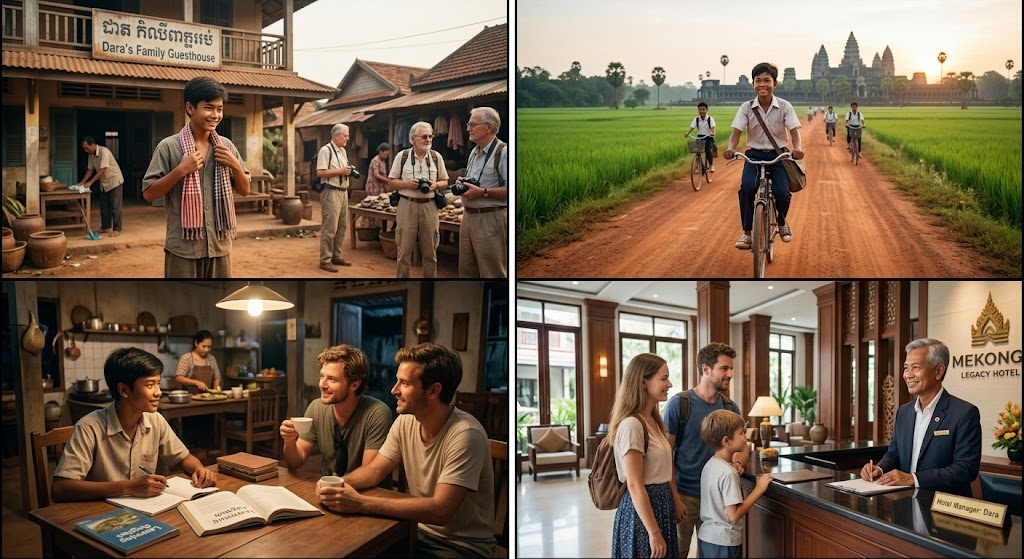
My name is Dara. I am 63 years old. When I _____ (be) 15 years old, I _____ (live) with my family in a small town in Cambodia. Many visitors _____ (come) to our town. They _____ (visit) old temples and _____ (eat) Cambodian food.
My family _____ (have) a small guesthouse. It _____ (be) near the market. We _____ (have) eight rooms. My father and mother _____ (work) there every day. My mother _____ (make) breakfast for the guests. My father _____ (clean) the rooms. My older sister _____ (help) them.
I _____ (get up) at six o’clock every morning. Before school, I _____ (help) my family. First, I _____ (open) the windows. Then I _____ (clean) the tables and chairs. I _____ (put) water and cups in the rooms. Sometimes, I _____ (help) my father with the guests’ bags.
At seven o’clock, I _____ (have) breakfast with my family. Then I _____ (go) to school by bicycle. My school _____ (be) three kilometres from our guesthouse. I like school. I _____ (like) English very much. I _____ (want) to speak English well because some guests _____ (speak) English.
I _____ (come) home at four o’clock. I _____ (change) my clothes and _____ (go) to the guesthouse. I _____ (help) my mother. I _____ (bring) food and drinks to the guests. I also _____ (talk) to them. I _____ (ask) them where they _____ (come) from. I _____ (like) talking to people from other countries.
In the evening, I _____ (do) my homework. Then I _____ (help) my parents again. I _____ (be) sometimes tired, but I _____ (be) happy.
I _____ (like) working at our guesthouse. I _____ (meet) many people and _____ (learn) many new things. I _____ (want) to work in a hotel when I _____ (be) older.
Now I am 63 years old. I work in a hotel. I still like meeting people and helping guests. I am happy with my job.
——————————————-
Correct version:
My name is Dara. I am 63 years old. When I was 15 years old, I lived with my family in a small town in Cambodia. Many visitors came to our town. They visited old temples and ate Cambodian food.
My family had a small guesthouse. It was near the market. We had eight rooms. My father and mother worked there every day. My mother made breakfast for the guests. My father cleaned the rooms. My older sister helped them.
I got up at six o’clock every morning. Before school, I helped my family. First, I opened the windows. Then I cleaned the tables and chairs. I put water and cups in the rooms. Sometimes, I helped my father with the guests’ bags.
At seven o’clock, I had breakfast with my family. Then I went to school by bicycle. My school was three kilometres from our guesthouse. I like school. I liked English very much. I wanted to speak English well because some guests spoke English.
I came home at four o’clock. I changed my clothes and went to the guesthouse. I helped my mother. I brought food and drinks to the guests. I also talked to them. I asked them where they came from. I liked talking to people from other countries.
In the evening, I did my homework. Then I helped my parents again. I was sometimes tired, but I was happy.
I liked working at our guesthouse. I met many people and learned many new things. I wanted to work in a hotel when I was older.
Now I am 63 years old. I work in a hotel. I still like meeting people and helping guests. I am happy with my job.
######################
True or False
Dara asked guests where they came from.
Dara’s father made breakfast for the guests.
Dara did his homework in the evening.
Dara travelled to school by train.
His school was three kilometres from the guesthouse.
Dara is 63 years old now.
The family had twelve rooms.
Dara brought food and drinks to the guests.
Dara played football after school.
His father cleaned the rooms.
Dara wanted to become a doctor.
Some guests spoke English.
Dara studied at home every morning.
Dara wanted to work in a hotel when he was older.
Dara’s mother cleaned the guesthouse rooms.
Dara got up at six o’clock every morning.
Dara never talked to the guests.
His family had a small guesthouse.
Dara now works in a restaurant.
Dara lived in a large city as a teenager.
____________________________
True: 1,3,5,6,8,10,12,14,16,18
___________________________
Correct version:
Dara lived in a large city as a teenager. True is: Dara lived in a small town in Cambodia.
Dara asked guests where they came from.
Dara’s father made breakfast for the guests. True is: Dara’s mother made breakfast for the guests.
Dara did his homework in the evening.
Dara travelled to school by train. True is: Dara went to school by bicycle.
His school was three kilometres from the guesthouse.
Dara is 63 years old now.
The family had twelve rooms. True is: The family had eight rooms.
Dara brought food and drinks to the guests.
Dara played football after school. True is: Dara helped his mother after school.
His father cleaned the rooms.
Dara wanted to become a doctor. True is: Dara wanted to work in a hotel when he was older.
Some guests spoke English.
Dara studied at home every morning. True is: Dara helped his family before school.
Dara wanted to work in a hotel when he was older.
Dara’s mother cleaned the guesthouse rooms. True is: Dara’s mother made breakfast for the guests.
Dara got up at six o’clock every morning.
Dara never talked to the guests. True is: Dara talked to the guests.
His family had a small guesthouse.
Dara now works in a restaurant. True is: Dara now works in a hotel.
Dara lived in a large city as a teenager. True is: Dara lived in a small town in Cambodia.
####################
Match the word with the definition
guesthouse
visitor
breakfast
cup
bag
bicycle
clothes
country
market
guest
tired
school
hotel
room
family
a. a place where people learn b. a person who stays at a hotel or guesthouse c. things you wear d. a place where people can buy and sell things e. a place where people sleep or stay f. a small place where visitors can stay g. a person who comes to a place h. the first meal of the day i. a vehicle with two wheels j. a group of parents and children k. a place such as Cambodia or Japan l. a place where people can stay when they travel m. needing rest n. a container for drinking o. something used to carry things
came · ate · had · went · got up · put · spoke · met · guesthouse · visitor · breakfast · cup · bag · bicycle · clothes · tired · market
Dara _____ at six o’clock every morning.
Many visitors _____ to the town.
They _____ Cambodian food.
Dara’s family _____ eight rooms.
He _____ water and cups in the rooms.
Dara _____ to school by bicycle.
Some guests _____ English.
Dara _____ many people from other countries.
His family had a small _____ near the market.
A _____ is a person who comes to a place.
Dara had _____ with his family at seven o’clock.
He put water in a _____.
Dara helped his father with the guests’ _____.
He changed his _____ after school.
Dara was sometimes _____ in the evening.
—————————————–
Correct version:
Dara got up at six o’clock every morning.
Many visitors came to the town.
They ate Cambodian food.
Dara’s family had eight rooms.
He put water and cups in the rooms.
Dara went to school by bicycle.
Some guests spoke English.
Dara met many people from other countries.
His family had a small guesthouse near the market.
A visitor is a person who comes to a place.
Dara had breakfast with his family at seven o’clock.
He put water in a cup.
Dara helped his father with the guests’ bag.
He changed his clothes after school.
Dara was sometimes tired in the evening.
###################
Answer:
Was Dara 15 or 25 years old when he lived with his family?
YOU WRITE: Dara was 15 years old when he lived with his family.
Did many or few visitors come to his town?
Did his family have eight or ten rooms?
Was the guesthouse near the market or the school?
Did his mother or father make breakfast?
Did his father clean the rooms or the windows?
Did his older sister help him or his parents?
Did Dara get up at six or seven o’clock?
Did he clean the tables or the floors before school?
Did he put water and cups or books in the rooms?
Did he go to school by bicycle or bus?
Was his school three or five kilometres from the guesthouse?
Did Dara like English or French very much?
Did some guests speak English or German?
Did Dara come home at four or five o’clock?
Did he bring food and drinks or books to the guests?
Did he ask the guests where they came from or where they worked?
Did Dara do his homework in the evening or in the morning?
Did he want to work in a hotel or a school when he was older?
Does Dara work in a hotel or a restaurant now?
_________________________
Correct answers:
Dara was 15 years old when he lived with his family.
Many visitors came to his town.
His family had eight rooms.
The guesthouse was near the market.
His mother made breakfast.
His father cleaned the rooms.
His older sister helped his parents.
Dara got up at six o’clock.
He cleaned the tables and chairs before school.
He put water and cups in the rooms.
He went to school by bicycle.
His school was three kilometres from the guesthouse.
Dara liked English very much.
Some guests spoke English.
Dara came home at four o’clock.
He brought food and drinks to the guests.
He asked the guests where they came from.
Dara did his homework in the evening.
He wanted to work in a hotel when he was older.
Dara works in a hotel now.
######################
Short answers, past simple, basics:
Example Sentence
Yes
No
I learned letters.
Yes, I did.
No, I didn’t.
You read signs.
Yes, you did.
No, you didn’t.
He spoke English.
Yes, he did.
No, he didn’t.
She watched TV.
Yes, she did.
No, she didn’t.
It helped me.
Yes, it did.
No, it didn’t.
We used an app.
Yes, we did.
No, we didn’t.
You read words.
Yes, you did.
No, you didn’t.
They made mistakes.
Yes, they did.
No, they didn’t.
Questions (Past Simple)
Question
Yes
No
Did I learn letters?
Yes, I did.
No, I didn’t.
Did you read signs?
Yes, you did.
No, you didn’t.
Did he speak English?
Yes, he did.
No, he didn’t.
Did she watch TV?
Yes, she did.
No, she didn’t.
Did it help me?
Yes, it did.
No, it didn’t.
Did we use an app?
Yes, we did.
No, we didn’t.
Did you read words?
Yes, you did.
No, you didn’t.
Did they make mistakes?
Yes, they did.
No, they didn’t.
Was / Were
Question
Yes
No
Was I happy?
Yes, I was.
No, I wasn’t.
Were you happy?
Yes, you were.
No, you weren’t.
Was he happy?
Yes, he was.
No, he wasn’t.
Was she happy?
Yes, she was.
No, she wasn’t.
Was it good?
Yes, it was.
No, it wasn’t.
Were we happy?
Yes, we were.
No, we weren’t.
Were you happy?
Yes, you were.
No, you weren’t.
Were they happy?
Yes, they were.
No, they weren’t.
#################
Short answers:
Dara brought food and drinks to the guests.
YOU WRITE: Yes, she did.
Dara was 18 years old when he lived in Cambodia.
His father cleaned the rooms.
Dara went to school by bus.
The guesthouse had eight rooms.
Dara’s mother liked talking to people from other countries.
His mother worked in a school.
Dara got up at six o’clock every morning.
His school was five kilometres from the guesthouse.
Dara did his homework in the evening.
Many visitors came to the town.
Dara’s family had a large hotel.
Dara wanted to work in a hotel when he was older.
His older sister helped his parents.
Dara came home at five o’clock.
Some guests spoke English.
Dara put books and pencils in the rooms.
The guesthouse was near the market.
Dara worked in a restaurant when he was young.
Dara asked guests where they came from.
Dara was sometimes tired in the evening.
Dara went to school on foot.
Dara is 63 years old now.
Dara stopped working with guests when he became older.
He still likes meeting people and helping guests.
Dara’s parents were farmers.
___________________________
Correct answers:
Dara brought food and drinks to the guests. Yes, he did.
Dara was 18 years old when he lived in Cambodia. No, he wasn’t.
His father cleaned the rooms. Yes, he did.
Dara went to school by bus. No, he didn’t.
The guesthouse had eight rooms. Yes, it did.
Dara’s mother liked talking to people from other countries. No, she didn’t.
His mother worked in a school. No, she didn’t.
Dara got up at six o’clock every morning. Yes, he did.
His school was five kilometres from the guesthouse. No, it wasn’t.
Dara did his homework in the evening. Yes, he did.
Many visitors came to the town. Yes, they did.
Dara’s family had a large hotel. No, they didn’t.
Dara wanted to work in a hotel when he was older. Yes, he did.
His older sister helped his parents. Yes, she did.
Dara came home at five o’clock. No, he didn’t.
Some guests spoke English. Yes, they did.
Dara put books and pencils in the rooms. No, he didn’t.
The guesthouse was near the market. Yes, it was.
Dara worked in a restaurant when he was young. No, he didn’t.
Dara asked guests where they came from. Yes, he did.
Dara was sometimes tired in the evening. Yes, he was.
Dara went to school on foot. No, he didn’t.
Dara is 63 years old now. Yes, he is.
Dara stopped working with guests when he became older. No, he didn’t.
He still likes meeting people and helping guests. Yes, he does.
Dara’s parents were farmers. No, they weren’t.
####################
Basics in past simple:
Personal Pronoun
Verb (Past)
Object
I
ate
apples
You
ate
apples
He
ate
apples
She
ate
apples
It
ate
apples
We
ate
apples
You (plural)
ate
apples
They
ate
apples
I
played
football
You
played
football
He
played
football
She
played
football
It
played
football
We
played
football
You (plural)
played
football
They
played
football
Personal Pronoun
Verb (Past Negative)
Object
I
did not eat
apples
You
did not eat
apples
He
did not eat
apples
She
did not eat
apples
It
did not eat
apples
We
did not eat
apples
You (plural)
did not eat
apples
They
did not eat
apples
I
did not play
football
You
did not play
football
He
did not play
football
She
did not play
football
It
did not play
football
We
did not play
football
You (plural)
did not play
football
They
did not play
football
Did + Pronoun
Verb
Object
Did I
eat
apples?
Did you
eat
apples?
Did he
eat
apples?
Did she
eat
apples?
Did it
eat
apples?
Did we
eat
apples?
Did you
eat
apples?
Did they
eat
apples?
Did I
play
football?
Did you
play
football?
Did he
play
football?
Did she
play
football?
Did it
play
football?
Did we
play
football?
Did you
play
football?
Did they
play
football?
Didn’t + Pronoun
Verb
Object
Didn’t I
eat
apples?
Didn’t you
eat
apples?
Didn’t he
eat
apples?
Didn’t she
eat
apples?
Didn’t it
eat
apples?
Didn’t we
eat
apples?
Didn’t you
eat
apples?
Didn’t they
eat
apples?
Didn’t I
play
football?
Didn’t you
play
football?
Didn’t he
play
football?
Didn’t she
play
football?
Didn’t it
play
football?
Didn’t we
play
football?
Didn’t you
play
football?
Didn’t they
play
football?
##################
Past simple forms of ‚to be‘:
Person
Past
I
was
You
were
He/She/It
was
We
were
You (pl)
were
They
were
Person
Question
I
Was I …?
You
Were you …?
He/She/It
Was he/she/it …?
We
Were we …?
You (pl)
Were you …?
They
Were they …?
Person
Negative
I
I was not (I wasn’t)
You
You were not (You weren’t)
He/She/It
He/She/It was not (He/She/It wasn’t)
We
We were not (We weren’t)
You (pl)
You were not (You weren’t)
They
They were not (They weren’t)
Person
Negative Question
I
Wasn’t I …?
You
Weren’t you …?
He/She/It
Wasn’t he/she/it …?
We
Weren’t we …?
You (pl)
Weren’t you …?
They
Weren’t they …?
##################
Answer as shown in #1:
Dara was 15 years old when he lived with his family in Cambodia.
YOU WRITE: a) question: Was Dara 15 years old when he lived with his family in Cambodia? b) negation: Dara was not 15 years old when he lived with his family in Cambodia. c) negative question: Wasn’t Dara 15 years old when he lived with his family in Cambodia?
His father cleaned the rooms every day.
Dara got up at six o’clock every morning.
He went to school by bicycle.
His school was three kilometres from the guesthouse.
Some guests spoke English.
Dara brought food and drinks to the guests.
Dara asked guests where they came from.
Dara and his family were happy at the guesthouse.
He wanted to work in a hotel when he was older.
____________________________
Correct version:
Dara was 15 years old when he lived with his family in Cambodia. a) question: Was Dara 15 years old when he lived with his family in Cambodia? b) negation: Dara was not 15 years old when he lived with his family in Cambodia. c) negative question: Wasn’t Dara 15 years old when he lived with his family in Cambodia?
His father cleaned the rooms every day. a) question: Did his father clean the rooms every day? b) negation: His father did not clean the rooms every day. c) negative question: Didn’t his father clean the rooms every day?
Dara got up at six o’clock every morning. a) question: Did Dara get up at six o’clock every morning? b) negation: Dara did not get up at six o’clock every morning. c) negative question: Didn’t Dara get up at six o’clock every morning?
He went to school by bicycle. a) question: Did he go to school by bicycle? b) negation: He did not go to school by bicycle. c) negative question: Didn’t he go to school by bicycle?
His school was three kilometres from the guesthouse. a) question: Was his school three kilometres from the guesthouse? b) negation: His school was not three kilometres from the guesthouse. c) negative question: Wasn’t his school three kilometres from the guesthouse?
Some guests spoke English. a) question: Did some guests speak English? b) negation: Some guests did not speak English. c) negative question: Didn’t some guests speak English?
Dara brought food and drinks to the guests. a) question: Did Dara bring food and drinks to the guests? b) negation: Dara did not bring food and drinks to the guests. c) negative question: Didn’t Dara bring food and drinks to the guests?
Dara asked guests where they came from. a) question: Did Dara ask guests where they came from? b) negation: Dara did not ask guests where they came from. c) negative question: Didn’t Dara ask guests where they came from?
Dara and his family were happy at the guesthouse. a) question: Were Dara and his family happy at the guesthouse? b) negation: Dara and his family were not happy at the guesthouse. c) negative question: Weren’t Dara and his family happy at the guesthouse?
He wanted to work in a hotel when he was older.
a) question: Did he want to work in a hotel when he was older? b) negation: He did not want to work in a hotel when he was older. c) negative question: Didn’t he want to work in a hotel when he was older?
####################
Who + past verb — no “did”
When who is the person who does the action, do not use did.
Who made breakfast?
Who cleaned the rooms?
Who helped Dara?
Who brought the food?
Who opened the windows?
Who worked at the guesthouse?
The structure is:
Who + past verb + …?
❌ Who did make breakfast? ✅ Who made breakfast?
####################
Complete each question with the correct form of the verb in brackets.
Where __________ (live) Dara? YOU WRITE: Where did Dara live?
How old __________ (be) Dara?
What time __________ (get up) Dara?
How __________ (go) Dara to school?
How far __________ (be) his school from the guesthouse?
What __________ (eat) the visitors?
Who __________ (make) breakfast?
How many rooms __________ (have) the family?
When __________ (do) Dara his homework?
What __________ (bring) Dara to the guests?
Who __________ (help) his older sister?
What language __________ (speak) some guests?
What time __________ (come) Dara home?
Who __________ (meet) Dara?
Why __________ (want) Dara to speak English well?
———————————————
Correct questions:
Where did Dara live?
How old was Dara?
What time did Dara get up?
How did Dara go to school?
How far was his school from the guesthouse?
What did the visitors eat?
Who made breakfast?
How many rooms did the family have?
When did Dara do his homework?
What did Dara bring to the guests?
Who did his older sister help?
What language did some guests speak?
What time did Dara come home?
Who did Dara meet?
Why did Dara want to speak English well?
####################
Interview with Dara – match question and answer:
Questions
How old were you when you lived in Cambodia?
Where did you live when you were 15?
What was your family’s business?
How many rooms did you have?
What was your mother’s job?
What was your father’s job?
What time did your day start?
How did you travel to school?
What was your favourite subject?
Why was English important to you?
How did you help your mother after school?
What information did you want from the guests?
How did you spend your evening?
What was your dream for the future?
Where did you work when you were young?
What did you enjoy at the guesthouse?
Answers
a) I brought food and drinks to the guests.
b) I was 15 years old.
c) I wanted to work in a hotel.
d) I liked English very much.
e) I liked meeting people and helping guests.
f) He cleaned the rooms.
g) I lived in a small town in Cambodia.
h) I did my homework and helped my parents.
i) We had eight rooms.
j) I asked them where they came from.
k) Some guests spoke English.
l) She made breakfast for the guests.
m) I got up at six o’clock.
n) I worked at our guesthouse.
o) We had a small guesthouse.
p) I went to school by bicycle.
__________________________
Full dialogue:
Interviewer: How old were you when you lived in Cambodia? Dara:I was 15 years old.
Interviewer: Where did you live when you were 15? Dara:I lived in a small town in Cambodia.
Interviewer: What was your family’s business? Dara:We had a small guesthouse.
Interviewer: How many rooms did you have? Dara:We had eight rooms.
Interviewer: What was your mother’s job? Dara:She made breakfast for the guests.
Interviewer: What was your father’s job? Dara:He cleaned the rooms.
Interviewer: What time did your day start? Dara:I got up at six o’clock.
Interviewer: How did you travel to school? Dara:I went to school by bicycle.
Interviewer: What was your favourite subject? Dara:I liked English very much.
Interviewer: Why was English important to you? Dara:Some guests spoke English.
Interviewer: How did you help your mother after school? Dara:I brought food and drinks to the guests.
Interviewer: What information did you want from the guests? Dara:I asked them where they came from.
Interviewer: How did you spend your evening? Dara:I did my homework and helped my parents.
Interviewer: What was your dream for the future? Dara:I wanted to work in a hotel.
Interviewer: Where did you work when you were young? Dara:I worked at our guesthouse.
Interviewer: What did you enjoy at the guesthouse? Dara:I liked meeting people and helping guests.
###################
##################
##################
Please use the box below to write your feedback. Only I can read it. It is not public.
Babies learn a language by listening. They use their ears to hear sounds. Their brain remembers these sounds. Babies connect sounds with people and things. They listen to their parents. Then they copy the sounds they hear. They imitate words. Slowly, babies learn to speak.
We use the present simple for things that happen regularly, every day, or are generally true.
Lina rides her bicycle every morning.
She studies English every day.
She likes her bicycle.
1. I / You / We / They
Use the basic form of the verb.
I live in a village.
You like English.
We study every day.
They work hard.
2. He / She / It
Usually, add -s.
She lives in a village.
He likes English.
She wants to be a teacher.
It works well.
Most verbs: add -s
Basic verb
He / She / It
live
lives
like
likes
want
wants
work
works
help
helps
read
reads
listen
listens
talk
talks
learn
learns
3. Verbs ending in -y
If a verb ends in consonant + y, change y to ies.
study → studies
try → tries
carry → carries
Examples:
I study English.
She studies English.
They try hard.
He tries hard.
But: vowel [a,e,i,o,u] + y → just add -s
play → plays
stay → stays
enjoy → enjoys
Example:
I play football.
She plays football.
4. Have → Has
Have is different.
I have a bicycle.
You have a bicycle.
We have a bicycle.
They have a bicycle.
She has a bicycle.
He has a bicycle.
It has four legs.
5. Be → am / is / are
Be is also different.
Subject
Be
I
am
You
are
We
are
They
are
He
is
She
is
It
is
Examples:
I am 16 years old.
You are happy.
We are students.
They are from Cambodia.
She is 16 years old.
He is a teacher.
6. Questions
With most verbs, use do or does.
I / you / we / they → DO
Do you like English?
Do they study every day?
he / she / it → DOES
Does Lina like English?
Does she study every day?
Important!
After does, use the basic verb.
❌ Does she studies English? ✅ Does she study English?
❌ Does Lina likes her bicycle? ✅ Does Lina like her bicycle?
7. Negative sentences
Use don’t or doesn’t.
I / you / we / they → don’t
I don’t like English.
They don’t study every day.
he / she / it → doesn’t
She doesn’t like English.
Lina doesn’t study every day.
Again, after doesn’t, use the basic verb.
❌ She doesn’t studies English. ✅ She doesn’t study English.
❌ Lina doesn’t likes her bicycle. ✅ Lina doesn’t like her bicycle.
The most important rule
Positive sentences:
I / You / We / They → basic verb
I study.
He / She / It → verb + s
She studies.
Questions and negatives:
do / does + basic verb
Does she study? She doesn’t study.
Remember:
I study → She studies I live → She lives I like → She likes I have → She has I am → She is
##################
Vocabulary:
a village – a small place where people live, smaller than a town
to ride a bicycle – to sit on a bicycle and move with it
to be far from home – to be a long way from your house
at first – at the beginning
short stories – stories that are not long
to listen to songs – to hear songs carefully
to work hard – to do a lot of work and try very much
to believe in a dream – to think that your dream can happen
to teach English – to help people learn English
a dream comes true – something you want really happens
a small step – a small action that helps you move forward
tomorrow – the day after today
__________________________
My name is Lina. I am 16 years old. I live in a small village with my family.
Every morning, I ride my bicycle to school. My school is far from my home, so I ride many kilometres every day. I like my bicycle very much.
I love English. I want to be an English teacher. I want to help the children in my village.
At first, English is difficult for me. I know only a few English words. But I study every day. I learn new words. I read short English stories. I listen to English songs. When tourists come to my village, I talk to them in English.
I work hard. I am happy when I learn new words. My English gets better every day. I believe in my dream.
Many years later, I come back to my village. I am an English teacher now.
The children are happy to see me. I teach them English. I help them read, write and speak.
I am happy too. I have a good job, and I help the children in my village.
My dream comes true.
####################
Now rewrite the story, make all changes necessary:
Her name is Lina. She _____ (be) 16 years old. She _____ (live) in a small village with her family.
Every morning, Lina _____ (ride) her bicycle to school. Her school is far from her home, so she _____ (ride) many kilometres every day. She _____ (like) her bicycle very much.
Lina _____ (love) English. She _____ (want) to be an English teacher. She _____ (want) to help the children in her village.
At first, English is difficult for Lina. She _____ (know) only a few English words. But she _____ (study) every day. She _____ (learn) new words. She reads short English stories. She listens to English songs. When tourists come to her village, she _____ (talk) to them in English.
Lina _____ (work) hard. She is happy when she _____ (learn) new words. Her English _____ (get) better every day. She _____ (believe) in her dream.
Many years later, Lina _____ (come) back to her village. She is an English teacher now.
The children are happy to see her. Lina _____ (teach) them English. She _____ (help) them read, write and speak.
Lina is happy too. She _____ (have) a good job, and she _____ (help) the children in her village.
Her dream _____ (come) true.
———————————
Correct version:
Her name is Lina. She is 16 years old. She lives in a small village with her family.
Every morning, Lina rides her bicycle to school. Her school is far from her home, so she rides many kilometres every day. She likes her bicycle very much.
Lina loves English. She wants to be an English teacher. She wants to help the children in her village.
At first, English is difficult for Lina. She knows only a few English words. But she studies every day. She learns new words. She reads short English stories. She listens to English songs. When tourists come to her village, she talks to them in English.
Lina works hard. She is happy when she learns new words. Her English gets better every day. She believes in her dream.
Many years later, Lina comes back to her village. She is an English teacher now.
The children are happy to see her. Lina teaches them English. She helps them read, write and speak.
Lina is happy too. She has a good job, and she helps the children in her village.
Her dream comes true.
##################
Match the words and definitions
Words
a village
to ride a bicycle
to be far from home
at first
short stories
to listen to songs
to work hard
to believe in a dream
to teach English
a dream comes true
a small step
tomorrow
Definitions
A. The day after today. B. To help people learn English. C. A small action that helps you move forward. D. To sit on a bicycle and move with it. E. To do a lot of work and try very much. F. Stories that are not long. G. At the beginning. H. To think that your dream can happen. I. A small place where people live, smaller than a town. J. Something you want really happens. K. To hear songs carefully. L. To be a long way from your house.
A small place where people live, smaller than a town.
To think that your dream can happen.
The day after today.
To do a lot of work and try very much.
Something you want really happens.
To sit on a bicycle and move with it.
A small action that helps you move forward.
Stories that are not long.
To help people learn English.
To be a long way from your house.
Words
A. tomorrow B. to work hard C. a dream comes true D. short stories E. to ride a bicycle F. a small step G. to teach English H. a village I. to believe in a dream J. to listen to songs K. to be far from home L. at first
How does Lina feel when she learns new words? – Happy
What does Lina read? – Short English stories
When is English difficult for Lina? – At first
What does Lina want to help the children do? – Read, write and speak
What does Lina do every morning? – Rides her bicycle to school
What happens to Lina’s English? – It gets better every day
Where does Lina teach English? – In her village
What happens to Lina’s dream? – It comes true
##################
Fill in, words below:
tomorrow – tourists – reads – bicycle – dream – children – studies – school – songs – teacher – village – listens – English – teaches – words – stories
Lina lives in a small __________.
Every morning, Lina rides her __________ to school.
Her __________ is far from her home.
Lina loves __________.
She wants to be an English __________.
She wants to help the __________ in her village.
She learns new __________ every day.
Lina __________ short English stories.
She __________ to English songs.
Lina talks to __________ in her village.
Lina believes in her __________.
She __________ English every day.
Lina __________ English to the children.
Her English gets better every day, and her __________ comes true.
A small step today can help make a better __________.
Lina has a good job, and she __________ the children in her village.
————————————-
Full version:
Lina lives in a small village.
Every morning, Lina rides her bicycle to school.
Her school is far from her home.
Lina loves English.
She wants to be an English teacher.
She wants to help the children in her village.
She learns new words every day.
Lina reads short English stories.
She listens to English songs.
Lina talks to tourists in her village.
Lina believes in her dream.
She studies English every day.
Lina teaches English to the children.
Her English gets better every day, and her dream comes true.
A small step today can help make a better tomorrow.
Lina has a good job, and she teaches the children in her village.
#################
Short answers, basics:
Example Sentence
Yes
No
I learn the alphabet.
Yes, I do.
No, I don’t.
You read signs.
Yes, you do.
No, you don’t.
He practices speaking.
Yes, he does.
No, he doesn’t.
She watches cartoons.
Yes, she does.
No, she doesn’t.
It helps us learn English.
Yes, it does.
No, it doesn’t.
We use apps like Duolingo.
Yes, we do.
No, we don’t.
You read labels.
Yes, you do.
No, you don’t.
They make mistakes sometimes.
Yes, they do.
No, they don’t.
Question
Yes
No
Do I learn the alphabet?
Yes, I do.
No, I don’t.
Do you read signs?
Yes, you do.
No, you don’t.
Does he practice speaking?
Yes, he does.
No, he doesn’t.
Does she watch cartoons?
Yes, she does.
No, she doesn’t.
Does it help us learn English?
Yes, it does.
No, it doesn’t.
Do we use apps like Duolingo?
Yes, we do.
No, we don’t.
Do you read labels?
Yes, you do.
No, you don’t.
Do they make mistakes sometimes?
Yes, they do.
No, they don’t.
Question
Yes
No
Am I big?
Yes, I am.
No, I am not.
Are you big?
Yes, you are.
No, you aren’t.
Is he big?
Yes, he is.
No, he isn’t.
Is she big?
Yes, she is.
No, she isn’t.
Is it big?
Yes, it is.
No, it isn’t.
Are we big?
Yes, we are.
No, we aren’t.
Are you big?
Yes, you are.
No, you aren’t.
Are they big?
Yes, they are.
No, they aren’t.
#################
Short answers:
Lina works hard for her dream.
YOU WRITE: Yes, she does.
Lina wants to become a doctor.
Lina is 14 years old.
She comes back to her village many years later.
Lina stops studying when English is difficult.
She talks to tourists in English.
Lina has a bad job when she becomes a teacher.
Lina lives with her family.
She never speaks to tourists.
Lina knows only a few English words at first.
Lina wants to be an English teacher.
The children are angry when Lina returns.
She learns new words every day.
Lina rides a bicycle only on weekends.
Lina forgets her dream after leaving school.
She teaches English in another country.
Lina helps the children read, write and speak.
The children are happy with a great teacher.
_________________________
Correct version:
Lina works hard for her dream. Yes, she does.
Lina wants to become a doctor. No, she doesn’t.
Lina is 14 years old. No, she isn’t.
She comes back to her village many years later. Yes, she does.
Lina stops studying when English is difficult. No, she doesn’t.
She talks to tourists in English. Yes, she does.
Lina has a bad job when she becomes a teacher. No, she doesn’t.
Lina lives with her family. Yes, she does.
She never speaks to tourists. No, she doesn’t.
Lina knows only a few English words at first. Yes, she does.
Lina wants to be an English teacher. Yes, she does.
The children are angry when Lina returns. No, they aren’t.
She learns new words every day. Yes, she does.
Lina rides a bicycle only on weekends. No, she doesn’t.
Lina forgets her dream after leaving school. No, she doesn’t.
She teaches English in another country. No, she doesn’t.
Lina helps the children read, write and speak. Yes, she does.
The children are happy with a great teacher. Yes, they are.
#################
Answer in full sentences:
Who is Lina?
YOU WRITE: Lina is a girl.
How old is Lina?
Where does Lina live?
Who does Lina live with?
How does Lina go to school?
When does Lina ride her bicycle to school?
How far is her school from her home?
What does Lina like very much?
What subject does Lina love?
What does Lina want to be?
Why does Lina want to be an English teacher?
What is difficult for Lina at first?
How many English words does Lina know at first?
What does Lina learn every day?
What does Lina read?
What does Lina listen to?
Who does Lina talk to in English?
How does Lina feel when she learns new words?
When does Lina come back to her village?
What does Lina do for the children
__________________________
Correct answers:
Who is Lina? Lina is a girl.
How old is Lina? Lina is 16 years old.
Where does Lina live? Lina lives in a small village.
Who does Lina live with? Lina lives with her family.
How does Lina go to school? Lina goes to school by bicycle.
When does Lina ride her bicycle to school? Lina rides her bicycle to school every morning.
How far is her school from her home? Her school is far from her home.
What does Lina like very much? Lina likes her bicycle very much.
What subject does Lina love? Lina loves English.
What does Lina want to be? Lina wants to be an English teacher.
Why does Lina want to be an English teacher? Lina wants to help the children in her village.
What is difficult for Lina at first? English is difficult for Lina at first.
How many English words does Lina know at first? Lina knows only a few English words at first.
What does Lina learn every day? Lina learns new words every day.
What does Lina read? Lina reads short English stories.
What does Lina listen to? Lina listens to English songs.
Who does Lina talk to in English? Lina talks to tourists in English.
How does Lina feel when she learns new words? Lina is happy when she learns new words.
When does Lina come back to her village? Lina comes back to her village many years later.
What does Lina do for the children? Lina teaches the children English and helps them read, write and speak.
#################
Answer:
Is Lina a boy or a girl?
YOU WRITE: Lina is a girl.
Does she live in a city or in a village?
Is Lina 16 or 18 years old?
Does Lina live with her family or her friends?
Does she go to school by bicycle or by bus?
Is her school near or far from her home?
Does Lina like her bicycle or her school?
Does Lina love English or maths?
Does Lina want to be an English teacher or a doctor?
Does she want to help the children or the tourists?
Is English easy or difficult for Lina at first?
Does Lina know many English words or only a few?
Does Lina study English every day or every week?
Does she read short English stories or long books?
Does Lina listen to English songs or watch English films?
Does Lina talk to tourists in English or German?
Is Lina happy or sad when she learns new words?
Does Lina come back to her village many years later or the next day?
Does Lina teach English or maths?
Does Lina help the children read, write and speak or only listen?
________________________
Correct version:
Is Lina a boy or a girl? Lina is a girl.
Does she live in a city or in a village? She lives in a village.
Is Lina 16 or 18 years old? Lina is 16 years old.
Does Lina live with her family or her friends? Lina lives with her family.
Does she go to school by bicycle or by bus? She goes to school by bicycle.
Is her school near or far from her home? Her school is far from her home.
Does Lina like her bicycle or her school? Lina likes her bicycle.
Does Lina love English or maths? Lina loves English.
Does Lina want to be an English teacher or a doctor? Lina wants to be an English teacher.
Does she want to help the children or the tourists? She wants to help the children.
Is English easy or difficult for Lina at first? English is difficult for Lina at first.
Does Lina know many English words or only a few? Lina knows only a few English words.
Does Lina study English every day or every week? Lina studies English every day.
Does she read short English stories or long books? She reads short English stories.
Does Lina listen to English songs or watch English films? Lina listens to English songs.
Does Lina talk to tourists in English or German? Lina talks to tourists in English.
Is Lina happy or sad when she learns new words? Lina is happy when she learns new words.
Does Lina come back to her village many years later or the next day? Lina comes back to her village many years later.
Does Lina teach English or maths? Lina teaches English.
Does Lina help the children read, write and speak or only listen? Lina helps the children read, write and speak.
#################
Answer as shown:
Lina is 18 years old.
YOU WRITE: No, she isn’t. She is 16 years old.
Lina lives in a big city.
Lina lives with her friends.
Lina goes to school by bus.
Her school is near her home.
Lina likes her school very much.
Lina loves maths.
Lina wants to be a doctor.
Lina wants to help tourists.
English is easy for Lina at first.
Lina knows many English words at first.
Lina studies English once a week.
Lina reads long English books.
Lina listens to English news.
Lina becomes a doctor many years later.
_______________________
Correct answers:
Lina is 18 years old. No, she isn’t. She is 16 years old.
Lina lives in a big city. No, she doesn’t. She lives in a small village.
Lina lives with her friends. No, she doesn’t. She lives with her family.
Lina goes to school by bus. No, she doesn’t. She goes to school by bicycle.
Her school is near her home. No, it isn’t. Her school is far from her home.
Lina likes her school very much. No, she doesn’t. She likes her bicycle very much.
Lina loves maths. No, she doesn’t. She loves English.
Lina wants to be a doctor. No, she doesn’t. She wants to be an English teacher.
Lina wants to help tourists. No, she doesn’t. She wants to help the children.
English is easy for Lina at first. No, it isn’t. English is difficult for Lina at first.
Lina knows many English words at first. No, she doesn’t. She knows only a few English words.
Lina studies English once a week. No, she doesn’t. She studies English every day.
Lina reads long English books. No, she doesn’t. She reads short English stories.
Lina listens to English news. No, she doesn’t. She listens to English songs.
Lina becomes a doctor many years later. No, she doesn’t. She becomes an English teacher.
####################
Match the first half of each sentence with the correct second half.
A
Lina is 16
She lives in a small
Every morning, Lina rides
Her school is far
Lina loves
She wants to be an English
She wants to help the children
Lina studies English
She reads short English
She listens to English
She talks to tourists
Lina works
Many years later, Lina comes back
She is an English teacher
B
a. in her village. b. every day. c. years old. d. to her village. e. hard. f. her bicycle to school. g. in English. h. from her home. i. stories. j. songs. k. village with her family. l. teacher. m. now. n. English.
YOU WRITE: a) negation: Lina is not 16 years old. b) question: Is Lina 16 years old? c) negative question: Isn’t Lina 16 years old?
She lives in a small village with her family.
Her school is far from her home.
Lina loves English.
She wants to be an English teacher.
English is difficult for Lina at first.
She knows only a few English words.
Lina studies English every day.
She reads short English stories.
She listens to English songs.
Lina talks to tourists in English.
Her English gets better every day.
The children are happy to see Lina.
Lina has a good job.
Her dream comes true.
_________________________________
Correct answers:
Lina is 16 years old. a) negation: Lina is not 16 years old. b) question: Is Lina 16 years old? c) negative question: Isn’t Lina 16 years old?
She lives in a small village with her family. a) negation: She does not live in a small village with her family. b) question: Does she live in a small village with her family? c) negative question: Doesn’t she live in a small village with her family?
Her school is far from her home. a) negation: Her school is not far from her home. b) question: Is her school far from her home? c) negative question: Isn’t her school far from her home?
Lina loves English. a) negation: Lina does not love English. b) question: Does Lina love English? c) negative question: Doesn’t Lina love English?
She wants to be an English teacher. a) negation: She does not want to be an English teacher. b) question: Does she want to be an English teacher? c) negative question: Doesn’t she want to be an English teacher?
English is difficult for Lina at first. a) negation: English is not difficult for Lina at first. b) question: Is English difficult for Lina at first? c) negative question: Isn’t English difficult for Lina at first?
She knows only a few English words. a) negation: She does not know only a few English words. b) question: Does she know only a few English words? c) negative question: Doesn’t she know only a few English words?
Lina studies English every day. a) negation: Lina does not study English every day. b) question: Does Lina study English every day? c) negative question: Doesn’t Lina study English every day?
She reads short English stories. a) negation: She does not read short English stories. b) question: Does she read short English stories? c) negative question: Doesn’t she read short English stories?
She listens to English songs. a) negation: She does not listen to English songs. b) question: Does she listen to English songs? c) negative question: Doesn’t she listen to English songs?
Lina talks to tourists in English. a) negation: Lina does not talk to tourists in English. b) question: Does Lina talk to tourists in English? c) negative question: Doesn’t Lina talk to tourists in English?
Her English gets better every day. a) negation: Her English does not get better every day. b) question: Does her English get better every day? c) negative question: Doesn’t her English get better every day?
The children are happy to see Lina. a) negation: The children are not happy to see Lina. b) question: Are the children happy to see Lina? c) negative question: Aren’t the children happy to see Lina?
Lina has a good job. a) negation: Lina does not have a good job. b) question: Does Lina have a good job? c) negative question: Doesn’t Lina have a good job?
Her dream comes true. a) negation: Her dream does not come true. b) question: Does her dream come true? c) negative question: Doesn’t her dream come true?
###################
Find the word in the story
a person who visits a place → __________
a place where people live → __________
a two-wheeled vehicle → __________
a person who teaches → __________
young persons under 18 → __________
a place where children learn → __________
to get knowledge about something → __________
something you want to do or become in the future → __________
a group of people who live together → __________
to use your eyes to understand words → __________
to hear music or sounds → __________
to give lessons to children → __________
a job that Lina has → __________
————————————-
Correct answers:
a person who visits a place → tourist
a place where people live → village
a two-wheeled vehicle → bicycle
a person who teaches → teacher
young persons under 18 → children
a place where children learn → school
to get knowledge about something → learn
something you want to do or become in the future → dream
a group of people who live together → family
to use your eyes to understand words → read
to hear music or sounds → listen
to give lessons to children → teach
a job that Lina has → teacher
##################
Choose the word that does not belong, the odd one:
bicycle – banana – school – teacher
bicycle – English – stories – songs
village – family – teacher – children
village – read – listen – talk
happy – difficult – school – good
bicycle – English – car – bus
bicycle – teacher – student – tourist
learn – family – study – read
song – village – school – home
children – tourists – family – bicycle
doctor – teacher – student – tourist
bicycle – school – English – village
read – listen – family – talk
city – village – home – school
happy – bicycle – good – difficult
_________________________
Correct answers:
bicycle – banana – school – teacher → banana is the odd one out because it is a fruit.
bicycle – English – stories – songs → bicycle is the odd one out because the other words are connected with English.
village – family – teacher – children → teacher is the odd one out because the other words are connected with people or a place in Lina’s village.
village – read – listen – talk → village is the odd one out because the other words are actions.
happy – difficult – school – good → school is the odd one out because the other words are describing words.
bicycle – English – car – bus → English is the odd one out because the other words are vehicles.
bicycle – teacher – student – tourist → bicycle is the odd one out because the other words are people.
learn – family – study – read → family is the odd one out because the other words are actions.
song – village – school – home → song is the odd one out because the other words are places.
children – tourists – family – bicycle → bicycle is the odd one out because the other words are people.
doctor – teacher – student – tourist → doctor is the odd one out because the other words are in the Lina story.
bicycle – school – English – village → English is the odd one out because the other words are places or things.
read – listen – family – talk → family is the odd one out because the other words are actions.
city – village – home – school → city is the odd one out because Lina lives in a village.
happy – bicycle – good – difficult → bicycle is the odd one out because the other words are describing words.
################
Fill in, words below
songs, teacher, village, dream, words, bicycle, job, tourists, study, children, family, English, stories, learn, school
Lina is 16 years old. She lives in a small __________ with her __________. Every morning, she rides her __________ to __________. Her school is far from her home.
Lina loves __________. She wants to be an English __________ because she wants to help the __________ in her village. At first, English is difficult for her. She knows only a few English __________, but she __________ every day.
Lina reads short English __________ and listens to English __________. She also talks to __________ in English. Her English gets better every day. She __________ new words.
Many years later, Lina comes back to her village. She is an English teacher now. She has a good __________. Her __________ comes true.
————————————–
Correct version:
Lina is 16 years old. She lives in a small <village> with her <family>. Every morning, she rides her <bicycle> to <school>. Her school is far from her home.
Lina loves <English>. She wants to be an English <teacher> because she wants to help the <children> in her village. At first, English is difficult for her. She knows only a few English <words>, but she <studies> every day.
Lina reads short English <stories> and listens to English <songs>. She also talks to <tourists> in English. Her English gets better every day. She <learns> new words.
Many years later, Lina comes back to her village. She is an English teacher now. She has a good <job>. Her <dream> comes true.
#################
Rewrite the interview with Lina as shown below:
Interviewer: How old are you? Lina: I am 16 years old.
Interviewer: Where do you live? Lina: I live in a small village.
Interviewer: Who do you live with? Lina: I live with my family.
Interviewer: How do you go to school? Lina: I go to school by bicycle.
Interviewer: What subject do you love? Lina: I love English.
Interviewer: What do you want to be? Lina: I want to be an English teacher.
Interviewer: Why do you want to be a teacher? Lina: I want to help the children in my village.
Interviewer: What do you do every day? Lina: I study English every day.
Interviewer: What do you do when tourists come to your village? Lina: I talk to them in English.
Interviewer: What is your dream? Lina: My dream is to be an English teacher and help the children.
________________________
Interview with Lina’s friend,
YOU WRITE:
1. Interviewer: How old is she? Friend: She is 16 years old.
2. Interviewer: Where does she live? Friend:_____________
————————————
Correct version:
Interviewer: How old is she? Friend: She is 16 years old.
Interviewer: Where does she live? Friend: She lives in a small village.
Interviewer: Who does she live with? Friend: She lives with her family.
Interviewer: How does she go to school? Friend: She goes to school by bicycle.
Interviewer: What subject does she love? Friend: She loves English.
Interviewer: What does she want to be? Friend: She wants to be an English teacher.
Interviewer: Why does she want to be a teacher? Friend: She wants to help the children in her village.
Interviewer: What does she do every day? Friend: She studies English every day.
Interviewer: What does she do when tourists come to the village? Friend: She talks to them in English.
Interviewer: What is her dream? Friend: Her dream is to be an English teacher.
####################
Bonus text in B1
Her name is Lina, and she is 16 years old. She lives with her family in a small village.
Every morning, Lina cycles to school. Since her school is a long way from home, she rides several kilometres each day. She is very fond of her bicycle.
Lina has always loved English, and she dreams of becoming an English teacher. Her main goal is to help the children in her village have better opportunities.
In the beginning, English is quite difficult for Lina, and she knows only a few words. However, she works hard and studies every day. She learns new vocabulary, reads short English stories and listens to English songs. Whenever tourists visit her village, she takes the opportunity to speak English with them.
Lina is happy when she learns new words, and her English gradually improves. She believes that hard work can help her achieve her dream.
Many years later, Lina returns to her village as a qualified English teacher. The children are delighted to see her. She teaches them English and helps them improve their reading, writing and speaking skills.
Lina is happy with her life. She has a good job, and she can support the children in her village. In the end, her dream becomes a reality.
####################
Please use the box below to write your feedback. Only I can read it. It is not public.
Babies learn a language by listening. They use their ears to hear sounds. Their brain remembers these sounds. Babies connect sounds with people and things. They listen to their parents. Then they copy the sounds they hear. They imitate words. Slowly, babies learn to speak.
We use the past simple to talk about things that happened before now, e.g. yesterday
1. Regular verbs
For most verbs, add -ed.
Verb + ed = past simple
Examples:
I worked yesterday.
She played tennis.
2. Verbs ending in -e
Add only -d.
Examples:
He lived in London.
She liked the film.
3. Short verbs: double the last letter
Some short verbs double the last letter before adding -ed.
Examples:
to stop => The bus stopped.
ro plan => He planned a trip.
4. Irregular verbs
Some verbs do not use -ed. The verb changes. You must learn these forms.
Examples:
to go => I went home.
to see => She saw a bird.
to be => She was 10 years old. They were in the garden.
5. Negative sentences
Use:
did not (didn’t) + verb was/were not
The verb goes back to the normal form.
Examples:
I didn’t watch TV.
They didn’t go outside.
She was not 10 years old. They were not in the garden.
6. Questions
Use:
Did + person + verb? Was? Were?
Examples:
Did you visit your friend?
Did he cook dinner?
Was she 10 years old? Were they in the garden?
Past Simple Signal Words
yesterday
last night
last week
last year
two days ago
when I was young
#################
Fill in the verbs in the past simple.
Sita _____ (live) in a small village in Bali, Indonesia. She _____ (be) a young girl. She _____ (live) with her mother and father. Her house _____ (be) near the sea.
One morning, Sita _____ (get up) early. She _____ (wash) her face and _____ (eat) breakfast. She _____ (eat) rice and fruit. Then she _____ (walk) to the beach.
At the beach, Sita _____ (see) her friend Ana. They _____ (play) with a ball. They _____ (talk) and _____ (smile). They _____ (have) a good time.
After that, Sita _____ (go) home. Her mother _____ (cook) lunch. Sita _____ (eat) rice with her family. She _____ (be) very happy.
In the evening, Sita _____ (sit) outside her house. She _____ (look) at the sky. She _____ (see) the stars. Then she _____ (go) to bed and _____ (sleep).
Sita _____ (have) a nice day.
_______________________
Correct version:
Sita lived in a small village in Bali, Indonesia. She was a young girl. She lived with her mother and father. Her house was near the sea.
One morning, Sita got up early. She washed her face and ate breakfast. She ate rice and fruit. Then she walked to the beach.
At the beach, Sita saw her friend Ana. They played with a ball. They talked and smiled. They had a good time.
After that, Sita went home. Her mother cooked lunch. Sita ate rice with her family. She was very happy.
In the evening, Sita sat outside her house. She looked at the sky. She saw the stars. Then she went to bed and slept.
She ate rice and fruit for breakfast. Yes, she did.
She looked at the moon. No, she didn’t.
Sita got up early in the morning. Yes, she did.
They played with a toy car. No, they didn’t.
Her house was near the sea. Yes, it was.
Sita slept in the garden. No, she didn’t.
She was a young girl. Yes, she was.
Sita went to school. No, she didn’t.
She walked to the forest. No, she didn’t.
Sita lived in a small village. Yes, she did.
She ate vegetables for breakfast. No, she didn’t.
Sita looked at the sky in the evening. Yes, she did.
Sita got up late. No, she didn’t.
She played with a ball with Ana. Yes, she did.
She went to bed and slept. Yes, she did.
She washed her hands. No, she didn’t.
#################
Answer as shown:
Did she walk to the beach or to the shop?
YOU WRITE: She walked to the beach.
Was she a young girl or an old woman?
Did Sita live in a village or a city?
Was her house near the sea or near a mountain?
Did she get up early or late?
Did she wash her face or her hands?
Did she eat rice and fruit or bread and eggs?
Did she walk to the beach or the forest?
Did Sita see Ana or her teacher?
Were Sita and Ana friends or sisters?
Were they at the beach or at the park?
Did they talk and smile or cry and shout?
Did they have a good time or a bad time?
Did Sita go home or go to school?
Did her mother cook lunch or dinner?
Did Sita eat with her family or alone?
Did she sit outside her house or inside her house?
Did she look at the sky or the ground?
Did she see stars or clouds?
Did Sita sleep or play at night?
_______________________
Correct answers:
Did she walk to the beach or to the shop? – She walked to the beach.
Was she a young girl or an old woman? – She was a young girl.
Did Sita live in a village or a city? – Sita lived in a village.
Was her house near the sea or near a mountain? – Her house was near the sea.
Did she get up early or late? – She got up early.
Did she wash her face or her hands? – She washed her face.
Did she eat rice and fruit or bread and eggs? – She ate rice and fruit.
Did she walk to the beach or the forest? – She walked to the beach.
Did Sita see Ana or her teacher? – Sita saw Ana.
Were Sita and Ana friends or sisters? – Sita and Ana were friends.
Were they at the beach or at the park? – They were at the beach.
Did they talk and smile or cry and shout? – They talked and smiled.
Did they have a good time or a bad time? – They had a good time.
Did Sita go home or go to school? – Sita went home.
Did her mother cook lunch or dinner? – Her mother cooked lunch.
Did Sita eat with her family or alone? – Sita ate with her family.
Did she sit outside her house or inside her house? – She sat outside her house.
Did she look at the sky or the ground? – She looked at the sky.
Did she see stars or clouds? – She saw the stars.
Did Sita sleep or play at night? – Sita slept at night.
#################
Rewrite as shown:
Sita lived in a small village.
YOU WRITE:
a) Negation: Sita did not live in a small village. b) Question: Did Sita live in a small village? c) Negative question: Didn’t Sita live in a small village?
She was a young girl. a) Negation: ________ b) Question: ________ c) Negative question: ________
She got up early. a) Negation: ________ b) Question: ________ c) Negative question: ________
She washed her face. a) Negation: ________ b) Question: ________ c) Negative question: ________
She ate breakfast. a) Negation: ________ b) Question: ________ c) Negative question: ________
She walked to the beach. a) Negation: ________ b) Question: ________ c) Negative question: ________
They played with a ball. a) Negation: ________ b) Question: ________ c) Negative question: ________
Sita went home. a) Negation: ________ b) Question: ________ c) Negative question: ________
She looked at the sky. a) Negation: ________ b) Question: ________ c) Negative question: ________
Sita slept well. a) Negation: ________ b) Question: ________ c) Negative question: ________
———————————–
Correct answers:
Sita slept well. a) Negation: Sita did not sleep well. b) Question: Did Sita sleep well? c) Negative question: Didn’t Sita sleep well?
Sita lived in a small village. a) Negation: Sita did not live in a small village. b) Question: Did Sita live in a small village? c) Negative question: Didn’t Sita live in a small village?
She was a young girl. a) Negation: She was not a young girl. b) Question: Was she a young girl? c) Negative question: Wasn’t she a young girl?
Sita got up early. a) Negation: Sita did not get up early. b) Question: Did Sita get up early? c) Negative question: Didn’t Sita get up early?
She washed her face. a) Negation: She did not wash her face. b) Question: Did she wash her face? c) Negative question: Didn’t she wash her face?
She ate breakfast. a) Negation: She did not eat breakfast. b) Question: Did she eat breakfast? c) Negative question: Didn’t she eat breakfast?
She walked to the beach. a) Negation: She did not walk to the beach. b) Question: Did she walk to the beach? c) Negative question: Didn’t she walk to the beach?
They played with a ball. a) Negation: They did not play with a ball. b) Question: Did they play with a ball? c) Negative question: Didn’t they play with a ball?
Sita went home. a) Negation: Sita did not go home. b) Question: Did Sita go home? c) Negative question: Didn’t Sita go home?
She looked at the sky. a) Negation: She did not look at the sky. b) Question: Did she look at the sky? c) Negative question: Didn’t she look at the sky?
###################
Use: Who – Where – When – What, and give correct answer:
______ did Sita live?
YOU WRITE: Where did Sita live? Sita lived in a village in Bali.
______ did she eat for breakfast?
______ did she see at the beach?
______ did she walk in the morning?
______ did her mother cook?
______ did Sita get up?
______ did she play with?
______ did they have at the beach?
______ did Sita go after the beach?
______ did she sit in the evening?
______ did she look at?
______ did she see in the sky?
______ did Sita live with?
______ did she eat with?
______ did she wash?
______ did Sita go to bed?
______ did she walk to the beach with?
______ did Ana play with Sita?
______ did Sita sleep?
______ was Sita?
__________________________
Correct answers:
Where did Sita live? Sita lived in a village in Bali.
What did she eat for breakfast? She ate rice and fruit for breakfast.
Who did she see at the beach? She saw Ana at the beach.
Where did she walk in the morning? She walked to the beach in the morning.
What did her mother cook? Her mother cooked lunch.
When did Sita get up? Sita got up early in the morning.
What did she play with? She played with a ball.
What did they have at the beach? They had a good time at the beach.
Where did Sita go after the beach? Sita went home after the beach.
Where did she sit in the evening? She sat outside her house in the evening.
What did she look at? She looked at the sky.
What did she see in the sky? She saw the stars in the sky.
Who did Sita live with? Sita lived with her mother and father.
Who did she eat with? She ate with her family.
What did she wash? She washed her face.
When did Sita go to bed? Sita went to bed in the evening.
Who did she walk to the beach with? She walked to the beach alone.
Who did Ana play with? Ana played with Sita.
When did Sita sleep? Sita slept at night.
Who was Sita? Sita was a young girl.
##################
Interview – now Sita is 24 years old, she remembers the time when she was young:
What _______ (be) your name? My name _______ (be) Sita.
Where _______ you _______ (live)? I _______ (live) in a small village in Bali, Indonesia.
Who _______ you _______ (live) with? I _______ (live) with my mother and father.
Where _______ (be) your house? My house _______ (be) near the sea.
What _______ you _______ (eat) for breakfast? I _______ (eat) rice and fruit for breakfast.
What _______ you _______ (do) in the morning? I _______ (get up) early and _______ (walk) to the beach.
Who _______ you _______ (see) at the beach? I _______ (see) my friend Ana at the beach.
What _______ you _______ (do) with Ana? We _______ (play) with a ball and _______ (talk).
What _______ you _______ (do) after the beach? I _______ (go) home and _______ (eat) lunch with my family.
What _______ you _______ (do) in the evening? I _______ (sit) outside my house and _______ (look) at the sky.
What _______ you _______ (see) in the sky? I _______ (see) the stars.
_______ you _______ (have) a good day? Yes, I _______ (have) a nice day.
————————————-
Correct version:
1. What is your name? My name is Sita.
2. Where did you live? I lived in a small village in Bali, Indonesia.
3. Who did you live with? I lived with my mother and father.
4. Where was your house? My house was near the sea.
5. What did you eat for breakfast? I ate rice and fruit for breakfast.
6. What did you do in the morning? I got up early and walked to the beach.
7. Who did you see at the beach? I saw my friend Ana at the beach.
8. What did you do with Ana? We played with a ball and talked.
9. What did you do after the beach? I went home and ate lunch with my family.
10. What did you do in the evening? I sat outside my house and looked at the sky.
11. What did you see in the sky? I saw the stars.
12. Did you have a good day? Yes, I had a nice day.
##################
##################
##################
##################
##################
Please use the box below to write your feedback. Only I can read it. It is not public.
Babies learn a language by listening. They use their ears to hear sounds. Their brain remembers these sounds. Babies connect sounds with people and things. They listen to their parents. Then they copy the sounds they hear. They imitate words. Slowly, babies learn to speak.
Lina has a big dream. She wants to work in a big five star hotel one day. She likes hotels because they are clean, nice, and beautiful. She wants to help people and make guests happy. She knows a good hotel worker must be kind, friendly, and helpful.
Lina works hard for her dream. She learns English at school because she wants to speak with hotel guests. She learns new words and speaks English every day. She also learns maths because she needs to use numbers and money at work.
At home, Lina learns things for her future job. She helps her family on the farm and does her work every day. She makes small plans and finishes her jobs on time. She is nice to visitors and listens to other people.
Lina knows a good manager must be calm and ready to help. She learns something new every day. She works hard because she wants to be a hotel manager in the future.
_________________________
Vocabulary:
Word / Phrase
A1 English definition
a dream
something you want to do in the future
to be kind
to be nice to people
to be helpful
to help people
to work hard
to try a lot and do your best
to use numbers
to work with numbers
money
things you use to buy things
at home
in your house
a future job
a job you want to have later
to make a plan
to decide what to do
to finish on time
to finish before the time ends
a visitor
a person who comes to a place
to be calm
to be quiet and relaxed
#######################
Match the word with the definition
Words
a dream
to be kind
to be helpful
to work hard
to use numbers
money
at home
a future job
to make a plan
to finish on time
a visitor
to be calm
Definitions
A. to complete something before the time ends B. things you use to buy things C. to help people D. something you want to do in the future E. a person who comes to a place F. to decide what to do G. in your house H. to be nice to people I. a job you want to have later J. to try a lot and do your best K. to work with numbers L. to be quiet and relaxed
A. money B. to make a plan C. a visitor D. to be helpful E. a future job F. at home G. to work hard H. to be calm I. a dream J. to use numbers K. to be kind L. to finish on time
Lina has a big dream to work in a big hotel one day.
Lina learns English because she wants to speak with hotel guests.
Lina wants to work on the farm as a hotel manager. True is: Lina helps her family on the farm.
Lina works hard for her dream.
Lina learns maths because she wants to speak with hotel guests. True is: Lina learns English because she wants to speak with hotel guests.
Lina needs to use numbers and money at work.
Lina learns English because she wants to use numbers. True is: Lina learns maths because she needs to use numbers and money at work.
Lina learns things for her future job at home.
Lina helps her family at the hotel. True is: Lina helps her family on the farm.
Lina is nice to visitors.
Lina is a hotel manager now. True is: Lina wants to be a hotel manager in the future.
A good manager must be beautiful and ready to help. True is: A good manager must be calm and ready to help.
A good manager must be calm and ready to help.
Lina makes small visitors and finishes her jobs on time. True is: Lina makes small plans and finishes her jobs on time.
Lina wants to make guests happy.
Lina wants to be a hotel visitor in the future. True is: Lina wants to be a hotel manager in the future.
#########################
Put the sentences into the correct order, as shown in text:
A. Lina works hard for her dream. B. Lina has a big dream to work in a big hotel one day. C. Lina makes small plans and finishes her jobs on time. D. Lina learns English at school because she wants to speak with hotel guests. E. Lina wants to be a hotel manager in the future.
_________________________________
Answers: 1-B, 2-A, 3-D, 4-C, 5-E
_________________________________ Correct order:
A. Lina works hard for her dream. B. Lina has a big dream to work in a big hotel one day. C. Lina makes small plans and finishes her jobs on time. D. Lina learns English at school because she wants to speak with hotel guests. E. Lina wants to be a hotel manager in the future.
######################
Match the questions with the answers
Questions
What is Lina’s big dream?
Why does Lina like hotels?
What must a good hotel worker be?
Why does Lina learn English?
What does Lina learn in maths?
Where does Lina learn things for her future job?
What does Lina do for her family on the farm?
What does Lina make and finish on time?
What must a good manager be?
What does Lina want to be in the future?
Answers
A. She makes small plans and finishes her jobs on time. B. She wants to be a hotel manager. C. She learns numbers and money. D. She wants to work in a big hotel one day. E. She learns things at home. F. A good manager must be calm and ready to help. G. She helps her family on the farm. H. Hotels are clean, nice, and beautiful. I. A good hotel worker must be kind, friendly, and helpful. J. She learns English because she wants to speak with hotel guests.
What is Lina’s big dream? D. She wants to work in a big hotel one day.
Why does Lina like hotels? H. Hotels are clean, nice, and beautiful.
What must a good hotel worker be? I. A good hotel worker must be kind, friendly, and helpful.
Why does Lina learn English? J. She learns English because she wants to speak with hotel guests.
What does Lina learn in maths? C. She learns numbers and money.
Where does Lina learn things for her future job? E. She learns things at home.
What does Lina do for her family on the farm? G. She helps her family on the farm.
What does Lina make and finish on time? A. She makes small plans and finishes her jobs on time.
What must a good manager be? F. A good manager must be calm and ready to help.
What does Lina want to be in the future? B. She wants to be a hotel manager.
#####################
Answer the questions with:Yes, she does. / No, she doesn’t.
Does Lina want to work in a big hotel one day?
Does Lina work in a school?
Does Lina learn English at school?
Does Lina like hotels that are dirty?
Does Lina learn maths?
Does Lina help her family on the farm?
Does Lina want to be a teacher?
Does Lina make small plans?
Does Lina work in a hotel now?
Does Lina learn English because she wants to use money?
Does Lina want to make guests happy?
Does Lina live on a farm?
Does Lina want to be a hotel visitor in the future?
Does Lina learn something new every day?
____________________________
Correct answers:
Does Lina want to work in a big hotel one day? — Yes, she does.
Does Lina work in a school? — No, she doesn’t.
Does Lina learn English at school? — Yes, she does.
Does Lina like hotels that are dirty? — No, she doesn’t.
Does Lina learn maths? — Yes, she does.
Does Lina help her family on the farm? — Yes, she does.
Does Lina want to be a teacher? — No, she doesn’t.
Does Lina make small plans? — Yes, she does.
Does Lina work in a hotel now? — No, she doesn’t.
Does Lina learn English because she wants to use money? — No, she doesn’t.
Does Lina want to make guests happy? — Yes, she does.
Does Lina live on a farm? — No, she doesn’t.
Does Lina want to be a hotel visitor in the future? — No, she doesn’t.
Does Lina learn something new every day? — Yes, she does.
#######################
Fill in, no words given 😉
Interview with Lina
Interviewer: What is your _______, Lina? Lina: I want to work in a big hotel one day.
Interviewer: Why do you like hotels? Lina: I like hotels because they are clean, nice, and _______
Interviewer: What do you want to do at a hotel? Lina: I want to help people and make guests _______.
Interviewer: What must a hotel worker be? Lina: A hotel worker must be______, friendly, and helpful.
Interviewer: Where do you learn English? Lina: I learn English _______.
Interviewer: Why do you learn English? Lina: I learn English because I want to _______with hotel guests.
Interviewer: What do you learn in maths? Lina: I learn _______and money.
Interviewer: Where do you learn things for your _______? Lina: I learn things at home.
Interviewer: What do you do on the farm? Lina: I ________ my family on the farm.
Interviewer: What do you make? Lina: I make small _______
Interviewer: Who do you listen to? Lina: I listen to other _______.
Interviewer: What must a good manager be? Lina: A good manager must be calm and _______.
Interviewer: When do you learn new things? Lina: I learn something _______ every day.
Interviewer: What do you want to be? Lina: I want to be a _______ in the future.
________________________________
Full version:
Interview with Lina
Interviewer: What is your dream, Lina? Lina: I want to work in a big hotel one day.
Interviewer: Why do you like hotels? Lina: I like hotels because they are clean, nice, and beautiful.
Interviewer: What do you want to do at a hotel? Lina: I want to help people and make guests happy.
Interviewer: What must a hotel worker be? Lina: A hotel worker must be kind, friendly, and helpful.
Interviewer: Where do you learn English? Lina: I learn English at school.
Interviewer: Why do you learn English? Lina: I learn English because I want to speak with hotel guests.
Interviewer: What do you learn in maths? Lina: I learn numbers and money.
Interviewer: Where do you learn things for your job? Lina: I learn things at home.
Interviewer: What do you do on the farm? Lina: I help my family on the farm.
Interviewer: What do you make? Lina: I make small plans.
Interviewer: Who do you listen to? Lina: I listen to other people.
Interviewer: What must a good manager be? Lina: A good manager must be calm and helpful.
Interviewer: When do you learn new things? Lina: I learn something new every day.
Interviewer: What do you want to be? Lina: I want to be a hotel manager in the future.
#######################
Please use the box below to write your feedback. Only I can read it. It is not public.
Please tell me:
Are the texts and exercises OK?
Are the topics OK?
Is the level OK?
Is it too easy or too difficult?
Do you want texts about other topics?
Thank you! I appreciate your feedback.
##################
##################
##################
Remember how babies learn a language:
Babies learn a language by listening. They use their ears to hear sounds. Their brain remembers these sounds. Babies connect sounds with people and things. They listen to their parents. Then they copy the sounds they hear. They imitate words. Slowly, babies learn to speak.