Kategorie: Shinta Mani Foundation

  • Some useful vocabulary for working in a hotel


    Types of Accommodation

    When you travel, the place where you stay is essential. Understanding the various types ofaccommodation will help you choose the right place for your needs and budget. Let’s explore some common options you may encounter.

    • Hotel: a commercial establishment offering lodging; rooms typically rented per night.
    • Hostel: a budget-friendly option; often shared rooms with communal facilities.
    • Inn: a small hotel; usually in the countryside, provides meals and rooms.
    • Motel: a roadside hotel; designed for motorists, often with parking adjacent to rooms.
    • Resort: a vacation destination; offers recreational facilities like pools and restaurants.
    • Bed and Breakfast (B&B): a small lodging establishment; offers overnight accommodation
      and breakfast.
    • Villa: a luxurious house; often rented for vacations, may include private pools.
    • Guesthouse: a private home offering paid lodging; typically more affordable.
    • Apartment Hotel: offers apartment-style rooms; includes kitchen facilities.
    • Boutique Hotel: a small and stylish hotel; emphasizes unique design and personalized
      service.
    • Cabin: a small, rustic dwelling; often found in rural areas.
    • Timeshare: a property with a divided ownership; often used for vacation purposes.

      Room Types
      Selecting the right room type is key to a comfortable stay. Whether you’re traveling alone, with a partner, or with family, knowing the words from hotels related to room types will guide you in making the right choice. Here’s a look at some common room types.
    • Single Room: a room with one single bed; suitable for one person.
    • Double Room: a room with one double bed; suitable for two people.
    • Twin Room: a room with two single beds; suitable for two people.
    • Suite: a luxurious room; often includes living space and additional amenities.
    • Connecting Rooms: rooms with a connecting door; suitable for families.
    • Family Room: a room designed for families; typically more spacious.
    • Accessible Room: a room designed for disabled guests; includes accessibility features.
    • Penthouse: a luxurious apartment or suite; typically on the top floor of a hotel.
    • Balcony Room: a room with an outdoor balcony; offers additional outdoor space.
    • Ocean View Room: a room with a view of the ocean; it may come at a premium.
    • Smoking Room: a room where smoking is allowed; usually designated in specific areas.
    • Non-Smoking Room: a room where smoking is not allowed; common in many hotels.

    Booking and Check-in/Check-out
    Booking a hotel involves more than just selecting a room. Understanding the words used in the hotel industry related to reservations, check-in, and check-out is vital for a smooth experience. Here are some essential terms to help you navigate this process.

    • Reservation: booking a room in advance; ensures room availability.
    • Check-in: the process of registering upon arrival; usually requires identification.
    • Check-out: the process of leaving and paying; typically by a specific time.
    • Deposit: an upfront payment; secures the reservation.
    • Cancellation: terminating a reservation; may result in a fee.
    • Early Check-in: checking into the hotel before the regular time; may incur a fee.
    • Late Check-out: checking out of the hotel after the regular time; may incur a fee.
    • Confirmation Number: a number that confirms your reservation; provided by the hotel.
    • No-Show: failing to arrive without canceling; often results in a fee.
    • Occupancy Rate: the percentage of available rooms that are occupied; used in hotel
      management.
    • Waitlist: a list of people waiting for a room; used when the hotel is fully booked.
    • Upgrade: moving to a better room category; may be complimentary or for a fee.
      General Services
      In a hotel, there are many services provided to make your stay as pleasant as possible. These
      services range from assistance with your luggage to transportation and spa treatments. Let’s explore
      the words in English for the hotel industry related to these general services so you can take full
      advantage of what your hotel has to offer.
    • Concierge: hotel staff that assists guests; helps with directions, reservations, etc.
    • Wi-Fi: wireless internet connection; usually free or at a cost.
    • Room Service: meals or other services delivered to the room; available at specific hours.
    • Laundry: washing, drying, and ironing of clothes; usually for an additional fee.
    • Bellman: a staff member who helps with the luggage; offers assistance upon arrival or
      departure.
    • Shuttle Service: transportation provided by the hotel; usually to nearby attractions or the
      airport.
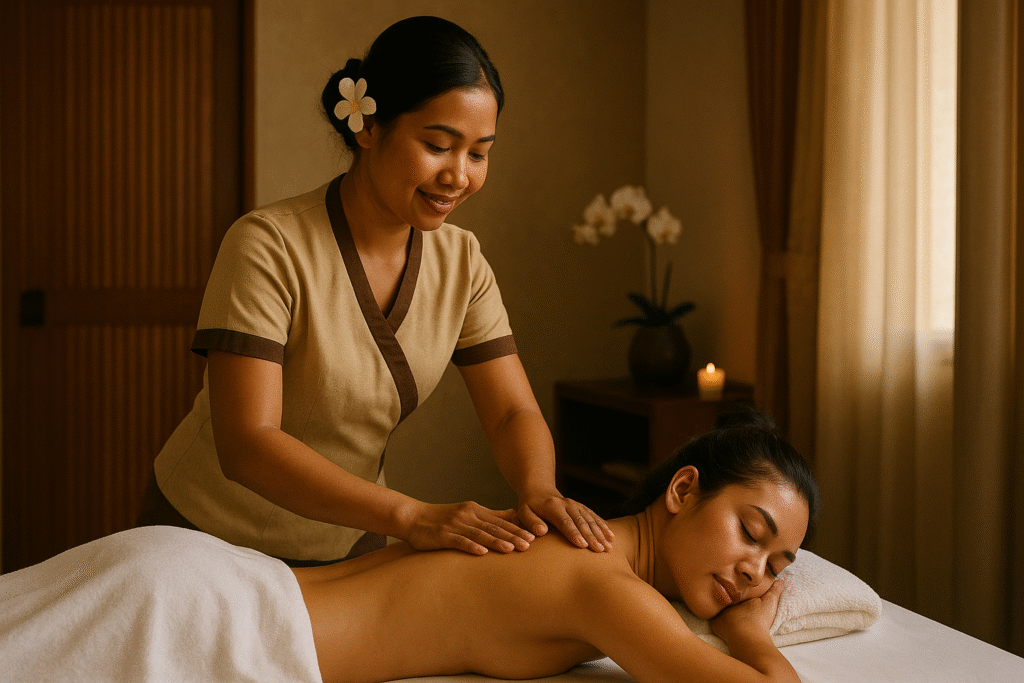
    • Spa: a facility offering health and beauty treatments; includes massages, facials, etc.
    • Gym: an area with exercise equipment; available for guests.
    • Valet Parking: a service where staff park and retrieve your car; usually for a fee.
    • Lost and Found: a place where lost items are kept; can be inquired at the front desk.
    • Business Center: a place with computers, printers, and other office facilities; for guest use.


      Food and Beverage

      When staying at a hotel, you’ll likely enjoy some meals and refreshments on-site. Understanding the hotel words related to food and beverage services will enhance your dining experience, whether you’re having breakfast in your room or enjoying happy hour at the bar. Let’s examine these terms
      to make your culinary experience at the hotel more delightful.
    • Restaurant: on-site dining option; serves meals at specific times.
    • Bar: a place to purchase alcoholic drinks; may also serve light snacks.
    • Buffet: a self-service meal option; a variety of foods displayed for selection.
    • Breakfast Included: breakfast provided with room booking; usually a buffet or set menu.
    • Café: a casual dining option; serves coffee, tea, and light meals.
    • Minibar: a small refrigerator in the room; stocked with drinks and snacks for purchase.
    • Happy Hour: a period with discounts on drinks; usually in the hotel bar.
    • Room Charge: adding purchases to your room bill; payable at check-out.
    • All-Inclusive: a package including all meals and drinks; usually at a resort.
    • Vending Machine: a machine offering snacks and drinks; operates with coins or cards.
    • Special Diet Menu: a menu catering to specific dietary needs; e.g. vegetarian, gluten-free.


      https://promova.com/english-vocabulary/hotels-vocabulary-terms#common_hotel_terms
    https://promova.com/english-vocabulary/hotels-vocabulary-terms#common_hotel_terms
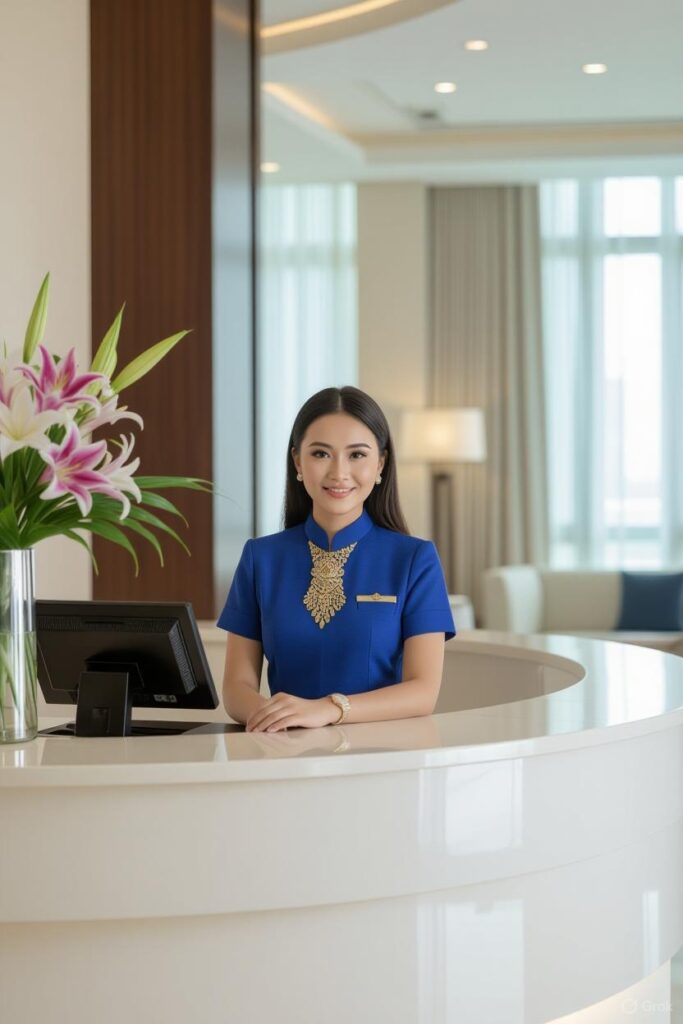
  • Working at the front desk (A2)

    meet guests……….

    A good front desk staff member in a hotel needs to have important qualities to make guests happy. First, they should be friendly and welcoming. They should greet guests with a warm smile and make them feel at home. It is important to be kind and listen to what guests need.

    Good communication is also important. Front desk staff should speak clearly and politely. They help guests check in, answer questions, and solve problems.

    They must also be organized. They do many things like checking guests in and out, making reservations, and talking to other hotel workers. They should know what job to do first, especially when it is busy.

    Problem-solving is also important. If a guest has a problem or a special request, staff should find a quick and good solution.

    They must also pay attention to small details, like correct bills and a clean lobby.

    Lastly, they need empathy and patience. They meet many different people and should be kind and calm at all times.

    All these skills help guests have a great stay.
    _______________________

    1. Welcoming – friendly and happy to see someone.
    2. To greet – to say “hello” to someone.
    3. Communication – the way people talk or write to share ideas or information.
    4. Politely – in a nice and respectful way.
    5. Speak clearly – to talk so that others can understand you easily.
    6. To check in – to arrive and tell the staff you are there (for example, at a hotel).
    7. To solve a problem – to find a good answer or fix something.
    8. To make a reservation – to book a place or time (like at a hotel or restaurant).
    9. Busy – having a lot of things to do or many people.
    10. A solution – the answer to a problem.
    11. To pay attention – to listen carefully or watch closely.
    12. A bill – a paper that shows how much money you need to pay.
    13. A lobby – the first room you enter in a hotel or big building.
    14. Empathy – understanding how someone else feels.
    15. Patience – staying calm when things take time.
    16. Calm – quiet and relaxed, not angry or worried.
    17. A skill – something you can do well because you learned and practiced it.

    #####################

    Vocabulary: multiple-choice test, with only one correct answer.


    1. What does it mean to greet someone?
    A) To walk away from them
    B) To say “hello” to them
    C) To give them money


    2. What is a bill in a restaurant?
    A) A table where you sit
    B) The food you ordered
    C) A paper that shows how much to pay


    3. If you are busy, what are you doing?
    A) Sleeping
    B) Doing many things
    C) Waiting for someone


    4. What does to make a reservation mean?
    A) To cancel something
    B) To book a time or place
    C) To pay money


    5. What does calm mean?
    A) Angry and loud
    B) Quiet and relaxed
    C) Busy and fast


    6. What does it mean to pay attention?
    A) To listen carefully
    B) To give money
    C) To sleep in class


    7. What is a lobby in a hotel?
    A) A bedroom
    B) A swimming pool
    C) The first room when you enter


    8. What does politely mean?
    A) In a rude way
    B) In a nice and respectful way
    C) In a loud and angry way


    9. What is a solution?
    A) A type of food
    B) A problem
    C) The answer to a problem


    10. What is empathy?
    A) Understanding how others feel
    B) Telling someone what to do
    C) Being fast and strong


    __________________________

    1b, 2c, 3b, 4b, 5b, 6a, 7c, 8b, 9c, 10a

    ###################

    Fill in:


    The hotel staff is __________ and smiles a lot.
    They greet every __________ at the door.
    Good communication helps guests feel __________
    They always speak __________ to everyone.
    The receptionist speaks __________ and slowly.
    Guests __________ in at the front desk.
    Sometimes guests have problems, staff __________ them fast.
    You can __________a reservation online.


    ______________________________

    The hotel staff is welcoming and smiles a lot.
    They greet every guest at the door.
    Good communication helps guests feel happy.
    They always speak politely to everyone.
    The receptionist speaks clearly and slowly.
    Guests check in at the front desk.
    Sometimes guests have problems, staff solve them fast.
    You can make a reservation online.

    ######################


    Match the words to their meanings

    Words:

    1. welcoming
    2. greet
    3. communication
    4. politely
    5. speak clearly
    6. check in
    7. solve
    8. make a reservation
    9. lobby
    10. bill

    Meanings:
    A. To say “hello” to someone
    B. A paper that shows how much to pay
    C. Friendly and happy to see someone
    D. To talk in a way people understand
    E. The first room you enter in a hotel
    F. To book a time or place
    G. Talking or writing to share ideas
    H. In a nice and respectful way
    I. To fix a problem
    J. To arrive and register at a hotel


    ______________

    1 – C 2 – A 3 – G 4 – H 5 – D 6 – J 7 – I 8 – F 9 – E 10 – B
    #################

    What is the correct sentence?

    1. greet / you / politely / must / always
    2. check in / at / hotel / you / a
    3. solve / problems / staff / can
    4. speak / to / help / guests / clearly
    5. make / reservation / online / a
    6. pay / to / the bill /attention
    7. lobby / is / near / entrance / the
    8. welcoming / smile / staff / warmly
    9. communication / people / understand / helps
    10. calm / be / and / patient

    ————————————-

    1. You must always greet politely.
    2. You check in at a hotel.
    3. Staff can solve problems.
    4. Speak clearly to help guests.
    5. Make a reservation online.
    6. Pay attention to the bill.
    7. Lobby is near the entrance.
    8. Welcoming staff smile warmly.
    9. Communication helps people understand.
    10. Be calm and patient.
      ######################

    True or false?

    1. The lobby is the first room you enter. — True
    2. To check in means to leave the hotel. — False
    3. Staff greet guests when they arrive. — True
    4. A bill shows how much money to pay. — True
    5. Being calm means you are angry. — False
    6. You make a reservation to book a place. — True
    7. Speaking clearly helps people understand you. — True
    8. Empathy means ignoring other people’s feelings. — False
    9. You pay attention when you do not listen. — False
    10. Politely means speaking in a rude way. — False

    ——————————
    2 false, 5 false, 8-10 false

    #################


    Interviewer: Hello! How do you welcome guests?
    Staff: We smile and greet guests politely when they arrive.

    Interviewer: How do you check in guests?
    Staff: I ask for their ID and make a reservation in the system.

    Interviewer: What do you do if there is a problem?
    Staff: I try to solve the problem quickly and calmly.

    Interviewer: Why is good communication important?
    Staff: It helps guests understand information and feel happy.

    Interviewer: How do you speak clearly?
    Staff: I talk slowly and use simple words.

    Interviewer: What is the lobby?
    Staff: It is the first room where guests wait and relax.

    Interviewer: How do you show empathy?
    Staff: I listen carefully and understand how guests feel.

    Interviewer: Why do you need patience?
    Staff: Because some guests take time to decide or explain.

    Interviewer: What is a bill?
    Staff: It shows how much money the guest must pay.

    Interviewer: How do you ask guests to pay attention?
    Staff: I ask them to listen when I explain hotel rules or the bill.


    #####################

    Can you answer these questions?

    1. How do staff welcome guests?
    2. When do you greet guests?
    3. What do you do to check in guests?
    4. How do staff solve problems?
    5. Why is good communication important?
    6. How do you speak clearly?
    7. What is the lobby?
    8. How do staff show empathy?
    9. Why do you need patience?
    10. What is a bill?

    Possible answers :

    1. Staff welcome guests by smiling and greeting them politely.
    2. You greet guests when they arrive at the hotel.
    3. To check in guests, staff ask for ID and make a reservation.
    4. Staff solve problems quickly and calmly.
    5. Good communication helps guests understand information and feel happy.
    6. You speak clearly by talking slowly and using simple words.
    7. The lobby is the first room where guests wait and relax.
    8. Staff show empathy by listening carefully and understanding guests’ feelings.
    9. You need patience because some guests take time to decide or explain.
    10. A bill shows how much money the guest must pay.

    ########################

  • Working at the front desk (B1)


    A good front desk staff member in a hotel needs to have several important qualities to ensure guests have a positive experience. Firstly, they should be friendly and welcoming, greeting guests with a warm smile and making them feel at home. Being approachable and attentive to guests‘ needs is
    crucial.

    Secondly, communication skills are key. They should be able to listen carefully to guests‘ inquiries and concerns, and respond clearly and politely. Whether it’s checking guests in, providing
    information about the hotel’s amenities, or assisting with any issues that may arise during their stay, effective communication is essential.

    Organizational skills are also important. Front desk staff need to handle multiple tasks efficiently, such as managing check-ins and check-outs, handling reservations, and coordinating with other
    hotel departments. They should be able to prioritize tasks and work well under pressure duringbusy periods.

    Furthermore, problem-solving abilities are crucial. There will inevitably be situations where guest encounter issues or have special requests. A good front desk staff member should be able to think quickly on their feet to find solutions that satisfy guests and ensure their comfort.

    Additionally, attention to detail is vital. From ensuring accurate billing information to maintaining a tidy and welcoming lobby area, paying close attention to the little things can make a big
    difference in guests‘ overall satisfaction.

    Lastly, empathy and patience are essential qualities. Dealing with a diverse range of guests means encountering different personalities and preferences. Front desk staff should be empathetic towards guests‘ needs and concerns, and patient in handling any challenges that may arise.

    In summary, a good front desk staff member in a hotel is someone who is friendly, communicative, organized, problem-solving, detail-oriented, empathetic, and patient. These qualities combined contribute to creating a positive experience for guests and ensuring they have a memorable stay.

    1. Ensure: To make sure something happens or is certain.
    2. Approachable: Easy to talk to or friendly; people feel comfortable approaching you.
    3. Attentive: Paying close attention to something or someone.
    4. Crucial: Extremely important; something you really need.
    5. Inquiries: Questions or requests for information.
    6. Amenities: Things that make life easier or more comfortable, like TV or a swimming pool.
    7. Efficiently: Doing something well and quickly without wasting time.
    8. Coordinating: Making sure different things work well together.
    9. Prioritize: Decide which things are most important and deal with them first.
    10. Encounter: Meet or come across something, often unexpectedly.
    11. Vital: Absolutely necessary; really important.
    12. Billing: Keeping track of how much money people owe or have paid.
    13. Tidy: Neat and organized; everything in its right place.
    14. Satisfaction: Feeling happy or pleased because something went well or you got what you
      wanted.
    15. Empathy: Understanding how someone feels because you can imagine what it’s like to be in their situation.
    16. Patient: Able to wait calmly and without getting angry.
    17. Communicative: Good at sharing information and talking to people.
    18. Empathetic: Understanding and sharing the feelings of others.
    19. Contribute: To help make something happen or be part of it.


      QUESTIONS
    20. What qualities should a good front desk staff member have?
    21. How should front desk staff greet guests?
    22. Why is it important for front desk staff to be good at communicating?
    23. What tasks might front desk staff need to handle?
    24. How can front desk staff help solve problems for guests?
    25. Why is paying attention to details important for front desk staff?
    26. What does it mean for front desk staff to be empathetic?
    27. What does it mean to prioritize tasks?
    28. What might guests encounter during their stay at a hotel?
    29. How can front desk staff make guests feel welcome?
    30. Why is it important for front desk staff to be patient?
    31. How can front desk staff make sure billing information is accurate?
    32. What does it mean to coordinate with other hotel departments?
    33. Why should front desk staff be organized?
    34. What can front desk staff do to ensure guests have a memorable stay?

    MULTIPLE CHOICE QUESTIONS

    1. What is an essential quality for a good front desk staff member?
      a) Shyness
      b) Friendliness
      c) Arrogance
    2. How should front desk staff greet guests?
      a) With a frown
      b) With a warm smile
      c) With indifference
    3. Why is effective communication important for front desk staff?
      a) To confuse guests
      b) To make guests feel welcome and understood
      c) To ignore guests‘ needs
    4. What tasks might front desk staff need to handle?
      a) Only cleaning rooms
      b) Managing check-ins and check-outs, handling reservations
      c) Answering phone calls only
    5. How can front desk staff help solve problems for guests?
      a) By ignoring them
      b) By thinking quickly and finding solutions
      c) By creating more problems
    6. Why is paying attention to details important for front desk staff?
      a) It’s not important
      b) It ensures accurate information and a tidy environment
      c) It leads to confusion
    7. What does it mean for front desk staff to be empathetic?
      a) To ignore guests‘ feelings
      b) To understand and share guests‘ feelings
      c) To laugh at guests‘ problems
    8. What does it mean to prioritize tasks?
      a) To do tasks randomly
      b) To decide which tasks are more important and do them first
      c) To avoid doing tasks altogether
    9. What might guests encounter during their stay at a hotel?
      a) Perfect conditions only
      b) Various situations and issues
      c) No challenges at all
    10. How can front desk staff make guests feel welcome?
      a) By ignoring them
      b) By being friendly and welcoming
      c) By being rude
    11. Why is it important for front desk staff to be patient?
      a) It’s not important
      b) To handle guests‘ diverse personalities and needs calmly
      c) To get angry at guests‘ complaints
    12. How can front desk staff make sure billing information is accurate?
      a) By guessing
      b) By paying attention to details
      c) By making mistakes deliberately
    13. What does it mean to coordinate with other hotel departments?
      a) To work separately from other departments
      b) To work together with other departments smoothly
      c) To create conflicts with other departments
    14. Why should front desk staff be organized?
      a) It’s not important
      b) To handle multiple tasks efficiently
      c) To confuse guests
    15. What can front desk staff do to ensure guests have a memorable stay?
      a) Make guests feel unwelcome
      b) Provide excellent service and attention to detail
      c) Ignore guests‘ needs

    ———————————-


    1. What is an essential quality for a good front desk staff member?
    b) Friendliness

    2. How should front desk staff greet guests?
    b) With a warm smile

    3. Why is effective communication important for front desk staff?
    b) To make guests feel welcome and understood

    4. What tasks might front desk staff need to handle?
    b) Managing check-ins and check-outs, handling reservations

    5. How can front desk staff help solve problems for guests?
    b) By thinking quickly and finding solutions

    6. Why is paying attention to details important for front desk staff?
    b) It ensures accurate information and a tidy environment

    7. What does it mean for front desk staff to be empathetic?
    b) To understand and share guests‘ feelings

    8. What does it mean to prioritize tasks?
    b) To decide which tasks are more important and do them first

    9. What might guests encounter during their stay at a hotel?
    b) Various situations and issues

    10. How can front desk staff make guests feel welcome?
    b) By being friendly and welcoming

    11. Why is it important for front desk staff to be patient?
    b) To handle guests‘ diverse personalities and needs calmly

    12. How can front desk staff make sure billing information is accurate?
    b) By paying attention to details

    13. What does it mean to coordinate with other hotel departments?
    b) To work together with other departments smoothly

    14. Why should front desk staff be organized?
    b) To handle multiple tasks efficiently

    15. What can front desk staff do to ensure guests have a memorable stay?
    b) Provide excellent service and attention to detail


    ####################

  • Tim and a typical morning (A2)

    how to use present simple

    Every morning, Tim wakes up at 7 o’clock. He rubs his eyes and stretches his arms. Then, he jumps out of bed and gets dressed quickly. Tim puts on his favorite t-shirt and jeans. Next, he goes to the kitchen for breakfast. Tim’s mom makes him toast and pours him a glass of orange juice.

    After breakfast, Tim brushes his teeth and combs his hair. He checks his backpack to make sure he has everything he needs for school. Then, he grabs his lunchbox and heads out the door. Tim walks to the bus stop and waits with his friends.

    When the bus arrives, Tim hops on and finds a seat. He chats with his friends during the ride to school. When they arrive, Tim says goodbye to his friends and goes to his classroom. He’s ready for another day of learning and fun!

    ___________________________

    Vocabulary:

    1. to rub – to press your hands on something and move them back and forth (e.g., He rubs his eyes when he wakes up.)
    2. favorite – the thing you like the most (e.g., My favorite color is blue.)
    3. to pour – to make a liquid go from a bottle or container into something else (e.g., She pours milk into the glass.)
    4. to brush teeth – to clean your teeth using a toothbrush (e.g., I brush my teeth every morning and evening.)
    5. to comb hair – to use a comb to make your hair neat (e.g., He combs his hair after showering.)
    6. a backpack – a bag you carry on your back, often used for school (e.g., She puts her books in her backpack.)
    7. to grab – to take something quickly (e.g., He grabs his lunchbox and runs to the bus.)
    8. to head out – to leave and go somewhere (e.g., She heads out to school at 8 o’clock.)
    9. to hop on a bus – to get on a bus quickly or easily (e.g., He hops on the bus with his friends.)
    10. to chat – to talk with someone in a friendly way (e.g., They chat about their weekend.)

    ####################

    Multiple-choice test , each question has one correct answer.


    1. What does „to rub“ mean?
    A) To jump quickly
    B) To move your hands back and forth on something
    C) To sleep longer


    2. What is a „favorite“ thing?
    A) A thing you hate
    B) A thing you forget
    C) A thing you like the most


    3. What does „to pour“ mean?
    A) To drink something quickly
    B) To put a liquid into something
    C) To mix food


    4. What does „to brush your teeth“ mean?
    A) To clean your teeth with a toothbrush
    B) To eat something sweet
    C) To wash your hands


    5. What does „to comb your hair“ mean?
    A) To cut your hair
    B) To color your hair
    C) To make your hair neat with a comb


    6. What is a „backpack“?
    A) A jacket for cold weather
    B) A bag you carry on your back
    C) A toy you play with


    7. What does „to grab“ mean?
    A) To take something quickly
    B) To drop something
    C) To hide something


    8. What does „to head out“ mean?
    A) To stay at home
    B) To go to sleep
    C) To leave and go somewhere


    9. What does „to hop on a bus“ mean?
    A) To drive the bus
    B) To get on the bus quickly
    C) To clean the bus


    10. What does „to chat“ mean?
    A) To sing loudly
    B) To sleep in class
    C) To talk in a friendly way

    ________________
    1b,2c,3b,4a,5c,6b,7a,8c,9b,10c

    #####################


    10 multiple-choice questions , each question has 4 answer options, and more than one answer may be correct.


    1. What does Tim do first in the morning?
    A) He eats breakfast
    B) He gets dressed
    C) He rubs his eyes
    D) He goes to school


    2. What does Tim wear?
    A) A jacket and shorts
    B) His school uniform
    C) A t-shirt and jeans
    D) A sweater and trousers


    3. What does Tim have for breakfast?
    A) Toast
    B) Cereal
    C) Eggs
    D) Orange juice


    4. What does Tim do after breakfast?
    A) He watches TV
    B) He brushes his teeth
    C) He combs his hair
    D) He plays video games


    5. What does Tim check before leaving home?
    A) His shoes
    B) His homework
    C) His backpack
    D) His lunchbox


    6. Where does Tim go after he leaves the house?
    A) To the park
    B) To the bus stop
    C) To the bakery
    D) To his friend’s house


    7. What does Tim do while waiting for the bus?
    A) He talks with his friends
    B) He listens to music
    C) He plays a game
    D) He stands at the bus stop


    8. What does Tim do when the bus arrives?
    A) He runs away
    B) He hops on the bus
    C) He finds a seat
    D) He drives the bus


    9. What does Tim do on the bus?
    A) He sleeps
    B) He chats with friends
    C) He eats lunch
    D) He looks out the window


    10. What does Tim do when he arrives at school?
    A) He says goodbye to his friends
    B) He goes home again
    C) He goes to his classroom
    D) He hides his backpack

    _________________

    1cb, 2c, 3ad, 4bc, 5cd, 6b, 7ad, 8bc, 9bd, 10ac
    ########################


    Answer these questions – present simple, don’t forget the ’s’……


    1. What time does Tim wake up in the morning?


    2. What does Tim do after waking up?


    3. What does Tim put on after getting dressed?


    4. What does Tim have for breakfast?


    5. Who makes Tim’s breakfast?


    6. What does Tim do after eating breakfast?


    7. What does Tim do to his teeth after breakfast?.


    8. How does Tim tidy his hair?


    9. What does Tim check before leaving the house?


    10. Where does Tim go after leaving the house?


    11. How does Tim get to school?


    12. Who does Tim wait with at the bus stop?


    13. What does Tim do when the bus arrives?


    14. Where does Tim sit on the bus?


    15. What does Tim do when he arrives at school?


    _______________________

    Answers


    1. Tim wakes up at 7 o’clock.


    2. He rubs his eyes and stretches his arms.


    3. He puts on his favorite t-shirt and jeans.


    4. He has toast and a glass of orange juice.


    5. His mom makes his breakfast.


    6. He brushes his teeth and combs his hair.


    7. He brushes his teeth.


    8.He combs his hair.


    9. He checks his backpack to make sure he has everything he needs.


    10. He goes to the bus stop.


    11. He goes by school bus.


    12. He waits with his friends.


    13. He hops on the bus and finds a seat.


    14. He finds a seat and sits there.


    15. He says goodbye to his friends and goes to his classroom.


    ##################

    Form questions to which the word/s given is/are the answer:

    1.Tim wakes up at 7 o’clock
    a) Tim:_____________________________
    b) at 7 o’clock ________________________


    2.After breakfast he brushes his teet
    a) after breakfast ________________________
    b) he ________________________
    c) brushes his teeth ________________________
    d) his teeth ________________________

    3.Tim and his friends walk to the bus stop
    a) Tim and his friends ________________________
    b) his ________________________
    c) walk to the bus stop ________________________
    d) to the bus stop ________________________
    e) bus ________________________

    ____________________________

    1a) Who wakes up ……?
    b) When does he wake up?

    2a) When does he brush his…..?
    b) Who brushes his ……?
    c) What does he do after breakfast?
    d) What does he brush….?


    3a) Who walks to…..?
    b) Tim and whose friends walk to….?
    c) What do Tim and his friends do?
    d) Which stop do Tim and his friends go to?

    ####################

    Describe your day, in present simple, about 100 words, send your text to me at SMFrockZ(at)gmx(dot)at, I’ll have a look at it, if necessary correct, commment, and send it back.


  • Shinta Mani Foundation – a fashion editor’s guide (B2),

    from the Style Traveller – a summary

    The Shinta Mani Foundation, founded in 2004 in Siem Reap, Cambodia, is a non-profit organization dedicated to improving the lives of disadvantaged local communities. It focuses on sustainable development through education, job training, healthcare, clean water access, and housing.

    In partnership with the Shinta Mani Hotel, the Foundation provides employment opportunities for locals in hospitality, with hotel profits and donations directly funding its programs. One key initiative is the Shinta Mani School of Hospitality, which offers free training to underprivileged young people, enabling them to gain skills and secure jobs in Siem Reap’s tourism industry.

    The Foundation also provides bicycles for schoolchildren, organizes free health and dental check-ups, and constructs clean water wells—teaching villagers how to build and maintain them, promoting self-sufficiency. Additionally, it supports women by teaching them how to make and sell handicrafts like rattan mats.

    To date, the Foundation has built 1,400 wells, 99 homes, trained 229 students, donated 641 bicycles, and provided over 8,000 health check-ups. Its impact is clear, helping communities move beyond poverty through long-term, practical solutions.

  • Shinta Mani Foundation – a fashion editor’s guide (B1),

    from the Style Traveller – a summary

    The Shinta Mani Foundation is a non-profit organization based in Siem Reap, Cambodia, founded in 2004. Its main goal is to help local communities overcome poverty by offering support in education, health care, job training, clean water, and housing.

    The Foundation works with the Shinta Mani Hotel, where many local people are employed. Profits from the hotel and guest donations help fund the charity’s activities. One major focus is education—children receive bicycles to travel to school, and the Shinta Mani School of Hospitality trains young people in hotel work, helping them find good jobs.

    The Foundation also provides free medical and dental care, often with the help of international volunteers. They build water wells and teach villagers how to build them, creating jobs and access to clean water. Women are taught how to make and sell handmade goods like rattan mats.

    So far, the Foundation has built 1,400 wells, 99 homes, trained 229 students, and given over 8,000 health check-ups. It’s making a real difference by giving people the tools and skills to build better futures.

  • Shinta Mani Foundation – a fashion editor’s guide (A2),

    from the Style Traveller – a summary

    The Shinta Mani Foundation is a charity in Siem Reap, Cambodia. It started in 2004 and helps poor families in the countryside. The Foundation gives support through education, jobs, health care, clean water, and safe housing.

    It works closely with the Shinta Mani Hotel. Local people can get jobs there, such as in cooking or guest services. The money from hotel guests also helps fund the Foundation’s projects.

    The Foundation gives bicycles to children so they can go to school, and brings in dentists and doctors for free check-ups. It builds wells to provide clean drinking water and teaches people how to build them, so they can help other villages and even earn money.

    The Foundation also helps women learn skills like making rattan mats to sell. It builds brick homes for families who need a safe place to live.

    Young people can study at the Shinta Mani School of Hospitality, where they learn hotel skills and get jobs later.

    So far, the Foundation has helped thousands of people and continues to give them hope and a better life.

  • Shinta Mani Foundation – a fashion editor’s guide (A1),

    from the Style Traveller – a summary

    The Shinta Mani Foundation is a charity in Siem Reap, Cambodia. It helps poor people in local villages. The Foundation gives jobs, education, clean water, health care, and more.

    It works with the Shinta Mani Hotel. Some local people get jobs there, which helps them support their families. The Foundation gives bicycles to children so they can go to school. It also brings dentists and doctors to give free health check-ups.


    The Foundation has built many clean water wells and houses. It teaches people how to build wells so they can help other villages and earn money. Women learn to make rattan mats to sell and earn income.

    The Shinta Mani School of Hospitality trains young people for free. After training, they can get jobs in hotels and restaurants in Siem Reap.

    Since 2004, the Foundation has:

    • Built 1,400 wells
    • Donated 641 bicycles
    • Given 8,123 health check-ups
    • Trained 229 students
    • Built 99 homes

    All money from hotel guests and donations helps the charity. It changes lives and gives people a better future.

  • Shinta Mani Foundation 5 (A2)

    environmental conservation


    The environment is very important for our life. Clean air, water, and forests help people, animals, and plants stay healthy. But sometimes, people cut too many trees, throw rubbish in rivers, or hurt wild animals. That is why it is important to protect nature. The Shinta Mani Foundation helps with this work in Cambodia.

    One special place is Shinta Mani Wild, a nature resort in the forest. It is not only for tourists — it also helps save the environment. The resort is in a big forest with animals, rivers, and trees. Rangers work there to stop illegal logging and hunting. They help keep the forest safe.

    Shinta Mani Wild also teaches local people about nature. They give jobs to people from the area, so they do not need to cut trees or harm the forest. Guests can also learn how to protect the environment.

    Thanks to Shinta Mani Wild, the forest is cleaner and safer. It shows that tourism and nature can work together to make a better future.

    _____________________

    Vocabulary:

    1. Environment – The world around us: the air, water, land, animals, and plants.
    2. Forests – Big areas with many trees.
    3. Plants – Green things that grow in the ground, like flowers, trees, and grass.
    4. Healthy – Feeling well, strong, and not sick.
    5. To cut trees – To use tools to make trees fall down.
    6. To throw – To make something fly out of your hand.
    7. Rubbish – Things we do not need and put in the trash.
    8. To hurt animals – To make animals feel pain or get injured.
    9. To protect – To keep something safe from harm.
    10. To save the environment – To help nature stay clean and safe.
    11. A ranger – A person who works in a forest or park to keep it safe.
    12. Illegal – Not allowed by the law.
    13. Logging – Cutting down trees to use the wood.
    14. Hunting – Catching or killing wild animals.
    15. To keep safe – To stop something from getting hurt or lost.
    16. To teach – To help someone learn something.
    17. To harm the forest – To do bad things to the forest, like cutting trees or starting fires.

    ############

    Match the word with the definition

    Words:

    1. Protect
    2. Environment
    3. To harm the forest
    4. Illegal
    5. Rubbish
    6. To teach
    7. To save somebody
    8. A ranger
    9. To go hunting
    10. Logging wood

    Definitions:

    A. Things we throw away because we do not need them.
    B. To help someone not get hurt or die.
    C. To go into nature to catch or kill wild animals.
    D. To stop bad things from happening to something.
    E. A person who works in the forest to keep it safe.
    F. Not allowed by law.
    G. The land, air, water, animals, and plants around us.
    H. To cut down trees and take the wood.
    I. To do bad things to trees and nature.
    J. To help someone learn.


    1d, 2g, 3i, 4f, 5a, 6j, 7b, 8e, 9c, 10h.

    #######################

    Fill in (words below):

    1. Shinta Mani Wild helps to protect the __________.
    2. A __________ works in the forest to stop logging.
    3. People should not throw _________ into the river.
    4. __________hunting can hurt animals in the forest.
    5. The Foundation teaches people how to save __________
    6. __________ trees is bad and harms the forest.
    7. __________ water helps people stay strong and healthy.
    8. The forest is home to many ___________ animals.
    9. Tourists learn how to __________ nature and animals.
    10. Shinta Mani Wild gives jobs to local _______________.

    a) people b) rubbish c) Clean d) environment e) nature. f) wild g) Illegal h) ranger i) Logging j) protect

    ###################

    True, false?


    1. Shinta Mani Wild is a nature resort in Cambodia.
    2. The foundation cuts down trees to build more hotels.
    3. Rangers work at Shinta Mani Wild to stop hunting.
    4. The resort teaches guests how to cook Cambodian food.
    5. Illegal logging is a problem in the forest.
    6. Local people can get jobs at Shinta Mani Wild.
    7. The foundation throws rubbish into the rivers.
    8. Protecting the forest helps animals and people.
    9. Shinta Mani Wild works to save the environment.
    10. The forest is turned into a city for tourists.

    ————————–

    true: 1,3,5,6,8,9

    #########################

    Only one answer


    🔹 Multiple Choice Vocabulary Questions

    1. What does “protect” mean?
      A. To play with something
      B. To keep something safe
      C. To clean something
    2. What does “ranger” mean?
      A. A cook in a restaurant
      B. A person who works in a forest
      C. A person who drives a bus
    3. What does “illegal” mean?
      A. Not allowed by law
      B. Very good and helpful
      C. Something you can buy
    4. What does “logging” mean?
      A. Watching birds in a forest
      B. Cutting down trees for wood
      C. Planting new trees
    5. What does “hunting” mean?
      A. Looking for and catching animals
      B. Playing a game with friends
      C. Building a house
    6. What does “rubbish” mean?
      A. Something we eat
      B. Something we throw away
      C. Something we wear
    7. What does “environment” mean?
      A. A place where people go to school
      B. The world around us, like air and water
      C. A kind of animal
    8. What does “to harm the forest” mean?
      A. To make the forest better
      B. To hurt or damage the forest
      C. To clean the forest
    9. What does “to save somebody” mean?
      A. To help them not get hurt or die
      B. To tell them a funny joke
      C. To give them a present
    10. What does “to teach” mean?
      A. To help someone learn something
      B. To clean something with water
      C. To take something away


    1b, 2b, 3a, 4b, 5a, 6b, 7b, 8b, 9a, 10a

    ######################

    Interview with a ranger


    Interviewer:

    1. What is your name and what is your job?

    Ranger:
    My name is Vannak, and I am a ranger. I work at Shinta Mani Wild to protect the forest and the animals that live here.

    Interviewer:
    2. Can you describe your daily work?

    Ranger:
    Every day, I walk through the forest to make sure everything is safe. I check for any illegal logging or hunting. I also make sure there is no rubbish left in the forest.

    Interviewer:
    3. What do you do if you see illegal activities?

    Ranger:
    If I find illegal logging or hunting, I report it to the authorities. Sometimes, I talk to the people and try to stop them from harming the forest.

    Interviewer:
    4. Why is it important to protect the forest?

    Ranger:
    The forest provides us with clean water and is home to many animals. If we don’t protect it, the environment could be damaged, and animals could lose their homes.

    Interviewer:
    5. What challenges do you face as a ranger?

    Ranger:
    The biggest challenge is stopping people who cut down trees or hunt animals illegally. Sometimes, they don’t understand why it’s bad for the environment.

    Interviewer:
    6. How do you teach others about protecting the environment?

    Ranger:
    I teach local people and tourists about the importance of protecting the forest. I explain how the forest helps us and why we need to keep it safe.

    Interviewer:
    7. Do you work with other people?

    Ranger:
    Yes, I work with other rangers to patrol the forest and keep it safe. We work together to stop illegal activities.

    Interviewer:
    8. What’s the best part of your job?

    Ranger:
    The best part is when I see people respecting nature. It feels good to know that I am helping protect the environment.

    Interviewer:
    9. What do you want for the future?

    Ranger:
    I hope more people understand how important it is to protect nature. I want to continue my work and teach others how to help.

    Interviewer:
    10. Why is your job so important?

    Ranger:
    My job helps protect the forest and the animals. It’s important for the future of the environment and for the health of our planet.


    ############################

    You interview a local about the work of rangers – use the interview above, rewrite it, and make all changes necessary:

    1. What is HIS name and what is HIS job?

    Ranger:
    HIS name is Vannak, and HE IS a ranger. HE workS at Shinta Mani Wild to protect the forest and the animals that live here.

    Interviewer:
    2. Can you describe HIS daily work?

    ……….continue


    >>>>>You can send me the interview via
    >>>>>SMFrockZ(at)gmx(dot)at –
    >>>>>I’ll have a look at it, correct, if necessary,
    >>>>>comment it, and send it back.

  • Shinta Mani Foundation 4 (A2)

    Microfinance & Entrepreneurship


    The Shinta Mani Foundation is in Cambodia. It helps poor people in the countryside. One important way it helps is by giving small loans. These loans are called microfinance. People do not pay interest. They use the money to start small businesses.

    Some people buy cows or chickens. Others grow vegetables or start small shops. Many women use the money to make and sell things. This helps them earn money for their families. They can buy food, send their children to school, and build better houses.

    The Foundation also teaches people. They learn how to run a business. They learn about money, saving, and selling. This is called entrepreneurship. With help, people become stronger and more independent.

    The Shinta Mani Foundation works together with hotels in Siem Reap. Tourists stay in the hotels, and part of the money helps the Foundation. This is a good way to support local people.

    The Foundation is a good example of how tourism and business can help communities grow. It gives people hope and a better future.


    __________________

    Vocabulary:

    Hope – A good feeling that something nice will happen.

    Countryside – Land outside the city with farms and small villages.

    A loan – Money someone gives you that you must pay back later.

    Microfinance – Small loans given to poor people to start a business.

    To pay interest – To give extra money when you pay back a loan.

    Vegetables – Plants people grow and eat, like carrots or tomatoes.

    To earn money – To get money by working.

    To teach people – To help people learn something.

    To run a business – To manage and work in your own shop or company.

    Saving – Keeping money to use later.

    Selling – Giving something to someone for money.

    Entrepreneurship – Starting and growing your own business.

    Independent – Able to do things without help.

    To support people – To help people live or do something better.

    Communities – Groups of people who live in the same place.

    #################


    10 questions, one answer only


    1. What is the countryside?
    A. A big city with many cars
    B. A place with farms and small villages
    C. A large shopping mall


    2. What is a loan?
    A. Free money from a friend
    B. Money you give to the bank
    C. Money you borrow and must pay back


    3. What is microfinance?
    A. A big bank in the city
    B. Small loans to help poor people start a business
    C. A way to save money in a jar


    4. What does it mean to pay interest?
    A. To give back the same money you borrowed
    B. To give less money than you borrowed
    C. To give back more money than you borrowed


    5. What are vegetables?
    A. Sweet food like cake
    B. Plants we eat, like carrots
    C. Drinks like juice or tea


    6. What does it mean to earn money?
    A. To spend money at the store
    B. To get money by working
    C. To give money to someone


    7. What does it mean to teach people?
    A. To help people learn something
    B. To cook food for people
    C. To drive people to school


    8. What does it mean to run a business?
    A. To clean a big house
    B. To work for a boss
    C. To manage and work in your own shop


    9. What is saving?
    A. Using all your money now
    B. Keeping money for later
    C. Giving money to friends


    10. What does hope mean?
    A. A bad feeling
    B. A happy feeling about the future
    C. A kind of food

    _____________________________

    1b, 2c, 3b, 4c, 5b, 6b, 7a, 8c, 9c, 10b

    ########################

    Fill in (words below):

    1. People __________and work in the countryside.
    2. She got a loan to start a __________.
    3. Microfinance helps small __________ in poor villages.
    4. I must pay interest on my __________.
    5. They grow __________ in their garden.
    6. He works hard to __________ money.
    7. The teacher wants to __________ people new skills.
    8. She __________ a small business at home.
    9. Saving __________ is important for the future.
    10. We have hope for a __________ life.

    earn, live, better, businesses, runs, loan, shop, money, vegetables, teach

    ###################

    10 multiple-choice questions, more than one answer may be correct.


    1. What can you find in the countryside?
    A. Small villages
    B. Big factories
    C. Farms
    D. Tall buildings


    2. What is true about a loan?
    A. You must pay it back
    B. It is always free
    C. You borrow it
    D. You give it to others


    3. What is microfinance for?
    A. Helping rich people
    B. Helping small businesses
    C. Giving small loans
    D. Building hotels


    4. What happens when you pay interest?
    A. You pay extra money
    B. You pay the same amount
    C. You pay less
    D. It is part of a loan


    5. Which of these are vegetables?
    A. Carrots
    B. Tomatoes
    C. Juice
    D. Apples


    6. How can someone earn money?
    A. By working
    B. By watching TV
    C. By selling vegetables
    D. By sleeping


    7. What do teachers do?
    A. Teach people
    B. Sell food
    C. Help people learn
    D. Plant trees


    8. What does it mean to run a business?
    A. To work in your own shop
    B. To go jogging
    C. To be the boss
    D. To clean the house


    9. What is saving?
    A. Spending all your money
    B. Keeping money for later
    C. Not using your money
    D. Throwing money away


    10. What gives people hope?
    A. A better future
    B. No food
    C. Good jobs
    D. A new business


    ______________________

    1ac, 2ac, 3bc, 4ad, 5ab, 6ac, 7ac, 8ac, 8bc, 10acd

    ##########################


    Match the words (1–10) with the correct definitions (A–J):

    Words:

    1. Countryside
    2. Loan
    3. Microfinance
    4. Interest
    5. Vegetables
    6. Earn money
    7. Teach
    8. Run a business
    9. Saving
    10. Hope

    Definitions:
    A. Give small loans to poor people to start a business
    B. Land with farms, fields, and small villages
    C. Plants people grow and eat, like carrots or tomatoes
    D. Help people learn something new
    E. To get money by working
    F. Extra money you pay back with a loan
    G. A good feeling about the future
    H. To keep money for later
    I. Money you borrow and must give back
    J. To manage your own shop or company


    Answer Key:

    1 – B 2 – I 3 – A 4 – F 5 – C 6 – E 7 – D 8 – J 9 – H 10 – G


    ####################

    True – false?


    1. The Shinta Mani Foundation helps people in the countryside.
    2. People get big loans from the Foundation.
    3. Microfinance gives small loans to help start a business.
    4. People must pay interest on the Foundation’s loans.
    5. Many people grow vegetables and sell them.
    6. The Foundation teaches people how to run a business.
    7. Saving money is not important.
    8. The Foundation gives people hope for a better life.
    9. The Foundation builds shopping malls.
    10. Some people earn money by selling things they make.

    ____________________

    false: 2,4,7,9

    ##################

    Vocabulary – in categories – remember the vocabularies


    1. Money-related words

    • Loan
    • Interest
    • Saving
    • Earn money

    2. Business-related words

    • Microfinance
    • Run a business
    • Teach
    • Entrepreneur

    3. Farming-related words

    • Vegetables
    • Countryside
    • Sell
    • Grow

    4. Emotional/Feelings-related words

    • Hope
    • Support
    • Independent
    • Teach

    5. Activities-related words

    • Earn money
    • Teach
    • Sell
    • Run a business

    6. Community-related words

    • Communities
    • Support
    • Teach
    • Help

    7. Words for what you can do with money

    • Save
    • Borrow
    • Pay
    • Earn

    8. Words for people involved in businesses

    • Entrepreneur
    • Teacher
    • Farmer
    • Worker

    9. Words for things people do to make money

    • Run a business
    • Sell
    • Earn money
    • Teach

    10. Words for things related to loans

    • Pay interest
    • Loan
    • Borrow
    • Save

    ##################

    Fill in – do you remember the words missing?


    Dialogue:

    A: Hi! Do you live in the __________?
    B: Yes, I do. I live on a small farm.

    A: What do you grow on your farm?
    B: We grow __________like carrots and tomatoes.

    A: Do you sell your vegetables?
    B: Yes, we __________ them in the local market.

    A: How do you earn money?
    B: I earn money by selling vegetables and working in a __________.

    A: Do you know about microfinance?
    B: Yes, it’s when people get small __________to start a business.

    A: Have you ever taken a loan?
    B: Yes, I took a loan to _________ seeds for my farm.

    A: Do you have to pay __________ on your loan?
    B: Yes, I pay a little __________each month.

    A: How do you _________ money?
    B: I save a little money every month in my bank.

    A: What gives you hope for the future?
    B: I hope my farm will grow, and I can help my __________

    _____________________

    countryside – vegetables – sell – shop – loans – loans – interest – interest – save – community.

    ##################

    Interview with a representative of the Foundation – fill in:


    Interviewer: Good morning! Can you tell me about the Shinta Mani Foundation?
    Representative: We help people in the __________ with small loans.

    Interviewer: What kind of help does the Foundation give?
    Representative: We give __________ loans to start businesses.

    Interviewer: Do people have to pay back the loan?
    Representative: Yes, with a little __________.

    Interviewer: Who can get a loan from the Foundation?
    Representative: People in the countryside who need __________

    Interviewer: What do people do with the loans?
    Representative: They __________ tools or seeds for their business.

    Interviewer: How does microfinance help the community?
    Representative: It helps people __________money and be independent.

    Interviewer: Does the Foundation __________ people how to run a business?
    Representative: Yes, we offer business training.

    Interviewer: How do people __________money with the Foundation?
    Representative: They can open a savings account.

    Interviewer: How does the Foundation give people hope?
    Representative: We __________ businesses and improve lives.

    Interviewer: Can the Foundation __________people in other ways?
    Representative: Yes, we also support education and jobs.


    #####################


    Interviewer: Good morning! Can you tell me about the Shinta Mani Foundation?
    Representative: We help people in the countryside with small loans.

    Interviewer: What kind of help does the Foundation give?
    Representative: We give microfinance loans to start businesses.

    Interviewer: Do people have to pay back the loan?
    Representative: Yes, with a little interest.

    Interviewer: Who can get a loan from the Foundation?
    Representative: People in the countryside who need money.

    Interviewer: What do people do with the loans?
    Representative: They buy tools or seeds for their business.

    Interviewer: How does microfinance help the community?
    Representative: It helps people earn money and be independent.

    Interviewer: Does the Foundation teach people how to run a business?
    Representative: Yes, we offer business training.

    Interviewer: How do people save money with the Foundation?
    Representative: They can open a savings account.

    Interviewer: How does the Foundation give people hope?
    Representative: We support businesses and improve lives.

    Interviewer: Can the Foundation help people in other ways?
    Representative: Yes, we also support education and jobs.