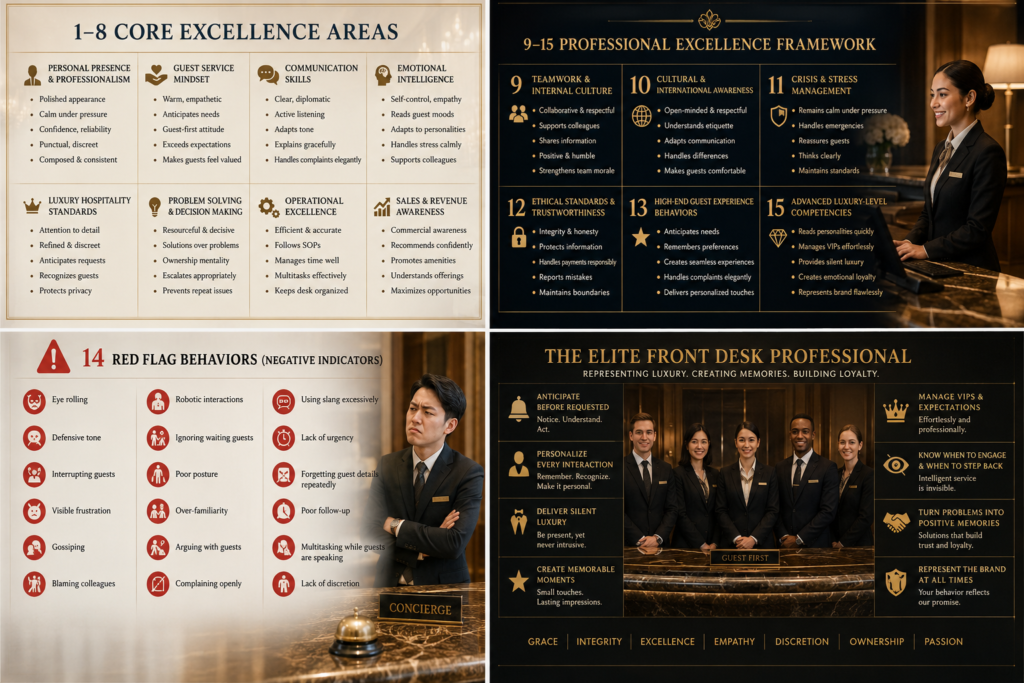
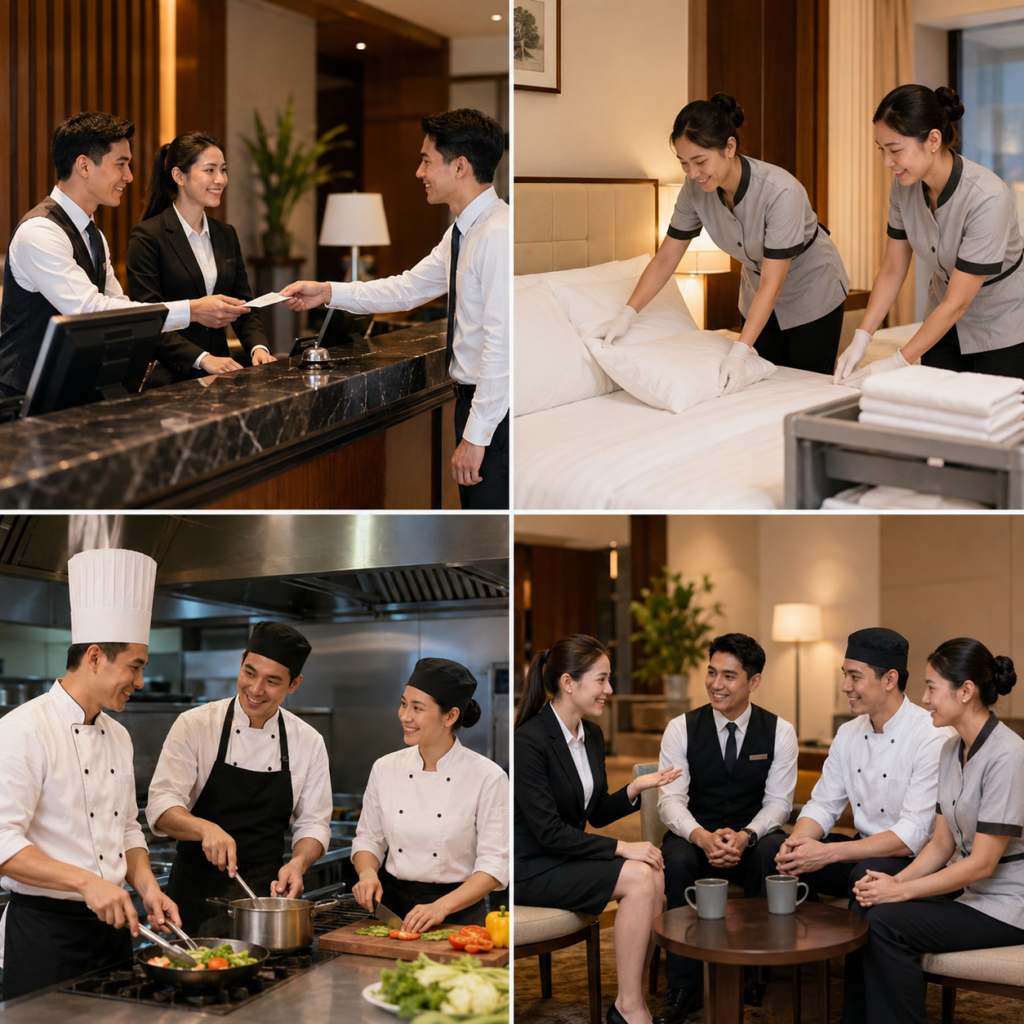
A Guest Service Mindset is the way a person thinks, feels, and behaves when serving guests. It means the guest is always the priority, and every action is guided by care, respect, and attention to detail. It is not just doing tasks correctly, but doing them in a way that makes guests feel welcome, safe, and valued.
Core Qualities
1. Hospitality instinct
This is a natural or trained tendency to make people feel comfortable and welcome.
You notice when someone enters a space and immediately acknowledge them
You feel motivated to help without being told
You treat every guest like they matter, not like a task
You enjoy improving someone’s experience
Example: A guest looks unsure at the entrance. Instead of waiting, you walk over and say: “Welcome! How can I help you today?”
2. Service orientation
This means your focus is on helping others, not on convenience for yourself.
You think in terms of “How can I solve this for the guest?”
You prioritize guest needs over personal speed or comfort
You take responsibility for making things right
Example: Even if you are busy, you pause briefly to guide a guest rather than pointing from a distance.
3. Warmth
Warmth is the emotional tone you bring into interactions.
Friendly voice and facial expression
Open body language
Calm and inviting presence
No cold or mechanical responses
Example: Instead of “Yes?” you say: “Of course, I’m happy to help you.”
4. Empathy
Empathy means understanding how the guest feels and responding with care.
You recognize frustration, confusion, or stress
You respond with patience instead of irritation
You imagine yourself in the guest’s situation
Example: A guest is upset about waiting: “I understand that waiting can be frustrating. Let me see how I can speed this up for you.”
5. Patience
Patience means staying calm and respectful even when situations are slow, repetitive, or difficult.
You do not rush guests
You repeat information kindly when needed
You stay composed under pressure
Example: A guest asks the same question twice. You answer again without showing frustration.
6. Generosity in attitude
This is a mindset of giving more than the minimum required.
You look for small ways to improve the guest experience
You do extra steps without being asked
You don’t think “that’s not my job”
Example: Instead of just giving directions, you walk the guest to the correct location.
7. Attentiveness
Attentiveness means noticing small details about guests and their needs.
You observe body language and tone
You notice confusion, hesitation, or discomfort
You stay aware even when not directly spoken to
Example: A guest keeps looking around unsure. You approach before they ask for help.
8. Anticipation of needs
This is the ability to predict what a guest might need before they ask.
You think one step ahead
You prepare solutions early
You reduce effort for the guest
Example: If a guest has luggage, you immediately offer storage or assistance before they request it.
9. Desire to exceed expectations
This means not just meeting needs, but improving the experience.
You aim for “wow” moments
You add small personal touches
You go beyond standard procedures when appropriate
Example: A guest mentions a birthday. You arrange a small surprise or message if possible.
10. Guest-first mentality
This is the foundation of all service behavior.
Every decision starts with: “What is best for the guest?”
Rules are followed, but guest experience is prioritized within them
You avoid actions that may inconvenience guests unnecessarily
Example: Instead of making a guest wait in line for a simple question, you handle it quickly at the side.
Observable Behaviors
These are actions that show a strong guest service mindset in real life.
1. Uses guest names naturally
You listen carefully to names and repeat them correctly
You use names in conversation without overdoing it
Example: “Thank you, Anna. I’ll take care of that for you.”
2. Offers assistance proactively
You don’t wait to be asked
You step in when you see possible need
Example: Seeing a guest with a map upside down, you say: “Would you like help finding your way?”
3. Notices guest discomfort quickly
You observe facial expressions and behavior
You react early before problems grow
Example: A guest looks confused at a menu. You approach and explain options.
4. Follows up without being asked
You check back after solving a problem
You ensure satisfaction
Example: “Is everything working well for you now?”
5. Escorts rather than points
You physically guide guests when possible
You avoid vague directions
Example: Instead of “It’s down the hall,” you say: “Let me show you.”
6. Remembers preferences
You recall repeat guest details
You use memory to personalize service
Example: “You prefer still water, right? I’ll bring that for you.”
7. Personalizes interactions
You adjust tone and style to the guest
You avoid robotic or generic communication
Example: Using casual warmth for families and more formal tone for business guests.
8. Makes guests feel valued
You acknowledge presence and importance
You show appreciation genuinely
Example: “We’re glad you’re here with us today.”
9. Handles special occasions thoughtfully
You recognize birthdays, anniversaries, celebrations
You add thoughtful touches when possible
Example: A small note, greeting, or special arrangement for a celebration.
10. Shows genuine care consistently
Your behavior is not scripted
Guests feel sincerity in tone and actions
Example: Even small tasks are done with attention and respect, not speed alone.
Summary
A strong Guest Service Mindset means:
Thinking first about the guest in every situation
Acting with warmth, empathy, and patience
Paying attention to small details
Anticipating needs before they are spoken
Going beyond expectations when possible
Making every guest feel respected, seen, and cared for
It is not a single behavior—it is a consistent way of thinking that shapes every interaction.
before doing that exercise check out part 1 and part 2
###############
###############
When to use which tense….
🔵 Present Simple (habit, facts)
Signal words:
every day
always
often
usually
sometimes
never
on Mondays
in the morning / evening
Example:
I always go to school.
🟢 Past Simple (finished past)
Signal words:
yesterday
last night
last week / month / year
ago
in 2020
then
Example:
I went home yesterday.
🟡 Present Progressive (NOW, AT THE MOMENT OF SPEAKING)
Signal words:
now
right now
at the moment
today (sometimes)
Look!
Listen!
Example:
She is studying now.
🟣 Future (plan = present progressive)
Signal words:
tomorrow
next week / month / year
tonight
on Monday (future meaning)
this evening
Example:
I am meeting him tomorrow.
🔴 Future with WILL (no plan / prediction (saying what you think will happen in the future))
Signal words:
I think…
maybe
probably
I’m sure
tomorrow (prediction)
one day
Example:
I think it will rain tomorrow.
⭐ Super simple rule:
🟢 present simple = every day / often
🟡 present progressive = now / at the moment
🔵 past = yesterday / last / ago
🟣 future with a plan = present progressive, tomorrow / next
🔴 will future = maybe / I think
###############
###############
Fill in:
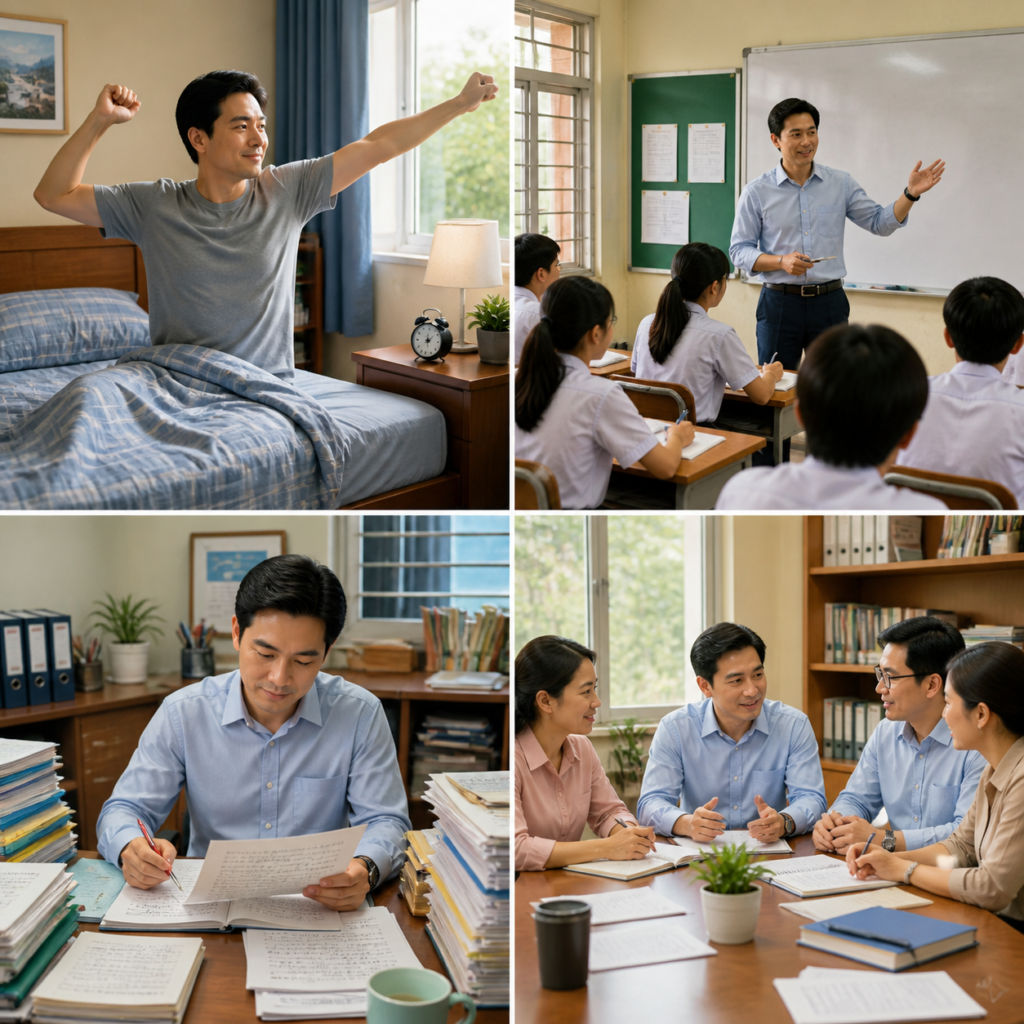
Mr. Vongg is at school now. He is in his classroom.
Interviewer: Hello, Mr. Vongg. Mr. Vongg: Hello.
Interviewer: What time ______ you ______ (wake up)? Mr. Vongg: I ______ (wake up) at 6:00.
Interviewer: Where ______ you ______ (work)? Mr. Vongg: I ______ (work) at a school.
Interviewer: What ______ you ______ (teach)? Mr. Vongg: I ______ (teach) English.
Interviewer: What ______ you ______ (do) now? Mr. Vongg: I ______ (teach) grammar.
Interviewer: What ______ the students ______ (do)? Mr. Vongg: They ______ (listen and write).
Interviewer: ______ you ______ (like) your job? Mr. Vongg: Yes, I ______ (like) my job. I ______ (like) teaching students.
Interviewer: How many students ______ (be) there in your class? Mr. Vongg: There ______ (be) 20 students in my class.
Interviewer: What time ______ your school ______ (start)? Mr. Vongg: My school ______ (start) at 8:00.
Interviewer: What ______ you ______ (do) yesterday? Mr. Vongg: Yesterday, I ______ (give) a test.
Interviewer: ______ (be) the students good? Mr. Vongg: Yes, they ______ (be) good.
Interviewer: ______ (be) teaching difficult for you? Mr. Vongg: Sometimes it ______ (be) difficult, but I enjoy it.
Interviewer: What ______ you ______ (do) after class yesterday? Mr. Vongg: I ______ (check) homework.
Interviewer: What ______ you ______ (do) tomorrow? Mr. Vongg: I ______ (have) a meeting with other teachers.
Interviewer: What ______ you usually ______ (do) after school? Mr. Vongg: I ______ (go) home and rest.
Interviewer: What ______ you ______ (do) last week? Mr. Vongg: Last week, I ______ (organize) a school activity.
———————————
Correct version:
Interviewer: Hello, Mr. Vongg. Mr. Vongg: Hello.
Interviewer: What time do you wake up? Mr. Vongg: I wake up at 6:00.
Interviewer: Where do you work? Mr. Vongg: I work at a school.
Interviewer: What do you teach? Mr. Vongg: I teach English.
Interviewer: What are you doing now? Mr. Vongg: I am teaching grammar.
Interviewer: What are the students doing? Mr. Vongg: They are listening and writing.
Interviewer: Do you like your job? Mr. Vongg: Yes, I like my job. I like teaching students.
Interviewer: How many students are there in your class? Mr. Vongg: There are 20 students in my class.
Interviewer: What time does your school start? Mr. Vongg: My school starts at 8:00.
Interviewer: What did you do yesterday? Mr. Vongg: Yesterday, I gave a test.
Interviewer: Were the students good? Mr. Vongg: Yes, they were good.
Interviewer: Is teaching difficult for you? Mr. Vongg: Sometimes it is difficult, but I enjoy it.
Interviewer: What did you do after class yesterday? Mr. Vongg: I checked homework.
Interviewer: What are you having tomorrow? Mr. Vongg: I am having a meeting with other teachers.
Interviewer: What do you usually do after school? Mr. Vongg: I go home and rest.
Interviewer: What did you do last week? Mr. Vongg: Last week, I organized a school activity.
#################
Fill in:
Interviewer: Hello, Oum. Oum: Hello.
Interviewer: What time ______ you usually ______ (wake up)? Oum: I usually ______ (wake up) at 7:00.
Interviewer: What ______ you usually ______ (do) in the morning? Oum: I ______ (eat) breakfast with my sister.
Interviewer: What ______ you ______ (do) now? Oum: I ______ (run) to the bus stop.
Interviewer: Why ______ you ______ (run)? Oum: Because I ______ (be) late for school.
Interviewer: Where ______ (be) your friends now? Oum: They ______ (be) at school.
Interviewer: What ______ you ______ (do) yesterday? Oum: Yesterday, I ______ (study) for a math test. I also ______ (watch) a movie.
Interviewer: What ______ you ______ (do) in the evening then? Oum: I ______ (go) to bed late.
Interviewer: What ______ your teacher ______ (do) today? Oum: My teacher ______ (teach) animals in class.
Interviewer: What ______ you ______ (think) about now? Oum: I ______ (think) about the weekend.
Interviewer: Why ______ (be) you excited? Oum: Because we always ______ (have) fun together.
Interviewer: What ______ you ______ (do) for this Saturday? Oum: I ______ (meet) my cousin in Salzburg. We ______ (go) to Salzburg by train at 10:00.
Interviewer: What ______ you ______ (do) last weekend? Oum: We ______ (play) volleyball, ______ (cook) pizza, and ______ (dance) at a party.
Interviewer: Thank you, Oum. Oum: You’re welcome.
———————————
Correct version:
Interviewer: Hello, Oum. Oum: Hello.
Interviewer: What time do you usually wake up? Oum: I usually wake up at 7:00.
Interviewer: What do you usually do in the morning? Oum: I eat breakfast with my sister.
Interviewer: What are you doing now? Oum: I am running to the bus stop.
Interviewer: Why are you running? Oum: Because I am late for school.
Interviewer: Where are your friends now? Oum: They are at school.
Interviewer: What did you do yesterday? Oum: Yesterday, I studied for a math test. I also watched a movie.
Interviewer: What did you do in the evening then? Oum: I went to bed late.
Interviewer: What is your teacher doing today? Oum: My teacher is teaching animals in class.
Interviewer: What are you thinking about now? Oum: I am thinking about the weekend.
Interviewer: Why are you excited? Oum: Because we always have fun together.
Interviewer: What are you doing for this Saturday? Oum: I am meeting my cousin in Salzburg. We are going to Salzburg by train at 10:00.
Interviewer: What did you do last weekend? Oum: We played volleyball, cooked pizza, and danced at a party.
Interviewer: Thank you, Oum. Oum: You’re welcome.
################# Fill in:
Interviewer: What time ___________ you usually __________ (wake up)? Salas: I usually __________ (wake up) at 6:30.
Interviewer: How ___________ you __________ (go) to school? Salas: I __________ (go) to school by bus.
Interviewer: What ___________ you usually __________ (eat) in the morning? Salas: I __________ (eat) breakfast quickly.
Interviewer: What ___________ you __________ (do) now? Salas: I __________ (sit) in the classroom and __________ (listen) to my teacher.
Interviewer: What ___________ your classmates __________ (do) now? Salas: They __________ (write) a test.
Interviewer: What ___________ you __________ (do) yesterday? Salas: Yesterday, I __________ (visit) my uncle in the city, I______________ (spend) some time in the park..
Interviewer: What ___________ you __________ (do) in the park? Salas: We __________ (walk) in the park and __________ (eat) ice cream.
Interviewer: ___________ you __________ (take) photos yesterday? Salas: Yes, I __________ (take) many photos.
Interviewer: What ___________ your mother __________ (do) now? Salas: She __________ (cook) lunch.
Interviewer: What ___________ your father __________ (do) now? Salas: He __________ (work) at home.
Interviewer: What ___________ you __________ (think) about now? Salas: I __________ (think) about my homework.
Interviewer: What ___________ you __________ (do) next Sunday? Salas: I __________ (meet) my best friend in the city center. We __________ (go) to the cinema.
Interviewer: Why ___________ (be) you excited? Salas: Because we always __________ (have) a great time together.
Interviewer: What ___________ you __________ (do) last weekend? Salas: We __________ (play) football, __________ (watch) a match, and __________ (laugh) a lot.
Interviewer: Thank you, Salas. Salas: You’re welcome.
——————————
Correct version:
Interviewer: What time do you usually wake up? Salas: I usually wake up at 6:30.
Interviewer: How do you go to school? Salas: I go to school by bus.
Interviewer: What do you usually eat in the morning? Salas: I eat breakfast quickly.
Interviewer: What are you doing now? Salas: I am sitting in the classroom and am listening to my teacher.
Interviewer: What are your classmates doing now? Salas: They are writing a test.
Interviewer: What did you do yesterday? Salas: Yesterday, I visited my uncle in the city, I spent some time in the park.
Interviewer: What did you do in the park? Salas: We walked in the park and ate ice cream.
Interviewer: Did you take photos yesterday? Salas: Yes, I took many photos.
Interviewer: What is your mother doing now? Salas: She is cooking lunch.
Interviewer: What is your father doing now? Salas: He is working at home.
Interviewer: What are you thinking about now? Salas: I am thinking about my homework.
Interviewer: What are you doing next Sunday? Salas: I am meeting my best friend in the city center. We are going to the cinema.
Interviewer: Why are you excited? Salas: Because we always have a great time together.
Interviewer: What did you do last weekend? Salas: We played football, watched a match, and laughed a lot.
Interviewer: Thank you, Salas. Salas: You’re welcome.
##################
Fill in:
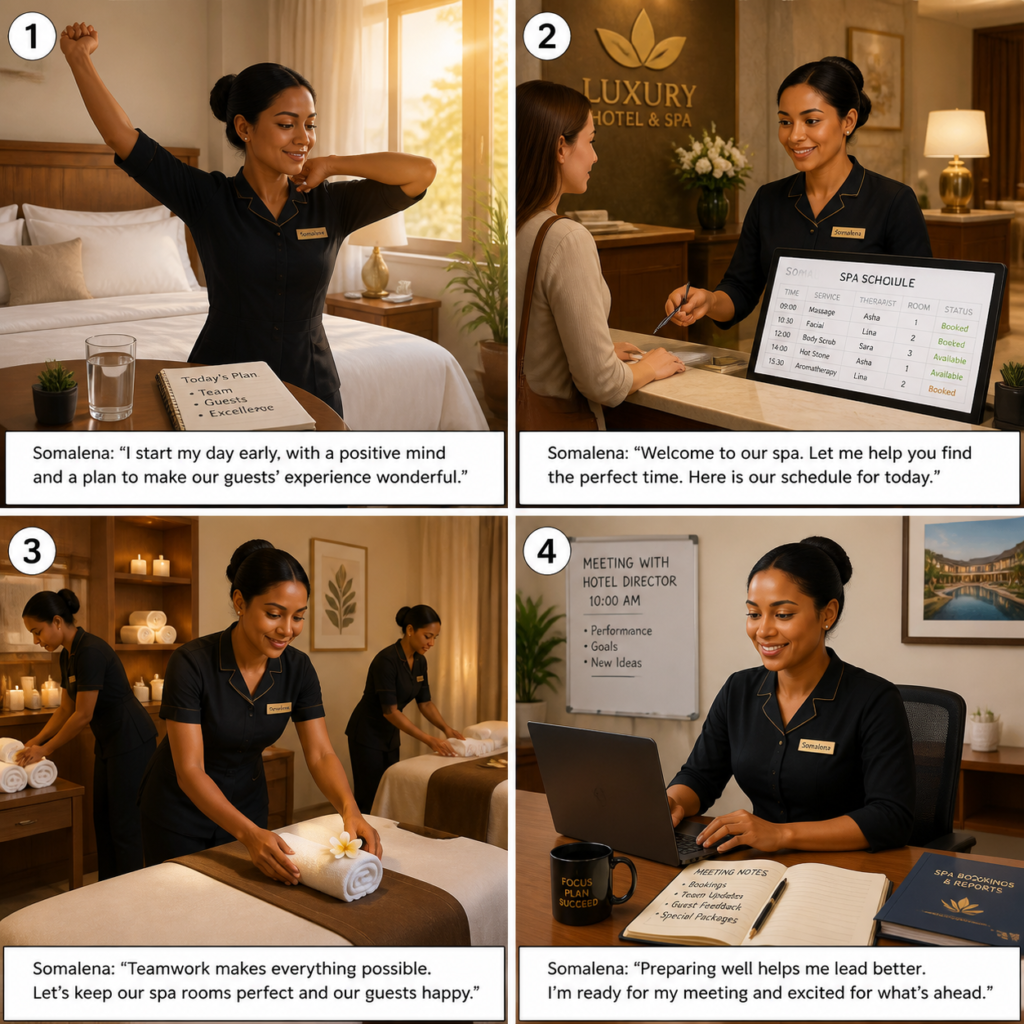
Interviewer: What time ____________ you usually ____________ (wake up)? Somalena: I usually ____________ (wake up) at 6:00.
Interviewer: Where ____________ you ____________ (work)? Somalena: I ____________ (work) at a luxury hotel.
Interviewer: What ____________ you ____________ (do) in your job? Somalena: I ____________ (help) guests and ____________ (organize) the spa schedule.
Interviewer: What ____________ you ____________ (do) now? Somalena: I ____________ (talk) to a guest at the reception.
Interviewer: What ____________ your team ____________ (do) now? Somalena: My team ____________ (clean) the spa rooms.
Interviewer: What ____________ you ____________ (do) yesterday? Somalena: Yesterday, I ____________ (have) a very busy day. I ____________ (meet) many guests and ____________ (solve) problems.
Interviewer: What time ____________ you ____________ (finish) work yesterday? Somalena: I ____________ (finish) work late.
Interviewer: What ____________ (happen) at the hotel now? Somalena: The hotel ____________ (be) very busy, and new guests ____________ (arrive).
Interviewer: What ____________ you ____________ (do) now at work? Somalena: I ____________ (check) the bookings.
Interviewer: What ____________ you ____________ (do) tomorrow? Somalena: I ____________ (have) an important meeting with the hotel director. I ____________ (prepare) new plans for the spa.
Interviewer: What ____________ you ____________ (do) last weekend? Somalena: I ____________ (work) on Saturday and Sunday.
Interviewer: How ____________ (be) you today? Somalena: I ____________ (be) tired but happy.
Interviewer: Why ____________ (be) you happy? Somalena: Because many guests ____________ (enjoy) the spa now.
Remember? Here’s a very simple explanation of when to use each tense:
🟢 Present Simple
When?
For things you do every day
For routines and habits
For facts that are always true
Keywords: always, usually, often, every day, never
Examples:
I go to school every day.
She likes pizza.
The sun rises in the morning.
🔵 Present Progressive (Present Continuous)
When?
For actions happening right now
For actions happening around this time
For future plans (fixed arrangements)
Keywords: now, right now, at the moment, today
Examples:
I am studying now.
She is reading a book at the moment.
We are meeting Tom tomorrow. (future plan)
🟡 Past Simple
When?
For finished actions in the past
When we say when something happened (yesterday, last week, in 2020)
Keywords: yesterday, last night, last week, ago, in 2003
Examples:
I watched a movie yesterday.
She went to Paris last year.
They played football last weekend.
🧠 Easy way to remember
🟢 Present Simple = always / usually / every day
🔵 Present Progressive = now / right now / at the moment
🟡 Past Simple = yesterday / last week / ago
🔵 (also) Present Progressive = future plans (tomorrow, next week)
#################
Fill in, present simple, present progressive (continuous), past simple:
Story #1: Oum’s busy week
Oum usually __________ (wake up) at 7:00. She __________ (eat) breakfast with her sister every morning.
Today is different. Right now, she __________ (run) to the bus stop because she is late. Her friends __________ (wait) for her at school now.
Yesterday, Oum __________ (study) for a math test and __________ (watch) a movie in the evening. She __________ (go) to bed very late.
At the moment, her teacher __________ (talk) about animals, but Oum __________ (think) about the weekend.
This Saturday, Oum __________ (meet) her cousin in Salzburg. They __________ (travel) by train at 10:00 in the morning. Oum is very excited because they always __________ (have) fun together.
Last weekend, they __________ (play) volleyball, __________ (cook) pizza, and __________ (dance) at a party.
——————————-
Oum’s Busy Week
Oum usually wakes up at 7:00. She eats breakfast with her sister every morning.
Today is different. Right now, she is running to the bus stop because she is late. Her friends are waiting for her at school now.
Yesterday, Oum studied for a math test and watched a movie in the evening. She went to bed very late.
At the moment, her teacher is talking about animals, but Oum is thinking about the weekend.
This Saturday, Oum is meeting her cousin in Salzburg. They are traveling by train at 10:00 in the morning. Oum is very excited because they always have fun together.
Last weekend, they played volleyball, cooked pizza, and danced at a party.
###################
Story #2: Salas in the city
Salas usually __________ (wake up) at 6:30. He __________ (eat) breakfast quickly and __________ (go) to school by bus.
Today is a busy day. Right now, he __________ (sit) in the classroom and he __________ (listen) to his teacher. His classmates __________ (write) a test at the moment.
Yesterday, Salas __________ (visit) his uncle in the city. They __________ (walk) in the park and __________ (eat) ice cream. Salas __________ (take) many photos.
At the moment, Salas’s mother __________ (cook) lunch, and his father __________ (work) at home. Salas __________ (think) about his homework.
Next Sunday, Salas __________ (meet) his best friend in the city center. They __________ (go) to the cinema at 5:00. Salas is excited because they always __________ (have) a great time together.
Last weekend, they __________ (play) football, __________ (watch) a match, and __________ (laugh) a lot.
__________________________
Salas in the city
Salas usually wakes up at 6:30. He eats breakfast quickly and goes to school by bus.
Today is a busy day. Right now, he is sitting in the classroom and he is listening to his teacher. His classmates are writing a test at the moment.
Yesterday, Salas visited his uncle in the city. They walked in the park and ate ice cream. Salas took many photos.
At the moment, Salas’s mother is cooking lunch, and his father is working at home. Salas is thinking about his homework.
Next Sunday, Salas is meeting his best friend in the city center. They are going to the cinema at 5:00. Salas is excited because they always have a great time together.
Last weekend, they played football, watched a match, and laughed a lot.
##################
Story #3: Somalena at the hotel
Somalena usually __________ (wake up) at 6:00. She __________ (go) to work at a luxury hotel every morning.
Somalena __________ (work) as a manager in the spa. She __________ (help) guests and __________ (organize) the spa schedule.
Right now, she __________ (talk) to a guest at the reception. Her team __________ (clean) the spa rooms at the moment.
Yesterday, Somalena __________ (have) a very busy day. She __________ (meet) many guests and __________ (solve) problems in the spa. She __________ (finish) work late.
At the moment, the hotel __________ (be) very busy, and new guests __________ (arrive). Somalena __________ (check) the bookings.
Tomorrow, Somalena __________ (have) an important meeting with the hotel director. She __________ (prepare) new plans for the spa.
Last weekend, she __________ (work) on Saturday and Sunday. She __________ (feel) tired but happy because many guests __________ (enjoy) the spa.
—————————–
Somalena at the Hotel
Somalena usually wakes up at 6:00. She goes to work at a luxury hotel every morning.
Somalena works as a manager in the spa. She helps guests and organizes the spa schedule.
Right now, she is talking to a guest at the reception. Her team is cleaning the spa rooms at the moment.
Yesterday, Somalena had a very busy day. She met many guests and solved problems in the spa. She finished work late.
At the moment, the hotel is very busy, and new guests are arriving. Somalena is checking the bookings.
Tomorrow, Somalena is having an important meeting with the hotel director. She is preparing new plans for the spa.
Last weekend, she worked on Saturday and Sunday. She felt tired but happy because many guests enjoyed the spa.
###################
Story #4: Rafi and his family
Rafi usually __________ (wake up) very early in the morning. He __________ (help) his family on the rice fields.
Rafi’s family __________ (work) together on a big rice farm. They __________ (plant) rice and __________ (take care) of the fields.
Right now, Rafi __________ (work) in the field. His father __________ (cut) grass, and his mother __________ (carry) water.
Yesterday, Rafi __________ (work) all day in the sun. He __________ (feel) tired, but he __________ (finish) a lot of work. His family __________ (eat) dinner together in the evening.
At the moment, the sun __________ (shine), and Rafi’s sister __________ (help) in the field too. Everyone __________ (be) busy.
Next week, Rafi __________ (help) to harvest the rice. His family __________ (plan) a big day for the harvest.
Last year, they __________ (have) a very good rice harvest. They __________ (sell) rice at the market and __________ (earn) some money.
———————————-
Rafi and his family
Rafi usually wakes up very early in the morning. He helps his family on the rice fields.
Rafi’s family works together on a big rice farm. They plant rice and take care of the fields.
Right now, Rafi is working in the field. His father is cutting grass, and his mother is carrying water.
Yesterday, Rafi worked all day in the sun. He felt tired, but he finished a lot of work. His family ate dinner together in the evening.
At the moment, the sun is shining, and Rafi’s sister is helping in the field too. Everyone is busy.
Next week, Rafi is going to help to harvest the rice. His family is planning a big day for the harvest.
Last year, they had a very good rice harvest. They sold rice at the market and earned some money.
################
Story #5: Mr. Vongg at school
Mr. Vongg usually __________ (wake up) at 6:00. He __________ (go) to school early every morning.
Mr. Karim __________ (work) as a teacher at a school. He __________ (teach) English to young students.
Right now, he __________ (stand) in front of the class and he __________ (explain) a grammar rule. The students __________ (listen) carefully and __________ (write) in their notebooks.
Yesterday, Mr. Karim __________ (give) a test. The students __________ (do) very well. He __________ (be) very happy.
At the moment, the school __________ (be) very quiet, and another class __________ (take) a test in the next room. Mr. Karim __________ (check) homework.
Tomorrow, Mr. Karim __________ (have) a meeting with other teachers. He __________ (prepare) new lessons.
Last week, he __________ (organize) a school activity. The students __________ (play) games and __________ (learn) new words.
—————————————
Mr. Vongg at school
Mr. Vongg usually wakes up at 6:00. He goes to school early every morning.
Mr. Vongg works as a teacher at a school. He teaches English to young students.
Right now, he is standing in front of the class and he is explaining a grammar rule. The students are listening carefully and are writing in their notebooks.
Yesterday, Mr. Vongg gave a test. The students did very well. He was very happy.
At the moment, the school is very quiet, and another class is taking a test in the next room. Mr. Vongg is checking homework.
Tomorrow, Mr. Vongg is having a meeting with other teachers. He is preparing new lessons.
Last week, he organized a school activity. The students played games and learned new words.
…………………. can be used to talk about the future when something is already planned or arranged.
Form
am / is / are + verb + -ing
A. Most verbs
Add -ing to the verb.
play → playing
visit → visiting
swim → swimming
Examples:
We are playing games.
They are visiting Italy next week.
B. Verbs ending in -e
Remove -e and add -ing.
live → living
make → making
come → coming
Examples:
We are living in Vienna.
She is coming tomorrow.
C. Short verbs with one vowel + one consonant
Double the last consonant and add -ing.
swim → swimming
run → running
sit → sitting
Examples:
They are swimming in the sea.
He is running in the park.
1. Use: Fixed plans in the future
We use it for things that are already decided and organized.
Examples:
I am meeting my friend tomorrow.
She is flying to Berlin next week.
We are having dinner at 6 pm.
👉 These are not spontaneous ideas — they are planned.
2. Time expressions are usually needed
We often say when the action will happen:
tonight
tomorrow
next week
at 5 pm
on Monday
Example:
They are playing football on Saturday.
3. Difference from “will”
Present progressive = planned
I am visiting my grandma tomorrow. (already planned)
will = decision made now / prediction
I think I will visit my grandma tomorrow. (decided now)
4. Important idea
We use present progressive for the future when the plan is:
organized
already arranged
usually with other people involved
#################
Fill in present progressive:
We _____ (go) to Italy for a beach holiday. We _____ (stay) at a seaside resort with our family and friends. We _____ (spend) our days on the beach. We _____ (build) sandcastles near the water and we _____ (swim) in the sea to cool off. We _____ (drink) fruit drinks and _____ (relax) in the sun.
In the afternoon, we _____ (play) beach games and _____ (enjoy) time together. In the evening, we _____ (watch) a show and _____ (eat) ice cream. We _____ (walk) along the shore as the sun sets.
Before bed, we _____ (play) games or _____ (rest) after a fun day.
_____________________
Correct version:
We are going to Italy for a beach holiday. We are staying at a seaside resort with our family and friends. We are spending our days on the beach. We are building sandcastles near the water and we are swimming in the sea to cool off. We are drinking fruit drinks and are relaxing in the sun.
In the afternoon, we are playing beach games and are enjoying time together. In the evening, we are watching a show and are eating ice cream. We are walking along the shore as the sun sets.
Before bed, we are playing games or are resting after a fun day.
###############
Fill in, present progressive:
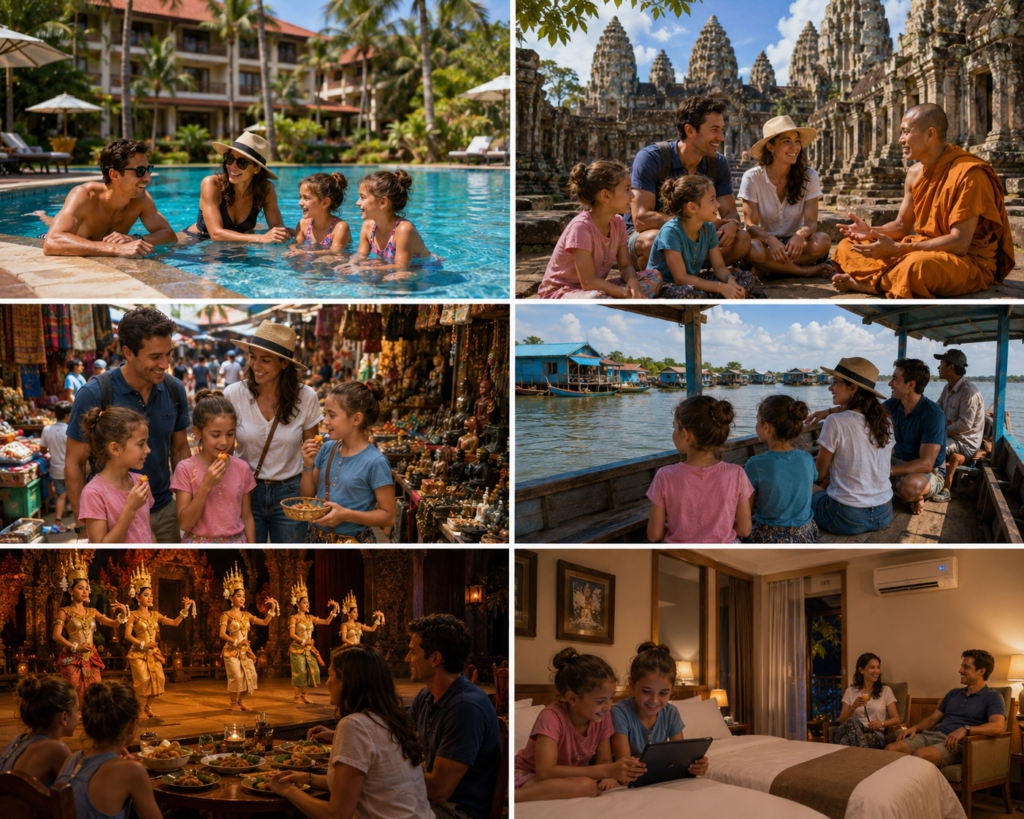
We _____ (go) on holiday to Cambodia with our parents and my twin sister. We _____ (stay) in a hotel with a swimming pool, and we _____ (spend) our days swimming and relaxing in the sun.
We _____ (visit) ancient temples and we _____ (meet) friendly monks who _____ (teach) us about their traditions. We _____ (go) to the local market, and we _____ (try) new foods and buy souvenirs.
We _____ (take) a boat ride on Tonlé Sap, where we _____ (meet) people living in floating houses.
In the evening, we _____ (watch) an Apsara show with traditional dances, and we _____ (enjoy) delicious local food.
Later, in our hotel room, we _____ (relax) and _____ (enjoy) the air conditioning after a long day.
___________________
Correct version:
We are going on holiday to Cambodia with our parents and my twin sister. We are staying in a hotel with a swimming pool, and we are spending our days swimming and relaxing in the sun.
We are visiting ancient temples and we are meeting friendly monks who are teaching us about their traditions. We are going to the local market, and we are trying new foods and buying souvenirs.
We are taking a boat ride on Tonlé Sap, where we are meeting people living in floating houses.
In the evening, we are watching an Apsara show with traditional dances, and we are enjoying delicious local food.
Later, in our hotel room, we are relaxing and are enjoying the air conditioning after a long day.
##############
Fill in, present progressive:
We _____ (go) on holiday to our grandparents’ house in the Vienna Woods. Our mother _____ (have) to work, and our father _____ (work) too, so we _____ (stay) with our grandparents.
We _____ (spend) our days outside and we _____ (roam) through the woods, exploring nature and enjoying the fresh air. When it is hot, our grandparents _____ (invite) us to the whirlpool, and we _____ (cool) off and _____ (have) fun in the water.
In the evening, we _____ (watch) movies together in the living room. If it is too hot inside, we _____ (switch) on the air conditioning and _____ (relax) comfortably.
________________
Correct version:
We are going on holiday to our grandparents’ house in the Vienna Woods. Our mother is having to work, and our father is working too, so we are staying with our grandparents.
We are spending our days outside and we are roaming through the woods, exploring nature and enjoying the fresh air. When it is hot, our grandparents are inviting us to the whirlpool, and we are cooling off and are having fun in the water.
In the evening, we are watching movies together in the living room. If it is too hot inside, we are switching on the air conditioning and are relaxing comfortably.
############
Fill in, present progressive:
Somalena _____ (spend) her holidays at home in the city. When it is hot, she _____ (stay) inside and she _____ (play) games. She _____ (switch) on the air conditioning and _____ (relax) in the cool air.
Somalena _____ (visit) her friends on Mondays and Wednesdays and she _____ (enjoy) spending time together. If it is too hot, she _____ (go) to the public pool, where she _____ (meet) her friends, _____ (have) fun, and _____ (splash) in the water. She _____ (stay) in the shade and _____ (avoid) sunburn.
In the evening, Somalena _____ (go) into the city with her parents. She _____ (have) a light lunch and she _____ (eat) ice cream while she _____ (walk) around and ______ (enjoy) the warm night air.
_________________
Somalena is spending her holidays at home in the city. When it is hot, she is staying inside and she is playing games. She is switching on the air conditioning and is relaxing in the cool air.
Somalena is visiting her friends on Mondays and Wednesdays and she is enjoying spending time together. If it is too hot, she is going to the public pool, where she is meeting her friends, is having fun, and is splashing in the water. She is staying in the shade and is avoiding sunburn.
In the evening, Somalena is going into the city with her parents. She is having a light lunch and she is eating ice cream while she is walking around and enjoying the warm night air.
#############
An email – birthday, invitation, fill in:
I _____ (invite) you to my birthday party this Thursday. The party _____ (start) at 5 PM. Then it is not so hot anymore, so we _____ (have) the party in the garden.
My grandmother _____ (make) a fruit cake, and my mother _____ (prepare) fruit juices for everyone. We _____ (play) music and we _____ (dance), so we _____ (have) a lot of fun together.
We _____ (eat) birthday cake and we _____ (enjoy) the evening with food, music, and friends.
I hope you _____ (come) and _____ (celebrate) with me!
—————————
Correct version:
Subject: 🎉 Birthday Party Invitation 🎉
Hi friends,
I am inviting you to my birthday party this Thursday. The party is starting at 5 PM. Then it is not so hot anymore, so we are having the party in the garden.
My grandmother is making a fruit cake, and my mother is preparing fruit juices for everyone. We are playing music and we are dancing, so we are having a lot of fun together.
We are eating birthday cake and we are enjoying the evening with food, music, and friends.
I hope you are coming and are celebrating with me!
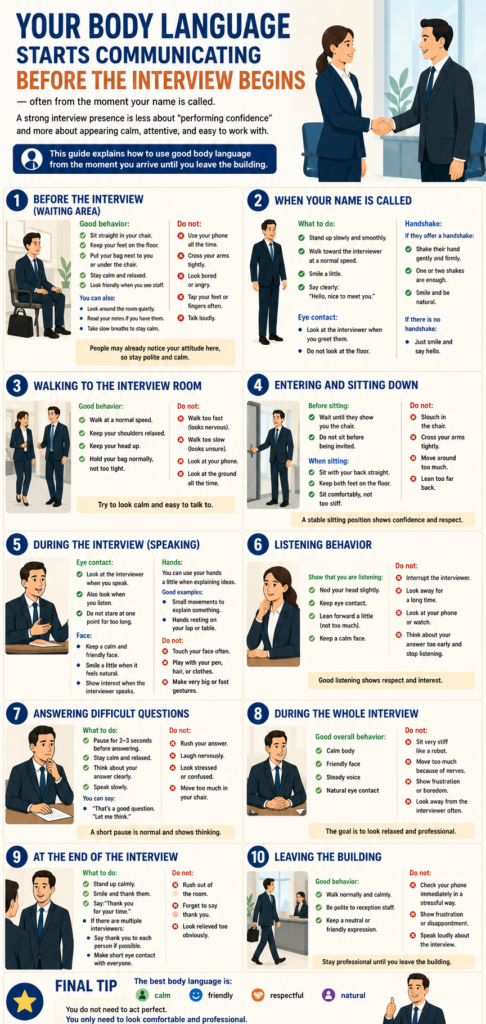
Your body language starts communicating before the interview begins — often from the moment your name is called. A strong interview presence is less about “performing confidence” and more about appearing calm, attentive, and easy to work with.
This guide explains how to use good body language from the moment you arrive until you leave the building.
1. Before the Interview (Waiting Area)
When you arrive at the company, you may need to wait.
Good behavior:
Sit straight in your chair.
Keep your feet on the floor.
Put your bag next to you or under the chair.
Stay calm and relaxed.
Look friendly when you see staff.
You can also:
Look around the room quietly.
Read your notes if you have them.
Take slow breaths to stay calm.
Do not:
Use your phone all the time.
Cross your arms tightly.
Look bored or angry.
Tap your feet or fingers often.
Talk loudly.
People may already notice your attitude here, so stay polite and calm.
2. When Your Name Is Called
This is your first direct contact with the interviewer.
What to do:
Stand up slowly and smoothly.
Walk toward the interviewer at a normal speed.
Smile a little.
Say clearly:“Hello, nice to meet you.”
Eye contact:
Look at the interviewer when you greet them.
Do not look at the floor.
Handshake:
If they offer a handshake:
Shake their hand gently and firmly.
One or two shakes are enough.
Smile and be natural.
If there is no handshake:
Just smile and say hello.
3. Walking to the Interview Room
You may walk with the interviewer.
Good behavior:
Walk at a normal speed.
Keep your shoulders relaxed.
Keep your head up.
Hold your bag normally, not too tight.
Do not:
Walk too fast (looks nervous).
Walk too slow (looks unsure).
Look at your phone.
Look at the ground all the time.
Try to look calm and easy to talk to.
4. Entering and Sitting Down
When you enter the room:
Before sitting:
Wait until they show you the chair.
Do not sit before being invited.
When sitting:
Sit with your back straight.
Keep both feet on the floor.
Sit comfortably, not too stiff.
Do not:
Slouch in the chair.
Cross your arms tightly.
Move around too much.
Lean too far back.
A stable sitting position shows confidence and respect.
5. During the Interview (Speaking)
Eye contact:
Look at the interviewer when you speak.
Also look when you listen.
Do not stare at one point for too long.
Face:
Keep a calm and friendly face.
Smile a little when it feels natural.
Show interest when the interviewer speaks.
Hands:
You can use your hands a little when explaining ideas.
Good examples:
Small movements to explain something.
Hands resting on your lap or table.
Do not:
Touch your face often.
Play with your pen, hair, or clothes.
Make very big or fast gestures.
6. Listening Behavior
Good listening is very important.
Show that you are listening:
Nod your head slightly.
Keep eye contact.
Lean forward a little (not too much).
Keep a calm face.
Do not:
Interrupt the interviewer.
Look away for a long time.
Look at your phone or watch.
Think about your answer too early and stop listening.
Good listening shows respect and interest.
7. Answering Difficult Questions
Sometimes questions are hard.
What to do:
Pause for 2–3 seconds before answering.
Stay calm and relaxed.
Think about your answer clearly.
Speak slowly.
You can say:
“That’s a good question. Let me think.”
Do not:
Rush your answer.
Laugh nervously.
Look stressed or confused.
Move too much in your chair.
A short pause is normal and shows thinking.
8. During the Whole Interview
Try to keep a balanced style:
Good overall behavior:
Calm body
Friendly face
Steady voice
Natural eye contact
Do not:
Sit very stiff like a robot.
Move too much because of nerves.
Show frustration or boredom.
Look away from the interviewer often.
The goal is to look relaxed and professional.
9. At the End of the Interview
When the interview finishes:
What to do:
Stand up calmly.
Smile and thank them.
Say:“Thank you for your time.”
If there are multiple interviewers:
Say thank you to each person if possible.
Make short eye contact with everyone.
Do not:
Rush out of the room.
Forget to say thank you.
Look relieved too obviously.
10. Leaving the Building
Even after the interview ends, people may still see you.
Good behavior:
Walk normally and calmly.
Be polite to reception staff.
Keep a neutral or friendly expression.
Do not:
Check your phone immediately in a stressful way.
Show frustration or disappointment.
Speak loudly about the interview.
Stay professional until you leave the building.
Final Tip
The best body language is:
calm
friendly
respectful
natural
You do not need to act perfect. You only need to look comfortable and professional.
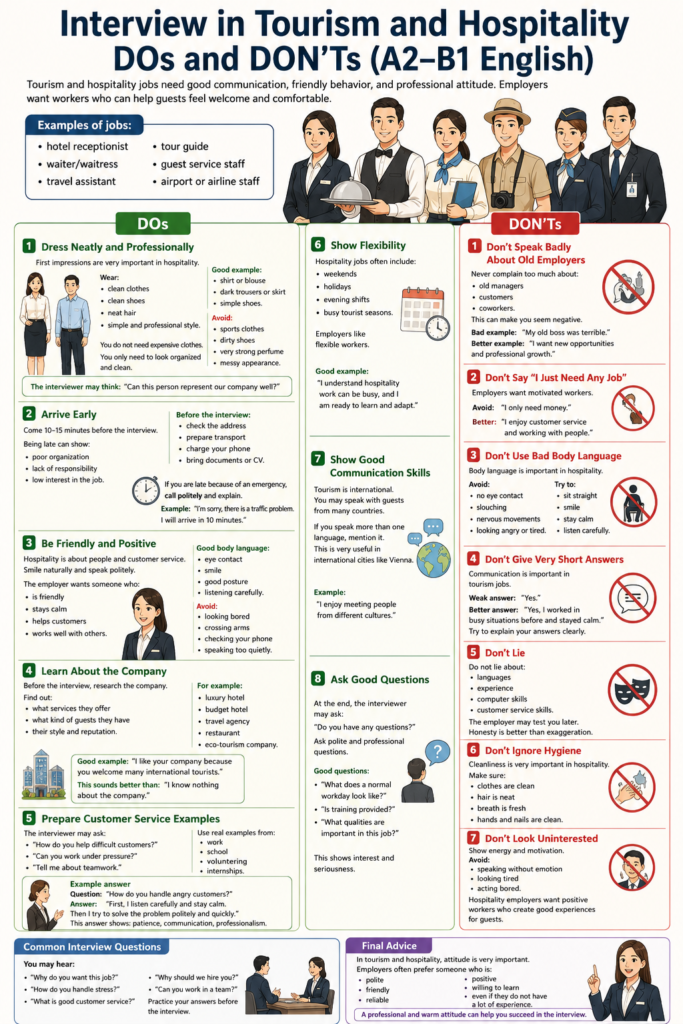
Tourism and hospitality jobs need good communication, friendly behavior, and professional attitude. Employers want workers who can help guests feel welcome and comfortable.
Examples of jobs:
hotel receptionist,
waiter/waitress,
travel assistant,
tour guide,
guest service staff,
airport or airline staff.
DOs
1. Dress Neatly and Professionally
First impressions are very important in hospitality.
Wear:
clean clothes,
clean shoes,
neat hair,
simple and professional style.
You do not need expensive clothes. You only need to look organized and clean.
Good example:
shirt or blouse,
dark trousers or skirt,
simple shoes.
Avoid:
sports clothes,
dirty shoes,
very strong perfume,
messy appearance.
The interviewer may think:
“Can this person represent our company well?”
2. Arrive Early
Come 10–15 minutes before the interview.
Being late can show:
poor organization,
lack of responsibility,
low interest in the job.
Before the interview:
check the address,
prepare transport,
charge your phone,
bring documents or CV.
If you are late because of an emergency, call politely and explain.
Example:
“I’m sorry, there is a traffic problem. I will arrive in 10 minutes.”
3. Be Friendly and Positive
Hospitality is about people and customer service.
Smile naturally and speak politely.
The employer wants someone who:
is friendly,
stays calm,
helps customers,
works well with others.
Good body language:
eye contact,
smile,
good posture,
listening carefully.
Avoid:
looking bored,
crossing arms,
checking your phone,
speaking too quietly.
4. Learn About the Company
Before the interview, research the company.
Find out:
what services they offer,
what kind of guests they have,
their style and reputation.
For example:
luxury hotel,
budget hotel,
travel agency,
restaurant,
eco-tourism company.
This shows motivation and preparation.
Good example:
“I like your company because you welcome many international tourists.”
This sounds better than:
“I know nothing about the company.”
5. Prepare Customer Service Examples
The interviewer may ask:
“How do you help difficult customers?”
“Can you work under pressure?”
“Tell me about teamwork.”
Use real examples from:
work,
school,
volunteering,
internships.
Example answer
Question:
“How do you handle angry customers?”
Answer:
“First, I listen carefully and stay calm. Then I try to solve the problem politely and quickly.”
This answer shows:
patience,
communication,
professionalism.
6. Show Flexibility
Hospitality jobs often include:
weekends,
holidays,
evening shifts,
busy tourist seasons.
Employers like flexible workers.
Good example:
“I understand hospitality work can be busy, and I am ready to learn and adapt.”
7. Show Good Communication Skills
Tourism is international. You may speak with guests from many countries.
If you speak more than one language, mention it.
This is very useful in international cities like Vienna.
Example:
“I enjoy meeting people from different cultures.”
8. Ask Good Questions
At the end, the interviewer may ask:
“Do you have any questions?”
Ask polite and professional questions.
Good questions:
“What does a normal workday look like?”
“Is training provided?”
“What qualities are important in this job?”
This shows interest and seriousness.
DON’Ts
1. Don’t Speak Badly About Old Employers
Never complain too much about:
old managers,
customers,
coworkers.
This can make you seem negative.
Bad example:
“My old boss was terrible.”
Better example:
“I want new opportunities and professional growth.”
2. Don’t Say “I Just Need Any Job”
Employers want motivated workers.
Avoid:
“I only need money.”
Better:
“I enjoy customer service and working with people.”
3. Don’t Use Bad Body Language
Body language is important in hospitality.
Avoid:
no eye contact,
slouching,
nervous movements,
looking angry or tired.
Try to:
sit straight,
smile,
stay calm,
listen carefully.
4. Don’t Give Very Short Answers
Communication is important in tourism jobs.
Weak answer:
“Yes.”
Better answer:
“Yes, I worked in busy situations before and stayed calm.”
Try to explain your answers clearly.
5. Don’t Lie
Do not lie about:
languages,
experience,
computer skills,
customer service skills.
The employer may test you later.
Honesty is better than exaggeration.
6. Don’t Ignore Hygiene
Cleanliness is very important in hospitality.
Make sure:
clothes are clean,
hair is neat,
breath is fresh,
hands and nails are clean.
Small details matter.
7. Don’t Look Uninterested
Show energy and motivation.
Avoid:
speaking without emotion,
looking tired,
acting bored.
Hospitality employers want positive workers who create good experiences for guests.
Common Interview Questions
You may hear:
“Why do you want this job?”
“How do you handle stress?”
“What is good customer service?”
“Why should we hire you?”
“Can you work in a team?”
Practice your answers before the interview.
Final Advice
In tourism and hospitality, attitude is very important.
Employers often prefer someone who is:
polite,
friendly,
reliable,
positive,
willing to learn,
even if they do not have a lot of experience.
A professional and warm attitude can help you succeed in the interview.
It might be a good idea to do that story first => link
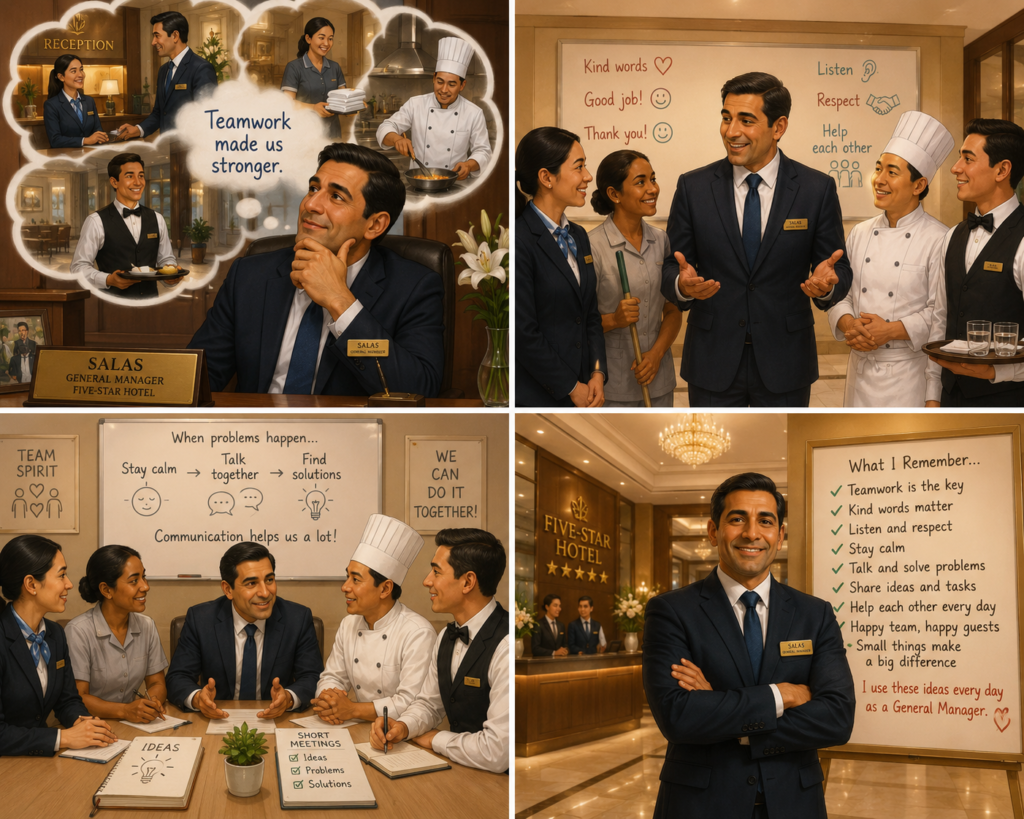
Salas is a general manager of a five-star hotel, looking back at his time when he worked in a team – memories:
I worked with reception workers, cleaners, cooks, and waiters. We helped each other every day. I learned that teamwork was very important.
I always helped my co-workers when they had a lot of work. I was friendly and polite. I listened to other people and respected their ideas.
I used kind words. I said good job and thank you many times. I saw that people felt happy and worked better.
When problems happened, I stayed calm. I talked with my team. We found solutions together. Communication helped us a lot.
I also tried to improve team spirit. We talked more during breaks. We got to know each other better.
We had short meetings. We shared ideas and problems. Sometimes we did small team activities after work.
Now I remember that small things made a big difference. Teamwork helped us give good service and make guests happy. I felt happy when the team worked well. I saw that guests were happy too. I learned that small kind words helped a lot. I believed teamwork was the key to success. We always tried to help each other every day. I remember that problems became smaller when we talked. We also shared tasks to make work easy. I learned to listen more and speak less. I saw that respect made the team stronger. I am proud of my past work in the hotel.
Now I use all these ideas as a general manager. I try to make a good team in my hotel every day. I still say thank you and I still help people. I think teamwork always stays very important for me. It helped me grow as a leader.
___________________
Vocabulary:
to look back at something — to think about something that happened in the past
memories — things you remember from the past
to be polite — to speak and behave in a kind and respectful way
to respect others’ ideas — to listen to and accept what other people think
kind words — nice and friendly words
to stay calm — to remain relaxed and not angry or nervous
to find a solution — to solve a problem
communication — talking and sharing information with other people
to improve team spirit — to make the team feel happier and work better together
a break — a short time to rest from work
to share ideas — to tell other people your thoughts or opinions
a key to success — something very important for success
to share tasks — to divide work between people
respect — feeling and showing care for other people
to grow as a leader — to become a better leader over time
##############
Match word and definition:
to look back at something
memories
to be polite
to respect others’ ideas
kind words
to stay calm
to find a solution
communication
to improve team spirit
a break
to share ideas
a key to success
to share tasks
respect
to grow as a leader
Definitions:
a) to solve a problem b) to divide work between people c) nice and friendly words d) to think about something that happened in the past e) talking and sharing information with other people f) to make the team feel happier and work better together g) things you remember from the past h) feeling and showing care for other people i) to become a better leader over time j) to remain relaxed and not angry or nervous k) to speak and behave in a kind and respectful way l) to tell other people your thoughts or opinions m) something very important for success n) a short time to rest from work o) to listen to and accept what other people think
Use: The past simple is used to talk about finished actions in the past.
##################
Verbs in text:
Infinitive
Past
Definition
work
worked
to do a job or activity
help
helped
to do something for someone to make it easier
learn
learned
to get knowledge or skill
be
was / were
to exist or to be
feel
felt
to have emotions
say
said
to speak words
see
saw
to look with your eyes
listen
listened
to hear carefully
respect
respected
to treat someone in a polite and kind way
use
used
to do something with a tool or method
stay
stayed
to remain in a place or state
talk
talked
to speak with someone
find
found
to discover or get something
improve
improved
to make something better
share
shared
to give part of something to others
get
got
to receive or obtain something
have
had
to possess or own
make
made
to create or produce something
believe
believed
to think something is true
try
tried
to attempt to do something
remember
remembered
to keep information in your mind
become
became
to start to be something new
grow
grew
to become bigger or better
think
thought
to have ideas or opinions
################### Fill in the correct form of the verb in past simple:
I ________ (work) in a hotel and ________ (help) reception workers, cleaners, cooks, and waiters. We ________ (learn) to work as a team, and I ________ (be) friendly and polite.
I ________ (listen) to others and ________ (respect) their ideas. I ________ (use) kind words and ________ (say) thank you often. I ________ (see) that people ________ (feel) happier when we worked together well.
When problems ________ (happen), I ________ (stay) calm and ________ (talk) with my team. We ________ (find) solutions together and ________ (share) ideas. Communication ________ (help) us a lot.
We ________ (try) to improve team spirit. We ________ (have) breaks together, ________ (share) tasks, and ________ (get) to know each other better. We also ________ (remember) that small things ________ (make) a big difference.
We ________ (believe) teamwork was the key to success. I ________ (think) about this often and ________ (become) a better leader. I ________ (grow) as a manager because I ________ (learn) from every situation.
—————————–
Correct version:
I worked in a hotel and helped reception workers, cleaners, cooks, and waiters. We learned to work as a team, and I was friendly and polite.
I listened to others and respected their ideas. I used kind words and said thank you often. I saw that people felt happier when we worked together well.
When problems happened, I stayed calm and talked with my team. We found solutions together and shared ideas. Communication helped us a lot.
We tried to improve team spirit. We had breaks together, shared tasks, and got to know each other better. We also remembered that small things made a big difference.
We believed teamwork was the key to success. I thought about this often and became a better leader. I grew as a manager because I learned from every situation.
###################
Short answers, past simple, basics:
Example Sentence
Yes
No
I learned letters.
Yes, I did.
No, I didn’t.
You read signs.
Yes, you did.
No, you didn’t.
He spoke English.
Yes, he did.
No, he didn’t.
She watched TV.
Yes, she did.
No, she didn’t.
It helped me.
Yes, it did.
No, it didn’t.
We used an app.
Yes, we did.
No, we didn’t.
You read words.
Yes, you did.
No, you didn’t.
They made mistakes.
Yes, they did.
No, they didn’t.
Questions (Past Simple)
Question
Yes
No
Did I learn letters?
Yes, I did.
No, I didn’t.
Did you read signs?
Yes, you did.
No, you didn’t.
Did he speak English?
Yes, he did.
No, he didn’t.
Did she watch TV?
Yes, she did.
No, she didn’t.
Did it help me?
Yes, it did.
No, it didn’t.
Did we use an app?
Yes, we did.
No, we didn’t.
Did you read words?
Yes, you did.
No, you didn’t.
Did they make mistakes?
Yes, they did.
No, they didn’t.
Was / Were
Question
Yes
No
Was I happy?
Yes, I was.
No, I wasn’t.
Were you happy?
Yes, you were.
No, you weren’t.
Was he happy?
Yes, he was.
No, he wasn’t.
Was she happy?
Yes, she was.
No, she wasn’t.
Was it good?
Yes, it was.
No, it wasn’t.
Were we happy?
Yes, we were.
No, we weren’t.
Were you happy?
Yes, you were.
No, you weren’t.
Were they happy?
Yes, they were.
No, they weren’t.
#################
Provide short answers:
The writer helped only guests and did not work with staff.
YOU WRITE: No, he didn’t.
The writer was friendly with co-workers.
The writer learned that teamwork was very important.
The writer always got angry when problems happened.
The writer worked in a hotel.
The writer stayed calm when problems happened.
The writer ignored other people’s ideas during work.
The writer became a general manager later.
The team worked without any meetings or discussions.
The writer used kind words with co-workers.
The writer worked in a hotel and only cleaned offices in the morning.
The writer listened to other people’s ideas.
The writer was responsible for managing the whole hotel alone.
The team had short meetings during work.
The writer helped reception workers, cleaners, cooks, and waiters.
The writer never used polite words at work.
The team talked together to find solutions.
The writer learned that working alone was better than teamwork.
The writer stayed calm when problems happened.
The writer was friendly with co-workers.
__________________________
Correct version:
1: The writer helped only guests and did not work with staff. — No, he didn’t. 2: The writer was friendly with co-workers. — Yes, he was. 3: The writer learned that teamwork was very important. — Yes, he did. 4: The writer always got angry when problems happened. — No, he didn’t. 5: The writer worked in a hotel. — Yes, he did. 6: The writer stayed calm when problems happened. — Yes, he did. 7: The writer ignored other people’s ideas during work. — No, he didn’t. 8: The writer became a general manager later. — Yes, he did. 9: The team worked without any meetings or discussions. — No, they didn’t. 10: The writer used kind words with co-workers. — Yes, he did. 11: The writer worked in a hotel and only cleaned offices in the morning. — No, he didn’t. 12: The writer listened to other people’s ideas. — Yes, he did. 13: The writer was responsible for managing the whole hotel alone. — No, he wasn’t. 14: The team had short meetings during work. — Yes, they did. 15: The writer helped reception workers, cleaners, cooks, and waiters. — Yes, he did. 16: The writer never used polite words at work. — No, he didn’t. 17: The team talked together to find solutions. — Yes, they did. 18: The writer learned that working alone was better than teamwork. — No, he didn’t. 19: The writer stayed calm when problems happened. — Yes, he did. 20: The writer was friendly with co-workers. — Yes, he was.
####################
Correct the statements, short answer first:
The writer was responsible for managing the whole hotel alone.
YOU WRITE: No, he wasn’t. He worked with his team and shared responsibilities.
The writer worked in a hotel and only cleaned offices in the morning.
The writer ignored other people’s ideas during work.
The writer never used polite words at work.
The team worked without any meetings or discussions.
The writer helped only guests and did not work with staff.
The workers were all from different companies and never worked together.
The writer always got angry when problems happened.
The team solved problems without talking together.
The writer learned that working alone was better than teamwork.
___________________________
Correct answers:
The writer was responsible for managing the whole hotel alone. No, he wasn’t. He worked with his team and shared responsibilities.
The writer worked in a hotel and only cleaned offices in the morning. No, he didn’t. He worked with reception workers, cleaners, cooks, and waiters.
The writer ignored other people’s ideas during work. No, he didn’t. He listened to other people’s ideas.
The writer never used polite words at work. No, he didn’t. He used kind and polite words with co-workers.
The team worked without any meetings or discussions. No, they didn’t. They had short meetings and discussed ideas.
The writer helped only guests and did not work with staff. No, he didn’t. He helped different hotel staff every day.
The workers were all from different companies and never worked together. No, they weren’t. They worked together as one team.
The writer always got angry when problems happened. No, he didn’t. He stayed calm when problems happened.
The team solved problems without talking together. No, they didn’t. They talked together to find solutions.
The writer learned that working alone was better than teamwork. No, he didn’t. He learned that teamwork was very important.
####################
Past simple – basics
Personal Pronoun
Verb (Past)
Object
I
ate
apples
You
ate
apples
He
ate
apples
She
ate
apples
It
ate
apples
We
ate
apples
You (plural)
ate
apples
They
ate
apples
I
played
football
You
played
football
He
played
football
She
played
football
It
played
football
We
played
football
You (plural)
played
football
They
played
football
Personal Pronoun
Verb (Past Negative)
Object
I
did not eat
apples
You
did not eat
apples
He
did not eat
apples
She
did not eat
apples
It
did not eat
apples
We
did not eat
apples
You (plural)
did not eat
apples
They
did not eat
apples
I
did not play
football
You
did not play
football
He
did not play
football
She
did not play
football
It
did not play
football
We
did not play
football
You (plural)
did not play
football
They
did not play
football
Did + Pronoun
Verb
Object
Did I
eat
apples?
Did you
eat
apples?
Did he
eat
apples?
Did she
eat
apples?
Did it
eat
apples?
Did we
eat
apples?
Did you
eat
apples?
Did they
eat
apples?
Did I
play
football?
Did you
play
football?
Did he
play
football?
Did she
play
football?
Did it
play
football?
Did we
play
football?
Did you
play
football?
Did they
play
football?
Didn’t + Pronoun
Verb
Object
Didn’t I
eat
apples?
Didn’t you
eat
apples?
Didn’t he
eat
apples?
Didn’t she
eat
apples?
Didn’t it
eat
apples?
Didn’t we
eat
apples?
Didn’t you
eat
apples?
Didn’t they
eat
apples?
Didn’t I
play
football?
Didn’t you
play
football?
Didn’t he
play
football?
Didn’t she
play
football?
Didn’t it
play
football?
Didn’t we
play
football?
Didn’t you
play
football?
Didn’t they
play
football?
Forms of ‚to be‘
Personal Pronoun
Positive
Negative
Question
I
I was happy.
I was not happy.
Was I happy?
You (singular)
You were excited.
You were not excited.
Were you excited?
He
He was at home.
He was not at home.
Was he at home?
She
She was tired.
She was not tired.
Was she tired?
It
It was cold.
It was not cold.
Was it cold?
We
We were at the party.
We were not at the party.
Were we at the party?
You (plural)
You were friends.
You were not friends.
Were you friends?
They
They were in the garden.
They were not in the garden.
Were they in the garden?
################
_____________________
Write as shown in 1:
The writer was a hotel worker.
YOU WRITE: Negation: The writer was not a hotel worker. Question: Was the writer a hotel worker? Negatove question: Wasn’t the writer a hotel worker?
The writer had many co-workers in the hotel.
The writer helped different hotel staff every day.
The writer said kind words to co-workers.
The writer saw that teamwork was important.
The team were busy during working hours.
The writer took part in short meetings.
The writer made the team stronger.
The writer found solutions when problems happened.
The writer became a general manager later.
_______________________
Correct version:
The writer was a hotel worker. Negation: The writer was not a hotel worker. Question: Was the writer a hotel worker? Negative question: Wasn’t the writer a hotel worker?
The writer had many co-workers in the hotel. Negation: The writer did not have many co-workers in the hotel. Question: Did the writer have many co-workers in the hotel? Negative question: Didn’t the writer have many co-workers in the hotel?
The writer helped different hotel staff every day. Negation: The writer did not help different hotel staff every day. Question: Did the writer help different hotel staff every day? Negative question: Didn’t the writer help different hotel staff every day?
The writer said kind words to co-workers. Negation: The writer did not say kind words to co-workers. Question: Did the writer say kind words to co-workers? Negative question: Didn’t the writer say kind words to co-workers?
The writer saw that teamwork was important. Negation: The writer did not see that teamwork was important. Question: Did the writer see that teamwork was important? Negative question: Didn’t the writer see that teamwork was important?
The team were busy during working hours. Negation: The team were not busy during working hours. Question: Were the team busy during working hours? Negative question: Weren’t the team busy during working hours?
The writer took part in short meetings. Negation: The writer did not take part in short meetings. Question: Did the writer take part in short meetings? Negative question: Didn’t the writer take part in short meetings?
The writer made the team stronger. Negation: The writer did not make the team stronger. Question: Did the writer make the team stronger? Negative question: Didn’t the writer make the team stronger?
The writer found solutions when problems happened. Negation: The writer did not find solutions when problems happened. Question: Did the writer find solutions when problems happened? Negative question: Didn’t the writer find solutions when problems happened?
The writer became a general manager later. Negation: The writer did not become a general manager later. Question: Did the writer become a general manager later? Negative question: Didn’t the writer become a general manager later?
################
Form questions in past simple:
he / work / reception workers?
they / help / each other?
he / learn / teamwork?
he / be / friendly and polite?
he / use / kind words?
they / solve / problems together?
he / listen / other people’s ideas?
they / have / short meetings?
he / improve / team spirit?
he / stay / calm in problems?
they / share / ideas?
he / become / a general manager?
he / feel / happy at work?
they / talk / during breaks?
_____________________
Correct answers:
Did he work with reception workers?
Did they help each other?
Did he learn teamwork?
Was he friendly and polite?
Did he use kind words?
Did they solve problems together?
Did he listen to other people’s ideas?
Did they have short meetings?
Did he improve team spirit?
Did he stay calm in problems?
Did they share ideas?
Did he become a general manager?
Did he feel happy at work?
Did they talk during breaks?
##################
Match the two halves:
The writer worked in a hotel
The writer helped reception workers
The writer learned teamwork
The writer stayed calm
The writer used kind words
The team had short meetings
The writer listened to others
The team talked together
The writer improved team spirit
The writer became a general manager
a. with cleaners, cooks, and waiters b. to understand it was very important c. when problems happened d. and said thank you often e. to share ideas and solve problems f. and respected their ideas g. during breaks at work h. and became a general manager later i. to make the team stronger j. and worked well as a team
I worked in a hotel and helped __________ workers, cleaners, cooks, and waiters. I learned that teamwork was very important. I was friendly and polite with my co-workers. I __________ to other people’s ideas and respected them. I used __________ words and said thank you often. I saw that __________ helped us solve problems. When problems happened, I stayed __________ and talked with my team. We found __________ together. We shared ideas during short meetings and tried to _________ team spirit. We also had __________ together and got to know each other. Small things made a big __________. I became a general manager and __________ as a leader.
—————————- Correct version:
I worked in a hotel and helped reception workers, cleaners, cooks, and waiters. I learned that teamwork was very important. I was friendly and polite with my co-workers. I listened to other people’s ideas and respected them. I used kind words and said thank you often. I saw that communication helped us solve problems. When problems happened, I stayed calm and talked with my team. We found solutions together. We shared ideas during short meetings and tried to improve team spirit. We also had breaks together and got to know each other. Small things made a big difference. I became a general manager and grew as a leader.
my name is Salas and I share my experience of working as part of a team
My name is Salas, and I work in a hotel. I like my job very much because I like working with other people. In a hotel, teamwork is very important. Many people work together every day. The reception workers, cleaners, cooks, and waiters all help each other. I think good teamwork helps the hotel work better and also makes the guests happy. Without teamwork, the work is more difficult and slow.
I always try to be a good team member. I like helping my co-workers when they need help. If somebody has a lot of work, I try to help them when I can. I am friendly and polite to everyone. I also listen to other people and respect their ideas. I think it is important to be kind at work and to work together as a team.
I also try to encourage my co-workers to work as a team. I often say “good job” or “thank you” because I think kind words are very important. They can make people feel happy and give them more energy to work. When there is a problem at work, I try to stay calm. Then I talk with my team and we try to find a solution together. I think communication is very important in a hotel.
Even if our team already works well, I still see chances to improve the team spirit more. For example, we can talk more during breaks and know each other better. We can also have short team meetings where we share ideas and problems. Sometimes we can do small team activities after work. I think these things can help us become a stronger team.
I also think it is important to say thank you more often and help each other every day. Small things can make a big difference in a team. When people feel respected, they work better and feel happier at work.
In conclusion, I am happy to work in a hotel. I enjoy teamwork, helping my co-workers, and encouraging a good atmosphere. I want our team to become even stronger in the future because teamwork is very important for good service and happy guests.
_______________________
Vocabulary:
a cleaner: a person who cleans rooms or places (like in a hotel or office)
to be slow: to do something not fast
a co-worker: a person you work with
to be polite: to be kind and say nice words (like “please” and “thank you”)
to respect ideas: to listen to other people’s thoughts and think they are important
to be kind: to be nice and friendly to people
to encourage: to say or do something that helps someone feel more confident or happy
to stay calm: to not get angry or nervous
to find a solution: to solve a problem
communication: talking and sharing information with other people
to improve team spirit: to make a team work better and feel happier together
a break: a short time to rest during work
to share an idea: to tell your thoughts to other people
to feel respected: to feel that other people are kind to you and value you
in conclusion: at the end of something you say or write
to enjoy teamwork: to like working together with other people
###############
Match word and definition:
Words:
a cleaner
to be slow
a co-worker
to be polite
to respect ideas
to be kind
to encourage
to stay calm
to find a solution
communication
to improve team spirit
a break
to share an idea
to feel respected
in conclusion
to enjoy teamwork
Definitions:
A. talking and sharing information with other people B. a short time to rest during work C. to not get angry or nervous D. a person you work with E. to solve a problem F. to like working together with other people G. to do something not fast H. to say or do something that helps someone feel confident or happy I. at the end of something you say or write J. to be nice and friendly to people K. a person who cleans rooms or places L. to listen to other people’s thoughts and think they are important M. to tell your thoughts to other people N. to be kind and say nice words O. to make a team work better and feel happier together P. to feel that other people are kind to you and value you
to feel that other people are kind to you and value you
a short time to rest during work
to not get angry or nervous
to make a team work better and feel happier together
to listen to other people’s thoughts and think they are important
to do something not fast
to say or do something that helps someone feel confident or happy
a person you work with
to be kind and say nice words
to tell your thoughts to other people
to like working together with other people
talking and sharing information with other people
a person who cleans rooms or places
Words:
a) communication b) to be slow c) a cleaner d) to improve team spirit e) to enjoy teamwork f) in conclusion g) a co-worker h) to stay calm i) to respect ideas j) to find a solution k) to be kind l) to share an idea m) a break n) to encourage o) to feel respected p) to be polite
The text is about a hotel worker who enjoys teamwork.
In the hotel, only reception workers help guests. True is: In a hotel, many types of workers help each other (reception, cleaners, cooks, waiters).
Different hotel staff work together every day.
Teamwork makes the hotel work better and guests happier.
Without teamwork, work becomes easier and faster. True is: Without teamwork, work becomes more difficult and slow.
The worker likes helping co-workers when they need help.
He is unfriendly and ignores other people’s ideas. True is: He is friendly and respects other people’s ideas.
Communication is not important in the hotel. True is: Communication is very important in the hotel.
He often says “thank you” and “good job” to others.
When there is a problem, he stays calm and talks with the team.
The team never talks during breaks. True is: The team can talk during breaks and share ideas or get to know each other better.
They try to find solutions together when problems happen.
He thinks small actions cannot change a team. True is: Small actions can make a big difference in a team.
Talking more during breaks can help the team know each other better.
The worker is unhappy in his job and dislikes teamwork. True is: The worker enjoys his job and likes teamwork.
##############
Match the sentence halves
Sentences (1–10):
We stay calm when…
Teamwork helps…
A cleaner…
We share ideas…
Communication helps…
A co-worker…
We take a break when…
We try to find a solution when…
We are polite when…
We improve team spirit when…
Options (A–J):
A. we work together and support each other B. cleans rooms in the hotel C. we feel tired during work D. there is a problem at work E. people understand each other F. we speak to guests or co-workers G. works with us in the hotel H. we talk and listen to each other I. we have a problem J. the hotel work better
______________
Correct answers:
1-D, 2-J, 3-B, 4-H, 5-E, 6-G, 7-C, 8-I, 9-F, 10-A
____________________
Correct version:
We stay calm when there is a problem at work.
Teamwork helps the hotel work better.
A cleaner cleans rooms in the hotel.
We share ideas when we talk and listen to each other.
Communication helps people understand each other.
A co-worker works with us in the hotel.
We take a break when we feel tired during work.
We try to find a solution when we have a problem.
We are polite when we speak to guests or co-workers.
We improve team spirit when we work together and support each other.
###############
Fill in, words below:
break – guests – encourages [to say or do something that makes someone feel happy, strong, or more confident] – polite – understand – teamwork – in conclusion – calm – cleaner – team spirit
The text is about a hotel worker who likes__________. In the hotel, many people work together, like a __________ and a co-worker. Communication is very important in the hotel. The worker tries to be kind and be __________ to everyone. He also tries to respect ideas from other people. He often __________ his co-workers with kind words. When there is a problem, he stays __________ and tries to find a solution. During a __________, workers can talk and share an idea. This helps to improve __________. Good communication helps people __________ each other and feel respected. The worker enjoys teamwork and helping others. __________, teamwork, kindness, and communication are very important for good work in a hotel and happy _________.
——————————–
Correct version:
The text is about a hotel worker who likes teamwork. In the hotel, many people work together, like a cleaner and a co-worker. Communication is very important in the hotel. The worker tries to be kind and be polite to everyone. He also tries to respect ideas from other people. He often encourages his co-workers with kind words. When there is a problem, he stays calm and tries to find a solution. During a break, workers can talk and share an idea. This helps to improve team spirit. Good communication helps people understand each other and feel respected. The worker enjoys teamwork and helping others. In conclusion, teamwork, kindness, and communication are very important for good work in a hotel and happy guests. ###############
Hotel interview – match the question with the answer
Questions (1–10):
Do you like working in the hotel?
Why is teamwork important in your hotel?
Who do you work with in the hotel?
How do you act with your co-workers?
What do you do when someone is very busy?
What kind of language do you use at work?
What do you do when a problem happens?
What happens during team discussions?
How do you support team spirit?
What is your hope for your team?
Answers (A–J):
A. I stay calm and talk with my team to solve it. B. I am friendly and always ready to help when someone needs support. C. It matters because many different staff must help each other to do the work well. D. I listen carefully and share my ideas with others. E. I want us to work even better together in the future. F. I speak in a kind and polite way to everyone. G. I work with reception staff, cleaners, cooks, and waiters. H. Yes, I really enjoy my job because I work with many people every day. I. I try to help if I have free time. J. I use kind words and work well with my team.
____________________
Answers:
1-H, 2-C, 3-G, 4-B, 5-I, 6-F, 7-A, 8-D, 9-J, 10-E
____________________
Correct version:
Q: Do you like working in the hotel? A: Yes, I really enjoy my job because I work with many people every day.
Q: Why is teamwork important in your hotel? A: It matters because many different staff must help each other to do the work well.
Q: Who do you work with in the hotel? A: I work with reception staff, cleaners, cooks, and waiters.
Q: How do you act with your co-workers? A: I am friendly and always ready to help when someone needs support.
Q: What do you do when someone is very busy? A: I try to help if I have free time.
Q: What kind of language do you use at work? A: I speak in a kind and polite way to everyone.
Q: What do you do when a problem happens? A: I stay calm and talk with my team to solve it.
Q: What happens during team discussions? A: I listen carefully and share my ideas with others.
Q: How do you support team spirit? A: I use kind words and work well with my team.
Q: What is your hope for your team? A: I want us to work even better together in the future.