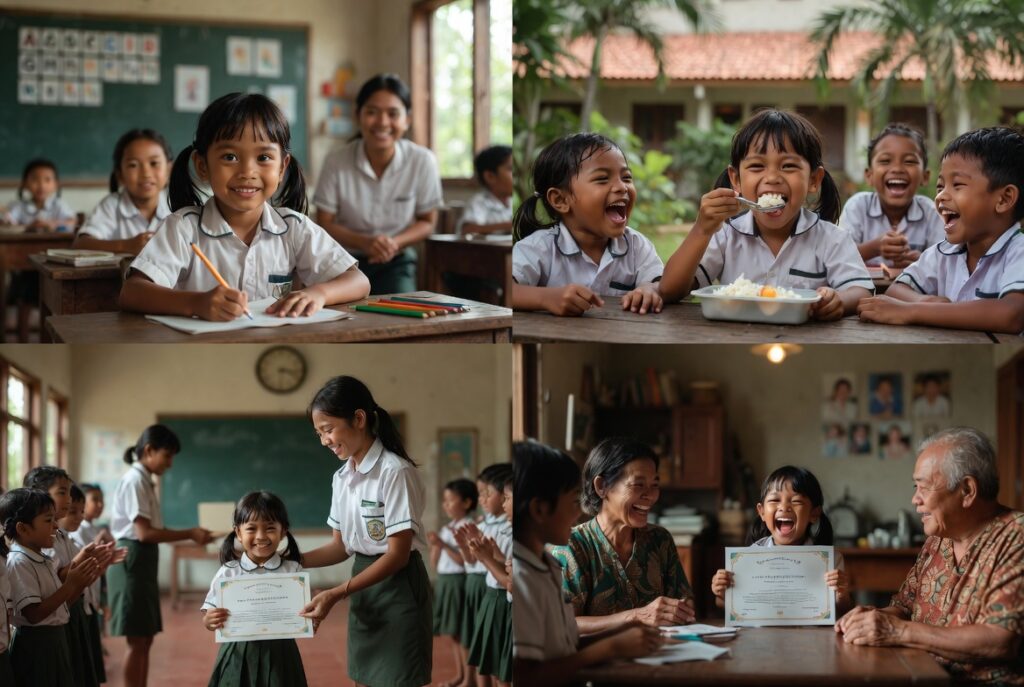
Char is a young lady in South East Asia. She is twenty-one and remembers her first school year very well.
Her teacher was kind and friendly. Char liked her class because the children were nice. They learned the alphabet, simple words, and numbers. They read short stories and wrote easy sentences. They sang songs together and played games in the classroom. Char liked drawing pictures with coloured pencils. She always listened to her teacher and finished her work.
At break time, Char ate rice and fruit. She talked with her friends and laughed with them. After the break, the class went back to the room. Char enjoyed every school day. She felt happy because she learned something new every week.
At the end of the school year, the school had a small ceremony. The teacher called every child to the front. Char walked to her teacher with a big smile. The teacher gave her a certificate for her good work. Char held it carefully in her hands. Her parents smiled and clapped for her. They were very happy.
Char went home with her certificate. She showed it to her family. They were happy and proud. They looked at it together and smiled. Char felt proud. She kept the certificate in a safe place.
________________________
Vocabulary:
to remember – to keep something in your mind from the past.
a sound – something that you hear.
to be kind – to be nice and helpful to other people.
numbers (in school) – 1, 2, 3, 4, 5, and other counting words.
to write a sentence – to write a group of words that makes a complete idea.
to draw pictures – to make pictures with a pencil, pen, or crayons.
to clap for somebody – to hit your hands together to show you are happy for someone.
to be proud – to feel happy because you or another person did something well.
coloured pencils – pencils in different colours for drawing and colouring.
to listen to somebody – to hear and pay attention to what a person says.
to finish work – to complete your work.
break time (school) – a short time when children stop lessons to eat, play, or rest.
to laugh – to make a happy sound because something is funny or makes you happy.
to enjoy something – to like something and feel happy doing it.
a ceremony (school) – a special school event to celebrate something.
to call to the front (school) – to ask a student to come to the front of the classroom or room.
a certificate (school) – a paper that shows a student did something well or finished something.
a safe place – a place where something is protected and will not be lost or damaged.
################
Verbs in text, regular, irregular:
Infinitive
Past Simple
Definition
to be
was / were
to exist or describe a person or thing
to remember
remembered
to keep something in your mind from the past
to like
liked
to think something is good or nice
to learn
learned
to get new knowledge or skills
to read [ri:d]
read [red]
to look at words and understand them
to write
wrote
to put words on paper with a pen or pencil
to sing
sang
to make music with your voice
to play
played
to do a game or have fun
to draw
drew
to make a picture with a pencil or pen
to listen (to)
listened
to hear and pay attention
to finish
finished
to complete something
to eat
ate
to have food
to talk
talked
to speak with someone
to laugh
laughed
to make a happy sound because something is funny
to go
went
to move from one place to another
to enjoy
enjoyed
to like something and feel happy doing it
to feel
felt
to have an emotion or a feeling
to have
had
to own or experience something
to call
called
to ask someone to come
to walk
walked
to move on your feet
to give
gave
to let someone have something
to hold
held
to keep something in your hands
to smile
smiled
to show happiness with your face
to clap
clapped
to hit your hands together to show you are happy
to show
showed
to let someone see something
to keep
kept
to leave something in a place or continue to have it
################
Match word and definition:
Words
to remember
a sound
to be kind
numbers (in school)
to write a sentence
to draw pictures
to clap for somebody
to be proud
coloured pencils
to listen to somebody
to finish work
break time (school)
to laugh
to enjoy something
a ceremony (school)
to call to the front (school)
a certificate (school)
a safe place
Definitions
A. to hit your hands together to show you are happy for someone. B. a paper that shows a student did something well or finished something. C. to make pictures with a pencil, pen, or crayons. D. to keep something in your mind from the past. E. a short time when children stop lessons to eat, play, or rest. F. to ask a student to come to the front of the classroom or room. G. to feel happy because you or another person did something well. H. 1, 2, 3, 4, 5, and other counting words. I. to make a happy sound because something is funny or makes you happy. J. to be nice and helpful to other people. K. to hear and pay attention to what a person says. L. to complete your work. M. to like something and feel happy doing it. N. a sound that you hear. O. a special school event to celebrate something. P. to write a group of words that makes a complete idea. Q. pencils in different colours for drawing and colouring. R. a place where something is protected and will not be lost or damaged.
Char _____ (remember) her first school year yesterday. YOU WRITE: Char _remembered_ her first school year yesterday.
She _____ (hear) a sound in the classroom.
The teacher _____ (be) kind to all children.
The children _____ (learn) numbers in school like 1, 2, 3.
Char _____ (write) a sentence in class.
She _____ (draw) pictures with coloured pencils.
The class _____ (clap for somebody) after the song.
Char _____ (be) proud of her certificate.
She _____ (use) coloured pencils to draw.
The children _____ (listen) in class.
Char always _____ (finish work) before break.
Break time _____ (be) fun for all children.
The children _____ (laugh) in the playground.
Char _____ (enjoy) every lesson.
The school _____ (have) a ceremony at the end of the year.
The teacher _____ (call) a student to the front.
Char _____ (receive) a certificate for good work.
Char _____ (keep) it in a safe place at home.
——————————-
Correct version:
Char remembered her first school year yesterday.
She heard a sound in the classroom.
The teacher was kind to all children.
The children learned numbers in school like 1, 2, 3.
Char wrote a sentence in class.
She drew pictures with coloured pencils.
The class clapped after the song.
Char was proud of her certificate.
She used coloured pencils to draw.
The children listened in class.
Char always finished work before break.
Break time was fun for all children.
The children laughed in the playground.
Char enjoyed every lesson.
The school had a ceremony at the end of the year.
The teacher called a student to the front
Char received a certificate for good work.
Char kept it in a safe place at home.
################
True or false:
Char moved to a new school in another country during the year.
The teacher gave each child a certificate at the ceremony.
Char remembered her first school year very well.
The children studied only mathematics during lessons.
Char showed her certificate to her family at home.
The ceremony happened in a large stadium with many schools.
The teacher was kind and friendly.
Char liked drawing pictures with coloured pencils.
Char spent break time eating noodles alone in the classroom.
The children learned the alphabet, simple words, and numbers.
Char returned home without speaking to her family.
The teacher gave certificates before the school year started.
______________________ False: 1, 4,6, 9, 11, 12
______________________
Correct answers:
Char moved to a new school in another country during the year. True is: Char went home with her certificate, showed it to her family, and they were proud.
The teacher gave each child a certificate at the ceremony.
Char remembered her first school year very well.
The children studied only mathematics during lessons. True is: The children learned the alphabet, simple words, and numbers, read short stories, and wrote easy sentences.
Char showed her certificate to her family at home.
The ceremony happened in a large stadium with many schools. True is: The school had a small ceremony at the end of the school year.
The teacher was kind and friendly.
Char liked drawing pictures with coloured pencils.
Char spent break time eating noodles alone in the classroom. True is: Char spent break time eating rice and fruit, talking and laughing with her friends.
The children learned the alphabet, simple words, and numbers.
Char returned home without speaking to her family. True is: Char went home with her certificate, showed it to her family, and they were proud.
The teacher gave certificates before the school year started. True is: The teacher called every child to the front at the end of the school year and gave them a certificate.
#################
Short answers, past simple, basics:
Example Sentence
Yes
No
I learned letters.
Yes, I did.
No, I didn’t.
You read signs.
Yes, you did.
No, you didn’t.
He spoke English.
Yes, he did.
No, he didn’t.
She watched TV.
Yes, she did.
No, she didn’t.
It helped me.
Yes, it did.
No, it didn’t.
We used an app.
Yes, we did.
No, we didn’t.
You read words.
Yes, you did.
No, you didn’t.
They made mistakes.
Yes, they did.
No, they didn’t.
Questions (Past Simple)
Question
Yes
No
Did I learn letters?
Yes, I did.
No, I didn’t.
Did you read signs?
Yes, you did.
No, you didn’t.
Did he speak English?
Yes, he did.
No, he didn’t.
Did she watch TV?
Yes, she did.
No, she didn’t.
Did it help me?
Yes, it did.
No, it didn’t.
Did we use an app?
Yes, we did.
No, we didn’t.
Did you read words?
Yes, you did.
No, you didn’t.
Did they make mistakes?
Yes, they did.
No, they didn’t.
Was / Were
Question
Yes
No
Was I happy?
Yes, I was.
No, I wasn’t.
Were you happy?
Yes, you were.
No, you weren’t.
Was he happy?
Yes, he was.
No, he wasn’t.
Was she happy?
Yes, she was.
No, she wasn’t.
Was it good?
Yes, it was.
No, it wasn’t.
Were we happy?
Yes, we were.
No, we weren’t.
Were you happy?
Yes, you were.
No, you weren’t.
Were they happy?
Yes, they were.
No, they weren’t.
#################
Give short answers:
Char was a young student in Southeast Asia.
YOU WRITE: Yes, she was.
Char travelled to school by boat every day.
Her teacher was very kind.
The class studied advanced chemistry in the first year.
Char went to school when she was young.
The children were unhappy in the classroom.
The students sang songs together.
Char ate pizza and burgers at break time.
She read short stories with her class.
The teacher gave Char a certificate.
The school had a large sports tournament every week.
Char liked drawing with coloured pencils.
The class learned the alphabet and simple words.
Char never attended school.
Her parents smiled and clapped proudly.
The teacher punished all students every day.
Char kept her certificate in a safe place.
The class wrote only long essays every day.
The school year ended with a small ceremony.
Char forgot everything she learned at school.
_______________________
Correct answers:
Char was a young student in Southeast Asia. Yes, she was.
Char travelled to school by boat every day. No, she didn’t.
Her teacher was very kind. Yes, she was.
The class studied advanced chemistry in the first year. No, they didn’t.
Char went to school when she was young. Yes, she did.
The children were unhappy in the classroom. No, they weren’t.
The students sang songs together. Yes, they did.
Char ate pizza and burgers at break time. No, she didn’t.
She read short stories with her class. Yes, she did.
The teacher gave Char a certificate. Yes, she did.
The school had a large sports tournament every week. No, it didn’t.
Char liked drawing with coloured pencils. Yes, she did.
The class learned the alphabet and simple words. Yes, they did.
Char never attended school. No, she didn’t.
Her parents smiled and clapped proudly. Yes, they did.
The teacher punished [to feel pain or feel bad] all students every day. No, she didn’t.
Char kept her certificate in a safe place. Yes, she did.
The class wrote only long essays every day. No, they didn’t.
The school year ended with a small ceremony. Yes, it did.
Char forgot everything she learned at school. No, she didn’t.
###############
Basics in past simple:
Personal Pronoun
Verb (Past)
Object
I
ate
apples
You
ate
apples
He
ate
apples
She
ate
apples
It
ate
apples
We
ate
apples
You (plural)
ate
apples
They
ate
apples
I
played
football
You
played
football
He
played
football
She
played
football
It
played
football
We
played
football
You (plural)
played
football
They
played
football
Personal Pronoun
Verb (Past Negative)
Object
I
did not eat
apples
You
did not eat
apples
He
did not eat
apples
She
did not eat
apples
It
did not eat
apples
We
did not eat
apples
You (plural)
did not eat
apples
They
did not eat
apples
I
did not play
football
You
did not play
football
He
did not play
football
She
did not play
football
It
did not play
football
We
did not play
football
You (plural)
did not play
football
They
did not play
football
Did
Personal Pronoun
Verb (Infinitive)
Object
Did
I
eat
an apple?
Did
you
eat
an apple?
Did
he
eat
an apple?
Did
she
eat
an apple?
Did
it
eat
an apple?
Did
we
eat
an apple?
Did
you
eat
an apple?
Did
they
eat
an apple?
##################
Forms of ‚to be‘
Personal Pronoun
Positive
Negative
Question
I
I was happy.
I was not happy.
Was I happy?
You
You were excited.
You were not excited.
Were you excited?
He
He was at home.
He was not at home.
Was he at home?
She
She was tired.
She was not tired.
Was she tired?
It
It was cold.
It was not cold.
Was it cold?
We
We were at the party.
We were not at the party.
Were we at the party?
You
You were friends.
You were not friends.
Were you friends?
They
They were in the garden.
They were not in the garden.
Were they in the garden?
Was/Were
Personal Pronoun
Place
Was
I
in America?
Were
you
in America?
Was
he
in America?
Was
she
in America?
Was
it
in America?
Were
we
in America?
Were
you
in America?
Were
they
in America?
#############
Answer as shown:
Char lived in Europe when she went to school.
YOU WRITE: Char did not live in Euope when she went to school. She lived in South East Asia.
Her teacher was strict.
The children learned science.
The class read long books.
Char wrote long stories.
Char painted with watercolours.
Char ate bread and cheese at break time.
The class played football after the break.
Char learned something new every day.
The school had a big sports festival.
The teacher gave Char a medal.
Char went home with a new book.
Char put the certificate on the wall.
Her family gave her a bicycle.
________________________
Answers:
Char did not live in Europe when she went to school. She lived in South East Asia.
Her teacher was not strict. She was kind and friendly.
The children did not learn science. They learned the alphabet, simple words, and numbers.
The class did not read long books. They read short stories.
Char did not write long stories. She wrote easy sentences.
Char did not paint with watercolours. She drew pictures with coloured pencils.
Char did not eat bread and cheese at break time. She ate rice and fruit.
The class did not play football after the break. They went back to the room.
Char did not learn something new every day. She learned something new every week.
The school did not have a big sports festival. It had a small ceremony.
The teacher did not give Char a medal. She gave her a certificate.
Char did not go home with a new book. She went home with her certificate.
Char did not put the certificate on the wall. She kept it in a safe place.
Her family did not give her a bicycle. They smiled and looked at her certificate together.
################
Form questions to which the word/s given is/are the answer:
Char went home.
YOU WRITE: a) Char: Who went home? b) went home: What did Char do? c) home: Where did she go?
Char showed her family the certificate. a) Char: b) showed her family the certificate: c) her family: d) her: e) the certficate:
Her family were proud a) Her family: b) Her:
They looked at the certificate. a) They: b) looked at the certificate: c) th certificate:
Char smiled. a) Char: b) smiled:
The teacher called every child to the front. a) The teacher: b) called every child to the front: c) every child: d) every: e) the front:
Char walked to her teacher. a) Char: b) walked to her teacher: c) her teacher:
The children sang songs. a) The children: b) sang songs: c) songs:
Char played 5 games. a) Char: b) played 5 games: c) 5 games: d) 5:
Char kept the certificate in a safe place. a) Char: b) kept the certificate in a safe place: c) the certificate: d) in a safe place: e) safe:
________________________
Answers:
Char showed her family the certificate. a) Char: Who showed her family the certificate? b) showed her family the certificate: What did Char do? c) her family: Who did Char show the certificate to? d) her: Whose family did Char show the certificate to? e) the certificate: What did Char show her family?
Her family were proud. a) Her family: Who were proud? b) Her: Whose family were proud?
They looked at the certificate. a) They: Who looked at the certificate? b) looked at the certificate: What did they do? c) the certificate: What did they look at?
Char smiled. a) Char: Who smiled? b) smiled: What did Char do?
The teacher called every child to the front. a) The teacher: Who called every child to the front? b) called every child to the front: What did the teacher do? c) every child: Who did the teacher call to the front? d) every: Which child did the teacher call to the front? e) the front: Where did the teacher call every child to?
Char walked to her teacher. a) Char: Who walked to her teacher? b) walked to her teacher: What did Char do? c) her teacher: To whom did Char walk?
The children sang songs. a) The children: Who sang songs? b) sang songs: What did the children do? c) songs: What did the children sing?
Char played 5 games. a) Char: Who played 5 games? b) played 5 games: What did Char do? c) 5 games: What did Char play? d) 5: How many games did Char play?
Char kept the certificate in a safe place. a) Char: Who kept the certificate in a safe place? b) kept the certificate in a safe place: What did Char do? c) the certificate: What did Char keep in a safe place? d) in a safe place: Where did Char keep the certificate? e) safe: What kind of place did she keep the certificate?
#################
Fill in, past simple:
The children _______ (be) nice.
Char _______ (go) home with her certificate.
Her teacher _______ (be) kind and friendly.
The school _______ (have) a small ceremony.
Char _______ (learn) the alphabet.
The children _______ (sing) songs.
The classroom _______ (be) happy.
Char _______ (hold) the certificate carefully.
The children _______ (play) games in the classroom.
Char _______ (feel) happy.
The school _______ (be) small.
The teacher _______ (give) a certificate to Char.
Her parents _______ (smile) and _______ (clap).
The class _______ (read) short stories.
Char _______ (write) easy sentences.
The children _______ (be) in the classroom.
Char _______ (draw) pictures with coloured pencils.
The teacher _______ (be) friendly.
Char _______ (eat) rice and fruit.
The school _______ (be) a nice place.
_____________________
Answers:
The children were nice.
Char went home with her certificate.
Her teacher was kind and friendly.
The school had a small ceremony.
Char learned the alphabet.
The children sang songs.
The classroom was happy.
Char held the certificate carefully.
The children played games in the classroom.
Char felt happy.
The school was small.
The teacher gave a certificate to Char.
Her parents smiled and clapped.
The class read short stories.
Char wrote easy sentences.
The children were in the classroom.
Char drew pictures with coloured pencils.
The teacher was friendly.
Char ate rice and fruit.
The school was a nice place.
###############
Fill in, words below:
certificate – learned – break time – looked – friendly – safe – drew – new – played – sentences – ceremony
Char was a young student in Southeast Asia. Her teacher was kind and ________. The children were nice and ________ the alphabet, simple words, and numbers. They read short stories and wrote easy ________. They sang songs and ________ games in the classroom. Char ________ pictures and listened carefully. At ________, she ate rice and fruit and talked with friends. She felt happy every day because she learned ________ things. At the end of the school year, the school had a small ________. The teacher gave Char a ________. Char held it and went home. She showed it to her family. They were proud and smiled. They________ at the certificate together. Char kept it in a ________ place and felt very happy about her first school year.
—————————- Correct version:
Char was a young student in Southeast Asia. Her teacher was kind and friendly. The children were nice and learned the alphabet, simple words, and numbers. They read short stories and wrote easy sentences. They sang songs and played games in the classroom. Char drew pictures and listened carefully. At break time, she ate rice and fruit and talked with friends. She felt happy every day because she learned new things. At the end of the school year, the school had a small ceremony. The teacher gave Char a certificate. Char held it and went home. She showed it to her family. They were proud and smiled. They looked at the certificate together. Char kept it in a safe place and felt very happy about her first school year.
#############
Match the questions with the answers (Char interview)
Questions
Who was your teacher?
Where did you go to school?
How was your teacher?
What did you learn in class?
What did you read?
What did you write?
When did you sing songs?
How did you feel at school?
What did you eat at break time?
Who did you talk with?
What did the teacher give you?
How did your family react?
Where did you keep the certificate?
Answers (mixed order)
a. I felt very happy. b. I placed it in a safe box. c. Miss Lee taught us in class. d. I had rice and fruit. e. I spoke with my friends. f. I studied in Southeast Asia. g. I received a certificate. h. I made easy sentences. i. They showed pride and smiled. j. I looked at short stories. k. She helped us and smiled a lot. l. I knew the alphabet, simple words, and numbers. m. I sang during lessons.
Tourism means people travel to other places. Many tourists stay in hotels. Hotel staff work in hotels and help guests. Most hotels are safe and good places.
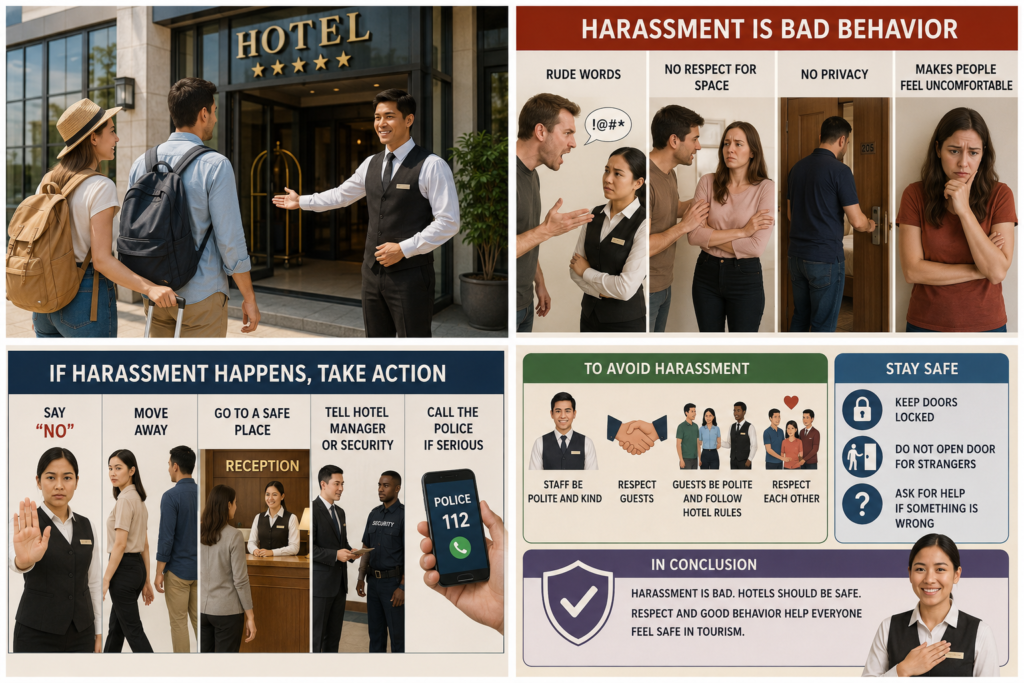
Harassment means bad or rude behavior. It makes people feel unsafe or uncomfortable. In hotels, harassment can happen. A staff member can be rude to a guest. A guest can also be rude to hotel staff. Sometimes someone says bad words. Sometimes someone does not respect privacy. This is harassment.
We can identify harassment when a person feels scared or unhappy. If someone is rude, or does not respect space, it can be harassment. If someone enters a room without permission, it is also harassment. People feel uncomfortable in these situations.
If harassment happens, we must stay calm. We should say “No”. We should move away from the person. We should go to a safe place like the hotel reception. We should tell the hotel manager or security. We can also call the police if it is serious.
To avoid harassment, we should be careful. Hotel staff should be polite and kind. They should respect guests. Guests should also be polite and follow hotel rules. We should respect each other.
We should also keep doors locked. We should not open the door for strangers. We should ask for help if something is wrong.
In conclusion, harassment is bad. Hotels should be safe. Respect and good behavior help everyone feel safe in tourism.
_______________________
Vocabulary:
harassment – bad or rude behavior that makes someone feel unsafe or uncomfortable.
reading comprehension – understanding what you read in a text.
a safe place – a place where you are not in danger and feel protected.
rude behavior – impolite actions or words that can hurt or upset others.
to feel uncomfortable – to feel not relaxed, worried, or not happy in a situation.
to respect privacy – to not look into or enter someone’s personal space or life without permission.
to identify something – to recognize something and understand what it is.
to feel scared – to feel afraid or worried about danger.
to respect space – to give someone their personal area and not go too close.
without permission – doing something without asking or getting agreement first.
to stay calm – to stay relaxed and not get angry or panicked.
to avoid something – to stay away from something or not do it.
to be kind – to be nice, friendly, and helpful to others.
to respect somebody – to treat someone well and show care for their feelings and rights.
to lock a door – to close a door with a key so nobody can enter.
in conclusion – the final part of something where you give a short summary.
#############
Match word and defintion:
Words
harassment
reading comprehension
a safe place
rude behavior
to feel uncomfortable
to respect privacy
to identify something
to feel scared
to respect space
without permission
to stay calm
to avoid something
to be kind
to respect somebody
to lock a door
in conclusion
Definitions
a. to stay away from something or not do it. b. to not look into or enter someone’s personal space or life without permission. c. the final part of something where you give a short summary. d. bad or rude behavior that makes someone feel unsafe or uncomfortable. e. to feel not relaxed, worried, or not happy in a situation. f. to close a door with a key so nobody can enter. g. to recognize something and understand what it is. h. to feel afraid or worried about danger. i. impolite actions or words that can hurt or upset others. j. to give someone their personal area and not go too close. k. to be nice, friendly, and helpful to others. l. to understand what you read in a text. m. to stay relaxed and not get angry or panicked. n. a place where you are not in danger and feel protected. o. doing something without asking or getting agreement first. p. to treat someone well and show care for their feelings and rights.
Guests can be rude to hotel staff. True is: Guests should be polite and respectful to hotel staff.
Tourism means people stay only in their home and never travel. True is: Tourism means people travel to other places.
Harassment means bad or rude behavior.
Entering a room without permission is always a normal action. True is: Entering a room without permission is harassment.
Hotel staff work in hotels and help guests.
Harassment makes people feel happy and comfortable in all cases. True is: Harassment makes people feel unsafe or uncomfortable.
Many tourists stay in hotels.
Guests are never allowed to interact with hotel staff at all. True is: Guests can interact with hotel staff.
People should report harassment to hotel staff or security.
Tourism means people travel to other places.
Hotel staff do not work in hotels and never help guests. True is: Hotel staff work in hotels and help guests.
Harassment can happen in hotels.
All hotels are unsafe places and should be avoided always. True is: Most hotels are safe and good places.
Harassment makes people feel unsafe or uncomfortable.
Reporting harassment is unnecessary because hotels automatically ignore all complaints. True is: People should report harassment to hotel staff or security.
Most hotels are safe and good places.
Hotel staff are not allowed to communicate with guests at any time. True is: Hotel staff are allowed to communicate with guests.
Harassment cannot happen in any hotel or tourism place. True is: Harassment can happen in hotels and tourism places.
Entering a hotel room without permission is a normal part of hotel service. True is: Entering a room without permission is harassment.
A guest is never allowed to speak to any hotel employee under any condition. True is: Guests are allowed to speak to hotel employees.
###############
Match Statements with Evidence
Statements
Tourism involves people visiting other places.
Hotels are places where travelers stay overnight.
Hotel employees assist guests during their stay.
Harassment can make someone feel unsafe or uncomfortable.
Entering a hotel room without permission is considered inappropriate behavior.
Both guests and staff should behave politely toward each other.
Reporting serious problems helps maintain safety in hotels.
Hotels usually have rules to protect guests and ensure comfort.
Respectful communication is expected in hotel settings.
Protecting personal space is important in accommodation places.
Evidence (shuffled)
A. Speaking in a polite way is expected between workers and visitors. B. Going into someone’s hotel room without asking is not allowed. C. Travel to different locations is part of tourism activities. D. Guests and employees are expected to treat each other properly. E. Hotels normally include guidelines to keep guests safe and comfortable. F. Telling hotel management or security can solve serious issues. G. People often stay in hotels when they travel away from home. H. Personal space should be respected in lodging environments. I. Saying or doing rude actions can cause fear or discomfort in others. J. Staff members in hotels support visitors with services and guidance.
__________ means people travel to different places for leisure or work.
Hotel staff help guests with services and information.
Protecting personal __________ helps prevent uncomfortable situations.
Many __________ stay in hotels during their trips.
Entering a room without __________ is not allowed in hotels.
Good __________ between guests and staff helps create a safe environment.
__________ means rude or harmful behavior that makes people uncomfortable.
Hotels provide __________ for travelers who need a place to stay.
Hotel staff should always be __________ and respectful to guests.
Respecting __________ is important in all accommodation places.
Most hotels are considered __________ and comfortable places.
Guests should follow hotel __________ to ensure safety and order.
If harassment happens, people should __________ it to hotel management or security.
__________ means people travel to different places for leisure or work.
Both guests and staff must treat each other with __________.
_______________________
Correct version:
Tourism means people travel to different places for leisure or work.
Hotel staff help guests with services and information.
Protecting personal space helps prevent uncomfortable situations.
Many tourists stay in hotels during their trips.
Entering a room without permission is not allowed in hotels.
Good communication between guests and staff helps create a safe environment.
Harassment means rude or harmful behavior that makes people uncomfortable.
Hotels provide accommodation for travelers who need a place to stay.
Hotel staff should always be polite and respectful to guests.
Respecting privacy is important in all accommodation places.
Most hotels are considered safe and comfortable places.
Guests should follow hotel rules to ensure safety and order.
If harassment happens, people should report it to hotel management or security.
Tourism means people travel to different places for leisure or work.
Both guests and staff must treat each other with respect.
################
Find the correct idea:
Ideas
A. Traveling to different places for leisure or work B. Places where travelers stay overnight C. Rude or unsafe behavior toward others D. Reporting problems to hotel staff or security E. Treating people with politeness and care F. Protecting personal space and privacy G. Staying in hotels during a trip H. Moving from one place to another I. Hotel staff helping guests with services J. Following rules in hotels for safety K. Feeling unsafe or uncomfortable because of behavior L. Communication between guests and staff M. Respecting others in shared spaces N. Keeping hotels safe and comfortable
Tourism → A, H Hotels → B, G, I Harassment → C, K Safety actions → D, J, N Respect → E, F, L, M
#################
Put the actions in the correct order if harassment happens in a hotel:
A. Tell hotel staff or security B. Move away from the person C. Stay calm D. Go to a safe place like reception E. Say “No” clearly
______________________
ANswers: 1c, 2e, 3b, 4d, 5a
################
Problems and solutions – match:
Problems
A. Someone enters a hotel room without permission B. A guest feels unsafe in the hotel C. A staff member is spoken to in a rude way D. A hotel rule is not followed E. A guest feels uncomfortable because of someone’s behavior F. A visitor ignores safety instructions from hotel staff
Solutions
Speak politely and set clear boundaries
Move away from the situation and go to reception
Follow all hotel rules carefully
Report the issue to hotel security or management
Stay calm and ask hotel staff for help
Remind the visitor about safety instructions
_______________________
Answers:
A → 4 B → 2 C → 1 D → 3 E → 5 F → 6
################
Answer:
Why is respect important in hotels?
What makes a hotel safe?
What should a guest do if they feel uncomfortable?
Why should hotel rules be followed?
How can communication help in hotels?
Why do tourists stay in hotels?
Who helps guests in a hotel?
What should you do if someone is rude?
Why is privacy important in a hotel?
What should you do if there is a problem in a hotel?
_____________________
Answers:
Why is respect important in hotels? Respect is important because it helps guests and staff feel safe and comfortable.
What makes a hotel safe? A hotel is safe when there are rules, staff, and security.
What should a guest do if they feel uncomfortable? A guest should stay calm and tell hotel staff or go to reception.
Why should hotel rules be followed? Hotel rules should be followed to keep everyone safe and organized.
How can communication help in hotels? Communication helps guests and staff understand each other and solve problems.
Why do tourists stay in hotels? Tourists stay in hotels because they need a place to sleep and stay during travel.
Who helps guests in a hotel? Hotel staff help guests during their stay.
What should you do if someone is rude? You should stay calm and tell hotel staff.
Why is privacy important in a hotel? Privacy is important because guests need personal space and comfort.
What should you do if there is a problem in a hotel? You should report the problem to hotel staff or reception.
################
Interview, find answer to question:
Questions
Why should people report harassment?
What is the main purpose of hotels?
Can harassment occur in hotels?
Why is privacy necessary in hotels?
What should hotel staff do?
What does harassment mean?
Should guests behave politely in hotels?
Where can a guest seek help?
What is a safe action in such a situation?
Who may take part in harassment?
What should a guest do during harassment?
Is reporting harassment important?
Answers
A. Moving away from the person is a safe choice. B. It refers to rude or unsafe behavior that makes people feel uncomfortable. C. They need to listen carefully and support the guest. D. Yes, it plays an important role in safety. E. Polite behavior is expected from all guests. F. Help can be found at reception or with security. G. The main purpose is ensuring safety and comfort for guests. H. This action helps protect others and keeps the hotel safe. I. Staying calm and telling hotel staff is the right step. J. Both guests and hotel employees can be involved. K. Guests require personal space to feel comfortable. L. It may happen in hotels as well.
Interviewer: What does harassment mean? Expert: It means rude or unsafe behavior that makes people feel uncomfortable.
Interviewer: Can harassment occur in hotels? Expert: Yes, it can happen in hotels as well.
Interviewer: Who may take part in harassment? Expert: Both guests and hotel employees can be involved.
Interviewer: What should a guest do during harassment? Expert: The guest should stay calm and tell hotel staff.
Interviewer: Where can a guest seek help? Expert: Help can be found at reception or with security.
Interviewer: Is reporting harassment important? Expert: Yes, it is very important for safety.
Interviewer: Why should people report harassment? Expert: It helps protect others and keeps the hotel safe.
Interviewer: What should hotel staff do? Expert: They should listen carefully and support the guest.
Interviewer: What is a safe action in such a situation? Expert: Moving away from the person is a safe choice.
Interviewer: Should guests behave politely in hotels? Expert: Yes, polite behavior is expected from all guests.
Interviewer: Why is privacy necessary in hotels? Expert: Guests need personal space to feel comfortable.
Interviewer: What is the main purpose of hotels? Expert: The main purpose is to ensure safety and comfort for guests.
################
################
Bonus text in B1:
Tourism refers to the activity of people travelling from one place to another for leisure, business, or other personal reasons. During their journeys, many tourists choose to stay in hotels, which provide accommodation, services, and support throughout their visit. Hotel staff play an important role in ensuring guests feel comfortable, safe, and well cared for. In general, most hotels are considered safe environments where people can relax and enjoy their stay.
Harassment is understood as unwanted, rude, or inappropriate behaviour that causes discomfort, fear, or distress to another person. In hotel settings, harassment can occur in different situations and may involve either staff or guests. For example, a staff member might treat a guest disrespectfully, or a guest might behave inappropriately towards a staff member. Harassment can also include offensive language, ignoring personal boundaries, or failing to respect a person’s privacy.
It is possible to identify harassment when someone feels unsafe, frightened, or uncomfortable in a situation. Behaviours such as invading personal space, using insulting language, or entering a hotel room without permission are clear examples of harassment. These actions often lead to emotional discomfort and a loss of trust in the environment.
If harassment takes place, it is important to respond in a calm and controlled manner. The person affected should clearly say “no” to stop the behaviour, then remove themselves from the situation. They should move to a safe location, such as the hotel reception, where assistance is available. Reporting the incident to hotel management or security is also important. In serious cases, contacting the police may be necessary.
Preventing harassment requires awareness and respectful behaviour from everyone involved. Hotel staff are expected to remain professional, polite, and supportive towards guests. At the same time, guests should follow hotel rules and treat staff and other visitors with respect. Mutual respect helps create a safe and welcoming environment for everyone.
In addition, personal safety measures are important. Guests should keep their room doors locked and avoid opening them to unknown individuals. If something feels wrong or unsafe, it is always better to seek help immediately from hotel staff or security personnel.
In conclusion, harassment is unacceptable in any environment, including hotels. Maintaining respect, following rules, and practising good communication are essential for ensuring safety and comfort in tourism settings.
The Secret Garden is a story by Frances Hodgson Burnett. It is about a girl named Mary Lennox.
Mary is a young girl. At the start, she is not happy. She lives in India with her rich parents, but they are always busy. They do not take care of her. Mary feels lonely and often behaves rudely.
One day, a sickness spreads in India. Many people get sick. Mary’s parents die. Mary becomes an orphan. She has no family in India.
Mary goes to England to live with her uncle, Mr. Craven. He lives in a big house called Misselthwaite Manor. The house is old and quiet. Mary feels lonely again.
At the house, she meets Mrs. Medlock, the housekeeper. She is strict. Mary learns that her uncle is often away because he is sad about his wife’s death.
Mary spends time outside. She enjoys the garden. She hears about a secret garden that is locked and not used.
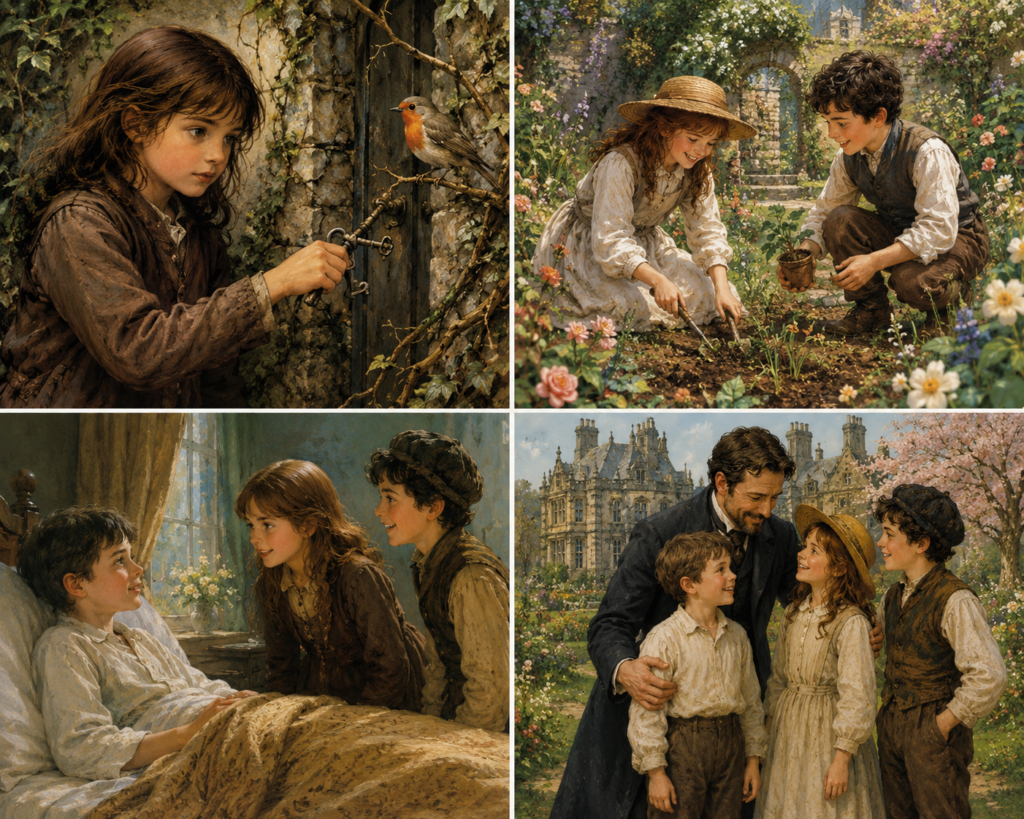
Mary becomes curious. She looks for the garden. A robin bird helps her find a key and a hidden door. Mary opens the door and finds the secret garden.
The garden is empty and wild. Mary decides to care for it. She cleans it and plants seeds. She goes there every day.
Slowly, Mary becomes happier and kinder. The garden also becomes beautiful again. Flowers grow.
Mary meets a boy named Dickon. He loves animals and plants. He helps Mary in the garden. They become friends.
Mary also finds her cousin Colin. He is sick and stays in bed. He thinks he cannot walk.
Mary tells Colin about the garden. Colin wants to see it. Mary and Dickon take him outside.
Colin feels happy in the garden. He comes many times. He becomes stronger and starts to walk again.
At the end, Mr. Craven comes home. He is surprised to see Colin walking and happy. He also sees the beautiful garden.
The secret garden changes many lives. Mary, Colin, and the garden all become healthy and happy.
______________________
Vocabulary
a secret garden: a garden that is hidden and not easy to find
to be busy: to have a lot of work or things to do
to take care of somebody: to help and look after someone
to feel lonely: to feel sad because you are alone
to behave in a rude way: to act impolitely or badly to others
sickness: illness; when you are not healthy
an orphan: a child whose parents are dead
a manor: a big old house, usually in the countryside
a housekeeper: a person who cleans and organizes a house
to be strict: to make people follow rules very carefully
to be curious: to want to learn or know new things
big grounds: a large area of land around a house
a robin (bird): a small bird with a red chest
to be hidden: to be not easy to see or find
to clean: to make something not dirty
to pull out weeds: to remove unwanted plants from the ground
to plant seeds: to put seeds in soil so plants can grow
all the time: always; very often
to believe: to think something is true
to be afraid: to feel scared
to be healthy: to be well and not sick
to be confident: to feel sure about yourself
to be surprised: to feel shocked because something unexpected happens
A. to act impolitely or badly to others B. a child whose parents are dead C. to feel sure about yourself D. a big old house, usually in the countryside E. to remove unwanted plants from the ground F. to have a lot of work or things to do G. a small bird with a red chest H. to feel sad because you are alone I. a garden that is hidden and not easy to find J. to help and look after someone K. to feel scared L. to think something is true M. a person who cleans and organizes a house N. to be not easy to see or find O. to make people follow rules very carefully P. to put seeds in soil so plants can grow Q. a large area of land around a house R. always; very often S. illness; when you are not healthy T. to feel shocked because something unexpected happens
to feel shocked because something unexpected happens
to help and look after someone
a large area of land around a house
to be not easy to see or find
to think something is true
illness; when you are not healthy
to feel or want to learn new things
Words:
A. to take care of somebody B. to be strict C. a robin (bird) D. to behave in a rude way E. a manor F. to be afraid G. to plant seeds H. an orphan I. to feel lonely J. a housekeeper K. to pull out weeds L. to be confident M. a secret garden N. to be curious O. sickness P. big grounds Q. to be busy R. to be surprised S. to be hidden T. to believe
Remember? Here’s a very simple explanation of when to use each tense:
🟢 Present Simple
When?
For things you do every day
For routines and habits
For facts that are always true
Keywords: always, usually, often, every day, never
Examples:
I go to school every day.
She likes pizza.
The sun rises in the morning.
🔵 Present Progressive (Present Continuous)
When?
For actions happening right now
For actions happening around this time
For future plans (fixed arrangements)
Keywords: now, right now, at the moment, today
Examples:
I am studying now.
She is reading a book at the moment.
We are meeting Tom tomorrow. (future plan)
🟡 Past Simple
When?
For finished actions in the past
When we say when something happened (yesterday, last week, in 2020)
Keywords: yesterday, last night, last week, ago, in 2003
Examples:
I watched a movie yesterday.
She went to Paris last year.
They played football last weekend.
🧠 Easy way to remember
🟢 Present Simple = always / usually / every day
🔵 Present Progressive = now / right now / at the moment
🟡 Past Simple = yesterday / last week / ago
🔵 (also) Present Progressive = future plans (tomorrow, next week)
#################
Fill in, present simple, present progressive (continuous), past simple:
Story #1: Oum’s busy week
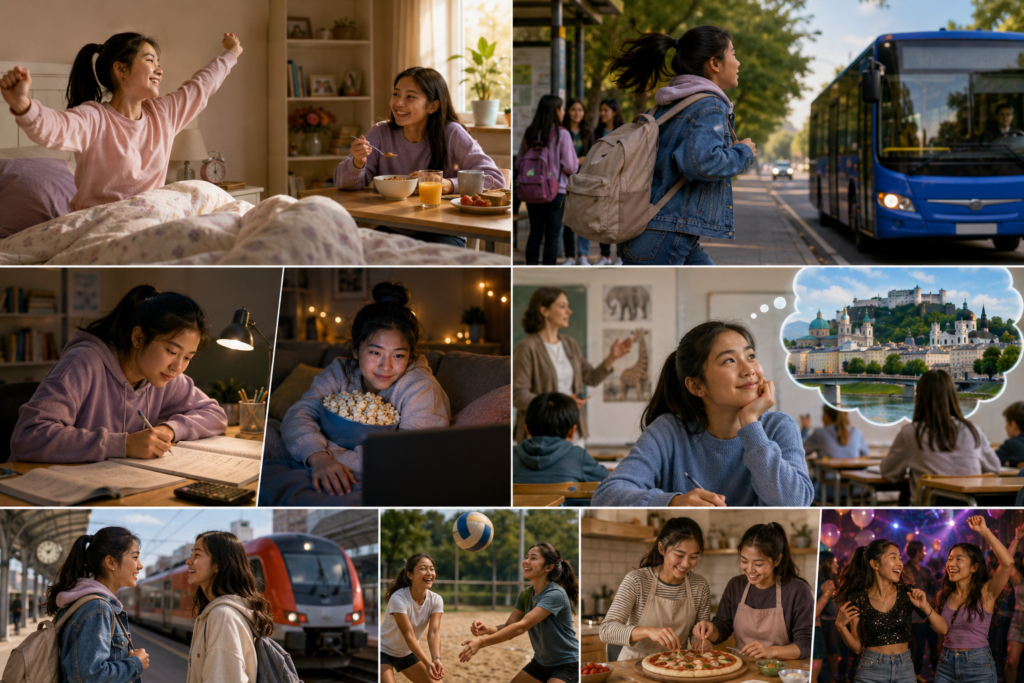
Oum usually __________ (wake up) at 7:00. She __________ (eat) breakfast with her sister every morning.
Today is different. Right now, she __________ (run) to the bus stop because she is late. Her friends __________ (wait) for her at school now.
Yesterday, Oum __________ (study) for a math test and __________ (watch) a movie in the evening. She __________ (go) to bed very late.
At the moment, her teacher __________ (talk) about animals, but Oum __________ (think) about the weekend.
This Saturday, Oum __________ (meet) her cousin in Salzburg. They __________ (travel) by train at 10:00 in the morning. Oum is very excited because they always __________ (have) fun together.
Last weekend, they __________ (play) volleyball, __________ (cook) pizza, and __________ (dance) at a party.
——————————-
Oum’s Busy Week
Oum usually wakes up at 7:00. She eats breakfast with her sister every morning.
Today is different. Right now, she is running to the bus stop because she is late. Her friends are waiting for her at school now.
Yesterday, Oum studied for a math test and watched a movie in the evening. She went to bed very late.
At the moment, her teacher is talking about animals, but Oum is thinking about the weekend.
This Saturday, Oum is meeting her cousin in Salzburg. They are traveling by train at 10:00 in the morning. Oum is very excited because they always have fun together.
Last weekend, they played volleyball, cooked pizza, and danced at a party.
###################
Story #2: Salas in the city
Salas usually __________ (wake up) at 6:30. He __________ (eat) breakfast quickly and __________ (go) to school by bus.
Today is a busy day. Right now, he __________ (sit) in the classroom and he __________ (listen) to his teacher. His classmates __________ (write) a test at the moment.
Yesterday, Salas __________ (visit) his uncle in the city. They __________ (walk) in the park and __________ (eat) ice cream. Salas __________ (take) many photos.
At the moment, Salas’s mother __________ (cook) lunch, and his father __________ (work) at home. Salas __________ (think) about his homework.
Next Sunday, Salas __________ (meet) his best friend in the city center. They __________ (go) to the cinema at 5:00. Salas is excited because they always __________ (have) a great time together.
Last weekend, they __________ (play) football, __________ (watch) a match, and __________ (laugh) a lot.
__________________________
Salas in the city
Salas usually wakes up at 6:30. He eats breakfast quickly and goes to school by bus.
Today is a busy day. Right now, he is sitting in the classroom and he is listening to his teacher. His classmates are writing a test at the moment.
Yesterday, Salas visited his uncle in the city. They walked in the park and ate ice cream. Salas took many photos.
At the moment, Salas’s mother is cooking lunch, and his father is working at home. Salas is thinking about his homework.
Next Sunday, Salas is meeting his best friend in the city center. They are going to the cinema at 5:00. Salas is excited because they always have a great time together.
Last weekend, they played football, watched a match, and laughed a lot.
##################
Story #3: Somalena at the hotel
Somalena usually __________ (wake up) at 6:00. She __________ (go) to work at a luxury hotel every morning.
Somalena __________ (work) as a manager in the spa. She __________ (help) guests and __________ (organize) the spa schedule.
Right now, she __________ (talk) to a guest at the reception. Her team __________ (clean) the spa rooms at the moment.
Yesterday, Somalena __________ (have) a very busy day. She __________ (meet) many guests and __________ (solve) problems in the spa. She __________ (finish) work late.
At the moment, the hotel __________ (be) very busy, and new guests __________ (arrive). Somalena __________ (check) the bookings.
Tomorrow, Somalena __________ (have) an important meeting with the hotel director. She __________ (prepare) new plans for the spa.
Last weekend, she __________ (work) on Saturday and Sunday. She __________ (feel) tired but happy because many guests __________ (enjoy) the spa.
—————————–
Somalena at the Hotel
Somalena usually wakes up at 6:00. She goes to work at a luxury hotel every morning.
Somalena works as a manager in the spa. She helps guests and organizes the spa schedule.
Right now, she is talking to a guest at the reception. Her team is cleaning the spa rooms at the moment.
Yesterday, Somalena had a very busy day. She met many guests and solved problems in the spa. She finished work late.
At the moment, the hotel is very busy, and new guests are arriving. Somalena is checking the bookings.
Tomorrow, Somalena is having an important meeting with the hotel director. She is preparing new plans for the spa.
Last weekend, she worked on Saturday and Sunday. She felt tired but happy because many guests enjoyed the spa.
###################
Story #4: Rafi and his family
Rafi usually __________ (wake up) very early in the morning. He __________ (help) his family on the rice fields.
Rafi’s family __________ (work) together on a big rice farm. They __________ (plant) rice and __________ (take care) of the fields.
Right now, Rafi __________ (work) in the field. His father __________ (cut) grass, and his mother __________ (carry) water.
Yesterday, Rafi __________ (work) all day in the sun. He __________ (feel) tired, but he __________ (finish) a lot of work. His family __________ (eat) dinner together in the evening.
At the moment, the sun __________ (shine), and Rafi’s sister __________ (help) in the field too. Everyone __________ (be) busy.
Next week, Rafi __________ (help) to harvest the rice. His family __________ (plan) a big day for the harvest.
Last year, they __________ (have) a very good rice harvest. They __________ (sell) rice at the market and __________ (earn) some money.
———————————-
Rafi and his family
Rafi usually wakes up very early in the morning. He helps his family on the rice fields.
Rafi’s family works together on a big rice farm. They plant rice and take care of the fields.
Right now, Rafi is working in the field. His father is cutting grass, and his mother is carrying water.
Yesterday, Rafi worked all day in the sun. He felt tired, but he finished a lot of work. His family ate dinner together in the evening.
At the moment, the sun is shining, and Rafi’s sister is helping in the field too. Everyone is busy.
Next week, Rafi is going to help to harvest the rice. His family is planning a big day for the harvest.
Last year, they had a very good rice harvest. They sold rice at the market and earned some money.
################
Story #5: Mr. Vongg at school
Mr. Vongg usually __________ (wake up) at 6:00. He __________ (go) to school early every morning.
Mr. Karim __________ (work) as a teacher at a school. He __________ (teach) English to young students.
Right now, he __________ (stand) in front of the class and he __________ (explain) a grammar rule. The students __________ (listen) carefully and __________ (write) in their notebooks.
Yesterday, Mr. Karim __________ (give) a test. The students __________ (do) very well. He __________ (be) very happy.
At the moment, the school __________ (be) very quiet, and another class __________ (take) a test in the next room. Mr. Karim __________ (check) homework.
Tomorrow, Mr. Karim __________ (have) a meeting with other teachers. He __________ (prepare) new lessons.
Last week, he __________ (organize) a school activity. The students __________ (play) games and __________ (learn) new words.
—————————————
Mr. Vongg at school
Mr. Vongg usually wakes up at 6:00. He goes to school early every morning.
Mr. Vongg works as a teacher at a school. He teaches English to young students.
Right now, he is standing in front of the class and he is explaining a grammar rule. The students are listening carefully and are writing in their notebooks.
Yesterday, Mr. Vongg gave a test. The students did very well. He was very happy.
At the moment, the school is very quiet, and another class is taking a test in the next room. Mr. Vongg is checking homework.
Tomorrow, Mr. Vongg is having a meeting with other teachers. He is preparing new lessons.
Last week, he organized a school activity. The students played games and learned new words.
…………………. can be used to talk about the future when something is already planned or arranged.
Form
am / is / are + verb + -ing
A. Most verbs
Add -ing to the verb.
play → playing
visit → visiting
swim → swimming
Examples:
We are playing games.
They are visiting Italy next week.
B. Verbs ending in -e
Remove -e and add -ing.
live → living
make → making
come → coming
Examples:
We are living in Vienna.
She is coming tomorrow.
C. Short verbs with one vowel + one consonant
Double the last consonant and add -ing.
swim → swimming
run → running
sit → sitting
Examples:
They are swimming in the sea.
He is running in the park.
1. Use: Fixed plans in the future
We use it for things that are already decided and organized.
Examples:
I am meeting my friend tomorrow.
She is flying to Berlin next week.
We are having dinner at 6 pm.
👉 These are not spontaneous ideas — they are planned.
2. Time expressions are usually needed
We often say when the action will happen:
tonight
tomorrow
next week
at 5 pm
on Monday
Example:
They are playing football on Saturday.
3. Difference from “will”
Present progressive = planned
I am visiting my grandma tomorrow. (already planned)
will = decision made now / prediction
I think I will visit my grandma tomorrow. (decided now)
4. Important idea
We use present progressive for the future when the plan is:
organized
already arranged
usually with other people involved
#################
Fill in present progressive:
We _____ (go) to Italy for a beach holiday. We _____ (stay) at a seaside resort with our family and friends. We _____ (spend) our days on the beach. We _____ (build) sandcastles near the water and we _____ (swim) in the sea to cool off. We _____ (drink) fruit drinks and _____ (relax) in the sun.
In the afternoon, we _____ (play) beach games and _____ (enjoy) time together. In the evening, we _____ (watch) a show and _____ (eat) ice cream. We _____ (walk) along the shore as the sun sets.
Before bed, we _____ (play) games or _____ (rest) after a fun day.
_____________________
Correct version:
We are going to Italy for a beach holiday. We are staying at a seaside resort with our family and friends. We are spending our days on the beach. We are building sandcastles near the water and we are swimming in the sea to cool off. We are drinking fruit drinks and are relaxing in the sun.
In the afternoon, we are playing beach games and are enjoying time together. In the evening, we are watching a show and are eating ice cream. We are walking along the shore as the sun sets.
Before bed, we are playing games or are resting after a fun day.
###############
Fill in, present progressive:
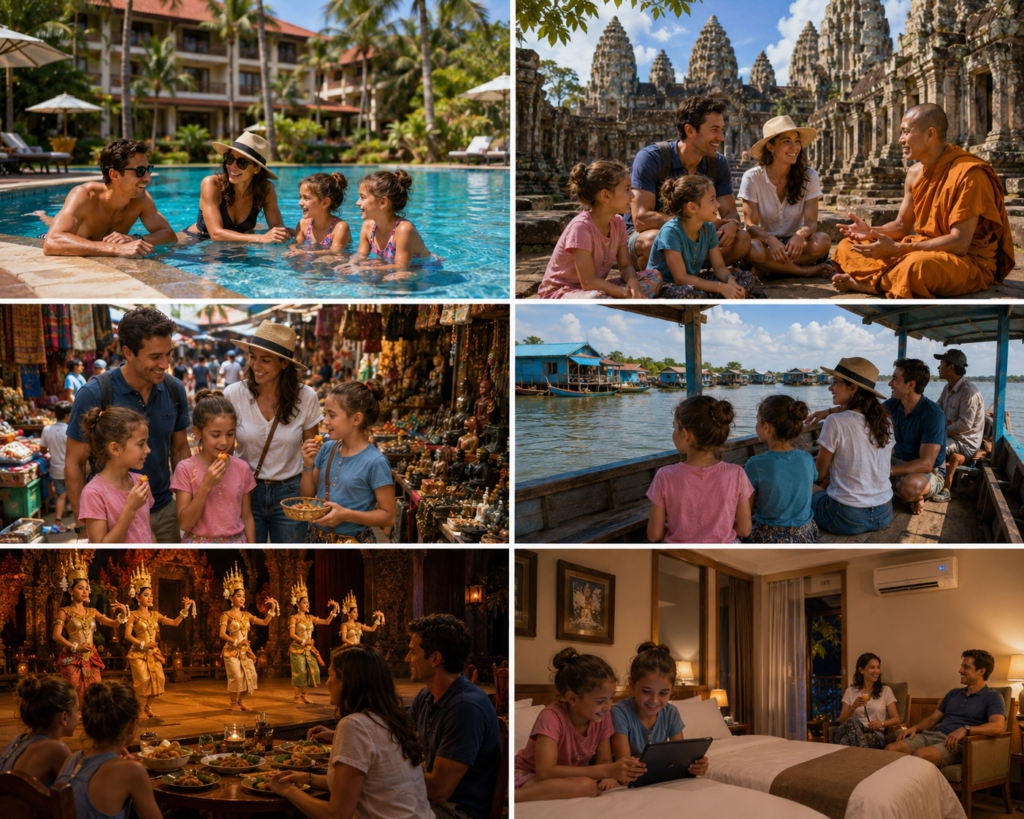
We _____ (go) on holiday to Cambodia with our parents and my twin sister. We _____ (stay) in a hotel with a swimming pool, and we _____ (spend) our days swimming and relaxing in the sun.
We _____ (visit) ancient temples and we _____ (meet) friendly monks who _____ (teach) us about their traditions. We _____ (go) to the local market, and we _____ (try) new foods and buy souvenirs.
We _____ (take) a boat ride on Tonlé Sap, where we _____ (meet) people living in floating houses.
In the evening, we _____ (watch) an Apsara show with traditional dances, and we _____ (enjoy) delicious local food.
Later, in our hotel room, we _____ (relax) and _____ (enjoy) the air conditioning after a long day.
___________________
Correct version:
We are going on holiday to Cambodia with our parents and my twin sister. We are staying in a hotel with a swimming pool, and we are spending our days swimming and relaxing in the sun.
We are visiting ancient temples and we are meeting friendly monks who are teaching us about their traditions. We are going to the local market, and we are trying new foods and buying souvenirs.
We are taking a boat ride on Tonlé Sap, where we are meeting people living in floating houses.
In the evening, we are watching an Apsara show with traditional dances, and we are enjoying delicious local food.
Later, in our hotel room, we are relaxing and are enjoying the air conditioning after a long day.
##############
Fill in, present progressive:
We _____ (go) on holiday to our grandparents’ house in the Vienna Woods. Our mother _____ (have) to work, and our father _____ (work) too, so we _____ (stay) with our grandparents.
We _____ (spend) our days outside and we _____ (roam) through the woods, exploring nature and enjoying the fresh air. When it is hot, our grandparents _____ (invite) us to the whirlpool, and we _____ (cool) off and _____ (have) fun in the water.
In the evening, we _____ (watch) movies together in the living room. If it is too hot inside, we _____ (switch) on the air conditioning and _____ (relax) comfortably.
________________
Correct version:
We are going on holiday to our grandparents’ house in the Vienna Woods. Our mother is having to work, and our father is working too, so we are staying with our grandparents.
We are spending our days outside and we are roaming through the woods, exploring nature and enjoying the fresh air. When it is hot, our grandparents are inviting us to the whirlpool, and we are cooling off and are having fun in the water.
In the evening, we are watching movies together in the living room. If it is too hot inside, we are switching on the air conditioning and are relaxing comfortably.
############
Fill in, present progressive:
Somalena _____ (spend) her holidays at home in the city. When it is hot, she _____ (stay) inside and she _____ (play) games. She _____ (switch) on the air conditioning and _____ (relax) in the cool air.
Somalena _____ (visit) her friends on Mondays and Wednesdays and she _____ (enjoy) spending time together. If it is too hot, she _____ (go) to the public pool, where she _____ (meet) her friends, _____ (have) fun, and _____ (splash) in the water. She _____ (stay) in the shade and _____ (avoid) sunburn.
In the evening, Somalena _____ (go) into the city with her parents. She _____ (have) a light lunch and she _____ (eat) ice cream while she _____ (walk) around and ______ (enjoy) the warm night air.
_________________
Somalena is spending her holidays at home in the city. When it is hot, she is staying inside and she is playing games. She is switching on the air conditioning and is relaxing in the cool air.
Somalena is visiting her friends on Mondays and Wednesdays and she is enjoying spending time together. If it is too hot, she is going to the public pool, where she is meeting her friends, is having fun, and is splashing in the water. She is staying in the shade and is avoiding sunburn.
In the evening, Somalena is going into the city with her parents. She is having a light lunch and she is eating ice cream while she is walking around and enjoying the warm night air.
#############
An email – birthday, invitation, fill in:
I _____ (invite) you to my birthday party this Thursday. The party _____ (start) at 5 PM. Then it is not so hot anymore, so we _____ (have) the party in the garden.
My grandmother _____ (make) a fruit cake, and my mother _____ (prepare) fruit juices for everyone. We _____ (play) music and we _____ (dance), so we _____ (have) a lot of fun together.
We _____ (eat) birthday cake and we _____ (enjoy) the evening with food, music, and friends.
I hope you _____ (come) and _____ (celebrate) with me!
—————————
Correct version:
Subject: 🎉 Birthday Party Invitation 🎉
Hi friends,
I am inviting you to my birthday party this Thursday. The party is starting at 5 PM. Then it is not so hot anymore, so we are having the party in the garden.
My grandmother is making a fruit cake, and my mother is preparing fruit juices for everyone. We are playing music and we are dancing, so we are having a lot of fun together.
We are eating birthday cake and we are enjoying the evening with food, music, and friends.
I hope you are coming and are celebrating with me!
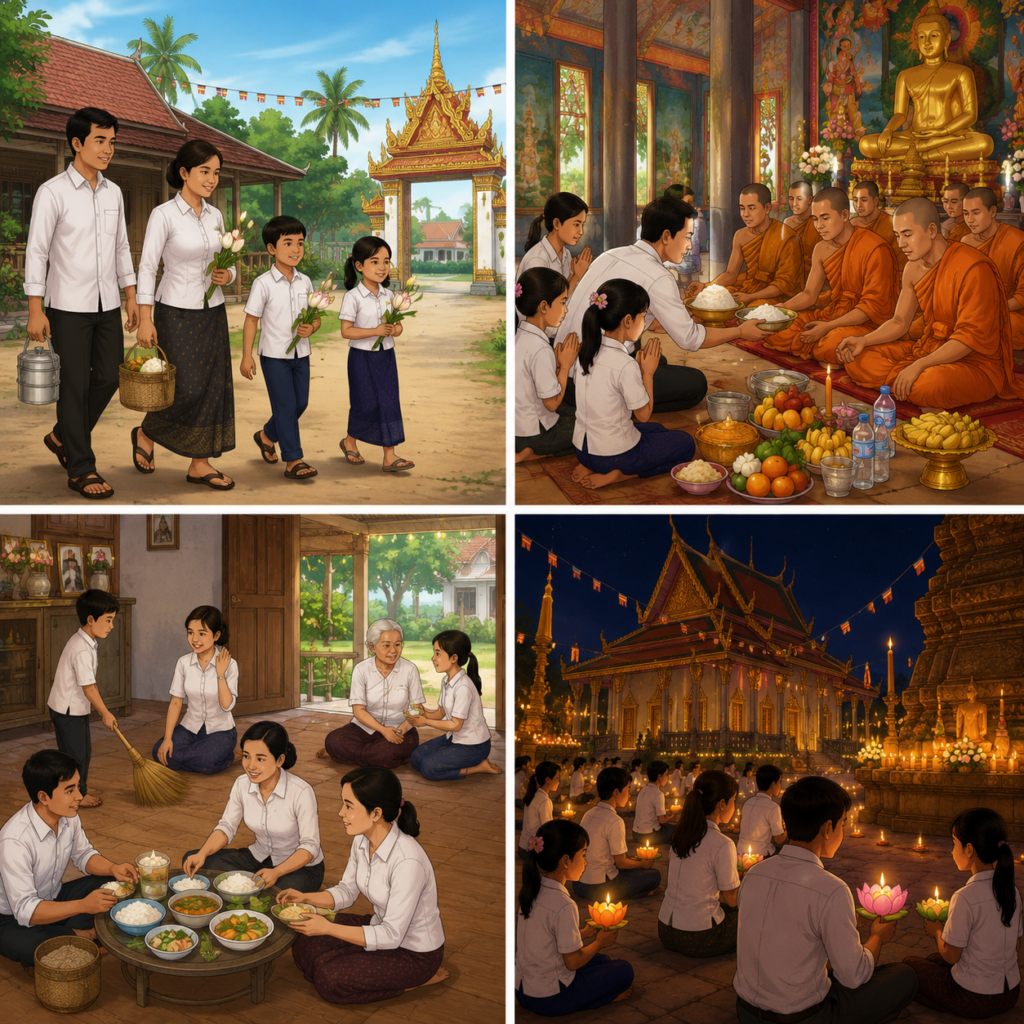
Visak Bochea Day is an important day in Cambodia. Many people know this day. Buddhist people celebrate it every year. On this day, people wake up early in the morning. They wash, eat breakfast, and get ready to go out. Many people wear white clothes. They go to the pagoda with their family.
At the pagoda, people see many monks. The pagoda is quiet and clean. People bring rice, fruit, water, flowers, and candles. They give food to the monks. Then they sit and listen. The monks talk to the people. Many people pray quietly.
Children also go to the pagoda. They stay with their parents and grandparents. Some children carry flowers or candles. They feel happy to be there.
In the afternoon, families go home. They eat food together and talk. Some people clean the house or help old people. In the evening, people light candles and pray again.
Visak Bochea Day is a calm and special day. People feel happy, peaceful, and close to their family.
______________________
Vocabulary:
to be important — to be very special or needed
to celebrate — to do something happy for a special day
to wake up — to stop sleeping
to get ready — to prepare to go somewhere or do something
to wear clothes — to have clothes on your body
a pagoda — a Buddhist holy place
a monk — a Buddhist man who lives and works in a pagoda
to be quiet — to make little or no noise
a candle — a small stick with fire for light
to pray quietly — to speak to God or Buddha in a soft voice
to stay with one’s parents — to be together with mother and father
grandparents — the mother and father of your mother or father
afternoon — the time after lunch and before evening
to clean the house — to make the house clean
to light a candle — to make a candle burn with fire
to be calm — to feel relaxed and not worried
to be peaceful — to be quiet and calm
to be close to one’s family — to love and spend time with family members
#################
Match word and defintion:
to be important
to celebrate
to wake up
to get ready
to wear clothes
a pagoda
a monk
to be quiet
a candle
to pray quietly
to stay with one’s parents
grandparents
afternoon
to clean the house
to light a candle
to be calm
to be peaceful
to be close to one’s family
Definition:
a. to make little or no noise b. to have clothes on your body c. to feel relaxed and not worried d. a Buddhist holy place e. to make the house clean f. to prepare to go somewhere or do something g. to stop sleeping h. the mother and father of your mother or father i. to make a candle burn with fire j. to be very special or needed k. to be together with mother and father l. a Buddhist man who lives and works in a pagoda m. a small stick with fire for light n. to do something happy for a special day o. to speak to God or Buddha in a soft voice p. the time after lunch and before evening q. to be quiet and calm r. to love and spend time with family members
a. to be important b. to celebrate c. to wake up d. to get ready e. to wear clothes f. a pagoda g. a monk h. to be quiet i. a candle j. to pray quietly k. to stay with one’s parents l. grandparents m. afternoon n. to clean the house o. to light a candle p. to be calm q. to be peaceful r. to be close to one’s family
Correct answers: People travel to the city on this day. True is: People go to the pagoda on this day.
Monks talk about peace and kindness.
The day is quiet and peaceful.
People go to the beach on this day. True is: People go to the pagoda on this day.
People wear white clothes.
Children do exams in the pagoda. True is: Children go to the pagoda with their family.
People bring flowers and candles.
Monks sing loud pop songs in the street. True is: Monks talk about peace and kindness.
Visak Bochea Day is in Cambodia.
People eat only pizza at the pagoda. True is: People bring rice, fruit, and food to the pagoda.
Families stay together on this day.
People swim in the ocean at midnight. True is: People pray at home or at the pagoda.
Schools are open and students study all day. True is: People go to the pagoda and celebrate.
People give food to monks.
People go to the pagoda on this day.
The day is very loud and full of traffic. True is: The day is quiet and peaceful.
################
The odd one out – try to find it:
banana / monk / candle / pagoda
flowers / incense / candles / white clothes
pray / eat / listen / think
calm / peaceful / noisy / quiet
morning / afternoon / candle / evening
family / parents / teacher / grandparents
sit / swim / give food / light candle
rice / school / fruit / water
stand / sit / listen / pray
happy / kind / peaceful / loud
______________________
Correct answers:
banana – monk – candle – pagoda Odd one: banana Why: banana is a fruit, the others are in a pagoda or used there.
flowers – incense – candles – white clothes Odd one: white clothes Why: white clothes are worn, the others are things you give or burn at a pagoda.
pray – eat – listen – think Odd one: eat Why: the others are mental or spiritual actions, eat is a physical action for food.
calm – peaceful – noisy – quiet Odd one: noisy Why: the others mean no sound or soft feeling, noisy is loud.
morning – afternoon – candle – evening Odd one: candle Why: the others are times of day, candle is an object.
family – parents – teacher – grandparents Odd one: teacher Why: the others are family members, teacher is not family.
sit – swim – give food – light candle Odd one: swim Why: the others are actions done at the pagoda, swim is not.
rice – school – fruit – water Odd one: school Why: the others are food or drink, school is a place.
stand – sit – listen – pray Odd one: pray Why: the others are simple body actions, pray is a religious action.
happy – kind – peaceful – loud Odd one: loud Why: the others are positive feelings, loud is about sound.
###############
Give short answers:
Where is Visak Bochea Day?
YOU WRITE: It is in Cambodia.
When do people celebrate Visak Bochea Day?
What do people wear on this day?
What do people bring to the pagoda?
Who goes to the pagoda with children?
Who lives in a pagoda?
What do monks do at the pagoda?
Why do people go to the pagoda?
How do people feel on this day?
Is the pagoda noisy?
Do people give food to monks?
Do people light candles?
Can children go to the pagoda?
Do families stay together?
Are people quiet at the pagoda?
Does everyone wear white clothes?
Do monks eat pizza?
Do people swim in the ocean that day?
Are there many candles at the pagoda?
Do people think about kindness?
_____________________
Correct answers:
Where is Visak Bochea Day? It is in Cambodia.
When do people celebrate Visak Bochea Day? People celebrate it in May.
What do people wear on this day? People wear white clothes.
What do people bring to the pagoda? People bring flowers and candles.
Who goes to the pagoda with children? Families go to the pagoda with children.
Who lives in a pagoda? Monks live in a pagoda.
What do monks do at the pagoda? Monks talk and pray.
Why do people go to the pagoda? People go to the pagoda to pray.
How do people feel on this day? People feel calm and happy.
Is the pagoda noisy? The pagoda is not noisy.
Do people give food to monks? People give food to monks.
Do people light candles? People light candles.
Can children go to the pagoda? Children can go to the pagoda.
Do families stay together? Families stay together.
Are people quiet at the pagoda? People are quiet at the pagoda.
Does everyone wear white clothes? People wear white clothes.
Do monks eat pizza? Monks do not eat pizza.
Do people swim in the ocean that day? People do not swim in the ocean that day.
Are there many candles at the pagoda? There are many candles at the pagoda.
Do people think about kindness? People think about kindness.
###############
Fill in, words below:
monks – peaceful – important – grandparents – candles – family – stay – pray – pagoda – kindness
Visak Bochea Day is__________in Cambodia. People wake up and get ready. They go to the _________ with family. People wear white clothes. They bring flowers, __________, fruit, rice, and water. People give food to monks. __________ live in a pagoda. People sit, listen, and __________ quietly. Monks talk about __________, peace, and good actions. Children stay with parents and __________. In the afternoon, families go home. Families __________ together. In the evening, people light candles and pray. The day is calm, __________, and quiet. People feel happy and close to __________.
—————————
Correct version:
Visak Bochea Day is important in Cambodia. People wake up and get ready. They go to the pagoda with family. People wear white clothes. They bring flowers, candles, fruit, rice, and water. People give food to monks. Monks live in a pagoda. People sit, listen, and pray quietly. Monks talk about kindness, peace, and good actions. Children stay with parents and grandparents. In the afternoon, families go home. Families stay together. In the evening, people light candles and pray. The day is calm, peaceful, and quiet. People feel happy and close to family.
#############
Interview with a monk on Visak Bochea Day – find the correct answers:
Questions:
Where do you live?
What do you do every day?
What do people bring to you today?
What food do people give you?
Why do people come here?
What do you tell people?
Who comes with the people?
Do children come here?
What clothes do people wear?
Is the pagoda quiet today?
Do you feel happy today?
What do you do with candles?
Do you eat pizza?
What is this day for you?
Answers:
a. I speak about kindness and peace. b. Yes, children arrive with parents. c. People come for prayer. d. I stay in a pagoda. e. People have white clothes. f. It is a calm and important day. g. I feel happiness. h. People bring flowers and candles. i. No, I do not eat pizza. j. People make light from candles. k. I pray and speak to people. l. Yes, the pagoda has quiet. m. Families come together. n. People give rice, fruit, and water.
Find the correct order of the story – regroup the paragraphs
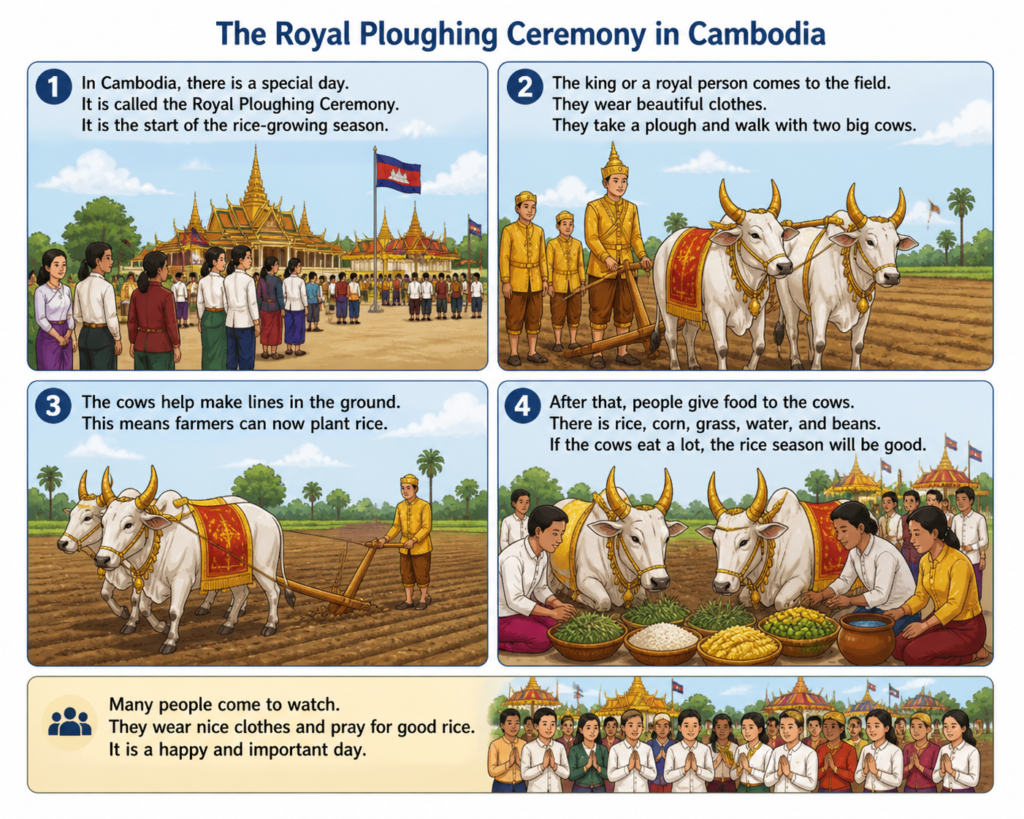
a) Many people come to watch. They wear nice clothes and pray for good rice. It is a happy and important day.
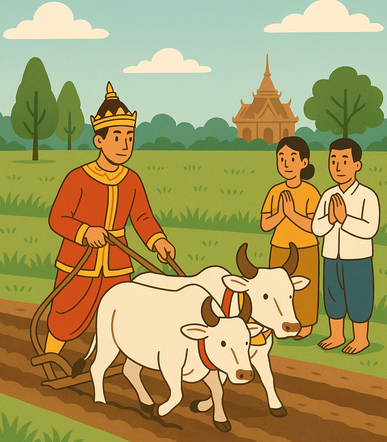
b) The cows help make lines in the ground. This means farmers can now plant rice.
c) In Cambodia, there is a special day. It is called the Royal Ploughing Ceremony. It is the start of the rice-growing season.
d) The king or a royal person comes to the field. They wear beautiful clothes. They take a plough and walk with two big cows.
e) After that, people give food to the cows. There is rice, corn, grass, water, and beans. If the cows eat a lot, the rice season will be good.
———————————-
The Royal Ploughing Ceremony
In Cambodia, there is a special day. It is called the Royal Ploughing Ceremony. It is the start of the rice-growing season.
The king or a royal person comes to the field. They wear beautiful clothes. They take a plough and walk with two big cows.
The cows help make lines in the ground. This means farmers can now plant rice.
After that, people give food to the cows. There is rice, corn, grass, water, and beans. If the cows eat a lot, the rice season will be good.
Many people come to watch. They wear nice clothes and pray for good rice. It is a happy and important day.
###############
Vocabulary:
to plough – to break the ground so farmers can grow food
a season – a part of the year (like hot time or rainy time)
to wear – to put clothes on your body
a plough – a thing that helps cut the ground for farming
to plant – to put seeds in the ground to grow
corn – a yellow food that grows on a plant
beans – small foods that grow on plants
clothes – things we put on our body, like shirts and pants
to pray – to talk to God or ask for help from the sky
#################
True or false?
The Royal Ploughing Ceremony happens in Cambodia.
The ceremony starts the rice-growing season.
A farmer wears old clothes for the ceremony.
Two cows help with the ploughing.
The cows eat hamburgers and pizza.
People come to watch the ceremony.
The cows do not get any food.
People wear nice clothes and pray.
The ceremony is a sad day.
The plough makes lines in the ground.
————————
The Royal Ploughing Ceremony happens in Cambodia. ✅
The ceremony starts the rice-growing season. ✅
A farmer wears old clothes for the ceremony. ❌
Two cows help with the ploughing. ✅
The cows eat hamburgers and pizza. ❌
People come to watch the ceremony. ✅
The cows do not get any food. ❌
People wear nice clothes and pray. ✅
The ceremony is a sad day. ❌
The plough makes lines in the ground. ✅
#################
More than one answer may be correct:
What is the Royal Ploughing Ceremony in Cambodia? a) The start of the rice-growing season b) A celebration of harvest c) A day to pray for rain d) A royal wedding celebration
Who participates in the Royal Ploughing Ceremony? a) The king or a royal person b) Local farmers c) The cows d) Foreign guests
What does the king or royal person do during the ceremony? a) Watches the cows plough the field b) Wears beautiful clothes c) Takes a plough and walks with two cows d) Sings a song for the rice season
What do the cows help with during the ceremony? a) Plough the field b) Eat rice c) Make lines in the ground d) Carry the king’s crown
What happens after the ploughing is done? a) People give food to the cows b) The cows are taken to a farm c) The king leaves the field d) People celebrate with fireworks
Which of the following foods are given to the cows? a) Rice b) Corn c) Grass d) Cake
What does it mean if the cows eat a lot? a) The rice season will be bad b) The rice season will be good c) The cows are tired d) The ceremony is over
Who comes to watch the Royal Ploughing Ceremony? a) Many people b) Farmers only c) Foreign tourists d) People who pray for good rice
What do the people wear during the ceremony? a) Simple clothes b) Nice clothes c) Traditional clothing d) Festival costumes
What do people do at the ceremony besides watching? a) Pray for good rice b) Eat food with the cows c) Plant rice d) Dance and sing
———————-
#####################
Fill in:
The Royal Ploughing __________ is a special day.
It is the start of the rice-growing __________.
The king or a__________ person comes to the field.
They wear __________ clothes.
They take a __________ and walk with two big cows.
The cows help make __________in the ground.
This means farmers can now __________ rice.
After that, people give __________ to the cows.
There is rice, corn, grass, __________, and beans.
Many __________ come to watch.
———— a) plant
b) food
c) season
d) Ceremony
e) water
f) lines
g) beautiful
h) plough
i) people
j) royal
_________________________________
Correct answers:
The Royal Ploughing Ceremony is a special day.
It is the start of the rice-growing season.
The king or a royal person comes to the field.
They wear beautiful clothes.
They take a plough and walk with two big cows.
The cows help make lines in the ground.
This means farmers can now plant rice.
After that, people give food to the cows.
There is rice, corn, grass, water, and beans.
Many people come to watch.
########################
Complete:
It is called the Royal __________ Ceremony.
The king or a royal __________ comes to the field.
They __________ beautiful clothes.
They take a __________ to make lines in the field.
The __________ help make lines.
Farmers can plant __________
People give __________ to the cows.
If the cows eat a lot, the rice __________ will be good.
Many people come to __________.
It is a __________and important day.
——————————
It is called the Royal Ploughing Ceremony.
The king or a royal person comes to the field.
They wear beautiful clothes.
They take a plough.
The cows help make lines.
Farmers can plant rice.
People give food to the cows.
If the cows eat a lot, the rice season will be good.
Many people come to watch.
It is a happy and important day.
#################### What is wrong?
Interviewer: Hello! Can you tell us about the Royal Planting Ceremony?
Organizer: It is the start of the corn-growing season.
Interviewer: Why is this ceremony important?
Organizer: It is important for a good rice season.
Interviewer: Who takes part in the ceremony?
Organizer: The king or a royal person comes to the home of people..
Interviewer: What happens during the ceremony?
Organizer: The king walks with four big horses and uses a plough.
Interviewer: What do the cows do in the ceremony?
Organizer: The cows help make circles in the ground.
Interviewer: What do people do after the ploughing?
Organizer: People give fruits to the cows.
Interviewer: How do the cows‘ actions affect the rice season?
Organizer: If the cows eat little, the rice season will be good.
Interviewer: How do people dress for the ceremony?
Organizer: People wear old clothes.
Interviewer: What is the overall feeling of the day?
Organizer: It is a happy and important day. ———————-
The original:
Interviewer: Hello! Can you tell us about the Royal Ploughing Ceremony?
Organizer: It is the start of the rice-growing season.
Interviewer: Why is this ceremony important?
Organizer: It is important for a good rice season.
Interviewer: Who takes part in the ceremony?
Organizer: The king or a royal person comes to the field.
Interviewer: What happens during the ceremony?
Organizer: The king walks with two big cows and uses a plough.
Interviewer: What do the cows do in the ceremony?
Organizer: The cows help make lines in the ground.
Interviewer: What do people do after the ploughing?
Organizer: People give food to the cows.
Interviewer: How do the cows‘ actions affect the rice season?
Organizer: If the cows eat a lot, the rice season will be good.
Interviewer: How do people dress for the ceremony?
Organizer: People wear nice clothes.
Interviewer: What is the overall feeling of the day?
Organizer: It is a happy and important day.
######################
What is the correct order?
People give food to the cows, such as rice, corn, grass, water, and beans.
If the cows eat a lot, the rice season will be good, and people pray for a good harvest.
The cows help make lines in the ground.
The Royal Ploughing Ceremony starts the rice-growing season.
The king or royal person walks with two big cows and uses a plough.
————————————-
The Royal Ploughing Ceremony starts the rice-growing season.
The king or royal person walks with two big cows and uses a plough.
The cows help make lines in the ground.
People give food to the cows, such as rice, corn, grass, water, and beans.
If the cows eat a lot, the rice season will be good, and people pray for a good harvest. #################
Answer these questions:
When does the Royal Ploughing Ceremony take place?
What does the ploughing signal for farmers?
What kind of clothes do the king or royal person wear?
What food is given to the cows?
What happens if the cows eat a lot?
How do people celebrate the day?
Why is the ceremony important for farmers?
Answers:
The Royal Ploughing Ceremony takes place at the start of the rice-growing season.
The ploughing signals that farmers can begin planting rice.
The king or royal person wears beautiful clothes.
The cows are given rice, corn, grass, water, and beans.
If the cows eat a lot, it means the rice harvest will be good.
People celebrate by watching the ceremony, wearing nice clothes, and praying for a good harvest.
The ceremony is important for farmers because it marks the beginning of the farming season and is believed to predict the success of the rice harvest.
Rina lived with her brother and her parents in a small village in the countryside. Their house was made of wood with a tin roof. Near her house were rice fields, trees, and a dirt path. Life in the village was quiet and simple.
Rina had a white cat named Mimi. Mimi was small and friendly. The cat often slept under the house or walked in the garden. It liked warm places and quiet corners.
One morning, Rina and her brother woke up early. They could not find Mimi. They looked inside the house, under the table, and near the kitchen, but Mimi was not there. Rina and her brother felt worried. Then Rina went outside and looked around the yard and the garden. The sun rose over the rice fields.
Rina walked along the dirt path near the fields. She looked near the grass and small trees. After a while, she heard a soft sound near a wooden cart. Mimi hid there. The cat was safe but a little scared.
Rina carefully carried Mimi back home. She and her brother gave it food and water. Mimi ate and rested. Rina and her family felt happy again. The village became quiet, and the day continued peacefully.
____________________________
Vocabulary:
a village – a small place where many people live, with houses and farms
countryside – land outside cities, with fields, trees, and nature
to be made of wood – built using wood
a tin roof – a roof made from thin metal sheets
a dirt path – a small road made of soil, not concrete
to be quiet – with little or no noise
a corner – a small place where two sides meet
to wake up – to stop sleeping
to feel worried – to feel not calm because something may be wrong
a yard – open space around a house
sunrise – when the sun comes up in the morning
a soft sound – a quiet, gentle noise
a wooden cart – a small vehicle made of wood, used to carry things
to hide – to stay in a place where others cannot see you
to be safe – to not be in danger
to be scared – to feel afraid
carefully – doing something slowly and with attention
to carry – to hold and move something
to rest – to relax or sleep
to continue – to keep going
to be peaceful – to be calm and quiet, with no problems
################ Basics in past simple:
Past Simple – Regular Verbs
Rules:
Most verbs: add -ed play → played
Verbs ending in -e: add -d live → lived
Verbs ending in consonant + y: change y to i and add -ed study → studied
Short verbs ending in vowel + consonant: double the final consonant and add -ed stop → stopped
Use: The past simple is used to talk about finished actions in the past.
###############
Verbs in text:
Infinitive
Past simple
A1 definition
live
lived
to have your home in a place
be
was / were
to exist; used to describe people or things
have
had
to own or possess something
sleep
slept
to rest with eyes closed
walk
walked
to move on foot
like
liked
to enjoy something
wake up
woke up
to stop sleeping
can
could
to be able to do something
look
looked
to try to see something carefully
feel
felt
to experience an emotion or physical state
go
went
to move from one place to another
rise
rose
(sun) to move up in the sky
hear
heard
to notice sound with your ears
hide
hid
to put something or yourself out of sight
carry
carried
to hold and move something
give
gave
to hand something to someone
eat
ate
to take food into the body
rest
rested
to relax after activity
become
became
to change into something
continue
continued
to keep doing something
#################
Fill in the correct form of the verb in past simple:
Rina ________ (live) with her brother and her parents in a small village in the countryside. Their house ________ (be) made of wood with a tin roof. Near her house ________ (be) rice fields, trees, and a dirt path. Life in the village ________ (be) quiet and simple.
Rina ________ (have) a white cat named Mimi. Mimi ________ (be) small and friendly. The cat often ________ (sleep) under the house or ________ (walk) in the garden. It ________ (like) warm places and quiet corners.
One morning, Rina and her brother ________ (wake up) early. They ________ (can find) Mimi. They ________ (look) inside the house, under the table, and near the kitchen, but Mimi ________ (be) not there. Rina and her brother ________ (feel) worried. Then Rina ________ (go) outside and ________ (look) around the yard and the garden. The sun ________ (rise) over the rice fields.
Rina ________ (walk) along the dirt path near the fields. She ________ (look) near the grass and small trees. After a while, she ________ (hear) a soft sound near a wooden cart. Mimi ________ (hide) there. The cat ________ (be) safe but a little scared.
Rina carefully ________ (carry) Mimi back home. She and her brother ________ (give) it food and water. Mimi ________ (eat) and ________ (rest). Rina and her family ________ (feel) happy again. The village ________ (become) quiet, and the day ________ (continue) peacefully.
Correct version, see text above
##################
Short answers, past simple, basics:
Example Sentence
Yes
No
I learned letters.
Yes, I did.
No, I didn’t.
You read signs.
Yes, you did.
No, you didn’t.
He spoke English.
Yes, he did.
No, he didn’t.
She watched TV.
Yes, she did.
No, she didn’t.
It helped me.
Yes, it did.
No, it didn’t.
We used an app.
Yes, we did.
No, we didn’t.
You read words.
Yes, you did.
No, you didn’t.
They made mistakes.
Yes, they did.
No, they didn’t.
Questions (Past Simple)
Question
Yes
No
Did I learn letters?
Yes, I did.
No, I didn’t.
Did you read signs?
Yes, you did.
No, you didn’t.
Did he speak English?
Yes, he did.
No, he didn’t.
Did she watch TV?
Yes, she did.
No, she didn’t.
Did it help me?
Yes, it did.
No, it didn’t.
Did we use an app?
Yes, we did.
No, we didn’t.
Did you read words?
Yes, you did.
No, you didn’t.
Did they make mistakes?
Yes, they did.
No, they didn’t.
Was / Were
Question
Yes
No
Was I happy?
Yes, I was.
No, I wasn’t.
Were you happy?
Yes, you were.
No, you weren’t.
Was he happy?
Yes, he was.
No, he wasn’t.
Was she happy?
Yes, she was.
No, she wasn’t.
Was it good?
Yes, it was.
No, it wasn’t.
Were we happy?
Yes, we were.
No, we weren’t.
Were you happy?
Yes, you were.
No, you weren’t.
Were they happy?
Yes, they were.
No, they weren’t.
#################
Short answers:
Mimi was large and unfriendly.
YOU WRITE: No, it wasn’t.
Rina had a white cat named Mimi.
Her house was made of stone with a metal roof.
Rina lived in a small village in the countryside.
The cat always slept inside the kitchen.
Rina walked along a dirt path near the fields.
Rice fields were near her house.
Mimi was a black cat with long fur [the soft hair on an animal’s body].
Rina and her brother woke up early.
The cat sometimes slept under the house.
Rina found Mimi near a wooden cart.
They found Mimi immediately in the garden.
Mimi was small and friendly.
Rina walked through a forest instead of a dirt path.
Rice fields were far away from her house.
Rina lived in a village by the sea instead of the countryside.
One morning, Rina and her brother woke up early.
Rina had a white cat named Mimi.
Mimi was hiding inside the house behind a cupboard.
Her house was made of wood with a tin roof.
_________________________
True: 2,4,6,7,9,10,11,13,17,18,20
_________________________
Mimi was large and unfriendly. — No, it wasn’t.
Rina had a white cat named Mimi. — Yes, she did.
Her house was made of stone with a metal roof. — No, it wasn’t.
Rina lived in a small village in the countryside. — Yes, she did.
The cat always slept inside the kitchen. — No, it didn’t.
Rina walked along a dirt path near the fields. — Yes, she did.
Rice fields were near her house. — Yes, they were.
Mimi was a black cat with long fur. — No, it wasn’t.
Rina and her brother woke up early. — Yes, they did.
The cat sometimes slept under the house. — Yes, it did.
Rina found Mimi near a wooden cart. — Yes, i did.
They found Mimi immediately in the garden. — No, they didn’t.
Mimi was small and friendly. — Yes, it was.
Rina walked through a forest instead of a dirt path. — No, she didn’t.
Rice fields were far away from her house. — No, they weren’t.
Rina lived in a village by the sea instead of the countryside. — No, she didn’t.
One morning, Rina and her brother woke up early. — Yes, they did.
Rina had a white cat named Mimi. — Yes, she did.
Mimi hid inside the house behind a cupboard. — No, it didn’t.
Her house was made of wood with a tin roof. — Yes, it was.
#################
Past simple – basics
Personal Pronoun
Verb (Past)
Object
I
ate
apples
You
ate
apples
He
ate
apples
She
ate
apples
It
ate
apples
We
ate
apples
You (plural)
ate
apples
They
ate
apples
I
played
football
You
played
football
He
played
football
She
played
football
It
played
football
We
played
football
You (plural)
played
football
They
played
football
Personal Pronoun
Verb (Past Negative)
Object
I
did not eat
apples
You
did not eat
apples
He
did not eat
apples
She
did not eat
apples
It
did not eat
apples
We
did not eat
apples
You (plural)
did not eat
apples
They
did not eat
apples
I
did not play
football
You
did not play
football
He
did not play
football
She
did not play
football
It
did not play
football
We
did not play
football
You (plural)
did not play
football
They
did not play
football
Did + Pronoun
Verb
Object
Did I
eat
apples?
Did you
eat
apples?
Did he
eat
apples?
Did she
eat
apples?
Did it
eat
apples?
Did we
eat
apples?
Did you
eat
apples?
Did they
eat
apples?
Did I
play
football?
Did you
play
football?
Did he
play
football?
Did she
play
football?
Did it
play
football?
Did we
play
football?
Did you
play
football?
Did they
play
football?
Didn’t + Pronoun
Verb
Object
Didn’t I
eat
apples?
Didn’t you
eat
apples?
Didn’t he
eat
apples?
Didn’t she
eat
apples?
Didn’t it
eat
apples?
Didn’t we
eat
apples?
Didn’t you
eat
apples?
Didn’t they
eat
apples?
Didn’t I
play
football?
Didn’t you
play
football?
Didn’t he
play
football?
Didn’t she
play
football?
Didn’t it
play
football?
Didn’t we
play
football?
Didn’t you
play
football?
Didn’t they
play
football?
Forms of ‚to be‘
Personal Pronoun
Positive
Negative
Question
I
I was happy.
I was not happy.
Was I happy?
You (singular)
You were excited.
You were not excited.
Were you excited?
He
He was at home.
He was not at home.
Was he at home?
She
She was tired.
She was not tired.
Was she tired?
It
It was cold.
It was not cold.
Was it cold?
We
We were at the party.
We were not at the party.
Were we at the party?
You (plural)
You were friends.
You were not friends.
Were you friends?
They
They were in the garden.
They were not in the garden.
Were they in the garden?
############## Answer as shown, question, negation:
Rina lived in a small village in the countryside.
YOU WRITE: a) Did Rina live in a small village in the countryside? b) Rina did not live in a small village in the countryside.
Her house was made of wood with a tin roof.
Rice fields were near her house.
Rina had a white cat named Mimi.
Mimi was small and friendly.
The cat sometimes slept under the house.
The cat walked in the garden.
Mimi liked warm places and quiet corners.
Rina and her brother woke up early one morning.
Rina went outside to look for Mimi.
The sun rose over the rice fields.
Rina walked along a dirt path near the fields.
Rina heard a soft sound near a wooden cart.
Mimi was safe near the wooden cart.
_____________________
Correct answers:
Rina lived in a small village in the countryside. a) Did Rina live in a small village in the countryside? b) Rina did not live in a small village in the countryside.
Her house was made of wood with a tin roof. a) Was her house made of wood with a tin roof? b) Her house was not made of wood with a tin roof.
Rice fields were near her house. a) Were rice fields near her house? b) Rice fields were not near her house.
Rina had a white cat named Mimi. a) Did Rina have a white cat named Mimi? b) Rina did not have a white cat named Mimi.
Mimi was small and friendly. a) Was Mimi small and friendly? b) Mimi was not small and friendly.
The cat sometimes slept under the house. a) Did the cat sometimes sleep under the house? b) The cat did not sometimes sleep under the house.
The cat walked in the garden. a) Did the cat walk in the garden? b) The cat did not walk in the garden.
Mimi liked warm places and quiet corners. a) Did Mimi like warm places and quiet corners? b) Mimi did not like warm places and quiet corners.
Rina and her brother woke up early one morning. a) Did Rina and her brother wake up early one morning? b) Rina and her brother did not wake up early one morning.
Rina went outside to look for Mimi. a) Did Rina go outside to look for Mimi? b) Rina did not go outside to look for Mimi.
The sun rose over the rice fields. a) Did the sun rise over the rice fields? b) The sun did not rise over the rice fields.
Rina walked along a dirt path near the fields. a) Did Rina walk along a dirt path near the fields? b) Rina did not walk along a dirt path near the fields.
Rina heard a soft sound near a wooden cart. a) Did Rina hear a soft sound near a wooden cart? b) Rina did not hear a soft sound near a wooden cart.
———-end of audio file———–
Mimi was safe near the wooden cart. a) Was Mimi safe near the wooden cart? b) Mimi was not safe near the wooden cart.
#################
Answer as shown:
Rina lived in a big city with tall buildings.
YOU WRITE: No, she didn’t live in a big city with tall buildings. She lived in a small village in the countryside.
Her house was made of brick and glass.
There were mango fields near her house.
Rina had a brown dog named Mimi.
Mimi was large and unfriendly.
The cat always slept on the roof of the house.
Rina and her brother woke up late in the afternoon.
They found Mimi inside the kitchen.
The sun set over the village in the morning.
Rina heard a loud noise instead of a soft sound near the wooden cart.
____________________
Correct version:
Rina lived in a big city with tall buildings. No, she didn’t live in a big city with tall buildings. She lived in a small village in the countryside.
Her house was made of brick and glass. No, her house was not made of brick and glass. It was made of wood with a tin roof.
There were mango fields near her house. No, there weren’t mango fields near her house. There were rice fields near her house.
Rina had a brown dog named Mimi. No, she did not have a brown dog named Mimi. She had a white cat named Mimi.
Mimi was large and unfriendly. No, Mimi was not large and unfriendly. Mimi was small and friendly.
The cat always slept on the roof of the house. No, the cat did not always sleep on the roof of the house. It sometimes slept under the house.
Rina and her brother woke up late in the afternoon. No, they did not wake up late in the afternoon. They woke up early in the morning.
They found Mimi inside the kitchen. No, they did not find Mimi inside the kitchen. They could not find Mimi in the house.
The sun set over the village in the morning. No, the sun did not set over the village in the morning. The sun rose over the rice fields.
Rina heard a loud noise instead of a soft sound near the wooden cart. No, she did not hear a loud noise. She heard a soft sound near the wooden cart.
################
Fill in the correct form of the verb in past simple:
Q: Where did you live when you were young? A: I __________ (live) in a small village in the countryside.
Q: What was your house like? A: My house __________ (be) made of wood with a tin roof.
Q: Did you live near nature? A: Yes, rice fields and trees __________ (be) near my house.
Q: Did you have any pets? A: Yes, I __________ (have) a white cat named Mimi.
Q: What was Mimi like? A: Mimi __________ (be) small and friendly.
Q: Where did Mimi usually sleep? A: Mimi sometimes __________ (sleep) under the house.
Q: Did you have a brother or sister? A: Yes, I __________ (have) a brother.
Q: What did you do in the mornings? A: I __________ (wake) up early in the mornings.
Q: Did you have a busy life? A: No, my life __________ (be) quiet and simple.
Q: What did you do when Mimi was lost? A: I __________ (look) for Mimi in the house and outside.
Q: Where did you find Mimi? A: I __________ (find) Mimi near a wooden cart.
Q: How did you feel when you found her? A: I __________ (feel) happy.
Q: What did you do after you found Mimi? A: I __________ (take) Mimi back home.
Q: How was your life in the village? A: My life in the village __________ (be) peaceful.
————————————
Correct version:
Q: Where did you live when you were young? A: I lived in a small village in the countryside.
Q: What was your house like? A: My house was made of wood with a tin roof.
Q: Did you live near nature? A: Yes, rice fields and trees were near my house.
Q: Did you have any pets? A: Yes, I had a white cat named Mimi.
Q: What was Mimi like? A: Mimi was small and friendly.
Q: Where did Mimi usually sleep? A: Mimi sometimes slept under the house.
Q: Did you have a brother or sister? A: Yes, I had a brother.
Q: What did you do in the mornings? A: I woke up early in the mornings.
Q: Did you have a busy life? A: No, my life was quiet and simple.
Q: What did you do when Mimi was lost? A: I looked for Mimi in the house and outside.
Q: Where did you find Mimi? A: I found Mimi near a wooden cart.
Q: How did you feel when you found her? A: I felt happy.
Q: What did you do after you found Mimi? A: I took Mimi back home.
Q: How was your life in the village? A: My life in the village was peaceful.
##################
Form questions as shown in 1:
Rina lived in a small village in the countryside. (Where)
YOU WRITE: Where did Rina live?
Rina lived with her brother and her parents. (Who)
Her house was made of wood with a tin roof. (What)
Rice fields were near her house. (Where)
Rina had a white cat named Mimi. (What)
Mimi was small and friendly. (What)
The cat sometimes slept under the house. (Where)
The cat walked in the garden. (Where)
Mimi liked warm places and quiet corners. (What)
Rina and her brother woke up early one morning. (When)
They could not find Mimi in the house. (Where)
Rina went outside to look for Mimi. (Why)
The sun rose over the rice fields. (What)
Rina walked along a dirt path near the fields. (Who)
Rina looked near the grass and small trees. (Where)
Rina heard a soft sound near a wooden cart. (What)
Mimi hid near a wooden cart. (Where)
Mimi was safe but a little scared. (How)
Rina carried Mimi back home. (Where)
Rina had a white cat named Mimi. (What)
_____________________
Correct version:
Rina lived in a small village in the countryside. Where did Rina live?
Rina lived with her brother and her parents. Who did Rina live with? Who lived with her brother and her parents?
Her house was made of wood with a tin roof. What was her house made of?
Rice fields were near her house. Where were rice fields?
Rina had a white cat named Mimi. What did Rina have?
Mimi was small and friendly. What was small and friendly?
The cat sometimes slept under the house. Where did the cat sometimes sleep?
The cat walked in the garden. Where did the cat walk?
Mimi liked warm places and quiet corners. What did Mimi like?
Rina and her brother woke up early one morning. When did Rina and her brother wake up?
They could not find Mimi in the house. Where could they not find Mimi?
Rina went outside to look for Mimi. Why did Rina go outside?
The sun rose over the rice fields. What rose over the rice fields?
Rina walked along a dirt path near the fields. Who walked along a dirt path near the fields?
Rina looked near the grass and small trees. Where did Rina look?
Rina heard a soft sound near a wooden cart. What did Rina hear?
Mimi hid near a wooden cart. Where did Mimi hide?
Mimi was safe but a little scared. How was Mimi?
Rina carried Mimi back home. Where did Rina carry Mimi?
Rina had a white cat named Mimi. What did Rina have?